Jihoo Tech's Chen Keqing: Driving Demand-Driven Product Development Through 'Algorithm + Chip' Dual-Engine Model

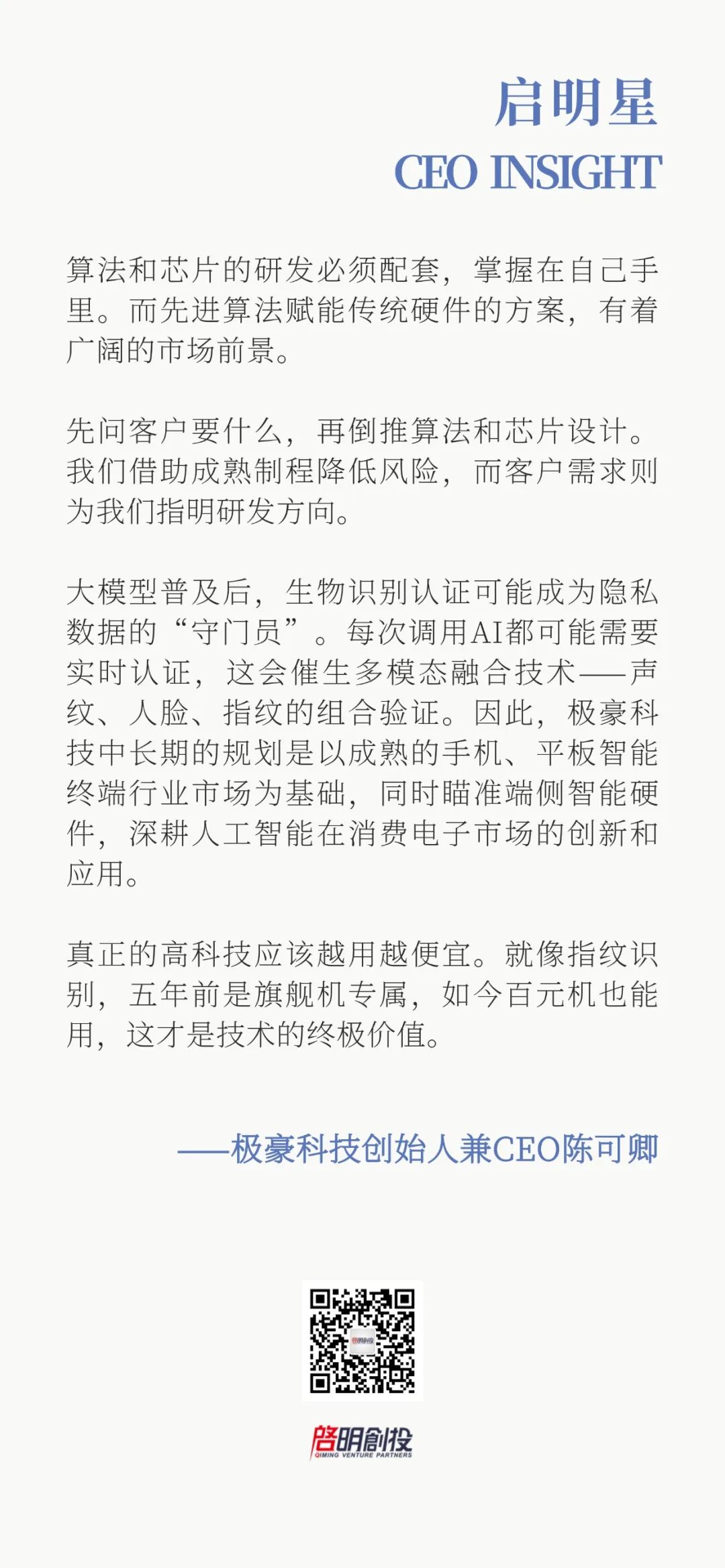
Jihao Technology's medium- to long-term plan builds on the established smartphone and tablet markets while targeting edge-side intelligent hardware, with a deep focus on innovating and applying AI in the consumer electronics market.

Editor's Note: Recently, Chen Keqing, founder and CEO of Jihoo Technology, a Qiming Venture Partners portfolio company, sat down with Cyzone for an interview. He analyzed Chinese users' demand for fingerprint unlocking and the challenges previously facing under-display fingerprint technology. Based on this, he argued that algorithm and chip R&D must go hand in hand, and that using advanced algorithms to empower traditional hardware holds broad market potential. Chen also shared Jihoo's "demand-oriented" product logic — the company's solutions function like a toolkit from which clients can select the most suitable approach. Looking ahead, Chen said Jihoo's medium-to-long-term plan is to build on its established position in the mature smartphone and tablet market while targeting edge-side intelligent hardware, going deep into AI innovation and applications in the consumer electronics market.
This article is republished with authorization from Qiming Venture Partners' WeChat official account.

Chen Keqing, Founder and CEO of Jihoo Technology
In 2017, global smartphone shipments peaked and then plateaued, sending the industry into a phase of zero-sum competition where upstream supply chains began to solidify. Yet Jihoo Technology, founded in 2020, broke through this red ocean with fingerprint recognition chips and solutions: 140 million chips shipped in 2024, revenue exceeding 400 million yuan, successfully cracking a market defined by high barriers and entrenched incumbents.
The young company's core competitiveness stems from a dual-engine model of "algorithm + chip." Its flagship products are AI sensor chips powered by deep learning algorithms, currently deployed in phones from brands including OPPO, Xiaomi (editor's note: a Qiming Venture Partners portfolio company), and HONOR.
How did Jihoo Technology manage to break through the red ocean and achieve such rapid growth?
01/
"Algorithm + Chip"
A Brand New Market
To understand Jihoo Technology, start with its founder and CEO, Chen Keqing.
Born in 1991 in Shaoxing, Zhejiang, Chen won a gold medal in the National Olympiad in Informatics during high school and was admitted to Tsinghua University to study computer science.
He went on to lead the face unlock features for the vivo X20 and Xiaomi 6, and spearheaded the OPPO Find X as the first Android phone with mass-produced 3D structured light technology.
This experience gave Chen sharp insight into a critical tension: despite the iPhone X popularizing face recognition, Chinese users' attachment to "press-type" fingerprint unlocking never faded — a habit that kept fingerprint unlock dominant domestically. A 2025 data report shows fingerprint recognition still commands over 90% market share in China's smartphone market.
Through conversations with downstream chip supply chain partners, Chen gradually realized that optimizing algorithms alone had hit a ceiling for fingerprint recognition. Under-display fingerprinting must capture images in harsh conditions where screen light transmittance is below 2%; without mastery of sensor and optical path design, there was no way to achieve breakthroughs at the architectural level — no matter how powerful the algorithm.
Chen recognized that algorithm and chip R&D had to be integrated and kept in-house. And the approach of using advanced algorithms to empower traditional hardware had vast market potential. In 2019, he founded Jihoo Technology.
02/
Demand-Driven R&D
Locking Onto Customer Pain Points
"First ask what the customer wants, then reverse-engineer the algorithm and chip design." This mindset came from early hard lessons. Chen had once been seduced by technical sophistication and launched a product that bombed in the market. "No matter how cool the tech, if users can't use it smoothly, it's a fake product. If users find it difficult, the highest technology is worth zero." Chen distilled Jihoo's product logic as "demand-oriented."
Jihoo's under-display optical fingerprint chips, which Chen calls "the ultimate aggregator of granular problem-solving," target scenarios previously ignored: wet or dusty fingers, tempered glass screen protectors, naturally sweaty hands. These became the breakthrough points for Jihoo's technical iteration. Jihoo's self-developed JFinger Solution™ algorithm uses generative AI to simulate millions of edge-case scenarios for model training, paired with a customized chip on a mature 55nm process node, boosting complex-environment recognition rates by over 2x and driving the false acceptance rate down to 0.0002%. Meanwhile, Jihoo's optical fingerprint chips employ a unique optical path design that precisely captures fingerprint texture even at just 1.5% screen light transmittance, with AI algorithms real-time filling in missing image data — achieving deep hardware-software synergy.
"The chip is where algorithmic data processing originates; the two must fit together seamlessly," Chen said, echoing his earlier point that algorithms and chips must be developed as a matched set.
Beyond technology, Chen credits a "mature supply chain + demand-driven" synergistic effect.
"We leverage mature process nodes to reduce risk, while customer demand points us toward R&D direction," Chen noted. When foldable phones rose to prominence, their widespread use of OLED flexible screens — backed by metal support plates with poor light transmittance — made optical fingerprint solutions unworkable. Jihoo adapted swiftly, rolling out an ultra-thin side-mounted fingerprint solution for devices under 9mm thick, demonstrating formidable responsiveness.
In 2023, OPPO launched the foldable Find N3 equipped with Jihoo's side-mounted capacitive fingerprint chip JV0103, making it the industry's first flagship with a side cover plate fingerprint solution. Unlike traditional side-mounted fingerprint approaches, the cover plate module integrates the recognition sensor into a panel matching the phone's color, offering glossy finish, easy color matching, and seamless aesthetic integration with the phone's design language — all while maintaining convenient unlocking. This also demanded higher performance from the chip in sensitivity, anti-interference, and low-quality image processing.
Beyond that, OPPO's Reno8 Pro+ carried the JV0301, and HONOR's foldable flagship Magic V2 used Jihoo's side-mounted capacitive fingerprint chip JV0104. In spring 2025, OPPO released the thinnest foldable phone on the market to date, the Find N5, also equipped with Jihoo fingerprint chips.
"Whether pursuing extreme thinness or demanding strict unlock speed and accuracy, we can provide the corresponding solution," Chen said. Jihoo's product solutions function like a toolkit — clients can choose the most suitable tool path.
03/
Targeting Edge-Side Intelligent Hardware
A Larger Market
Smartphone makers are Chen's anchor market. "With 1.2 billion phones shipped globally each year, semiconductors are a scale business — we must hold this ground." He revealed that Jihoo's under-display fingerprint chips have entered Samsung's supply chain, while a "follow the customer overseas" strategy is pushing Jihoo's products into Southeast Asian and Middle Eastern markets. In 2024, Jihoo shipped 140 million chips, generated over 400 million yuan in revenue, and covered all top-tier Chinese phone makers.
But Chen's ambitions stretch far further. As the variety of information-accessing terminals expands — AR/VR devices, smart glasses, action cameras — identity recognition and authentication needs are rising. "A few million units annually makes a quality segment," Chen said. Next-generation fingerprint chips could be compressed further in size, even embedded into glasses temples. "Or maybe it won't be fingerprint at all — perhaps a blink will unlock."
The bigger variable, however, is AI.
According to a Dongxing Securities research report, edge AI technology — deploying AI algorithms and compute directly on edge devices — has already seen wide adoption in laptops, phones, wearables, smart home, and security devices. Upstream in the supply chain, ultra-compact low-power AI sensors are drawing increasing attention, and biometric technology stands to ride rapid penetration of these devices for substantial growth. Chen predicts that as large models proliferate, biometric authentication could become the "gatekeeper" of private data. "Every AI invocation may require real-time authentication, which will drive multimodal fusion technology — combined verification of voiceprint, face, and fingerprint."
Thus, Jihoo's medium-to-long-term plan is to build on its established position in the mature smartphone and tablet market while targeting edge-side intelligent hardware, going deep into AI innovation and applications in the consumer electronics market.
"Truly advanced technology should get cheaper the more it's used." In Chen's view, good technology and products must sell to generate returns, and Jihoo's mission is to make technology increasingly accessible. "Just like fingerprint recognition — five years ago it was flagship-exclusive, now even 100-yuan phones have it. That's the ultimate value of technology."
Source | Cyzone Author | Bu Song Editor | Liu Hengtao
PAST REVIEWS

Founded in 2006, Qiming Venture Partners currently manages 11 USD funds and 7 RMB funds, with total assets under management reaching $9.5 billion. Since inception, the firm has focused on investing in early and growth-stage outstanding companies in Technology and Consumer (T&C) and Healthcare sectors.
To date, Qiming Venture Partners has invested in over 580 high-growth innovative companies, with more than 210 exiting through listings on the NYSE, NASDAQ, Hong Kong Exchanges and Clearing Limited, Shanghai Stock Exchange, and Shenzhen Stock Exchange, or through M&A and other means. Over 80 portfolio companies have become recognized unicorns or super-unicorns.
Many Qiming Venture Partners portfolio companies have grown into the most influential players in their respective fields, including Xiaomi (01810.HK), Meituan (03690.HK), Bilibili (NASDAQ:BILI, 09626.HK), Zhihu (NYSE:ZH, 02390.HK), Roborock (688169.SH), UBTECH (09880.HK), WeRide (NASDAQ:WRD), Gan & Lee Pharmaceuticals (603087.SH), Tigermed (300347.SZ, 03347.HK), Zai Lab (NASDAQ:ZLAB, 09688.HK), CanSino Biologics (688185.SH, 06185.HK), Schrödinger (NASDAQ:SDGR), MicroPort EP MedTech (688617.SH), New Horizon Health (06606.HK), Sanyou Medical (688085.SH), Amoy Diagnostics (300685.SZ), Berry Genomics (000710.SZ), Genrix Bio (688520.SH), Yuanxin Technology, ClinChoice, Belief BioMed, Biren Technology, and others.