Qiming Star | Tashi Zhihang's Yilun Chen: Third Attempt at a Trillion-Dollar Track
We're not afraid of failure at all, but we want to move fast and generate a lot of original, self-driven solutions and ideas.

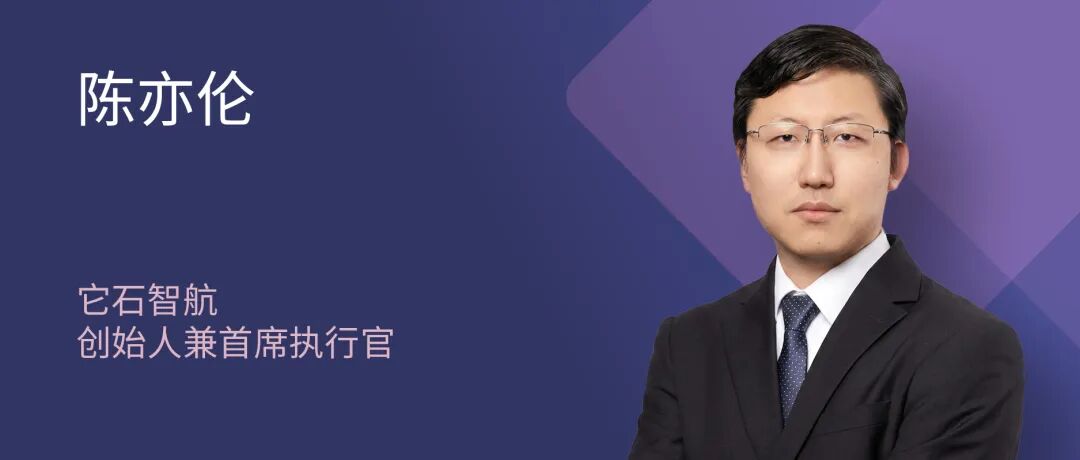
Editor's Note: Driven by a lifelong passion for robotics, Yilun Chen, founder and CEO of Tashi Zhihang, has consistently operated in "founder mode" on journeys from zero to one — from serving as chief engineer of machine vision at DJI, to leading the full-stack R&D of Huawei's first-generation autonomous driving system ADS 1.0, to establishing the innovation center at Tsinghua University's Institute for AI Industry Research (AIR) to explore the frontiers of robotics. He has repeatedly achieved breakthroughs in core domains, living by the philosophy: "We don't mind failure at all, but we want to move fast and produce original, self-driven solutions and ideas." As 2026 approaches — a critical year for robot mass production — Tashi Zhihang is pushing toward commercialization at a pace exceeding industry norms, determined to build robots that create real value. On April 16, Tashi Zhihang announced it had raised over $450 million in a Pre-A round, setting a record for the largest single funding round in China's embodied AI history. This article presents a conversation between China Entrepreneur magazine and Chen on February 26, 2026, dissecting his team's DNA, technical approach, and commercialization strategy, showcasing the original capabilities and long-term commitment of a Chinese embodied AI enterprise. Alex Zhou, managing partner at Qiming Venture Partners, stated: After deeply positioning itself in the embodied AI sector, Qiming chose to invest in Tashi Zhihang based on the scarce combination of team capabilities and its pragmatic choice of technical route. In Zhou's view, Tashi Zhihang remains in early R&D stages, yet has already exceeded investor expectations in many areas.
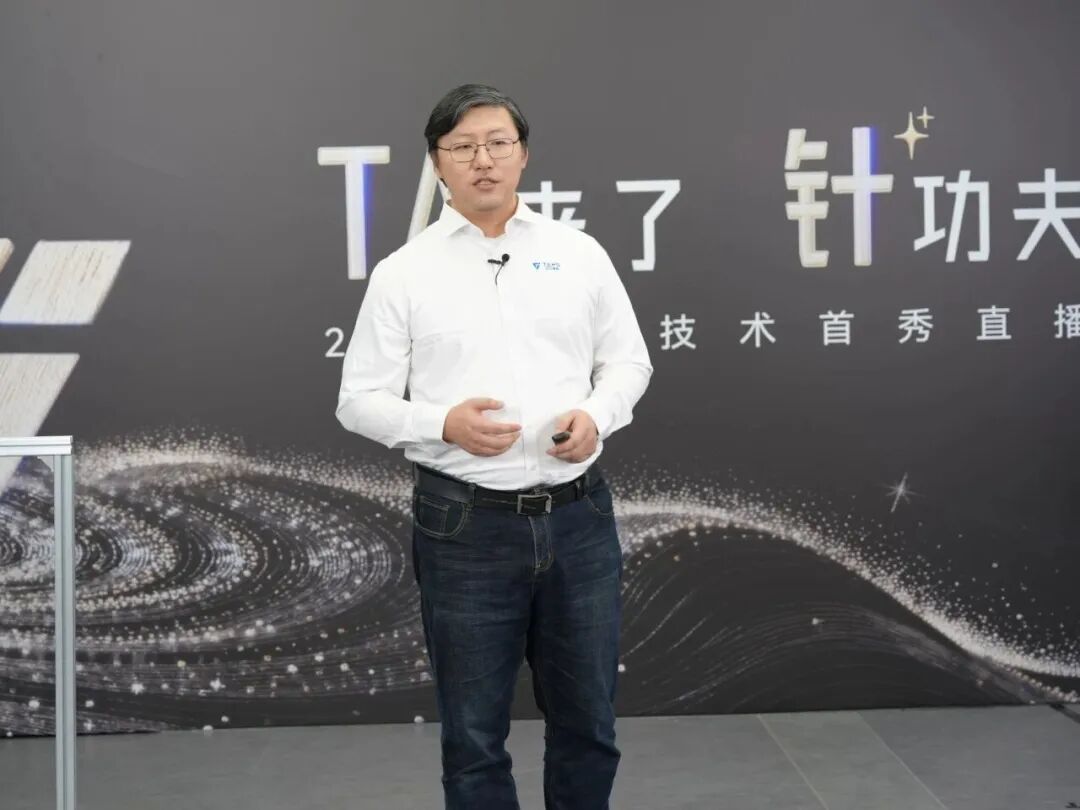
In Tashi Zhihang's largest conference room, a whiteboard covers an entire wall. As CEO, Chen has a habit: when discussions go deep, he loves to scribble formulas on it.
This habit didn't change during fundraising. When conducting its angel+ round, Chen spent an entire afternoon writing on the whiteboard to answer Meituan's investment team on technical details.
Chen describes his state with a Silicon Valley-esque term — "founder mode": full of passion, running at full throttle, with a flat organizational structure. "I deeply enjoy this zero-to-one process," he says.
In fact, Chen has personally experienced "zero to one" multiple times. In 2017, he served as chief engineer of machine vision at DJI. He later joined Huawei as chief scientist of the Intelligent Automotive Solution BU, building from scratch the full-stack R&D of Huawei's first-generation autonomous driving system ADS 1.0. He then established the AIRIC (AIR Innovation Center) at Tsinghua University's Institute for AI Industry Research, working with his team to deeply explore the technological frontiers of robotics.
He has been fascinated by robots since childhood. During his PhD studies in 2007, Boston Dynamics released a video of a robot dog walking on ice. He thought, "This is amazing," and the idea of building robots took root. After completing his doctorate, armed with the conviction that he "must build the robot in my imagination," he joined a renowned electromechanical systems company, learning how to better drive robots using motors, servo controls, and hydraulic systems. But for someone with an algorithms research background, simple programs were insufficient to create his ideal robot. The technology of that era wasn't ready for the age of robotics — until a series of breakthroughs emerged around 2022.
That year, several key changes converged: the explosion of GPT; quadruped robot dogs achieving gait control through neural networks; and breakthrough progress across the three traditional pillars of robotics — motion planning, motion control, and end-to-end algorithms. Most importantly, Chen had personally unlocked and validated the success and enormous potential of end-to-end algorithms in autonomous driving, which would become the most important dawn for making general-purpose robots commercially viable. "Technological progress reveals tremendous prospects, but there's a natural chasm between technology and entrepreneurship," Chen says.
So he chose to return to his alma mater, Tsinghua University, to teach while contemplating how to bridge frontier technology with industrial development.
By late 2024, Chen — armed with "answers" — prepared to start his company. He assembled a team with Zhenyu Li, former head of Baidu's autonomous driving business group, and Wenchao Ding, a Huawei "Genius Youth" recruit, formally establishing Tashi Zhihang in February 2025. Less than six months after founding, Tashi Zhihang completed $242 million in angel series funding, setting a record for the largest angel round in China's embodied AI sector to date, with investors including Qiming Venture Partners.
Alex Zhou, managing partner at Qiming Venture Partners, stated that before engaging with Tashi Zhihang, Qiming had already invested in multiple quality companies in the embodied AI and robotics sectors and conducted in-depth exchanges with twenty to thirty founding teams. The decision to invest in Tashi Zhihang rested on two key judgments.
First, the scarce combination of team capabilities. In Zhou's view, Tashi Zhihang's team uniquely combines three capabilities: hands-on mass-production engineering experience from the front lines of physical AI, frontier academic technical vision, and mature management and commercialization skills. Only this combination can truly navigate the long-term commercialization of robotics, a trillion-dollar mega-sector.
Second, the pragmatic choice of technical route. Rather than blindly following the VLA model's general-purpose approach, Tashi Zhihang zeroed in on the core pain point of data collection, delivering a pragmatic full-chain solution for low-cost real-world data acquisition instead of pure technical abstraction.
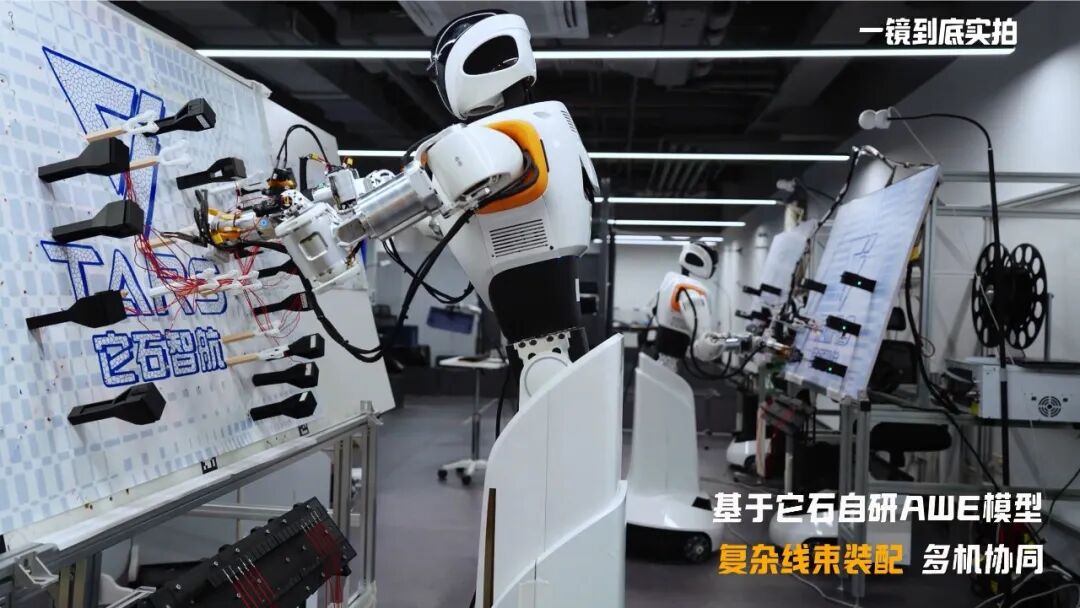
In Zhou's assessment, despite being merely a year old and still in early R&D stages, Tashi Zhihang has already exceeded investor expectations in many respects. In less than a year, the company launched two hardware products — bipedal and wheeled-legged — released a human data collection hardware solution and open-sourced portions of its dataset globally, developed a proprietary high-DOF dexterous hand, trained its own end-to-end world model, and initially ran through complete operational workflows for wire harness manufacturing. "This speed far exceeds the vast majority of companies in the market," Zhou said.
Chen believes that robotics' Scaling Law moment will likely arrive in 2026, and Tashi Zhihang will push for mass production and commercialization that year.
The following is an edited selection of the conversation, republished with authorization from Qiming Venture Partners' WeChat account.
01 Starting Anew
China Entrepreneur: After leaving Huawei in 2022, you went to teach at Tsinghua University's Institute for AI Industry Research. What preparations did you make before entrepreneurship?
Yilun Chen: I made several technical judgments and reflections at that time.
First, I believe that AI deployed at significant scale generally goes through three phases: cracking the data challenge; cracking the algorithm and compute challenge; and cracking the scenario-based interactive iteration challenge. AI is essentially a compression of data mapping — it's a function mapping one set of data to another. No data, no AI. Large language models were fortunate to have abundant internet data. The autonomous driving industry lacked data even in 2019. More forward-looking companies, such as Tesla, began seriously considering around 2019: how much data is needed to train an extremely powerful network, where does that data come from, and how to make data "living data" that continuously participates in product iteration — questions that AI must think through clearly. Robotics is the same. From 2022 to 2025, everyone was thinking about how to obtain robot data. Initially, people considered the simplest approach: using exoskeletons to teleoperate robots like puppeteers. Whether this is the best approach and whether it can meet expectations requires thought. I had a different way of thinking. First, data volume. Autonomous driving requires 100,000 to 1 million hours — 100,000 hours represents the threshold for product-grade iteration; below that, it's research-grade iteration. One million hours is the current best-in-class level, achieved by a few top companies. Robotics will need at least 10x that of autonomous driving, because tasks are more complex. If robots need 1 million to 10 million hours, how should that data be acquired? Second, algorithms. Mainstream AI algorithms have diverse architectures. Only with the correct algorithm does stacking compute become effective. Robotics and autonomous driving are very similar, collectively termed "physical world AI" — they process essentially physical quantities: time, space, state of existence, force and feedback. When designing algorithms, for neural networks, the core is determining where neurons are located — more on the retina, in physical space, or elsewhere. These require careful deliberation. Academics have academic perspectives; industry has industry judgments. One must weigh these and form one's own understanding. Third, and most central to entrepreneurship, is thinking through several simple but critical questions: what problem do you want to solve? Where is user demand? Why solve this problem? How urgent is this need — is it a big problem or small problem, and is it solvable with current technology? One must also clarify corporate vision: do you want to build a small but beautiful company, or one with a chance to enter the main channel? Different visions correspond to different development models, paces, and organizational capabilities — all requiring thought.
China Entrepreneur: When did you fully commit to leaving and building your team?
Yilun Chen: I felt that the second half of 2024 was actually a downturn for robotics industry fundraising. After the 2025 Spring Festival, with DeepSeek's release and progress from other robotics companies, confidence in AI suddenly surged and trends reversed upward. When we chose to fundraise, conditions weren't necessarily favorable. But we felt we had thought things through internally, so we could begin.
China Entrepreneur: Did you encounter many difficulties in your first funding round?
Yilun Chen: It was actually okay. I prefer to treat fundraising as a process of sharing one's aspirations or dreams. I express very faithfully to investors what we want to do, how we think it should be done, and why we believe this approach could succeed. All our progress and everything we've done to date matches exactly what I wrote in my first pitch deck — not a single change.
China Entrepreneur: What were investors most curious about when you went fundraising?
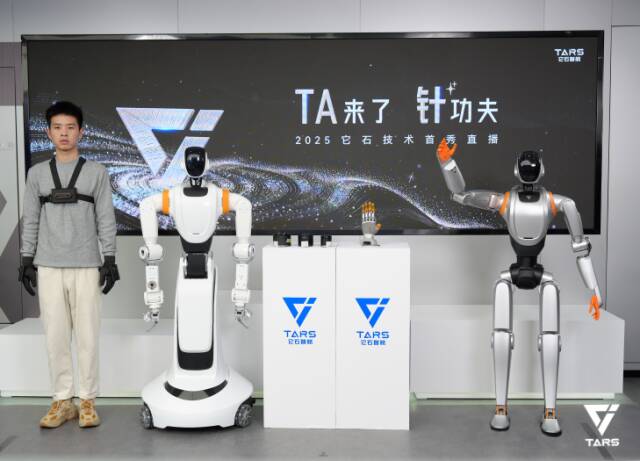
Yilun Chen: At the time we named the company Tashi Zhihang, investors thought we were doing autonomous driving again. I said, no, no, no — not autonomous driving, already did that, not doing it again. "Tashi" derives from the English TARS, alluding to "stones from other hills"; TARS is a character from the renowned film Interstellar. "Zhihang" refers to space navigation, not autonomous driving. We spent some time explaining that we don't do autonomous driving — we focus on robotics. As an emerging industry, embodied AI must undergo a process from proliferation to convergence, so sophisticated investors tend to ask extremely detailed questions. I believe the core is still thinking through fundamental questions clearly: what problem to solve, how impactful is this problem, what method to use, and why this method can work.
China Entrepreneur: What do you consider the most critical thing you've done this year?
Yilun Chen: What we're doing aligns completely with our understanding before starting this company. The key judgments we made at the end of 2024 have all proven accurate. And it's not just us anymore — the entire industry is moving in this direction. Take a simple example: from the start, we were clear about taking a human-centric perspective. Now you see "Human Centric" being cited everywhere. Beyond that, the industry's understanding of scaling laws for embodied AI has also converged exactly with what we believed at the time. Customers tell us that the wiring harness scenario is like "Goldbach's conjecture" for them — everyone knows it's extraordinarily difficult and would be enormously impactful if solved, but everyone questions whether we can actually do it, whether our approach can work. Looking at where we are today, our progress has been very smooth, and the entire timeline matches our earlier predictions very closely.
I've always liked talking about the concept of "super products." Actually, there aren't that many candidates that qualify. Smartphones, computers, intelligent vehicles, and intelligent robots all count. Generally, a super product takes a form close to general-purpose hardware that can be continually endowed with various software capabilities, and AI can accelerate the monetization of those software features. For super products, especially in early development, you need to do three things simultaneously: general-purpose hardware, very powerful AI, and a killer application. Once these three get spinning, the super product grows very fast. Multiply them together and you get a multiplicative effect. If any one of them fails and drops to zero, the whole thing collapses.
China Entrepreneur: What do you discuss most with investors now?
Yilun Chen: I believe both the industry and the technology are evolving rapidly. Looking at technological change alone — I was talking with Alex (Alex Zhou) earlier about "inflection points" or "exponential growth" — and I was thinking: what counts as exponential growth? There's actually a very intuitive way to judge it. If the ratio of your year-over-year change to last year's data consistently exceeds 1, or even 1.1, that's classic exponential growth. From this perspective, I'm quite certain that (in the robotics industry) the annual change magnitude definitely exceeds 1. From 2024 to 2025, 2025 to 2026, and on to 2027, I don't see any signs of technological slowdown. The technology will only accelerate. Against this backdrop of rapid evolution, where the industry is heading and which nodes will become critical are questions everyone cares deeply about. This is also what I frequently discuss with investors.
02 Conquering Scenarios
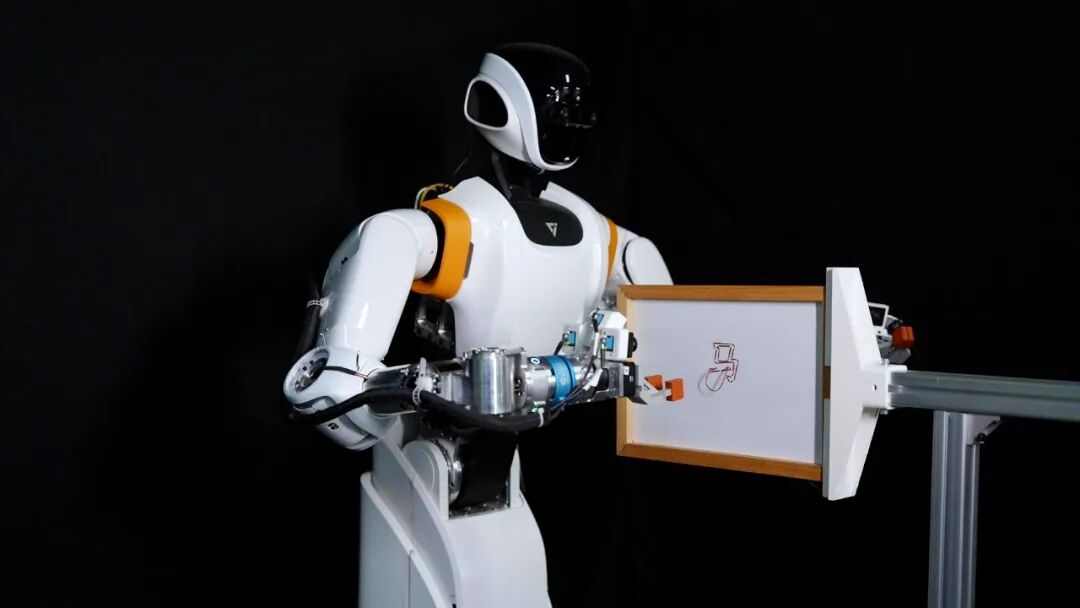
China Entrepreneur: In your December 2025 livestream, you demonstrated robot "embroidery." Why did you choose to showcase it that way? What industrial applications can it serve?
Yilun Chen: I genuinely want to solve the industrial wiring harness problem from the bottom of my heart. The earliest robots originated in the automotive industry. Back in the 1970s and 80s, when there weren't even computers or programmers, robot manufacturers like ABB invented industrial robotic arms to solve automotive spray painting. Based on that technology, they then solved body welding and assembly.
Wiring harnesses represent the fourth major category in automotive — and the one that has remained unsolved by automation for years. The difficulty lies entirely in algorithms. This is a fundamental manufacturing problem, but many people don't know about it, so we externalized our capabilities into something people can feel and understand — embroidery. It manipulates extremely soft materials with great precision, over long sequences, with complexity, requiring bimanual coordination and dexterous manipulation. The methodology is the same.
China Entrepreneur: What scenarios can this capability apply to? What challenges did you overcome to make it work stably in industrial settings?
Yilun Chen: Whether in industry or the home, executing complex tasks requires robots to be usable and stable. From a technical standpoint, this usability isn't actually limited by electromechanical capability. In fact, most robotic electromechanical systems already far exceed humans — they can move faster and more precisely, without fatigue.
Usability is largely determined by algorithms. Sometimes when you see robots moving slowly and jerkily in videos, it's the algorithms constraining overall performance. So our goal from the start was clear: robots must be capable of outperforming humans. What does "better" mean? Faster, more precise, and higher success rates — these three are actually the most朴素, most classic standards in robotics.
But if you truly use these three goals to drive technology development, you'll find that the entire algorithm design, architecture, innovation points, and focus areas become completely different — each link connecting to the next.
Second is stability. The process of converging a flawed, unstable system toward stability is itself the most valuable thing. This process constitutes a methodology. If you've developed complex, large-scale systems before, you know how to apply this methodology to gradually bring systems under control, moving from uncertainty to stability. This is something we're quite good at.
China Entrepreneur: What level or performance will your system reach in 2026?
Yilun Chen: Generally there's a baseline level (similar to autonomous driving deployment), and this baseline needs to reach a fairly good state. Along the way you continuously improve capability — simply put, it's the 9s after the decimal point. Each additional 9 is a milestone.
We're mainly focused on three things: our solution robot can genuinely solve this problem; this robot is actually creating value all day long; and the value created is accepted, appreciated, and understood by users.
Once you reach that point, I believe sales volume, supply volume — these become natural consequences.
China Entrepreneur: What challenges does stable delivery face? How do you avoid pitfalls?
Yilun Chen: What we care about most is whether delivery creates actual value. So our robots must be working every single second. This means ensuring both that the robot hardware doesn't fail and that the model itself doesn't fail.
For this generation of robots, we have a clear internal definition: it's a mobile pair of hands.
Whether carried by bipedal legs, wheels, or whatever else, this definition doesn't change.
This form has significant advantages for swarm operations. When one robot fails, it can exit and another takes its place. Previous automation equipment was different — if one component in a complex machine broke, the entire machine stopped, requiring specialized personnel to disassemble, repair, and recalibrate.
Take the logistics industry as an example. In the early days of AGV carts, the system's redundancy was extremely high. One cart breaks, it exits, another cart follows — overall operations unaffected.
Mobile robot swarm operations follow this same organizational management form, largely mitigating the impact of individual failures. Moreover, failure data enters a closed loop, flows through the system, and in turn drives continuous iterative improvement of the entire model, algorithms, and system.
China Entrepreneur: What's your commercialization plan? Are you going after large enterprise orders?
Yilun Chen: Overall, every problem we're targeting represents a large commercial opportunity — there are no small ones. This is why we chose wiring harnesses as our entry point from the start.
When we initially selected our problem, we eliminated relatively granular commercial opportunities. We had three selection criteria: first, the pain point must be extremely painful; second, there must be market space — simply put, the granularity must be very large; third, there must be barriers to entry.
Based on these three points, we felt manufacturing was a good entry point. I'm very familiar with this industry and roughly know which demands are urgent and feasible, and which can be addressed through other segments.
China Entrepreneur: Many robotics companies are now focusing more on overseas markets, especially European manufacturing. What are your plans for going global?
Yilun Chen: In China, any problem that could be solved by previous-generation automation equipment has basically already been solved. Yet across the entire industrial manufacturing domain, labor remains extremely scarce. This shows that everything solvable with previous-generation technology has been solved, but demand still exists — and it's massive. This is precisely the call for next-generation form factors and next-generation technology. Because current work is being done by humans in various ways, humanoid form factors will definitely work.
The essential difference between this generation and the previous one still lies in algorithms.
We joke that previous-generation automation equipment was like replacing "small cars" with "small trains" — tracks, motions, space were all designed in advance. The hardware was extremely complex, the software very simple.
This generation of robots takes exactly the opposite approach: make hardware as standardized as possible, make software as advanced as possible — completely different paths. We're already seeing that this generation's potential is actually far greater.
We've always insisted on product and R&D design from the user perspective. I myself was once a user of large-scale automation equipment, so I understand clearly: the core is whether your product technology is competitive. Labor cost, operational efficiency — these have been key product design metrics from the very beginning.
There was indeed a situation in the past where the value generated by equipment didn't match its cost, so to promote sales, you'd specifically target places with high labor costs. I don't think this is contradictory: you can absolutely build excellent products while also making the economics work for users. These two things should be done together.
As for overseas markets, I've noticed an interesting phenomenon. In places like the United States, many companies and important figures place greater emphasis on robots for production processes. Because the US wants manufacturing to reshore, but its social structure and demographic structure simply don't support this — it's a massive contradiction. They're counting on this wave of AI technology to help.
And I hold a firm belief: before this generation of robots, there is no such thing as so-called low-end manufacturing anymore. As long as the technology and problems are properly addressed, all manufacturing can be high-end manufacturing.
As for Southeast Asia, while many companies are expanding there, why do so many excellent manufacturing operations remain in China? There are many reasons — for instance, supply chain coordination is excellent, Chinese management capabilities and craftsmanship levels remain leading, and now it's not just about price but increasingly about quality.
So the drivers for robotics adoption in manufacturing are diverse, but the core remains high efficiency, high success rates, and high accuracy. Do these three well, and you can make the economics work anywhere.
Data Innovation
China Entrepreneur: You also released a data collection glove. How was it designed? It's different from other companies' data collection solutions — have you faced skepticism from others, especially investors?
Yilun Chen: Our data glove, including the entire data collection solution, was on the pitch deck for our first funding round. To this day, the solution hasn't changed — we've executed it faithfully and even accelerated it.
Investors ask extremely detailed technical questions. Before 2025, there was heavy focus on data, with teleoperation and exoskeletons receiving considerable attention.
I believe industry-relevant data needs to follow several principles: First, you need 10 million hours. Second, it must be real-world scenarios.
China Entrepreneur: You don't believe in simulation data?
Yilun Chen: This is my personal view, because often it's a process of elimination. I have a basic line of reasoning: autonomous driving is a subset of embodied AI, a sub-problem.
If simulation data doesn't work for autonomous driving, it probably won't work for embodied AI. Because if a method can't solve a sub-problem, there's no way it can solve a super-problem.
I seriously tried simulation data in autonomous driving. I once had an excellent simulation team render all of Shanghai for me. Take a road: it starts raining, water pools on the ground; later the wind picks up, snow starts falling — all rendered beautifully, incredibly realistic, but useless.
On real-device teleoperation, when I was at Tsinghua University, I worked with another professor to develop a kind of novel arm specifically to help students with manipulation tasks, but its efficiency was extremely low. A human could do ten things in an hour; it could only do one. And to do that one thing, you had to have a robot sitting right there. This made it very difficult to capture real-world scenarios. Say I want to see how someone makes coffee — the barista is working just fine, and you're going to pair a robot to synchronously operate alongside them? Or in a factory where workers are moving fast, you wheel in a robot to operate, and the entire production line gets disrupted. The total data volume is also completely limited by the robot's physical footprint. Right now this robot can't do anything except collect data — so who's actually going to buy this thing? It works for research, but large-scale deployment is difficult, and the willingness to pay becomes questionable.
I like to borrow thinking from previously successful AI applications. How did autonomous driving and GPT get their data? Autonomous driving may have eight cameras mounted on a car, but fundamentally it's a dashcam, recording your driving data. When algorithms were less sophisticated early on, we even liked installing LiDAR on vehicles, but fundamentally it was also a LiDAR version of a dashcam. If you asked me to redo autonomous driving now, I wouldn't even want dedicated front-facing cameras — just hang a real dashcam up there, that's enough. It records your driving data, human-centric.
Large language models draw from massive amounts of internet data, all typed and written by people themselves. They're also recording your bits of text, your thoughts, your life — everything comes from humans.
The goal for robots is the same: they want to possess human skills, to serve humans. It's about fully and faithfully recording human data, then through a series of algorithms converting it into data that machines can recognize. I think this is a very correct path.
Next comes the question of what data to record. We don't need to record data for every joint — say, the elbow — because the end goal is getting the hand to the right position. What matters is hand pose, hand shape, and contact information. How the intermediate joints move isn't important. Similarly, leg, waist, and body posture may not matter that much either.
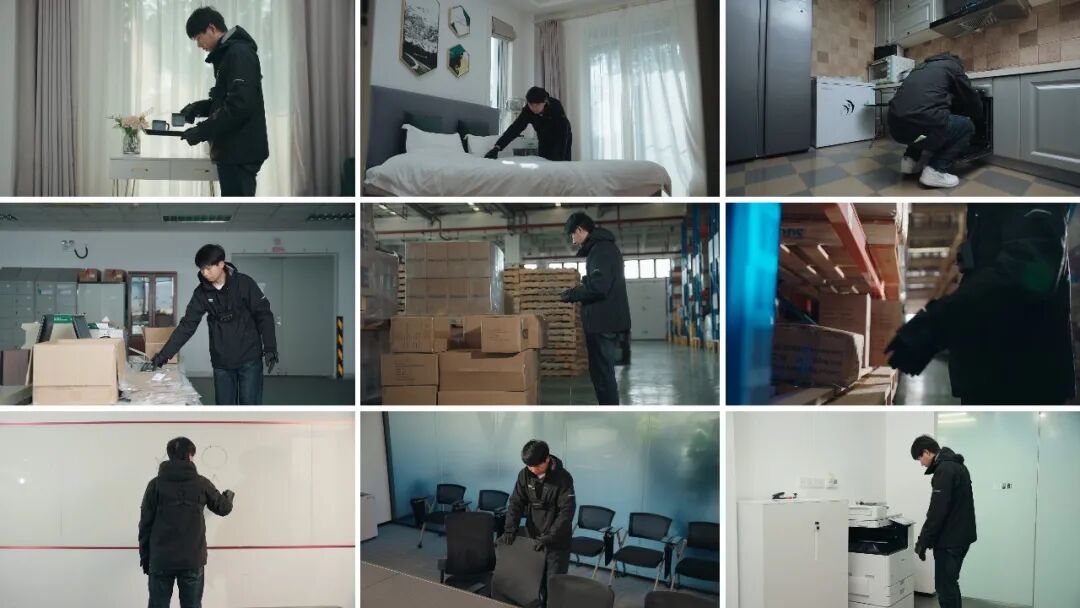
Sense Hub conducting real human data collection across multiple scenarios.
What truly matters are the eyes and hands: the scenes the eyes see, the robot must be able to see; the hands create value, and their position, state, and tactile sensation all need to be recorded. These are all the sensors we use — the goal is to make this system very lightweight.
The difficulty lies in what to do when hands are occluded — say, when making a bed and you can't see them. This requires a complete technical solution.
China Entrepreneur: How did you come up with the glove approach?
Yilun Chen: It came from several observations.
First, recovering finger pose is extremely important. Just like wearing AI glasses where the camera can see your hands — images can only give you 2D position, and the spatial precision isn't enough. We place heavy emphasis on spatial localization.
Second, when hands are occluded — like holding coffee, or reaching into a quilt to make a bed — visual quality degrades, so you need a robust and reliable multi-modal localization solution. Camera sensors on the hands thus become important, and they need to be carried on wristband-like devices.
Third, many application scenarios, including industrial settings, already require wearing gloves, so this became a very natural choice.
China Entrepreneur: For your robots, is a five-finger dexterous hand mandatory?
Yilun Chen: Yes, we're firm advocates of high-degree-of-freedom dexterous hands. Based on extensive human data collection, we've done quantitative assessments: on average, completing tasks with five human fingers is three times more efficient than forcing a gripper to pinch. Some things grippers can't even hold, like a heavier water bottle. A five-finger hand is a sufficient and complete solution — the results are definitely good. We've developed our own dexterous hand as well.
Of course, grippers aren't completely useless. Some industrial scenarios use them — for handling very thin wire harnesses, for example. We'll collect gripper data for these special cases. But broadly speaking, I'd judge the application ratio between dexterous hands and specialized tools like grippers to be about nine to one.
China Entrepreneur: But dexterous hands are currently a problem plaguing the entire industry. Even Tesla can't solve it. Have you considered that this might create difficulties for scenario deployment in the near term?
Yilun Chen: We're not actually worried about this. I think dexterous hands will have two different upward paths.
Elon Musk likes to go straight to the end goal — that's his style. Their dexterous hand is hard to design because it has to do two things simultaneously: first, be extremely flexible, with 21 or more degrees of freedom; second, be very strong and powerful. When you combine these two requirements, you find that Tesla has chosen an extremely, extremely difficult path.
What if you separate these two things? Focus only on dexterity, without requiring so much grip strength, and you'll find there are actually many better solutions. I'm a strong advocate of direct-drive solutions — they're very friendly to AI algorithms, easy to manufacture, and can leverage China's existing supply chain very well. China is already strong at making gears and motors.
In this solution, cost depends on only one thing: when motor and gear suppliers switch to automated production lines. The only reason costs are high now is that they haven't automated yet — they're still using manual production lines.
04/
Organization and Management
China Entrepreneur: How do you allocate your time and energy now?
Yilun Chen: My time allocation falls into two categories: static and dynamic.
Static time is what a company must continuously think about and iterate on: Are we still on the right path? Is the pace right? Do we have enough resources to sustain ourselves? Do we have enough excellent talent? Can the team and organization carry what we want to do? I think about these questions every day.
Dynamic time is the daily state of founder mode. You need to be extremely sharp at capturing the most important few things for the company each day, each week — these things change dynamically. If you can anticipate what's coming next, even better. Then I personally drive these most important things. Because from a founder mode perspective, when I push on them, it's often the most effective, fastest, and feels best for everyone.
China Entrepreneur: How much time do you spend on fundraising?
Yilun Chen: For a company, capital is the ammunition for battle. Whether it's fundraising or our commercial revenue, these are equally important — or even the most important — things for the company. These matters are constantly on my mind.
China Entrepreneur: What methodology do you have for communicating with and managing your team?
Yilun Chen: I generally divide this into two levels.
When I built an autonomous driving team from zero to one at my previous company, I consistently adhered to an elite-troops strategy. I strongly identify with Tesla's approach — their autonomous driving team never exceeded 200 people from start to finish. I believe around 200 people is a critical scale inflection point for high-density technical teams. Beyond this number, management approaches need to be adjusted in phases.
For me, the most comfortable state is leading an excellent technical team at this scale, advancing rapidly like a sharp knife. At this size, I can understand each person's working state and anticipate when they might need my help — this is a habit I've developed over many years.
The period of fastest autonomous driving progress at my previous company was also when the team was under 300 people. At that time, we could basically push the progress bar to 80%, 90%. That's the zero-to-one rhythm.
But productization versus delivery and stability operates on a different logic. First you need to "quickly get things right," then "avoid getting things wrong" — two different methodologies.
Process methodologies like IPD are essentially tools to prevent mistakes, suitable for the scaling phase. While every company has its own development processes, I've found that true masters "capture the spirit, not the form." IPD is like a legal code — once you understand the thinking behind each provision, you can flexibly deploy the right tools according to your current state.
China Entrepreneur: What details do you and your team often discuss?
Yilun Chen: I often work through formulas on whiteboards. I'll directly look at a particular chip on a circuit board, even how to tune a power amplifier's gain. I'll also carefully examine motor design, how to make cogging torque extremely small. Because I previously managed manufacturing myself, I also care about how something gets manufactured after we design it.
China Entrepreneur: So you participate in employees' technical discussions, even showing up unexpectedly during their conversations?
Yilun Chen: Actually, many discussions they like to invite me to. In many technical people's eyes, I'm a very good technical expert. Often I can very effectively help them advance quickly, and they're even happier about it.
I have a dynamic priority list. I know at what time, on which matters, people will face difficult technical challenges that need to be cracked. I'll actively pick my moments to step in and see if I can help push things forward. So far it's working out pretty well.
China Entrepreneur: In daily management, are you an encouraging type of "boss"?
Yilun Chen: Yes, I'm very clear that I'm the encouraging type. We often like to say: much of innovation comes from the persistent pursuit of truth.
Because you're constantly exploring new things, often what you see isn't the truth. Sometimes I'll join everyone in investigating the truth, seeing if we can successfully "solve the case." The process of "solving the case" is itself a very good thing.
Second, I often tell our team: our working principle is to allow failure, or rather we completely don't mind failure, but we want to advance quickly and be able to produce many solutions and ideas more originally and self-driven.
China Entrepreneur: This sets very high demands for talent. High-end talent across the entire industry is relatively scarce. For your core people, do you tend toward cultivating them yourselves or building a corresponding recruitment system?
Yilun Chen: Every single person we hire, I personally sit down and talk with. Talent is our most important priority. For a high-tech company, talent and organizational approach are the core competitive moat. Figuring out how to bring together exceptional people and get them to perform at their best — driving forward with genuine self-motivation — is itself a fascinating challenge.
I used to read wuxia novels where masters could recognize each other without ever crossing swords. That feeling is real. Sometimes you meet someone and just sense they're exceptional. You talk, and even if they're from a completely different field, you can feel that energy. We're intensely hungry for this kind of extreme talent, regardless of background or pedigree.
What I've observed is that these people share one trait: they genuinely love what they do, and they continuously derive positive feedback from the work itself. With that foundation, they keep learning, keep pushing forward, keep producing better work. That's what we value most.
China Entrepreneur: How do you find people like this?
Yilun Chen: Top-tier talent is extraordinarily rare — you can't manufacture encounters with them. There are some basic principles for discovering them.
As the saying goes, excellent people tend to cluster together. Starting from one exceptional person, we look for others they respect and endorse. This dramatically raises the probability of finding talent, and the mutual recognition tends to run deeper.
Second, since robotics and embodied AI are relatively new fields, we're not particularly fixated on whether someone has directly relevant experience. Even if they've worked in an entirely different domain, if they have strong work to show and a sound way of working, we believe that if they maintain that drive and passion, they'll achieve tremendous results in this field too.
We used to think we won battles because we assembled a group of "heroes." But in reality, it's probably that we gathered like-minded people who won the battle together, and in doing so, they became heroes.
China Entrepreneur: Do you cultivate young people internally, like DeepSeek does?
Yilun Chen: Yes. What's most impressive about DeepSeek is knowing how to bring together exceptional people to accomplish something remarkable, and to keep them growing alongside the organization continuously.
China Entrepreneur: What are your expectations or plans for the company's future development?
Yilun Chen: I'm committed to building useful robots. I need this robot to continuously create value, to help me do my job well. With robots augmenting everyone, people become superhuman.
Source | China Entrepreneur Reporter | Kong Yuexin Editor | Ma Jiying
Past Highlights
Qiming Portfolio | Tashi Zhihang Releases WIYH, the World's First Scalable Real-World Embodied Multimodal Dataset Dialogue | Qiming Venture Partners' Alex Zhou in Conversation with Yilun Chen of Tashi Zhihang and Wenbin Tang of Yuanli Lingji: Macro Consensus and Micro Non-Consensus on Embodied AI Qiming Perspectives | Three AI IPOs to Start the Year: Qiming Venture Partners' Alex Zhou on Following Power Laws and Firmly Betting on Technology Targets in Long Slopes and Large Tracks

Founded in 2006, Qiming Venture Partners currently manages 11 USD funds and 7 RMB funds, with total assets under management reaching $9.5 billion. Since its inception, the firm has focused on investing in outstanding early and growth-stage companies in Technology and Healthcare innovation.
To date, Qiming Venture Partners has invested in over 580 high-growth innovative companies, of which more than 210 have listed on the New York Stock Exchange, NASDAQ, Hong Kong Exchanges and Clearing Limited, Shanghai Stock Exchange, and Shenzhen Stock Exchange, or exited through M&A and other means. Over 80 portfolio companies have become recognized unicorns or super-unicorns.
Many Qiming Venture Partners portfolio companies have grown into the most influential players in their respective fields, including Xiaomi (01810.HK), Meituan (03690.HK), Bilibili (NASDAQ:BILI, 09626.HK), Zhihu (NYSE:ZH, 02390.HK), Roborock (688169.SH), Hesai Technology (NASDAQ:HSAI, 02525.HK), UBTECH (09880.HK), WeRide (NASDAQ:WRD, 0800.HK), HyperStrong (688411.SH), Insta360 (688775.SH), Unisound (09678.HK), Biren Technology (06082.HK), Zhipu (02513.HK), Gan & Lee Pharmaceuticals (603087.SH), Tigermed (300347.SZ, 03347.HK), Zai Lab (NASDAQ:ZLAB, 09688.HK), CanSino Biologics (688185.SH, 06185.HK), Schrödinger (NASDAQ:SDGR), MicroPort EP MedTech (688617.SH), Sanyou Medical (688085.SH), Amoy Diagnostics (300685.SZ), SinoCellTech (688520.SH), Insilico Medicine (03696.HK), Hepb Therapeutics, Yuanxin Technology, MediLink Therapeutics, LaNova Medicines, StepFun, among others.