Qiming Perspective | William Hu on the Ecosystem Logic Behind Innovative Drug M&A Integration
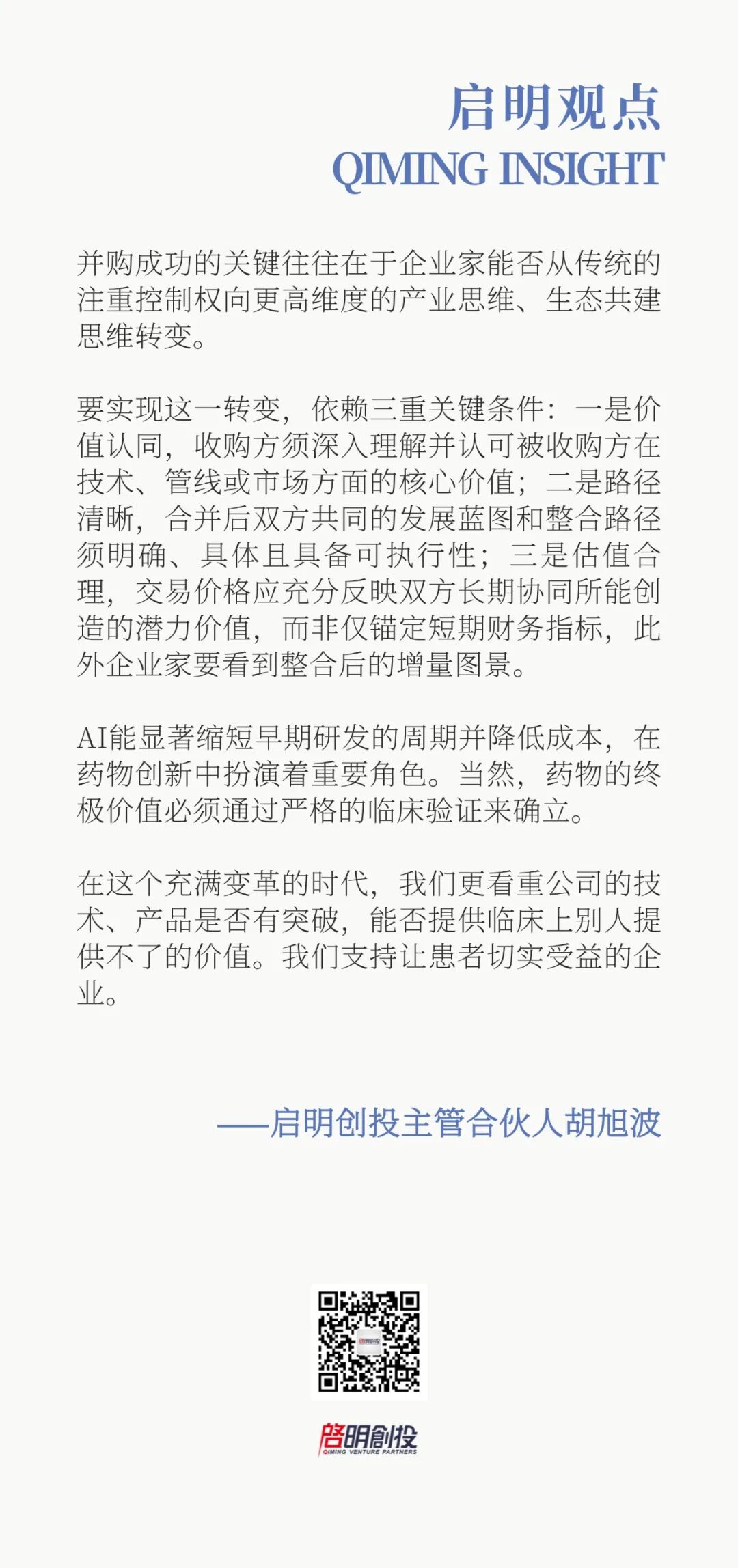
In this era of transformation, Qiming Venture Partners places greater emphasis on whether a company's technology and products achieve genuine breakthroughs, and whether it can deliver clinical value that others cannot. Qiming Venture Partners supports enterprises that bring tangible benefits to patients.

At the intersection of policy, capital, and technology, China's innovative pharmaceutical industry is entering a period of deep consolidation. Moving beyond "wild growth," the sector urgently needs to optimize resource allocation and enhance global competitiveness through mergers and acquisitions.
As an investor deeply rooted in healthcare, William Hu, Managing Partner at Qiming Venture Partners, recently spoke with Shanghai Securities News about the core logic and development path behind investing in innovative drugs, drawing on evolving policy trends, corporate strategic transformation, and frontier technological variables.
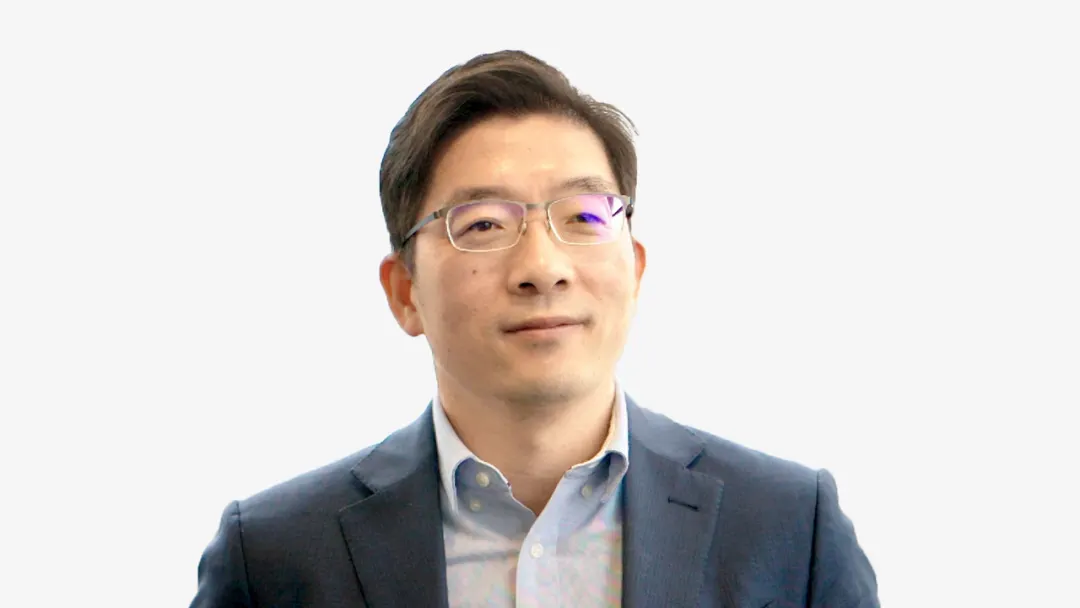
William Hu, Managing Partner at Qiming Venture Partners
01/
Policy Optimization:
Institutional Support for Endogenous Integration
China's innovative pharmaceutical industry has now entered a transformation phase — from simply having products to pursuing excellence, high-quality development, and global competitiveness. With routine healthcare cost controls, rationalizing capital market valuations, and clustering R&D efforts in certain sub-sectors, the need for internal industry consolidation has become increasingly pressing.
In recent years, a series of significant policies have been implemented, injecting fresh momentum into the M&A market for innovative drugs. Hu noted that this has provided a certain boost to industry consolidation and development. For sustainable industry growth, China needs to cultivate a cohort of internationally competitive leading enterprises that can enhance overall industrial efficiency and resilience through economies of scale and supply chain synergies.
Take Mindray's acquisition of MicroPort EP MedTech (editor's note: a Qiming Venture Partners portfolio company) as an example. The supportive policy environment — one that encourages "strong alliances" and backs industry consolidation and upgrading — provided fertile ground for this strategic acquisition. The acquirer, Mindray, filled a critical gap in cardiovascular intervention, while MicroPort EP MedTech gained access to a leading player's powerful distribution channels and platform, accelerating the commercialization of its innovative technologies. The high degree of strategic alignment between both parties became the cornerstone of the deal's success.
Regarding the current phenomenon where multinational corporations (MNCs) frequently acquire high-quality domestic assets while M&A activity among local pharmaceutical companies remains relatively muted, Hu observed: "Financial capacity and accumulated M&A integration experience represent the core difference." Multinational companies have abundant capital, and mergers and acquisitions have been standard practice throughout their growth, enabling them to build mature M&A systems and integration capabilities. Domestic pharmaceutical companies are generally constrained by their own financial scale and lack of experience with complex M&A transactions, often adopting a more cautious stance toward large-scale acquisitions.
However, as leading domestic innovative pharmaceutical companies have significantly improved their technological capabilities and internationalization competence, the value of "China innovation" is gaining broad recognition in global markets. Hu anticipates that proactive, strategically motivated M&A activity among domestic pharmaceutical companies will increase going forward.
02/
Corporate Strategy and Integration Logic:
From Control to Ecosystem Co-Building
Successful M&A is not merely a capital transaction but a complex strategic action and cultural integration. Hu emphasized that the key to successful M&A often lies in whether entrepreneurs can shift from a traditional focus on control toward higher-dimensional industrial thinking and ecosystem co-building.
This transformation depends on three critical conditions: First, value alignment — the acquirer must deeply understand and recognize the acquired company's core value in technology, pipeline, or market access. Second, clear roadmap — the joint development blueprint and integration path post-merger must be explicit, concrete, and executable. Third, reasonable valuation — the transaction price should fully reflect the potential value of long-term synergies rather than merely anchoring to short-term financial metrics, and entrepreneurs must envision the incremental landscape after integration.
M&A is never the endpoint but the starting point for building new capabilities.
In this process, Qiming Venture Partners' role in facilitating resource connections for healthcare enterprises has far exceeded that of a pure financial investor. By actively building global industry collaboration platforms, it has successfully facilitated deep partnerships between multiple portfolio companies and overseas leading pharmaceutical firms in technology collaboration, pipeline licensing, and market expansion. Hu believes this serves two purposes: helping entrepreneurs deeply understand the long-term strategic significance behind such partnerships, and playing an indispensable bridging role in connecting critical resources.
03/
AI Drug Discovery and New Industry Variables:
Reshaping Future M&A Logic
Alongside policy guidance and corporate strategic evolution, frontier technologies represented by AI are becoming a critical new variable reshaping the innovative pharmaceutical landscape. AI's applications in target discovery and molecular design have demonstrated enormous potential and attracted considerable attention. "AI can significantly shorten early-stage R&D cycles and reduce costs, playing an important role in drug innovation. Of course, a drug's ultimate value must be established through rigorous clinical validation," Hu said.
Take Insilico Medicine, a Qiming Venture Partners portfolio company, as an example. Insilico Medicine used its AI platform to design a novel target, novel molecular structure drug for idiopathic pulmonary fibrosis. The candidate has successfully entered global multi-center Phase 2 clinical trials, becoming a benchmark case in the field and powerfully demonstrating AI technology's feasibility.
Based on observations of technological development trajectories, Hu predicts that AI pharmaceutical companies will gradually differentiate into two models: One is the technology platform model — becoming infrastructure providers. The other is the ecosystem partnership model — accessing AI capabilities through collaboration.
"For traditional pharmaceutical companies, they don't necessarily need to build AI capabilities from scratch themselves. But they must deeply understand AI technology's boundaries, value, and viable partnership models," Hu noted.
The continued optimization of the policy environment, the upgrading transformation of corporate strategic thinking, and frontier technological transformations represented by AI are together forming three solid pillars driving deep consolidation and high-quality development in China's innovative pharmaceutical industry. "In this era of transformation, we place greater emphasis on whether a company's technology and products achieve breakthroughs and can deliver clinical value that others cannot. We support enterprises that genuinely benefit patients," Hu concluded.
Source | Shanghai Securities News
Author | Zhang Xue
Past Reviews
Founded in 2006, Qiming Venture Partners currently manages 11 USD funds and 7 RMB funds, with total assets under management reaching $9.5 billion. Since its inception, the firm has focused on investing in early and growth-stage outstanding enterprises in Technology and Consumer (T&C) and Healthcare sectors.
To date, Qiming Venture Partners has invested in over 580 high-growth innovative companies, of which more than 210 have listed on the New York Stock Exchange, NASDAQ, Hong Kong Exchanges and Clearing Limited, Shanghai Stock Exchange, and Shenzhen Stock Exchange, or exited through M&A and other means. Over 80 companies have become recognized unicorns or super-unicorns.
Many Qiming Venture Partners portfolio companies have grown into the most influential players in their respective fields, including Xiaomi (01810.HK), Meituan (03690.HK), Bilibili (NASDAQ:BILI, 09626.HK), Zhihu (NYSE:ZH, 02390.HK), Roborock (688169.SH), UBTECH (09880.HK), WeRide (NASDAQ:WRD), Insta360 (688775.SH), Gan & Lee Pharmaceuticals (603087.SH), Tigermed (300347.SZ, 03347.HK), Zai Lab (NASDAQ:ZLAB, 09688.HK), CanSino Biologics (688185.SH, 06185.HK), Schrödinger (NASDAQ:SDGR), MicroPort EP MedTech (688617.SH), Sanyou Medical (688085.SH), Amoy Diagnostics (300685.SZ), Berry Genomics (000710.SZ), SinoCellTech (688520.SH), Yuanxin Technology, Insilico Medicine, MediLink Therapeutics, LaNova Medicines, Zhipu AI, StepFun, Biren Technology, and others.