In this year's booming AI hardware race, AI earbuds have become something of an "open secret." They're portable, can record what the user hears to serve as AI's "ears" for supplementing real-world information, and fill in the contextual gaps that AI needs.
So, how do you build an AI earbud?
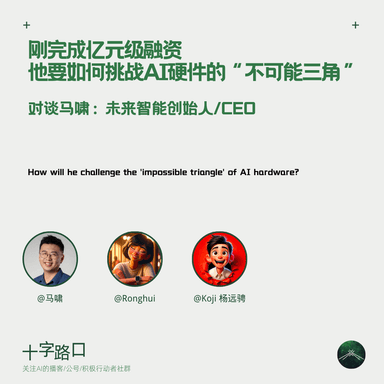
This week, we invited Ma Xiao, founder and CEO of iFLYTEK Future Intelligence, which just announced nine-figure RMB funding from investors including Ant Group and Qiming Venture Partners — its third round this year.
Future Intelligence's iFlytek AI earbuds have consistently topped sales charts for AI earbuds across major e-commerce platforms, and the company has been profitable since its founding.
Ma Xiao shared his 15-year journey building AI earbuds, his understanding of how AI hardware becomes an "entry point," and how to make difficult trade-offs within hardware's "impossible triangle" (performance, battery life, and weight) — and ultimately transcend it.
Beyond that, Ma Xiao also opened up about his emotional journey through the corporate world: when his decision to keep pushing forward with earbuds was met with incomprehension, when everyone told him it was a dead end, how he withstood immense pressure and repeatedly questioned himself: "What if everyone else is wrong?" — It was this very reflection that taught him to understand himself in his lowest moments, and ultimately, with guidance from a "benefactor," to make the decision to "follow my heart" and embark on the entrepreneurial path. We hope these reflections prove valuable.
🎥 This episode was recorded at AI Hacker House. The video podcast will be published on Koji Yang Yuancheng's Xiaohongshu, Bilibili, WeChat Channels, and YouTube.
🟢 02:21 Rapid-fire Q&A: Age, alma mater, MBTI and zodiac sign, one-sentence product description, revenue and profit, team size, what he was doing before entrepreneurship
🟢 04:54 Crossing cycles: The blood, sweat, and choices of AI hardware
Our self-positioning: To become the world's best "AI software-hardware integrated" office assistant company.
Lessons from crossing cycles: Personally experienced the full arc of the previous AI wave (the third wave) — "the noise, then the silence."
All hardware can be reimagined with AI, but you can't do everything yourself; you must have focus.
🟢 06:51 The AI entry point is not "the next phone"
Future AI entry points may be plural; stop obsessing over "using another device to beat the phone."
Why earbuds? They're a natural way to interact with AI through language, portable anytime, anywhere.
The strength of earbuds is their portability; the weakness is no screen and potentially limited interaction efficiency — but they're an unavoidable interaction pathway.
🟢 10:09 The "5+X" capabilities of AI earbuds and the "impossible triangle"
Early startup pitfall: The AI features were strong, but the earbuds themselves were terrible. A good AI hardware product must first deliver on its fundamental purpose.
What is "5"? The five fundamentals of earbuds: sound quality, design, battery life, noise cancellation, wearing comfort.
What is "X"? To surpass traditional earbuds, AI earbuds must "listen alongside the user," converting real-world audio information into real-time data streams.
Hardware's "impossible triangle": battery life, weight (comfort), and processing performance. Trade-offs are mandatory.
🟢 14:27 "Sexy" vs. "Tough": The difficult trade-offs of AI earbuds
Sacrificing some "sex appeal" and elegance for "business-oriented" durability.
Business users may have 6-8 hours of meetings daily, requiring AI recording to stay online without switching ears to recharge.
Achieved 9-10 hours of call time; the market standard is typically 5-6 hours.
One of the biggest trade-offs: sound quality. Good speakers are power-hungry; a balance must be struck between battery life and audio quality.
🟢 17:47 "Non-consensus" in a red ocean: Why platform giants can't do what Future Intelligence is doing
"AI earbuds" is consensus, but "what kind of AI earbuds" contains massive non-consensus.
Phone makers (Apple, Huawei) must build earbuds for the mass market, competing to the extreme on all "5" attributes.
"We knew from day one: it's hard for a startup to compete with Apple." Find breakthroughs in vertical domains (meeting and office scenarios).
Serving tens of millions with a vertical office assistant is "using a sledgehammer to crack a nut" for platforms like Apple — they won't do it in the near term.
🟢 23:03 Future Intelligence's core competency: Transmitting audio streams over narrow Bluetooth bandwidth
Industry challenge: Bluetooth calls consume all classic Bluetooth bandwidth, leaving no room for data transmission.
Future Intelligence's "black tech": Modified the BLE GATT protocol (originally for small commands) to stably transmit voice streams.
Technical moats are only short-term advantages.
The real moat is user mindshare and recognition.
🟢 30:22 "Users complained while using it": Convincing an Apple supply chain manufacturer with 80% monthly active data
In 2021 (pre-ChatGPT), the "AI earbud" concept was not accepted.
Winning over Apple's earbud supplier
Key data: iFlytek's previous failed product (only 40,000 units sold) had an app monthly active rate of 80%.
"Users complained while using it": They hated the look, the sound quality, but couldn't live without the recording-to-text feature.
The confidence to start up: If we just make the earbuds themselves good, this AI feature will explode.
🟢 41:14 The pragmatic 8 hours: Why not 24-hour "Always-on"
24/7 always-on recording? The idea is radical, but definitely非主流 [non-mainstream] for now.
People care deeply about privacy; technology, ethics, and social acceptance all need to be crossed.
First, do the most valuable thing well within the "8-hour workday."
🟢 51:56 Why not build Her? I fell into the "universal assistant" trap
At iFlytek, built China's first Siri-like product, but two bottlenecks remain unsolved to this day.
Bottleneck one (solved): AI comprehension capability.
Bottleneck two (unsolved): "Service integration capability." Want to book flights by voice? Online service platforms simply won't open their internal transaction flows.
The biggest failure of "universal assistant": Telling users it can do everything, but doing everything mediocrely.
🟢 56:29 "Hardware is the theory of the shortest plank; internet is the theory of the longest plank"
"Why do many internet companies fail at hardware? Because they approach hardware with an internet mindset."
Internet (longest plank): One excellent feature is enough; other bugs are quickly iterated.
Hardware (shortest plank): Once shipped, one fatal flaw can kill the company. R&D, tooling, inventory "press down like a mountain."
Channel confidence is extremely important for hardware.
Why did I still choose hardware? "Hardware is more like farming — spring planting, autumn harvest, advantages accumulate gradually, it feels grounding."
🟢 01:06:21 "What if everyone else is wrong?" — The 30-minute phone call that decided entrepreneurship
"I doubted myself, was I wrong? ... What if everyone else is wrong?"
The predicament at iFlytek's later stage: Company leadership had already decided to kill the earbud business.
Inner torment: Holding onto 80% monthly active data, feeling "one more generation and this will work."
iFlytek co-founder Hu Yu told Ma Xiao: You must follow your heart, only then can you unleash your full energy.
I'd heard "follow your heart" so many times before, but only when you're truly in that situation do you really understand it.
🟢 01:18:40 The "massive gap" in AI talent: Old experts may not match new students
Build an "honest" company, build AI for "human-machine collaboration, liberating human capability" rather than replacing humans.
AI talent has developed a massive "tear and gap."
Previous-generation AI: algorithms, product, and coding were separate.
New-generation AI: they naturally integrate scenarios, coding, and algorithms as one.
Subscribe to "Crossroads" podcast 🚦 We follow the industry transformations and entrepreneurial opportunities brought by the new wave of AI technology.
🚦 Crossroads is Steve Jobs' metaphor for Apple — standing at the intersection of technology and liberal arts, where great products are born. AI is transforming every industry; we seek out, interview, and bring together a new generation of AI entrepreneurs and active participants in the AI era, exploring and embracing new changes and possibilities alongside them.
👦🏻 Host Koji: Co-founded Jiepang / The Fair / Tangdao, launched AI Hacker House, a community space for the new generation of AI entrepreneurs. I believe technology, especially AI, is the greatest value-creation opportunity of our generation. Feel free to reach out to chat, bounce ideas, and connect on what's next. Koji on Jike, Koji's website
👧🏻 Host Ronghui: Worked at a USD VC, spent five years as a Silicon Valley correspondent, following tech development and business stories. Feel free to reach out and exchange ideas. Ronghui on Jike
🎄 This podcast is supported by "The Fair Sound Forest Podcast Project."