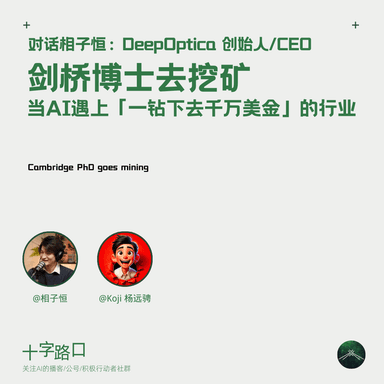
🚥 This week's Crossing guest is Ziheng Xiang, founder and CEO of DeepOptica.
During his four years as a PhD student at Cambridge, he spent four years rowing — becoming the first Chinese captain in his college's history. After graduating, he didn't go into investment banking or Big Tech. He chose to go mining — with AI.
Mining is an industry where a single decision can lock up hundreds of millions of dollars, and once you break ground, there's no turning back. It's ancient, expensive, and wildly uncertain — and Ziheng Xiang, a Cambridge quantum optics PhD and former UK Space Agency project lead, chose to break into it using AI.
What DeepOptica is building is a world model for mining — integrating multimodal data from geophysics, remote sensing satellites, and geochemistry to let AI truly "see through" to underground 3D ore body structures. Not just telling mining companies "where to drill next," but directly answering the probability distribution and confidence intervals for "how many tons of copper, how many ounces of gold" are down there.
🚥 In this episode, we covered:
How hard is mineral exploration really? From geologists' field surveys to geophysical remote sensing to AI world models — how a century of industry evolution is being rewritten by a new technical paradigm; why synthetic data is so critical in mining AI, already comprising 50% of training data and climbing; the fundamental difference between DeepOptica and pioneers like Kobold Metals — from "decision optimization" to "value assessment," entirely different product logic; and how an all-Chinese team landed a partnership with GE21, South America's largest geological consultancy, and completed early validation in Mongolia, the Middle East, and Brazil. We also dug into the story behind that Cambridge rowing captain experience — how to win over a team that doubts you, how to build leadership without authority, and how these lessons map directly to his founder journey today. Those who master AI have become the barbarians at the gate. A thread running through this episode: the ones who disrupt traditional industries are rarely insiders. They're outsiders armed with new tools and fresh perspectives. There's a massive gap between earth science and computer science — and the teams bridging that gap are standing at this interdisciplinary crossroads. If you're tracking the AI for Science direction, or wondering "where can AI create real value in extreme-risk traditional industries," this episode is worth your full attention.
🎬 Our video podcast is now live on Koji Yang Yuancheng's WeChat Channels, Xiaohongshu, Bilibili, YouTube, and other platforms.
📒 The transcript will be published on the @CrossingCrossing WeChat official account.
🟢 00:02 Rapid-fire: Age, alma mater, MBTI and zodiac sign, one-sentence intro to DeepOptica, funding status, revenue and order scale, pre-founder experience
🟢 03:24 Cambridge rowing's first Chinese captain
A team that's 90% European, with better individual records — why him? The four-year path: men's second boat → men's first boat → vice captain → captain. Every step earned, not waited for. What is the real source of leadership? "Rowing is a team sport — if even one person doesn't show up, that boat doesn't go out." 5:30 AM assembly, first boat on the river facing endless water — how do you get a crew of arrogant undergraduates to willingly drag themselves out of bed? There was a Russian teammate who initially wouldn't even speak to him. What changed?
🟢 05:10 Elon Musk explores space; he wants to explore beneath our feet
Mining isn't some dirt-boss business. "Mining is exploring Earth" — a single decision bets hundreds of millions, no turning back once you start. The decision cost of this industry determines the value density of AI intervention. Data centers, new energy, robotics — every industry you think represents the future needs massive amounts of metal. Mining is the foundation beneath all tech narratives. DeepOptica doesn't just want to find where the minerals are — it wants to directly answer: how many tons of copper, how many ounces of gold.
🟢 06:55 Putting the elephant in the refrigerator
Three key steps in AI mineral exploration. Geologist field surveys → geophysical remote sensing → drill verification. A century-old industry workflow — where does AI cut in? When underground iron and copper concentrations are high, they distort magnetic and gravitational fields — what AI must do is reverse-engineer 3D ore body structure from this "distortion." The same surface magnetic signal could correspond to 100,000 underground ore configurations: this is the "non-uniqueness proliferation" problem, and the core technical stack DeepOptica is built to solve. Synthetic data currently comprises 50% of training — why isn't real data enough?
🟢 14:06 Why would a quantum optics PhD go into mining?
The two biggest applications of quantum sensing are quantum gravimetry and quantum magnetometry — and these happen to be exactly what mining and oil & gas exploration need most. "As long as it involves physics, whether geophysics or quantum physics, many principles are interconnected" — this isn't a career change, it's the same mathematical language on a different battlefield. This path closely mirrors Kobold Metals' founding team: a quantum computing scientist, an earth scientist, a finance background — the entrepreneurial DNA converges remarkably.
🟢 16:38 Twenty people. That's enough.
In the AI era, the consulting company business model is being rewritten. Mining projects sound labor-intensive, but with AI productivity multipliers, each service project no longer needs massive manpower — "field work wraps up, we bring it back and analyze together." The moat is two things: data, and the team that can sustain the "synthetic data → mining world model" pipeline — neither alone suffices. Why is earth science + computer science so much harder than biology + computer science? Geostatistics as a discipline hasn't existed for very long.
🟢 30:48 This track isn't as crowded as you'd think
There are thousands of publicly listed mining companies globally, many of them junior miners with just a few people — they simply can't access top-tier AI systems. Large companies are developing their own efficient exploration methods, but the industry isn't monopolized; vast regions go untouched. Multiple paths forward: sell software to mid-tier miners, or take equity stakes and become mine owners directly — "get the model right first, the rest follows naturally."
🟢 37:01 What the rowing captain taught him about leadership
Leadership doesn't equal being liked. "My results weren't the best" — why would teammates with better physiques, faster times, follow you? The essence of leadership without authority: not making everyone like you, but making them feel they'll grow with you. Three entrepreneurial essentials from rowing: the capacity to endure, calm leadership, and a systems view that never elevates the individual above the team.
🟢 44:23 If DeepOptica fails, what would most likely cause it?
"Small-town grindset kids only focus on solutions; we have a long-term vision, lead mid-term vision, then break it into actionable goals for everyone" — less grindset kid, more like a well-organized vehicle. The biggest risk isn't technical, it's pace — funding pace, customer acquisition pace. Miss a window, and the downward slide begins.
🟢 46:12 DeepOptica in five years, and the real dream
The goal is to build a mining model at AlphaFold's level — basic version open-source, commercial version paid, serving global mining companies. "I don't get anxious about having less money; I get intensely anxious about not doing what I want to do." The real dream is exploring space, exploring Earth — mining is the stepping stone; next is space mining, seabed exploration.
🟢 51:06 One piece of advice for early-stage founders
Startups have one advantage that most people don't realize: you can hire people that big companies absolutely cannot — because you can offer hope. This leverage may vanish in year three or four — either you haven't made it, or you've gotten too big; both kill it. "At this moment, be maximally ambitious — even poach people you think you could never get. They're likely in a professional crisis."
Subscribe to Crossing: 🚦 We track how the new wave of AI technology is reshaping industries and creating new entrepreneurial opportunities.
🚦 Crossing is Steve Jobs' metaphor for Apple — standing at the intersection of technology and liberal arts, where great products are born. AI is transforming every industry. We find, interview, and bring together a new generation of AI founders and proactive builders in the AI era — exploring and embracing new changes, new possibilities, together.
👦🏻 Host Koji: I founded Crossing and started AI Hacker House, a community space for the new generation of AI founders. I serve as Venture Partner at ZhenFund. I believe technology, especially AI, represents the greatest value-creation opportunity of our generation. Koji's Jike, Koji's website
👧🏻 Host Ronghui: I co-founded Crossing, worked at a dollar-denominated VC, and spent five years as a Silicon Valley correspondent, tracking tech development and business stories. Feel free to reach out and chat. Ronghui's Jike