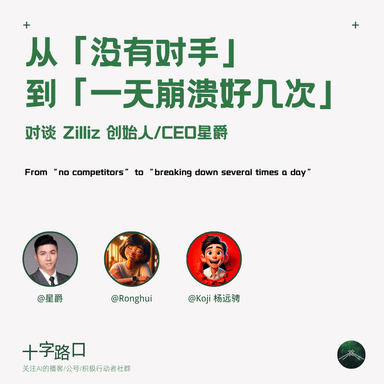

This week's guest on "Crossroads" is Charles Xie, founder and CEO of Zilliz. Zilliz is a world-leading vector database company valued at $600 million.
At the 2023 GTC conference, Zilliz got a shoutout from Jensen Huang as AI large-model infrastructure, and vector databases suddenly became the focus of everyone's attention.
In an interview earlier this year, Charles said: "We have no competitors" — a statement dripping with confidence.
But Zilliz didn't come out of nowhere. In 2018, he started Zilliz with the goal of building infrastructure for processing unstructured data.
Zilliz has stayed firmly committed to the open-source path. In this episode, Charles shares with us why he chose open source, what's great about it, where the pitfalls lie, and most importantly: how do you make money from open source?
This episode is also for all technically-minded entrepreneurs. Charles shares his journey from engineer to CEO: after becoming more pragmatic and learning to navigate strategic games, he discovered that his core competitive advantage still rests on "the tech world needs idealism."
Guest Bio: Charles Xie, founder and CEO of Zilliz. He graduated from Huazhong University of Science and Technology and previously worked as a database engineer. He founded Zilliz in 2018, focusing on unstructured data processing and vector databases, pioneering the technical direction and product form of this field globally.
About Zilliz: A technology company focused on data infrastructure for the AI era. Its open-source project Milvus is the world's leading vector database solution, widely used in generative AI, autonomous driving, recommendation systems, biopharmaceuticals, and other scenarios. The company's revenue grew 3.3x over the past 12 months, with a valuation reaching $600 million.
🟢 Part 1: Rapid Fire — Getting to Know Charles
02:07: Rapid fire: Who is Charles? Company revenue/profit? Company size?
02:30: Zilliz is an AI-era data infrastructure company, focused on building unstructured data platforms.
03:01: What was it like the moment Jensen Huang name-dropped you?
04:07: Vector databases are a product of long-term refinement, not a sudden flash of insight.
04:53: How did vector databases blow up?
06:21: Vector Database 101: What is a vector database? What is Zilliz?
08:27: Original vision: Vector databases predate generative AI, initially serving early AI technologies like convolutional neural networks.
.
🟢 Part 2: "I Have No Competitors" — Really?
12:54: Biggest customer case study: A top global IT company uses vector databases to retrieve information across the entire web, developing AI search.
15:14: Why do you dare to say you have "no competitors"?
16:19: Open source vs. closed source: Zilliz sticks to open source, believing technical advantage comes from an open ecosystem.
17:07: Zilliz's competitive advantages over rivals, and the long-term value of the open-source ecosystem.
18:38: Competitive analysis: Zilliz collaborates with algorithm library FAISS; other open-source projects each have their own entry points.
21:55: Why can't traditional databases replace native vector databases?
24:06: Biggest concern: Whether we can keep innovating, not what competitors are doing.
24:20: If he could choose again, he'd still go open source. Open source is a moat, not a shortcut.
.
🟢 Part 3: Why Is Open Source Good? How Does Open Source Make Money?
26:03: Dual Core model: How does open source make money?
29:43: Why is DeepSeek's open source valuable? Rapidly capturing developer mindshare, avoiding tech stack lock-in.
30:16: Is open source still pure? Is it about co-creation, or brand strategy?
33:07: Charles's entrepreneurial goal: Not just to be a pioneer, but to be the great synthesizer.
34:45: Innovation can't be "managed": The real key is hiring the right people.
35:03: On the edge of breakdown every day — that's the normal state of entrepreneurship.
36:03: Commercialization challenges: Customer churn and growth pressure coexist; first-time commercialization team lacked experience.
.
🟢 Part 4: How Do Technically-Trained People Become Good CEOs?
39:50: Cognitive shift: From idealism to realism.
42:24: Technology commercialization: "Good enough" suffices in business, but technical pursuit still requires idealism.
43:26: AI companies he's bullish on: Public cloud (e.g., AWS), large model leaders, and AI application companies (e.g., ChatGPT, DeepSeek).
Subscribe to the "Crossroads" podcast 🚦 We follow the industry shifts and entrepreneurial opportunities brought by the new wave of AI technology.
🚦 "Crossroads" is Steve Jobs's metaphor for Apple — standing at the intersection of technology and liberal arts, where great products are born. AI is transforming every industry. We seek out, interview, and bring together a new generation of AI entrepreneurs and active players in the AI era. Together with them, we explore and embrace the changes and new possibilities.
👦🏻 Host Koji: I co-founded Jiepang / The Fair / Tangdao, and started AI Hacker House, a community space for a new generation of AI entrepreneurs. I believe technology, especially AI, is the greatest value-creation opportunity of our generation. Feel free to reach out to chat, bounce ideas, and connect on what's next. Koji on Jike, Koji's website
👧🏻 Host Ronghui: I've worked at a dollar-denominated VC and spent five years as a Silicon Valley correspondent, following tech development and business stories. Feel free to reach out and chat with me. Ronghui on Jike
🎄 This podcast is supported by "The Fair Sound Forest Podcast Initiative."