This year we've been tracking a lot of consumer-facing Agent products. This week, we're turning our attention to B2B Agents — and there's a strong case that Agents will create far more commercial value in enterprise than in consumer markets.
In late August, "AI Agent" was formally written into a State Council document: Opinions on Deepening Implementation of the "AI+" Initiative. Many see this as the next pivotal moment for frontier technology to integrate with industries across the board, following the "Internet+" push a decade ago that transformed daily life through food delivery, ride-hailing, and countless other services.
In the coming weeks, Crossroads will be rolling out a series on this topic.
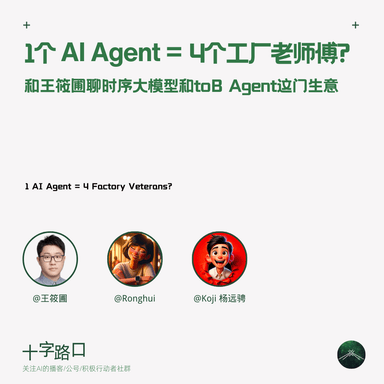
This episode, we're looking at how Agents are merging with industrial operations. We've invited Wang Xiaopu, founder of Jifeng Technology — the startup behind the time-series foundation model Geegobyte-g1 and the industrial intelligence platform "River Valley" — to break down what time-series foundation models actually are, how they differ from large language models, and real-world use cases. We'll explore how they train an Agent and sell it into enterprise production workflows. Hope this helps you understand how AI Agents are being applied in industrial settings.
🟢 02:09 Rapid Fire: Age, alma mater, MBTI and zodiac sign, one-liner on company and product, funding status, revenue and profit, team size, pre-founder experience
🟢 03:21 A Time-Series Foundation Model Is Not Another ChatGPT
- Core concept: Large language models converse with humans; time-series foundation models converse with the future
- Its ultimate goal is to make the future predictable, manageable, and optimizable
- Why does industrial need a "large" model? — To use one general model that generalizes across industries and problems
🟢 11:08 Why Build This?
- AI empowering industry is like J.A.R.V.I.S. for Iron Man — we're not focused on "designing the suit," but on process management and control in "manufacturing the suit"
- Why do rigid automated production lines still depend on veteran workers' on-the-spot judgment?
- Which roles will a "digital worker (AI Agent)" eventually replace? From equipment operators to maintenance staff to planners — evolving from assistance to substitution to surpassing human capability
🟢 24:26 How It's Done
- A counterintuitive entry point: Not relying on interviews with veteran workers, because human language introduces information loss and bias
- What does training an Agent depend on? "First principles" and "data that never lies"
- How does a digital worker's brain divide labor? The large language model handles knowledge comprehension and communication; the time-series foundation model handles pattern recognition and causal reasoning
- The Agent framework functions like a "neural circuit," packaging brain, memory, and action execution into a controllable, observable closed-loop process
🟢 52:02 What Have They Achieved?
- At a waste-to-energy plant, one digital worker replaced four operators working in four-shift rotation, achieving "unmanned operation"
- Reframing tech procurement as an investment logic, generating 4 to 5 million RMB in incremental annual revenue per client
- A disruptive business model: Using a "labor dispatch" logic, clients pay monthly wages for digital workers — at far less than the human labor costs replaced
- Why is this model sustainable? It balances clients' need for low upfront investment with suppliers' need for recurring revenue
🟢 01:09:40 What's Next? Will AI Bring Industrial-Revolution-Level Change?
- How will future workflows be reshaped? Humans will evolve from simple operators to designers, supervisors, and innovators
- What happens when skilled workers are liberated? They'll be redeployed into R&D for new processes, helping companies seize fleeting market opportunities
- Ultimate vision: If one day entire upstream and downstream industry chains are linked by digital workers, the responsiveness will bring "industrial-revolution-level change"
- One insight for AI-era founders: Don't root yourself in a single industry; instead leverage the generalization capability of foundation models to focus on solving one "cross-industry, same-process problem"
Subscribe to the Crossroads podcast 🚦 We track how new waves of AI technology are reshaping industries and creating entrepreneurial opportunities.
🚦 Crossroads is Steve Jobs' metaphor for Apple — standing at the intersection of technology and liberal arts, where great products are born. AI is now transforming every industry. We seek out, interview, and bring together a new generation of AI founders and proactive actors in the AI era. Together, we explore and embrace the changes and new possibilities.
👦🏻 Host Koji: I co-founded Jiepang / The Fair / Tangdao, and launched AI Hacker House, a community space for the new generation of AI entrepreneurs. I believe technology, especially AI, represents the greatest value-creation opportunity of our generation. Feel free to reach out to chat, bounce ideas, and connect on what's next. Koji on Jike, Koji's website
👧🏻 Host Ronghui: I've worked at a dollar-denominated VC and spent five years as a Silicon Valley correspondent, tracking technology development and business stories. Welcome to reach out and exchange ideas. Ronghui on Jike
🎄 This podcast is supported by The Fair's Sound Forest Podcast Initiative.