Two Gen-Z Tsinghua and Peking University Founders Rack Up 23,000 GitHub Stars in 20 Days, Gunning for Adobe and CapCut with Hypit

"Are you getting in?"
"Want to get in?"
👦🏻 Interview: Miss Yi
🥷 Edited by: Crossing
🧑🎨 Layout: NCon

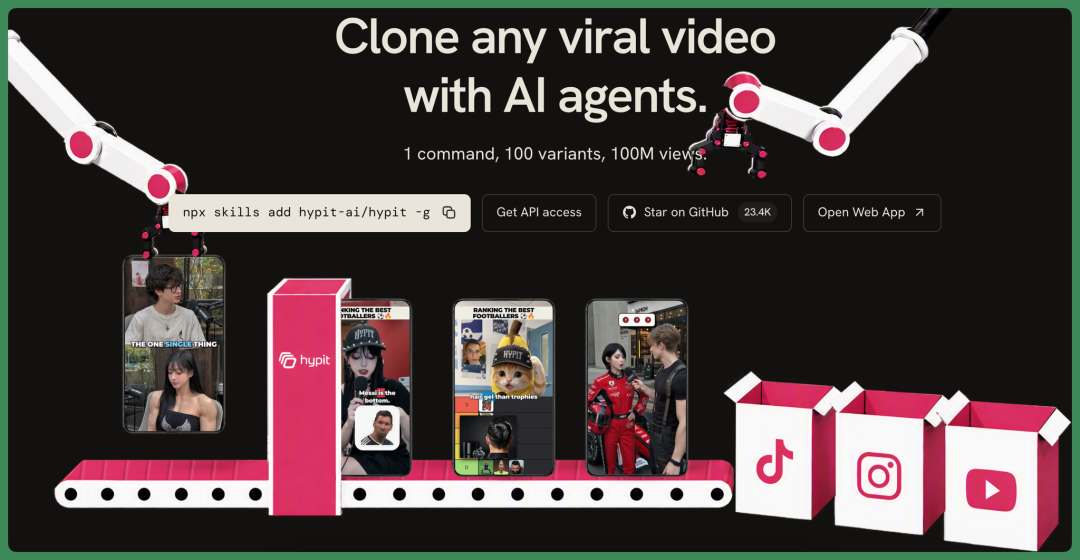
Lately, a dark horse has emerged in the AI applications race — one that claims to "one-click replicate viral videos." Open-sourced for just a month, it's already surged to 23,000 GitHub Stars.
It's Hypit.ai[1]. A single video made with Hypit delivered 40x ROAS (Return on Ad Spend) for a merchant; one Silicon Valley founder used Hypit to make their launch video, then promptly fired their $1,500-a-month video editor.
The Hypit founding team consists of two Gen-Zers — Yudong "Alvin" Chen, who graduated from Peking University and dropped out of Tsinghua's master's program, and Qunlin "Kashorin" Jin, a Tsinghua University computer science graduate. Their backgrounds trace a consistent arc through AI content entrepreneurship:
Alvin once went undercover at a cross-border MCN, bought 40 secondhand iPhones to run accounts, and dabbled in pretty much every flavor of AI UGC content there is. Kashorin built an AI virtual influencer account during his internship that hit 300,000 followers; he also used Claude to write Attack on Titan fanfiction on Xiaohongshu, earning a reputation as "the most mysterious account on Paradis Island."
Beyond the headline-grabbing "one-click viral replication," what else can Hypit actually do? And how does it differ from using Opus to edit videos?
We recently sat down with Hypit's two founders for a wide-ranging conversation. They spoke candidly about Hypit's steepest growth moments, the breakthrough of their SVML language architecture, the daily rhythms of a Gen-Z team, and a dream that sounds almost audacious: Kill Adobe & CapCut & ... Finally, Alvin issued a direct appeal: "If you already missed Cursor, missed Lovable, missed HeyGen, missed Manus... before AGI arrives, Hypit might be one of the last few chances left. The 86 is heading up the mountain — want to get in?"
Below is the complete transcript of Crossing's conversation with Hypit founders Alvin and Kashorin.
Rapid-Fire Round
🚥 Crossing
Let's start with some rapid-fire questions to help everyone get to know you. How old are you?
🧙♂️ Alvin
22
👨🏻💻 Kashorin
23
🚥 Crossing
Alma maters?
🧙♂️ Alvin
Undergrad at Peking University, dropped out of Tsinghua master's
👨🏻💻 Kashorin
Undergrad at Tsinghua University, Computer Science
🚥 Crossing
MBTI and zodiac sign?
🧙♂️ Alvin
ENTP, Sagittarius
👨🏻💻 Kashorin
INTJ, Libra
🚥 Crossing
One sentence describing your current company and product?
🧙♂️ Alvin
Open-source Video Programming Language and System for AI Agents.
A video programming language and system designed for coding agents.
🚥 Crossing
Funding status?
🧙♂️ Alvin
Monad Ventures incubated us for one round, ZhenFund invested in another.
🚥 Crossing
Revenue and profit?
🧙♂️ Alvin
Open-sourced on September 15, hit 23,000 Stars in one month, topped Alibaba and Cloudflare on the trending charts for several days straight; ARR broke $1 million USD.
🚥 Crossing
Team size?
🧙♂️ Alvin
Seven people. Four full-time, two high school interns, and one good friend from Peking University's physics department.
🚥 Crossing
What were you doing before starting this company?
🧙♂️ Alvin
Graduated from Peking, dropped out of Tsinghua, served as student council president, sourced deals at ZhenFund. From AI influencers, AI e-commerce livestreaming, to AI pet short dramas, AI real-person short dramas, AI UGC — I've churned out every kind of absurdist content there is.
👨🏻💻 Kashorin
Tsinghua CS undergrad, worked on video generation model training at Zhipu AI, and at CMU researched how to get agents to understand human creative intent through dialogue.
How Hypit Compares to Opus
🚥 Crossing
How simple does video creation become after using Hypit?
🧙♂️ Alvin
We want to reduce video-making to one thing: you express your idea, provide a reference, then iterate through conversation while the agent handles the production behind the scenes.
You no longer need to learn editing software, then generative models, then motion graphics tools, and how all these tools work together — just to realize one creative concept.
We did a demo using Xiaolin Shuo's videos: "replicate Xiaolin Shuo" to produce a video introducing Hypit.
You'll see that the original video uses panels on both sides of the screen to represent conflict between two forces; Hypit-generated video borrows this approach and transforms it into a comparison between two production methods (editing software vs. code).
What's magical to us: it learns the "logic behind the production" of the original video, then borrows that logic to express a new theme.
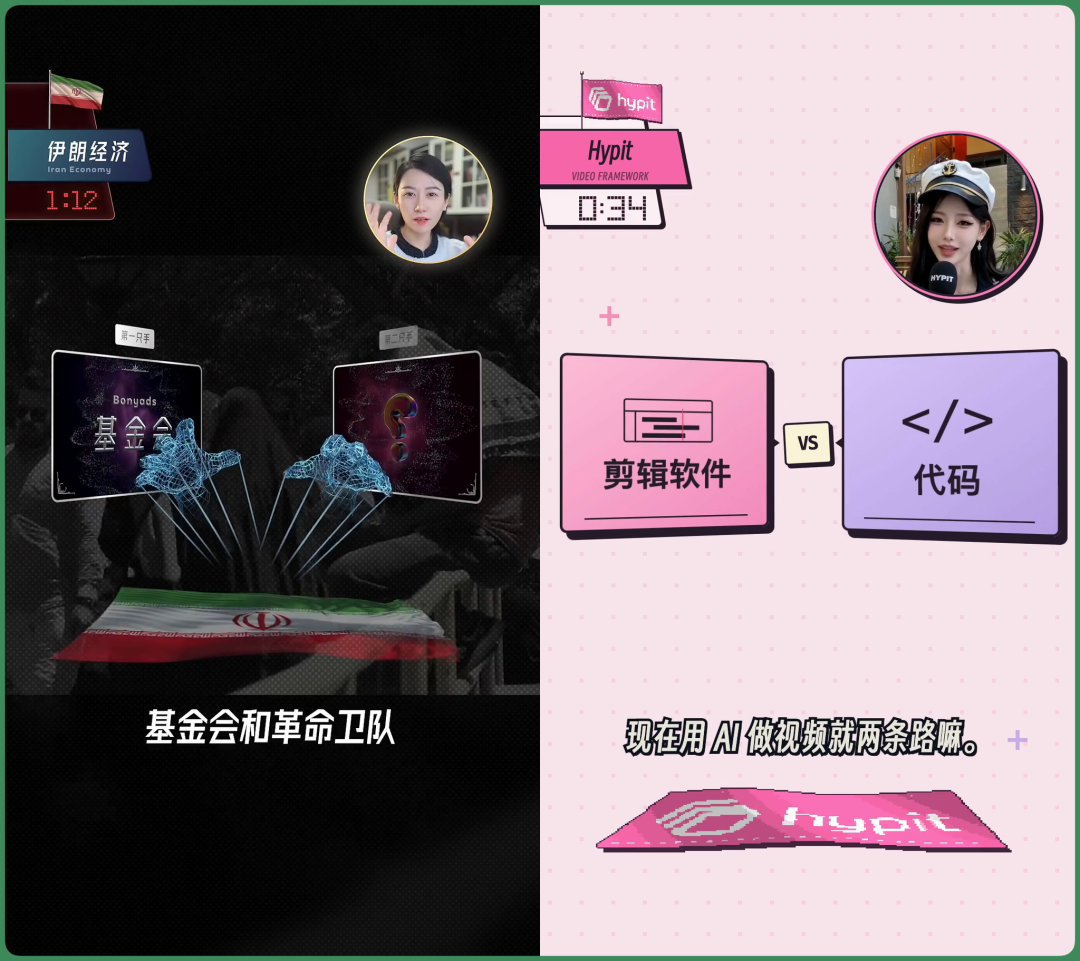
Hypit doesn't replicate pixel colors — it replicates the creative intent behind them
Let me give another concrete scenario: You simply say "when Google is mentioned, make the Google logo pop out," and Hypit makes it happen.
Traditional video editing means "listen to the voiceover, find the timestamp, drag in the asset" — repeat that dozens or hundreds of times for bulk production.
Hypit's semantic timeline can bind when elements appear to specific words or sentences. Even if you regenerate the voiceover or switch languages, it automatically realigns based on the new speech positions, eliminating the need to manually adjust timestamps for each video.
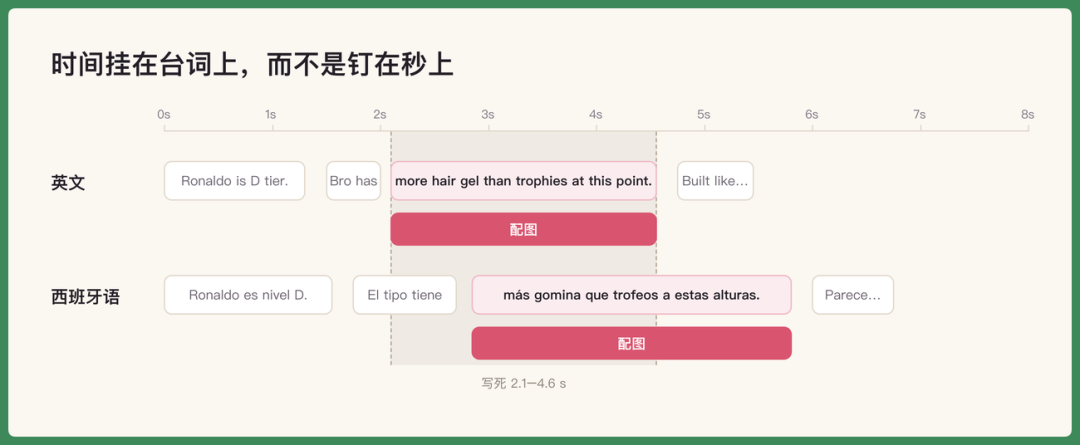
After switching languages, Hypit's semantic timeline automatically realigns audio-visual effects
A third highly applicable scenario is Launch Video.
Someone used Hypit to create their launch video, stitching together an opening motion graphic (also generated by Hypit), product screen recordings, and voiceover — when a feature is mentioned, the corresponding product interface appears.
Work that used to be fragmented across multiple tools with no closed loop can now be completed within a single production project.
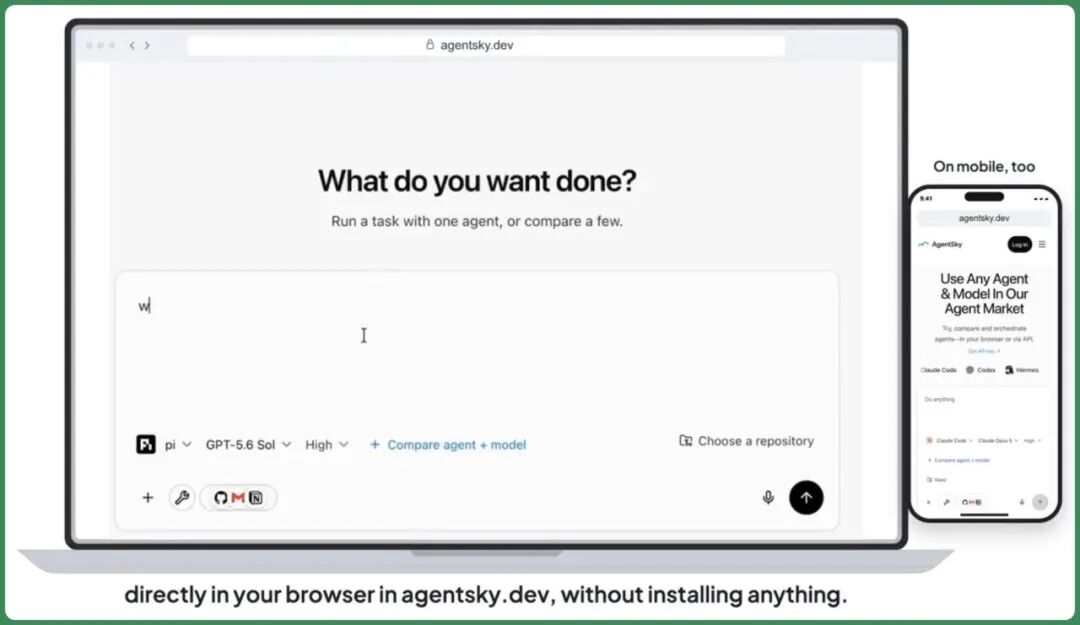
A launch video made entirely with Hypit, without switching to any other tools
A couple days ago at the AI Cloud 100 China exhibition, an IELTS education founder wanted to try using AI to create game-style vocabulary learning videos for his elementary students. He wasn't satisfied with what he made himself or what he outsourced.
I did a "magic trick" for him on the spot. Using his Grok Bot, one line of prompt transformed his video into another audio-visually synchronized, 3D version.
You can't fake that spark in a user's eyes. He said he'd make sure all of Shanghai's English education circle knew about our product.
Of course, we don't want to oversell it as "one sentence gets you a perfect video unconditionally." Until Hypit can read your brainwaves, one-click perfection isn't realistic.
What we're actually trying to do is revolutionize the video production paradigm — shrinking the gap between "I know what I want to make" and "I've made it."
🚥 Crossing
How does Hypit differ from using Opus to edit videos?
👨🏻💻 Kashorin
Opus 5.5's ability to generate creative concepts is already quite strong, but turning that concept into a complete video still involves a mountain of production work.
Characters and voices need to be generated, product interfaces need real screen recordings, some motion graphics work better with JS code than diffusion models, and you might even need 2D, 3D scenes and Blender modeling — then you have to place all these elements on the same timeline, with voiceover, music, and visuals tightly coordinated: which word triggers what, where the music hits, how the visuals respond, all in sync.
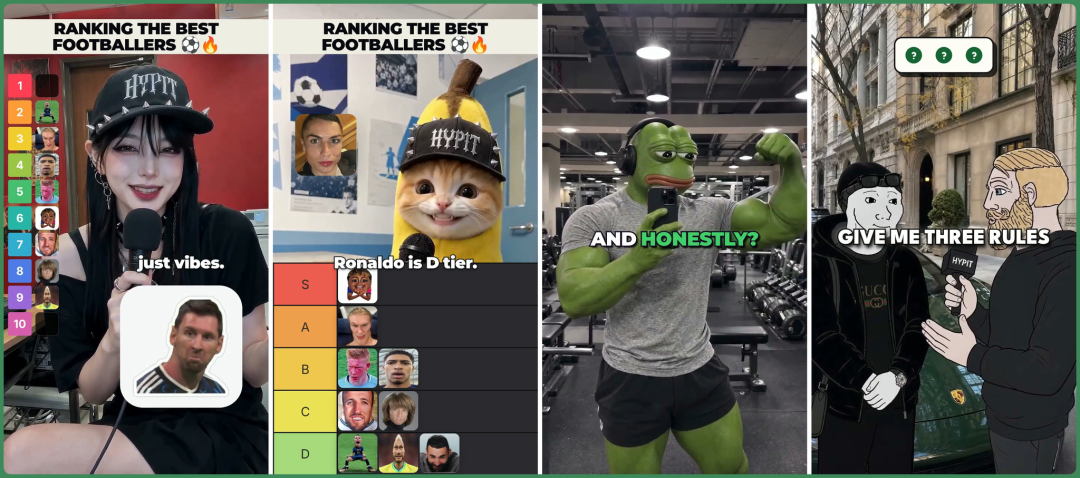
Hypit handles video production; the viral concepts come from Opus
Of course, if you just hand everything over to an Agent, it'll figure out how to call tools and write scripts to get a video made. But that's a makeshift video production system it rigs up for itself on the fly — the next video might use a completely different setup, or another session might not understand what the previous one built at all. So all that scaffolding is hard to reuse.
What Hypit is doing is getting this production layer right, thoroughly, ahead of time. Taking all this fiddly production work and fully engineering it, so an Agent's creative ideas can more smoothly become finished videos.
For instance, asset arrangement, AI generation, code-driven motion graphics, and the temporal relationships between them — all of these can be expressed in the same language, and the Agent can continuously modify a video the way it would maintain a code project.
Plus, finished components, subtitle styles, and effect templates can be imported into the next video with a single line of code.
🚥 Crossing
As foundation models keep improving, can this advantage be sustained?
👨🏻💻 Kashorin
We really hope foundation models improve fast. The better Agents get at creative work and coding, the less we need to hand-hold them through techniques in Skills, and the more interesting things they can make with Hypit.
We've always said Hypit adds value on top of what Agents can do, and that incremental value should keep rising as foundation models get more capable.
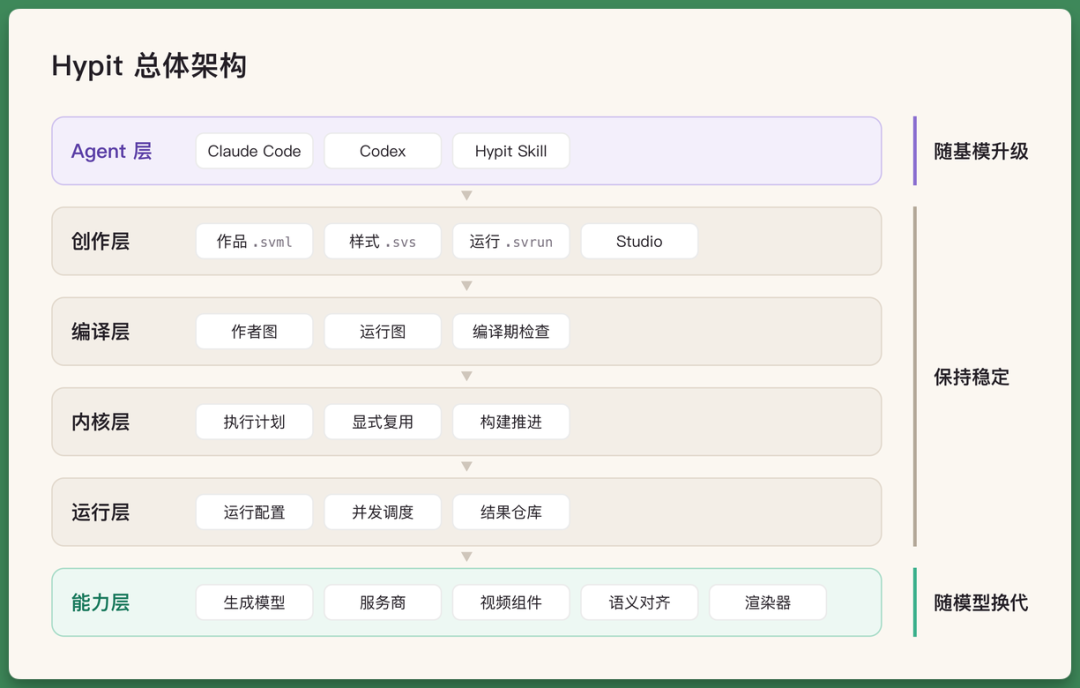
Hypit adds incremental value to Agents, not filling gaps
What we want to accumulate long-term is very concrete: good-looking subtitle styles, motion graphics components, god-tier prompts, plus well-executed complete projects and workflows.
We distribute them through npm or GitHub, then aggregate them in an ecosystem that Agents can directly read from and write to, callable in a few lines of code. Want to tweak colors, layout, or motion? Optimize on demand. Come up with a new style or component? Share it with others.
Already, many community users are contributing components through PRs — like the manim animation engine used for 3b1b-style explainer videos.
Going forward, we'll also invest heavily in building out the ecosystem and community, and doing it to the extreme.
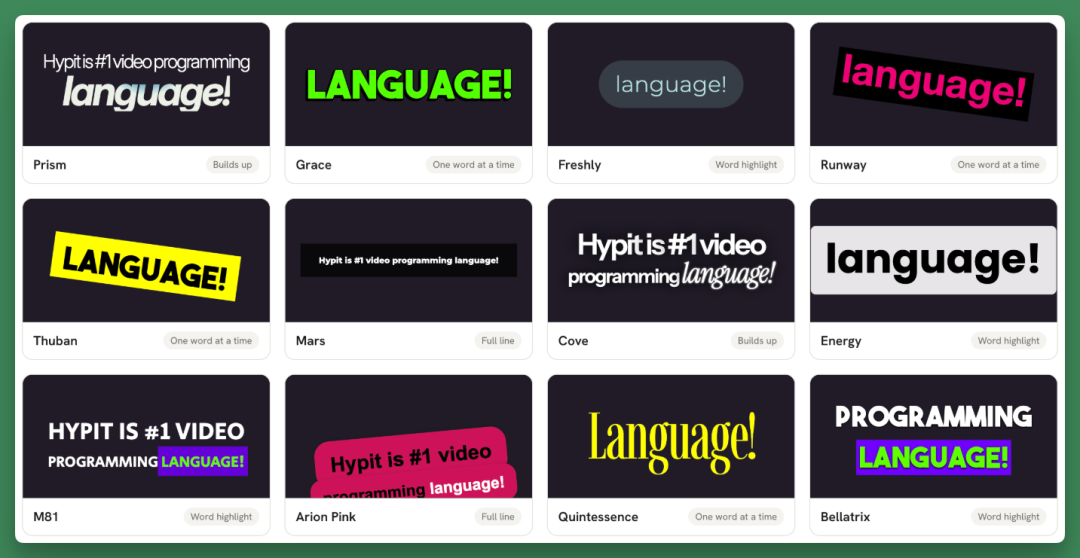 Hypit.ai's subtitle ecosystem showcase on its official site
23k stars, I didn't fake it
🚥 Crossing
How long did it take from idea to launch for Hypit?
🧙♂️ Alvin
About two to three months. The first two months focused on development, then roughly half a month preparing the launch campaign.
On day one of the launch, when we only had 1,000 stars, I DM'd every WeChat contact I had in this space and said: "Mind giving a star to what might be the most explosive open-source project in video this year?"
As it stands, I believe we have a shot. Twenty-plus days in, the project has 23k stars. I don't think I was faking it.
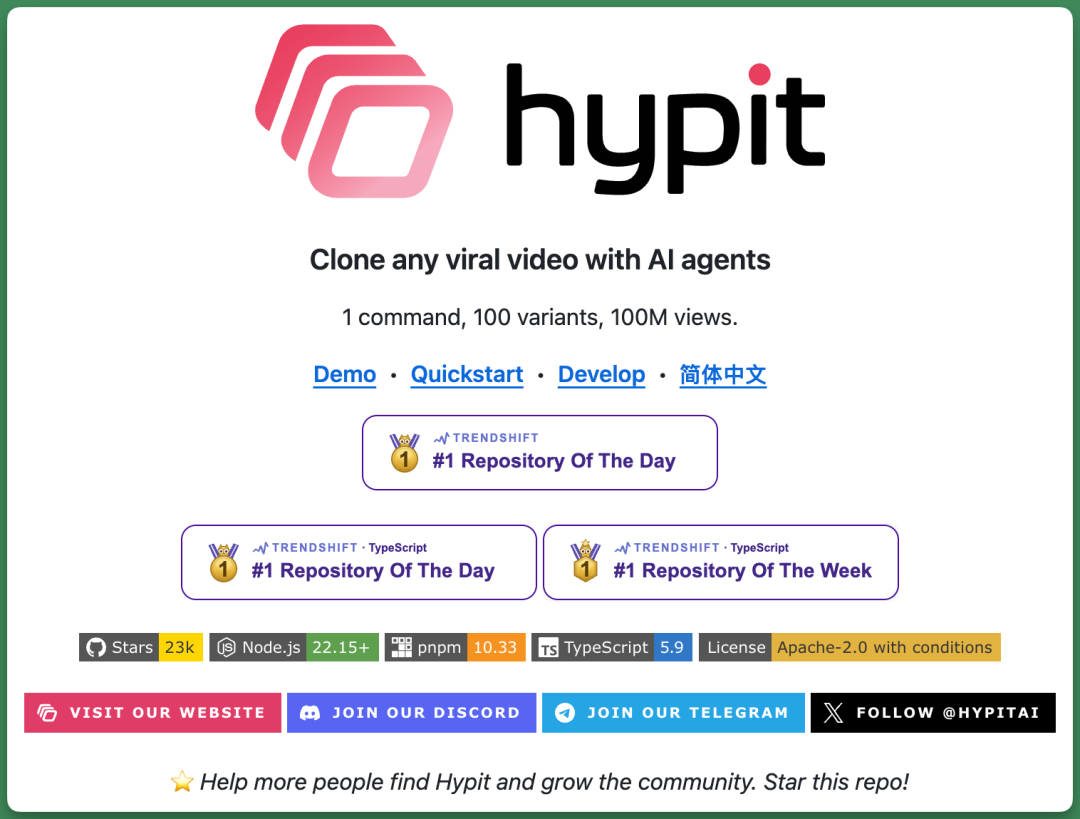 Hypit's GitHub repo hits 23k stars!
🚥 Crossing
Breaking 23k stars in less than a month after going open source — was this within your expectations?
🧙♂️ Alvin
It exceeded the team's expectations, but not mine personally — I was expecting 100k.
We're convinced Hypit is a revolution, the only solution for future Agent-driven video. Our marketing angle this time was "one-click replication of any video," because we're young, small, and broke.
It was out of necessity. Only by drilling down from real demand can we get people to remember us. Why we ultimately chose this angle for GTM was also carefully considered — the copy went through dozens of revisions.
🚥 Crossing
What other external feedback have you received?
🧙♂️ Alvin
Besides hitting 23k GitHub stars in under a month, when I talked to some investors, I found many of them were confused by "replication," even thinking it was kinda lowbrow. I told them: go ask your portfolio companies, the ones with content marketing needs — 100% of them are using us.
Another one is Ms. Xiaoyin — I call her the Queen of Silicon Valley. The first thing she said when she added me on WeChat was asking how to invest in us, and that we're the next Higgsfield.
Though she was also drawn in by the replication pitch, she actually figured Hypit out, and ended up firing her team's editor — a $1,500/month editor — and completed her launch video entirely with Hypit.
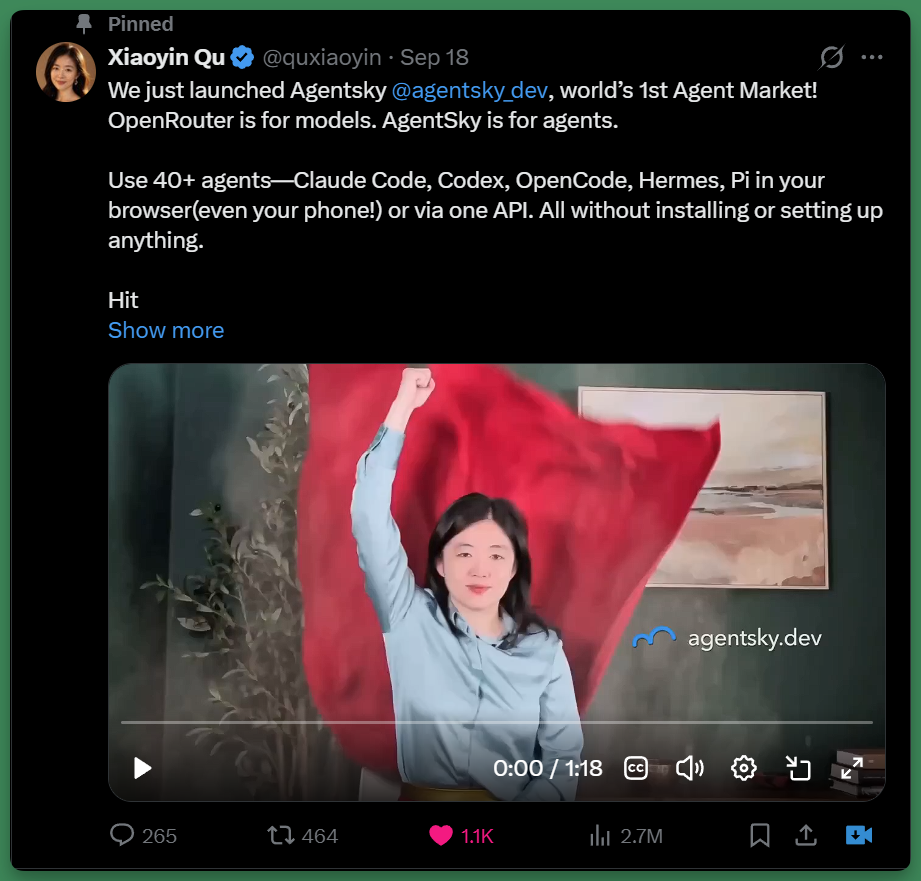 This video was produced entirely using Hypit
Giving Video Agents a Source Code Entry Point
🚥 Crossing
Next, could you introduce that language you specifically designed for video Agents?
👨🏻💻 Kashorin
The language is called SVML, Semantic Video Markup Language.
You can think of it as source code for video: who delivers the voiceover, how the script is written, what assets are needed, how visual layers are organized, and what happens when — all expressed uniformly within the same project.
The Agent writes the creative intent into the SVML source file, and Hypit's compiler and runtime system execute it.
 Hypit brings Semantic Video Markup Language to the world
Take a player ranking video we did: the host roasts Cristiano Ronaldo that "his hair gel outnumbers his trophies," and right when that line hits, a hair gel image pops up.
There are actually several pieces of information here: what image, when, where, what the card looks like, how it enters and exits.
In SVML, these relationships can be expressed in one self-contained line of code. The image can be an existing file, or something generated by an image model — and Hypit can write the downstream arrangement even before it's generated.
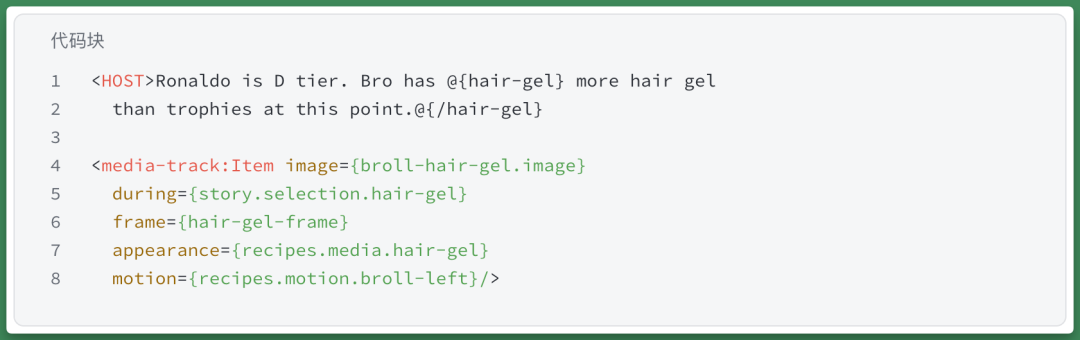 A creative intent is one self-contained line of code in SVML
Once the source code is handed to the compiler, it gets expanded into a dependency graph.
The runtime system calls models and local tools according to the specified relationships — things that can be done independently run in parallel, while dependent tasks wait for prior results.
SVML is a declarative markup language, compiled into a directed acyclic dependency graph
Users can preview the final cut and timeline in Studio, leave frame-by-frame feedback for the Agent to drive revisions.
What ultimately remains is both the video file and its project: how this video was made, which modules can be reused next time — all carried and expressed in an entirely new data format.
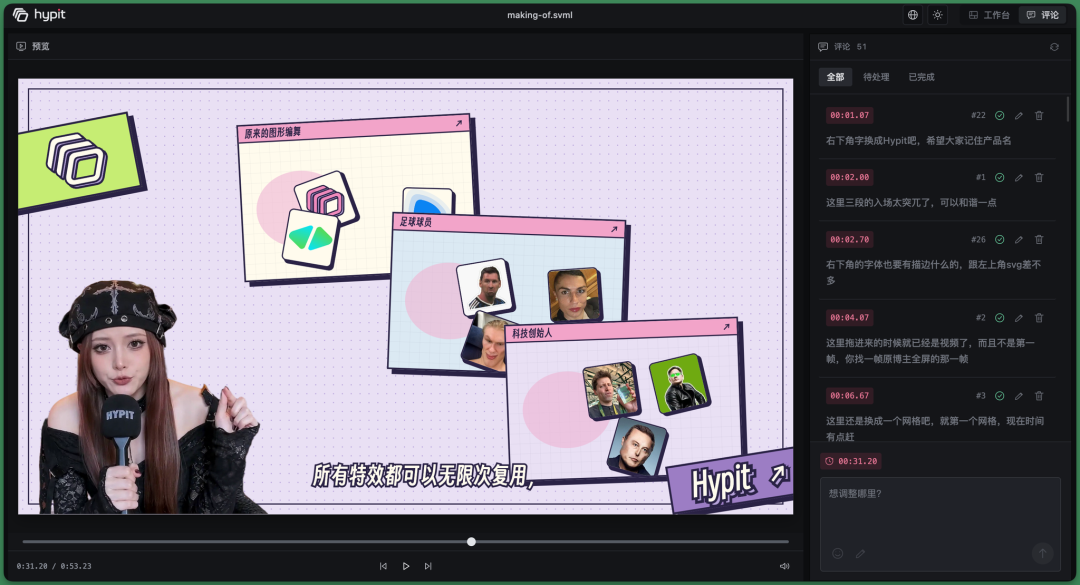 Users can leave frame-by-frame feedback for the Agent in Hypit Studio
🚥 Crossing
Why does video need a new language paradigm?
👨🏻💻 Kashorin
Right now, making a video already involves several very different paradigms mashed together.
When people create content themselves, part of it is editing existing assets, part is calling AIGC models for generation, and part is having Agents write JS code for motion effects. They often appear in the same video, but the tools for each understand and express things differently.
If generated assets live in one script, motion effects in another, and audio-visual alignment in yet another, then the complete, self-contained creative intent that should have existed from the start gets scattered everywhere.
But in the end, something still needs to record why these things belong together, and how other parts should cascade when one part changes.
Traditional editing starts from: I already have these assets, now how do I cut and arrange them? But AIGC flips this — intent first, then materialize the assets.
Moreover, the specific executor of video creation has shifted from humans to Agents.
Traditional NLE software lets you adjust visuals directly with your hands and eyes — it's intuitive. But GUIs and computer use aren't native capabilities for Agents; reading and writing code is.
We wanted to give Agent a source-code entry point that can directly express these relationships.
So it can use a single line of code to say "show this card this way during this segment," and the system materializes that relationship onto a timeline — letting creative intent be preserved with engineering precision.
That's why we evolved from making content, making canvases, and delivering to clients, to making languages and making systems.
What we kept running into was fundamentally the same problem: a video needs to be generated, edited, animated, and endlessly revised. There has to be a unified expression paradigm where all this work can build on itself within the same project, and reusable modules can accumulate into an ecosystem.
🚥 Crossing
What's the hardest part of building a product like this?
👨🏻💻 Kashorin
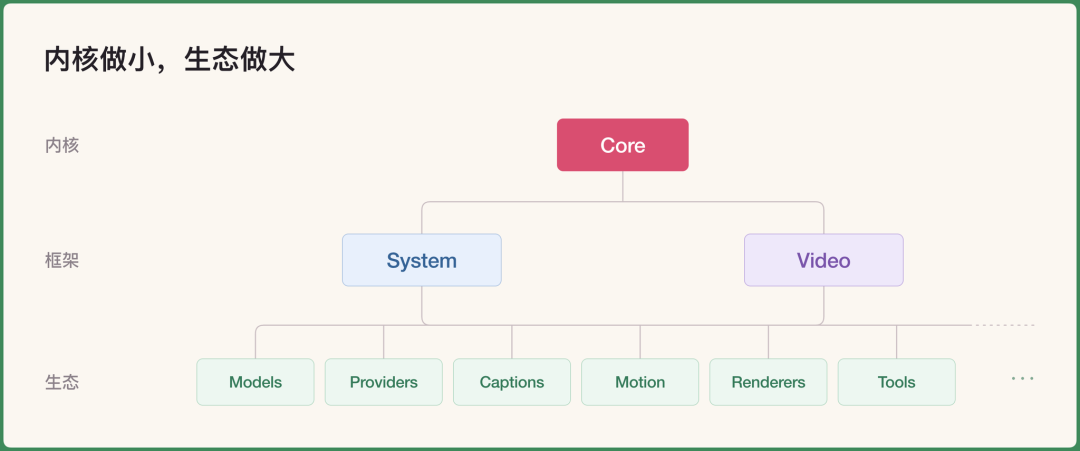
Architecturally, the hardest thing is actually keeping it small. We spent a lot of effort making the language kernel as minimal as possible.
It's tempting at first to hardcode your familiar production workflow: generate voiceover here, add subtitles there, finally export video. You can wire up a pipeline quickly, but once you try a few different video types, you realize some don't use AIGC at all, some are pure motion graphics, some are entirely user-shot footage like VLOG mashups.
If every new scenario requires changing the underlying layer, the system quickly hits exponential complexity.
We converged the kernel to one simple responsibility: advancing a dependency graph.
The specific architecture borrows heavily from DSH's "everything is a plugin" philosophy: eliminating unnecessary complexity through modularity and decoupling.
You only need to know what a node requires, what it produces, which results already exist, and what can happen next. Whether that node is generating video, aligning speech, or rendering subtitles — that's handled by components and capabilities outside the kernel. Even how source code gets parsed into a dependency graph can be separated from the kernel itself.
🚥 Crossing
Let's expand on some design points in this architecture that users can actually perceive?
👨🏻💻 Kashorin
I'll give three problems we kept hitting when making videos ourselves, which later became designs in Hypit.
First: semantic timeline — writing audiovisual relationships directly into the voiceover script.
For example, we once made a hundred voiceover videos for a client, each needing a Google icon to pop up when mentioned. We had authors mark in the script: show this image during this segment, trigger this sound effect when this word finishes. The system aligned actual audio with the script word-by-word, then materialized it onto the final timeline. We accumulated hundreds of audiovisual assets this way.
These preserved audiovisual relationships can be re-aligned to new voiceovers — sound effects, images, and subtitles don't need to be repositioned from scratch each time.
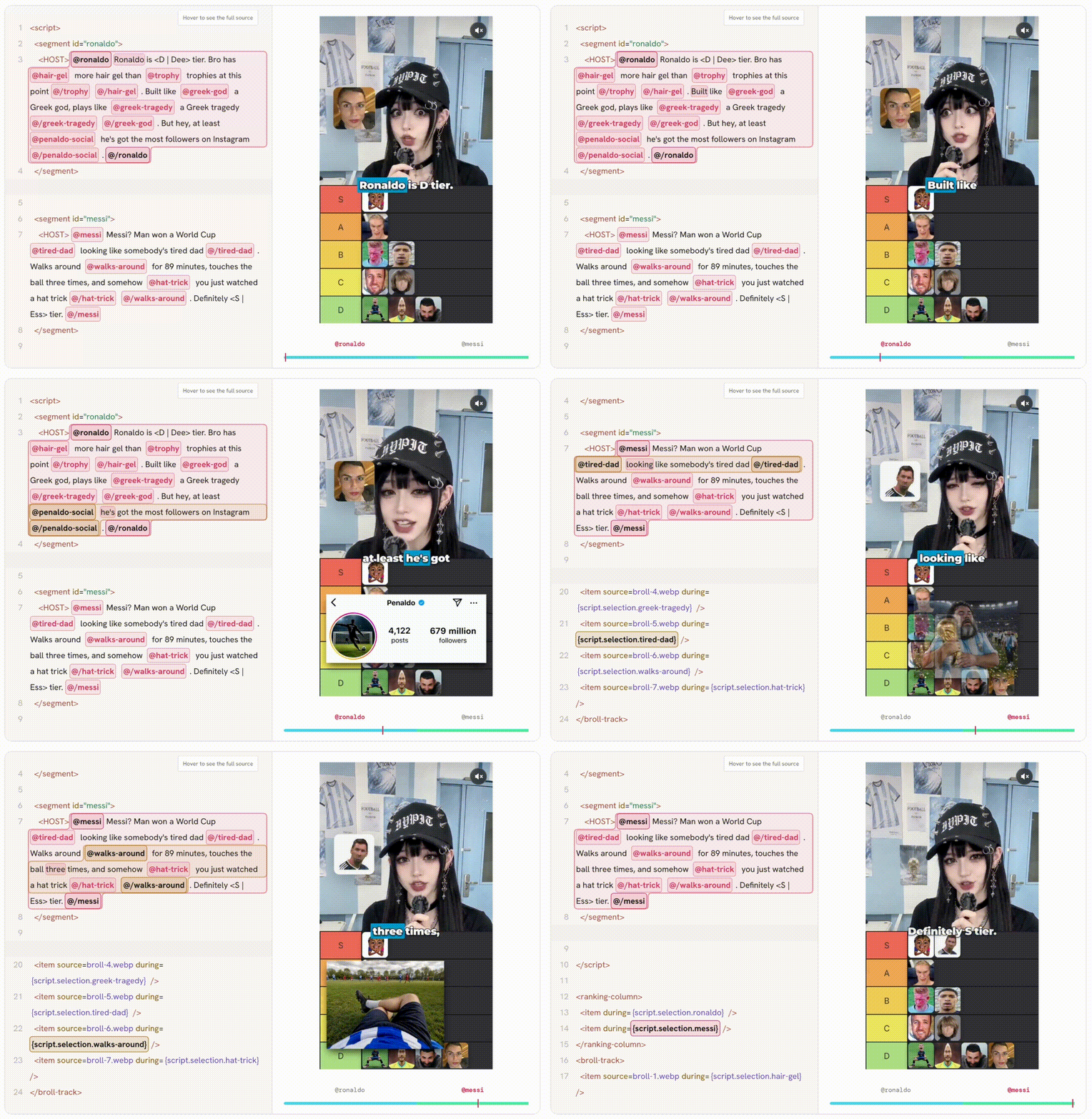
Left is the voiceover script, right is the video, with timestamps marked directly in the script using @ syntax
Second: Dual syntax — letting subtitles and spoken narration each be accurate.
For example, the subtitle writes "9:30" but the voiceover should say "nine thirty" — just write <9:30 | nine thirty> directly in the script. Left side for subtitles, right side for speech and voice alignment. Creators don't need to maintain two separate scripts.
There's more playful uses too: this team <is mediocre | total randos>, and if your sound is off you'd never know. This handles pronunciation while letting subtitles display <more concisely | avoid getting flagged> — without having to transcribe every verbal filler onto screen.
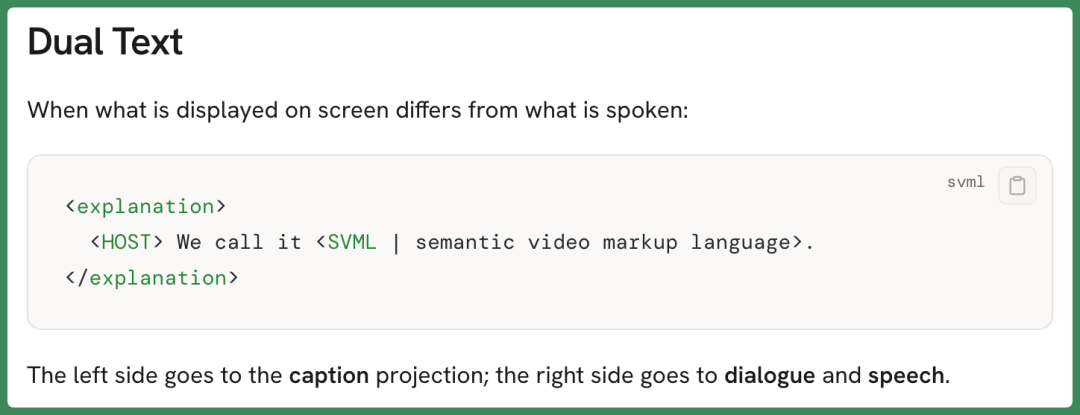 A safe example of Dual syntax
Third: dual-graph decoupling — completely separating creative intent from execution intent.
The creative graph only writes production arrangements: dialogue, assets, motion effects, and their dependency relationships. The execution graph writes what this run should produce and explicitly reuses which existing results.
Most canvas products on the market clearly haven't achieved this decoupling, so every time you want to run a single asset in isolation, you have to delete all the wiring, generate, then reconnect. We wasted enormous time doing this with ComfyUI, and Hypit naturally avoids it.
 Same creative intent, three different execution intents
The aha moment of video Agent
🚥 Crossing
AI video token usage remains stubbornly high. How much can Hypit reduce it?
👨🏻💻 Kashorin
We mainly optimize two things: Agent efficiency, and AIGC yield rate.
For AIGC, the key is keeping results you're already satisfied with.
Hypit can do this: once a person voiceover is done, if you only want to change subtitles and leaderboard layout, explicitly reuse the original voiceover and alignment results, only re-compositing what comes after. If one shot is unsatisfying, constrain regeneration to that shot and only the subsequent steps it actually affects.
Hypit goes another layer deeper: division of production methods.
People and scenes can go to generative models; subtitles, logos, data charts, and much motion graphics get rendered with code. Subtitle color wrong? Just change parameters and re-render — no need to have the video model regenerate entire frames. By separating these parts and orchestrating them uniformly, we confine changes to where they actually matter.
Savings vary by video type and number of revisions.
What we aim for: the next revision can continue building from existing results; the next video of the same type can inherit validated production methods — letting creative accumulation truly convert to lower production costs.
🚥 Crossing
How is Hypit embedding into real, high-frequency workflows? What scenarios have already converted to productive use?
👨🏻💻 Kashorin
Among users coming in through the reference video entry, we observe two main types:
One is continuously updating content creators — knowledge sharers, industry analysts, product explainers — who need to regularly produce voiceover videos. The other is marketing teams — for e-commerce, games, or software products — who need to keep producing content around different products, selling points, and audiences.
Their needs are specific. For example, a video model generated some good footage, and now they need to insert their product image, add subtitles, add a logo, even have a small arrow point to the like button when a certain line is spoken.
Individually these are small tasks, but doing them daily, for every video, wastes serious time. We can preserve a tuned production method for the same account, so next time they swap content, it keeps working.
 Videos created by community creators using Hypit
Going forward, we'll push harder on two needs.
One is something for everyone — like adding good-looking subtitles to already-shot voiceovers, a need many people have. The other is everything for someone — like a startup team making a product launch video, where Hypit can handle the full production workflow in one place.
🚥 Crossing
Recently, what "aha moments" with video Agents have impressed you?
👨🏻💻 Kashorin
What surprised me most: Agent is starting to understand why a video expresses itself this way, and can transplant that method into new contexts.
For example, we used a video from "Xiao Lin Shuo" as reference. It opens with a countdown and prominent theme text. Thinking in terms of production intent: the countdown creates urgency, the theme text tells viewers in the first three seconds what they're about to watch.
Agent can grasp the intent behind the video, then migrate it to new video generation.
Another earlier surprise: we found Agent already thinking up deliberately provocative openings to keep viewers watching.
We once had Opus write an opening: first asking "Have you ever cheated on your boyfriend?", then the response "No, but I just cheated on my interview." It connected romantic cheating and interview cheating through the word "cheat."
This video delivered 40x ROAS for the client — four viewers bought a $100 annual subscription.
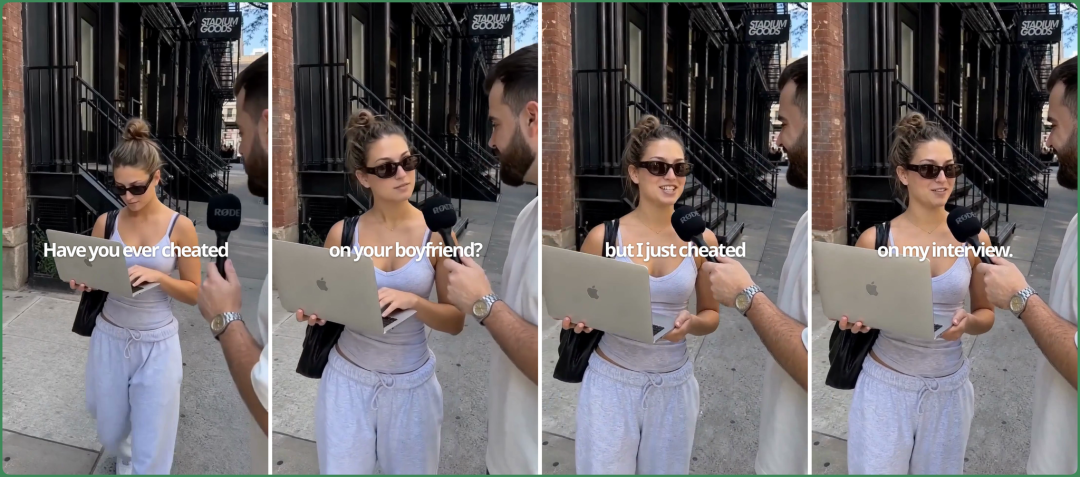 The god-tier cheat double-entendre hook that delivered 40x ROAS
This Gen-Z team wants to Kill Adobe & CapCut
🚥 Crossing
Tell us about the Hypit team?
🧙♂️ Alvin
We have four full-timers: me, Qunlin Jin (Kashorin), Runsheng Liu, and Yuning Wang (Eva).
I already introduced Qunlin above. She was the one who first showed me the opportunity in AI + video content. In the second half of 2024, every ZhenFund intern from our cohort probably remembers the AI influencer project she built.
That's when we started immersing ourselves in this industry. We ran accounts, built an MCN, operated overseas account matrices, developed video content workflows, built infinite canvas tools — then later pivoted to delivering video content for e-commerce, gaming, internet products, and AI startups. Now, Hypit is the solution to all of the above.
Runsheng is an engineer from ByteDance. There, he worked on full-stack development for the company's internal unit-testing service, covering service stability governance, intelligent test generation, and test quality assurance. He's also a TikTok cross-border e-commerce shop owner.
Eva holds a Master's in Information Science from Cornell University and a BFA in Design and Psychology from Pratt Institute. She's worked on Google Cloud Platform and Twirlista AI projects, leading core experience design for AI product evaluation, e-commerce homepages, and sales history interfaces.
We also have two prodigy interns on the team. One is rpone, an 18-year-old independent developer who just graduated high school — she's the top contributor to Hypit's codebase and a Bilibili-exclusive contracted creator @rponeawa (46K followers). I met her at a Xiaohongshu hackathon.
The other is Seraphina, just 16, also someone I met on Xiaohongshu. She led our launch campaign. We achieved massive traffic leverage at minimal cost.
Another key person is my good friend Jiashan Wei, a Physics undergraduate at Peking University (Class of 2022) and a veteran open-source developer. He does high-energy physics research, builds physics × AI benchmarks, and has the sharpest intuition for AI-native design and frontend architecture. Our team's token supply and early revenue came from the relay server he set up.
He keeps our team on unlimited tokens and still pulls in hundreds of thousands in extra income per month.
🚥 Crossing
What's your team culture and day-to-day like?
🧙♂️ Alvin
We rented a loft in Shenzhen. The three guys sleep upstairs; six workstations downstairs. Someone's always at a desk, 24/7.
Everyone works flexibly — come in whenever, leave whenever. When people have frustrations, they usually vent them straight at me. I'm emotionally detached and thick-skinned, so getting yelled at doesn't bother me. Not a big deal.
Our only working principle: maintain context alignment at all times. No information asymmetry allowed. Which means engineers need to understand growth's thinking, and PMs need to understand the tech perspective.
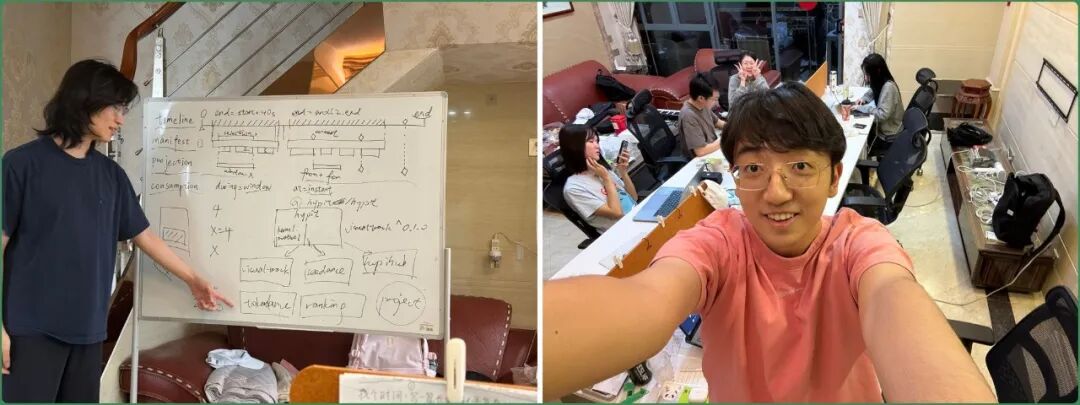
As for team requirements — before getting into specific roles, I think you need three things:
-
(Preferably) born in the 2000s.
-
Not someone who dwells on sunk costs. We iterate and ascend rapidly; you can't get too caught up in the spirals. In other words, you need to be a "rational actor."
-
Genuine interest in content creation — this is our team's greatest common denominator. Whether you're in algorithms, data, infra, PM, or growth, you need to have made content yourself and care about it.

Everyone's welcome to tour our office 👉 Virtual Tour
🚥 Crossing
If a new team of four or five people tried to replicate Hypit in a week or two, could they?
🧙♂️ Alvin
If you're talking about a superficial clone, you wouldn't even need a team — one person could just fork it on GitHub.
Think of it as a spiral ascending around a cylinder. From a top-down view, maybe everyone looks like they're at the same point. But we've been at this for a long time — it's not a short path.
The outside world only sees what we've shipped. But we've spent ages finding the target, figuring out how to hit it, even calculating how the walls might ricochet. Then we shoot with a specific force, at a specific angle — rather than shooting first and painting the target afterward.
The grammar and systems we've built, the engineering and ecosystem around them — these were refined through endless iteration. That's our accumulated capability. Source code doesn't tell that story.
🚥 Crossing
Why the name Hypit? And what's the long-term vision?
🧙♂️ Alvin
Simple: Hype it!
Medium-term, we want to Kill Adobe & CapCut & ... We believe human value shouldn't be wasted on learning and operating software.
Agent + Hypit solves the entire video pipeline: from generating assets, to orchestrating and coupling them with raw footage, to audio insertion, subtitles, effects, transitions... all handled in Hypit.
In the future, producing a video will require only interacting with an Agent to process any component, effect, or asset as needed.
Hypit's position in the ecosystem is to complete the language and component stack that Agents need for video production — something that didn't exist before.
Long-term, I don't like discussing endgames, but the endgame is definitely AGI eating everything.
AGI won't necessarily be OpenAI, won't necessarily be Anthropic, but it's coming. What we need to do is make great contributions to AGI's arrival in the video domain.
🚥 Crossing
Let's talk about your latest funding situation.
🧙♂️ Alvin
Our first round was incubated by Monad Ventures. ZhenFund invested in a + round before our product launch. We just opened a new funding round.
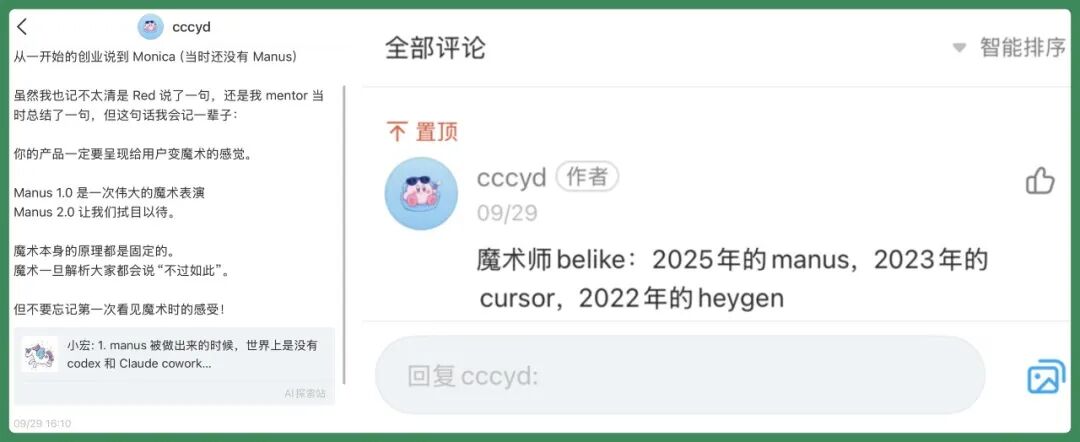
If you already missed Cursor, missed Lovable, missed Heygen, missed Manus... before AGI arrives, Hypit might be one of the few remaining opportunities. The 86 is heading up the mountain — you getting in?
References
[1] Hypit.ai: https://hypit.ai/
[2] Virtual Tour: https://rose-office-play-90740.sonoma200312.chatgpt.site/
Join the membership group  Comment to win prizes