The 18 AI Voice Agent Startups to Watch in 2025

"People are seriously underestimating the potential of voice as an AI interaction interface."
"People are seriously underestimating the potential of voice as an AI interface."

👦🏻 Author: Jingshan
🥷 Editor: Koji
🧑🎨 Layout: NCon

"People are seriously underestimating the potential of voice as an AI interface."
So says Sequoia Capital partner David Cahn.
For the longest time, users grew accustomed to "press 1 to inquire, press 2 for a human agent, press 3 to return to the previous menu." Companies treated "call deflection" as their primary goal, not "problem resolution."
The experience was maddening.
But between 2022 and 2025, a new species is taking shape: the AI Voice Agent.
These AI Voice Agent startups have already closed commercial loops across verticals including auto finance, insurance, customer service, restaurants, and more.
Each individual AI Voice Agent company appears to solve a discrete workflow. Taken together, they represent a massive structural shift:
Conversation itself may be becoming the operating system.
Voice is not a "customer service channel." Voice is becoming a "task entry point."
At this inflection point, we've surveyed 18 representative companies — from high-valuation enterprise platforms to YC-incubated deep-vertical tools to new species that found product-market fit in record time.
AI Voice Agents in Vertical Scenarios
AI truly reaches maturity when it becomes about "applications" — typically from the moment it starts "actually running in industry."
In the AI Voice Agent space, the path to deployment is clear: burrow into high-frequency, repetitive, heavily human-dependent communication workflows, and let Agents directly take over the tens of thousands of daily calls, appointments, inquiries, and task executions.
This article surveys 18 AI Voice Agent startups that have demonstrated real operational velocity in live business environments, covering:
- Who is this company?
- What exactly are they selling?
- What's their growth trajectory?
- Who's running the show?
- Why are investors betting on them?
Typeless
Who is this company?
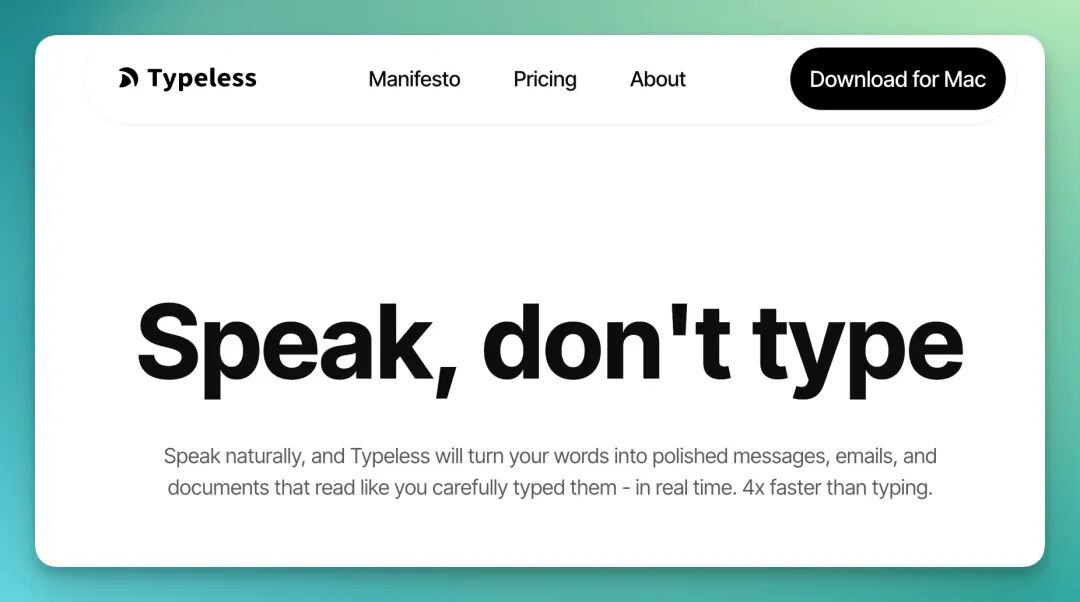
Typeless is a productivity tool focused on "voice input → high-quality text." The core concept is simple: users simply speak, and the system converts spoken language into polished, formatted text in real time — stripping out filler words and redundant phrasing.
The website's description is refreshingly direct: "Speak naturally, and Typeless will turn your words into polished messages, emails, and documents."
It supports over 100 languages, targets a global user base, and offers desktop versions for Mac and Windows. The team behind it is Chinese.
What exactly are they selling?
Typeless's core value proposition is "liberation from the keyboard" — enabling users to complete emails, documents, and messages entirely by speaking.
It emphasizes that generated text is "polished": the system automatically handles filler words, repetitive expressions, and structural disorganization, making spoken content read as if you'd carefully typed it out. If you habitually mix Chinese and English, Typeless accurately recognizes both languages.
It also offers contextual adaptation: more formal tone in emails, more natural cadence in chat apps, automatic structural formatting in documents.
Additionally, it supports "select text → modify by voice" and "read text aloud → ask the system to summarize or analyze by voice" interactions, making voice a genuine universal input layer.
Currently available for Mac and Windows. Mobile version in closed beta.
What's their growth trajectory?
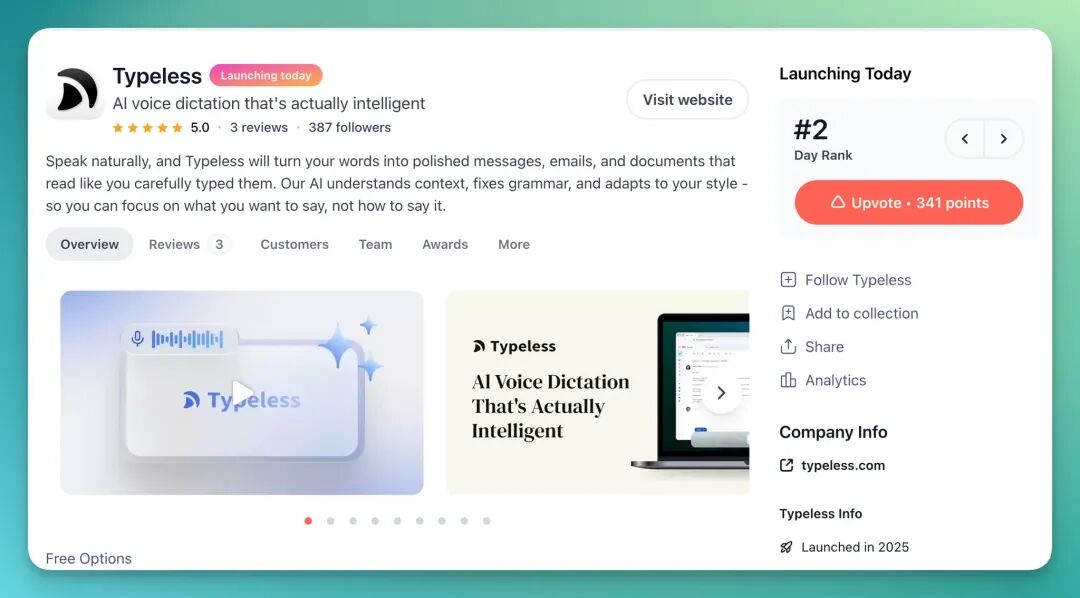
Typeless launched on Product Hunt under the theme "AI voice dictation that's actually intelligent," targeting global users seeking text productivity tools.
On launch day, it achieved Day Rank #2.
With no disclosed funding or incubator affiliation on record, it appears to be a product that emerged from user needs and has been refined within the productivity tools space.
Who's running the show?
Typeless is led by Chinese founder and CEO Song Huang, with angel investment from ZhenFund.

Judging by product form, this is a highly execution-oriented small team with the singular goal of "building a genuinely high-quality voice input tool."
Why might investors be bullish?
Typeless's product logic carries the classic appeal of productivity tools, and the same赛道 includes competitors like Whispr Flow and Aqua Voice.
They've found their wedge through several factors:
【1】First, the pain point of text input inefficiency is long-standing. Thinking outpaces typing; voice input is inherently faster.
【2】Second, the use cases are extraordinarily broad: emails, documents, customer service replies, IM messages — all benefit.
【3】Third, Typeless's AI delivers "visible improvement" immediately. Users feel the speed and quality difference within minutes, making this the kind of product that generates stickiness fast.
【4】Finally, the toolification path is clear: desktop software + SaaS subscription model scales readily.
Pine AI
Who is this company?
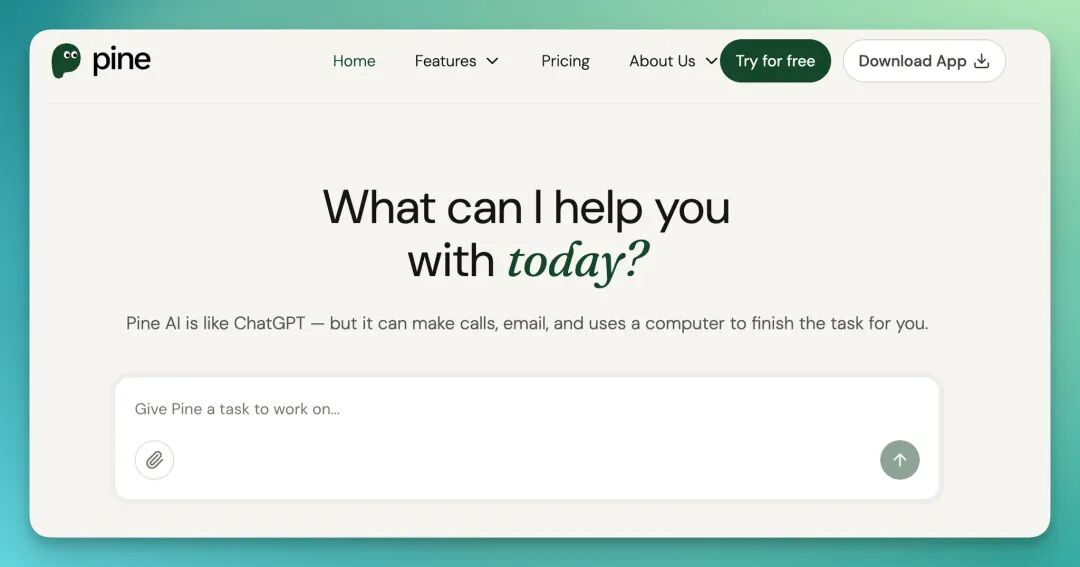
Pine AI is a Chinese AI Voice Agent company offering something like "an intelligent assistant that makes calls and handles annoying tasks on your behalf."
Its capabilities are remarkably broad: from canceling subscriptions and disputing bills to negotiating fees and navigating tedious customer service interactions — all handled by Pine AI's Agent.
The team is archetypically early-stage and young. Its positioning is distinct: rather than serving enterprise customer service teams, it stands squarely on the consumer's side, helping ordinary people handle time-consuming, headache-inducing phone processes.
What exactly are they selling?
Pine AI lets users completely delegate "calling companies" to AI.
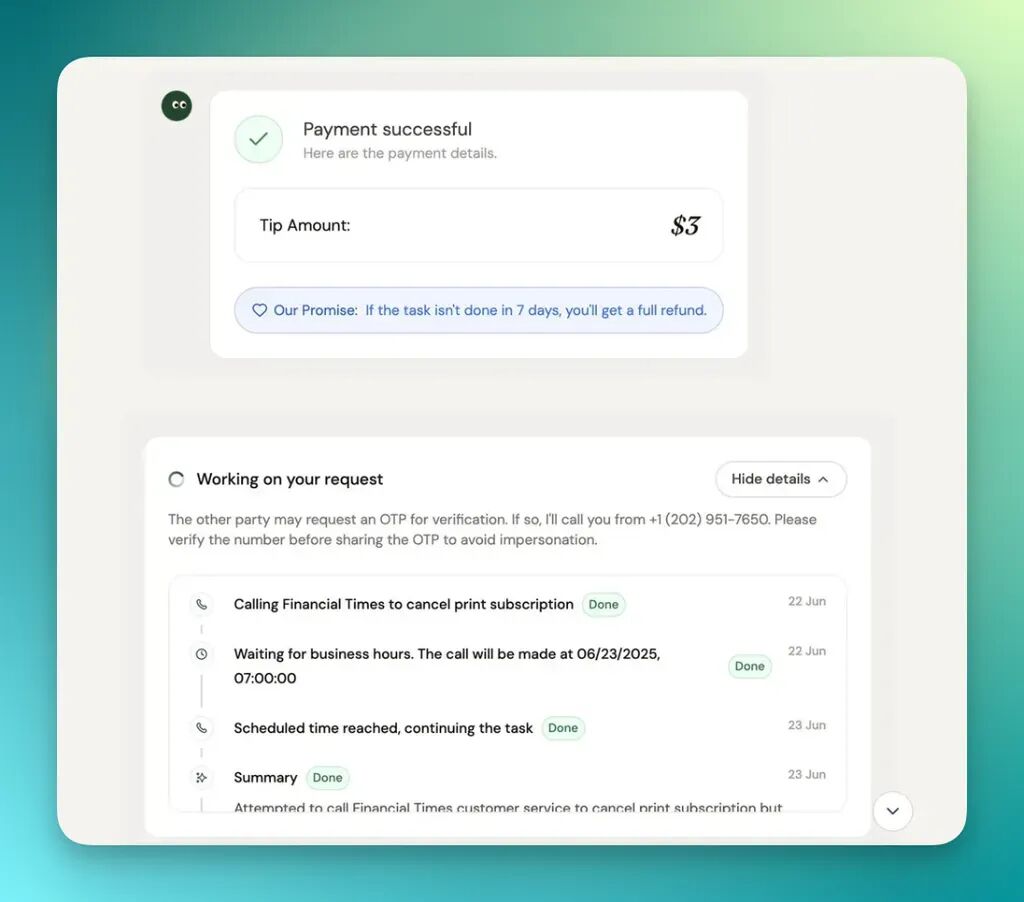
For example: want to lower your broadband bill, cancel a subscription, request a refund, or dispute an erroneous charge? Pine AI's AI Agent, once authorized, dials, queues, and negotiates with customer service on your behalf until the matter is resolved.
Pine AI's workflow
From its App Store description, it can immediately cancel subscriptions, automatically negotiate bills, help users save money — even offering a "pay only if successful" model: no fee unless it actually saves you money.
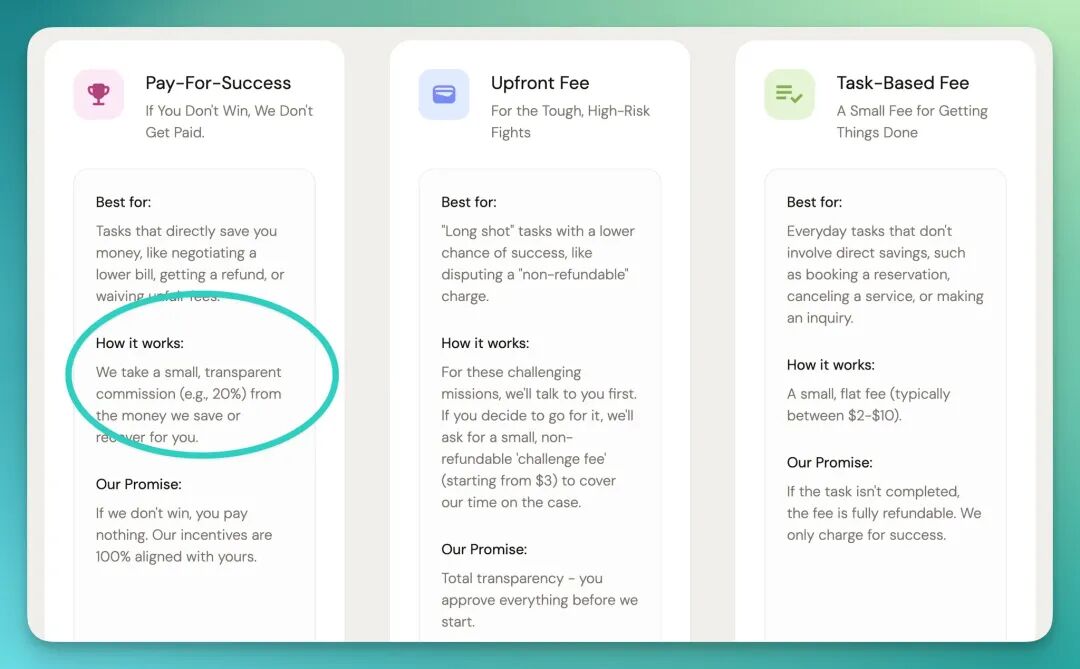
Pine AI's pricing mechanism
Overall, it provides a consumer service of "handling annoying tasks to AI," using AI to automate the traditional phone communication chain into a personal Agent.
What's their growth trajectory?
Pine AI officially launched in early 2025, riding the "consumer Agent" concept.
Its stated mission is explicit: reduce user wait times on customer service calls, lower communication stress, and improve handling efficiency.
Voice call Agents impose demands on technology, process, and regulatory compliance. Being operational indicates the team has built out foundational infrastructure and cleared early-stage hurdles.
Who's running the show?
Pine AI's CEO is Chinese founder Stanley Wei (former CSO & COO of Agora Inc.). According to multiple reports, he was inspired to start the company after enduring a grueling credit card dispute process.
Pine AI has completed multiple funding rounds to date.
From a product standpoint, this is a team that moves fast and has deep understanding of voice technology and consumer interaction design.
Why are investors betting on it?
Pine AI's appeal comes down to a few very straightforward points:
[1] First, the user pain point is extremely clear.
Calling businesses is complicated, involves long wait times, and the experience is often terrible. "Make the call for me" is one of the most universal needs in the consumer market.
[2] Second, the barrier to automating voice calls is genuinely high.
Compared to chatbots, Pine AI has to communicate in real time with human agents, understand customer service logic, and push processes forward — all of which demands more sophisticated technology and faces less competition.
[3] Third, the model is novel.
Pine AI stands on the consumer's side, making AI function as "your personal Agent." This positioning is relatively fresh within the Agent赛道, and it carries strong replicability.
[4] Fourth, the business model is clear.
Success-based pricing is an easy path to understand: the more money you save, the stronger the incentive to keep using it.
[5] Fifth, the赛道 differentiation is significant.
While most AI Voice Agent companies are going B2B, Pine AI's B2C entry point gives many investors a glimpse of a new growth trajectory.
Sierra
What is this company?
Sierra is a conversational AI company focused on enterprise customer service and support scenarios. Its website states:
"Sierra helps businesses build better, more human customer experiences with AI."
Its core product, the "Voice" module, emphasizes that Agents can speak with customers using "human-like voice quality" while maintaining multi-channel capabilities (voice, chat, channel integration).
Its customers include many major brands, such as Sonos, Casper, and SiriusXM.
What exactly is it selling?
What Sierra does is straightforward. Its core product is the Sierra platform, essentially an enterprise-grade AI Agent operating system and data platform.
Subscription renewals, return processing, billing inquiries — tasks that previously required human agents — can now run autonomously. Moreover, Sierra connects directly to internal enterprise systems and integrates smoothly with existing tools like CRMs, allowing AI to actually execute within business workflows.
Sierra has also launched voice call support, enabling customers to converse with AI Agents over the phone rather than being limited to chat windows.
Within the industry, it's regarded as a representative "AI Agent platform" company, distinct from traditional customer service bot and chatbot vendors. Its emphasis is on maintaining consistency across voice performance, action execution, and brand voice.
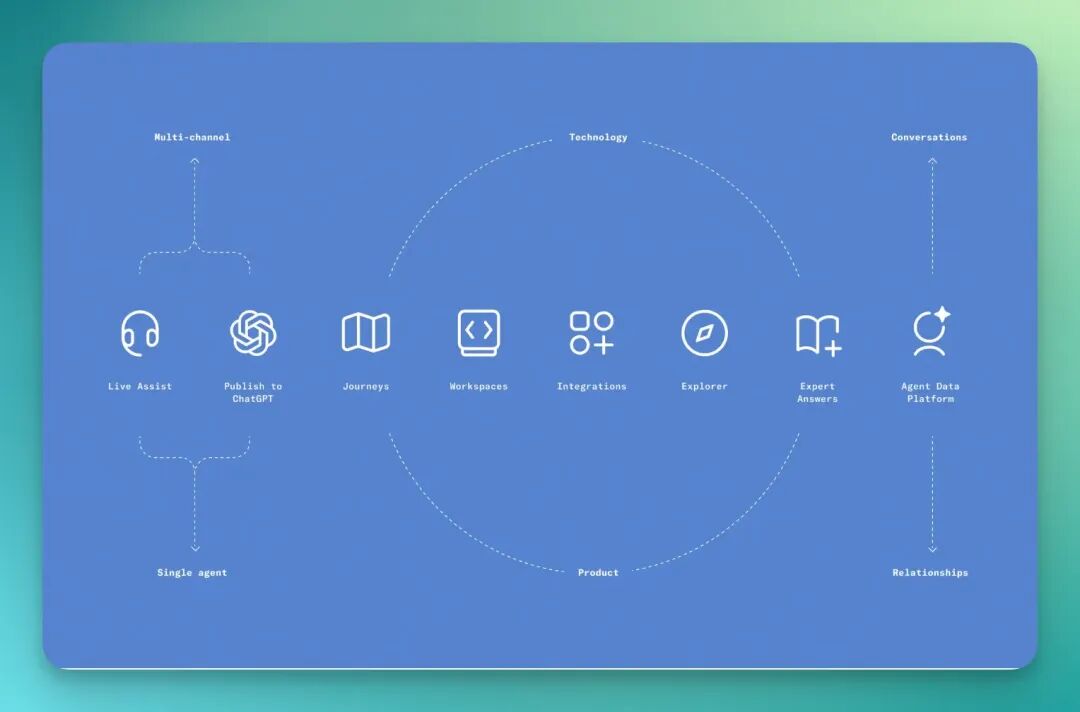 Sierra Agent OS 2.0
What's its growth background?
Sierra was founded in 2023 in the United States, but from day one, it was no ordinary startup.
Its early customers were already heavyweights in the enterprise market: SoFi, Ramp, Brex, plus massive-scale companies like SiriusXM, ADT, and Thrive Market.
Landing customers of this caliber means Sierra's product wasn't "something for SMBs to try out" — it could genuinely withstand the complex systems and high demands of large corporations.
Sierra has raised $635 million in total funding to date. The September 2025 round of $350 million sent its valuation soaring to $10 billion.
Who's running the show?
Sierra's founding team has two core members.
Bret Taylor is the former co-CEO of Salesforce, a board member at OpenAI, and was involved in creating Google Maps, plus served as Facebook CTO.
Clay Bavor is a Google veteran of nearly two decades. Together, these two give Sierra what amounts to a "maxed-out configuration" in resources, connections, go-to-market, and product insight.
Why are investors betting on it?
Sierra's valuation isn't built on telling some grand "AI story." It's because the company has genuinely grasped the pain points of large enterprises.
Bret Taylor's years at Salesforce gave him granular understanding of Fortune 500 needs — security, compliance, system integration, and other major concerns. His role at OpenAI lets Sierra access the latest models and technical directions first.
Add to that the fact that most of its customers are giants with annual revenue exceeding $1 billion, and Sierra started at the TOP tier of the enterprise market from the very beginning.
Why are investors willing to place such heavy bets?
The reason is quite practical: this company understands what large enterprises want, can actually build AI into products that "land, scale, and integrate into systems," and its founding team sits at the core of both Silicon Valley and the enterprise market.
For investors, this combination means lower risk and higher ceiling.
Retell
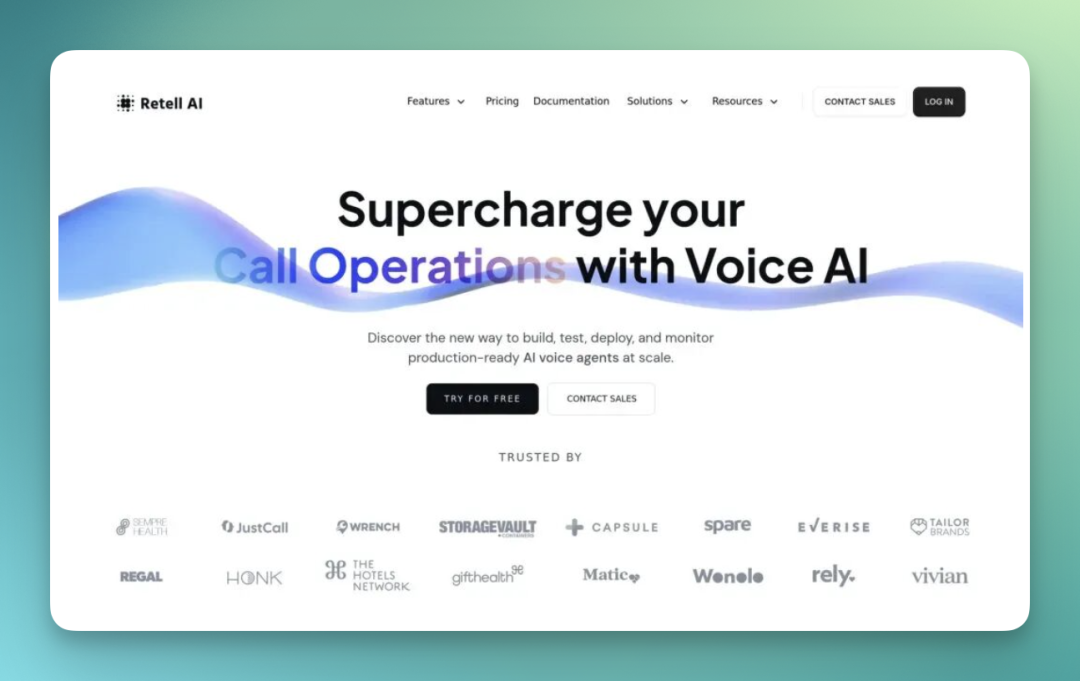
What is this company?
Retell is a platform company specializing in "ultra-low-latency voice agent APIs." Its target users aren't ordinary consumers — they're developers worldwide.
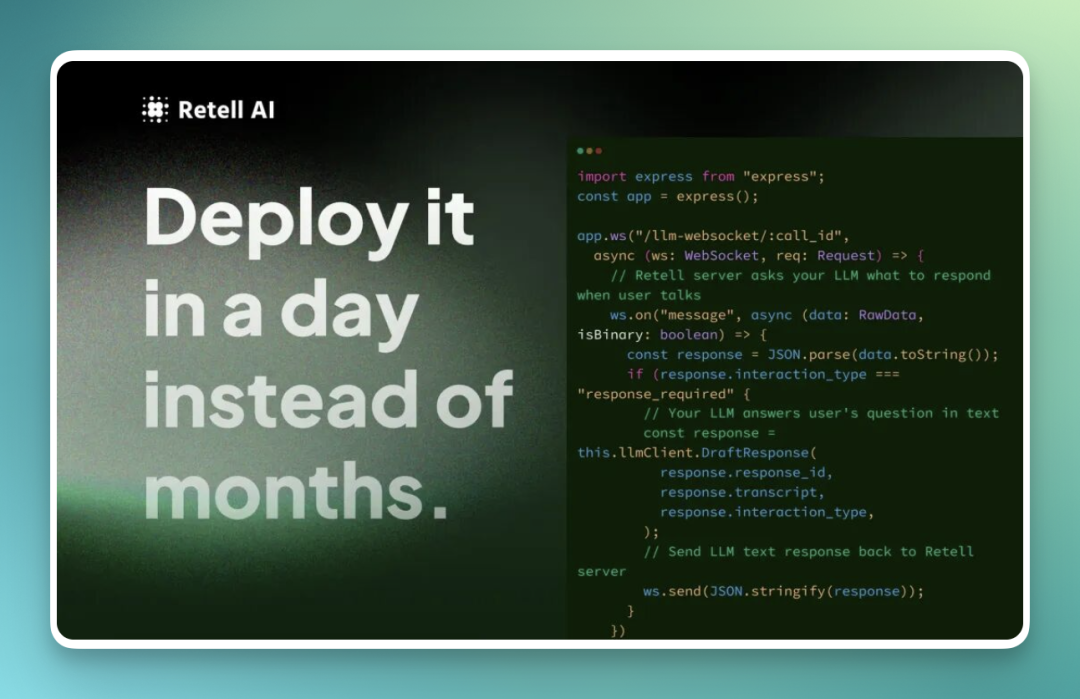
The core problem it aims to solve is simple: make AI speak to you in a way that's as natural as a real person, without lag or talking over you. Its flagship capability is keeping voice conversation latency under 500 milliseconds, an extremely aggressive benchmark for the entire industry.
What exactly is it selling?
Retell has one core product direction: an API platform that "lets developers quickly build voice agents." It took the hardest part of Voice Agents — the "turn-taking mechanism" in voice conversations — and made it the core technology.
Its turn-taking model lets AI understand what you mean even when you're only halfway through speaking, and handles natural interruptions without that mechanical "you speak, I speak" feel.
For developers, this product can be directly used to build applications for recruiting, customer service, companionship, training, research, or any voice-related use case.
As a result, enterprise users can spin up an AI Voice Agent on the platform in minutes, configuring everything from character setup and task objectives to variables and conversation flows — no need for engineers to code from scratch.
Unlike many tools that only handle text chat, Retell can actually "make phone calls." It can receive calls and proactively place outbound calls, engaging users in natural conversation. The experience is far smoother than traditional bots.
More importantly, it handles real-world phone processes like keypad IVR navigation, call transfers, even batch outbound calling, while also interfacing with enterprises' existing SIP trunks or VoIP systems.
For more complex enterprise use cases, Retell has built out considerable "automation capabilities."
It can automatically sync knowledge bases from documents or websites, automatically summarize calls afterward, and analyze conversations for "business-critical information" like appointment times, customer intent, and order numbers.
On the technical side, they've polished the voice experience to something quite extreme — latency around 500ms, with virtually no "AI pause" during calls, and support for 18+ languages already.
Another Retell advantage is rapid upgrade cycles. They quickly migrate to the latest models like GPT-4o and GPT-4.1, so the platform's comprehension and conversational abilities improve rapidly alongside model iterations.
What's its growth background?
Retell was born in 2024 as a YC W24 incubated project.
Despite its youth, it hit the hardest technical pain point in voice AI: low latency and natural fluidity. As more and more products want to add voice modes, Retell's API has become what people commonly call "infrastructure."
This is why it's grown quickly in the developer community. Almost anyone needing voice interaction comes to test how low its latency can go.
Who's running the show?
Retell's team is heavily technical. Core members mostly come from Google, Meta, and ByteDance. CTO Zexia Zhang was one of Google Speech Translation and NLP technology's core engineers — the kind of expert who "has built large-scale voice systems at the front lines."
CEO Bing Wu previously worked on products at ByteDance / TikTok, handling global products with massive user bases and complex interactions, so he has strong intuition for "how voice, this high-real-time scenario, actually lands in products."
Co-founder Todd Li comes from the classic YC founder route, taking the team through W24 from demo to a version that could actually go live and run business — someone who turns chaotic ideas into shippable products.
The team combines big-company experience with having pushed through early-stage together at YC. They understand product, technology, and how to get things to market fast.

Why are investors betting on it?
Retell has raised a total of $5.1 million in seed funding, led by YC and Alt Capital with $4.6 million.
The investor logic is straightforward: in the future, thousands of companies will need Voice Agents, but not every company will build its own low-latency voice stack from scratch.
Rather than becoming an "end-to-end solution" giant like Sierra, Retell has chosen to be the "core component supplier" for the entire voice ecosystem.
In the golden era of Voice Agents, infrastructure companies like this tend to become standards — and tend to get truly big.
Dex
What is this company?
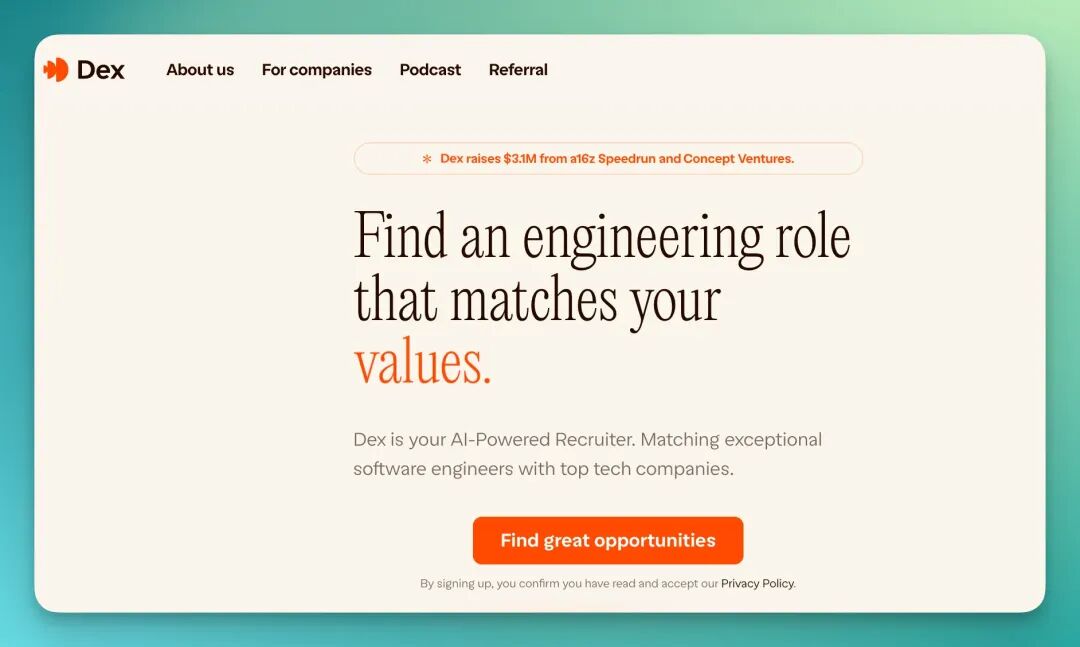
Dex does something unusual: instead of helping companies find people, it stands on the candidate's side, turning AI into a "personal talent agent" for users.
Its goal is to flip the job search process. Rather than having candidates blast resumes everywhere, AI first gets to know the candidate deeply, then goes to market on their behalf to filter, match, apply, prep for interviews, and even advise on salary.
For many people who aren't actively job-hunting but are open to hearing about opportunities, this approach is genuinely appealing.
What exactly is it selling?
Dex's core product is an AI recruiter also named "Dex." It's designed from the ground up not for HR, but for candidates.
Candidates have a quick voice chat with it, talking through their experience, strengths, what they want to do, what they don't want, their ideal team and culture.
These are details that never fit well on a resume, but the AI captures and analyzes them all. Then it goes to market to find opportunities, submits applications, gives interview prep advice, and even tells candidates the reasonable salary range for a given role.
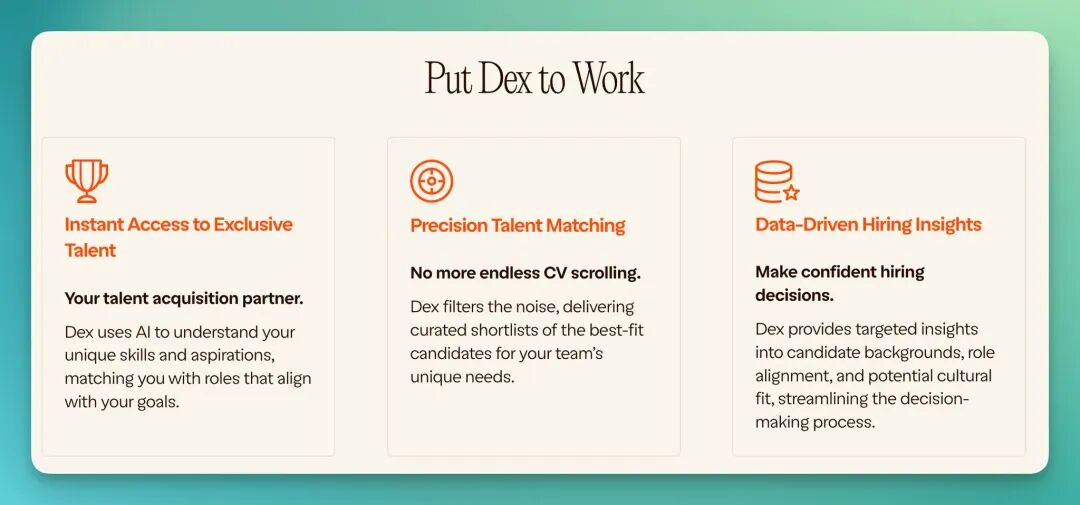
From a technology and product perspective, Dex's workflow looks roughly like this:
- After signing up, the AI agent reads the candidate's LinkedIn or resume;
- It schedules a brief call or voice conversation to gather background and preferences;
- The system scans the market for suitable positions in their direction, automatically matches them, and pushes opportunities to the candidate.
What's its growth story?
Dex is a very young company, founded in 2025 and headquartered in London.
Young as it is, it's not aiming at a small market — it's going after the global talent-matching industry, worth trillions of dollars. Recruitment has always suffered from massive inefficiency and misalignment, especially since high-quality candidates often don't have time to polish resumes and browse listings.
Dex's voice-first approach happens to hit this structural pain point squarely.
Who's running it?
Dex's founding team really knows the recruiting business.
CEO Paddy Lambros has ten years of recruiting experience and has interviewed over 10,000 candidates. He has deep, visceral knowledge of how inefficient, mechanical, and mismatched traditional processes are. His edge isn't technical — it's industry insight.
CTO Harry Uglow fills in the technology side, enabling Dex to string together voice understanding, personality modeling, and matching recommendations into a complete product pipeline.
This "domain expert + technical lead" pairing is also why Dex was able to land strong investment.

Why are investors betting on it?
In April 2025, Dex closed a $3.1 million Pre-Seed round led by a16z Speedrun and Concept Ventures.
The investor thesis is clear: the core bottleneck in recruiting isn't resume-screening technology — it's insufficient understanding of the person themselves.
Voice conversations can capture motivations and soft skills that never appear on a resume, and applying that understanding in reverse — "AI helping people find jobs" — is a fundamentally different model.
Dex didn't choose to automate CV screening. Instead, it's trying to actually do something at the "finding opportunities" stage.
EliseAI
What is this company?
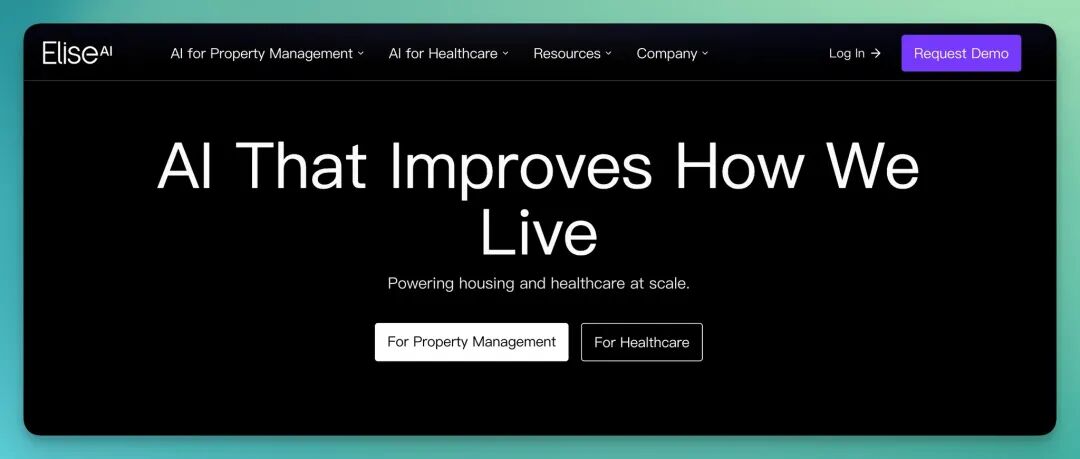
EliseAI is a unicorn valued at $2.2 billion, providing fully automated AI conversation platforms for the housing and healthcare industries.
For example, it has completely AI-ified the "rental customer service" function, allowing renters to go from inquiry to viewing to final signing — all seamlessly handled by AI.
What exactly is it selling?
EliseAI's flagship product is called "LeasingAI." This is a 24/7 AI Agent covering voice, SMS, email, web chat — the full omnichannel stack.
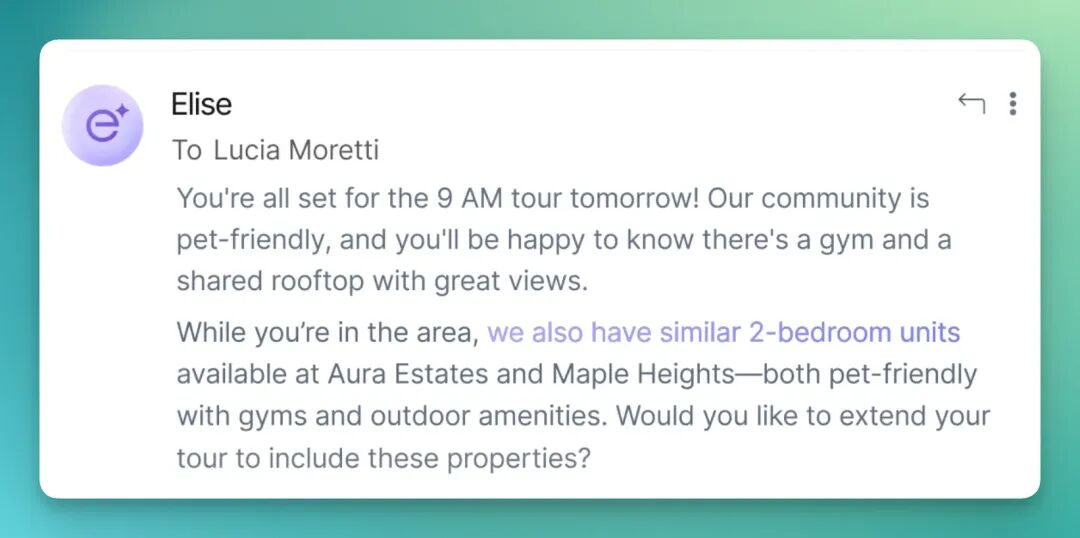 Elise Agent's messaging capabilities
Its core value lies in "actually moving the leasing process forward":
【1】When a renter sends a message, AI responds within minutes;
【2】It recommends suitable properties based on renter preferences;
【3】It can directly schedule viewings in various formats — self-guided, virtual tours, or in-person;
【4】Even follow-ups happen automatically.
Its goal is direct: boost overall "lead-to-lease" conversion rates by 30% or more.
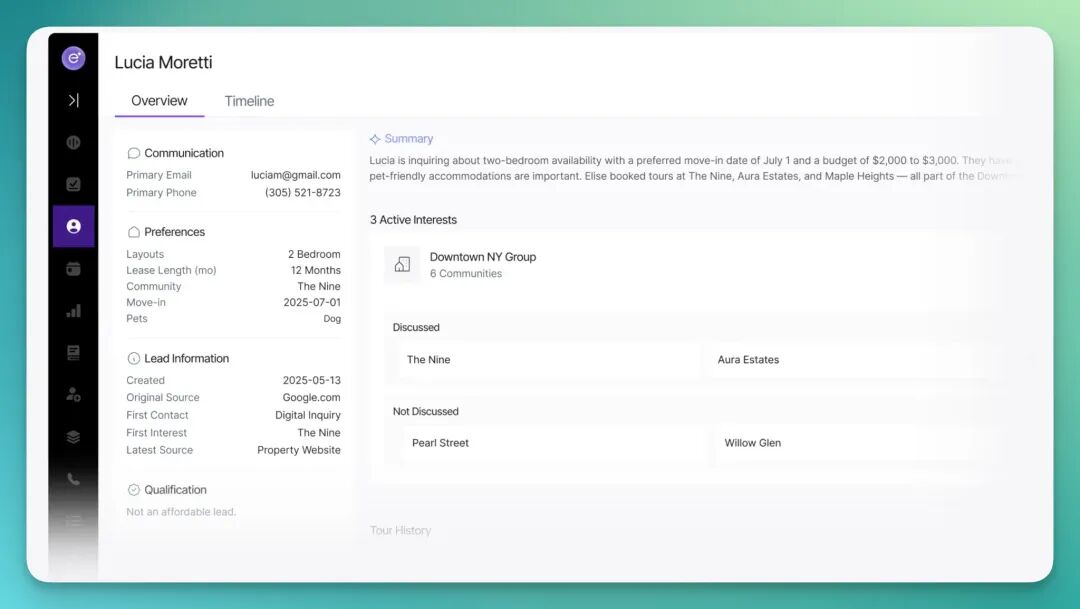 User lead parsing
What's its growth story?
EliseAI was founded in 2017 and is headquartered in New York.
Its customer scale is staggering: seven out of ten of the top 50 multifamily apartment operators in the US use it, including giants like AvalonBay and Equity Residential.
To date, EliseAI claims to have processed over 30 million real customer conversations. This industry depth and data scale is something newcomers simply can't catch up to in the short term.
In 2023, they extended their mature conversation technology into healthcare, further broadening their business boundaries.
Who's running it?
EliseAI was founded by Minna Song (CEO) and Tony Stoyanov (Co-founder/CTO).
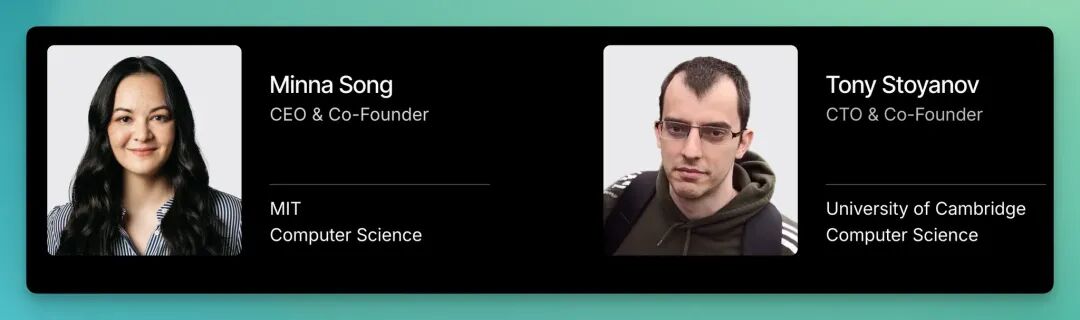
While official biographies aren't exactly voluminous, the company's execution over the past eight years shows a style of deep industry focus and heavy operational grounding.
They don't chase hype. They grind through the hard problems — deep integration with property management systems, year-by-year accumulation of conversation data, and so on.
Why are investors betting on it?
EliseAI has raised over $360 million to date. In 2025, they closed a $250 million Series E led by a16z, bringing the company's valuation to $2.2 billion.
The capital logic is clear: EliseAI is one of the very few companies that had already been digging deep in its industry before the AI explosion. It pre-accumulated system integration capabilities, proprietary data, industry understanding, and communication scenarios — all things that later AI companies can't patch together overnight.
When the large model era arrived, it only needed to swap in stronger underlying models to immediately extract greater value from the same business.
Companies that "landed in the right massive industry and started laying groundwork years ahead" are exactly the kind investors most want to back heavily.
Listen Labs
What is this company?
Listen Labs is an AI research platform heavily backed by Sequoia Capital. Its core capability is taking "in-depth interviews" — traditionally an extremely time-consuming and labor-intensive process — straight into the AI parallelization era.
To sum it up in one sentence: it can simultaneously conduct thousands of AI-moderated video interviews, compressing research projects that used to take months into a matter of hours.
What is it actually selling?
Listen Labs offers a complete, end-to-end automated research platform. It generates interview scripts on its own, recruits research subjects on its own (covering a massive user base across more than 200 countries worldwide), then launches hundreds or thousands of video or audio interview sessions.
More critically, its AI moderator doesn't just fire off robotic questions — it can read a respondent's expressions, tone, hesitation, and emotions to push deeper. This emotional intelligence makes a real difference in interview quality.
After interviews wrap up, the system can produce consulting-firm-grade insight reports and presentation materials within hours. For enterprises, this essentially rebuilds the cost structure and accessibility of qualitative research from the ground up.
What's its growth story?
Listen Labs was founded in 2023 in the United States.
Despite its youth, the company landed squarely on a massive industry pain point: brands, product managers, consulting firms, and investment research teams are all desperate to understand real users quickly.
This used to take weeks or even months. Listen Labs compresses it to hours. That efficiency gap is a natural growth engine.
Who's running it?
The company was founded by Alfred Wahlforss and Florian Juengermann, who met at Harvard University.
Both founders fit the classic profile of problem-driven entrepreneurs — they didn't set out to build AI for AI's sake. They hit a genuine problem first, then reverse-engineered a product to solve it.

Why did investors bet on it?
Listen Labs raised $27 million from Sequoia Capital in April 2025. What's notable is that Sequoia unusually led both the seed and Series A rounds consecutively — a strong signal of conviction.
The reason ties directly to the founders' own story. They previously built a viral AI avatar app called "BeFake" that quickly hit 20,000 DAU. But they had zero idea who these users were, why they came, or whether they'd stick around.
To figure out what their product actually was, they built a "research tool" for themselves.
They discovered: the tool for understanding users was far more valuable than the original product.
Listen Labs grew out of that genuine pain point — and products born this way tend to hit real industry needs with precision. Sequoia bet on this "product born from personal pain" logic, which is why they were willing to commit heavily at an early stage.
Ethos
What is this company?
Ethos is an AI-powered expert network founded by a former DeepMind scientist and a former McKinsey & Company executive.
Its positioning is fundamentally different from traditional expert networks: it uses AI to actively "discover people who actually know what they're talking about." It targets private equity firms, hedge funds, and consulting shops — clients who care most about information quality.
What is it actually selling?
Ethos is an AI platform connecting enterprise clients with domain experts.
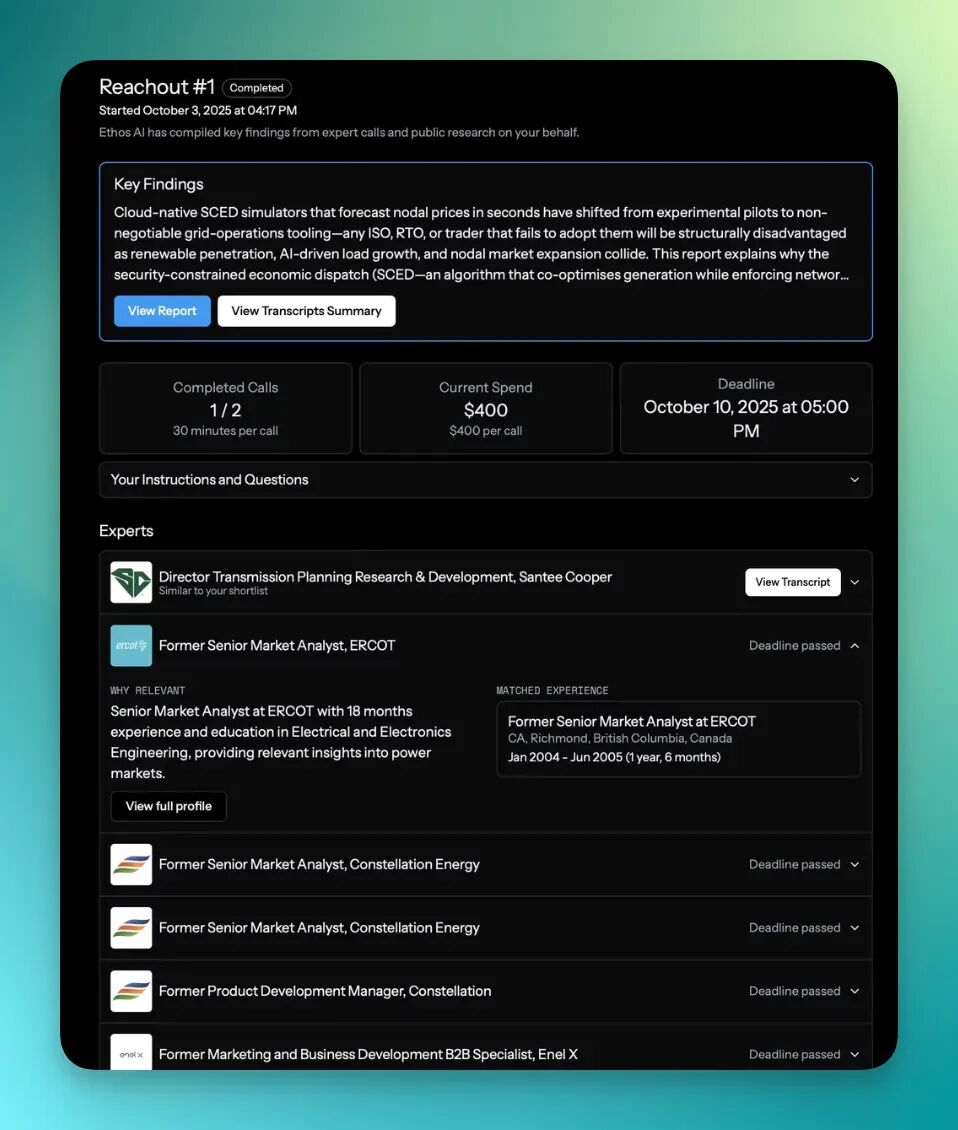
Traditional expert networks rely heavily on human recruiters scraping LinkedIn, checking titles and résumés, then manually filtering. Ethos takes the opposite approach: it ignores titles and instead has AI read massive amounts of public data — papers, GitHub repositories, blogs, podcasts — to build a vast knowledge graph that analyzes each expert's actual contributions and expertise.
When a client needs research on a sector, technology, or niche area, Ethos's platform finds the most valuable "hidden experts" directly, arranges paid voice calls with them, and automatically transcribes and summarizes the conversations.
The experience is more like using a "global expert search engine."
What's its growth story?
Ethos is headquartered in London and announced its funding in March 2025.
To date, it has already signed on more than 25 global investment firms and consulting companies as clients.
The industry dynamic here is: once a company proves it can deliver higher-quality expert matching, clients tend to become deeply dependent on it. For Ethos, this means it's entering a multi-billion-dollar traditional industry with massive room for displacement.
Who's running it?
The founding team is itself a powerful combination.
Daniel J. Mankowitz is a deep reinforcement learning expert who did research at Google DeepMind.
CEO James Lo came from McKinsey & Company and SoftBank, giving him intimate familiarity with the demand side of expert networks.
One understands AI; the other understands how the industry operates. It's the classic "technology supply + business demand" pairing that aimed the product in the right direction from day one.

Why did investors bet on it?
Ethos closed a $3.5 million seed round led by General Catalyst, with 8VC and Conviction participating.
The investor thesis is straightforward: the traditional expert network industry hasn't changed much in decades and isn't particularly efficient — AI can completely rebuild this system.
Ethos's value is that it can evaluate millions of data points in seconds to find people who have actually made real contributions — the key developer behind a GitHub repository, not just someone with an impressive title.
Compared to traditional manual screening, this is a clear dimensional upgrade. That's why capital was willing to get in early.
HappyRobot
What is this company?
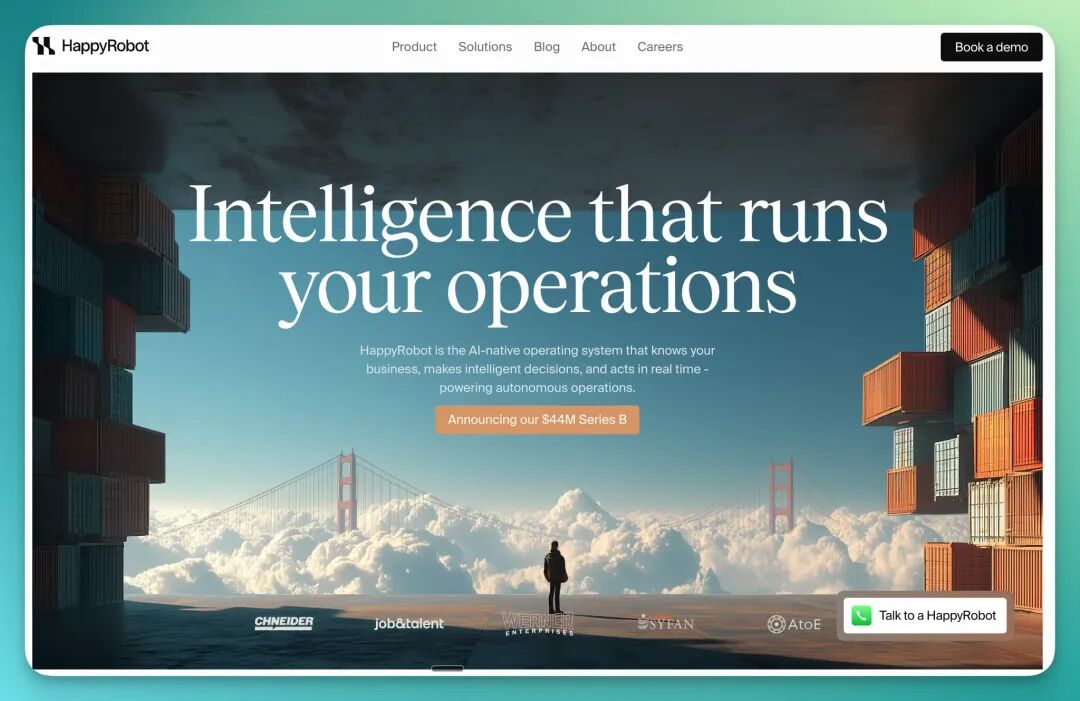
HappyRobot is an AI company focused on logistics and supply chain automation. What it does sounds unglamorous but carries enormous value: handing over the repetitive, tedious, millions-of-times-daily phone calls and communication tasks in logistics to an "AI workforce."
It has already landed industry giants like DHL — a textbook example of "AI that actually works in the real economy."
What is it actually selling?
HappyRobot provides an AI Agent operating system with a fleet of independently functioning "AI Agents."
These AI Agents automatically handle the most painful high-frequency communication tasks in logistics: tracking shipment status, coordinating warehouse inbound/outbound appointments, negotiating rates with carriers, collecting proof-of-delivery documents, and more.
These workflows used to require humans making call after call, sending email after email. The value of AI Agents is this: they don't get tired, don't forget, don't get stuck. They can run hundreds or thousands of workflows per day, turning complex supply chain communication into something automated, structured, and monitorable.
What's its growth story?
HappyRobot was founded in 2022 in San Francisco, but its growth velocity looks nothing like a typical startup. Shortly after launching, it was adopted and invested in by DHL and RyderVentures.
This is extremely rare in logistics, because large customers in this sector are typically extremely conservative.
It shows HappyRobot hit real demand: logistics is a multi-trillion-dollar massive market where internal communication still relies on huge volumes of manual, repetitive, highly inefficient operations.
If AI can automate even a fraction of this, the savings and productivity gains are enormous.

Who's running it?
HappyRobot's three founders form a classic complementary trio of technology, engineering, and industry expertise.
CEO Pablo Palafox studied at Technische Universität München, did computer vision research, and spent time at Meta Reality Labs. He was the first to see how much of logistics still depended on phone calls, emails, and spreadsheets — and proposed replacing that repetitive communication with "AI workers that can talk and collaborate." That became HappyRobot's starting point.
CTO Luis Paarup, Pablo's university classmate, brings strong engineering chops and excels at turning technical prototypes into systems that run stably in enterprise environments. He architected HappyRobot's AI Worker framework, enabling these Agents to not just make calls and write emails, but integrate with enterprise systems and handle complex tasks.
COO Javier Palafox fills in the critical industry piece.
He served as CFO at a logistics distribution company and knows where the pain points are. He helped the company focus from day one on the most刚需 scenarios — freight brokerage, dispatching, warehouse communication — enabling rapid product deployment into real operations.
This three-person combination let HappyRobot zero in on logistics's core problems quickly and land enterprise deployments with companies like DHL.

Why are investors betting on it?
HappyRobot closed its Series A ($15.6M) and Series B ($44M) within ten months, bringing total funding to roughly $60 million at a valuation around $500 million.
a16z led the A round; Base10 led the B. The speed and conviction of that financing speaks for itself.
The logic is straightforward: logistics may not be "sexy," but it's highly profitable and ripe for automation.
HappyRobot's AI models are deeply fine-tuned on logistics-specific terminology and scenarios, letting them replace substantial human communication almost immediately — with validation cycles that are extremely fast.
When an industry giant like DHL is willing to deploy at scale, that's essentially proof of product-market fit in VC eyes. So capital piled in quickly, pushing the company into "blitzscaling" mode.
Infer AI
What is this company?
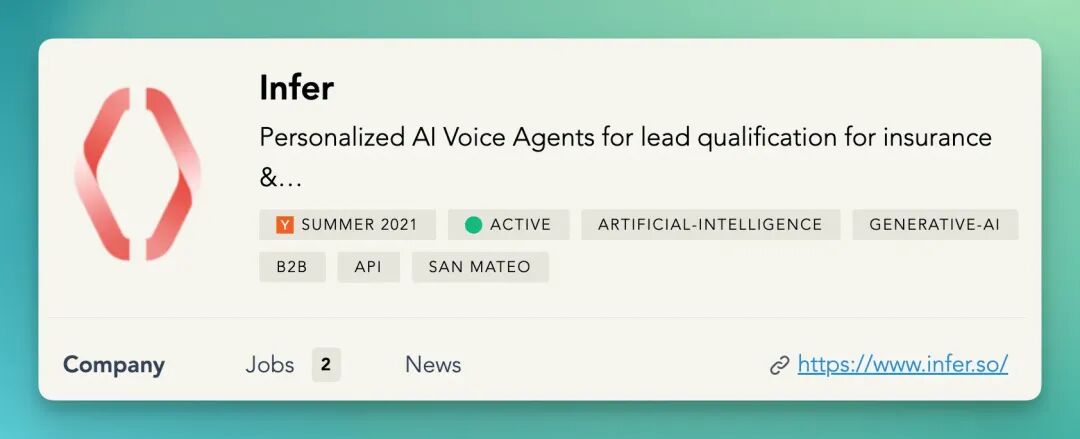
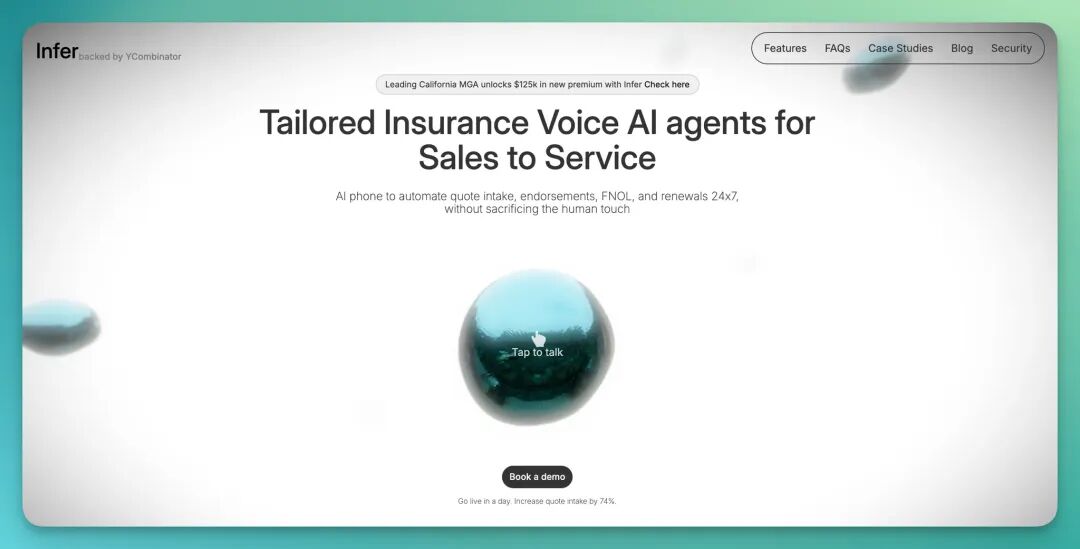
Infer AI is a YC-backed voice agent startup tackling the most tedious, repetitive, yet critical piece of the insurance industry: lead qualification.
In plain terms, it hands off all those grueling "first-round phone calls" to AI, so human teams only touch leads that are actually worth their time.
What exactly is it selling?
Infer AI offers AI voice agents custom-built for MGAs (Managing General Agents — think "quasi-insurance companies") and insurance carriers.
It answers calls 24/7 and handles classic insurance workflows: gathering quote information, processing policy endorsements, handling first notice of loss, assisting with renewals, and more.
These processes used to require customer service reps, agents, and brokers to make call after call, ask the same questions, and log the same details. Infer AI's value is automating, tracking, and never dropping these high-frequency, repetitive conversations.
For insurers, it's like hiring several "AI phone specialists" who never clock out.
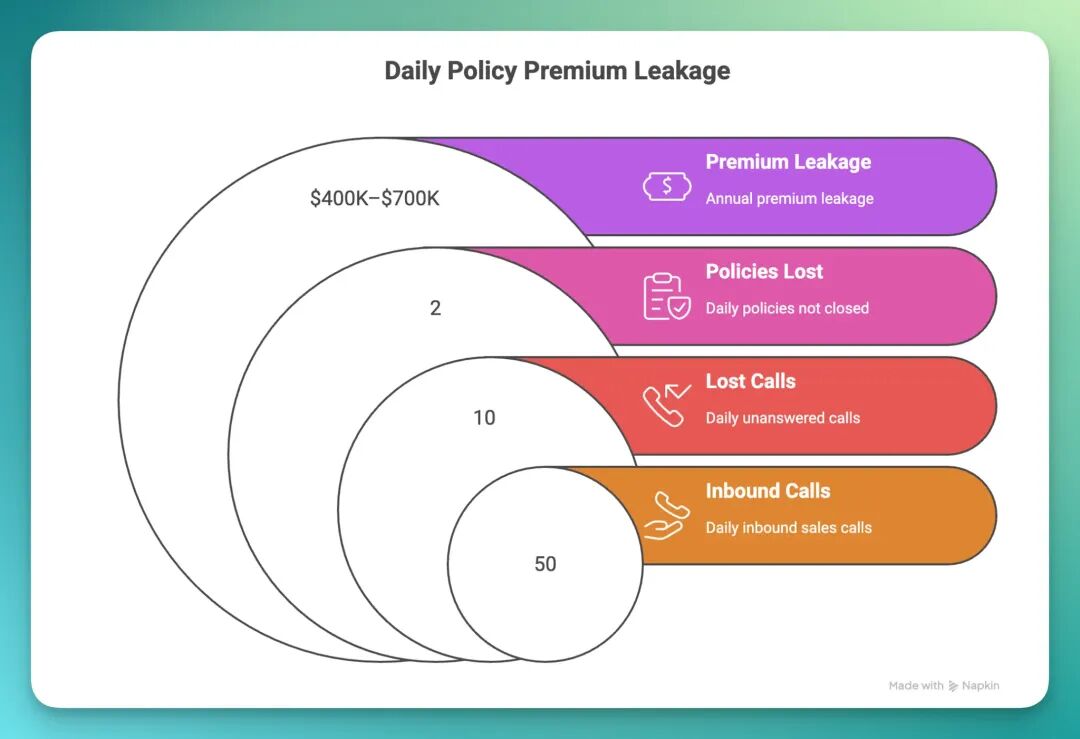
Infer AI integrates the entire workflow
What's its growth story?
Founded in 2021 as part of YC's S21 batch, based in San Francisco.
Infer AI hasn't made noise with splashy marketing or massive funding rounds, but its entry point is surgically precise: insurance is a traditional, process-heavy industry where a huge share of communication tasks are highly standardized — making them ideal for AI.
This let Infer AI quickly find its own pocket of demand within a legacy sector.
Who's running it?
The founding team: Vaibhav Saxena, Urvin Soneta, and Suneel Matham.
None are the "storyteller" type of founder. They're the classic YC archetype: find a hard industry pain point, then drill in from a narrow opening.
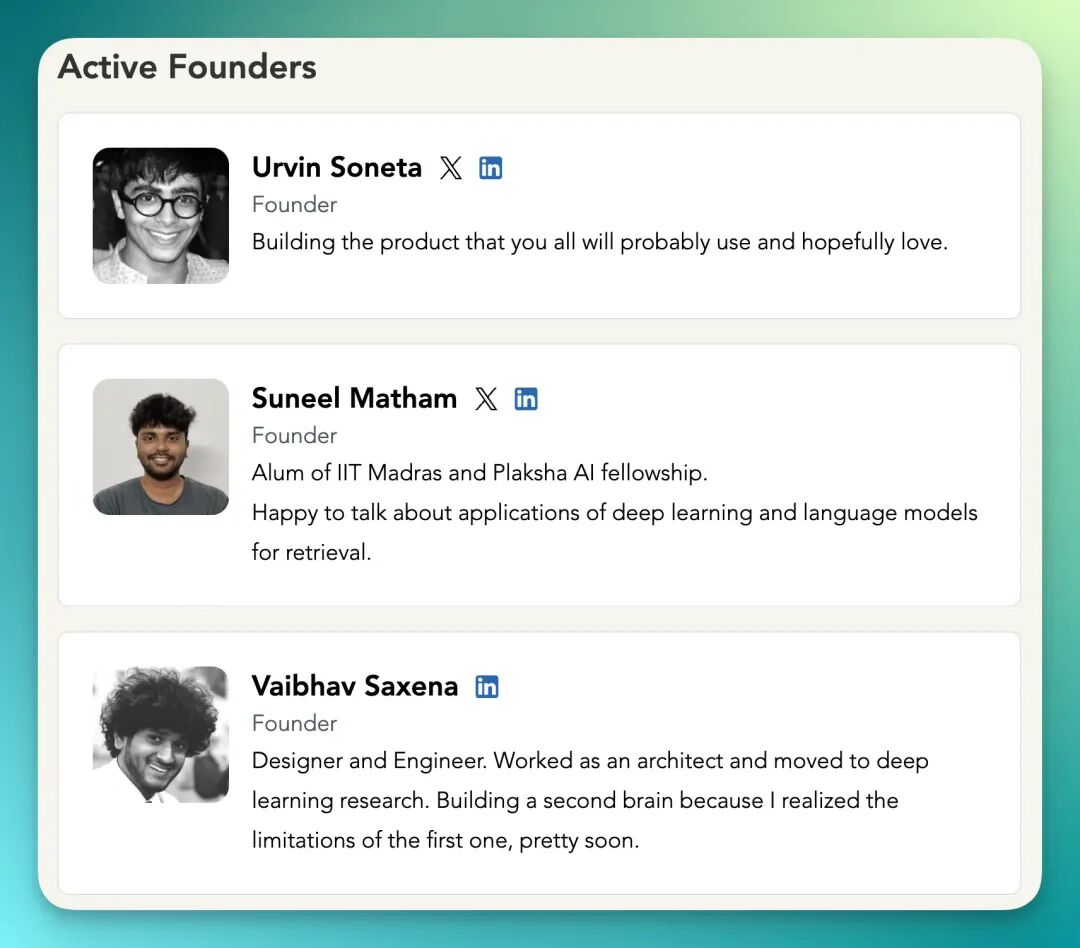
Their backgrounds aren't the flashiest, but their grasp of insurance workflows runs deep — and that's what drives product adoption.
The team structure is textbook: one deep in tech, one turning tech into product, one who knows how to land it in the industry.
Suneel, from IIT Madras, brings solid deep learning and speech model expertise; he's Infer's technical core. Vaibhav came from construction engineering before pivoting to product and machine learning, with a knack for making complex tech genuinely usable. Urvin leans closer to the business side, familiar with insurance, lending, and other phone-heavy verticals, and pushes the product into live operations.
Together they thread "tech + product + business," letting Infer move fast in high-frequency voice outreach while staying oriented toward real market needs.
Why are investors betting on it?
Infer AI hasn't disclosed much about its funding scale.
But there's a long-standing rule of thumb in insurance: over 70% of sales leads die from lack of qualification or follow-up.
That's a massive efficiency black hole: high frequency, high repetition, high cost, low conversion.
Infer AI uses AI for that first round of screening and information gathering — not just saving labor, but lifting conversion rates through instant response.
For insurance, that's a "small entry point, big value" business. It's also why YC backed them early.
Replicant
What is this company?
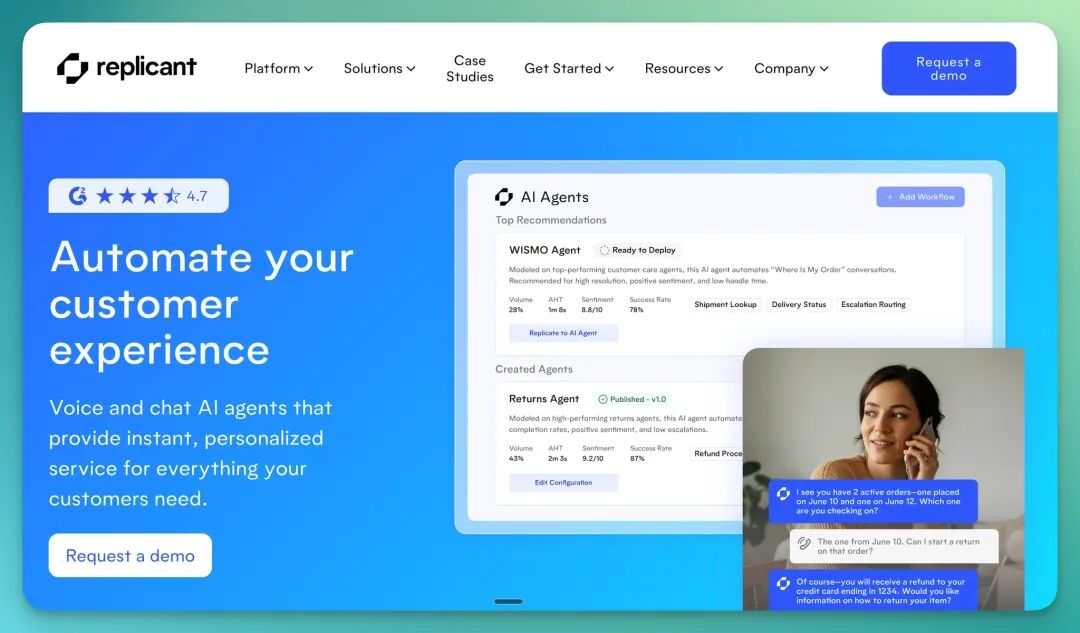
Replicant is an "autonomous contact center" provider valued at roughly $550 million.
Its pitch is direct: use AI to replace the densest customer service calls in restaurants, e-commerce, and beyond — automating the high-volume drudgery of order lookups, appointment changes, and refund requests that get repeated thousands of times daily.
For industries long squeezed by support costs and staffing shortages, it's an AI system that relieves pressure immediately.
What exactly is it selling?
Replicant's core is a "conversational automation platform."
What sets it apart isn't whether it uses large language models; it's the training methodology. Instead of preset scripts, the AI learns from the actual calls of a company's best human agents.
The resulting voice agents don't read from a script — they solve problems like seasoned employees.
It handles both voice and chat, automatically managing order tracking, appointment modifications, refund requests, and other frontline staples.
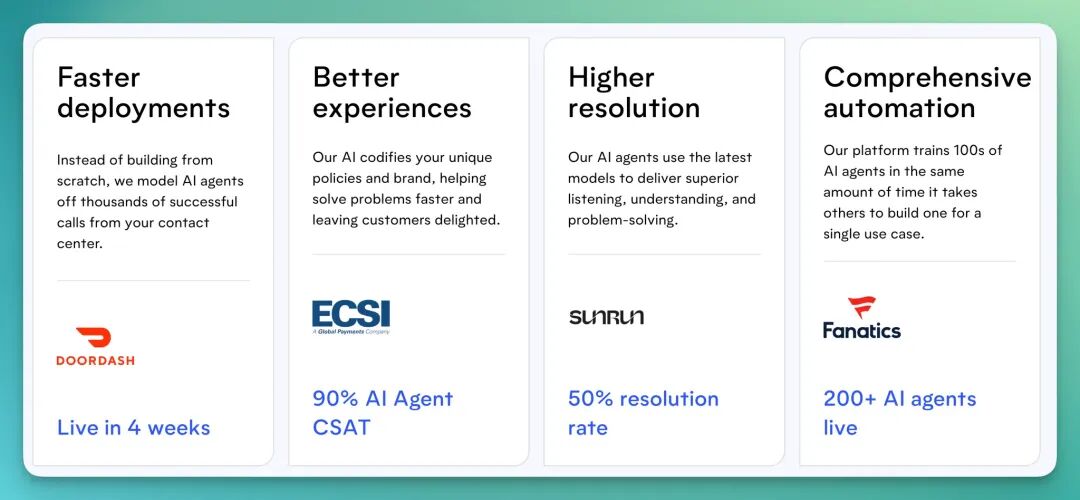
Replicant also emphasizes "200+ AI agents live" and "Live in 4 weeks," signaling rapid deployment tailored to specific business scenarios.
For enterprises, this support squad is clearly a bargain.
What's its growth story?
Founded in 2017, headquartered in San Francisco.
One highlight cited repeatedly: its AI agents score close to 90 on customer satisfaction and net promoter metrics — exceptionally rare highs in customer service.
In other words, it actually gets things done.
Who's running it?
Replicant's success is almost inseparable from CEO Gadi Shamia's track record.
A veteran of the call center world, he was the first COO at Talkdesk, a $3 billion company, and has personally managed frontline call center teams.
He knows the real pain points intimately: pandemic-era agent shortages, surging call volumes, inefficient scripts, the inability to scale what great agents do.
CTO Benjamin Gleitzman handles the technical direction. Together, they give the product both industry depth and engineering execution.
Why are investors betting on it?
Replicant has raised $110 million total, including a $78 million Series B in 2022 that brought its valuation to $550 million.
Investors' logic is clear: the core value of a call center isn't "who can chat," it's "who can solve problems."
By learning from the best human agents, Replicant anchors AI value in efficiency and resolution rate — not superficial conversational polish.
That's practically a dimensional advantage over nearly every other customer service automation company, and it's why Replicant has pulled ahead in a crowded field.
Salient
What is this company?
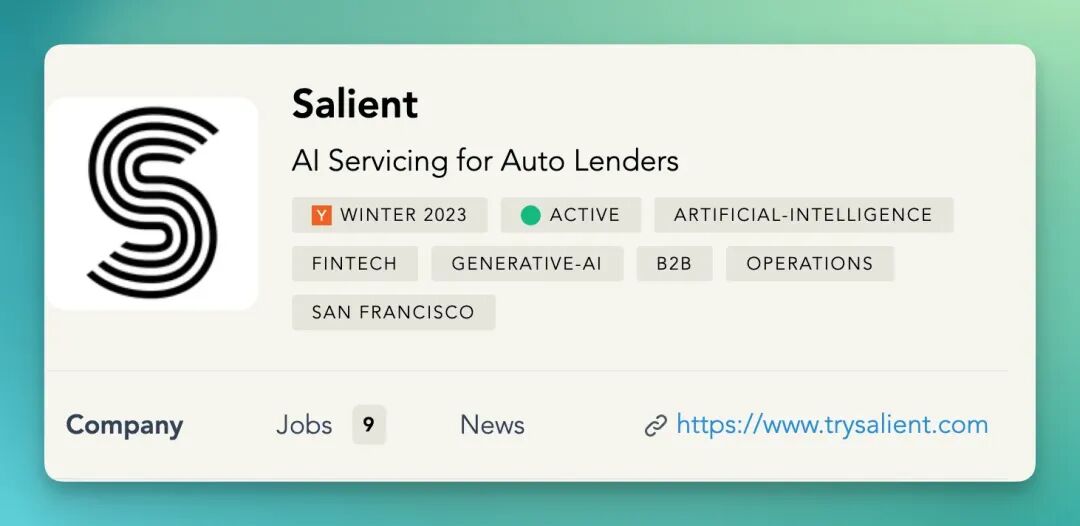
Salient is an AI platform focused on auto finance services, with a major Series A investment from a16z.
It's targeting the most labor-intensive, repetitive, and least glamorous part of auto loan servicing: collections, borrower communication, and compliance reminders.
Essentially, it's gradually replacing an aging loan servicing chain with something more automated and more intelligent.
What exactly is it selling?
Salient's product is simple at its core: let AI talk to borrowers.
The AI answers calls, sends messages, handles payment reminders, negotiates due dates, processes extension requests, updates account info — all tasks that used to require armies of agents working through repetitive queues, where things got missed or messy the moment volume spiked.
After the AI went live, response times got faster, the tone stayed consistent, and the system didn't collapse during peak hours or go dark because no one was on the night shift.
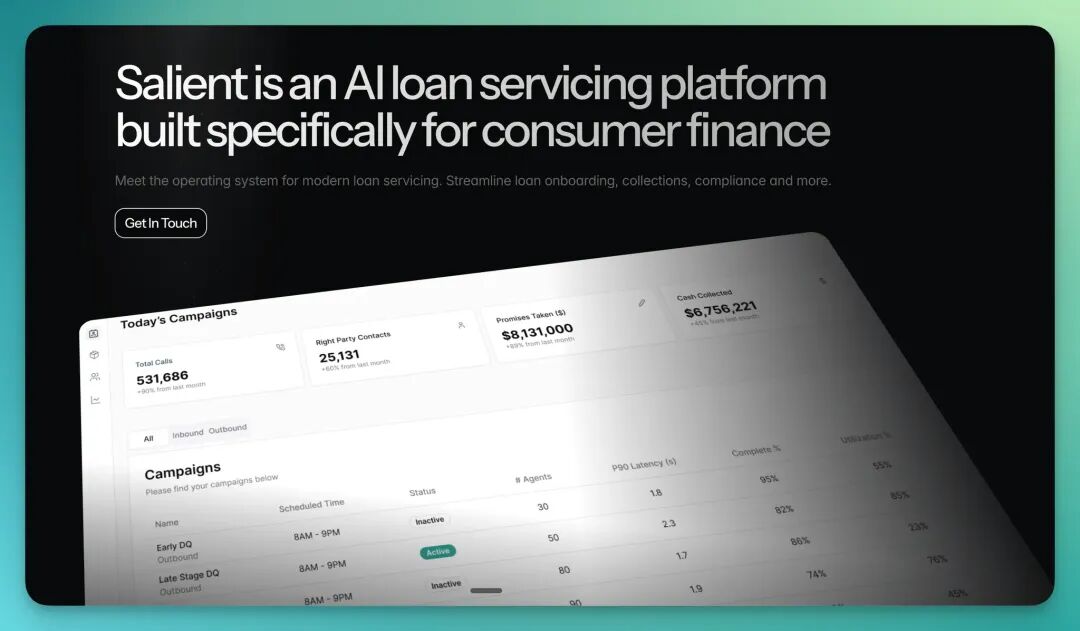
And Salient offers a full multi-channel communication suite — voice, SMS, email, web chat — with the same agent switching freely between channels.
Because financial services run on tight compliance, Salient baked regulatory requirements into its foundation from day one. Before any agent goes live, it gets trained on CFPB, FCRA, TILA, UDAP, and other rules to keep conversations within bounds.
On the implementation side, it plugs directly into loan management systems like OFSLL and Shaw Systems, plus payment and call center tools, folding AI agents into existing workflows rather than replacing them wholesale.
What's its growth story?
Founded in 2023 and headquartered in San Francisco, Salient has put up solid numbers in just two years. According to disclosed figures, its system has handled over 39 million interactions, reached more than 3 million borrowers, and processed over $3 billion in transactions — clear signs of scale effects in the post-loan servicing space.
Its customers are heavyweights like Westlake Financial and American Credit Acceptance. The fact that such compliance-obsessed institutions are adopting AI means the product has already passed through the industry's hardest gates.
Who's running it?
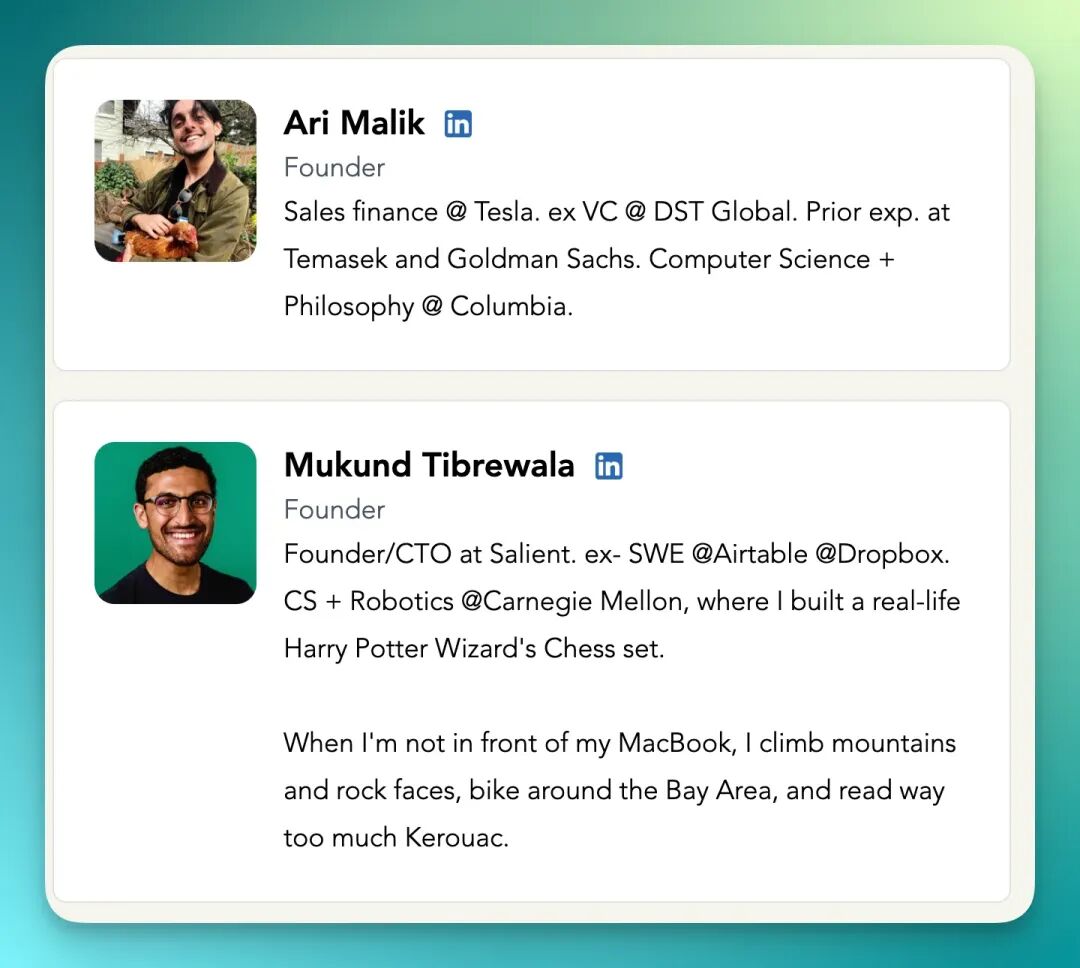
CEO Ari Malik came from Tesla, where he saw a glaring contradiction: Tesla had digitized car manufacturing, pricing, and sales to near-perfection, yet loan servicing still ran on workflows from a decade ago — people making calls, sending emails, doing everything by hand.
That gap made the efficiency opportunity impossible to ignore.
CTO Mukund Tibrewala joined from Airtable and Dropbox, bringing deep experience with complex workflow design and large-scale software architecture. From the start, this let the team build something stable and genuinely scalable.
Why did investors bet on it?
In July 2025, Salient closed a $60 million Series A led by a16z — an unusually large check at that stage.
The investor logic was straightforward: auto finance is massive, the processes are ancient, and human communication is expensive. If AI can streamline even a slice of it, the value isn't incremental — it's transformative.
What Salient is doing, essentially, is rebuilding an entire industry chain that was previously held together by human labor, this time with automation as the default.
Decagon
What is this company?
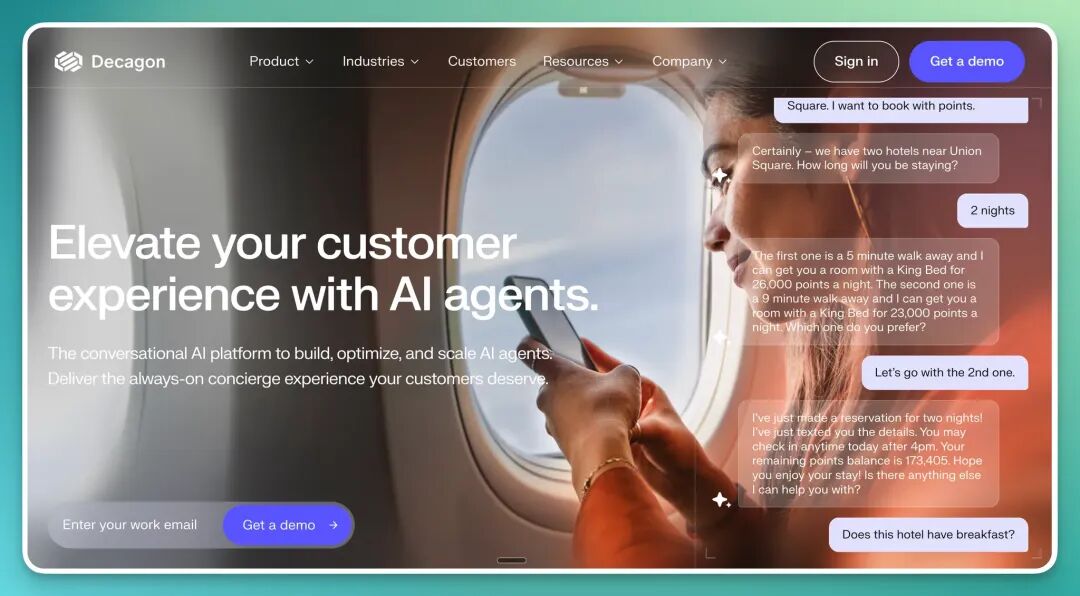
Decagon is a unicorn valued at roughly $1.5 billion, with total funding of $230 million.
It started as a text-based customer service tool, but grew fast — now it's a full-fledged "omnichannel AI customer service platform" running across chat, email, and phone.
What exactly is it selling?
Decagon began with chat and email, building its reputation on reliable, low-error text support.
As customer demands escalated, they launched "Decagon Voice," letting companies run voice, chat, and email through one unified system. Decagon claims it can handle inbound calls for account access, returns, dispute resolution, and more.
For enterprises, this matters enormously: they don't want to maintain three separate AI systems, and they definitely don't want customers experiencing three different service logics across chat, email, and phone.
Decagon's unified platform ties every channel together.

What's its growth story?
Decagon grew quickly from the start, but the past two years in particular caught the wave of surging demand for customer service automation. One thing customers keep saying: phone remains the primary channel.
Even in 2025, huge numbers of users still prefer to call directly — especially in financial services, lifestyle services, ticketing, and subscriptions.
This gave Decagon natural demand tailwinds as it expanded from text into voice. With Voice's launch, it's evolved from a "text AI vendor" into a "genuinely omnichannel AI customer service provider."
The funding pace has been equally aggressive.
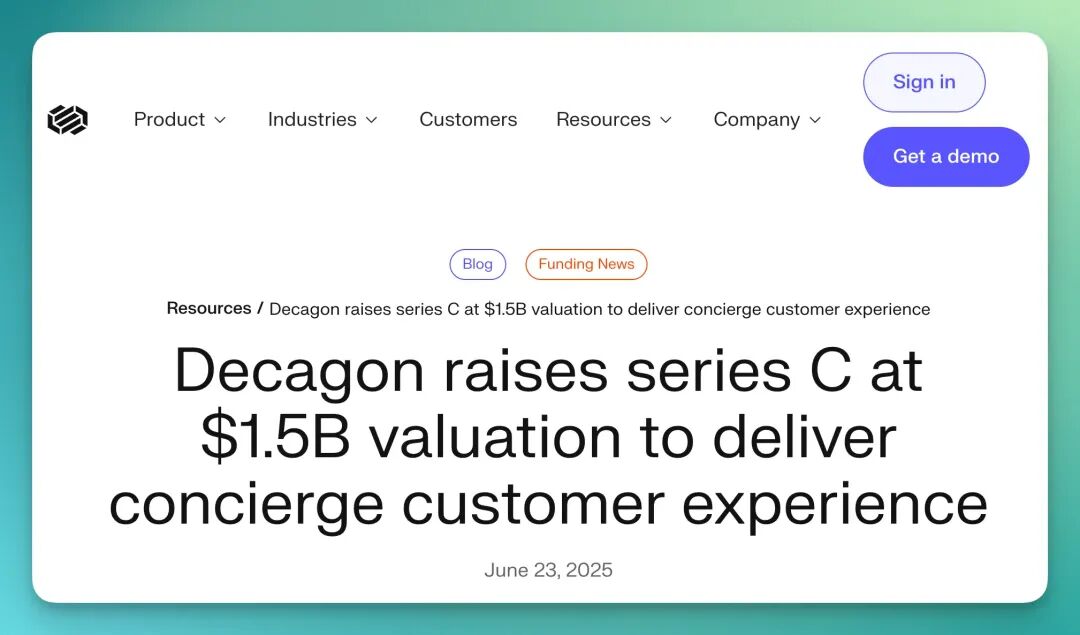
In October 2024, it closed roughly $65 million in Series B funding, bringing total raised to about $100 million. Less than a year later, in June 2025, it raised $131 million in Series C at a valuation of around $1.5 billion.
Recent media reports suggest Decagon is already preparing its next round, with target valuation ranges climbing to $4–5 billion — a sign that market appetite for "multichannel AI agents plus voice capabilities" keeps heating up.
Who's running it?
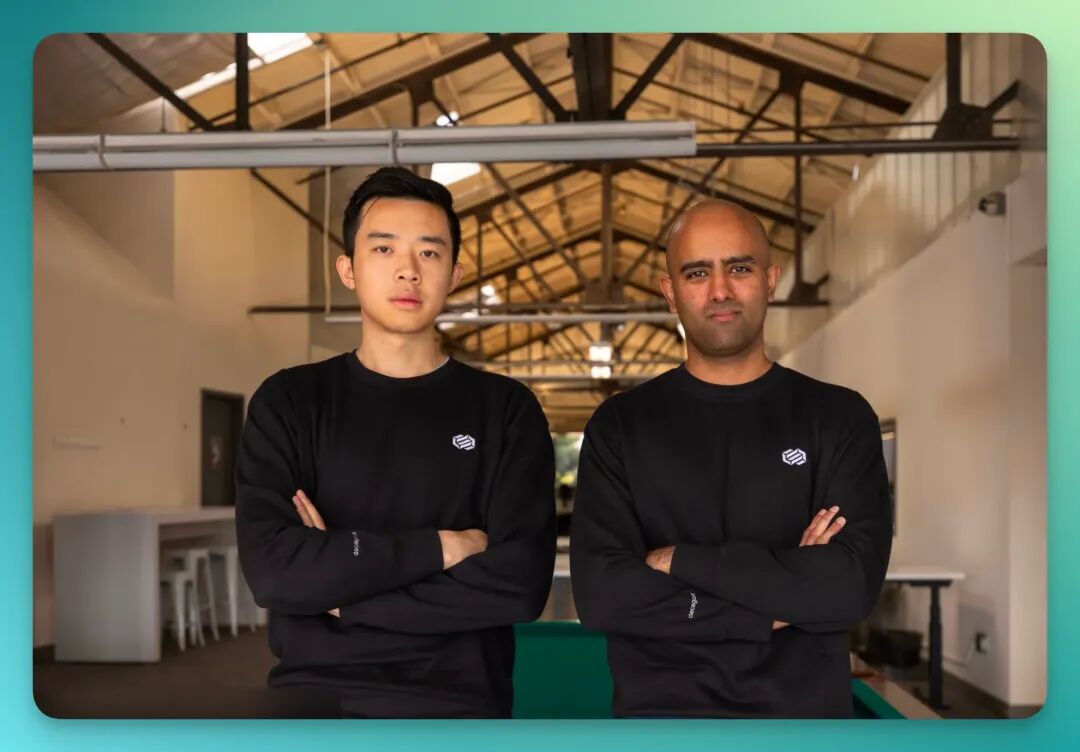
Decagon was co-founded by Jesse Zhang and Ashwin Sreenivas.
Jesse studied computer science at Harvard, previously built Lowkey (a video creation tool acquired by Niantic), and spent time at Google and Citadel. He knows products, growth, and enterprise customer needs inside out.
Ashwin came from Stanford, founded Helia (acquired by Scale), and brings deep technical chops plus a knack for turning raw technology into stable, scalable products.
The pairing is classic: one leans toward product and commercialization, the other toward technology and architecture. This let Decagon move fast on product, land major accounts, and build complete solutions across voice, chat, and email.
The team's DNA is engineering and product — they abstract complex workflows into structured modules rather than piling on features. The clearest expression of this is their "AOPs" system.
Why did investors bet on it?
Decagon's real differentiation is "AOPs" (Agent Operating Procedures). It solves a problem that's plagued enterprises for years: how to combine AI flexibility with corporate control.
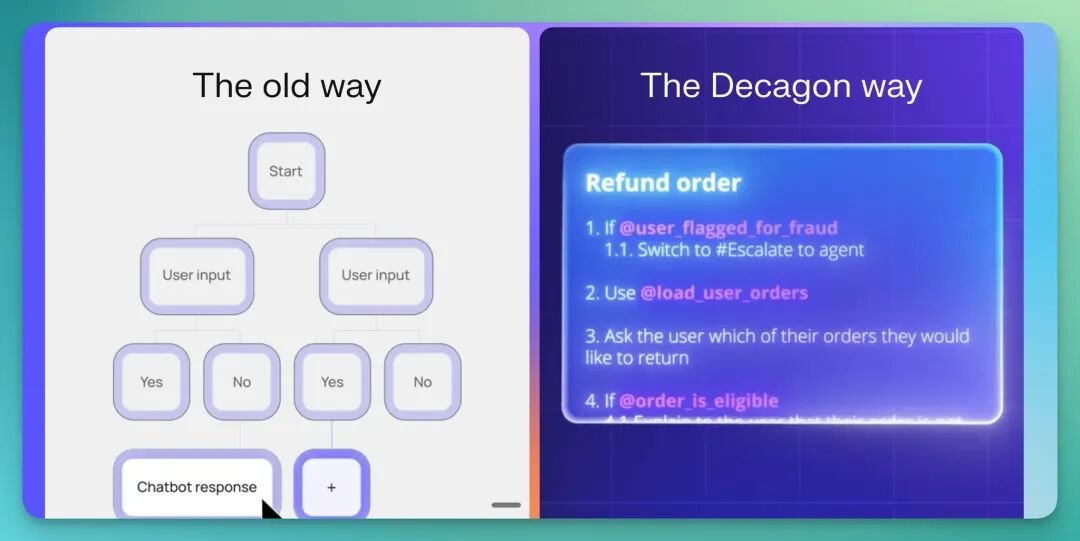
The enterprise fears are familiar — AI overthinks, improvises, gives non-compliant answers. Yet companies also want AI to understand complex problems, not just rigidly follow scripts.
AOPs sits at the intersection of both needs: it lets CX teams write instructions in natural language, like an SOP, telling the AI how to handle specific scenarios — and the system converts those descriptions into highly precise execution flows.
So the AI understands context without stepping outside boundaries.
This resonates powerfully with large enterprises, especially in financial services and subscriptions. It's why customers like Chime, Bilt, and ClassPass have adopted it at scale.
Investors are betting on exactly this — the ability to penetrate core workflows while keeping risk contained.
Outset
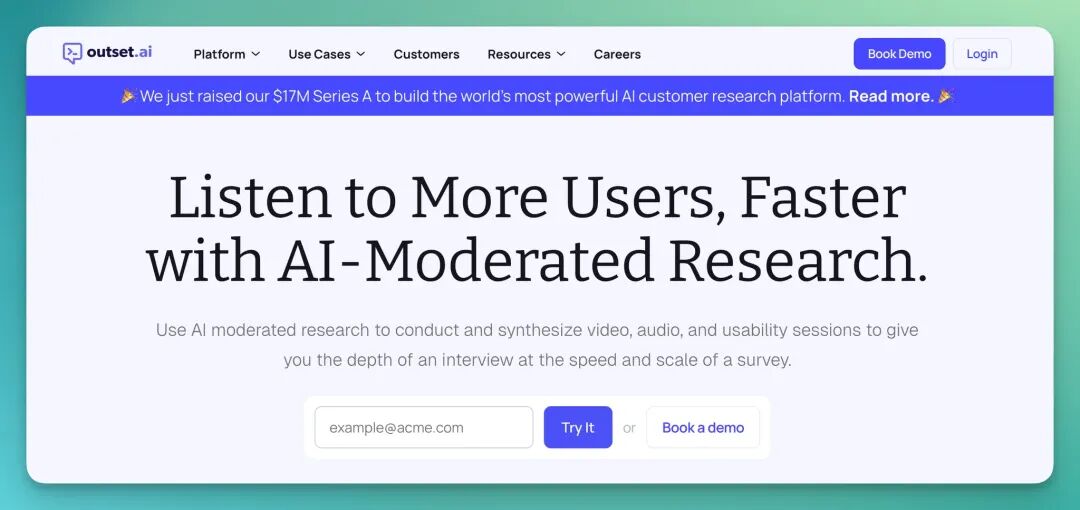
What is this company?
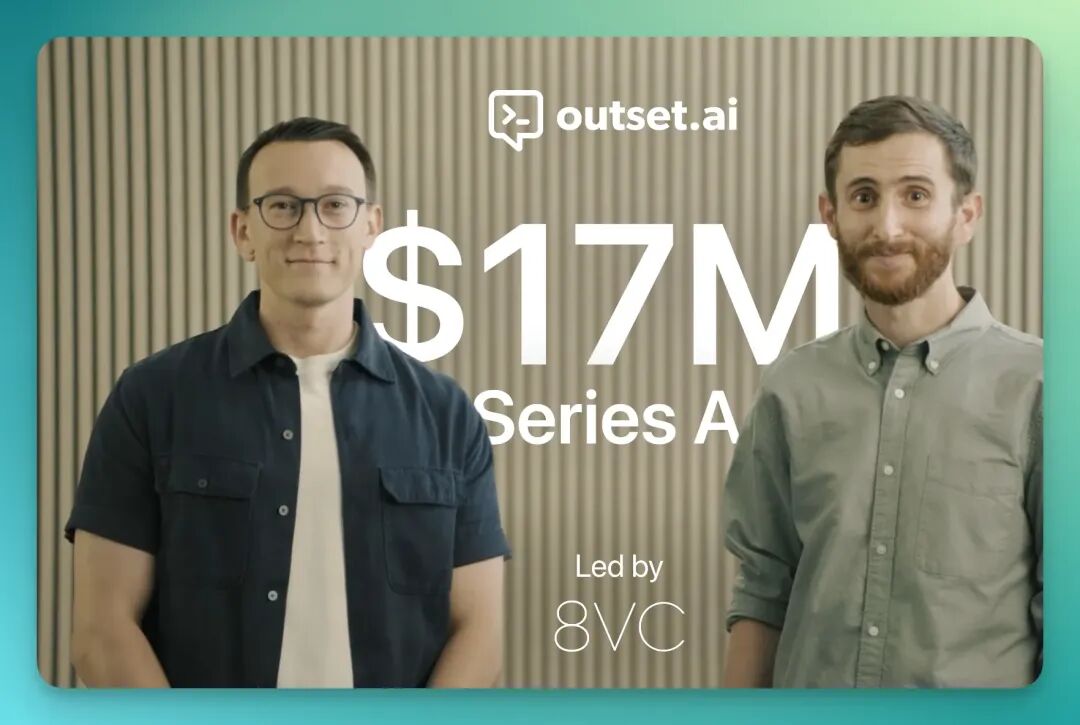
Outset is an AI platform focused on user research, which just closed a $17 million Series A in June 2025 led by 8VC.
Its positioning is clear: drag "user research" — historically expensive, slow, and hard to scale — into the AI era.
What exactly is it selling?
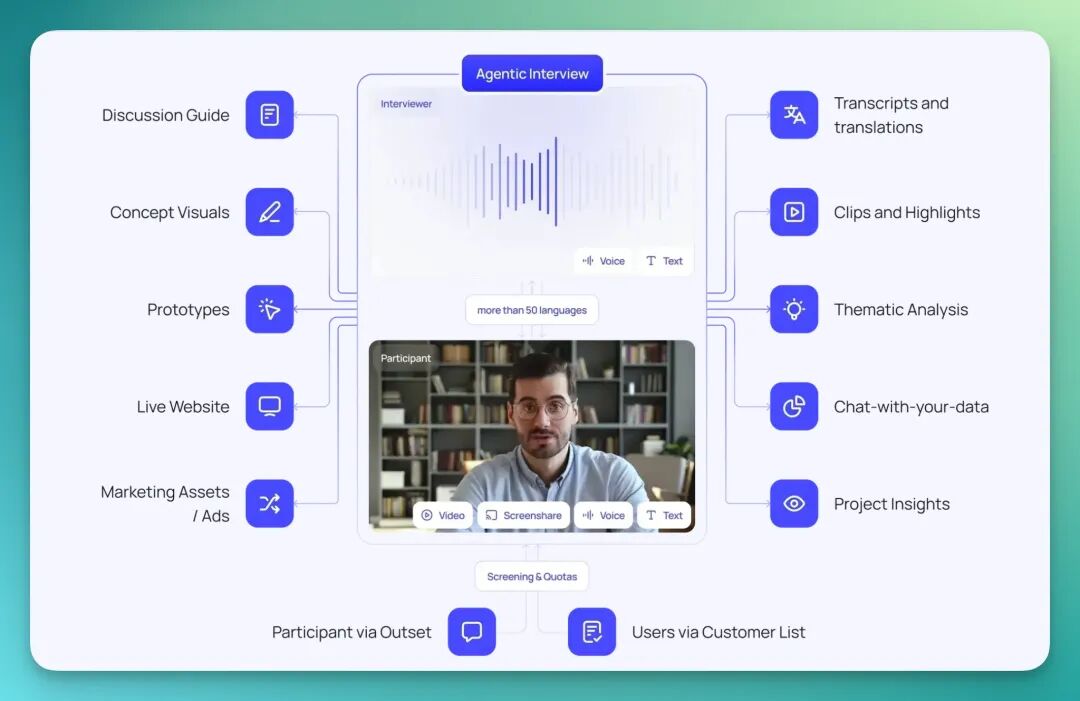
The core of Outset's product is an "AI moderator."
What sets this moderator apart is its real-time interactivity. Rather than simply firing off fixed questions, it continuously adjusts its approach based on what the user is doing. As participants share their screens, test website prototypes, or complete tasks, the AI observes their behavioral rhythm and interjects with more relevant, more probing follow-ups at just the right moment.
Prompts can be delivered by voice or text, and the whole experience feels more like having a professional researcher guiding the session — just faster, more consistently responsive, and with uniform quality throughout.

What's the context behind its growth?
The problems with traditional user research are glaring: slow processes, small samples, high costs. It's extremely difficult to gather large volumes of quality feedback in a short timeframe.
Outset accelerates all of this by several orders of magnitude.
Once a study launches, the platform can run hundreds of in-depth interviews simultaneously, wrapping up in a matter of hours. Afterward, it auto-generates transcripts, distills key findings, and maps out behavioral patterns.
This level of efficiency has made many product teams feel, for the first time, that qualitative research can actually scale.
Outset AI's funding trajectory has also been notably steady.
In June 2025, it closed a $17 million Series A led by 8VC, with other investors including Bain's Future Back Ventures. Combined with earlier rounds, the company has raised approximately $21 million in total.
Who's running it?
The company was founded by Aaron Cannon and Michael Hess.
Aaron comes from a product background, previously leading product at Untapped and Triplebyte, with earlier stints at Tesla, Pebble, and Monitor Deloitte. He knows the mechanics of making user research actually land in practice.
Michael Hess is the classic engineer-turned-founder, with a long-standing focus on building technology into scalable products.
With one partner who understands product and another who excels at engineering, they pulled Outset AI's "AI research interviewer" from concept to something that actually runs inside enterprises.
The Outset team's grasp of user-research methodology runs deep. They've abstracted the critical experiences from human-led interviews into an automatable workflow. You can feel this in the product details: every feature is designed around "faster, deeper, more authentic," not simply moving interviews online.
Why are investors betting on it?
Outset's breakthrough isn't just efficiency — it's data quality.
Many users feel a psychological burden of "being judged" when facing a human researcher. They worry about being too direct, too negative, or seeming like they "don't get it." This anxiety distorts their genuine feedback.
An AI moderator significantly reduces this pressure. Participants become more willing to voice confusion, criticize design, and flag problems — there's no one to offend, no risk of seeming "unprofessional."
The Glassdoor case illustrates this well: people tend to be more candid with AI.
For enterprises, this means Outset doesn't just make research faster and more scalable — it also has the potential to make results more authentic, cutting closer to what users actually think.
That's the core reason investors are eager to get in early.
Toma
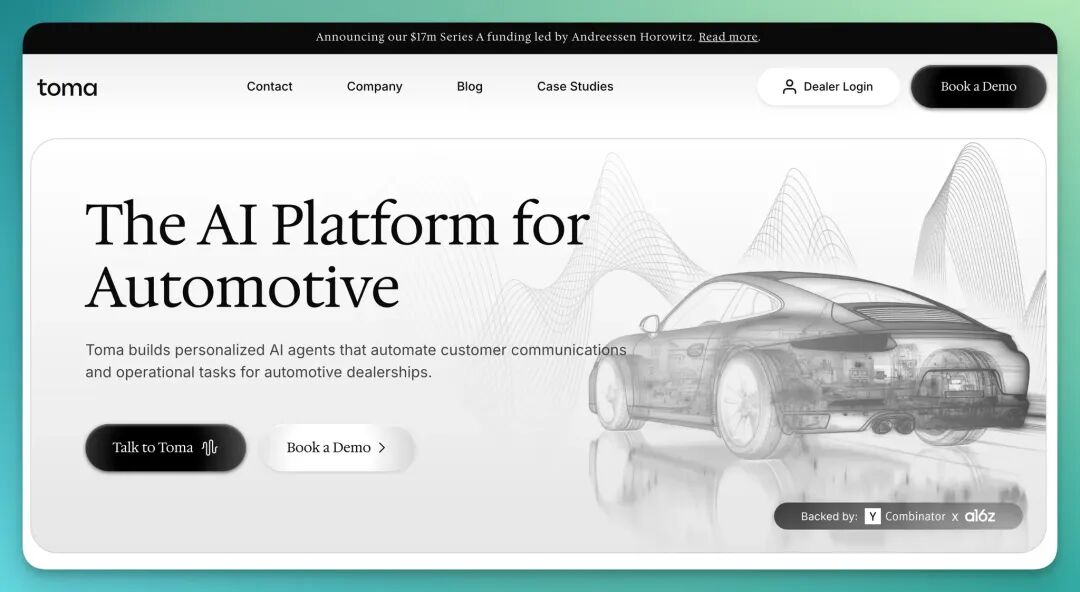
What is this company?
Toma is an AI company focused on serving auto dealerships, founded in 2024, and it quickly secured a $17 million Series A led by a16z (with participation from Y Combinator, Flex Capital, Holman Growth, and others).
Its positioning is crystal clear: make "AI employees" the dealership's frontline touchpoint every single day, automate the massive volume of phone-dependent processes, and actively position AI as a genuine "revenue source" for dealers.
What exactly is it selling?
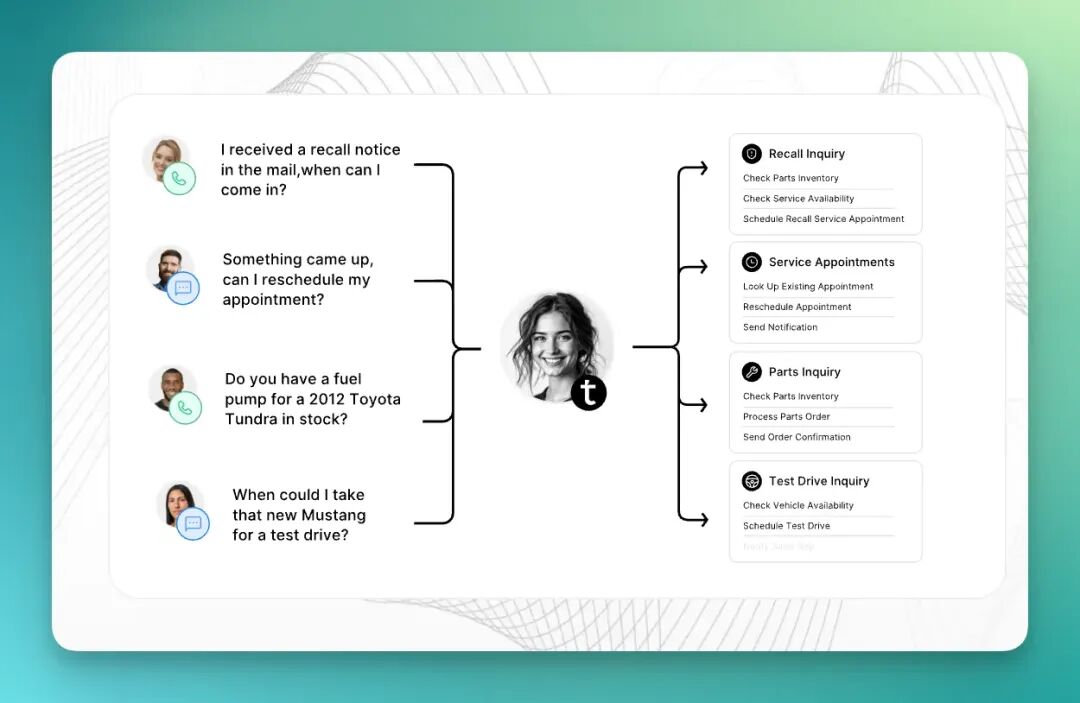
Toma offers an always-on-call "AI sales associate."
Its responsibilities start with inbound call handling and extend through multiple stages of sales and aftersales service. Here's how we've mapped it out:
[1] On the phone, it acts as the dealership's "24/7 receptionist" — every call gets picked up immediately, with no missed connections;
[2] In sales, it can independently book test drives, meaning the sales team no longer needs to spend time on high-volume basic communication;
[3] In service, it helps customers create maintenance appointments, organize parts inquiries, record vehicle information, and directly push next steps when needed.
One particularly interesting feature is "proactive recall checks."
When a customer calls in, the AI automatically queries whether their vehicle has any outstanding recall items. If it finds any, it immediately alerts the customer and attempts to schedule service.
This capability elevates the AI from "responsive support" to "proactive revenue-generating employee."
What's the context behind its growth?
Dealership operations are heavily phone-dependent, and phones are precisely where bottlenecks and missed calls happen most.
Many dealerships operate by a simple, brutal rule: "Missed calls are missed revenue."
Toma hits this pain point dead-on.
According to the team's data, the AI generates over a hundred additional appointments per month while saving staff roughly 30–40 hours of work each week. For dealerships that are already stretched thin and heavily reliant on service revenue, this value is easy to quantify and shows up fast.
Reports indicate Toma already serves 100+ dealerships. Within 90 days, one dealership logged 9,000+ appointments through Toma and added approximately $2 million in revenue.
It's fair to say Toma has found product-market fit.
Who's running it?
Toma was co-founded in early 2024 by Monik Pamecha (Co-founder & CEO) and Anthony Krivonos (Co-founder & CTO).
Monik is an engineer by training, started coding at 13, and built AI products at Uber, Lyft, and Amazon. He personally embedded himself at dealerships across the United States to understand the pain point of "high call volume, outdated processes."
Anthony brings similarly solid technical credentials, specializing in voice AI and systems integration. He handles the work of translating the team's explorations in voice interaction and business logic into deployable, scalable products.

The pairing fuses product thinking with engineering execution, building an AI Voice Agent specifically for phone handling, appointments, parts ordering, service reminders, and other tasks within the traditional auto dealership context — allowing Toma to quickly earn customer trust and achieve early market traction.
While publicly available information on the founders' backgrounds is somewhat limited, the product philosophy makes clear that they understand dealership workflows and rhythms at a deep level.
Many features reflect things that "actually happen on the lot," not concepts ported over from office settings.
Proactive recall checks, streamlined parts requests, and deeper backend capabilities now in development are all examples.
Why are investors betting on it?
a16z has been highly active in the automotive vertical, and Toma's direction aligns neatly with their long-term positioning.
Dealerships represent a massive, complex, communication-intensive industry — high call volumes, high labor costs, high service-revenue dependence. It's an ideal scenario for large-scale AI automation.
Toma keeps answering calls, keeps generating appointments, keeps improving conversion — framing the AI as a revenue-generating role rather than a cost-cutting tool.
With this positioning, Toma's value ceiling rises substantially, making it a natural key piece in a16z's automotive service chain strategy.
Giga
What is this company?
Giga is a San Francisco-based AI startup with a sharply defined focus: building voice and conversational AI agents for enterprises, enabling customer service and support teams to handle massive user communication demands with AI.
On its website, it defines itself as "AI agents for enterprise support."
The company was founded sometime between 2023 and 2024. Both founders are IIT Kharagpur graduates from India — a classic startup pairing of strong technical chops + ruthless execution speed.
It later got into Y Combinator, which sparked an early wave of attention in Silicon Valley.
What exactly is it selling?
Giga offers an enterprise-grade "voice and conversational agent platform."
Its AI can read emotions, switch between languages naturally, handle both voice and text, respond fast, and deliver an experience close to that of a human agent.
Enterprises can upload knowledge bases, define workflow logic, set compliance rules, and customize brand voice on its platform — then deploy a fully functional AI agent through a visual interface in short order.
The website promises "deployment in as fast as two weeks" and publicly showcases customer cases like DoorDash.
In short, Giga's product lets companies use AI to handle massive volumes of communication across customer service, operations support, and order processing — driving down costs and response times.
How did it grow?
Giga started as more of an "enterprise AI infrastructure" project, then pivoted based on market feedback — doubling down on voice and conversational agents, which put it on a much bigger track.
In November 2025, it announced a $61 million Series A led by Redpoint Ventures, with YC and Nexus Venture Partners also participating.
Media reports noted that the system was already processing hundreds of thousands of conversations daily, spanning e-commerce, healthcare, finance, operations support, telecom, and more. From product form to customer scale, the company moved very fast.
Who's running it?
Giga's founding team has a distinctly hard-charging, Indian-style energy:
CEO Varun Vummadi, an IIT Kharagpur alum, had a clear path toward academia and Big Tech but chose to skip further schooling and start a company instead.
CTO Esha Manideep, also from IIT Kharagpur, brings solid technical depth.
The duo got into YC and drew attention from many Silicon Valley investors.
Redpoint even said in a public statement that this was "one of their largest early-stage investments to date" — citing the team's extreme execution speed and ability to ship.
Why are investors betting on it?
From an investor's perspective, Giga has several clear attractions:
[1] Demand for voice agents, multilingual support, and emotional intelligence is rising fast — especially in customer service, support, and operations, where labor costs are high and hiring is difficult. The value of AI here is unambiguous.
[2] Its product is easy to deploy, customizable, and scalable — exactly what enterprises want.
Brands can define the AI's tone, scripts, rules, and response patterns directly on the platform. Deployment cycles are short, and adaptability is high.
[3] The founding team is reliable and executes at extreme speed — the single most prized trait in Silicon Valley investing circles.
Finally, the entire "Agentic AI"赛道 heated up in 2025, with everyone watching for "AI that actually gets things done." Giga sits squarely in the middle of this trend, and already has real customer scale — which reduces risk and expands the upside.
Cactus
What is this company?
Cactus is a San Francisco-based AI company focused on the home services industry.
It positions itself as a "24/7 AI call center" or "AI operating system," serving trades like repair, HVAC, electrical work, and general contractors — traditional service businesses that depend heavily on phone calls and run on fragmented, chaotic workflows.
For these industries, the phone line is the lifeline. Cactus wants to make sure every call gets answered, no lead gets dropped, and every appointment moves forward smoothly.
What exactly is it selling?
Cactus's core product is an AI call center system that works around the clock.
It can answer calls, identify customer needs, qualify leads, schedule service appointments, and continue follow-up via text or email. For contractors used to living by the phone, it's a permanently on-duty front desk and assistant rolled into one.
The website hammers home one point:
"Every missed call is lost revenue."
Home services is a textbook example: many bookings are spur-of-the-moment, and customers who don't get a response immediately move on to the next option. Cactus's AI keeps taking calls through the night and on holidays, giving small companies the answering capacity of much larger operations.
Another selling point is "after-care."
The system automatically sends appointment reminders, follow-ups, and nudges for maintenance and renewals, helping service companies build steadier recurring revenue. This matters enormously for HVAC and repair businesses, where most income comes from repeat customers and annual maintenance plans.
Overall, Cactus offers a communication and scheduling system that lets traditional service businesses run 24 hours a day — fully outsourcing the age-old headache of "can you answer the phone?" to AI.
How did it grow?
Cactus closed a $7 million seed round in November 2025, led by Wellington Management and Y Combinator.
The U.S. home services market is worth over $650 billion, but phone systems are generally outdated, call centers are expensive, staffing schedules are a nightmare, and missed calls are routine.
Cactus is targeting this massive, overlooked need.
From its website and media coverage, the product roadmap is clear: start with home services, use AI to catch every call, then automate scheduling, maintenance, and follow-up — so service providers can focus on actual fieldwork instead of spending hours managing front-desk communication.
Who's running it?
Cactus was founded by Ajith Govind (CEO) and Avinash Joshi (CTO).
Ajith is a two-time YC founder with strong product instincts and rapid execution ability; Avinash specializes in system design and engineering implementation. The pair emphasizes a culture of "product-first, steady progress, and staying kind" — something you can sense even from the website copy.
Their combination fits a familiar pattern: technical fluency + real understanding of how service industries actually operate. That's a major advantage for vertical AI deployment.
Why are investors betting on it?
The investment case for Cactus is tightly focused.
Home services is a huge market with massive call volume, but tech penetration is extremely low — making it ripe for disruption.
Missed calls, unresponsive nights, scheduling bottlenecks: these are universal pain points, and Cactus's product catches each of these critical links.
Early feedback has been striking — customers report noticeable improvements in booking rates and more consistent service experience — giving investors confidence that this "actually ships."
Add in the team's YC pedigree and execution ability, plus the hot cycle around AI voice agents and service automation, and Cactus naturally becomes a bet that capital wants to make early.
The Mobile‑First Company
Who Is This Company?
The Mobile-First Company started in France and now houses its U.S. headquarters in Miami, with a crystal-clear positioning: building a mobile-first AI toolkit for small and medium-sized businesses.
Most enterprise software tilts toward large organizations — complex workflows, heavy desktop dependence, completely out of reach for small teams.
The Mobile-First Company spotted the opportunity to let SMBs get work done from their phones, embedding AI into the core tools they open every single day.
The Mobile-First Company's website is pretty creative too.
What Exactly Is It Selling?
Its product line currently spans three directions:
[1] Allo, an AI phone system built entirely for mobile.
It automatically answers calls, logs conversations, syncs to CRM, schedules appointments, and sends follow-up reminders. Allo has already been adopted by over 5,000 businesses and serves as the company's core growth engine right now.
When a call comes in, the AI automatically picks up, figures out what the customer wants, and routes the request to booking, a human agent, or further questions — a workflow the company labels "AI Answering Service" and "Smart Routing" on its site.
Here's how the workflow breaks down:
After the call ends, Allo auto-generates a log and summary, distilling the key points so team members can review and sync up anytime.
It also plugs into CRMs like HubSpot and Salesforce, plus SMS, email, Webhooks, and Zapier — making "answer call → update record → create task → send follow-up" fully automated.
Despite the mobile-first branding, it actually has both mobile and desktop versions, and onboarding is fast — ideal for small teams with no time to wrestle with systems.
From user feedback, Allo's pricing is friendly too: the basic plan runs roughly a few dozen dollars per month, fitting neatly into the budgets of modern founders and SMBs.
[2] Due (in beta), for invoice and billing management. Users can create, send, and auto-reconcile invoices directly from their phones, turning a tedious process into something lightweight.
[3] Claim (in beta), for expense reimbursement. It auto-reads receipts, categorizes them, and generates reports.
The product philosophy is consistent: make the phone the team's primary workspace, and use AI to automate the repetitive daily workflows around calls, invoices, and expenses — faster execution, less manual work.
What's Its Growth Story?
On October 30, 2025, The Mobile-First Company announced a $12 million seed round led by Base10 Partners and Lightspeed — a substantial amount in the SMB track.
The team chose Miami for its U.S. headquarters and plans to scale to a team of 30-plus, locally or remote.
Core product Allo has put up impressive growth numbers. Media reports indicate that after entering the U.S. market in early 2025, its usage and revenue grew at roughly 50% month-over-month.
Overall, the company carved out its market with a pain-point-hitting mobile-first tool, validated demand with Allo, and is now expanding with new products — clear direction, disciplined pacing.
Who's Running It?
CEO Jérémy Goillot previously led global growth at Spendesk and was an early employee there — deeply familiar with the growth playbook for SMB software.
CTO Franco Pinto handles technical and product execution, with a particular strength in abstracting complex logic into smooth mobile experiences.
Add in backing from Base10 and Lightspeed, and the team structure is textbook: growth expertise, SMB fluency, product delivery chops, plus a strong engineering lead — perfectly aligned with the "mobile + SMB + AI" combination.
Why Are Investors Betting on It?
Investors see several core reasons to back The Mobile-First Company:
[1] The SMB market is massive but chronically overlooked. Most software is designed for large enterprises; small teams struggle to find tools that actually fit them.
[2] It has already proven real demand.
Allo landing 5,000-plus business customers is exceptionally strong for an early product, and the growth velocity speaks for itself.
[3] Its positioning is tightly aligned with the moment.
AI has long clustered around big enterprises, while "mobile business operations" for SMBs remains wide open. Embedding AI into daily must-use tools like invoices, expenses, and phone calls delivers immediate efficiency gains.
[4] The team executes fast with a clear roadmap.
Expanding from phone systems to invoicing to expense management, the pace steadily builds out a "toolkit" that could eventually become an AI-native operating system for SMBs.
[5] Timing is favorable.
The 2025 trend is AI deepening into vertical scenarios, with mobile experiencing a resurgence. The Mobile-First Company sits squarely at that intersection.
As Sequoia Capital partner David Cahn puts it, we're at an inflection point.
AI is shifting from "passive response" to "active reasoning and planning," and AI agents will "augment" human workers rather than simply "replace" them.
Ultimately, AI voice agents aren't just a "better IVR" — they're likely the first mass-commercialized form of "autonomous AI agents."
Voice is the most natural, oldest interface humans use to "issue commands" and "delegate tasks" to AI.
The companies we're seeing today aren't merely "automating customer service calls." What they're building is the next operating system — an entirely new human-computer interaction paradigm centered on conversation.
Going forward, the Crossing team will continue tracking AI agent startups that achieve commercial traction in vertical scenarios, bringing you firsthand analysis and insights.