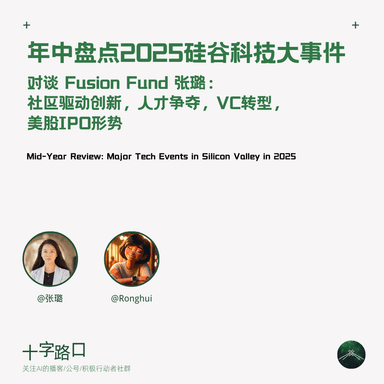

Halfway through 2025, what major events have shaken Silicon Valley?
From DeepSeek's release sending ripples through the tech industry and society at large, to the relentless race among large language models, to AI Agents becoming industry consensus, to Silicon Valley's giants accelerating their AI competition through premium hiring and massive acquisitions to compress iteration cycles — what are these "crazy" moves really about? Who currently holds the strongest position, and who faces the toughest challenges?
In this episode, we welcome Lu Zhang, founding partner of Fusion Fund, a venture capital firm focused on early-stage investments in AI enterprise applications, healthcare, and industrial automation in Silicon Valley. She helps us make sense of the major tech events of the first half of 2025, and uses the Windsurf acquisition as a lens to examine how Silicon Valley's startup ecosystem is evolving. From Meta to Google to Apple, Amazon, and Microsoft, we analyze what their key moves this half-year reveal about their strategic choices. We hope this provides valuable context for understanding the AI landscape in Silicon Valley.
PS: Some background on the Windsurf acquisition, which has drawn considerable attention recently. What started as a potential $3 billion acquisition by OpenAI shifted to Google poaching the founder and select employees for $2.4 billion, and finally ended with the remaining employees and business being acquired by Cognition Lab.
This podcast was recorded after Windsurf announced its acquisition by Cognition on July 16 Beijing time, before OpenAI released its AI Agent, which is therefore not discussed.
🟢 Part One: 2025 First Half Silicon Valley Recap
01:35 Introduction to Lu Zhang and Fusion Fund
03:10 The first half of 2025 saw an extremely active AI ecosystem, with new products launching weekly
05:17 DeepSeek made prioritizing open-source ecosystems industry consensus, shifting from company-driven to community-driven development
05:56 NVIDIA's GTC Conference demonstrated opportunities in the AI ecosystem, and the collaboration between large and small companies
08:32 Gemini begins to gain momentum
10:12 The rise of the AI Agent market
11:12 How legacy player Salesforce quickly seized AI opportunities, and why founder-CEOs make steadier, sharper decisions
13:15 Chinese AI Agents frequently launch new products, and Silicon Valley is paying attention
14:28 The core of AI Agents is whether they can handle complex tasks and execute decisions
.
🟢 Part Two: What Are Big Companies Worried About? The Windsurf Acquisition as a Case Study
15:22 The day before recording, Windsurf was acquired by Cognition. This closely watched case reflects big tech's anxiety: rapid ecosystem iteration plus intense competition
20:05 Why didn't the OpenAI acquisition of Windsurf work out? The awkward situation created by Microsoft's close ties
22:05 "For OpenAI, this has been a very challenging year"
23:00 Meta: not leading in model capabilities, ecosystem still unformed
24:13 Grok: hasn't released a code model yet, but xAI is already using internal AI coding tools extensively
25:23 Why is Meta spending huge sums to "poach" people?
27:06 Meta has consistently invested in AI, but unfortunately lacks an ecosystem; how to focus and allocate resources is a major challenge
28:07 In the AI era, founders can no longer gradually build advantages, so Meta's recent moves aim to compress iteration cycles, buying time through hiring and acquisitions
29:37 What Meta lacks isn't execution capability, but building the brain and establishing an ecosystem
30:07 Meta is pushing so hard — why hasn't Llama performed well?
32:10 For big companies right now, time is the most valuable asset
34:45 Google evolved from having different departments work on AI separately, with DeepMind focused on research, to integrating capabilities across the board
36:16 Google's challenge: in what form, and at what timing, to undergo self-revolution and optimization
37:22 Google's advantages: chips, models, cloud services, infrastructure, and applications — all in-house, making cost optimization much easier
40:15 AI development hasn't affected iPhone sales; what is Apple's AI strategy?
42:06 Apple's advantages: AI chips, hardware entry points, and the potential for platform effects
44:41 Amazon as the "pick and shovel" seller: the more model companies and AI Agent companies there are, the higher Amazon's revenue
46:27 From aligned interests to conflicting interests — will Microsoft and OpenAI decouple?
49:08 At the application and model layers, Microsoft is beginning to move beyond OpenAI as its core
.
🟢 Part Three: How Silicon Valley's Startup Ecosystem Changed in 2025's First Half
50:40 The impact of talent wars on Silicon Valley's startup ecosystem
53:40 Rapid M&A allows capital to recycle faster, which benefits the innovation ecosystem
54:18 Large acquisitions targeting talent prioritize payouts to teams, with limited returns for investors
56:13 Grok as a disruptor
57:20 The high-valuation fundraises by Thinking Machines Lab (founded by former OpenAI leader Mira) and Safe Superintelligence Inc (founded by Ilya Sutskever) — what does this signal about what capital markets are betting on?
01:00:12 Major funds lining up to register as RIAs (Registered Investment Advisors) — what has changed for Silicon Valley VCs in the past two years?
01:01:28 The speed and scale of startup revenue has shifted, and the challenge for VCs is: there's too much money to just do VC
01:02:44 CoreWeave's IPO performed well, but the US IPO market hasn't yet recovered
.
🟢 Part Four: AI Ushering in the Age of Exploration
01:05:19 Innovation in B2B applications, industrial automation, and healthcare driven by AI
01:13:00 Robotics and AI applications in the space industry
01:16:11 For over a decade, foundational technology innovation has had limited application in the physical world; AI is bringing us into a new age of exploration
01:17:45 Rapid AI development brings both benefits and risks, but technological stagnation carries risks too — don't let fear of the unknown prevent progress
01:18:33 Using AI will be a foundational skill for the future, just as learning to use computers was for past generations
Subscribe to "Crossroads" podcast 🚦 We track the industry transformations and new entrepreneurial opportunities brought by the new wave of AI technology.
🚦 "Crossroads" is Steve Jobs' metaphor for Apple — standing at the intersection of technology and liberal arts, where great products are born. AI is transforming every industry. We seek out, interview, and bring together a new generation of AI entrepreneurs and active builders in the AI era. Together with them, we explore and embrace new changes and new possibilities.
👦🏻 Host Koji: Co-founder of Jiepang / The Fair / Tangdao, and founder of AI Hacker House, a community space for a new generation of AI entrepreneurs. I believe technology, especially AI, represents the greatest value-creation opportunity of our generation. Feel free to reach out to chat, exchange ideas, and connect on what's next. Koji on Jike, Koji's website
👧🏻 Host Ronghui: Formerly worked at a USD VC fund, and spent five years as a Silicon Valley correspondent. I follow tech development and business stories. Feel free to reach out and chat. Ronghui on Jike
🎄 This podcast is supported by The Fair's Sound Forest Podcast Initiative.