On the last day of 2025, MiniMax began its IPO roadshow.

Gunning for the title of "first AI large-model IPO."
Gunning for "China's First AI Large-Model IPO."
 👦🏻 Author: Jingshan
🥷 Editor: Koji
🧑🎨 Layout: NCon
 By the end of 2025, AI had entered the deep end.
On December 31, the final day of 2025, MiniMax officially launched its IPO bookbuilding, with plans to list on January 9 — gunning for the title of "China's first AI large-model IPO."
While the market was still poring over the 716-page prospectus, many had already zeroed in on the newly disclosed cornerstone investor lineup.
In that list, we saw long-haul funds, tech giants, and strategic industry capital all showing up together. This IPO felt more like a market referendum on where China's AI unicorns are headed.
People started asking:
Why, at this particular moment in late 2025, would these long-term investors make such heavy bets on MiniMax?
🚥
Next, we'll use this cornerstone list, combined with data from the prospectus, to share our thinking on the MiniMax IPO.
The "Long-Termists" Have Gathered
If you want to gauge the quality of MiniMax's offering, the HK$2.723 billion figure is one highlight. But what more people are actually watching is:
Where this money is coming from, and why it's converging right now.
Looking at who's sitting at the table, the mix is subtle: international long-haul capital like Aspex, Eastspring, and Mirae Asset.
Most notably, these investors share a common trait: they're basically all "long-termists."
What is a "long-termist"?
The core philosophy is this: investment isn't just about near-term returns, but about long-term value accumulation and growth potential.
For capital markets, they care more about a company's growth trajectory and technological innovation over the coming years. In other words, they're willing to bet on this higher-risk arena, backing MiniMax toward more distant goals.
Take a global asset management heavyweight like Aspex — they're notoriously picky about cornerstone investments. Analysis of Aspex typically focuses on one thing: its bottom-up, fundamentals-driven approach, centered on deep understanding of individual businesses, then riding major trends through long-term holds.
This means when they open their wallets, it usually signals:
After fairly rigorous due diligence, they've concluded the company's business model is likely viable, with genuine "self-sustaining" capability — not just burning cash to tell stories.
So when 14 institutions simultaneously decided to invest as cornerstone investors, it sent a hard signal to the market: their entry means they're willing to run with this company for three to five years, or longer.
Looking closer, the participating institutions include not only global capital management giants but also strategic industry investors.
Behind this "cross-border collaboration" lies a shared value and vision:
AI technology will profoundly transform every industry, and MiniMax is getting ready for that future.
Correspondingly, MiniMax's young founding team believes AI is the赛道 (track) of the next decade, and this capital happens to be willing to pay for this "long-term certainty" — preparing for the long haul in AI's incremental market.
Yet all this confidence must ultimately return to business fundamentals.
If these investors have already cast their "votes of trust," then where exactly does MiniMax's potential lie?
Here's our thinking.
1) First, MiniMax Is a Global Company
If one word captures the feeling after following MiniMax's entire IPO process, it's:反差 (contrast).
When we think of Chinese AI companies, we habitually assume their main battlefield is domestic, in B2B, in government. But MiniMax's data shatters that stereotype.
Over 73%.
That's MiniMax's overseas revenue share as of September 30, 2025. Yes, this "homegrown" Chinese company derives less than 27% of its revenue from mainland China, with the rest coming from global markets.
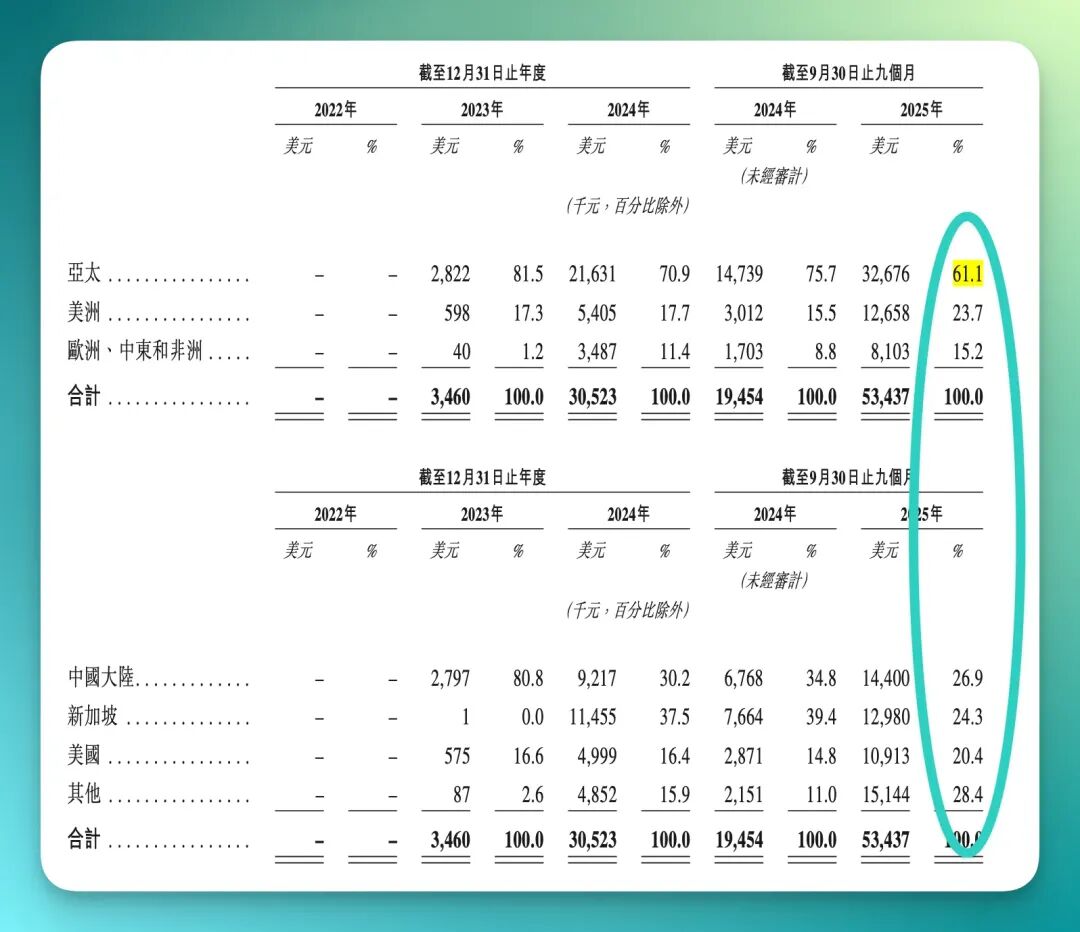
So from capital's perspective, this may not be zero-sum博弈 (game) within a single region — MiniMax has the potential to become a Global Player.
Spread the map out, and it breaks into three blocks:
[1] The entire Asia-Pacific contributes 61.1% of revenue — MiniMax's core base (note that Singapore's share is inflated by settlement location effects);
[2] The Americas contribute 23.7%, with the United States alone contributing over US$10 million;
[3] Europe, Middle East, and Africa are also climbing rapidly.
Dig deeper, and you'll find equally strong performance in individual core markets.
Notably, MiniMax's products already cover over 200 countries and regions, with enterprise clients on its open platform coming from 100+ countries.
This breadth and depth of globalization is actually quite rare.
It means MiniMax's ceiling has been raised — it's facing a global incremental market.
Why is MiniMax so committed to globalization? Why does capital value it?
The logic here is clear, built on three points:
First, ceiling height.
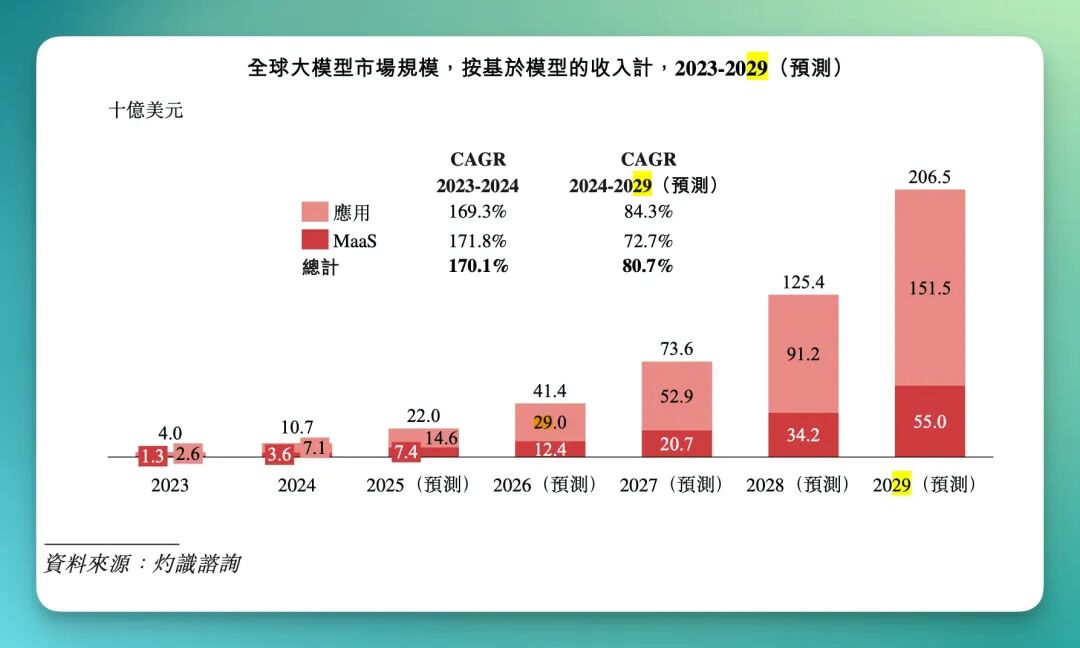
According to CIC data, the global large-model market will grow from US$10.7 billion in 2024 to US$206.5 billion in 2029, a CAGR of 80.7%.
Relying solely on the China market, the ceiling is relatively easier to see. But looking globally, the想象空间 (room for imagination) is completely different.
Second, the quality of competition.
In overseas markets, MiniMax faces SOTA-level AI giants like OpenAI, Google, and Anthropic — but that also means access to the most authentic market feedback and the most intense technological competition.
The prospectus notes that MiniMax "aimed for globalization from day one," with every model and product launching simultaneously in international markets.
This strategy of "competing alongside overseas giants" has also helped MiniMax, directly or indirectly, sharpen its product competitiveness.
As a result, MiniMax achieved: "cumulative spend of US$500 million, roughly 1% of what OpenAI has spent."
Another impressive figure is MiniMax's paid user growth curve.
The prospectus data speaks volumes. From 2023 to September 2025, in just two years, MiniMax's AI-native product paid users grew from 119,700 to 1.7716 million — nearly 15x growth.
Open platform paid customers grew from roughly 100 to roughly 2,500 — a straight 25x increase.
This shows one thing: MiniMax didn't just survive, it's doing quite well.
It also proves a proposition: the path of "China AI applications + models going global" actually works, and capital will cast "votes of trust" for it.
2) Diverse C-End + B-End Revenue, Strong Predictability
In the AI industry, "how to make money" is a harder question than "how to do technology" — and for investment logic, this is a critical point.
Many AI companies fall into the trap of B2B customization, but MiniMax chose a different path: a business model centered on C-end subscriptions, supplemented by B-end APIs.
As of September 30, 2025, MiniMax's revenue breakdown was AI-native product revenue at roughly 70%, with open platform and other enterprise services making up the remainder at 28.9%.
Within the larger AI-native product bucket, the revenue structure breaks down further.
This business model is generally seen to have certain advantages.
First, revenue predictability. Subscription models tend to generate stable recurring revenue, which matters greatly for financial planning and investor confidence.
Second, C-end products have extremely low marginal costs, meaning gross margins improve rapidly once scale kicks in.
The evolution in revenue mix also shows MiniMax's commercialization capability. MiniMax's C-end AI-native product revenue share started as a "small slice" and now exceeds 71%. This shift matters.
Why?
Because once C-end products click, gross margin修复 (repair) speed is staggering. MiniMax's gross margin has already climbed from negative territory in 2023 (-24.7%) to 23.3% in the first three quarters of 2025.
Standardized products, global distribution, predictable subscription revenue — this may be the business story capital markets actually like.
3) Full-Modality AI Large Models + AI-Native Products
First, what's MiniMax's positioning in the broader AI landscape? Where's its moat?
The answer: full-modality AI large models + AI-native products.
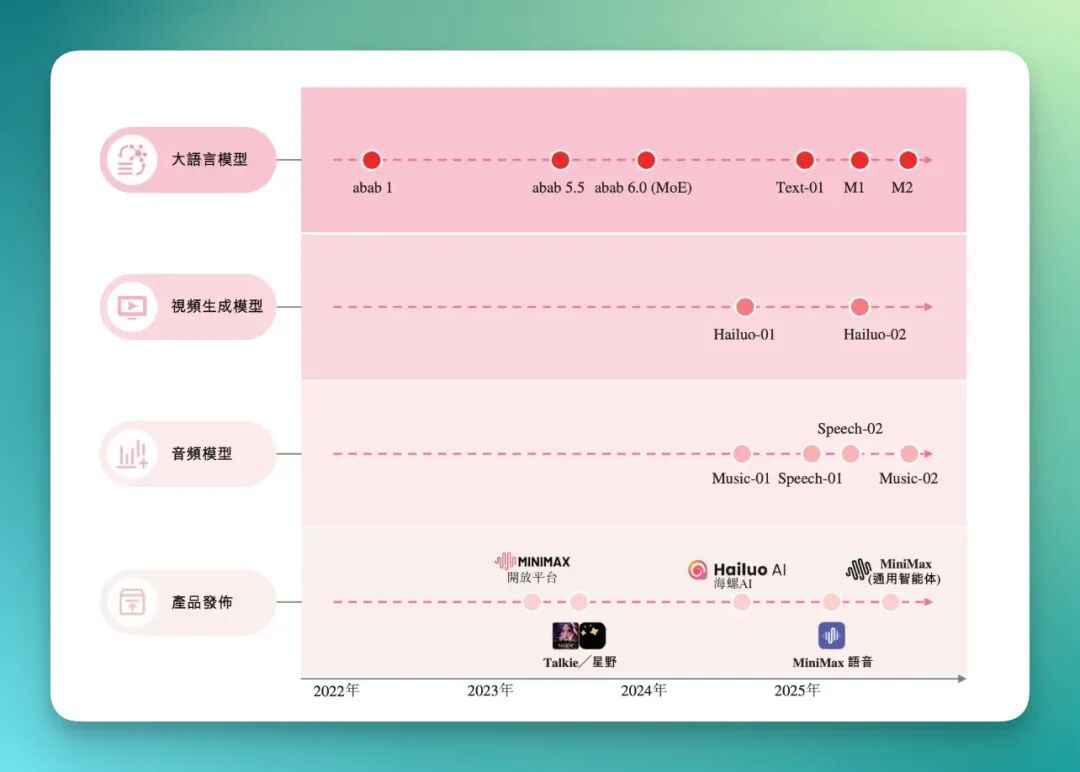
MiniMax never wanted to be a偏科生 (student who's good at some subjects and bad at others) — it wanted text, video, and voice, all of it, building toward a "technology-product-monetization"闭环 (closed loop) from the start.
We've mapped out MiniMax's current product portfolio — its model matrix comprises three core pillars:
Large Language Model: MiniMax M Series
The M series has two models: MiniMax M1 and M2.
Both generated strong reactions in the market and tech community when launched.
MiniMax M1, released in June 2025, was a notably buzzy open-source large-scale hybrid-attention inference model at the time.
MiniMax M2, released four months later in October 2025, was the latest model designed specifically for code and agent tasks.
More recently, MiniMax M2.1's release also drew considerable attention.
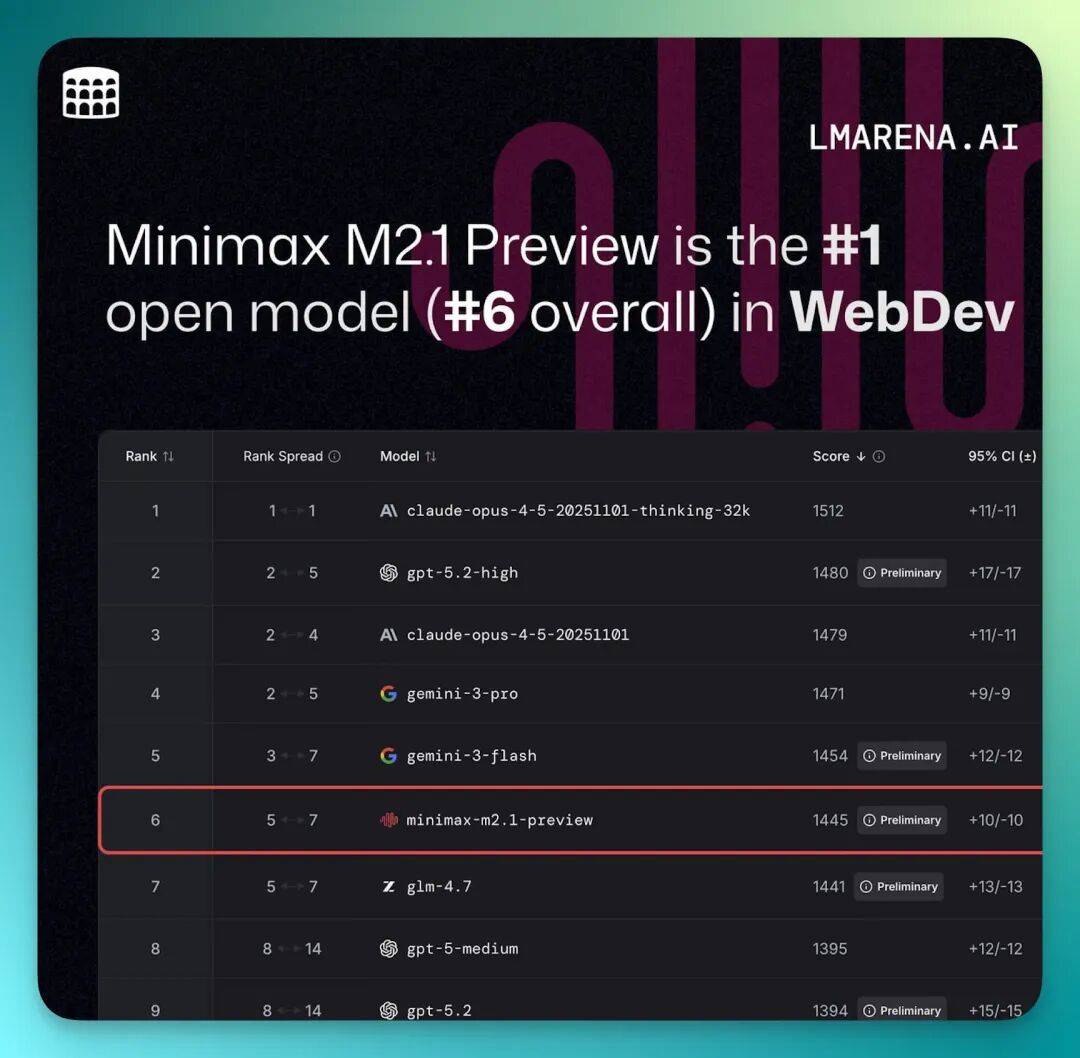
On LMArena.ai[1]'s WebDev leaderboard, MiniMax M2.1 Preview has already climbed to fourth globally, with only Anthropic, OpenAI, and Google ahead of it.
Even Ruby on Rails creator DHH called it out on X, saying MiniMax M2.1's efficiency in handling large, complex codebases was somewhat beyond expectations.
Video Generation Model: Hailuo-02 Series
In video models, MiniMax's Hailuo team has also drawn significant attention.
Hailuo-02, released in June 2025, generates high-quality video from text or image inputs.
On Artificial Analysis's image-to-video evaluation leaderboard, it ranks second globally (Arena ELO score: 1,331). Technically, Hailuo-02 already supports native 1080P HD video generation, 24fps smooth frame rates, instruction-following capability, and rendering of complex physical scenes.
Speech Generation Model: Speech-02
In speech generation, MiniMax's strength is equally notable.
Speech-02, released in April 2025, is a multilingual speech generation model. On Artificial Analysis Speech Arena's evaluation, Speech-02-HD ranked first globally for ultra-high audio quality (Arena ELO score: 1,174).
This full-modality AI-native model capability underpins MiniMax's AI-native product capability.
We can break it down by individual product:
First, there's MiniMax's breakout hit Talkie / STARFIELD. According to disclosures, cumulative users have hit 147.1 million, with average MAU growing from 2.905 million to 20.051 million.
Per CIC data, what's more interesting is the platform's user stickiness: users spend over 70 minutes per day on this app on average.
Second, Hailuo AI (video generation platform) — launched only in August 2024, yet by September 2025 it had accumulated 42 million users, with average MAU of 5.648 million and paid users of 311,100.
For a new product, this growth rate already says plenty.
Beyond that, MiniMax Voice and the open platform have also basically achieved "multiples" growth.
From 2023 to December 31, 2025, many people's clear impression of this IPO is:
MiniMax didn't take shortcuts.
It chose to plunge directly into global markets, committing to the full battlefield of full-modality technology and AI-native products.
The road ahead is far from smooth.
But now, 14 long-haul funds have provided their answer: this is an ambitious, disciplined, youthfully energetic company.
In 2026, MiniMax's story is just beginning.

References [1] LMArena.ai: http://lmarena.ai/