Where Did the Money Go? Who's Still Writing Checks? A 2025 VC Debrief With Jing Liu
VC takes a certain amount of instinct.
VC takes a little bit of talent.
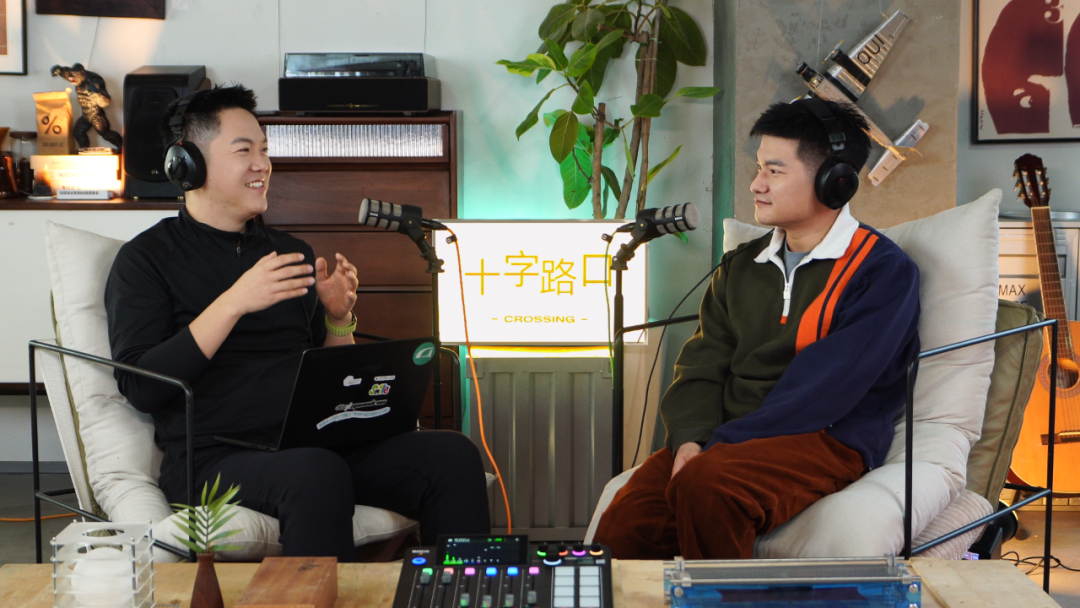
👦🏻 Podcast interview: Koji
🥷 Edited by: Crossing
🧑🎨 Layout: NCon

🚥 Is the money back? Where is it flowing? Who's making bold moves, and who's quietly positioning?
Following last year's year-end review[1], this week Crossing once again invited Jing Liu to join elsewhere[2] for a crossover episode, jointly reviewing the rise and fall, shifting sentiments, and undercurrents of China's AI primary market in 2025.
In 2025, VC sentiment swung from last year's "dispersion" and pessimism toward this year's "strong consensus" and fervor. The emergence of DeepSeek and Manus ignited FOMO among VCs for the next era; embodied intelligence and consumer electronics saw the rise of "city-based investment teams" and "China confidence"; and new species like Solo GPs, corporate capital, and novel incubators entered the fray, attempting to seize position amid the transition between old and new orders.
We hope this episode delivers value to AI founders — because understanding VC movements, tastes, and sentiments isn't for cocktail chatter, but to help you make smarter fundraising decisions: at the right time, in the right way, telling your story to the right people.
Listen on WeChat:
Listen on Xiaoyuzhou:
🎬 The video podcast is now live on @Koji Yang Yuancheng's WeChat Channels, Xiaohongshu, Bilibili, YouTube, and other platforms
Follow the elsewhere WeChat account
As the full interview is quite long (21,432 characters), here's the table of contents:
🟢 "Strong Consensus" and "Marking the Boat to Find the Sword"
2024's keyword was "dispersion"; in 2025, VCs moved toward "strong consensus." When AI became the whole village's hope, how did FOMO sentiment drive the entire primary market?
- From year-end pessimism to post-holiday fervor, what impact did DeepSeek and Manus have on VCs?
- Last year everyone was anxious about PMF — why isn't anyone talking about it this year?
- A rapid positioning battle is underway among a new generation of GPs for "China's top new-generation GP."
🟢 The Great Model Shake-up
The rise and fall of "China's AI Six Little Dragons"
- Do China's six AI unicorns combined still fall short of one Thinking Machine?
- When your biggest "sugar daddy" internet giant becomes your direct competitor.
- The disappearance of the "four foolish mega-funds" of the mobile internet era.
- What happens when models become the fastest-depreciating commodity?
🟢 Applications and AI Agents
Ignited "national confidence"
- How did Manus and Genspark give the industry a shot of adrenaline?
- Two roads lead to Rome: the prodigy and the veteran — both founder archetypes are working.
- Was IDG's post-90s fund a victory for the post-90s generation, or for mobile internet?
- What is today's frenzy for '97/'98-born founders replicating?
🟢 Confidence in Path and Anxiety Over Talent
An A16Z China employee's verdict: "Hardware is what you [China] should be doing."
- Insta360's hundred-billion market cap, Bambu Lab's five-year miracle, and Plaud's million-unit sales jointly ignited the market.
- DJI's talent anxiety.
- Embodied intelligence's "108 Arhats": boom or bubble?
🟢 Who's Making Moves?
- Mainstream fund profiles: HSG, Hillhouse, IDG Capital, BlueRun Ventures, Matrix Partners China, ZhenFund...
- Internet giant CVC landscape: Meituan and JD.com's clear synergies, Baidu and Alibaba's "financial investments," and how Xiaohongshu single-handedly stirred up the investment circle?
- Market new species: Why did Solo GPs rise, and what challenges do they face? FAs launching funds, Innox Shenzhen, Sparklab... how are they changing the rules of the game?
- Why do today's new-generation investors face a brutal reality?
🟢 VC Talent, Luck, and Organizational Innovation
"VC takes a little bit of talent, and good luck."
- What kind of person is suited for VC?
- Why have most VC fund organizational forms become "sclerotic"?
- The secret to VC's enduring success: finding that delicate balance between embracing change and staying true to oneself.
- VC and media: Why in the AI era, discourse power no longer belongs to institutional media, but to KOLs with a "living, breathing human presence"?
🟢 Koji x Jing Liu: How Do We Find Our Place in This Era?
- Koji's identity shift: From founder to Venture Partner — what updated perceptions of the VC industry has this brought?
- What is the most important quality for entrepreneurship? In this accelerating AI era, why is "resilience" more important than ever?
- As a KOL with industry influence, what values should one hold?
"Strong Consensus" and "Marking the Boat to Find the Sword"
👦🏻 Koji
Last year Jing Liu summarized the year's keywords as "dispersion" and "the beginning of the era of taking sides, the end of the era of fence-sitting." Is there a word like that this year?
🧑🏻💻 Jing Liu
Those two words last year were mainly about the divergence between currency denominations. This year, because VC is an industry that invests in non-consensus, I反而 feel that the "consensus" across the entire VC market has gotten stronger, and non-consensus seems to be diminishing.
👦🏻 Koji
Where is this consensus showing up?
🧑🏻💻 Jing Liu
From after the New Year this year, especially in the second half, many people started looking at hardware, or "AI hardware," and many funds quickly formed consensus. You could see many hardware companies rapidly receiving follow-on investments from multiple funds; some funds may have densely deployed in over a dozen companies within just a few months.
👦🏻 Koji
Isn't this also a long-standing state of the primary market? — Everyone very easily forms consensus, and behind this is some kind of FOMO (Fear of Missing Out)?
🧑🏻💻 Jing Liu
Simply put, it's definitely FOMO. But I think there's a larger backdrop. During the "thousand-group buying wars" over a decade ago, all the money was also concentrated in piling into that sector. But what's relatively incomparable between today and before is that what we used to call dollar or dual-currency funds had many domains they could deploy in. So why does everyone form such strong consensus now? — Because AI has become what's called "the whole village's hope."
Other industries simply don't have the slope that the AI industry has, so all the money, attention, and focus are migrating here, which actually further strengthens this sense of consensus.
But on individual projects, there will definitely be some cognitive divergence between different funds — that's certain.
👦🏻 Koji
So you think the consensus is a consensus on the broad direction, but between funds there's still significant difference in team aesthetic, approach, entry point, and so on?
🧑🏻💻 Jing Liu
Right. And looking at the timeline, after the post-New Year explosion of DeepSeek and Manus and other companies, the shock to funds was actually quite strong. At the end of last year when we talked, everyone was somewhat pessimistic about the AI industry.
👦🏻 Koji
Very pessimistic.
🧑🏻💻 Jing Liu
But after the New Year it was a super shot of adrenaline — everyone got excited very quickly. Many companies, founders, and new directions were emerging rapidly. But at this time, the research and judgment time left for funds was actually relatively limited.
So in this process, funds found it difficult to very calmly follow their own rhythm on projects. This is also an important reason for the feeling it gives us.
👦🏻 Koji
When we reviewed last year, there was a word everyone kept talking about: PMF. The rough meaning was, yes the technology was booming, it felt like models had many breakthroughs, but it seemed like there weren't any successful commercialization cases, or even cases that clearly solved user needs. But I recently suddenly realized, the word PMF hasn't appeared in our discourse system for a long time.
The DeepSeek release was something that changed many people's fates. At the time many primary market friends said their bosses were very anxious, that the first thing after returning from Spring Festival was to hold a meeting.
🧑🏻💻 Jing Liu
You're talking about those few large model companies?
👦🏻 Koji
I'm actually talking about funds. After DeepSeek's release, first the model companies were very anxious — we've recently seen reports that MiniMax and Moonshot AI held long discussions after the New Year.
It was the same in the primary market. Many people said that after their boss saw DeepSeek, the first thing upon returning to work was to organize discussions on where to find the next Wenfeng Liang.
Then Manus was released, and I feel this FOMO sentiment was amplified again. Everyone started wondering why we missed it, and where to find the next one. So actually this year's overall market sentiment is much better than last year's, or much hotter — even a bit overheated.
🧑🏻💻 Jing Liu
So when you said earlier that people aren't talking much about PMF this year, it's because after companies like DeepSeek, Manus, and even Plaud emerged, everyone realized PMF isn't an unsolvable problem — is that right?
👦🏻 Koji
Yes. I think today people have already seen that some Agent applications are starting to produce real data and revenue. Beyond the ones we just mentioned, an even more typical example is AI Coding — that's basically given everyone a shot of adrenaline.
So this year might be more worth reviewing than last year. Last year was more a state where practitioners needed to cheer each other on, giving each other optimistic signals. Like I used to say: "Critics often appear clever, just as builders often appear clumsy." In that stage, people really needed some positive energy.
But today you'll find the pessimism has completely vanished. At most, the topic of discussion has become "Is there a bubble?" Even Allen Zhu came out and said he doesn't think there will be a real bubble in the next three years.
🧑🏻💻 Jing Liu
Yes.
👦🏻 Koji
Jing, you've been writing that "Chinese Investment Chronicles" series on Xiaohongshu lately — it's become the kind of short essay everyone loves to read over tea, and I never miss an issue.
In one of them you wrote: "The obsession with stories, the intoxication with stories — that's often one of the reasons we work so hard."
So I wanted to ask: is there any story you've experienced in 2025 that left a deep impression on you?
🧑🏻💻 Jing Liu
I just recorded a podcast for elsewhere with Yuan Liu about the story of what happened between him and Manus over all these years. Because before Manus became Manus, it was Wuhan Nightingale Technology, it was Butterfly Effect, it was Monica.
This is a classic VC story: a young investor, and an entrepreneur who might be even younger than him, running a marathon for nearly a decade, and finally achieving — for now we can only call it a阶段性 — success. And I can very much understand what such an investment means to a young investor. That video podcast has already been released on elsewhere — go check it out.
👦🏻 Koji
Yuan Liu also talked on Crossing about his five investments in Red Xiao. But I feel like what we're doing here is a factual review. Your interview, Jing, really dug into the emotional side of things, even how this affected his life, in a very thorough way.
🧑🏻💻 Jing Liu
There's another story that I don't think has quite as strong a narrative arc, but it has a sense of historical cycles.
In June we held an event in Liangzhu, Hangzhou, because Liangzhu has a lot of indie developers now — it's really hot. We invited Feng Li from FreeS Fund to give a talk. And the timing that day was so coincidental, there was absolutely no planning or orchestration — that was the day Insta360 went public.
Actually, Insta360 was a project Feng invested in at IDG when he was running the post-90s fund. Besides Justin Sun (which probably doesn't count as a formal project in the conventional sense, but was also impressive), Insta360 was definitely the most conventionally successful project. I'm not sure if IDG got any returns from Justin Sun's project, but they definitely did on Insta360.
👦🏻 Koji
Super returns.
🧑🏻💻 Jing Liu
I had a very strong feeling at the time — we were doing "Gen Z Night" in Liangzhu, and a decade later a new generation is emerging. That feeling was quite奇妙.
👦🏻 Koji
Yes, there was a very strong sense of succession: the day Insta360 from the post-90s program went public, you were doing "Gen Z Night" in Liangzhu.
I know you've been extensively meeting with GPs and LPs in the primary market. Have you observed any new changes or phenomena lately?
🧑🏻💻 Jing Liu
For the past few years there was this very long narrative that China's primary market was basically finished.
Actually there are some new phenomena happening this year. For example, I feel like there's a very interesting covert competition happening right now among the new generation of GPs. Including who got more investor support earlier, who can stand with the new generation of entrepreneurs — it's actually a very rapid land grab, and there are a lot of fun stories in there.
👦🏻 Koji
Care to share a couple?
🧑🏻💻 Jing Liu
Just like investors now want to invest in the new generation of entrepreneurs, there's a similar sentiment spreading among LPs — finding the new batch of New Generation GPs. Who can establish themselves as China's top New Generation GP, or get into the top three, everyone is accelerating.
You can feel who I'm talking about, right? Haha.
👦🏻 Koji
Haha, I can tell, because I saw on your Xiaohongshu about Monolith's event in Europe where an LP rushed up to Xi Cao and said they wanted to invest, telling him: "I'm willing to do anything."
When someone forwarded that to a WeChat group Xi Cao was in, everyone collectively spammed "I'm willing to do anything."
The Shifting Landscape of Foundation Models
👦🏻 Koji
Let's still start with foundation models — it's the starting point for many things. Earlier we mentioned how DeepSeek R1's release during Spring Festival lifted market sentiment. Have you felt any shifts in sentiment?
🧑🏻💻 Jing Liu
Chinese foundation models are actually a story that began around 2023. By the end of 2024, especially with the controversy around Moonshot AI at the time, it had some impact on the industry's confidence. Back then there was a common narrative: foundation models would have long-term commercialization problems.
Today, looking back at the so-called "Six Little Dragons." We can run through them: 01.AI and Baichuan, we don't seem to hear much new from them. MiniMax is pushing for an IPO, Zhipu AI is also working toward going public, StepFun seems to have found a different path.
What I think gave people a refreshing feeling was that Moonshot AI actually completed another funding round. It was indeed the institution reported in the news. So purely from a capital markets perspective, people thought the capital story for foundation models was almost over, but actually there's a subsequent chapter.
And before, people might have thought whether 3 billion USD was already expensive enough for China's major foundation model companies.
But now the entire capital market narrative is: China's OpenAI might be valued at less than 1/100th of the U.S. one. Moonshot AI's latest round was around 4 billion USD.
👦🏻 Koji
OpenAI is at 500 billion now.
🧑🏻💻 Jing Liu
It can't even really be compared to Mistral, including Thinking Machines.
👦🏻 Koji
Right, the "Six Little Dragons" combined are worth less than Thinking Machines. Thinking Machines at 50 billion USD, the "Six Little Dragons" combined probably around 20 billion. Actually from a certain angle, you could understand our assets today as being undervalued.
🧑🏻💻 Jing Liu
But I think this undervaluation actually contains many reasons, including the overall supply of capital in China's primary market, and the question of how to value and price such companies.
And another point I think is particularly critical: although we think dollar or dual-currency funds are all investing in AI, this might be a fallacy of mine and not necessarily correct, but I believe: U.S. VCs today might only be able to support the AI industry, but China besides AI still has some other industries getting investment.
👦🏻 Koji
Indeed there's also embodied AI.
🧑🏻💻 Jing Liu
Even so-called hard tech. So capital is actually being dispersed.
👦🏻 Koji
There are still "dark clouds" behind the "Six Little Dragons": ByteDance and Tencent. Actually there's a terrifying fact: Doubao today should have exceeded 100 million DAU, but it's a free product — people often forget that. And Doubao will probably remain free for a very, very long time.
A large part of what supports OpenAI's valuation is the massive revenue contributed by ChatGPT. But in China, how can the "Six Little Dragons" charge? Doubao is free, Yuanbao is free, Qwen, Lingguang — all of them are free.
🧑🏻💻 Jing Liu
This phenomenon might be the class contradiction between big tech and startups, which appears more pronounced in China.
To some extent, one narrative is that startups' winning chance comes from using fewer resources but with stronger focus — that's a particularly strong competitive advantage distinct from big tech. But in this wave of AI, many big tech founders are betting energy that completely exceeds what they're putting into their traditional existing businesses. If that's the case, how much of an advantage do startups really have? That might also be something to consider.
👦🏻 Koji
Under the Scaling Law backdrop, building foundation models still requires enormous resources.
Actually there's another very interesting thing: Alibaba previously invested in 5 foundation model companies, but now they've gone all-in on Qwen — not just the Qwen model, but also the Qwen App. In the past two weeks, everyone should have seen Qwen's crazy marketing momentum. Ant Group is also going all-out on Lingguang. This is a very interesting signal. Previously, an important part of funding for the "Six Little Dragons" actually came from big tech, but today big tech has joined the competition itself.
🧑🏻💻 Jing Liu
This might involve another topic. I once posted on Jike that in the mobile internet era, after many companies got early-stage VC investment, the next money they took was from Growth-stage funds. Growth-stage fund money — the likes of Tiger, Coatue, including Vision Fund and DST, the so-called "Four Foolish Dollars."
But this money basically doesn't exist today. With the so-called dollar retreat in the past couple years, these big foreign Mega Funds have mostly withdrawn from China. So I always had this question: when I saw many domestic robotics companies raising enormous amounts of money, I didn't understand who could actually provide the next supply of capital.
Now looking at it, for example robotics has Meituan, has JD.com and other big CVCs paying the bill. But without such market-driven, financially-motivated big Growth-stage funds providing support, it will determine whether these foundation model companies, even AI software companies, hardware companies can get new valuations.
👦🏻 Koji
So how do you think things will develop going forward?
🧑🏻💻 Jing Liu
Actually there's one question: when we look at the "ride-hailing wars," "food delivery wars," "O2O wars" — the reason they could burn that intensely was because there were Mega Funds supporting them. VC money alone was insufficient, unable to provide such strong capital supply.
That level of capital deployment was staggering. In 2011, DST and a few other funds put $300 million into JD.com in a single round. Yet today, Liblib raising $130 million is seen as earth-shattering.
👦🏻 Koji
Liblib's $130 million is the largest single-round financing for an AI application company domestically.
🧑🏻💻 Jing Liu
Right. So I think long-term, the supply of capital in the primary market beyond CVC could be an issue.

👦🏻 Koji
Do you think things will change by 2026? The capital supply?
🧑🏻💻 Jing Liu
In theory, these foreign Mega Funds are all profit-driven. If you can offer them predictable financial returns, they should come back.
👦🏻 Koji
Actually, speaking of foundation models, there's another issue: models are becoming a commodity, and their depreciation rate seems to be the fastest in history. After OpenAI released o1, DeepSeek's r1 caught up and open-sourced within three months. Before, you might have charged ten yuan; six months later, you could only charge one yuan; another six months, and you might not be able to charge anything, because there are already n SOTA open-source models at your level.
🧑🏻💻 Jing Liu
For Moonshot AI to secure a new round of funding, it actually needs to provide a new narrative, or at least a stable one. Even if that narrative doesn't necessarily lead directly to commercialization, as long as you maintain your monopoly on that narrative, I think people will pay you that premium.
AI Applications and AI Agents
👦🏻 Koji
This year we saw Manus launch, Genspark perform very well, Lovart also impress — this series of Agent successes, what kind of sentiment do you think they've brought to the primary market?
🧑🏻💻 Jing Liu
For a long time, people held this fixed belief: when it comes to software companies, China definitely can't beat the United States.
But I think founders like Manus or Red Xiao, and even Kun Jing — Jing is more of an old-school entrepreneur in that sense — have shown everyone that products made by Chinese startups aren't necessarily worse than those from American startups. This actually carries very strong emotional weight.
Including the Manus explosion — beyond some residual DeepSeek warmth amplifying it — it really made people feel that China could actually make such a sophisticated product. It's a kind of national confidence it delivered.
👦🏻 Koji
Before this, there was actually an undercurrent of thought that we Chinese are good at ToC software, because for so many years Americans were all doing ToB, while only here was ToC still thriving. But there was no proof. Manus proved it. I think it greatly boosted the confidence of practitioners, including investors.
🧑🏻💻 Jing Liu
Also, Manus and Genspark are quite interesting as companies, because their products are pretty similar, even their visual logos are somewhat alike, and several funds are simultaneously investing in both. But they're actually two types of founders: Red Xiao is a young prodigy, someone who started entrepreneurship right after graduation; while Kun Jing is a senior executive from a major tech company, an old hand. Some investors have clear preferences, but Red Xiao and Kun Jing each in their own way have proven that entrepreneurs from different backgrounds can achieve this kind of阶段性成绩.
👦🏻 Koji
This is a very good signal — all roads lead to Rome.
🧑🏻💻 Jing Liu
Before this new generational wave, just as when Feng Li launched the "Post-90s Fund," VCs were all deeply researching which generation of entrepreneurs, or what profile of entrepreneurs, they should back. There are quite a few fixed beliefs here, some of which I find very unfriendly to people in my and Koji's age bracket. They might say post-00s, '97ers, '98ers with such precision, but I hope the market provides more counterexamples: it's not only young people who are suited for entrepreneurship.
👦🏻 Koji
The '97ers, '98ers thing is quite interesting. Most people probably know a book called Outliers — there's a famous theory in there that both Steve Jobs and Bill Gates were born in 1955. It argues that your birth year determines a lot. So today, some funds also have their own hypotheses about "the best years." For example, Yunqi Capital launched a Y Transformer program looking for post-'98s. BlueRun Ventures' "Buming" entrepreneurship camp recently also talked about seeking post-'97s.
I don't think these are random years either — there's logical reasoning behind them: when someone graduates, how many years of training they get at a major tech company, then encountering AI at roughly what age. So they might be the most AI Native, have received enough training, and still be relatively young — multiple factors converging to land right on '97, '98.
🧑🏻💻 Jing Liu
First, I don't know how scientifically rigorous the distinction between '97 and '98 really is. But I did think about a question — I discussed this with an investor before. When IDG did the Post-90s Fund, was it a victory for the post-90s, or a victory for mobile internet?
👦🏻 Koji
Actually, I think each generation encounters its generation's opportunity. If the post-90s hadn't encountered mobile internet, they might have been a forgotten generation.
👦🏻 Koji
I think the post-'97 and '98 framing is still important for funds. Including ZhenFund, which has also been doing a Post-00s program.
Because funds themselves operate in perfect competition — you need people to immediately have a clear brand positioning and first impression when they think of you, or mention your fund.
🧑🏻💻 Jing Liu
Right, you need some convergent, easily understood way of expressing who you are.
Confidence in Our Path and Talent Anxiety
👦🏻 Koji
Speaking of embodied intelligence earlier — I think China also has a very distinctive track: consumer electronics. Now people like to call it AI hardware, because once you call it AI hardware, its valuation can get the AI premium, haha.
Here we see a kind of "confidence in our path," or the sense that this opportunity belongs to us Chinese. Because only China has the Greater Bay Area supply chain, and only we have actually produced companies like DJI and Insta360 — this batch of new hardware-software integrated companies that are leading in every aspect.
Have you seen what sentiments and trends are emerging in the primary market around this phenomenon?
🧑🏻💻 Jing Liu
I think after this New Year, especially heading into the second half of the year, investing in so-called AI hardware became a consensus for almost all VCs.
Actually, many VCs wonder whether investing in software companies, in Agents, is where China's greatest advantage lies. I even spoke with a China-based employee at a16z who said they pay special attention to this wave of Chinese hardware companies — whether they can invest is another matter, but they feel "this is what you guys should be doing."
So we can see that many funds have made extensive deployments, and many hardware companies now have quite high valuations.
👦🏻 Koji
I think the Insta360 IPO also gave everyone a huge confidence boost.
🧑🏻💻 Jing Liu
I think several factors are叠加ing together. One is Insta360's market cap of around 150 billion RMB, and DJI needs no introduction. There are two more recent stories: one is Bambu Lab, which is actually 3D printing — a company that was founded just five years ago.
And Plaud, which might feel more natively AI. Last year when people heard Plaud's story, they mostly thought it might be a quick-buck company. Unexpectedly, this year Plaud has become an AI hardware company selling a million units globally or more, with a very high software component.
There are distant examples and near examples together,叠加ing everyone's emotions.
👦🏻 Koji
Actually, a cohort of talent has indeed emerged. In the past, whether from smartphone manufacturing or within the DJI ecosystem, this batch of talent is now showing very strong creativity.
🧑🏻💻 Jing Liu
This is also part of why Bambu Lab founder Tao Ye posted that article on his Moments some time ago.
It contained a very important piece of information: he felt what DJI is very concerned about is that the two companies are competing for the same generation of talent. Many young students just graduating from school, if they go to work in Shenzhen, face a binary choice between DJI and Bambu Lab — this poses a strong threat to DJI.
👦🏻 Koji
Yes. Including today, entrepreneurs with the "DJI" label are very popular in the capital markets. There was also a previous report saying FAs basically moved into the building downstairs from DJI. Indeed, from Bambu Lab to EcoFlow, and now a batch of DJI alumni doing new things — like Strutt, an automated wheelchair, which is also quite popular in capital markets.
Talent does flow, and talent emerges in clusters — it's been this way throughout history.
Good News on Fundraising
👦🏻 Koji
Earlier we mentioned two newly raised funds, Monolith and Source Code Capital, roughly $400 million and $600 million.
🧑🏻💻 Jing Liu
$500 million and $600 million. Monolith should be around $288 or $289 million, plus about 1.2 billion RMB, so converted it's roughly $500 million.
👦🏻 Koji
But how do you see 2026? Will there be more of this kind of good fundraising news?
🧑🏻💻 Jing Liu
At least from what I know, many foreign LPs' attention to Chinese GPs is陡然 rising. But I saw one news item — a foreign media outlet wrote that Monolith raised $500 million, but what they wrote wasn't "Monolith raised $500 million," they wrote "Moonshot AI's heavy-hitter fund raised $500 million."
So for many overseas capital providers, they still understand these GPs' existence through some of the most star-studded portfolio companies.
As long as good companies emerge, capital is profit-driven. Although there will be some policy leanings, without major obstacles, this money can all come back. For example right now, pure American dollars are definitely very difficult, but you have many other sources of dollars — Europe, the Middle East, Southeast Asia and so on — that money is still quite abundant.
👦🏻 Koji
What do the LPs you usually interact with say most often lately? Are they saying "let's wait and see," or "we're trying to figure out if we can actually deploy this capital," or something else?
🧑🏻💻 Yuan Liu
Probably the second one. If you're really going to invest in AI, there are really only two countries you can invest in: the United States and China. At this point, choosing China might be a very good option for them.
👦🏻 Koji
A few months ago, I read an article from a pretty prominent American tech publication. The impression I got was that Chinese highways are already completely filled with embodied robots. They have some unrealistic fantasies about China, thinking our lead in the embodied intelligence space, or how far along we are in commercialization, is much greater than it actually is. This in turn affects their allocation sentiment toward China.
🧑🏻💻 Yuan Liu
Because the robotics industry isn't actually that vibrant in the United States, but in China its vibrancy is pretty terrifying. Koji, didn't you show us a chart before?
👦🏻 Koji
That chart broke things down by city — row after row, Beijing had seven or eight, Shanghai had seven or eight, and various other cities, something like forty or fifty companies total on one page. It was a pretty stunning image, like the 108 Arhats. But at the same time you couldn't help thinking, why do all of these seem so indistinguishable, so lacking in differentiation?
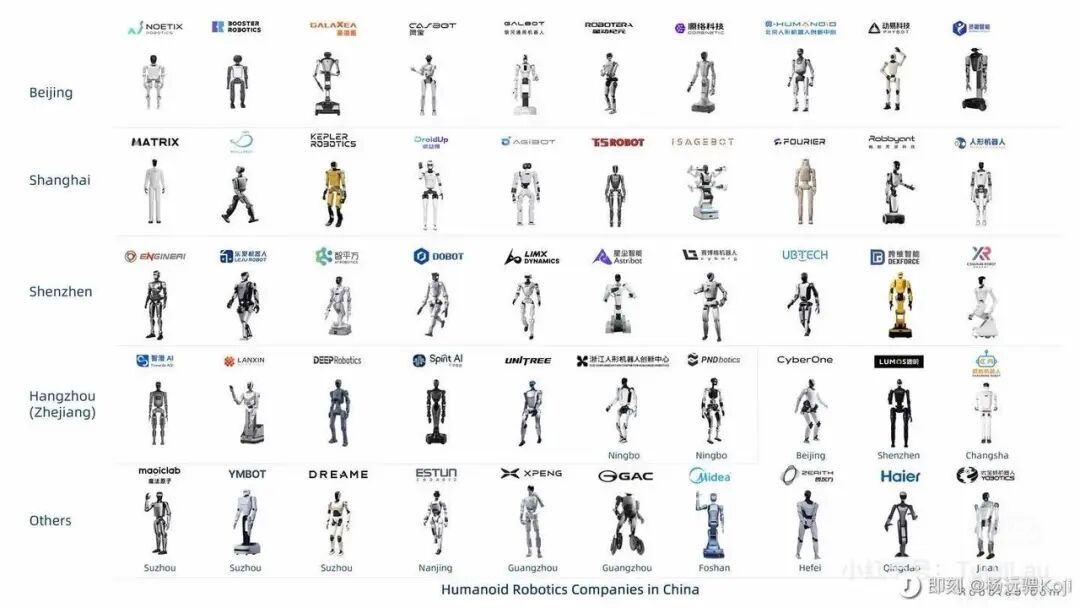
When I saw it, I actually had two reactions: on one hand, awe; on the other, some confusion — how is this going to work? Everyone looks so homogeneous, and none of them have really landed yet in any meaningful way.
But not long after, I saw the Sunday release, from Tony Zhao and Cheng Chi. That was awe on an entirely different level — suddenly there was that "this is what I want to buy" wow moment. You look at the 108 Arhats and you don't actually feel any impulse to own it, but when you see Sunday, it's very clear: I want this.
🧑🏻💻 Yuan Liu
Last year at a conference, I asked a fund partner a question. His core view was that this industry is too early — so early that VCs shouldn't even be investing in it yet. That basically captures the perspective of a fairly significant cohort of dollar funds on this question.
We can analyze this: many of the more dollar-oriented funds actually don't have that much exposure in robotics.
But people may be overlooking one thing: the fact that robotics is so hot in China is actually because a lot of Chinese technology and commerce has very strong ideological and policy-level directionality.
In fact, the robotics industry first became hot because the Ministry of Industry and Information Technology issued some document supporting the robotics sector — it really did become hot because of that.
Over the past few years, low-altitude economy was probably a similar concept, but low-altitude economy may not have the same sustainability as robotics, and there's less that people can actually see delivered.
👦🏻 Koji
Maybe top-down it's one big campaign, but often big campaigns do produce good results — the atomic bomb was built that way, after all.
🧑🏻💻 Yuan Liu
The other day I happened to catch a headline on CCTV News saying China already has more than 200,000 robotics companies.
👦🏻 Koji
And actually a relevant department recently issued a document telling people to avoid making homogeneous robots.
🧑🏻💻 Yuan Liu
But that's incredibly difficult.
👦🏻 Koji
Right, way too difficult to avoid.
🧑🏻💻 Yuan Liu
The gaokao is all about crossing a single-log bridge.
👦🏻 Koji
Now robots are crossing a single-log bridge. We'll see — I genuinely hope embodied robots can achieve some real commercialization, which would boost market confidence and give everyone participating in this market a greater sense of belonging and satisfaction.
🧑🏻💻 Yuan Liu
But I think, purely from a capital markets perspective, there should be some positive feedback in the near term. For example, Moore Threads listing today — that was an absolutely terrifying issuance.
Unitree is also going through this process, and after Unitree goes public, it will very likely also be a pretty good outcome in the capital markets.
Who's Investing in AI?
👦🏻 Koji
We just discussed fundraising; now let's talk about something everyone cares about: among mainstream funds today, who is particularly active in making AI investments?
🧑🏻💻 Yuan Liu
First, I don't think there's any fund not investing in AI — it's just that everyone's emphasis and degree of overweighting differs.
Sequoia Capital, Hillhouse — they're definitely both investing. I feel like Sequoia seems to be repeating their strategy from the internet era, where the overall approach is still "invest in everything that should be invested in." They invested in Manus early on, and then added to their position in Genspark later.
From my sense, the funds that are making especially large numbers of investments today definitely include these: Sequoia Capital, Hillhouse, and Jinqiu Fund. Jinqiu Fund is very much like ZhenFund from a decade ago — investing very heavily, very broadly, with a brand presence everywhere.
Other funds may not look as active purely in terms of deal count, but their deployment is still quite positive. For example, in the robotics space, Qiming Venture Partners, BlueRun Ventures, Hillhouse, and Matrix Partners China are all very active. A couple days ago I was chatting with Huadong Wang from Matrix Partners China — Matrix is probably one of the funds that has invested the most in Chinese robotics, having covered a massive number of companies with only a small handful they haven't invested in.
👦🏻 Koji
Are they also investing a lot in consumer electronics?
🧑🏻💻 Yuan Liu
They've been making dense investments in consumer electronics lately. Probably a dozen or so companies in just a few months.
👦🏻 Koji
You mentioned everyone is active, no one is inactive, but there are still some differences in thinking. Beyond sector choices — like consumer electronics, embodied intelligence, AI applications — what other differences are there?
🧑🏻💻 Yuan Liu
Probably around teams as well. At early stages, people disagree about teams: some want to invest in younger generations, others want seasoned veterans.
I think people have different understandings of generational dynamics, different understandings of what makes a team.
And in the tech era there really is an issue: many founders or core team members are scientists, researchers — sometimes you need to "assemble" a team from different pieces. Different funds have different views on this kind of "assembled" team-building scenario.
👦🏻 Koji
Are there some specific examples here?
🧑🏻💻 Yuan Liu
A lot of people questioned the Zhilin Yang and Yutong Zhang pairing back then. But when I looked back later, I found that many AI companies need someone like Yutong Zhang — she's the president, the fundraising lead, the external interface.
👦🏻 Koji
You just said there's no fund not investing in AI this year. Next let's do a roundup of the more mainstream dollar funds in China! This is pretty off-the-cuff, so it's hard to cover everything — if there's any fund we don't mention that you'd like to hear Yuan Liu say a few words about, we can continue the discussion in the comments.
Let's start with Sequoia?
🧑🏻💻 Yuan Liu
In total deal numbers, isn't Sequoia probably still the fund with the most investments in the entire market?
👦🏻 Koji
Supposedly more than eighty this year.
🧑🏻💻 Yuan Liu
The overall strategy is similar to the mobile internet era — though you can't completely call it "invest in everything," the coverage is extremely broad.
👦🏻 Koji
What about Hillhouse?
🧑🏻💻 Yuan Liu
Hillhouse has had a noticeable sense of activation this year, especially with very heavy positioning in robotics and hardware, though they've also invested quite a bit in other areas.
👦🏻 Koji
I heard Lei Zhang is also personally meeting with a lot of projects.
🧑🏻💻 Yuan Liu
Right, even very young founders. Overall I think Liang Li is running things.
👦🏻 Koji
IDG?
🧑🏻💻 Yuan Liu
I've always felt that IDG is a fund whose brand has been undervalued in Chinese VC history, especially over the past 5 to 10 years. IDG is no longer just a VC — it's also a capital management platform. Especially in recent years, IDG has had quite a number of eye-catching projects, whether Insta360, Shein, or Bambu Lab — Bambu Lab is probably one of the most under-the-radar yet fastest-moving companies of the past two years. I don't think IDG operates on a "spray and pray" logic at all; they're still selective.
👦🏻 Koji
Qiming Venture Partners?
🧑🏻💻 Yuan Liu
First, Qiming's underlying colors have always been healthcare and technology — that's a tradition going back many years. Qiming is quite active in deploying capital, and they're also the manager of the Beijing AI Fund, which gives them a somewhat different perspective and lens for looking at companies compared to other institutions.
👦🏻 Koji
BlueRun Ventures?
🧑🏻💻 Yuan Liu
BlueRun entered China in 2005, the same year as Sequoia. Frankly, my impression of BlueRun in earlier years wasn't that strong, but in the past two years they've been very ambitious and active. They just raised a RMB 2 billion fund, and they're a first-tier fund brand.
👦🏻 Koji
I also attended BlueRun's RMB AGM this year — the atmosphere was pretty good.
Then, Matrix Partners China?
🧑🏻💻 Yuan Liu
Matrix is more active than people imagine. The difference is that Matrix doesn't only invest in AI. A couple years ago when dollar VCs talked about investing in hard tech it was mostly talk, but Matrix was one of the few that executed seriously and got positive feedback: MetaX is nearing IPO, and they have a very high ownership stake; including in energy, they're one of the only ones investing there.
👦🏻 Koji
Matrix got positive feedback starting from their electric vehicle investments, and they've also been very active in this consumer electronics wave.
🧑🏻💻 Yuan Liu
Right, Matrix has invested very little in Agents, and in large models they've only invested in MiniMax.
👦🏻 Koji
Next, Jinqiu Fund — in the same building as Matrix?
🧑🏻💻 Yuan Liu
Jinqiu Fund is a very loud fund this year — you see it every day. They're in many projects, at various stages from seed to growth. From a fund asset allocation perspective, it's definitely sensible.
👦🏻 Koji
Gaorong Ventures?
🧑🏻💻 Yuan Liu
Gaorong is way too low-key on brand, but they've actually invested in quite a few projects. Their work on Kimi during the large model era was decent.
👦🏻 Koji
Next, let's talk about ZhenFund?
🧑🏻💻 Yuan Liu
Shouldn't you be the one to talk about ZhenFund?
👦🏻 Koji
Hahaha, let's hear your industry perspective.
🧑🏻💻 Yuan Liu
I've been in touch with Yusen and Yuan Liu recently. I think ZhenFund is a very bellwether fund in China's early-stage investment industry. Its significance is different from Sequoia's — Sequoia's significance comes from scale, where its scale might account for 1/5 or 1/10 of the entire Chinese VC industry.
ZhenFund can't match Sequoia in terms of capital size or number of projects, but because it truly is China's first early-stage fund — or first angel fund — it's essentially the industry's thermometer. How they evaluate people and spot new generations is very representative. I think they're also constantly asking themselves: in a new generation, how should we capture this cohort? When ZhenFund first started exploring early-stage investing in China, there weren't many precedents. They basically figured it out on their own.
I asked Yuan Liu about this before. He said the past couple of years have been the best one or two years in ZhenFund's history — a lot of companies are filing for IPOs, they've gotten a lot of positive feedback, and different partners each have their own wins.
👦🏻 Koji
5Y Capital?
🧑🏻💻 Jing Liu
5Y Capital is actually deploying pretty intensively right now. Last year Koji, you and Xing Meng had a conversation on the Crossing podcast — he's their new partner.
5Y's old style was "cautious." The core logic was "concentrated bets" — and concentrated bets mean you can't make many bets. But now they're actually making quite a lot of bets.
👦🏻 Koji
Source Code Capital?
🧑🏻💻 Jing Liu
Yungang Huang launched a new brand called "Source Code Rhythm," focused on early-stage investing. Not long ago, Source Code's main fund also announced a new $600 million fund with a 25-year lifespan. And Source Code itself invested in Liblib.
👦🏻 Koji
BAI?
🧑🏻💻 Jing Liu
I know BAI has a new fund in the middle of fundraising, and they've already locked in a pretty substantial portion.
This summer, BAI invited people to a modern theater performance near Beijing's Sanlitun area. I interpreted that as a "BAI is back to market" signal.
Over the past few years, BAI spent a lot of time exploring investments in overseas Chinese founders, with some presence in Mexico and Latin America. But in the domestic market, there hadn't been much noise. Starting this year, I think they're sending a strong signal that they'll be paying attention to more mainstream entrepreneurs. BAI has invested in AI hardware companies like Looki.
👦🏻 Koji
What about Monolith? We actually talked about it quite a bit earlier — anything else to add?
🧑🏻💻 Jing Liu
I think Monolith is very strongly Xi Cao's style.
👦🏻 Koji
This year, besides VCs investing in AI applications, a lot of corporate strategics have been pretty active too. Alibaba's strategic investment arm, for example — of the six major LLM companies, they invested in five.
At the same time, Ant Group's strategic investment and Baidu's strategic investment have both been very aggressive, writing a lot of checks. Ant invested in Zhipu AI, Moonshot AI, PixVerse, Liblib, Astribot, Future Intelligent, and a whole bunch of others.
Baidu too — last year, when Liblib was at its toughest, they came in with $30 million. That was the money that turned things around. They also invested in Shengshu, Infinigence AI, and others.
Then there are JD.com and Meituan, which have been particularly active in embodied intelligence. Meituan, for instance, invested in Xinghai Tu, Tashi Zhihang, Zelos, and others.
Another particularly interesting one is Xiaohongshu. They have a lot of money — profits are now over $1 billion, and they're sitting on plenty of cash. The things they invest in are often quite interesting. For example, there's a flying companion robot.

🧑🏻💻 Jing Liu
Let me ask you a question, Koji. In the mobile era, I remember 36Kr had an article called "Baidu's Investments and the Era It Lost," about how internet giants used investments to create significant value for their core businesses. Tencent did this very well. Alibaba was pretty good for a while too, but later its aggressive investment style drew some controversy.
I'm curious — take Baidu, for example. Do you think these current investments will create much long-term value for the parent company?
👦🏻 Koji
Honestly, it's hard to see right now. There's no so-called "ecosystem synergy" happening yet.
🧑🏻💻 Jing Liu
Right, it doesn't seem like that kind of thing has formed.
👦🏻 Koji
Yeah, not yet. It's like when Alibaba invested in major LLM companies earlier, they were probably thinking about ecosystem effects. In the end, they realized they still had to build Qwen themselves.
🧑🏻💻 Jing Liu
So is it possible that — except for Meituan and JD.com investing in robotics companies, where there seems to be relatively clear business synergy — for these big tech companies investing in hardware, agent companies, or software companies, the logic right now is actually pretty similar to financial funds?
👦🏻 Koji
It feels that way. The only possible exception is Xiaohongshu, but even when they invest, they don't particularly promise "we'll give you more traffic." They don't make commitments like that.
It's just that if an entrepreneur or product feels native to Xiaohongshu, or has that Xiaohongshu vibe, they might be more likely to get their investment.
🧑🏻💻 Jing Liu
And I think Xiaohongshu has now become the go-to channel for a new generation of AI entrepreneurs and companies to build their brand. Investors are now sourcing deals on Xiaohongshu too. When we're looking for early-stage companies to write about, we've found Xiaohongshu to be a great platform.
New Species in Primary Markets
👦🏻 Koji
Actually, a lot of new species have emerged in primary markets this year. Many solo GPs, and many new accelerators and incubators. Have you seen any new GP this year that particularly caught your eye?
🧑🏻💻 Jing Liu
The new GPs that emerged this year — everyone can probably name them. Peter's Alphaist from 5Y Capital. He raised better than most in this wave of new GPs, about $60-70 million, with very substantial support from Qin Liu. Yongteng Wen is also raising a new fund. There's CreekStone, a two-person fund. And XiaoXiao Fund. About five or six in total, usually solo GPs.
If we draw an analogy, China's VC industry saw a batch of so-called "VC 2.0" emerge between 2013 and 2016. But back then, most funds still appeared in an institutionalized form.
👦🏻 Koji
And when they launched, their first fund sizes weren't small either.
🧑🏻💻 Jing Liu
Right. But today, it's rare for a solo GP to raise $100 million — almost unheard of. Source Code Rhythm is hard to call a solo GP; it's still more institutional, inheriting Source Code Capital's brand.
These are all emerging, but how they'll actually perform probably needs more time to tell.
👦🏻 Koji
Do you think the reason there haven't been particularly large new GPs is a talent gap in the market, or is it that capital is genuinely scarce?
🧑🏻💻 Jing Liu
Both. On the capital side, it's not easy for new funds to convince LPs to commit. Then there's the talent issue.
One solo GP was asked by his former boss: "You've been investing for years without a single exit — what makes you think you can run a fund?" I think this is different from before. A lot of solo GPs haven't gone through a full cycle. A full cycle is really long — we're talking 10 years. From investment to IPO to exit, all three stages matter.
China's VC market hasn't really given young people these opportunities in recent years.
👦🏻 Koji
We just mentioned that a batch of new solo GPs emerged this year. Actually, we've also noticed some interesting new investors appearing. For example, CZ — he announced he's putting $10 billion into Chinese founders building AI.
🧑🏻💻 Jing Liu
That $10 billion is what his family office publicly claimed, right? It's literally $10 billion.
👦🏻 Koji
But he hasn't really found projects that can absorb that kind of capital volume. Though he does have an incubator — I think it's $500,000 per deal.
Then there's Huiwen Wang. This year he's also been very seriously and actively investing, putting together a small team.
🧑🏻💻 Jing Liu
Light Source is an investment bank in primary markets, but this year they also launched an incubator, investing very early in many companies. And it's not just investing — they're also helping researchers think through directions, refine ideas, even find co-founders. This is really at a very early stage. Just from an investment perspective, they got involved in Galaxy Universal quite early.
👦🏻 Koji
Light Source was also involved early in PixVerse.
New Incubators and Accelerators
👦🏻 Koji
Some new accelerators have also emerged this year. Innox Shenzhen, for example — in consumer electronics, you can hardly avoid this name. I visited recently, and it was quite striking.
A few things left a deep impression. First, they don't encourage copying; they explicitly encourage absolute originality. In this environment, you do see some very interesting projects emerge. Like Kamingo, which converts regular bicycles into e-bikes; Yunwang Innovation, which makes smart massage rollers; and a project called XBrew, which makes coffee taste better by infusing it with nitrogen.
What allows these innovations to continue is that they all target very vertical, previously untouched niches. There have been many similar examples in the past — DJI, Insta360, and categories like pool-cleaning robots and lawn-mowing robots. They tend to target global markets while addressing real needs, making it quite possible for something new to emerge from here.
They've incubated about 80 startup teams so far, with 30 of them receiving angel investment.
There's also Spark Lab, where I serve as an advisor. They're on Shanghai's Urumqi Middle Road, a very downtown location — they rented a five-story townhouse. Each batch recruits 10 startup teams, who live together in the villa for 42 days, eating, sleeping, and building together. I often describe it as a "monastery for entrepreneurs." During this time, no media, no investors — just a group of people in flow state, building products with complete focus.
This program is completely free and open to all entrepreneurs.
Of course, MiraclePlus is still actively investing too. I heard that this year, MiraclePlus might see its first IPO.
🧑🏻💻 Jing Liu
Which one?
👦🏻 Koji
It's a robotics project called Standard Robots. But interestingly, MiraclePlus invested at the Series B.
🧑🏻💻 Jing Liu
So it doesn't really prove the MiraclePlus model works, does it?
👦🏻 Koji
I think it might still need some time. MiraclePlus didn't really start investing systematically until late 2019, early 2020. That batch had 22 projects total, and it's been less than five years since then. But you can already see some projects performing very well in later rounds. For example, Hypershell, which has been getting a lot of market attention lately, just raised a new round at a $70 million valuation.
Besides incubators and innovation academies like Spark Lab and MiraclePlus, the cloud providers have been extremely active this year — and with even greater force. From Google, Microsoft, and AWS to Volcano Engine, pretty much everyone has their own accelerator program. Personally, I think entrepreneurs should really take the time to study the support conditions they're offering.
I've always had this feeling that the activity level of U.S. capital markets in AI is probably ten times ours. So before recording this podcast, I compiled the publicly disclosed new funding rounds from Silicon Valley over the past week, and found that the gap might be more than tenfold.
Let me quickly run through a few funding announcements from just the past week: Runlayer, $11 million seed round; Onepot AI, doing AI-driven small-molecule drug synthesis, $13 million seed round; Phaidra, doing AI energy optimization, $50 million Series B.
And then there are two even more extreme cases on the valuation side. One is the AI search company founded by former Twitter CEO Parag, which raised $100 million in a Series A at a $740 million valuation. The other is even more impressive — Unconventional, a new project from Databricks' former AI head Naveen Rao and others, which went straight to a $5 billion valuation, targeting $1 billion in funding, to build an entirely new kind of computer.
Any one of these deals, if placed in China, would be almost unimaginable in scale. But in the United States, they're just "one of them" in the news, and would barely trend on social media.
The VCs here must all see similar comparisons. What do you think is the prevailing mood among them right now?
🧑🏻💻 Jing Liu
From my limited perspective, the market-driven money in China's early stage has typically come from dollar funds, and those VC dollars really are incomparable to what's over there. U.S. VC capital is almost excessively abundant.
For young entrepreneurs in China, the choices are basically dollar funds, RMB funds, state-owned government capital, or big tech money. In early stages, everyone definitely prefers dollar funds. After everything that's happened in the past couple years, that pool of capital has definitely dropped sharply.
I noticed a really interesting phenomenon: last month, two or three VCs announced they had completed new fund raises — a rare piece of good news that surprised people. Though the fund sizes are much smaller than a few years ago, when VCs routinely raised $1 billion or more.
On the other hand, these announcements didn't spark widespread discussion. Why? I think one possible reason is that the industry's base has shrunk.
👦🏻 Koji
So there are fewer people working in the industry.
🧑🏻💻 Jing Liu
Certainly. Although AI has brought in a new wave — post-95s and Gen Z investors entering — the level of vibrancy isn't really comparable to a few years ago.
VC Talent, Luck, and Organizational Innovation
👦🏻 Koji
I actually have a question I'm really curious about. What kind of person do you think is suited for VC?
🧑🏻💻 Jing Liu
First, VC requires some talent. This talent is very similar to what makes a good journalist — some people, no matter how hard they try, will never become good VCs.
Second, I think you need some good luck. Getting positive feedback relatively early in your career is incredibly important for a VC.
Let me give you an example. If you were a young investor who entered the industry in 2020, invested in consumer brands, and fortunately put money into some companies during the "flood irrigation" period. But looking back today, a huge number of those consumer companies that rose up then ultimately didn't survive. So you might have gotten negative feedback, and if you don't have very strong resilience, you might have been eliminated by the market.
Or another example: if an investor was in online education and made really great bets — online education was arguably one of China's best industries for a while. But once an irresistible force hit and the industry disappeared, it was just gone.
The VC industry only asks about results, not about what happened.
👦🏻 Koji
So talent, luck, timing, getting positive feedback early in your career — confidence and opportunity then accumulate like a snowball.
🧑🏻💻 Jing Liu
I remember starting to do investment-related interviews in 2017. Back then, writing this kind of industry content felt somewhat like admiring flowers in a mirror — the people who truly cared numbered maybe tens of thousands. But in recent years, the entire industry has been continuously expanding, and its influence at a broader social level has been constantly evolving.
This is actually a good thing. VC should be an important industry in any country — it supports innovation, supports the unknown, and supports people in taking risks and trying things. But as the industry expanded in personnel, even with some people leaving, the overall scale remains considerable.
The question is: does this industry really need so many people? That's a discussion at another level. Under this structure, young people need to complete self-validation as quickly as possible among a large pool of practitioners.
To some extent, this is similar to why China has so many robotics companies. There are now over 200,000 robotics companies — unless you can become an absolute top player, the vast number of non-head companies will inevitably end up in fierce competition.
👦🏻 Koji
Actually, VC is also a place that follows power law dynamics. It's certainly not winner-takes-all, but the top-tier funds capture the majority of returns.
🧑🏻💻 Jing Liu
Maybe what I just said sounded somewhat negative, but what I actually want to emphasize is a very positive change. After the consumer track clearly declined in 2022, market-oriented VCs were in a relatively difficult state for a while.
Back then, many people were asking: what should we invest in next? Energy? Manufacturing? These directions are certainly important too, but they don't really fit the original narrative of how VC was formed.
And precisely because of this, many people chose to leave the industry, especially young people.
I remember when GPT first exploded in 2022, we interviewed an investor who said something at the time: "This thing can let us work another 15 years." The feeling in that moment was very intense — like a string that had already snapped being reconnected.
👦🏻 Koji
It's not just investors, I think many entrepreneurs feel the same way.
What traits do you think good GPs have?
🧑🏻💻 Jing Liu
I think the best, or the rarest trait, is embracing change while maintaining your core. Because VC is an industry with too much change — VC is always living with change. But in this process, an individual or an organization can easily get lost.
For example, many funds are being extremely aggressive on branding this year — do you do it or not? Many young entrepreneurs are emerging — do you invest in a wave, or stick to your overweight principles?
For example, American VC: a16z is building a new media team, and some innovative VC paradigms are emerging — do you follow or not?
I think these are all very challenging questions for a fund.
👦🏻 Koji
There's a lot of noise, and the cycle to get results is very long. So in this process, how do you both embrace the changes that noise brings, and stick to some principles to get through the cycle?
🧑🏻💻 Jing Liu
And I think there's another thing that might further amplify this difficulty. If you're running a company, you're very clear that besides maintaining your core product's unique position, a basic premise is: the market is constantly changing, consumers are constantly changing. So you naturally have higher acceptance of "change" itself, and might even actively embrace it.
But looking at the VC industry, it's actually quite interesting. Everyone is always investing in the most innovative industries, the most breakthrough entrepreneurs, but the organizational form of VC itself has barely undergone major changes over all these years. It has remained stable for a long time, partly because for a very long period, this approach was proven to be the most efficient and produce the best results.
So today, does this approach need to change? I think this itself is a question worth seriously considering.

👦🏻 Koji
Just like we were discussing — what makes the best investor. If we add one more condition: from the entrepreneur's perspective, what kind of investor is the best investor?
🧑🏻💻 Jing Liu
Someone who gives money and talks less.
👦🏻 Koji
Gives money, talks less.
🧑🏻💻 Jing Liu
And helps you out at critical moments.
👦🏻 Koji
How do entrepreneurs identify and judge whether a VC is someone who can give money, talk less, and help at critical moments?
🧑🏻💻 Jing Liu
I think entrepreneurs today should spend some time understanding different funds and their key decision-makers — what their overall style is like. In a market with sufficient information flow, this isn't very hard to do.
👦🏻 Koji
Listen to more elsewhere and Crossing podcasts, hahaha.
🧑🏻💻 Jing Liu
Exactly!
VC and Media
👦🏻 Koji
A lot of industry insiders are discussing two phenomena today: one is a16z launching a new media team, and the other is 20VC starting from a podcast and now becoming a fund. What do you think about the relationship between VC and media?
🧑🏻💻 Jing Liu
20VC's slogan is great: The Intersection Between Venture Capital and Media. I've always found this a very interesting phenomenon, especially in the United States.
I previously read that book The American Venture Capital Revolution, and after finishing it, my biggest feeling was how enviable Silicon Valley is. This envy doesn't come from any single startup or VC fund, but from how startups, VCs, tech media, plus some other roles, form a very high-density interactive relationship.
I read that book in 2022. At that time, the primary market was mainly looking at new energy, and I actually felt quite despairing — it felt like VC was becoming a story that had little to do with China.
But after this wave of AI took off, a lot of people's feelings changed. As one of the AI KOLs, Koji, you must feel this strongly — its impact on the industry is enormous.
At such an early stage, if you ask: Does media have faster information, or do VC funds have faster information? Or rather, the information advantage and moat of true insiders compared to outside observers isn't actually that high. Because everything is still at the starting line, many things are growing simultaneously.
And it's precisely at this stage that I feel the interaction between media and VC has a chance to become more valuable. This is quite different from the energy or manufacturing sectors. We used to say media was at the end of an industry's chain, collecting "tea money." If you analogize to the energy industry, media is basically outside the industry chain, more of an excluded role.
But in AI, I actually think the role media can play is quite heavy. Plus, many AI companies now need to invest enormous energy into expression and communication — which can also be understood as a kind of pan-media capability, precisely something media can deeply participate in, even co-build.
Organizational Change in VC and Built-to-Last Institutions
👦🏻 Koji
Just now we mentioned that when people today are betting on AI application entrepreneurs, some believe in "old hands," some believe in young people. Although the mainstream funds are still those same ones, if the managing partners are getting older, they may not necessarily be able to invest in founders born after 2000 or 1998.
Have you observed any recent changes in fund organizational structures?
🧑🏻💻 Jing Liu
I think most funds have become aware of a new generation emerging to varying degrees, which means their own organizational forms need to change too. Some are moving fast, some are moving slow.
I think Monolith moved very fast. Xi Cao is a mid-generation investor, born around 1985. Now he has roughly a 15-year generation gap with the post-2000 crowd. You can actually feel that within the past year or two, Monolith basically replaced all of its younger-generation investors with a new batch between 1995 and 2000.
He was quite decisive on this point. Actually there's enormous organizational pressure here, because you have to consider that previous colleagues may no longer fit today's organization.
I've talked with other GPs about this, and on this matter, many still have some organizational internal friction. Most VC funds in China have existed for over a decade now; to some degree, the organizations already have sclerosis problems.
👦🏻 Koji
How do you think a primary-market fund achieves built-to-last status?
🧑🏻💻 Jing Liu
You need to maintain some stable, sustainable style and brand, while also keeping the organization dynamic — this is a very delicate balance.
And I think there's another issue. I'm particularly obsessed with discussing organizational problems in the fund industry, and I've discussed this topic.
I'm particularly obsessed with discussing organizational problems in the fund industry. If we analogize the fund form, this kind of organization, to companies, some aspects seem incomparable. Because funds have very few people, relatively small organizations. China's largest HSG is only 300-something people — can't compare to company scale at all.
So most Chinese funds and those boutique VCs are actually a highly person-governed industry, person-governed organizations.
A given fund may have a strong personal style. Like Emerson said, "An institution is the lengthened shadow of one man." Funds fit this description extremely well. So if the founder themselves leaves, steps down, can that institution maintain that style? Though their name may be the same, it might be a completely different institution.
I remember David Zhang of Matrix Partners China once said something to the effect that succession in the fund industry is extremely difficult. If one day he's no longer running Matrix, and someone else takes over, it's actually no longer Matrix — it just has that name.
Of course similar situations occur in company succession processes, but because companies are usually larger organizations. A fund's only product is your investments, but a company has many other products; its products can define its style.
👦🏻 Koji
Because the investment product only includes limited things: one is a person's network, the other is a person's taste and judgment. So these are both highly dependent on personal management and style.
🧑🏻💻 Jing Liu
So in the new era, there do need to be some new solutions. Like what Yuan Gong (HSG partner) is doing with xbench, even his investment in Agent Universe (Guancha), including some internal explorations they're doing — I think these are all trying to find new solutions for what funds should look like today.
Koji x Jing Liu: How Do We Position Ourselves in This Era?
👦🏻 Koji
In the entire venture capital ecosystem, do media and self-media play different values depending on whether they're "institutionalized" or "personalized"? Because you were previously at 36Kr as institutional media, and now you're doing elsewhere more personally. When people mention elsewhere they might think of Jing Liu — the personal label is stronger. When people think of "Crossing" they also first think of Koji, Ronghui — our personalization is also very strong. This is fundamentally different from 36Kr, though both can be called media.
🧑🏻💻 Jing Liu
Honestly I haven't thought about this from that angle. But I think the fundamental difference is that your expression is freer — this is a very essential difference.
👦🏻 Koji
But on the other hand, the transmission leverage of being a living, breathing person is very high.
🧑🏻💻 Jing Liu
I later realized that institutional media today actually faces problems somewhat similar to funds.
Let me answer from another angle. After this wave of AI rose, those who got big pieces of the pie, or quickly gained influence in the industry — institutional media or institutional-media-style media people were rare. You're obviously not, Kazi Ke isn't either. The performance of large amounts of institutional media in this wave was actually mediocre.
This is challenging for us. Young people today may have no baggage, even no "inner demons." But when we first started working, what we were trained in was actually a logic of "hiding the self."
👦🏻 Koji
When a guest faces a KOL host with personality versus a faceless journalist-type host, their state and expression are sometimes different.
🧑🏻💻 Jing Liu
So this is quite interesting. The Transformer classic: Attention is all you need — it actually has an astonishing similarity to today's entire media transmission form.

👦🏻 Koji
Jing Liu, you've done primary-market reporting for so many years — in this year 2025 alone, how has your thinking changed?
🧑🏻💻 Jing Liu
Because I'm in an industry with huge changes, actually sometimes thinking too much isn't very meaningful — do while doing.
For example, similarly doing video podcasts, when Koji told me about his video podcasts, I looked at what you started with versus what you're doing now, and I think you're continuously iterating. But I find it very hard to start things — being able to consistently start is very difficult. This is a big lesson for me.
👦🏻 Koji
I think these two approaches are actually quite different. My intuition is, if I were building a new brand myself, I probably wouldn't do a big splashy launch at the beginning. I'd rather say, don't let too many people see me first, operate in a relatively hidden state, and slowly get things running smoothly.
These two paths each have pros and cons. A launch approach like elsewhere's is itself very valuable. Because you did that kind of launch, when you later do video or podcasts, people will naturally pay attention to you — but at the same time, it also brings certain "baggage."
On my side, I indeed lost the marketing momentum of a launch, but in exchange got a relatively free space to "stealth develop." These two things are inherently two sides of the same coin.
🧑🏻💻 Jing Liu
Koji, you're definitely not a so-called pure content industry person — you're probably from the product world, the entrepreneurship world. You definitely have less of that baggage than us.
I think there's a common phenomenon in many industries: what really takes you out is often not your peers. Precisely because people in the same industry are more easily trapped by a kind of inner demon.
I watch "Da Congming" do CyberZen — he can update 3 posts a day, he posts whatever he sees. Actually look at the traffic per post, it's huge, I think it's great. It's just that for us to quickly embrace this change is hard.
👦🏻 Koji
Indeed.
🧑🏻💻 Jing Liu
Let me ask Koji a question. First I'm very curious — because you went to ZhenFund as Venture Partner. I've always felt Koji is the person in China most likely to become China's 20VC, so why did you still choose to go to an established fund as Venture Partner? And how does it feel?
👦🏻 Koji
One is that 10 years ago when I started The Fair, Bob Xu and Yuan Liu were my angel investors. I previously worked with Yusen at Jumei, and even earlier we hung out together frequently in college, so I have deep ties with ZhenFund. This time they invited me, I was very happy — this is also a huge opportunity for me. I can switch to a different identity and go to the front lines of entrepreneurship, which is a particularly interesting perspective shift.
After becoming Venture Partner at ZhenFund, I had an adjustment in my thinking. Previously I thought VC judgment might be the only important thing. Now I find that judgment may be one important factor, but other factors — like the entire fund's organizational capability, culture, and how the fund builds relationships with founders, how it does branding — all of these together make a fund, and not any single factor is absolutely more important than another. I have more reverence for how to be an excellent angel fund that consistently invests well in the market for over a decade.
What I'm doing now with content, community, plus investment — this "trinity" has Synergy between them.
I already felt that chatting with people is very important energy replenishment. If anyone listening to our podcast now wants to chat with me, whether about content, community, or wanting to do PR, or wanting to discuss this year's fundraising plan — I'd be very happy.
🧑🏻💻 Jing Liu
I also very much understand what you're saying. You said after going there you discovered that previously you thought ZhenFund's core style was this, but then discovered there are other dimensions.
I once asked Yuan Liu: When you observe Red Xiao, or after all these years in venture capital, what do you think is the truly important entrepreneurial quality?
You know, Yuan Liu is a pretty unconventional person. He's romantic. I thought he'd pick those kinds of traits. But after thinking for a while, he said, no — what matters most is actually "resilience."
I don't know if this comes with age, but in the end you realize you've come back to what your ancestors and parents told you thousands of years ago, not what you thought, what you believed mattered when you were young.
👦🏻 Koji
I deeply agree with this. And I think resilience will become even more important in the AI era.
Why? Because today, failures may come more often and more frequently. Competition is more intense, and the times are accelerating.
For example, you might build a great AI application, but it could quickly be disproven or drowned out by a model upgrade.
Or take this: in the past, raising $1 million might give you one shot at launching a product, but today you might get five chances — though the first four might all fail. All of this points to the same thing: a person needs to face more and more frequent failures, so resilience becomes more important. It gives you more fight, lets you get back up, and go at it again.
🧑🏻💻 Jing Liu
This might seem like an unrelated topic: in today's era, people who desperately want to project a perfect persona are actually less likely to survive. A founder with a perfect persona is also less likely to survive.
👦🏻 Koji
This might not be off-topic either. We can talk about marketing at the end. ChatGPT and Sam Altman — they manufacture three to four headline stories every week. Like Sam Altman and Jony Ive — they've shared the stage four times in recent months, talking about all sorts of things, and each time they give the media a usable tagline. But the product they're going to release might be two years away.
So the scariest thing is doing something that nobody knows about. You work hard for three months and release a product, or even work hard for a year and release a product, and there's no sound — that's the most terrifying thing.
🧑🏻💻 Jing Liu
Two more questions for Koji. One is, I've listened to every episode of Crossing and that pre-recorded opening where you talk about becoming "an active actor in the AI era." And I think Koji has always been someone everyone likes, someone very friendly. I wonder, do you ever have moments where you feel like you praise this era, or this group of people, a bit too much?
👦🏻 Koji
This probably has something to do with my own life state. A lot of what you express, what you say outwardly, sometimes you're also saying to yourself. I think I'm at a stage where I really need to praise myself, which is why there's so much external output.
On one hand I have this awareness, but on the other hand I think "praising" entrepreneurs is itself a good thing. Probably because I've been an entrepreneur myself, I'm very clear that nothing is easy. I've also seen people around me who I was very bullish on at the time but ultimately didn't achieve particularly outstanding results. Conversely, there are also friends who seemed very average in terms of ability and direction at the time, but later achieved quite good career success.
Looking back, the difference often isn't in ability itself, but in their resilience and persistence. But what's behind resilience? A lot of the time, I think it's still a kind of optimism, that psychological suggestion that you believe you can do things well. It's what gets you out of bed every morning, and it's why you're still willing to keep going when facing long-term difficulties.
So I'm willing to praise entrepreneurs more, to make them more optimistic, more willing to believe they can get things done.
🧑🏻💻 Jing Liu
The reason I ask is because I've been thinking about what posture we should adopt when facing these young companies. In fact, most companies are "building towers on quicksand" — even many big companies that look very resource-rich may not ultimately succeed, and might even fail.
Under this premise, what kind of attitude should we have toward these companies that would be more appropriate?
This also extends to another question. Today there are already some AI self-media outlets and KOLs, and because commercial interests are mixed in, in such an environment, what values should an AI KOL uphold?
👦🏻 Koji
First, I think changing others, influencing others, is an enormously difficult thing. Second, I do have some things I believe in. For example, I believe in taking positive action, I believe only through creation can there be results.
But these are all actually very plain, obvious things. Yet sometimes you realize they're easier said than done. A lot of the time, you need to hear someone tell you, or you need to see vivid, concrete individuals around you doing it, before you can be inspired, before you can be mobilized.
In any era, entrepreneurship is a nine-deaths-one-life proposition. Encouraging someone to start a company is actually a very high-risk thing, because they're essentially gambling their youth.
🧑🏻💻 Jing Liu
I often feel like people who egg others on to start companies are sirens, using their beauty to bewitch people.
👦🏻 Koji
Hahaha, so we encourage everyone to "take positive action." But that action doesn't mean you have to quit your job and start a company.
🧑🏻💻 Jing Liu
Action and starting a company — these are two very different things.
👦🏻 Koji
I think action is especially necessary. At least for myself, once I start taking action, my state improves.
🧑🏻💻 Jing Liu
I think I'm quite similar to you — I'm not in this game either, but I'm definitely someone who'd rather celebrate than criticize.
There's one more thing I'm very curious about. Koji seems to have a strict schedule every day, very disciplined, sleeping before midnight, waking up at six or seven in the morning. You're doing Crossing, you're doing Venture Partner — it feels like you're everywhere. How do you allocate your time?
👦🏻 Koji
AI has really helped a lot. Many things can be handed over to AI, so quite a bit of time has been freed up. Also, the team is very reliable — not everything requires so much effort.
Plus, doing media and doing Venture Partner have a lot of synergy. They're both people businesses, both require extensive communication with people, so a lot of my time and energy can be reused.
🧑🏻💻 Jing Liu
Got it. You're someone who can do everything with full energy — that's rare.
👦🏻 Koji
Sometimes with certain things, if they really don't feel that important, I'll handle them more "passively." Essentially it's about prioritizing first, then AI solves a big efficiency problem, and the team also solves a big efficiency problem.
Very happy to have Jing Liu with us today. I really hope we can do another episode this time next year. Finally, a grand wish: I hope after elsewhere launches, it can create a lot of valuable content for everyone, and I hope you doing elsewhere makes you happy every day!
🧑🏻💻 Jing Liu
Thanks Koji, thanks everyone.
👦🏻 Koji
Thanks.
🚥

References [1] Following last year's year-end review: https://www.xiaoyuzhoufm.com/episode/675e1f3c84447b1bd0eae32f
[2] elsewhere: https://www.xiaoyuzhoufm.com/podcast/68ff657d9c745a6e69da8fcf