2026: A Letter to AI Founders — on Generosity, Cruelty, and Fog

Is AI entrepreneurship entering its "worst" era?
🚥
👦🏻 Koji:
I highly recommend this article.
What struck me most is that it doesn't stay stuck in the surface-level excitement of "AI is amazing." Instead, it places today back into the longer arc of technological history. For founders, this matters. Because every time a core capability gets rapidly commoditized, the opportunity expands — but so does the brutality of competition. Building becomes easier, yet "what to build, for whom, and how to get noticed" becomes far more important.
My own feeling is that this era is both generous and cruel to founders. Generous because one person can now build what once took a team. Cruel because simply being able to build is no longer an edge. What truly matters is judgment, product sense, understanding of users, and the courage to reframe old problems around new capabilities.
This article is worth reading. Not because it gives answers, but because it helps us see the questions more clearly.
The author is "Jiayuan," an AI founder who built Devv.AI to over a million users and is about to launch a new product.
01. Accelerating Into 2026
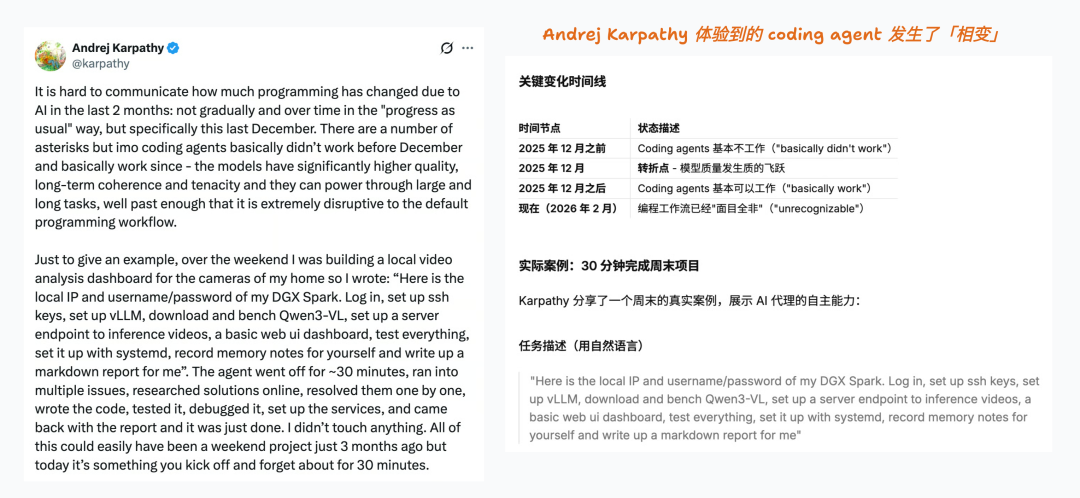
In February 2026, Andrej Karpathy (former Tesla AI Director, OpenAI founding member) described a very specific inflection point on X.
In November, his coding work was still 80% handwritten code, 20% delegated to agents. By December, the ratio had completely flipped — 80% directing agents in natural language, 20% editing and finishing touches himself.
He described recently giving an AI agent a chain of tasks in natural language: log into a remote server, configure SSH keys, install and test a model, set up a Web UI, configure system services, write documentation. The agent completed everything autonomously in 30 minutes, encountering and resolving multiple issues along the way. Just three months earlier, the same work would have consumed an entire weekend.
DHH (creator of Ruby on Rails) was equally direct:
"Biggest and fastest change in the 40 years I've tried to make computers do my bidding. And surprisingly, the most fun too!"

As a founder on the front lines of AI, I've spent the past three months back in builder mode myself — averaging 100M+ tokens consumed daily, with over 1,000 commits submitted:

This acceleration is real. One person working for a week can now exceed what a team used to produce in months.
This acceleration isn't just happening at the individual level. In the first two-plus months of 2026, the entire tech world seems to have entered a period of acceleration.
The explosion of OpenClaw. This product, which brings Claude Code-level agent capabilities to mainstream users via Telegram and Slack, suddenly went viral in late January. Its success confirms a pattern: virality = democratization of experience — taking what niche users already had and pushing it to a broader audience. Unified entry points, persistent memory, and composable Skills forming a flywheel let non-technical users feel for the first time that "AI can actually do things for me."
Coding agents are crossing the threshold. Tools like Claude Code and Codex can now independently complete tasks in medium-complexity codebases (hundreds of thousands of lines), with minimal human intervention. This isn't incremental improvement — when AI shifts from "assisting with code" to "leading code," the logic of the entire development process changes.
Long-horizon agent breakthroughs. In January, Sequoia published an article with a blunt title: "This is AGI". Their definition wasn't some benchmark score but a functional judgment: AI agents can now work autonomously for hours, make mistakes and correct them, iterating until the task is done. METR data shows that the complexity of tasks agents can handle roughly doubles every 7 months. Sequoia extrapolated from this trend: by 2028, they'll complete tasks equivalent to a full day of expert human work; by 2034, a full year; by 2037, a century.
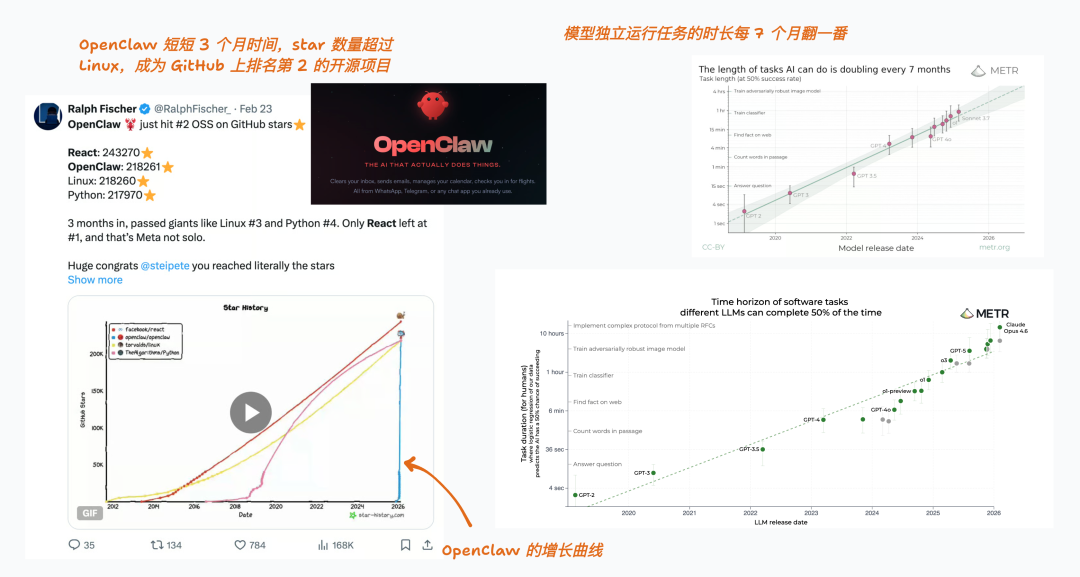
(Note: At the time this article was published, OpenClaw had already surpassed React to become the most-starred code repository on GitHub.)
Structural shifts at the corporate level. On February 26, Block founder Jack Dorsey announced cutting the company from 10,000+ people to fewer than 6,000 — slashing over 40%. He attributed the layoffs to AI: "intelligence tools... are enabling a new way of working which fundamentally changes what it means to build and run a company." The market's response was direct: the stock jumped 20% that day.

(It's worth noting that critics argue Block's layoffs were more about correcting pandemic-era overhiring — the company had ballooned from roughly 4,000 to 13,000 people. Even Sam Altman has acknowledged the phenomenon of "AI washing." But regardless of the true cause, the market chose to believe the AI narrative. That itself says something.)
This isn't gradual efficiency improvement. The core inflection is this:
AI coding (or more broadly, agents) has crossed the baseline and is being rapidly commoditized — programming is no longer a scarce capability requiring years of training, but a resource available on demand at near-zero marginal cost.
But amid this acceleration, one thing makes me want to pause and think clearly: this isn't the first time. Throughout history, whenever some once-high-barrier capability suddenly became cheap and massively accessible, it triggered a predictable series of structural shifts — old professions declined, new ones emerged, value chains reorganized, nodes of power migrated. History doesn't tell us "what to do," but it at least tells us "what's wrong."
This article tries to return to the scene of those historical moments, to see what actually happened then, and then come back to the present to see what it can help us understand.
02. When Copying Became Free
Before Gutenberg, every book in Europe had to be copied by hand, letter by letter, by monastery scribes. A handwritten Bible cost the equivalent of a clerk's three years' wages. The total number of books in all of Europe was roughly 30,000. The "copying" of knowledge was an expensive capability monopolized by the Church and a tiny elite.
Around 1440, Gutenberg independently developed a practical metal movable-type printing system in Europe (the principle of movable type had first been invented by Bi Sheng in the Northern Song dynasty around 1040). By 1455, the first Gutenberg Bible was printed. After that, book prices fell at roughly 2.4% per year for over a century, declining by two-thirds by 1500.
A key competitive dynamic: when a new printer entered a city's market, local book prices immediately dropped by about 25%. By 1480, 110 European cities had printing presses; by 1500, more than 236, and the total number of books exploded from 30,000 to 10–20 million.
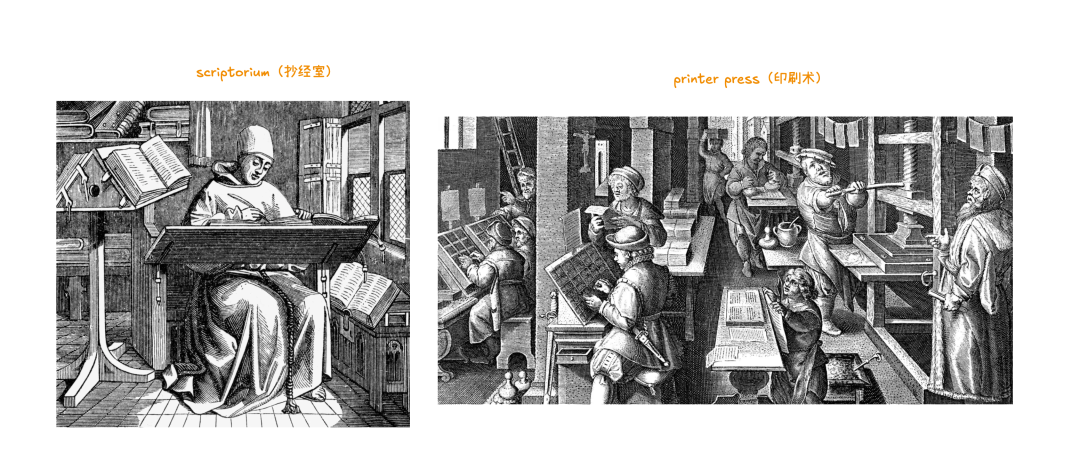
Supply exploded. But the consequences of that explosion went far beyond "more books":
- Decline of old professions: Demand for scribes collapsed, and monastery scriptoria faded within decades. In 1492, Abbot Johannes Trithemius wrote In Praise of Scribes, attempting to argue for the spiritual value of handwritten manuscripts.
- Birth of new professions: Printing spawned an entirely new industrial chain — typesetters, proofreaders, binders, illustrators, publishers, booksellers. These jobs simply didn't exist before Gutenberg.
- Oversupply and uneven quality: A flood of low-quality printed material emerged — religious pamphlets, prophecy booklets, pornography.
- Unforeseen second-order effects: The Protestant Reformation (Luther weaponizing print to spread his ideas at scale), the Scientific Revolution (academic papers circulating across borders), and the rise of nation-states (vernacular publications strengthening national identity) — none of which Gutenberg could have anticipated.
This story reveals a recurring pattern. Clayton Christensen proposed the Law of Conservation of Attractive Profits: when one layer of the value chain is commoditized and profits disappear, adjacent layers spawn new proprietary products to capture those profits. Ben Thompson, analyzing Netflix, put this logic more bluntly: "Breaking apart the formerly integrated system — commoditizing and modularizing it — destroys incumbent value while enabling new entrants to integrate at a different point in the value chain and capture new value."
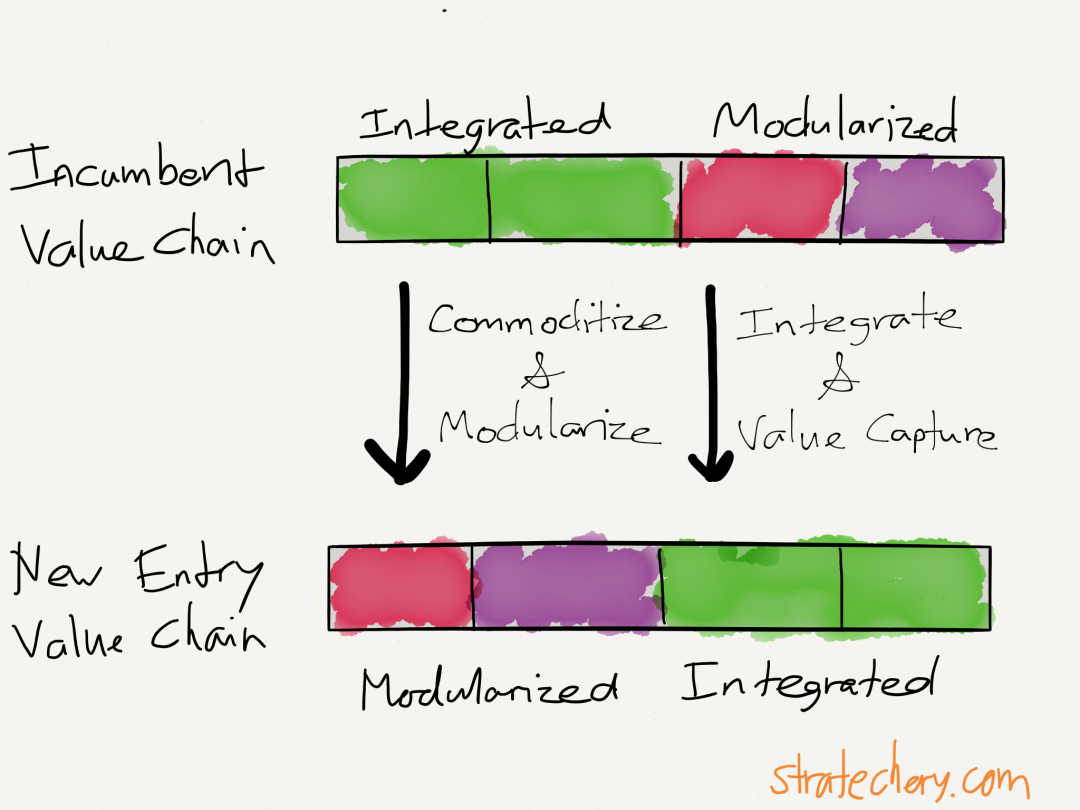
(Image source: "Netflix and the Conservation of Attractive Profits" by Ben Thompson)
Value doesn't vanish into thin air; it migrates. Once "replication" was commoditized, value shifted from "copying" to "content creation" and "curation/distribution." Publishers — not printers — became the new power nodes.
Joel Spolsky, in his 2002 essay Strategy Letter V, distilled this logic into a strategic principle: "Commoditize your complement" — smart companies actively commoditize complementary goods to increase demand for their core product. Microsoft commoditized PC hardware to boost the value of its operating system; Netscape gave away browsers to increase server value.
There's also a frequently overlooked structural consequence of commoditization: when supply explodes, demand (attention, budget, time) doesn't grow proportionally. The result is an extreme power-law distribution — a tiny handful of winners at the top capture the vast majority of value, while the long tail of massive output goes largely unseen.
Fifty years after the printing press, European books grew from 30,000 to 20 million, yet the classics that survived to the present day represent only a minuscule fraction. In a world of oversupply, attention itself becomes the scarcest resource.
This supply-side explosion is replaying right now. a16z data shows that iOS new app releases in December 2025 were up 60% year-over-year, with a 24% cumulative increase over the past 12 months — which they attribute to the rise of agentic coding (also known as "vibe coding"). This mirrors exactly the app explosion after the iPhone SDK launched in 2008: when creation barriers plummet, supply always explodes.

03. When Power Became Cheap
In the late 19th century, factory power came from steam engines or waterwheels. The entire factory layout was designed around a massive central line shaft: a steam engine in the basement turned the main shaft, which drove machines on every floor through belts. Factories had to be built as narrow, multi-story buildings, with all machines clustered tightly around the shaft. Building a factory required enormous capital — not just for machines, but for constructing the power system itself.
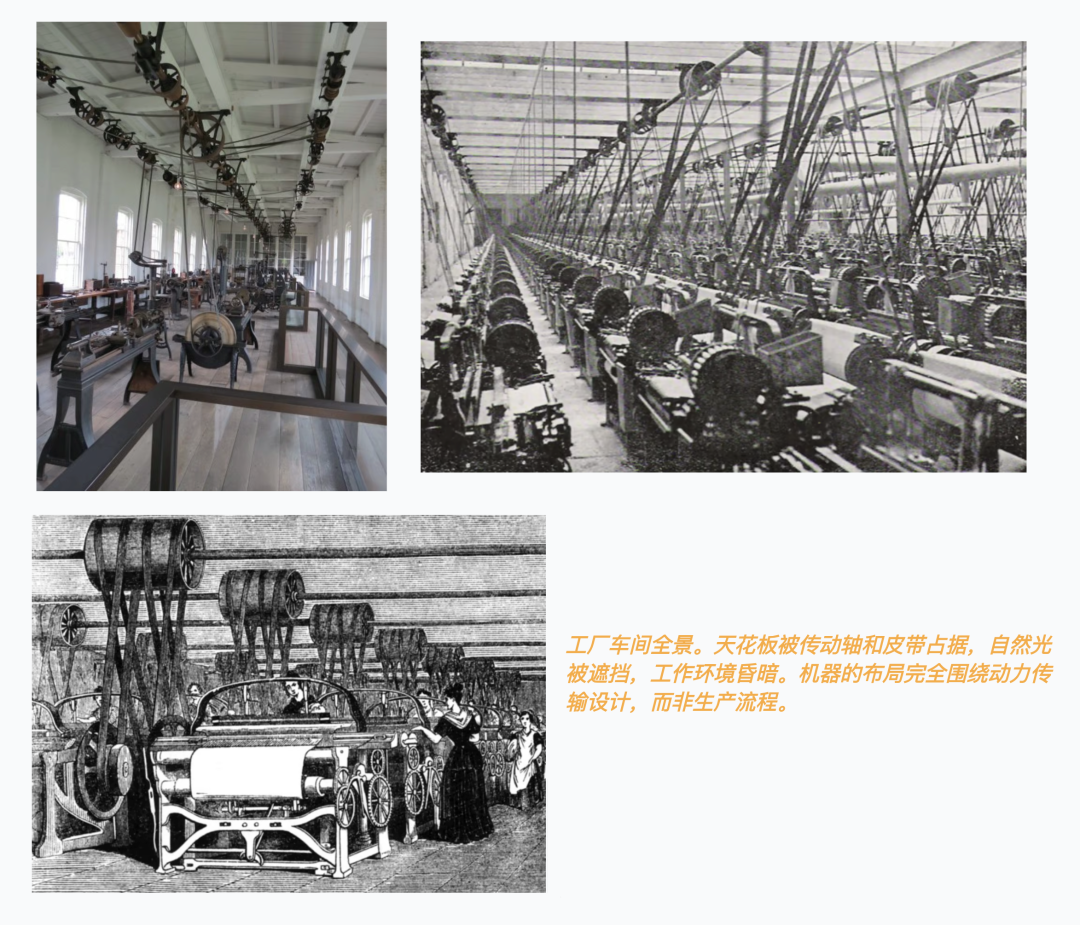
Electricity changed everything. The power grid let any factory "plug and play" for energy, no steam engine required. In 1899, electric motors accounted for just 5% of total US manufacturing power; by 1909, 23%; by 1929, 77%. This transformation unfolded in three stages: first, large electric motors replaced steam engines to drive existing line shafts; then machines were grouped, with each group powered by a smaller motor; finally, line shafts were abolished entirely, with each machine getting its own independent motor.
But there's an extraordinarily important lesson here.
In his famous 1990 paper "The Dynamo and the Computer: An Historical Perspective on the Modern Productivity Paradox," economist Paul David pointed out that from the commercialization of electricity (power stations built in New York and London in 1881) to economically measurable productivity gains (the 1920s), there was a lag of roughly 40 years. An observer in 1900 would have found almost no evidence that the "electricity revolution" was making business more efficient.
Why? Because early factories simply swapped steam engines for electric motors while changing nothing else — same layout, same processes, same organizational structure. They were using new tools to do old things.
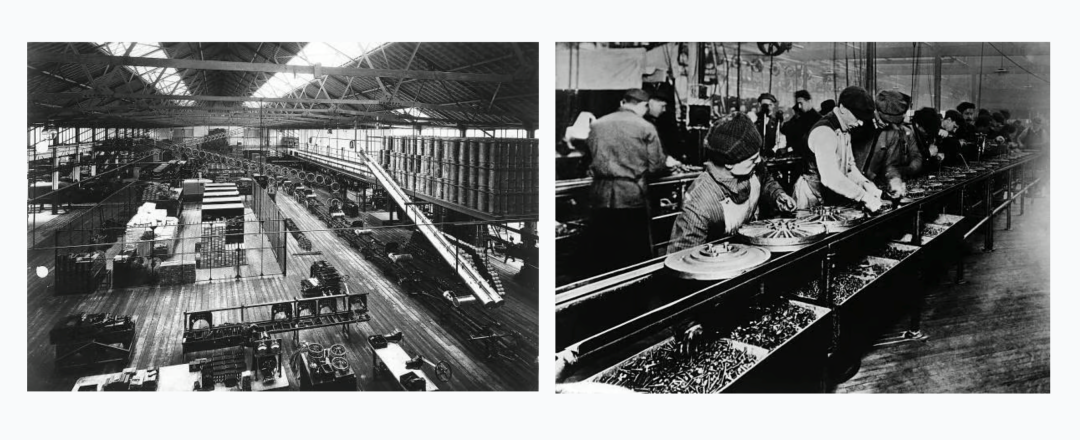
The true productivity explosion came in the 1920s — manufacturing total factor productivity (TFP) grew at roughly 5% annually, accounting for 84% of the entire economy's TFP growth — when a new generation of factories was designed from scratch around electricity's properties: single-story buildings replaced multi-story ones, machines could be arranged by workflow rather than power transmission, factories became brighter and safer. This ultimately gave rise to Ford's assembly line. Ford's plant wasn't "an old factory powered by electricity," but "a completely new production system designed around electricity's characteristics."
This echoes across a century to Robert Solow's 1987 IT productivity paradox — "You can see the computer age everywhere but in the productivity statistics." Erik Brynjolfsson confirmed in his 1993 research: despite a hundredfold increase in US computing power during the 1970s–1980s, labor productivity growth slowed from over 3% annually in the 1960s to roughly 1%. Productivity only improves when technology investment is accompanied by complementary organizational change — exactly the electricity story all over again.
The same paradox is now replaying in AI coding. A rigorous randomized controlled trial conducted by METR in 2025 found: when 16 experienced open-source developers used AI tools on their own familiar projects (maintained for an average of 5 years), task completion time was actually 19% slower — while before the experiment, these developers had expected to be 24% faster. Larger-scale surveys show 75% of engineers are using AI tools, yet most organizations see no measurable performance improvement. Why? AI accelerates the code generation step, but creates new bottlenecks in code review, integration, and testing — like speeding up just one machine on the assembly line; you don't get a faster factory, you get bigger pile-ups.
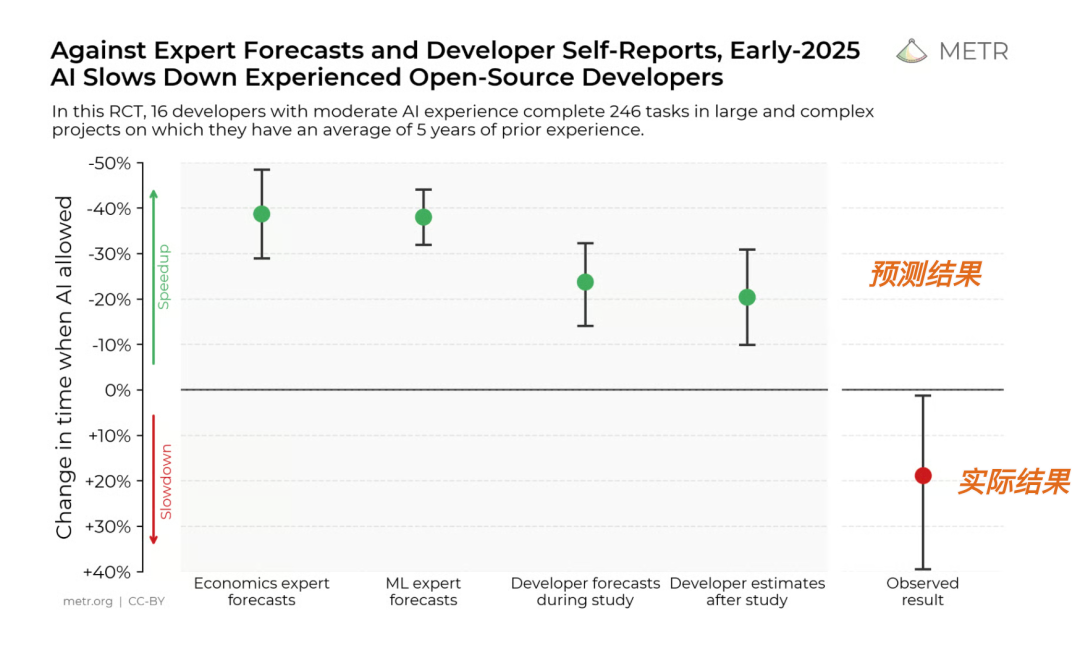
But this doesn't mean AI coding lacks value. The key is who uses it and how. Karpathy's example — compressing a weekend project into 30 minutes — precisely illustrates: when the user already possesses sufficient system architecture skills and judgment, AI becomes massive leverage. The METR trial developers slowing down on "familiar projects" likely reflects precisely that old workflows weren't optimized for AI. Real efficiency gains require redesigning the entire way of working around AI's characteristics — just like the electricity story.
04. When Barriers Collapsed
Before AWS, building an internet service meant buying servers, leasing data center space, hiring operations teams. In "Why Software Is Eating the World," Marc Andreessen recalled: in 2000, when his partner Ben Horowitz was CEO of Loudcloud, the cost for a customer to run a basic internet application was about $150,000 per month.
In 2006, AWS launched S3 and EC2. By 2011, the same application on AWS cost roughly $1,500 per month — a 100x cost reduction. AWS cut prices over 60 times between 2006 and 2014; S3 storage costs fell 86% over 12 years (from $0.15/GB to $0.022/GB).
The collapse of barriers triggered an explosion in entrepreneurship. The capital threshold to start an internet company dropped from millions of dollars to a few thousand. Y Combinator was able to launch in 2005 and back founders with minimal seed funding (initially around $20,000) precisely because of this seismic shift in infrastructure costs. Instagram had just 13 employees when Facebook acquired it for $1 billion. Airbnb, Dropbox, Stripe — these companies could exist only because they didn't need to build their own data centers.
The SaaS market grew from $31.4 billion in 2015 to over $250 billion in 2024, with more than 16,500 SaaS companies in the United States alone. Yet each vertical ultimately converged on 2-3 winners — yet another power-law distribution, following the same pattern as the supply explosion after the printing press. Value migrated from "having servers" to "having users," then to "having data flywheels" and "having network effects."
This supply-side explosion is accompanied by a recurring cycle: first Unbundle, then Re-bundle.
Jim Barksdale had a famous line: "There are only two ways to make money in business: One is to bundle; the other is to unbundle." When a capability becomes cheap, the integrated solution fragments into smaller, focused products. But when fragmentation reaches an extreme, new integrators emerge to recombine these pieces into a new unified experience.
This loop has played out repeatedly through history:
- The printing press first unbundled the Church's monopoly on knowledge; publishers then re-bundled content curation and distribution.
- Cloud computing first unbundled IT infrastructure; AWS/GCP/Azure then re-bundled it into new integrated cloud platforms.
- Journalism was first unbundled by blogs and social media — reporters could bypass newspapers to publish directly, readers could consume single articles rather than subscribing to entire papers. Then Substack and paid newsletters re-bundled independent writing: authors gained direct subscription relationships, readers received curated content packages. Value migrated from "owning the printing press" to "owning reader trust."
05. The Pattern of Commoditization
Three stories spanning centuries — the printing press, the electric motor, cloud servers — follow the same law:
| Layer Commoditized | Value Migrated To |
|---|---|
| Scribal copying → | Content creation & publishing |
| Factory power → | Production process design |
| Server infrastructure → | Application-layer experience & network effects |
| Code writing → | Problem definition, product judgment, user acquisition |
AI is commoditizing coding, but not "what problem to solve." When "how to build" ceases to be the bottleneck, "what to build" and "for whom" become the possible differentiators.
The same power-law distribution is now replaying in the AI agent赛道: countless copycats emerge, but the Matthew effect is extreme — not because latecomers are incompetent, but because in a world of supply surplus, attention itself becomes the scarcest resource. Using AI to accelerate building SaaS products in their traditional forms — "AI helps you build a CRM faster" — is essentially swapping the steam engine for an electric motor, with extremely low defensive moats. Redesigning product form around the new reality of zero-marginal-cost code production is where the real opportunity lies.
And the AI coding domain is currently in an unbundling phase: the value of standardized tools is declining, while the value of long-tail, personalized custom tools is rising. But history tells us re-bundling will inevitably follow.
06. Where We Are Now
Economist Carlota Perez proposed an influential framework describing how every technological revolution passes through two major phases.
- Installation Period: New technology enters the market, infrastructure is built, financial capital floods in, speculative bubbles form. This phase is characterized by chaos, experimentation, overinvestment.
- Turning Point: The bubble bursts, recession follows, institutional frameworks begin adjusting to accommodate the new technology.
- Deployment Period: Technology is widely adopted into mainstream society; if institutional arrangements are sound, a "Golden Age" may follow — the full potential of the technology is unleashed.
| Technological Revolution | Installation Period | Turning Point | Deployment Period |
|---|---|---|---|
| Railways | 1830s-1840s (Railway Mania) | 1847 Railway bubble burst | 1850s-1870s |
| Electricity/Heavy Industry | 1880s-1920s | 1929 Great Depression | 1930s-1960s |
| Internet/IT | 1990s | 2000 Dot-com bubble | 2003-2020s |
| AI | 2023-? | ? | ? |
If Perez's framework holds, AI is currently in the early Installation Period — massive capital inflows, labs springing up everywhere, consensus tracks extremely crowded. The characteristics of this phase are precisely what we observe: supply surplus, massive replication, extreme Matthew effects. The latter half of the Installation Period typically sees speculative bubbles. Only after the bubble bursts does the true "Deployment Period" begin — when infrastructure has matured, institutional frameworks have adapted, and the full potential of the technology starts to be released. According to this framework, the greatest value creation usually occurs during the Deployment Period, not the Installation Period.
07. What May Happen
Programmers won't disappear, but the definition of "programmer" will change. Just as scribes didn't vanish overnight — handwritten manuscripts were still being commissioned decades after the printing press — and steam-powered factories didn't immediately disappear after electrification. But the competitive differentiator will shift from "can you write code" to "system design and architectural judgment."
An important distinction here: technology substitutes "tasks," not "people." Work that can be broken down into explicit steps — whether cognitive (data entry) or physical (assembly line) — gets substituted by technology; work requiring judgment, creativity, complex communication gets amplified by it. The result: high-end skills become more valuable, mid-tier skills get commoditized, practitioners are squeezed toward both ends.
Similarly, programmer value will migrate from "can write code," an increasingly routine task, to system architecture judgment, product intuition, taste, and the debugging and integration of complex systems — tasks that remain non-routine.
The biggest winners won't be "those who use AI to write code fastest." In every historical commoditization, the biggest winners weren't those who executed faster, but those who redefined the rules of the game. Gutenberg wasn't the biggest winner; publishers and authors were. Power companies weren't the biggest winners; Ford was. AWS was certainly a winner, but so were Airbnb and Stripe — they leveraged commoditized infrastructure to create business models previously impossible. When coding is commoditized, the winners may not be "those who use AI to write code fastest," but those who leverage zero-marginal-cost code production to redefine product form, distribution methods, or value capture models.
After Unbundling, Re-bundling opportunities are brewing. We're currently in the unbundling phase — standardized tools are fragmenting, long-tail personalized tools are emerging (see the recent shift from SaaS to personalized agents). But if historical patterns hold, these fragmented long-tail tools will eventually need a new integration layer. It might be an "app store" where AI-generated one-off tools can be discovered and reused; a "composable platform" letting users assemble multiple long-tail tools like Lego blocks; or an "AI-native operating system" that treats code generation, execution, and management as underlying primitives.
And the forty-year lesson of electricity reminds us to be patient. Our current use of AI — having it write software in traditional forms faster — is likely still the "replacing steam engines with electric motors" stage. The true "assembly line moment" — redesigning the entire software paradigm around the unique properties of AI capabilities — may still be years or even longer away. But when it arrives, it may catalyze entirely new product forms previously impossible:
- Disposable software: custom tools built for one specific scenario, one specific user, discarded after use;
- Self-adapting software: applications that generate and modify their own code in real-time based on user behavior;
- Ultra-long-tail software: dedicated products built for every conceivably niche demand.
But one caveat: AI is developing far faster than the electrical age. The 40-year lag in the electricity revolution partly stemmed from physical infrastructure construction cycles — power grids, factories, worker training all took time. AI's "infrastructure" is software and compute, with iteration cycles measured in months. McKinsey's 2025 survey found that organizations that redesigned end-to-end workflows before adopting AI were nearly three times more likely to achieve significant financial returns. This suggests: the "assembly line moment" won't wait 40 years; it may arrive in just a few years.
08. The Worst Time to Be an Entrepreneur
If the preceding analysis is correct, then for entrepreneurs, this is simultaneously the best of times and the most brutal of times.
The upside is obvious: the barrier to building products has never been lower. One person, one weekend, a few hundred dollars in API fees, can produce what once required a team several months to build. The distance from idea to prototype has been compressed to the limit. "Can we build it?" is no longer the question.
But this is precisely where hell mode begins: when everyone can build products quickly, "building it" itself ceases to be a competitive advantage. What you can make in a weekend, others can too. Your innovation today will be copied tomorrow.
This leads to several brutal realities:
Competition intensifies exponentially. Every track is packed with people. Lower barriers to entry mean more entrants; faster iteration means everyone is shipping frantically. You're no longer racing a few competitors — you're racing everyone on the internet who can think of the same idea.
Attention becomes the ultimate bottleneck. In a world of oversupply, being seen is harder than being built. Product Hunt sees dozens of new launches daily; on X, someone demos a new AI tool every hour. The cost of acquiring user attention — whether through paid acquisition or content marketing — is rising fast, even as product differentiation declines.
Winner-take-all dynamics are extreme. History tells us that after every supply-side explosion, value concentrates heavily at the top. This means: moderate success may disappear. Either become the category leader, or struggle to survive in the long tail.
Moats are collapsing. Traditional software moats — technical complexity, engineering team size, years of accumulated codebase — have grown fragile in the face of AI. Nicolas Bustamante analyzed the fate of vertical software's ten moats in the LLM era: five are collapsing (learned interfaces, customized business logic, public data access, scarce talent, bundling), five remain solid (proprietary data, regulatory compliance, network effects, transaction embedding, system of record status). The key insight: what's being destroyed is precisely what once kept competitors out.
Put simply: if your advantage lies in "how," you're being commoditized; if your advantage lies in "what you have" (data, users, compliance credentials), you're actually safer.
09. Surviving Hell Mode
So in this hell mode, what strategies might actually work?
Don't use AI to do old things. Using AI to build traditional SaaS faster is essentially swapping a steam engine for an electric motor. The question you need to ask is: if code production cost drops to zero, what product forms were previously impossible? Disposable software? Self-adapting software? Hyper-personalized experiences?
(Of course, in the short term, "using AI to do old things faster" does present an arbitrage window — before competitors catch on, you can capture market share at lower cost and greater speed. But this window closes rapidly, because what you can do, others can do too.)
Build moats outside the code. If code itself is no longer a barrier, then barriers must come from: unique data assets, strong user relationships, hard-to-replicate distribution channels, or brand and community.
Speed still matters, but direction matters more than speed. In a world where everyone can execute fast, judgment — knowing what to build, and for whom — becomes the true differentiator. Slowing down to think through the right questions may prove more valuable than rapidly executing the wrong answers.
Embrace unbundling, while seeking re-bundling opportunities. We're currently in an unbundling phase — long-tail tools proliferating, standardized products being pulled apart. But history tells us re-bundling inevitably follows. Ask yourself: what integration layer will these fragmented tools ultimately need? Who will provide it?
Accept this is a war of attrition. The installation period's chaos may last years. This isn't an era of "quickly find PMF then scale," but one requiring constant adaptation, constant redefinition of oneself. Patience and resilience may matter more than any single skill.
10. Without Destruction, No Construction
Every major commoditization in history carries a particular pain: those who accumulated advantages under the old order find their advantages evaporating. Scribes who spent a decade perfecting their script found it worthless before the printing press. Factory owners who invested heavily in shaft-drive systems found them a burden in the electrical age. Programmers who spent years accumulating coding skills are being caught up by AI on a monthly basis.
But the other side of "without destruction, no construction" is this: the disappearance of old advantages also means the disappearance of old barriers. Those once excluded for lack of resources, team, or engineering capacity can now compete. What once required hundreds of people and tens of millions of dollars, one person can now begin in a weekend.
This is why we stand at the beginning of transformation.
Not because AI will replace everyone's work — history tells us technology rarely "eliminates" occupations directly; it more often redefines their substance.
But because: when a core capability is commoditized, the entire value chain reorganizes. And the moment of value chain reorganization is precisely when new players enter and new rules are written.
Gutenberg didn't know printing would spark the Reformation. Ford didn't know the assembly line would reshape the middle class. When AWS launched in 2006, no one could foresee that companies like Airbnb and Stripe would become possible because of it.
Likewise, we don't know today what new product forms, business models, or value creation methods will emerge once coding is thoroughly commoditized.
But one thing is certain: those who first understand the new rules, who first redesign themselves around new capabilities — whether individuals, teams, or companies — will seize the advantage in the new order.
Without destruction, no construction.
References
- Autor, D.H., Levy, F., & Murnane, R.J. (2003). "The Skill Content of Recent Technological Change: An Empirical Exploration." The Quarterly Journal of Economics, 118(4), 1279-1333. https://doi.org/10.1162/003355303322552801
- Brynjolfsson, E. (1993). "The Productivity Paradox of Information Technology." Communications of the ACM, 36(12), 66-77.
- Christensen, C. & Raynor, M. (2003). The Innovator's Solution: Creating and Sustaining Successful Growth. Harvard Business School Press.
- David, P.A. (1990). "The Dynamo and the Computer: An Historical Perspective on the Modern Productivity Paradox." American Economic Review, 80(2), 355-361.
- Dittmar, J. (2011). "Information Technology and Economic Change: The Impact of The Printing Press." The Quarterly Journal of Economics, 126(3), 1133-1172.
- Dittmar, J. & Seabold, S. (2019). "New Media and Competition: Printing and Europe's Transformation after Gutenberg." CEP Discussion Paper No. 1600.
- Perez, C. (2002). Technological Revolutions and Financial Capital: The Dynamics of Bubbles and Golden Ages. Edward Elgar Publishing.
- Solow, R. (1987). "We'd better watch out." New York Times Book Review, July 12, p.36.
- Andreessen, M. (2011). "Why Software Is Eating the World." Wall Street Journal. https://a16z.com/why-software-is-eating-the-world/
- Bustamante, N. (2026). "The Crumbling Workflow Moat." https://www.nicolasbustamante.com/p/the-crumbling-workflow-moat-aggregation
- Grady, P. & Huang, S. (2026). "2026: This is AGI." Sequoia Capital. https://sequoiacap.com/article/2026-this-is-agi/
- Spolsky, J. (2002). "Strategy Letter V." https://www.joelonsoftware.com/2002/06/12/strategy-letter-v/
- Thompson, B. (2015). "Netflix and the Conservation of Attractive Profits." Stratechery. https://stratechery.com/2015/netflix-and-the-conservation-of-attractive-profits/
- a16z. (2025). "Charts of the Week: The Almighty Consumer." https://www.a16z.news/p/charts-of-the-week-the-almighty-consumer
- McKinsey & Company. (2025). "The State of AI 2025." https://www.mckinsey.com/capabilities/quantumblack/our-insights/the-state-of-ai
- METR. (2025). "Measuring AI Ability to Complete Long Tasks." https://metr.org/blog/2025-03-19-measuring-ai-ability-to-complete-long-tasks/
- METR. (2025). "Early 2025 AI Experienced OS Dev Study." https://metr.org/blog/2025-07-10-early-2025-ai-experienced-os-dev-study/
- Buringh, E. & Van Zanden, J.L. (2009). "Charting the 'Rise of the West': Manuscripts and Printed Books in Europe." The Journal of Economic History, 69(2), 409-445.
- CBO. (2013). "Total Factor Productivity Growth in Historical Perspective." Working Paper 2013-01.
- AWS. (2006-2018). S3 pricing history.
- Y Combinator founding history (2005). https://paulgraham.com/ycstart.html