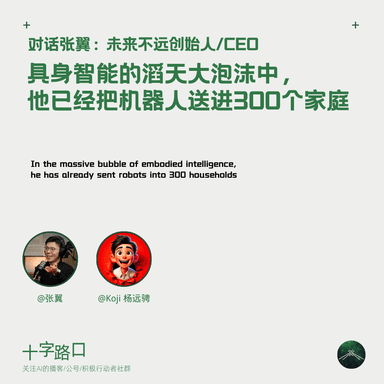

🚥 Embodied intelligence is rapidly sliding into a capital carnival. Since the start of the year, at least five Chinese embodied intelligence companies — Galaxy Universal, Xinghai Tu, AI2Robotics, Qianxun Intelligence, and Independent Variable Robotics — have each raised funding in the hundreds of millions of RMB. When a billion yuan starts becoming the common entry price for this track, many people, ourselves included, can feel the towering sense of froth.
This week's Crossing guest is Zhang Yi, founder of Weilai Buyuan Robotics. Four years ago, he decided to enter the robotics business. The market was silent then; he thought he was choosing a path that was slow, difficult, and ignored.
Zhang Yi previously founded "Zhangmen 1-on-1," a publicly listed company valued at $3 billion, and also experienced the "overnight zeroing" brought by the shuangjian policy. We start from that cliff-like fall — it took a full half-month to confirm that shuangjian was real; cutting a company of nearly 90,000 people down to under 1,000, a memory that has "faded to white" in his mind, though a patch of white hair remains on the back of his head from the pressure of that time.
This time around, he did the opposite: spent three years in stealth without raising funding, first sending robots into 300 real Shanghai households, using long-term collected scenario data to drive product iteration, and this week released the new-generation home robot F2.
——————————————————
🤖 This is also the second episode of Crossing's series "Robots Come to the Crossing."
Welcome to listen to the first episode: Is AI the Decisive Factor in Embodied Intelligence? After Raising 300 Million in Half a Year, How Is VBot's First Product? | A Conversation with Zhao Zhelun, Co-founder of Weita Dynamics
In this episode, you will hear:
- The "blankness" of the shuangjian moment, and the extreme decisions as CEO that followed
- Why the second venture bet on home robots rather than faster, "sexier" directions
- The counterintuitive approach of holding back for three years without funding and entering households first — what advantages it actually brought
- F2's core scenarios: childcare and light housework, and why "the kitchen" is the heaviest, hardest housework of all
- Under the embodied intelligence boom, how to choose between world models and VLA
- Why data is a moat — and the "third type of data" that most people overlook
- After experiencing the biggest rises and falls, how he learned to "stand in the future and look back at the present"
If you're interested in embodied intelligence, home robots, or any hard-tech entrepreneurship that needs to cross cycles, this episode is worth a listen.
🎬 Our video podcast is now live on @Koji Yang Yuancheng's channels on WeChat Video, Xiaohongshu, Bilibili, YouTube, and other platforms.
📒 The transcript will be published on the @十字路口Crossing WeChat public account.
🟢 00:02 Rapid-fire Q&A: Age, alma mater, MBTI and zodiac, one-sentence introduction, funding status, revenue and order scale, pre-entrepreneurship experience
🟢 02:26 The Shuangjian Moment
- From $3 billion valuation to "blank nothingness"
- When the "$10 billion revenue machine" suddenly ran out of fuel
- From 90,000+ people cut to under 1,000, leaving a kind of trauma: memories fade to white
🟢 06:04 Why Choose Home Robots
- "In 20 years, every household will definitely buy a robot."
- Not switching tracks, but re-answering "why do I still want to do things?"
- What is the underlying motivation for starting over?
- Three converging forces pointing to robots: LLM (the sense of opportunity in the ChatGPT 3.0 era), engineering background (electronic information), to-C home user insight
- If doing it again, it must be "bigger than before," otherwise there's no motivation
🟢 08:56 Why "Doing Hardware Early" Is More Valuable Than Doing AI Early
- The compound interest of hardware-software integration comes from time, not money
- AI software iterates fast; leads get caught up easily; robots, because of hardware and engineering chains, accumulate leads into moats
- Spending a billion may not catch up to mature motion control and stability: many capabilities are "a matter of time"
- Holding back for three years before emerging: not avoiding funding, but waiting until "can enter homes, can run stably, can be productized"
- Early core judgment: first get consumer-grade to the point where "people are amazed when you take it out," then educate the market
🟢 11:08 Staying Firm on Home To-C
- To-B often ends up as price wars; to-C can trade experience for profit, then trade profit for the next generation of products
- Industrial/to-B tech often doesn't have high enough barriers, ending up competing on cost; home to-C's "experience + brand" forms a moat
- From day one, "finding the product": 5,000-6,000 questionnaires + phone interviews, only settling on the first version of features once robots could actually enter homes
- 300 Shanghai households in trial: from "can only do these few things" to "free play," features came from co-creation not imagination
- Real insight: many users don't want to accompany the elderly, but want to "help the elderly take care of kids"
🟢 14:34 F2's Real Selling Point: Childcare + Light Housework, Service Pricing Not Product Pricing
- If only benchmarking against nannies, robots will always seem expensive; once benchmarking against "premium childcare services," the value changes
- Two main scenarios: childcare (reading picture books, correcting instrument playing, playing chess, telling stories, hide-and-seek) and light housework (tidying toys, picking up trash)
- Usage duration and referral are the true product metrics: 50% referral rate, 30% renewal rate, better than "how many units sold"
- Early surprise: the robotic arm brought "fancy" play patterns, kids could play for two hours
- Early scare: cat-and-dog households are extreme corner cases, which inversely forced out "dog-training/cat-accompanying" capabilities
- Business model: rent first (3-4k/month), then consider buyout + subscription (advanced features consume compute)
🟢 21:06 Wheeled vs. Bipedal
- Homes aren't labs: usable, durable, won't hurt people matters more than "looks human"
- Bipedal has safety and stability issues at home, real usage scenarios amplify risk
- Wheeled indoor cost-performance comes from safety, stability, battery life, and more controllable engineering complexity
- Real-world constraints determine form: first get a structure that "can continuously run in homes" working
🟢 22:19 World Models and Data
- What decides victory is the "real home data flywheel"
- Models can be copied in two months, but data pipelines can't
- World models bring surprises on zero-shot, but far from 100% robustness
- At this stage, running world models + VLA in parallel is more realistic
- The scarcity of robot data determines competitive rhythm: little historical data, hard to collect, data becomes a long-term differentiator
- Data isn't two types but three: standard task data, home corner cases, and "living being interaction" (humans and animals)
- 80% of home scenarios are interaction: interaction differences across ages and people, hard for factory data to cover
- Will they subsidize scale, enter homes to collect data?
🟢 37:57 Entrepreneur Mindset
- Anxiety makes strategy short-sighted: win this month, lose the next two years
- Better able to persist after experiencing shuangjian: saw further from the start, more resolute once direction was set
- Dissolving ups and downs by "looking back from the future": the "light boat has passed ten thousand mountains" perspective stabilizes the organization
- Rewriting setbacks: failure is sometimes external forces helping you make choices, key is finding self-consistency
- Ten-year message: after Weilai Buyuan is realized, still believe there's an even better future not far away
Welcome to subscribe to Crossing: 🚦 We follow the new industry changes and entrepreneurial opportunities brought by the new wave of AI technology.
🚦 Crossing is Steve Jobs's metaphor for Apple — standing at the crossing of technology and liberal arts, where great products are often born. AI is bringing change to all industries; we seek out, interview, and gather a new generation of AI entrepreneurs and active actors in the AI era, and together with them, explore and embrace new changes, new possibilities.
👦🏻 Host Koji: I founded Crossing, launched AI Hacker House — a community space for a new generation of AI entrepreneurs, and serve as Venture Partner at ZhenFund. I believe technology, especially AI, is the greatest value-creation opportunity of our generation. Koji's Jike, Koji's website
👧🏻 Host Ronghui: I co-founded Crossing, worked at a dollar-denominated VC, and was a Silicon Valley correspondent for five years, following tech development and business stories. Welcome to chat and exchange with me. Ronghui's Jike