Three-Hour Interview with Juanjuan: From Douyin to AI 3D, the Rollercoaster of Entrepreneurship, Ambitions to Become Manufacturing OS, and Why Foundation Models Won't Swallow Everything!

👦🏻 Podcast Interview: Koji
🥷 Edited by: Crossing
🧑🎨 Layout: Zeoooo

➤ This week's guest on "Crossing" is Juanjuan, real name Ren Lifeng, founder and CEO of Hitems. He previously led the team that incubated Douyin from scratch, widely credited as a key force behind its rise.
This is a nearly 3-hour conversation: we started with how Douyin was originally greenlit, moved to Hitems' newly released Hi3D 3.0 2048³ model, and discussed their ambition to evolve from Maker OS toward a "Manufacturing OS."
After talking with Juanjuan, my strongest takeaway: foundation models won't swallow everything.
Large language models and multimodal models may seem capable of generating anything, but once you enter physical manufacturing, you still need models that can produce "production-grade" 3D assets. And the real difficulty usually comes after the model: how to break designs into parts, how to add connection structures, how to adapt for different materials and equipment; how to unfold plush surfaces into paper patterns, how to convert images into stitch patterns that embroidery machines can read; and how, amid high-volume orders where every single piece is different, to deliver products to customers on time.
This explains why Hitems has extended from 3D foundation models all the way to tools, factories, transactions, and ecosystem — and why its goal has shifted from Maker OS to Manufacturing OS. What they're building is a production pipeline that channels ordinary people's creative impulses into the physical world.
This is a long conversation about AI, trends, products, ambition, and self-cultivation — and the story of someone who built a super-product, now becoming a startup novice all over again.
Listen on WeChat:
Listen on Xiaoyuzhou:

🎬 The video podcast is also available on @Koji's WeChat Channels, Xiaohongshu, Bilibili, YouTube, and other platforms
Rapid Fire
👦🏻 Koji
Age?
🧑🏻💻 Juanjuan
39 this year.
👦🏻 Koji
Education?
🧑🏻💻 Juanjuan
Undergrad in Qinhuangdao.
👦🏻 Koji
Your MBTI and zodiac sign?
🧑🏻💻 Juanjuan
INFP, Taurus.
👦🏻 Koji
Describe Hitems in one sentence.
🧑🏻💻 Juanjuan
We develop proprietary AI generative 3D general-purpose foundation models, primarily applied to manufacturing, with smaller use cases in gaming, film, and similar fields.
On the consumer side, we have two products: Hi3D and Goodthings. They serve makers, illustrators, and artists respectively, lowering the barrier to obtaining 3D designs and helping creative concepts materialize into physical products and transactions.
👦🏻 Koji
Serving Chinese users or global users?
🧑🏻💻 Juanjuan
Global users currently.
👦🏻 Koji
Funding status?
🧑🏻💻 Juanjuan
Several rounds so far, with cumulative funding exceeding $100 million. The most recent round was roughly close to $50 million.
👦🏻 Koji
Team size?
🧑🏻💻 Juanjuan
Around 170-something people.
👦🏻 Koji
What did you do before this Hitems venture?
🧑🏻💻 Juanjuan
I joined Baidu in 2010 after graduation, managing and operating Baidu Tieba moderators. Then I worked at Ganji.com, right through its merger with 58.com.
After that I joined ByteDance, when the main product was still Toutiao. Before taking on Douyin, I was responsible for Toutiao, Q&A, and live-streaming businesses.
How Did Douyin Begin?
👦🏻 Koji
As the person who took Douyin from zero to one, tell us: at the very beginning, how did Douyin actually start?
🧑🏻💻 Juanjuan
ByteDance's interest in short video was largely tied to underlying infrastructure. The so-called internet infrastructure really boils down to two factors: hardware and networks.
Going back to 2015, before 2016, we saw two fairly clear signals.
One was that the government work report at the end of 2015 mentioned plans for 2016 to broadly reduce home broadband costs and significantly boost internet speeds. Plus, by 2016, mobile operators had begun building out 5G infrastructure. That was a massive network signal.
The other factor was hardware — our mobile devices. We observed that handset makers led by OPPO, vivo, Huawei, and Xiaomi were all saying 2016 would be the year of large-screen adoption. Larger screens inherently benefit imaging, and better imaging necessarily raises demands for graphics rendering and GPU capabilities.
At the same time, phone cameras as capture devices were seeing major leaps in image quality and resolution. I remember one brand's tagline was "illuminate your beauty" — that was vivo. Xiaomi also collaborated with Leica on special edition models.
Seeing these hardware and network shifts is what made short video viable.
👦🏻 Koji
That's very much a top-down industry trend perspective. Did you also see bottom-up signals or opportunities?
🧑🏻💻 Juanjuan
There were two standout products in the market at the time: Kuaishou domestically, and Musical.ly internationally.
These two products had achieved impressive results, one through unvarnished documentation of daily life, the other by adding musical playfulness to expression. When we thought about what the next generation of mobile internet video products should look like, we referenced and observed these industry shifts.
👦🏻 Koji
What was the internal greenlight story for Douyin at ByteDance? Can you share that?
🧑🏻💻 Juanjuan
The greenlight was ultimately a management decision. Given the combined factors of network evolution, hardware advances, and consumer product trends, the company decided to explore two directions: Volcano Video and Douyin.
The Douyin direction was handed to me to explore.
👦🏻 Koji
How did such a critical mission end up with you? ByteDance had no shortage of talent.
🧑🏻💻 Juanjuan
There was luck involved, and I'm especially grateful for management's support. Truth is, we were all basically nobodies back then — no particularly eye-catching resumes — but the company provided an excellent environment for growth.
👦🏻 Koji
You weren't exactly nobody — you'd produced results. What achievements do you think gave the organization confidence that Juanjuan could make Douyin work?
🧑🏻💻 Juanjuan
A big factor was probably my operations background. I'd worked at Baidu Tieba and had relevant user product operations experience.
On top of that, I'd had opportunities to work on backend products — operations dashboards, review systems, internal efficiency tools.
The combination of operations and product capabilities is a pretty good fit for content products.
👦🏻 Koji
I've met quite a few early Douyin team members recently. Xiao An said when he first visited your office, he was struck by how everyone could work with such joy — playing while working — and he decided on the spot that he had to join.
Does this Hitems venture share anything with that zero-to-one Douyin experience? Is it as joyful?
🧑🏻💻 Juanjuan
The vision is beautiful, the path is winding — that part is the same.
Before building Douyin, nobody had clairvoyance — no way to predict where it would go.
But the vision at greenlight was beautiful: young users expressing their inner worlds and perspectives through the camera lens.
China's young users are incredibly interesting — they just lacked opportunities to be seen. Douyin's earliest positioning was as a music short video product for post-95s and post-00s. Later we discovered: everyone says Chinese people are reserved, not good at self-expression, but Douyin unlocked their creativity and revealed an extraordinarily vibrant side.
👦🏻 Koji
How did you unlock that creativity? What were the key elements?
🧑🏻💻 Juanjuan
We identified two critical needs.
One is the need to be triggered. This triggering requires guidance from us, but it can't become templated. Templates make onboarding easy, but they constrain and imprison user creativity. Completely open-ended free expression is also hard to establish early on, because users haven't yet developed an understanding of how to play.
So we adopted a "semi-guided" approach. For example, we'd give you a piece of music — you didn't need to care what the lyrics or theme expressed, it was simply a tool for setting atmosphere and conveying emotion. Later this expanded to stickers, props, effects, and beauty filters — all key production elements for triggering user expression.
The other thing is that users need to be seen. Good content deserves wider distribution. Recommendation algorithms matter, but to a large extent you still need to inject human aesthetic judgment — using operational thinking to surface excellent tags, visual styles, and thematic formats.
From Sculpting Time to Sculpting Space
Koji
What parallels do you see between building Douyin back then and building Hitems now?
Juanjuan
The common thread is that we're both looking at the key variable elements of an industry.
In the Mobile Internet era, content products depended on hardware and network infrastructure; today, we're looking at AI. In the 3D space, we see the possibility of evolution — continuing from images, audio, video, and other multimodal formats into 3D.
When we started thinking about this direction at the end of 2023, we did some technical推演, including data collection and technology roadmap evolution, and concluded that AI 3D would have sustained AIGC tailwinds.
Koji
What specific signals did you see at the time?
Juanjuan
The earlier signal was probably when Midjourney first came out at the end of 2022. For the first time, people had a clear and magical perception of AI: you input natural language, and you get a beautiful image. We saw the possibility of AIGC evolution.
Also, at the time I was on the PICO team. PICO is VR hardware, also the XR business direction, where we researched and applied a lot of 3D. In virtual reality, there are Unity and Unreal engine pipelines, requiring large FOV, 3 to 6 DOF immersive interaction.
What we saw then was that beyond hardware experience, content ecosystem was the critical bottleneck. And in a VR environment, 3D asset production costs were extremely high, cycles extremely long — almost equivalent to a mini AAA game. The production process was incredibly painful.
When I saw Midjourney, my first reaction was: if AI-generated images can achieve this, when will AI-generated 3D arrive? If it could lower the barrier to acquiring 3D assets and dramatically improve quality, that would be a crucial boost to the industry's key variable elements. From that point, we started doing research in this direction.
Another variable was on the manufacturing side. Manufacturing sounds like a huge leap from my past work experience, but I've always had personal interest in this area. You could even trace it back to my time working at Tieba — to manage the bar owners well, we had to empathize with their mindset and that of users.
Out of personal interest, I hung out in jadeite bars, tea bars — I was only 23 at the time, which seemed precocious.
Koji
I notice you're still wearing a jadeite ring?
Juanjuan
This is actually nephrite jade, "kiwi fruit" material. I did wear a jadeite ring earlier.
Sometimes interest is hard to explain with logic. I suggest the same for everyone — when people ask what your interest is, you don't need to explain it with logic. What you naturally gravitate toward, what your heart yearns for — that's your truest interest.
I've always been looking at aesthetically-oriented consumer goods — jadeite, tea, porcelain, jewelry, collectibles, even clothing. This gave me long-term摸索 and understanding of underlying materials, equipment, processes, production lines, and industrial cluster coordination. This was a personal interest thread running in the background.
Koji
You probably thought it was just consumer behavior back then, right? Never imagined it would end up becoming the foundation of a career主线.
Juanjuan
Right, so looking back, the industry variable was on the manufacturing side.
We see that China is the world's largest manufacturing nation, with very complete full-industry-chain distribution. In the core industrial clusters centered around the Pearl River Delta and Yangtze River Delta, the upgrade of digital production equipment is astonishing. Years ago I already saw the trend of industrial-grade equipment evolving toward desktop, miniaturized equipment — desktop 3D printers, laser engraving, CNC carving machines.
Desktop equipment benefits ordinary users. To explain the leap from content product to today's business in one sentence: we used to start with 15-second short videos, providing users with tools to sculpt time — that was work in the dimension of time; today we hope to use AI generative 3D large model capabilities to provide users with tools to sculpt space.
Three-dimensional space plus one-dimensional time is the four-dimensional world humans can comprehend. What we're doing is moving from the democratization of expression in the digital world to the democratization of creation in the physical world.
Koji
This has a lot in common with how you wanted to inspire people and help them be seen when building Douyin. What's different?
Juanjuan
The difference is definitely the manufacturing-related落地 portion.
In the past, people were expressing themselves through virtual assets and virtual content experiences, but today we need to break through the barrier between digital and physical worlds, which involves specific manufacturing落地 pipelines.
This is a huge hurdle for internet practitioners — 隔行如隔山. I often joke with industry friends that in many ways, these past few years have largely been an internet person trying to be a good factory director.
Koji
What's the biggest gap that shocked you?
Juanjuan
Respecting the laws of physical industries. You can't use internet iteration thinking to rapidly trial-and-error — it has its own cyclical rhythms.
Looking from the source of manufacturing, you need to research materials, and materials science has its research attributes and contingent elements — it's hard to force rapid change. More often, you need to find materials science foundations suitable for today's AI-pipeline-connected manufacturing, then decide what equipment, what processes, what production lines, how to deliver, until it meets users' specific product quality demands.
Today's manufacturing is a networked structure — one factory cannot完备ly handle the entire industry chain itself. You must find quality suppliers in industrial clusters to build together. This also tests our "sourcing" capability for industrial clusters, and the difficulty of communicating with cross-industry practitioners.
Internet work means looking up at the office ceiling, doing封闭 development in conference rooms or small black rooms; but in manufacturing, you must constantly collide and interact with every link in the industry chain.
These two work forms are very different.
Koji
You must have encountered some personality and working style friction along the way? Like having to deal with actual factory directors.
Juanjuan
Definitely. Let me give two examples:
First, when you try to explain AI concepts to factories in industrial clusters, they don't understand.
Two or three years ago, they had a hard time understanding what you wanted to do. In their language, helping factories improve efficiency isn't important. What they care more about: do you have orders? Revenue? Guaranteed profit? Can it keep the factory running?
Asking them to抽出 some energy and resources to combine with your AI elements and explore new areas — they were generally unwilling.
Koji
No motivation. So what did you do?
Juanjuan
Forced by circumstances, we built our own small experimental factory in Panyu, Guangzhou.
We purchased some equipment ourselves, hired industry experts from the industry chain, and explored实践 with our AI pipeline.
Koji
What can this factory do?
Juanjuan
It has several process types and corresponding material characteristics — basically industrial-grade 3D printers, laser cutting and engraving machines, miniaturized CNC. Nearby core industrial clusters also have precision CNC lathes. Additionally there's a flexible fabric processing workshop, exploring processes like plush toys, fabric embroidery, etc.
Materials-wise, it involves resin types, metal types, plush and fabric types; other materials we also explore with industrial clusters, like ceramics. It's more like an experimental facility. As the business developed, we started using it for flexible delivery, positioned for small-batch, rapid极速 delivery.
Koji
You said there were two stories — what's the other one?
Juanjuan
The other is the inevitable bringing-in of the growth hunger from doing internet products.
Having done user-facing products, you develop a hunger for numbers, a desire for scale. But doing manufacturing, doing physical business, requires respecting industry laws. Before the industry's variables arrive, it's hard to force scale through external pressure. This is actually elevating our understanding of business logic.
We've built a long-chain business — can it achieve a good business model? For industrial clusters, can it truly bring them order volume? If not, are you willing to subsidize the industry early on, like you subsidized C-end users? What's the subsidy logic? How do you calculate ROI and future returns for these R&D-nature investments? These are all concrete questions right in front of us.
Dissatisfied with yourself, so you started a company?
Koji
Going back to the starting point of entrepreneurship — you managed a large team, life was comfortable. What was the trigger that made you start a company? I met BAI's Yu Long (Annabelle) recently, and she said you were dissatisfied with yourself so you wanted to start a company. Do you agree?
Juanjuan
I understand what Anna meant — I'm someone who's quite harsh on myself.
Saying I was comfortable staying at ByteDance, that's hard to say. In the past when we did projects, no one had superhuman ability to predict the future — we're all ordinary people. We faced problems we'd never encountered before, and when large-scale user demand arrived, we had to be responsible for global大规模 users. We were indeed often dissatisfied with ourselves, felt a lot of work wasn't good enough, always on the road of pursuing极致, putting in a lot of personal thinking and effort.
Entrepreneurship is because of vision: we want to help ordinary users realize their desire to create. Many people have talent, have design sense, even without professional design training, but because they lack industry chain support, no factory is willing to do very small-batch prototyping and realization of their work for them. This is the stuck环节.
Satisfied? Hard to be satisfied — we're constantly reflecting, don't mind打脸 ourselves. When we discover changes in understanding, we bravely admit mistakes and learn to improve.
At the end of 2023, we saw the AI 3D variable and the production-side equipment digitalization variable.
These are China's two strongest variables:
One is China's decades of engineering talent accumulation, the engineering talent dividend — global AI development has massive华人 presence;
The other is China as a manufacturing大国, having accumulated full industry chains, production elements, and the networked structure capability of industry chain coordination. The combination of these two variables makes it possible for globalized business to generate massive advantages.
Koji
This sounds like particularly rational derivation? But being dissatisfied with yourself is an emotional, need-to-prove-yourself impulse.
Juanjuan
I'm not trying to prove myself, don't need to prove.
In the past when we did products, we also saw needs, and did it with a mindset of benefiting others, helping others succeed — it wasn't about forcibly embodying my personal will in the product.
Koji
This is quite interesting. In organizations — at Baidu, at ByteDance — many ideas, concepts, and project approvals actually flow top-down. But for many people, entrepreneurship is finally being able to do what they're passionate about, what they want to do, it's a form of self-expression.
But it seems like it's not quite the same for you?
Juanjuan
No. I didn't leave ByteDance because I was uncomfortable there. I'm deeply grateful to my former employer — I have comrades-in-arms here, and the bonds run deep.
There were two rational factors behind my decision to leave and start a company:
First, ByteDance's platform wasn't the optimal soil for touching supply chains and manufacturing. This work is grueling, exhausting, with long cycles — it operates on a different logic from the rapid iteration of the internet.
Second, the 3D space. We saw that Microsoft, Tencent, Meta, and others were all starting from the same line in 3D as an independent modality. Only in 3D as an independent modality does an entrepreneurial opportunity exist, so after rational deliberation, I decided to establish an independent organization to operate.
The First Thing I Did as a Founder: Get a Physical
Koji
So after you decided to start a company, what was the first thing you did?
Juanjuan
Got a physical exam.
Before making the decision, I asked myself one question: What possibilities in the future could cause this business to fail? One critical factor was my body not holding up.
I wanted to be responsible to myself and others, so I got a full-body checkup. The indicators were good. With the confidence of a healthy body, I could throw myself into the difficulties that were certain to come, and survive the cycles of entrepreneurship.
What Makes Hi3D 3.0 Strong?
Koji
Should we use a computer? Let's do a live demo of the model's effects (Koji note: the following section involves screen demonstration; watching the video podcast is recommended).
Juanjuan
Sure, let me show you some results from this version. Our 3.0 release introduced the industry's first commercial-grade 2048³ ultra-high-precision AI-generated 3D general-purpose foundation model.
First, look at this cute Pomeranian. Over 150 million households in China own pets — the pet market is massive. Among our global customers, in Europe, Japan, and Taiwan, there's demand for pet figurines, toys, and keepsakes. This requires extremely high consistency and faithful expression. 2048³ precision can achieve remarkably faithful reproduction.
Not just texture — if we look at the geometric level (white model, normal maps), animal fur detail has historically been extremely difficult in 3D modeling. It required digital brushes to painstakingly stroke out texture. And 3D can't trace outlines like images can — one image in, one model out, this really tests consistency. This version's white model and geometric performance are both strong.
Let's look at decorative crafts, like this bronze sculpture of a matador and bull. The modeling challenge lies in expressing the spatial relationship between human and animal, and the logic of their poses. In the original image, the front of the bull blocks the rear portion of the human body, but under 3D inference, the model correctly understands positional relationships and reasonably reconstructs the unseen back-space logic.
Koji
This is genuinely stunning.
Juanjuan
Let's look at its geometric performance. Zoom in on muscle lines, clothing folds, skin and fur — this can be directly used for printing.
Koji
What kind of printer would this need?
Juanjuan
For something like this, I'd probably recommend resin printing for better results. In games and film, subjects requiring extremely high model detail, like this hellhound, are also generated from single image input.
Koji
This is also single-image input?
Juanjuan
One image.
Koji
Then for it to fill in the back, the difficulty is quite high, since this isn't a common object.
Juanjuan
Right — it's only a single front-view image.
Koji
What's the biggest change in 3.0 compared to before, or compared to competitors?
Juanjuan
The biggest differentiator is the geometric-level reproduction of text and symbols, achieving unprecedented consistency.
In the past, in multimodal performance, the precise and controllable reproduction of text in images was only solved in the second half of last year — 3D was even slower. This time we've achieved high-fidelity reproduction of text and symbols at the geometric level.
For example, English letters, numbers, and complex symbols on a calculator can all be precisely reproduced. This is a unique capability in the current global AI-generated 3D space.
Let's look at a possibly more complex case.
Koji
Wow, what is this?
Juanjuan
It's a mask storage box. Each mask in the storage box is given its own name. You can see the original image has name labels.
We not only present the complex geometry of the masks, but the name labels are clearly visible too. It's at the geometric relief level, not texture mapping. The original image input is completely preserved in consistency.
Koji
Can this be directly printed? Such a complex model.
Juanjuan
It can be printed.
Koji
Can this be printed on a home machine?
Juanjuan
Home machines might still have difficulty within the FDM range — I'd still recommend resin printing as I mentioned, or even industrial-grade equipment. If using consumer-grade, some precision detail will be lost. But because the original model's precision is high enough, even with loss, it would certainly be much better than generic results.
Look at this — we can even read a book. See its expression of Chinese characters. This is the poem "Tianjingsha · Autumn Thoughts." At the geometric level, it clearly carves out the characteristics of Chinese typeface, like stone carving and jade carving, with varying depth.
Koji
Carved in?
Juanjuan
Carved in, recessed. It has completely expressed the characteristics of Chinese typeface through carved form.
Koji
And the depth variations are all distinct — this is incredible. If I understand correctly, ancient carving also had heavy and light strokes, and heavy areas needed deeper carving.
Juanjuan
Including this painting, it's also presented in three dimensions — the scene of withered vines, old trees, evening crows, small bridges, flowing water, homesteads, bringing a flat painting into reality. This is a particularly standout feature of this version.
Let's look at human figures, a very common subject in 3D applications. First, head sculpts — this is Wolverine.
We remove PBR rendering and lighting to see the truest geometric hair detail and eyebrow-eye expression. In white-model state, it already needs no modification — it's production-ready.
Koji
Truly stunning.
Juanjuan
Let's look at a female star. Can you tell who she is?
Koji
Rosamund Kwan?
Juanjuan
Yes.
Koji
That fringe on the forehead — this is interesting. This requires some imagination, since you can't tell from the flat input image that her bangs are floating up.
Juanjuan
Right — including that the original image input actually has lighting interference. If 3D doesn't handle lighting well, the head comes out as a black blob merged with the hair. But our version can cleanly process away shadows, accurately restore structure, and even infer a braided hairstyle for the unseen back portion.
This is me.
Koji
Looking at yourself is a bit strange. But it's the easiest way to see if it actually looks like you.
Juanjuan
There was indeed a gap in the past, but today it looks good. I even think the generated version looks better than me in person.
Let's look at some complex structures, like complex figures and objects in games and jewelry. This is Black Wukong. The expression on Wukong's face — that divine aura is extremely difficult to capture.
His eyes are filled with the fighting spirit of the Victorious Fighting Buddha, right?
Koji
Including the nostrils, the mouth shape, all of it.
Juanjuan
Right. Let's look at his armor.
The back inference is all quite reasonable — we might even say it looks better at the geometric level.
Let's look at this, common content in jewelry: Buddha amulets.
We remove the texture to look at geometry. The Buddha's face is very benevolent and rounded, with surrounding lotus flowers, staff, and shallow relief details on the back all clean and crisp.
Koji
Does 3.0's improvement mainly come from algorithmic changes, or Scaling Law, or data?
Juanjuan
Several directions:
First, investment in high-quality data has reached unprecedented scale;
Second, new 3D expression methods in the technical approach;
Third, improved post-processing algorithm capabilities after model training. For example, input images inevitably have lighting interference — the post-processing pipeline can extract information from the original image and restore its consistency.
This is a six-armed Guanyin on lotus throne. One image.
In the industry, building a model like this used to take about a month, at considerable cost. Now it's rapidly generated, with only local detail refinement needed.
Also like this designer toy, chibi style. You can see this is a chibi figure in a dinosaur costume, holding a little monkey by the hand.
Koji
The input was one image?
Juanjuan
One image.
Also, we can look at a recent self-developed IP we created. It sold quite well at the QDF show that just passed in Shanghai.
Koji
You're also doing your own IPs?
Juanjuan
Yes. This IP sold about 100,000 to 200,000 in three days.
Koji
Is this selling blind boxes? Or large figures?
Juanjuan
Large figures, small figurines, and peripherals.
IP designers who looked at it felt that today's AI 3.0 model generation already surpasses many designer toy designers on the market — the white model is also very clean, with accurate structure.
Look at pure mecha, like this Autobot. There's an antler on the head, very complex structure. Mechanical structure is reasonably inferred, wheel ruts are restored, tire tread patterns are well presented.
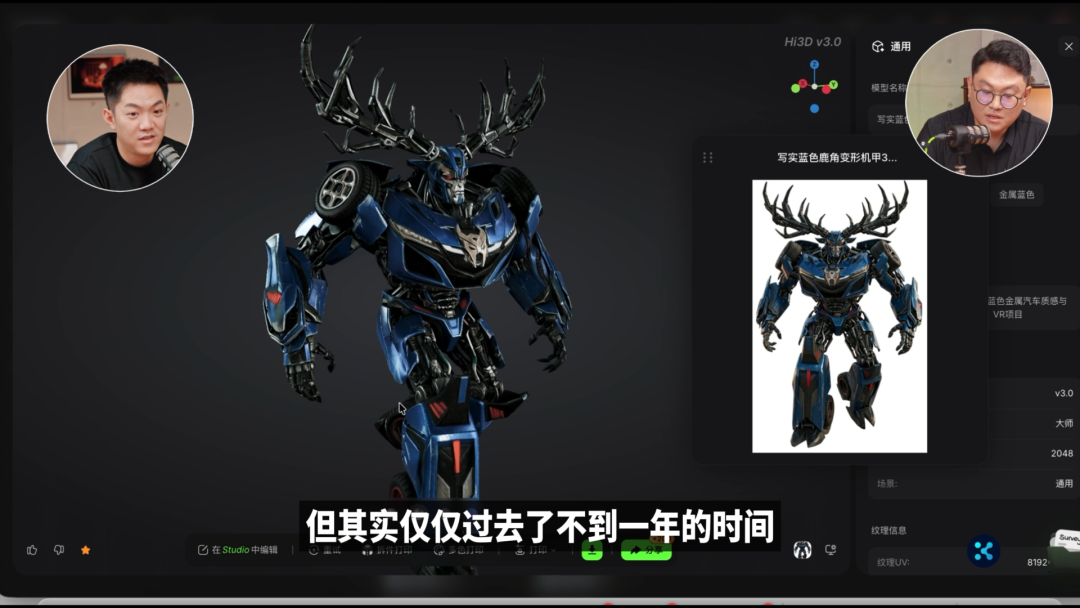
A year ago, realistic-style human figurines for outdoor sports like rock climbing and cycling were beyond our capability. Now through industrial-grade 3D resin printing, they can be directly produced.
Koji
Is the 3D you create ultimately all printable, production-grade?
Juanjuan
Yes, the goal is real-world deployability, connected to industrial-grade or desktop manufacturing equipment. We've integrated multiple productized services into Hi3D.
Ordinary people have no experience with how to split model parts, add articulation joints, or tune parameters. Hi3D doesn't just provide model generation — it also provides semantic-understanding-based segmentation, automatically splitting different body parts in reasonable ways. At the split locations, it does "pinning" (adding tenon, rivet, and other connector structures) — this was traditionally in the realm of classical geometry.
We've done a fusion of AI models with classical geometry pipelines — this is also a unique capability of our platform.
Additionally, we help users automatically do "nesting." Large models need split parts — what orientation to place the model, how to add supports to avoid print failure or damage — ordinary people don't actually understand this. We automatically identify models and provide an intelligent parameter set, fused into CMF format, directly importable into slicing software for printing.
Koji
Many companies also make 3D software — our optimization targets are different from others. How does this determine model training?
Juanjuan
In training, we've built geometric precision, structural understanding, and real-world material mechanics into our data construction and training objectives. Once the base model was ready, we combined multiple post-processing models, all aimed at actual production equipment and processes.
We want to build a one-stop AI 3D manufacturing pipeline. In terms of processes, we're serving 3D printing, laser cutting, and CNC machining — and eventually becoming the OS for Makers.
Will video models replace 3D?
Koji
As video models get stronger, will film and game companies simply use cross-modal video models instead of 3D assets? Do you think that's possible?
Juanjuan
It's possible, and it's already happening.
From our perspective, AI 3D applications in 2025 were spread across gaming, 3D printing, e-commerce, film, and education. But by the first half of 2026, the landscape narrowed dramatically. The number one application is absolutely 3D printing-related — pointing to physical manufacturing.
Demand in gaming and film hasn't decreased; it's just being better served by cross-modal video models and coding approaches. But in physical manufacturing, you can't get around 3D. Visual expression alone can't solve production problems.
Koji
3D training data is extremely hard to obtain. Where does your data mainly come from?
Juanjuan
Data is the hardest to acquire in multimodal AI. Most of it sits with game companies, manufacturing workshops, and model repositories.
Fortunately, I've got this under-the-radar connection with industrial clusters. I get along well with factory owners — they feel I understand manufacturing, so they're willing to provide data for model training without suspecting we're out to copy their products. We also acquire data through some formal channels.
Koji
That's also a barrier to entry?
Juanjuan
Yes, quite difficult. But what's worth being proud of is that in 3D, from the early days of AI model development to now, Chinese teams have consistently led the way and maintained global leadership.
Our team has deep expertise in ultra-high precision, production manufacturing, high-poly game models, and film CG scenes. Other companies excel in low-poly models, topology, and rigged animation. Everyone's digging deep in their own vertical.
Koji
Is your business mainly B2C or B2B right now?
Juanjuan
Mostly B2C, since we've built B2C websites and apps.
Koji
What do users most commonly make on the platform?
Juanjuan
Figurines and toys mostly, plus pet figurines — mostly for emotional connection, as gifts or keepsakes.
Koji
What do you mean by flexible materials?
Juanjuan
In the Maker world, 3D printing, laser cutting, and CNC have historically skewed male, with DIY materials being hard and rigid. But today, the female Maker market is exploding. My mother's generation knitted sweaters; my wife's generation did cross-stitch; now young women are into crochet, embroidery, felting, and tufting — all manual flexible material work.
Many excellent hardware teams in Shenzhen are now starting projects around miniaturized equipment for flexible material processing. On the software side, we're mainly working on: plush toy digital pattern-making algorithms and AI embroidery algorithms.
Training an experienced pattern maker takes ten years minimum — talent is scarce, yet creative demand is exploding. We're combining algorithms with production line processes to solve this creative capacity bottleneck.
Koji
Does all production eventually need to deliver a specific format?
Juanjuan
Yes. The most universal format for 3D printing is STL. At its source is the vector model (parametric model, like CAD).
Embroidery works similarly: image in, EMB format vector file out (containing stitch path planning and color information), then exported to DST format that embroidery machines recognize. It's essentially a format mapping.
Koji
What's difficult about making plush toys?
Juanjuan
Garment production has three steps: concept design, pattern making, and mass production.
Concept design is done by fashion designers. The second step is pattern making — pattern makers work like tailors, draping fabric on dress forms, drawing flat pattern pieces, repeatedly adjusting samples to finalize the pattern, then locking in the parameters.
Plush toys are often original characters that don't exist in the world — there's no human body reference. We use our image-to-3D model capability.
First, we build a 3D model from a flat character design, creating its 3D "dress form";
Second, we find the seam lines on its 3D surface and segment out different pattern pieces;
Third, since flexible fabric has elasticity (tension), a curved surface laid flat will shrink back. We need to simulate manual cutting in high-tension areas to release that tension, resulting in a truly flat pattern.
Finally, it's laser cut, sewn, and stuffed. We transform this entire process into a 3D geometry problem.
Koji
Are plush toys also B2C?
Juanjuan
We offer both B2C and B2B. B2C has long-tail, diverse creative expression that mass-production factories can't satisfy — this is where algorithmic capability is needed. As miniaturized equipment enters homes, hand-making plush toys will become reality.
Koji
Is the B2C creation frequency on the platform high?
Juanjuan
The submission rate exceeds 20%, which is a very high bar for content products. When the barrier is low enough and the results are good enough, it triggers people's desire to express. Getting a physical product that matches the design reignites that desire. We're turning the "magic paintbrush" legend into reality.
Koji
For example, on Douyin, submission rates might drop as more people just browse. Is our 20% submission rate because the active user base is still small?
Juanjuan
No — you have to understand UGC behavior logic. When tools are accessible enough and results are good enough, it triggers ordinary people's desire to express and share.
And in the physical world, what sustains users' sharing motivation is positive feedback — the moment they actually receive a physical product that matches their design. That reignites their desire to create and post.
Koji
For personalized printing, what's the pricing and margin logic?
Juanjuan
Gross margin is basically set above 50%. We're currently in an accessibility phase, so margins aren't extremely high. Globally, margins would be higher due to exchange rate differences and supply advantages.
Koji
If a user has a printer at home, how do you charge?
Juanjuan
That's the Hi3D service. It's mainly an AI subscription for Makers who can't model or handle complex operations. The global standard is roughly 130 to 140 RMB per month for access to diverse models and combined tools.
Koji
What's the usage rate among Bambu Lab owners on your platform?
Juanjuan
The proportion is climbing. Many advanced capabilities — like adding connectors, arranging builds — are currently only available from us.
Production-ready direct output: how do you validate it?
Koji
How do you evaluate achieving "production-ready direct output"?
Juanjuan
We face this challenge: on-time delivery rate for high-volume, non-standard product orders.
Every order has a different design, with high daily volume. We need to deliver all of these within the same committed timeframe, T+7 (from order to shipping). Currently, our T+7 on-time delivery rate reaches 90% to 95%. If models can't output nearly directly, the manual repair costs behind the scenes would make the business model unviable.
Koji
How do you mobilize the supply chain for delivery?
Juanjuan
A small portion is self-produced; part is outsourced.
Direct output standards are established with reference to offline labs and expert review panels. We've purchased mainstream equipment at our Beijing office and invited external professional KOLs to form review panels, testing applicability — whether models import into hardware without errors, whether one-click printing succeeds. We're building industry evaluation standards through real testing.
Koji
You're doing quite a lot — 3D models, factories, Hi3D, Goodthings, the creation camera. Why do so much from the start?
Juanjuan
It wasn't actually planned all at once; it extended along one main thread.
We first launched Goodthings. To solve physical fulfillment, we were forced to develop 3D large models, committing firmly to this about six months into the business. Hi3D came from using the models ourselves, seeing good results, and going with the flow to build a platform for broader access.
Last June, we released our 1.0 model on Hugging Face for public evaluation. The response was strong — over a thousand likes. In the 3D vertical, globally only four have ever crossed a thousand likes: Microsoft Trellis, Tencent Hunyuan, Stability, and Hitems. Seeing this signal, we decided to go with the flow and build it into a platform.
Koji
Did you predict Bambu Lab's explosion?
Juanjuan
We saw it coming. Looking back from 2024 over the past five years, desktop 3D printing equipment had a CAGR above 23%. Customs export growth was also very fast — 3D printing equipment exports ranked in the top 20 by growth rate for certain categories.
In 2025, on Chinese e-commerce platforms, desktop 3D printers are already the top-selling item in the printing category. This isn't just overseas — it's happening in China too.
Koji
How do you differ from MakerWorld / MakerLab?
Juanjuan
We're actually partners — our models are available as API services on MakerWorld too.
In positioning, we're going the comprehensive Maker OS route, supporting 3D printing, laser, CNC, plus flexible materials they don't have (embroidery, plush).
Additionally, we've connected with resin printers, providing automatic vent hole drilling. Ordinary people don't understand where and how deep to drill holes in enclosed cavities for resin printing — we provide intelligent automated handling.
Koji
How will 3D printing develop in the future? Will it hit a ceiling?
Juanjuan
We're quite optimistic. Annual shipments exceeding ten million is a certainty.
On Kickstarter, consumer-grade five-axis CNC machines, UV printers, and other equipment are miniaturizing. Desktop 3D printers are already a confirmed large market. Multi-process, miniaturized equipment launches will continue to drive Maker market growth.
Koji
Has social media amplified this force?
Juanjuan
It has. The underlying factor is global deindustrialization leading to insufficient goods supply and high prices. COVID accelerated overseas users' need to purchase small equipment for DIY — that's the big backdrop.
On social media, "hand-making figurines and plush" has sparked creative desire, and some people are making a living from it. Fidget toys, articulated "dragons" — these can only be achieved through 3D printing; injection molding can't do it. Multiple factors resonating together have birthed this market.
Koji
What's the current state of 3D printing farms?
Juanjuan
Mega-farms are surging. Small farms run 300 to 500 machines; mega-farms can house ten thousand or even thirty thousand. The bulk serves overseas markets.
But right now, product homogenization is severe — articulated snakes and squishy yo-yos are everywhere — and there's a real danger of a race to the bottom on price. Where the next hit product comes from is a problem everyone faces; it demands a steady stream of creative output. And original creators can't count on their copyright being protected or monetized.
With Hi3D, we're planning to connect these farms, offering one-click ordering and job distribution, plus revenue sharing with creators to build a healthy ecosystem.
Koji
Is that also the thinking behind 3D ComfyUI?
Juanjuan
We want to atomize capabilities like modeling, kitbashing, and relief work, so they can be freely combined.
For example, a natural language prompt: "Design a miniature scene, model the cabinet and bed separately, then assemble them." The pipeline automatically breaks this down, generating images, generating models, visually decomposing and reassembling — giving users a personalized, controllable workflow.
Koji
Is this because 3D can't be generated in one shot? Some people feel ComfyUI is losing users, and 3D still requires tweaking so many parameters.
Juanjuan
3D is end-to-end multimodal manufacturing connectivity — it's a chain of services, not solvable at a single point.
Koji
You've been at this for over two years now. What from your Douyin days transfers over?
Juanjuan
ToC experience translates: content understanding, creator ecosystems, growth methods. But models, manufacturing pipelines, and domain knowhow all have to be built from scratch — none of that carries over.
Koji
I've read that in Douyin's early days, your team would stay up all night chatting with creators?
Juanjuan
Mainly late-night calls with overseas creators in different time zones, to understand their pain points — details like multi-segment shooting, audio-video sync timestamps.
Honestly, we were "taking a beating." We were complete novices in that space and had to ask experts for help. When we did poorly, they'd criticize us directly. And that was exactly what we wanted. The willingness to criticize firmly meant they knew how to solve the problem.
So we'd patiently listen to their complaints and fix things fast.
Koji
You describe yourself as INFP, but talking with you, you come across more like a T-type. Do you feel there's a duality?
Juanjuan
There definitely is. I'm feeling-driven — deciding to do something usually comes from intuitive gut sense and operational instinct. But once that intuition hits, another voice pulls me back: are you just indulging yourself?
Then we enter concrete logical deduction and validation. The essence of a product manager's job is translating intuitive feeling into engineering code.
Koji
Any examples where feeling drove you to act, but analysis later showed it wouldn't work?
Juanjuan
In Douyin's early days, we used our personal tastes to constrain the content style for comedy and entertainment. Later, at a bimonthly review, we self-criticized for narrow-mindedness, opened up content diversity, and metrics and retention surged.
That taught me humility and inclusiveness. You increasingly respect how different everyone is. You see the diversity of the world, you learn to appreciate it and become more inclusive, you want to lift others up rather than yourself.
Koji
Was there a pivotal story that changed this mindset, or did it happen gradually?
Juanjuan
Gradually. Building large-scale user personas on Tieba, I saw the full spectrum of humanity.
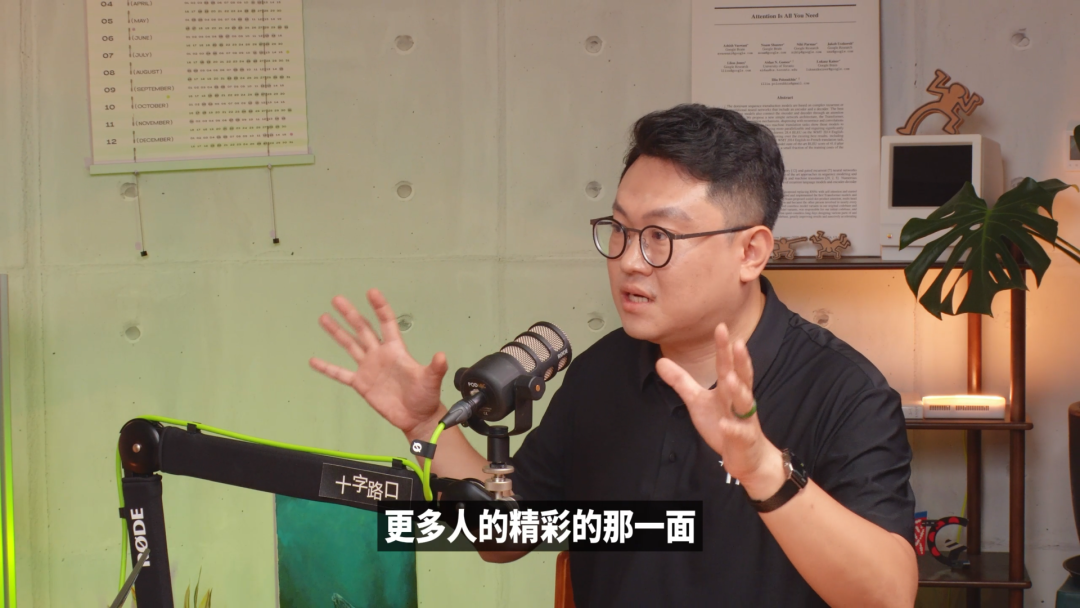
"Learning from the worthy makes you a gentleman; learning from the sage makes you worthy; learning from the masses makes you a sage." You see how different people are, and the brilliance in so many of them. When you appreciate them, you want to serve them, to help them succeed — it's a mutual elevation mindset. At its foundation: humility from seeing all of humanity, and mutual achievement.
Koji
It feels like your whole career has changed you a lot. What's stayed the same since you graduated, and what's different?
Juanjuan
The differences are certain — they're massive. I consider myself incredibly fortunate to have lived through the three most important phases of China's internet development.
The first was the PC internet era — I learned and practiced at excellent companies.
The second was the mobile internet era — I worked on excellent platforms.
The third is AI. These three experiences shaped me profoundly. Often it feels like an inexplicable twist of fate; I can't logically explain why, and there was definitely luck involved.
Koji
Plenty of people lived through those same three phases without the same outcomes.
How do you think individual effort and choices determine whether luck lands on you? What's your method, your summary?
Juanjuan
Probably two words: "sincerity" and "selflessness."
"Sincerity" means purity — focusing on the problem itself, the need itself, and solving it well. That's the fundamental drive from within.
"Selflessness" means doing things without major self-interest, things that benefit others. Not bringing in too many complicated personal calculations. "Selflessness" is also a concept from traditional Chinese philosophy and Buddhism — "acting without self." You establish a good faith and vision, but that faith and vision isn't about you; it's about something beautiful for the world.
The altruistic perspective is deeply Buddhist — including the bodhisattva ideal, where a bodhisattva doesn't just liberate themselves but liberates others too. That influenced me enormously.
I often tell everyone: I'm really nothing special. In every expert domain, I'm not as good as all of you. I genuinely need us all working toward a shared goal, because we need each other.
On the other hand, I might be a bit "stubborn." This stubbornness means that once I've decided on something, I don't much care about external changes — whether short-term difficulties or long-term persistence. If I've committed, I want to do it purely and well.
Koji
What are some things you've been stubborn about historically?
Juanjuan
In Douyin's early days, we made many decisions to subtract and exercise restraint. We didn't show unhealthy content, we didn't fill the feed with content from external platforms.
Early on, that brought visible data pressure and slower growth. But I stayed true to doing the right thing, to building a beautiful product.
Douyin's slogan is "Record a Beautiful Life." I feel we achieved that.
Koji
There's tension between "stubbornness" and "admitting mistakes promptly." What's the most recent thing you were stubborn about, got proven wrong on, and then adjusted?
Juanjuan
Early on I was somewhat naive, very particular about product delivery quality, pursuing perfection. But from the user perspective, a more critical issue was "delivery timeliness."
For example, you promise a user ten-day delivery; ten days pass and it's not there, and you say you need to keep refining. When we lacked capability early on, we dragged past a month. The user didn't want to hear about your relentless pursuit of quality anymore — they only cared about fulfillment. Their experience was terrible; they wouldn't give you another chance to iterate.
This showed us we lacked sound business logic at the time. We established on-time delivery rate standards, using them to drive all work, with quality being just one clearly defined dimension — not something to pursue infinitely. After we adjusted quickly, everything started running smoothly.
That's also why I love our colleagues so much — they're experts in their respective fields. I tell everyone: please voice your opinions, we're not a one-person show. Don't be superstitious about so-called past successful experience.
Regularly question whether I'm wrong, and speak up. If you don't, I'll assume I'm right and everyone agrees — which only makes trial-and-error costs and cycles bigger.
Will There Be a Douyin for the AI Era?
Koji
Do you think there will be a "Douyin of the AI era"?

Juanjuan
Hard to say.
But groundbreaking content products must define a "new content format": Douyin's vertical video plus music, Bilibili's horizontal video plus bullet comments, Xiaohongshu's image-plus-tags format.
We need to find new combinatorial possibilities within content format paradigms to have a shot at defining formats and defining categories.
If you only focus on model performance itself without innovating on format, you're mostly likely just doing free R&D for platforms with network effects and scale.
Koji
A year ago at the Xiaohongshu Red Land booth, I said I expected it to be hard, but it was harder than expected. A year later, how do you feel now?
Juanjuan
I've gone through several phases.
First, optimism fueled by vision-building.
Second, self-blame and pressure facing new domain problems and insufficient expertise.
Third, regaining upward momentum after persisting and solving some small problems through trial and error.
Today's mindset is more of an interweaving. Entrepreneurship is a daily roller coaster. I mean literally different times of day — you encounter different problems, and your state fluctuates a lot. But you have to stabilize and adjust.
The approach is to detach your emotions and focus more on the problem itself.
I often tell myself: don't rush, let the bullet fly a bit longer. Give things more time and validation cycles. Don't be anxious, because anxiety distorts your actions and signals anxiety to the team, causing everyone to lose focus on the problem itself.
Koji
Entrepreneurship is spiritual practice. What have you cultivated?
Juanjuan
To a large extent, a phrase Yiming once said to me: "Affairs may be chaotic, but the mind must not be." I've been contemplating this for years, and it's one of my biggest takeaways from ByteDance. I'm still practicing in that state.
Also, you come to understand more deeply that building a great product and running a great company are two different dimensions. I often think back to my former leader, my benefactor Kelly Zhang — she probably faced repeatedly the problems I'm facing today. What was her mindset in handling and adjusting?
The more you do, the more awe and respect you feel for experienced, excellent managers and fellow entrepreneurs today. You realize how hard it all is, and anyone who persists in trying to do things well deserves respect.
Product itself is relatively straightforward: Is the design logic sound? Is the interaction good? What's the delivery timeliness? But running a company requires simultaneously considering people, money, and operations.
People — how to acquire talent, how to organize it, how to get people collaborating effectively. That includes aligning partners both inside and outside the company and building opportunities for cooperation.
Money — where does it come from? Whether through fundraising or value creation. On the flip side, is the underlying business logic actually sound? Do you have the ability to falsify your core assumptions?
Many friends come to me for startup advice, and I'm basically throwing cold water on their plans. I tell them: don't start a company if you don't have to, don't seek out suffering for no reason. Unless you've really thought something through, and preferably something that creates incremental value, something innovative. If you had a good situation and solid conditions at a platform, you don't necessarily need to choose the entrepreneurial path. I'm actually talking a lot of people out of it.
👦🏻 Koji
What kind of person would you not talk out of it — someone you'd even encourage?
🧑🏻💻 Juanjuan
When you throw cold water on them and they remain resolute, charging ahead without hesitation.
And within that logic of charging ahead, you can't negate them with your existing knowledge framework. You feel they're doing something that creates incremental value for society, not just linear growth. That's the kind of person I support.
👦🏻 Koji
At a big company, say at Douyin where you also managed large teams and touched on business models — what's the difference?
🧑🏻💻 Juanjuan
Before, you had partners, you had management layers to share the load with. Today, a lot of the time you need to stand on your own.
On the startup journey as a small enterprise, you feel loneliness — you look behind you and there's no one. I've told colleagues: I'm the person who should be standing at the very back against the wall in this company. Beyond that wall is the abyss. I'm the bottom of the bottom, the last backstop.
👦🏻 Koji
So how do you coexist with that loneliness, or that abyss?
🧑🏻💻 Juanjuan
Think back to why you chose to do this in the first place. It's what "acting without self-interest" means — it has nothing to do with you personally, it's about the choice to do something. If you want to do something that benefits others, then just do it resolutely.
Overthinking is useless. Overthinking usually comes from a self-centered perspective and only adds unnecessary worry.
Why discourage people from starting companies?
👦🏻 Koji
If the you from two years ago, just starting out, came to the you of today — would you throw cold water on yourself?
🧑🏻💻 Juanjuan
I'd lay out the difficulties more thoroughly. But if I had the choice again, I'd still choose to do this.
Entrepreneurship is just one means of achieving innovation and solving problems.
👦🏻 Koji
For this startup, what kind of result would count as success for you? When would you be satisfied with yourself?
🧑🏻💻 Juanjuan
There won't be some clearly defined finish line. I think breaking through the barrier between the digital world and the physical world to satisfy people's creative expression — that's a very big thing.
If I were to define stages from a more intuitive angle:
The first stage is whether we can become the OS for the maker industry, serving categories and needs, becoming a pipeline service platform for users;
At a larger scale, whether we can become the OS for manufacturing. That's a very big proposition.
Connecting various industries, solving software-side pipeline services for physical manufacturing and infrastructure at a broader scale. Those are the two goals I'm working toward.
👦🏻 Koji
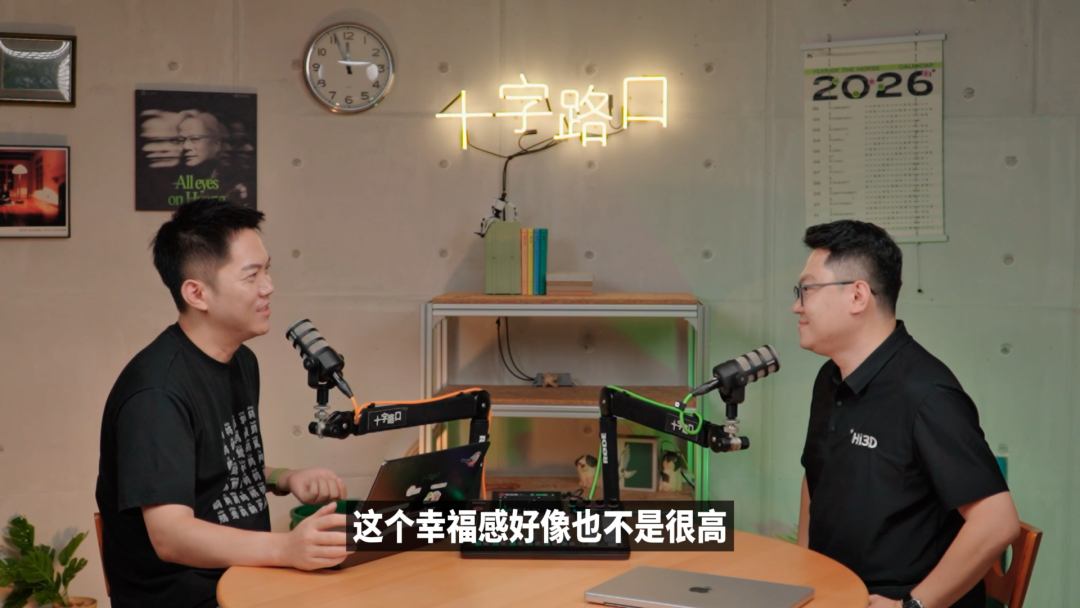
If a person is always living dissatisfied with themselves, chasing the next target, like riding a roller coaster every day — that doesn't seem like a very happy existence. So from a personal state perspective, what achievement would make you satisfied with yourself?
🧑🏻💻 Juanjuan
When I see many people gaining income, gaining recognition, because of the products and services we've built — from that perspective, I'd be very happy.
Helping others succeed is helping each other succeed. When you see that you've helped many people, it brings you the satisfaction of empathetic achievement. That's my source of happiness.
I recently heard a perspective on why helping others makes us happy: it's likely because when you expand your field of vision to a very high level, you realize that people are essentially a community. Helping others — in essence, benefiting others is benefiting yourself.
🧑🏻💻 Juanjuan
Right. I watched a documentary recently where astronauts went to space, and the moment they came back, their personalities changed dramatically. Looking at Earth from space, the births and deaths, joys and sorrows of billions of people all condensed into that tiny point.
On that blue planet, it produces something called the "overview effect." You feel that past conflicts, contradictions, worries are all trivial. You develop a kind of great love.
The feeling of a shared destiny makes you happy when you see others happy and thriving, because everything else really doesn't matter.
Just a few decades in this life — what can you take with you when you leave? What matters more is how many people your existence helped, what you left behind. Leaving intangible assets — that's what's most precious.
👦🏻 Koji
I feel like your entire state is very calm. Many entrepreneurs radiate anxiety or aggression, but you have a kind of composure?
🧑🏻💻 Juanjuan
Same as before: don't rush, let the bullet fly a bit longer. It'll work, it can be solved. The future is bright, the path is winding, but we'll get there eventually.
👦🏻 Koji
Do you think this confidence or calm comes from ByteDance?
🧑🏻💻 Juanjuan
ByteDance's influence on me was definitely huge. On another level, I think it comes from my being fundamentally an introvert. I'm an I, I can say this myself — here's a hot take: I'm an insecure person.
A lot of the time I feel I'm not as good as others. Including when I first joined Tieba, I was a complete newbie, surrounded by excellent people, and that insecurity forced me to quickly catch up to others' pace.
Later with Douyin, it was also my first real experience doing product work — before that I was on the operations track, with no product manager background. Given such a good opportunity, I couldn't embarrass myself, I had to become a competent product manager. I asked engineers what makes a good product requirement, wrote labels and tracking points myself, analyzed data myself — insecurity forced me into action.
Today, starting a company in a new field, facing 3D technology and manufacturing supply chains, I'm similarly not specialized. That underlying insecurity and lack of confidence instead forces me to keep learning and growing.
👦🏻 Koji
Many insecure people tend to sink into depression or avoid problems — how do you fight against that?
🧑🏻💻 Juanjuan
Insecurity is my harsh demand on myself, my clear self-awareness.
Anxiety usually arises when you set high goals but there's a massive gap between your capabilities and those goals, and simultaneously you can't find solutions — the accumulated gap makes people anxious. My approach is to use learning and practice to close that distance, to bring capabilities closer to goals.
Action is the cure for anxiety. Wang Yangming's philosophy of "the unity of knowledge and action": knowledge is the intention of action, action is the completion of knowledge. You can't just fantasize without practicing. Insecurity itself isn't scary — it can be resolved by eliminating the gap between your capabilities and what you want to do.
👦🏻 Koji
Today, if a fresh college graduate just entering the workforce wants to accomplish something significant in the future, what specific advice would you give them?
🧑🏻💻 Juanjuan
Don't overthink it, do well what's in front of you. Live in the present.
Whatever choice you make isn't right or wrong, but understand: opportunities usually aren't found, they're waited for.
Think about whether you've built deep enough foundations in your current position. Opportunities only arrive in the process of sufficiently deep accumulation, so you need to first dig deep enough to settle yourself.
👦🏻 Koji
I saw that many former colleagues' assessment of you was that you're very nice, a good person. Are you still a good person now?
🧑🏻💻 Juanjuan
That depends on context. Today in company management and operations, I'm becoming less and less nice.
As CEO, you have to be responsible. You took shareholders' money, organized so many excellent people to work toward your vision — if you make decisions purely based on personal emotions, that's extremely irresponsible. I'm becoming more and more rational.
Excellent leadership isn't about how well you manage others, it's about understanding yourself, becoming a manager who dares to speak truth and lead the team to overturn past mistaken statements.
An excellent manager can't only be willing to do positive management — you should first do negative management well. You need to be able to identify organizational problems where people don't meet requirements or aren't right for their roles, and make adjustments. When adjusting, you can't fear or avoid it because of management pressure.
The id can show the nice, warm side of human nature, but the superego that the position demands requires us not to bring personal emotions into decisions, to do what the role requires.
👦🏻 Koji
This is also very similar to what former Intel CEO Andy Grove wrote in Only the Paranoid Survive: imagine you're a newly hired CEO with no historical sunk costs or baggage, and the right decision becomes clear.
Do you ever occasionally think: if you were still in weekly or biweekly meetings with Yiming, what feedback would he give?
🧑🏻💻 Juanjuan
I do. The question you constantly had to face was: how big are the variables in what you're doing? Is it big enough for some efficiency to qualitatively change, or for costs to dramatically decrease? Don't always think about doing small optimization things without major breakthroughs.
👦🏻 Koji
So you think if you were still in those weekly meetings with Yiming, the question he'd most likely ask is whether there's a genuinely massive variable?
He'd keep reminding you to think about this?
🧑🏻💻 Juanjuan
Right. Right, and it really is — don't get high on your own supply, don't be self-satisfied every day thinking you're optimistic and happy, when actually what you've done is nothing much, it doesn't have major variable impact on the industry.
👦🏻 Koji
Do you worry about this happening at Hitems?
🧑🏻💻 Juanjuan
It can't be called worry, it's the essence of the problem. Worrying is useless if that's the reality — instead you should be trying to conceive and solve this problem from start to finish, rather than anxiously worrying about it.
Fear is useless.
👦🏻 Koji
If Kelly Zhang were still in weekly meetings now, would her feedback be similar to Yiming's? Or would she have a different perspective or working style?
🧑🏻💻 Juanjuan
She'd give very effective decisions on balancing user needs understanding with growth items. She used to often criticize me for being overly optimistic, immersed in my own perspective. That reminds us to pay more attention to user and industry perspectives, not to be narrow-minded.
👦🏻 Koji
So to many people, your life has actually been very smooth. At Baidu you immediately took on heavy responsibility, managing Tieba's moderator operations, then got the Douyin opportunity and succeeded, and now your startup has many people bullish on it.
Behind this path that looks smooth to outsiders, would you describe yourself as having had smooth sailing?
🧑🏻💻 Juanjuan
No. It's just good luck. I'm not being modest or pretending, I'm not. I used to often say this to everyone — I think it's just good luck. I find it hard to summarize or evaluate, I can only think of it as some kind of fate.
👦🏻 Koji
So you very much believe luck is innate?
🧑🏻💻 Juanjuan
Luck is a big component, but there's this one point.
I might have one thing that's a bit more pronounced than others: when that lucky opportunity arrives, you have to seize it for all you're worth. You have to realize luck has come, the opportunity has come, you have to do it well, you can't miss it.
So fate's favor gives many people opportunities. But some people aren't self-aware, and they'll regret missing that opportunity. My somewhat more pronounced trait might be that I realize when something is an opportunity.
So when they first put me in charge of forum moderators, they didn't actually tell me I'd be managing all of them. But I thought, if I'm overseeing several verticals, could I organize the user resources? And as I kept at it, I realized that moderators across every vertical were willing to support my work.
Back then, I made an effort to chat with moderators and users every day, communicating with them to solve problems. I'd even stay up all night talking with them, building a connection that broke through the cold screen and let you feel its warmth. We built mutual trust. The super-moderators supported my work unconditionally.
Later, when I started working on Douyin — that was the first product I ever worked on — Kelly Zhang said to me with real gravity, "If you take this product on, you have to do it well. You can't embarrass yourself."
So I carried that responsibility. I'd never done product work before, but I thought, I can't embarrass myself. At minimum, I should be a competent product manager.
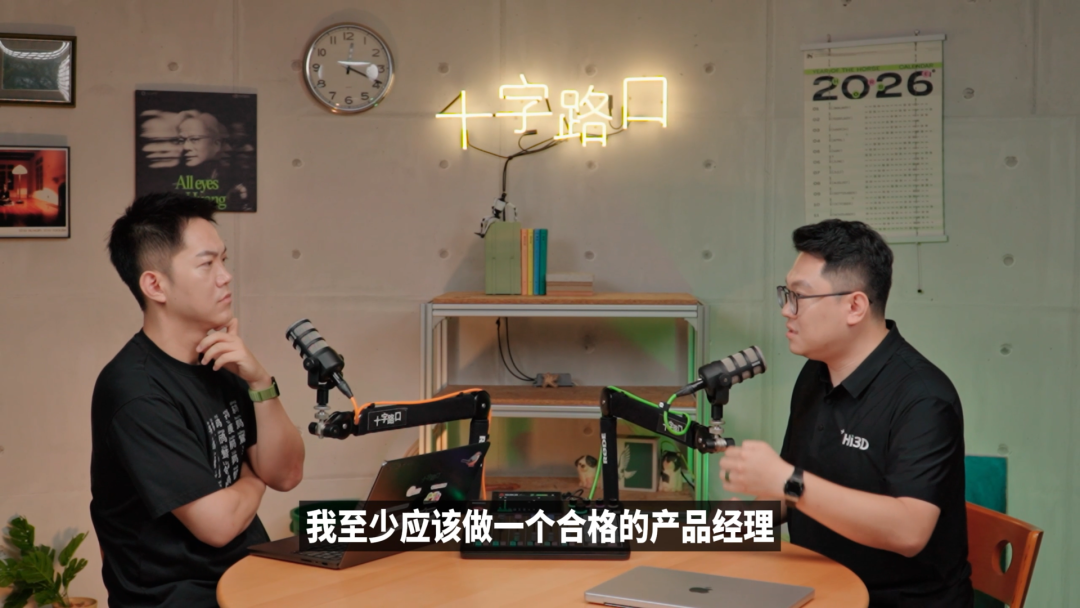
So as soon as I got the assignment, I quickly started seeking out product managers and engineers to learn from. I asked the engineers: "What does an excellent product manager look like in your eyes? What kinds of requests do they make of you?" I wanted to learn, to write good product docs. In the early days, I even wrote the data tracking specs myself, because I worried that whatever tracking ideas I gave the analysts might be unreliable. I wrote the labels, the tracking definitions, did my own analysis, then asked them to help out.
So when opportunity comes, you desperately want to seize it. Starting a business today is the same — once you decide to do something, you can't let people down.
Even if it ultimately might not work out, along the way you have to commit fully and without reservation, doing everything you can to solve what needs solving. When difficulties come, it's not about your personal feelings — face them head-on, grab hold of them.
👦🏻 Koji
After starting a company, you're both CEO and product manager at the same time. How do you fuse these two roles together? Do they conflict?
🧑🏻💻 Juanjuan
I don't think they conflict.
At the macro level, the CEO definitely has to set direction, organize resources, and map out critical paths.
But at the micro level, you still need to maintain a product manager's sensitivity — don't detach from real voices, don't detach from user feedback. The first item on the agenda at every weekly meeting is user feedback.
We have several feedback groups on Lark where real-time content is visible to everyone, and almost nothing goes more than five minutes without a response. The moment I see user complaints, and colleagues forward them to the logging group, we jump on it right away to follow up. If it's our problem, we quickly reassure them, apologize and compensate, make things right, and readjust our service. We take user voices very seriously and don't let ourselves drift away from them.
Second, you have to be hands-on yourself — you have to personally use and deeply experience your own product and competitors' products to build accurate micro-level understanding. We invite industry KOLs to do evaluations at our offline lab specifically so we don't delude ourselves. Whether we're doing well or poorly, we have to be honest about it and close the perception gap. These are all traits that being a product manager demands you do well.
Also, you're not just CEO, HR, and product manager — you're also BD and sales. In that capacity, can you very clearly articulate the company's specific work plan and capabilities, making others trust you and want to connect?
Lately I've been adjusting myself to become more of a marketing and BD person, sincerely introducing the capabilities we've built up over more than two years, personally getting people to use them.
👦🏻 Koji
Very interesting. Looking forward to chatting again sometime.
🧑🏻💻 Juanjuan
Sure. Thanks, Koji. Bye.