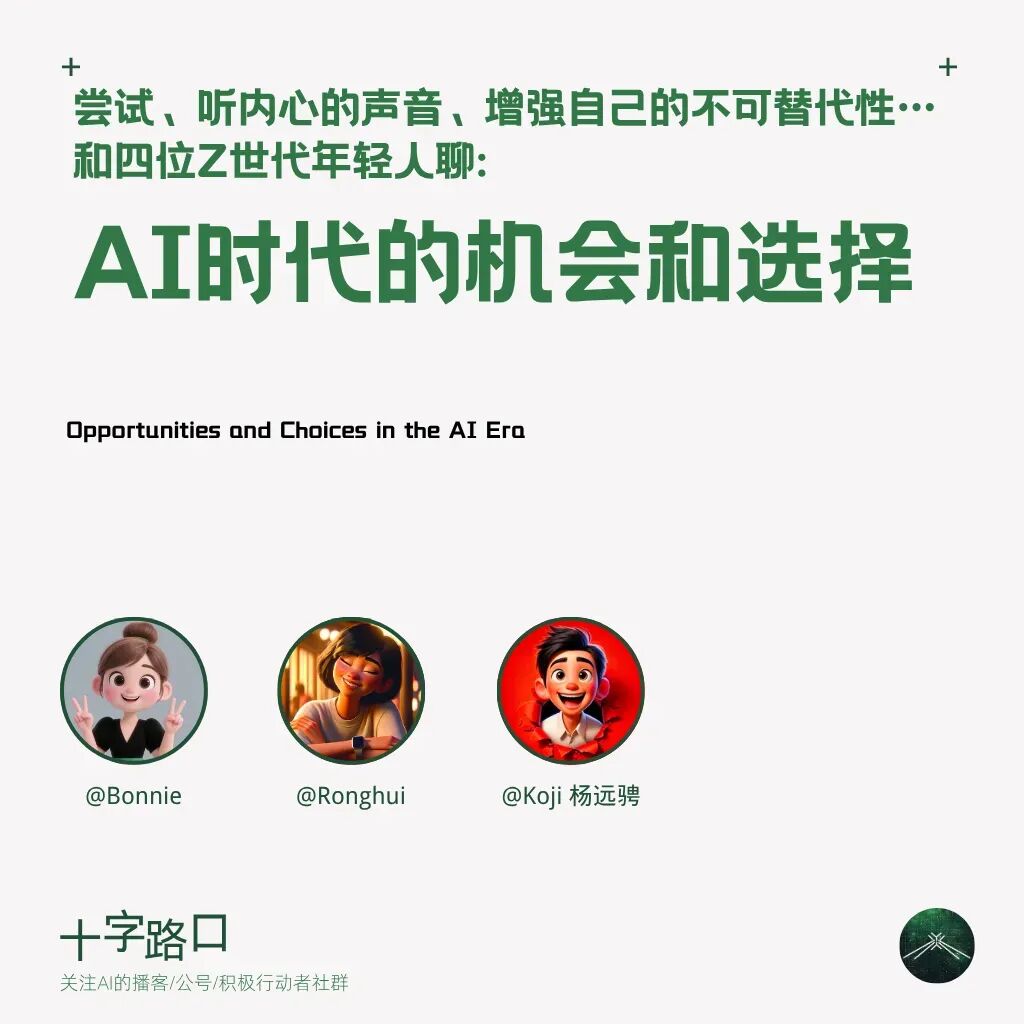
Trying, Listening to Your Inner Voice, Building Irreplaceability — Talking Opportunities and Choices in the AI Era with Four Gen Z Young People
No one can become someone else; they can only become themselves.
You can't become someone else. You can only become yourself.

👦🏻 Podcast interview: Koji, Ronghui
🥷 Editing: Starry
🧑🎨 Layout: NCon

Are you standing at a career crossroads — confused, anxious, yet somehow excited?
In the AI era, this feeling may come more frequently. Jobs that once seemed stable no longer are, and opportunity and risk are arriving simultaneously.
In this episode, we talked with four young people about their choices and transitions:
- If the path you've walked for years turns out to be the wrong fit, would you have the courage to walk away?
- If you wanted to pivot from a field you've spent years mastering, would you dare start over?
- Stepping into an entirely new world of creation, would you use AI to carve out a fresh path?
- If the chance to start a company came before you even graduated, would you take it?
In July, we partnered with friends at IDG Capital to conduct a small survey on Gen Z lifestyles and work attitudes, followed by in-depth interviews with several participants. Though the sample was limited, their stories reveal an authentic slice of how young people are navigating the AI wave. Our thanks to Chenran, Leo, Shutong, and Ryan for sharing their experiences, and to everyone who participated in our WeChat survey.
Their stories mirror what many are experiencing at the career and life crossroads of the AI era: probing, adjusting, and searching for direction amid uncertainty.
After hearing their stories, what would you choose?
Listen on WeChat:
Listen on Xiaoyuzhou:
Three Millennials Reflect on the Job Market at Graduation
👦🏻 Koji
This week's Crossing is special — we'll share the highlights and takeaways from our recent interviews with young people, exploring how AI is reshaping their lives and work. In recent years, more voices have claimed that AI will replace human jobs. At the latest Y Combinator Startup School, YC partner Gary Tan shared a striking statistic: over 6% of US computer science graduates are unemployed after graduation, compared to just 3% of arts majors — meaning CS graduates are twice as likely to be jobless right out of school. It's a counterintuitive finding.
We've also noticed more young people around us pursuing freedom and self-actualization. They're building one-person companies, and no longer feel tied to big cities. We believe young people's lives are undergoing massive change, and AI is accelerating shifts in how they think about lifestyle, work, and career decisions. At Crossing, we've always focused on proactive actors in the new wave of AI. The life choices of Gen Z during this period is a topic we care deeply about. We wanted to hear from some of the most conventionally impressive young people around us — whether from top schools or with elite company internships — to understand what they're thinking now, and perhaps capture the voice of a broader generation.
This survey wasn't comprehensive, and doesn't cover every young person's profile. But the group we selected reflects a representative slice. Today we'll play audio from these interviews, and invite Bonnie from IDG Capital to discuss the survey and interview experience. First, Bonnie, please introduce yourself and your career background.
👩🏻 Bonnie
Thanks, Koji. Glad to be here on Crossing. I'm Bonnie. I joined IDG in 2021, after working at Michael Page and Korn Ferry — a fairly typical recruiting consultant career path. My work has always centered on searching for, understanding, and attracting talent.
👦🏻 Koji
Ronghui, Bonnie, and I are all Millennials, with some shared generational imprints. When we talk about the career outlook of today's fresh graduates, we can also look back at our own graduation years — the rules of the world as we saw them, and what counted as a "successful" career path back then.
👩🏻 Bonnie
Let me start with the post-90s, specifically those born between 1990 and 1995. I've been thinking about whether there's a rule or summary that captures our generation. There's plenty of discussion online. I once came across a line that resonated: our generation inherited the sense of responsibility from Chinese culture, while maintaining a relatively open mindset toward globalization and technological innovation. That really struck a chord. When we graduated, finance and internet industries were booming. During school, everyone chased internships at major tech companies, securities firms, investment banks, and consultancies, hoping to land good jobs upon graduation. The study-abroad atmosphere was also strong — whether for exchange programs, overseas master's, or PhDs, many classmates wanted to see the world. Plus, the entrepreneurship climate was vibrant. Schools had dedicated startup incubators offering space and funding, and brought in entrepreneurs as mentors.
I first learned about IDG during college, around 2013 or 2014, when they announced a focus on investing in projects targeting the post-90s lifestyle. For example, JK, founder of Insta360 — which recently went public — was spotted back then. Bilibili, Lilith Games, and HEYTEA were also invested in during that period. It generated huge buzz among students and was deeply inspiring, making us feel we too could give it a shot.
👦🏻 Koji
I remember IDG's post-90s investment push drew considerable market skepticism at the time — people thought it was too bold, that they were backing "incomprehensible" founders. But looking back, the standouts from that wave have indeed excelled across industries. Ronghui, what about you?
👩🏻 Ronghui
As someone born in the mid-1980s, the rules of the world I faced at graduation were clearer and simpler than today's. Foreign companies were highly sought-after back then, followed by the mobile internet entrepreneurship wave. Many people chose startups because they didn't want a life that was "predictable from day one." My own thinking was simple — after graduation, I entered media with just one goal: become a good reporter. I didn't anticipate the massive disruption the media industry would face, or how many around me would eventually start companies.
👦🏻 Koji
Everything felt "normal" at the time, but in retrospect — I graduated undergrad in 2008, finished grad school in 2011 — that was an era of rapid economic growth with opportunities everywhere. Looking back, it was almost enviable. Whether joining foreign companies or starting businesses, ample opportunities existed: foreign firms were growing fast, and entrepreneurship was in the golden age of mobile internet going from zero to one. We didn't realize how lucky we were. I threw myself into mobile internet without hesitation — first as a product manager, then as a founder. Different majors experienced different atmospheres. I feel the opportunity that AI presents today differs from what mobile internet offered us back then.
👩🏻 Ronghui
This time, Bonnie and invited some listeners and friends — all Gen Z young people — to share their experiences and environments. Let's hear what they have to say.
Chenran: My Major Was Computer Science, But I Explored Content Creation Throughout School
👦🏻 Chenran
I'm Chenran, born in 1999. I studied computer science at Fudan University for undergrad, then did a graduate program at Cornell in the intersection of computer science and entrepreneurship. I'm currently product lead at a startup called One2X, developing an AI video production tool. My background is pretty cross-disciplinary — I'm a programmer, product manager, and I've also worked as a director, self-media creator, and content producer. So I see myself as a pretty well-rounded person. When did I start content creation? I think there were two catalysts.
The first was a microfilm elective I took freshman year. The second was formally launching my Bilibili channel junior year. Content creation seems far removed from computer science. I pursued it partly because I felt CS was already a red ocean market, and I couldn't see a clear career path for myself — so I wanted to cultivate a second interest. My greatest passion was film, so I chose content creation.
The second reason was that students simply have lots of time, and I wanted to use it meaningfully. I participated in various student activities, which inevitably required making videos, promoting events, or galas — so I shot many microfilms. Self-media came later, coinciding with the peak of the vlog wave when there was still organic growth potential. I particularly wanted to train my expression skills, and committed to editing with focus. I spent four hours a week editing, aiming for weekly uploads while preserving memories of my college years. Combined, these factors led me into content creation.
I did feel confused during undergrad — the market seemed saturated. Even in a hot field like computer science, talent density was high. While there were still opportunities to land decent offers at major tech companies, the overall market, driven by macroeconomic trends, had reached a saturation peak and was heading downward.
I feel like students born around the turn of the millennium all share similar confusion — the economic upswing has passed, and what lies ahead is the reality of not being able to find a job. This is especially true for me and the people around me. Many of us ended up in our majors almost by accident, including my choice of computer science, which wasn't driven by any particular passion but rather stumbling into this track. I never expected it to be an oversaturated market, and in an oversaturated market, most things become standardized. Within standardized processes, experienced veterans carry higher market value, because by then work has been subdivided to the point where every position has an extremely granular job title. Such a hyper-competitive red ocean offers almost no opportunity for newcomers, new companies, or especially fresh graduates.
I found this pretty demoralizing. The hot topics in computer science at the time — things like facial recognition, natural language processing, and similar tracks — were all boring to me, and these directions were equally standardized and oversaturated. I completely ruled out entrepreneurship back then; it seemed like pure fantasy. So I was quite lost. My classmates were in similar boats, all anxious about where they were headed. When all business objectives were still growing, many problems could be papered over. Everyone felt things were trending upward, so nobody scrutinized every link or the quality of work too carefully. But once the market solidified into a red ocean, involution set in, and young people naturally started feeling that things made less and less sense.
Actually, not many people around me went to Big Tech. Everyone's path was all over the map. I don't think people were particularly pessimistic — rather, after accepting the status quo, each person found their own way to make peace with it, and the ways were all different. Some became teachers, some pursued PhDs, some went abroad, some joined Big Tech. Everyone had their own choice and didn't agonize over it too much. Though the downside was perhaps greater mental pressure, the upside was that with greater social diversification of options, even forced diversification, there was much less keeping up with the Joneses, because different people's paths simply can't be compared.
Leo: From Aspiring Professor and Researcher to Analyst at McKinsey
👦🏻 Leo
Hi everyone, I'm Leo, born in 1997. I did my undergrad at Tianjin University, my PhD at Cornell, and I'm currently a consultant at McKinsey & Company.
When I was studying, I basically only did things I enjoyed. I had a clear sense of what excited me and sparked my passion, and I'd go do it. Around my third year of undergrad, I was pretty set on becoming a university professor, so I went abroad for a visiting period. I found that pursuing a PhD overseas was appealing — different language environment, unfamiliar setting, a sense of novelty — so I came out to study.
In my third year of the PhD, I started realizing that being a professor wasn't as simple as I'd imagined. As an undergrad, I thought a professor's job was just advising students, writing papers, and running projects — all downward management stuff. But in the middle-to-later stages of my PhD, after more contact with my advisor and other professors, I discovered that being a professor is multidimensional: beyond advising students, writing papers, and running projects, there's also applying for funding, collaborating with senior colleagues, going up for tenure, doing public service, and many other obligations. Your energy gets scattered, and much of it is beyond your control, which made the prospect less attractive.
Later I considered working as a researcher at a national lab — no teaching, no student advising, you could mentor postdocs, or do research like a senior postdoc. But I found I didn't like the national lab environment. I preferred interacting with people and solving more immediate problems. Research goes deep, but many projects lose their novelty due to long cycles, and solutions aren't timely enough. Understanding my own personality, I'd eliminate options I didn't like and focus energy on directions that fit better.
Around my third year of the PhD, I started feeling academia might not be my long-term path. At the time I still assigned it 50-60% probability, but that later dropped to 20-30%. So I began exploring what else I could do besides academia, looking at what industry was doing. Around 2021 to 2022, global climate change was a hot topic, an emerging industry with substantial funding flowing in. I started applying for related part-time positions and was fortunate to do several VC internships. I found I really liked the industry, so I tried VC in different sectors, experiencing the differences in investment directions, domains, fund styles, and development cycles — all of it was interesting.
After that I applied for other jobs. I'm quite pragmatic in how I do things. I'd make a list of careers I was interested in — at the time it included university professor, venture capital, quantitative researcher, patent lawyer, and management consulting. I'd score them from perspectives of personal interest, career development, long-term planning, and verify through practice or conversations with people. In the end, it wasn't me choosing my current job — the job chose me.
Many people around me wouldn't scatter their energy exploring like I did, because it requires enormous time and effort. Some people had their future figured out early, which is why they pursued a PhD and made corresponding choices. I changed more — I only decided to pursue a PhD in the later stages of undergrad, and only started thinking about work in the middle-to-later stages of my PhD. My pattern is to try first, continue if I like it, reassess if it doesn't fit, and when I reach a point where I don't want to continue, start scattering energy to explore new directions.
I'm fairly thick-skinned — I don't care much about others' views of me or my career choices, I only focus on what I want to do and what I enjoy. Of course, I'm also clear that this decision-making style brings corresponding consequences, so now when making decisions I consider possible outcomes and whether I can bear them. There was a period when I wasn't very happy, even wondered whether I should leave, but then I thought I might as well give it a try first.
My realization is that life has ups and downs and shifting directions, like mountain climbing or traveling — different paths have different scenery, all of which bring experiences. When it comes to defining success, I never define it, because it's too abstract. As a word, two separate symbols, vocabulary in different languages, it can be measured from infinite dimensions — personal, matters, money, others. I only feel that making myself and my family happy in the present moment is success and happiness. Of course, I also have times when I'm not in a good state and unconsciously transmit negative emotions. Observing myself from others' perspectives, I find I easily influence others, so I don't like it when my core isn't stable. If I had to define success, I hope everyone is happy.
Shutong: Tried All Three Directions in Medicine, Learned What She Didn't Like, and Listened to Her Inner Voice
👩🏻 Shutong
I'm Shutong, born in 2000. I did my undergrad at UBC (University of British Columbia) in pharmaceutical sciences and immunology, and I'm going to Yale for my MPH in September, which you can think of as an MBA for healthcare. The main post-graduation directions for this major are three: medical school, dental school, or research. I've tried all three paths.
The first was research — during undergrad I worked part-time at a pharmaceutical lab for over a year, doing COVID drug development, actually entering the lab to do experiments, analysis, and drug production, getting exposure to very high-tech content. The second was dentistry — I shadowed at a clinic. The third was medical school — after undergrad I first took the medical school entrance exam, then after returning to China I shadowed at a hospital for a period. Actually, when I switched from the Faculty of Arts to the Faculty of Science, choosing immunology and pharmaceuticals, it was because I genuinely liked this field, and I don't regret that choice.
But from a career planning perspective, I was still somewhat afraid of pathogens. After actually interning at the hospital for two and a half weeks, I got seriously ill and was sick for a month. By the end of undergrad, I had eliminated all three paths — medical school, dentistry, and research. I was extremely lost at the time, not knowing what I could do besides these three paths. So I searched LinkedIn for alumni from my major and found that very few people had taken paths other than these three, but there were some who had switched to consulting or investment in the pharmaceutical field. Generally undergrads wouldn't consider this direction.
At my most confused, I reached out to about 30-40 alumni in VC, PE, investment banking, and consulting, people with backgrounds similar to mine. Some had even finished four years of medical school before realizing it wasn't for them and switching to business work. I resonated deeply with this, because during my two weeks shadowing at the hospital, I already knew the answer in my heart — I just needed the courage to abandon the path I'd persisted in for five years. This experience taught me that with major decisions, you should listen more to your inner voice. Often, when a path isn't working, you already know it deep down, you just try to convince yourself to keep going. I used to be a very "rational" person, but now with big directional choices, I trust my inner answer more and have the guts to take that step.
Among my undergrad classmates, I may be the only one who made this kind of choice. Most people are still on the medical school, dental, or research path. Actually whatever choice you make, there will be people who support it and people who oppose it. What matters is how you see it and what you do. I'm quite selective about whose opinions I care about. For career planning now, I want to walk on two legs, pushing forward in both consulting and investment. I'm in a pretty good state now — I feel that no matter what happens, mindset and approach to choice matter most. As long as I make the choice that suits me best and expresses who I am most, given the information I have, I'm quite satisfied.
I grew up in an exam-oriented education environment. In China there's always been heavy emphasis on math, physics, and chemistry, but I never had much aptitude for quantitative subjects. As a child I envied those who won gold medals in physics competitions, while I had to work hard just to pass. Later I realized that you can't become someone else, you can only become yourself. Understanding yourself, being yourself, and feeling happy — that's actually enough.
I often think, if I'm lying on a hospital bed at 70 or 80 looking back on my life, if I did what I wanted to do, regardless of the outcome, this life was interesting and without regret. I'd rather try hard and strive for things than care about what others think or fear rejection. What you regret are usually the things you didn't try. I can't control the outcome of success, but I can control my own actions, so I should make decisions as well as possible and put in the effort.
Ryan: Started a Business While in School, Had Overseas University Offers After Graduation But Still Chose Entrepreneurship
👦🏻 Ryan
Hello everyone, I'm Ryan. I enrolled in 2020 and graduated from Zhejiang University in 2024 with a major in information security. I started my business in 2022 and am still running it now. Before graduating in 2024, I started my current project — Spark Lab. Spark Lab's philosophy is to encourage more young entrepreneurs to build projects from their hearts and further create the world they want. It's both a physical place and a spiritual home, a platform built for young entrepreneurs. In China's venture capital environment, what we're exploring is a completely new organizational structure, an accelerator form that has never existed in China.
Starting Spark Lab was fairly instinctive — there was a gut feeling driving me to do it. Though it was hard to articulate its value and business model all at once, we started anyway. At the time I faced an important choice: I had offers from overseas prestigious universities. If I started a business right after graduation, it meant giving up those offers, as well as opportunities tied to fresh graduate status and such. But I didn't overthink it, I just started. Looking back, this choice was important.
Entrepreneurship is a grinding process. I always wanted to do something, but both my own and the team's time were quite fragmented. The simple idea at the time was to do something interesting and meaningful. From a rational perspective, it had huge room for growth and impact in my career development, so I was willing to do it. Looking back, the core reason we could persist was that we were genuinely interested. We felt China lacked this kind of soil, and this thing had huge room for growth — whether the growth from my first serious entrepreneurial attempt, or the perspective and network this thing brought, it was all important to us.
We don't care much about salary or stability, we're more obsessed with pursuing uncertainty. Nobody on the team is doing this for money — as long as we can support ourselves, that's enough. The post-00s and post-05s generation grew up in a quite different environment from the post-90s and post-85s. The post-00s and post-05s grew up as China's economy kept trending upward, so when choosing majors they considered personal interest more and had a certain degree of choice.
When entering the workforce, most of us aren't under huge financial pressure, and we don't have major consumption demands either. Buying an apartment in Beijing or Shanghai is so difficult that many people simply don't even aspire to it. With less economic pressure, people prioritize room for growth — for instance, what you can see at a big company that you can't see elsewhere. That's a unique asset, and a growth opportunity only big companies can offer. Then there's the influence that comes with a big brand, plus factors like personal interest.
I don't think salary is necessarily the most important thing. There aren't many people from my graduating class who've started working yet, because most are still pursuing master's or PhD degrees. But I can sense that almost everyone in grad school is doing something AI-related — probably because so many labs are working on AI, so it naturally feels like the hot direction. When choosing careers, many people want to enter this industry, whatever role or mindset it takes, finding ways to participate and ride the wave.
As for whether AI makes career choices harder or easier, I don't have a particularly strong feeling. In the first three months after ChatGPT came out, almost everyone was anxious. But two or three years later, people have a clearer sense of where AI is in its development and how they can engage. China is huge — I've found that many people my age don't even have computers. Their way of using AI is very simple; maybe they only started in 2025, using Doubao and DeepSeek. For them, AI is just another tool like Baidu — the impact isn't really noticeable. For maybe 90% of ordinary people, nothing has really changed.
Every generation has its own challenges; the AI era unlocks many possibilities
👩🏻 Ronghui
These are some of the stories we've excerpted from our interviews. I'm not sure what you all felt hearing them? Let me share my thoughts first. Overall, people are under quite a lot of pressure — pressure from the broader social environment, and from their immediate surroundings, like peer pressure.
👦🏻 Koji
After listening, I feel like people today spend more time thinking about "what do I want to do." Maybe taking myself as an example — when I graduated, my classmates didn't spend this much time on that question, but now people are investing more in this area.
👩🏻 Ronghui
My strongest feeling is that they taught me a lesson. Looking at their actions, they're quite different from the image of "Gen Z is so burned out and anxious" that circulates on social media. When I actually sat down with them — like Shutong and Leo from the interviews, and several classmates from the WeChat survey — I found they started exploring a lot while still in school. Some are working while experimenting with AI on the side. This might already be fairly common among young people today, but I was still struck when talking with them.
In the WeChat survey, one student took a gap year to think about what they wanted and where they stood. For me, taking a year off school never crossed my mind. It used to seem like a rebellious thing; now it's more common, a way of exploring oneself.
👦🏻 Koji
We also interviewed Ryan this time — he founded Spark Lab. On his team, there's a student who took time off in his junior year. Since I'm involved with some Spark Lab work, I've collaborated quite a bit with this student. His name is Koi, and only after working together for a while did I realize he's still a junior. He wanted to experience different kinds of work, find his passion, then decide his next steps for college and career. I was surprised — his maturity is completely unlike a typical junior.
👩🏻 Bonnie
What moves me most about these stories is that vibrant curiosity. They're willing to actively explore, try all kinds of possibilities, and make their paths broader and broader. Information is more accessible, competition is fiercer — anxiety is inevitable — but from another angle, this also means more opportunities. We often say to find something suitable that you like, but the prerequisite is to step out, to leave your comfort zone.
👦🏻 Koji
I strongly agree. Anxiety is hard to avoid, but a good antidote is taking action. Paul Graham, founder of Y Combinator, wrote an essay called How to Do Great Work. He believes you need to find something you're good at, love, and find effortless — when all three conditions align, you have the potential to achieve something great. Because for the same task, you'd have an advantage over others, get positive feedback more easily, and thus invest more time and energy to do it even better.
So I encourage everyone to try more things — the broader your exploration, the higher your probability of finding your domain of excellence. However, our social environment still has room to improve in terms of tolerating mistakes. When young people today receive that tolerance, they can start fresh even after failure.
👩🏻 Bonnie
Overall, the social environment will certainly keep getting better. IDG has been working toward this, because investing itself is a form of exploration — it's a place full of people who love getting to the bottom of things, who understand the desire young people have to try things out. IDG is like a school, providing platforms and mentors to help people think and explore, hoping to become a buffer zone for trial and error.
For example, the iStar Program, open to undergraduate, master's, and PhD students, lets people understand VC work and the buy-side market. There's also the PhD Program, the JD Program — inviting people with doctoral backgrounds to join, encouraging them to treat this as a second lab or school, researching industries with mentors, analyzing companies, exploring business logic, and engaging with entrepreneurs. There are also rotation opportunities to help people find what they truly want to do.
Through these programs, some discover they fit investing and formally enter the field; some find their passion in a niche sector and choose to start companies, which we support with resources; others gain inspiration through discussion and research, deciding to return to industry or academia to continue exploring. Overall, we want to create possibilities, to be a buffer zone or school — wherever people choose to go, we hope they gain valuable experience here. We welcome people from all backgrounds — IDG investors include doctors, engineers, lawyers, and researchers. Our middle and back office is also diverse; for instance, most of our HR team came from non-HR backgrounds. Speaking of which, a small plug:
If you're Gen Z, navigating uncertainty with the courage and curiosity to explore — welcome to apply through hr@idgcapital.com and join IDG Capital :) Let's make our passion and curiosity about the world burn even brighter!
👦🏻 Koji
Going back to the young people we recently interviewed — did you sense any impact or influence AI has had on them?
👩🏻 Ronghui
Whether from the WeChat survey or the later interviews, I generally felt they were less impacted by AI than I imagined, and their attitude toward AI was more rational and clear-headed than I expected. They weren't as worried as I thought. In the short term, AI's impact seems huge, but in the long run it will still bring more opportunities to society.
👦🏻 Koji
I believe many of our listeners are Gen Z — we hope you'll share your stories, observations, or summaries of your generation's characteristics in the comments. So what do you think — in the AI era, what has changed and what hasn't changed in how young people approach career choices?
👩🏻 Ronghui
I remember when I was at Renmin University, Bai Yansong came to give a speech, and a student asked: "Why is our post-80s generation so miserable? Employment is hard, housing prices are high, we have to support four elderly parents — we hit all these problems, why is it so unfair?" Bai Yansong said: "This is a question about youth. Every generation has its own problems." That really resonated with me. These interviews made me feel that whether you're post-00s, post-90s, post-80s, or post-70s, every generation faces its own world of problems — just different ones.
👦🏻 Koji
What hasn't changed: someone is always young, and young people always have their problems.
👩🏻 Bonnie
I think AI brings more of a restructuring of the physical world — technology, tools, and efficiency are transformed dramatically, breaking many boundaries and conventions, creating huge imaginative space. But people's underlying needs don't change: emotional resonance, self-actualization, sense of value, and the curiosity and desire for growth we're discussing today. These needs are amplified in this era, and they're what we want to explore and pursue more.
👦🏻 Koji
I think there's one fairly significant change: AI unlocks more possibilities. There are always people who don't fit well in companies or organizations — they may not be naturally good at collaboration, but excel at other things. Today AI unlocks their capabilities. Events like Adventure X hackathons, accelerators like Spark Lab aimed at younger generations — they've gotten huge attention in the market, with many people willing to support them. This generation of young people is quite fortunate, receiving abundant resources and attention. While AI may seem to close some advancement channels and job opportunities for young people, if you use this lever well, the resources and value you can mobilize far exceed what previous generations had access to.
👩🏻 Ronghui
In the interviews, we also asked how people view opportunities brought by AI, and how their mindset about life has changed in the AI era. Here are their responses.
Chenran: AI completely changed my perspective; even in an economic downturn there are many new opportunities
👦🏻 Chenran
After AI emerged, my whole mindset shifted. Even in an era of economic decline, I still see massive new opportunities. AI is a blue ocean, truly fresh — nobody really understands it, everyone's learning from scratch. I can actually grasp it faster because I have no baggage; I learn faster than experienced people. I'm an AI-native professional. I don't limit myself — I actively use all kinds of AI tools, from AI coding and AI chatbots to productivity tools and new products, willing to try them all, and thus learn faster. This is what I see as the biggest opportunity for young people.
Looking back to November 2022 when ChatGPT launched, I didn't immediately think of all this — I explored out of interest. At the time I was a graduate student in a computer science and entrepreneurship interdisciplinary program, had studied natural language processing, and quickly understood its principles. I also had writing and video-making abilities, which highly complement AI skills. Now these abilities have evolved into what's called context engineering (previously prompt engineering), formally becoming an industry standard. The AI industry went through about three years of wild growth before standards formed, and before that, it brought completely new opportunities for young people — regardless of computer science background, anyone could participate, because using AI doesn't necessarily require understanding the underlying principles.
The second change is that AI frees me from confining myself to a specific niche. I used to be confused about whether to become a senior product manager, frontend, or backend — I was particularly confused about which direction to pursue, and it changed my career planning. But with AI, industry barriers are broken; originally esoteric knowledge can now be easily accessed from 0 to 1 with AI's help. I don't have to be fixed as product or full-stack engineer — I can try various technical directions.
The third change is that AI gives me more ideas. After GPT launched, I filled ten pages of scratch paper with various ideas, some of which were later validated as commercial products or became projects I'm currently working on.
The fourth change is that with more ideas, AI also helps me validate them quickly, shortening the feedback loop. I can become the person who realizes my own ideas, completing MVPs independently without needing a full team. This is massive leverage.
What's helped my professional development and growth the most is building in public. This habit brings several benefits:
- Deeper thinking: Sharing ideas on social platforms forces me to slow down and organize my thoughts. Like the Feynman Technique, I restructure what I've learned and explain it to others. Publishing creates a record; others can comment. This helped me overcome my initial sense of shame, and the benefits far outweigh the drawbacks.
- Social proof: When content accumulates to a certain point, new connections can quickly understand me through my historical work and interactions, building trust.
- Opportunity accumulation: With public work, people reach out to me proactively, bringing job and collaboration opportunities. My current role came from building in public.
Compared to the past, I now have a clearer sense of what I want and don't want. I only recently realized this is the charm of getting older. I used to think youth was wonderful — carefree in college. Looking back, most of that time was spent confused about what I wanted to do. Now that I know exactly what I want, I can filter out unnecessary distractions. I used to see success as a destination; now I pursue finding satisfaction in my present circumstances. Of course, this doesn't mean staying in my comfort zone — it's about maintaining ambition while appreciating what I already have.
I strongly agree with a friend's definition of happiness, which I'd like to borrow — "attention freedom" is what I want to pursue, not just financial freedom. Wealth can bring happiness, but it's not everything. True happiness is being able to decide where your attention goes, and I want to control that myself.
Leo: AI Has Changed How I Work
👦🏻 Leo
I feel like AI has completely changed how I work. Before, in China, before age 22 as an undergrad, my go-to tool was definitely Baidu. Later in the United States, in the years before ChatGPT emerged, I mainly studied traditional machine learning and deep learning — non-generative AI knowledge. I didn't do much AI-related work as an undergrad. By the time I reached my PhD, I worked on some AI projects, mostly model training, data processing, and prediction tasks. For example, in my final year at Tianjin University, facial recognition technology was already being developed — that was a very intuitive case. Later, when I got into biology-related research, I could also use it for recognition and diagnosis.
It wasn't until ChatGPT exploded a few years ago that AI's role fundamentally shifted and became a phenomenon — it wasn't just analyzing anymore, but "generating" knowledge and content. From that moment on, my go-to tools became ChatGPT and related products.
I've always seen AI as an "enabler." It doesn't bend to individual will, nor can it be fully controlled, but it will happen and it will spread. Since that's the case, you have to think about how to strengthen your own irreplaceability. I believe this can be viewed from two dimensions: knowledge and reality. The reality dimension is more about dealing with people and building connections; the knowledge dimension is about maintaining your ability to learn and master things in an environment where tools iterate rapidly.
In the past, people first acquired knowledge themselves, then used tools to get things done. Now, with this new tool paradigm, what matters is who can use these tools better. This is similar in essence to learning a language or mastering a programming language — they're all about solving problems better, or communicating and collaborating with different people and stakeholders. Ultimately, personal irreplaceability still depends on two things: the ability to keep learning, and the ability to deal with people.
Shutong: I Have Concerns About AI, and I Think About How to Develop My Strengths Rather Than Filling Every Gap
👩🏻 Shutong
In consulting, many junior business analysts will likely be replaced by AI — this concern is real. The same applies to other fields. In computer science, for instance, entry-level positions that graduates typically start in may also be taken over by AI in the future. The core worry is: if even the entry-level positions disappear, promotion becomes much harder.
But for me, this anxiety hasn't had much impact. It just made me think more clearly about which of my abilities are easily replaceable and which are my strengths. For example, I've never been good at math — I don't have strong numerical sensitivity — so I won't force myself into quant or computer science, those math-heavy popular directions. Especially as these fields become increasingly automated and efficient, only those with genuine talent and passion will stand out in the competition.
So rather than trying to fill every weakness, it's better to concentrate on developing your strengths and use AI as an opportunity to amplify them. For me, AI is my "little employee." Perplexity excels at article summaries and planning, ChatGPT at various generation tasks, and there are specialized AI tools for making presentations. I delegate tasks like managing a team, letting these "employees" help me achieve my goals.
I'm not someone who acts very early, but I've always felt I adapt well to change. No matter what scenario or profession I'm placed in, I'm confident I can do well. Most people around me aren't anxious about AI itself, but about their jobs being replaced. I have this anxiety too, but anxiety itself doesn't create change — it only makes life less happy. What I can do is focus on doing my current work well.
For example, I once spent a long time trying the medical school path but ultimately didn't continue. I felt terrible and lost for more than half a year. I still remember on my birthday in September, a friend wished me "to find your direction in life." Though that experience was a failure, it taught me how to make choices and to trust my inner voice more. I'm actually grateful for those failures because they taught me valuable lessons.
Compared to AI anxiety, I think people my age are more anxious about age. At 25, many people are already married; others see peers getting into PhD programs and feel they should too. Many people have never truly made choices for themselves — because real choice takes time, and time has a cost. Peer pressure easily pushes people down paths based on motivations that don't suit them.
Ryan: AI Has Significantly Lowered the Barrier to Doing Things, and More Young People Are Recognizing the Importance of Agency
👦🏻 Ryan
I think the overall development of AI is actually one reason why we started Spark Lab in 2024. We had two very direct observations at the time.
First, starting from 2024, the development of AI tools has significantly lowered the barrier to doing something. This means that concepts like "super individual" or "unicorn of one" are no longer just ideas — individuals can completely use AI to independently accomplish something, even produce a polished work. In the past, if you wanted to start a company, you might need to support 10 or even 100 people; now, it might only take one person to operate. This leads more and more young people to not just consider employment, but to try finding fields they truly care about, start businesses, and develop sustainable business models in those directions to support themselves.
Second, I think AI is more like a "Renaissance" than an "Industrial Revolution." More and more young people are recognizing the importance of agency. They start asking: Do I really want to be a cog in a big machine? This shift leads many to explore this question early in their careers, rather than suddenly discovering what they truly love in their thirties and pivoting. This certainly brings some confusion, but confusion and exploration are two sides of the same coin — they're not mutually exclusive, they're one and the same.
Our phrase at Spark Lab is Find your spark by getting lost — only by getting lost can you possibly find your spark. It doesn't come from deliberate planning, but from encountering it through exploration.
I've observed that many young people are already quite skilled at using AI, which has actually become a plus for them in job hunting. However, the overall employment situation remains challenging — this is related to AI, but not entirely determined by it. In terms of career directions, I believe two types of work are least likely to be replaced by AI:
The first is work highly related to people, such as investment, art, and humanities. The core of these industries is hard to quantify or fully pass down — it depends more on personal taste, judgment, and human interaction.
The second is "racing against AI" work, such as top-tier research — as long as you stay ahead of AI, you're less likely to be replaced. But this path is also risky, because it's hard to guarantee your growth speed will outpace AI's long-term. Cases like Go have already proven that for many things, it's only a matter of time.
However, in the very few fields pushing the frontier of human civilization, AI is still unlikely to fully replace human roles.
Bonus Time
👩🏻 Ronghui
When we were doing our research, we asked students one question: If you had the chance to ask HR something, what would you most want to ask? We collected a lot of feedback, and two questions came up very frequently. As a small bonus for today's episode, we'll have Bonnie answer them.
The first question is: When looking at resumes or conducting interviews, what does HR value most? Do you care more about background and internship experience, or something else? And what kind of demeanor should candidates show in interviews?
The second question is: In the job search process, how can you clarify your goals and path as much as possible, rather than working blindly, not knowing how far you are from your goal, and ultimately relying on luck or probability?
👩🏻 Bonnie
Alright, let me share my thoughts on these two questions — this is just my personal opinion, for reference only.
When interviewing candidates, I don't purely focus on whether they have impressive backgrounds or internship experience. What I care more about is: What kind of person are you? Where does your internal drive come from? What efforts have you made to achieve your goals? In the process of these efforts, what thinking, gains, and growth have you had? These are what I care about more.
As for the second question — how to clarify the path and details of job searching as much as possible — I think the underlying logic is the same: first figure out who you are and what you truly want. When your goals are clear, every step of your actions becomes more valuable and meaningful, and you won't fall into that state of "working hard but not knowing if the direction is right."
👩🏻 Ronghui
Alright, thank you Bonnie. As we mentioned earlier, Crossing has been paying attention to young people's states and choices in this era. We've done some research on WeChat and interviewed some students — today we're simply presenting everyone's genuine thoughts. We'll continue to follow this topic in the future. If listeners are particularly interested in what we discussed, or have perspectives they'd like to share, feel free to leave comments. That's all for this episode — thank you everyone for listening.
👦🏻 Koji
Alright, thank you Bonnie.
👩🏻 Bonnie
Thank you, everyone.
🚥