What Did We Learn After Analyzing 400 US AI Companies?

Not long ago, **Crossing** and **"The Art of Dragon Slaying"** co-produced a five-hour podcast marathon, in which we [**systematically reviewed the 260+ AI startups Y Combinator invested in over the past year**](https://mp.weixin.qq.com/s?__biz=MzAxMDMxOTI2NA==&mid=2649088059&id
Preface
Not long ago, Crossing and "The Art of Slaying Dragons" co-produced a five-hour podcast marathon where we systematically mapped out the 260-plus AI startups Y Combinator had invested in over the past year, introducing them one by one through audio and video.
Since then, we've kept tracking these companies' progress, occasionally sharing updates on WeChat — "so-and-so just raised another round," "so-and-so is facing stiff competition" — like two old fathers tending to a brood of chicks.
Today, Minghao shared an article whose author also compiled and analyzed this same batch of YC-backed AI companies. Because his perspective differs from ours in many ways, we're translating and sharing it here.

This article may help you find the answer.
Introduction: Searching for Role Models of How AI Lands
If you've been racking your brain over "What should I build with AI to have a better shot at success?"
This article will help you find the answer.
Y Combinator (YC) has an unmatched track record in identifying and nurturing successful startups in the tech industry. Their selection process consistently surfaces companies that go on to reshape entire industries, making their portfolio a critical indicator of emerging trends and technologies.
Given AI's transformative potential, combined with YC's track record and my own curiosity about which types of AI companies attract investment, I decided to analyze YC-backed, AI-focused startups.
I was looking for answers to questions like: Which industries are seeing the most AI innovation? What types of AI applications draw investment? What backgrounds do successful AI founders have?
To address these questions, I conducted an extensive analysis of 417 AI companies from YC's 2023 and 2024 batches.
This study aims to provide insights on:
- The hottest industries and sectors for AI startups
- Fields ripe for AI disruption
- AI applications in emerging technologies like blockchain and quantum computing
- Companies working on AI safety, accessibility, and explainability
- Common traits of YC-backed AI founders
- How to use the above insights to find the AI project you should build
For those unfamiliar, Y Combinator is a leading startup accelerator that provides seed funding, mentorship, and resources to help early-stage startups succeed.
How YC works:
- Y Combinator invests $500,000 in each startup accepted into its three-month program in exchange for a small equity stake.
- The program is designed to help startups significantly improve their product and user growth, and increase their options for raising additional funding.
Data
I collected data from YC's startup directory, filtering for the summer and winter batches of 2023 and 2024.
Source: Y Combinator Directory
I cleaned the data, extracted tags, and cross-checked company descriptions to capture their primary categories.
Analysis Overview of 417 AI-Focused Startups
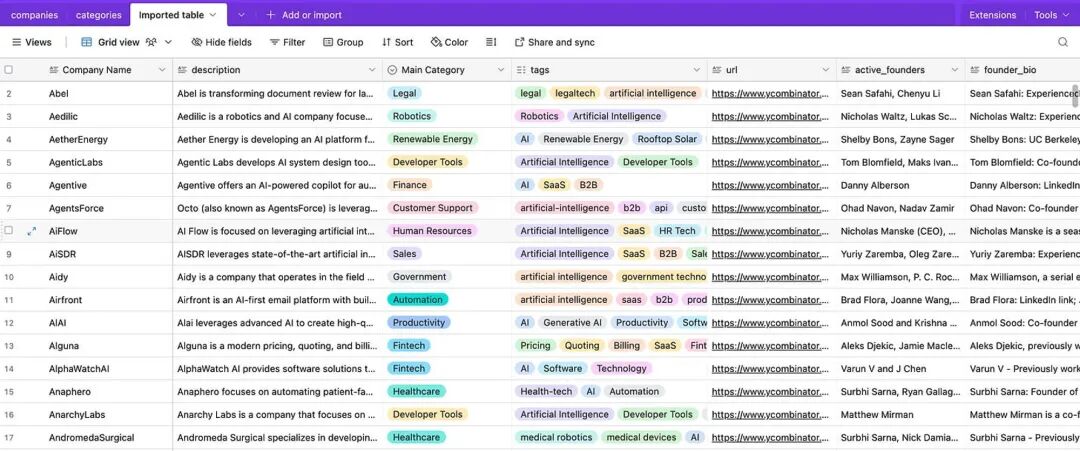
While reviewing this subset of companies, I discovered many outstanding AI use cases. In fact, part of the data collection process was done using Gumloop (YC-backed). I prefer using Gumloop over Zapier, and find myself reaching for it more often than I expected.
On to the analysis...
Where Is AI-Driven Innovation Currently Concentrated?
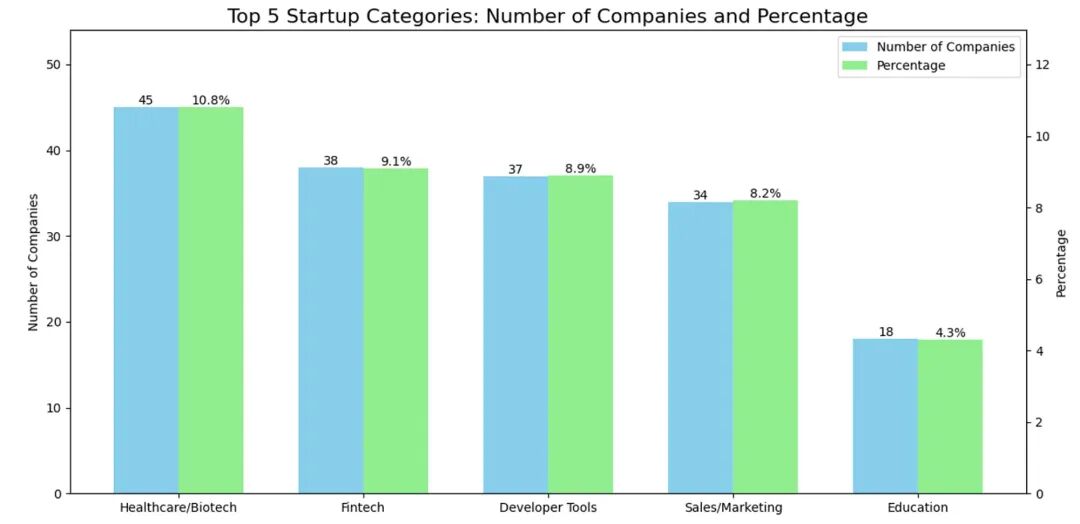
Industries most commonly intersecting with AI:
-
Healthcare/Biotech: 45 companies (10.8%)
- Example: Elythea (using machine learning to prevent maternal deaths)
-
Fintech: 38 companies (9.1%)
- Example: Arcimus (AI-driven insurance premium audits)
-
Developer Tools: 37 companies (8.9%)
- Example: Sudocode (AI for developer tools)
-
Sales/Marketing: 34 companies (8.2%)
- Example: MicaAI (streamlining sales processes)
-
Education: 18 companies (4.3%)
- Example: Studdy (AI tutor)
B2B vs B2C
-
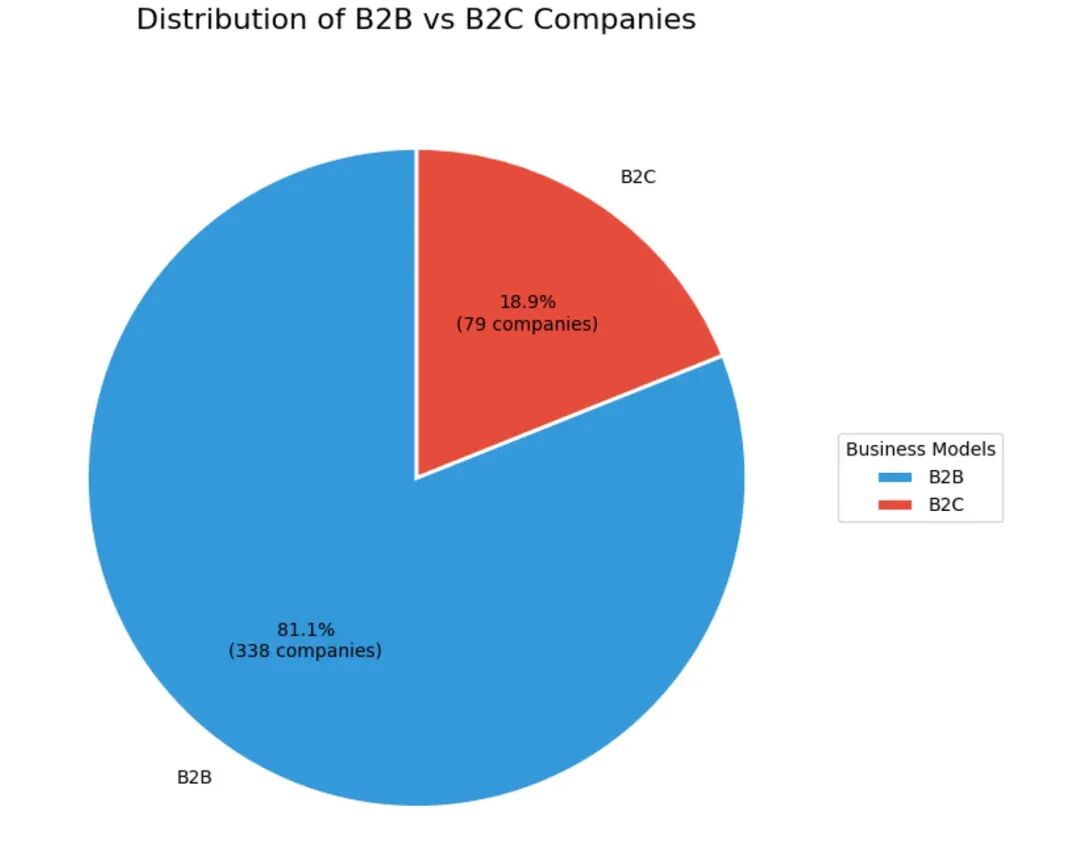
B2B: ~338 companies (81.1%): Example companies:
- GigaML: Helps enterprises build and deploy large language models (LLMs) on-premises.
- Constructable: AI copilot for construction teams.
- AiSDR: Uses AI to streamline sales processes for B2B companies.
- Corgea: Uses AI to fix vulnerable code, enhancing enterprise data security.
-
B2C companies (18.9% of portfolio): Example companies:
- Rex: AI-powered workout and nutrition coach.
- PocketPod: Delivers AI-generated podcasts based on user interests.
- Shortbread: Offers a "Netflix for comics" service.
- Roame: A platform that uses AI for travel planning and booking.
Key Takeaways:
- B2B dominance: 81.1% of YC-backed AI startups focus on enterprise solutions, indicating investor confidence in business-facing AI applications.
- Untapped B2C potential: Only 18.9% of startups target consumers, suggesting a massive opportunity for innovative consumer AI products.
- Technical expertise-driven focus: The prevalence of founders with strong technical backgrounds (74.8%) may have influenced the B2B emphasis and the types of AI problems being addressed.
AI Infrastructure vs AI Applications:
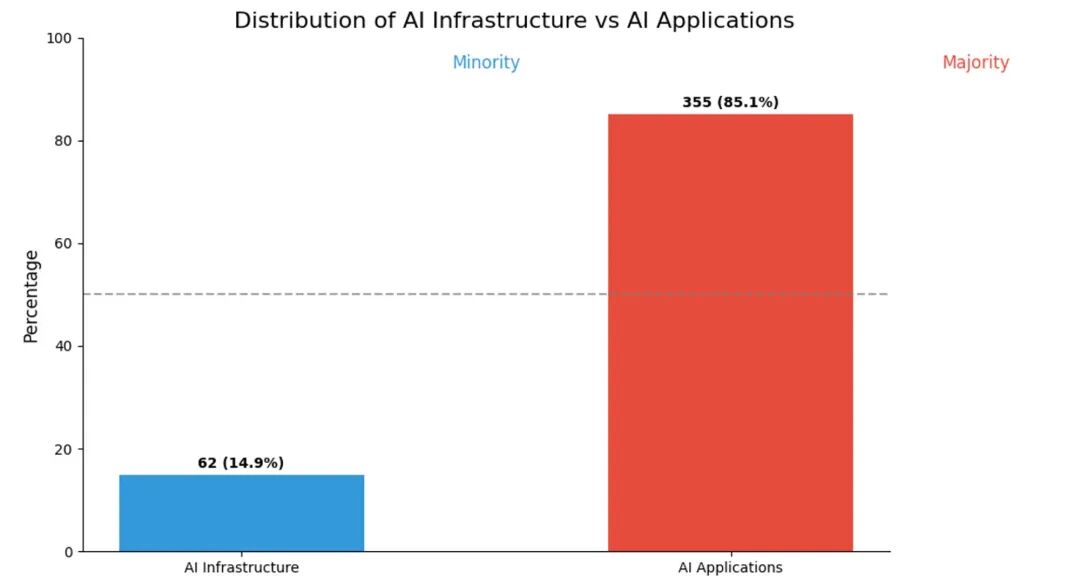
AI Infrastructure Companies — 62 (14.9%):
- Epsilla: Offers an open-source vector database with 10x speed.
- GigaML: Helps enterprises build and deploy large language models (LLMs) on-premises.
AI Application Companies — 355 (85.1%):
- Corgea: Uses AI to rapidly fix vulnerable code, enhancing enterprise data security.
- Elythea: Applies machine learning to prevent maternal deaths.
Key Takeaways:
- Application-heavy focus: 85.1% of companies develop AI applications, while 14.9% work on infrastructure, indicating a clear emphasis on practical, industry-specific AI solutions.
- Potential infrastructure gap: The relatively small number of infrastructure-focused startups may signal demand for more foundational AI tools and platforms.
- Specialization trend: AI applications tend to solve specific industry problems, while infrastructure companies aim to provide more general-purpose AI development and deployment tools.
AI-Driven Automation vs AI-Assisted Human Work
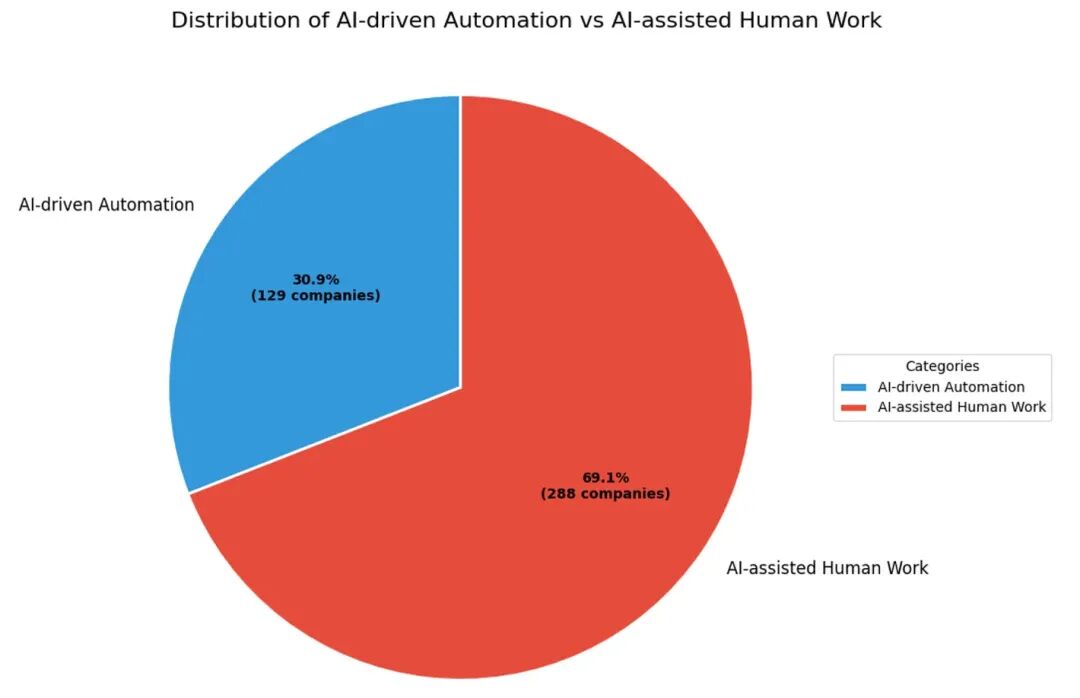
At the application layer, automation is AI's biggest use case across industries. While some automation is fully AI-driven, other processes are AI-assisted but primarily human-driven.
AI-Driven Automation — 129 companies (30.9%):
- Ofone: Automates fast-food drive-thru order processing, streamlining the ordering process and reducing wait times.
- Respaid: A modern B2B collections platform that automates the management and tracking of unpaid invoices.
- RetailReady: Automates supply chain compliance, focusing on warehouse shipping solutions to improve logistics operations.
AI-Assisted Human Work — 288 companies (69.1%):
- Constructable[26]: An AI copilot for construction teams, helping streamline projects and reduce losses from poor data.
- RadMateAI[27]: An AI copilot for radiologists, improving diagnostic accuracy and efficiency.
- Agentive[28]: An AI-driven copilot for auditors, boosting their efficiency and effectiveness through advanced technology.
While these industries are booming, others lag behind...
Untapped Frontiers — Industries Ripe for AI Disruption
Fast adopters:
- Healthcare
- Finance
- Software development
- Sales/marketing
Lagging:
- Manufacturing (4 companies, 1%)
- Agriculture (3 companies, 0.7%)
- Energy (4 companies, 1%)
- Retail (5 companies, 1.2%)
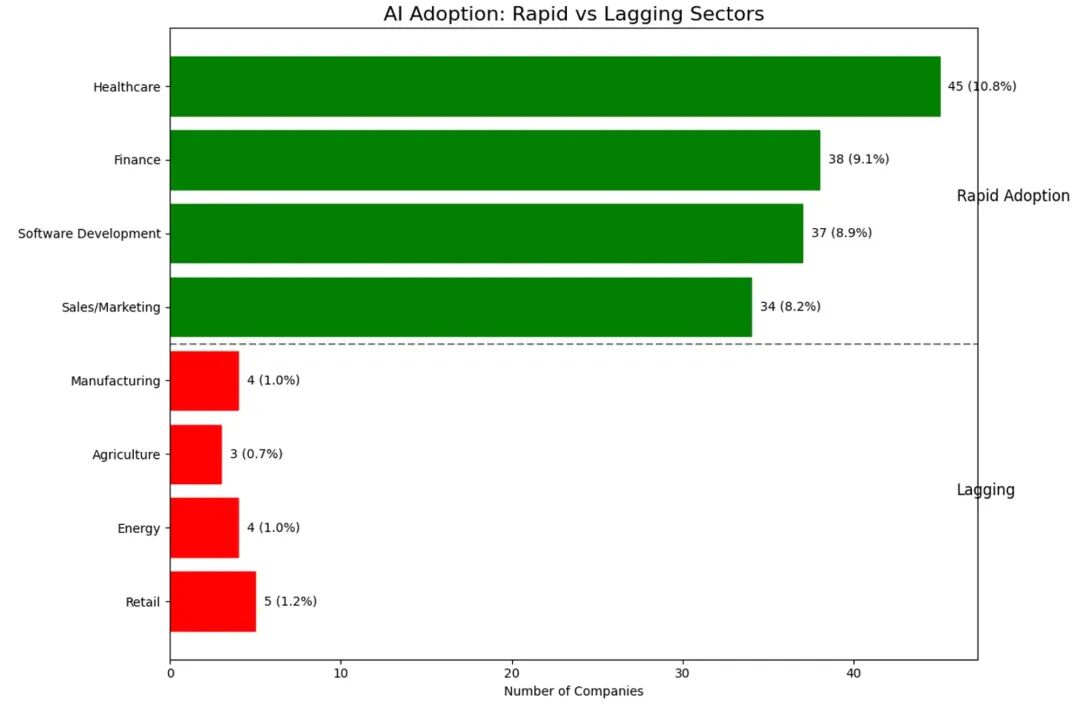
Industries like manufacturing, agriculture, energy, and retail still offer opportunities for early movers in AI adoption.
Note that this only represents YC startups following a specific funding model, focus, and domain expertise of YC staff and mentors, which may not align with these industries.
Technology Trends Shaping AI's Future
Most common AI technologies:
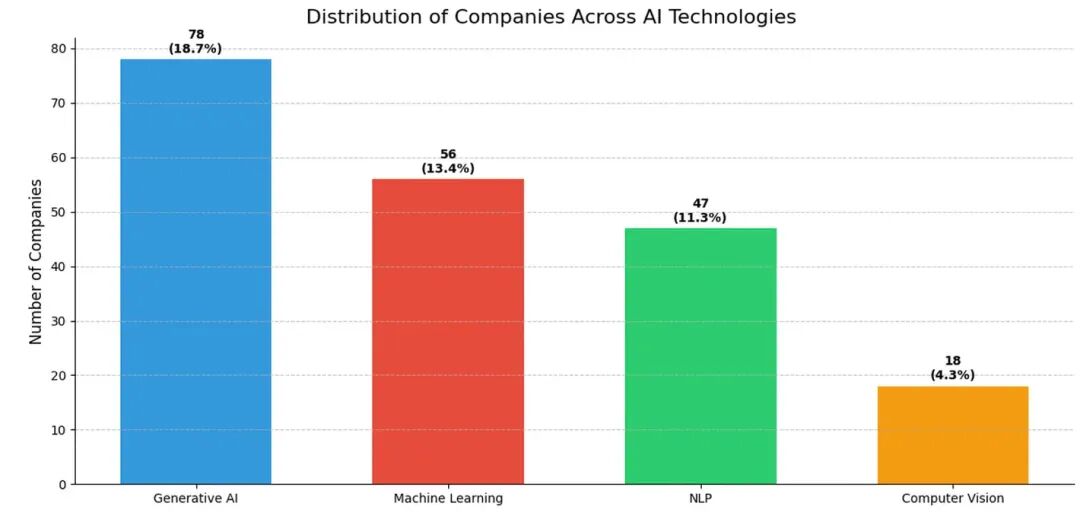
- Generative AI: 78 companies (18.7%)
- Machine learning: 56 companies (13.4%)
- Natural language processing (NLP): 47 companies (11.3%)
- Computer vision: 18 companies (4.3%)
Note that there may be significant overlap here, as companies mentioning AI may be working on generative AI, machine learning, and NLP simultaneously.
Open source vs. proprietary:
- Open source: 18 companies (4.3%)
- Proprietary: 399 companies (95.7%)
Open source example: FlowiseAI[29] (open-source AI solution)
Note that this only represents YC's portfolio. Many companies originate from open-source projects[30].
Edge AI vs. cloud-based AI: Only 2 companies (0.5%) 🔻 explicitly mention edge AI, while the vast majority appear to be cloud-based solutions.
AI model efficiency and reduced compute: Only 5 companies (1.2%) 🔻 explicitly mention a focus on AI model efficiency or reducing compute resources.
Real-time AI applications: Approximately 46 companies (11%) ✅ mention or imply working on real-time AI applications.
Example: Retell AI[31] (real-time AI-powered voice agent)
Multimodal AI: Approximately 22 companies (5.3%) appear to be working on multimodal AI solutions.
Key takeaways 💡:
- The generative AI revolution: With 18.7% of companies focused on generative AI, we're witnessing a paradigm shift in AI capabilities. This trend suggests a future where AI doesn't just analyze but creates, potentially transforming industries from content creation to drug discovery.
- The cloud-edge disconnect: With only 0.5% of companies focused on edge AI, there's a striking gap between current AI development and the growing demand for real-time, on-device AI processing. This discrepancy could be a blind spot for the industry, neglecting critical applications in IoT, automated systems, and privacy-preserving AI.
As AI becomes more powerful, new challenges and opportunities continue to emerge...
The Potential for Ethical, Efficient, and Accessible AI
Among 417 YC-backed AI startups, surprisingly few are addressing critical issues like data privacy, AI ethics, accessibility, and fairness. This section explores this small but vital subset of companies, highlighting the progress made and the enormous opportunity that remains in creating more responsible, transparent, and inclusive AI systems.
Startups addressing data privacy and security: Approximately 18 companies (4.3%) 🔻 explicitly focus on data privacy and security.
Example: Corgea[32] — Uses AI to easily and quickly fix vulnerable code, enhancing enterprise data security and privacy.
Given increasingly stringent regulations, more AI startups have an opportunity to focus on data privacy and security.
Startups addressing AI ethics and AI safety Only 5 companies (1.2%) 🔻 explicitly mention a focus on AI ethics or safety.
Example: Atla[33] — Building AI models with guardrails
Startups enabling non-technical users to use AI Approximately 28 companies (6.7%) 🔻 focus on making AI more accessible to non-technical users.
Example: Creo (build internal tools with AI without coding)
Startups focusing on explainable AI or AI transparency Only 3 companies (0.7%) 🔻 explicitly mention working on explainable AI or AI transparency.
Examples:
- Atla[34]: Atla focuses on building text-generating AI models with guardrails. Their mission is to create trustworthy and useful AI assistants for various applications, particularly legal contexts.
- GuideLabs[35]: Guide Labs develops interpretable foundation models, focusing on AI and machine learning.
- Sizeless[36]: Sizeless is a company focused on making machine learning reproducible and secure.
AI focused on sustainability or climate tech: 11 companies (2.6%) 🔻 focus on sustainability or climate tech.
Example: AetherEnergy[37] (AI platform optimizing rooftop solar installation)
Startups addressing AI bias and fairness ⏬: Only 3 companies (0.7%) 🔻 explicitly mention addressing AI bias and fairness.
AI for small businesses vs. enterprise solutions:
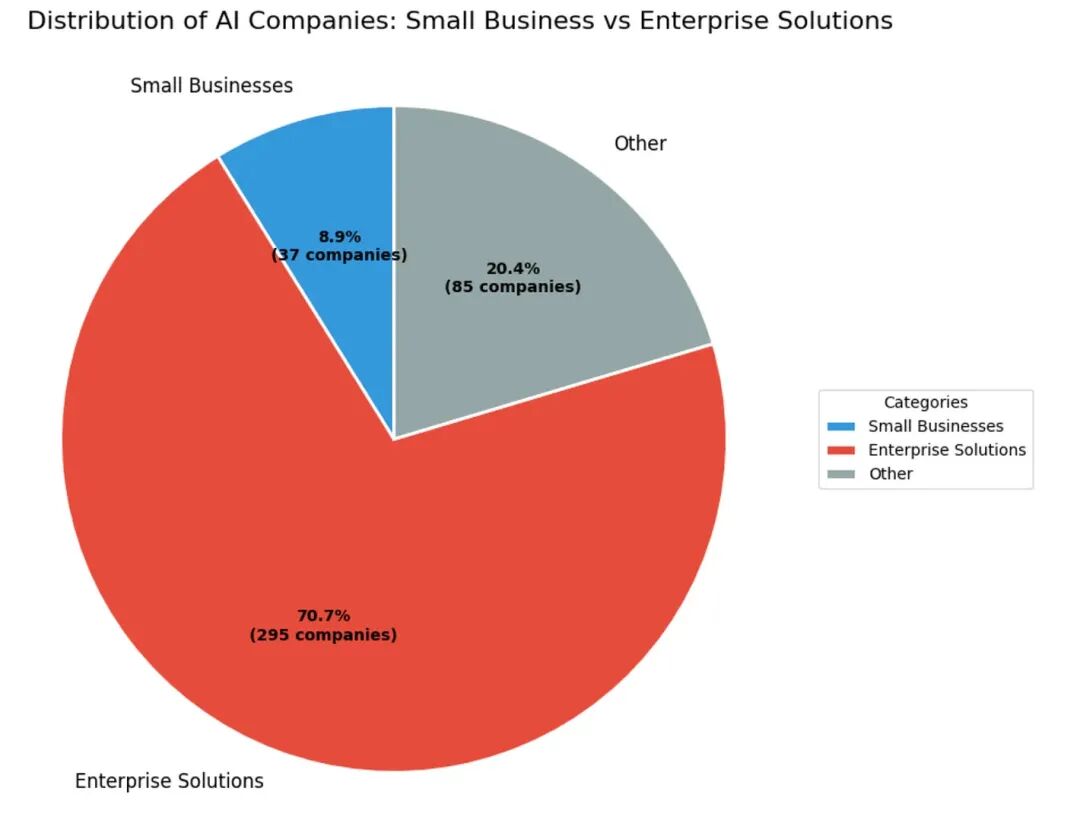
- Small businesses: approximately 37 companies (8.9%) 🔻
- Enterprise solutions: approximately 295 companies (70.7%)
Example for small businesses: HostAI[38] (AI-powered operating system for vacation rentals)
Key takeaways 💡:
- The ethics gap: With only 1.2% of startups focused on AI ethics and safety, we face a critical imbalance between AI's rapid development and its responsible development. As AI becomes pervasive in decision-making processes, this severe underrepresentation could lead to significant societal and regulatory challenges.
- The transparency paradox: Despite growing demands for AI accountability, only 0.7% of startups are addressing explainable AI. This gap could create "black box" problems at scale, potentially eroding trust in AI systems and hindering their adoption in critical sectors like healthcare and finance.
- The democratization dilemma: While 6.7% of startups are working to make AI accessible to non-technical users, this figure suggests a missed opportunity in truly democratizing AI. Concentrating AI power in the hands of a technical elite could exacerbate existing digital divides and limit AI's potential to drive inclusive innovation across all sectors.
AI Applications in Emerging Technologies 💎:
At the frontier of innovation, a small number of startups are pioneering the integration of AI with revolutionary technologies:
- Quantum computing: 2 companies (0.5%)
- Blockchain: 3 companies (0.7%)
Pioneers in this space include:
- ConductorQuantum[39]: Leveraging quantum computing to solve complex problems beyond the reach of classical AI.
- Cedalio[40]: Combining blockchain with AI to enhance data integrity and decentralized intelligence.
Key takeaways:
- Untapped potential: The scarcity of startups in these fields (1.2% combined) indicates vast, unexplored territory for AI applications.
- Exponential impact: Successfully combining AI with quantum computing or blockchain could lead to breakthroughs in cryptography, drug discovery, and financial systems.
- High risk, high reward: While these ventures face significant technical challenges, they represent the cutting edge of computational advancement that could reshape the entire AI landscape.
Typical YC-Backed Founder Background and Skills
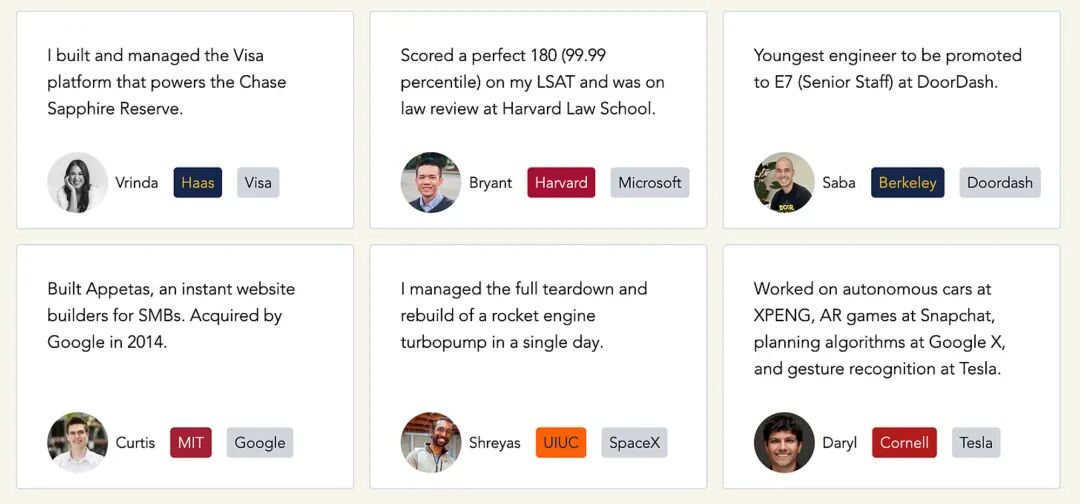
This analysis helps sketch the profile of a typical YC-backed AI startup founder.
Technical expertise: The vast majority (>75%) of founders have strong technical backgrounds in computer science, software engineering, AI/ML, and data science.
Technical expertise, particularly in AI and related fields, appears to be highly valued by YC.
Educational background: Approximately 20% of company founders hold degrees from prestigious universities, as stated in their profiles:
- Stanford University
- MIT
- Harvard University
- UC Berkeley
- Other top universities
Many founders have strong educational backgrounds from well-known institutions, particularly those with strong computer science and engineering programs.
Prior work experience: Many (approximately 25%) founders have experience working at top tech companies, such as:
- Facebook (Meta)
- Amazon
- Microsoft
- Apple
Experience at top tech companies appears to be a strong positive factor for YC funding.
Entrepreneurial experience: A significant number (approximately 15%) of founders have prior startup experience:
- Serial entrepreneurs
- Previously founded or co-founded other startups
For example: Surbhi Sarna, who founded multiple companies including Olio Labs, "previously founded nVision Medical and sold it to Boston Scientific."
YC values founders with prior entrepreneurial experience, particularly those with successful exits.
Please note that even if you haven't attended a top school or worked at a leading tech company, you can still stand out by demonstrating exceptional work.
For example, Jaspar Carmichael-Jack[41] (founder of Artisan[42]) didn't list big-company titles in his profile, but showcased outstanding work.
Academic research: Some (approximately 8%) of founders come from academic research backgrounds:
- PhDs in relevant fields
- Postdoctoral researchers
- University professors
For example: Roman Engeler of Atla "holds a PhD in AI and has worked on several machine learning projects."
Strong research backgrounds, particularly in AI and ML, are valued by YC.
Diverse skill sets in founding teams: Many (45%) startups have founding teams with complementary skills:
- Technical founder + business/operations founder
- AI expert + domain expert
For example: Arcimus has "Hussein Syed: extensive experience in AI and software development" and "Omar Dadabhoy: background in finance and insurance."
YC appears to prefer founding teams that combine technical expertise with business acumen or domain knowledge.
Industry disruptors: Many (approximately 24%) of founders have backgrounds that enable them to disrupt traditional industries:
- Previously worked at large companies in the industries they are now disrupting
- People with unique insights into industry pain points
For example: Tom Blomfield, who has been involved in several YC companies, is the "former CEO of Monzo, co-founder of GoCardless."
YC values founders who can bring fresh perspectives and disruptive ideas to traditional industries.
How to Find What You Should Build with AI
Paul Graham says that great work is a combination of three elements: natural aptitude, deep interest, and scope to do great work. Let's apply this framework to finding your ideal AI startup focus:
- Natural aptitude: Assess your innate strengths. If you have a technical background, you'll be in the same category as 74.8% of YC AI founders. If not, consider partnering with a technical co-founder to complement your skills. Whether technical or non-technical, your natural aptitude will be the foundation of your startup's success.
- Deep interest: Identify which industry, domain, or problem captivates you most. Your passion will drive you through challenges. Look at high-potential sectors like healthcare/biotech (10.8%), fintech (9.1%), and developer tools (8.9%), or explore underserved areas like manufacturing (1%) or agriculture (0.7%). Genuine interest in the problem you're solving will be key to long-term motivation.
- Scope to do great work: Conduct market analysis, considering whether to focus on the dominant B2B market (81.1%) or the less saturated B2C space (18.9%). Explore critical gaps like data privacy (4.3%), AI ethics (1.2%), or explainable AI (0.7%). For those drawn to cutting-edge technology, quantum computing (0.5%) and blockchain (0.7%) offer high-risk, high-reward opportunities. The key is to identify areas where AI can make a significant impact and where there's room for innovative solutions.
Conclusion
So if you're an aspiring AI founder or practitioner, here's my advice:
- Focus on B2B: Since 81.1% of YC-backed AI startups serve enterprises, consider enterprise solutions for higher chances of funding and success.
- Explore underserved sectors: While healthcare/biotech (10.8%), fintech (9.1%), and developer tools (8.9%) dominate, look for opportunities in overlooked areas like manufacturing (1%) or agriculture (0.7%).
- Prioritize technical expertise: Ensure your founding team includes strong technical talent, as 74.8% of YC-backed AI companies have at least one founder with a solid technical background.
- Leverage generative AI: With 18.7% of startups entering this space, generative AI is hot. However, consider how you can apply it innovatively to stand out.
- Pay attention to ethics: Only 1.2% of startups focus on ethical AI. This gap presents a significant opportunity for forward-thinking founders.
This article was translated by 4o from: HARSHIT TYAGI[43], What I learned from looking at 400 AI-based Startups backed by YCombinator[44]
References
[1] Paul Graham: https://paulgraham.com/
[2] Y Combinator (YC): https://www.ycombinator.com/
[3] Y Combinator Directory: https://www.ycombinator.com/companies?batch=S24&batch=W24&batch=S23&batch=W23&tags=Artificial%20Intelligence&tags=AI&tags=Generative%20AI
[4] Gumloop (YC-backed): https://gumloop.com/
[5] Gumloop instead of Zapier: https://youtu.be/g53BIZX9Hag
[6] Elythea: https://www.ycombinator.com/companies/elythea
[7] Arcimus: https://www.ycombinator.com/companies/arcimus
[8] Sudocode: https://www.ycombinator.com/companies/sudocode
[9] MicaAI: https://www.ycombinator.com/companies/mica-ai
[10] Studdy: https://www.ycombinator.com/companies/studdy
[11] GigaML: https://www.ycombinator.com/companies/giga-ml
[12] Constructable: https://www.ycombinator.com/companies/constructa
[13] AiSDR: https://www.ycombinator.com/companies/aisdr
[14] Corgea: https://www.ycombinator.com/companies/corgea
[15] Rex: https://www.ycombinator.com/companies/rex
[16] PocketPod: https://www.ycombinator.com/companies/pocketpod
[17] Shortbread: https://www.ycombinator.com/companies/shortbread
[18] Roame: https://www.ycombinator.com/companies/roame
[19] Epsilla: https://www.ycombinator.com/companies/epsilla
[20] GigaML: https://www.ycombinator.com/companies/giga-ml
[21] Corgea: https://www.ycombinator.com/companies/corgea
[22] Elythea: https://www.ycombinator.com/companies/elythea
[23] Ofone: https://www.ycombinator.com/companies/ofone
[24] Respaid: https://www.ycombinator.com/companies/respaid
[25] RetailReady: https://www.ycombinator.com/companies/retailready
[26] Constructable: https://www.ycombinator.com/companies/constructable
[27] RadMateAI: https://www.ycombinator.com/companies/radmate-ai
[28] Agentive: https://www.ycombinator.com/companies/agentive
[29] FlowiseAI: https://flowiseai.com/
[30] Derived from open-source projects: https://huyenchip.com/2024/03/14/ai-oss.html
[31] Retell AI: https://www.ycombinator.com/companies/retell-ai
[32]Corgea: https://www.ycombinator.com/companies/corgea
[33]Atla: https://www.ycombinator.com/companies/atla
[34]Atla: https://www.ycombinator.com/companies/atla
[35]GuideLabs: https://www.ycombinator.com/companies/guide-labs
[36]Sizeless: https://www.ycombinator.com/companies/sizeless
[37]AetherEnergy: https://www.ycombinator.com/companies/aether-energy
[38]HostAI: https://www.ycombinator.com/companies/hostai
[39]ConductorQuantum: https://www.ycombinator.com/companies/conductor-quantum
[40]Cedalio: https://www.ycombinator.com/companies/cedalio
[41]Jaspar Carmichael-Jack: https://www.linkedin.com/in/jaspar-carmichael-jack/
[42]Artisan: https://artisan.co/
[43]HARSHIT TYAGI: https://substack.com/@dswharshit
[44]What I learned from looking at 400 AI-based Startups backed by YCombinator: https://highsignalai.substack.com/p/what-i-learned-from-looking-at-400