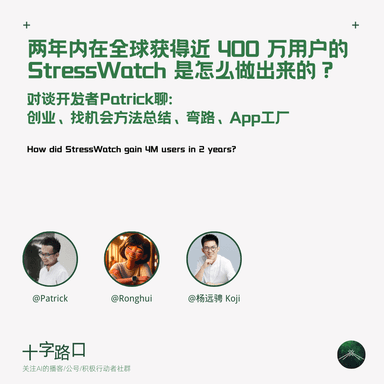

This week, we invited Patrick, founder of "100 Bad Ideas" and the development team behind StressWatch, to share how he built a health product that has been featured on the App Store in over 170 countries and now has nearly 4 million users — all within two years. From MEIZU and frogdesign to fitness hardware startup Fiture, and now StressWatch, Patrick reflects on what methods developers can borrow for finding opportunities, and how today's app factories differ from the mobile internet era — including what new players have emerged.
Patrick told us that he and "100 Bad Ideas" welcome collaborations with other teams, and encourages people to reach out for more information. Patrick on Jike: okjk.co
We'd like to give special thanks to our previous podcast guest Maozhu for generously providing the recording space. We also continue to warmly welcome AI entrepreneurs to check out the AI Hacker House initiated by "Crossroads," located in Shanghai's Caohejing Park, our offline event in late April, and the "Next-Gen AI Entrepreneurs" community. Details were shared at the beginning of the podcast, and more information is available on the "Crossroads" WeChat official account.
00:58 Three updates from "Crossroads": AI Hacker House (detailed introduction), April offline event (detailed introduction), "Next-Gen AI Entrepreneurs" community
🟢 Part 1: Patrick's Personal Journey
03:52 Built StressWatch, an Apple Watch-based stress detection and health management product, with nearly 4 million users worldwide
05:17 Unexpectedly hit #1 on Xiaohongshu's trending search
06:34 The studio is called "100 Bad Ideas" — who describes their own work as bad ideas?
09:27 Patrick's career path: from MEIZU and frogdesign to Fiture
14:36 The most wildly imaginative project he's worked on: a car-washing robot
16:56 At Fiture, was assigned to overseas markets and spent a year in New York understanding American fitness needs
19:18 Analysis of U.S. fitness consumer demand characteristics: older demographic, segmented needs, software-plus-hardware models are common
23:20 Why choose the broad health sector for entrepreneurship? Pandemic-driven Apple Watch sales growth, health metrics concepts popular in the U.S. but not yet widespread in China, scarcity of existing stress-related software, insufficient emotional expression
26:52 What is "emotional design"?
28:39 Besides StressWatch, what are the other 100 "bad ideas"?
32:02 When preparing to start up, told himself he could accept zero income for two years
35:31 From initial excitement about doing something of his own, to confusion, to experimentation...
🟢 Part 2: Finding Opportunities — Lessons from StressWatch's Development
36:19 Thinking through what AI can do: 1) it favors Matthew effects; 2) when AI becomes infrastructure, data matters most, and startups don't have user data; 3) return to what you know and do well
39:05 Launched the product, got positive feedback, but made one mistake: underestimated its potential
40:24 If he could go back, would focus all R&D and design energy on making the product excellent and deep; raise funding, and grow as fast as possible
42:43 Any product with clear PMF deserves full focus, no matter how small that PMF is
44:34 Advice for indie developers: emotional and rational metrics
47:01 Patrick's method #1 for spotting product opportunities: finding PMF is less important than finding MPF
49:10 Method #2: look at what's already in the market, which concepts have been validated in Market A but remain blank in Market B
50:47 If the total score is 100, users won't switch for a product that's only 5 or 10 points better
51:30 Check the rankings, but don't look at the top
52:39 Don't fear small demand — build must-have products for minorities
56:38 Method #3: build products starting from users and communities around you
58:16 Method #4: pay attention to new technology trends; iOS developers must follow WWDC announcements to unlock new directions
1:00:30 "We took so many detours before realizing these things"
1:02:18 What growth opportunity StressWatch caught: every product has a window, and so does growth
1:03:53 Detours in growth: didn't devote full energy to it at first, didn't yet understand how this category of overseas products grows
1:06:07 Considering possibilities for collaboration with other teams
🟢 Part 3: Observations and Analysis of App Factories
1:07:29 There are many app factories domestically and abroad — the name sounds like mass-produced mediocrity, but some products are quite polished
1:11:24 What's the difference between today's app factories and those of the mobile internet era?
1:12:54 Why didn't last era's app factories evolve? Growth capability is hard to cultivate
1:14:35 Overseas app factory recommendations
1:19:14 Looking back at these two years, feels lucky: asking his own questions and answering them, completing a full business cycle
1:25:11 Today is a good time to start a business: overseas infrastructure is mature, AI enables rapid globalization, AI makes trial-and-error more efficient
Subscribe to the "Crossroads" podcast 🚦 We follow the industry transformations and entrepreneurial opportunities brought by the new wave of AI technology. "Crossroads" was Steve Jobs' metaphor for Apple — standing at the intersection of technology and liberal arts, where great products are born. AI is transforming every industry. We seek out, interview, and bring together "active doers" of the AI era, exploring and embracing new changes and new possibilities alongside them.
👦🏻 Host Koji: Co-founder of The Fair / Tangdao. I believe technology, especially AI, will fundamentally transform society and empower humanity. Welcome to chat, exchange ideas, and connect on what's next. Koji on Jike, Koji's website
👧🏻 Host Ronghui: Works at a tech VC, former Silicon Valley correspondent for Yicai. Ronghui on Jike
🎄 This podcast is supported by "The Fair Sound Forest Podcast Project."