Starting from Five Investments in Manus's Red Xiao: A Conversation with ZhenFund Partner Yuan Liu on How His Read of People Has Evolved
I think the market is at its best right now.
I think the market is the best it's ever been right now.

👦🏻 Podcast interview: Koji, Ronghui
🥷 Edited by: Starry
🧑🎨 Layout: NCon

This is the 12th year of Red Xiao's entrepreneurial journey. In 2013, he was still studying at Huazhong University of Science and Technology. Many of his classmates had started using QQ and WeChat official accounts. At the end of that year, when WeChat launched its official account programming feature, he immediately built a small project: follow the account and you could check that day's weather in Wuhan. The moment he made that demo in his dorm room, he truly understood for the first time "how a small product gets made."
Many people came to know Red Xiao through Manus, the "first general agent," but his story with ZhenFund began long before that. In 2016, he and his co-founder had decided to give up on entrepreneurship and had offers from major Beijing tech companies. With a "just for fun" mentality, they joined a hackathon — and ended up meeting Yuan Liu, a partner at ZhenFund. Unexpectedly, "the next day we got ZhenFund's SPA, and we could get the money after signing," Red Xiao recalls. That experience "felt like a dream."
ZhenFund invested in Red Xiao five times in total. The first time was when he and several HUST classmates founded "Wuhan Nightingale Technology Co., Ltd" on campus, which gained some local fame and was later acquired. The second time was when he pivoted from Weiban to "Jianji," a China-version of Benchling — a team that had been through a full cycle and decided to start again. The third time was in 2022, when he first used GPT-3 (ChatGPT hadn't been released yet) and suddenly realized he'd regret not seizing this opportunity. He wrote on Fanfou that "this was the biggest entrepreneurial opportunity he had seen in the AGI field," and Monica was born. The fourth and fifth times were continued bets on Manus.
Throughout this process, Yuan Liu said: "My confidence in him has only grown stronger. Every round we invested in him was at a higher valuation, which shows we really believed he was on the right track and getting better and better."
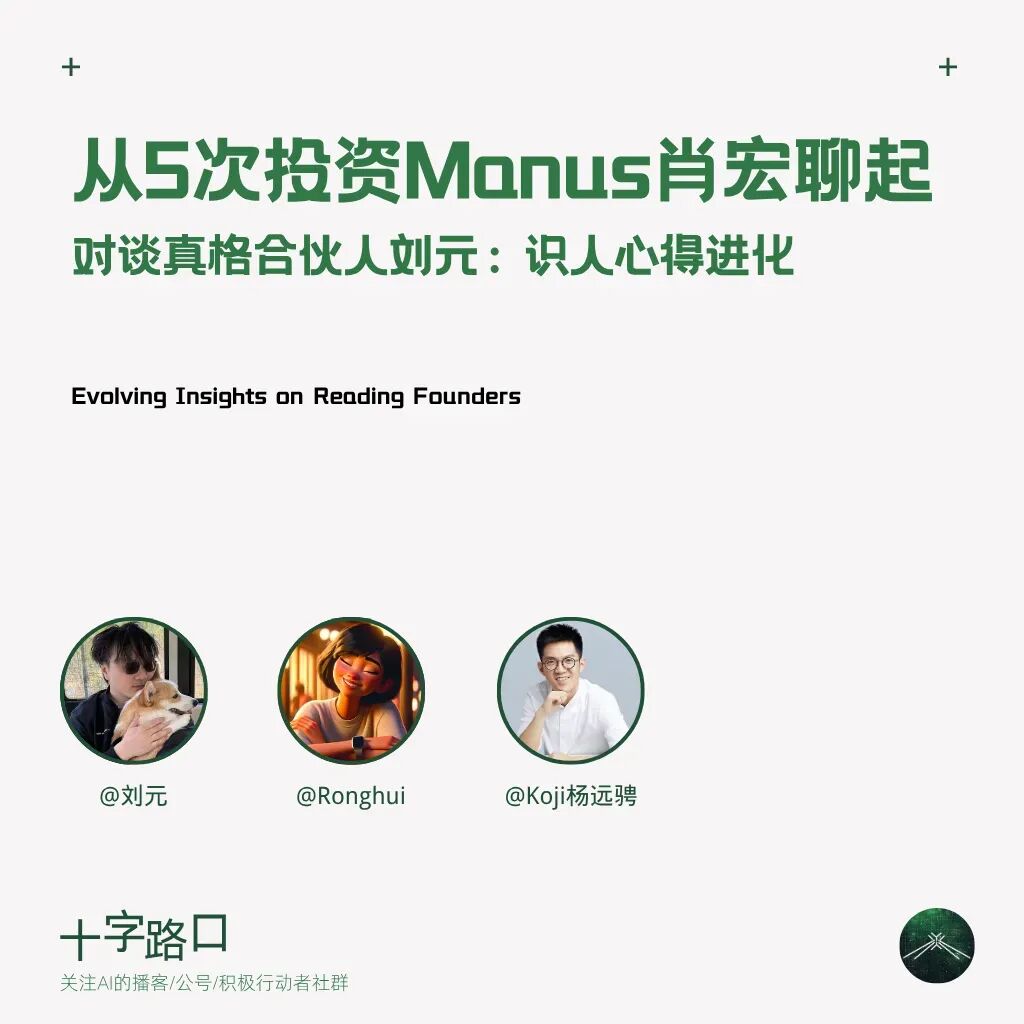
In this episode, we sat down with Yuan Liu to share the story of his five investments in Manus founder Red Xiao, and to hear his reflections as a ZhenFund partner — from starting in fund-of-funds, joining ZhenFund in 2014, riding the mobile internet cycle, moving from "looking at everything" to gradually forming his own judgments about investing and people. He reviews and summarizes several key moments and what happened at each.
You'll hear about a product's choices and transformations through ups and downs, and you'll see an early-stage investor reflecting on judgment, people-reading, and timing through countless cycles and founders. We hope this episode brings you some insight.
Listen on WeChat:
Listen on Xiaoyuzhou:


The Story of Five Investments in Red Xiao
👦🏻 Koji
This week Crossing finally welcomed our old friend Yuan Liu. From our first episode until now, nearly 60 episodes in, we've been figuring out when to invite him on — but we also felt such a precious guest should be saved for the right moment. Now is exactly that moment: after the launches of DeepSeek and Manus, these past two months it feels like every investor I've met is brimming with confidence, and AI entrepreneurship and investment are surging again, rolling toward us. I've heard HSG's conference rooms are fully booked lately — a spectacle we haven't seen in two or three years.
Yuan Liu is a partner at ZhenFund, and he also represented ZhenFund in investing in The Fair, the company I co-founded. We've known each other for about ten years and have stayed in touch. This past March, Yuan Liu also joined the AI Hacker House that Crossing organized in Shanghai, participating in one of the offline salons. His talk was excellent, and we published the content on Crossing's official account. Today, we'll start with what Yuan Liu has been up to lately. I heard he recently met Bob Xu (founder of ZhenFund), and I'm curious — what did Bob Xu think of Manus?
👦🏻 Yuan Liu
Actually we go back even further than you said, before The Fair was founded. Around late 2014, I had just joined ZhenFund and took the first cohort of ZhenCamp to Jumei International Holding Limited. Chen Ou had something come up and couldn't make it, so he asked if someone could substitute — and they found you. At the time you were Jumei's mobile business lead, I believe.
👦🏻 Koji
Right, I remember — I was called up last minute to share with the ZhenCamp students.
👦🏻 Yuan Liu
Chen Ou was at the height of his fame then. Looking back, someone who could step in for him on short notice couldn't be ordinary. In fact, this was also an important reason we later decided to invest in The Fair.
Back to Bob Xu — he's doing great. When I first saw him this time, he really didn't know anything about Manus. He asked what this company does, who the people are, told me to explain, because Manus has been quite hot lately. Like parents caring about their children, he cares about his students and junior colleagues.
👩🏻 Ronghui
Do you feel like you're bringing your work to your teacher for evaluation?
👦🏻 Yuan Liu
Of course, I actually feel that quite strongly. Manus is still a very young company. In tech history, many products that once dominated headlines were eventually forgotten, even becoming "martyrs." So every time I tell Manus's story, while I get excited, I also stop myself for some self-reminder. This company, like all startups, is very fragile and could fail at any moment.
But I don't need to explain this to Bob Xu. He's been through so many cycles, ups and downs — he understands. Manus may not be a very large company, but for an early-stage investor, it's a project worth being happy and proud about. Especially after so many years at ZhenFund, Manus has many special qualities, which we can get into. For example, as a startup, to be able to expand internationally with users from Day 1 based on entirely new business models and technological frontiers, and to receive such strong resonance and response from mainstream entrepreneurs and investors — such cases are very rare.
I'm still very happy and excited to share these observations with Bob Xu. It's a bit like finally placing in a competition using the sword techniques you've learned.
👦🏻 Koji
Then let's walk through the full story of how you invested in Manus.
👦🏻 Yuan Liu
This is the first time I'm telling this story completely. We've invested in Red Xiao and his team five times total, from 2016 to now — nine years. The first time was in their company "Wuhan Nightingale Technology Co., Ltd." Several HUST classmates started a business on campus, made some money, built some locally famous products, but soon ran out of funds and were planning to join big tech companies. Before that, they decided to try one more hackathon in Beijing. They were probably hoping to get lucky, win some prize money to last a bit longer. Unexpectedly, I was also there as a judge that day, and their product demo and presentation moved me. The team was young, execution was strong, and they didn't need much capital, so we quickly decided to invest an angel round — 1 million RMB — starting their path of institutional funding and officially becoming a startup company.
Wuhan Nightingale Technology Co., Ltd actually didn't follow the funding path as smoothly as other companies of that era; from a fundraising perspective it was pretty rough. But from a product and user growth perspective, even revenue, for undergraduates it was already very impressive. Some of their assistant products reached tens of millions of users. The company was acquired around 2022, and we made some money too — though we didn't invest much, it was more than ten times return. A "small bet, big return."
Actually when acquisition talks started in 2021, I began talking to him about whether he wanted to keep building companies. He was still very young with many possibilities. I remember he once said his entrepreneurial mission was "to build great tools for humanity." So every time I saw good tool products I'd send them to him. In 2022 I noticed a product called Benchling, a Lark-like tool for scientists, and we talked about this direction repeatedly. He decided to build a China-version of Benchling, and we didn't hesitate to invest a second time. The second investment was in a mature team that had been through a full entrepreneurial and exit cycle and was ready to start again.

There's actually a story behind the third round. Many people know Monica as Manus's predecessor, but Monica's predecessor was actually a browser extension called "ChatGPT for Google." And before that extension, it was their China-version of Benchling, "Jianji." The jump from "Jianji" to "ChatGPT for Google" happened because we had invested in a co-founder of Benchling, a Chinese-American who wasn't fluent in Chinese. I introduced Red Xiao to learn from him. At the time, Red Xiao was using GPT-3 to write emails for him and discovered that GPT-3's translation was already very good, but there was no friendly interface — "it still needed a shell." ChatGPT hadn't been released yet, and he suddenly realized this was a massive opportunity.
On November 10, 2022, he wrote on Fanfou: "This is the biggest entrepreneurial opportunity I've seen in the AGI space." On November 20, they greenlit Monica. Ten days later, ChatGPT launched. So he started tracking products like ChatGPT for Google. Their "Jianji" project was basically finished by then, but he made a crucial call: kill the nearly completed product, pay out of pocket during Spring Festival to acquire the ChatGPT for Google extension, no board meeting, no investor consultation — just go. Monica and the extension were developed in parallel, with zero cross-promotion, each growing independently. ChatGPT for Google sounded like an OpenAI-Google collaboration; it had nothing to do with either.
Like McDonald's movie The Founder says: sometimes a great company's biggest asset is simply its name. Riding that extension's early growth, Monica rose fast too. We saw their timing and their willingness to make ruthless strategic trade-offs.
This was actually someone we backed on his very first startup. After talking with Butterfly Effect for the angel round, I told him: we're in. A week later he came to pitch — already had a frontend demo. Backend was far from ready, but you could feel the product taking shape, the design completeness.
By the second round, the product was usable; we all thought they could soft-launch. But he had higher ambitions, the team was intensely focused, attention management was tight — so he cut the launch. Looking back, that was smart strategy. For instance, he insisted on not funneling Monica traffic to Manus, letting both grow independently. Still hasn't, to this day. Yesterday I teased him: "Just funnel a little." But that choice shows he's playing long.
Our third investment in him — the Butterfly Effect check — came when Monica had grown from three thousand users to hundreds of thousands, even millions, with ARR already past several million dollars, becoming a known quantity in the circle. Back then, nearly every founder doing a demo in our office had Monica's floating widget on screen. We'd heard some big tech companies had internal Monica user groups with tens of thousands. That penetration made us realize it had broken out. So we added more; Sequoia, Tencent, and Huiwen Wang came in too. That was Butterfly Effect's third financing, our fourth time backing him.
Four or five months later, they decided to build a browser. He judged that while Monica was growing well, the extension ceiling was too low — needed to go up a layer, build a browser for the AI era. We talked a lot about AI search, which led me to introduce Peak Ji to him. Peak was someone we'd backed since he was 18, started with Mammoth Browser, then built Magic search engine and sold it to a public company. Deep expertise in search and browsers. Red Xiao happened to want both directions, so we put them together.
But problems emerged. Monica was already on a16z's Top 100 GenAI Consumer Apps list, yet when they went to fundraise, everyone only wanted to debate "is a browser worth investing in" — almost nobody assigned value to Monica. The ChatGPT financing coldness was one thing; Monica was a mature product with millions of users, yet still didn't get the valuation bump it deserved. That round was pretty demoralizing. Tencent and Sequoia came in eventually, but the valuation was basically flat with the previous round.
The browser was mostly built, but launch kept getting delayed. Tao Zhang would get excited talking about it, yet I never saw the product. Then once in Wuhan, he demoed features. I said, "Show me the browser now." He said, "I was just demoing on our browser." The air froze — awkward for me, probably awkward for him too. The product genuinely wasn't distinctive enough. Arc, you remember: vertical tabs. Arc is more than that, but you remember it. Their browser hadn't reached that point. Red Xiao once told me: "There's no such thing as user error." When I first used it and didn't notice the browser difference, I said "sorry maybe I didn't get the design," he replied: "It's not that you didn't notice — the product isn't designed well enough yet."
So I believe they didn't launch not because they gave up, but because their own bar for "innovation" wasn't met. Two months later, Manus launched. And then came the financing story everyone knows.
👦🏻 Koji
I thought Yuan Liu's telling was fantastic; many Crossing listeners probably know this story. Yuan first invested a million RMB in 2015. Less than a year later, Red Xiao came saying "we can't continue." The team was on minimal salaries, the million nearly gone. Yuan said: "Go to Beijing, talk to Koji. He gives founders emotional support." So Red Xiao and two co-founders, Yang Huijie and "Lao Da," came to Beijing. We talked an entire afternoon at Apple Community in Shuangjing.
Their product then was called "Yiban" — I loved it, even felt it'd be a loss if they stopped entrepreneuring. That day I transferred several hundred thousand RMB, eased the cash crunch, gave some confidence. They returned to Wuhan, pushed through from Yiban to Weiban, to the unreleased "Benchling," until eventually Monica and Manus.
Actually, this reminds me of a story from early 2024. Monica had received an acquisition offer from ByteDance. Yiming Zhang met with Red Xiao once; Red Xiao was deeply torn about selling. We had two phone calls; later he came to Shanghai, and we talked a whole afternoon at a teahouse in Hongqiao Airport.
I strongly advised against selling. My thinking was direct: selling might be one person's ceiling, but staying, the company and product's future is unlimited. Monica's "floor" was already high then — even without selling, continuing would bring substantial financial returns and career foundation.
And not everyone is suited to be "acquired big-company manager." I felt Red Xiao was better as "founder #1." Another point from personal experience: what founders fear most isn't failure — it's emptiness. Compared to unclear product direction or growth stalls, that "nothing to do" emptiness is the most terrifying. We recorded a podcast last December, his tenth entrepreneurship anniversary, where he talked about spotting the Manus opportunity and deciding to go all-in. That episode hasn't been released yet; we're still waiting for the right "historic moment."
👩🏻 Ronghui
It sounds like he had products ready several times, then abandoned or pivoted direction at the last minute. How did you prioritize this investment? Did you ever doubt yourself?
👦🏻 Yuan Liu
Not at all. Honestly, looking back now, it's easy to slip into a tone of "Manus is already successful," but it's far from that. We still constantly debate whether PMF is truly found. It may have sparked a wave defining agent interaction patterns, but for over two years, I've never wavered in my confidence.
Colleagues even joke that I pitch Manus to everyone I meet. Many friends and investors around us know, including when I convinced Peak (Peak Ji, Manus Chief Scientist) to join Monica. After selling his company, Peak was EIR at ZhenFund — always a prodigy in our eyes. Getting an 18-year-old Forbes cover subject, ZhenFund and Sequoia backed, public-company-exit founder to join a new team — not something everyone would do.
Many of Monica's core employees today were indeed our referrals, especially after Manus launched. You say he changed directions a lot, but I don't think he pivoted out of desperation — he pivoted because he saw bigger opportunities.
👩🏻 Ronghui
So each pivot had its reasoning?
👦🏻 Yuan Liu
The first was from Jianji to agent — he suddenly realized there was a completely different magnitude of opportunity. Things were actually going smoothly then, fundraising, partnerships weren't bad, but the moment he used GPT-3, he felt an opportunity he couldn't let slip.
The browser direction was similar. He wasn't unable to build it — he felt it wasn't good enough, didn't meet his own standards, so no launch. For him this wasn't speculation or incompetence, but higher standards. He's a founder with real ambition; not launching was strategic choice, and making choices is a CEO's most important capability. Looking at Manus now, it's essentially a new kind of browser — not traditional browser, but solving information collection from a search angle.
So through this process, my confidence in him only grew. Every round we invested at higher valuation — we genuinely believed he was on the right track, and getting better.
👩🏻 Ronghui
What specifically told you he was "on the right direction"?
👦🏻 Yuan Liu
Most obviously, Monica kept growing, becoming more known, the product more complete — though some say it's getting more complex. And the founder himself matured. These sound abstract, but if you observed firsthand, you'd clearly feel his rapid progress each time.
Yuan Liu's Career as an Angel Investor
👦🏻 Koji
Let's talk about your own VC experience. When did you enter the industry? Feels like you've lived through the full early-investment cycle, from "VC is a golden rice bowl" to now warning young people to be cautious. How do you view your own career?
👦🏻 Yuan Liu
I've only had two formal jobs. After undergrad, first was Greenspring Associates, a VC fund-of-funds that also did some direct investing. For example, if we backed a VC that did Series A, we'd see if we could lead Series B. I was there three-plus years. I was the company's only Asian person, so I proactively reached out to China-market VCs, studied the China VC landscape extensively.
I remember in 2017 writing an article called "The Suicide of a Top VC," about Crosspoint — virtually unknown today. But those years I genuinely studied much VC history. Many US VCs by the time we invested in 2011 were already on Fund XIX, Fund XXII. Many started in the 1980s. China's VCs — most names we know today are still the earliest generation, the pioneers still dominating. So while we've been through many cycles, in longer historical view, China's VC industry is still very young.
I was at that US firm from 2011 to 2014, then returned to China in 2014. That was right at the peak of mobile internet — many companies were just starting to hit their stride. We only did early-stage investing, and we backed several projects that later grew enormously, like ByteDance and Pinduoduo. At the time, they were just beginning to show their value.
Then pretty quickly came the 2015–2016 "mass entrepreneurship and innovation" wave, the O2O era, the online-offline integration. Back then, every day you'd see shared bikes, shared power banks, and even themed shared KTV booths.
👦🏻 Koji
What were you doing then? Were you looking at the same things as everyone else?
👦🏻 刘元
In 2016, I invested in Momenta and Red Xiao's Nightingale Technology. I did look at sharing-economy projects too — shared KTV, for instance. I almost invested, but the round filled up and I missed out. Later, I was glad I did.
I hadn't yet realized a pattern then: most hype waves are driven by losers. By the time you notice a sector is "hot," it's already too late. What's truly worth investing in are the "wave-makers," not the followers riding the trend.
In 2016, I personally backed 26 projects at ZhenFund. The entire firm invested in over 100 that year. Looking back, it's almost unbelievable. Today, a fund doing 20–30 deals annually is considered very active. In retrospect, many of our assumptions about the future were naive, idealistic, and wrong — wishful thinking.
👦🏻 Koji
What were some of your most wishful, even naive assumptions?
👦🏻 刘元
For example, I invested in many WeChat public accounts that seemed to be doing well. I had this naive idea that every company could build its own user base through content, then transition to community with tools, and from community to e-commerce. There were lots of business deductions like that: a major account with many female readers — could it launch a母婴 brand? Theoretically it seemed sound, and some people actually pulled it off. But looking back, much of that reasoning didn't really hold up.
Back then, we'd casually call a consumer product "the next Coca-Cola," see content and call it "the next Netflix," see social and call it "the next Facebook." Some people even built social products for elementary and middle schoolers, and we'd wonder if this might be Facebook's starting point. We were incredibly optimistic about the future back then. And our scrutiny of founders' overall quality and long-term capabilities was far less rigorous than it is now.
👦🏻 Koji
On one hand, you're naturally optimistic — and you have to be, doing early-stage investing. On the other hand, the whole society's mood then was believing tomorrow would be better: double-digit GDP growth every year, companies getting bigger and bigger. You mentioned those seemingly sound business logics from back then now look more like VC self-indulgence, even collective market euphoria, leaving a mess behind. Does this reflection affect your judgment now? Have you stopped believing in "logic" and started believing more in "reading people"?
👦🏻 刘元
I've always believed in "logic." Ultimately, it's a worldview question. I'm someone never swayed by mysticism — very materialist. What I don't believe in is "business logic" deduction. Because I think it over-abstracts the world's complexity and chaos into easily digestible models. Like weather forecasts — you know they're inaccurate, yet you still check them. Business logic is the same: everyone knows weather forecasts are wrong, yet somehow believes business logic is reliable.
"Investing in people" sounds mystical, like fortune-telling. You chat with someone for a while and have to judge if they'll be a successful founder in ten years. But I think there's hidden logic in it. Take the assumption that "people are harder to change than direction." Compared to a company's direction or product, a person's character, cognitive patterns, and learning ability are much harder to change. So "investing in people" can actually be logically derived — it's not mysticism.
But much so-called business logic, especially in investing, actually violates basic logic. It just looks reasonable while having no logic at all.
👦🏻 Koji
So how do you now think about "who to invest in"?
👦🏻 刘元
This abstraction process has changed dramatically. At first, we crudely assumed: if someone will be very different in the future, they must have already been different in the past. If they'll be excellent later, there must be traces earlier. So people change gradually, not suddenly. I still believe this assumption today.
But how you defined "excellent" then versus the "excellent founder" you seek now — those standards have diverged. We used to think the best schools, the most prestigious company backgrounds — investment banks, consulting, big tech — these were the "cream of the crop," and we naturally gravitated toward them.
But later you realize: if we're betting on someone's future life choices, their past choices should reflect their judgment too. Yet precisely these choices often aren't what a true entrepreneur would make. You don't see Bill Gates, Mark Zuckerberg, Yiming Zhang, or Xing Wang going to McKinsey or Goldman Sachs.
👩🏻 Ronghui
Why don't we map this out chronologically? You started with fund-of-funds in 2011, joined ZhenFund in 2014. You've mentioned some key inflection points — 2016, 2018, 2022. Across these phases, how did you evaluate people and projects? What did your typical investments look like? Were there key cognitive shifts?
👦🏻 刘元
This has absolutely been a process of gradually moving away from "maximum ignorance." I'm still far from wisdom, but at least I'm far from that peak ignorance of back then. Broadly progressing, but spiraling upward with reversals.
When I first joined ZhenFund, I was essentially learning from a blank slate. None of us were from investing backgrounds; no one in our families had relevant experience. Many at ZhenFund started as student interns. Bob Xu was figuring things out too — ZhenFund began with his own money. Because of New Oriental, he had cultivated many students who went to the US for degrees, won full scholarships, entered top schools, then returned to China for investment banking, consulting, big tech. Back then, US-educated returnees were considered the best. So when I first joined, our early investments followed this founder profile. One of ZhenFund's most important investments — Xiaohongshu — had founders from consulting backgrounds.
These early investments all looked "perfect" on paper, but the vast majority died. What actually survived were outliers like Manus: no dazzling credentials, but that raw entrepreneurial obsession and conviction. This kind of founder stays put and keeps going after all the polished-background people have given up — that's what moves me most.
Later, Bob Xu encouraged us to find our own niches — whether sectors or founder types. Essentially, "each of the Eight Immortals crossing the sea shows their own magic" — you need to find your "magic." I felt content was where I could shine, so I met extensively with public account creators. Among the new-generation content creators then, some were doing exceptionally well. I spent my days meeting these creators. Public accounts were just one text medium; short video was rising too, with major creators across platforms — Weibo, Zhihu. This made me feel that someone capable of generating their own traffic was inherently valuable.

Of course, I also met some emerging AI projects, like autonomous driving. ZhenFund invested in several autonomous driving companies around 2016, mostly at angel stage. Multiple threads were running in parallel. Back then, people's imagination about entrepreneurship was simple and very optimistic. People from every industry were starting companies, believing traditional industries could be disrupted by the internet again, then by mobile internet again.
People were also saying SaaS had reached its "Year One," that China would finally see its own SaaS companies. Media believed content was entering a paid era; content-to-e-commerce was rising too. Various vertical e-commerce companies emerged. We invested in Perfect Diary in 2016. Consumer was about to explode — it felt like anything could make money, if you were capable enough.
Competition was still mainly among startups then. Everyone was raising their own rounds; every color of shared bike company could raise Series A, B, C, D. The ride-hailing wars followed the same logic, round after round. But the "giant enters, game over" atmosphere of today didn't exist yet. Though people would ask, "What if Tencent does this?" Tencent had actually become relatively restrained after its WeChat-Samsung battles. Alibaba also focused on core businesses, not rapidly entering every sector like today. The shadow of giants wasn't as intimidating.
So during that 2016 period, I mainly looked at projects following my industry interests. Besides autonomous driving, I invested in some fintech. I was very active then, and with fast fundraising rhythms, many projects could raise their next round within a month or two after my investment. In short, it was a gilded age — I looked at everything broadly, but had my own compass — which in retrospect was completely wrong.
By 2018, we started paying attention to ByteDance. We thought ByteDance was so impressive that ByteDance alumni would be strong too, so we invested in a series of ByteDance executives. Looking back, this is actually hard to judge — were they inherently strong, or was it ByteDance's platform effect? There may be no objective answer; it was a symbiosis of timing, place, and people.
I probably invested in seven or eight ByteDance executives then, and had very thorough internal mapping of ByteDance. Many VCs were mapping ByteDance then. We didn't stop at ByteDance — we expanded to other internet companies: Kuaishou, Bilibili, Mobike, Ele.me, and others. Many young executives from these companies later started their own ventures. So mapping became important work — pulling org charts, meeting people one by one, building profiles. 2018 was largely spent on this.
Then came new consumer. Since we'd already invested in consumer companies in 2016, when consumer became hot, I was personally less enthusiastic. But I still made some investments, focusing on founders with genuine long-term understanding of consumer industries, not those who jumped in just because they saw a trend.
By 2021–2022, I started spending more time on young people and serial founders.
👦🏻 Koji
Different investors have different strengths or characteristics. Have you now figured out what kinds of people and projects you're particularly suited to, or good at discovering?
👦🏻 刘元
Within ZhenFund, I've recently been somewhat regarded as someone good at spotting "underdog" founders. Some call them "grassroots founders," but grassroots and underdog aren't the same thing.
Take a typical star founder profile: someone who's already proven themselves, whose success is widely recognized, and who stands out among their peers. The classic example is the serial founder. But many founders' excellence isn't immediately obvious. Depth of thought, hands-on ability, leadership, information processing — these traits may not show up directly on a résumé, or they may be hidden deeper, more subtly.
A lot of the projects I've championed internally at ZhenFund happen to be founders who don't have the most glamorous backgrounds. Much of the positive feedback here probably comes from the Manus experience. People see: yes, these people are worth betting on.
Actually, several projects that have been hot topics in VC circles recently — CHAGEE, Pop Mart, Unitree — their founders all had backgrounds that weren't the traditionally "polished" type VCs typically prefer. You might call one an outlier. But they've become some of the best companies in the market today.
I think the greatest happiness for an angel investor comes from discovering something others haven't, and helping someone who, without you, might never have made it down this path. If you're backing someone who's already taken a company public, someone with abundant resources and money, you're just adding flowers to brocade. Of course these founders have higher success rates and are more "stable" commercially. But from a returns perspective, these projects often start with very high valuations, with everyone competing to invest, so there's limited room for valuation growth. Doubling in the next round is much harder. So many projects that start "with a silver spoon" don't necessarily end up doing that well. Though there are counterexamples, like Lei Jun.
👦🏻 Koji
I'm a bit curious — you just mentioned Junjie Zhang of CHAGEE, Ning Wang of Pop Mart, and Xingxing Wang of Unitree, how they weren't the kind of people VCs traditionally invest in, yet became very successful founders. Have you distilled any common pattern internally?
👦🏻 刘元
We already have consensus on this internally. First is genuine passion for what they're doing. How does passion show? Well, "companionship is the longest confession of love." Your willingness to keep putting in time over the long term — that's liking it, that's passion.
Long-term investment brings deep understanding. You can explain what you're doing clearly, eloquently, with full command of the details. The so-called "zoom in, zoom out" — seeing macro industry trends, like the gross margins of listed competitors, while also seeing micro-level things, like whether a component supplier can be swapped. This ability to move between scales reflects practical capability.
These traits aren't actually hard to observe; we just didn't give them enough weight before. Our previous investment logic was more "top-down": how big is the market, what share can you capture, what's the moat. It's a bird's-eye view. But now, at least for myself, I lean toward a "bottom-up" approach. I'll ask: how did you come up with this project? What problem did you observe? Why did you choose to build this product? What other directions did you consider at the time? In the process of building it, what was hardest? How did you solve it? Because what's most important for founders is: understanding users, understanding problems, and iteratively solving based on that understanding. This is a "bottom-up" path of comprehension.
I haven't asked "how big is the market" in a very long time.
👩🏻 Ronghui
When did this "bottom-up" approach start for you?
👦🏻 刘元
Honestly, Yusen influenced me enormously on this. He's a founder himself, and from Bob Xu to Yusen, ZhenFund has always carried a founder's logic. And they were both number-twos — Yusen ran product — so the questions he asks tend to be very hands-on. This had a subtle influence on me.
I actually can't pinpoint when the shift happened. On one hand, it was the influence of colleagues' styles; on the other, lessons from both positive and negative feedback over the years. I gradually realized that judging whether a founder has passion is crucial. So how do you judge if someone is "seriously" starting a company? I think you have to go back to an origin point — why are they starting this company? We used to ask this too, but more from a storytelling angle to understand motivation, rather than observing from the stage of hands-on product building and idea generation.
So while I can't say exactly when this shift occurred, once I realized this, this perspective never disappeared from my judgment framework.
👩🏻 Ronghui
It sounds like this shift was like a certain "switch" being flipped — from that moment, the way you see things became more solid, more expansive. Maybe I'm being a bit abstract.
👦🏻 刘元
It's actually pretty much like that. I'm not sure exactly where that inflection point was, but I remember when I first started engaging with serial founders, I would often ask: "How did you start your last company?" And when they looked back, they never started from how big the market was or where trends were going — they always started from very concrete hands-on experience.
Hearing so many serial founders narrate their stories in this "bottom-up" way gradually shaped my own thinking. Like you said, these stories formed a switch at some point, making me suddenly realize: "So this is what actually matters."
👩🏻 Ronghui
Actually this methodology is quite similar to that classic investment logic in Silicon Valley. Many classic cases also tell "bottom-up" founding stories.
👦🏻 刘元
Right, I keep emphasizing that this isn't some transcendent insight of mine, but plain truths understood only after going through it. Like a Bei Dao poem says: "Only then did I know that all my efforts / merely completed an ordinary life." After more than a decade of learning, I finally understood what predecessors had already written in books.
To some degree, this is also a process of "to truly know, you must do." Others have long told you these things are right, but you still have to walk the path yourself to truly feel their weight.
👩🏻 Ronghui
As you said, some things are written in books, but you have to walk the road yourself to discover they really are right.
👦🏻 刘元
Right, before I even started investing, I'd heard many Silicon Valley founder stories — like how Mark Zuckerberg was eccentric and rebellious in his early days, the classic iconoclast. But once I actually started investing, many of the veterans we encountered were already quite polished, and we ourselves may have taken some detours. For example, early on we invested in a lot of "smooth" founders — impeccable in business negotiations, very proper, but not the rough, direct type. Yet real founders should care about customers and users, not investors.
👩🏻 Ronghui
So can you now accept "rough" founders?
👦🏻 刘元
Actually I didn't go through any particularly difficult adjustment process — I can accept them now. One mistake I made: around 2016, I really liked backing content-type founders, and at the time I thought taste was especially important. I'm not saying my own taste was that great, but if a founder liked the same books, directors, writers as me, I'd feel a special resonance and unconsciously give them lots of extra points. But this isn't a good thing. A real founder's time is extremely limited; their attention should only go to what truly matters. They don't have time to drink the same wine, read the same books, like the same restaurants as you. These things might actually be negative indicators.
To put it bluntly, I used to like investing in people "like myself." But this was wrong. Shared interests are unimportant, and possibly the more you have, the worse. Because I'm not a successful founder myself, so I have no right to use myself as a measuring stick. I should use the successful founders I've seen and observed as my standard, not judge others through self-projection.
This is a mistake I look back on with particular stupidity, even shame.
Investing in the AI Era: How to Find the Next Star Founder?
👦🏻 Koji
Actually, when you were talking about "bottom-up" just now, it suddenly struck me that your own journey as a VC has also shown me a kind of "bottom-up passion." Like when you first entered the industry, you proactively researched other VCs' stories, and even wrote that somewhat famous article at the time, "The Suicide of a Top-Tier VC." So your research and interest in this industry is quite native-born.
So I want to ask a related question — many people now say that standing at this point in 2025, it's a huge opportunity for people doing VC: there's great beta, and you might even catch the next Yiming Zhang or Richard Liu. But at the same time, quite a few people are starting to feel anxious. Recently several young VCs told me they're so FOMO they don't even know how to arrange their days.
What's your own state right now? How do you see your life as a VC today, how should a day be spent?
👦🏻 刘元
This is a really good question. My understanding of peers actually went through quite a long disenchantment process, because I started in fund-of-funds. Simply put: LPs give money to GPs to manage, and GPs collect management fees. In our eyes then, GPs were smarter, more impressive characters. Just as in GPs' eyes, excellent founders are more impressive than they are. So when I transitioned from LP to investor, I actually carried a certain reverence — I used to give money to these people, they were "god-like" figures. I was a rookie just entering the field, now competing on the same court as these all-stars.
And you're right, this industry did go through a romanticized phase. Everyone thought VCs were the person in the passenger seat, with founders steering. But I often joke that I'm not the passenger — I'm the person Anna (ZhenFund founding partner and CEO) brought to ring the bell, sitting in the trunk. A lot of the time the success had little to do with me, I just "got a ride." So I've always felt my entry into VC was somewhat accidental, riding a wave of era dividends. When I returned to China, domestic VC was still relatively sparse, and while my fund-of-funds work in the US wasn't high-barrier, few people understood the industry. So this slight know-how had huge information asymmetry value at that time.
For example, in 2013, at age 24, I could recite the background of every GP in the global top 100 VCs, what they'd invested in, their styles. Back then, who could name Founders Fund, Accel, or even Benchmark's European sub-fund Balderton, or Israel's Gemini? Almost no one. But I knew, so I could get some opportunities simply because so few people understood.
Including later joining ZhenFund — it was also at a very fortuitous moment. Bob Xu probably hadn't met many young people who understood investing. To some degree, I "talked my way in." I was very clear that I didn't actually have investor capabilities at that time. As a young person, getting to help those who'd earned real money through entrepreneurship allocate their capital was itself a kind of luck.

In my view, truly great VCs must have either participated in or witnessed firsthand the birth of great companies — only then do they develop their own playbook. This experience can become path dependence, but it's still better than having none at all — provided you remain open to that experience rather than closed off. Of course, some people haven't participated directly but have sufficient proximity. Take Bill Gurley at Benchmark: he came from equity analysis, but maintained extraordinarily close contact with the industry's evolution.
Simply put, as an investor you need discernment to judge entrepreneurs' caliber and deliver genuinely valuable feedback. And I think most investors today lack this capability.
Think about it: what qualifies a twenty-something with little work experience to judge whether someone is a good founder? What aesthetic standards do you have? Where do your judgment criteria come from? What trials have you endured to confirm your judgments are correct? Many people don't know — worse, they don't know that they don't know.
So I've always believed: it's fine for an investor to lack experience, but they must at minimum recognize their inexperience and be willing to approach the right answer through continuous trial and error. That mindset matters most. Today's market is genuinely less hot, and the slower pace is actually a good thing. At the peak, many people entered this industry through sheer luck, just as I did — except they never recognized their limitations. Sometimes it's arrogance in attitude; sometimes it's humility toward entrepreneurship. But they never questioned whether their business reasoning would withstand historical testing and retrospective examination. Many investors today lack this sensibility.
I think Chinese entrepreneurs today can already stand toe-to-toe with overseas competitors. Look at the US App Store top ten: six are Chinese companies. Whether in cutting-edge technology or AI, Chinese founders can hold their own. But Chinese investors — from what we've observed, whether from fund managers' perspective or individual VCs — the gap between top-tier US and Chinese investors, between first-tier and second-tier funds in the US versus China, remains substantial.
👦🏻 Koji
Coming back to 2025, everyone believes AI applications present massive opportunity. We're in the early days of an era where early-stage investing can achieve great things. As an investor actively working on the front lines, how do you structure your days to maximize catching this wave?
👦🏻 刘元
Probably not so different from my colleagues. Our entire mentality at ZhenFund is actually intense FOMO. Though FOMO sounds pejorative, as if you lack conviction, in early-stage investing what you fear most isn't betting wrong — it's missing out. Bet wrong and you lose capital; miss out and you might forfeit 100x or 1000x returns.
To avoid missing out, the crucial thing isn't judgment — it's "seeing." With the most exceptional founders, you can feel their brilliance the moment you meet them. But often the connection never happens: they approached another VC first, or they're self-funded and don't need financing, and you never even get the meeting.
👦🏻 Koji
So how do you ensure you don't miss these "shining people"?
👦🏻 刘元
We do enormous amounts of this weekly. For example, we hold four-hour meetings that everyone attends. We review the hottest projects on GitHub, the most upvoted products on Product Hunt, key papers recently published, and early-stage funding announcements from that week both domestically and abroad. We go through each one: who led their first round? Did we meet this team? How were they found? Why didn't we see them?
So every meeting is essentially intelligence gathering and gap analysis. Did you read that paper? Who's following which project? Who hasn't followed up yet? Is someone responsible for outreach? Will we talk to them next week?
Even things like Crossing's Demo Day, MiraclePlus's pitch sessions — we mark every single project: have we talked to them? Who went? Each time we're plugging holes and filling gaps.
These meetings are just one link in our "deal sourcing" chain. We refine inbound and outbound strategies — which actions make us more discoverable, which involve us proactively discovering others. At bottom, we're building a long-term, sustainable mechanism to become more perceptive, more comprehensive, and less likely to miss opportunities.
👦🏻 Koji
Actually sounds quite interesting. I remember at Crossing's offline salon last time there was a similar question about what directions you're most focused on this year. You said ZhenFund doesn't really concentrate on any particular "direction" but rather focuses on people and coverage. After doing this for so long, do you ever feel exhausted, drained, bored?
👦🏻 刘元
Not at all. Because you see, what I just described has been going on for ten years already. But across those ten years, every two years brings a different phase, completely different people, completely different themes. Different people doing different things, with different aesthetics and beliefs. Those stories feel both distant and as vivid as yesterday. No sense of "sameness" whatsoever.
👩🏻 Ronghui
Then do you worry that past positive feedback — whether success or not — creates path dependence in how you evaluate people now?
👦🏻 刘元
The worst thing isn't positive feedback creating path dependence — it's discovering that the supposed positive feedback was wrong all along. Right now everyone thinks Koji finally invited me onto Crossing after sixty episodes because Manus is doing so well. But what if Manus is gone in six months? What if they die a very "heroic" death? Then we might realize our earlier judgments were mistaken. We always thought startups are hard to defeat through innovation, then suddenly OpenAI releases something innovative and Manus might be finished. So-called "positive feedback" is often temporary.
I remember when Zheng Huang came to share, a student asked him a very trendy question: "What's Pinduoduo's endgame?" He said: "Pinduoduo's endgame is definitely death." And that was it. The student was pretty deflated, didn't know how to respond.
Yesterday chatting with Red Xiao, he mentioned Cursor has an internal motto: "Every day we wake up, our default state is — we have no reason to exist." Not that they want to die, but that they must earn their right to survive every single day. I think Manus is the same. Every day you ask: do I still have value to exist tomorrow? Because OpenAI, Anthropic, Google — any of them could release a product that kills you instantly.
So you ask if I worry about path dependence? Of course I hope the positive feedback is real — if we actually made money, let me depend on that a bit, fine. But often you discover the foundation you depended on was wrong. That's happened to me many times.
Path dependence is unavoidable. I've observed many investors, in China and the US, and at bottom path dependence is also a kind of "distillation of successful experience."
For example, starting from Butterfly Effect, even earlier from the Monica phase, I've had a particular fondness for HUST (Huazhong University of Science and Technology) projects. There's definitely path dependence there. But I constantly ask myself: where might I be wrong?
👩🏻 Ronghui
If we take 2022 as a starting point, having met so many new AI entrepreneurs these past few years, do you sense any differences between this cohort and the previous cycle? For example in choosing investors, valuations, pace? As an early-stage investor, how are you adjusting to what they need?
👦🏻 刘元
I think as Bezos said, faster-better-cheaper should be the constant. We also want to find these constants in investing. First it must exist, second it must be findable. Entrepreneurial directions and technological progress move incredibly fast. I mentioned earlier that over ten years we've seen four or five shifts in investor interest, from PC to mobile to AI.
Those of us who invest long-term definitely hope to find traits that transcend time and industry. We want something like a "holy grail" — aesthetic evaluation criteria that apply in consumer, AI, even healthcare. Have we found it today? Hard to say.
But our track record has been decent, our confidence grows yearly, good companies keep increasing, we feel we're selecting more accurately, and we hope to gradually approach the truth.

From entrepreneurs of the Columbus sailing era, to the older generation who started from nothing before China's reform and opening, to the PC era, the mobile era — however things change, the spirit of adventure I observe remains constant: willingness to abandon the status quo, to step outside comfort zones. Courage is constant, regardless of industry or sector. Sensitivity and insight toward opportunity is constant — the opportunity has appeared, you see it before others, even perceive its shape and size more clearly. This hasn't changed from entrepreneurs a hundred years ago to today.
Hands-on ability is the same too: willingness to actually do things, to do them well, to rapidly enter iteration cycles. And after graduating from the early "jungle university," beginning to think about institutionalization or replicability — these are also constants.
Actually from the railroad era, steamships, manufacturing era to now, many classic management textbooks we study, like Drucker's — the technological contexts were completely different, so why can we still draw inspiration from that era? There must be constants.
The changing things — we definitely can't keep up with, and we're clear-eyed about that.
👩🏻 Ronghui
So what's making you most anxious these days? Is there anything keeping you up at night?
👦🏻 刘元
Actually I sleep quite well, and often get scolded by Anna for it. She's losing sleep over Manus now. I sleep well because of my mentality. I've been through many companies that looked successful for a time then died. After enough roller coasters, you start thinking "Hope for the best, prepare for the worst."
These past couple of days, Anna and I have been arguing about something. I say, I'll tell everyone when a problem actually shows up — don't stress about things that haven't happened yet. Because there's no shortage of things to worry about right now — geopolitics, Big Tech pressure, technological disruption. You think ByteDance doesn't have seven people working on the same thing? Isn't OpenAI doing it too? Could the US ban you tomorrow? Worrying about these things today doesn't help. So I won't lose sleep over them.
👩🏻 Ronghui
Does thinking about "missing Unitree" keep you up at night?
👦🏻 刘元
If we're not speaking metaphorically, these things haven't actually reached the point of affecting my sleep, but they are things I think about often. One thing ZhenFund has historically been proud of is that with many projects, I never even saw them — not that I saw them and didn't feel anything, but that I never got to see what made that founder shine. So we pour all our experience, resources, discussions, and attention into seeing as many projects, events, content, and internal systems as possible, to make sure every founder gets a conversation. Unitree, CHAGEE, Pop Mart — we touched all of them to varying degrees.
But by our old standards, we actually had false negatives. We used to only worry about false positives — thinking something was good when it turned out not to be. That's not so scary for investing; if you're wrong, you just lose money. But false negatives are more lethal. They determine whether you get to participate in the greatest, most extraordinary entrepreneurial ventures. If you can't do that, your edge in this industry weakens.
I often think about what we should have done but didn't, and what we did that was actually unnecessary, or even wrong. What mistakes might we be making now? Most likely, we have a lot of what you'd call hindsight bias. The halo of hindsight makes us think founders today are already so impressive, and we forget how green they were when they were young. That drives our standards for early-stage investing too high. We want founders who are both young and mature, both dazzling and undiscovered by VCs — these are almost contradictory traits. Which pole do we lean toward?
With CHAGEE and Pop Mart, for example, we probably saw them or were introduced to them at some point, but didn't share them with everyone. So a lot of the time these become thought experiments. I do worry that we haven't calibrated our margin of error to the right place. Sometimes I think peers are investing too early, but looking back, ZhenFund also invested in plenty of projects where peers thought we were too early. Back then our margin of error was higher. Now our aesthetic standards have risen, but our margin of error has shrunk. That's what worries me most.
👦🏻 Koji
You mentioned Cursor and Manus — they wake up every day figuring out how to survive. And you said investors encounter new people every two years, with new logic, new aesthetics, new convictions. Whether it's working at the edge of a cliff or being reborn every two years, this sounds like a passionate, vivid vitality — a fiery, searing attitude toward life. There are worries and anxieties, but it's full of power. Thank you, Yuan, for coming to Crossing, and I hope you'll come back often.
👦🏻 刘元
Thank you, Koji. Thank you, Ronghui.
🚥