RunningHub Launches World's First AIGC Feature-Length Film Competition with 5.5 Million Yuan Prize, Backed by Cixin Liu

What truly moves people is always "story" and "emotion."
What truly moves people is always "story" and "emotion."

👦🏻 Author: Yi Xiaojie
🥷 Editor: Koji
🧑🎨 Layout: NCon

In 2026, the AIGC video industry has entered a delicate phase.
Wan 3.0 can generate 30-second videos, Seedance 2.5 supports 30-second continuous shots straight out of the model, and MiniMax H3 has achieved synchronized audio-visual generation. The technology is iterating fast — the visuals keep getting more realistic, the motion keeps getting smoother.
But open Bilibili, Douyin, or Xiaohongshu, and the dominant form of AIGC video is still 15-second fragments of polished shots, or a flashy visual effect — plenty of imagery, little story.
Breaking this pattern is a 113-minute AIGC feature film from RunningHub — Chuma Xian: Guardians of the Northeast. The film topped Bilibili's trending list for a full week, racking up over 3.9 million views. Viewers wrote in the comments: "This work holds its own against theatrical releases."
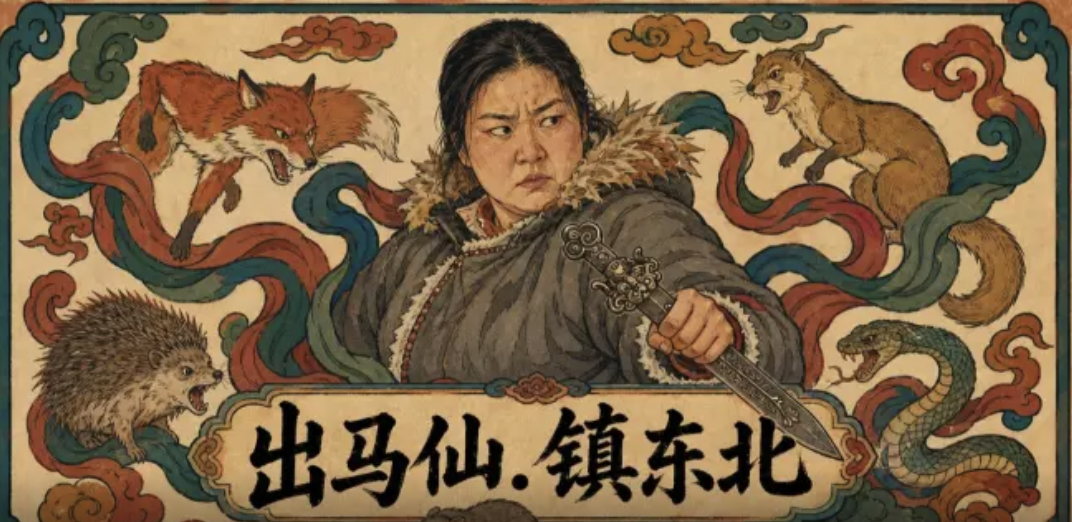
Market demand exists, but great work remains scarce — this is the growth space for high-quality AIGC features. The next stage of competition in the AIGC industry is no longer about who adopts a model first, but about who can build a stable production system and develop a distinctive voice.
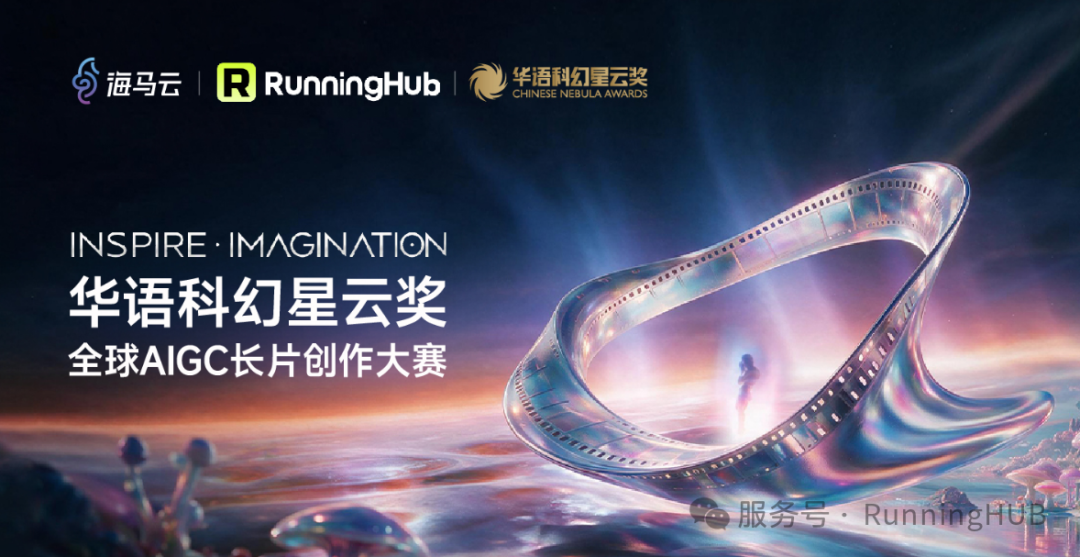
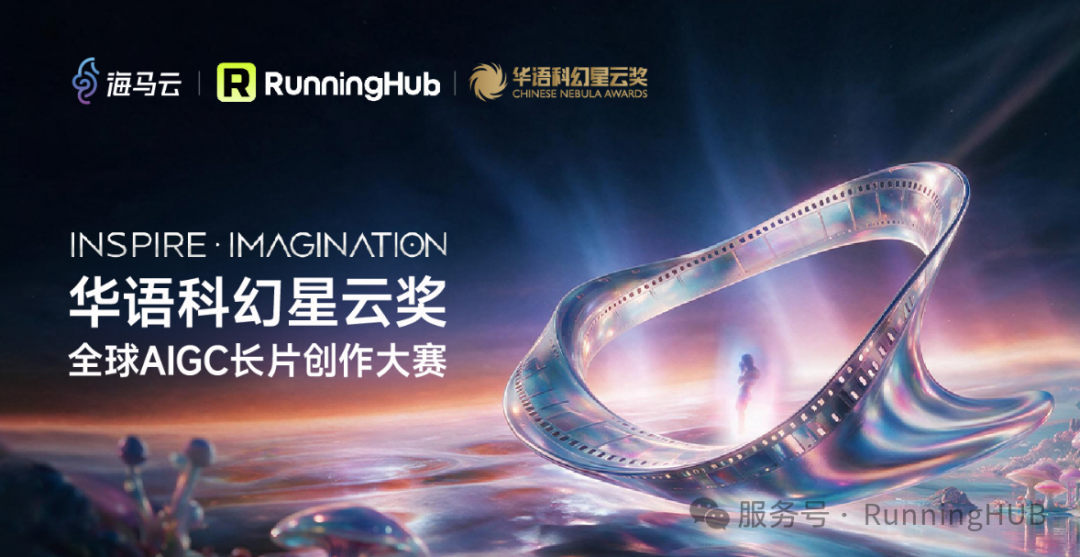
On September 8, RunningHub put up a prize pool worth 5.5 million RMB, partnered with the 17th Chinese Nebula Awards, and launched the world's first AIGC filmmaking competition for feature-length content.
Cixin Liu as advisor — selecting "directors," not "VFX artists"
Renowned science fiction author Cixin Liu, Asia's first Hugo Award winner, is serving as the competition's advisor. This is one of the few public collaborations the sci-fi writer has taken on in recent years.
The judging criteria for this competition differ from the AIGC contests on the market that emphasize individual shots, visual spectacle, and short-form effects. Its focus is on films, long-form series, and other feature-length content with sustained narrative capability.
Unlike short films, feature-length works demand a "narrative system." This means entrants need to build a world, maintain character consistency, manage narrative pacing, and keep their cost structure under control.
Visual precision is only one dimension of the judging criteria — not the whole picture. The competition evaluates an AIGC work across multiple dimensions, including "creativity, story, audiovisual expression, and production completeness."
Besides Cixin Liu, the judging panel includes professionals from science fiction literature, film, AIGC creation, academia, and industry.
They are: renowned sci-fi author Stanley Chan; science popularization and sci-fi writer Dong Renwei; LABO, founder of Adquan; up-and-coming mainland Chinese director/screenwriter Yang Yufei; and Zhao Enzhe, Asia's first Hugo Award winner for Best Professional Artist.

The signal this judging panel sends is clear: the AIGC industry is moving from a "technology race" toward "a comprehensive evaluation of storytelling, directorial expression, and filmmaking capability."
For the past two years, competition in this industry has revolved around visual fidelity, but that standard has a shelf life. When every video is realistic enough, what separates a great work from the rest returns to the content itself.
At this stage, the role of the "director" is being redefined.
In the traditional film industry, a director's core skill is orchestration — orchestrating people, equipment, and budgets. In the AI era, the director's core skill is becoming selection — selecting the world, the narrative rhythm, the aesthetic direction.
In fact, what RunningHub's competition is selecting for is not "VFX artists," but the "directors" of the AI era.
Ten Nebula Award novels, open for adaptation for a limited time
This AIGC competition, in partnership with the Chinese Nebula Awards, has selected 10 science fiction works that have never been adapted for screen, and opened their adaptation rights to entrants for free, for a limited time.
The works include: The Nature of the Universe, Sunset over Ancient Shu, Epic of Heroes, The Loneliest Whale on This Planet, Dance of Shiva, The Universe Outside, and more.

Entrants can start from these proven stories, characters, and worlds, and devote more of their energy to "directorial expression" and "feature-length production."
This format solves a common dilemma for AIGC creators: they have the technology, but lack validated, quality stories.
The time-limited free adaptation of ten Nebula Award novels means creators no longer have to build a world from scratch — they can jump straight into the core challenge: how to tell a good story through visual language.
At the same time, the competition also encourages original IP entries.
Whether adapted or original, the organizing committee will give priority attention to film works of 90 minutes or longer, as well as long-form series projects capable of sustained storytelling.
One person, one computer, one feature film
A core difference between this competition and other AIGC contests on the market: entrants don't have to piece together their own toolchain.
That's because RunningHub provides the competition with a full-pipeline creation platform covering story development, shot design, and image generation and editing — and has further upgraded the long-form creation capabilities of "RHTV Infinite Canvas" and "RHSTORY."
RHTV Canvas now lets creators connect white-model previsualization through a Blender plugin, then make more precise frame-level edits via second-by-second frame extraction. Meanwhile, SkillHub gathers professional Skills such as "5-Minute Long-Video Director" and "Sci-Fi Scene," helping creators quickly tap into mature long-form production capabilities.
RHSTORY connects the workflow from "outline, script, storyboard" to "image generation," making it easier for creators to use professional shot language and global character settings to improve character and visual consistency across long narrative works.
What RunningHub's toolkit solves isn't just "generating good images" — it's "making good images serve a complete story." A 5.5 million RMB prize pool, with a top single award of 1 million RMB in cash
To make a feature film, the most practical problem is money.
The competition's total prize pool is worth 5.5 million RMB — 3.5 million in cash and 2 million in compute credits. The top single award is 1 million RMB in cash — for one great work alone.

The schedule has two key dates: by October 9, submit your registration and a trailer of no less than 2 minutes; shortlisted creators must submit their final works by November 3.

For participating creators, three things genuinely lower the barrier:
First, you don't pay for compute yourself. After submitting a trailer, the committee rates each project's potential, and qualifying entrants receive startup compute subsidies worth 1,000, 3,000, or 5,000 RMB. This means that from day one of creation, you barely need to cover compute costs out of pocket.
Second, every shortlisted entry wins. There are 100 shortlist slots, each receiving 5,000 RMB in cash plus 5,000 RMB in compute.
Third, the final awards cover works of different scales. Best Short Series: 100,000 RMB cash plus 50,000 in compute. Best Long Series: 250,000 RMB cash plus 150,000 in compute. Best Film: 300,000 RMB cash plus 200,000 in compute. And the Grand Prize: 1 million RMB cash plus 300,000 in compute.
The competition is the entry point; a long-term ecosystem is the goal
For submissions, the competition offers three tracks — Sci-Fi Studio, Microlight Studio, and Brand Studio.
• Sci-Fi Studio: for sci-fi works with complete worldbuilding and narrative capability, using either original scripts or the competition's licensed sci-fi literature adaptations.
• Microlight Studio: no genre restrictions — seeking outstanding works with distinctive characters and complete plots.
• Brand Studio: jointly launched by RunningHub and the Golden Eye Awards, oriented toward real brand needs for commissioned creation, with ongoing collaboration that gives creators a sustainable path to commercialization.
These three tracks correspond to three possibilities for commercializing AIGC content: IP development, independent creation, and brand partnership. Creators can choose their submission track based on their own positioning.
The competition is only the starting point. Long-term support for creators is the real design intent behind this event.
RunningHub provides an ongoing incubation mechanism and a complete ecosystem.
-
RunningHub has established a three-tier growth system — "Pioneer — Benchmark — Super Creator" — with continuous compute and cash incentives, where a single video with one million likes can earn up to 52,000 RMB in cash rewards.
-
For feature-length creators, RunningHub also opens a priority channel to its "Studio Program," offering long-term support including additional compute, technical guidance, traffic promotion, and co-production opportunities.
-
For truly outstanding works, RunningHub will provide full-chain support from content incubation and production assistance to distribution matchmaking.
Currently, RunningHub is building partnership channels with multiple video platforms, and winning works will have the chance to enter priority review queues.
After the competition ends, your creative journey can continue here.
RunningHub provides a set of conditions for feature-film production
Why is RunningHub the one doing this?
Completing a feature film means handling large volumes of characters, scenes, shots, and versions. For individuals and small teams, what truly derails a project usually isn't a single failed shot — it's information gradually scattering across different tools, confirmed character and spatial relationships that can't be reused downstream, and every revision costing exponentially more.
As a comprehensive content creation platform driven by native AI agents, RunningHub supports professional tools including RHTV Infinite Canvas, the RHSTORY comic-drama tool, ComfyUI workflows, and AI application and model API access.
RHTV Infinite Canvas concentrates intelligent scripting, workflow nodes, white-model previsualization, a 3D director's console, second-by-second frame extraction, and more into a single creative space.
Creators can lock in character blocking, camera angles, and camera movement before generation; flexibly combine different models and workflows during generation; and afterward, precisely locate and edit specific frames — reducing the time and compute burned on repeated do-overs.
It's like a digital film set built for AI feature production, making complex shot production far more controllable. RHSTORY starts from the story, linking outline, script, storyboard, and image generation into a complete pipeline.
Through global character settings, professional cinematic shot language, long-segment splitting, and team collaboration, it helps creators manage character consistency, plot progression, and production schedules across long narratives — turning an idea into a film or series that can actually be finished.
RunningHub has also partnered with model and technology partners including Volcano Engine, MiniMax, Wan, and PixVerse, bringing different model capabilities into real creative workflows.
Beyond that, RunningHub is a technology company with a compute foundation.
RunningHub's parent company, Haima Cloud, operates a GPU compute pool totaling 2.5 EFLOPS. The platform brings together over 15,000 active developers and integrates 13,681 available nodes, more than 100,000 models, and 100,000+ AI applications.
For feature-film creators, this means RunningHub offers not just more models or features, but a connected system of creative tools, workflows, model ecosystems, compute resources, and creator collaboration.
From GPU compute pools to cloud rendering platforms, from model ecosystems to creative tools, from IP resources to creator communities — RunningHub is building a full set of film-industry infrastructure for the AI era.
Finally
For the past hundred years, the birth of a film has been a capital-intensive process. Funding, crews, equipment, long production cycles — this structure determined who was qualified to make movies.
AI is changing that structure. When technical barriers drop dramatically, when the toolchain is integrated into one platform, when compute costs fall within an individual's reach, the barrier to filmmaking is shifting from "capital" to "creativity."
What RunningHub's competition is looking for are the people who were shut out by the traditional film industry — but who have good stories to tell.
You can be a director, a screenwriter, a producer, or any individual or team with visual and AI production skills. As long as you have ideas about telling stories through visuals, and passion for feature-length cinematic work — this competition was made for you.
It's not just a competition — it's an invitation, and a challenge issued to a century-old film industry.
Competition registration and trailer submissions close on October 9.
If there's a story in your heart that you've never had the chance to tell — this competition is turning that possibility into reality.