The Day Unitree Surged 629%, GEN 1.5 Dropped: Is the Robot ChatGPT Moment Finally Near?

People always overestimate change in the next two years and underestimate change in the next ten.
People always overestimate change in the next two years, and underestimate change in the next ten.
👦🏻 Author: DeKox
🥷 Editor: Koji
🧑🎨 Layout: NCon
On August 19, in Shanghai, Unitree debuted on the STAR Market, surging as much as 629% intraday — capital markets were going all-in on the robot's "body."
That same day, on the other side of the ocean, in Generalist's Cambridge, Massachusetts office, a dual-arm robot had just watched a few seconds of human demonstration: open a wallet, take out cash.
Its turn. Right hand reached over — missed.
It didn't freeze up, didn't mechanically repeat the same motion, didn't wait for a programmer to step in. Instead, it did something small that left a strong impression on the reporters present: switched to its left hand, and got the money out.
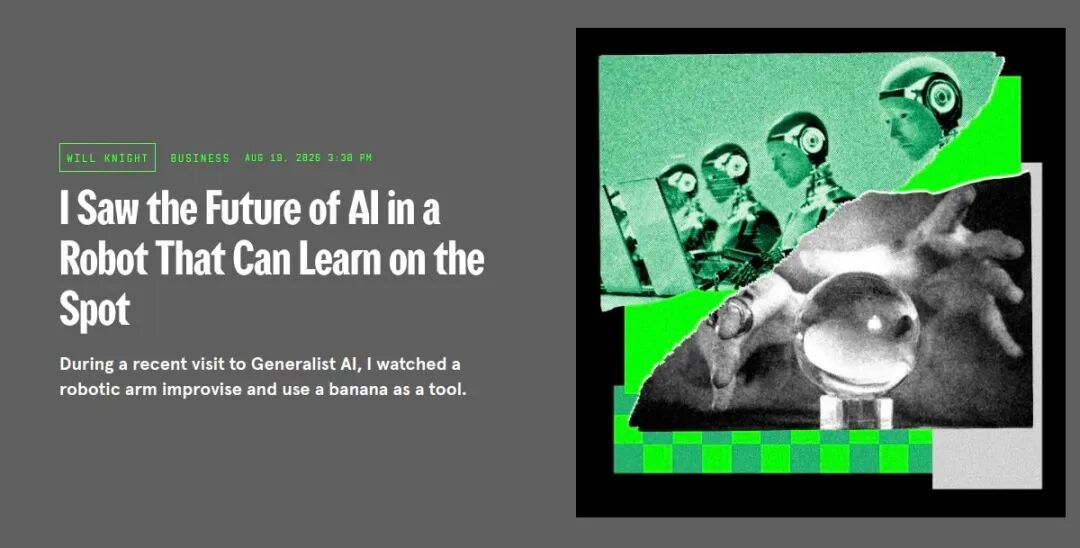
This is what WIRED reporter Will Knight witnessed on-site[1]. The same demo had more instances of "adapting on the fly": when shown how to sweep blocks into a bowl with a brush, and the brush was taken away, it grabbed a dustpan instead; when only a banana remained in front of it, it used the banana as a makeshift brush.
One number deserves attention: this robot was running the new model GEN-1.5, with an average success rate of just 59% on novel tasks; its predecessor, GEN-1, clocked in at 99%+.
Why take a model with a "plummeting" success rate seriously? Because what actually changed wasn't reliability — it was the marginal cost of learning a new task, which for the first time started approaching zero.
And that is where the question in the title comes from: The eve of robotics' ChatGPT moment may actually be near.
01 Robots Finally Have Their Own Prompt
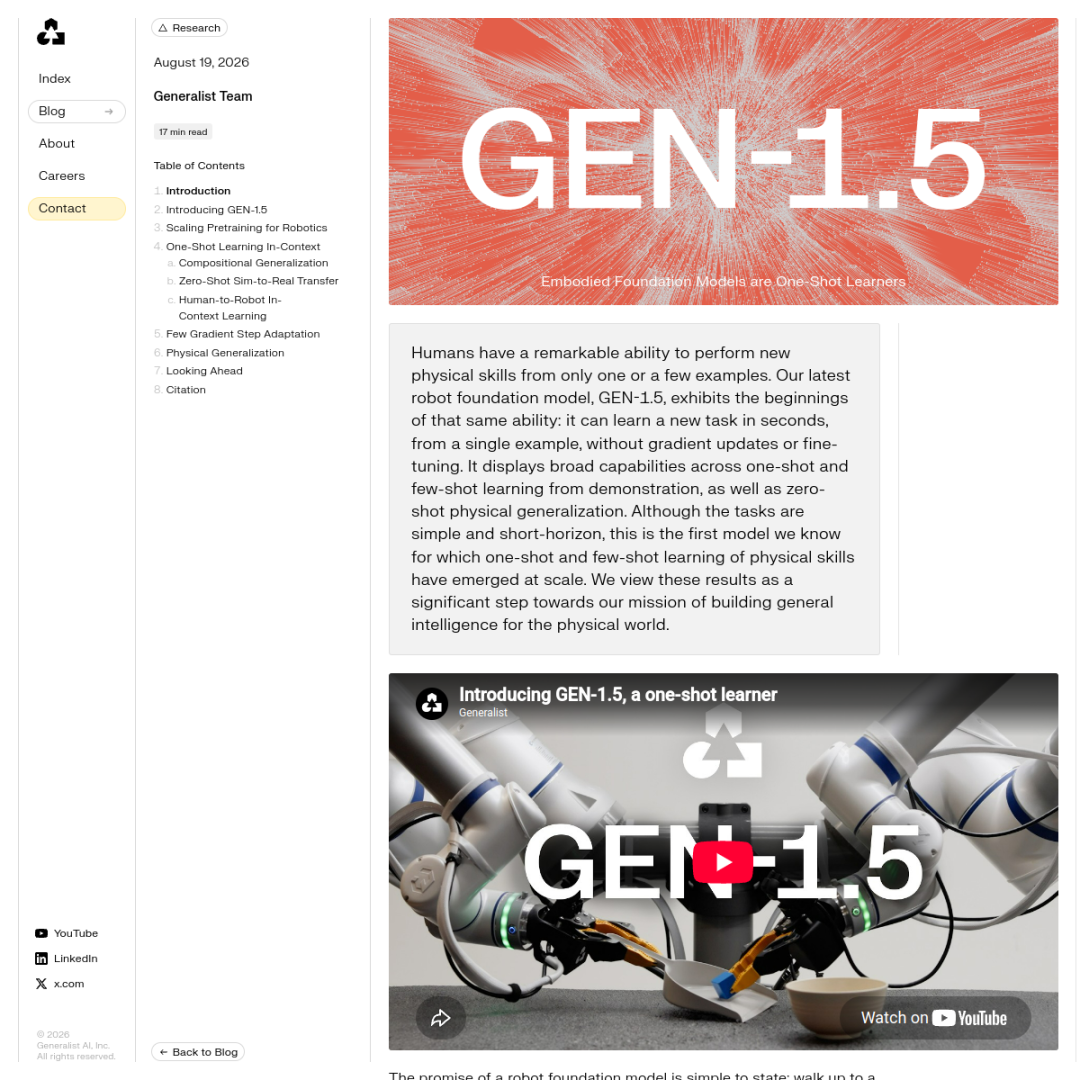
On August 19, Generalist released its next-generation robotics foundation model, GEN-1.5.
We used AI to generate two images to help everyone better understand GEN-1.5:
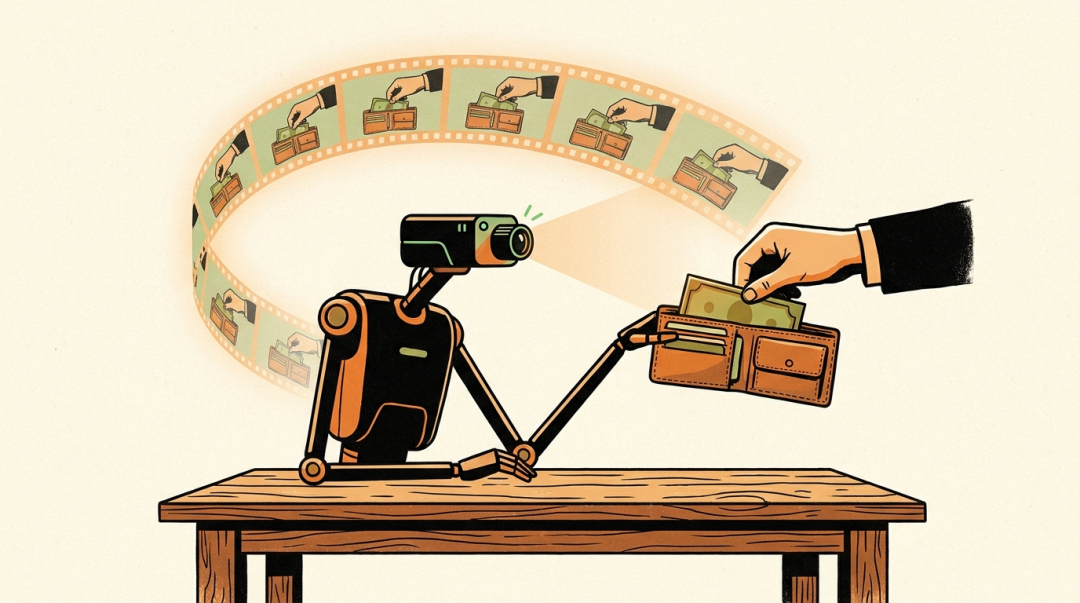
The most important thing about GEN-1.5 — a human demonstrates opening a wallet and taking out cash once, and those few seconds of motion become a film strip that the robot "reads" with its eyes — represents precisely that sensor-action sequence placed into the context window.
Note where the film strip goes: it doesn't enter any training pipeline to rewrite model parameters. Instead, like pasting an example into a chat box, it stays in the "conversation."
Grasp this, and you grasp the essential difference between Physical Prompting and traditional methods: before it was "rewiring its brain," now it's "showing it once."
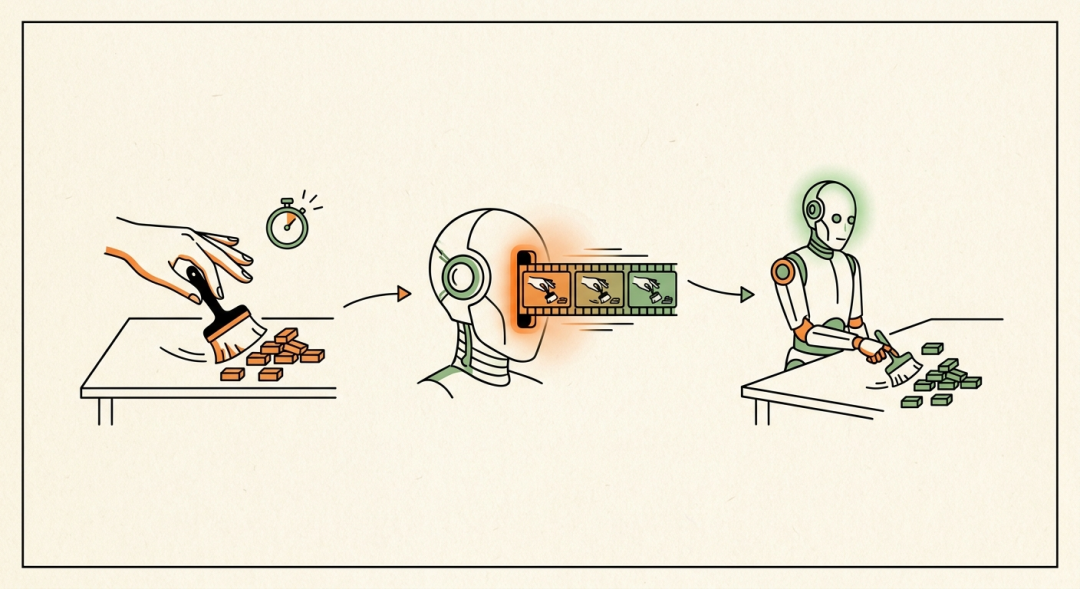
Physical Prompting has three steps. Step one: a human demonstrates "sweep blocks together with a brush" once, with a stopwatch reminding you the cost is only 3–12 seconds. Step two: this demonstration is encoded into a sensor-action sequence, inserted like a film strip into the robot's "context window." Step three: the robot executes on the spot.
The most intriguing detail hides in the third panel: the blocks in front of it have changed color, changed arrangement — they're not identical to the demonstration scene. This shows the robot isn't replicating a video clip, but the "task itself."
Look at the three sets of numbers from Generalist's official technical article[2]:
| Mode | New Task Data | Training Required? | Average Success Rate |
|---|---|---|---|
| GEN-1 "Task Mastery" | ~1 hour | Requires post-training | 99%+ |
| GEN-1.5 "Physical Prompting" | 3–12 sec, one demo | No training | 59% |
| GEN-1.5 "Rapid Adaptation" | 5 min, ~50 demos | 10 gradient steps | 83% |
This past April, GEN-1 told an industrial story: feed roughly an hour of data for a task, do post-training, polish success rate to 99%+ — like cultivating a worker whose movements are always standard.
GEN-1.5 made a completely different trade: no parameter updates, no retraining, just one 3–12 second demonstration, and it can start executing a task it's never seen before. Generalist calls this approach Physical Prompting: not programmers writing motion scripts for robots, not retraining for every job, but a human does it once, and the robot places this sensor-action sequence into roughly a 30-second context window, understanding on the spot like a large model reading few-shot examples. If you're willing to spend 5 more minutes, do about 50 demonstrations, plus 10 gradient steps, success rate climbs to 83%.
GEN-1 solved "can a robot master one thing"; GEN-1.5 tries to solve "can a robot immediately learn something new."
02 Why 59% Might Matter More Than 99%
At first glance, it's genuinely hard to associate 59% with "breakthrough."
But what determines the shape of the robotics industry has never been single-point success rate — it's the "cost function of adding one more task."
-
GEN-1's 99% represents the ability to "grind a task into a high-reliability SOP," with a mindset close to automated factories: few tasks, extreme stability;
-
GEN-1.5's 59% represents the ability to "turn an unfamiliar task into something attemptable," more like a human apprentice: get it roughly right first, then get better through practice.
And real-world demand is never 10 tasks — it's 100,000 long-tail tasks. The biggest obstacle to robotics deployment in recent years hasn't been that some task can't be done, but that every added task requires paying again: data is expensive, training is expensive, deployment is expensive, maintenance is expensive — in the end, "it can be done, but it doesn't scale economically." When learning cost drops to "learn by watching," robots have a chance to take on those small tasks in services, manufacturing, and homes that nobody wants to write dedicated programs for.
We've actually seen this path once before: large models moved software from "write rules for every task" to "give a prompt, a few examples, and adapt on the spot."
Now, the same mechanism is crossing from the text world into the physical world.
03 It's Not the First One-Shot Robot
One-shot imitation in robotics didn't appear today:
-
2024's ICRT[3] already attempted to prompt robots through novel tasks using sensor-action trajectories;
-
June's Behavior Prompting Policy[4] directly proposed "using one human demonstration as a behavior prompt";
-
July's RoboTTT[5] from NVIDIA and others expanded robot context to 8K timesteps, demonstrating human video one-shot imitation and five-minute-long tasks.
So the more accurate formulation is: GEN-1.5 is not the first one-shot robot. In Generalist's own words, it's the first model they know of that "demonstrates general one-shot / few-shot demonstration learning across a broad range of dexterous, closed-loop physical tasks"; prior comparable work either covered limited task variations, or was constrained to specific objects, task types, or sensing modalities.
External researchers' assessments provide reference. In WIRED's coverage, Danfei Xu of Georgia Tech considers Generalist possibly among the teams "closest to deployable" general-purpose robot models; Stanford's Karen Liu notes that this large-scale physical data approach, not tied to a single robot body, is starting to show results.
04 Three Bets: Language, Feedback, and Demonstration
Looking at Embodied Artificial Intelligence as a whole, leading teams are actually betting on three different "prompt languages":
-
Physical Intelligence's π0.7[6]: prompts with language, metadata, and visual subgoals, recombining existing skills to solve unfamiliar tasks, strong in semantic control, long-horizon tasks, and cross-robot transfer — prompting with language;
-
Skild AI[7]: robots adjust body control in context based on failure experience, focused on cross-robot morphology and locomotion capabilities — prompting with feedback;
-
Generalist's GEN-1.5: directly uses "the sensor-action demonstration of the new task itself" as prompt — prompting with demonstration.
These three paths will likely converge: language tells the robot what to do, demonstration tells it how, feedback tells it where it went wrong.
05 Banana as Brush: Understanding, Imitation, or Similar Patterns?
Back to that banana.
Seeing the robot grab a banana to sweep blocks, many can't resist declaring: it understands the function of a "brush."
But strictly speaking, this could be understanding, could be imitation, or could just be "similar patterns" colliding in high-dimensional space from training data and context prompts — it only looks like understanding. There's currently no public evidence sufficient to distinguish these three, and Generalist hasn't provided any.
The more practical看点 lies elsewhere: when demonstrations can be placed in a context window, we can for the first time study and modify robot behavior through the lens of "Prompt Engineering." A new job may emerge in the future — Physical Prompt designer: knowing how to demonstrate once so the robot learns best; knowing what it's prone to get wrong, and how to use better demonstrations to push success rates higher.
If this path works out, the division of labor in robotics will shift accordingly: from "programmers programming" to "ordinary people teaching."
06 Same Day, Two Sides of the Ocean
The day GEN-1.5 launched, Unitree listed on the STAR Market, surging as much as 629% on its first day, closing up roughly 460%[8]. The next day, Xingxing Wang gave a very concrete definition of "Embodied Artificial Intelligence's ChatGPT moment": robots entering an unfamiliar environment and completing about 80% of tasks[9]; he judged optimistically two to three years, conservatively five to ten.
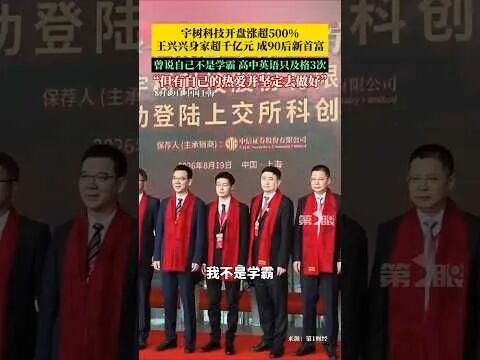
Put these two events together:
-
China is rapidly solving the body: cost, supply chain, engineering, shipment volume, and capital markets' concentrated bet on the embodied narrative;
-
US foundation model companies are solving the brain: letting robots learn on the spot in unfamiliar environments, loosening the old model of "retrain from scratch every time the task changes."
Using Xingxing Wang's benchmark, GEN-1.5's 59% still has a clear gap to that 80% threshold. But it may have shown a route to get there: not training every task to 99%, but driving learning cost near zero, then letting reliability climb through iteration.
When bodies are cheap enough and plentiful enough, and brains can learn new tasks at near-zero marginal cost, robots will shift from "equipment for the few" to "infrastructure for the many."
07 Finally
GEN-1.5 is currently a research release, not a downloadable model or formal product: no open weights, no complete technical paper, no third-party unified benchmark, and demo tasks are mainly ten simple, short-duration tabletop operations.
Reading it as a strong signal worth paying attention to is more accurate, and more responsible, than declaring "the robot ChatGPT moment has arrived."
But the signal itself is clear enough. In the past, robots had to pay anew to learn each new thing; now, a new task has for the first time become a prompt.
On one side of the ocean, robots are being transformed from "expensive" to "numerous"; on the other, from "dumb" to "able to learn."
The endgame is still far, but the path is clearer than before.
References
[1] WIRED reporter Will Knight's on-site account: https://www.wired.com/story/generalist-ai-robots-learn-like-clever-toddlers/
[2] Generalist official technical article: https://generalistai.com/blog/gen-1.5
[3] ICRT: https://arxiv.org/abs/2408.15980
[4] Behavior Prompting Policy: https://arxiv.org/abs/2606.30457
[5] RoboTTT: https://arxiv.org/abs/2607.15275
[6] Physical Intelligence's π0.7: https://www.pi.website/blog/pi07
[7] Skild AI: https://www.skild.ai/blogs/omni-bodied
[8] Surged as much as 629% intraday, closed up roughly 460%: https://apnews.com/article/f33facc61122faf0c0b08af5020bd170
[9] Robots entering unfamiliar environments, completing about 80% of tasks: https://www.thestandard.com.hk/innovation/article/340485/Robots-poised-for-ChatGPT-moment-Unitree-CEO-says