Seven Months Into World Model Fray, PixVerse Plays Its Second Card

Summon a tiger, disguise yourself as a patrol guard, or chat with Sanxingdui bronzes in Sichuan dialect.
Summon a tiger, disguise yourself as a patrol guard, chat with Sanxingdui bronzes in Sichuan dialect.

👦🏻 Author: GaKi
🥷 Editor: Koji
🧑🎨 Layout: NCon

According to Dealroom, in the first half of 2026, global funding for world models has already exceeded $3 billion.
Per IT Juzi's statistics, 23 new world model companies were founded in China within a seven-month span — surpassing the total for all of 2025 — with combined fundraising exceeding RMB 4 billion.
At this inflection point, AISphere (PixVerse) officially released R2, a real-time video world model.
When its predecessor R1 launched, we ran hands-on tests within 24 hours. This was PixVerse's first playable model in the category, and what stuck with us most was how the continuously generated footage could be altered in real time by user input.
R2 builds on this same real-time foundation. The upgrade is that input no longer affects only the current frame — it now feeds into the ongoing state of the running content.
🚥 Below, we share our observations and thinking on PixVerse R2, and on what it means that PixVerse is entering the world model space.
From R1 to R2: What changed, what didn't
Looking back at R1's product trajectory makes R2's positioning easier to grasp.
In January 2026, R1 launched with the paradigm of "real-time video world model":
🚦 Video generation is a continuously running world evolution process. The model receives user input during operation, updates world state in real time, and continuously outputs audio-visual content consistent with the interaction. What users see can be influenced in real time and co-evolves with them.
From January to July, R1 added personalized Avatars, Shared Worlds, and multi-user input. The PixVerse Game Engine also shipped. Real-time world models, AI agents, and structured game mechanics were linked together, expanding the possibilities.
We previously tested the PixVerse Game built on it.
Our assessment at the time: the visuals were still early, but the completeness of game elements had a foundation. The official positioning was also as an early research-stage system.
R2 extends this same line.
Broadly speaking, compared to R1, R2 focuses on four priorities:
[1] Whether visual changes are remembered by subsequent content;
[2] Whether stories can continue after changes;
[3] Whether characters maintain identity and relationships;
[4] Whether tasks produce clear outcomes.
Real-time, interactive, virtual avatars
This time, the official release included three categories of demos, corresponding to three product directions for R2:
Real-time generated games — content becomes gameplay
In the first demo category, a courier carries cargo while evading pursuers. Users control movement and jumping in real time via WASD keys and spacebar.
While being chased, typing prompts like "use obstacles to block soldiers" into the input field below instantly generates corresponding obstacles and shifts the situation — directly transforming generated content into live gameplay mechanics.
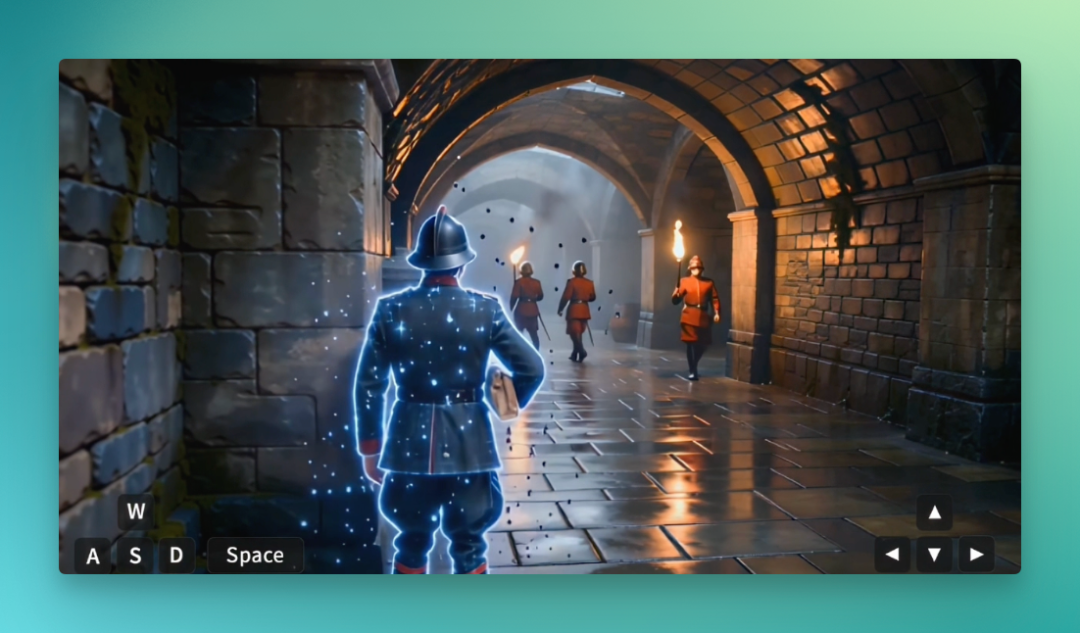
More strikingly, when controlling the courier to hide in a corner, simply entering a prompt lets you disguise yourself directly as a patrol guard.
Interactive film & TV — stories you can participate in
The second demo is set in an ancient Chinese scene. Again through text prompts (e.g., "summon a tiger mount"), the protagonist can directly interact with generated objects — for instance, riding the tiger.
Upon entering the next level, weapon options pop up for player selection, presenting interactive film-and-game-style gameplay.
Real-time virtual humans — characters that persist
The official showcase also included another real-time virtual human demo: players type text dialogue in the input field below, and the on-screen subject responds in real time.
For example, asking "are you really a Sanxingdui alien?" brings the bronze artifact to life as a virtual avatar that speaks back in Sichuan dialect.
More critically, it possesses contextual memory. When followed up with "why are your eyes so big?", the avatar's answer carries forward from the previous exchange, maintaining full conversational coherence.
Technical report: Get strong first, then get fast
The keyword in this technical report is Scaling — how to make the model continuously stronger.
The report lays out the team's thinking:
R1 proved that the real-time video world model path fundamentally works. R2 builds on this by adding more data, more compute, and more input modalities, validating whether the model can scale stably stronger with them.
The overall pipeline roughly divides into two layers.
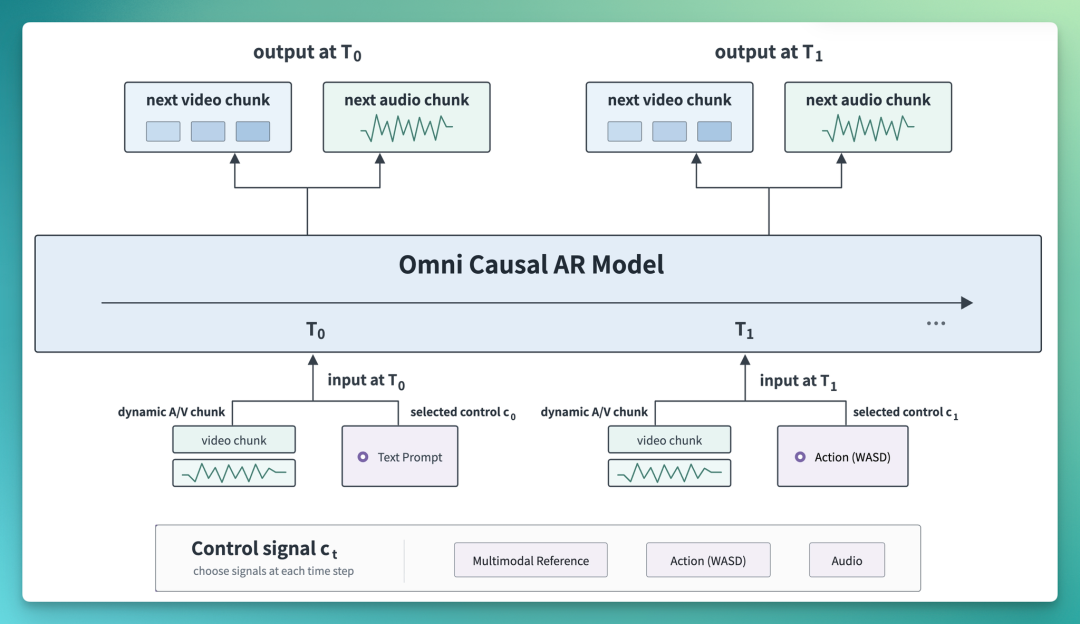
[1] Omni Causal AR, responsible for building up model capability.
[2] Real-Time Acceleration, responsible for accelerating the scaled-up capability to meet real-time interactive latency requirements, with minimal "packet loss."
Multi-stage compression is not a scalable path
While explaining their solution, the report also reveals some common industry practices. For instance, to build a real-time generation model that's both fast and high-quality, the typical approach involves multiple training stages:
First train a large model with high quality but slow response and high latency, then compress it step by step into a fast, responsive small model.
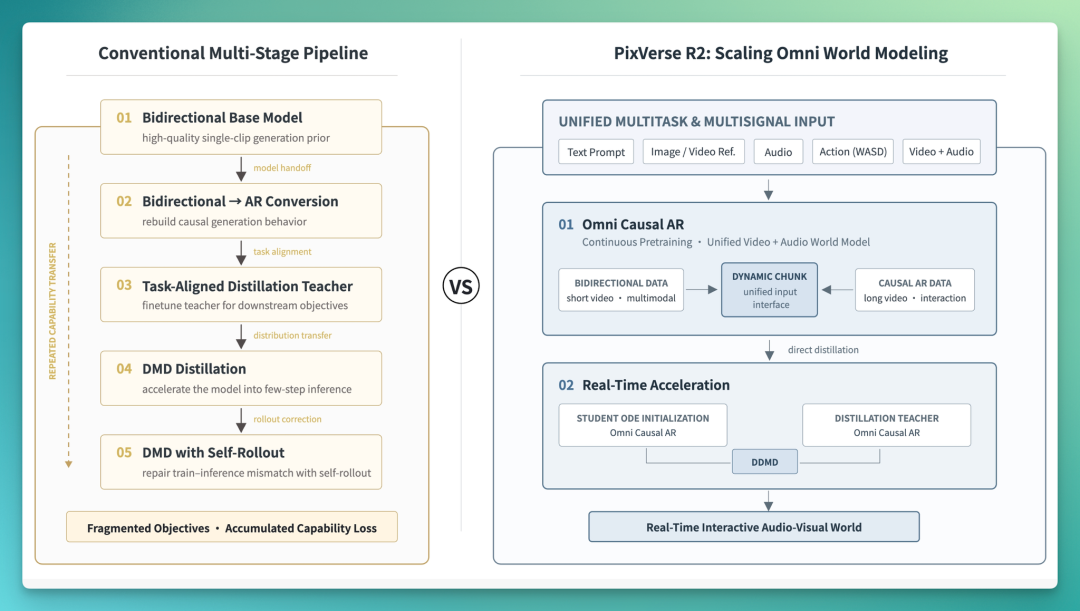
The problem lies at the starting point of this route. Traditional approaches inherit from bidirectional video foundation models — the world model base (the Omni Causal AR layer) hasn't been properly established before entering multiple stages of parameter tuning, progressively compressing generation steps down to real-time model levels.
Once in the real-time stage, extensive fine-tuning is spent on effects.
With each stage passed, some of the image quality and motion performance from the previous step may be lost — the more stages, the more loss, and the higher the training cost. More crucially, real-stage fine-tuning can only patch the current version's performance; the base capability doesn't actually grow from this.
Adding data and compute won't make the model continuously stronger — this route lacks a scalable evolutionary path.
So R2's overall approach collapses training into two stages.
Stage one uses the same Scaling scale as training bidirectional video large models to train the world model base, building up capability first.
Stage two applies real-time acceleration on top of a sufficiently capable large world model — an area where PixVerse already has substantial accumulated experience from previous iterations.
How this is done specifically breaks down into two layers, explored below.
Layer one: Keeping a long-running "world" from collapsing
At this layer, the model receives unified multi-modal input including text, images or video, game controller and WASD operations, and audio. Output is synchronized video and audio streams. You can input at any time during operation, and the model can immediately alter what happens next.
Generating the next segment of footage isn't hard in itself. What's hard is keeping that footage, segment after segment, within the same "world" logic.
Specifically, during gameplay, every generated frame must maintain character and scene consistency. And the model's output needs memory — an action you performed 10 minutes ago shouldn't be forgotten 10 minutes later.
But this is extremely difficult in real-time video world models, which PixVerse acknowledges in the technical report.
However, R2 does several things around this problem, providing a strong solution framework.
[1] Slice time by input nature
Different inputs — text, visuals, operations, audio — require vastly different model response speeds. Pressing a WASD directional key versus inputting a plot description demand completely different time scales. Previous approaches processed all inputs at the same fixed rhythm; fast inputs had to wait for slow ones.
R2 instead slices time based on what the input is. Simply put, operation inputs get very short slices for faster model response; plot inputs get longer slices for more complete content.
[2] Deliberately train on "biased history"
During training, the historical frames models see are clean and standard.
But in actual operation, when generating new frames, the model must look back at previous historical frames. If what it looks back to contains flaws, and there's no targeted training method, subsequent generation breaks down and likely cascades into error.
So R2 trains on both types of frames during training — flawed and unflawed. Clean historical frames maintain quality ceiling; flawed historical frames let it adapt to real operational conditions in advance.
This way, even if earlier frames have issues, later frames can continue generating stably.
The effect is significant: one metric measuring long-term visual drift dropped from 0.201 to 0.129, a reduction of roughly 35.8%.
[3] Divide memory into three layers
Recording all historical frames incurs extremely high compute and VRAM costs. But with too few memory points, character and world consistency during generation easily degrades.
So R2 divides memory into three specialized layers.
Layer one preserves the most irreplaceable memories: character appearance, scene settings, world rules. Layer two tracks recently generated actions and camera movements. Layer three saves important object states.
This distinguishes long-term memory from rolling updates — the character identity consistency R2 achieves comes from this memory division.
Layer two: Real-time acceleration, not relearning
Beyond the architectural design in layer one to prevent world collapse, the "real-time acceleration layer" involves additional engineering work.
Large models are capable but very slow. Real-time video world models have extremely high demands on interaction speed. "Acceleration" is therefore common industry practice; the traditional path has small models learn from large models, with the large model teaching the small one.
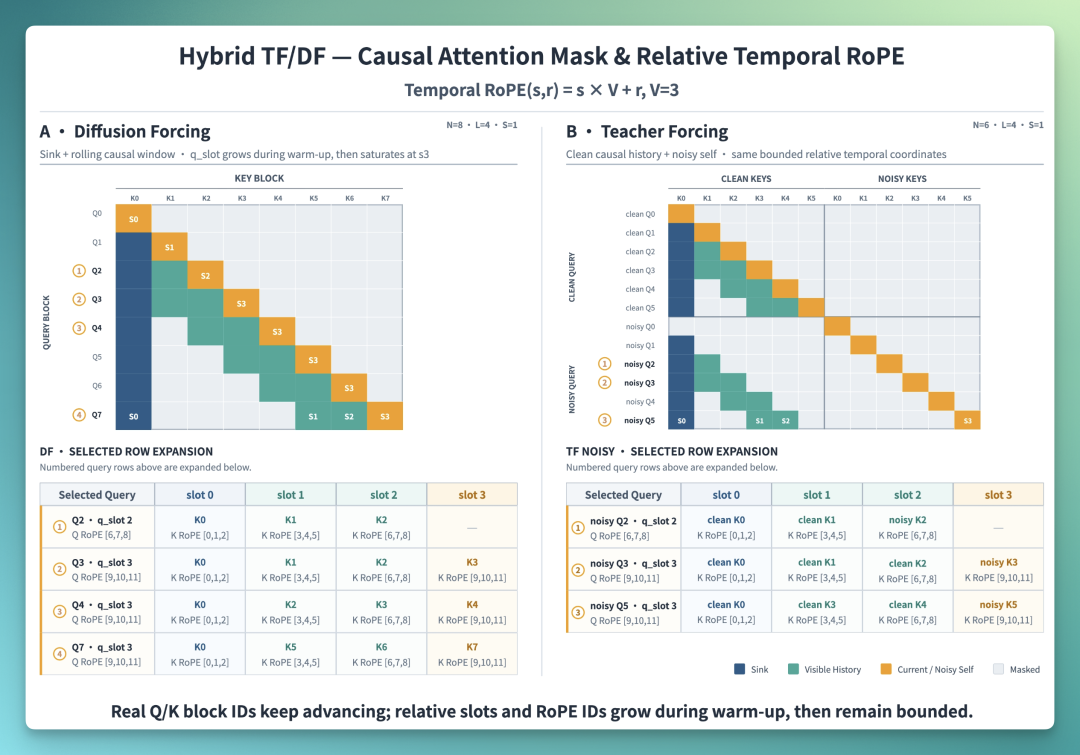
But R2 has a key design here — teacher and student share the same underlying base, both coming from the large model trained in layer one, so the small model knows from the start how the whole world operates.
What "acceleration" needs to solve is reduced to: how to achieve results closer to the large model with fewer computation steps.
Specific acceleration methods are threefold.
[1] Separate then merge training objectives like instruction-following capability and visual realism, preventing them from holding each other back.
[2] Let the model look at less irrelevant information.
When generating each new frame, the model needs to review all previous frame information, but most of it is irrelevant to the current segment. So R2 only has the model query the most relevant portion, eliminating over 90% of lookup operations. Per the team, performance loss is basically negligible.
[3] When generating frames, first establish scene layout and motion at low resolution, then supplement high-resolution details with very few computation steps, eliminating massive redundant calculation.
So overall, a simple summary can be made.
R2's sequence is get strong first, then get fast. Along this route, it does substantial engineering work on memory layering, error collection, and similar fronts, doing its utmost to keep the whole model from collapsing during real-time world generation.
However, the official limitations note that under real-time latency requirements, R2's single-generation quality still lags behind the best offline video models, especially in complex scene details, motion naturalness, and physical consistency.
The official position also notes that this gap stems from current training scale; the framework's own ceiling hasn't been reached. As data and compute continue scaling, this gap will keep narrowing through Scaling.
Viewed this way, the next model under R2's technical route will be well worth anticipating.
After world models
Around world models, technical routes have already diverged clearly.
In her June 3, 2026 Substack article, Fei-Fei Li proposed a functional taxonomy dividing all self-described world model systems into three output categories: renderers, simulators, and planners.

By commercial route, there are also two main threads.
One is "world model as product," like World Labs selling Marble to creators.
The other is "world model as training base, agent as product" — General Intuition explicitly states it won't sell models, agents are the product; Embo building robot world models also falls on this route.
But the definition of world models itself still hasn't converged, and many routes are mutually incompatible.
In this context, AI video model companies naturally become hot properties. Simply put, there are three layers of reasons.
[1] Technical continuity: video models are already implicitly learning physical world patterns during training.
[2] World models need massive video data and real interaction signals — video companies happen to have both.
[3] AI video is, alongside coding, the other path in AI that has achieved real commercial validation.
So in the still-unconverged world model track, PixVerse's position is clear — a main pusher of the real-time interactive world model route.
AISphere (PixVerse): R1 established the paradigm, R2 validates that Scaling works.
Layered on top of this, the fact that a "leading video model company with existing users and revenue" is entering world models means their product iterations will be among the most worth watching developments in this space. P.S.: PixVerse R2 reservation link: https://aisphere.feishu.cn/share/base/form/shrcnjw9Co12dji5ZtvH18YOakf. Those who want early access, fill it out quickly.