98-Hour Deep Dive: How Does Mobvoi's TicNote, Its First Post-IPO Hardware, Actually Stack Up?
Don't create new scenarios — make old scenarios smarter.
Not creating new scenarios, but making old ones smarter.
👦🏻 Author: Jingshan
🥷 Editor: Koji
🧑🎨 Design: NCon

Zhifei Li has made another piece of hardware.
On the day Mobvoi launched TicNote, ifanr ran a headline that read: "An Entrepreneur Scarred by AI Hardware for Ten Years Makes Another AI Hardware." I couldn't help but smile.
Some say that entrepreneurs and business leaders like Zhifei Li suffer from varying degrees of PTSD — after surviving brutal competition and multiple stumbles, despite achieving enviable success, they instinctively replay every fall and misstep whenever a new opportunity arises, leaving them hesitant and reluctant to jump in.
But this time, Zhifei Li went all in again. Two weeks ago, he launched TicNote, an Agentic AI hardware device, in China — and it's already sold out in some regions.
Here's the official description:
TicNote is your "portable AI thinking companion," supporting voice-to-text transcription, translation, summarization, Q&A, and even chat.
That's right, this is an Agentic AI hardware device, not an invention from scratch.
After Plaud defined this product category and achieved impressive results, the proud Zhifei Li this time chose to follow Yongping Duan's famous dictum:
"Dare to be second."
— As a latecomer, both users and the industry will be more demanding.
Every member of Crossing's content team has a TicNote. After using it for a week, collectively logging about 98 hours of recordings — covering everyday scenarios (meetings, interviews, presentations) and experimental ones (casual shopping conversations, talking to myself, studying alongside video lectures) — and pushing every feature to its limits, we unanimously agree:
TicNote is genuinely well-made!
While AI hallucinations still pop up from time to time (more on that later), the overall product completeness is high, and the user experience is smooth and fluid.
We also had one particularly distinctive impression:
Agentic AI hardware products like TicNote feel like a unique "plugin" for smartphones — making them more powerful, just as Chrome extensions don't replace the browser but enhance it.
Here's our review of TicNote.
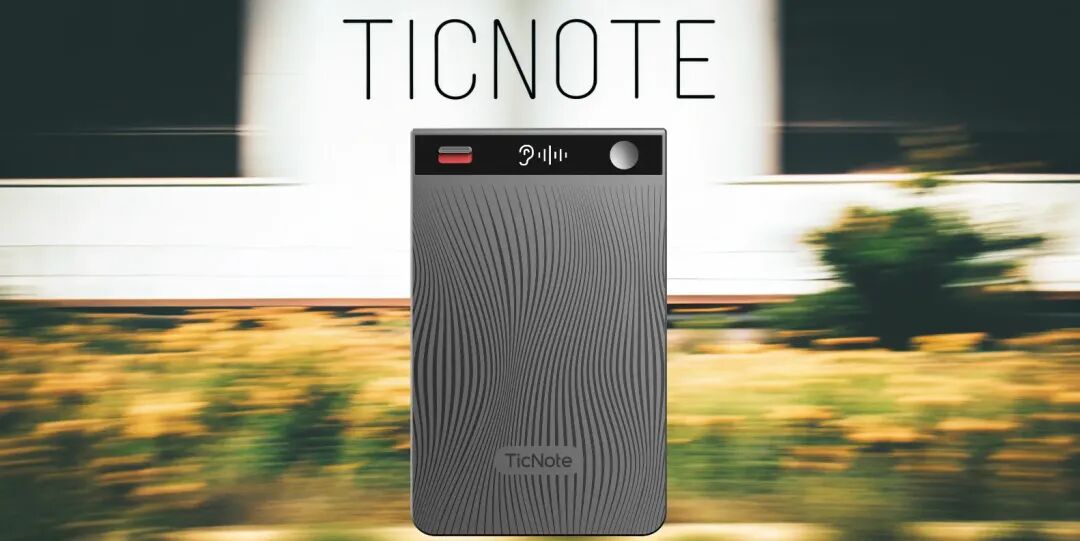
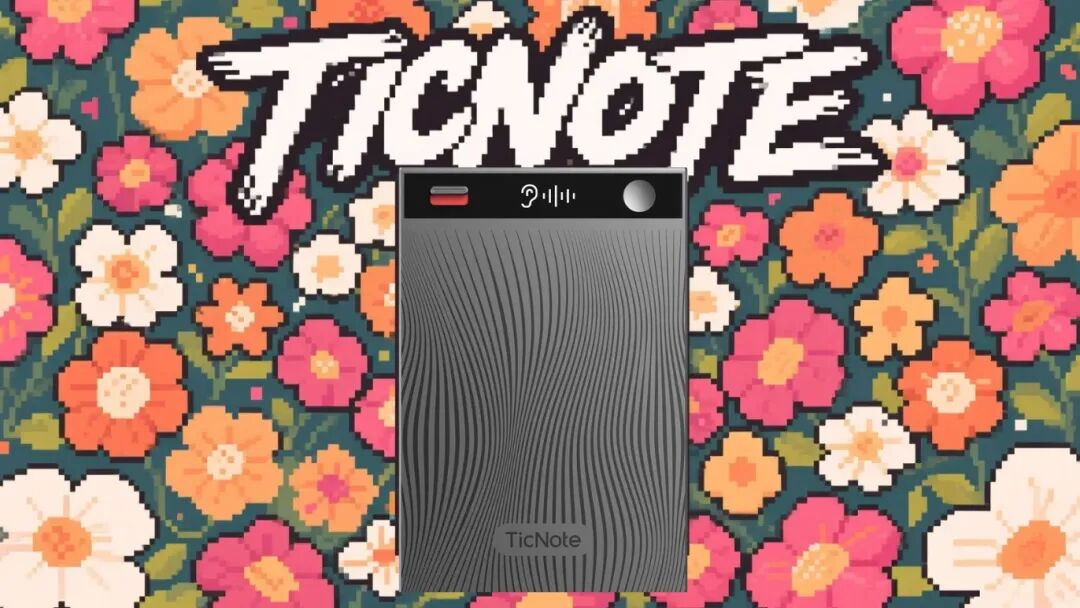
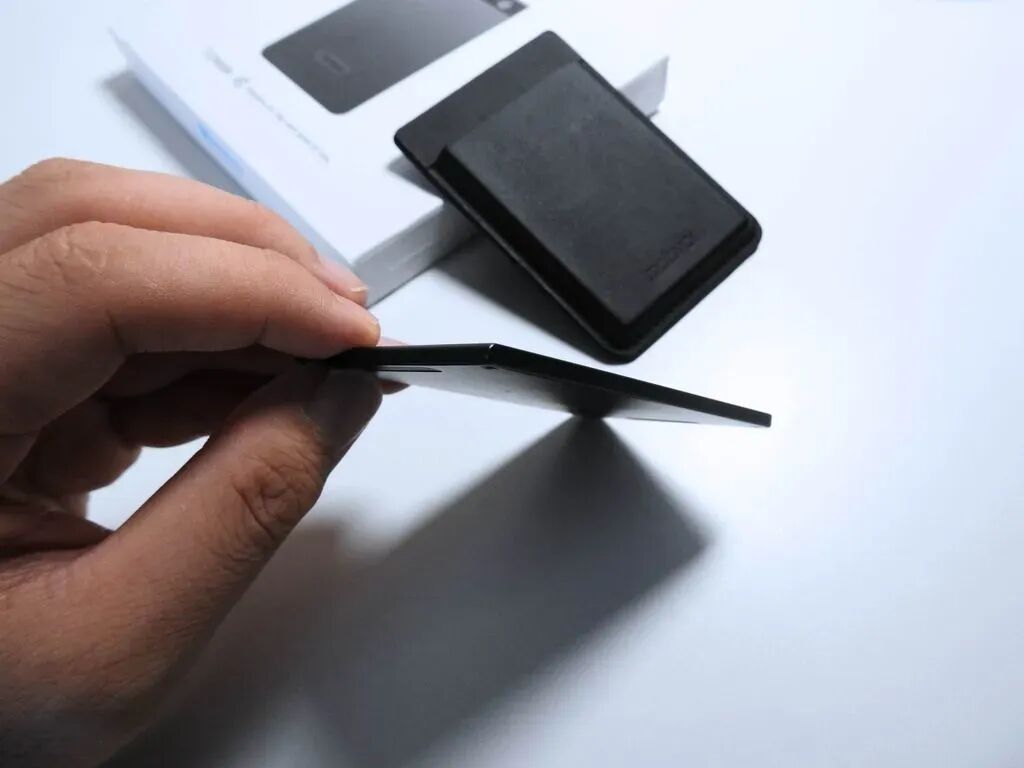
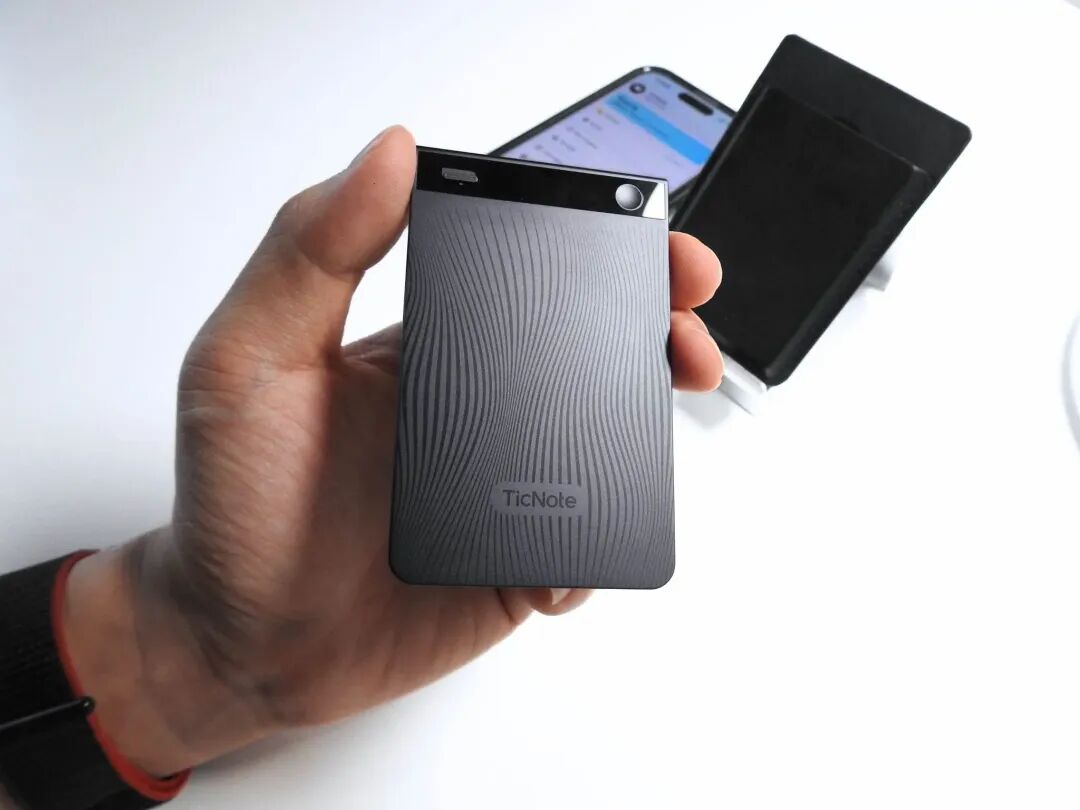
The first thing I noticed unboxing was how thin and light it is. The entire device looks like a transit card, thinner than a charging cable at roughly 3mm, and weighs under 30 grams.
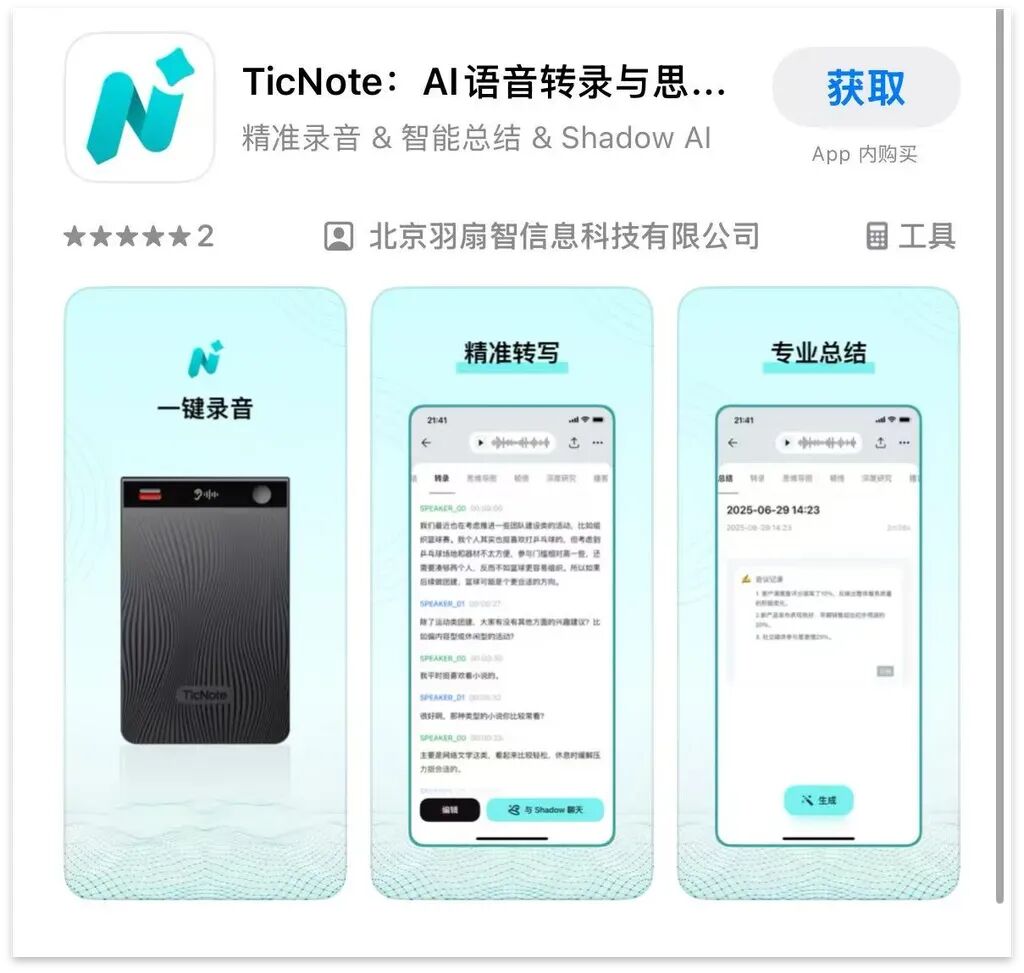
For initial setup, you need to download the TicNote app first.
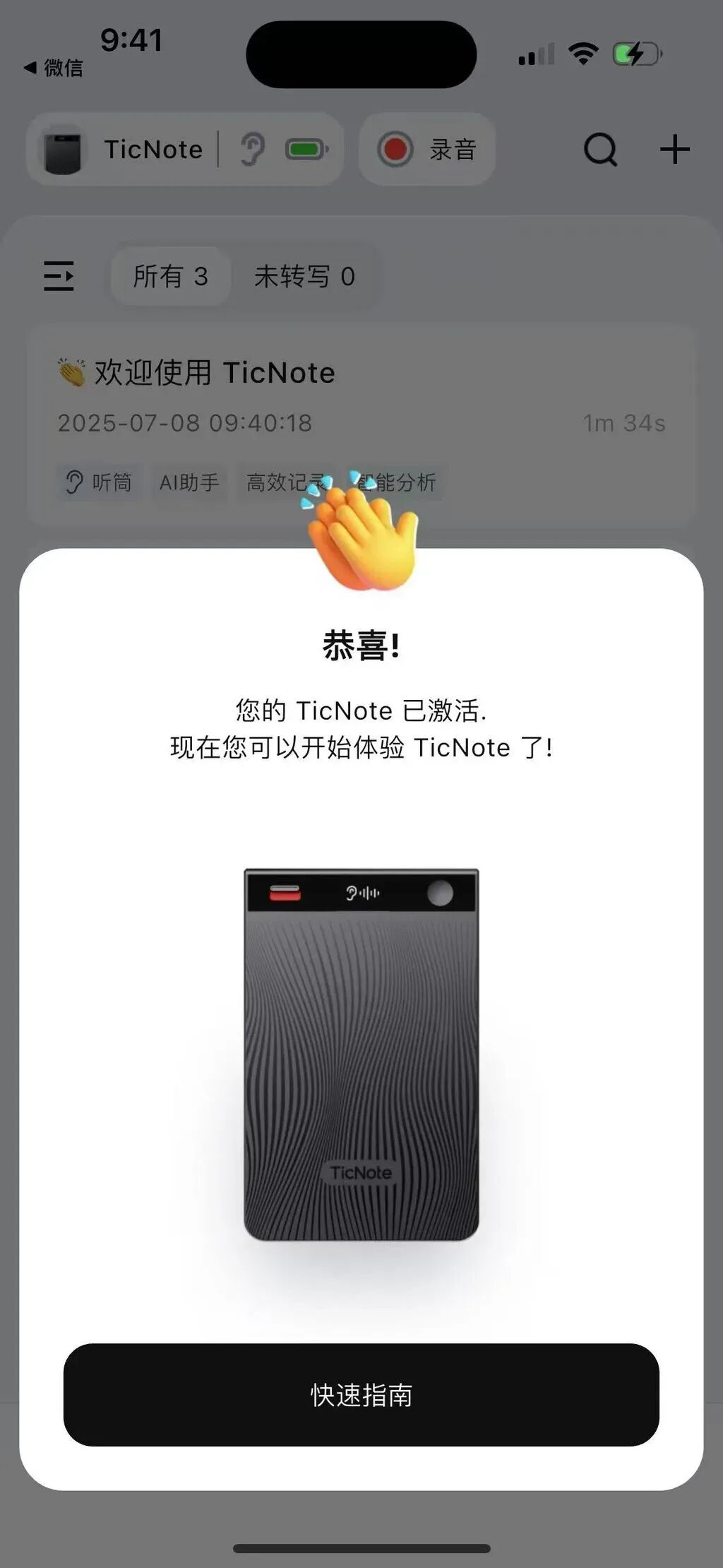
In our experience, pairing with iPhone was simple, effortless, and successful on the first try every time — even smoother than many Xiaomi devices. Strong first impression!
It comes with a magnetic case that attaches to the back of your phone without looking obtrusive.
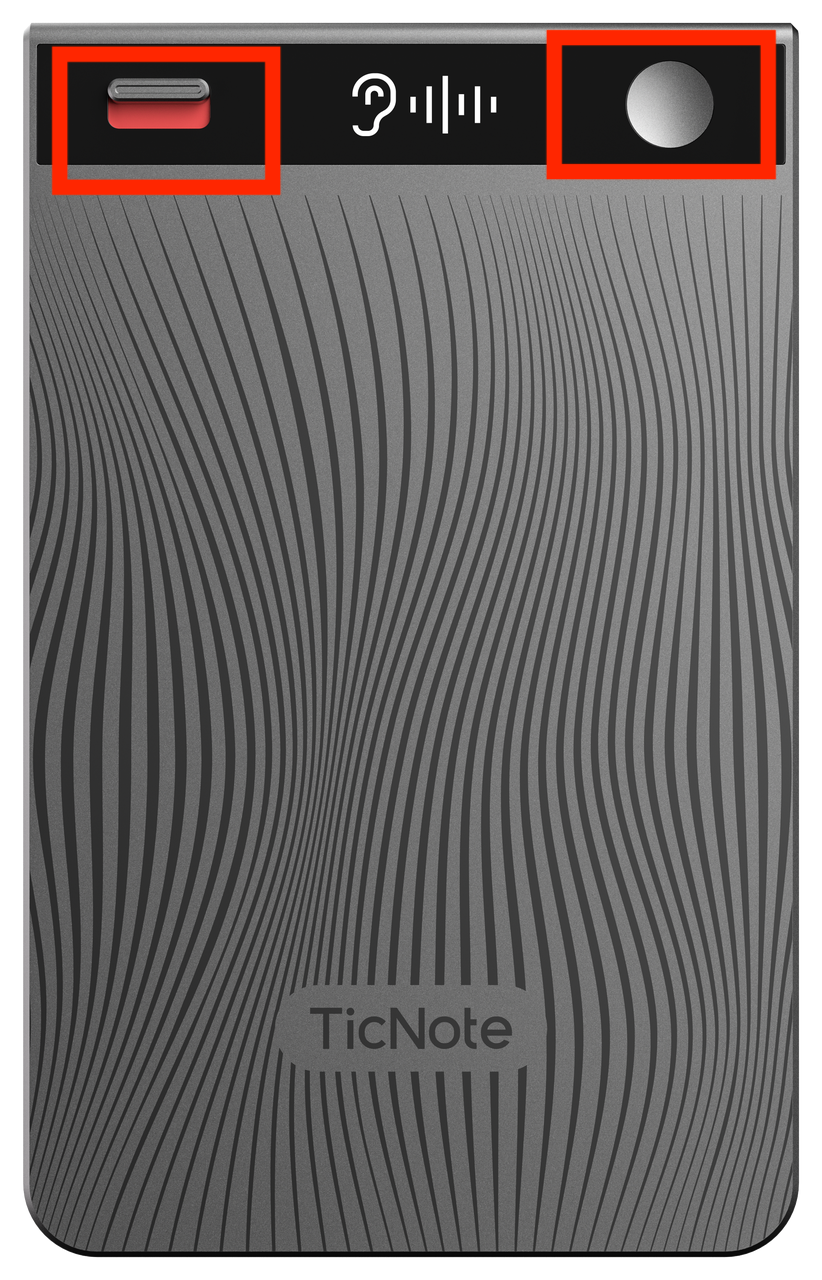
TicNote's design is radically minimal, with just two buttons at the top of the card:
- A mode switch: TicNote has two recording modes — "Call" mode (sensing vibrations from the phone earpiece) and "Field" mode (recording distant sounds).
- A circular button 🔘, the device's only button. Start or stop recording with a long press; a vibration confirms success. Easy to operate blindly from my pocket.
Each time you open the app, TicNote auto-connects and transfers data quickly.
For transcription, a 90-minute recording takes under 10 minutes to process. In our test, we recorded for 4 hours straight with no malfunctions; transcription completed quickly and consumed less than 10% battery.
To speed up transfers further, you can connect TicNote directly to WiFi — transmission speed more than doubled in our observation.
From a pure hardware interaction standpoint, TicNote performs admirably.
Next, we share experiments from two scenarios.
💡
One is the scenario every TicNote user will try: meetings.
The other is a creative use case we discovered ourselves: studying companion.
Meetings are TicNote's most heavily refined use case, leveraging virtually every possibility of voice recording for one-stop productivity, achieving:
"Solid fundamentals, surprising execution."
1) The Basic Discipline of an Agentic AI Hardware Product
AI Summarization
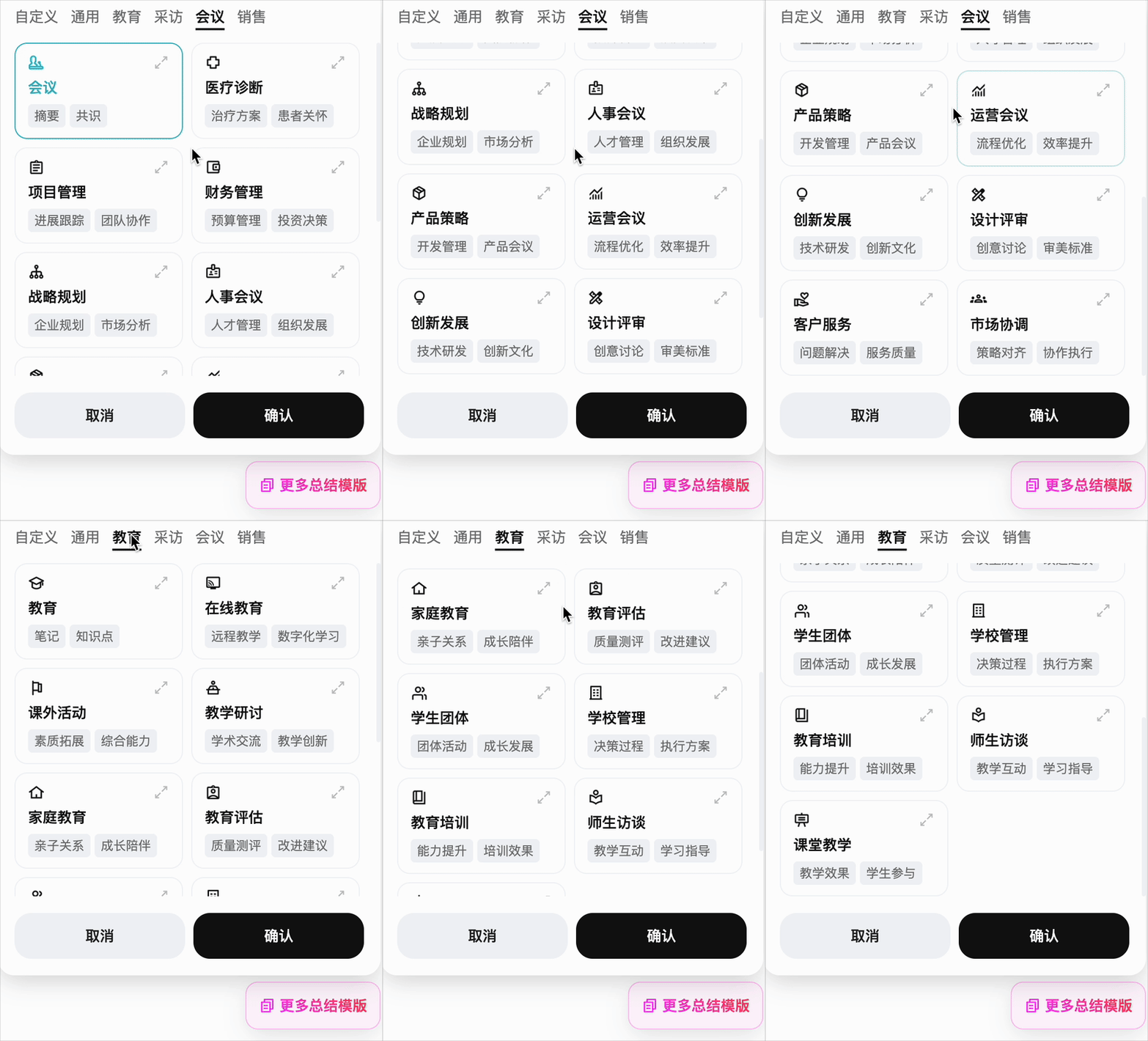
After recording with TicNote, the next step is selecting a "summary template." This process is quite flexible — you can design a custom template or choose from dozens of official presets.
Depending on the template, the AI-generated summary and its formatting become more personalized:
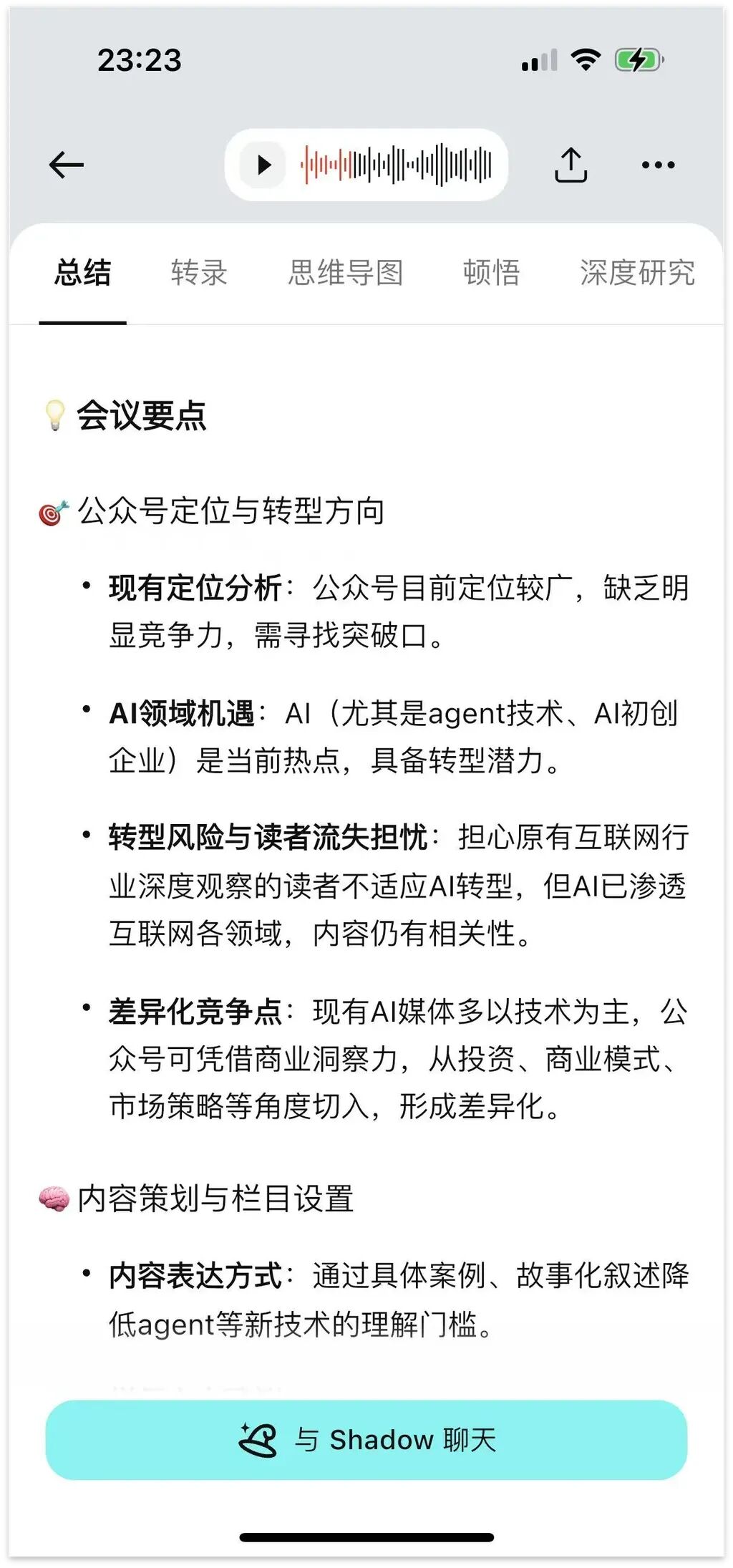
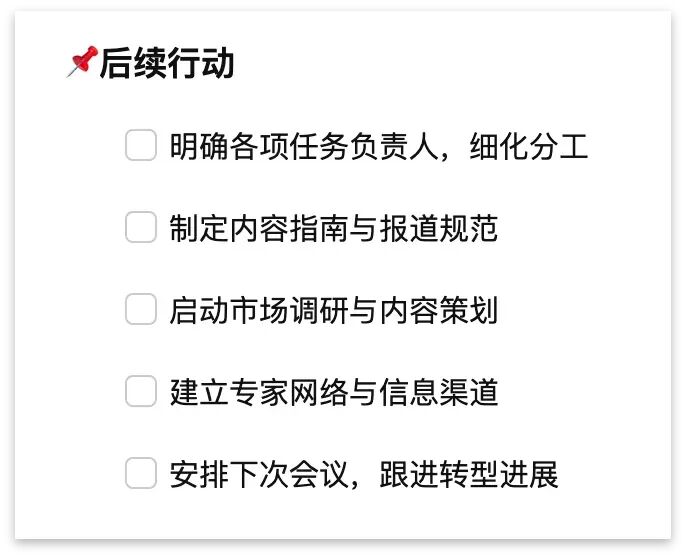
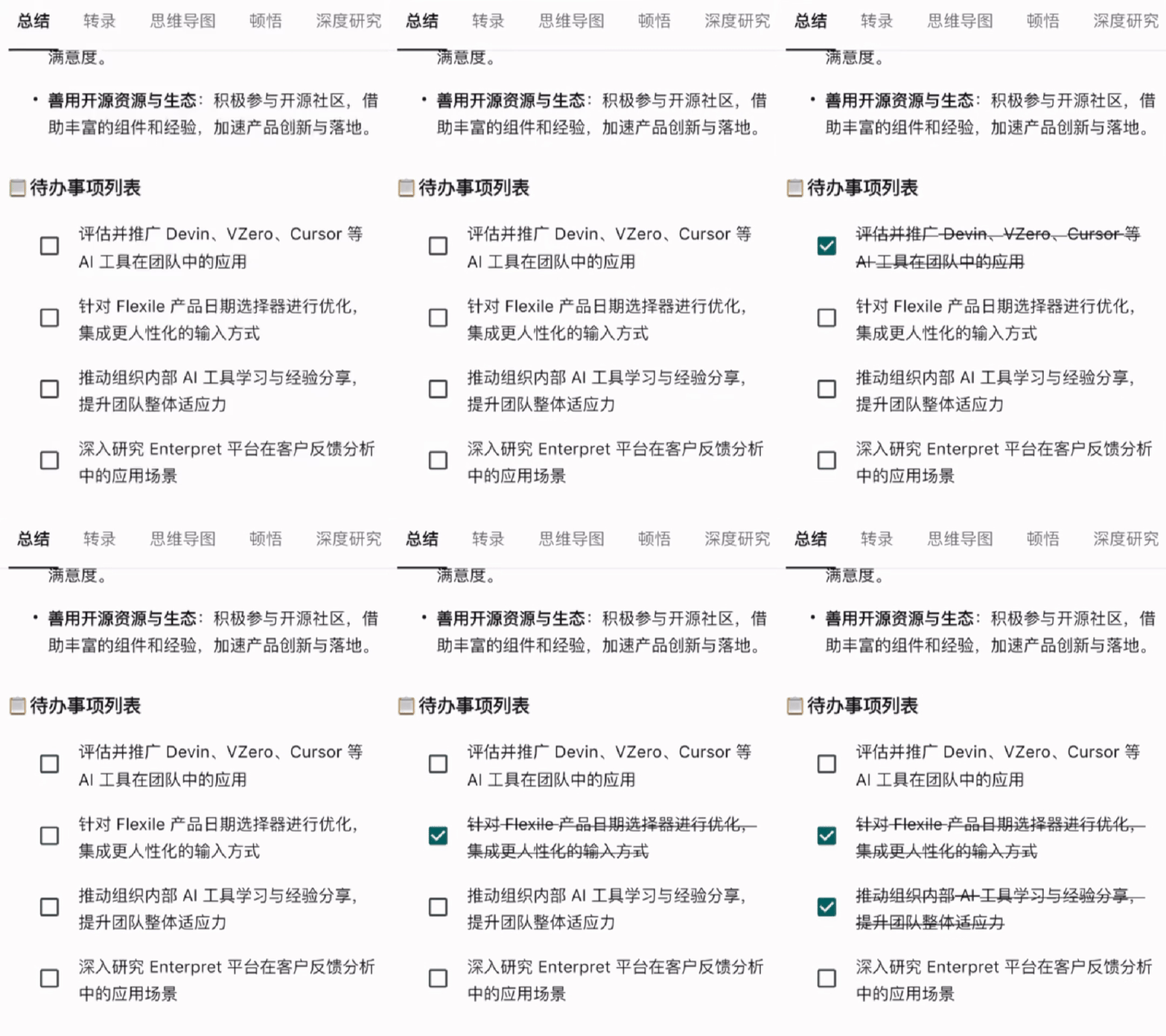
TicNote places the meeting "summary" on the first tab. If the AI summary misses anything or gets something wrong, you can manually edit it, and it also auto-generates a to-do list based on the recording content:
Clickable, Editable Transcription
TicNote's transcription speed is genuinely impressive, and accuracy is high. Of course, recording should be table stakes for AI hardware.
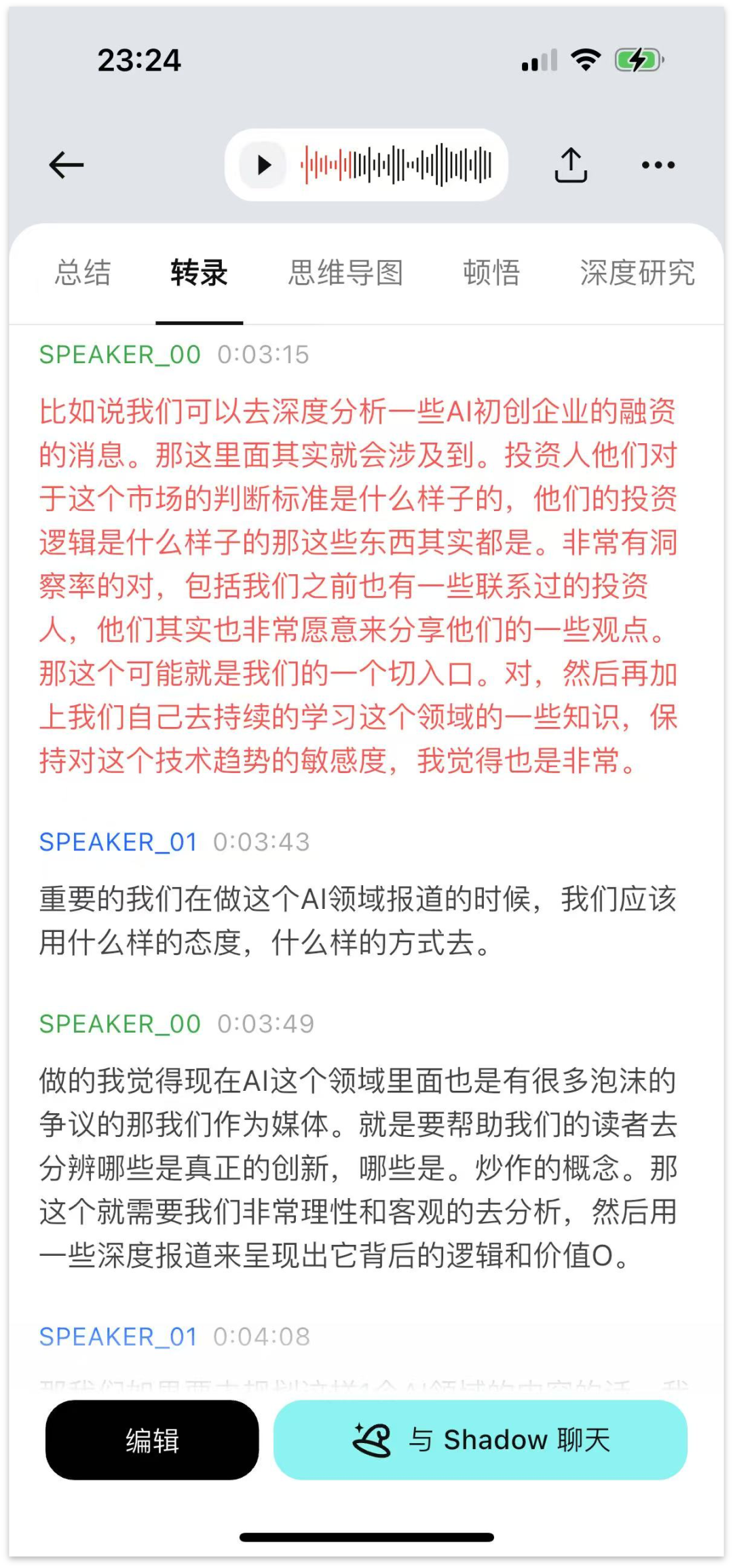
Beyond basic speaker identification, TicNote links every transcript segment to its corresponding audio.
Because every transcription tool will hallucinate.
So this interaction works well for me — when I see something questionable, I can tap directly to the original recording at that moment and hear what was actually said. This is especially useful for confirming important details.
Also, all content can be converted to different languages with one tap; for Chinese (Simplified), you can even switch to dozens of dialects.
2) Where TicNote Tries to Differentiate
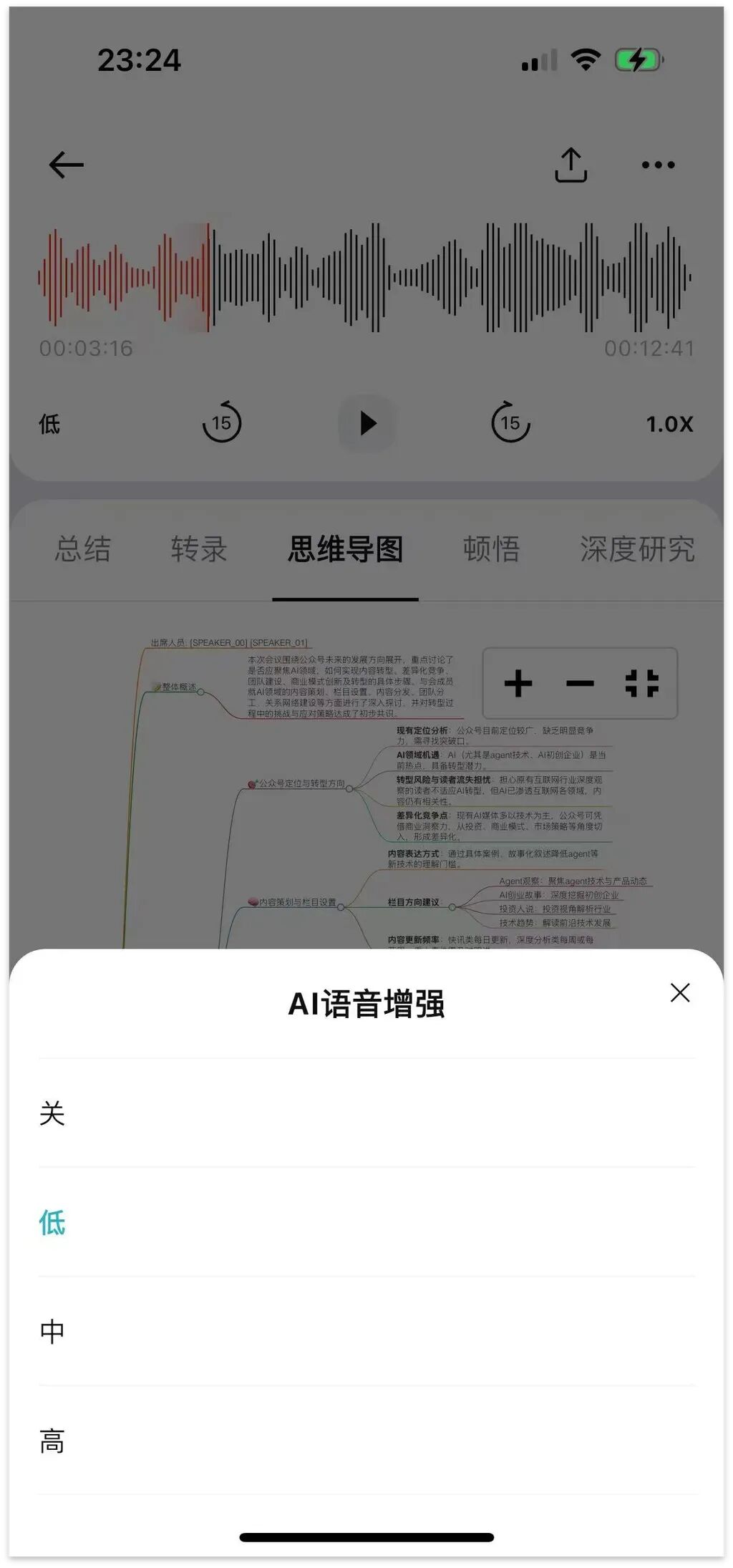
AI Voice Enhancement
The audio features integrated AI voice enhancement to boost vocal clarity — mainly to make recorded voices clearer, more natural, and easier to process later, conveniently exporting audio for "secondary processing" in other workflows.
In practice, the "low" and "medium" enhancement levels suffice. Even audio recorded in noisy environments achieves relatively clear playback.
Mind Maps
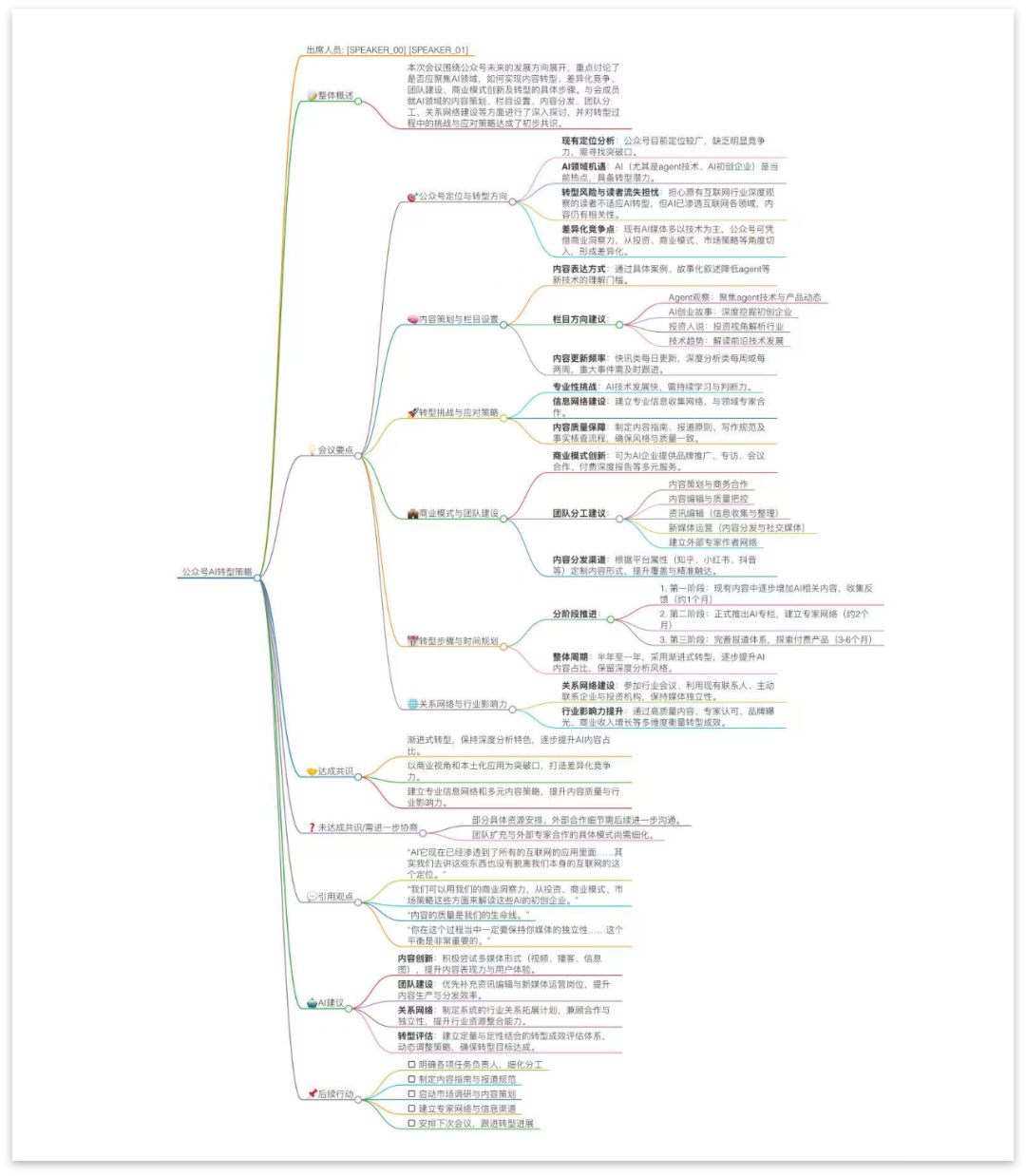
TicNote also auto-generates mind maps from meeting content, structuring every topic and branch of discussion, with each branch further broken down into specific talking points.
That said, I have to admit this mind map errs on the side of being too detailed. When the information density gets this high, it creates the illusion that nothing has really been summarized at all.
Epiphanies
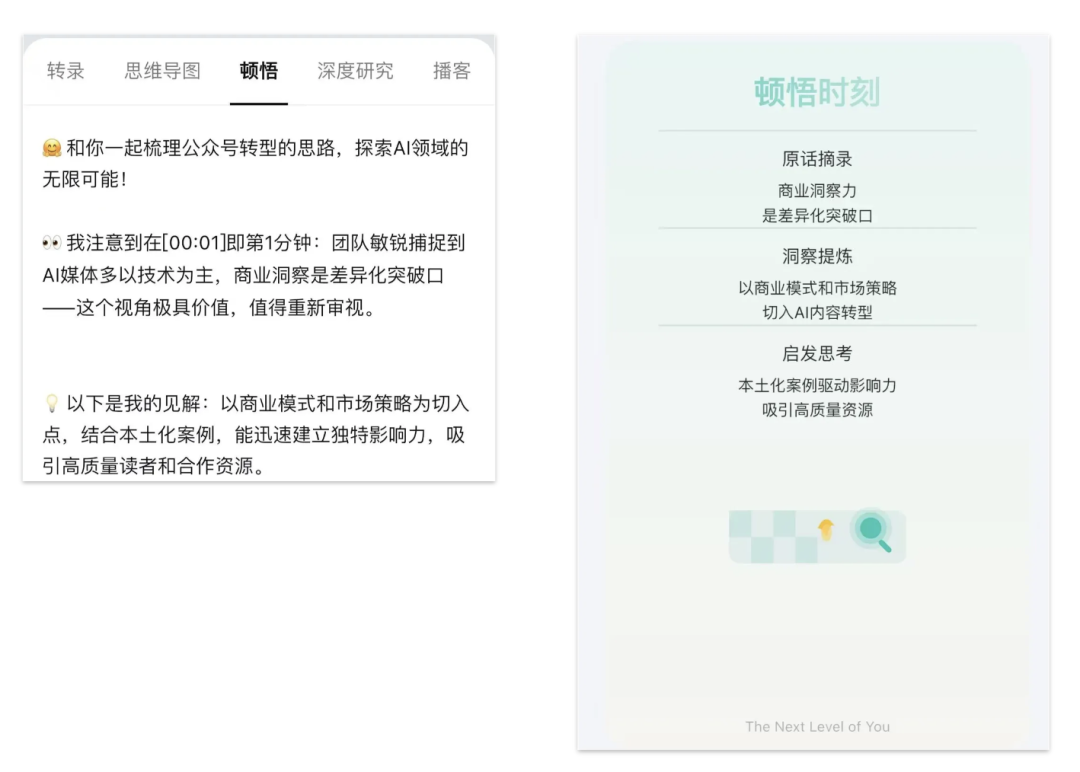
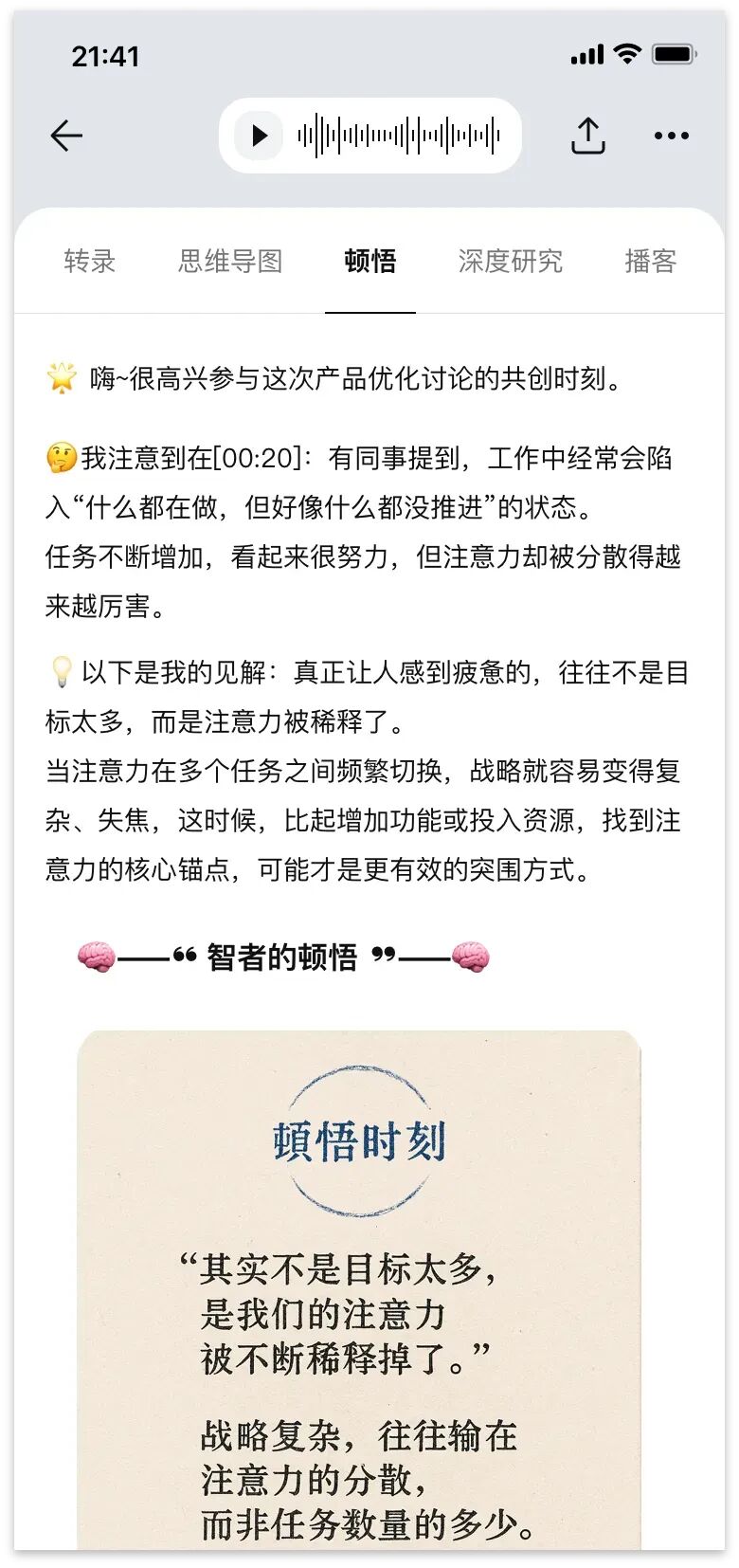
Worth noting: TicNote's feature set includes a particularly interesting module — "Epiphanies," a collaboration between Shadow AI and Li Jigang.
It automatically identifies highlight moments in meetings — things like innovative ideas, insights, moments of revelatory thinking — and flags these "epiphany" moments as individual cards.
Sometimes, "Epiphanies" genuinely surprises you, but its performance isn't especially consistent. In our meeting, it picked up on a perspective from the very first minute: "The business insight perspective is extremely valuable and needs to be re-examined."
In the official demo, "Epiphanies" can keenly notice when a colleague is feeling lost at work and offer a distinctive observation:
What really exhausts people is diluted attention. You need to find your core anchor.
Deep Research
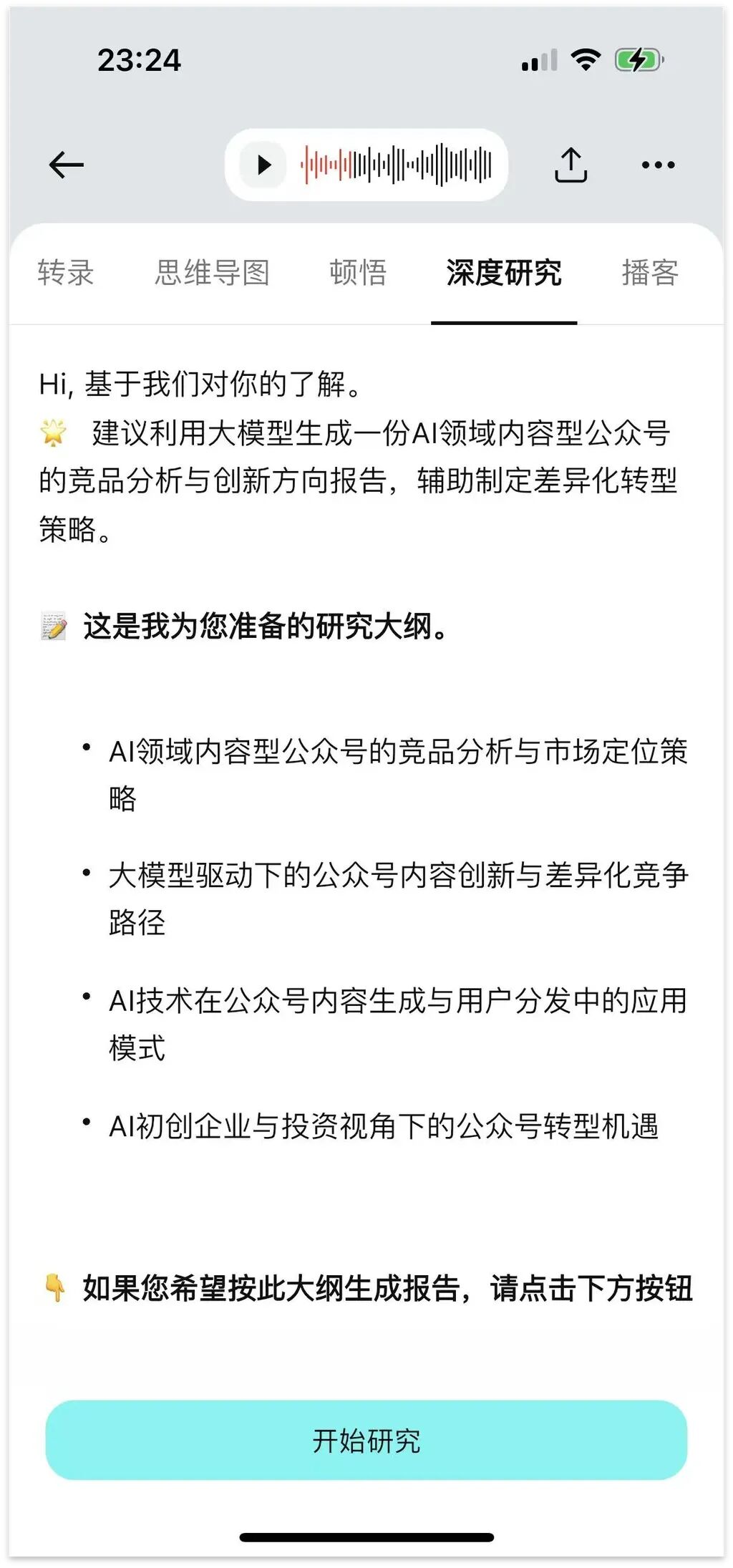
TicNote also auto-generates deep research outlines based on voice content.
For example, after we discussed "content-focused WeChat public accounts for AI startups," it produced a multi-dimensional research framework that you could launch into with one click.
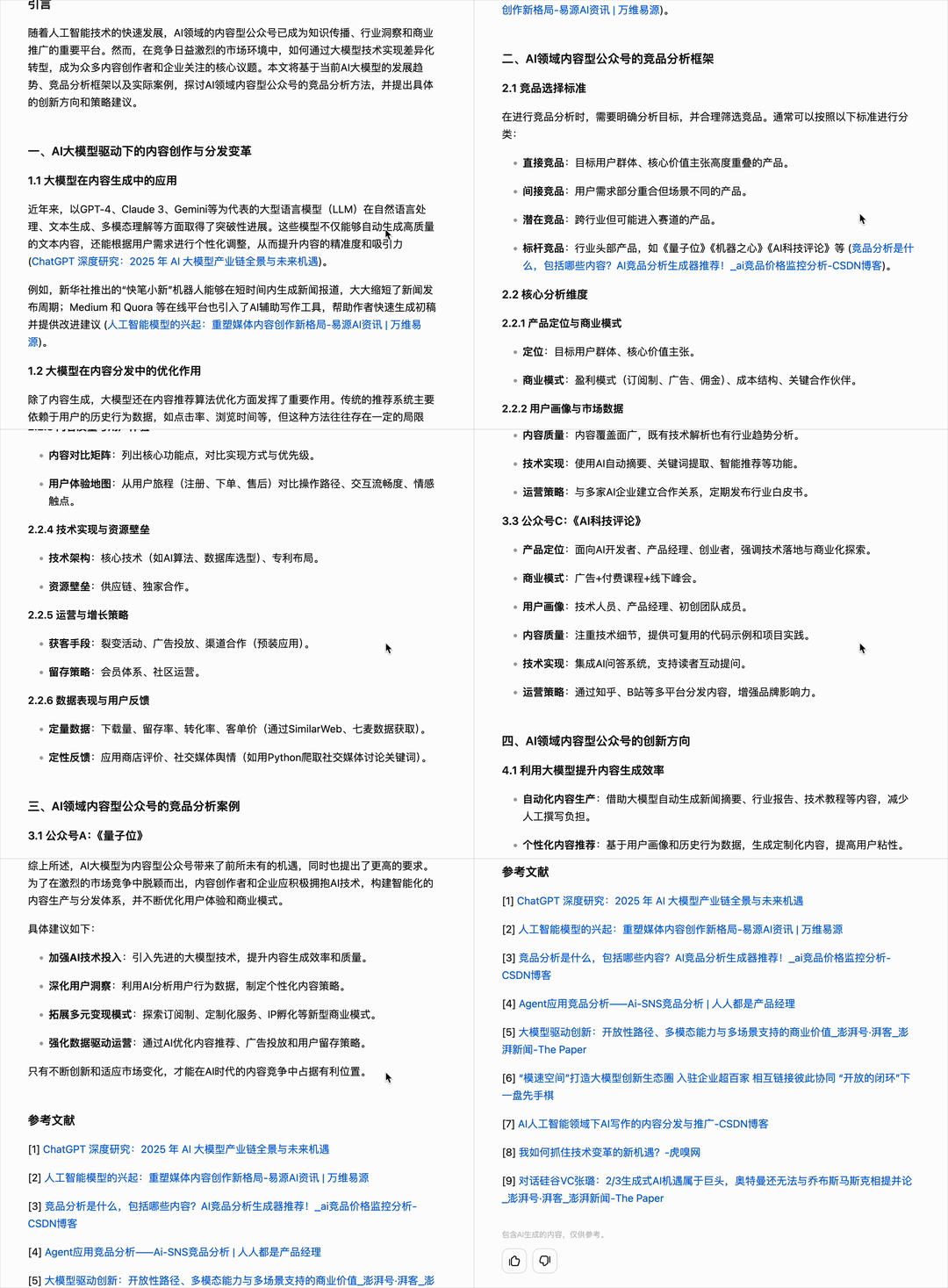
TicNote's research reports run roughly 3,000 words with 5–10 references — solid enough to serve as a professional information brief.
In this AI Content Public Account Competitive Analysis and Innovation Directions Report, for instance, the core analytical dimensions are quite granular, covering things like user personas for AI content accounts, the relationship between content quality and user experience, and so on:
Podcast
TicNote can also repurpose the summarized and transcribed content from Shadow AI and its built-in DeepSeek LLM into a podcast.
The AI automatically selects highlights from the recording and reorganizes them into smoother narration — very much a "voice brief" feel.
I uploaded an audio clip so you can hear for yourself:
One Link to Share Everything
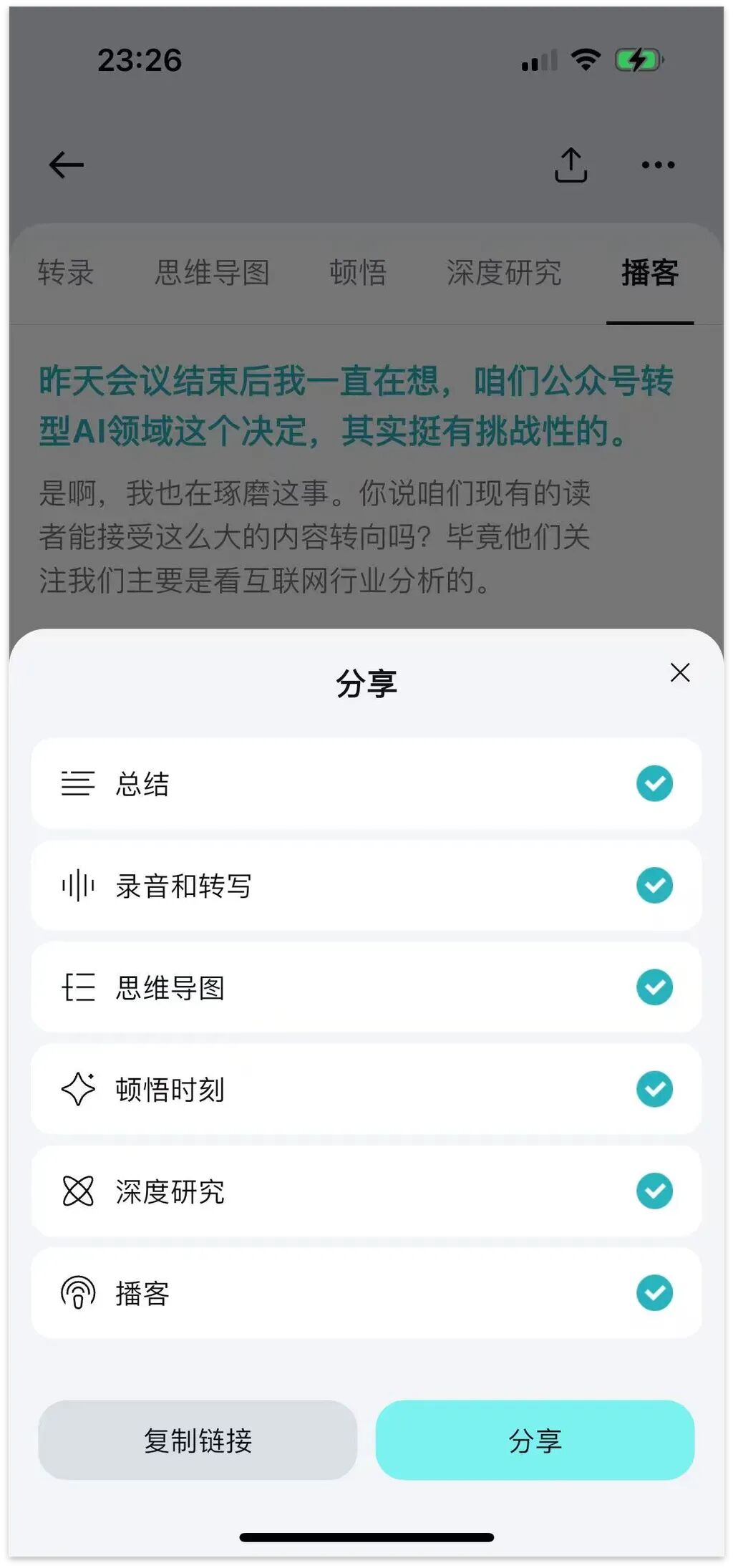
All these features squeeze meeting recordings for pretty much everything they're worth, and everything can be shared through a single link: summaries, transcripts, mind maps, epiphany moments, deep research outlines, podcasts — spanning multiple modalities of information:
Plus, all generated content — whether raw transcripts or AI-enhanced material — can be further translated into another language.
So shortly after a meeting ends, every participant can use this link to quickly align on what was discussed and get up to speed on the "actually useful stuff" in the shortest time possible.
This is a clear efficiency boost for rapid post-meeting review and follow-up report preparation.
Shadow AI
Behind all these "conventional yet inventive" AI features lurks Shadow AI — TicNote's built-in AI agent. As the name suggests, it's like a "shadow" agent assistant that follows you around, learns how you think, and helps you with recording, summarizing, and deep research.
Shadow AI can also be used as a chatbot, and TicNote gives it its own dedicated panel. You can ask it directly what was said in a recording, what the key takeaways were, what critical information appears in the transcript — it'll find the answers for you automatically.
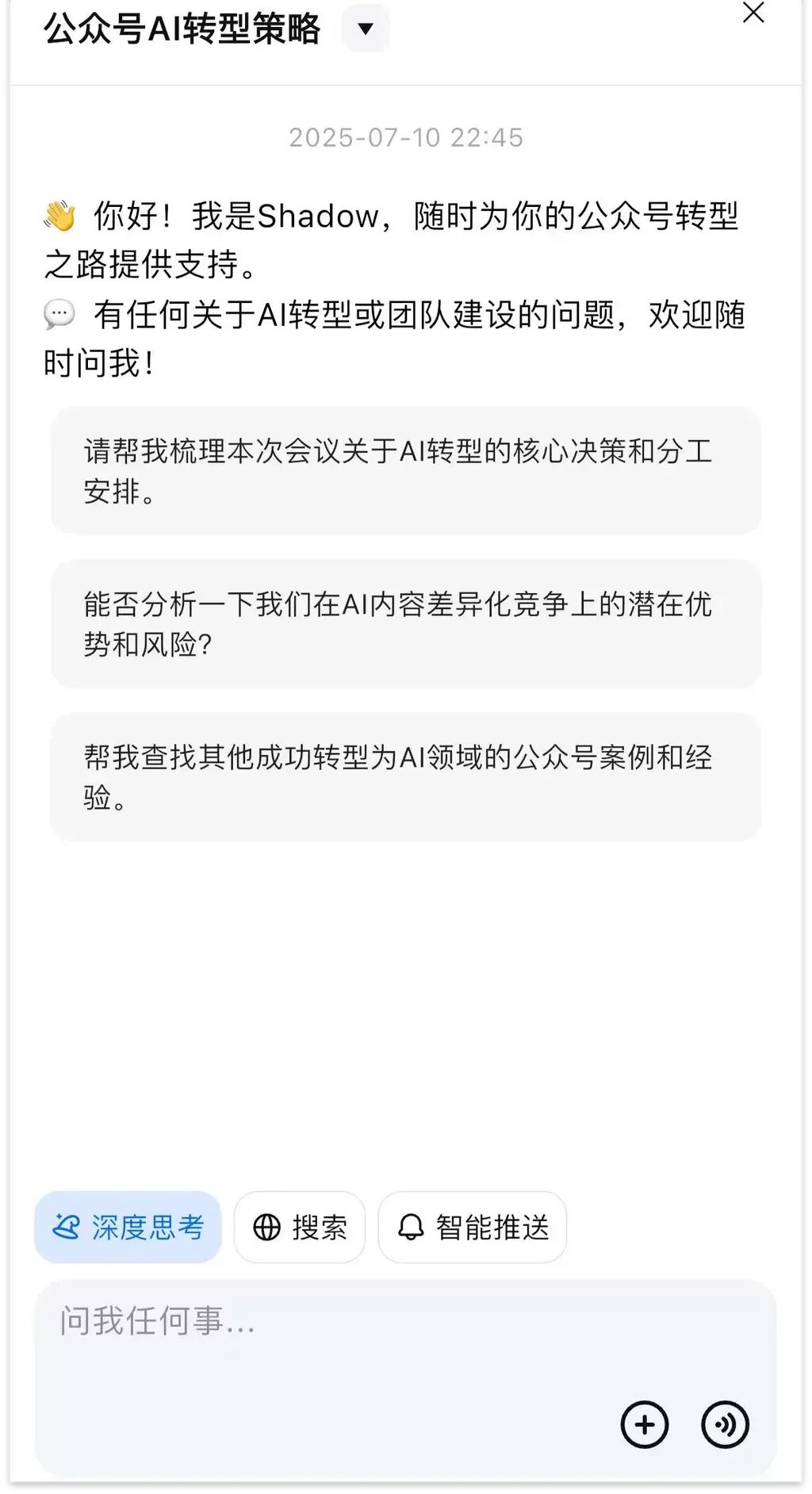 Shadow AI Chatbot
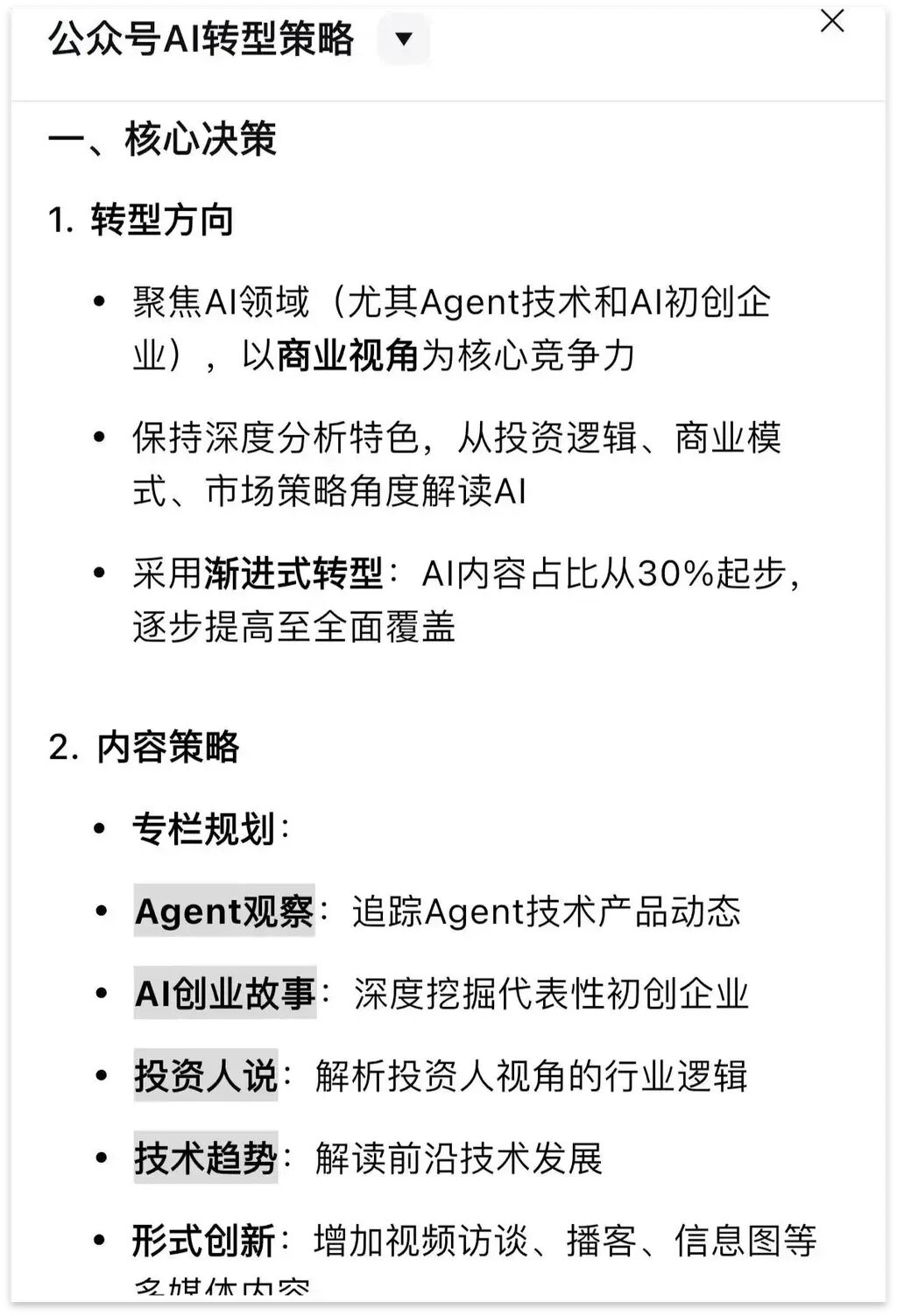
However, when we asked too many questions in succession, Shadow AI did exhibit some degree of hallucination, producing answers that were inaccurate or outright fabricated. This is something we hope improves over time.
Now let's take a closer look at how Shadow AI enables some more innovative use cases.
My "Aha Moment" Voice Notebook for Learning
Through deep hands-on use, I found that hardware like TicNote is perfectly suited to serve as a "voice notebook for my Aha moments while studying."
Since its hardware identity is fundamentally that of a recording device, it's quite accurate at distinguishing between different speakers. And Shadow AI's seamless integration significantly amplifies the note-taking function, letting you rapidly piece together fragmented information.
1) Finding My Aha Moments
Sahil Lavingia, author of The Minimalist Entrepreneur and founder of Gumroad, recently appeared on Lenny's Newsletter podcast to share his survival guide for "small but beautiful" businesses in the AI era.

When I watched this interview, I'd set TicNote quietly off to the side and focus on the content.
Whenever I hit "something that takes effort to learn" or an "Aha, that's a good point" moment, I could just say it out loud as a "voice note." Based on my prior experience, I had zero worry about "painstakingly hunting down my inspiration" afterward.
TicNote quickly identified three speakers: me, the host, and Sahil Lavingia:
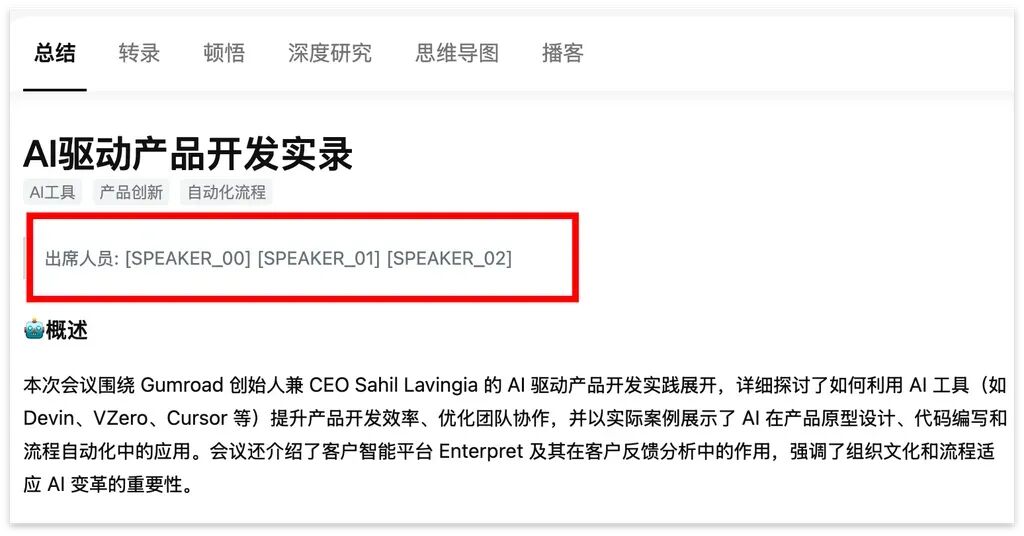
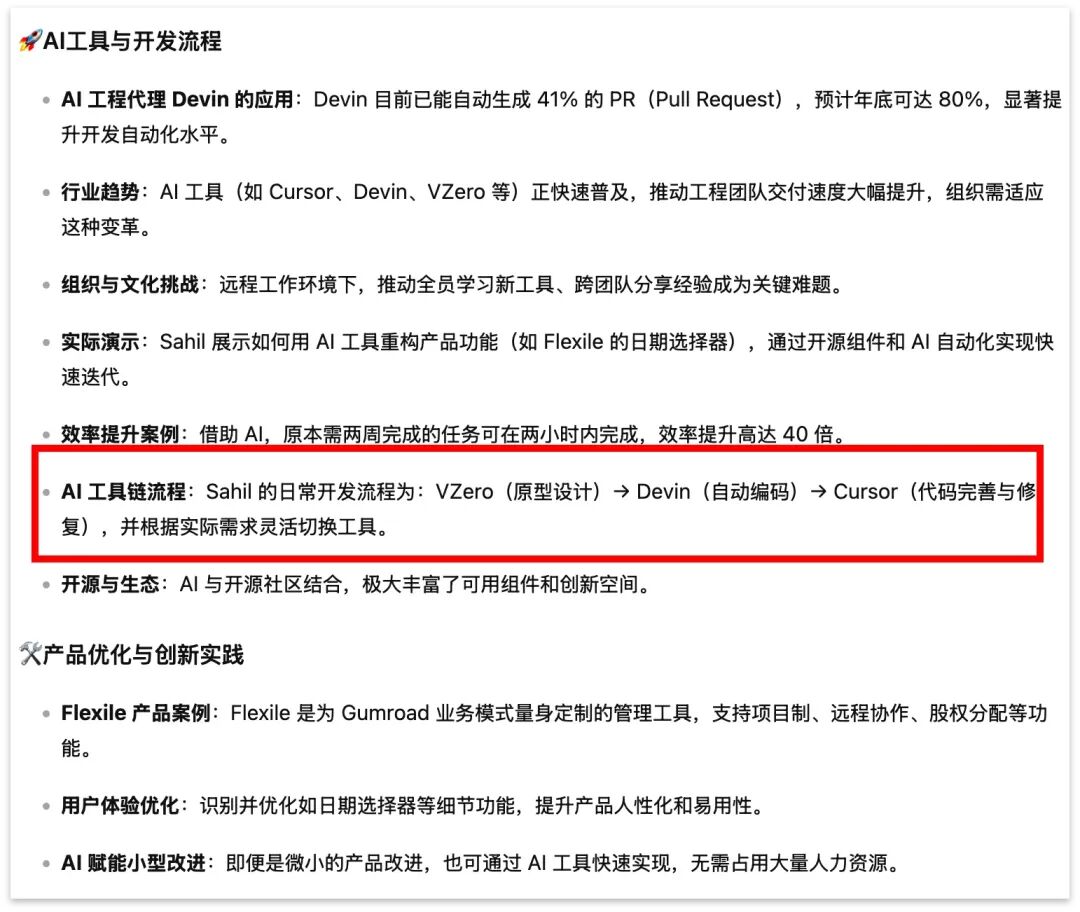
I have to say, TicNote's AI summarization accuracy and contextual analysis are genuinely solid. Take this AI Coding Agent toolchain workflow — it was a key information point in the original interview:
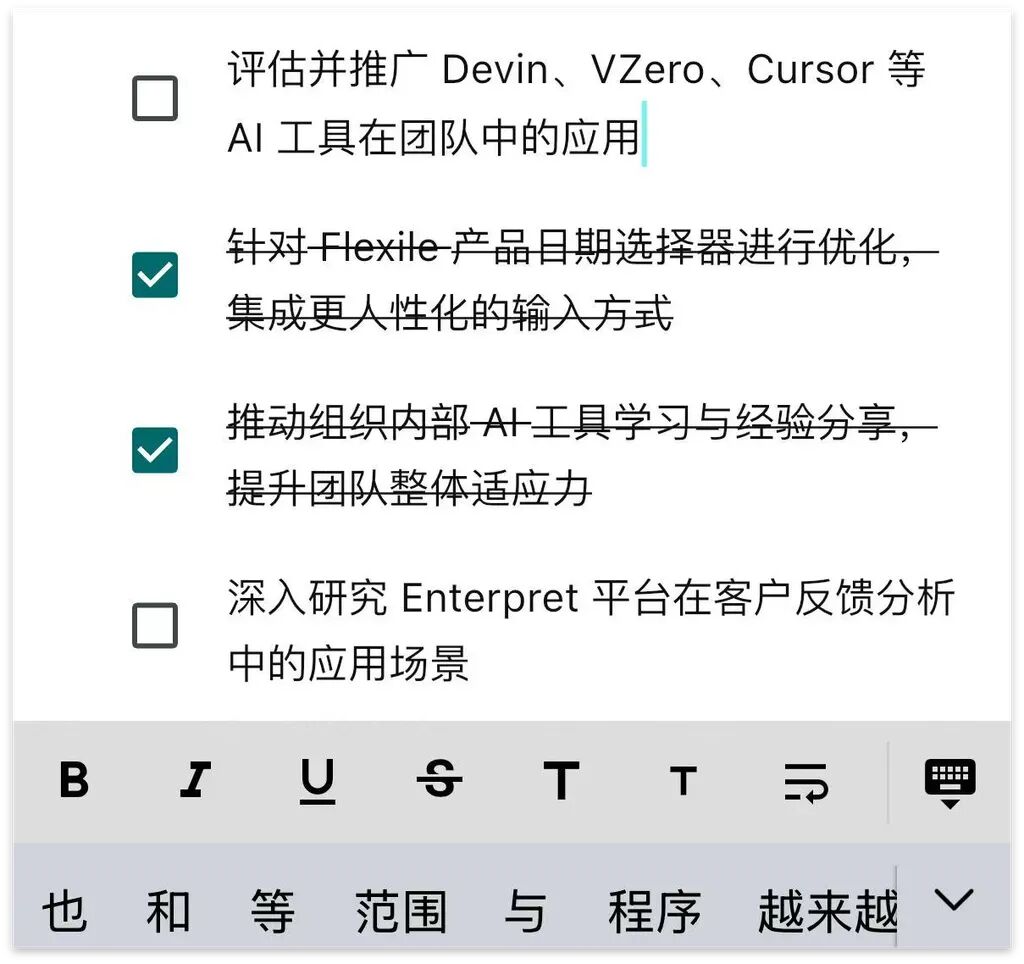
It even generated a to-do list based on the podcast content, which you can manually edit:
For instance, when the host and Sahil were discussing PR, I casually asked: "What does PR mean here? 41% PR?"
But Shadow AI still hallucinates on some specialized, domain-specific terms. It interpreted "PR" as "public relations," when in this computer science context it actually meant "Pull Request":
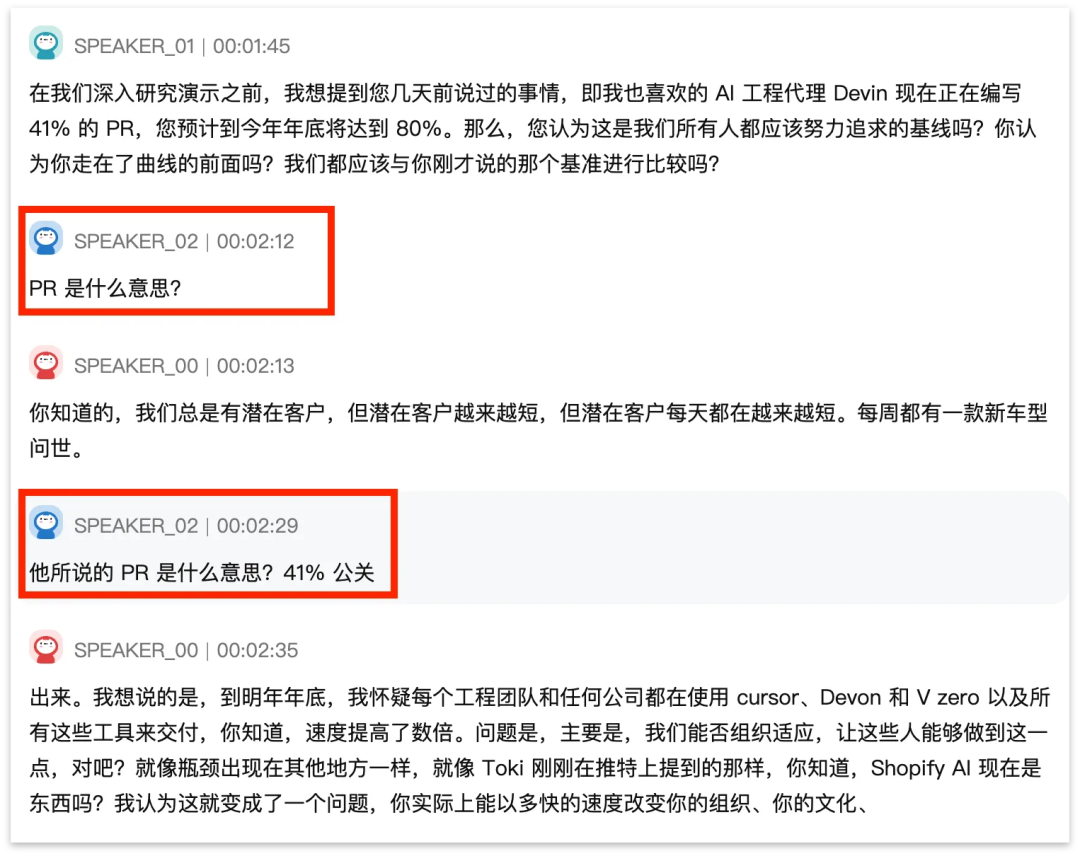
At this point, you can go in and manually correct Shadow AI's hallucinations. Still, I really hope TicNote will release a "terminology library" to reduce these kinds of errors.
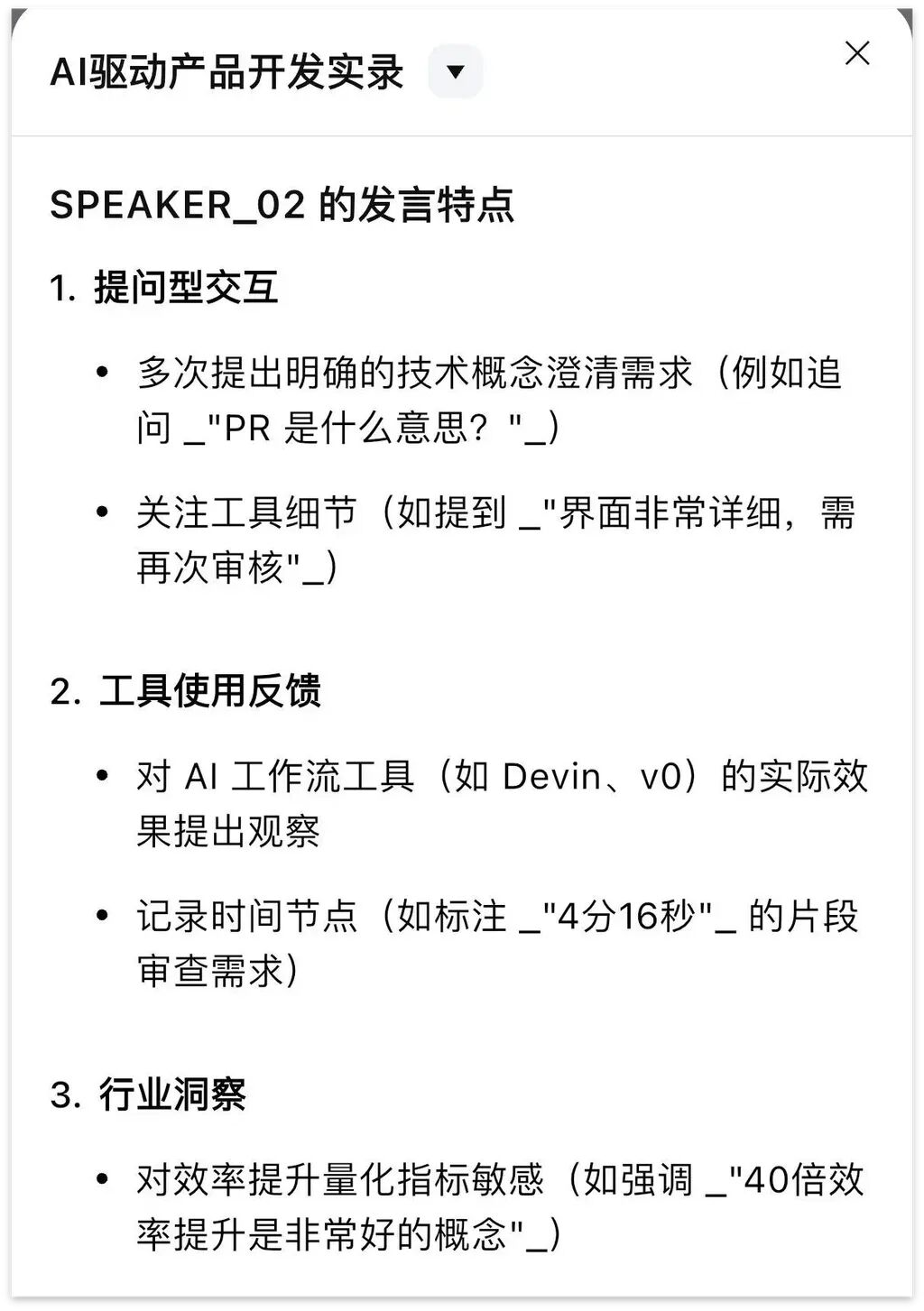
After that, I could directly ask Shadow AI to find my "Aha Moment Notes" based on the recording's context. It quickly and accurately located my questions and produced a structured summary combining them with surrounding context.
Something like "What does PR mean?" got categorized under "Question-Based Interaction," while "AI Tool Workflow" landed in "Tool Usage Feedback." I even carefully cross-checked and found that every single "Aha Moment" I had recorded was found by Shadow AI, each neatly placed in its corresponding category:
Then, turning on Shadow AI's "Search" function brings you back to the familiar chatbot-style conversation. You can continue exploring anything from the recording that you want to learn more about:
At this point, the AI combines TicNote's content with web search results.
For example, I asked it:
What is Devin?
Shadow AI answers based on both web information and recording content, attaching "meeting transcript snippets" in the "Examples" section.
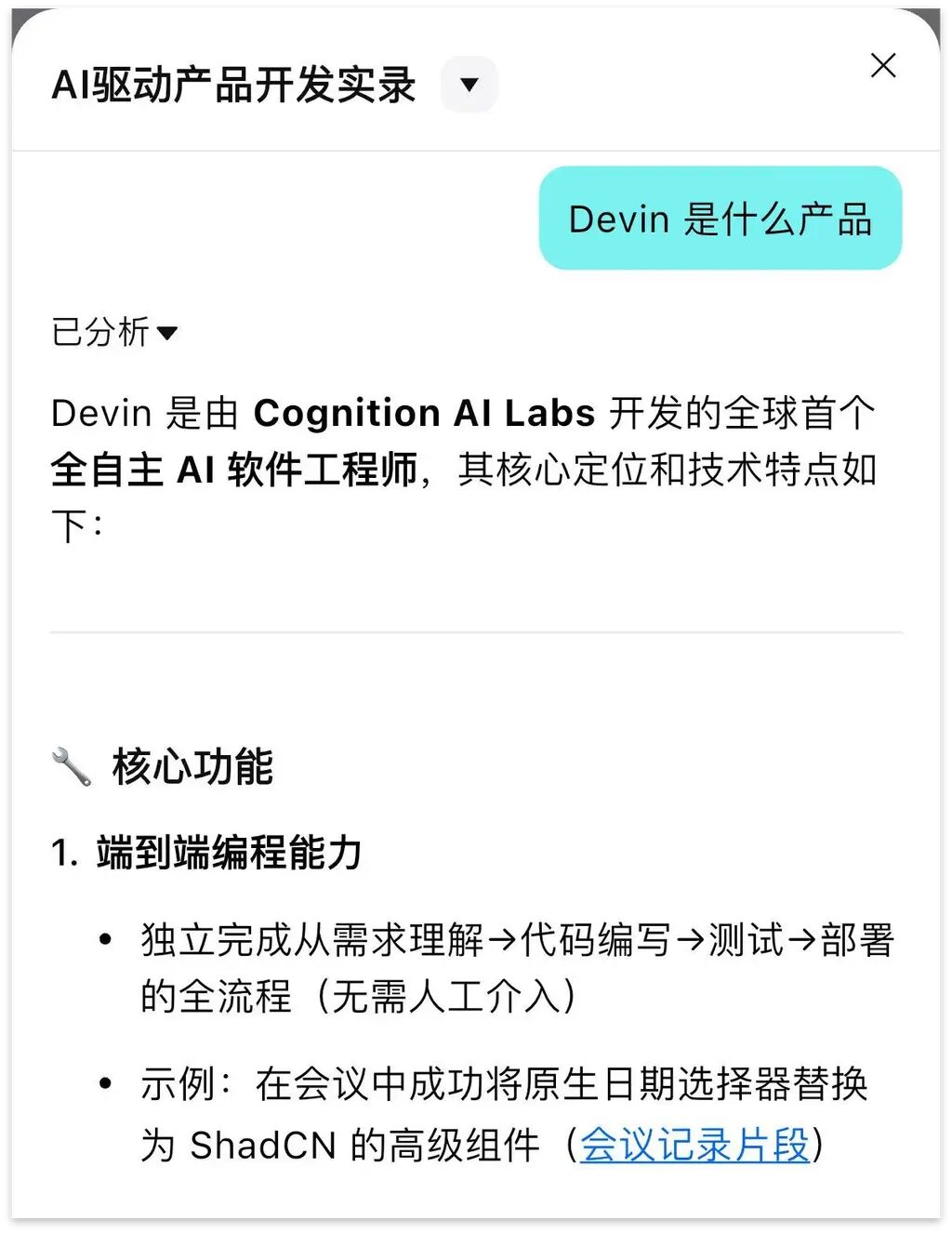
What's interesting is that in my actual testing, I found: clicking "Meeting Transcript Snippet" doesn't jump to the original podcast recording, but rather to an AI summary of that transcript snippet:
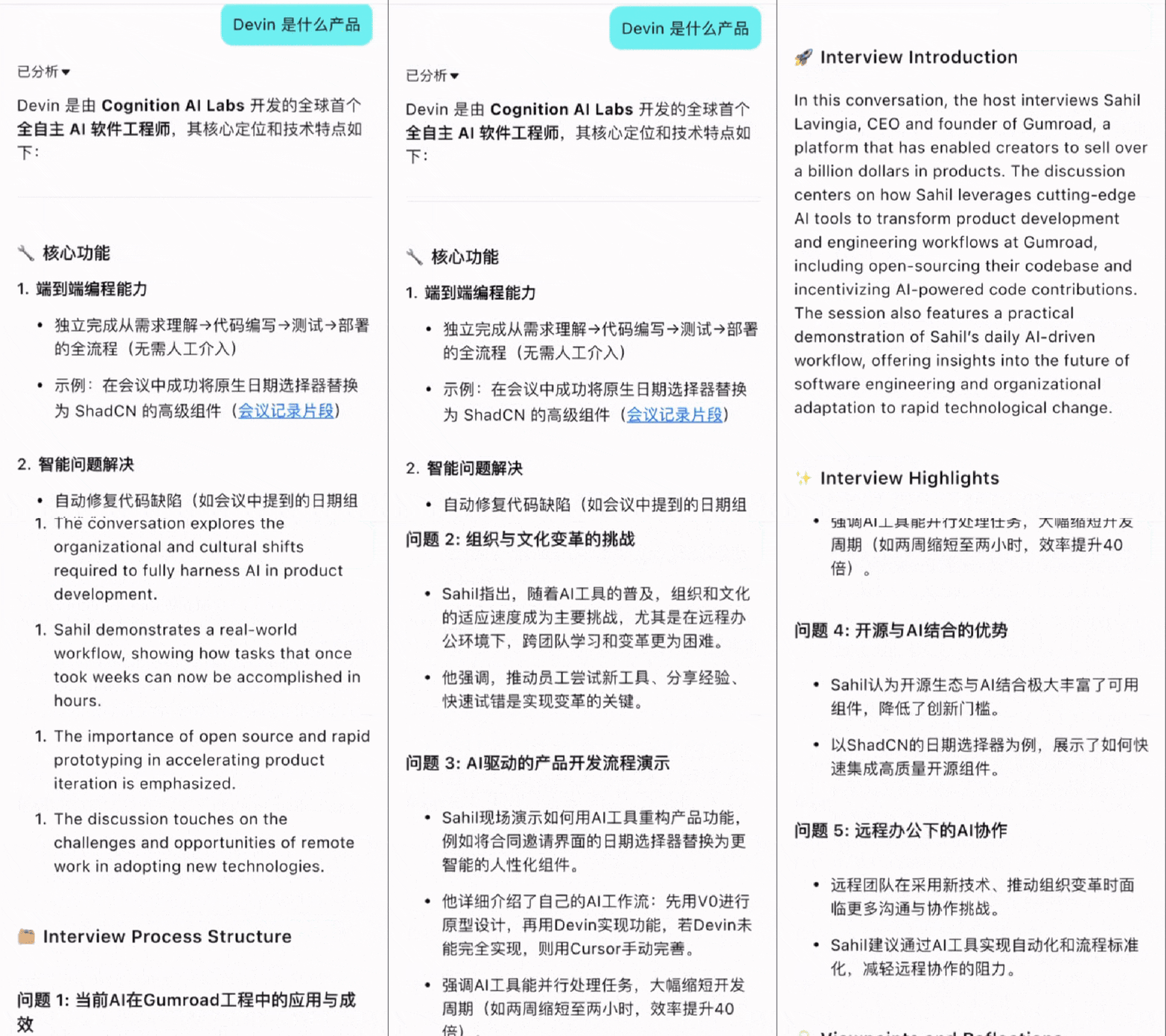
"Meeting Transcript Snippet"
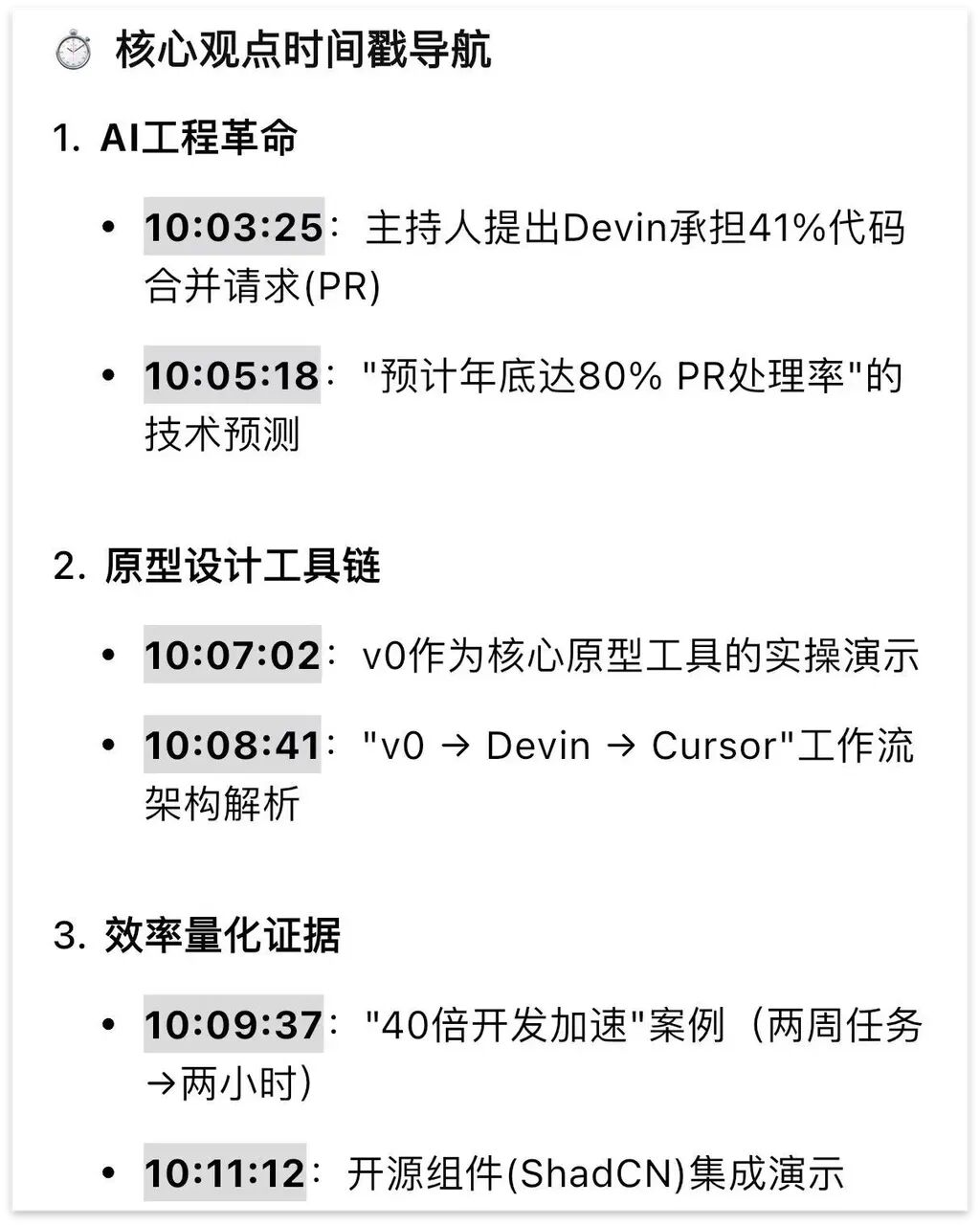
There are many ways to use Shadow AI, mainly because it has thoroughly "internalized" the entire recording. For example, it can easily and accurately extract timestamps for core viewpoints:
AI hardware products like TicNote are essentially selling one-stop, closed-loop software services, not a voice recorder. The hardware is merely the vehicle for this service. On the hardware side, they aim for a seamless experience that doesn't disrupt user attention; on the software side, they aim for a closed loop.
For example, it can convert fragmented attention into deep learning through very simple means.
One interesting feature is that TicNote supports daily task push notifications. After listening to this interview, I decided to systematically study AI Coding Agents to level up my understanding, so I set it to push daily at 8 AM:
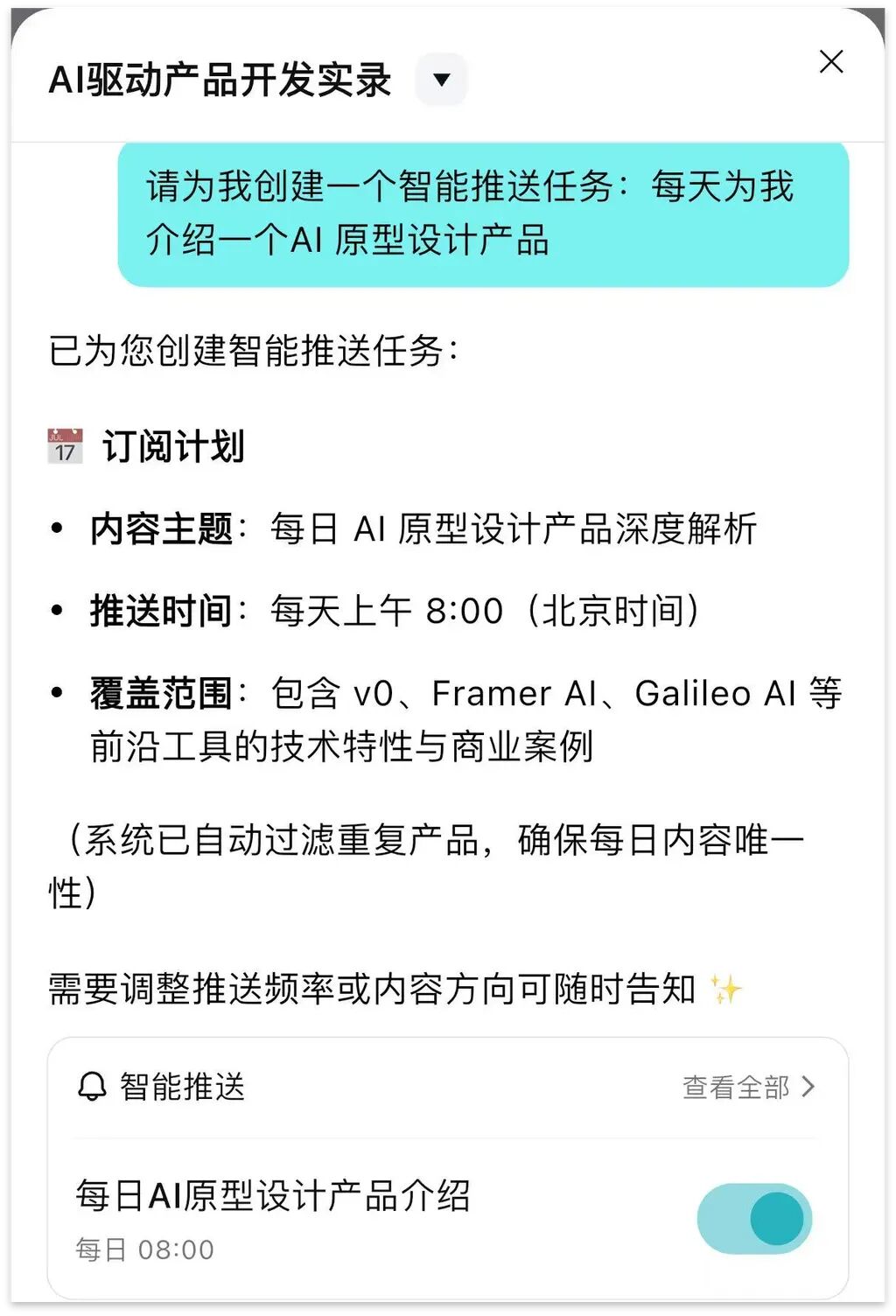
Since TicNote's built-in AI handles context well and performs accurately on recordings, if you want to deepen your awareness of some fragmented piece of information, you can directly use TicNote's auto-generated "Deep Research" outline to quickly engage in deep learning.
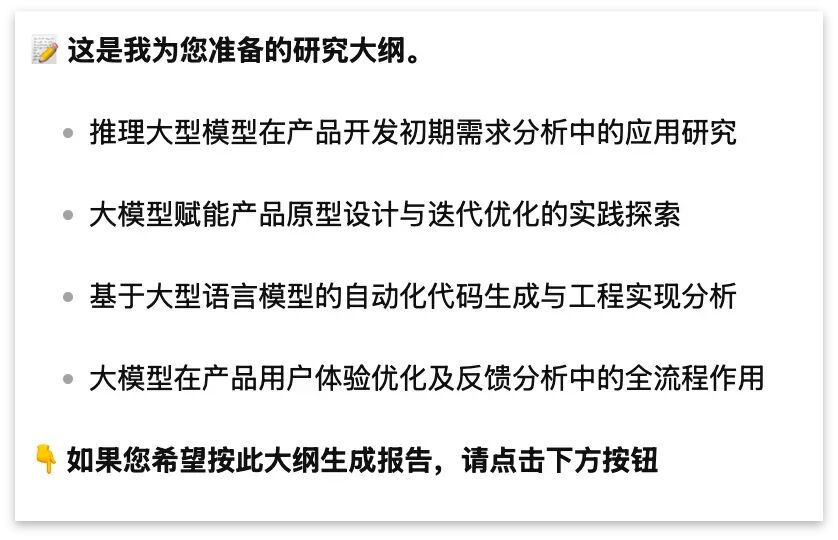 Auto-generated Deep Research Outline
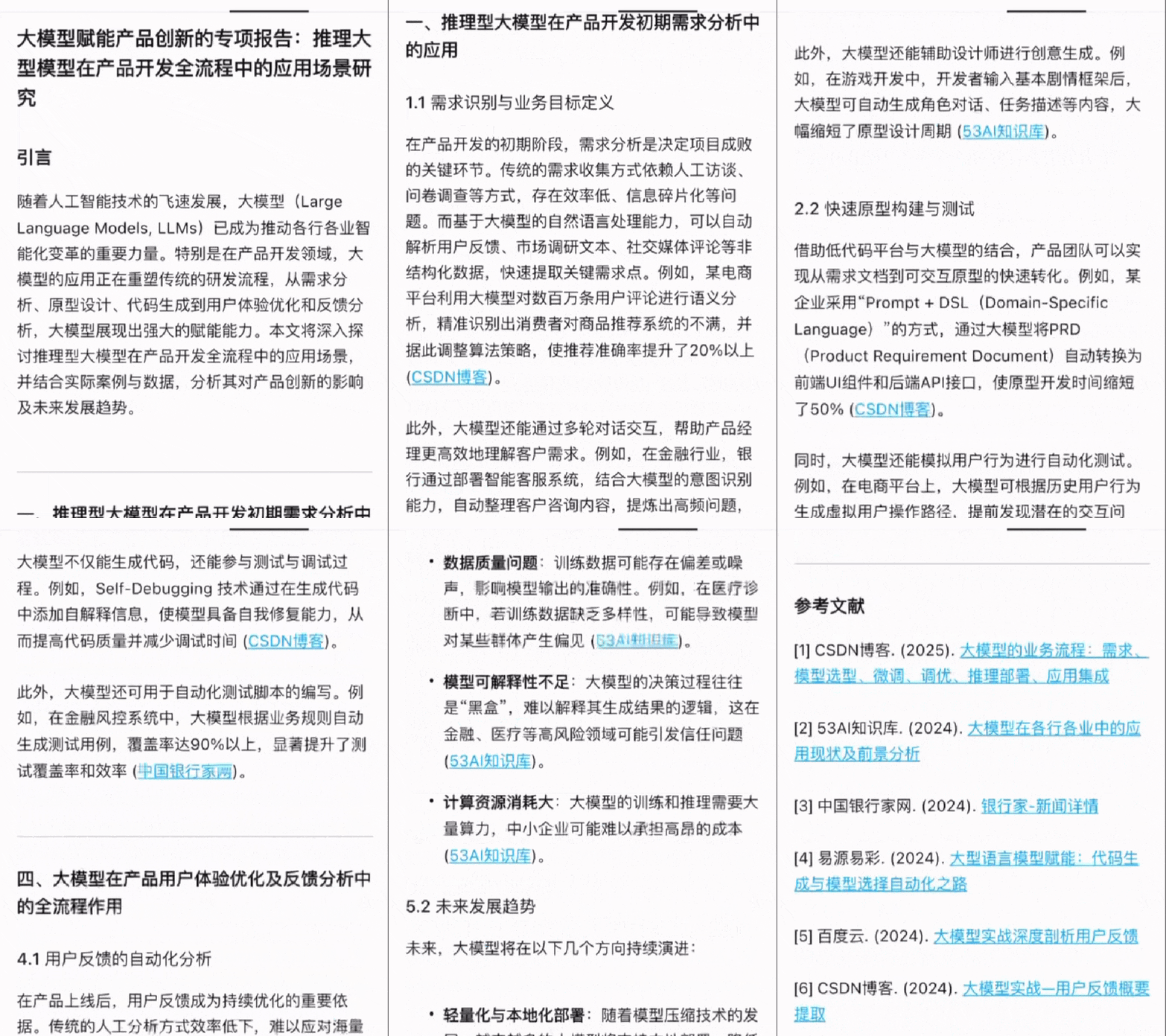 Deep Research Report
If reading all this on your phone feels too cramped, you can also go to TicNote's website, where they've placed Shadow AI in a dedicated sidebar — the whole page is much more spacious and comfortable to read:
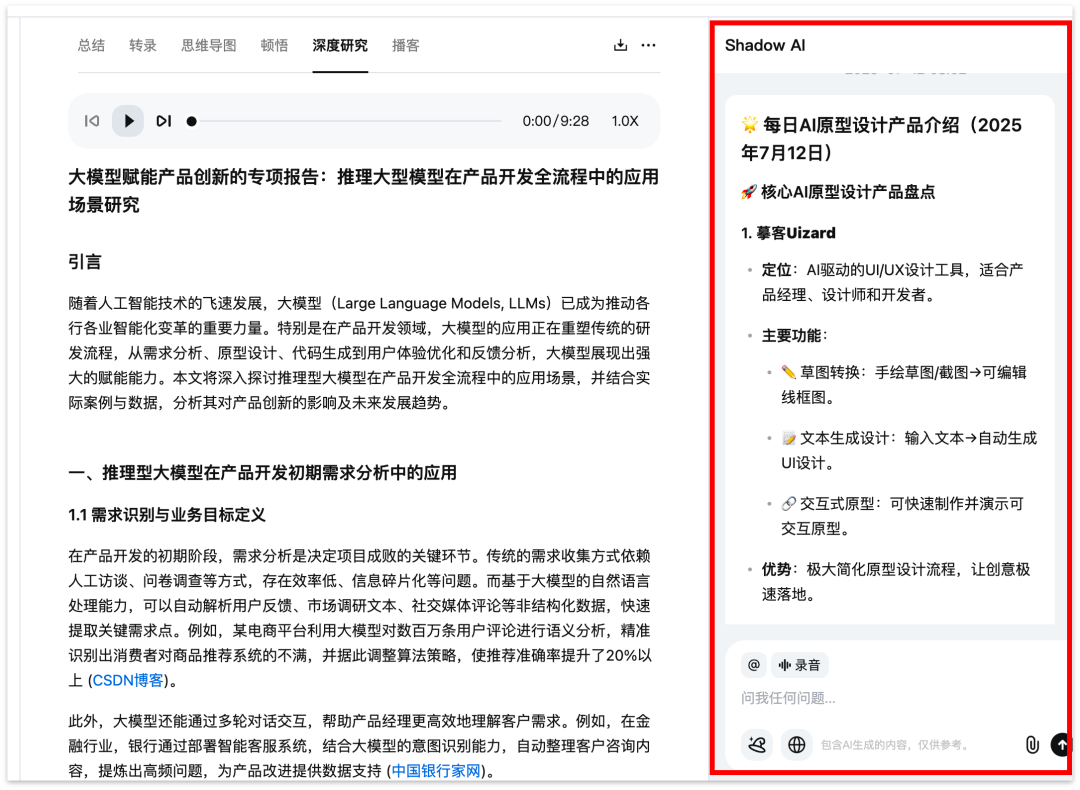
2) Rapidly "Assembling" All Fragmented Knowledge
During use, I discovered that TicNote can also create a "Project" — just like current chatbots — to gather all information on the same topic in one place.
For example, I created a "Gumroad Project," putting in several interview and podcast recordings about Sahil Lavingia, a summary PDF of The Minimalist Entrepreneur, my casually recorded thoughts, and deep research reports. This lets you build a special Gumroad-specific context environment:
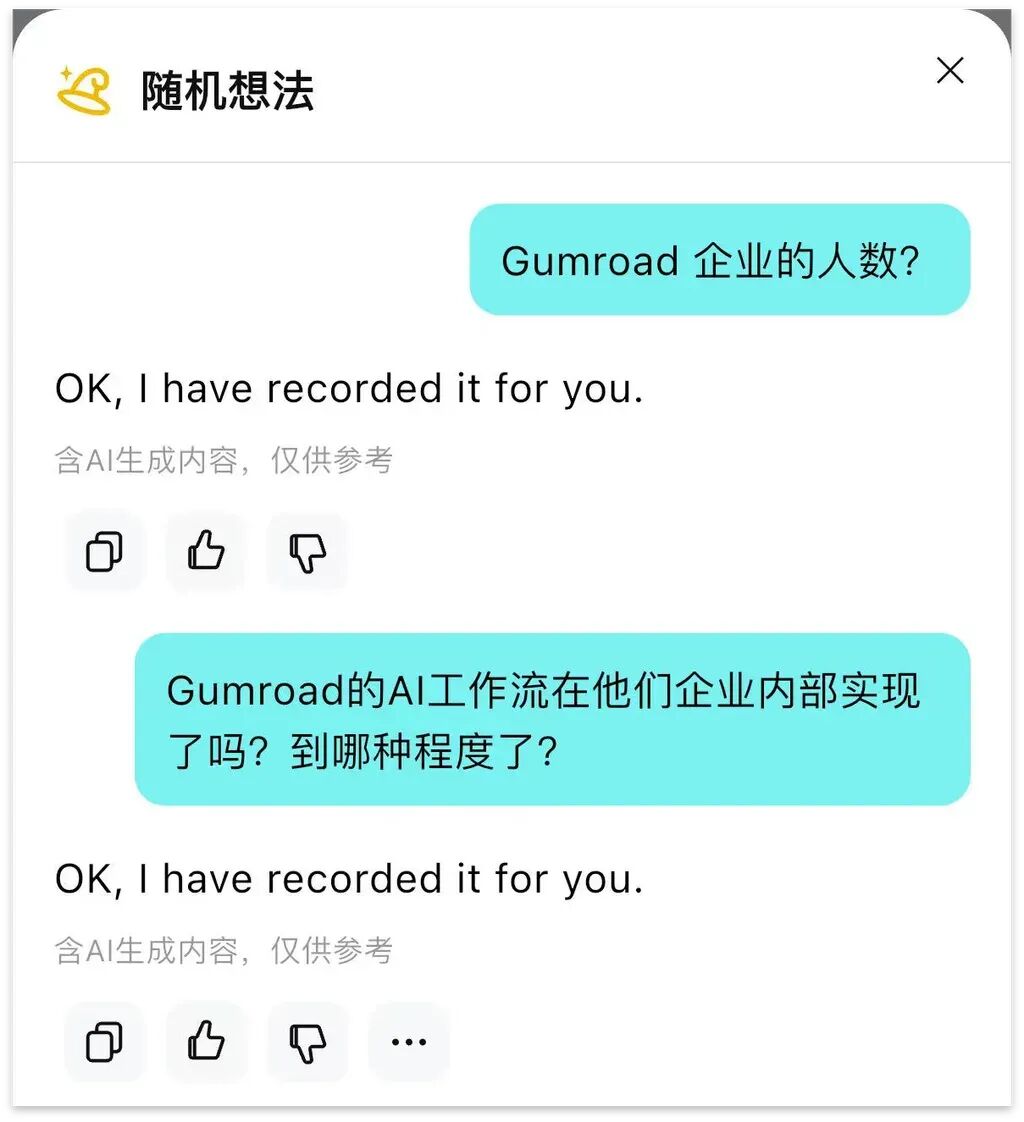 Recording my random thoughts
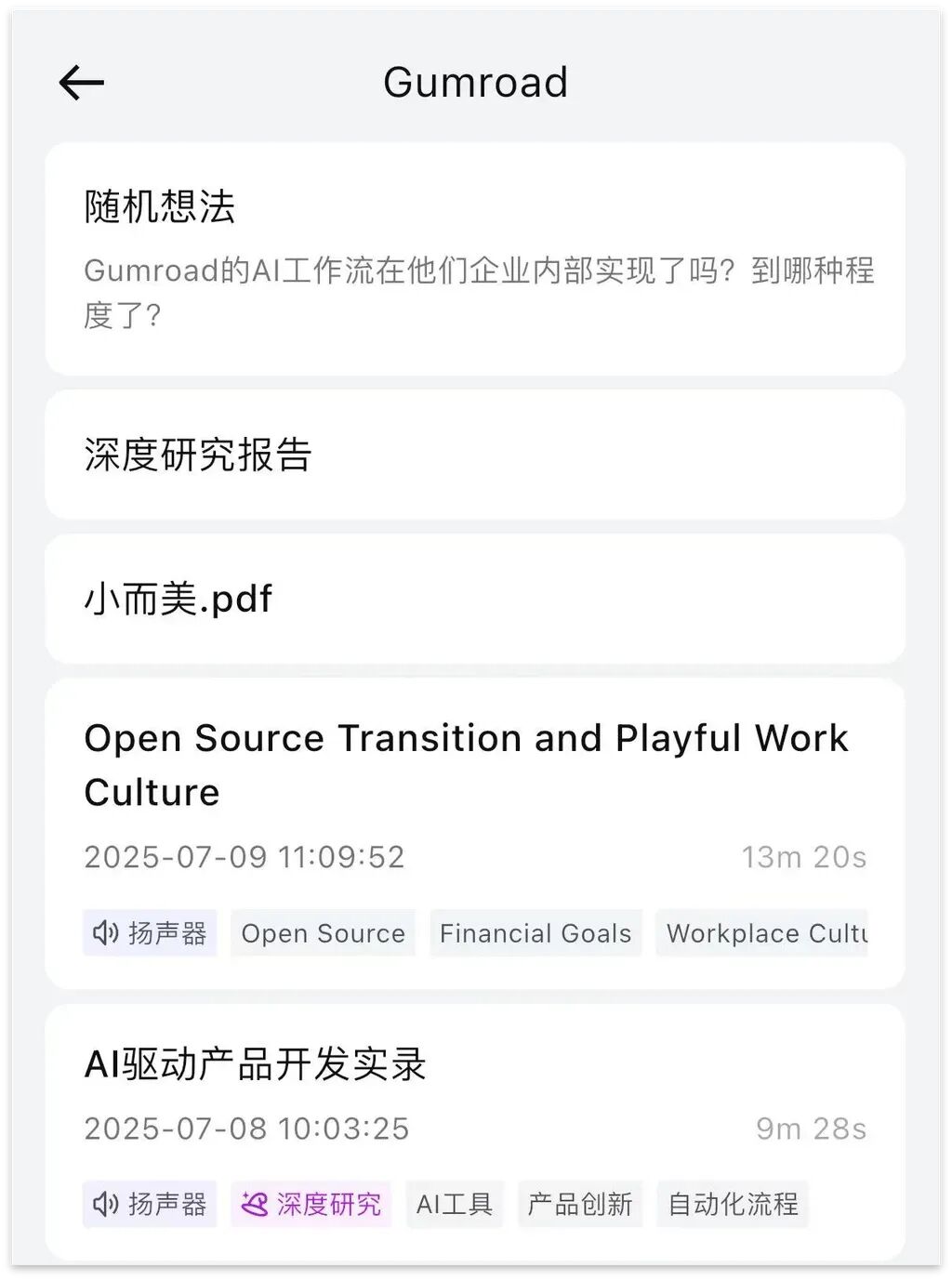
Then, we can ask questions based on all the content within the "Gumroad Project," such as:
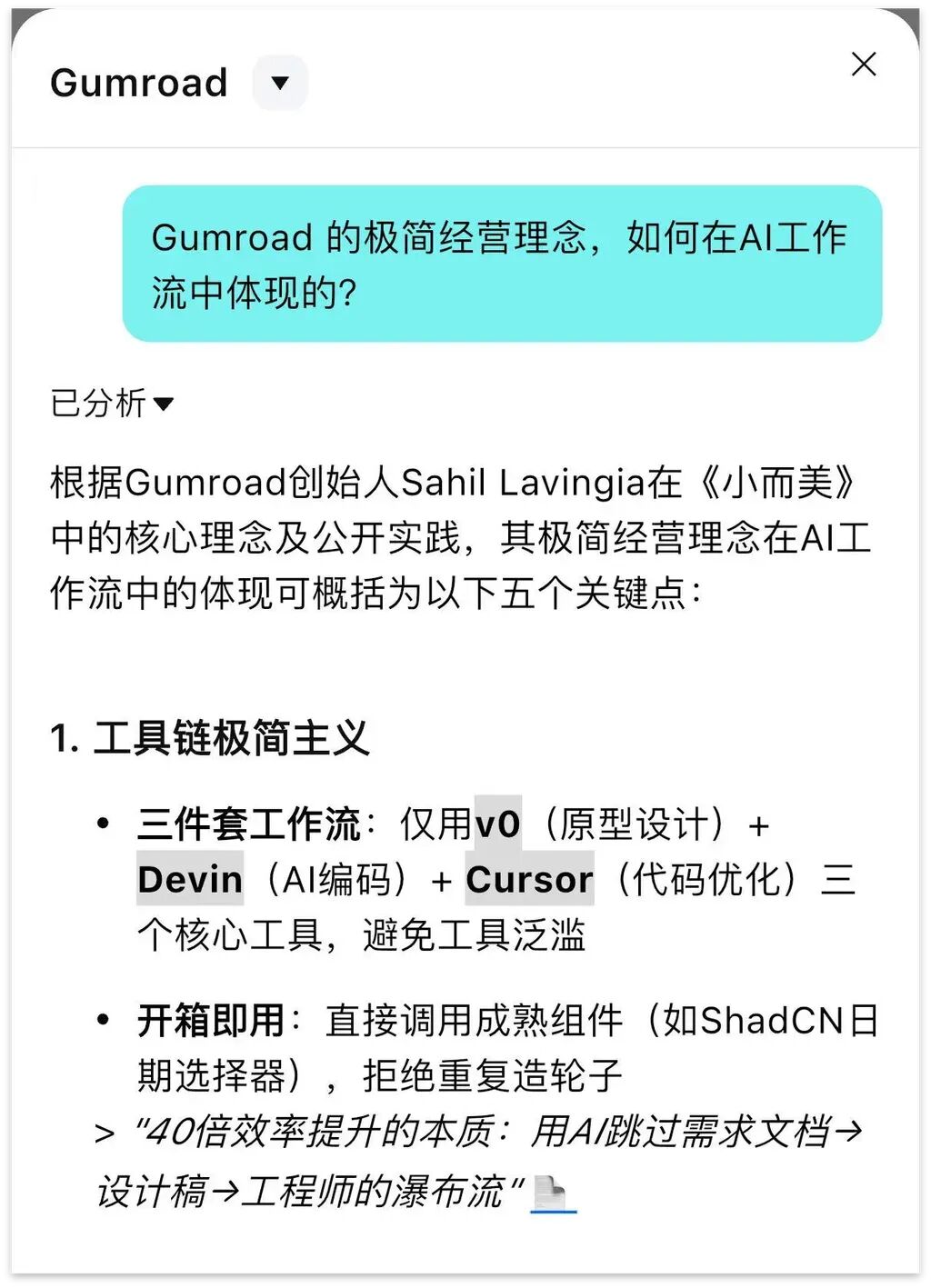
How does Gumroad founder Sahil Lavingia's minimalist business philosophy manifest in AI workflows?
Since my recorded Sahil Lavingia podcast and interview content mainly covers AI workflows, while The Minimalist Entrepreneur focuses on minimalist management principles, Shadow AI would need to combine the AI summaries of the recordings with the PDF content of The Minimalist Entrepreneur to "seriously answer" this question.
In the end, it successfully produced a structured brief that quickly organized the relevant information, with source links provided for easy one-click navigation.
For example, the 📚 icon next to "Essence of Minimalism" below jumps directly to the PDF file:
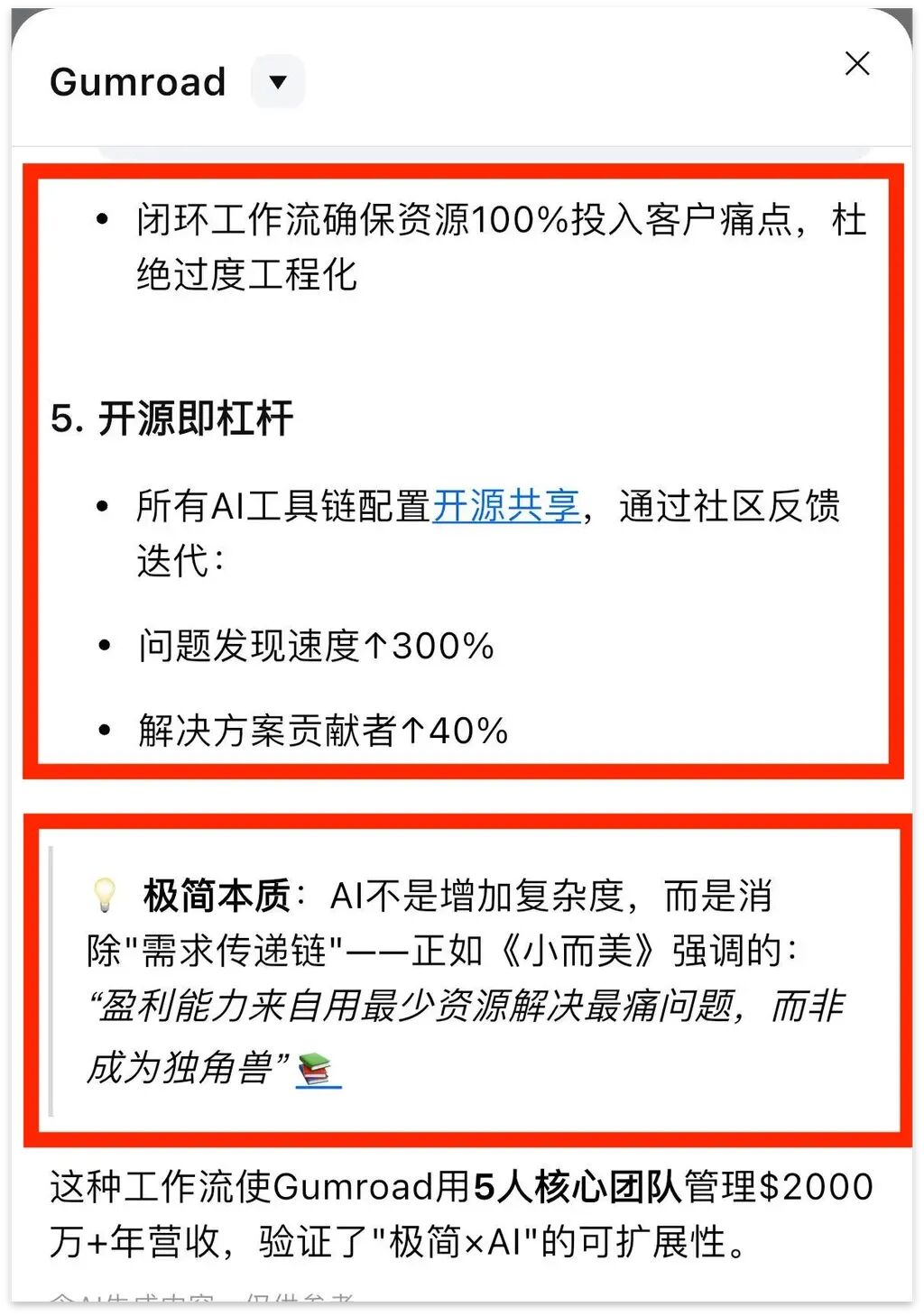
From a basic Lenny's Newsletter interview recording with Sahil Lavingia to a full panoramic understanding of Gumroad — the entire process basically unfolded within 30 minutes of finishing the podcast.
Some "Small" Ways to Use TicNote
Beyond "Meetings" and "Study With Me," we also discovered some creative use cases.
For example, since the TicNote sits on the back of my phone without feeling obtrusive at all, I just carry it around all day, recording my "self-talk" and "random ramblings," then check it once before bed each night.
Shadow AI organizes my stream-of-consciousness with surprising care. Even when I'm not deliberately asking it to build a daily plan, the AI picks up on things accurately:
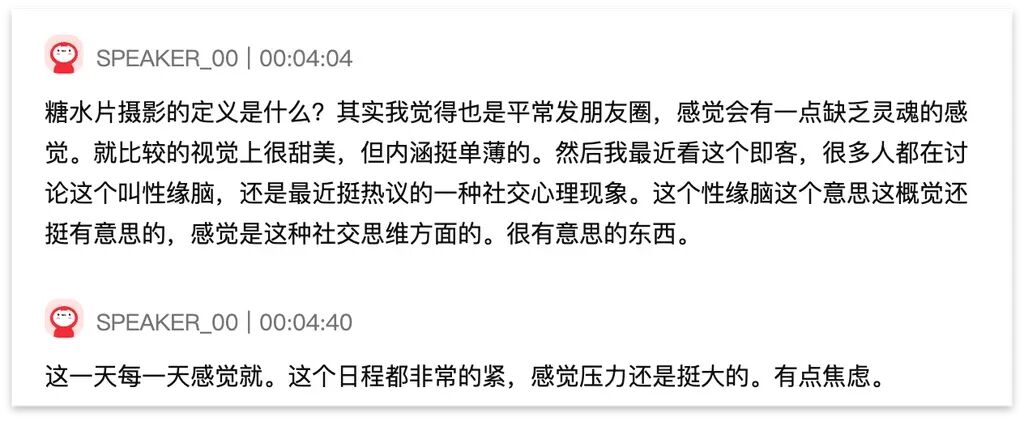
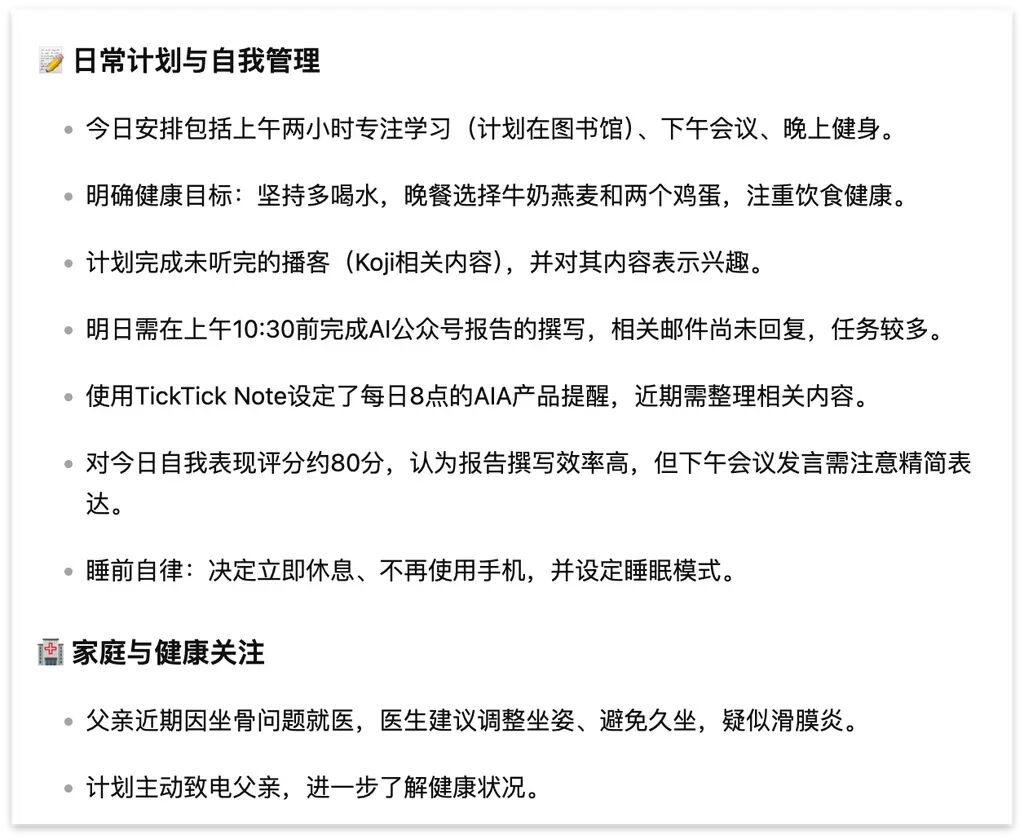
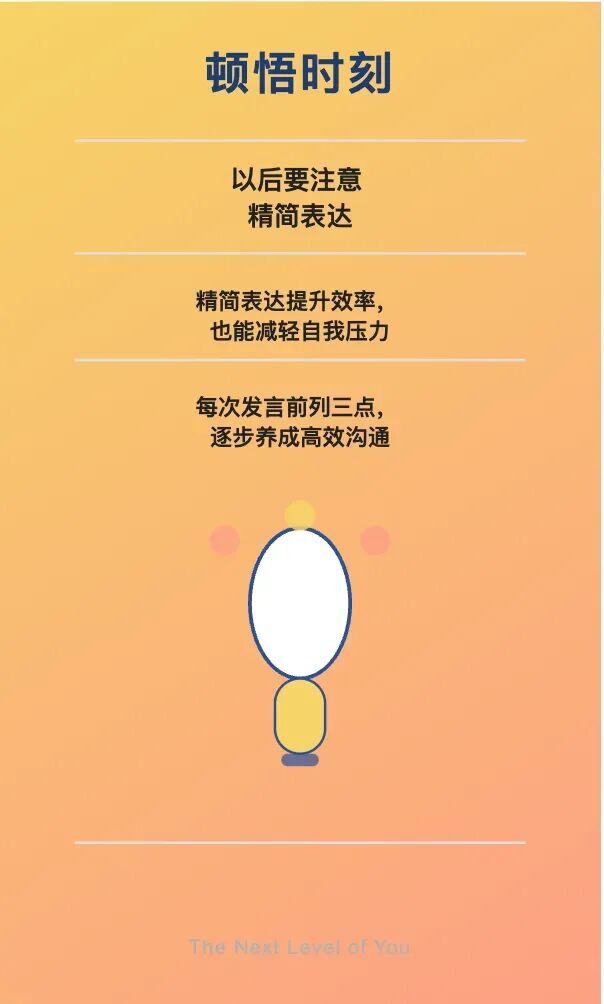
Finally, I'll look at whether any "epiphany" moments yielded real insight — like when it noticed I'd "reflected on rambling too long during a meeting," flagged it as significant, and suggested I revisit it (going forward, I'll work on being more concise):
As an AI recording device, TicNote's greatest advantage is "AI-augmenting" the user's capabilities.
The specific path: getting AI-enhanced information in a very short time, rather than a pile of raw material — hours of audio, dense pages of transcript.
This means users can work and study more efficiently, acquire knowledge faster, and redirect that saved time toward more valuable thinking and application.
TicNote retails in China for ¥999 or ¥1,499, including 3 months or a full year of Pro membership, with 1,500 monthly credits that get consumed when using AI features.
Many AI products are fighting for our attention, trying to become the next "must-have."
But for productivity-focused AI hardware, "not creating new use cases, but making existing ones smarter" might be the right way to think about it.
Judging from the actual integrated software-hardware experience, TicNote does exactly what a "carry-anywhere AI thinking partner" should do.
It leaves us more energy for what actually matters:
Thinking, creating, and connecting with people.
For the question of "How should AI hardware integrate into our daily lives and workflows?" we don't have a definitive answer yet. But with each deep-dive experience, we're trying to trace the outline of one.
The Crossing team will continue tracking new AI hardware and bringing you hands-on reviews.