After using this Doubao feature in depth, I'm a little envious of students today
When AI Learns to "Not Give the Answer Directly"
When AI Learns to "Not Give the Answer Right Away"

👦🏻 Author: Jack
🥷 Editor: Koji
🧑🎨 Layout: NCon

This past January, Elon Musk sat down for a 173-minute conversation on Moonshots #220, a podcast hosted by Peter Diamandis.
One of his points landed like a gut punch: the only reason to go to college in the future might be the social experience — being physically present among peers, in an environment where you can talk, compete, and influence one another.
As for the knowledge itself, Musk put it bluntly: "Let AI handle it. It will absolutely do a better job than human teachers!"
The reasoning is simple but brutal: a human teacher stands at the front of a classroom facing dozens of students with wildly different aptitudes. The fast kids are bored out of their minds, the slow kids are hearing gibberish, and the ones who don't understand are often too intimidated to even raise their hands.
AI is different. It never loses patience, and it never thinks you're stupid. You ask exactly what you don't understand, and it answers.
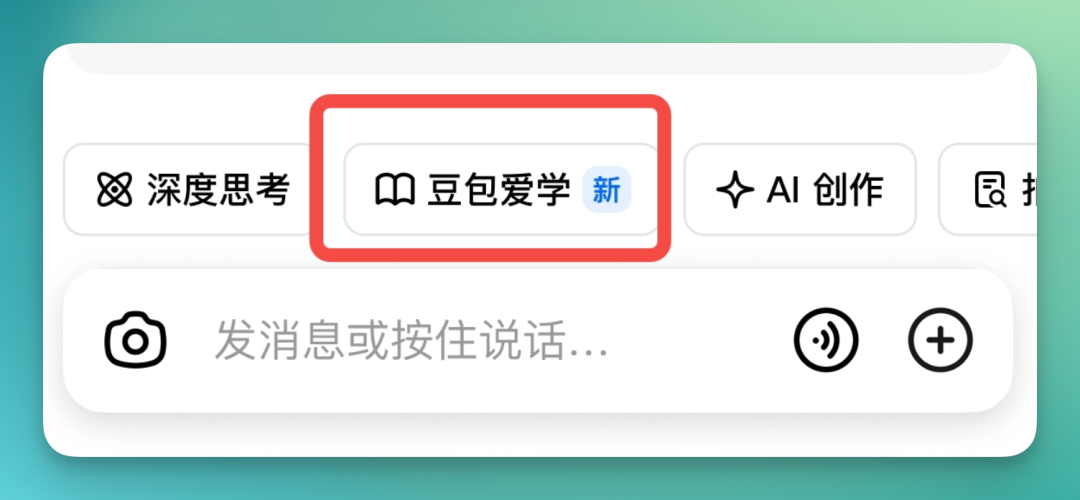
🚥 Recently, the Crossing content team tested "Aixue," a feature inside the Doubao app.
After several days of deep exploration, we came away with one clear impression:
AI is moving beyond "giving the answer right away" and starting to act like a real teacher — one who holds your hand through the learning process.
From Photo-Searching Homework to Photo-Explaining Homework
For years, homework-search apps have been the most deeply penetrated education tools.
Stuck on a problem? Snap a photo with your phone, and within seconds, the step-by-step solution and standard answer appear on your screen.
But when "Aixue" is handed the same problem, it does something completely different. We photographed this junior high geometry problem with "Aixue":

Then it began to understand the problem, identify the relevant concepts, and structure its explanation.
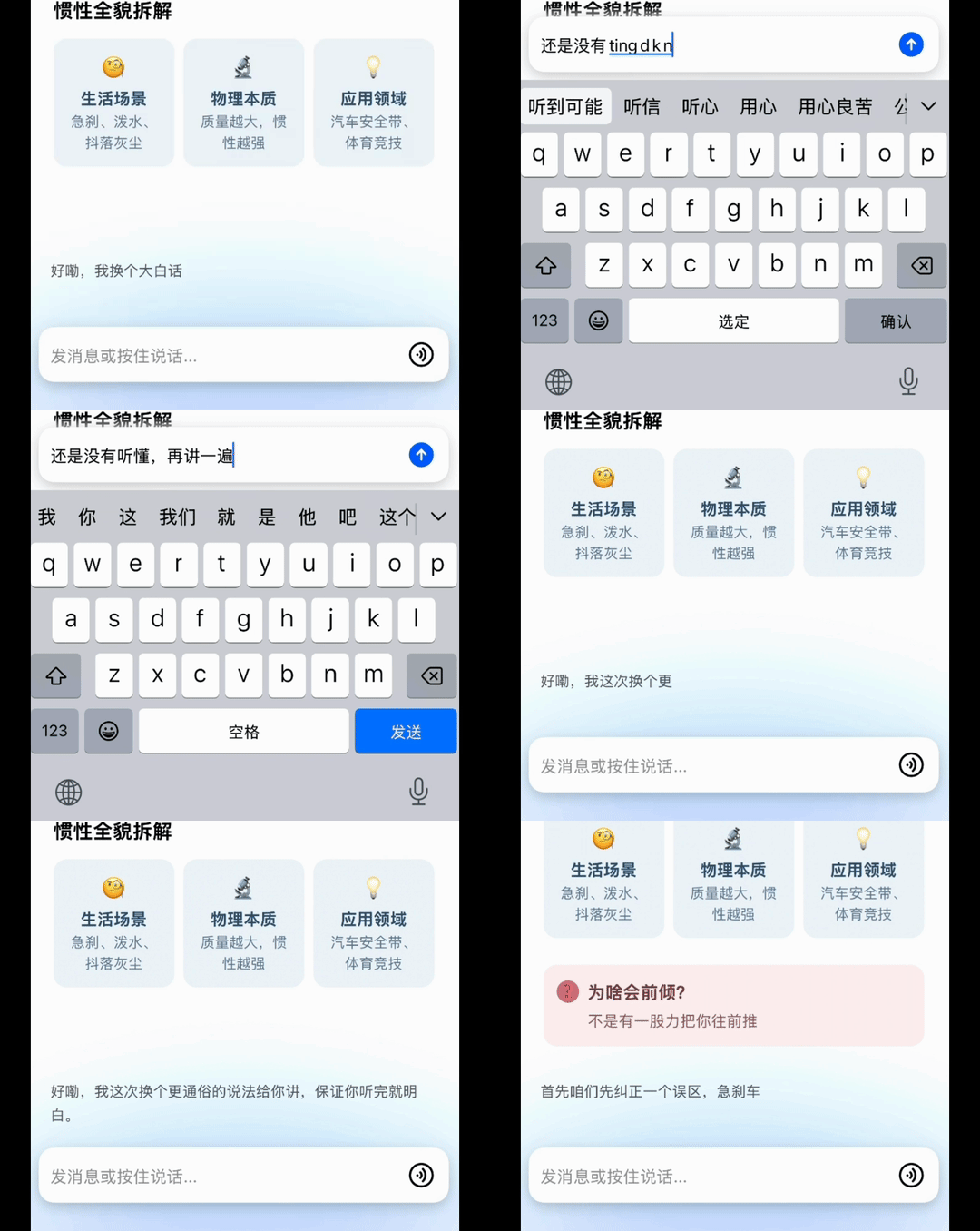
As you can see, it doesn't serve up the answer directly. Instead, like a human teacher, it guides you step by step, waits for your questions, and adjusts the pace and content based on your feedback.
During this process, it even proactively asks: "Do you remember this formula?" "Did you follow this shortcut calculation?"

What if you still don't get it after the first round? You can simply speak into the chat box and interrupt at any time. It will reorient and walk you through it again — a level of patience that human teachers don't always have.
The logic of traditional homework-search apps is: You don't know, so I tell you the answer. The logic of "Aixue" is: You don't know, so I guide you to think and help you figure it out.
The difference between those two words — "tell" and "think" — may be the dividing line where AI education crosses over from being a tool to becoming a teacher.
The Blackboard Follows the AI Teacher Wherever It Goes
Voice explanation alone isn't enough.
The reason many subjects are hard isn't that the words are difficult — it's that the concepts are abstract. You understand every word, but you can't assemble the picture in your head.
This is a problem traditional online education has never fully solved: the teacher is talking, the student is listening, but there's no blackboard in between.
"Aixue" fills in that missing blackboard. During its explanations, it generates visual blackboard notes in real time.
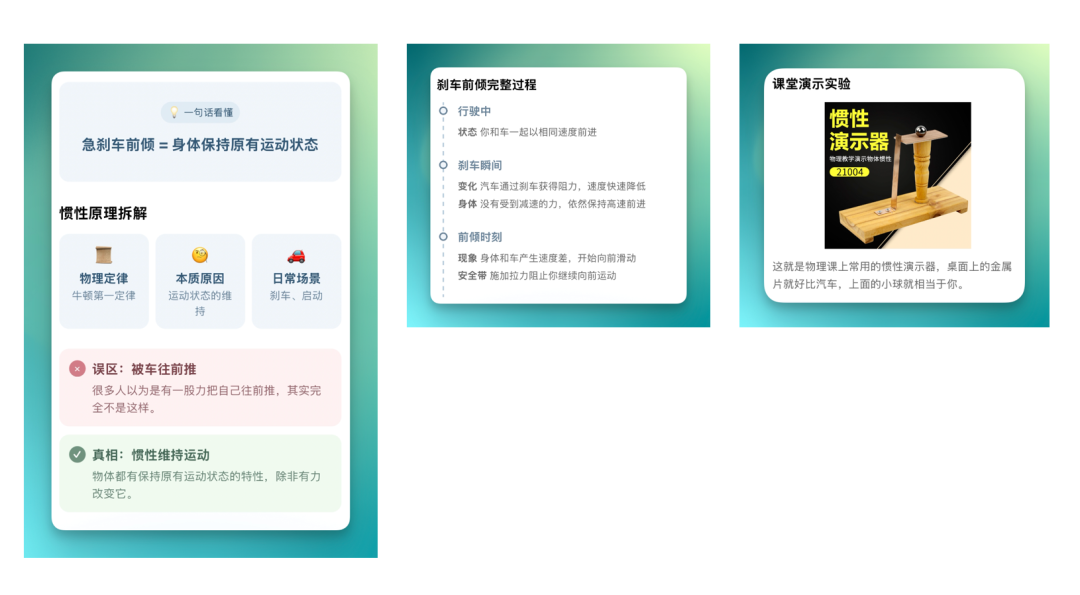
We tested it with this fun physics question: "Why does your body lean forward when a car brakes suddenly?"
Why does your body lean forward when a car brakes suddenly?
First, it precisely identified the classic physics concept behind the problem: inertia.
But it didn't lead with the definition. Instead, it reconstructed the full process of sudden braking: before the brake, during the brake, the body leaning forward — letting you see the phenomenon before you understand the principle.
It even took a moment to correct the most common everyday misconception about this phenomenon.
The entire blackboard is generated in sync with the AI teacher's voice. Wherever the explanation goes, the diagram follows.
Compared to listening to a voice recording alone, this "listen while watching" rhythm is genuinely easier to follow. You can get a feel for the whole process in this screen recording:
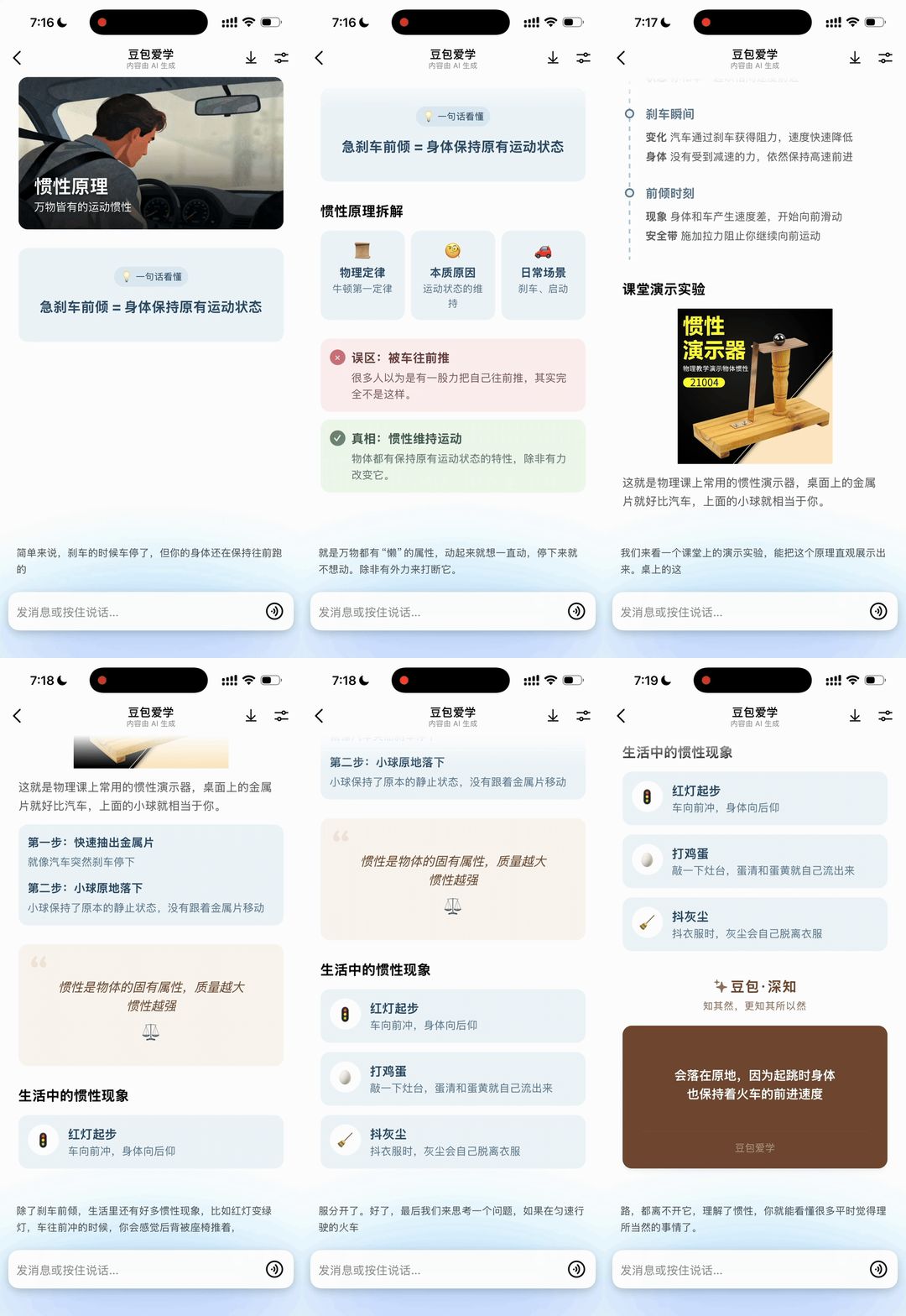
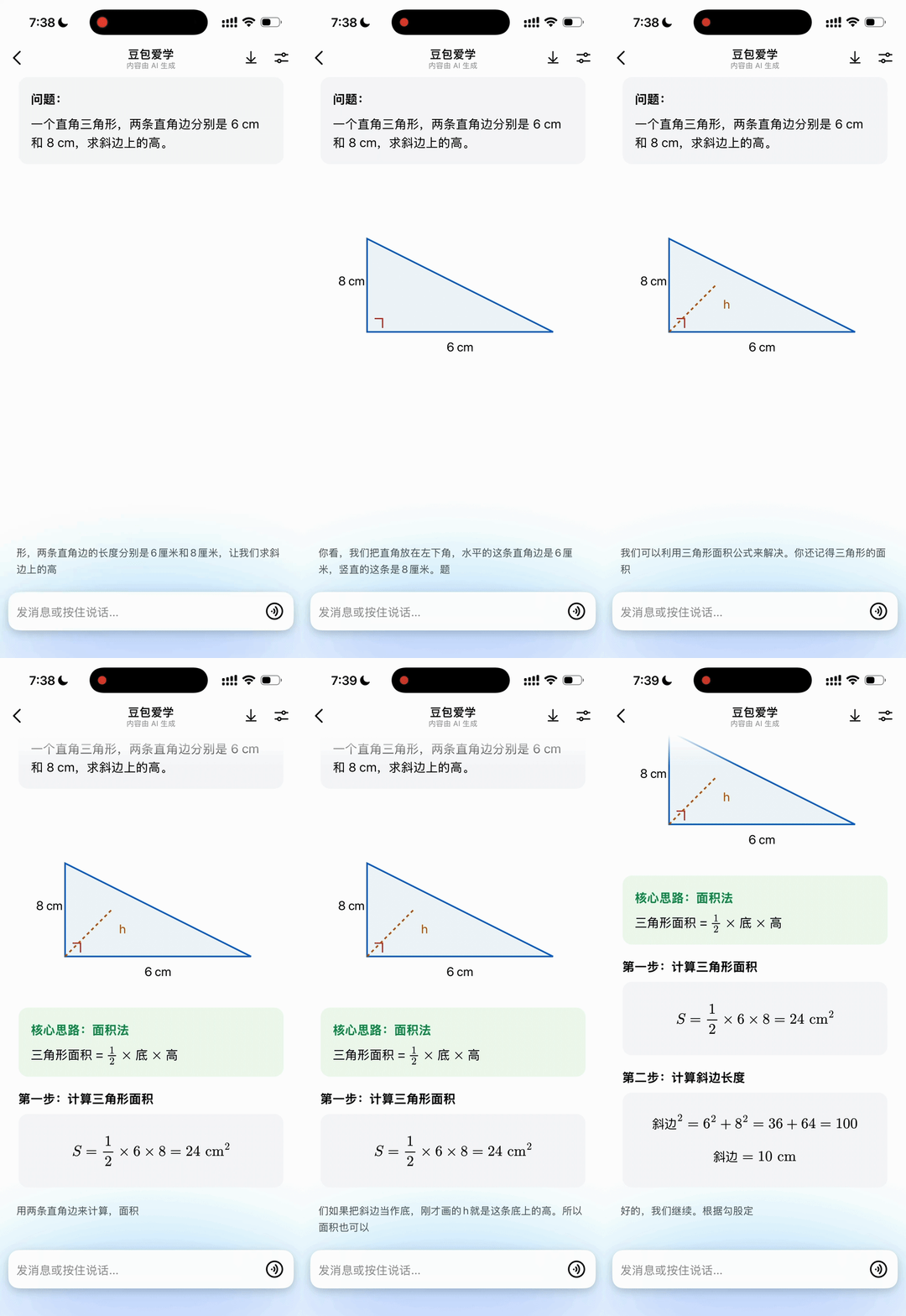
Here's another example with a geometry problem's blackboard notes — how to draw auxiliary lines, how to decompose area, how to substitute equivalent quantities, all broken down step by step with diagrams:
A right triangle has two legs of 6 cm and 8 cm. Find the height on the hypotenuse.
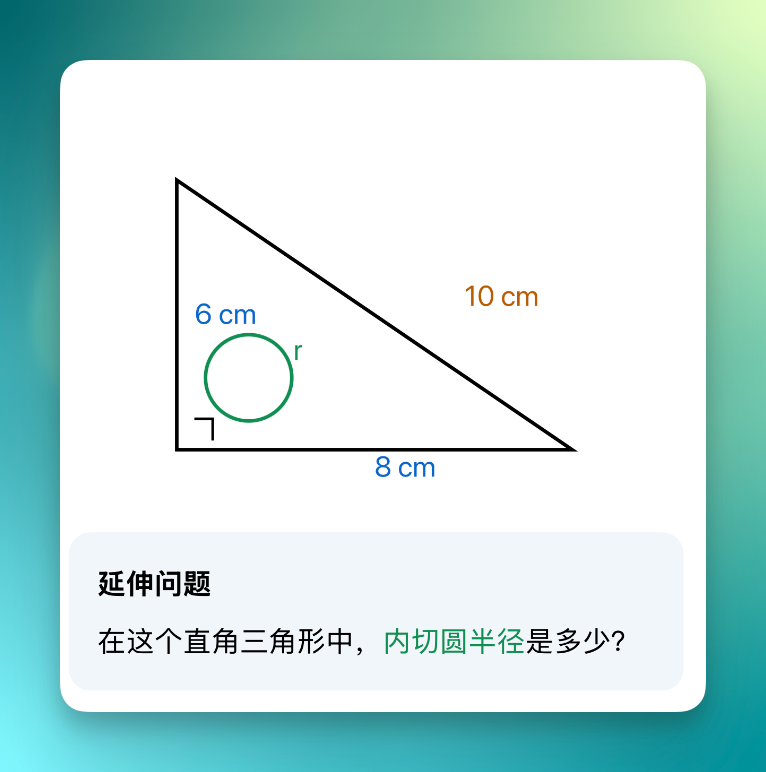
And it doesn't end when the explanation ends. After each round, it proactively throws out an extension question: "Do you know what an incircle is? What's the radius of the incircle in this right triangle?"
It doesn't let you stop at "I can solve this problem." It pushes you one step toward "I can solve this type of problem."
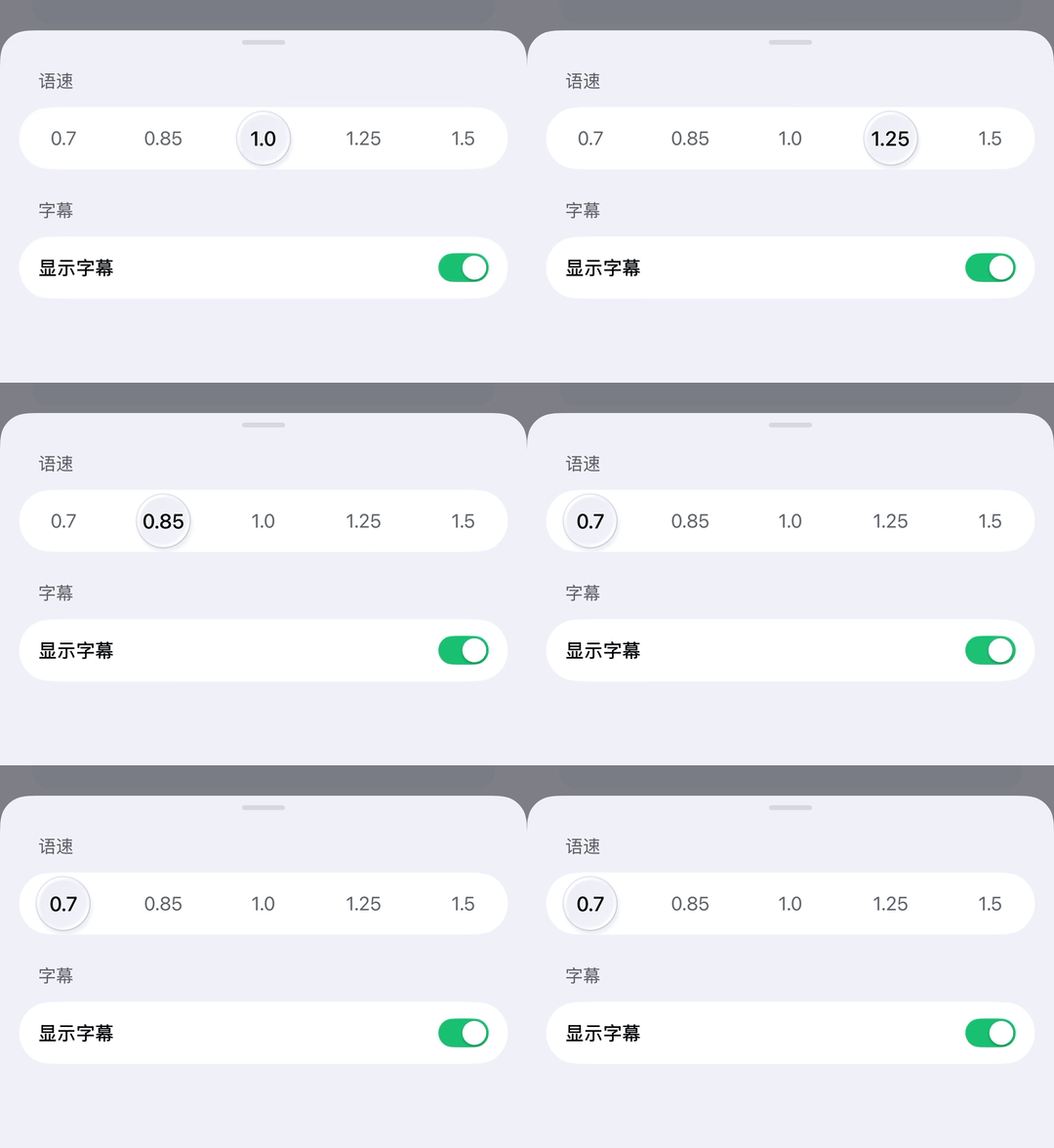
The voice delivery deserves mention too. You can adjust the speaking speed yourself — slow it down if you can't catch it, speed it up if it feels wordy.
More interestingly, it supports regional dialects. We tried having it explain the law of inertia in Northeastern Mandarin — the effect was hilariously addictive. Cantonese and English are also supported. For English subjects or users who think more naturally in their native tongue, this detail is surprisingly practical.
After experiencing this "intelligent blackboard," our takeaway was: It's like stuffing the best blackboard from the best classroom into your phone.
Think about it — what's the biggest regret of traditional classrooms? It's not that teachers aren't good. It's that one teacher has only one blackboard and one pace, yet faces dozens of completely different brains.
What "Aixue" is essentially doing is giving everyone their own personal blackboard, plus a teacher who's always willing to explain it one more time.
Not Just Answering Questions, But Chatting "Encyclopedia"
If you think "Aixue" is limited to photographing and explaining problems, you're selling it short.
What really struck us as interesting: you can ask it any "why" question. Not limited to textbooks. Not limited to subjects.
For example, we tried a question that a kid might ask at the dinner table but that most adults would struggle to explain clearly:
Why can airplanes fly when they're so heavy?
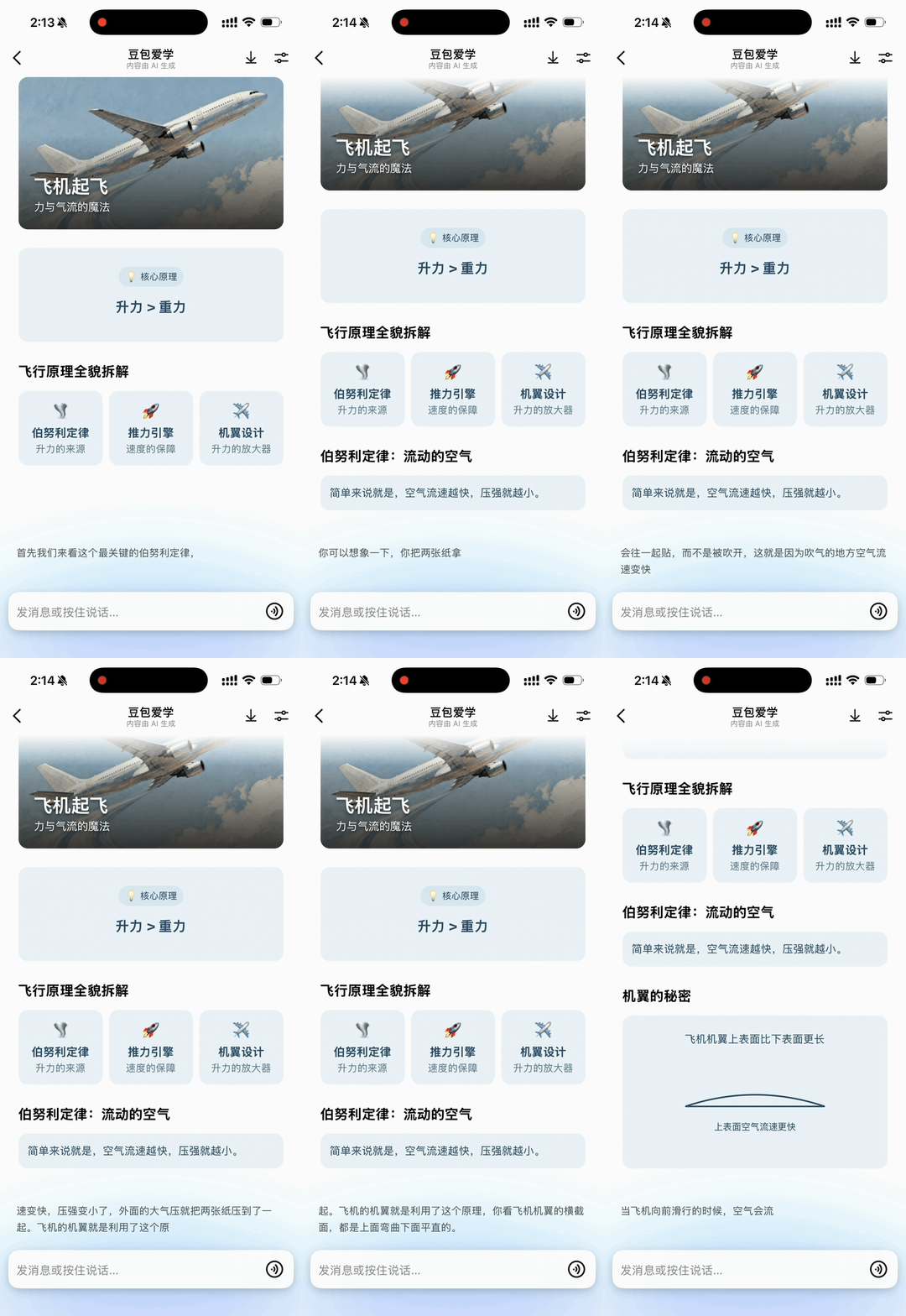
It didn't lead with a definition of Bernoulli's principle. Instead, it started from a life scene: "What happens when you blow on a piece of paper with your mouth?" From there, it built step by step to the shape of a wing's cross-section, the difference in airflow speed, and the generation of lift.
The whole explanation had imagery, had rhythm — an elementary schooler with no physics background could follow it.
We tried something even more wildly imaginative:
What would happen if the Earth suddenly stopped rotating?
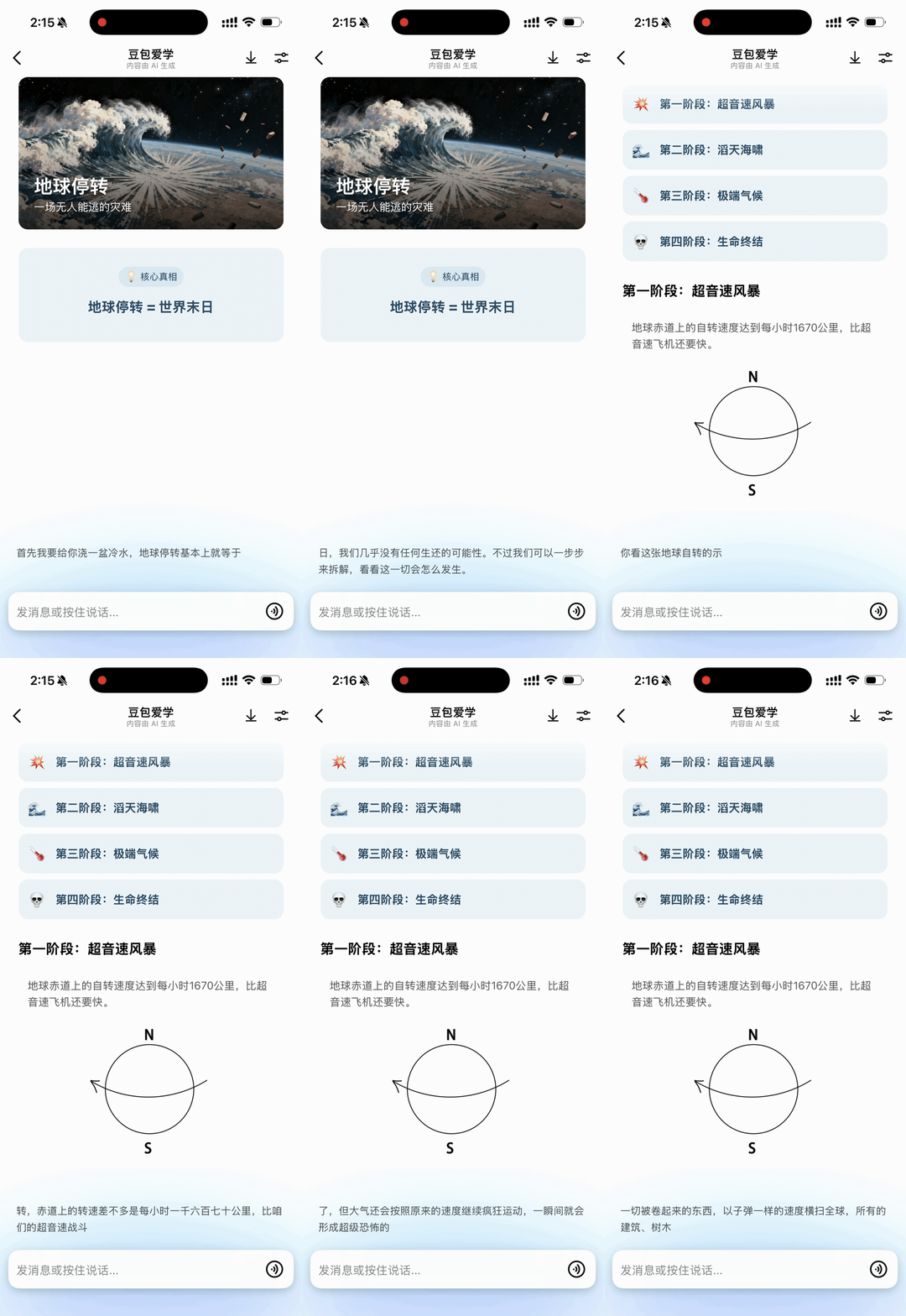
There's no standard answer to this kind of question, but "Aixue" handles it cleverly:
As you can see, it still breaks down the structure, pairs it with blackboard notes, and offers extensions — the same logic as when it explained the math problem.
This capability stretches "Aixue's" use cases wide: it functions more like an encyclopedia teacher who's always available to chat through "why" questions with you.
From "Why do mosquitoes always bite me and not other people?" to "What's at the end of the universe?" — it can engage with all of it.
🚥
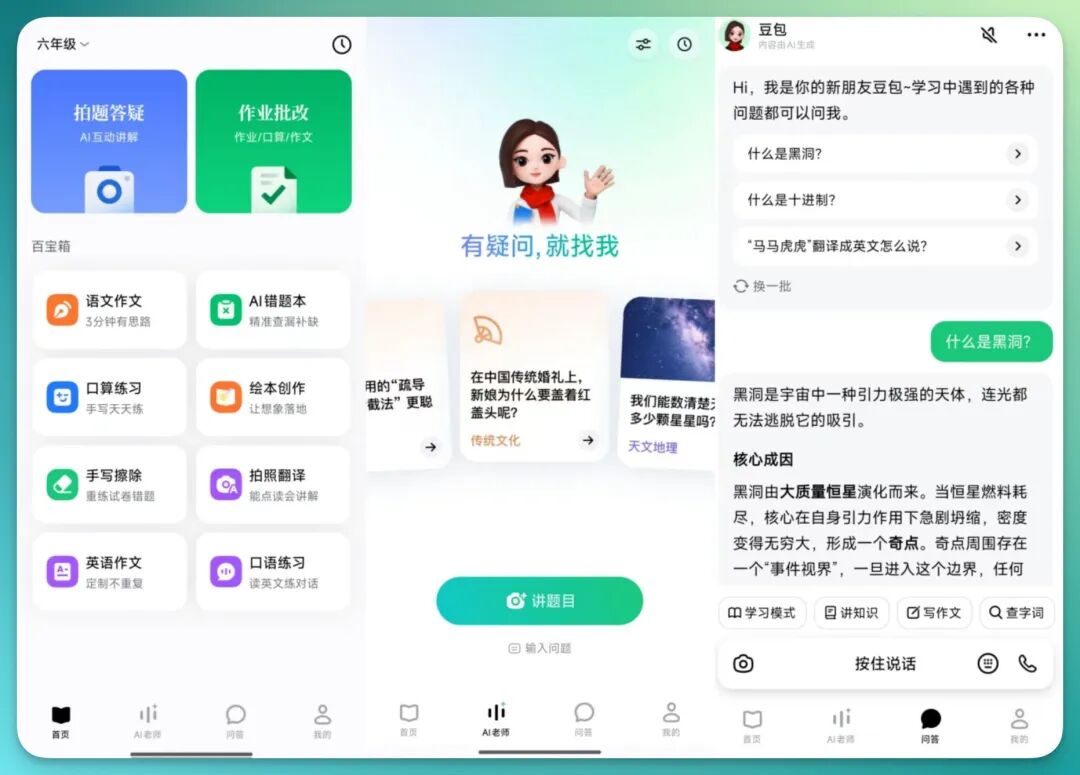
Worth noting separately: "Aixue" also has a standalone app. Beyond the core AI teacher capabilities, it fills in everyday learning scenarios like homework grading, AI-powered error notebooks, and essay tutoring.
People have been talking about AI in education for years. Most products end up becoming faster search engines.
"Aixue" points in a different direction: it's not rushing to give you the answer. It wants to first confirm that you actually understand, and keep you company until you truly do.
Returning to Musk's opening prediction: AI will do a better job than human teachers.
That may still be premature. But there's one thing AI has already accomplished that most human teachers find genuinely difficult:
Treating every single student with the same patience, no matter how many times they ask.
That alone makes it worth taking seriously.