We Are Witnessing the Birth of "A Thousand Vertical Agents" | When Building Becomes as Simple as Snapping Together Blocks, Innovation Will Bloom Everywhere
A breakthrough is underway: a hundred flowers blooming, a hundred Agents contending.
The Breakthrough Underway: A Hundred Flowers Bloom, a Hundred Agents Compete.

👦🏻 Author: Jingshan
🥷 Editor: Koji
🧑🎨 Layout: NCon

"From generative AI as a not-so-smart 'hammer' in users' hands, to Agentic AI working to build users a hammer that actually works" — this is the paradigm shift we witnessed firsthand at the dawn of 2025, the Year of the Agent.
At the Volcano Engine Force Conference these past two days, we saw a critical inflection point in Agent construction:
From "wild growth" toward "systematic engineering," Agent democratization is happening, and Agent development is going mainstream.
The protagonists at this inflection point are ordinary developers with industry insight and business needs.
At this conference, one concept was mentioned repeatedly and woven throughout the entire Agent development system:
🚦
AI Cloud-Native
What Is AI Cloud-Native?
The AI cloud-native philosophy has been evolving alongside shifts in the AI paradigm. At its core, it emphasizes the "deliverability" of AI Agents.
Simply put, AI cloud-native is a development philosophy that Volcano Engine keeps returning to: providing a complete end-to-end platform to achieve "Agent democratization" where technology is product and service.
Before the Year of the AI Agent, AI's goal was merely to become "a better hammer in users' hands"; after the dawn of this new era, Agentic AI's goal is to "become the user's helper, building hammers that actually work."

Volcano Engine's AI cloud-native philosophy continues to evolve with the AI paradigm:
Late 2024: The future of applications is inference; the core of AI is GPU. Early 2025: Large models at the center. Now: Doubao large models + AI cloud-native
In its current form, AI cloud-native aims to let individual developers and enterprise users build their own intelligent Agents through radically simplified methods, with one-click access to Volcano Engine's rich cloud services as "backup power."
However, this goal isn't easy to achieve, because building high-performance Agents requires mature AI coding platforms, MCP, and cloud service support.
But once connected, we'll witness:
Agents that once grew wild will gradually evolve into orderly, civilized Agents, unlocking more entrepreneurial possibilities.
Below, Crossing will walk through a simple, intuitive Agent development experience to explain in detail:
Why we believe the "wild growth period" for Agents has ended, and systematic engineering has begun.
The "Wild Growth Period" for Agents Is Over
An Agent capable of efficiently executing long-term tasks with clear deliverability typically covers the following workflow:
-> Define tasks and scenarios -> Design prompts and conversation flows -> Integrate required tools/data -> Call large models for inference execution -> Obtain results and iterate.
Now, we're seeing Volcano Engine dive deep into each of these steps, rolling out supporting products and services.
Using TRAE (ByteDance's AI coding IDE that blew up domestically and internationally) as the development environment entry point, we can already clearly see a complete AI cloud-native Agent development paradigm taking shape:
- Development environment: TRAE
- External functional extensions: Third-party functional MCP + cloud service MCP
- Foundation model: Doubao
To give a concrete example, Crossing frequently organizes team-building activities and business trips, so internal flight booking standards are critical. Based on this, we planned to build a customized flight booking Agent exclusively for Crossing.
Next, I'll use TRAE as the AI coding development environment to give you an intuitive feel for the Agent development workflow under AI cloud-native.
1) Building Basic Functions
The current AI IDE TRAE already integrates a dedicated MCP function module, embedding numerous MCP Servers:
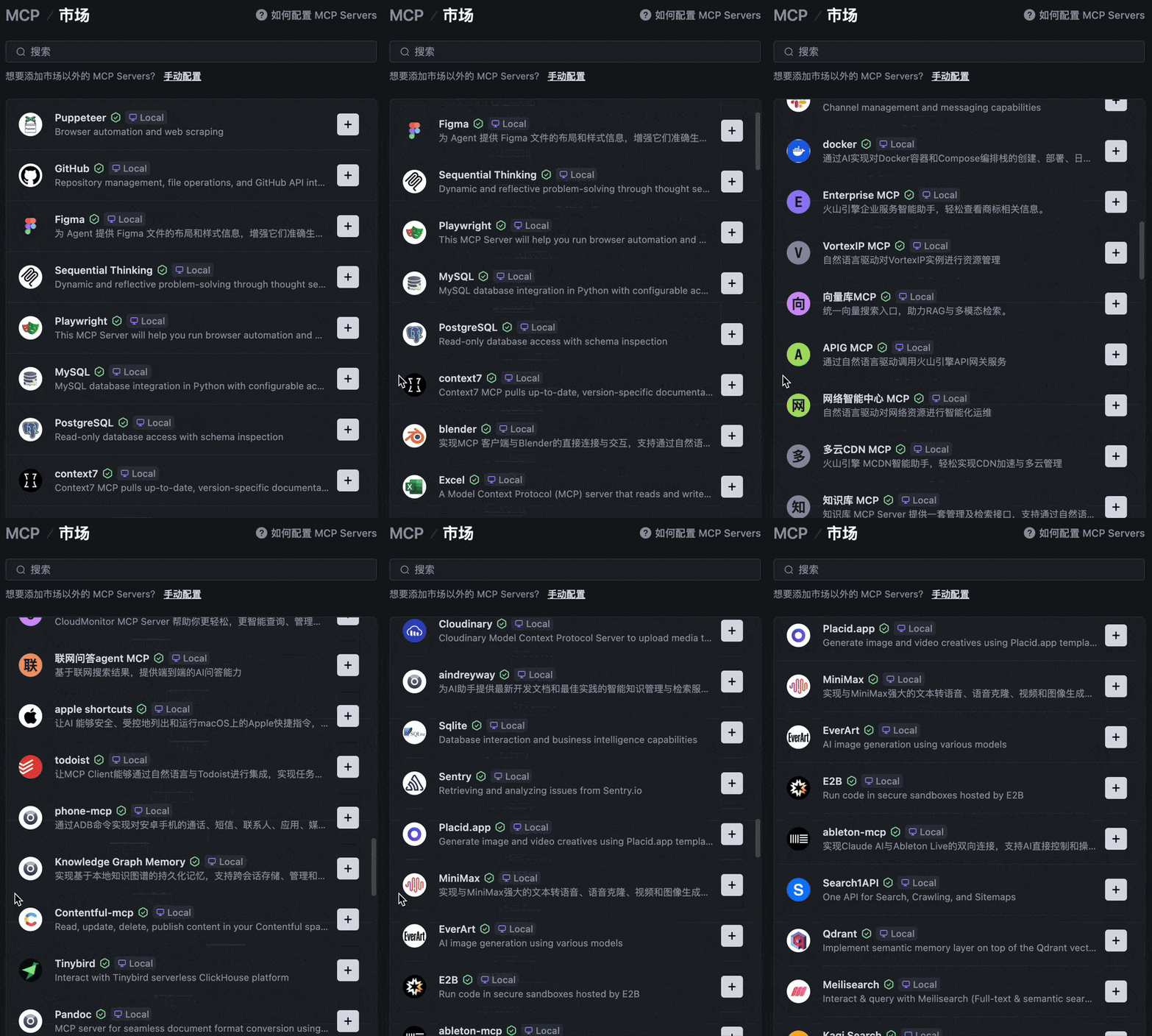
These MCP Servers can be configured with one click through TRAE's internal official platform, or manually configured — both are extremely simple, basically requiring only the target MCP Server's API.
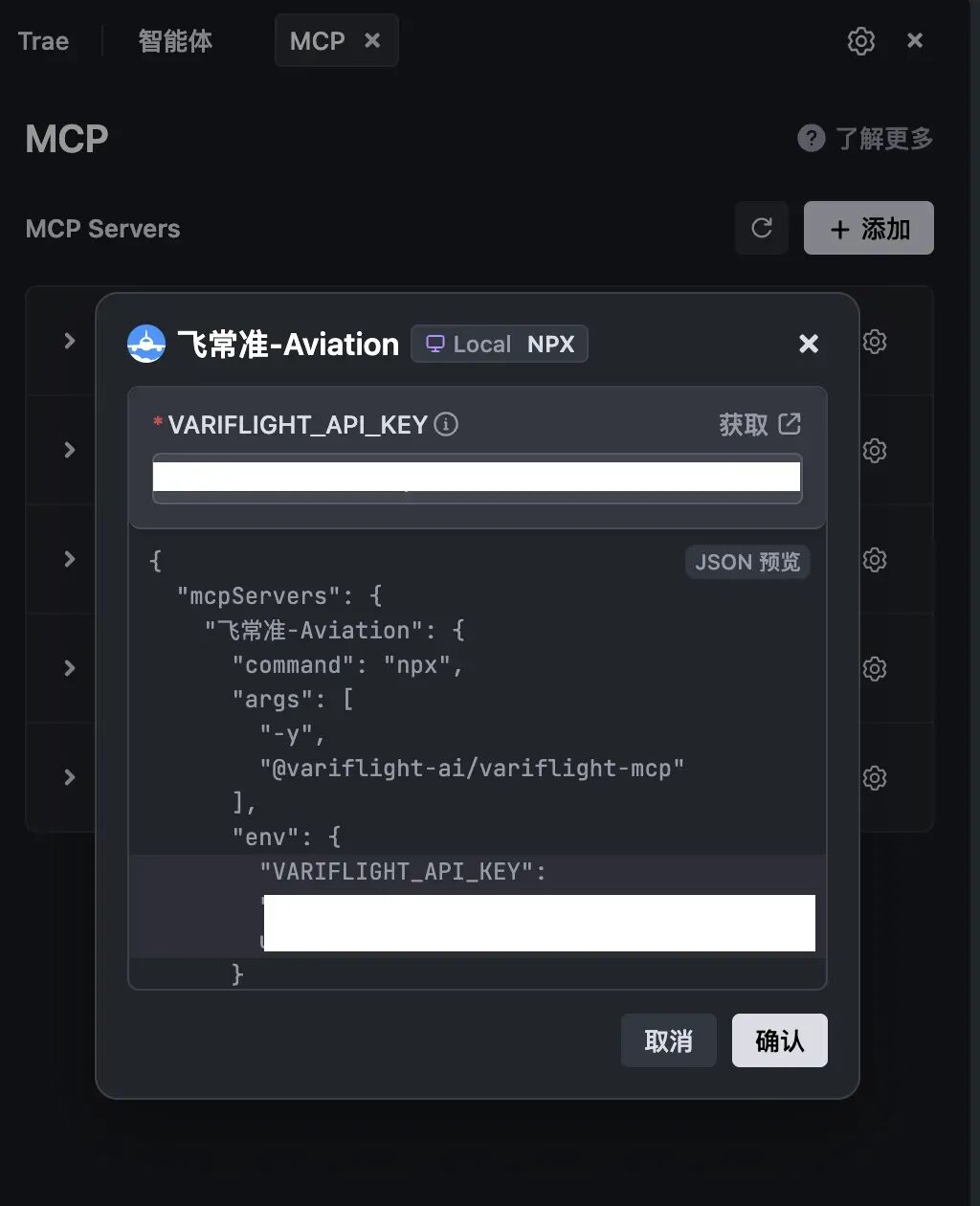
For example, MCP: Feichangzhun-Aviation can be integrated with any flight-related information in a very lightweight way, such as flight status, comfort analysis, ticket prices, real-time tracking, airport weather, and more.
You can directly search for any MCP you need in the MCP marketplace, then register an account on the corresponding official website, obtain the API, and confirm with one click.
2) Team-Oriented Cloud Services
Volcano Engine provides a complete, comprehensive suite of cloud services for individual developers, teams, and enterprises.
Moreover, since Agents have become products with "deliverable capabilities," these cloud services have "joined" the Agent development ecosystem in the form of MCP.
So we can extend this further by adding Volcano Engine's own cloud service MCP, which is also their core value-add — the LAS MCP. This MCP lets us directly upload local data to Volcano Engine's AI data lake service.
Simply put, it allows private multimodal data to be uploaded to the cloud, then "amplified layer by layer."
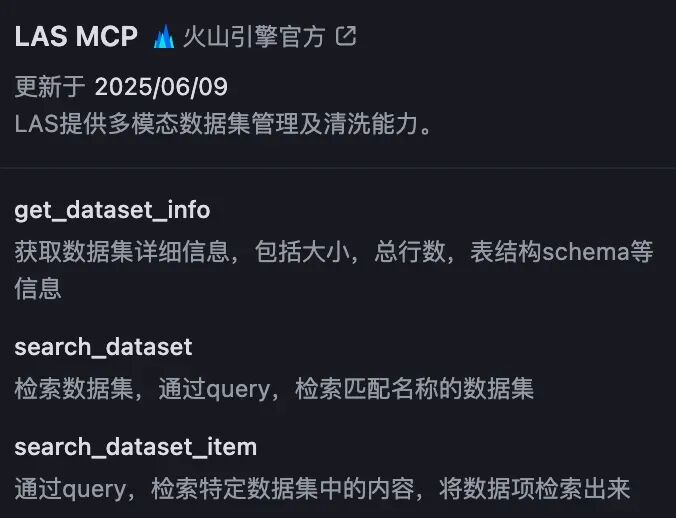
The essence of LAS service is that enterprise data can be moved to the cloud in one step, then called upon and managed within a self-developed Agent with one click. This largely deconstructs the necessity of "local deployment" for large models.
For example, I first created an internal flight policy document for Crossing:

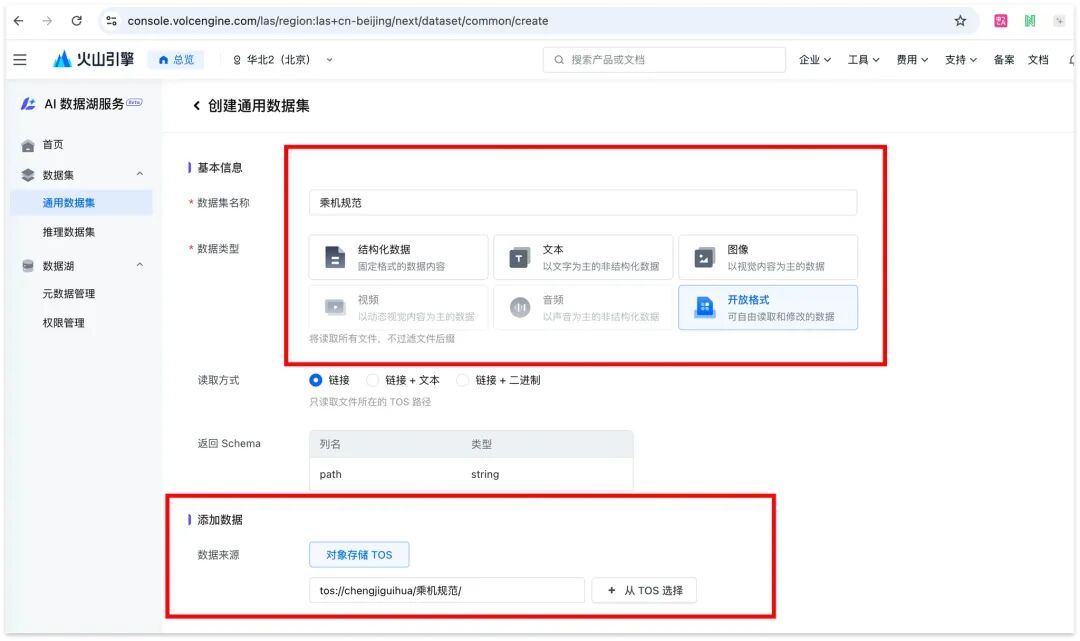
Then I created a general dataset in Volcano Engine's AI data lake, uploaded Crossing's internal flight policy into it, and from there we could automatically leverage this data during Agent creation.
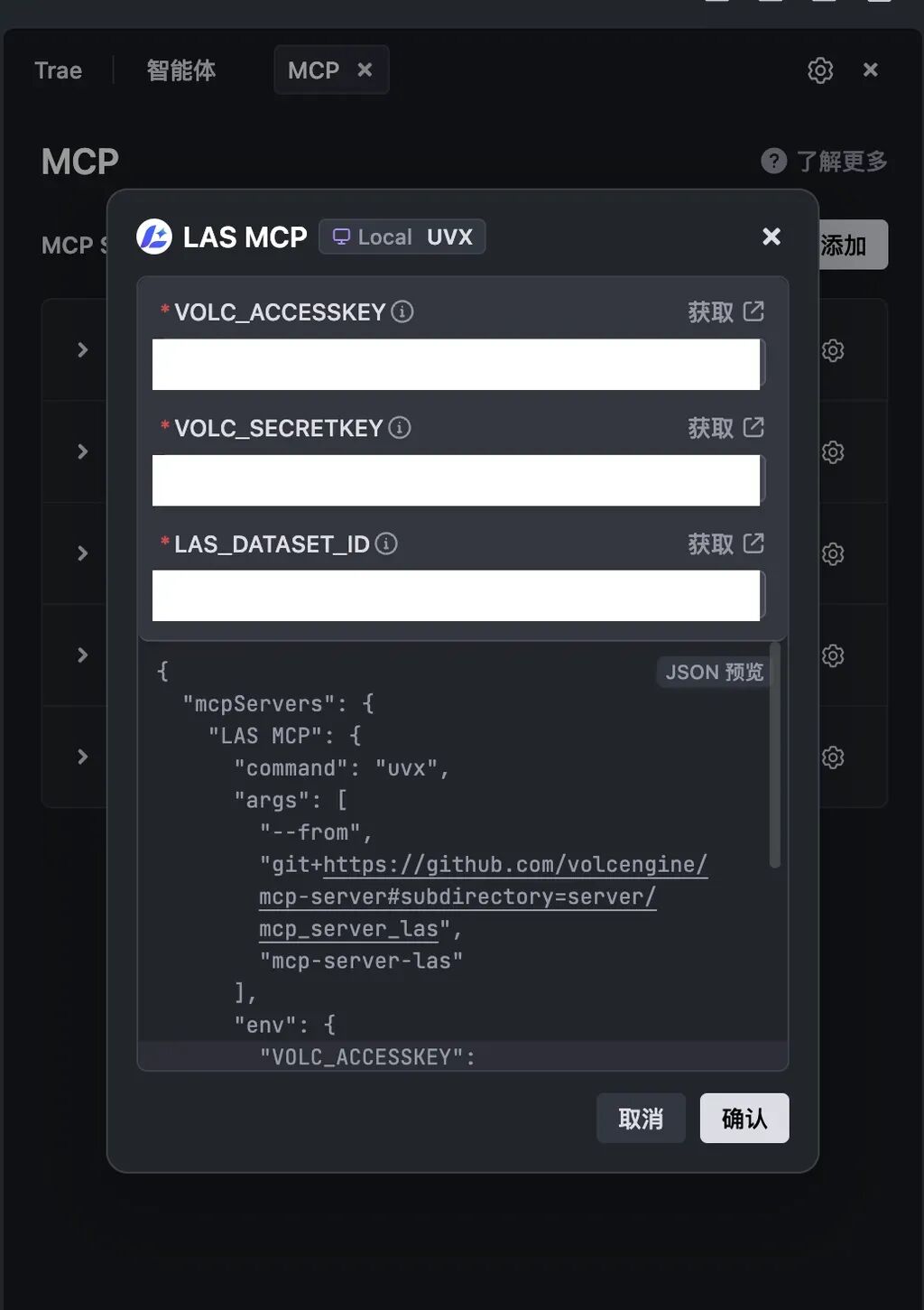
After the cloud data setup, we return to TRAE, enter the Volcano Engine API account and password, input the database ID for "Crossing Flight Policy," and deploy the LAS MCP with one click:
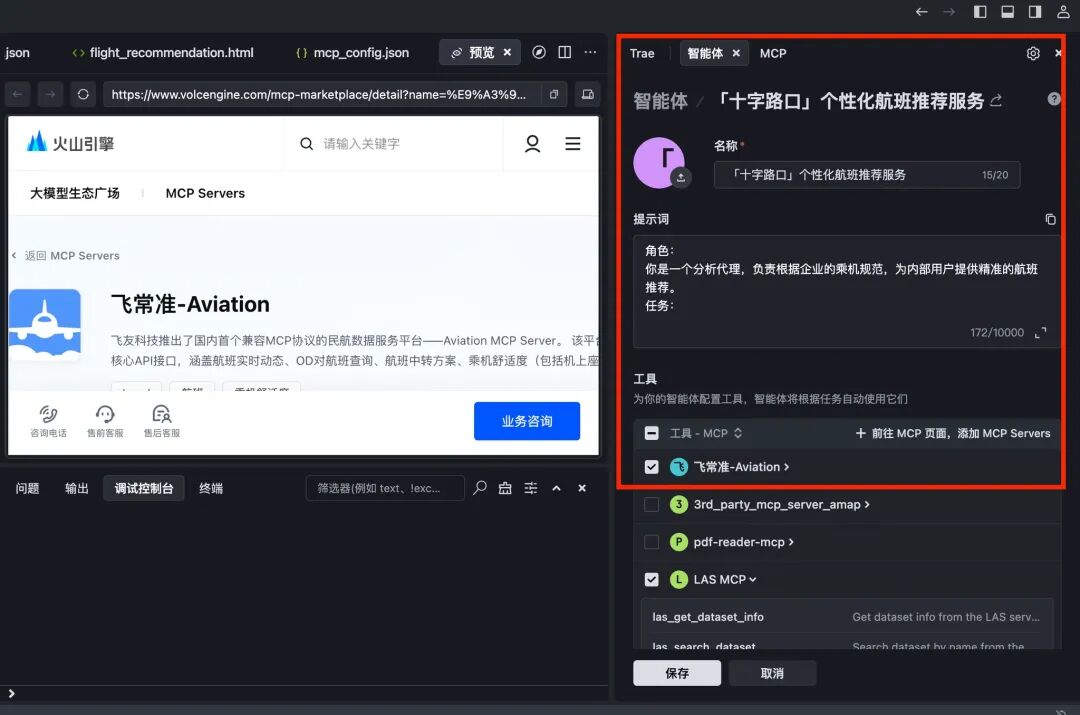
Next, we can directly create a personalized Agent in the "Intelligent Agent" module.
In the prompt section, we need to give this Agent a simple personality.
My prompt is:
Role: You are an analysis agent responsible for providing precise flight recommendations to internal users based on corporate flight policies. Task: Access flight policy information in the general dataset through the LAS MCP service, querying internal enterprise regulations on flight pricing and other rules. Combine real-time flight data from Feichangzhun with internal flight policy information to recommend suitable flights. Based on this information, generate a HTML webpage that displays recommended flight details as comprehensively as possible, with clean and elegant design.
In the "Tools-MCP" section in the lower half of the interface, check all required MCPs, and the framework is set.
Beyond the Feichangzhun MCP, virtually all open MCP platforms on the market can be configured into TRAE and other AI coding platforms with one click: Notion, Lark, PDF readers, Slack, and various platforms developed by geeks.
This paradigm — using AI coding platforms as the development environment and MCP as functional extensions — is the major trend in Agent development.
Once MCP and intelligent agent deployment are complete, Crossing's internal flight recommendation service is basically finished — the entire process takes only a few minutes.
Next, we can act as "internal enterprise users" and directly input requirements:
Find me suitable round-trip flight options from Shanghai to Singapore on June 23 that comply with internal corporate policies.
The embedded Doubao 1.6 model immediately begins Vibe Coding:
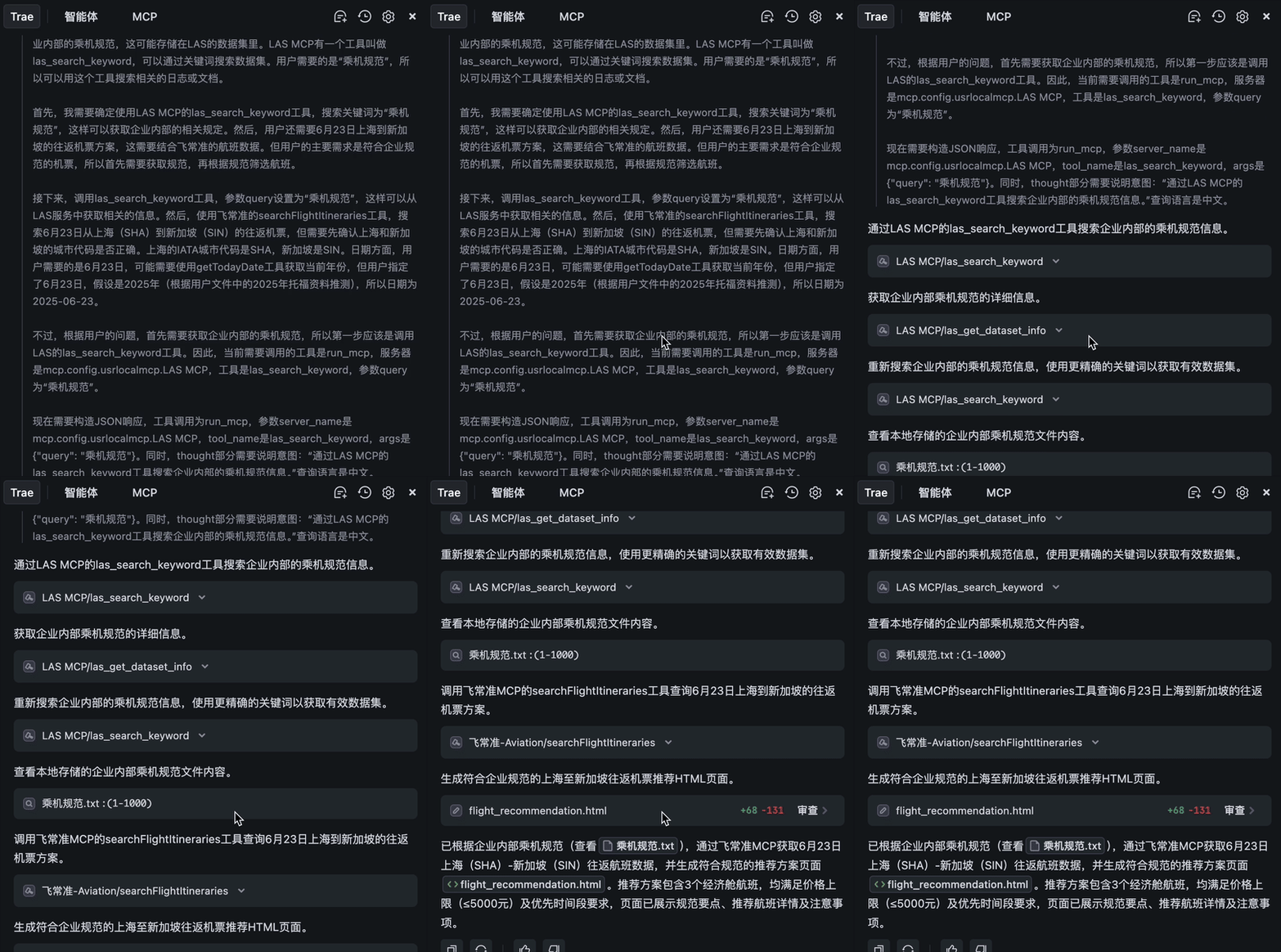
Under Volcano Engine's AI cloud-native workflow, the autonomous Agent's business process flows very smoothly.
For instance, it first uses the various tools built into LAS MCP to search for internal flight policy information:
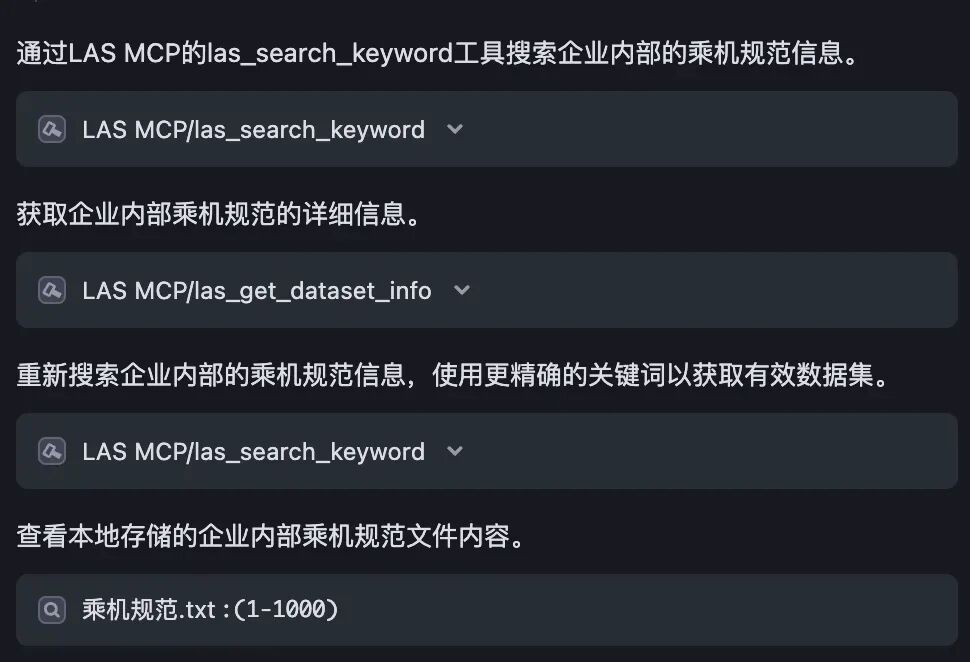
Then, the Agent can begin autonomously using the Feichangzhun MCP to search for information based on the flight policy:

Finally, a visualized Shanghai-Singapore round-trip flight recommendation is presented:

Going further, this type of Agent development is actually very suitable for enterprise teams.
For example:
Multiple employees have different business deadlines on June 21-23 and are located in different Chinese cities. Design individual flight plans for them that comply with flight policies.
Thereafter, Crossing's internal customized flight Agent recommended flights for each person based on their business deadlines, organizing prices and policy compliance explanations:

3) Deliverable Agent Products
This is just a very simple "internal use only" Agent.
If further automation is needed, you can directly use TRAE to enjoy Vibe Coding and build out a frontend page.
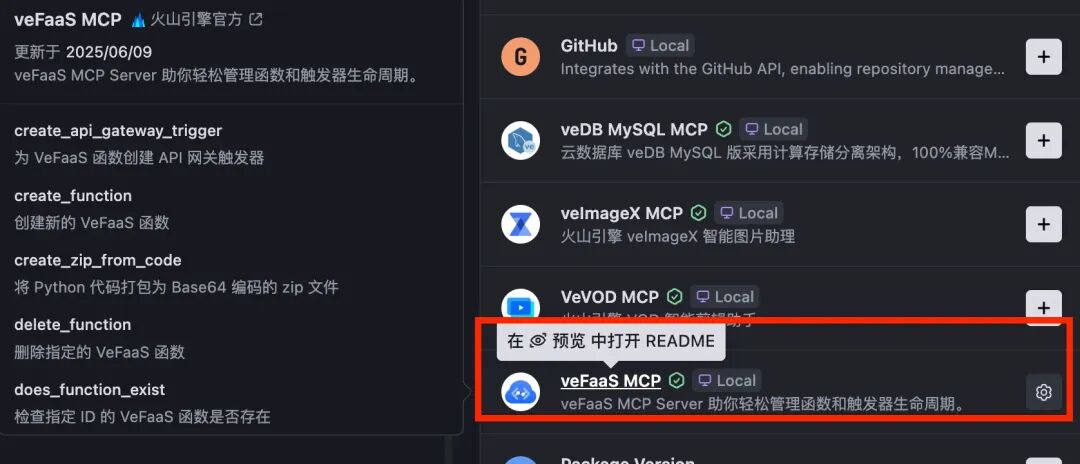
Moreover, Volcano Engine's veFaas MCP can directly deploy this entire HTML file suite to the public internet and return a link, becoming a deliverable "internal enterprise Agent."
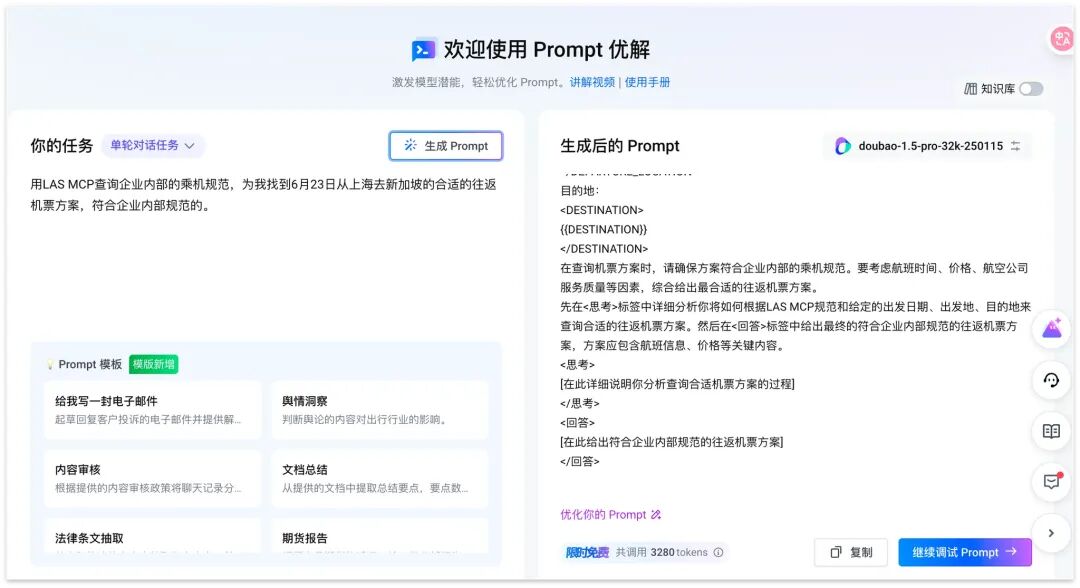
Every prompt in the entire workflow can be optimized using Volcano Engine's PromptPilot, so Agent designers and developers no longer need to waste time on "how to ask a good question."
Of course, the Agent we're demonstrating here is just a simple, easy-to-understand process example. The Agent development paradigm that Volcano Engine provides is actually very applicable to more complex and refined scenarios — we only introduce it briefly here.
In Volcano Engine's solution, the AI Agent construction process is clearly broken down into multiple components at different layers. Through coordination between components, it achieves a shift from "wild growth" to standardization.
Notably, this development paradigm not only enables deep collaboration with TRAE but also forms powerful "synergy" with ecosystem applications like Ark and Coze, such as creators being able to seamlessly launch applications on Coze and so on.
After actually experiencing Volcano Engine's AI cloud-native development process, Crossing also deeply felt:
This new paradigm will likely bring more "Agent democratization" in development, dramatically lowering innovation barriers and creating more opportunities for entrepreneurs.
The core essence of the Year of the Agent is the continuous evolution of productivity demands. As long as Agents possess certain deliverable capabilities, the innovations they spawn are worth watching.
At the Volcano Engine Force Conference, 12 tools specifically for Agent development were released in one go, building up a complete "AI cloud-native" technology stack like Lego bricks.
In this context, we see "Agent democratization" happening — no longer the patent of big tech, every developer has the opportunity to build their own AI Agent.
Crossing summarized 3 structural opportunities that AI cloud-native will bring:
1) We Will Encounter "A Thousand Vertical Domain Agents"
Technology barriers dramatically lowered
Through the AI cloud-native system, individual developers, teams, or enterprises across industries — as long as they have a certain data foundation — can build personalized Agent development platforms in extremely simple ways.
For example, for vertical industries like education, automotive, and retail, developing low-code Agent development platforms with quick access to industry-specific templates and pre-trained models — the technical barrier for Agents has already dropped significantly compared to before.
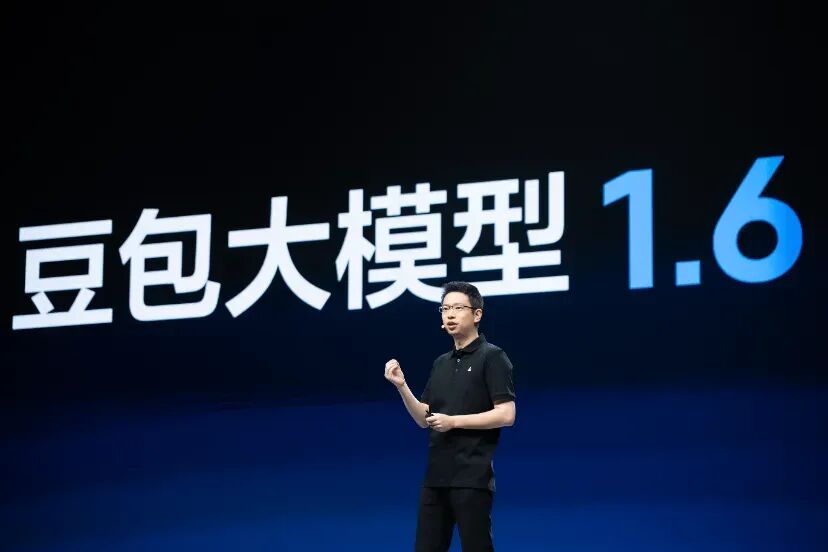
Relying on multimodal-capable large models like Doubao 1.6, such as text-to-image, voice interaction, etc., can effectively meet specific scenario needs across different vertical industries.
With Volcano Engine's cloud MCP and AI IDEs like TRAE, future developers can rapidly build industry-specialized Agents and quickly achieve commercialization of Agent products through cloud MCP and rich cloud services.
Going further, developers can flexibly choose model solutions based on their own business scenarios.
For example:
For high-frequency and relatively simple scenarios, directly call existing large model APIs; for more complex industry-specific scenarios, directly import proprietary models and use specific datasets for autonomous pre-training or fine-tuning.
Development time dramatically compressed
With ready-made models and tools provided by Volcano Engine, small teams can rapidly build AI applications that previously required massive investment from large companies.
For example, a team of two or three people can build a prototype on the Coze platform in a few days — this will greatly unleash grassroots teams' innovative power.
We've also seen many ordinary developers in this platform create excellent "grassroots products," and these innovations are all very heartwarming:

Coze Space @duisanbuyao
Beyond using Coze for project releases, we've also seen large numbers of professional developers using Coze Compass for operations, rapidly running through a project at low cost, optimizing most of the AI Agent workflow: multi-model comparison, creating commercializable prompts, Agent benchmark comparison, and more.
Entrepreneurs' cost-conscious mindset needs to find "one-stop AI Agent development and operations platforms" like Coze Compass as experimental fields.
I've also had a realization:
From now on, as long as your project has "one centimeter of value," someone will see it.

Numerous developer applications on Coze
Super individuals and teams have found entry points like Coze within the "AI cloud-native" philosophy.
Similarly, we've also seen B2B enterprise users' interest in these one-stop platforms. For example, here are some fun AI hardware devices embedded with Coze and Doubao technology:

Sunflower released by FoloToy

AI smart flowerpot released by Beijing Rongyin Technology

Voice plush bear released by Xi'an Shunmei Technology
Beyond this, the Agent platform that recently won全网掌声 (network-wide applause) with a segment of "hyper-realistic podcast" — Coze Space often immediately puts new Doubao large model updates into users' hands.
If "technology democratization" is achieved, then the value distribution among creative ideas won't show断层 (fractures/gaps).
This lowering of entry barriers really resembles the普及 (popularization) of cloud services in the mobile internet era. In the past, teams developing apps didn't need to maintain their own servers, which gave rise to大量创业公司 (numerous startups). We believe that with AI cloud-native services, the Agent space will also see大量新的产品和创业机会 (a large number of new products and entrepreneurial opportunities emerge).
As long as industry knowledge and data can become "a single straw" in product competition, we believe AI cloud-native will nurture more vertical domain Agent product opportunities.
2) Agent Is No Longer Just a "Concept" — Large-Scale Commercialization Is Coming
AI infrastructure prices are rapidly falling
The "cloud" in AI cloud-native, as "AI infrastructure," has only two衡量标准 (measuring standards): computing cost and performance optimization.
Now, through AI cloud-native, the cost of large-scale inference is dramatically decreasing — startups and even individual developers can rapidly obtain inference services at lower costs.
In this domain, the Doubao large model family is very confident. Doubao large models have already been validated in real commercial environments. For example, Doubao large models' daily token usage now exceeds 16.4 trillion, and the newly released Doubao 1.6 has综合成本 (comprehensive cost) 63% lower than the previous 1.5.
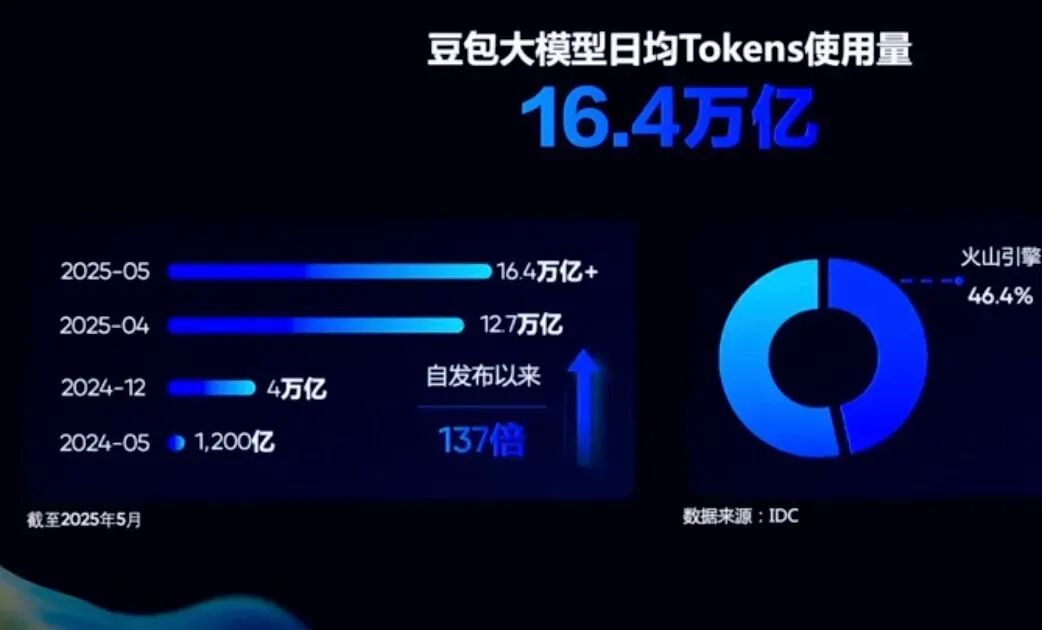
Doubao is just too comprehensive
Multimodal large model accessibility is improving
As the core of the Agent cost layer in AI cloud-native, large models essentially determine Agent output and commercialization prospects.
Developers typically care about several aspects of large models: cost, low latency during high concurrency, performance, and scenario richness of the model family.
For example, Doubao's multimodal family of models covers very comprehensive scenarios: text, image, video, voice interaction, text-to-image, and more. Recently, Doubao's text-to-image model made waves across the internet when it generated 20 high-quality series images in a single test.
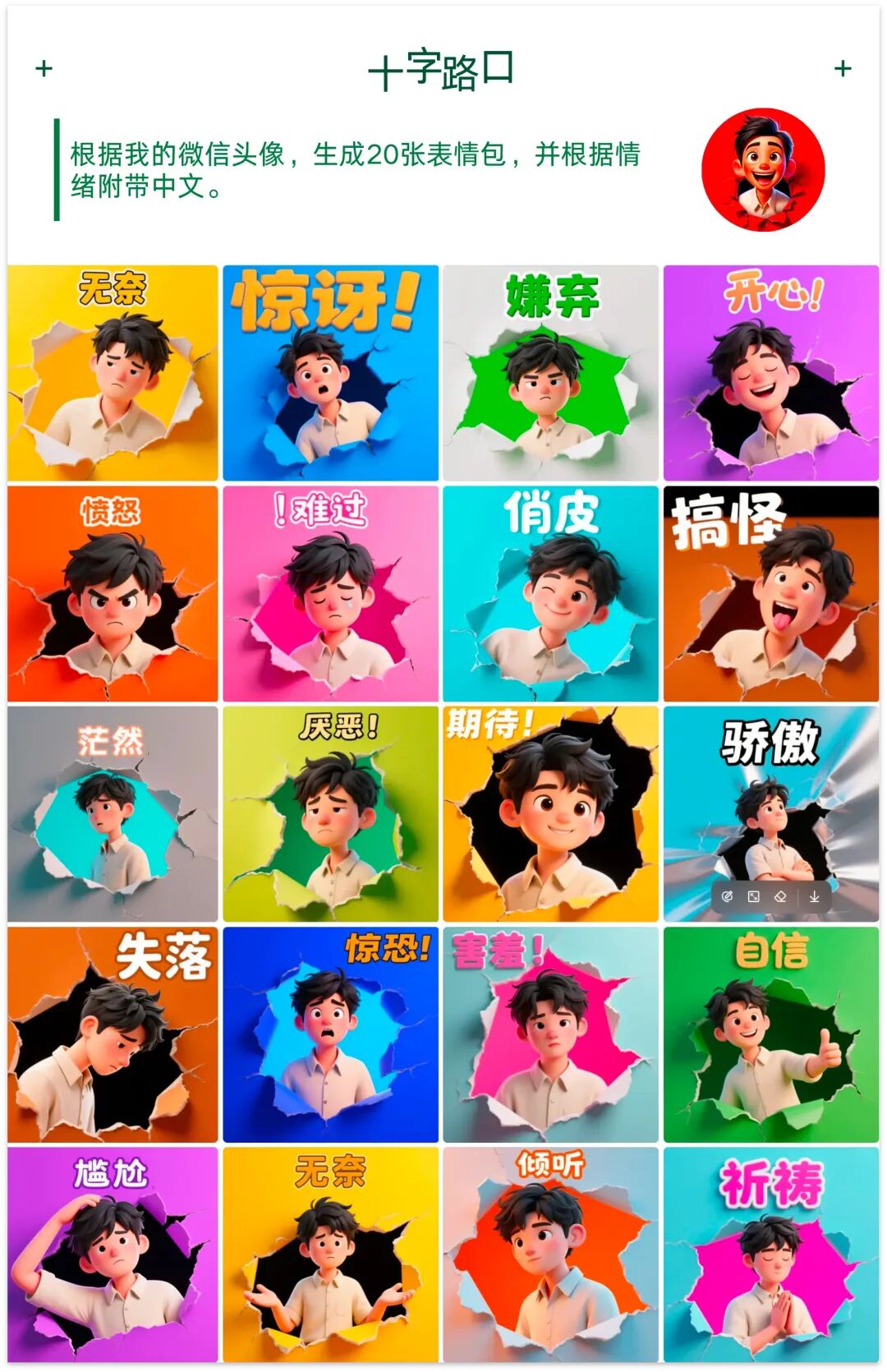
Beyond the platform's own large models, third-party large models remain essential for special commercial scenarios. In this regard, Ark has integrated DeepSeek API services.
The cost-effectiveness, stability, and model family richness of large models under Volcano Engine's AI cloud-native system can already support the trend of Agent commercialization.
3) Agent Ready
Now, Agents have stronger business understanding capabilities
Volcano Engine AI cloud-native proposes a core concept — Agent Ready, meaning making intelligent agents "always ready," available on demand. This concept transforms the originally complex AI development process into a simple "out-of-the-box" experience like "building with Lego."
Through Volcano Engine's cloud services, future entrepreneurial teams can easily achieve multi-source data integration, cleaning, and knowledge base construction.
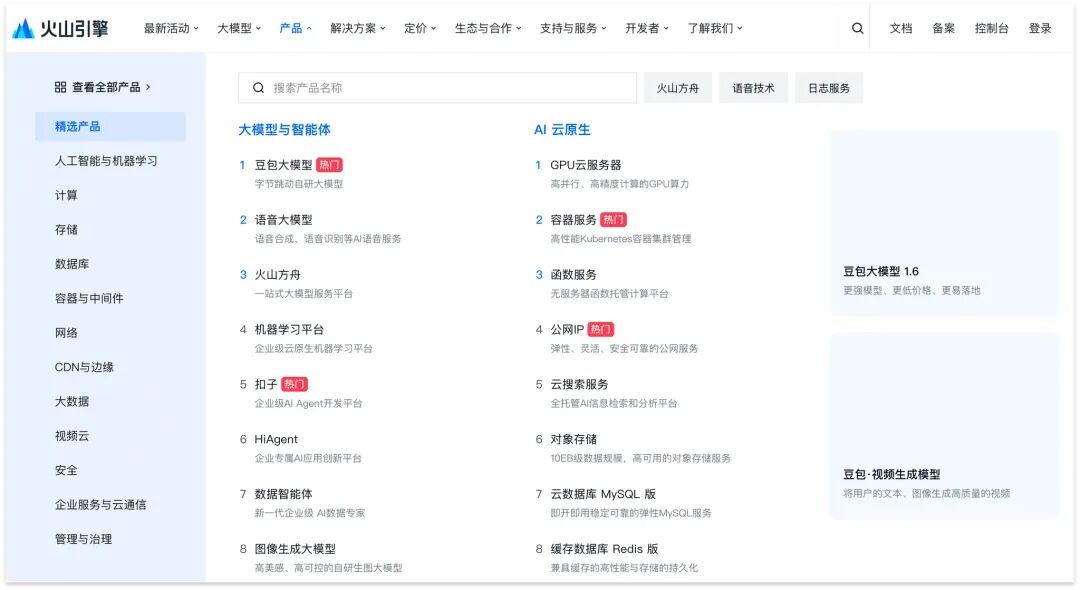
We've seen Volcano Engine rapidly update its rich product interfaces
Whether individual developers, small teams, or enterprises, everyone can quickly find suitable entry points in the future. The entire process of data integration, cleaning, and knowledge base construction has been dramatically simplified, lowering the barrier to AI technology application.
It can be said that with data and knowledge base participation, Agents under AI cloud-native now have stronger business understanding capabilities.
Technology packaging
Under AI cloud-native, Agent developers can achieve technology packaging and pay-as-you-go.
Developers no longer need to purchase GPUs themselves, train their own models, or go through complex technical development processes. They can completely package AI models, data processing tools, and cloud services into ready-to-use tools. Just like ordering takeout — pay more if you use more, pay less if you use less, with fully controllable costs.
From an idea to final落地 (landing/implementation), perhaps it only takes one simple AI cloud-native process.
Simply put, future enterprises or individuals may not be forced to be "tech gurus" to rapidly build professional-grade Agents, letting AI adapt to specific business scenarios and achieving "Agent Ready."
Agent Democratization Will Make This Place Bloom with Flowers
We have always believed that the soul of Agent development lies not in technology itself, but in designers' unique taste and insight.
Yet the reality is that the Agent industry faces an awkward contradiction: the most creative and tasteful designers are often shut out by technical barriers.
The technical threshold of Agent development has become a fence, blocking imagination and limiting the space for imagination.
We've always believed that those most tasteful designers don't only exist "within 3 km of big tech headquarters," but live in every city, in every vertical industry with specialized knowledge.
When technical barriers are no longer obstacles, gardens of creativity will bloom everywhere.
Now, AI cloud-native gives developers unlimited room for imagination. It makes complex technology stacks more modular and composable, lowering development barriers and allowing more innovative ideas to rapidly land.
In the future, we'll see more breakthrough application scenarios emerge.
Thousands of "small but beautiful" vertical domain Agents are breaking through the soil, each carrying creators' unique thinking and warmth.
We are witnessing an era of "a hundred flowers blooming."