First Investment Deal Agent Bobby Launches; Exclusive Interview with Vakee
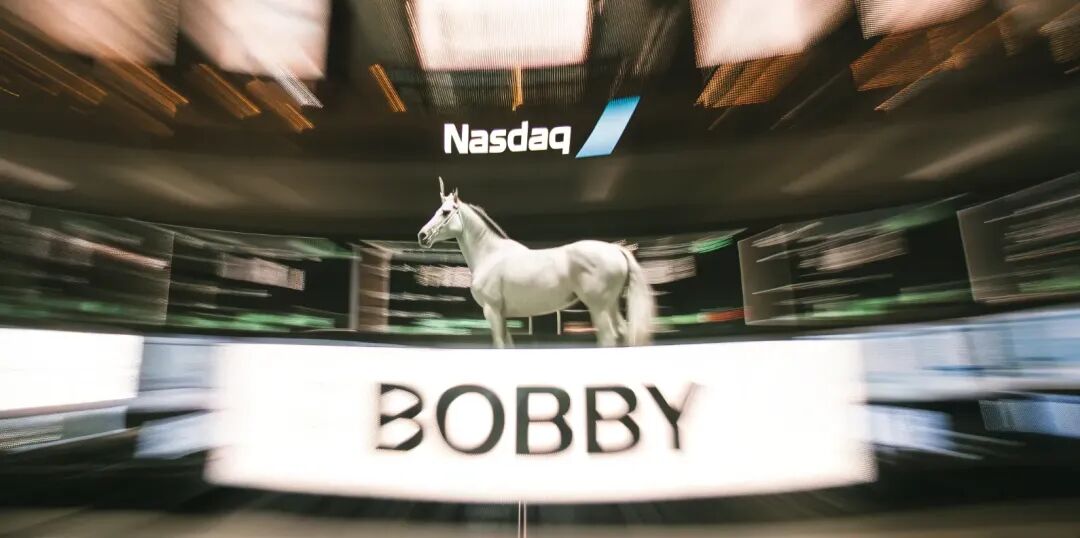
Never underestimate anything you see in life.
Don't underestimate anything you see in life.
👦🏻 Podcast interview: Koji, Ronghui
🥷 Edited by: Starry
🧑🎨 Layout: NCon

What if you had an "investment partner available 24/7" that could analyze market movements in real time through natural language conversation, generate personalized AI investment portfolios based on life inspirations and work insights, execute stock and options trades with one tap, and even offer rational strategies when you're feeling anxious — how would such an AI Agent redefine what it means to "participate in the world through investing"?
This week on Crossing, we welcome Vakee Lai, founder and CEO of Singapore-based fintech company RockFlow[1], to discuss her newly launched financial trading AI Agent — Bobby. This isn't just a product launch; it's the concrete realization of a mission to "make investing simpler": from starting to trade stocks at age 9, to product R&D at Baidu's Fengchao, to early-stage AI investing, and now to entrepreneurship "reshaping the investment experience with AI," every step Vakee has taken answers one question: How can ordinary people use the most natural methods to transform their everyday knowledge into investment action?
We'll explore three dimensions:
-
Bobby's "not simple" story: Why did RockFlow spend two years refining this Agent? How does it solve users' pain points of "high barriers to investment awareness" and "complex tool operation"? How do real cases like a UK user using Bobby to monitor and buy Circle stock, doubling their investment, validate the value of an "AI-native investment experience"?
-
Vakee's "investment worldview": From the cognitive advantage of Fengchao advertising monetization to the "cognitive return amplification" of her 15-year NVIDIA investment, how does she navigate primary and secondary markets with the philosophy of "earning money within your circle of competence"? As a rare female CEO in tech, how does she balance entrepreneurial challenges with the mission of "making investing accessible to everyone"?
-
The "rock spirit" of future investing: Why is "removing all GUI and keeping only Bobby" not radical but inevitable? When Gen Z expresses attitudes through investing and conveys opinions through trading, how does RockFlow use AI Agent to build a "lifestyle investment playground"?
Finally, Vakee will combine insights from a viral Xiaohongshu post titled "How Ordinary People Can Discover the Next Big Trend Right Around Them[2]" to share her unique perspective on capturing investment opportunities from daily life and work — perhaps the starting point for your next "cognitive monetization" is hiding in your everyday routine.
Listen on WeChat:
Listen on Xiaoyuzhou:

👦🏻 Koji
This week on Crossing, we've invited Vakee. Vakee is the founder and CEO of RockFlow, which recently launched their own AI Agent product called Bobby.
Today we hope Vakee can chat with us about her own story of starting to invest at age 9 — beginning as a teenage investor, then moving into primary and secondary markets, and now with her startup RockFlow aiming to help more young people enjoy the fun of investing and reap investment returns.
Vakee has actually been on Crossing's podcast before, roughly a year ago, but at that time we weren't talking about the RockFlow product. The title of that conversation was "Are My Investor Friends Really All Selling Off NVIDIA?[3]"
We talked about whether NVIDIA stock was worth buying. I remember Vakee was firmly advising everyone to keep building positions, right? If you had followed Vakee's advice back then, you should have gotten pretty good returns by now.
So please say hello to everyone again, Vakee, and briefly introduce yourself, RockFlow, and your latest AI Agent Bobby.
👩🏻 Vakee
Hi everyone, great to be back on Crossing.
I'm Vakee, founder of RockFlow. I'm here today with our new AI Agent product Bobby, and I hope to share more of RockFlow's story and Bobby's origin story with you all.
What a Trading Agent Is and How to Use It
👦🏻 Koji
Please introduce what Bobby is? Because Bobby feels like a major focus for you recently, a product that you've accumulated a lot of energy to launch.
👩🏻 Vakee
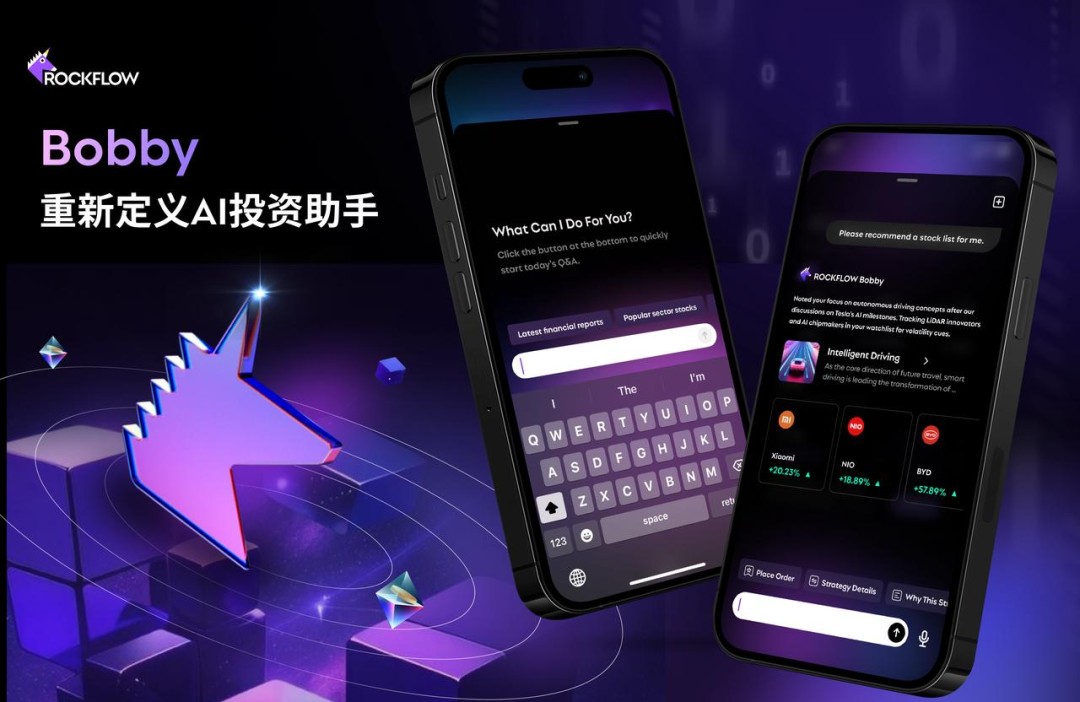
Bobby is the first AI Agent in the financial trading domain.
Simply put, it's your 7 × 24 investment partner. Its biggest feature is that it can complete your entire investment closed loop — from daily inspiration discovery to investment analysis and research, to generating trading strategies, to order execution, and even to position management after execution. It's like having your own hedge fund team.
You have traders, analysts, and risk management teams helping you better realize your ideas in investing.
This is a particularly vertical domain, very difficult to build, but we still managed to realize a product that can close the loop.
👦🏻 Koji
What's the biggest difference from the previous RockFlow App?
👩🏻 Vakee
The previous RockFlow was still in App form. We wanted it to be simple enough for people to complete trades very conveniently. Bobby's entire form is natural language conversation. We actually hope that eventually there might be "no RockFlow App" — the main interface is just Bobby, you only need to converse with it to complete the entire trading closed loop.
I used to tell people that RockFlow's clean design and simple usage met some people's needs, but they weren't really the most fundamental differentiation. Now Bobby's Agent-based interactive application form, I believe, is a cross-era product that can solve all problems in complex scenarios.
After people use Bobby, they won't ask me "what's the difference between you and Robinhood" anymore.
👦🏻 Koji
Speaking of "in the future there might be no RockFlow App," just yesterday Sam Altman gave a talk on the first day of Y Combinator Startup School, and one important point was that "future UI interfaces will disappear."
This actually aligns with what you just mentioned. Are you really planning to execute this so extremely? When do you plan to kill the App and keep only the Bobby Agent?
👩🏻 Vakee
We're planning to launch a Bobby-only product this year.
Both Koji and I have been product managers. In the past, when we built products, we had to find the greatest common denominator, so we'd extract what we considered the most important features and needs from our target user group — that was the old product logic.
But we've clearly found that in complex scenarios, function-based interfaces actually struggle to meet different people's needs — take this particularly complex scenario. Actually, stepping back, even OTA apps like Trip.com Group, or even Baidu Maps, inadvertently become incredibly complex.
Let me give a few examples. I frequently book hotels on Trip.com Group, and I simply can't select or filter out what I want because its filter dimensions are different from mine. The dimensions I need can't be filtered all at once, which is actually quite absurd because all these dimensions, data, and tags exist in the database. Rather, it's the App form itself, or this page-based approach with limited functions, that severely hinders me from accomplishing what I want to do.
I think going forward it will be very simple: Agent plus database.
My genuine feeling is, take Bobby for example — we used to have to develop multiple order placement methods. We actually had so many in our requirements pool, but every time we'd debate for a long time whether to do trailing stop orders first, or that other order type first, because each order type has non-trivial development costs, from frontend to backend, from algorithms to engineering, and they all take up significant interface real estate.
We all know that subtracting features from a product is hard, while adding is easiest, and then you end up with 10,000 functions on your App.
👦🏻 Koji
Right, especially for a brokerage app like RockFlow, it's particularly easy to end up with 10,000 functions.
👩🏻 Vakee
Exactly, so what is Agent actually solving? In these complex scenarios, every need is actually quite unique.
Take Bobby, for example. Going forward, we won't develop any of these granular features directly in the App. Users can simply tell Bobby what they want to do, and Bobby can help them create conditional orders that have never existed before in the world, because it can reassemble those capabilities using AI.
These types of conditional orders don't exist on any current internet brokerage App.
An App can't possibly offer 80 different ways to place conditional orders — there have to be trade-offs. But users might actually have 800 different ways they want to place orders.
So in complex scenarios, interacting with an Agent through natural language can better serve each user's personalized needs.
AI Agent is an entirely new experience. It will change how product and R&D teams work, and even change what Apps look like — we're going to see a massive paradigm shift.
For example, yesterday my mom asked me to book flights for her. She and my dad are traveling to Urumqi. They can't take flights that are too late, and they'd prefer no connections, or at least not short layovers. There's no way I can express all that through the Trip.com Group App.
👦🏻 Koji
So you're basically your parents' Agent. You're interpreting their needs, breaking down tasks, and completing the booking for them — full闭环.
👩🏻 Vakee
Exactly. But look at Trip.com Group — everything I want to express is already in their database, yet the App solves nothing. Same with Baidu Maps, same with AutoNavi. Say I'm in Xierqi and want to meet a friend in Shuangjing for hot pot. I want to ask Baidu Maps to find somewhere convenient by subway for both of us, with a non-spicy option. But you can't search for that on the App. It's incredibly clunky.
So the shift I'm seeing is this: for all relatively complex scenarios, it will definitely be database plus Agent going forward. I don't think function-based App layouts will exist anymore.
👦🏻 Koji
There's been a surge of Agent enthusiasm this year.
In the first episode of Crossing's first season, we invited Yusen Dai, managing partner of ZhenFund, for a New Year's conversation. That episode was titled The Year of the Agent.
At the time, calling it the Year of the Agent wasn't so obvious yet, but we were already seeing signals — especially Devin's release, which made us feel the maturity of Agent technology and the innovation in interaction paradigms.
After Manus and Lovart launched, Crossing published in-depth reviews within 24 hours. AI Agent products like Flowith, Clacky, and today Bobby have also chosen Crossing for their launches.
I'd like to ask Vakee: when did you start planning to build this Agent product?
👩🏻 Vakee
We were actually just looking through this internally the past couple days. Bobby started out as Rockbot — we began working on it in April 2023.
The current first-level page feature in the App is called AI Strategy. It used to be called TradingGPT — also the world's first implementation using GPT to go from "what's happening" to "what stocks or options you can buy," and it was a personalized experience, personalized trading opportunity alerts in real time.
Right after we launched that product, we immediately started internal discussions about what product form our next AI-native experience should take. I even found the demo video from back then. When we were discussing this so-called AI-native product form, the term "Agent" didn't even exist yet.
👦🏻 Koji
That was May two years ago?
👩🏻 Vakee
May two years ago, May 2023. We had launched TradingGPT and explored product forms. Based on this bot and Copilot product form, we had already made a very polished demo. Then in September 2023, we formally greenlit the project internally to build what is now Bobby. Because our documentation culture is really strong — all meetings have very clear records.
The first point was Agent. So actually, it was in September 2023 that we decided on this current Bobby form, using Agent's basic architecture to achieve the AI product experience we wanted. I looked at the meeting notes from then. The first thing we discussed was the boundaries of AI capabilities at the time — what was possible in 2023, what it did well, what wasn't there yet.
👦🏻 Koji
I'm curious: when you greenlit the project in 2023, what were the capability boundaries of Agent versus today, building Bobby — what breakthroughs have there been?
👩🏻 Vakee
At the time, we could already see that Agent could support logical reasoning and multi-stage contextual thinking, could automatically choose what to do next based on current state. Calling APIs was no problem, and maintaining knowledge base access was ready — those capabilities were fine. The biggest problem back then was severe hallucination. I had to make a decision, because there were differing voices in the company. Seeing such serious hallucination, some wanted to wait a bit longer, until models and foundational capabilities were more stable.
But I and the core team members were actually quite firm: we had to explore first. It's the difference between a "ship-building company" and a "tower-building company." If you're a ship-building company, as foundation models and underlying capabilities improve, your product capabilities improve with them. Build a tower and it gets flooded.
So first we judged whether what we wanted to build was a ship or a tower. Building an application in an industry with high barriers to entry — definitely the ship route. Second, if I'm that kind of company, should I wait? Because we had already been building RockFlow for a year or two, I deeply knew that finance has enormous knowhow embedded in product and engineering. If I wanted to build a vertical application in this domain, the optimal solution was to start immediately, because along the way you solve many very detailed problems.

👦🏻 Koji
Building a good financial tool involves a lot of engineering tasks and details. If you start early and go deeper, you get a first-mover advantage. I feel this myself using RockFlow and Bobby.
After Manus launched, six teams immediately emerged inside ByteDance to copy it. Today many companies have indeed released high-fidelity replicas, but none have shaken Manus's position — Manus wasn't as "copyable" as people imagined.
But when I look at Bobby, I feel it's even more "uncopyable" — at least no one will copy a Bobby in six months. There's a massive amount of tedious, delicate work behind it.
👩🏻 Vakee
For Manus, from my superficial understanding (I could be wrong, since I'm an outsider), although it's a general-purpose Agent, the entire interaction experience involves a lot of understanding of browsers, engineering understanding at the interaction layer — this team definitely has core members with strong prior积累 in this.
Some things are universal. Like what I just said: to build Bobby, you first need to be a team that knows financial engineering. For example, handling corporate actions — there might be hundreds of possibilities. To this day, no vendor in the world can help you solve these detailed problems well, including IB, including Futu Holdings Limited, including us — we all handle them step by step ourselves. That's why Bloomberg, and domestic equivalents like Wind, are still so valuable, because financial data is all grunt work.
In finance, accuracy requirements for data are extremely high, tolerance is very low — you have to be very meticulous. So your financial engineering team has to be built through doing this business. Whether we're building general-purpose or vertical Agents, for the product R&D and engineering problems to solve in the domain, there are countless details — that's the moat.
So RockFlow didn't build Bobby in year one. We were founded in 2021, first spent several years as a US stock brokerage, built out the full counter trading system. Gained users across various countries, understood demand details together with our users, and then started building Bobby — still the same team. Beyond AI R&D capabilities, vertical Agent applications also require product and engineering teams with deep domain understanding. In fields like finance and healthcare, the team's industry cognition shows up in the product.
👩🏻 Ronghui
What weight does Bobby carry internally? Did you treat it as an experimental product, or a bet on the future?
👩🏻 Vakee
It started as a priority project, and especially this year it's absolutely all in. Throughout the R&D process, this quarter and last quarter's OKRs — except for trading stability requirements — everything else was deprioritized for Bobby.
You raised an excellent question, which also answers why incumbent peers aren't doing this, and how they would approach it. The core is we're doing this all in, as the highest priority. We're building it as if there will be no RockFlow App in the future. If you just treat it as a feature, it's very hard to succeed.
Back when I did VC, I often asked founders: what if the giants do this too? In recent years I've deeply felt that no matter how large the team, there are only about ten to twenty people who can really fight. Any competition between companies, or in an industry, comes down to who dares to all in those 20 people into this project.
If you dare, I think everyone has a chance. If you don't dare, and just treat it as internal innovation, it's very hard. Because startup teams fight with their lives, while big companies do internal innovation on million-yuan salaries — completely different战斗状态.
👩🏻 Ronghui
How much of this comes from your certainty that Bobby's Agent product form will replace RockFlow's future, versus confidence from the industry?
👩🏻 Vakee
I'd say 99% is the former.
Crossing has interviewed many founders of AI Agent products, but I barely have the energy to care about what others are doing. Lots of people ask me, what do you think of Manus? What about Flowith? The truth is I can't pay attention to too many things — you're really pouring almost all your energy into charging toward that one goal you believe in. Because this thing is so new, Bobby is the first of its kind in the world.
We imagined a future for ourselves, and then we went all-in charging toward that future. About 80-90% of our team are INTJs — everyone is extremely J. When I decide something must be done, it must get done as quickly as possible.
Right now you can clearly feel massive changes happening in the world. And seeing Agent plus database — that's the future product form. What I want to do is use this form to serve user needs in this domain. I firmly believe in this, and I'm even using Bobby myself now for all my trading and order placement. It's just more convenient and better to use.
I've never had peer pressure since I was young. I never care what others are doing. Every generation has its own needs. ToC entrepreneurship is about whether you can make a better product that satisfies this generation's needs. So through this process, it's more about thinking of your users, thinking of your team — what do your users need, is your team's execution efficient enough. That's it.
👦🏻 Koji
This sounds like a pretty blissful kind of entrepreneurship. INTJs can grind something to death until it's exquisitely polished.
Bobby has been in internal testing for a while now — there should have been several hundred users in the beta. Wondering if there are any fun stories?
👩🏻 Vakee
Since we're gradually opening up over these past two weeks, I feel pretty excited. Bobby ships a new version every day, iterates the model once daily — that's what we can do. Even the RockFlow app today still has this or that small issue, so we just keep rapidly iterating.
Let me share a few fun examples. First, on the day Circle went public, we had a user in the UK. This was the first stock she ever bought, and her first time trading on RockFlow, because everyone was discussing Circle in the group chat. She just told Bobby: after the listing, place this order for me, help me buy this amount of money, then went off to do other things. The next day she found Bobby bought in at $80, and even placed a stop-loss order for her. That stock has now doubled. She shared her complete chat history with Bobby and her profit screenshot in the group. She felt that without Bobby, she probably would have delayed starting to invest in US stocks even longer.
Actually he'd been a RockFlow user for a while, but never bought anything — didn't know how to start. Bobby actually has many boundaries to explore. I didn't even know before that Bobby could do one-click liquidation. We'd always had a need for one-click position closing, but it never got prioritized. Now we discovered users figured it out themselves, and Bobby just completed it for them.
👦🏻 Koji
Does Bobby have any liquidation strategies?
👩🏻 Vakee
It will make some adjustments. For example, if you have $1 million in Tesla stock to liquidate in one click, it will help you place orders in batches to smooth out your slippage.
👦🏻 Koji
I tried a very, very noob instruction with Bobby myself. I deposited $3,000 and told Bobby: "I have $3,000, help me buy stocks, I want to make money."
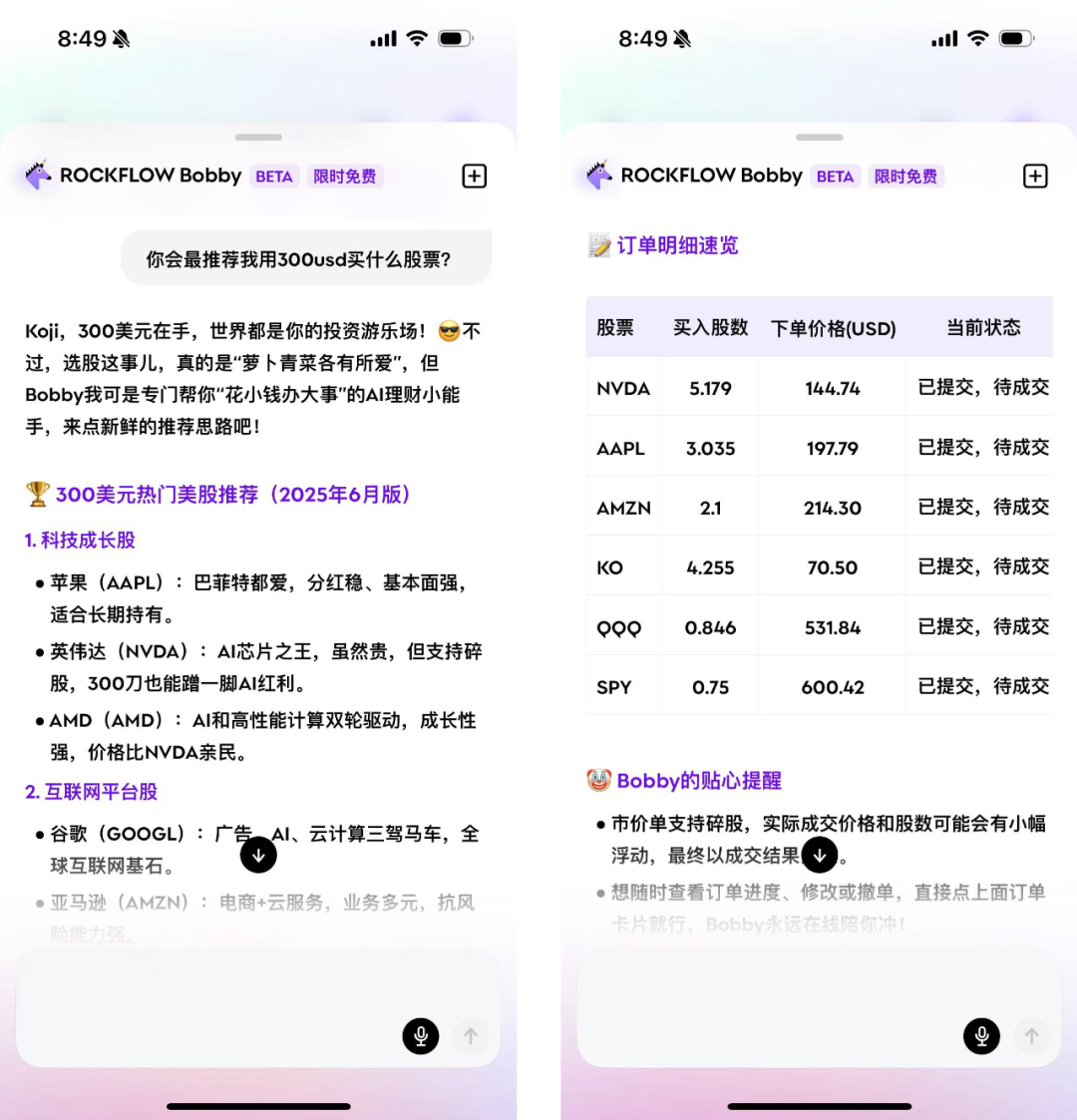
I really wanted to test, under blind faith in Bobby, what would it do for me? It ended up buying 6 stocks for me, all very conservative ones, including two indices (SPY and QQQ), plus Apple, NVIDIA, and Coca-Cola — this is actually very friendly to noobs. When you have $3,000 and don't know what to buy, handing it to Bobby, the result is probably better than if you impulsively placed orders yourself.
👩🏻 Ronghui
I also thought of a question. For many novice users, like me who doesn't really trade stocks, it sounds very simple to operate. I asked many questions, gave the same prompt to several other Agent tools. My feeling is first, Bobby's operation is very simple, and second, it's helping me operate something with very high barriers. For users like me, how would you explain how Bobby serves better, and how it helps me achieve my goals?
👩🏻 Vakee
Actually the example I just shared was a novice user who had never traded before. Investing has two barriers: one is psychological — you think it's hard; the second is operational — it's troublesome, you genuinely don't know how. Bobby's Agent natural-language conversational approach solves user pain points from both levels.
Bobby lets you take things you see in life, things you think of, express them, and turn an idea into a trading opportunity. This interaction form inherently lowers your psychological barrier. When you try to communicate with existing brokerage apps, you don't know how to communicate. Bobby is more like communicating with a person in a more natural way — it lowers your psychological pressure and barrier.
👦🏻 Koji
But actually if users chat with ChatGPT or Yuanbao, wouldn't they get similar responses?
👩🏻 Vakee
At the natural-language conversational interaction level, it's the same — this form first helps lower your psychological barrier.
But more importantly, the trading scenario feels operationally complex to many people. Bobby's biggest difference from other large model chatbots is that Bobby closes the loop on the investment trading action for you. For example, early this year you asked Bobby: "Labubu is super hot, what should I do?" Bobby might say you could consider Pop Mart stock. Or if it's already too hot, Bobby would caution you to be careful investing in Pop Mart. It gives you an investment strategy based on your inspiration, combined with market environment and your risk appetite, and can help you complete the order and trade.
I think the most important thing for a vertical AI Agent is helping users actually get the thing done.
👩🏻 Ronghui
Bobby's entire development process took two years. Why did it take so long? Were there any detours along the way?
👩🏻 Vakee
We officially kicked off in September 2023, so a year and a half. Basically no detours. To build a vertical Agent that achieves closed-loop, it really takes a lot of time, lots of details to polish. In the earliest versions, we didn't think too much about speed. But later we realized: slowness is a sin. If it's slow, you can't wait — users don't have that patience.
👩🏻 Ronghui
What's the standard for measuring "slow," what counts as slow?
👩🏻 Vakee
We actually did a ton of optimization on the "slow" problem. Early on, Bobby's response speed genuinely wasn't fast enough — one round of dialogue might take ten to twenty seconds to produce results, which is completely unacceptable in a trading scenario. Later we redesigned the entire Agent scheduling system, optimized orchestration capabilities, and pushed efficiency and performance up. Because I always feel speed is the first gate — only when you're "fast enough, stable enough" can you even talk about "productization."
But to achieve productization, or even go further toward commercialization, you have to face a very critical issue: cost control. You can't consume massive tokens with every interaction, and you can't have users exit the flow because they waited too long. So building Agents, building large model applications — essentially you always have to solve these two problems: first, speed and experience; second, cost control.
Internally we actually spent a lot of effort on these "structural problems behind the features." For example, how do you design architecture so token consumption stays stable? How do you ensure users get answers within 1-5 seconds every time they ask? These underlying mechanisms are often harder than surface-level features, but it's precisely these that form the foundation for an Agent product to be actually deployable.
👦🏻 Koji
Among these beta users, what data metrics do you care about most? Like number of conversation rounds? Number of orders placed? Or how much money you helped them make?
👩🏻 Vakee
Activity metrics, time spent. You need to have multi-round conversations with it, and it needs to actually help you — it must have solved some problem or doubt in the process.
👦🏻 Koji
The Circle stock case you shared earlier — it sounds like Bobby placed the order in the middle of the night? Did it have the user confirm at the time? I feel like with this kind of automatic order placement, if it helps users make money they're of course happy; but if they lose money, wouldn't the blame fall on Bobby?
👩🏻 Vakee
All orders are confirmed. For example, for "buy how much," Bobby will repeatedly confirm, at what price to buy, and only after conversational confirmation will it execute the instruction. So it's still reliable.
👦🏻 Koji
Are there any stories about people using Bobby to "make money they perhaps couldn't have made before"?
👩🏻 Vakee
That day when Donald Trump and Elon Musk had their fight, a user who trades a lot of Tesla asked Bobby, what should I do now? Bobby said the two of them fighting, Tesla will probably keep dropping, you could consider buying a bear — that's our put option product. After several rounds of dialogue, he selected a put in the conversation. This user bought the bear, then became the top performer on the daily leaderboard, selling at over 400% gain. And he gave Bobby the biggest tip ever. He even said, if he could set up "profit-sharing tips," like giving Bobby 1% or 5% of his gains, he'd be willing to.
He also shared several feedback points in the community:
First, he placed this trade entirely because of the dialogue with Bobby. It wasn't a judgment he made out of thin air — Bobby structured the cognition and turned it into a clear, executable decision. Of course the final order was his own decision, but Bobby played a very critical triggering role.
Second, he said Bobby was the first AI trading product where he truly felt "understood." He'd used many products — from IB, Futu Holdings Limited, and Robinhood to various AI tools — but none offered this combination of "dialogue + understanding + customization."
When using Bobby, he could clearly sense the agent analyzing his past trading behavior, understanding how he managed risk and selected assets, with every recommendation hitting the mark. It felt like a real investment assistant who understood his rhythm and habits, not some rigid trading tool.
This is typical feedback from an experienced user. Previously, many people found RockFlow too "light," too simple, not professional enough. But after they started using Bobby, they discovered it was actually the tool best suited for complex decision-making. This brings us back to why we shifted from traditional functional apps to a conversation-centric agent form. This form naturally broadens the range of users you can serve — from complete beginners to seasoned traders, everyone can get something from Bobby that matches their needs.
These two examples illustrate two very different experiences. Both felt that Bobby as an agent could better cover different user needs. Moving from functional apps to this agent-based conversational form dramatically expands the user base you can cover. Previously, some more experienced users felt RockFlow was too simple, that many features couldn't meet their requirements. But now mature traders are also using Bobby, following its recommendations, and getting their first positive feedback.
👦🏻 Koji
Right now Bobby still requires users to initiate a question before it responds. Have you considered having Bobby proactively offer users some suggestions?
👩🏻 Vakee
The next version of Bobby will proactively surface things you might want to know. There will be some trading inspiration, but it won't suddenly jump out and say you should buy this.
👦🏻 Koji
What kind of trading inspiration?
👩🏻 Vakee
For example, macro information like geopolitical conflicts, or stocks related to your holdings. If you're very interested in stablecoins, it will push relevant information to you. We've also found that users' most pressing need is for Bobby to call them — to have Bobby call the user.
👦🏻 Koji
Users want to be reminded?
👩🏻 Vakee
Yes, they just want to be reminded.

👦🏻 Koji
I have a friend who once managed a family office for a big shot in Hong Kong. The job itself was quite interesting — a small team of four or five people serving a ninety-something-year-old man who still closely tracked market movements every day, calling them countless times.
The calls fell into two categories: explicit trading instructions, and vague research requests like "help me check if there's any movement in this sector lately" or "is this worth adding to?" Listening to this, their team sounded like the old man's "Bobby" — an always-on AI agent, just in human form. Each of them had impressive backgrounds, basically top MBA programs, seasoned financial industry professionals, with annual salaries in the millions.
But I'm thinking, these "high-end financial industry workers" will probably soon be competing with Bobbys.
👩🏻 Ronghui
I just wanted to add a question. Over roughly a year and a half of R&D, you mentioned some important decisions about how to save tokens and reduce costs — I'm actually quite curious about that. Looking back, which decisions now seem correct or particularly meaningful? This could be quite instructive for many entrepreneurs.
👩🏻 Vakee
The first question all entrepreneurs should ask themselves is whether you want to build a vertical or general-purpose agent, and why choose that approach? We chose vertical, and the logic is simple: there are fundamentally two types of demand in this world. One is where people simply don't want to do something, and whether it's done well or not doesn't matter that much — it's not fatal. Like writing an email at work, analyzing a travel itinerary, generating a research document. I could spend time doing these myself and get to 70 points. Having an agent help might get me to 60 or 65, and that's acceptable. This describes most demands in life.
The other category — finance, healthcare, precision manufacturing scenarios — is different. The gap between 70 points and not reaching 70 points can be fatal; the difference is enormous. So in these high fault-tolerance scenarios, you must meet the standard. Using a workflow-based approach is relatively the fastest and best way to reach that 70-point standard.
So you need to identify which category of problem your vertical industry is solving. This determines what architectural form to base your solution on — that's the first business question. The second is optimization, which you solve along the way. Over our year-plus of development, we went through multiple iterations. The core thinking was to select best-practice solutions around specific scenario demands.
Vakee's Personal Journey: Investing, Baidu, AI
👩🏻 Ronghui
Could you talk about your personal background? Especially the story about starting to trade stocks at age 9 — I was very curious about this when I read about it recently.
👩🏻 Vakee
This was mainly due to family environment. I remember the 1990s as a time when stock trading was a national phenomenon: TV channels broadcast market data from 1-3 PM, newspapers ran K-line charts, and you placed orders by phone. I often went to the VIP room at securities trading halls.
👩🏻 Ronghui
This environment naturally exposed you to massive amounts of investment information, lowering the barrier to entry?
👩🏻 Vakee
Indeed. Later, trading US stocks followed a similar pattern — after I returned to China in 2013 to join Baidu, colleagues around me were all trading Chinese concept stocks. Internet professionals were among the earliest groups in China to access US stock investing.
👩🏻 Ronghui
Could you map out your career trajectory? Anything related to investment trading and AI?
👩🏻 Vakee
My career spans big tech product and R&D (Baidu's Phoenix Nest), primary markets (Baidu investment department tech track + VC), secondary market investing, and now entrepreneurship. Except for never working at a state-owned enterprise, I've held basically every type of role. In 2013, I gave up a sovereign wealth fund opportunity to return to China because I saw the mobile internet wave coming. Before entrepreneurship, I was either working on AI or investing in AI, while consistently investing in US stocks.
👩🏻 Ronghui
You mentioned earlier that the inspiration for RockFlow came from "retail investors versus Wall Street." So when you talk about "conviction," your entire entrepreneurial journey has been executing on this idea of "making trading simpler." Could you describe what you felt when you witnessed that retail-versus-Wall Street moment?
👩🏻 Vakee
It was a starting point. Because it was a phenomenon-level event, it prompted me to start paying attention to this group and this phenomenon. I had already returned to the secondary market by then, and I began focusing on changes happening in the trading world — first, young people's investment methods were changing dramatically. In the past, the goal of investing was simply to make money. But for Gen Z, investing carries additional attributes beyond profit: they use it to express values.
Let me give the simplest example. Traditional value investing, the Warren Buffett approach, evaluates a company from a research perspective — PE needs to be reasonable, etc. But when young people today talk about "value investing," they mean "I think it has value, therefore it has value." Investing has become a completely different experience. GameStop was a classic case. Someone might say, that's where I bought game discs as a kid, that's my memory, it shouldn't be shorted by you people. To him, that company held value in his life, so he used investment behavior to express his stance. Investing has become part of lifestyle.
Because of this event, I began researching this demographic and discovered that young people worldwide wanted to buy Tesla and Apple stock, were interested in US stocks. But outside of China and the US, there were almost no usable US stock brokerages — supply was extremely limited, penetration very low. This was a clear opportunity I identified.

👩🏻 Vakee
As for why I chose to start a company, my criteria at the time were several:
First, I wanted to do something big enough. Because I knew that whatever I did would be difficult, so it might as well be something large. Finance is an industry bigger than the internet — except for energy, it's the largest sector there is.
Second, I definitely wanted to build an AI company. When I was investing before, I often said that advertising, finance, and gaming are the three scenarios most suitable for AI implementation. Finance especially is a pure data scenario, very suitable for rapid AI iteration, and trading is the most ideal entry point.
Third, I had to have passion for it. Because entrepreneurship is too hard. I've invested in nearly 30 startups; many that look glamorous today, even some that have gone public, went through incredibly difficult processes. So you must truly love what you're doing. It's not about "having to do it" — if it isn't, you won't persist. I still get asked for entrepreneurship advice by young people, and my first question is usually: is this something you absolutely must do? If not, you don't actually have to start a company.
Fourth, I had to be capable of doing it. This comes back to how I defined the goal. If I wanted to build an AI-era trading platform, what did I need to do?
I set two keywords for myself at the time:
- All-in-one: A single platform where you can trade every asset class — US stocks, Hong Kong stocks, global equities, futures, options, lottery, contracts, forex, crypto, everything tradable.
- AI Native: I wanted to provide a natively AI experience.
All-in-one and AI-native were the two core problems I needed to solve. If I could do these well, it would be a "new species" — an opportunity to give new-era users an entirely new experience.
Could my team and I actually pull this off? Looking back, every step of my decade-long career before founding a company counted for something. From doing quant work in London, to joining Baidu and becoming an AI user, to moving into Baidu's investment arm and then VC to invest in AI — from AI R&D to investing in AI, plus my constant immersion in secondary markets — founding RockFlow in the end looks completely natural in hindsight. Finding someone who understands AI, understands investing, and can still tirelessly get their hands dirty with daily product development and operations? I'm one of very few. Honestly, for many people with similar backgrounds, those who can consistently make money from investing — the vast majority of them would never want to do a toC product startup. It's too grueling.
To this day, the question I get asked most often is: "Vakee, you're such a strong investor, why did you go into entrepreneurship?"
My answer is: This is my mission. I genuinely want to build this. From first encountering investing as a child to truly understanding the logic behind trading, I've always believed investing isn't some distant, unattainable thing — it can be for everyone. When I first started trading US stocks, it was because I was at Baidu's ad system division, where I was exposed to Chinese concept stocks and US internet companies. Phoenix Nest was an advertising system, and 90% of internet companies monetize through advertising, so I naturally had a cognitive advantage in this space. I could even open the Taobao homepage, look at the position and height of the first few ads, and roughly guess whether Alibaba would hit its quarterly targets — because that was my daily work. Later, when I started investing in AI, I bought NVIDIA stock. Same logic: amplifying cognitive returns through secondary markets.
What takes extra effort is designing the payoff structure: buy stocks or buy options? How to allocate, how to hedge risk? These are technical trading-level skills. But judging "is the direction right?" — that comes from life and work. And this is why I believe: if I can do it, many people actually can too. When GPT-3.5 came out, plenty of people already knew NVIDIA would benefit, even knew AI was the future. But many didn't convert that knowledge into an investment decision, didn't take action. I've seen too many examples like this. Someone buys from Pinduoduo every single day but never bought a single share. Many early Tesla owners never invested in Tesla stock either.
👦🏻 Koji
I find this experience particularly interesting. Vakee recently had a post blow up on Xiaohongshu titled How Ordinary People Can Spot the Next Big Trend Right Around Them. The core message she wanted to convey was encouraging people: transforming observations about trends in your daily life into investment decisions can actually yield real returns.
Just yesterday, Red Xiao suddenly messaged me on WeChat saying that when I met him a year ago, I told him — Pop Mart's best-selling IP was no longer Molly, but Labubu, and it was growing extremely fast. We both share the same regret: we didn't convert that discovery into an investment decision at the time.
👩🏻 Vakee
Right? Money was literally falling from the sky, and you didn't even reach out to catch it.
👦🏻 Koji
So I feel like now that Bobby exists, I'm more likely to actually catch it!
👩🏻 Vakee
Exactly. Whether it's RockFlow or Bobby, what I'm fundamentally doing is using different product forms and new technical methods to help people convert their everyday knowledge into trading opportunities. And the simpler this action becomes, the easier it is to actually follow through. For example, you just say: "Buy me $100 of Tesla" or "Buy me one lot of Pop Mart," and the trade is done. It's no longer complicated, no longer scary.
I've always believed everyone has their own way of changing the world. And if because of products like Bobby and RockFlow, more people can turn the knowledge from their lives and work into their own investment decisions, increasing penetration by 100x — I feel my life would be worth it. This is genuinely my mission from the heart: letting everyone experience the joy of investing, letting them know they too can participate in a company's growth and profit.
Actually, this isn't hard to explain. Though there will definitely be people in the comments saying things like "survivorship bias." First, it's true — not everyone can make money investing; that has to be acknowledged. Second, what's the key? I've known so many hedge fund managers who missed Pop Mart, Laopu Gold, Mixue Ice Cream & Tea. Why? Because ordinary people are the ones who actually buy these products. This consumption is their life. And many fund managers just don't observe these things.
So fundamentally, don't underestimate everything you see in your daily life. For example, you see a steady stream of customers at a Yiming snack shop and think it's just an ordinary scene. But let me tell you: this is your opportunity. Because what you see, Wall Street doesn't see. You knew early on that Bilibili's danmu culture was huge; young people around you were using it every day. Many primary market investors just couldn't feel that at the time. Many people default to assuming "investing" is for professionals — reading financial reports, analyzing price-volume relationships, running models. And they end up overlooking the most valuable clues: your own life.
What is DAU, really? It's more and more people around you using something. What is growth? Isn't it you constantly buying blind boxes? The reason I bought Pop Mart was because I saw the piles of blind boxes in the office growing, everyone constantly asking how to buy Labubu. Same with Mixue Ice Cream & Tea — I never drink it, but colleagues were saying "so good and so cheap," so I applied for the IPO. Got allocated, and felt like the IPO gains could fund my Mixue consumption for life.

👩🏻 Vakee
I remember the Sushiro case — someone loved that restaurant, so they bought the Japanese stock of its parent company. Because they observed: stores opening one after another, everyone eating there. They bought. They were an ordinary person who simply made a decision based on their own life. So I've always emphasized: opportunities in life are the best opportunities for ordinary people.
First, don't think investing has to mean studying price-volume indicators and poring over financial reports.
Second, your observations and knowledge aren't something everyone possesses.
Every generation has its own opportunities. If you can't even see the opportunities in your own life, can't convert knowledge from your work into judgment, then you certainly won't seize opportunities beyond your cognition.
At the end of 2023, I bought a lot of Robinhood stock at $8. If I'm building RockFlow and don't even buy the industry leader Robinhood's stock, don't know when to buy or how to buy, then I'm unqualified as an AI trading platform founder. Similarly, if you're an AI investor or entrepreneur, you need to look at how much NVIDIA you have in your portfolio. Because primary market investing, secondary market investing, and entrepreneurship — all three share one common requirement: judgment.
What is judgment? It's your assessment of industry scale, evolution direction, and competitive landscape shifts. And this ability is most reflected in your secondary market positions.
👦🏻 Koji
While opening a stock trading app isn't actually difficult, for many people it remains a barrier that keeps them outside of "investing."
And Bobby's goal is to lower that barrier even further. So I really think it can enable many young people to genuinely, possibly enjoy for the first time: transforming their lives and knowledge into investment returns. This is also one of the positive values AI can bring us.
👩🏻 Vakee
Right, I think so too. I truly hope that because of Bobby's emergence, investing can "fly into ordinary households." Everyone can participate in the world's changes through investing. We all know that truly the greatest returns are actually capital returns. We're consumers of many companies — for example, I subscribe to Duolingo, so of course I also buy its stock. This way I'm both consumer and shareholder — I use its product, create revenue, drive up the stock price, and ultimately benefit myself.
But the reality is, most users are just consumers. They create value for companies without participating in capital gains — that portion gets captured by me, because I hold the stock. You contribute the effort, I capture the returns; this cycle is actually incomplete.
But the ideal commercial cycle should be: users are both consumers and shareholders. Because consumers are shareholders, they're more loyal; they'll give you feedback, help you optimize your product, support you and want you to succeed.
We're already seeing some companies start down this path — Tesla is a very typical example. Also, when Square went public, investment banks invited many of its clients to participate in the IPO. Because they held stock, their cooperative relationships became more stable too. This is a very positive cycle. Including Robinhood — many of its users are also its shareholders. If Xiaohongshu goes public in the future, it should also let its users become shareholders.
Because once you understand this cycle — the more you use, the more the company's stock rises, the higher returns you get — of course you'll support it, right? I once even told Bilibili, your premium membership should come with one share of Bilibili stock, gifted directly on RockFlow. This is the power of virtuous cycles.
I think what's most important is: letting ordinary people identify trends around them, then buy companies they're familiar with, companies they've consumed from, supporting products they love, becoming shareholders of these companies and growing with them. This is what a healthy commercial society looks like. Same with DiDi drivers. They've contributed enormous value to DiDi but don't have DiDi stock, only wages after commission cuts. This return system is unbalanced. But if buying stock becomes simple enough, this cycle can be established.
I think this is commercial democratization. And this is the change I want to truly drive through product.
👩🏻 Ronghui
I want to add one final point: I think many people aren't that they didn't see these signals — they actually saw them — but what they're missing is "a rational gatekeeper." A voice telling them, "this is something you can do," "you can participate." Like you said earlier, there needs to be a shift in mindset — I'm not just a consumer, I can also be an investor. But in this process, people need rational confirmation. They worry: "Is this too professional?" "What if my judgment is wrong?"
👩🏻 Vakee
Right, so Bobby isn't a voice-ordering feature — it's an AI Agent. Even if you just casually say: "I want to buy $3,000 of stocks," it will have a complete logic chain telling you: why these stocks are worth considering? Why these 6 specifically? It won't just take orders; it will explain and judge for you — in ways you can understand, converting ordinary knowledge into executable investment advice.
For example, if you asked it last year: "Labubu is hot, what should I do?" it might have told you to buy Pop Mart. But if you ask now, it might say the price is too high, watch the risk. So Bobby isn't just an order-placing tool — it has its own logical framework, risk assessment, and considers factors you might not have thought of, like current price trends, volatility, position levels, etc. These are actually areas ordinary users can't independently judge, and these are all Bobby AI's capabilities.
Bobby never promises to "make money for you" or "earn money on your behalf." What it actually does — help you think one step further and manage risk. That reflects our values too. We never tell users: "RockFlow will make you money" or "we guarantee you'll profit." I even say this myself: if you copy my trades, you might still lose money.
So I often say: start with $100, just try it out. If you feel more confident in your investing abilities, then increase your position. We even built a "position protection" feature — when a single stock exceeds double-digit percentage of your portfolio, say 10%, the system reminds you: remember to buy a put for protection. We can't make money for you, but we'll do our best to remind you, protect you, and assist you, making every step you take more steady. That's how our values translate into practice.
And at the end of the day, investing is a game of "staying at the table." As long as you're not eliminated, you have a chance to wait for your winning hand. So staying at the table matters most — risk management always comes first. Don't go all in unless you're extremely confident, and even then, have hedging protection in place.
👦🏻 Koji
Thank you so much to Vakee for joining us at Crossing. Especially that last point — since our founding, Crossing has been guided by one phrase: "finding and bringing together proactive actors in the AI era." And one manifestation of "proactive action" is this: after listening to today's episode, are you willing to translate your understanding of the AI era into investment action?
Bobby is precisely the tool that lowers the barrier to that action. I'd recommend everyone give it a try. While Bobby doesn't promise to make money for you, we hope that with its companionship and assistance, everyone can genuinely earn some investment returns.
👩🏻 Vakee
Alright, thank you all. It was a pleasure sharing with you today, and I look forward to more people beginning their investment journey because of Bobby, and experiencing the joy of investing. Thank you.
🚥

References [1] RockFlow: https://rockflow.tech/
[2] How Ordinary People Can Spot the Next Big Trend Around Them: https://www.xiaohongshu.com/explore/6830a3f5000000002100c5a4?xsec_token=AB5Pj7J9c1fwxaPObAy7WP4EyZ3nKxsUxmaetIvKI_a2M%3D&xsec_source=pc_search&source=web_explore_feed
[3] Are My Investor Friends Really Selling All Their NVIDIA?: https://www.xiaoyuzhoufm.com/episode/66a5b30733ddcbb53c8c7594