The Agent Infra Startup Wave Is Here: A Conversation with ByteDance Alum Chen Hong, Founder of MemU
After Leaving Seed, Empowering the Memory System for AI Emotional Companionship Products
After Leaving Seed, Empowering the Memory System for AI Emotional Companionship Products
👦🏻 Interview: Koji
🥷 Editor: Belulo
🧑🎨 Layout: NCon
 🚦
🚦
Memory has long been the technical "pain point" and battleground for AI products. Because it determines user retention, ambitious entrepreneurs thinking about how to leverage AI for long-term engagement invariably focus on the AI + Memory space.
Recently, MemU — a new Memory technology framework — has gained significant attention as an open-source project on GitHub, racking up 1.4K Stars within two weeks. It achieves an average accuracy of 92.09% across all reasoning tasks on the Locomo dataset, while substantially reducing costs.
Today, Crossing sat down with MemU founder Chen Hong for an in-depth interview. He showed us how a technically-minded person who doesn't excel at building products can help other teams create genuinely great next-generation emotional companionship products.

Quick-Fire Q&A
👦🏻 Koji
Age?
👦🏻 Chen Hong
Born in '93.
👦🏻 Koji
Alma mater?
👦🏻 Chen Hong
Undergrad at Shandong University, Master's and PhD at the University of Tokyo, NLP focus.
👦🏻 Koji
What did you do before starting up?
👦🏻 Chen Hong
I worked on TikTok's customer service chatbot, and later trained large models at ByteDance Seed. I was also the algorithm lead for Memory on Doubao and NekoBox (Catbox).
👦🏻 Koji
One sentence describing your company/product?
👦🏻 Chen Hong
MemU is a memory management system for long-term emotional companionship. Unlike other Memory Systems, we use a "file system" as the Memory carrier, with a memory administrator Agent managing the user's memory file system — enabling more accurate and efficient retrieval, while significantly reducing costs through optimization.
MemU website: https://memu.pro/
👦🏻 Koji
Revenue and profit?
👦🏻 Chen Hong
We just launched the product and are now starting to engage with B2B clients.
👦🏻 Koji
Latest funding and valuation?
👦🏻 Chen Hong
Not disclosing at this time.
👦🏻 Koji
Team size?
👦🏻 Chen Hong
We currently have 6 full-time members from my previous schools, companies, and the open-source community. We also have some part-time friends helping out, plus advisors providing support on technical and operations fronts.
From "Not Good at Products" to "Memory Service"
👦🏻 Koji
How do you quickly pitch MemU to users?
👦🏻 Chen Hong
If your product heavily depends on long-term user memory — assistants, roleplay, OC (original characters), education, companion dolls, etc. — come find us.
👦🏻 Koji
Why did you choose to build MemU?
👦🏻 Chen Hong
At Seed and later on Doubao and NekoBox, I worked on emotional companionship products. It's actually quite funny — we initially benchmarked against Pi.ai, and Pi folded; then we benchmarked against Character.AI, and Character.AI folded too. Basically whoever we benchmarked against went bust.
There are indeed more and more borderline products in the emotional companionship space now. But I'm still very bullish on long-term emotional companionship — I believe better products will definitely emerge.
After leaving Seed, I tried building products myself and realized I'm not cut out for it. So I changed my thinking — since I'm not good at building products, I'll help other friends with the same vision do it instead. So I chose to do Memory Service, the most critical piece in long-term companionship products, hoping to help everyone build truly great next-generation emotional companionship products.
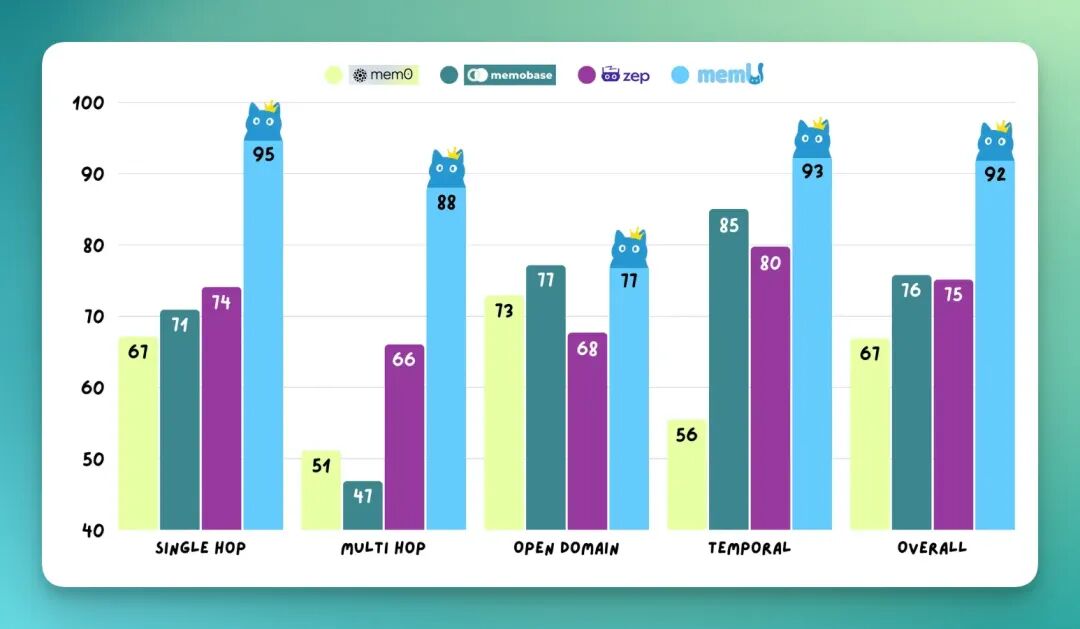
MemU achieves an average accuracy of 92.09% across all reasoning tasks on the Locomo dataset
👦🏻 Koji
You mentioned realizing "you're not the product type" and pivoting to underlying Memory services. How did this self-awareness develop?
👦🏻 Chen Hong
After leaving, I did indie development with friends and tried various online products. I discovered a problem — my product design skills are lacking. Probably from doing algorithms too long, I kept trying to cram technology into products, making them flashier and flashier, while losing sight of what users actually need.
After struggling for a while, I talked with some PM friends and realized I genuinely wasn't good at consumer-facing stuff — my product sense was off.
👦🏻 Koji
Two years ago you were at Seed working on Memory Systems for Doubao and NekoBox. Given model and technology advances since then, what's different now? Has Memory become more important, or has it been covered by model capabilities?
👦🏻 Chen Hong
I started leading Seed's Memory algorithm work in July 2023. Honestly, from then until now, Memory solutions on the market haven't really changed. I always felt something was off with the existing approach — switching to GPT-4, GPT-5, or even Claude wouldn't significantly improve current Memory Solutions, because the framework itself lacks the ability to scale up.
Recent advances in Agentic capabilities gave us new inspiration. We thought, why not map Memory to a file system? Recording, modifying, deleting, and reading memories — aren't these just file operations?
Some in academia and industry have done text-based memory records, but applying this concept to Agent memory of users is relatively new. File systems are particularly well-suited as Memory carriers because they natively support categorization, referencing, search, and forgetting mechanisms. What MemU's memory Agent does is automatically perform these operations for users.
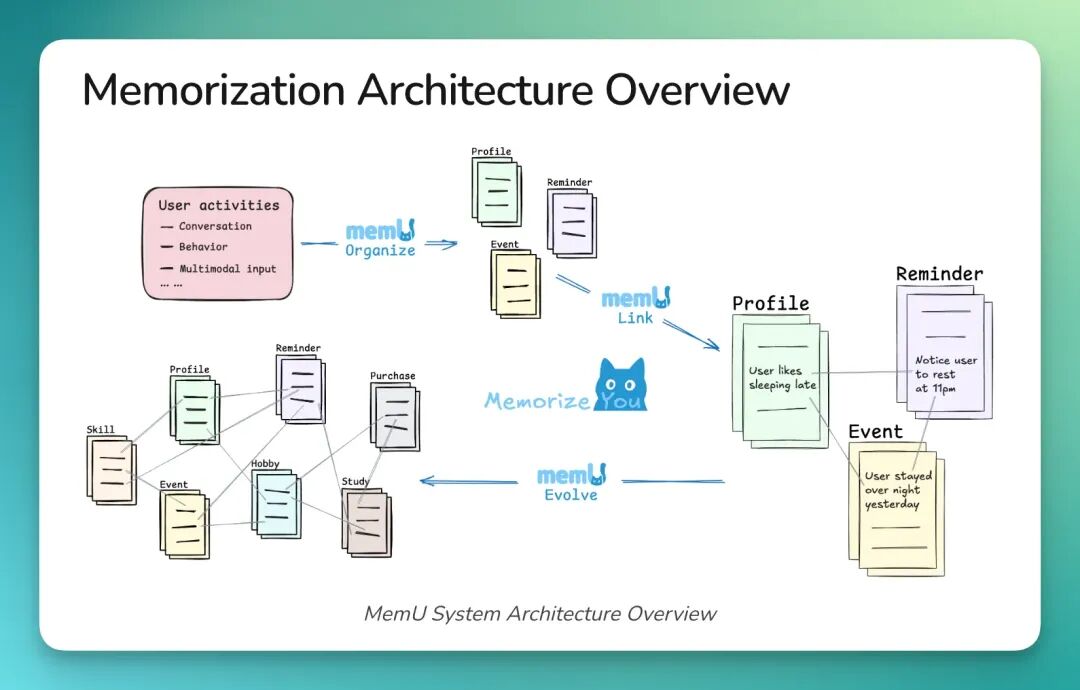
MemU system architecture
👦🏻 Koji
What's the market landscape for AI long-term memory? Can you give us an overview?
👦🏻 Chen Hong
Memory is a broad concept. We focus on emotional companionship, specifically Agent memory of users.
Actually, Memory has multiple dimensions:
[1] Agent's own Memory: Recording workflows, action results, reflections — speeding up similar task execution and improving success rates;
[2] Agent-to-Agent Memory: Recording mutual preferences during multi-Agent collaboration. This will become an opportunity similar to recommendation systems in future Agent Networks.
From a technical perspective, Memory and Self-Evolving are also inseparable — Agents can achieve self-learning through experience.
However, the market situation is quite awkward. Take Mem0, the leading third-party Memory service — it has decent market influence, but friends who've used it say the results are mediocre. The problem is, for an extra-cost service like Memory, mediocre results mean it's useless — you might as well spend that money upgrading your model or improving Agent capabilities.
Another issue: the validation cycle for long-term memory is too long. Next-day retention, 7-day retention — these metrics can't demonstrate Memory's value at all. You might not even exceed the model's context window. To see 30-day retention or longer? With AI products iterating so fast now, nobody can wait that long. Memory becomes an uncontrollable experimental variable.
👦🏻 Koji
Given all this, why are you choosing to start a company in Memory now?
👦🏻 Chen Hong
Because looking ahead, Memory is a massive market. Agent is the hottest topic this year; Multi-Agent is likely to be the hot topic by year-end or next year, followed by Agent Network.
Some say every company building Agents will build their own Memory System — maybe in the Single Agent era, but when there are hundreds of millions or even tens of billions of Agents in the market, and Agents start producing Agents, Memory can't realistically be customized into each Agent. At that point, Memory will inevitably be called as a third-party component at scale, becoming a To-Agent product. What's a To-Agent product? Applications designed for Agents — Browser Use, various Sandboxes, MCP services, and Memory is one of them.
From a traffic logic perspective, when the U (User) in DAU isn't just human users anymore, Memory could become one of the larger To-Agent applications.
👦🏻 Koji
Why did you choose the "AI companionship" vertical rather than a more general memory framework?
👦🏻 Chen Hong
When people hear AI companionship, their first thought might be Character.AI or some borderline products — that's actually a misconception. Companionship covers a wide range — AI assistants, AI education, even astrology and divination, they're all fundamentally companionship. As long as something needs to know you better, it's a fit for MemU.
Why choose a vertical scenario?
In the AI era, everyone wants to build something general — that's normal. Using a file system to manage Memory is indeed general; theoretically applicable to all domains. But applicable doesn't mean well-executed — Memory is extremely scenario-dependent. For example, the same file has completely different importance on a work computer versus a personal computer. Currently there's insufficient data to support an entire Memory system, so we must cut into specific scenarios.
Why choose emotional companionship?
Honestly, I just love this赛道 (track/space). Right now everyone's doing short-term emotional stimulation, which doesn't translate into long-term companionship. Many friends around me have beautiful visions of true long-term companionship. While we don't have the ability to build complete products, we can help friends achieve true emotional companionship through technology.
MemU's unique aspect is introducing "Theory of Mind" — enabling Agents to reason over existing Memory and expand understanding.
For example: You've always said you like coffee. Today I order you coffee, and you suddenly say you don't like it.
- Ordinary Memory System: either keeps "likes coffee" or changes to "doesn't like coffee"
- MemU records: "You might be in a bad mood today" or "Have you been having insomnia lately, too much stress?"
This deep understanding is crucial to the success of long-term companionship.
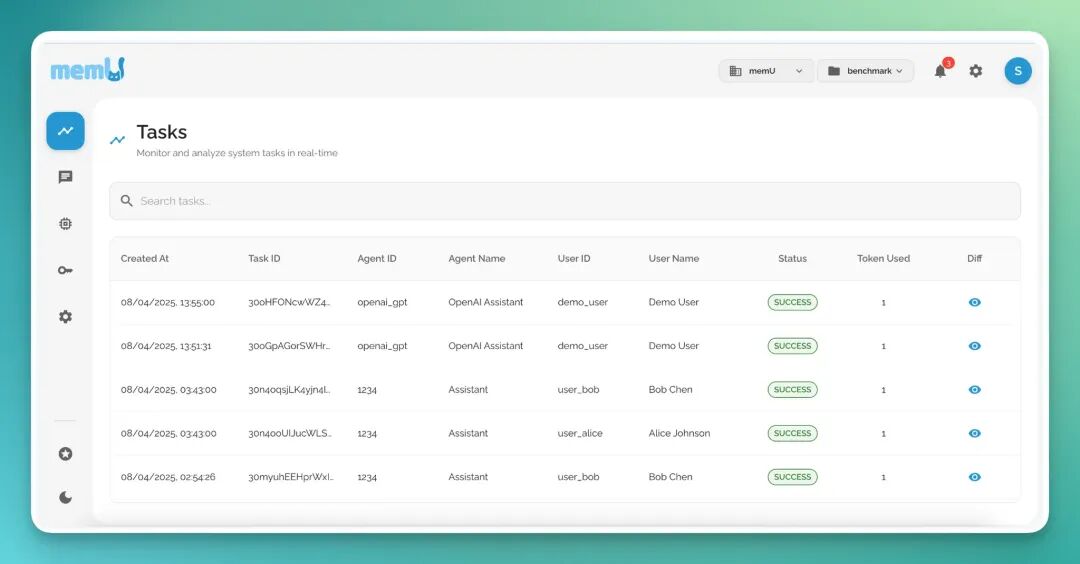
A Different Path from Big Tech: MemU's Technical Trade-offs
👦🏻 Koji
Compared to other products like Mem0, Zep, etc., what's MemU's biggest differentiating advantage?
👦🏻 Chen Hong
Better results, lower costs, faster retrieval speed, and scenario focus.
👦🏻 Koji
Which competitor do you pay most attention to? Why?
👦🏻 Chen Hong
Memory will definitely be a huge market in the future. Right now everyone's still small — no need to compete, better to collaborate and grab scope from the big players.
👦🏻 Koji
Recently big tech has been making moves too. Crossing's podcast just interviewed Xu Qing, President of Alibaba Cloud's Wuying Business Division — their AgentBay product also includes Memory services. How do you plan to compete with big tech for market share?
👦🏻 Chen Hong
Agent platforms will certainly have their own Memory Systems, but in their offerings, Memory is just a small component — big tech definitely won't invest enough in this area.
👦🏻 Koji
Are Manus, Genspark, and other leading Agent products your typical customers?
👦🏻 Chen Hong
No. We focus on companionship scenarios, while Manus and Genspark are primarily tool/efficiency-oriented.
For emotional companionship, To-User long-term memory is core — you must remember every detail about the user. But for Manus and Genspark, they focus on the Agent's own memory to control costs. To-User Memory represents only a small portion of their ROI.
Put simply, Memory priorities differ completely across scenarios. We chose to do the scenario that most needs User Memory.
👦🏻 Koji
You've chosen to open-source key technologies — aren't you worried about being "copied"?
👦🏻 Chen Hong
Open source doesn't mean charity; there are license agreements. Only when everyone follows the agreement can the ecosystem develop better.
Our strategy is similar to other open-source companies — we'll maintain both open-source and commercial versions. The commercial version leads by 1-2 versions; paying users get newer and better features, which also helps us commercialize.
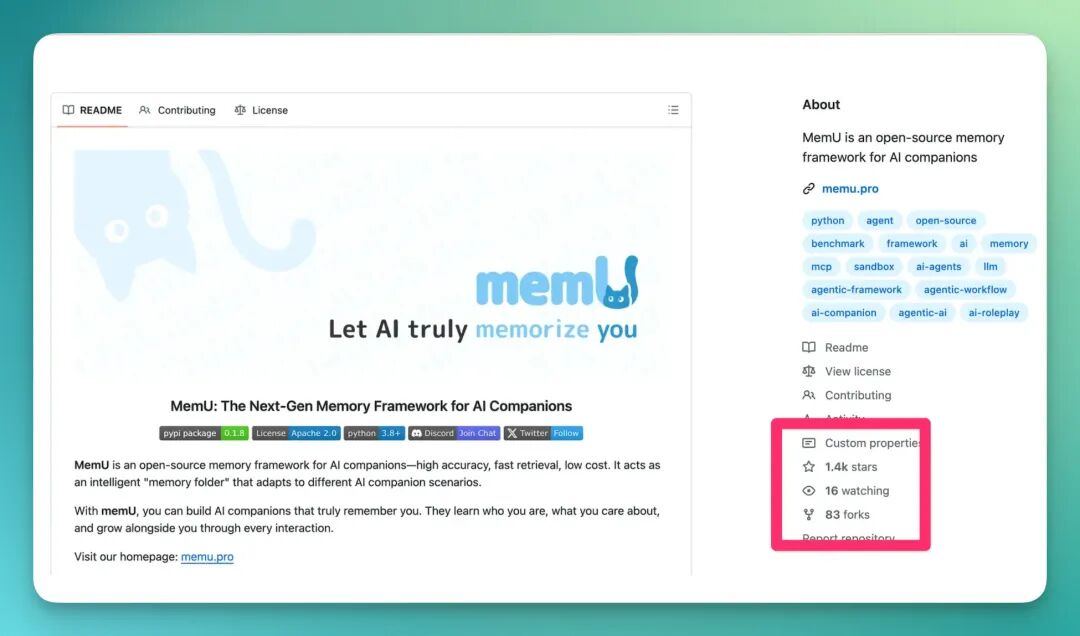
MemU GitHub project: https://github.com/NevaMind-AI/memU
👦🏻 Koji
Speed, cost, results — which matters most? Do you have internal priorities?
👦🏻 Chen Hong
Cost has always been our top priority.
Because we're an Agent system, our token consumption far exceeds ordinary solutions, though results are also significantly better. The problem is, most clients find this hard to accept, because Memory's revenue lift isn't obvious. So we're planning a major update in September — stay tuned.
👦🏻 Koji
What's actually going on with LLM memory?
👦🏻 Chen Hong
Many people confuse "short-term memory" and "long-term memory" in LLMs. Let me use an analogy:
Scenario 1: Currently reading (short-term memory). Like when you just finished reading an interview about MemU and can recite it verbatim. This is like the context window.
Scenario 2: After one day (long-term memory — core). You only remember core concepts like "MemU is a company that does Memory services." These essentials usually go in the System Prompt.
Scenario 3: When details are needed (long-term memory — retrieval). Someone asks about technical details? Then you have to go to Retrieval, digging through the "archive room" for relevant materials.
👦🏻 Koji
So how should an ideal LLM system work?
👦🏻 Chen Hong
At conversation start, put important background knowledge (Scenario 2) into the System Prompt, keeping it constant. As conversation progresses, dialogue content accumulates as short-term memory (Scenario 1). When users ask beyond background knowledge, search the Memory bank (Scenario 3) and append results after the user's question. After the chat, summarize and update essentials to long-term memory for next time.
Simply put, Scenario 1 is short-term memory; Scenarios 2 and 3 are long-term memory. Especially in companionship applications, Scenario 2 matters more — it determines the AI's "persona" and foundational understanding.
👦🏻 Koji
What are the main technical approaches in the industry for solving Memory problems? What are their respective strengths and limitations?
👦🏻 Chen Hong
From a technical perspective, there are two paths to perfectly solve Memory: Context management and infinite-length text models. Theoretically, if either path is pushed to the extreme, both could perfectly solve long-term memory.
From a practical standpoint, Context is simpler but tends to lead developers toward "explicit modeling." Long-context models are still far from supporting long-term memory — both inference efficiency and long-text reasoning quality fall significantly short.
There are also some parametric memory methods, but these remain largely at the laboratory research stage. Overall, we've chosen to focus on the Context-based long-term memory direction.
👦🏻 Koji
When designing MemU, what user experience details do you focus on most?
👦🏻 Chen Hong
We've found that many teams building AI products don't know how to properly utilize Context. For example, some set very small context windows, frequently calling Memory to save tokens, but end up losing Context Cache, resulting in higher input costs.
Because our team previously built large-scale applications (like Doubao, STARFIELD), we're very familiar with AI chat software development logic. We'll provide a series of tutorials telling developers how to save costs, how to achieve optimal Memory effects, and how to coordinate with dialogue models for the best experience.
Why Start a Company? Who Can Build True AI Companionship?
👦🏻 Koji
Why did you start a company?
👦🏻 Chen Hong
The question should be reversed: why NOT start a company?
After Agents emerged, it's a new wave with opportunities everywhere. I personally am very bullish on the long-term emotional companionship direction. And I believe that big companies using DAU as their North Star metric cannot build good long-term companionship products.
👦🏻 Koji
Last question: In your view, which teams in this industry are most likely to truly build AI companionship products that can comfort, soothe, and help people? What characteristics do they have?
👦🏻 Chen Hong
Emotional companionship apps have long been dragged down by the "borderline content" problem. Borderline content attracts users that completely skew feedback data — once reward data skews, the entire product's model iteration flywheel breaks — that's the赛道's (track's) fatal knot.
But recently I've seen some positive signs, like "Tolan", and domestic products like "Forest Healing Room" (林间聊愈室), plus attempts from other teams, all seriously building something different.
Honestly it's quite ironic: rich, technically-resourced big companies are all doing borderline content for traffic and quick money, while resource-constrained small teams are seriously doing emotional healing.
In this environment, being able to provide technical support to these idealistic teams is our way of doing something socially meaningful.