Agent Neo Launches: A Conversation with CEO Derek and CMO Guai Zi on Building the Ultimate AI Creation Tool

Young dreamers aiming for the stars.
On May 17, the flowith[1] team officially "debuted" their new product Agent Neo at the AI Hacker House organized by Crossing. At the event, flowith gave a detailed introduction to this all-powerful Agent positioned for AI creators. We also took this opportunity to invite flowith's founder Derek and CMO Guai Zi to Crossing to share the story behind Agent Neo.
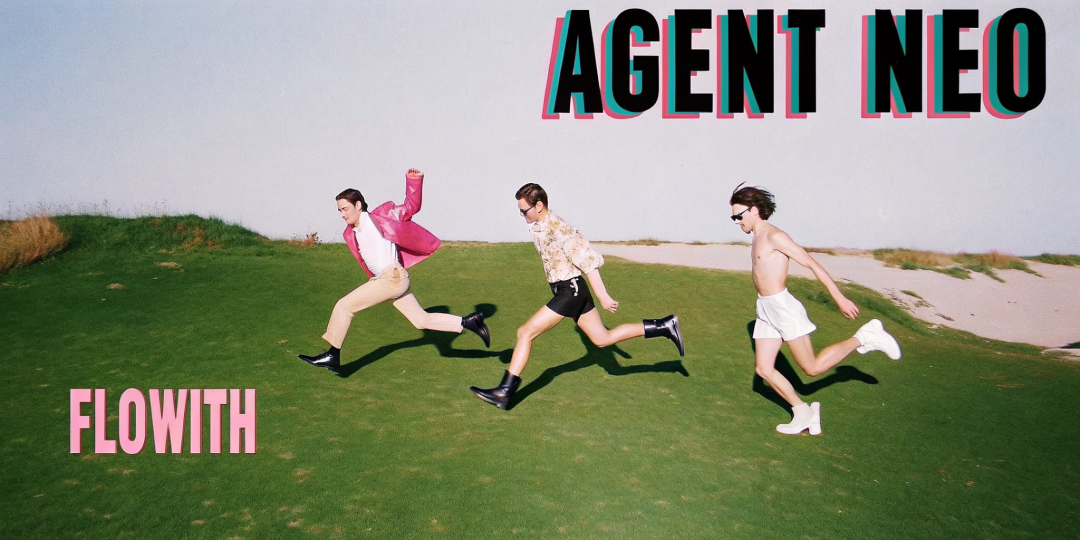
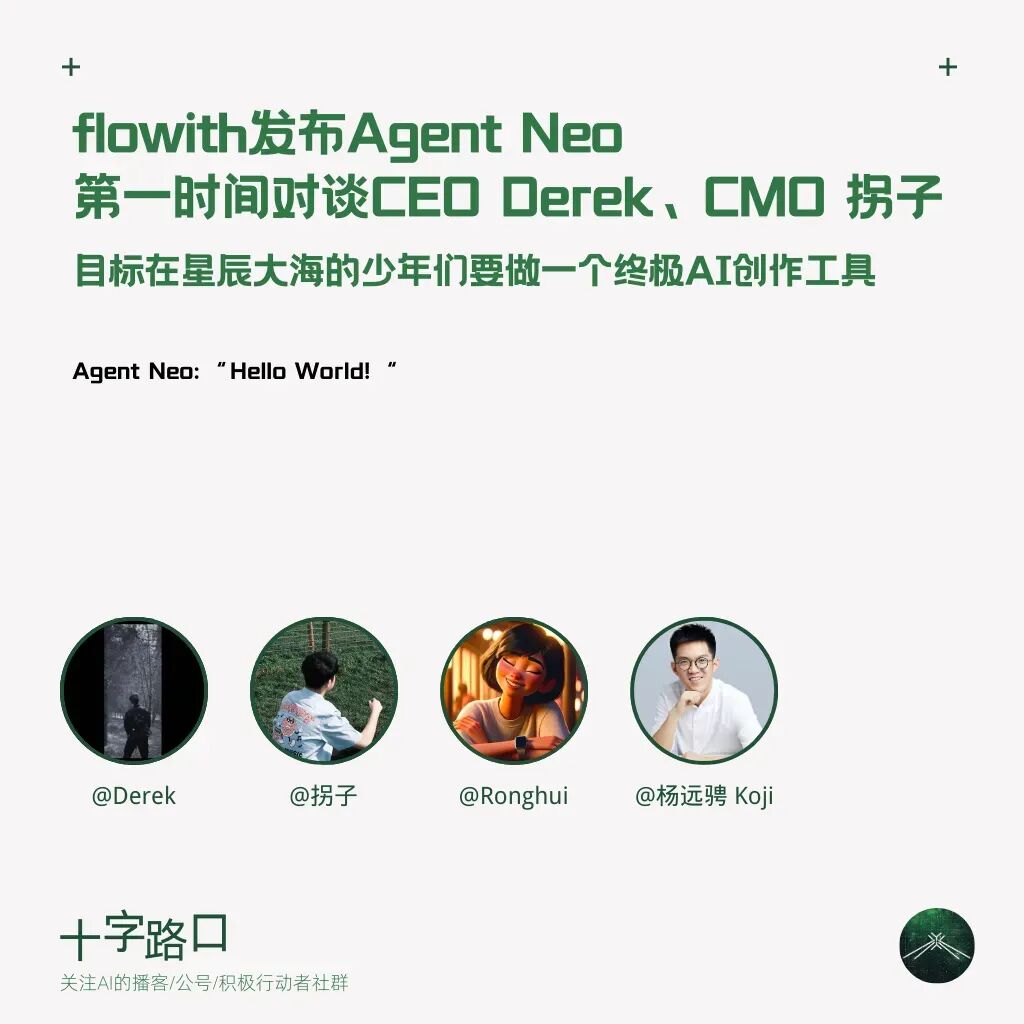
In this podcast episode, Derek and Guai Zi shared Agent Neo's features and use cases, and analyzed the strategic choices and their own judgments about Agent products currently on the market.
Meanwhile, flowith has developed considerable expertise in Xiaohongshu operations, and Derek and Guai Zi also shared many of their insights and takeaways during this recording. We hope you'll find them valuable.
Listen on WeChat:
Listen on Xiaoyuzhou:

🚥 Koji:
Last April, Flowith launched on Twitter, and I was completely blown away when I saw it. I managed to track down founder Derek's WeChat and met him at a Starbucks on Shanghai's North Bund. Looking back, that was the only time last year I felt the impulse "I absolutely have to meet this founder." That kind of person, that kind of product — in my memory, really only Flowith and Derek fit that description.
What struck me about Flowith back then was its silky-smooth experience and distinctive aesthetic. In an environment saturated with boring chatbots, Flowith chose the infinite canvas interaction model, which felt refreshingly novel. This week Crossing is delighted to host Flowith's founder and CEO Derek and CMO Guai Zi. Flowith has both Silicon Valley vibes and down-to-earth energy. What many people may not know is that their Xiaohongshu operations are practically masterful — in my view, among the strongest of any AI productivity product.
Flowith has amassed a large following on Xiaohongshu, which I believe stems not just from their internet savvy and operational skills, but from the product itself being genuinely excellent with its own unique character. This time Flowith also came to our AI Hacker House, where they held a special event for the debut launch of their latest AI Agent Neo. So we took this opportunity to record this podcast. Feel free to leave comments below — we'll select 10 people in a week to receive Flowith membership redemption codes.
First, let's have a rapid-fire Q&A with you two.
🚥 Koji: Age?
👦🏻 Derek: 29.
👦🏻 Guai Zi: 24.
🚥 Koji: Alma mater?
👦🏻 Derek: I graduated from Lafayette College in the United States, mathematics major.
👦🏻 Guai Zi: I'm a master's graduate from UCL, in AI and digital innovation.
🚥 Koji: What did you both do before Flowith?
👦🏻 Derek: I've tried many projects. One of the more substantial ones was a tech education brand I founded in 2016, originally called TechX Academy, later renamed X Academy — a youth-oriented tech summer camp held annually in Shanghai. Now in its tenth year, many friends and AI entrepreneur friends are our alumni.
Beyond that, from 2018 to 2019 I worked on an interest-based social product called Realm. I took a leave of absence from undergrad to return to China and spent over a year building this in Shenzhen. Later I hit a bottleneck and the project ended, but it counts as my first internet product experience.
👦🏻 Guai Zi: I did my undergraduate degree at a Chinese-foreign cooperative university called the University of Nottingham Ningbo China, in mathematics. I started a business in my first year, creating China's first electronic music festival, which gained some renown in Zhejiang and nationally. Our WeChat public account had millions in traffic, and we experimented with a lot of viral social growth tactics.
🚥 Koji: Your MBTI and zodiac signs?
👦🏻 Derek: INTP, Pisces.
👦🏻 Guai Zi: ENFJ, Aries.
🚥 Koji: What's Flowith's current fundraising situation?
👦🏻 Derek: We're currently closing two consecutive funding rounds with a combined total of roughly over $10 million. However, the deals aren't fully closed yet, so details aren't convenient to disclose at this time. Last year we received an individual angel investment. Before that, Flowith was bootstrapped by my partner and me using savings from previous ventures.
🚥 Koji: Can you reveal your current user scale and DAU?
👦🏻 Derek: The user base is still quite small — currently over 200,000 registered users. DAU has been growing rapidly recently, with quite a bit of fluctuation.
🚥 Koji: How's the revenue situation?
👦🏻 Derek: In March this year our ARR reached $1 million. February was several times January, and March was several times February, so overall revenue growth has been quite fast. Currently monthly revenue is in the hundreds of thousands of dollars, and we're very much looking forward to what changes this launch will bring.
Flowith's New Agent Product Neo: A Super All-Purpose Agent That Makes You Smarter and Lazier
🚥 Koji: Thank you both for choosing AI Hacker House to launch Neo. If you had to pitch Neo in one sentence, what would you say?
👦🏻 Derek: Neo is a super all-purpose Agent that makes you smarter and lazier.
🚥 Koji: How is Neo different from other Agents? Can't other Agents make me smart and lazy too?
👦🏻 Derek: We emphasize "making everyone lazier." Actually, we decided to build an Agent last May because we discovered that large models' reasoning capabilities and intelligence were already extremely strong. Anyone using various advanced models in daily life can feel this — their information mastery and IQ are excellent.
But we were thinking, why hasn't AI created more value for many people? For instance, most people haven't earned more money through AI or produced better work. We believe the biggest problem is that AI hasn't truly exercised its "agency." AI itself is smart but not proactive. And Agent can exactly compensate for this. It can execute multi-step tasks, call tools, manage context, and thereby complete more complex work. We actually experimented with this when building Oracle, but it was still an exploratory phase without explicitly making these the primary goals.
With Neo this time, we've clearly identified that "longer task flows, longer context processing, longer outputs" are critically important. We don't want Agent to be just a toy that users try once and move on from — we want it to genuinely help users solve needs and produce high-quality content. So Neo's focus this time is executing ultra-long tasks to generate ultra-long content, and we've designed its architecture toward the goal of "infinity." Whether it's how many steps a task has or how much the final output is, it can handle it. This is Neo's biggest difference from other products. Additionally, Neo runs entirely in the cloud. You can assign it a task that runs for a week or even a month, and it will operate stably. So "infinite flow + cloud execution" gives it many new possibilities.
👦🏻 Guai Zi: Let me add something. As Derek just mentioned, "infinite tasks, infinite steps" — internally we have a summary for Neo: it's a can't-stop Agent. It can't stop, and will keep working for you.
🚥 Koji: Can you give an example of something Neo can do that other Agents can't?
👦🏻 Guai Zi: I'll give an example related to Crossing. As a tech media outlet, we need to track the latest global hotspots in real time — companies like OpenAI, Google, Anthropic. We can assign Neo a task, such as checking these companies' official accounts (like Twitter, Weibo) every two hours to track whether they've posted new content. You can even specify to follow Sam Altman, the head of Google Gemini, or Anthropic's CEO, etc.
Neo will continuously scrape this content for you and generate deliverables as needed. For example, it can send you a summary email every day, or continuously update a certain webpage or document. The entire flow is multi-round, automatic, and uninterrupted. This kind of "uninterrupted continuous follow-up" is something current other Agents can't achieve — only Neo can do it.
🚥 Koji: Do you think other Agents can't do this because the technology isn't there, or because they're not planning to do it?
👦🏻 Guai Zi: I think it's both.
First, we designed the architecture for "infinite tasks" in Neo from the very beginning, which other products currently can't do.
Second, from a product philosophy standpoint, we're very deliberately focused on the domain of "creation." We believe that an Agent capable of reaching AGI-level performance must satisfy the needs of content creators like us: it needs to generate infinitely, deliver high-quality output, and simultaneously capture and integrate information in real time.
So other Agents currently lack both this design philosophy and this capability. We're very confident that Neo can pull this off.
Longer steps, longer output, and more complex execution is the inevitable direction for all Agents
🚥 Koji: What I actually wanted to ask earlier is that "infinite" sounds like a massive differentiator. It's like an AI that works for you for life: you set a task, and it keeps executing quietly in some corner, burning through your tokens and credit card.
Are you making "infinite" a core keyword for differentiation, or because you genuinely believe this creates enormous user value? Derek, what do you think?
👦🏻 Derek: I believe "longer steps, longer output, and more complex tasks" is the direction all Agents must inevitably move toward. We may just be earlier on this path, and we've successfully made it work. But I believe whether it's Manus or other model companies, everyone will develop in this direction.
This trend is essentially the path toward AGI. Because one capability of AGI is the ability to execute tasks continuously over long periods, even initiating actions proactively. And the foundation for these capabilities is this: the Agent must be able to handle long tasks and have long memory.
We're working toward this direction now, and we're among the earlier ones to actually build it.
🚦 Ronghui: Do you think other teams will quickly move in this direction too? Do you see anyone else doing this now?
👦🏻 Derek: Not that I'm aware of currently. Flowith has always moved relatively fast and aggressively. For example, when we built Oracle last year, Agents weren't yet widely discussed in the industry, and our infinite canvas (Flowith Canvas) was also quite ahead of its time.
I believe other products will soon start investing in "long task flows." But beyond "infinite steps and context," another major difference for us is our focus on the "creation" domain. What we hope to achieve isn't general-purpose AGI, but "creative AGI." We still position ourselves as a creation tool, so we believe the execution flow of Agents in the creative domain is critically important. For example, with tasks like booking flights or planning itineraries, the Agent just needs to complete it itself — users don't care about the intermediate process. But creation is different; creators need to see every step of the content, and even intervene and participate during the process.
This is also why we insist on using the "canvas" and insist on human-AI co-creation. This is a completely different philosophy from other products.
🚥 Koji: When you say "creation," what's the more typical or more granular creator profile? Text, images, video, or something else?
👦🏻 Derek: We don't really have limitations on modality. Conversion between different modalities is now very natural. Sometimes a user's initial expectation might be generating a piece of text, but then they discover, "Oh, I can turn this into a webpage." So we now feel that in the era of AI generation, modality is extremely flexible: it can be text, images, video, or even a complete webpage. Of course, different user groups use it differently — students might use it for writing papers or making reports, professionals might use it for product copy or new media content. Everyone's interaction pattern with it is different.
🚥 Koji: So to serve creators, beyond the long context and infinite modalities you mentioned, does Agent Neo have any special interaction designs or features? Can you give one or two examples?
👦🏻 Derek: For example, you can ask it to write a 200,000-word novel, or continue writing Empresses in the Palace (Zhen Huan Zhuan), and this continuation can fully integrate text and images. If you say "write 100 episodes," it will actually plan the structure itself — first finding the original ending of Empresses in the Palace, then writing an outline covering the plot for the next 100 episodes. Then it will first generate a webpage shell, and start filling in content from chapter one to chapter five. After each chapter is written, it will also add illustrations, like generating ten images, inserting them into the webpage, and writing step by step until the end. This webpage will be extremely long, but reading it feels like a complete novel — very complete, very immersive. The content is extremely high quality, looking like a real novel that you can keep reading.
How to solve the hardest Level 3 question in the GAIA benchmark
👦🏻 Guai Zi: I can add a small story from our internal testing. At the time, one of our algorithm developers quietly bought memberships to various products and had everyone do a horizontal comparison of GAIA benchmark capabilities across products, and whether we were actually doing Agent Neo better than others.
In the GAIA benchmark test, there's one question we consider the hardest in Level 3: given an image of two dogs on leashes, determine what brand of harness they're wearing. Then find a story published on the brand's official website on December 8, 2020, and identify what kind of meat the dog ate that was mentioned in that day's article. This question is particularly convoluted because there's no obvious brand information, and the official website content has lots of distracting words. The correct answer is just one word: bacon. But most general-purpose Agents couldn't answer this question — only Agent Neo got it right. This illustrates a difference between Agent Neo and other products: it's like a high school student competing in a math olympiad versus writing a Chinese essay — both use the same brain or the same Agent to handle, but the capabilities selected in between to deliver results under different circumstances are completely different. Its ability to dynamically invoke tools and strategies is more like an agent that can handle professional complex tasks, not just a text generator.
Making a 3D billiards mini-game
👦🏻 Guai Zi: Because I come from a technical and coding background, I think making a 3D game is extremely difficult, whether for humans or AI. One day when we were playing billiards in Dali, we wondered if we could make a 3D billiards table, then make a 3D billiards mini-game. This doesn't just require considering ball collision, cue force, and camera language, but also involves 3D rendering. Previous Agents, like Oracle or Manus, could only generate 2D desktops and couldn't really be played. But Agent Neo can start from the rules, and step by step build rules, scenes, and interaction logic, ultimately producing a playable 3D billiards game. This capability isn't just generation — it's advancing the entire task like a game product manager. So what's different about Agent Neo compared to other products is that, based on our proprietary self-downward-review mechanism, it continuously optimizes its own tasks and ultimately reaches a level the user wants. This is extremely rare.
Making a comprehensive official introduction for Black Myth: Wukong
👦🏻 Guai Zi: Finally, let me share a more "product-level" case. Last year's hit game Black Myth: Wukong. When we first built Oracle, I posted on Xiaohongshu a product introduction for Black Myth: Wukong made with Oracle. But Oracle's capabilities were limited at the time — it could only pull a few simple images and some brief descriptions from web searches, lacked context processing capabilities, and couldn't index images well or generate images. Additionally, if users wanted the AI to generate images, the prompts needed to be extremely refined, with a very high barrier to entry.
This time we used Agent Neo for a similar task: generating a product introduction website for Black Myth: Wukong. Our prompt was very simple — just asking it to generate as detailed and complete an introduction page as possible. Neo first studied the aesthetic style of Black Myth: Wukong, such as the泛金色 (golden-toned) palette and artistic fonts. For character design, it studied the game's art foundation, and combined with the image generation methods we use, created character prototype images for each character (like Sun Wukong, Zhu Bajie, monsters, etc.), and showed which styles or elements they referenced, ultimately generating a very detailed, interactive webpage.
In eras with limited context capabilities, Agents couldn't complete such text-and-image-rich pages. Long Context or Infinite Context isn't just about processing long text — it also includes the integration of images and multimodal content. In this case, the Agent also embedded YouTube videos, completing the overall output using text, images, code, and multiple other forms.
I think the significance of this case is that it demonstrates Agent Neo is the first Agent that can truly complete product-level delivery, whereas previous Agents, including Oracle, still couldn't achieve this.
🚦 Ronghui: Hearing all this, I'm getting the sense that the "creators" you're talking about aren't "people who create content" in the traditional sense anymore. Is what you mean by creators essentially just "people who use AI to do things"?
👦🏻 Guai Zi: Whether models or Agents, there's an opportunity in the future to turn everyone into a creator. Before you might only know how to write text, but now AI or Agents can help you become a product designer, programmer, or interaction designer. So first it broadens the possibilities of creation for you, and then it truly allows everyone to become a creator.
The optimization behind Neo's capabilities
🚥 Koji: The example Derek gave earlier of writing 200,000 words continuing Empresses in the Palace — what optimizations actually make this possible behind the scenes? How did you achieve this? And how are you doing it better than others?
👦🏻 Derek: The "infinite output" or "infinite steps" I mentioned earlier might sound a bit abstract, so let me give a concrete example. In the past, when we used AI coding tools or large models to generate webpages, it was typically single-step: for example, "make an adventure webpage," and it would generate code, done in five minutes. This is the typical experience with traditional large models or Agents.
Agent Neo can break a project down into very granular steps for execution. For example, it will first generate version one of the webpage code, then based on this version do self-modification and optimization. It has a mechanism that enables AI autonomous planning, autonomous execution, and autonomous iteration, developing from an initial 5,000 lines of code to 50,000 lines, or even 500,000 lines — something other products can't do.
Even some tools specifically for AI coding, like Cursor, can't have AI autonomously complete all tasks — they still require human supervision to execute step by step. Our system allows AI to autonomously plan, make step-by-step adjustments, and ultimately complete the entire code and project delivery process.
Neo v.s. Manus
🚥 Koji: So how is this different from Manus or Genspark's Agent? When people build Agents, they usually do task planning first, rather than solving everything in one shot like a chatbot. From your description, it sounds like everyone does something similar. Is there anything else you can elaborate on?
👦🏻 Derek: This is indeed a common approach across all Agents right now. But Neo's distinction lies in how granularly it breaks down the web generation process. Each step focuses on implementing one specific function. We emphasize repeatedly refining a single piece of work rather than "one-click generation" or completing everything in one go.
On the surface, all Agents have step-by-step planning, but when it comes to actually delivering services and polishing finished work, existing Agent products are generally lacking. We believe high-quality output requires iterative revision, just like human creation. But current Agents fall short in this regard.
🚦 Ronghui: Do you mandate a minimum number of steps?
👦🏻 Derek: There's no fixed number — we adjust dynamically. The Agent has an option to control execution steps: if the user wants an efficient, concise completion, just a few steps suffice. But if they're expecting production-grade, highly polished code output, the step count can be set very high — 100 steps, 200 steps.
For example, if someone wants a Snake game, some users just want a simple version, while others want it extremely refined. Even with the same prompt, different expectations lead us to let users freely control the step count and iteration depth.
The "Infinite Canvas" Product Vision
🚥 Koji: I think Flowith has a fairly steep learning curve. Many friends find the interface impressive and the口碑 solid, but struggle to get started after trying it. How do you view this problem?
👦🏻 Derek: This is something we've been concerned about. Flowith started development in 2023, and our biggest challenge then was that canvas-based interaction is inherently high-threshold. We wanted to optimize from the start. Initially it was similar to Figma or Photoshop — a free canvas mode where users could drag, combine, and manipulate elements. But we found this unfriendly to novice users, with high onboarding costs.
So we later optimized the interaction design, shifting from free canvas to what we now call "flow layout." Users enter the product, no learning required — just type in the input box and start using it. Our philosophy is that users shouldn't need tutorials; they just input text, similar to using ChatGPT or other AI products. As they go deeper, they can branch out or switch models within threads, expanding what was originally a linear process into a structure that combines vertical and horizontal dimensions. At that point, users discover that Flowith helps them better发散, compare, adjust, and optimize. Only then do they want to learn slightly more advanced operations, and it's much easier to pick up.
🚦 Ronghui: What was your thinking behind the "infinite canvas" at the time? Weren't you worried about the high user barrier? After all, people are more accustomed to chat-style interaction.
👦🏻 Derek: Honestly, we didn't overthink it at first. We were frantically tuning prompts and building small AI tests — though they weren't called Agents back then. We found a major problem: in ChatGPT or other single-thread AI, once you modify your prompt, the history is gone. You can only maintain one thread, making modification and comparative testing very inconvenient.
We ourselves frequently held brainstorming sessions — we're typical multi-thread users. But in single-thread dialogue, both content generation and AI interaction were severely constrained. So we'd move prompts, generated results, and conversation threads onto Figma. Figma allowed horizontal arrangement with more freedom, making side-by-side comparison and reviewing follow-up replies easier.
So we wondered: could we build a product where, within one canvas or simple interface, you could extend both vertically and horizontally? There was nothing like this on the market then, so we weren't sure if it would work. But after building the MVP, we tested it with many friends and found this pain point was universal.
For example, one investor friend used to put AI replies in Excel, because Excel essentially turns one-dimensional content into two dimensions. We felt this aligned with our thinking, so we continued refining the MVP.
Later we focused our positioning on the creation domain. While canvas or this interaction style has some learning curve, once mastered, many people can't go back to traditional linear interaction. So we believe canvas-based interaction is the superior choice for creation scenarios. After completing the product last year, we noticed many products began borrowing our design. This year, more people are moving in this direction — I think this is the process of moving from "anti-consensus" toward "consensus."
Industry Landscape and Competition: Flowith's View on 2025's Hottest Segment
🚥 Koji: We've talked a lot about how Agent Neo differs from other Agents, constantly pressing on functional and scenario differences. It's now May 2025, and Agent is the hottest topic. How do you view other teams — Manus, Genspark, Fellou, even the recently launched Lovart? Can you comment on each?
👦🏻 Derek: We've been following these products. Manus is a milestone product — it brought the Agent concept to the masses, making users who had zero concept of "intelligent agents" understand and accept this new AI interaction paradigm. But after Manus emerged, many products simply copied it without much innovation or highlight in functionality. Despite big marketing pushes, they lacked substantive breakthroughs, and there's some fatigue setting in.
I look forward to more breakthrough attempts from both startup teams and major companies. We're also happy to experiment — even failures can push the entire Agent industry forward.
🚥 Koji: Flowith and Agent Neo have consistently done things differently from others, which has been quite inspiring to the industry. After Manus, Xie Yang built Fellou, and he's been aggressively advocating that Agents should run in local browsers rather than in the cloud. But Devin, Manus, and your Neo are all cloud-based. How do you view this architectural choice?
👦🏻 Derek: We haven't actually used Fellou, but our early Oracle was locally executed — it had to operate in real-time within the webpage. We explored this extensively. Neo now emphasizes cloud execution, and its advantages over local are numerous. Let me give a concrete example: we're currently beta testing Neo, and every day many users assign it complex tasks before bed — like 200-step research on a topic, stock analysis, building a website, or researching someone. For instance, if I'm meeting Koji today and don't know much about you, I can have it frantically search for your information online and prepare a report. After assigning these tasks, I go to sleep. The next morning, I check the execution process and final output webpage or report on my phone. This feeling is quite special — like having a little assistant or intern you can fully trust with delegated tasks. This shift in user mentality is hard to achieve with local Agents. Local mode typically requires keeping the device on, and the operation process isn't as convenient.
🚥 Koji: But Fellou's argument is that local browsers have more complete context and browsing history, and since you're already logged in, accessing data doesn't require repeatedly entering passwords. What's your take on this?
👦🏻 Derek: This is indeed a real issue. For example, if you ask an Agent to post on Twitter, you can't do it from the cloud because login is required. But having users log into a virtual machine raises significant privacy and security concerns, whereas local browsers don't have this problem.
However, I think both approaches have their strengths, and better integration may emerge in the future.
Vertical Agent v.s. General-Purpose Agent
🚥 Koji: You mentioned that Agent Neo is designed for creators, making it a vertical Agent in some sense. But when we say vertical Agents have a reason to exist, it's usually because a domain has complex workflows, requires specialized knowledge bases, or demands higher accuracy in information sources. Why can the creator direction support a standalone Agent without being swallowed by general-purpose Agents?
👦🏻 Derek: The ultimate form of general-purpose Agent is AGI. If AGI truly arrives, many vertical domains might indeed be displaced, and even many human roles would be disrupted. But I don't think this will happen that quickly.
Before AGI is achieved, general-purpose Agents will struggle to surpass specialized Agents in efficiency within certain vertical scenarios. General-purpose Agents can do everything, but often not with enough precision.
🚥 Koji: Are there examples of functions you've deliberately abandoned because you chose to be a "creator-dedicated Agent"? These might be things general-purpose Agents would do, but you deemed not worth investing in.
👦🏻 Derek: Yes, and this relates to a new technical update we're planning in the coming months that will be more imaginative — hopefully we can share more then.
For example, Neo currently supports many tools: web generation, web search, etc. When deciding whether to add new capabilities, we specifically consider whether these tools have value for creation. Functions like "sending text messages" or "making phone calls" — while not technically difficult to implement — don't meaningfully contribute as creative tools. So we've consciously made trade-offs.
🚥 Koji: You mentioned many differences between vertical and general-purpose Agents. But honestly, after getting a Neo invite and using it for a few days, it feels quite general-purpose to me — I didn't particularly feel where it's "vertical." How do you internally define "general" versus "vertical"?
👦🏻 Derek: Actually, we think the boundary between "general" and "vertical" is blurry. Manus claims to be the first general-purpose intelligent agent, but in our view it still has boundaries. Our self-defined direction is "creation-focused Agent." We could implement phone calls, food delivery, and other functions, but we choose not to because they don't align with our product positioning and vision. We want to focus on scenarios and capabilities strongly tied to creation.
🚥 Koji: After Manus launched, market attention toward Agents clearly increased, and Manus's $500 million valuation ignited market enthusiasm. Have you noticed any changes when talking to VCs?
👦🏻 Derek: Actually, we saw a wave of growth back in February, before Manus launched, and closed our first round then. Valuations and attention were still relatively low at that point, so that round wasn't really affected. But follow-on financing and market attention definitely got a boost from Manus. You could say they heated up the entire Agent赛道, and we do have to thank them for that.
We had originally planned to launch the new version of Oracle around mid-year or the second half of this year, but Manus's emergence accelerated our timeline. Now we're looking at a May launch. This shift in pace is directly tied to market changes.
What Did Flowith Get Right During Its Exponential Growth in February–March?
🚥 Koji: You mentioned Flowith achieved very significant growth in Q1, even doubling. What do you think you got right during that period?
👦🏻 Guaizi: In January, I think one of the most important things was something everyone knows about — during the Spring Festival, an AI star emerged: DeepSeek. We launched Flowith 2.0 in January, with the "Knowledge Garden" feature going live. DeepSeek blew up right on New Year's Eve, and I remember it vividly — I was eating reunion dinner when DeepSeek's servers crashed, and everyone was talking about it.
We integrated DeepSeek too. At the time, I was thinking: beyond just introducing DeepSeek, could we combine it with our product somehow to help people break through in content creation, while also capturing this wave of traffic? I thought of our "Knowledge Base" feature, which also has content monetization attributes. So I told DeepSeek about this idea and created a Flowith x DeepSeek support library.
I fed it some of my past copywriting that had good "internet sense," and it generated twenty or thirty directions for me. One particularly valuable angle was "making money with DeepSeek." This aligned perfectly with our "monetizable knowledge base" concept. During that period we published a lot of related content, both domestically and internationally, which drove organic growth. Combined with some product-side viral mechanisms, it created a small exponential explosion.
Flowith's Xiaohongshu Playbook: Key Learnings
🚥 Koji: This experience is fascinating, and I want to dig deeper. Flowith has been very impressive on Xiaohongshu. You just told the story of leveraging DeepSeek for growth — can you share which of your notes performed best, or which ones?
👦🏻 Guaizi: The DeepSeek period had pretty good numbers across the board; the highest-performing post got around 500,000 views. The biggest hit was that "DeepSeek can make you money" note — the data was excellent. During that time, most of my content was actually generated by AI helping me with titles, copy, and images. I even built a small Agent to handle these tasks.
Another memorable one was our "Knowledge Garden" post when we launched 2.0. Internally, we were discussing how to get this feature more market attention. It already had knowledge trading, viral mechanics, and other attributes, but we felt it needed a stronger hook. I had AI brainstorm titles for me, and it gave me over a dozen options. Then I saw one word — OnlyFans. While it's slightly sensitive in international contexts, its trading and social attributes are very successful. I personally loved that piece of content because it demonstrated AI's assistance in creation, nailing the precise keyword. That note's title was frequently cited by media and other bloggers.
Recently there's a hot concept abroad called "Vibe Marketing," similar to "Vibe Coding" — the core idea is letting AI make decisions for you, reducing human intervention, and enjoying the process of interacting with AI. Derek DM'd me early on saying I could champion this concept. I think our Xiaohongshu operations since last year have been practicing this philosophy. Someone abroad even made a 20-minute video about this concept, and many of the views aligned with mine. This counts as validation that "Vibe Marketing" is genuinely viable, and perhaps even more likely to break through than "Vibe Coding" at the传播 level. I think I'll continue going deep in this direction.
🚥 Koji: You mentioned that note's title got cited by a lot of media — which line was it?
👦🏻 Guaizi: "I think I discovered the OnlyFans of the AI era."
🚥 Koji: Do you have any methodology or learnings from doing Xiaohongshu that you could share? Any principles you've distilled?
👦🏻 Guaizi: First, Xiaohongshu originally grew because of its female user base, driven by beauty and shop-exploration "grass-planting" content. So the "grass-planting" concept is deeply ingrained. Whether you're a major blogger with 100,000 followers or a new account with a few hundred, your chances of getting recommended are actually pretty similar — this is something I observed after posting consistently.
Second, Xiaohongshu is a content-driven platform, and "internet sense" in titles and copy is critical. For example, most of what I post is Flowith-related content, and on this platform you still need a fairly polished, genuinely impressive product to capture people's affection. If you want to "go viral" here, you first need to understand its distribution mechanism, then have attention-grabbing titles and visual expression to get users to click. Finally, think about conversion — what's your goal? For instance, you need to植入 some content to accomplish what you want to do. For me, it's definitely product conversion.
🚥 Koji: Any particularly practical, immediately actionable advice? Like a specific note-writing tip?
🦻🏻 Guaizi: I think it's "watch and learn a lot," just like training AI. Look at what the hottest content in your target category looks like, and study its structure, language, and titles. Don't just learn from Xiaohongshu — learn what the hottest stuff in your specific topic might look like anywhere, then use paraphrase to重构 those titles.
Another non-consensus view: if an account has posted 100 notes and traffic has stayed consistently low, it's probably not luck — it's likely a problem with the account itself or the content strategy. Xiaohongshu operates on completely different logic from WeChat Official Accounts or Weibo. You need to rebuild your understanding of the platform: browse more, learn more, post more.
👦🏻 Derek: I think the most core thing about Xiaohongshu is that it somewhat achieves "attention egalitarianism." Like, we have hundreds of thousands of followers on WeChat Official Accounts and many followers on other platforms, but on those platforms, the more followers you have, the better your subsequent data gets. If you're a new account with just dozens or hundreds of followers, your initial posts will definitely get low traffic. On Xiaohongshu, even as a new account, if your content is good enough, you can get the same recommendation opportunities as major bloggers with tens of thousands of followers. It's primarily image-text, doesn't require high-cost video production, and has a low creation barrier.
Guaizi just mentioned "Vibe Marketing" — I think Xiaohongshu is particularly well-suited for it. The barrier is low, you don't need to overthink it, just post. But many people give up after a few posts with poor data. Actually, the seemingly simplest truth is: post like crazy. If five posts don't work, do twenty, do fifty. While your internet sense might not be great initially, if you keep outputting, something will eventually blow up. Once you get positive feedback, that flywheel can start spinning — this is absolutely critical.
Whether it's AI entrepreneurs like us or creators in other fields, I think this applies. Of course, if you're doing product, the core is still the product itself. If the product has no亮点 and is fairly ordinary, even the most attention-grabbing Xiaohongshu title won't help much. I use Xiaohongshu myself — though I've posted less recently, last year when I had time I would post, trying to sincerely share some认知 and reflections. Perhaps this kind of content is relatively uncommon on the platform, so it tends to get attention more easily.
Staying Lean: How a Small Team Keeps Burn Rate Low
🚥 Koji: Last week I met another entrepreneur working on Agents, and he said he really admires Flowith — he feels your burn rate is exceptionally low and cost control is excellent because your team is so lean. How big is your team now? What roles?
👦🏻 Derek: We've been hiring recently, so quite a few new colleagues just joined. We're at about fifteen or sixteen people now, quite a bit more than before. The first time I met you, Koji, we were just three people — a tiny team. We hired gradually after that, but at a relatively slow pace. Overall we want to stay under thirty people and keep things lean while building the product.
🚥 Koji: Roughly what are the roles and division of labor among these fifteen or sixteen people? Can you share?
👦🏻 Derek: More than half are technical and engineering. The rest are split among marketing/operations, product, and design.
🚥 Koji: How is your current product R&D team structure different from traditional internet companies?
👦🏻 Derek: The difference is quite significant. Early on, including our previous startup and when Flowith first launched, we were fairly traditional too. The product flow went from product manager to UX, then to UI, then handed off to engineering, then testing before launch. But in the AI era, that's too slow.
So we've streamlined a lot of processes. Now it's product straight to engineering. UI is handled by AI or Agents. UX and product are merged, with product managers directly pushing engineering forward. On the engineering side, we also leverage Vibe Coding and AI assistance, so implementation is very fast. After development, I do a round of testing myself — adjusting UI or interactions that aren't ideal, modifying the code myself, and ultimately arriving at a shippable version. In short, our development process is now quite different from traditional approaches.
🚥 Koji: You mentioned having AI do UI — someone still needs to guide it, right? Who handles that now? At what stage do they介入?
👦🏻 Derek: We experimented a lot initially, then found a relatively stable method: having AI work within our existing design language and style, mastering things like shadows, primary colors, corner radius, and so on. We provide this set of prompt rules to the AI agent, and it can generate code that conforms to our design system, then implement it.
Beyond this process, our engineers can also make微调 to the UI during generation. Finally, I get involved in modifications too. Because AI sometimes generates fairly mediocre interfaces that need polish and adjustment. Once all of this is done, it can be delivered and launched.
Fundraising Learnings: Last Year and This Year Are Completely Different
🚦 Ronghui: Derek, you mentioned you've been talking to investors for a new round recently, and you had some individual investments before. Have you been running between China and the US since last year? Do you engage with investors on both sides simultaneously?
👦🏻 Derek: Yes, actually we've been mainly domestic recently, especially while we're racing on product, but before that I was indeed spending quite a bit of time on both sides.
🚦 Ronghui: What would you say are the biggest differences between fundraising last year versus this year?
👦🏻 Derek: The difference is pretty stark. Early last year, or even the year before, the domestic funding environment wasn't great — people were generally pessimistic, and institutions were very conservative. Firms that used to invest in dozens of projects annually were down to just a handful the year before. We felt that shift acutely. So our strategy last year was more conservative too; we figured if the environment was tough, we'd just focus on refining the product and building tech. Whether it was the canvas or the Agent, we were cautious in our marketing and weren't aggressive about fundraising.
But this year, starting with DeepSeek and then some other breakout products, domestic institutions suddenly got very active. In the past two months, we've seen some pretty "wild" funding events — completely different from before.
🚦 Ronghui: What kind of "wild" things?
👦🏻 Derek: In the last two months, we've talked to maybe twenty or thirty firms, and many expressed strong interest. Actually, we got a solid offer two months ago and were about to sign, but then a top-tier firm came in and started competing for the deal, and the valuation shifted very quickly.
🚦 Ronghui: Had you been in touch with US investors before? Would you consider taking American money?
👦🏻 Derek: We talked to some US institutions last year. This year we've been going back and forth between Shanghai and Silicon Valley, and we weren't in a huge rush to raise. Since domestic funds are easier to meet with, we've mostly been talking to them these past few months. But going forward, we hope to engage more with US institutions — after all, we're a fairly global product.
🚦 Ronghui: Would you prepare for that in advance? Like the situations HeyGen or Manus ran into — do you have contingency plans?
👦🏻 Derek: Yes, we definitely need to prepare ahead of time. Whether it's thinking through which institutions to work with, or designing the corporate structure, it's all quite complex. For global companies doing overseas fundraising, US institutions have a lot of concerns around these issues, so we're constantly learning — things like structure need to be planned out in advance.
What Could Have Been Better in the Past Year: Having More Confidence in Our Choices
🚥 Koji: What do you think was the best decision you made in the past year?
👦🏻 Derek: I can't think of anything very specific that was "most right" — there are more decisions that could have been improved.
🚦 Ronghui: Could you share some?
👦🏻 Derek: For example, one issue I had this past year: we actually saw several very clear directions for development, or what you might call "non-consensus" judgments, but we weren't confident enough in our own assessments to commit fully and go all in, to push more aggressively. Whether we were developing the canvas or the Agent, we were relatively conservative. Looking back, if we had been more adventurous and more confident, we probably would have made faster progress with better results.
🚥 Koji: What are some things you think you should have been more aggressive about but weren't?
👦🏻 Derek: For example, when we launched the Agent, the Oracle technology was actually performing exceptionally well, but in our marketing we didn't position it as "the first general-purpose Agent" — we just said it was an AI assistant that could help you with deep work. That kind of messaging was too conservative and limited our reach; a lot of people missed our product's development trajectory and didn't realize we were working on this stuff very early on.
🚦 Ronghui: So now, what are some areas where you push yourself to be more aggressive?
👦🏻 Derek: It's not really about being more aggressive per se — it's about having more confidence in the consensus and inferences we form internally as a team, and being willing to commit more resources to execution. For example, the Neo launch we're doing now, and the new features we're preparing for the next three to four months. We can already see very clearly where these directions are headed, so we'll prepare earlier, invest more resources, and really make them happen.
Short-Term Goal: Optimize the Product; Long-Term Goal: Build the Ultimate AI Creation Tool
🚦 Ronghui: What are your short-term and long-term goals for Flowith?
👦🏻 Derek: In the short term, we'll keep optimizing existing product features. The Agent is a very core piece — we've already launched Agent Neo, and there will be more new Agents coming with continuously improving capabilities. At the same time, we'll further optimize previous features like knowledge bases, the canvas, and other foundational interactions. Because the team was relatively small before and time was limited, there's still a lot of room for improvement, and we'll keep refining and upgrading these areas.
The long-term goal is for Flowith to become the ultimate AI creation tool. This isn't just for professional creators, but for all users with intelligent creation needs — even some non-traditional forms of creation. Our vision is that users can quickly and efficiently realize their creative ideas on Flowith and get satisfying results.
🚦 Ronghui: How long do you think it will take to achieve this goal?
👦🏻 Derek: Our plan is roughly one to three years. But the pace of progress is hard to predict — we'll do our best to accelerate, while also preparing for the long haul.
A Non-Consensus View: General-Purpose Agent Model Vendors Have More Room to Play; Startups' Opportunity Lies in Vertical Agents
🚦 Ronghui: How do you think the competitive landscape for Agents will look by the end of this year?
👦🏻 Derek: I think we'll see more and more vertical Agents emerging — like ours, which is focused on creation. Similar developments will happen in other domains.
For general-purpose Agents, model vendors like OpenAI will probably make more attempts. Many model companies haven't released truly cutting-edge Agent products yet, but they should roll out over the coming months, and we're looking forward to seeing breakthroughs in technology and products there.
For startups, the opportunity probably lies more in vertical directions. You can expect to see interesting new products popping up constantly over the next few months.
🚦 Ronghui: So to summarize — general-purpose Agents are better suited for model vendors, while startups have more opportunity in vertical Agents?
👦🏻 Derek: Yes.
🚦 Ronghui: Is this a consensus view?
👦🏻 Derek: I don't think it's fully formed into consensus yet.
🚦 Ronghui: Besides Flowith, what are the two or three AI tools you use most yourself?
👦🏻 Derek: I use Cursor the most, since I write code a lot — whether it's Neo's algorithms or front-end components, I'm pretty hands-on. Our workflow is a bit unusual; I basically spend three or four hours on Cursor every day. Other tools I use less frequently — for video or audio work I might use some AI tools like ElevenLabs or Keling AI. Beyond that, not much else.
Entrepreneurs and Company Culture I Admire
🚦 Ronghui: Regardless of whether you know them personally, are there any entrepreneurs you particularly admire, domestic or in Silicon Valley?
👦🏻 Derek: Abroad, many of the people we interact with are XAcademy alumni, and they're doing quite well in the US, though they may not be well-known domestically. For example, we have a friend who built Flair AI, an image generation tool with solid user numbers and revenue, and another friend working on hardware who's also making good progress.
Domestically, there are also some people we've recently collaborated with who are doing very well, though for privacy reasons it's not convenient to name them specifically.
🚦 Ronghui: Is there any company culture you particularly like? What kind of brand impression do you hope Flowith leaves on users in the future?
👦🏻 Derek: The well-known ones everyone already knows about — one more particular example is Duolingo. My college roommate works there, and we chat often; he shares about their company culture and internal communication style, which I think is quite good. Duolingo appears to be a vertical, niche company, but culturally we're very similar. They really emphasize "candor and kindness" — encouraging employees to point out problems directly without beating around the bush. But while being candid, you have to stay kind, so that issues and ideas within the team can be communicated and resolved effectively. I really identify with this approach.
The problem with candor is that it can sometimes hurt people, so you have to maintain kindness and try to balance both. That way, whatever issues or ideas come up within the team can be resolved well. I quite agree with this.
🚥 Koji: Thank you Derek, and thank you Guaizi — today's conversation was fantastic. Looking forward to Agent Neo being loved by more users, and welcome back to Crossing anytime!
👦🏻 Guaizi: Bye-bye. Thanks.
👦🏻 Derek: Thank you.
🚥
References
[1] flowith: https://flowith.io/
[2] How to solve the hardest Level 3 problem in GAIA benchmark: https://beta.flowith.net/oracle-play/0c70186c-2d2e-437a-931a-b7c768d3c076?oracle-id=8ff00280-0761-480d-92ef-d3406cf9b2c3
[3] Make a 3D billiards mini-game: https://flo.host/Mbo_8mS/
[4] Create a comprehensive official introduction for Black Myth: Wukong: https://flo.host/69tglwV/#game-features