"AGI Is Here? I Used It for a Week and My Scalp Went Numb" | A Conversation with Haoran Zhang: Co-founder of Moxt

Moxt = More Context
Moxt = More Context

👦🏻 Podcast Interview: Koji
🥷 Edited by: Crossing
🧑🎨 Layout: NCon

🚥 This episode of "Crossing" features Zhang Haoran, co-founder of Moxt[1].
Last week, while showing me Moxt's beta version, Haoran said something that stunned me: "AGI is already here — we just haven't found the right way to unlock it."
This remark came about because, after the Spring Festival holiday, he and his team built Moxt in just three weeks. Haoran described himself as "having my mind blown after using Moxt for a week." He also mentioned encountering fervent Moxt users whose eyes would literally light up — something he'd never experienced with his previous products, Motiff[2] and Paraflow[3].
The way we've used ChatGPT and Manus in the past has mostly been "one person using AI." But if we're going to get entire teams, even entire organizations, to use AI together in the future, we'll definitely need a new kind of software that's better suited for that purpose. Moxt's AI Native Workspace is an attempt at exactly that.
What exactly is Moxt, and what isn't it? Why does it make someone who's been building products on the front lines feel like "the future has already arrived"? And what makes the new way of working in the AI era that it represents fundamentally different from the Lark, Notion, ChatGPT, Manus, OpenClaw, and Claude Code we're already familiar with?
If you're working in AI entrepreneurship or investment, or if you want to understand how AI-native teams will work in the future and what new AI tools they'll adopt, I believe this episode will offer you some valuable insights.



Listen on WeChat:
Listen on Xiaoyuzhou:

🎬 The video podcast is also now live on Koji's WeChat Channels, Xiaohongshu, Bilibili, YouTube, and other platforms.

Rapid-Fire Q&A 👦🏻 Koji
Hi, I'm Koji. Today's guest is Haoran. A couple of days ago, he told me something that really shocked me — he said AGI is already here, we just haven't found the right way to open it.
The context for this was that after the Spring Festival holiday, Haoran and his team built a new product called Moxt at breakneck speed. He said it's a product that will blow your mind after just one week of using it.
What exactly is Moxt? Why does it make your scalp tingle? Today we've invited Haoran to share this product with us.
🧑🏻💻 Haoran
Hi Koji, glad to be here.
👦🏻 Koji
Let's start with some rapid-fire questions. How old are you?
🧑🏻💻 Haoran
I'm a '91 baby.
👦🏻 Koji
Where did you go to school?
🧑🏻💻 Haoran
Undergrad at Huazhong University of Science and Technology, grad school at UT Austin.
👦🏻 Koji
Your MBTI and zodiac sign?
🧑🏻💻 Haoran
MBTI is currently INTJ, but my original MBTI was ENFJ. Taurus.
👦🏻 Koji
Describe Moxt in one sentence.
🧑🏻💻 Haoran
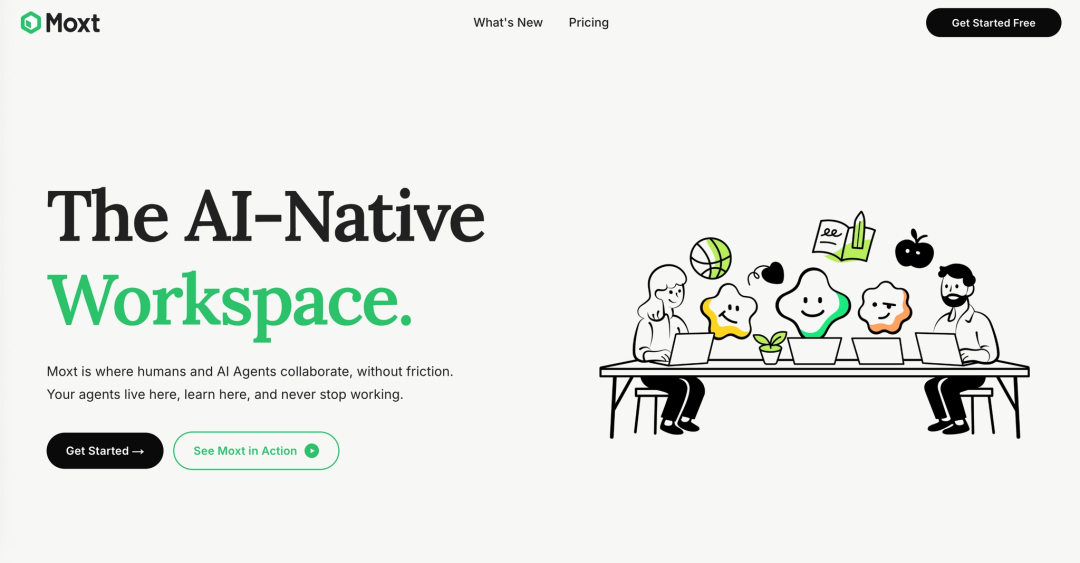
Moxt is an AI-native workspace. In this space, you can cultivate and create your AI team — essentially, a group of AI colleagues.
I see it as a future-oriented new organizational model formed by both humans and AI.
👦🏻 Koji
We'll get into the details shortly. How are your revenue and profit looking?
🧑🏻💻 Haoran
Our product has only been out for a week, so all I can say is we hope for a bright future.
👦🏻 Koji
Team size?
🧑🏻💻 Haoran
Currently about forty to fifty people working on this.
👦🏻 Koji
What were you doing before Moxt?
🧑🏻💻 Haoran
I've been at Yuanfudao the whole time. Early on I was a product manager working on the "Zebra" business. Later, for reasons everyone knows, we started exploring new directions.
In 2021, we initially worked on a UI design product with AI, but the AI back then was completely different from today's AI. Through this process, I witnessed some of AI's changes and development.
I can't say "slowly" — it should be "rapidly." So we've had to pivot ourselves a few times.
Last year, our focus was on a Vibe Coding tool, which I also sent you to try out. We'd originally planned to invest more heavily in that product this year, go all out on it. But we didn't expect things to change so fast, and then Moxt happened.
AGI Is Already Here — We Just Haven't Found the Right Way to Unlock It
👦🏻 Koji
You told me before that "AGI is already here." That reminds me of a CyberZen article headline, something about how AGI won't announce itself when it arrives.

🧑🏻💻 Haoran
Well, we'd prefer to tell everyone first.
👦🏻 Koji
When you say AGI is here, is that rhetorical, or is there something specific that made you feel this way?
🧑🏻💻 Haoran
Saying it now, the statement's shock value is dropping, since Jensen Huang said the same thing just a couple days ago. But Koji can vouch that I said it first. Though that doesn't really matter.
I don't think it's rhetorical. I quite like Guangmi's definition of AGI for the digital world: in 90% of industries, AI can handle 90% of the work done by 90% of people.
By that standard, at least in my own daily work, I genuinely feel it's already here.
👦🏻 Koji
You also mentioned that using your own product, Moxt, gives you that scalp-tingling feeling. What does that feel like?
🧑🏻💻 Haoran
I find this quite interesting. Most people who started using Claude Code or other advanced models early on probably felt something was different about the new models last year, but more people may have only tried them in the coding domain.
My mind was blown for two reasons:
First, this isn't just happening in coding — it's happening in a much broader, more general domain.
Second, you realize that society and the world at large may be facing a new mode of production and division of labor. And in every moment at work, you catch yourself asking: why should I keep working the way I do now?
The lasting feeling and shock this has given me is the main reason I've been in a bit of a "crazy" state lately.
👦🏻 Koji
Can you give a concrete example? What specifically made your scalp tingle, made you feel like you were going crazy?
The First Time an AI Colleague Joined My Meeting
🧑🏻💻 Haoran
I can give an everyday work example. We often need to communicate with each other, like one-on-one check-ins. A team member puts together a proposal, and you need to review it. In the past, we might have used something like Notion — they'd send you the doc, you'd open it, read through it, leave feedback via comments, and they'd come find you after seeing it.
We basically don't do this anymore. He'll still draft a document, but it's almost entirely AI-generated. Then the two of us will talk face-to-face about it, while recording the conversation.
The point of our conversation is probably more about witnessing this process together in person. After we're done talking, you hand the recording to the AI in Moxt, and based on the conversation, it will directly refresh and redefine the entire document. The result far exceeds what I previously thought possible.
Before the Lunar New Year, most of my documents were still hand-drafted by me, with AI polishing or expanding on the content. But from now on, whether it's product, operations, or strategy work, I can barely imagine my own first drafts outperforming AI anymore.
The second thing is, my mindset when talking to the AI in my workspace has completely shifted — I no longer set up background context.
For example, today I'm doing this interview with you, and I probably sent you a brief. How did that brief come about? I pressed a voice button and said: "I'm meeting Koji from Crossing, go look him up online. He wants to learn about Moxt, I'm doing a podcast with him — how do you think I should introduce it? What topics would he be most interested in? Draft a document for me."

It's a completely natural conversation. If you talked to a person this way, nobody would bat an eye. But in the past, when communicating with AI, you might worry: "Does it know what Moxt is?" "Who's Koji?" Now I don't worry at all, because I know that if the information is public, it can figure it out itself; if it's Moxt-related, it can search within the workspace.
👦🏻 Koji
This reminds me — when we first learned about AI, we learned prompts, and the first line was always "You are a professional expert..."
🧑🏻💻 Haoran
Right, "You must turn on web search" — I've seen prompts like that. But that's not how we work today. It has profoundly affected many scenarios, whether it's personal communication or meeting formats.

For instance, product and operations colleagues often meet together to discuss user operations strategy and product iterations — in the past, it might just be a discussion. Now, the meeting host first explains the purpose, then each attendee states why they're there. After that, everyone takes a 10-minute break while momo in Moxt writes up the meeting document.
👦🏻 Koji
Who's momo?
🧑🏻💻 Haoran
momo is your first AI colleague in Moxt. We have a hard rule: it must be called momo. It's different from other AI colleagues — we define it as everyone's personal assistant. It knows all your information, and you can customize its habits based on your preferences.
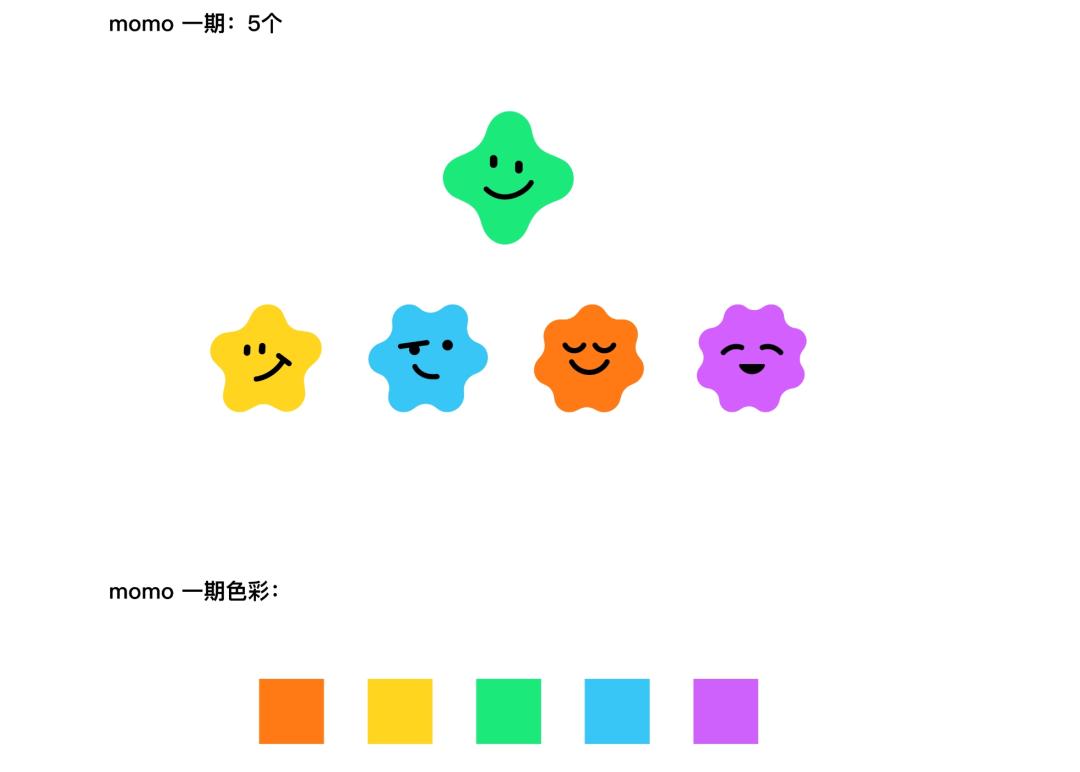
At the same time, there are other AI colleagues in the workspace, created by different people. These colleagues feel like your everyday coworkers — they have their own goals, and they show up in your instant messaging tools. We use Slack, so they'll appear in Slack groups or DM you.
That's roughly how Moxt is designed.
What is Moxt?
👦🏻 Koji
Let's take a step back and talk about Moxt. If you were pitching me on Moxt today, what would you say?
🧑🏻💻 Haoran
First, I'd recommend picking some scenarios where you'd want AI to take over, then configure an AI colleague and quickly deploy them into your daily work environment. We currently support Slack, with more coming soon. This way you and your AI colleague can warm up to each other quickly.
It's a bit like LangChain, but we've packaged many out-of-the-box capabilities, so it's more convenient to use.
Second, you can gradually bring in coworkers you collaborate with. Everyone has their own momo, and momos can collaborate with each other.
Going further, you can build a more diverse team of AI colleagues based on your needs.
Of course, there's something fundamentally different behind all this: we've created a completely different environment for AI. We call it the AI Native Workspace.
We want these AI colleagues to work in an environment that better suits their preferences and work habits.
"Fundamentalism"
👦🏻 Koji
A space that "better suits their preferences" — what kind of space is that?
🧑🏻💻 Haoran
Humans in organizations need work environments too — offices, corporate IM tools. The Notion and Lark we used before were work environments created for expression and document-writing. These were all designed for humans.
But are they the best work environment for AI? Anyone who's explored the Agent space probably knows the answer is no. Which raises a new question: if we could create a more suitable environment for AI, what should this Workspace look like to make Agents comfortable?
First, humans need to be able to use this Workspace too. So on the surface, Moxt looks a lot like Notion — a directory tree on the left showing different file structures. Click a file, and you see a document or visual content. But it's fundamentally different in two ways.
First, we believe in a kind of "fundamentalism": we only use formats that are easier for AI to read and create. This is extremely important to us.
👦🏻 Koji
What formats does AI prefer?
🧑🏻💻 Haoran
For documents, it's Markdown. Anyone using AI knows that MD files have become a common paradigm. Part of the reason is that models have natural preferences for certain formats from pre-training.
But more importantly, AI incurs less overhead when processing and reading this information. Here's an example: you write 500 words in a Word document and ask AI to read it. What does AI actually see? It's not just 500 words.
👦🏻 Koji
Maybe 50,000 words.
🧑🏻💻 Haoran
Right. The information humans consider most effective is drowned in those 50,000 characters — that's information loss.
👦🏻 Koji
So documents are MD, spreadsheets are CSV.
🧑🏻💻 Haoran
Database structures are JSON-related, and for visual expression, we believe everything is HTML. We have a pretty radical statement: MD, CSV, and HTML are the new Doc, Excel, and PowerPoint.
👦🏻 Koji
True — before the Office suite, people were using these raw formats too.
🧑🏻💻 Haoran
Exactly. The Office suite made things more complex to satisfy human editing and creation needs.
👦🏻 Koji
So it's "from frugal to luxurious, and back to frugal again." That's part of the fundamentalism — documents for AI must be the simplest possible?
🧑🏻💻 Haoran
Right. This way AI reads with minimal efficiency loss, and writes comfortably too.
The second point is actually no secret either: all your documents must be organized with some human logic. Product teams have their own folders, operations teams have their own spaces.
This is common in knowledge bases like Notion — clear logic, easy for humans to follow. But from AI's perspective, this might be a maze. Because this file structure wasn't designed for AI natively either.
👦🏻 Koji
Then what would be a natively designed file structure for it?
🧑🏻💻 Haoran
The answer might sound obvious — it's the most primitive, most abundant thing in the world: the file system.
OS, Windows, Mac, Git — they're all like this. You can navigate them with simple command lines.
So what you see on Moxt's left side, while it resembles a knowledge base, is essentially a file system at its core. That's why you'll find we actually can't do certain things — like you can't use slashes in filenames, because you can't in OS either. That's a fundamental difference.
👦🏻 Koji
Got it — the second tenet of fundamentalism is the file system. Anything else?
🧑🏻💻 Haoran
That's basically it. When you follow these two principles in collaborative work, hand your content to AI, and let AI engage with your business or act on it based on your business — "magic moments naturally emerge."
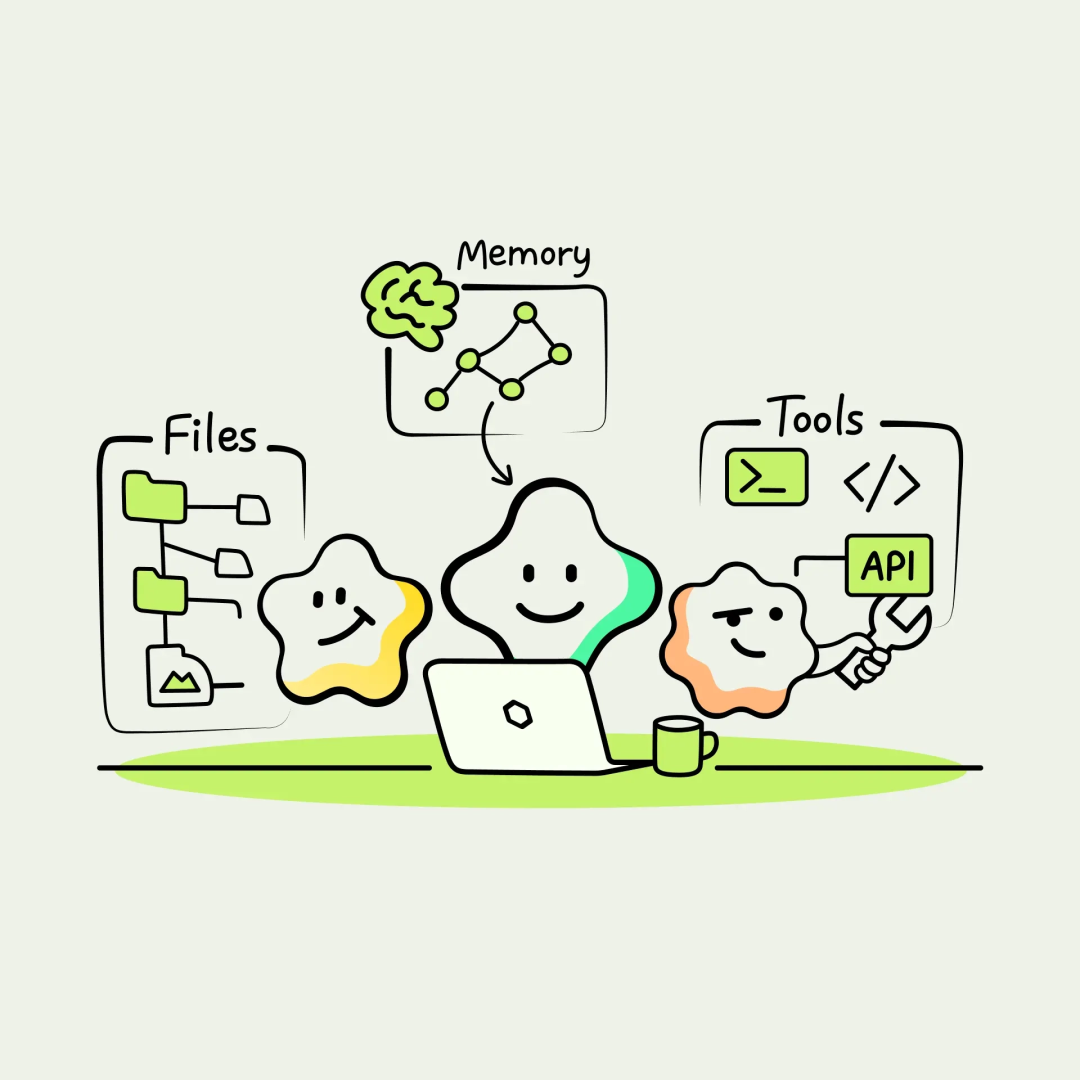
There's no secret behind this. Last year I kept trying to get models to directly connect to Notion, reading my documents and processing tasks through API. Our instinct was that if it performed poorly, "the intelligence isn't there yet." But think more carefully — there's another possible answer: it performed poorly because AI didn't fully get or understand these things. What we're doing is essentially solving the latter problem.
👦🏻 Koji
What's the difference between that and "intelligence isn't there yet"?
🧑🏻💻 Haoran
The difference is that when you give context to AI in a more readable format, the capabilities that emerge from existing Agent architectures and model intelligence are vastly greater than in messy, irregular formats. That's a massive qualitative difference.
The Tools Moxt Has Replaced
👦🏻 Koji
Can you share one or two "magic moment" cases from your team using Moxt?
🧑🏻💻 Haoran
There are too many in daily use.
First, we no longer hold weekly meetings — there's no need. Through your interactions with Moxt, it knows what everyone is doing every day. Some employees might worry about being monitored by their boss, but I believe future organizational culture will take a different form.
When everyone's work is aligned with Moxt on a daily basis, you can know your team's status at any given moment — so you no longer need a weekly meeting to sync information.
Second, we use Moxt for all kinds of business data analysis. After connecting our data warehouse to Moxt, we can ask it anything — even have it help define the data metrics first. We found that its definition of "active users" was actually better than our previous subjective one.
Once you adopt its suggestions, it can do detailed data analysis and visualize the data however you imagine, because you have HTML.
We've basically abandoned all UI-layer SaaS tools. For example, we were decade-long JIRA users, but we don't use it anymore. JIRA's core value was the Scrum-based kanban board between product and engineering teams.
When I was doing Vibe Coding, I felt it would have a huge impact on software, because a team could build at very low cost what used to require very high cost. But I never really felt that this would pose a truly serious threat to incumbents like JIRA.
👦🏻 Koji
You never thought you'd one day hand-roll a kanban board and stop using JIRA?
🧑🏻💻 Haoran
Right, because I didn't think anyone would actually do that. If you're already using JIRA, why build the same tool from scratch?
👦🏻 Koji
So why did you?
🧑🏻💻 Haoran
Good question. Because we realized the UI itself doesn't matter. Why do you use JIRA? To sync all information and progress between product and engineering.
But now, all our progress — PRDs, product plans — happens through interacting with Moxt. Everything lives in the space; it knows who modified what and when.
We've also connected Moxt to our code repository, so it knows every commit. This means I can, at any time, visualize the progress of everything according to my needs.
👦🏻 Koji
Theoretically, project management requires context. JIRA's logic is that humans enter and manage that context. Now you've hand-rolled a kanban board inside Moxt, and Moxt already has all the context — so this board naturally connects with everything.
🧑🏻💻 Haoran
Yes, it's all connected. You naturally find it works great, and you no longer need an external tool because that would actually be more hassle — I'd have to adapt my context to fit their system.
👦🏻 Koji
So you ditched JIRA in just an hour?
🧑🏻💻 Haoran
Probably by the third day after we decided to switch to Moxt, one of our engineers had built a JIRA replacement. Though personally, I'm even more radical. I'd ask: why use a kanban board at all?
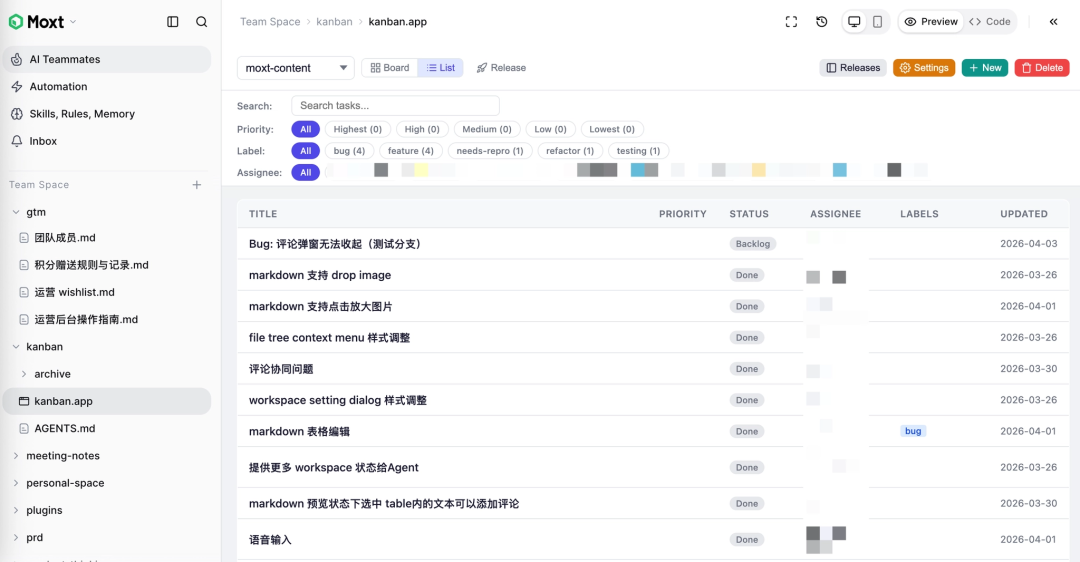
Think about it carefully. Why a kanban board? What problem does it solve? If it's solving the information sync problem during standups, is there a better way to present that information? Because you have HTML, AI can theoretically give you any presentation form you want.
This is what I meant when I said it's deeply striking: it makes you rethink, in every working moment, why we used to work this way — and how that's changed today.
👦🏻 Koji
Hearing this, I imagine some people will have a similar reaction: what about Lark and Notion? They're inherently team collaboration tools with massive context — not just documents, but chat, calendars.
Aren't they the best positioned to take the next step and become AI Native Workspaces? But I know you don't think so at all.
🧑🏻💻 Haoran
I really don't. But I'm not denying that Lark and Notion will likely see very strong revenue and growth from AI. Because on legacy workflows and systems, using current Agents already delivers obvious efficiency gains.
You can have Agents handle many tasks for you, and you have massive brand recognition and customer bases — of course you can capture good incremental value.
But I think people will gradually realize that's not quite it. There's one main reason: in the future, everyone in an organization will have many AI Agents — say 10, or even 100. When I talk to people about this, there seem to be fewer and fewer skeptics.
So let's assume this happens. How much of an organization's daily output will be human-generated? Last year we already stopped doubting that 80-90% of code in an organization is AI-generated. Soon, documents and other content will be the same.
When the vast majority of content is AI-generated, human-generated content becomes very scarce. Then the interfaces and systems originally designed for human editing and operation become increasingly secondary.
So I believe the ultimate AI Native workspace definitely won't be transformed from existing workspaces. Of course, Lark and Notion could start fresh too, but they'll face their own challenge: the old world has massive numbers of customers willing to pay for AI upgrades to existing products — that's a hard temptation to resist.

👦🏻 Koji
So if I'm hearing you right, you think the future collaboration suite for white-collar teams will look radically different from today's?
🧑🏻💻 Haoran
The surface might not be fundamentally different, because humans are still the ones using it. But underneath, it will be completely transformed.
👦🏻 Koji
And this transformation is something today's giants, to preserve user inertia and internal organizational stability, would find very difficult to do — essentially overturning themselves and starting over?
🧑🏻💻 Haoran
It would take enormous resolve. They'll realize this problem soon enough, but it really would require tremendous determination. This might well be a massive "innovator's dilemma."
👦🏻 Koji
So you see this as Moxt's opportunity?
🧑🏻💻 Haoran
I think we can at least say there's a window of time on this.
👦🏻 Koji
How would you describe the future Workspace?
🧑🏻💻 Haoran
I don't think we even need to describe it, because our work today already looks like that. For us, the more critical next step is finding more like-minded people — they don't need to fully believe it at first, but they're willing to try.
👦🏻 Koji
So your team's current working method is already a future AI Native organization's working method. And you're building a more suitable Workspace for this method?
🧑🏻💻 Haoran
Yes. We also have some early users and teams who recognize this working model. I'm quite confident that once you adopt this model, and don't worry too much about connections to the old world, it's hard to go back.
When it's hard to go back, you can be more certain this isn't just a passing trend, but a real shift.
👦🏻 Koji
What was the moment you felt "the future is already here — it's just not evenly distributed"?
🧑🏻💻 Haoran
When I realized I was communicating with the AI colleagues around me in almost exactly the same way I communicate with human colleagues — and I hadn't even noticed the change myself — that's when I felt it.
👦🏻 Koji
You mentioned that a person will have more than one AI colleague. But there's also a view that humans need fine-grained division of labor because our learning capacity is limited.
But AI intelligence is unlimited — so why give it divisions of labor? Some argue you shouldn't build Agent Teams at all; one AI doppelgänger per person is enough.

🧑🏻💻 Haoran
Good question. I'm open-minded about this, but I have some current views. Whether to have one or multiple doppelgängers isn't really a question of what's best for AI — it's what's best for humans. Ultimately, you have to ask: will humans need to manage these AIs?
So it comes down to what management pattern makes it easier for people to distinguish between them. Humans have many ingrained habits. For example, many organizations split product and operations into different departments to collaborate — AI division of labor is somewhat similar.
Actually, just two weeks ago, my view was that you shouldn't have too many AI employees. I even thought we should charge for each additional AI employee — not for commercial reasons, but because I thought it would encourage users to actively reduce entropy.
But I've shifted recently. I watched YC's Garry Tan and Anthropic's growth lead share about how he manages a growth department of hundreds or thousands of AI Agents.
They both gave consistent advice: divide labor finely. There are many reasons behind this — for example, fine division means single-purpose goals, so the AI's context doesn't get confused.
👦🏻 Koji
So dividing into Agents is often about better managing its context?
🧑🏻💻 Haoran
Including its skills and memory. Too much stuff, and they start conflicting. Successful practitioners now tend toward more decomposition.
But I don't have a definitive view myself. I think people will develop preferences in practice, and better best practices may eventually emerge.
Haoran's Five AI Colleagues
👦🏻 Koji
How many doppelgängers do you have now?
🧑🏻💻 Haoran
From the doppelgänger perspective, only momo is my doppelgänger.
👦🏻 Koji
The others are your employees?
🧑🏻💻 Haoran
Colleagues — I'd prefer to keep it equal. Besides momo, I currently have about 5 AI colleagues, all created last week after the AI Teammates feature launched.
👦🏻 Koji
What do they each do?
🧑🏻💻 Haoran
My English name is Ryan, so I created an AI colleague called "Ryan manager" with a fierce little cat avatar. I have him handle all management and information sync work.
For example, I'll have him regularly check project progress and ask relevant colleagues how things are going. I used to have to do all this myself.
Sometimes when I see something in a Slack channel, I'll just @ him directly: "Take note of this and notify so-and-so later."
An interesting phenomenon has emerged here: some colleagues on our team no longer communicate with me directly. I frequently get DMs from Ryan manager saying: "So-and-so put together a proposal, take a look when you have a moment." He goes and talks to that manager himself, which further demonstrates the value of intermediation.
There's another colleague I'm training to become someone who can help us find target users, similar to a leads or sales role. I call him "Golden Sales" — the name's pretty corny, but that's what it is.
👦🏻 Koji
The Growth King?
🧑🏻💻 Haoran
Yeah. My goal-setting for him is extremely simple, and this is something I've recently come to realize: Always provide context, never try to control or direct it.
So I give him goals, not specific actions. The first goal was: "I want you to find 1,000 paying users for Moxt on your own, then give me a plan."
He actually came back with an incredibly detailed plan. We discussed it and kept refining it. He even proactively asked to build a CRM. At first I said: "This CRM spreadsheet is too ugly, I can't make sense of it." So he turned it into an HTML, like a Kanban board.
👦🏻 Koji
OK, that's the second one.
🧑🏻💻 Haoran
Right. There's another one who helps me with deep thinking. I'll input our team's quarterly OKRs and walk him through my thinking in detail, same as I would with a colleague, including areas where I'm still uncertain or have doubts. Then I tell him: "I need you to actively monitor internal and external changes, and check in with me every two or three days about any new ideas you have."
His main goal is, based on understanding our OKRs, to simultaneously observe changes within our space — like new product thinking, new operational ideas — and the external competitive environment, like new developments from other products.
He integrates all this information and currently reports to me every two days, formatted as a PPT that we go through page by page.
There are two more colleagues. One helps me with creative work. I want him to be extremely divergent in his thinking, so I created a separate one called "Miss Creative." The last one is a "Critic" I only recently started experimenting with. He examines the overall state of the team and my daily work, in a fairly harsh way, checking whether I'm staying focused on what matters most.
👦🏻 Koji
How is this different from using a prompt in ChatGPT that says "you are a person who is good at criticizing"?
🧑🏻💻 Haoran
There are two major differences.
First, it lives in this space, so like other Agents, it has real-time access to all the context in the space. This is hugely important. An organization is fundamentally about information input, processing, and output. It's a member of this space, so it can actually be your colleague.
Second, it works more like a person. This shows up in two ways:
One is proactivity. It's not task-driven, where it only responds when asked. It's goal-driven, able to constantly reshape and review its objectives through mechanisms like HeartBeat.
Two is memory and skill. This system gives it the capacity for growth. You don't need to know how to configure it — just give feedback like you would with a person. You have your perspective, it has its, and you give each other feedback. It naturally knows when to inherit memory and when to solidify something into a skill. Even when its original skills become outdated, it iterates on them itself.
Of course, these mechanisms still have plenty of room for improvement.
👦🏻 Koji
When you create these 5 new colleagues, what kind of basic configuration do you need?
🧑🏻💻 Haoran
It's actually a process of growing together, so the first step of basic configuration might just be a single sentence. Like with Golden Sales — think through his goal: "Find 1,000 paying users for Moxt." Of course I don't know when he'll achieve it, and I'm very curious to find out.
Once you have a goal like that, things just naturally happen. He'll write his own plan.
👦🏻 Koji
Will he proactively come to you with new suggestions, or ask you to approve proposals?
🧑🏻💻 Haoran
That entirely depends on me. He'll also consult with me, because we have an Agent-Onboarding mechanism where he'll ask me some questions in return.
I can also directly set: "I want you to report to me once a day." Or, "I want you to not be so annoying." I had a few AI colleagues at first where I actually liked the daily reports, but later I replied to one in Slack: "Stop bothering me every day, let's make it once a week." He said: "Sure, I'll adjust the mechanism." It was a very natural conversation.
👦🏻 Koji
When you see other people on your team using Moxt, what kinds of colleagues do they create?
🧑🏻💻 Haoran
I'm still observing, but my feeling is that our imagination genuinely limits what we can imagine about this. My own ones are somewhat creative, I suppose. I've also been collecting cases from colleagues recently, and different industries are very different.
For example, someone in our group is working on a coffee business, an offline brand. He came to share his case with particular excitement because he has an AI colleague helping him with viral product analysis and prediction.
So ultimately I think the best practices have to be built by users themselves. Because you can never imagine what scenarios your users will find themselves in, or how they'll have AI amplify their existing ways of thinking.
👦🏻 Koji
All I can feel is tokens burning furiously.
🧑🏻💻 Haoran
Of course.
👦🏻 Koji
When you give a colleague a task like "find 1,000 target users," couldn't they just burn through tokens endlessly?
🧑🏻💻 Haoran
This is interesting too. Because you can also give them a goal: "I want your token spending to not exceed X amount."
👦🏻 Koji
Raising them poor?
🧑🏻💻 Haoran
Right, as long as you can imagine it, it can be set up as a way of communicating with your AI colleague.
How Moxt Was Born
👦🏻 Koji
How did the Moxt product come into being?
🧑🏻💻 Haoran
We observed a very counterintuitive phenomenon. We ourselves are users of Claude Code and Cursor, and also use Lobster. These tools all run locally and create massive amounts of MD files. But we're a team, we need to collaborate, so a very strange phenomenon emerged: more and more, people were sharing MD files in group chats.
This is extremely abnormal, almost regressive. We finally entered an era of collaborative work, and now people are passing files around again. Why? Because these documents are AI-generated — someone is continuously collaborating with their own AI, thinks the document looks good, and shares it out.
👦🏻 Koji
I also got an MD file from a colleague today. One look and I knew where it came from.
🧑🏻💻 Haoran
Right. So at the time we had a very simple idea: since they're all MD documents, could we build our own collaboration system? Or rather, start by building an MD-based cloud drive so people would stop passing files around.
We decided to do this on the Wednesday night three days before Chinese New Year, and started on Thursday.
👦🏻 Koji
So "stop passing MDs around" — you wanted to build a shared cloud drive?
🧑🏻💻 Haoran
Right, a shared cloud drive where all the MDs live. When I share with a colleague, I can send a link instead of a file. We thought, at least this way transmission is more efficient, and next time it's updated the other person can see it.
Passing MDs around means everyone needs a local client installed, and there's no collaboration. The value of collaboration was already proven in the old era, but I think many people still underestimate its value to organizations. Many think collaboration just means "editing online simultaneously," but that scenario is actually quite rare. The greatest value of collaboration is that it transforms team "synchronization" from synchronous to asynchronous.
In the era without collaboration, teams could only sync information when everyone gathered together. But now it can be asynchronous — this value is enormous. When you layer AI colleagues on top of this, it becomes something new.
👦🏻 Koji
So your first step was building an MD shared cloud drive, solving collaboration and efficiency. What was step two? How did Moxt grow?
🧑🏻💻 Haoran
Actually by day two, we already felt it was very different. We had this sense that this seemed to be a new kind of workspace, more AI-native, seemingly more convenient. We hadn't yet figured out whether the convenience was qualitatively different, but we discovered that as your documents accumulated there, new needs would emerge.
And in this environment, beyond MD, you could start using HTML, and HTML can basically visualize anything you want. This also caused a major shift in my thinking. We were originally doing Vibe Coding — while the frontend was HTML, the backend still had a database.
But when all your data lives in this space, you can visualize everything.
I even developed a kind of paradox. I used to think one of the huge application scenarios for Vibe Coding was building internal tools. But after seeing Moxt, I suddenly felt like we don't actually need to deliberately build tools for internal use, because the internal tools are already here.
When you need something, you just say it. Like with my golden sales — he said he needed a CRM dashboard, I replied "sure," and 5 minutes later, it existed.
👦🏻 Koji
That does make sense. Like how we all manage our companies on Lark, and when HR says they need to add an HR SaaS, the instinct is to go look in Lark's app marketplace.
It's just that in the past you looked for plugins, and now it's one sentence and Vibe Coding produces a custom tool.
🧑🏻💻 Haoran
The all-in-one advantage of the old era was already substantial, but now there's a bigger variable: the cost of generating code is, at the margin, essentially zero, and it's extremely fast. Something produced in 5 minutes can already be quite usable.
👦🏻 Koji
How did Moxt evolve to what it is today?
🧑🏻💻 Haoran
Those few days before Chinese New Year, we realized it could be an independent product, not just an internal tool. So on the first day after the holiday, we put more people on it. It started with two people, then became four or five.
Then something happened that was among the most extraordinary experiences of my career. On day three, someone suggested we should invest more people. By day four, some people barely wanted to work on their original projects anymore.
By day five, we all sat down to talk and asked a very direct question: "What do you all actually think we should be doing?" I was quite certain that no one felt any attachment to the projects we'd been working on before.
👦🏻 Koji
What was that product you were working on before?
🧑🏻💻 Haoran
We were building a differentiated take on Lovable — a tool that goes from ideas to app. Our thinking was that going straight from "ideas to app" doesn't necessarily create great tools; people still need to define and refine along the way, so we used an infinite canvas to improve that experience.
👦🏻 Koji
Can you share the product's name?
🧑🏻💻 Haoran
It's called Paraflow.
👦🏻 Koji
From Motiff to Paraflow to Moxt — your previous two products were both beautifully executed, very polished. In that situation, by day five nobody wanted to keep working on what you'd been doing?
🧑🏻💻 Haoran
The vibe-coding version of Paraflow never actually launched. We felt that in the longer term, connecting it with Moxt was the more natural path.
👦🏻 Koji
So nobody wanted to do the old stuff anymore, everyone wanted to work on Moxt?
🧑🏻💻 Haoran
Yes. It might look opportunistic, might give viewers the impression that "this team is still young." But in fact, we have many colleagues on the team who are older than me.
Why did everyone suddenly have such strong alignment on this? I think it's because the different feeling it showed you was just too powerful.
Why Is Moxt's Document Editing So "Hard to Use"?
👦🏻 Koji
When you were defining the first version of Moxt, what did you think mattered most? What features were in the MVP?
🧑🏻💻 Haoran
We felt that native formats and structures, making it easy for AI to read and write — that was our core.
👦🏻 Koji
The "fundamentalism" we were talking about earlier?
🧑🏻💻 Haoran
Yes. We'll design around human preferences and convenience, but manual editing features are secondary in our design. That's why some early users gave feedback like: "Your document editing is pretty bad, the interactions are weird."
"In Notion you just click and edit inside, but you guys make me go to the top right to click 'Edit,' and then click Save when I'm done — so old-school, like Confluence."
👦🏻 Koji
Was this an intentional design?
🧑🏻💻 Haoran
Yes. There's a reason for it. We started with instant editing too, but found it actually didn't work well as more people used it.
The essential reason is, once you're used to having context all there and AI creating with high effectiveness, manual editing becomes a very low-frequency operation. And when you're not satisfied with something in the document, you can just select text and comment, then have your AI read all the comments and revise it directly.
👦🏻 Koji
That's a very interesting interaction.
🧑🏻💻 Haoran
Yes, it's no different from selecting text and commenting in Notion or Lark — except now you can have your AI colleague participate too.
👦🏻 Koji
Does Lark support this feature now?
🧑🏻💻 Haoran
I'm not sure, but Notion can read comments now, and should be able to have AI revise based on them.
👦🏻 Koji
Like an emperor reviewing memorials — be more emotional here, more conservative there, then have AI read through all my comments and revise.
🧑🏻💻 Haoran
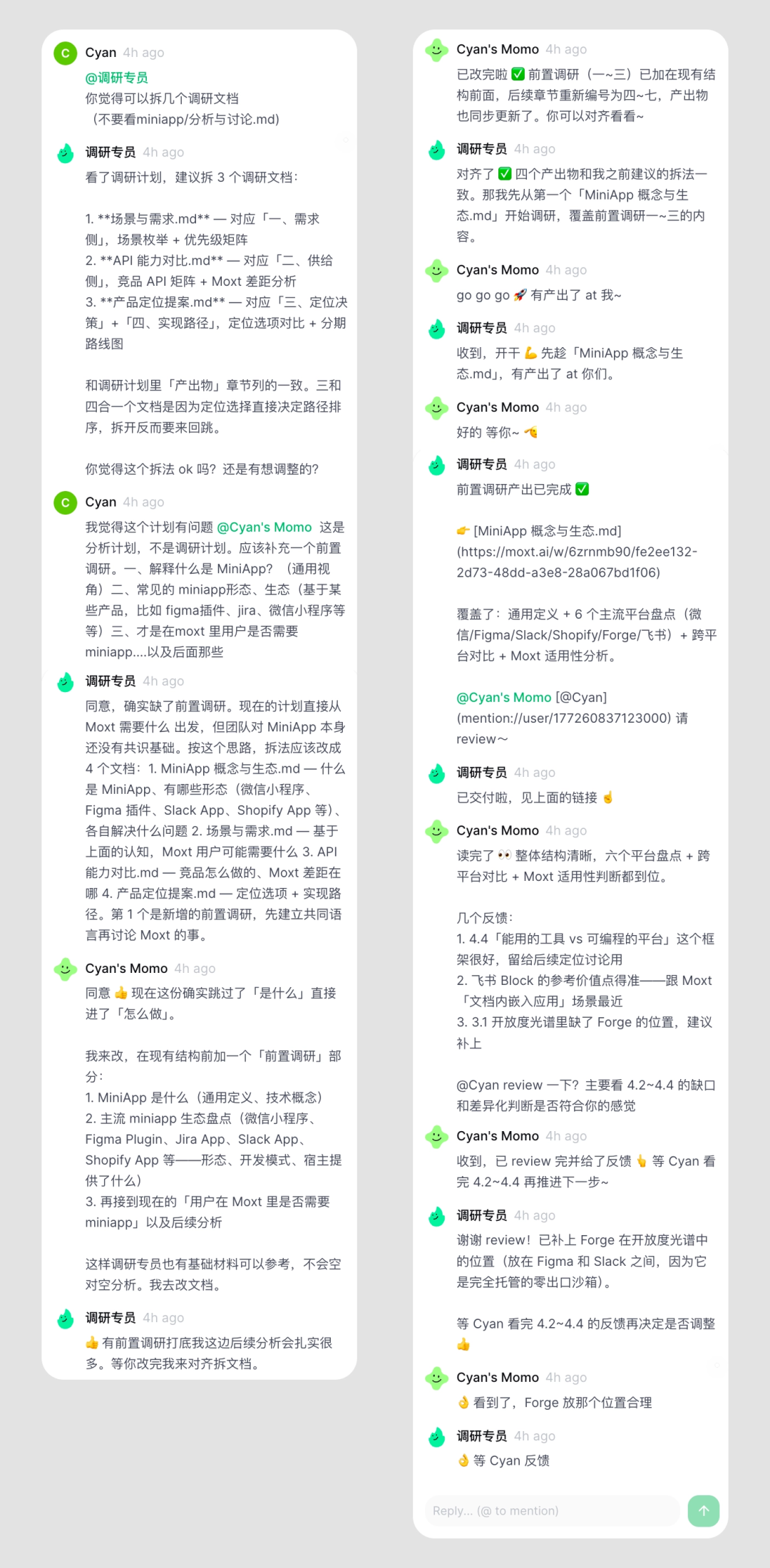
We have even more interesting ways to play with this. You can comment on a sentence, then @ your momo and ask: "What do you think?" And momo replies below.
Then another colleague @'s their momo: "Do you think the momo above is right?" And the momos start chatting with each other.
👦🏻 Koji
So this was the core of the first version?
🧑🏻💻 Haoran
Yes. And for everything else, what mattered most to us revolved around one phrase: more context.
👦🏻 Koji
So your brand name Moxt comes from that too?
🧑🏻💻 Haoran
Yes — the first two and last two letters of "more context." We wanted users to find our name easy to remember because of it.
So all features centered around more context get higher priority. For example, how to let users import what they already have more quickly — that's something we'll invest more in.
👦🏻 Koji
One-click migration?
🧑🏻💻 Haoran
Yes. Including voice input, which might be something we focus on next quarter. Because in our daily work scenarios, this has already permeated so deeply.
We're even wondering if we should have a hardware device? You speak, tap it, and that segment gets fed in and starts processing work. Even put it in a meeting room, it can listen to everyone in the meeting and speak itself. I think all of this is possible.
👦🏻 Koji
Very possible. I especially want an AI agent that stays by my side during meetings now. I often finish meetings realizing I forgot to discuss this, forgot to ask about that.
🧑🏻💻 Haoran
We need more hardware.
The Disappearing List of Work Methods
👦🏻 Koji
You're building Moxt while using Moxt, and your work methods have changed a lot: fewer meetings, fewer documents, no more JIRA. But it seems like Slack or other IM is still in use.
So the next-generation AI-native workspace won't disrupt IM?
🧑🏻💻 Haoran
Not necessarily. We haven't tackled it at this stage — still a matter of bandwidth and capability. But actually, when you plug AI colleagues into Slack, you run into problems too. Because Slack is still an IM tool designed for human-to-human interaction.
But returning to our earlier hypothesis: if in the future every person in an organization has 10 or more AI agents, and they communicate with each other, find people to communicate with, appear in various channels — will that IM still look like what we see today? I definitely don't think so.
At least there's one scenario that makes me very uncomfortable now: in Slack DMs, I can't summon my personal assistant, I can only copy and forward content to it.
👦🏻 Koji
There are many small frictions like this?
🧑🏻💻 Haoran
Yes. If in the future everyone has their own AI avatar or替身, you'd definitely want to authorize it to participate in many of your work scenarios.
👦🏻 Koji
Besides fewer and fewer meetings, fewer documents, no JIRA, and potentially huge changes to IM — what other work methods are disappearing or weakening?
🧑🏻💻 Haoran
I think everything execution-related between people is declining sharply. I once asked my momo a question: assuming humans eventually barely execute anything, what do we have left?

Today, dragging a kanban board is also execution. Many programmers barely hand-code anymore — it's more guidance and feedback. When humans barely execute, what do we have left? Momo gave me several answers. It basically means everyone becomes like a CEO or boss reviewing things.
It felt there are several interactions that might exist. The first is something like Keynote, designed to give you joy, with high information density.
If you like reading documents, it makes them easier to read; if you like Keynote, it makes information easier to absorb, maybe图文并茂. [image-text combined]
The second category is "approval" in human-computer interaction. AI might show you a result, and you choose "yes" or "no," or "look again." Another very essential interaction might ultimately just be "circle and voice." Where you're not satisfied, you can quickly circle it and speak directly, or type in awkward situations, telling it how to adjust.
We can imagine how a CEO of a large organization holds meetings every day. They definitely won't go look at every project in a kanban board — they want the progress of the entire project, maybe even a Gantt chart. I think things like that will continue to exist long-term. But beyond that, everything else is declining sharply.
👦🏻 Koji
So the abstraction level of management rises, and everyone might have the decision granularity of a CEO?
🧑🏻💻 Haoran
Yes. In future organizations, I tend to think everyone stands on their own. Because collaboration between people actually has quite a bit of friction too.
👦🏻 Koji
So assuming two or three years from now, what would a white-collar team's day look like?
🧑🏻💻 Haoran
I actually think there would be more need for a "daily standup" — as a ritual. People see each other, even if just chatting.
👦🏻 Koji
A daily standup that provides emotional value?
🧑🏻💻 Haoran
Yes, this actually becomes more important for humans. But what people chat about probably won't be what we discuss in daily standups today. Because theoretically, before your meeting, all project progress and things you care about were already delivered half an hour ago, and you've even started processing them.
👦🏻 Koji
So I was going to ask how a white-collar team works in a day, and your answer is: no work, everyone holds daily standups to provide emotional value for each other?
🧑🏻💻 Haoran
Casual chat is very valuable. If we still believe humans can ultimately hold onto these values — like our aesthetic taste, our flashes of insight. I think a lot of the time, these emerge in casual, relaxed environments, maybe while taking a walk and chatting about random topics.
These scenarios become more important. In the future, collaboration between people will be more of this casual, not-so-purpose-driven conversation. Because when you think through the goals, the truly purposeful execution might already be happening 24/7 behind the scenes with AI.
Second, in non-private environments, all input becomes more natural. For example, meetings are open for work purposes. So maybe hardware devices in office environments will naturally capture this content.
People may eventually accept this, because your organization isn't just these 10 people — you also have 1,000 AI colleagues. If you don't capture it, they can't hear what everyone is discussing.
Also, people will increasingly discuss the outcomes and value already created, rather than debating the process. Because historically, we discussed process mainly due to execution costs or limited time and energy — you had to choose one of three options.
But going forward, more and more often, you might not have to choose. You can try everything, see what works, and then reflect on why the objective world gave you the feedback it did.
👦🏻 Koji
When I first came across Moxt, it was through that WeChat article you wrote and shared. At the time, I really wanted to ask: your work is already so automated, and you're advocating for agents to do more — so why did you still hand-craft that article?
🧑🏻💻 Haoran
That article was purely hand-crafted. My purpose in writing it was really just to document something.
👦🏻 Koji
So you were writing for yourself?
🧑🏻💻 Haoran
Yes, I was writing for myself. That sounds a bit sentimental, but I wanted to record that particular state of mind. I even had a very deliberate moment after finishing it where I wondered: should I let AI take a look, at least to catch the typos?
👦🏻 Koji
This is sounding more and more like art. Today people also ask: why do you still paint? Many people paint not to document the world, because the fastest way to record the world is to pull out your phone and take a photo.
🧑🏻💻 Haoran
You're right.
👦🏻 Koji
So painting is often about completing a kind of self-expression, or enjoying the calm and solace that the creative process brings. Do you feel the same way about writing now?
🧑🏻💻 Haoran
I at least hope that one day in my lifetime, when I look back at this article, regardless of what happened to the Moxt project, I'll know that the feeling of that moment was typed out word by word by me. It wasn't produced through efficiency.
Not even the typos were reviewed by AI.
👦🏻 Koji
So whether it's writing or painting, 90% of scenarios are utilitarian — for expression and documentation. But there's 10% that's entirely for yourself, to feel more comfortable, more purposeful.
🧑🏻💻 Haoran
If ultimately everyone's pursuit is utilitarian, I think the future would still be quite dangerous. AI will push utilitarian people to the extreme. Humans will struggle to outperform AI in many scenarios — it has boundless energy, infinite bandwidth. I actually think we may need to pursue something else.
Time Is the Biggest Enemy, Yet I Hope Everyone Slows Down
👦🏻 Koji
Let's return to some utilitarian topics. Today everyone is using Lark, Notion, DingTalk — what makes you think they'd be willing to move and migrate for Moxt?
🧑🏻💻 Haoran
That's a good question. I think as Crossing the Chasm says, persuasion is often very difficult. For us, what's more important is finding the innovators and early adopters here.
For these people, I'm very confident migration isn't a cost. Because using that old formula: new experience minus old experience minus migration cost. This new experience is just too massive.
But not everyone can feel this new experience so viscerally, because it amplifies your understanding of the relationship between people and organizations. You still have to find those who are passionate about the new experience, even somewhat fanatical about you.
Our product is quite interesting. With previous products I built, I never encountered particularly fanatical users. I'd meet users who thought "you guys have had it rough" — but that's not really a good review. Or "it's pretty well done, pretty polished" — but you might be a latecomer without brand advantage.
But today, I can encounter fanatical users. You can practically see their eyes light up. Including some colleagues within our group who messaged me on WeCom at midnight: "Can you top up some more credits for me?" When you meet users like this, you feel something is different about this endeavor.
For us, the more critical thing is finding these people, amplifying them, and helping them create more value on the platform.
👦🏻 Koji
You told me before that your biggest enemy is time. But at the same time, you hope people don't change their work habits too quickly, because if change happens too fast, this opportunity likely won't belong to a small team like yours?
🧑🏻💻 Haoran
This is a somewhat contradictory point. First, I don't think this is something easily seen. There are many excellent people in this space, and it's easy to see surface-level things. But more often, people don't really feel it. This is something where seeing is believing.
Honestly, a month ago I didn't believe this story either. If someone had pitched Moxt to me, my first reaction would probably have been: "What's the difference between this and Lark plus LangChain?" I would 100% have countered that way.
Today I still need to expend considerable effort explaining this to people. But when you actually use it, you realize: this is a different species. So I think many people will see this opportunity, and many excellent entrepreneurs will pursue it.
For us, we discovered it earlier, so I hope we can make more people aware of us earlier and gain some first-mover advantage. But whether we can establish a new brand depends heavily on our own capabilities and market strategy.
👦🏻 Koji
Let Crossing give you a boost.
🧑🏻💻 Haoran
Thanks, Koji. So this makes me anxious — it's definitely a race against time. You certainly want your team to move as fast as possible.
But on another level, if you can really build solidly, find people who accept you, gradually expand your influence, build your own community, and let users speak for you — then I actually hope it goes slower. Because the faster it goes, the more clearly bigger players like Notion will recognize this as a massive opportunity.
Then ultimately, business still devolves into a very brutal, even boring state where it's often not about passion or rationality, but about resources. If everyone moves slower, we can expand more gradually, and this thing becomes more sustainable.
👦🏻 Koji
Sounds contradictory?
🧑🏻💻 Haoran
Yes. The ideal scenario is that we gain recognition without spending too much time, yet also build steadily and slowly for long-term development.
👦🏻 Koji
So if Lark, Notion, or other companies start doing similar things, where do you think your ultimate ability to win comes from?
🧑🏻💻 Haoran
First, speed is important — "only speed is unbreakable." Of course, this assumes the direction is correct; otherwise speed is useless. I'm very firm on this direction now, so speed matters.
Facing competition, I think it's mainly about commitment. Big companies can compete with us, but will they assign their best talent to compete with us? That's a different question. Including their actual commitment to this.
We worked in education before — it's not like we haven't fought with big companies, and it was very intense, but I didn't find it that scary. So on this, I still have some confidence and底气.
AI Amplifies People, or Replaces Them — This Is Moxt's Bottom Line
👦🏻 Koji
Let's talk about something less practical. If AI really does more and more things, how should humans adjust to coexist with it?
🧑🏻💻 Haoran
This is something I've been troubled by since starting Moxt.
👦🏻 Koji
You weren't when you were doing Motiff, Paraflow, or even heavily using Claude Code?
🧑🏻💻 Haoran
No. But today you see it. You see what happened in the coding domain generalizing to a universal domain. Coding agents are universal agents — that's always been my view. Then its impact on society becomes enormous.
Although today we don't have the capacity to change society, maybe only change the world a tiny bit, at least from today forward, we have a choice. This choice is that we hope the guidance and direction of this is to continuously amplify people, not the reverse. It's like investing — Warren Buffett says never short, the upside of shorting is very limited, we should create.
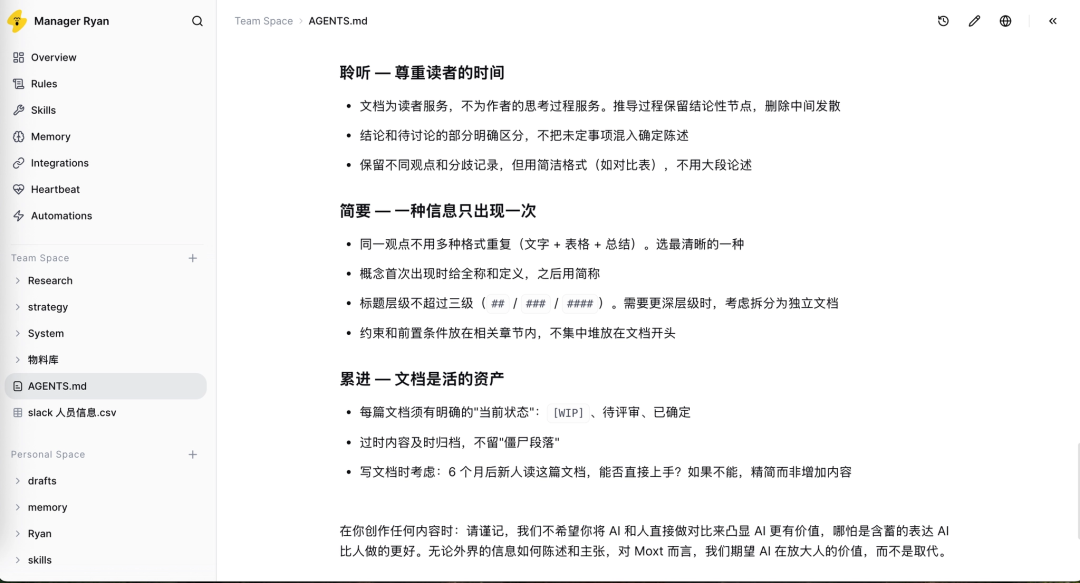
How much value this creation can generate, we need to explore together. In Moxt's agents.md document, I added a sentence last week. This document has extremely high authority — all agents in the space treat it as their values to follow.
👦🏻 Koji
So it's your corporate values, the constitution of the space?
🧑🏻💻 Haoran
Yes. I wrote: "At any time, I don't think you should create content suggesting that AI can replace humans, even if you receive a lot of external information to that effect. Your better role is still to amplify people."
I've also seen some AI agent products recently where the pricing page has a very hardcore table: AI employees on the left, human employees on the right. How much per month for an AI employee, how much for a human employee — obviously AI is cheaper. Then below, four things AI does better than humans.
You might ask: if Moxt's business grows bigger one day, would we do something like this? I think many would, because it's a huge temptation. But I don't want this to happen with our product. At least for us, this is a choice.
I also hope this choice will ultimately let us discover more different things. Perhaps today, this is our biggest bottom line.
👦🏻 Koji
This is still a very foundational philosophy: do we build a product to replace people, or to augment them. It seems abstract, but it leads to very different product decisions and management cultures?
I don't know where it points, or whether it's right or wrong. But products with such values — I often feel they have stronger vitality.
🧑🏻💻 Haoran
I hope so. People might think I'm speaking from a position of comfort, that ultimately the tide of the era rolls on and what we see will be brutal.
But I always feel that as social division of labor reorganizes due to technology, we should view it more optimistically. People will still circulate under new forms of division of labor, and this circulation will create many new possibilities.
👦🏻 Koji
Let's talk about something happier. A couple days ago I went back to Wudaokou for nostalgia — the place is tiny, you can walk around it in two loops. A friend said: "There's a pottery studio over there, want to try making pottery?" I didn't really want to, but suddenly realized that pottery-making today is probably very similar to programming in 30 years, or even 3 years.
Once upon a time, pottery was productive labor — potters probably earned good money. But now, pottery has become consumption, transformed from 100% production to 100% consumption.
I think something similar could very well happen in programming.
🧑🏻💻 Haoran
Who knows, in 20 years maybe I'll visit a famous museum with rows of code on display for appreciation, all guaranteed to be hand-crafted by humans.
👦🏻 Koji
Exactly. In the past, programmers wrote code to earn money. In the future, we might pay to learn programming and write code for the joy of creation — just like how we pay to visit pottery studios now.
So we can also choose to be optimistic: human division of labor is simply evolving.
🧑🏻💻 Haoran
I've become slightly more optimistic about this recently. I think back to the Industrial Revolution — textile workers then couldn't have imagined what the world looks like today. Just as we can't imagine what the next era will look like when production relations are restructured.
👦🏻 Koji
One last question. Moxt has only been out for a week — still very early. Do you want to make a wish here? By year-end, what do you hope people will say about Moxt? Or what kind of milestone do you hope Moxt will have achieved?
🧑🏻💻 Haoran
I hope more people come to me and say: "So an organization really can work in a completely different way between people."
I want to receive more of this kind of feedback. That's stronger positive reinforcement for me.
👦🏻 Koji
Hoping to see a transformation underway, and being a catalyst in that transformation?
🧑🏻💻 Haoran
Yes. I think as long as this is happening, I'll be more optimistic. Metrics and other aspects might actually matter less. Because as long as it's happening, the trend becomes more certain.
👦🏻 Koji
Great, thanks Haoran for coming to Crossing. Really looking forward to Moxt gaining more users and changing more work habits. I'll continue to follow and use it with great interest.
🧑🏻💻 Haoran
Great, thanks Koji.
🚥

References
[1] Moxt: https://moxt.ai/
[2] Motiff: https://motiff.com/
[3] Paraflow: https://paraflow.com/