Hands-On Test of Aha 2.0: Is It Really the Best Solution for Influencer Marketing?

How far can Aha actually go? How close is it to a real AI-powered marketing employee?
**
How Much Can Aha Actually Do? How Close Is It to a Real AI Influencer Marketing Employee?

👦🏻 Author: Jingshan
🥷 Editor: Koji
🧑🎨 Layout: NCon

Despite all the recent buzz around AI Agents, there still aren't many examples of them actually deployed in vertical industries. Especially the one we're discussing today: non-standardized, fragmented, and highly communication-dependent — influencer marketing.
For tech companies, influencer marketing is crucial. Yet even today, many teams still rely on Excel spreadsheets to manage creators and manually send hundreds or thousands of "spray and pray" emails.
The process is chaotic. The efficiency is terrible.
Last week, Aha 2.0, which shot to #1 on Product Hunt's daily rankings, caught our attention.
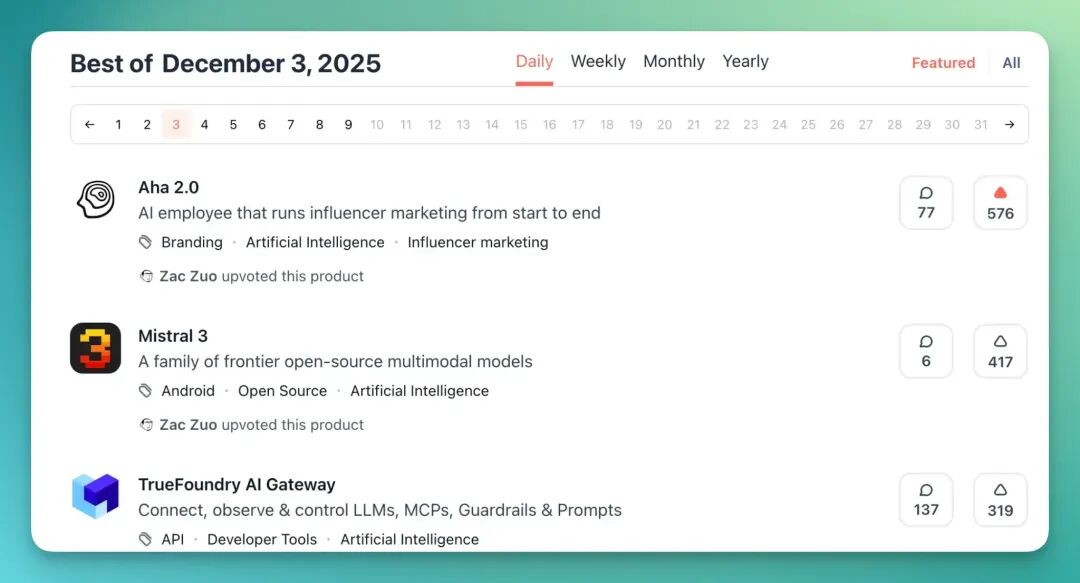
We heard their team also just raised $5.7 million in their latest funding round, led by Lenovo Capital and Incubator Group, with Monad Ventures participating, and continued follow-on investments from all existing shareholders including GSR Ventures and Jinqiu Fund.
Many of you probably know Aha 2.0's predecessor — it was originally Head AI. With this 2.0 release, they've sharpened their positioning:
An AI influencer marketing employee built for AI companies.
Meanwhile, there's been plenty of community discussion about how exactly Aha 2.0 pulls this off.
🚥
Out of curiosity, we decided not just to look, but to actually get our hands on it — trying to answer one question: How much can it actually do? How close is it to a real "influencer marketing employee"?
01 | Hands-On: The AI Influencer Marketing Employee
Honestly, there are quite a few products for influencer marketing out there, but most just awkwardly bolt together a search box and a CRM. Plus, influencer marketing still requires human judgment at this stage — deciding who to ultimately work with, whether content meets expectations, still needs a Human In The Loop.
But Aha 2.0 does bring some fresh thinking to how it strings tasks together.
So how does it connect all these tasks?
To verify its performance in real-world scenarios, we specifically reached out to the team at Manna, who used Aha for a complete overseas growth campaign. They walked us through the full influencer collaboration workflow.
I've roughly divided it into 2 parts:
[1] Campaign Basic Setup
[2] Post-Setup All In One Platform Operations
Part 1: Campaign Basic Setup
In traditional influencer marketing campaigns, writing a complete marketing brief is often the first "pain point." Growth marketers spend tons of time detailing product selling points, target users, translating everything into English — the whole process is incredibly complex.
Aha's approach is clever — they've built something like a "scraper" effect.
Step one of creating a campaign: paste your product website link into Aha's input field. Everything below uses Manna's actual running campaign as an example (thanks to the Manna team for sharing their experience and data).
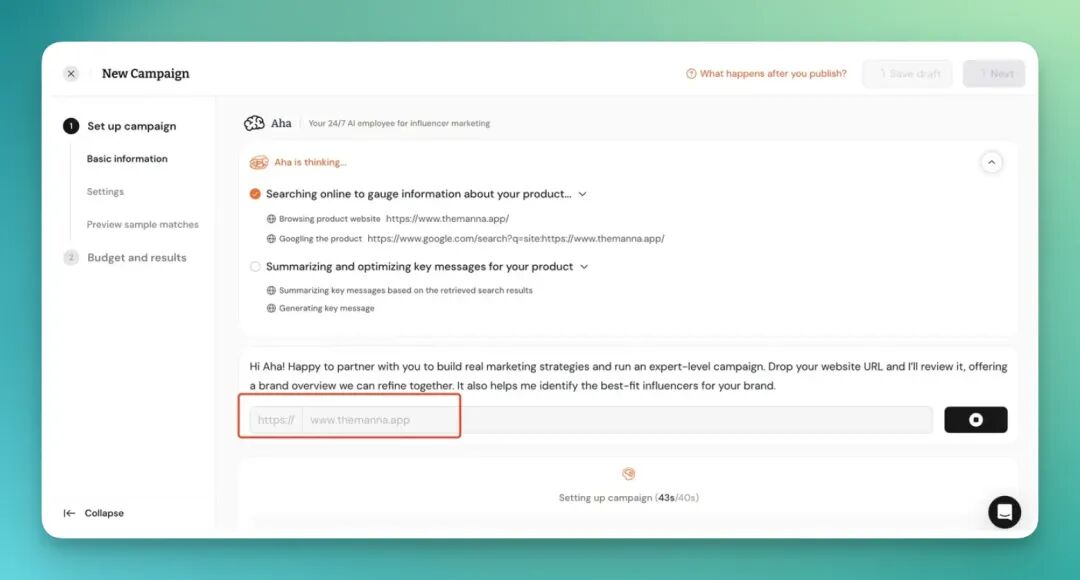
Next, Aha browses the product website and finds relevant content to understand the product's basics. It then distills key marketing points from this information. Pretty much everything is editable manually. Besides showing it to creators who take the job, it also helps the AI better align with your needs.
For example: brand logo, brand description, potential competitors, core selling points, core audience segments, etc.
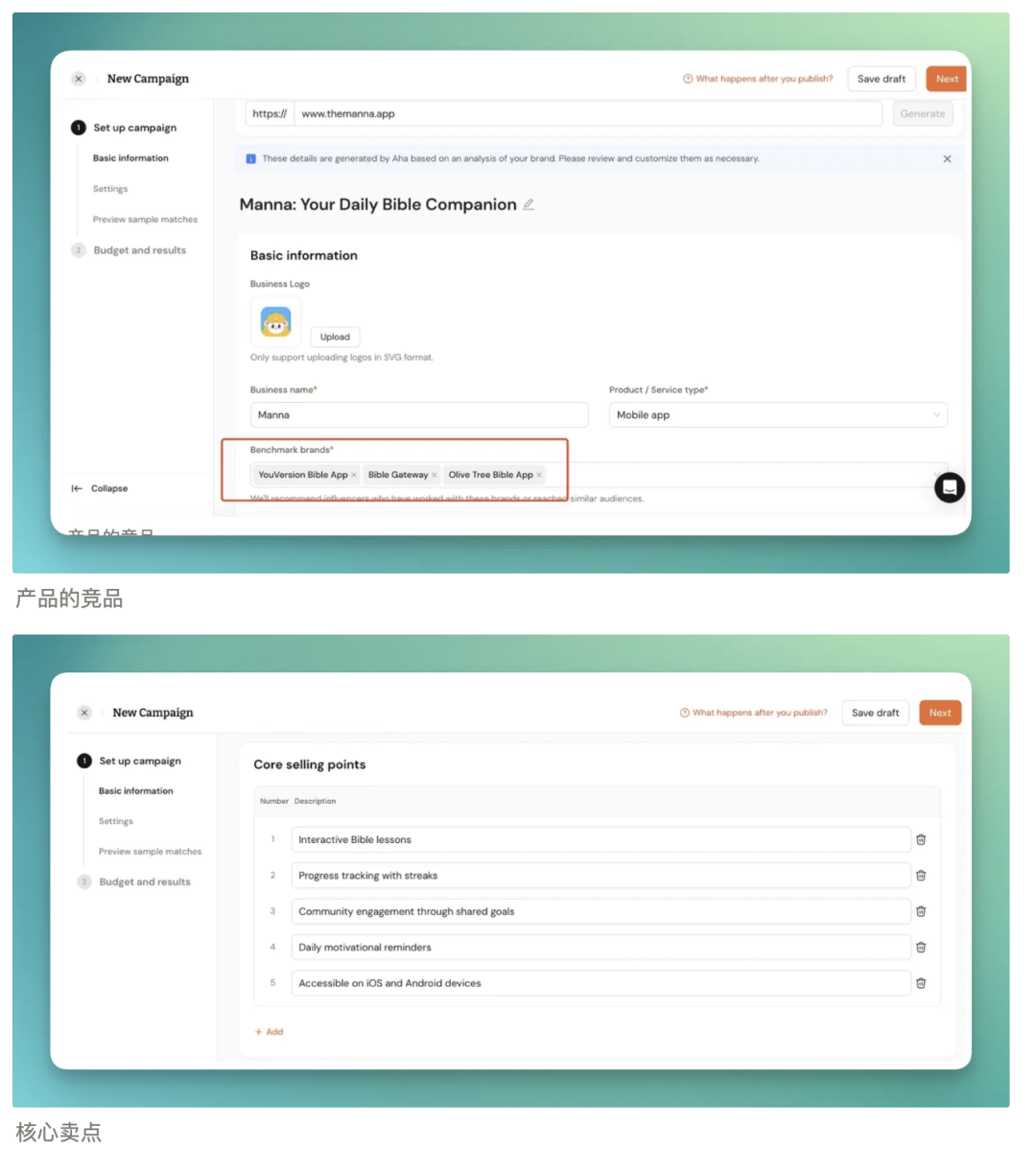
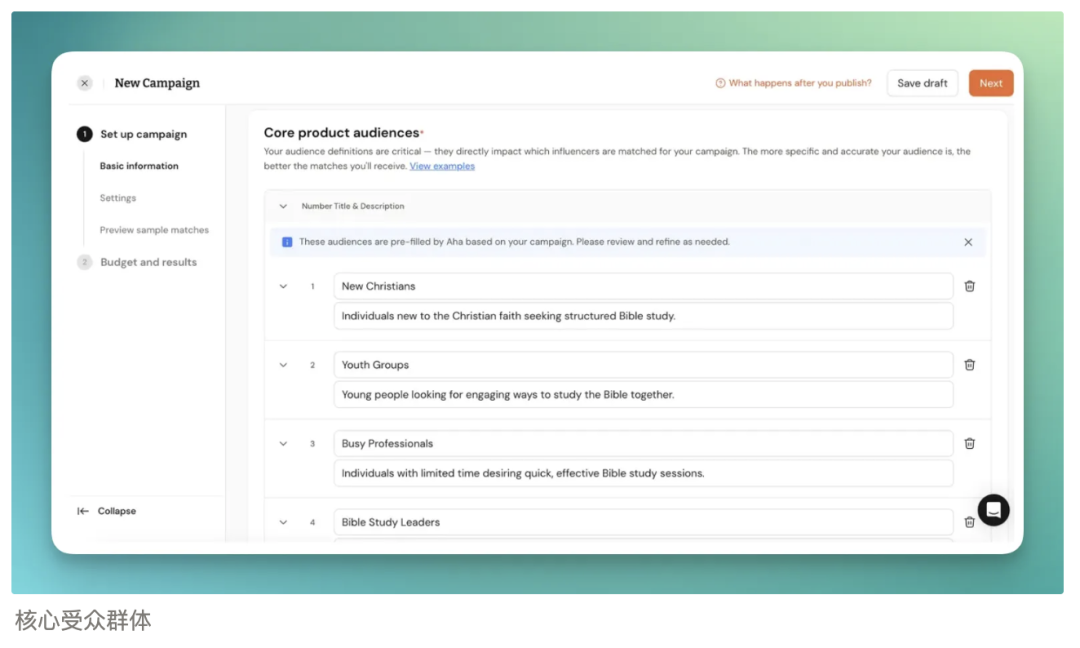
Step two: Configure the campaign.
First you need to set the creator matching logic. There are 3 modes in total, and different matching modes determine the campaign's precision and coverage.
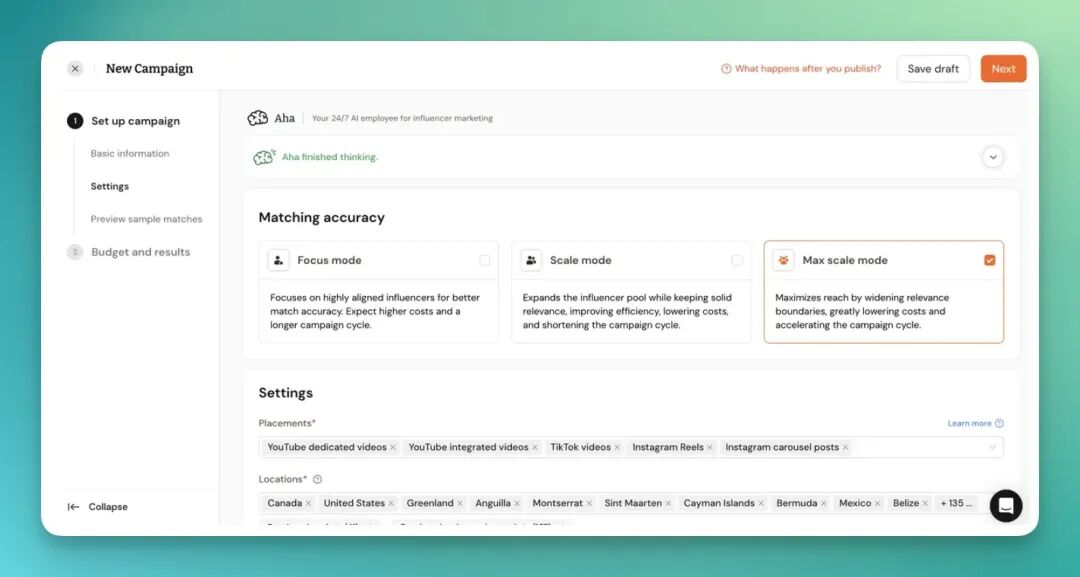
For example, in "Focus mode," the platform concentrates only on matching the most suitable creators, but each creator's cost may be slightly higher and the campaign cycle slightly longer.
This flow also focuses more on the brand's own strategy — you need to select your desired placement channels, target countries, languages, creator types, etc.
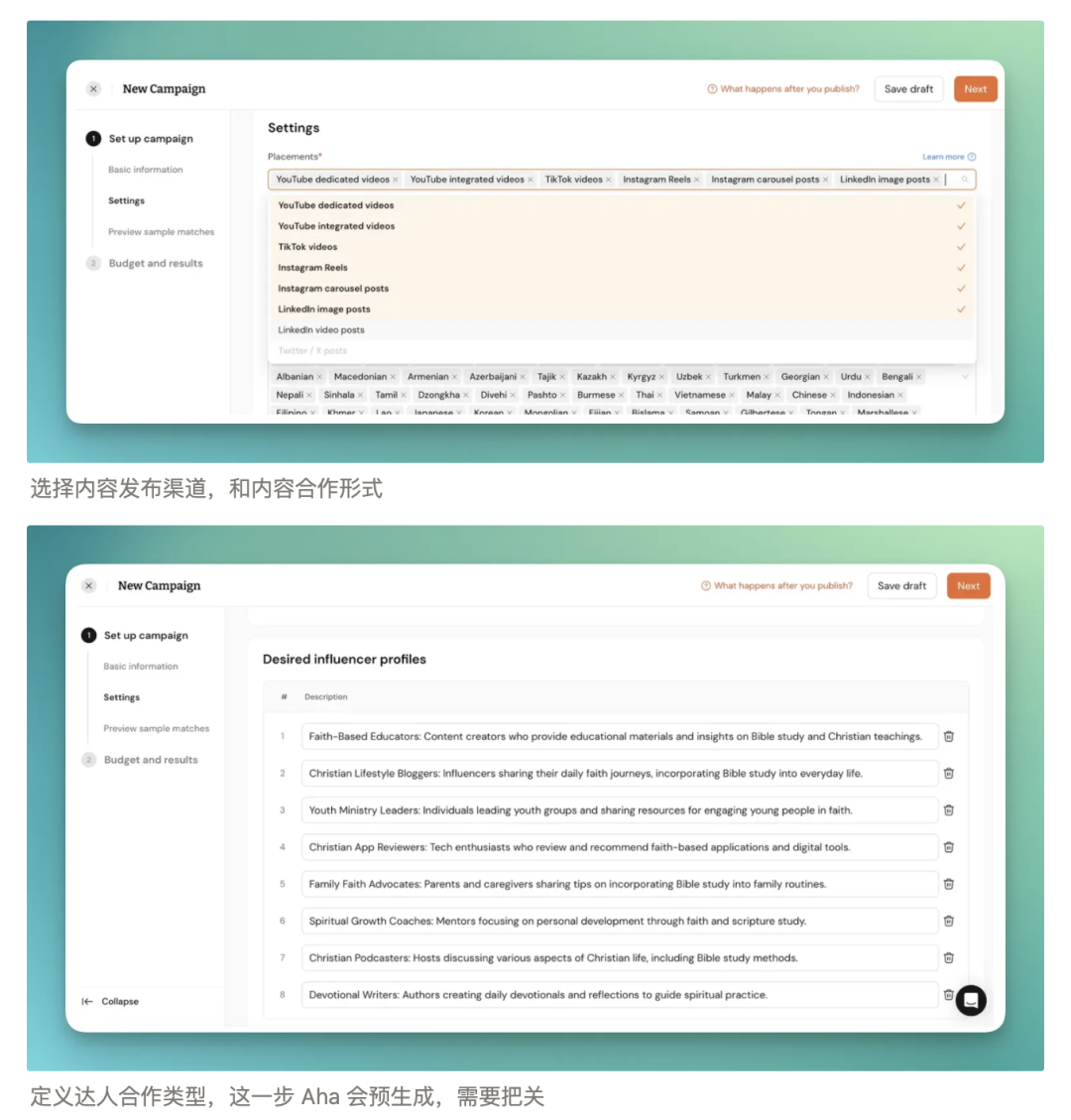
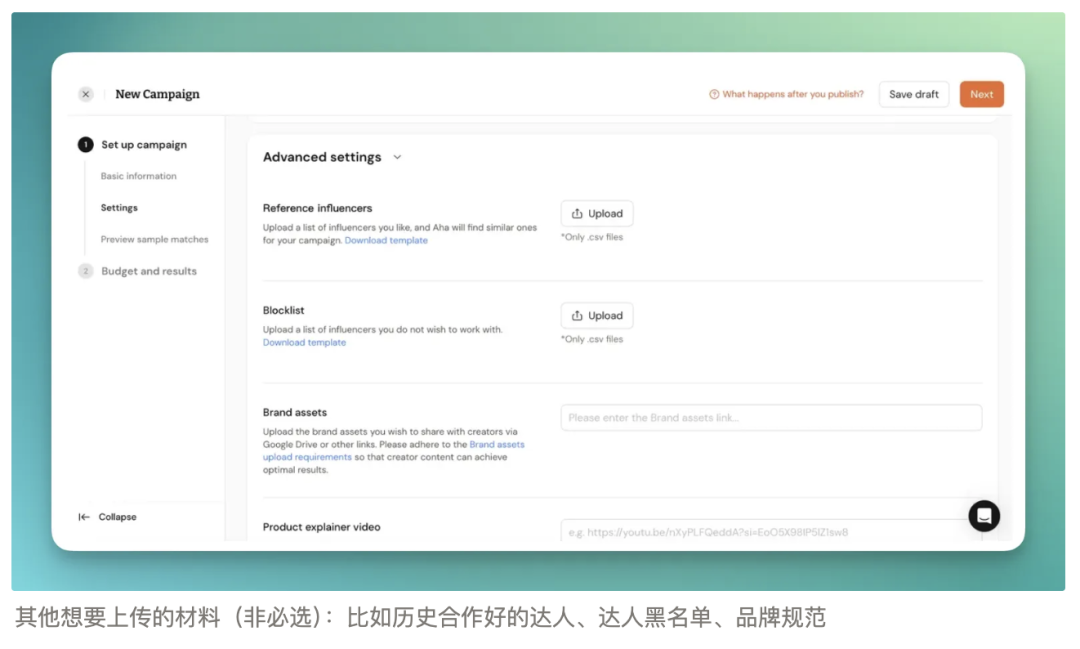
After completing the above setup, Aha gives you several creator examples based on the information you entered in the previous two rounds: you can click into their profiles to see if they match your expectations.
If you're satisfied with the match results, you can choose:
"Match."
If it doesn't meet expectations, you can choose:
"Not a match."
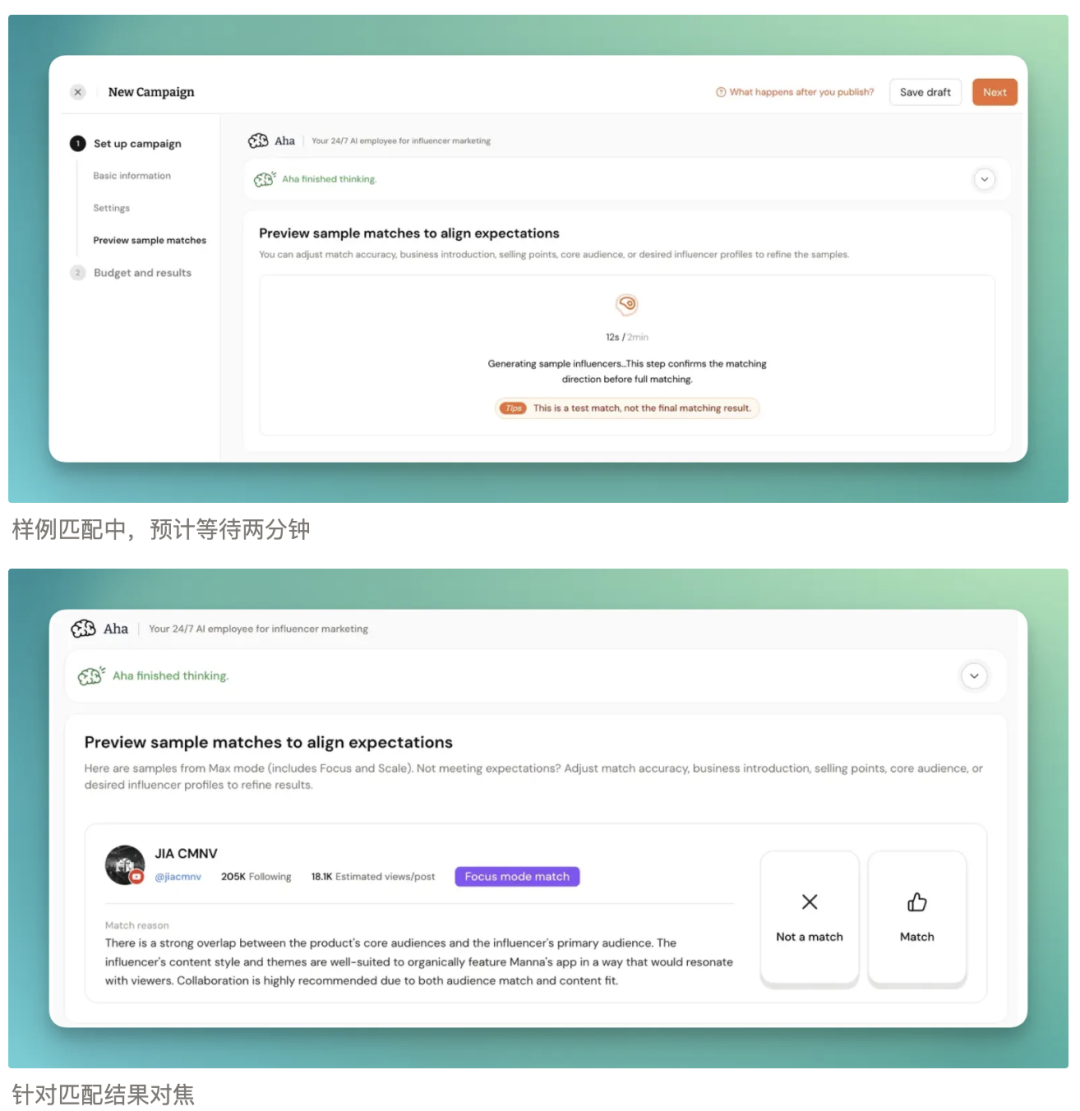
My read is that this step is actually "training" the model, aligning it with your expectations.
Once you've set your budget, the campaign launches. Aha needs roughly 24-48 hours to find people.
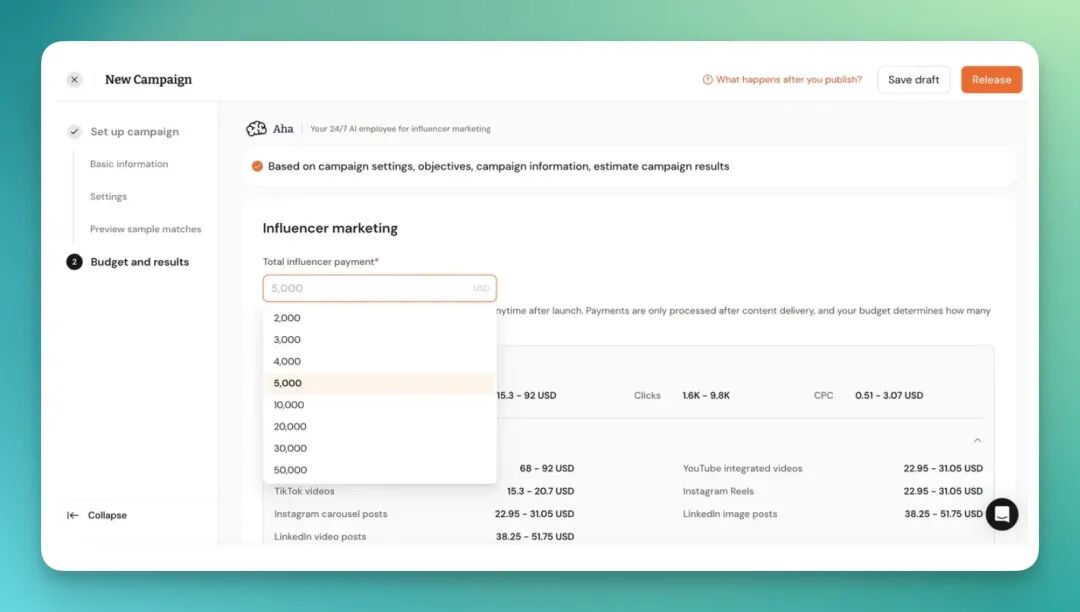
What exactly happens during the waiting period? Curious about this, I went digging through Aha's website.
Pretty interesting.
Aha's creator matching, officially called the LLM Expert-Led Influencer Matching System, can filter suitable candidates from over 5 million creators, and even detect whether someone is a spam account to filter them out.
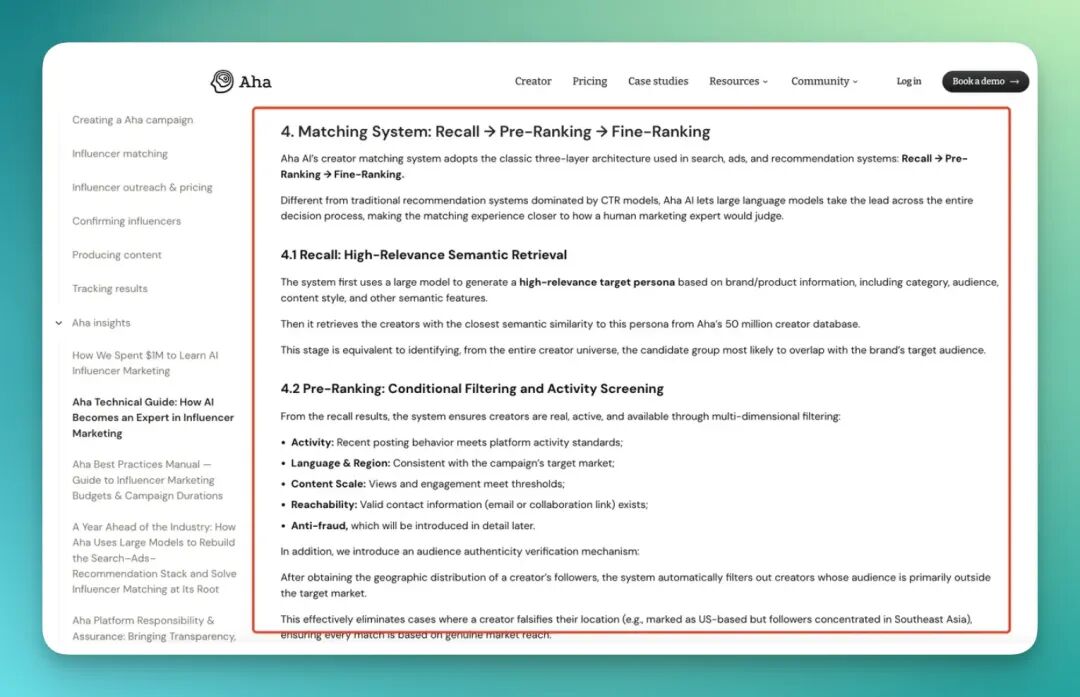
Moreover, this judgment logic doesn't rely on shallow tags, like simple search terms such as "AI." Instead, it has the AI comprehensively evaluate based on creator content and audience, brand target regions, creator engagement levels, and multiple other factors to select creators suitable for the brand's goals, then reach out and negotiate.
Of course, if you have the energy, you can also check in real-time who Aha is inviting and chatting with.
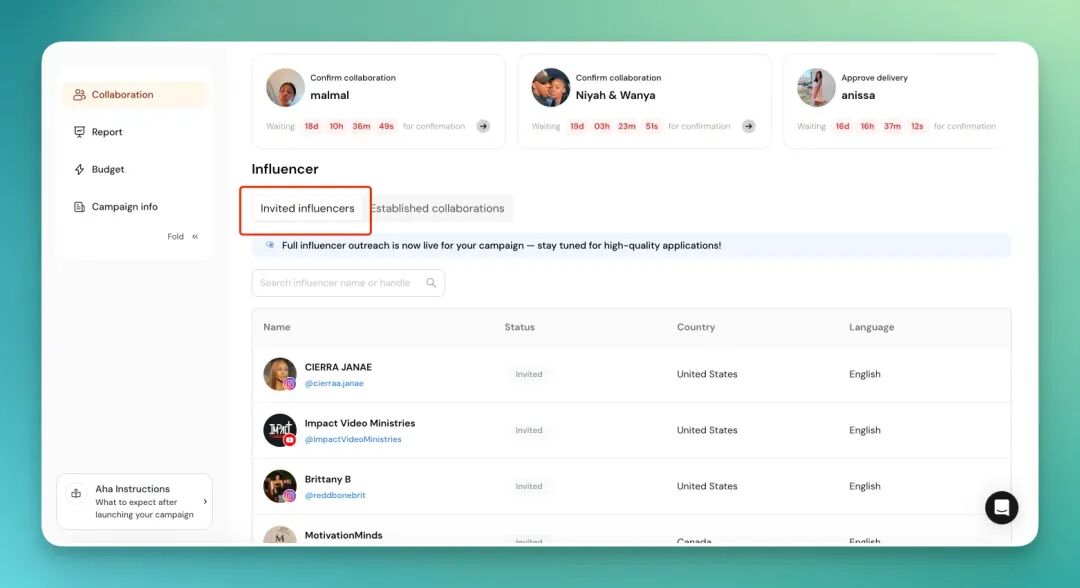
Within 48 hours, the people found will appear in your workspace with negotiated prices.
Part 2: All In One Platform Operations
Let's look specifically at how Manna's product operates after Aha's matching, and what concrete results they got.
First, the overall data: 10,699 matched, 318 negotiated with and invited, and 187 who ultimately expressed cooperation intent.
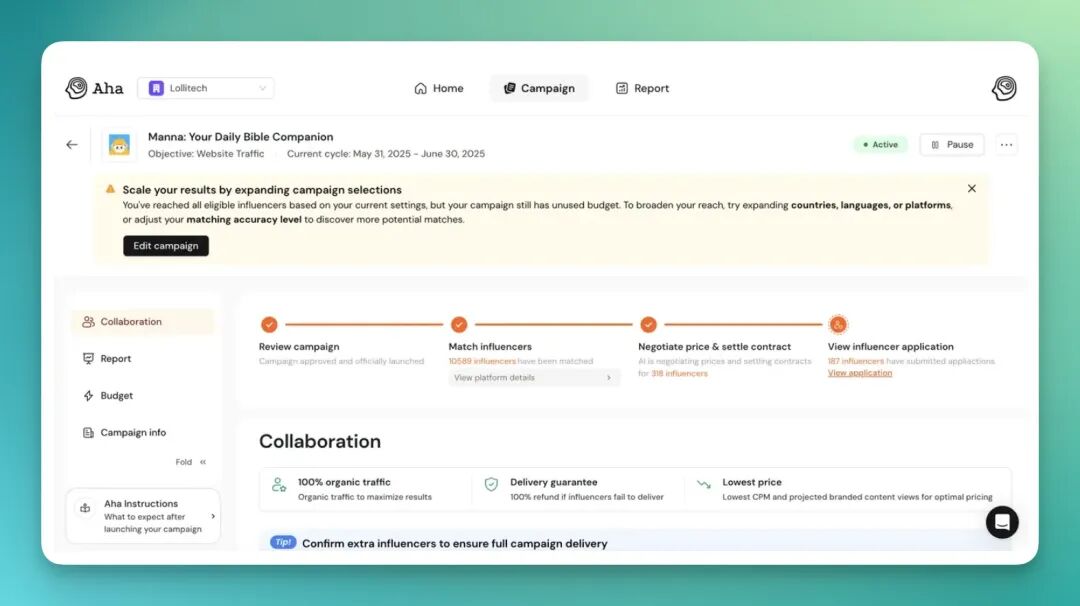
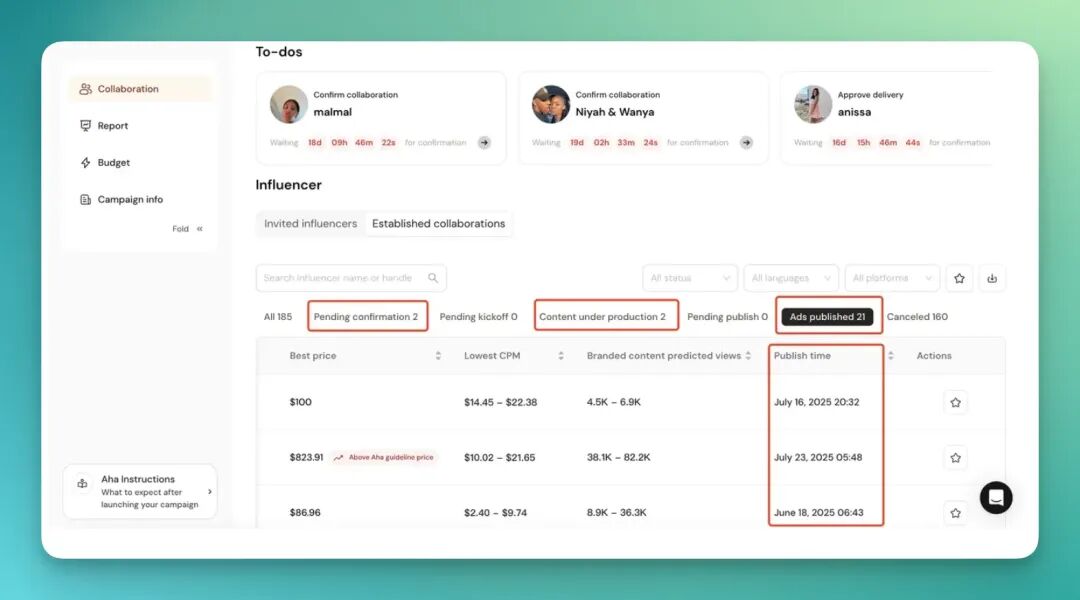
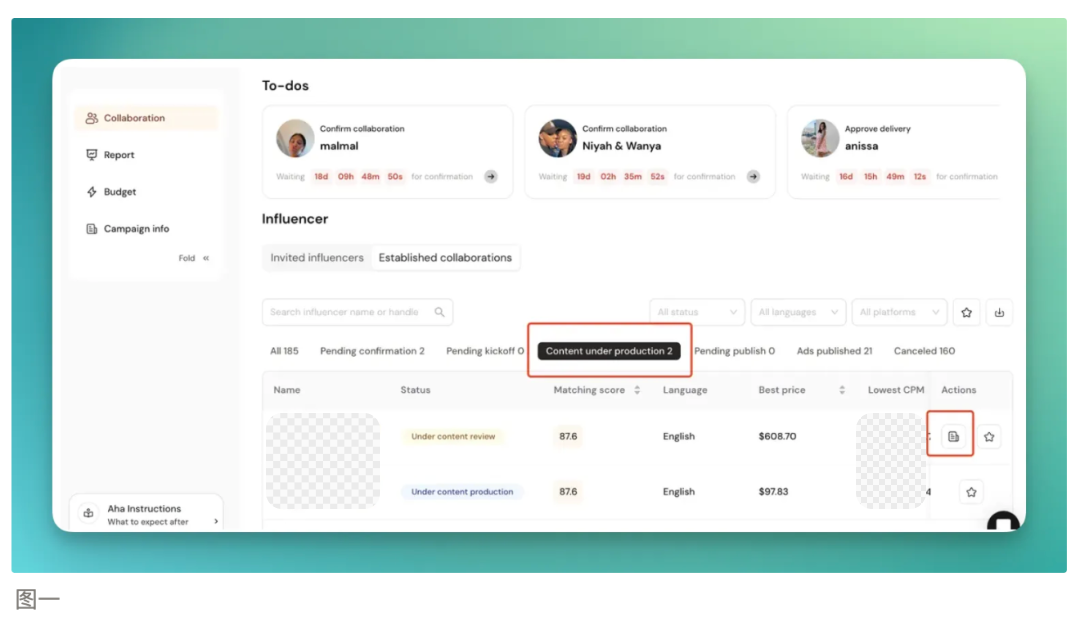
Next, in Aha's (Manna's) interface, you can clearly see creator progress categories: pending confirmation, content in production, pending publish, published, and the corresponding creator counts. A simple feature that solves the pain point of tracking creator progress.
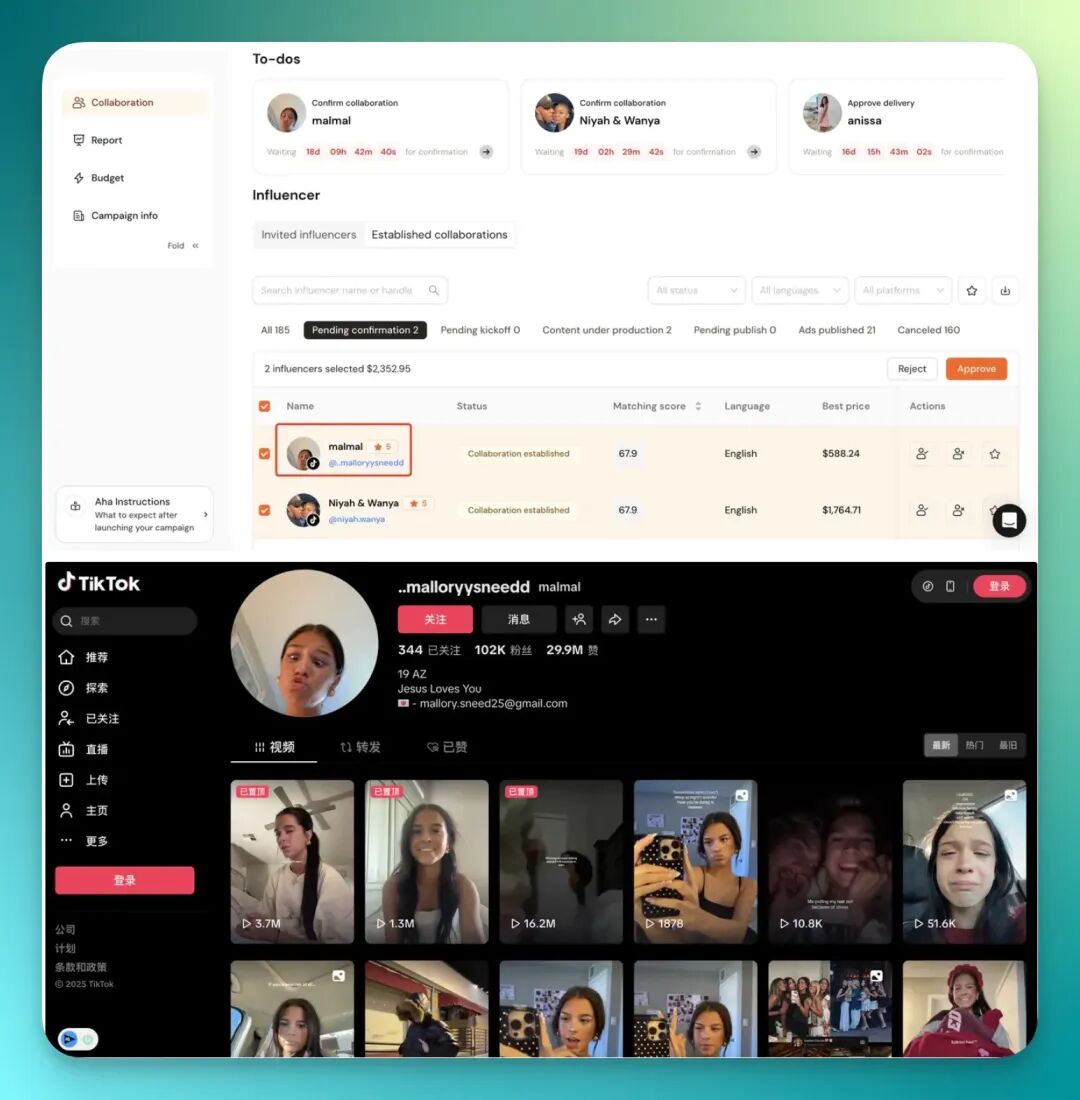
Let's use creators who "expressed interest but Manna hasn't selected yet" as an example. Note: these creators have already confirmed cooperation intent and negotiated prices. You can click the link next to their avatar to visit their platform profile and see if they meet expectations.
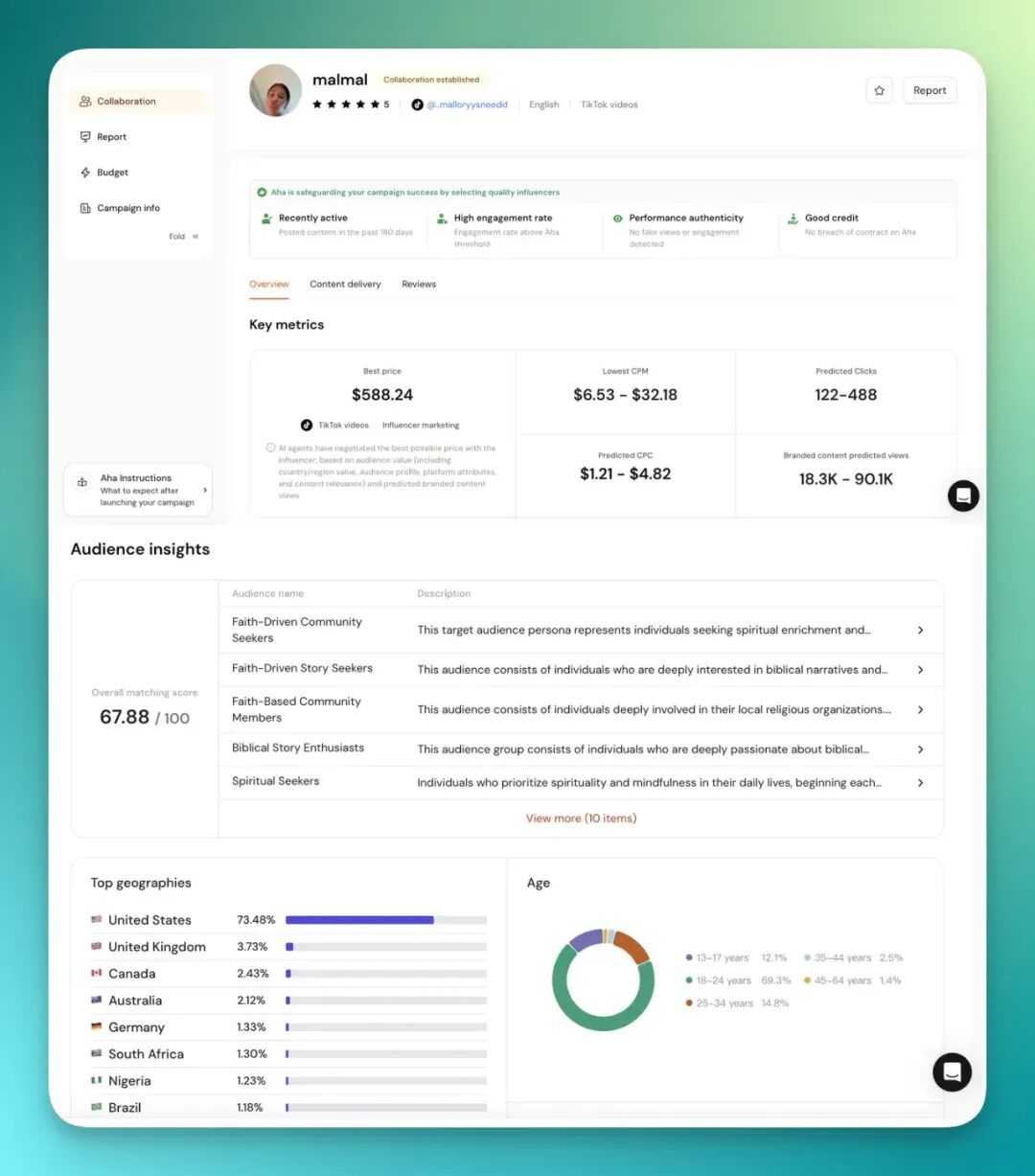
You can also click their avatar to directly enter Aha's "Creator Info Card." Here, "whether this creator is worth selecting" is condensed into several highly readable metrics: best price, estimated CPM, predicted views, creator audience profile, etc., making it easier for you to judge.
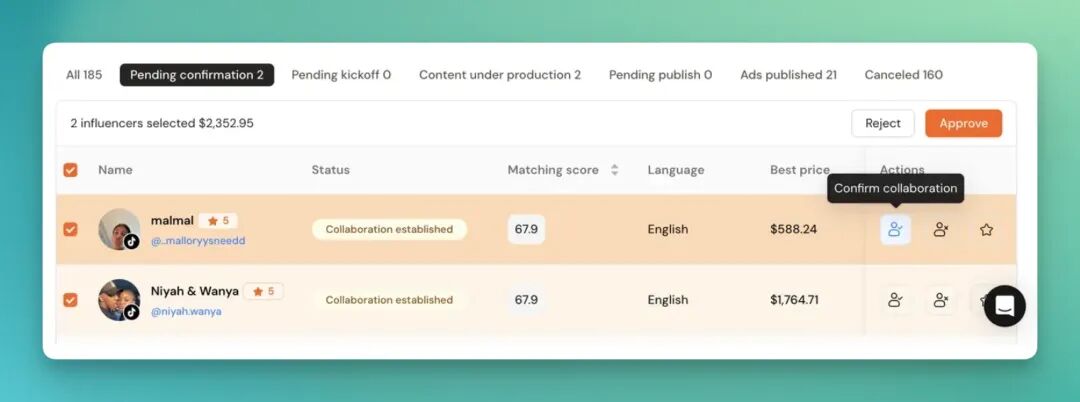
If you judge them worth working with, click "Confirm Cooperation," and you immediately move to the next content production node. If not, you can click remove, and the cooperation is canceled.
Confirmed creators are all centralized in "Content under production" for unified content review. The circled button indicates the creator's draft is ready — you can click to review (Image 2), and provide revision feedback (Image 3).
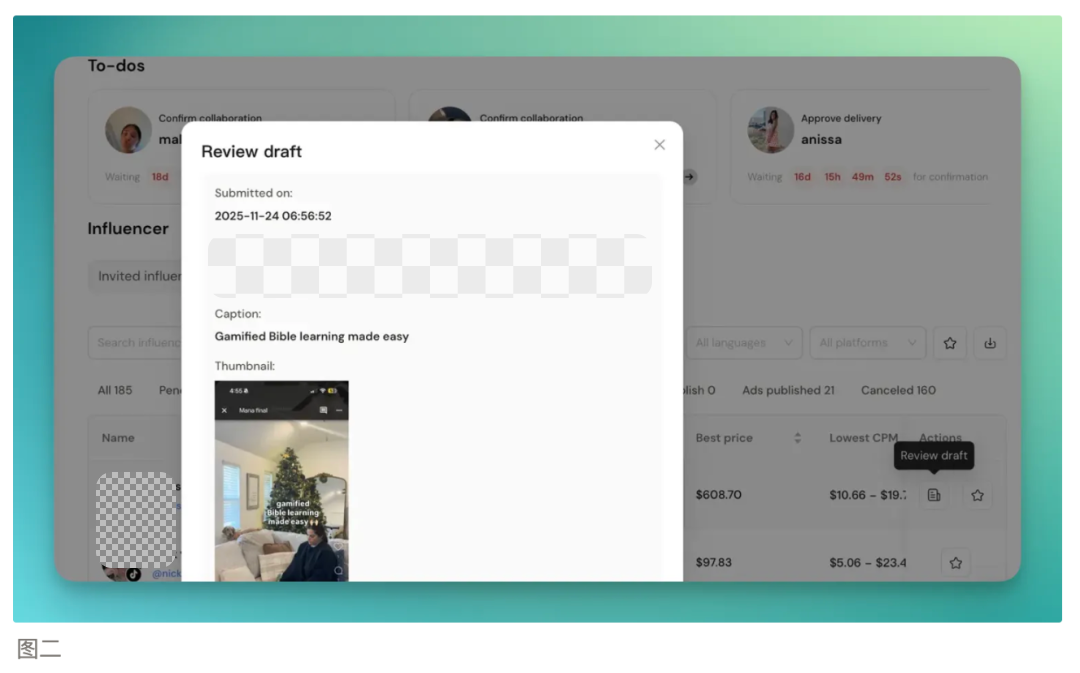
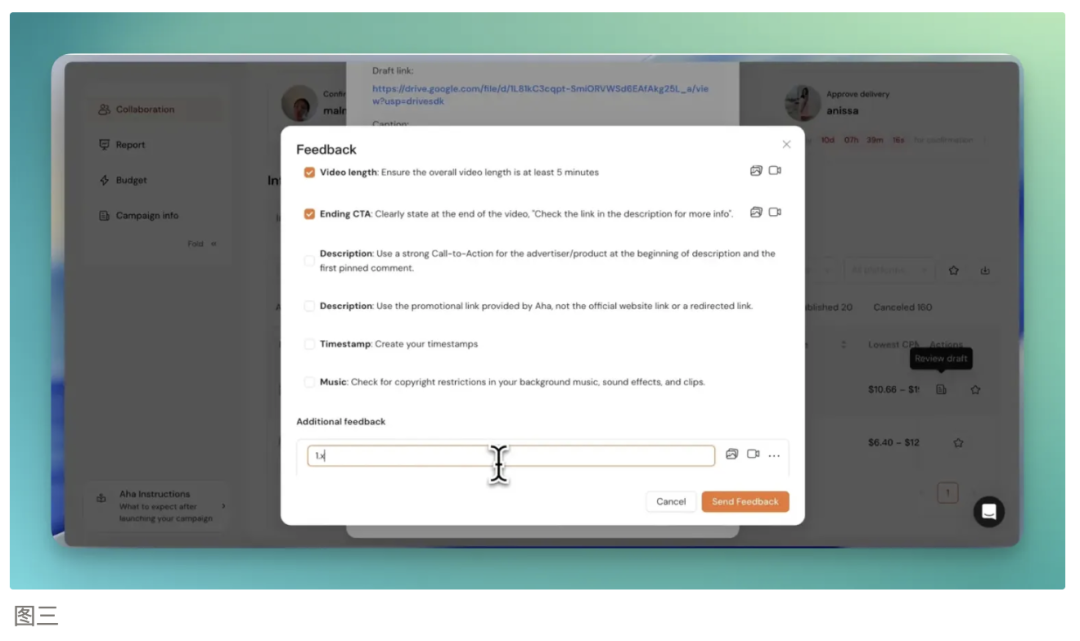
Here, let's also use a published creator from Manna as a case example; Image 2 shows the real communication process, and the creator's revised draft content.
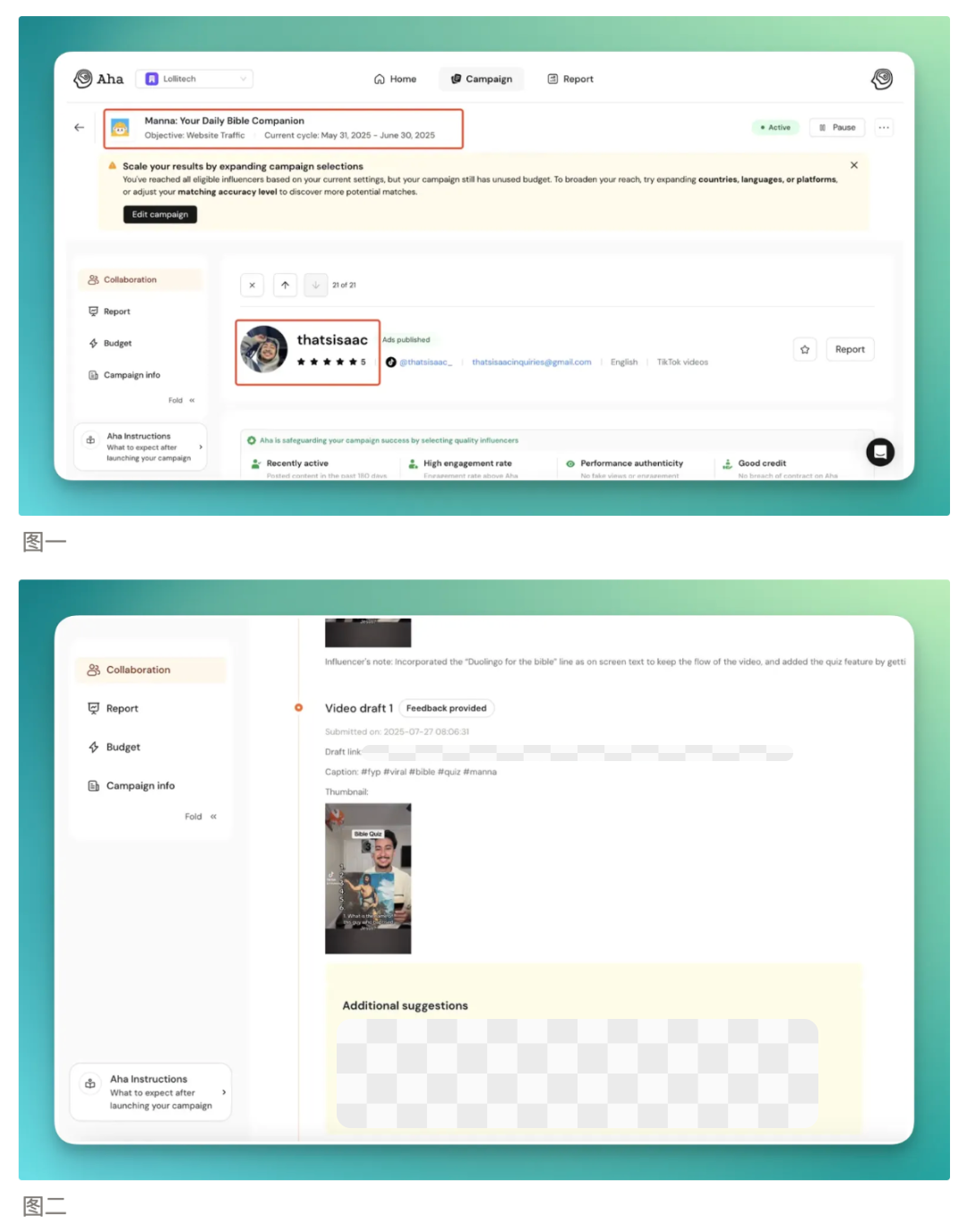
I happened to check this creator's profile data — spent $580, results in the image. Gotta say, that money was well spent.
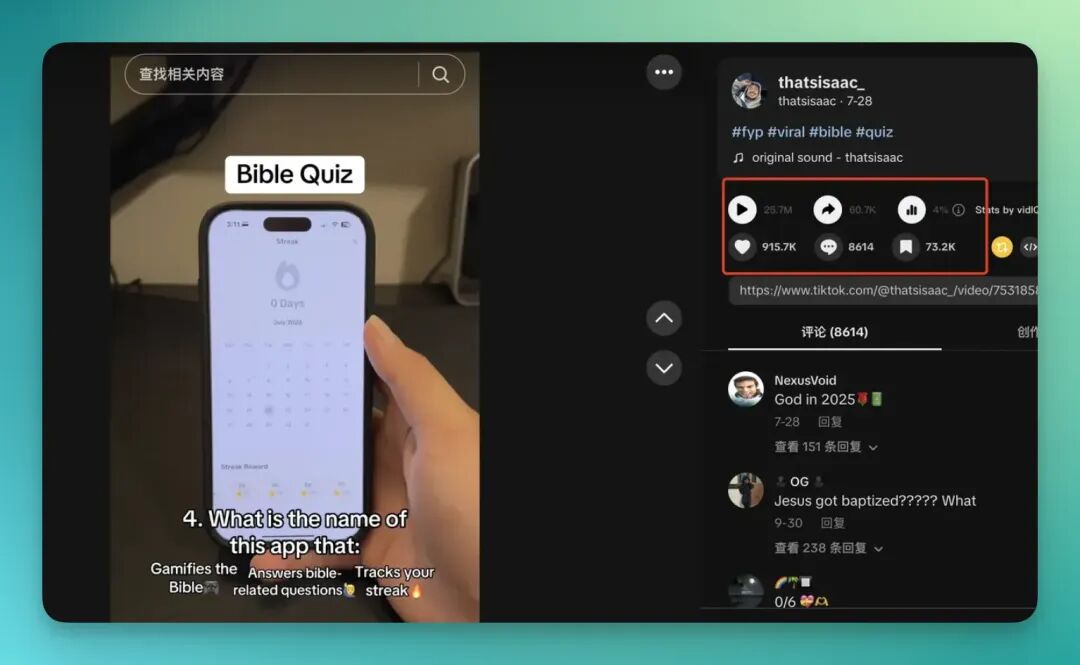
By this point, you can already intuitively feel that the work behind Aha is actually quite comprehensive.
During hands-on testing, many details also piqued my curiosity, such as:
[1] How does the AI Agent negotiate reasonable quotes and display "best price" to brands?
[2] How does it send cooperation invites? Monitor creator content progress?
After carefully studying Aha's creator pricing system on their website (Dynamic Pricing Engine), I realized this system is actually quite complex.
To summarize simply: each creator's quote is calculated by Aha's prediction model, primarily balancing several core dimensions: predicted views, platform base CPM, country, audience purchasing power, cooperation format, and market supply-demand.
The formula on their website looks impressively technical:
Expected Price = Base × CPM × MatchRate ± ε
In other words, after the AI calculates the price, it continuously tests and communicates with creators to arrive at a final executable optimal quote. For brands, the "fixed-price model" eliminates the back-and-forth negotiation process of the past.
For outreach, they've automated this process through engineering methods. On one hand, they manage a massive pool of sending domains for high-concurrency tasks. On the other, they use frequency control algorithms to dynamically adjust email sending intervals and daily volumes, avoiding platform anti-spam triggers. On the creator side, they also localize and diversify messaging to improve invite response rates.
What's interesting is, I assumed this step was all AI — but actually, when the AI encounters complex or ambiguous situations, it automatically flags and hands off to Aha's operations team for manual handling.
As for monitoring creator cooperation progress, to summarize: besides requiring creators to submit by deadlines and follow content placement guidelines, if a creator is overdue, the AI simulates human follow-up reminders. If a creator remains unresponsive for an extended period, brands receive a 100% refund.
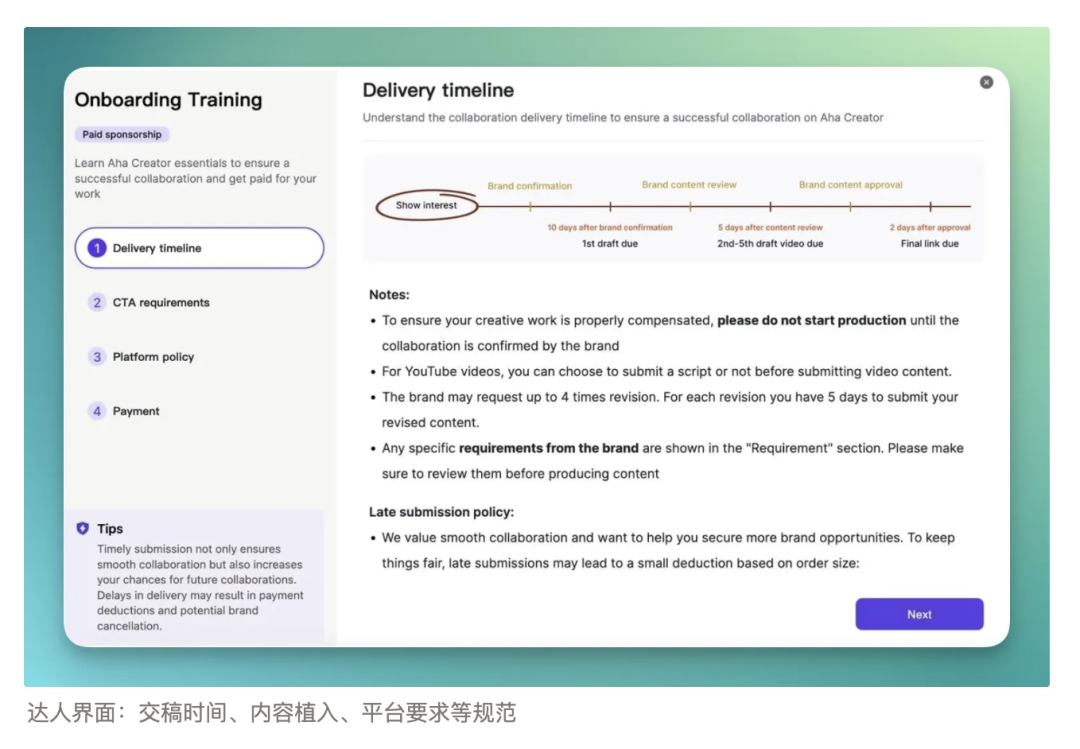
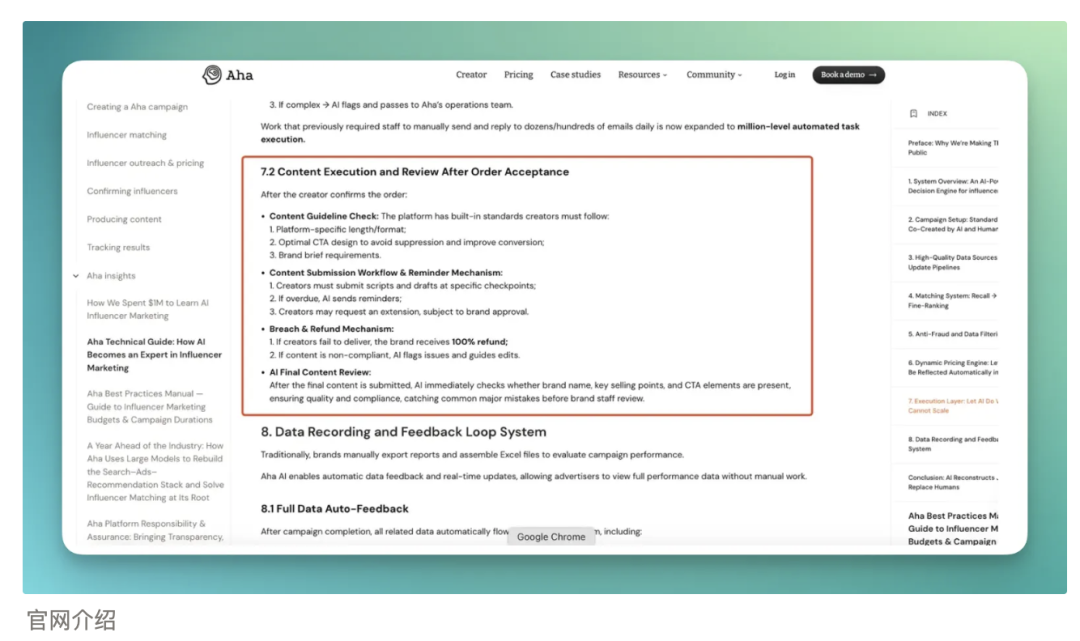
Beyond refund protection, before any first cooperation begins, Aha also handles dual-end authorization and agreement signing with both creators and brands.
For brands, the agency agreement only needs to be signed once, and all subsequent cooperations carry legally binding contract protection, plus content usage rights for creator materials. (Since authorizations involve stamped documents that are somewhat sensitive, we won't show them here.)
For creators, when receiving invites they can immediately view Aha's real authorization relationship with the brand, ensuring the cooperation is authentic and trustworthy.
Although what brands see in the backend is a highly simplified, visualized console. It's clear that "contacting creators," "confirming quotes," "back-and-forth communication," "ensuring compliance" and so on are no longer things brands need to worry about — Aha handles them all silently.
Finally, you just wait for creator content to publish and watch the data. In Manna's Report, you can see their campaign achieved 13M+ impressions. Activity data can be filtered by platform, and drilled down to each creator's performance: views, clicks, CPM, CPC, etc.
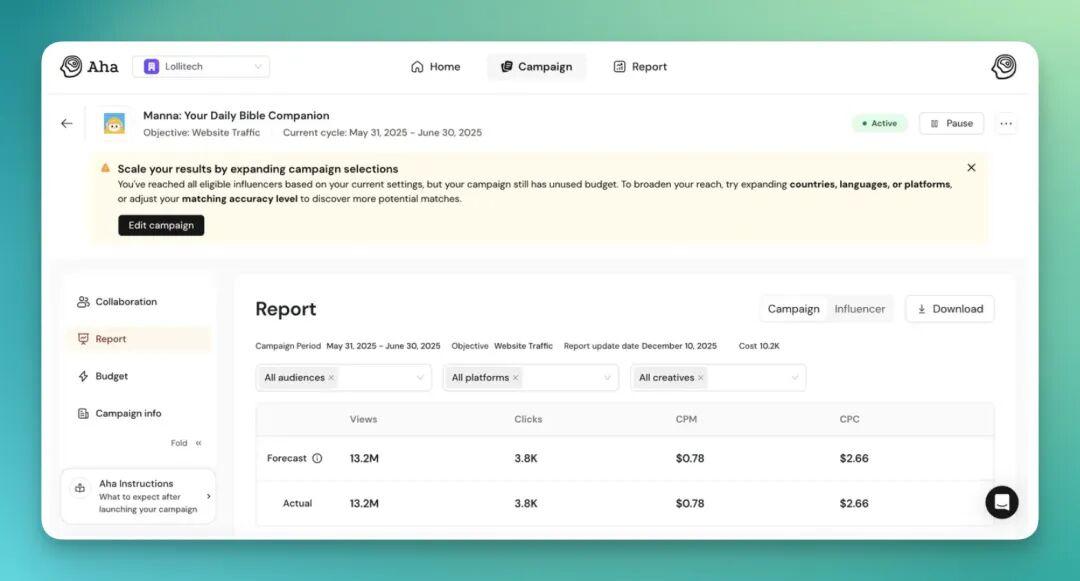
Testing the full workflow, my biggest feeling was "coherent." Compared to the traditional cumbersome process, Aha tries to optimize every segment to be more worry-free and transparent.
From auto-generating campaign briefs, to precise creator matching, to price negotiation, All In One workspace, to campaign result tracking, Aha offers a new marketing experience:
Saving time effectively at every node, making the entire marketing workflow a bit more efficient.
In this process, users no longer need to open Excel to track progress, open Gmail to send emails, or discuss prices with every creator on WhatsApp. They just clicked a few "Approve and Next" buttons on the Dashboard.
This is Aha's attempt at All In One — turning a non-standardized business into a standardized workflow.
If you're interested, we've also made a complete screen recording for you to check out:
Real brand Report:
Of course, since this is a hands-on test, there are a few shortcomings:
[1] Although Aha's automation is high, if your website isn't updated in time, the scraped product key information definitely won't be 100% correct.
Especially when website content is complex or structure isn't clear enough, some details may be missed, leading to incomplete generated briefs.
In this case, you still need to carefully review all content and manually adjust to ensure key information is correct and matches your campaign requirements.
[2] Although the platform offers many matching options, if brands have particularly specific needs, or target audiences and regions are quite niche, the number of matches may not be particularly high.
Though in this situation, finding on your own or through an agency would probably also be slow — you need to lower expectations and have enough patience.
[3] Whether to ultimately cooperate still requires manually screening one by one.
Setting aside these shortcomings, as a rapidly iterating 2.0 version, Aha is already trying to solve a series of problems that overseas growth leads frequently find "hair-pulling."
This may be one of the more cost-effective solutions for overseas growth marketing currently available.
02 | Looking Back: Why Is Influencer Marketing the Field AI Should Enter Most?
[1] Finding people is hard, screening is painful
In the past, people could only rely on shallow tags, like keywords such as "AI, productivity" to search. To go deeper, you'd have to click into each creator's content one by one to see if they're suitable for placement, whether their audience is your target demographic. Much of it still relied entirely on subjective feel.
Going one level deeper, you'd use various tools to check if view curves look abnormal, whether comments are real engagement. After confirming profile match, you'd still need round after round of outreach, negotiating details, and the ones you can actually finalize cooperation with are often few.
[2] Communication is exhausting, response rates are very low, very draining on energy.
Send 100 emails, get 3 replies. To confirm one small cooperation detail, you need 4-5 rounds of back-and-forth, plus dealing with time zone and timeliness issues.
[3] Black box operations, pricing isn't transparent.
This market has no standards. For creators at the same level, quote differences can be 10x. You don't know who to invest in, or whether "this money was well spent."
So the problem isn't really "lack of tools" (there are plenty of data analysis tools on the market), but rather the absence of an automated, scalable execution mechanism.
And these are exactly what Aha is currently working to gradually get right.
So:
Can AI Agents actually land in vertical scenarios' dirty, tedious work?
For a long time, our imagination of AI has often been too "sci-fi" — AGI is still very, very far away.
But Aha shows us that it can handle those non-standardized, trivial, process-oriented tasks, and do them pretty well.