How Is a Simple AI Meeting Notes App Worth $250 Million? | A Deep Dive into Granola's Product Philosophy

Granola found the optimal solution for "human-AI collaboration" with remarkable nuance.
The Optimal Solution for "Human-AI Collaboration"
 👦🏻 Authors: Xiaoju, Jingshan
🥷 Editor: Koji
🧑🎨 Layout: NCon

Every topic selection and event at Crossing is like making an early-stage investment — we're not just producing content, but aiming to become a "voice amplifier for founders + radar for early-stage projects."
And Granola[1], which released version 2.0 last month, is precisely such an "early-stage star project" worth our attention.
Granola is a startup that has risen rapidly with an AI-powered note-taking tool, boasting a large base of loyal Silicon Valley users. It's been called "the product that understands human-AI interaction most thoroughly."
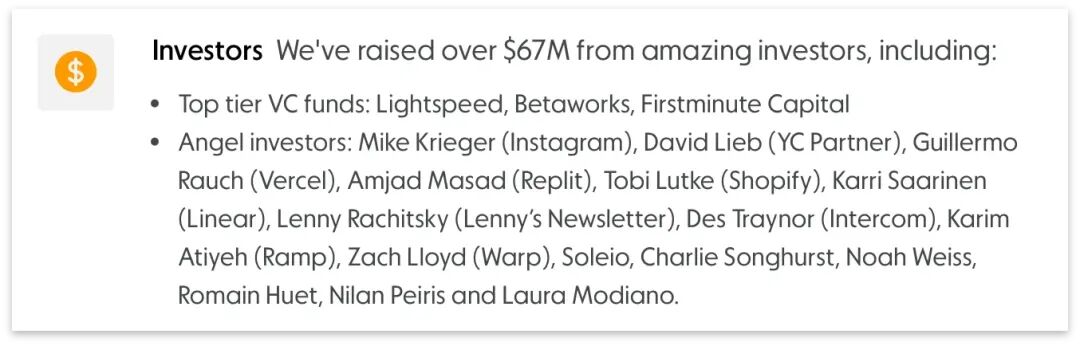
From its launch, Granola won a16z's favor with its "simple and efficient" product strength. Even with only 5,000 weekly users, Granola closed a $20 million Series A. Its latest $43 million Series B pushed its valuation to $250 million, with less than a year between the two rounds.
Crossing noticed that Granola co-founder and CEO Chris has consistently emphasized a product philosophy of "AI should augment, not replace humans," which has deeply influenced every detail and decision at Granola.
Since Granola hasn't officially entered the domestic market yet, and language support and localization are still being refined, this product remains somewhat mysterious for domestic audiences:
In the "AI meeting notes" segment — a niche that tech giants absolutely refuse to abandon — Granola has risen rapidly to become a young market leader thanks to exceptionally high user retention. So what exactly did Granola get right? And why does it make Silicon Valley heavyweights and frontline users willingly become organic advocates?
This article offers a comprehensive analysis of this product across five dimensions:
🚦
【1】What is Granola?
【2】It created an interaction innovation that almost everyone loves: clarifying "chaos"
【3】It lets users "do growth" for themselves
【4】The product philosophy of Granola's founder
【5】"Young products" have concerns too
What is Granola?
Granola is an AI meeting notes assistant that "enhances you, rather than replaces you."
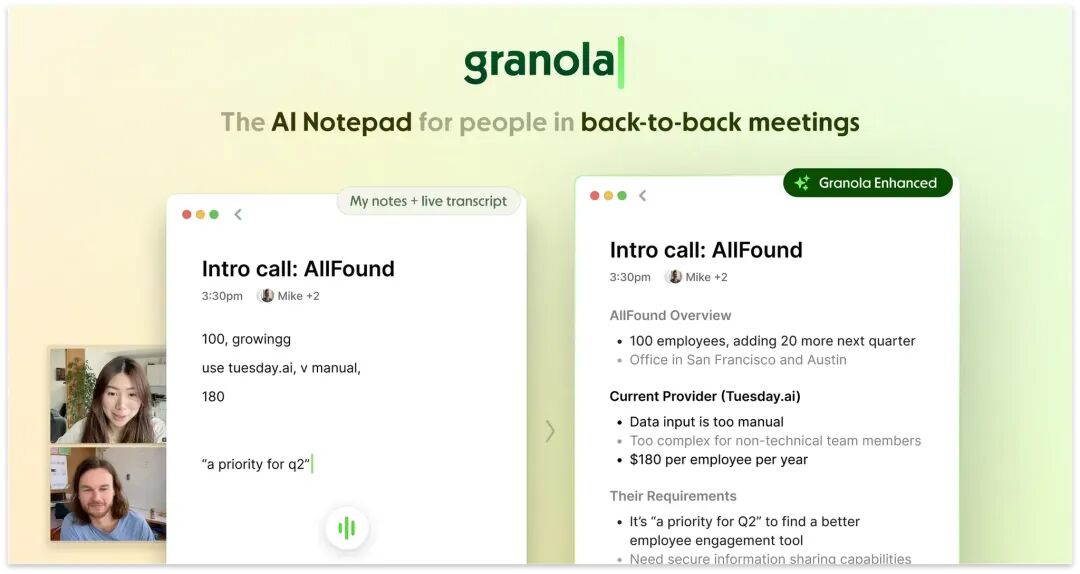
The simplest way to describe Granola's unique appeal: it lets users collaborate with AI to complete meeting notes each time.
First, users still need to jot down key points themselves during meetings — important ideas, information, inspirations, and so on. Even if it's just a few hastily scribbled words, Granola will automatically refine and polish the rest based on these extremely rough notes.
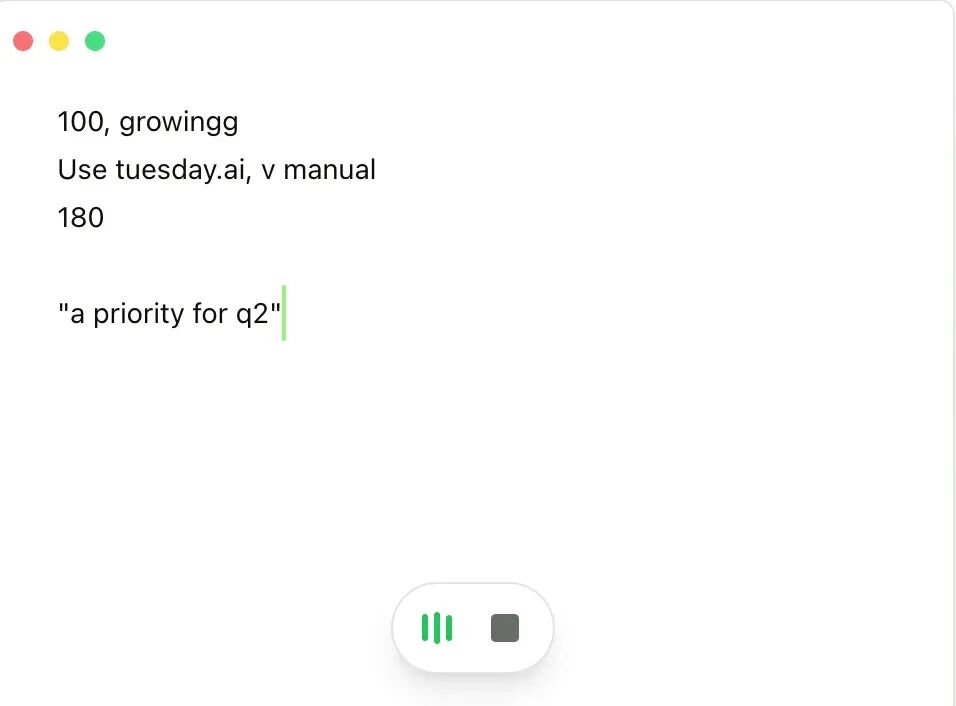 Users only need to write a few words — a rough sketch of notes
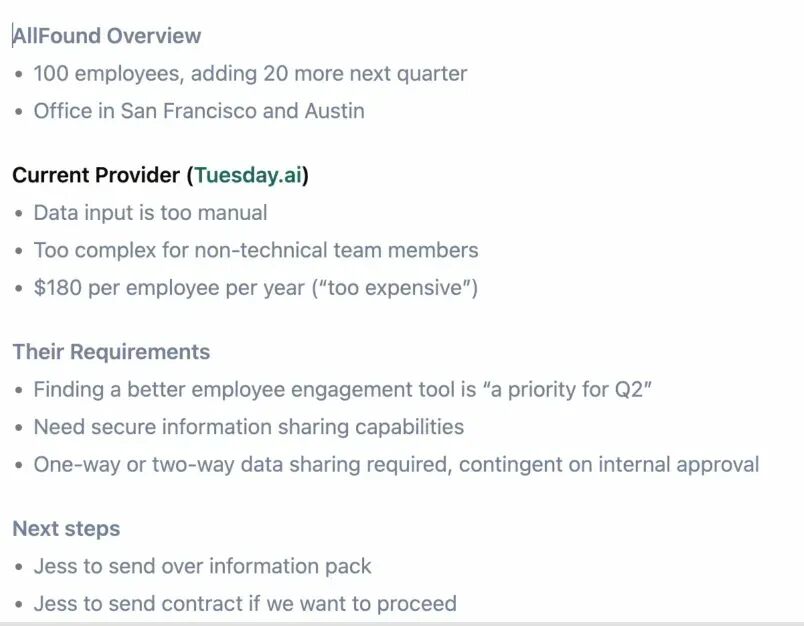 Granola automatically enriches it into a "meeting essence"
Meanwhile, Granola fully accounts for team collaboration needs, offering customizable templates for various meeting types (such as sales meetings, one-on-one performance reviews, etc.), so teams can record notes in their preferred format.
I want tools that make us "more human," that make us "better humans." That is, they should unleash our creativity, our judgment, and let us do the beautiful things that only humans can do. — Granola founder Chris
Granola deeply understands users' thinking patterns and inspirations, providing intelligent supplementation and structured organization based on meeting transcripts.
Currently Granola supports major meeting platforms including Zoom, Google Meet, Teams, Slack, and WebEx.
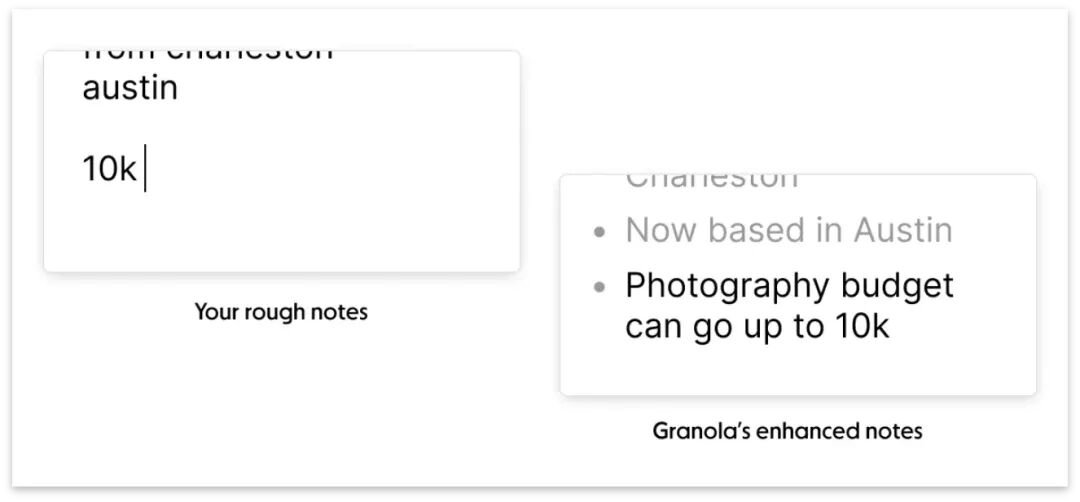 Regular meeting notes vs. Granola-enhanced meeting notes
It Created an Interaction Innovation That Almost Everyone Loves: Clarifying "Chaos"
Granola isn't just a simple meeting transcription tool. Unlike other transcription tools that immediately dump a pile of AI-generated summaries and verbatim transcripts after each meeting, it aims to become a genuine thinking tool — like expanding our brain's working memory — to help users thoroughly clarify the "chaos" in meetings.
1) Fluid Meeting Notes Interaction
Today, most mainstream meeting software comes with built-in AI summarization. However, many people, myself included, barely read these AI-generated meeting summaries at all. This is precisely the biggest pain point facing most current AI meeting summary tools. Granola chose a completely different path — its greatest innovation lies in thoroughly positioning AI as a tool to assist user thinking, rather than the protagonist driving content output.
Here's what Granola's interface looks like:
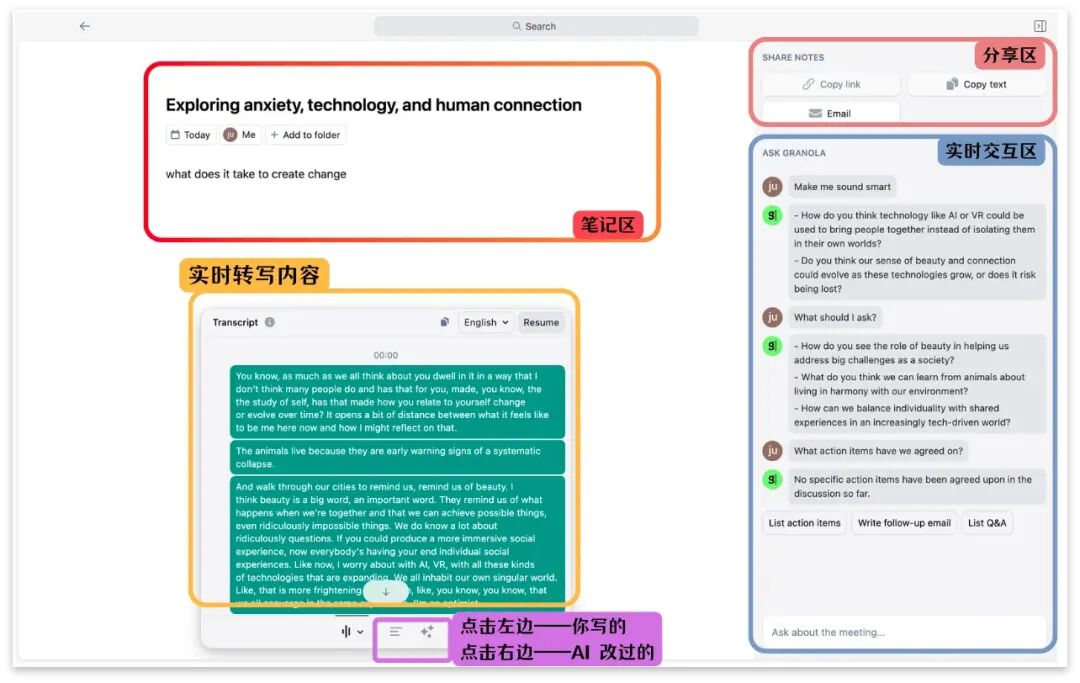
Granola deeply honors a philosophy of simplicity and efficiency. Opening the sidebar divides the entire interface into two clear zones: the notes area on the left and the real-time interaction area on the right.
The notes area allows continuous toggling and editing between "notes you completed yourself" (say, a very rough draft, or just a few isolated words) and "AI-generated notes" to more accurately record your own perspectives and ideas:
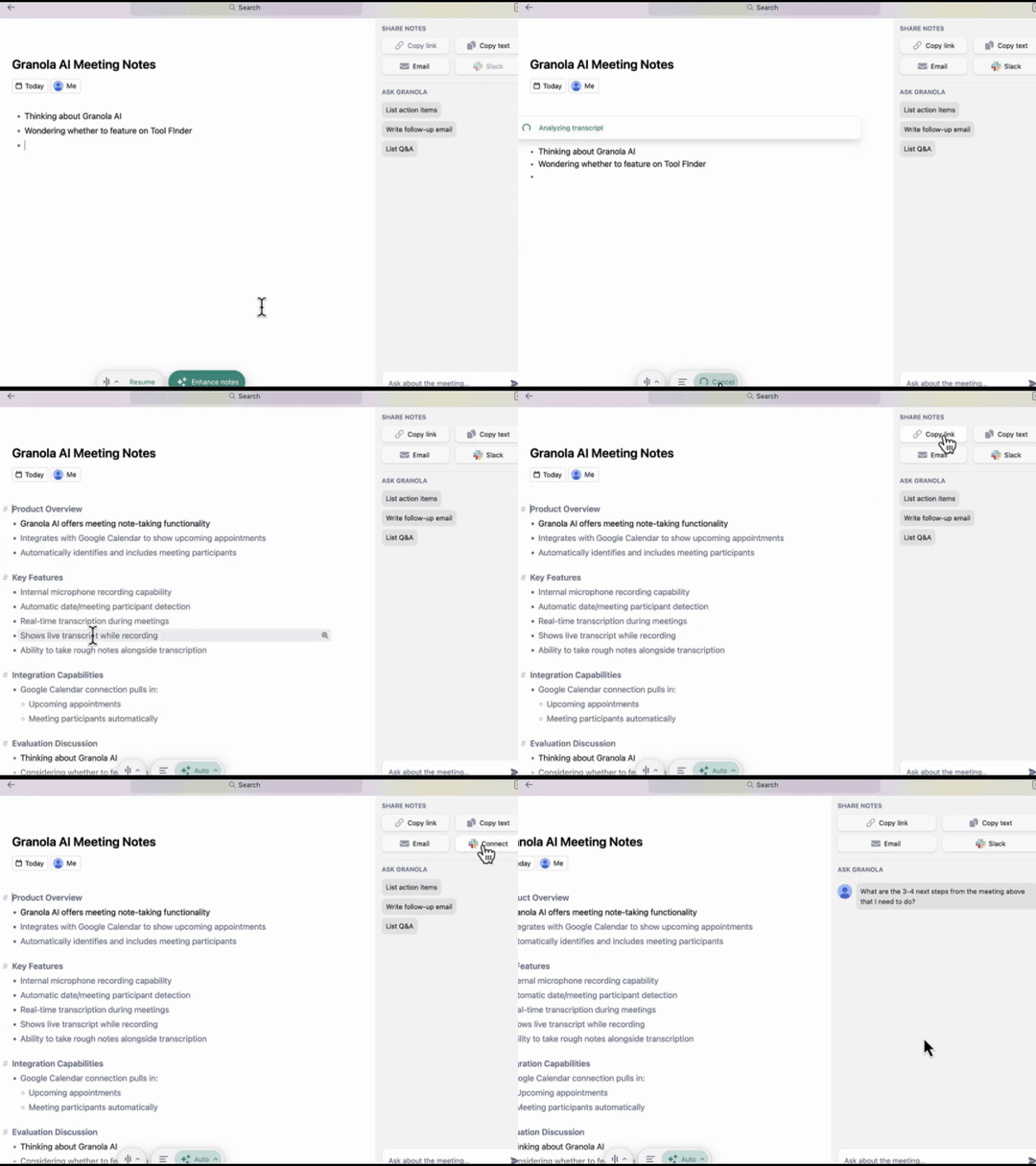
The interaction area on the right lets you ask questions in real-time during meetings — such as quickly summarizing discussion points or retrieving meeting information on the fly.
Below the notes area sits a "Templates" feature with numerous granular scenarios to choose from.
For instance, when communicating with a client in a one-on-one[2] setting, selecting the "1 to 1" template lets Granola capture communication points in a more personalized way:
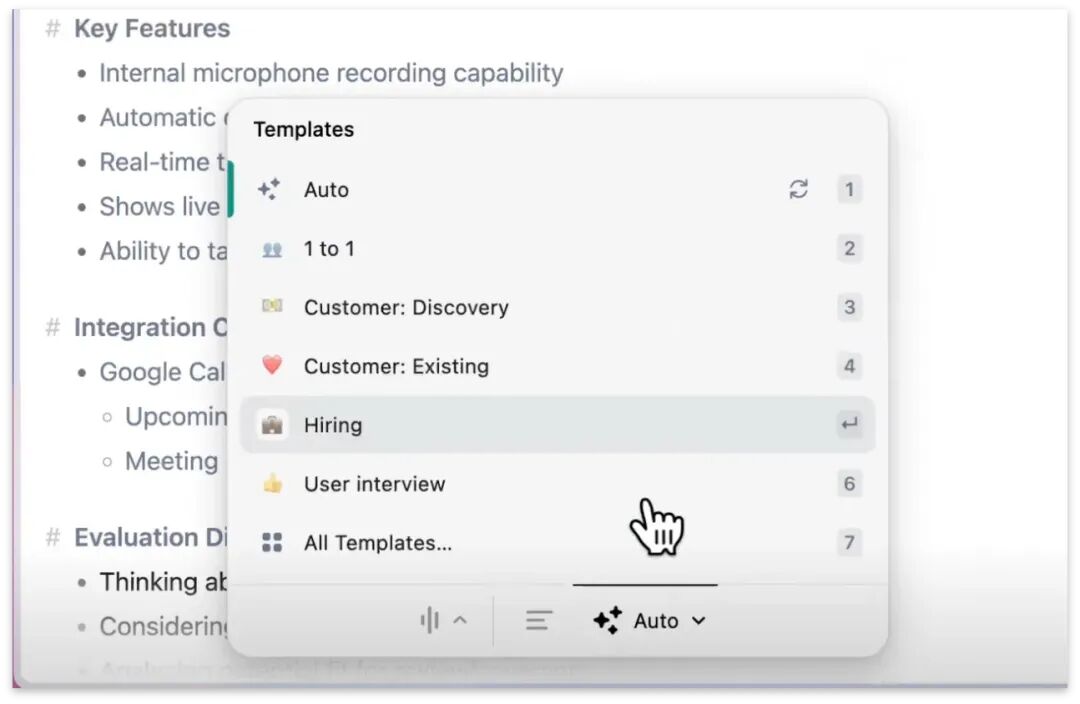
This proves especially useful in specific work scenarios. In sales meetings, it might focus more on client needs; during hiring interviews, it highlights candidate backgrounds and key information.
Beyond templates designed for different scenarios, users can also preset meeting templates to ensure consistent style and structure across the team when taking notes, improving work efficiency.
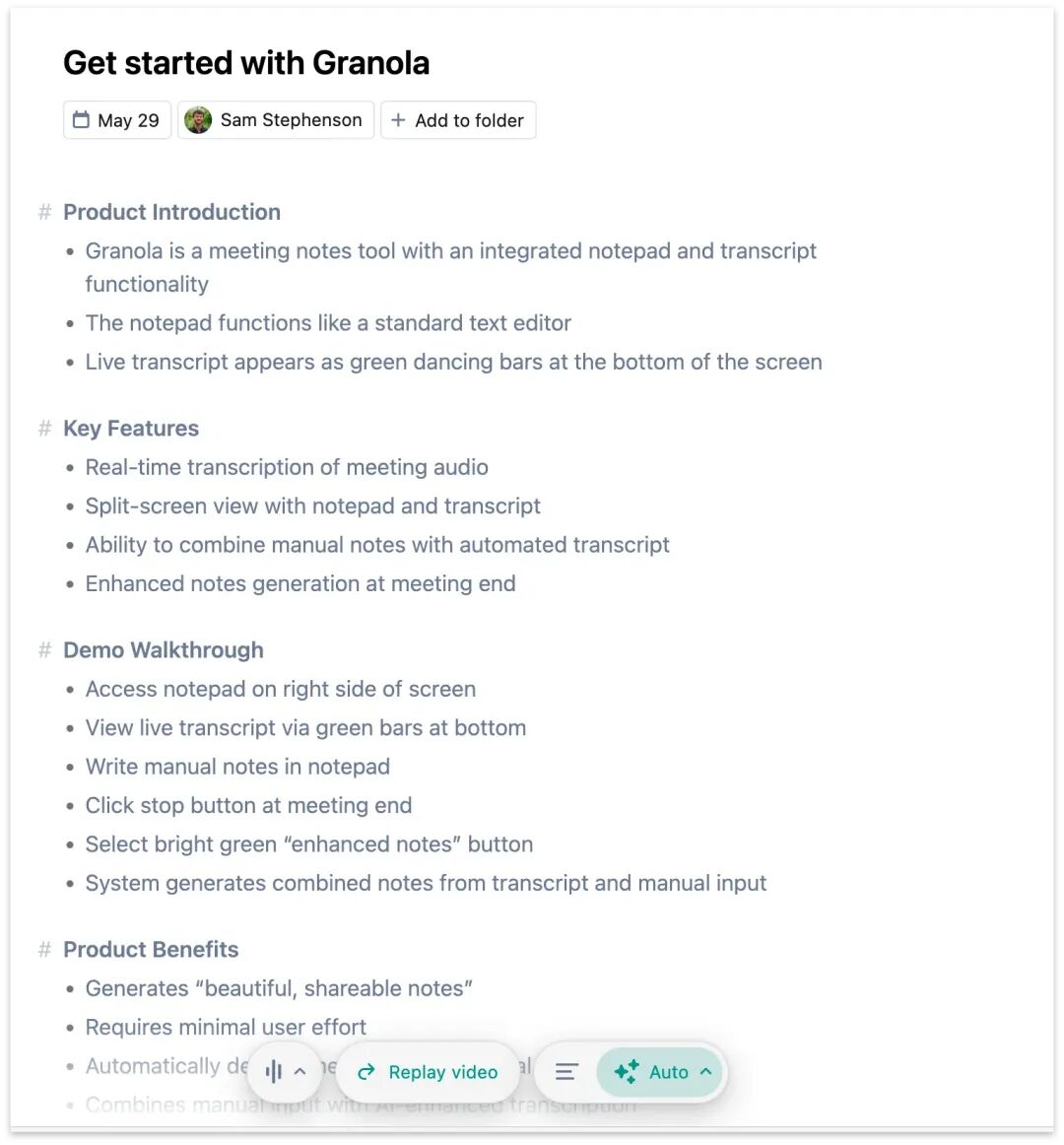 Even if users input almost nothing, Granola can automatically generate clearly structured meeting notes in Auto mode
Moreover, it can organize meeting content into clean, readable formats, letting users quickly grasp key points without repeatedly poring over verbatim transcripts.
For example, you can click any subheading to view more detailed information:
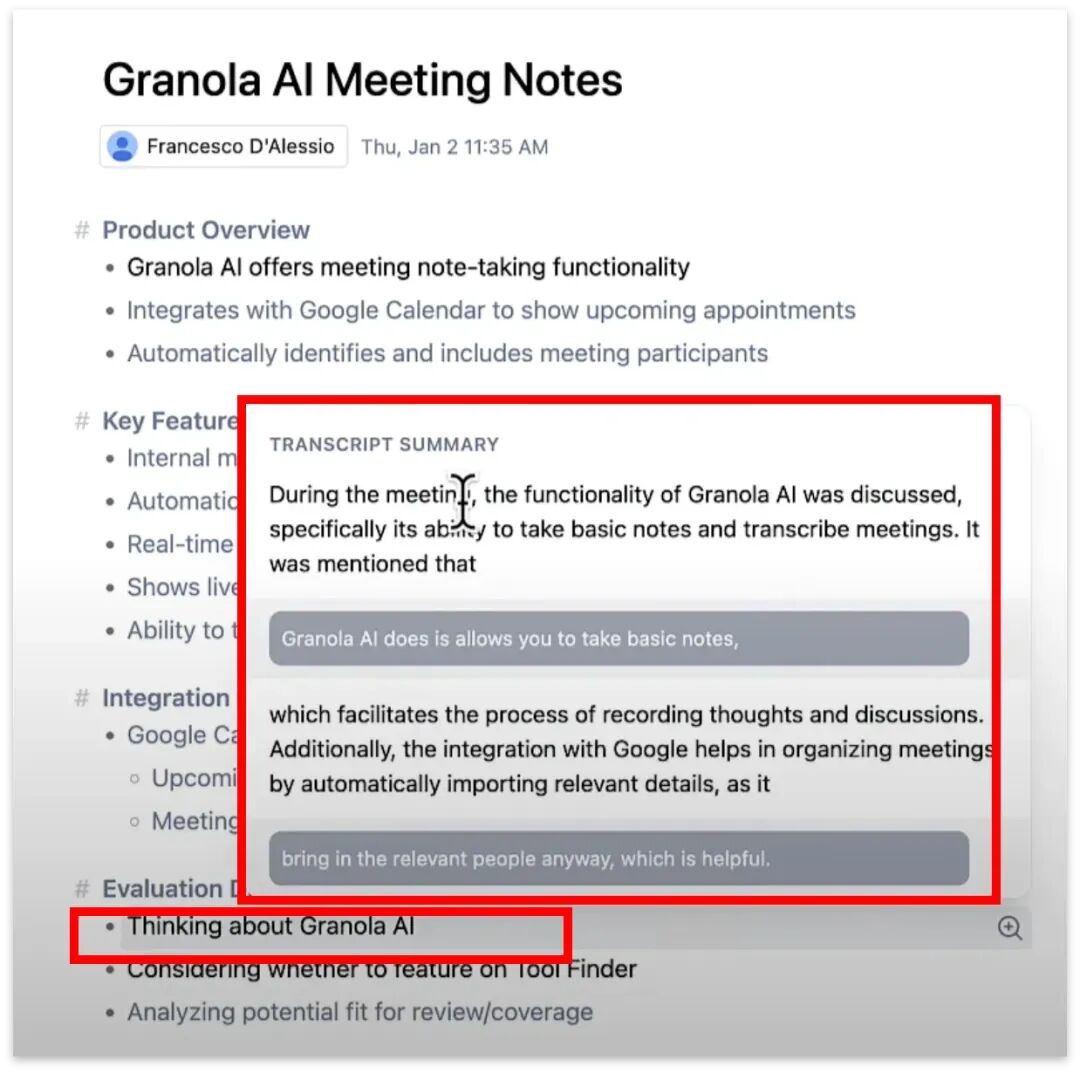
Overall, Granola's interface is clean and intuitive, with a smooth, natural interaction flow. It doesn't just record content — it genuinely helps users and external participants quickly grasp the core substance of a meeting.
To more vividly demonstrate Granola's complete interaction flow, I recorded a video of a TED talk.
I only jotted down a brief phrase and a single word as notes. Through AI interaction, Granola fills in everything I missed, enriching those notes.
2) Giving Everyone a Sense of "Meeting Participation"
One high-frequency scenario users face: it's easy to get distracted during meetings, and summaries are desperately needed. Granola picked up on this keenly.
Users can ask real-time questions about meeting content directly in the right-side interaction panel, so everyone understands what the meeting is actually about, where things stand, and how far along the process is.
For instance, users can open the sidebar anytime or use the CMD+J shortcut to ask questions like:
What did I miss? Summarize the past 5 minutes. List all decisions made so far.
Granola quickly summarizes the meeting content for users:
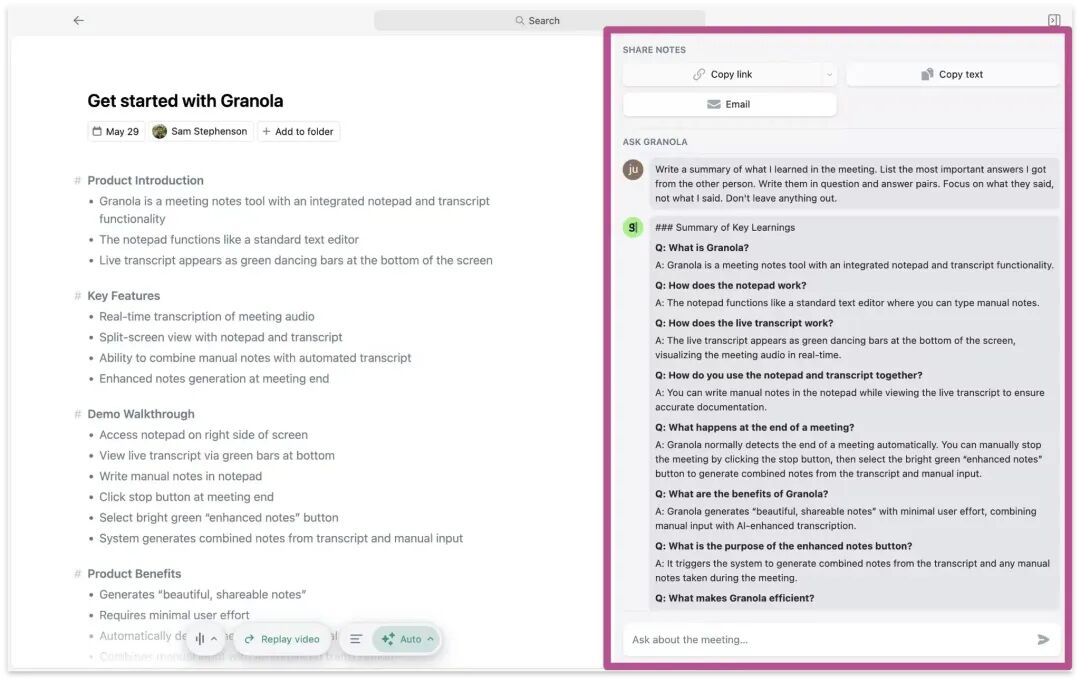
3) Make Me Sound Smart
Crossing also discovered a delightfully clever prompt — "Make me sound smart."
For example, you simply type this prompt into the interaction panel:
Make me sound smart
Granola then leverages its embedded AI model, combined with the surrounding meeting context, to deliver the "perfect answer":
How do you think technologies like AI or VR can be used to connect people within their own worlds rather than isolate them? And how do you think our perception of beauty and connection might evolve as these technologies develop — or is there a risk of losing that perception?
Beyond this, Granola offers additional quick-prompt options at the bottom of the interface to "make you sound smarter," such as:
"What did I miss?" "What should I ask?" "What does this mean?"
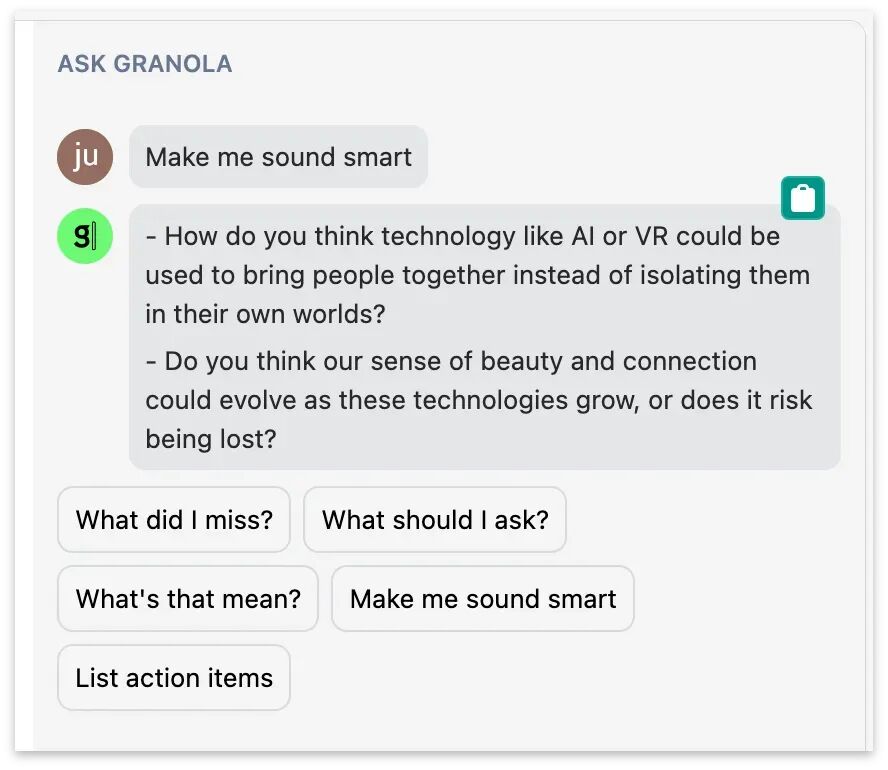
These designs precisely target users who've missed content or are simply zoning out.
4) Making "Context" Deliver 100% of Its Value
"Using AI to share meeting 'context' will become the core tool for future team collaboration." — Chris
"Context," simply put, is the background information of a discussion.
In the past, we needed to feed AI massive documents to guide it to organize and think within specific domains. But the real "context" — the freshest, most relevant data on a team — often isn't in meeting records or documents. It's scattered across members' day-to-day conversations.
With Granola, you can analyze this vast information anytime and put it to use in various ways.
Granola allows users to pull up past conversations from team-shared folders and ask AI questions:
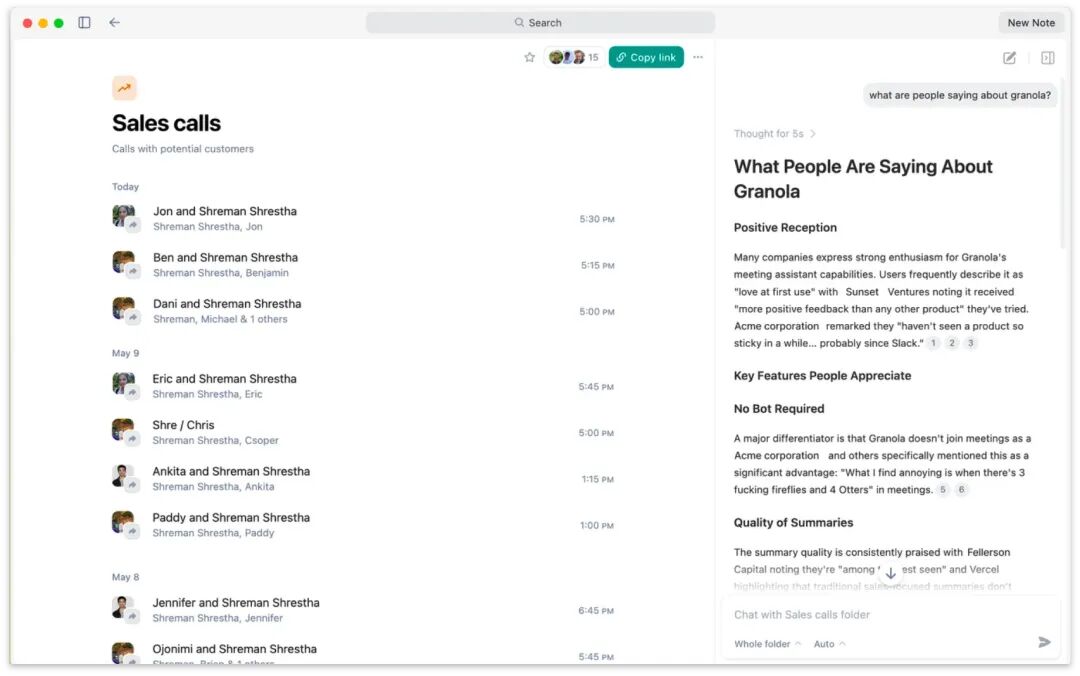
For example, I wanted to map out my company's key decisions over the past month and write a summary article.
I only needed to organize the meeting records into Granola's shared folder, then have AI help extract themes and provide an article framework.
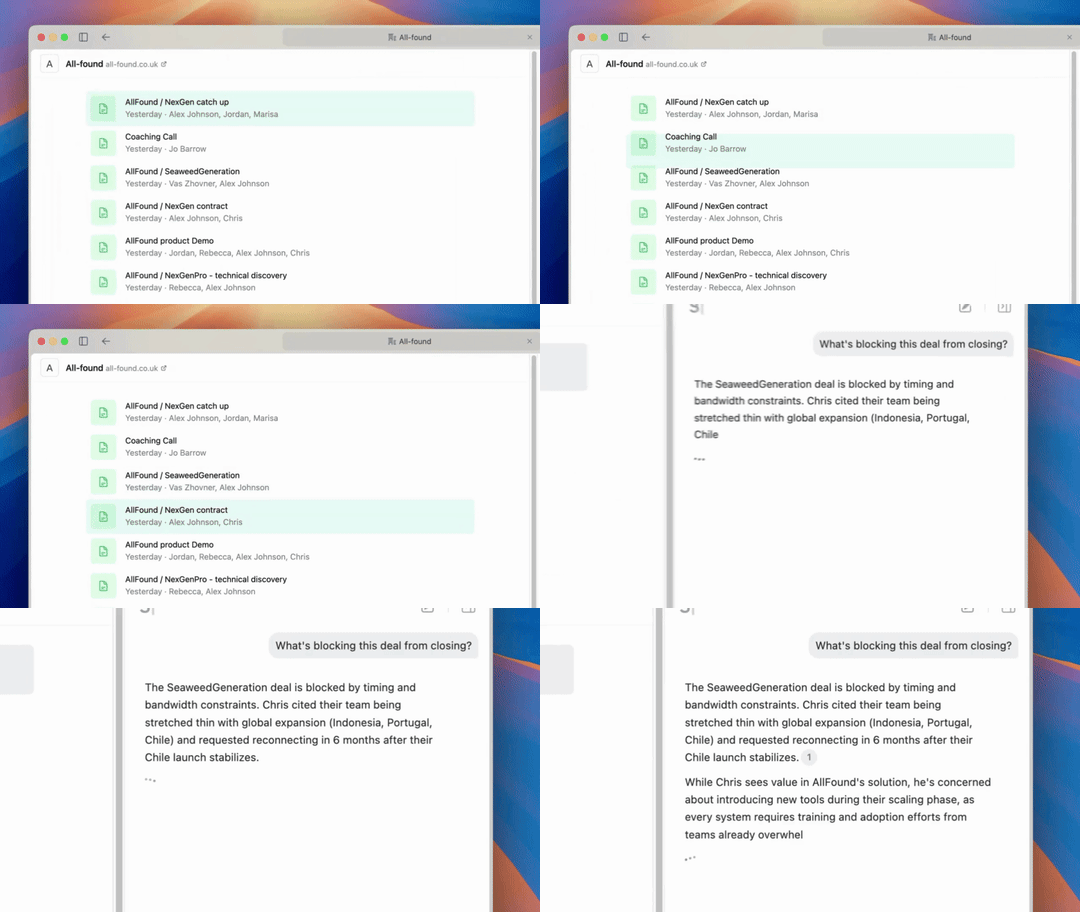
While I still wrote the final article myself, this process let me efficiently consolidate everything without missing anything.
5) Polishing Technical Details and Edge Cases
Granola spent enormous time refining the user experience, from reducing "intrusiveness" to attention on edge cases — all carefully considered.
Reducing "Intrusiveness"
"We needed to find a reasonable balance between 'maximizing practical value' and 'minimizing invasion of personal privacy'. So after careful deliberation, we decided not to record or store any audio data." — Chris
Although Granola listens to audio in real time for transcription, the raw audio files themselves are never saved.
Compared to traditional meeting tools' recording functions, Granola's "traceless" design dramatically lowers users' psychological burden.
In use, Granola's transcription button is nearly "invisible." You see only a clean notebook interface for jotting ideas, plus a small button with a green stripe that pulses dynamically during transcription.
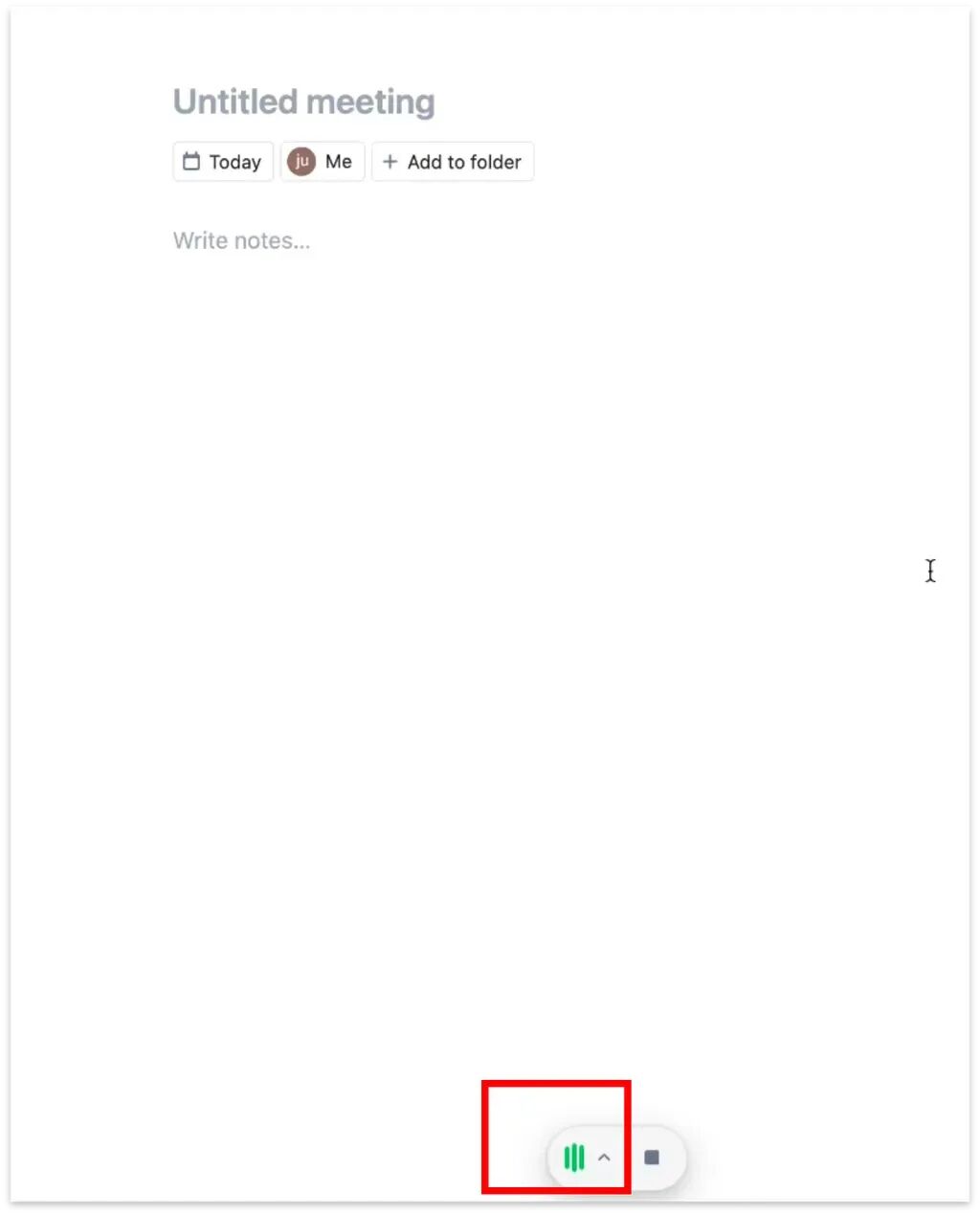
Granola also clearly distinguishes AI-generated content from user content (user text in black, AI additions in gray), reducing the psychological pressure of "AI invading users' native content."
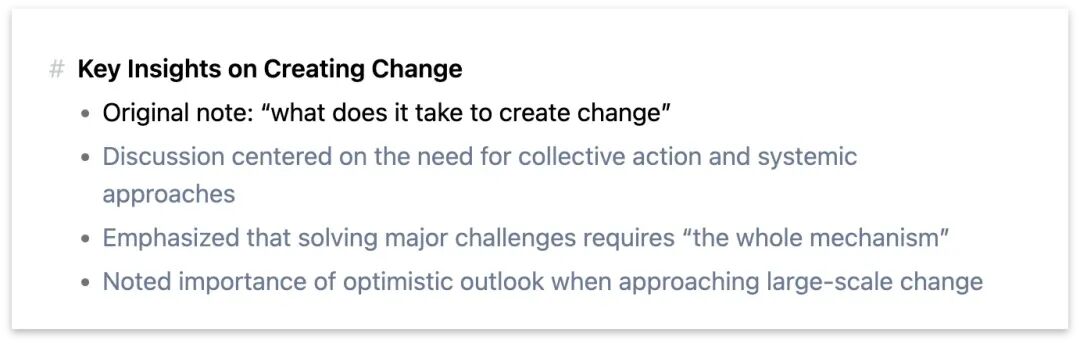 The black portions are what the user wrote; the gray portions are AI-enhanced.
Attention to Edge Cases
"What makes Granola stand out is largely our attention to edge cases. Some problems you might never think of — like a user removing their AirPods mid-meeting, or Granola needing special handling in a Zoom call with multiple audio channels to ensure smooth user experience." — Chris
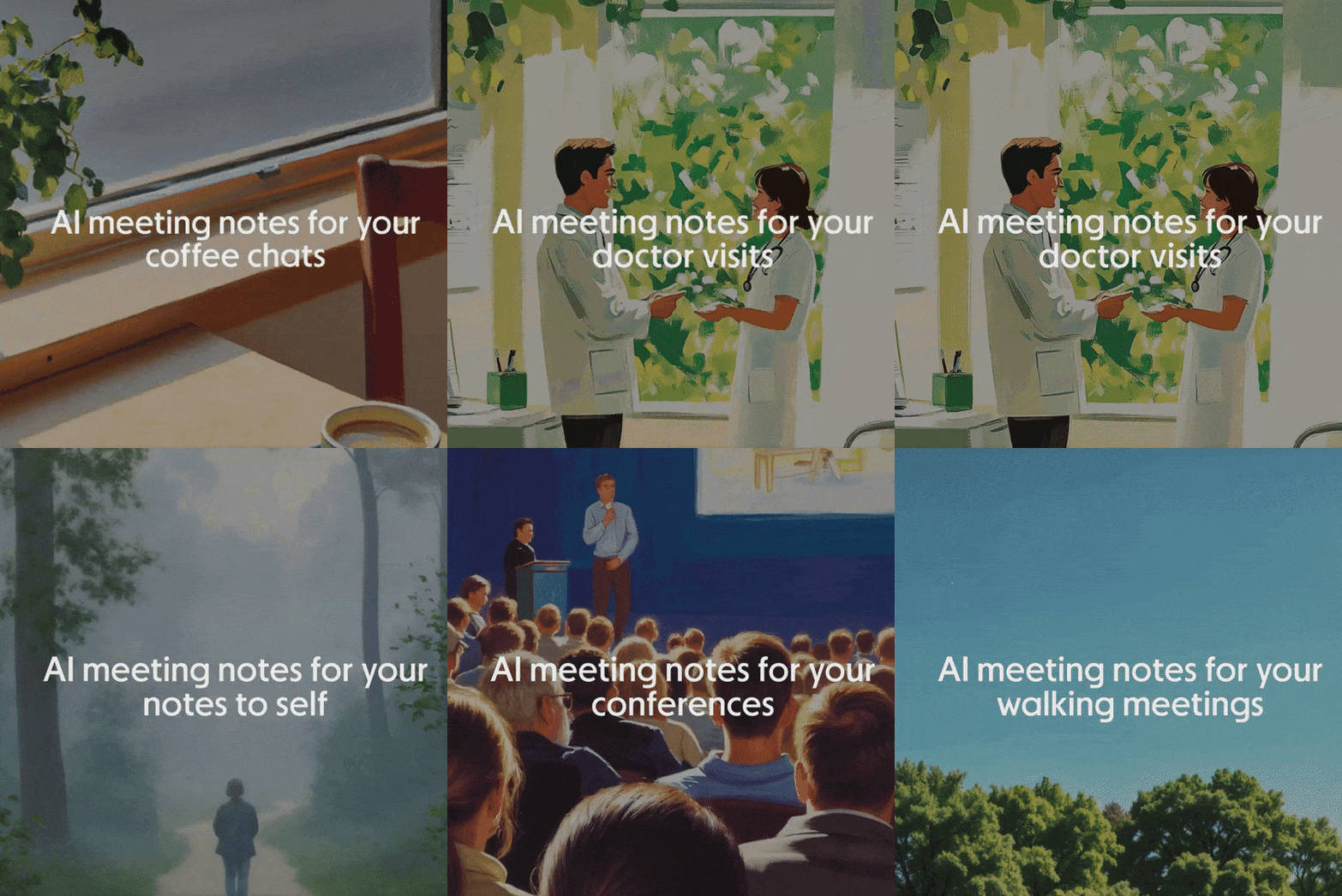
Beyond formal meetings, Granola has expanded into many new scenarios: medical conversations, café settings, and more.
It Lets Users "Do Growth" for Themselves
Granola's growth logic can be summarized as: make users the core, make the product the lever, make the community the amplifier.
From product launch, they've been relentlessly "user-loyal." This manifests on the product side as a pursuit of clean taste; on the marketing side as building a self-propagating ecosystem that tightens the relationship between product team and user community.
1) Granola's Taste: Loyal to Users First
Granola's success stems from its "simplest, most usable" product design philosophy and precise community-driven marketing strategy.
The source of this philosophy: Granola's founding team chose to be loyal to users first:
Initially attracting VC to build brand reputation; then expanding to founders and tech executives, leveraging these groups' influence to drive word-of-mouth.
These precise marketing moves kept Granola spreading continuously through tech circles.
Previously, Product Hunt co-founder Ryan Hoover asked his followers on X:
"What product has had the biggest impact on your life or work in the past 6 months?"
Granola was mentioned repeatedly. The following Monday, Hoover posted a follow-up:
"Granola is awesome."
Viral Word-of-Mouth Marketing
Last October, Granola's weekly user count was only 5,000, yet it still secured a $20 million Series A. Since then, that number has grown 10% weekly and now exceeds 50,000+.
More notably, every funding round has included substantial participation from actual users.
The high overlap between shareholders and users is Granola's distinctive growth advantage. These users aren't just die-hard fans — they actively spread Granola's value through social media, industry conferences, and private communities.
These loyal fans not only use the product themselves and invest in it, but also frequently appear on social media and at industry events to testify firsthand about how Granola has transformed their work.
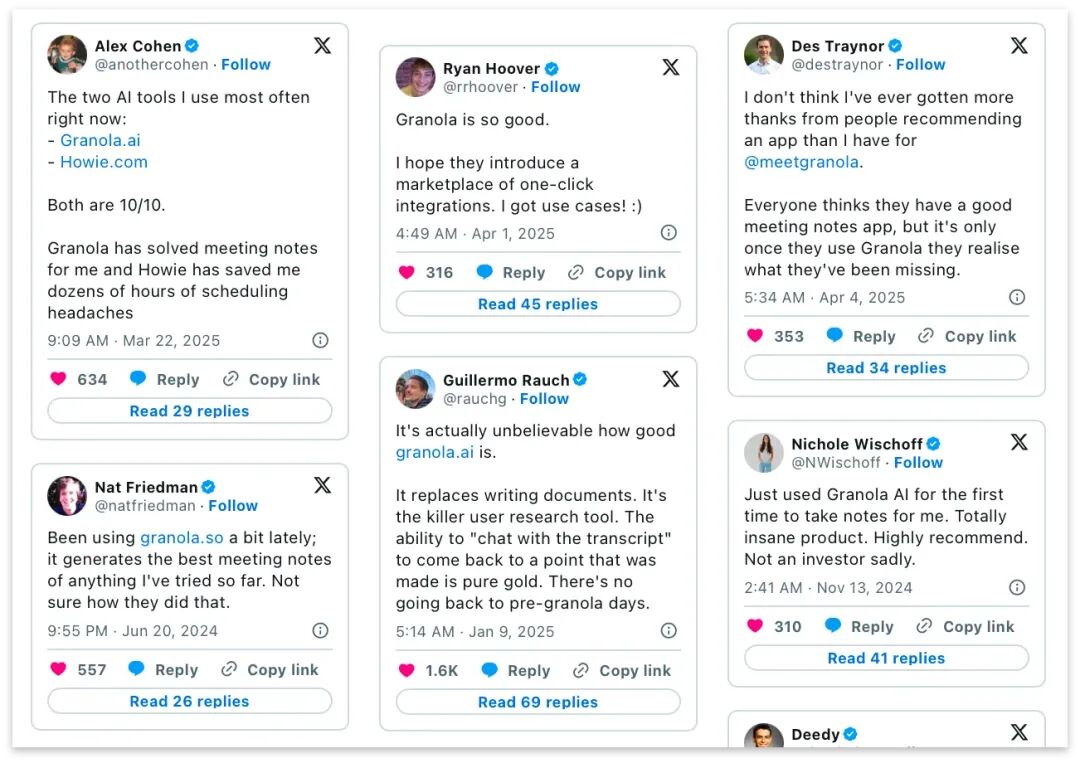
The end result: Granola has become especially beloved by Silicon Valley's enterprise users.
Employees at Google, Meta, and other tech giants aren't just using Granola — they're investing their own money in it, too. This tracks with Granola's remarkably high retention: 50% of users are still active after ten weeks, averaging six meetings per week on the platform.
2) Amplifying Reach Across Every Channel
Partnerships that multiply the signal
Granola has always pursued one north star: reach the widest possible user base.
The founding team has deliberately steered clear of "arrogance," maintaining an open posture. They aim to treat everyone as a "teammate" — even when some of those people are building competing products.
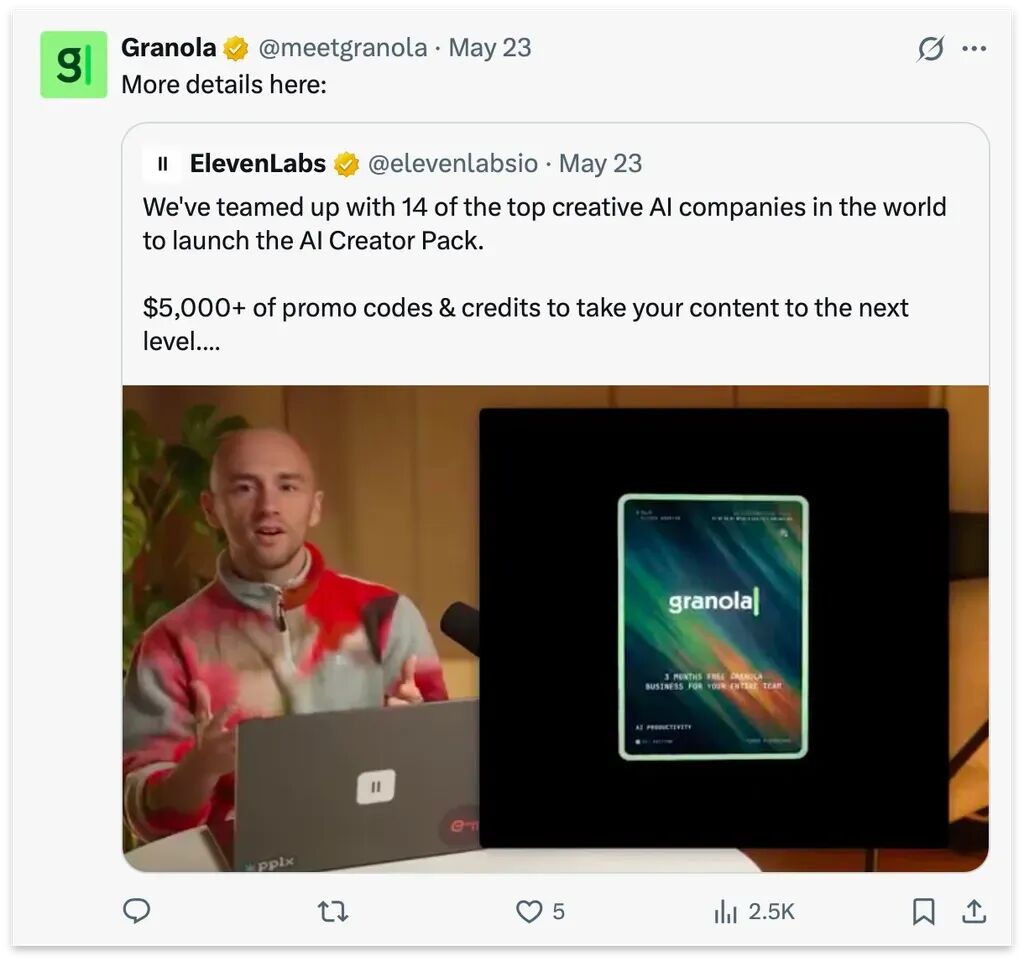
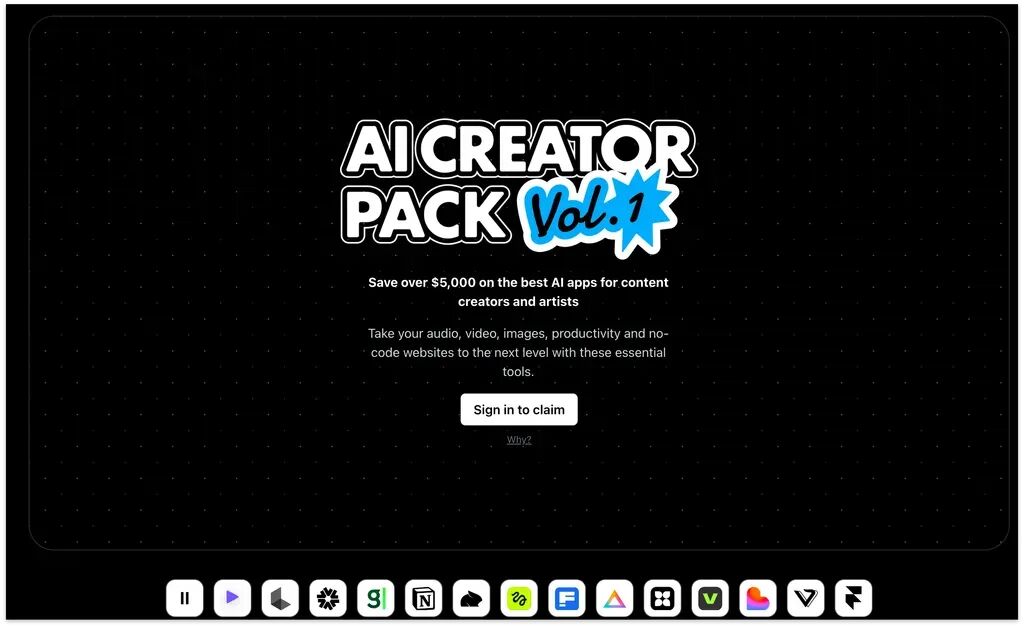
On May 23, for instance, ElevenLabs announced an AI creator toolkit integrating fourteen AI startup products, including Granola. The bundle also featured Notion, an established name in AI note-taking that had long since made its mark.
This partnership didn't just expose Granola to ElevenLabs' global user base — the bundled promotion brought in substantial new users.
The founder's voice
Like many AI startup founders today, Chris has leaned hard into "founder-led social."
Through relentless podcast appearances, a distinctly human-feeling X presence, and AI industry talks, he's constantly broadcasting the company's philosophy — cultivating an atmosphere of light, approachable product discourse:
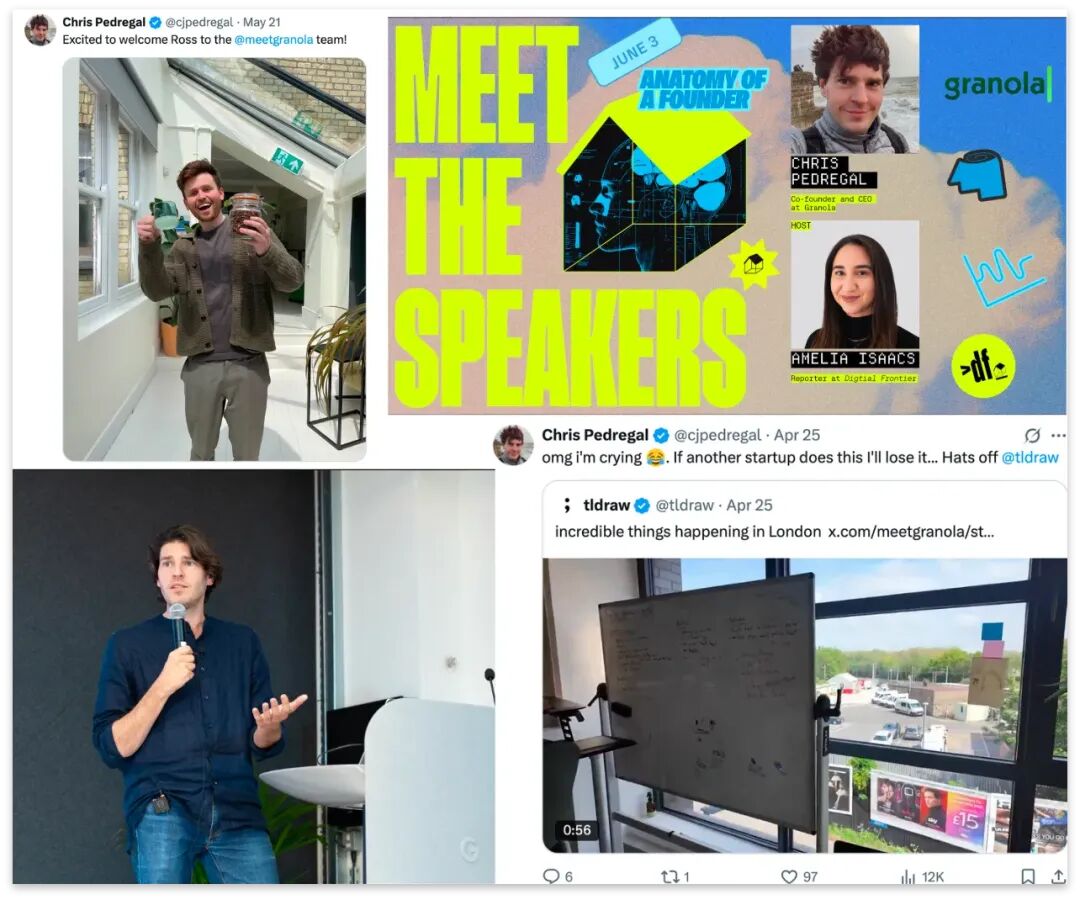
Chris's product philosophy carries serious weight across internet platforms. His content surfaces regularly in my feeds across various channels.
On Granola's official blog, the product team doesn't just share technical updates — they devote even more attention to "product philosophy" and spreading the ideas behind their AI product discussions.
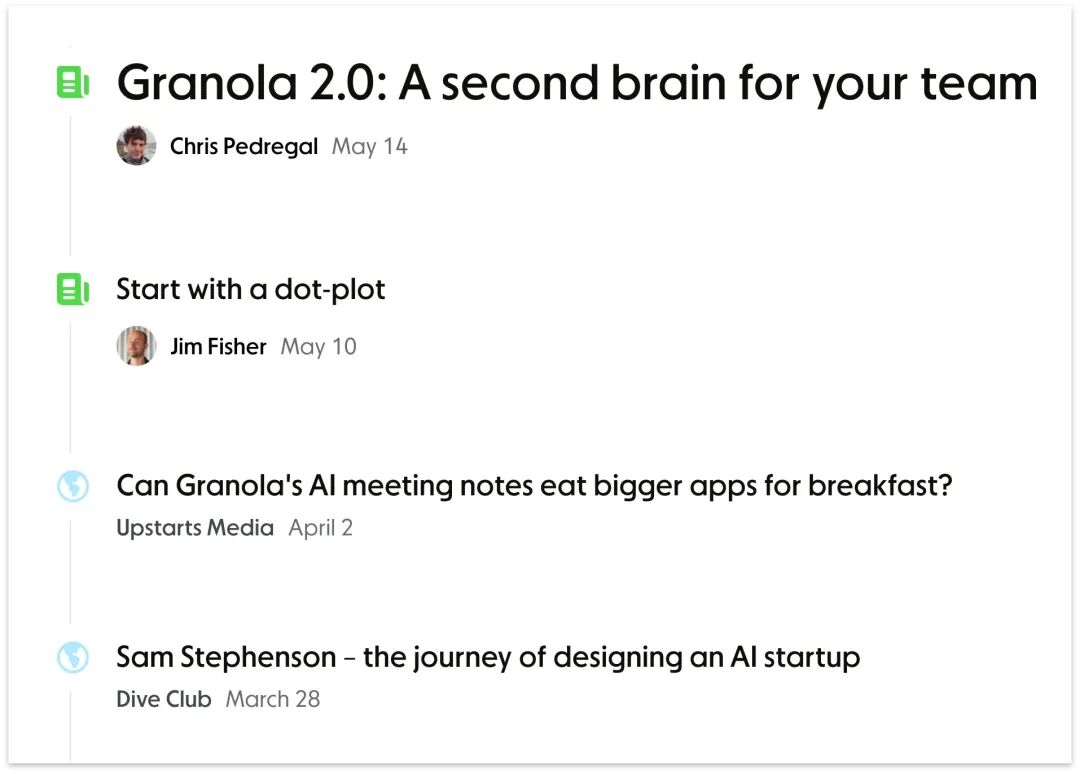
Granola's founding engineer Jim even wrote an extraordinarily detailed blog post dissecting "how Granola's recording indicator CSS height animation drove high CPU and GPU usage in a note-taking app."
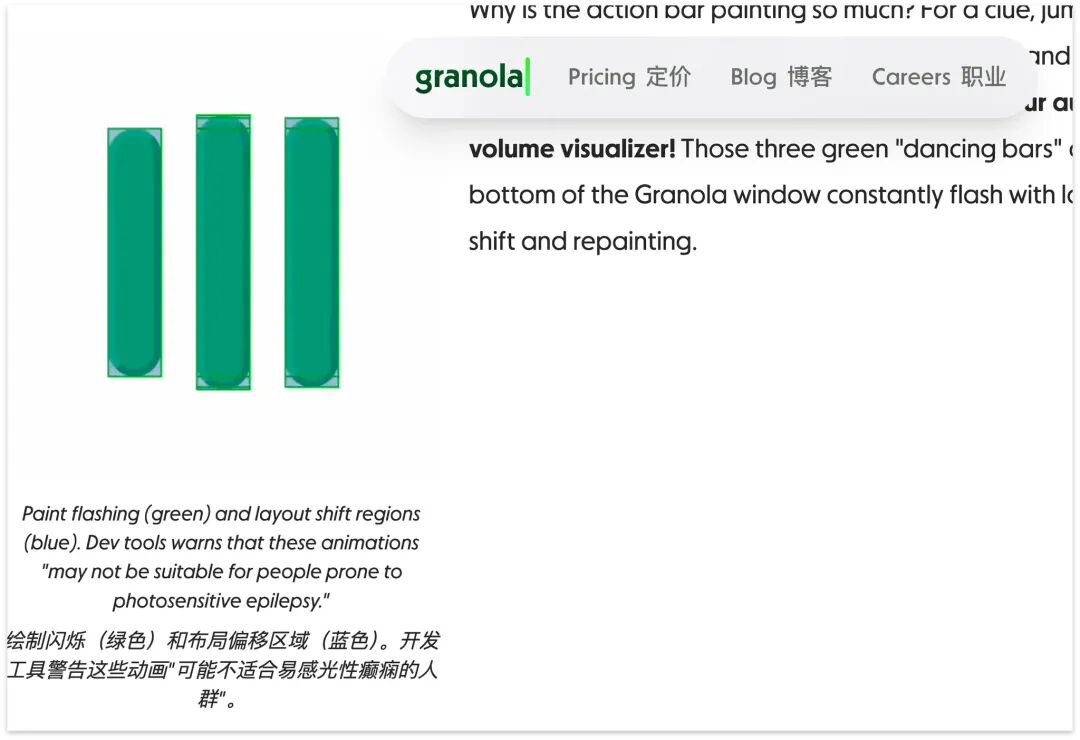
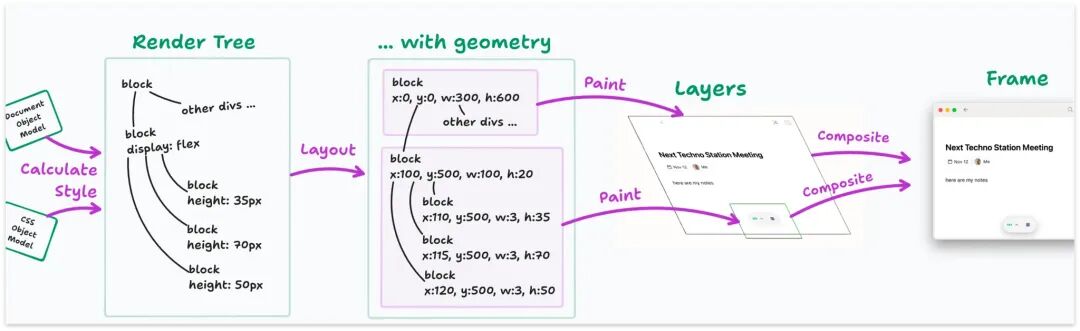
This post didn't just demonstrate the founding engineer's patience with granular problems — it revealed the startup team's "low posture."
Sometimes community matters more than product, and is more worth building. That's especially true for Granola.
The Granola Founders' Product Philosophy
1) AI Should Augment Humans, Not Replace Them
"We believe AI's role should be to 'augment humans,' not replace them. You can use AI to replace a person, or you can use AI to enhance a person — Granola chooses the latter." — Chris
In a high-frequency context like video conferencing, "nearly half of work hours consumed by meetings and communication, with remaining time spent reviewing and organizing them" reliably appears on users' pain-point lists.
So why not hand that drudgery off to AI?
That's how Granola came to be.
During development, Granola identified a trap: using AI to fully replace humans. Because in any realistic technical sense, that's nearly impossible.

Fully relying on AI to auto-generate notes just throws users from one pile of "garbage content" to another.
Traditional AI meeting tools tend to over-depend on pure auto-generation — leaving you staring at a lengthy Word document, still spending an afternoon restructuring it.
Granola's breakthrough: it lets users focus on the discussion itself, without the distraction of detailed note-taking, while preserving individual agency.
What Granola aims to do is respect each person's knowledge boundaries, support them with AI, and deliver meeting notes that map to their personal thinking style — dramatically boosting efficiency.
2) Toggling Between "Exploration Mode" and "Execution Mode"
Competition among AI tool products never lets up.
Despite Granola's excellent interaction design and user accumulation, rapid moves by top-tier players like Notion surfaced a harsh, difficult reality: if innovation is limited to the application interaction layer, building a durable competitive moat becomes extremely fragile.
Though Chris's small team is often cited as a byword for high-velocity iteration.
He's repeatedly shared his innovation philosophy across channels:
We need to be clear whether each phase is "exploration mode" or "execution mode":
- Execution mode: Once a feature is defined, ship a viable product to users quickly, iterate fast.
- Exploration mode: When the solution is uncertain, find the right direction first — avoid blindly shipping ineffective features.
At the right rhythm, we need to toggle between modes rapidly. Sometimes stopping to think about doing the right thing matters more.
This proved highly effective. For example, because the embedded OpenAI model's context window was limited to 4,000 tokens, Granola's first version only supported meetings under 30 minutes.
But Chris didn't immediately flip into "execution mode" to expand the time limit. Instead, he "bet" that ChatGPT and similar products would iterate faster and faster. Rather, the team identified note quality as the more urgent priority. Within months, AI model context windows had expanded exponentially.
Even a "Young Product" Has Its Worries
Granola signals a key shift in the AI note-taking market — from "basic transcription" toward "user-guided note refinement."
That said, this is an undeniably young product. Its user base and thin technical moat are hard to feel optimistic about — Notion, after all, has been building in notes for nearly a decade.
Ultimately, Granola stands out through sharp user insight and highly restrained taste, not pure technical advantage.
According to SimilarWeb data, Granola's site traffic still lags far behind competitors (the black line in the chart below).
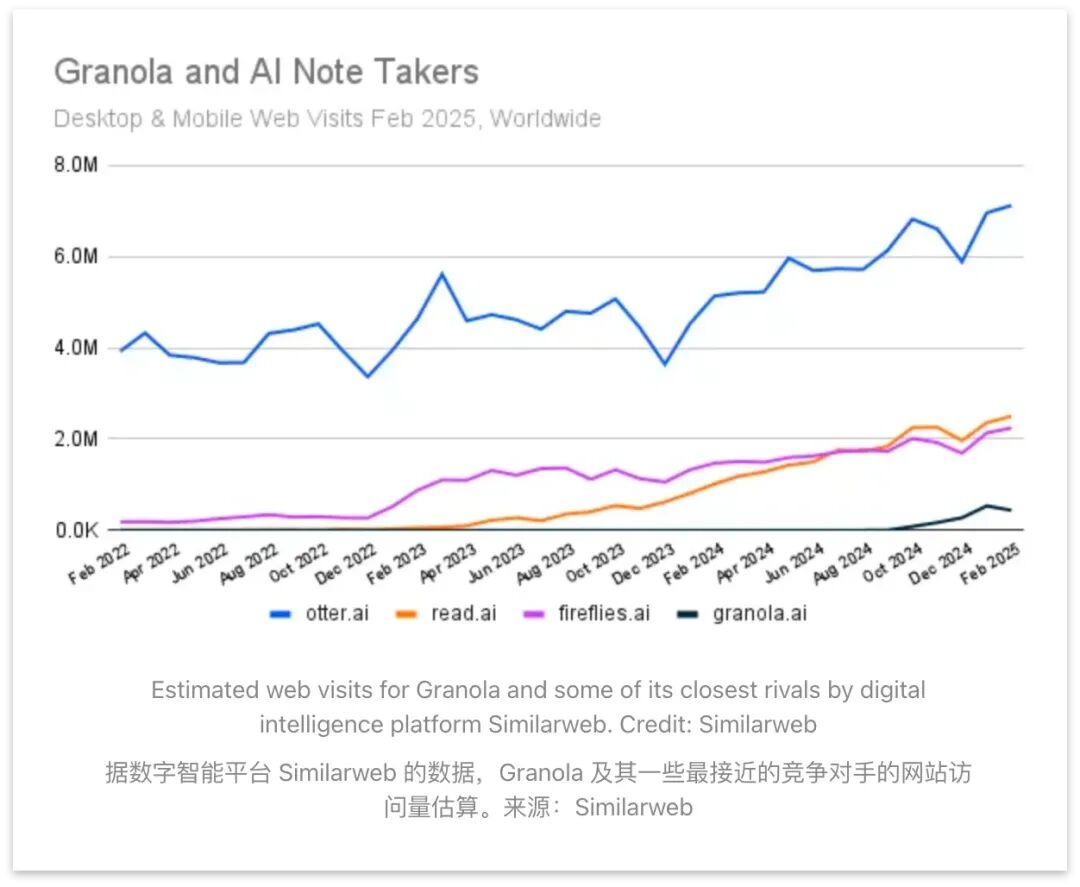
Among Granola's "major competitors," Read AI [3] raised $50 million on its own in October and commands a larger user base (claiming 100,000 new accounts weekly), while Fireflies [4] and Otter.ai [5] have each raised millions and continue rolling out new features.
Meanwhile, much of Granola's functionality is essentially wrapper-derived from large models.
For instance, Granola generates transcripts by calling APIs from ChatGPT, Claude, and others. Consequently, its product evolution depends on improvements to these underlying models.
The cost: for tools like Notion with built-in AI note-taking capabilities, copying this approach is almost trivially easy.
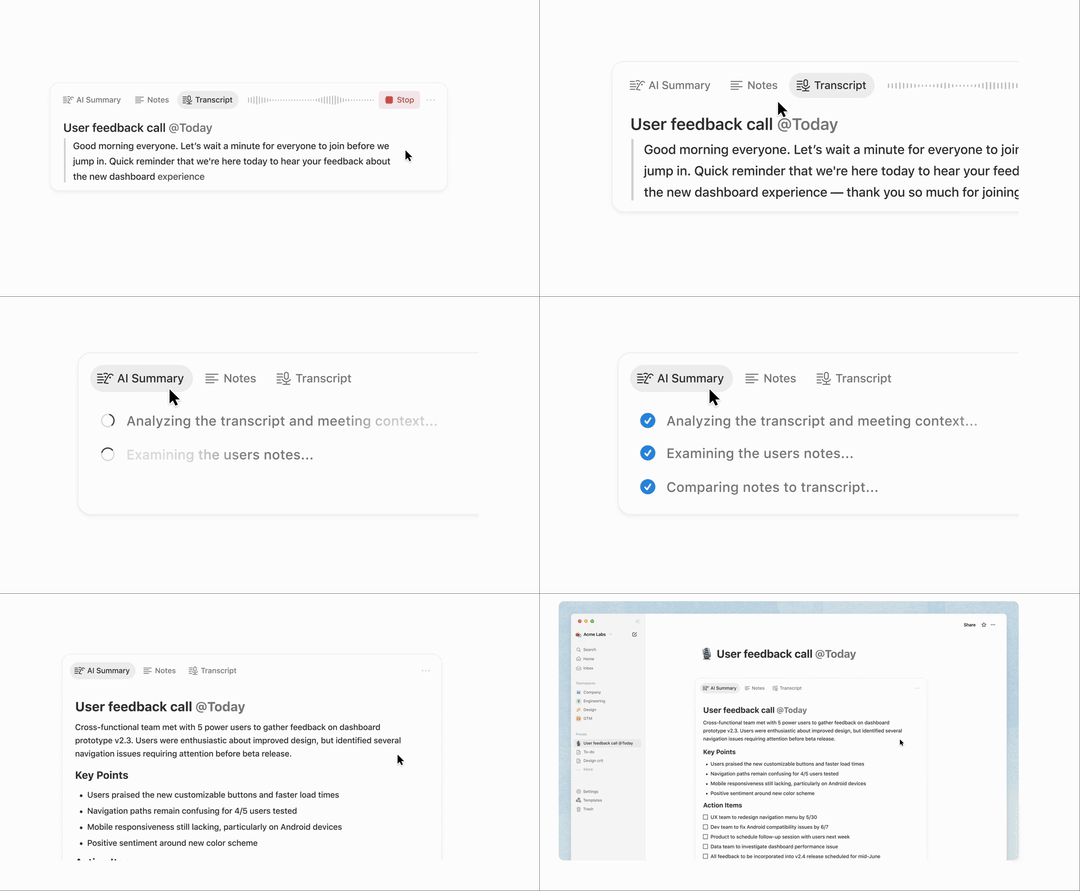
Earlier last month, Notion rapidly launched an AI meeting notes feature similar to Granola's, with broadly comparable interaction innovations. And unlike Granola, it also supports post-meeting audio transcription.
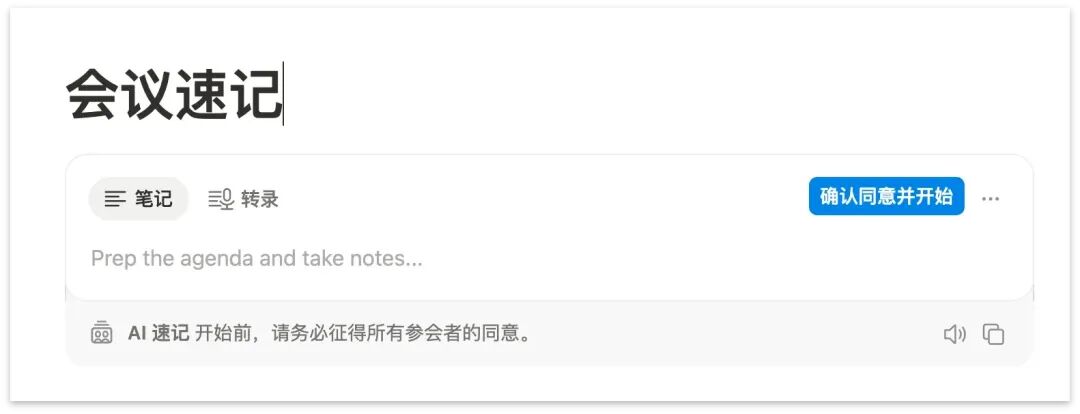
With a simple command in Notion, you can instantly generate AI-powered meeting notes. The interface is similarly clean, and it achieves seamless integration too.
That said, Granola's user retention is genuinely strong. Users have accumulated substantial meeting content within the platform, and this switching cost has become one of its primary moats.
How long this first-mover advantage can last, however, remains to be seen.
Perhaps, as one of Granola's investors put it:
Despite the massive capital poured in by large corporations, many breakthroughs ultimately still come from startups. So sometimes startups function like the "R&D departments" of big companies — once something new is validated, the giants integrate it into their own systems. The truly epoch-defining companies are those that spot trends early and leverage them into outsized returns.
As underlying large language models iterate faster and API costs continue to drop, relying solely on a not-especially-deep technological moat may make it increasingly difficult for Granola to break out of the AI meeting notes niche.
🚥
When technology fuses deeply with human creativity, we don't merely escape repetitive, low-value work — we reclaim control over our time and focus on what truly matters.
What exactly did Granola get right?
The answer may not be that complicated — Granola, with elegant taste, delicately arrived at the optimal solution for "human-AI collaboration."
Let's return to that most important question: What is Granola's founder actually worried about?
He said: "It's not that the tech giants will quickly copy our product features. It's whether we can always maintain that pursuit of elegance and simplicity, restraint and efficiency in our product taste."

References
[1]Granola: https://www.granola.ai/
[2]One-on-one: https://www.youtube.com/watch?v=EySp_B4ZhW4&t=220s
[3]Read AI : https://www.read.ai/
[4]Fireflies: https://fireflies.ai/
[5]Otter.ai: http://otter.ai/