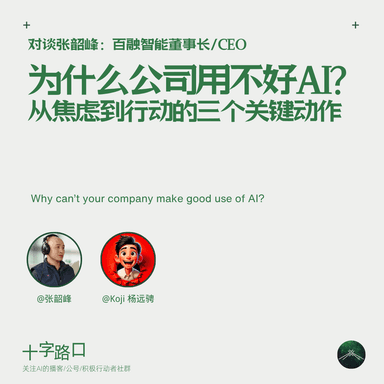

🚥 "Crossroads" runs an ongoing series called "AI in China," tracking how AI is actually landing across Chinese industries. We're observing together how AI is genuinely reshaping our work and lives. This is the sixth installment.
➤ A question we hear constantly: "How does AI actually get deployed? Is there a Chinese company we can learn from?"
This week on "Crossroads," we spoke with Shaofeng Zhang (Chairman/CEO of Bairong). Bairong is now a 1,600-person Hong Kong-listed company that has successfully put enterprise-grade Agents into production across financial risk underwriting, contact centers, recruitment interviews, expense reimbursement, and contract review.
Zhang offered a distinctly "traditional-enterprise-friendly" playbook: first get the concepts straight, then pick the right person to own it, finally punch through with scenarios that can close the loop and be measured — don't challenge human nature head-on, don't reengineer processes first. Find the "AI natives" inside your company. Let AI start delivering results within existing workflows.
We also tackled a question on many minds: why do most companies fail to get value from AI? And precisely this gap, in Zhang's view, represents a once-in-a-decade opportunity for China's ToB entrepreneurs.
🎬 Our video podcast is now live on @Koji Yang Yuancheng's channels on WeChat Video, Xiaohongshu, Bilibili, and YouTube.
📒 The transcript will be published on the @CrossroadsCrossing WeChat official account.
🟢 00:00 Rapid Fire
Age, alma mater, MBTI and zodiac sign, one-sentence intro to Bairong, revenue and profit, team size, what's on his radar lately
🟢 01:13 OpenClaw = Lights-Out Office
Manufacturing has had "lights-out factories" for years. White-collar office workers have never achieved this — until OpenClaw.
He defines OpenClaw as Chinese enterprises' "second AI shock moment," second only to DeepSeek — DeepSeek made people understand what AI is; OpenClaw made them start fearing for their own fate.
A question from a Tsinghua classmate who sells cranes: "The AI era is here, and I don't even know who in my company should own this" — this anxiety is widespread, and no one is systematically addressing it.
Both excited and anxious: excited because "either make money or save money," anxious because "I don't know how to actually do this."
🟢 03:30 How the 200,000 AI Employees Are Calculated
Bairong has a North Star metric internally called the "silicon-to-carbon ratio" — if AI can do it, don't use humans.
Bairong currently has roughly 200,000 AI employees corresponding to roughly 1,000+ human employees — but how this number is defined involves a fascinating calculation logic.
By this social-value conversion, Bairong's output equals that of a 400,000–500,000-person company, yet it charges only a fraction of what such a company would cost — how does he resolve this paradox?
He anticipated that some would "inflate" AI employee numbers to please bosses; the company specifically introduced third-party standards to prevent this.
🟢 07:41 Live! Dialing a Real AI Customer Service Call
A Chengdu-accented wealth manager, an AI that passes context forward — several details in this call deserve repeated listening.
An AI employee with regional accent dramatically outperforms standard Mandarin — "accented Mandarin has human texture."
The keyboard clicking sound before each utterance: a deliberately designed detail. What's the intent?
Human agents might promise guarantees to hit performance targets, but this AI never crosses the line no matter how it's baited — this isn't merely a technical issue.
🟢 10:50 Why AI Agents Can't "Do Everything Alone"
Neither a technical limitation nor a cost problem.
A do-everything super-Agent exposed to the outside is the biggest vulnerability for hackers — his logic for breaking it into multiple roles comes from attack-defense game theory.
The other half is harder to solve: changing AI workflows means changing internal power structures. When employees make excuses that AI "doesn't work well," is it genuinely not working, or something else?
His recommendation: first, don't change processes. Multiply everyone's capability by 10, leave power structures untouched, then advance from there.
🟢 13:00 AI Employees Also Have HR, Performance Reviews, and Parents
Bairong has an "AI Employee Home" internally: each AI employee has a name, tenure, hire date, email — the email format is identical to human employees'.
It has two "parents": one imparts business skills, one handles its "manufacturing" — why this separation?
When employees transfer their capabilities to AI employees, without incentive mechanisms, what makes them cooperate? — He's stepped into this pitfall before.
🟢 15:20 The Root Cause of China's Long-Term SaaS Failure
From day one of building Bairong, he decided against the traditional software path.
China's entire software industry product revenue is just 4% of the United States', yet China's economy is two-thirds the size of America's — this gap isn't accidental, it's structural.
Chinese enterprises will pay for "resources" (traffic, hardware) but not for "process tools" — is this a cultural problem or a business model problem?
From day one, they used the "delivery driver model" — get paid only when a job is completed, zero upfront cost.
🟢 19:30 The Two Domains Where Agents Found PMF
The first is unquestionable; the second is globally recognized — yet Chinese enterprises may not realize how significant this is.
First: programmers — all work is closable, measurable, available for reinforcement learning, and programmers themselves want to use it.
Second: Contact Center (CC) — handling complaints, inquiries, marketing, membership management. Why does he believe this is globally recognized as having found PMF?
The criteria are clear: "no need to meet face-to-face," "value is easy to measure," "was previously outsourced to BPO" — anything satisfying these three points will show dramatic AI Agent ROI.
🟢 22:15 AI Roll-Up: Acquiring BPO Is Acquiring the Future
All executive search firms, consultancies, accounting firms, law firms — essentially广义 BPO in the broad sense.
He believes AI's addressable market is 10–50x that of traditional software — HSG's number is 80x.
Bairong has already shrunk a 50-person small-customer operations department to 5 people + 18 categories of AI employees, but those 45 people weren't laid off. They transformed from cost center to profit center, beginning to export services externally — this story contains his real thinking on Roll-Up.
Their "Baijian" platform is a new species: neither classic Roll-Up nor SaaS, but "Tmall for professional services" — what's the logic of this model?
🟢 26:00 Consulting Firm 4.5 Million vs. Agent 50 Minutes
A manufacturing company spent 4.5 million and several months for a failed plan — then they fed the same problem into Bairong's Agent.
That professional separately came back the next day: "I didn't know your capabilities had reached this level, how about we partner" — this was the direct catalyst for Baijian's birth.
The Agent recommended setting up a factory in a certain Southeast Asian country; the client ultimately succeeded.
In the first half of last year, he'd approached the same person to partner on an AI-native law firm; the other declined citing "too intense" — what changed his mind took only 50 minutes.
🟢 30:00 Three Critical Moves From Anxiety to Action
This isn't mobile-internet-level transformation — it's supply-side transformation, not circulation-side. The cognitive altitude must upgrade.
Don't assume this is easy: thinking free open-source models are enough, failing the first project, possibly not restarting for two to three years.
Elicit the good in employees: incentive mechanisms must reach the micro level. Macro trends are useless; human nature is the variable that determines whether things land.
Start with high-frequency, boundary-clear simple tasks. Build confidence first, then expand investment — what counts as "boundary clear"? He gave criteria.
🟢 32:00 This Time, ToB Wins on the Supply Side
Historically, every highest-grade technology revolution began on the B side — Taobao and ByteDance, in his view, are fundamentally not productivity innovations.
Steam engine, electricity, the first computer — all supply-side revolutions first, then diffusion to C side; this AI is the same, "lights-out office" will arrive before "lights-out factory."
He made a rare judgment: in China-US history, truly ToB tech companies may for the first time "converge" in business model, product, and capital logic.
Previously Chinese ToB software revenue trailed ToC by over 10x — this time, he believes that gap could be overturned.
Subscribe to "Crossroads": 🚦 We track the industry transformations and entrepreneurial opportunities brought by the new wave of AI technology.
🚦 "Crossroads" is Steve Jobs's metaphor for Apple — standing at the intersection of technology and liberal arts, where great products are born. AI is transforming every industry. We seek out, interview, and bring together a new generation of AI entrepreneurs and active actors in the AI era. Together with them, we explore and embrace the new changes, the new possibilities.
👦🏻 Host Koji: I founded Crossroads, launched AI Hacker House (a community space for a new generation of AI entrepreneurs), and serve as Venture Partner at ZhenFund. I believe technology, especially AI, represents the greatest value-creation opportunity of our generation. Koji on Jike, Koji's website
👧🏻 Host Ronghui: I co-founded Crossroads, worked at a dollar-denominated VC, and spent five years as a Silicon Valley correspondent, tracking technology development and business stories. Feel free to reach out and chat. Ronghui on Jike