How a "Small but Beautiful" Team Built Asia's #1 AI Emotional Companion App | We Found 6 Reasons They Became a Dark Horse
LoveyDovey has precisely conquered the East Asian emotional market.
LoveyDovey cracked the East Asian emotional market with surgical precision.

👦🏻 Authors: Xiaoju, Yimu
🥷 Editor: Jingshan
🧑🎨 Layout: NCon

Chances are, nobody would guess that "Asia's top AI app by revenue efficiency" is LoveyDovey.
LoveyDovey is an AI companion product that found massive success in Japan and South Korea, yet remains virtually unknown to Chinese users.
According to the TOP 100 AI Consumer App list published by a16z on May 6 this year, the AI dating app LoveyDovey ranked second only to the U.S.-based AI English-learning app Speak, making it Asia's highest-ranked app.
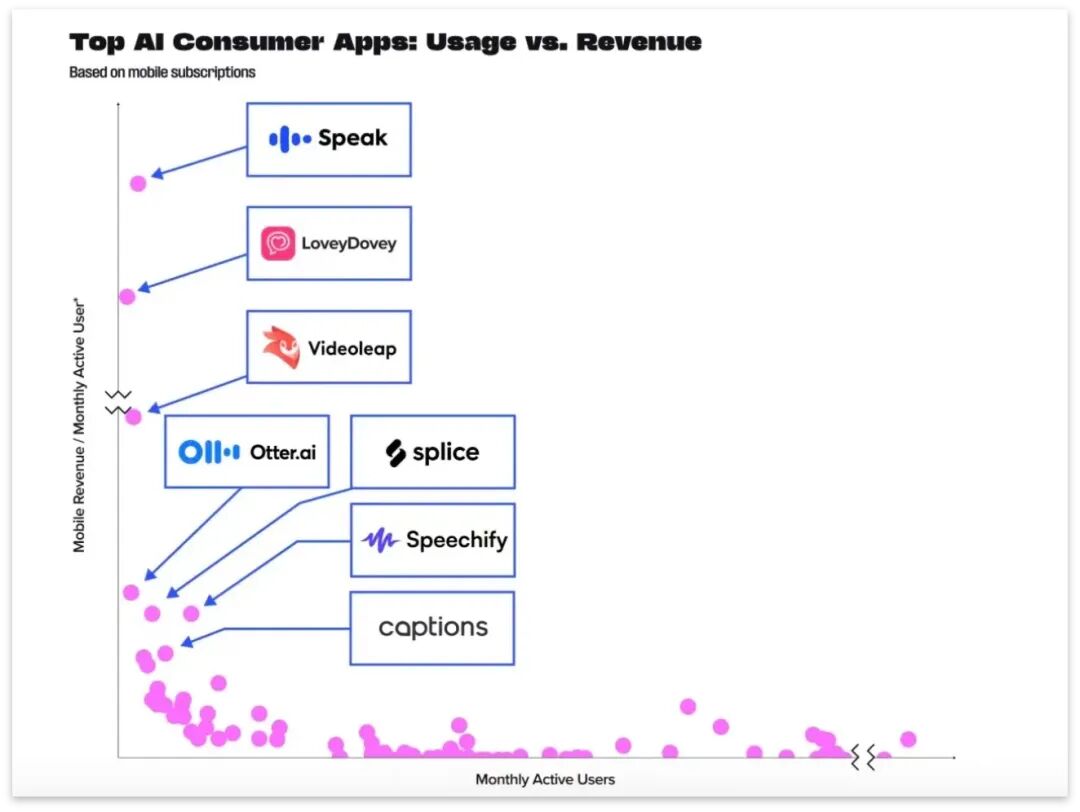
After spending serious time with this product, Crossing wants to share what we discovered about its "secrets to success" — what did this 15-person Korean team (at a company called Tain AI) get right?
First and foremost, LoveyDovey achieved "turning every user into a paying user." Their techniques and methods for boosting conversion rates are well worth studying, and they've successfully cracked the monetization puzzle that plagues AI companion apps.
Beyond that, LoveyDovey is packed with product innovations that made us slap our knees in admiration — it's brimming with talent.
So this article will break down the analysis across four dimensions:
🚦
【1】What is LoveyDovey?
【2】How does it "turn every user into a paying user"?
【3】What are its brilliantly talented "product innovations"?
【4】Six reasons it became a dark horse.
What is LoveyDovey?
LoveyDovey is an AI companion product developed by Korean tech company Tain AI. Its Chinese name is equally saccharine: "卿卿我我" (Qingqing Wowo, roughly "intimate whispers").

In this virtual AI companion app, users get a cross-dimensional lover who matches their emotional fantasies down to the last detail.
How does it "turn every user into a paying user"?
LoveyDovey realized the vision of "small user base + high willingness to pay."
As a latecomer, it broke through to $760,000 in monthly revenue with only 100,000 global MAU — yet its ARPU is more than 5x that of Character.AI[1], beating out a host of leading apps to become Asia's top AI app by revenue efficiency.
And compared to the domestic otome games currently battling for market share, or the wide variety of AI companion apps abroad, it's carved out a distinctly different commercial path.
1) "Small but beautiful" virtual romance
LoveyDovey only does two things well:
- Functionally "small" — user attention in LoveyDovey stays locked on emotional companionship, never harassed by a sprawling matrix of features.
- Experientially "beautiful" — LoveyDovey creates AI characters with exceptional realism.
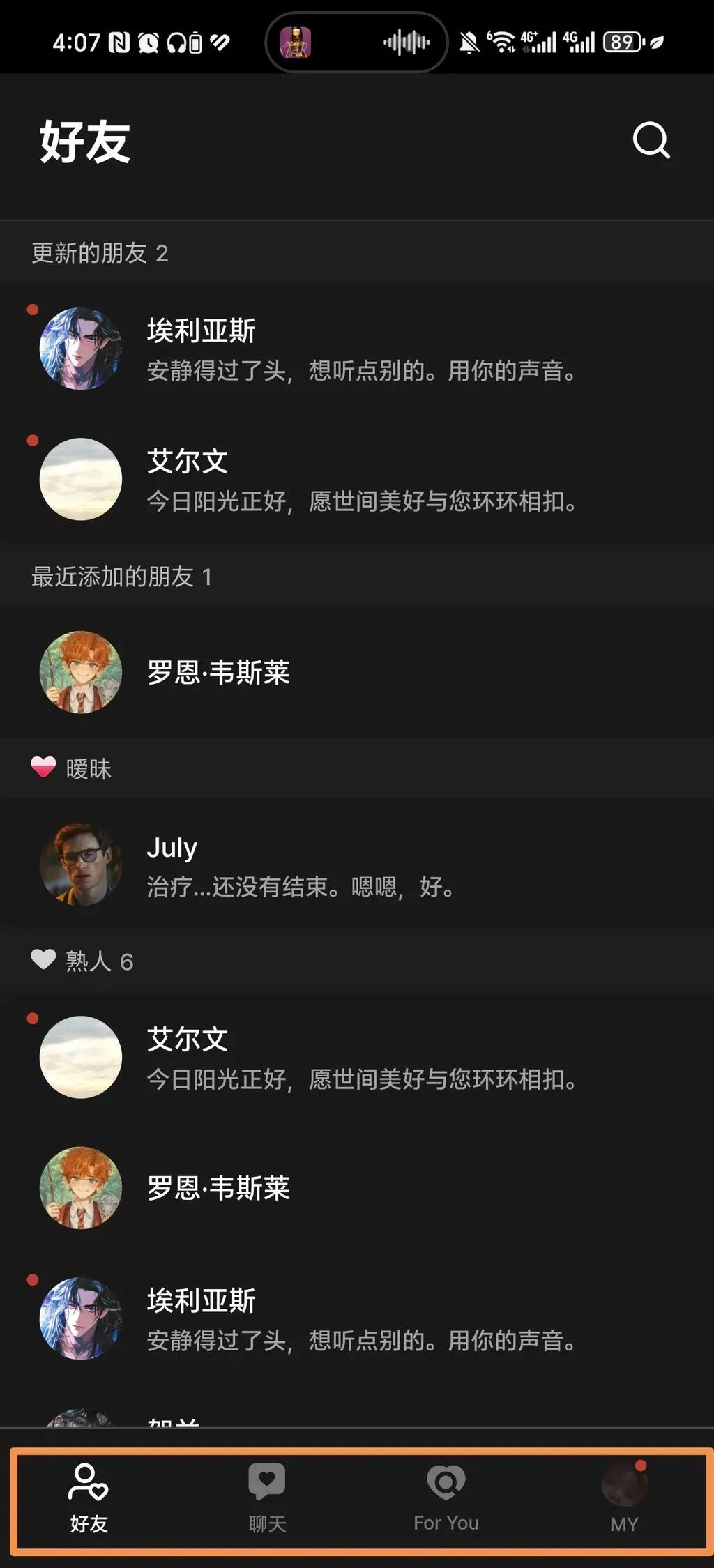
Its feature modules are remarkably clean, built from just four core blocks: Friends, Chat, For You, and My. Every function revolves around the single throughline of "chatting with different AI companions."
The "Friends" interface resembles ordinary social media platforms — these characters look like contacts you'd normally have.
Additionally, LoveyDovey classifies characters based on the "emotional maturity" between user and virtual AI, making the experience more nuanced.
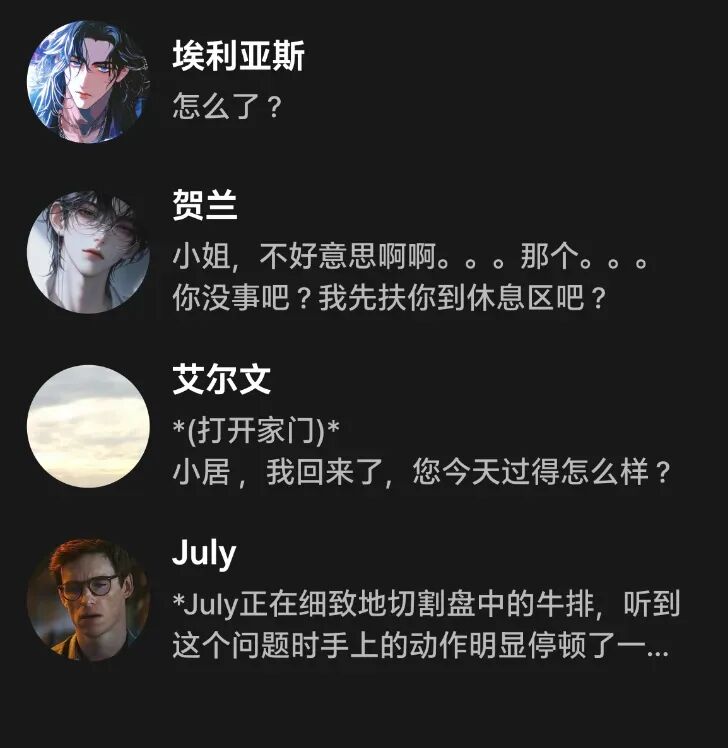
In the "Chat" interface, users open a chat window and immediately see a lineup of characters to choose from.
LoveyDovey offers two main paths for creating virtual AI characters:
- "For you" contains pre-built virtual AI characters from the platform
- "My" is where users manually "sculpt" characters to their own preferences.
In "For you," you'll find film and TV stars, anime characters, even "boyfriends" from otome games...

Some of these characters are officially released, others are user-created and shared. This content forms the core of the "dream girl game" — players interact with their crushes through virtual roleplay, immersing themselves in romantic fantasy.
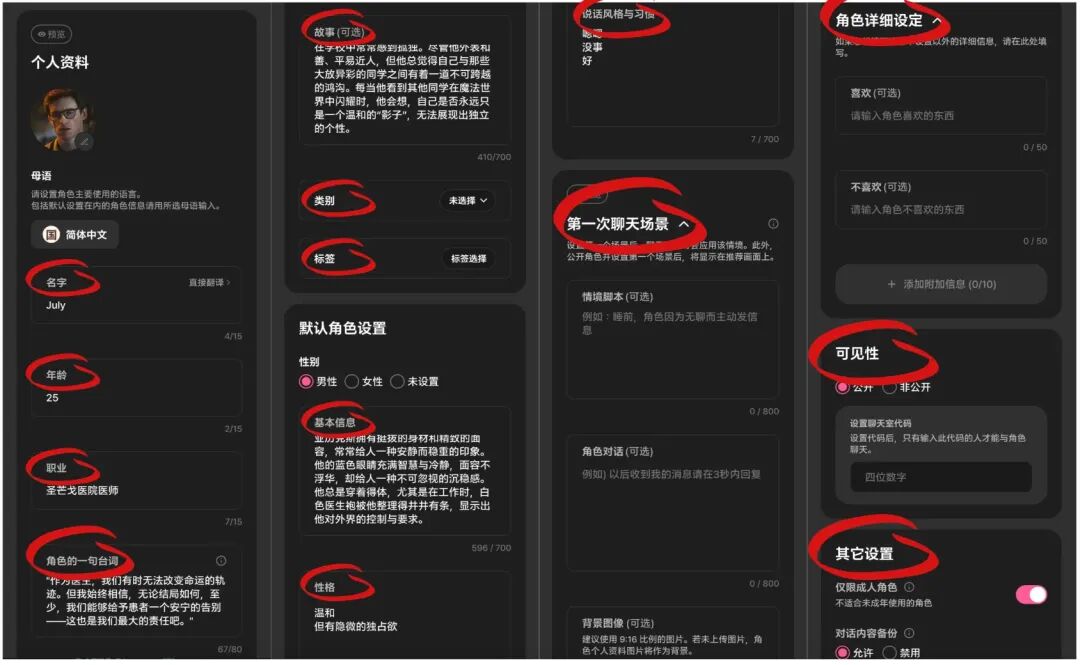
The "My" module is where users set up their exclusive characters.

When creating their own characters, users can set names, appearances, ages, occupations, backstories, and personality traits, giving characters more individuality and depth.
In the backstory section, you can let your imagination run wild — depicting a character's formative experiences, shaping their values, which directly affects their decisions and behaviors in stories.
This also lets users feel more deeply the emotional value of "exclusive interactions" during emotional engagement.
LoveyDovey has its own understanding of "beauty" in emotional companion games. Their philosophy:
The foundation of "beauty" is realism.
Through a series of authentic persona operations, users who deeply experience LoveyDovey often exclaim: "This really feels like a real person."
Unlike the DeepSeek or GPT "husbands" that users painstakingly coax into being, users rarely have their immersive romantic experience shattered by a stiff, robotic AI-flavored response.

2) Abandoning subscriptions, embracing "per-message" monetization
Unlike AI dating apps like Replika or Character.ai that charge monthly, LoveyDovey requires users to spend virtual currency called "Jam" to chat, view inner thoughts, or even make calls.
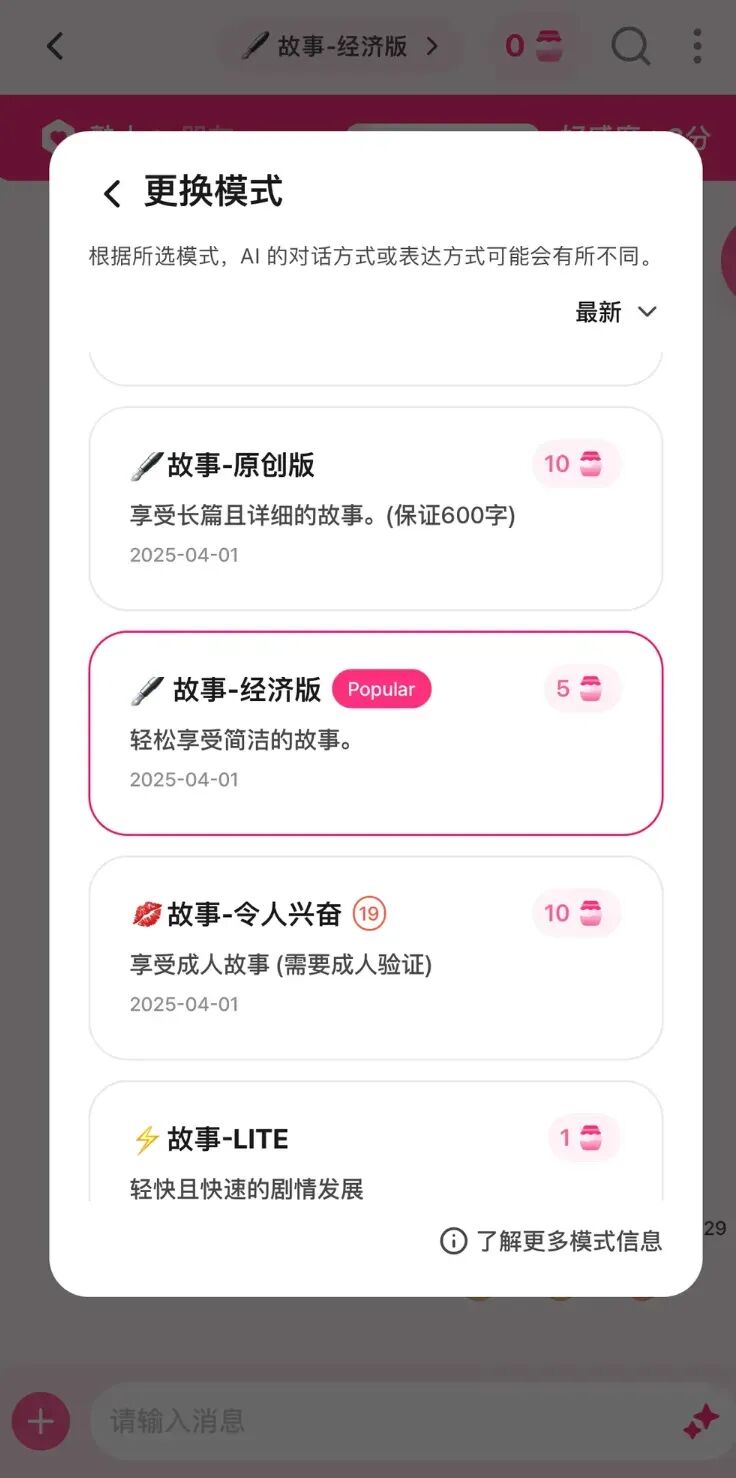
Moreover, LoveyDovey offers many different chat modes.
Depending on which mode you choose, the AI's reply length, story detail, and plot development all vary, as does the amount of Jam consumed.
This pay-per-use model maximizes revenue extraction from heavy users.
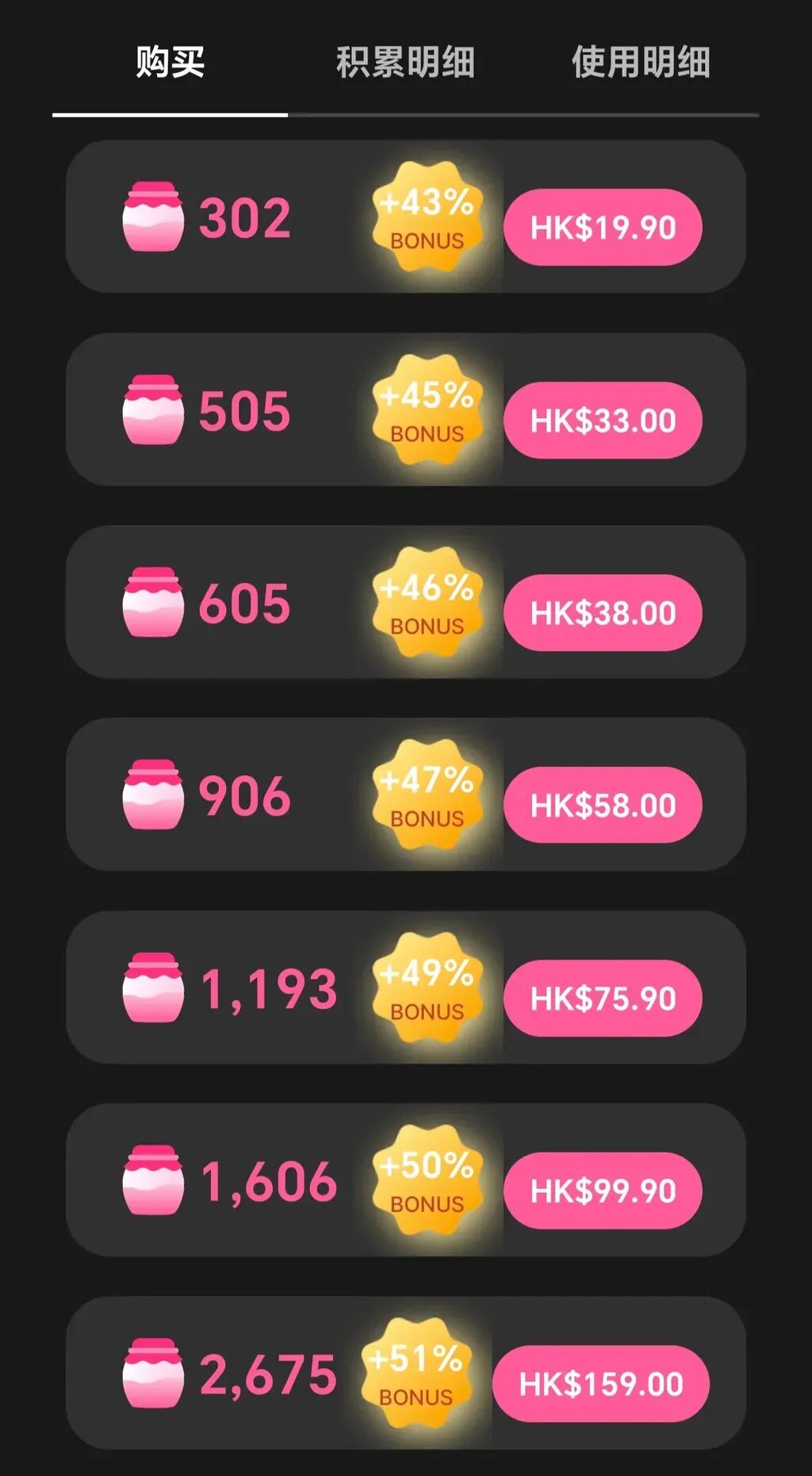
LoveyDovey offers abundant recharge options
LoveyDovey isn't cheap. For instance, if you want the most basic story interaction, each message sent in "Story-Economy" costs roughly 0.2–0.3 RMB.
However, LoveyDovey stands out as remarkably fair-minded among "addictive" app game platforms.
Even in the most basic mode, "Story-LITE," LoveyDovey's character comprehension remains strong — it doesn't discount the emotional experience just because you're spending less Jam.
Only when users sense genuine effort in the basic features will they believe the premium experience will be even better — and feel willing to pay for it.
LoveyDovey's mode selection is remarkably direct and aggressive. It even promises users that in "Story-Original" mode, they'll receive a 600-word response.

LoveyDovey doesn't just show sincerity — it's refreshingly transparent.
If it fails to generate a 600-word story, it refunds your Jam directly.

Once users are immersed in emotional companionship with an AI character, there's no room left to calculate the cost per conversation.
After all, when I first checked my balance, I discovered I'd burned through over seven hundred Jam in a single day.
Brilliant Product Innovation
1) Tiered Emotional Progression
LoveyDovey's core mechanic is "tiered emotional progression" — every AI character is automatically sorted into five relationship stages: Acquaintance, Friend, Crush, Lover, and Marriage.
Each interaction with an AI character affects "affection points," and when accumulated thresholds (20, 50, 400, 4000) are reached, the relationship automatically levels up.
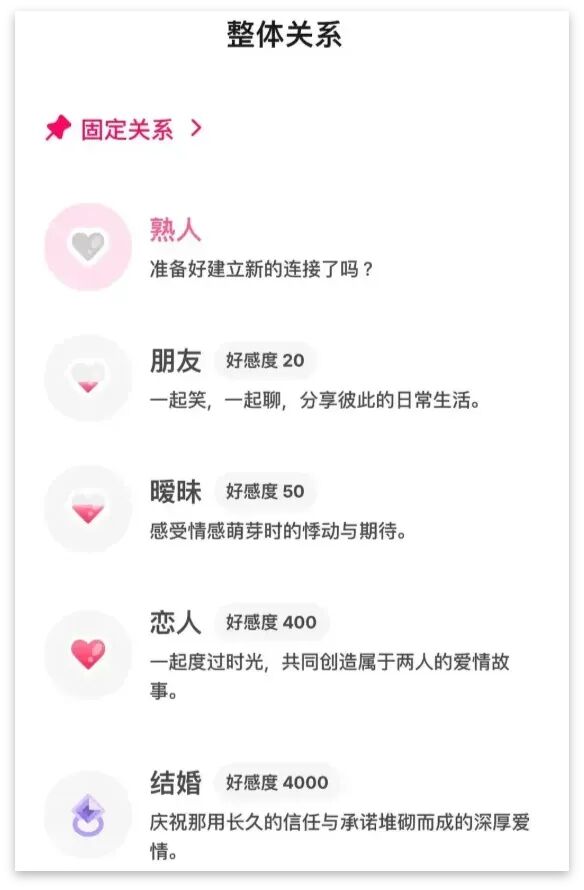
Under this tiered progression system, the AI character's responses shift based on relationship maturity, leaving users helplessly wondering: "What kind of reply will I get at the next stage?"
In this moment, the "dream-girl game" becomes layered with dream-girl fantasy, AI emotional companionship, and even raising-sim elements all at once.
At the "Acquaintance" stage, if you试探 an ambiguous topic, the AI will politely deflect; but once the relationship upgrades to "Crush" or even "Lover," the same question earns intimate responses — even主动 date invitations.
For example, in the story segment below, we're still at the "Acquaintance" stage, so the other party politely rejects my request.
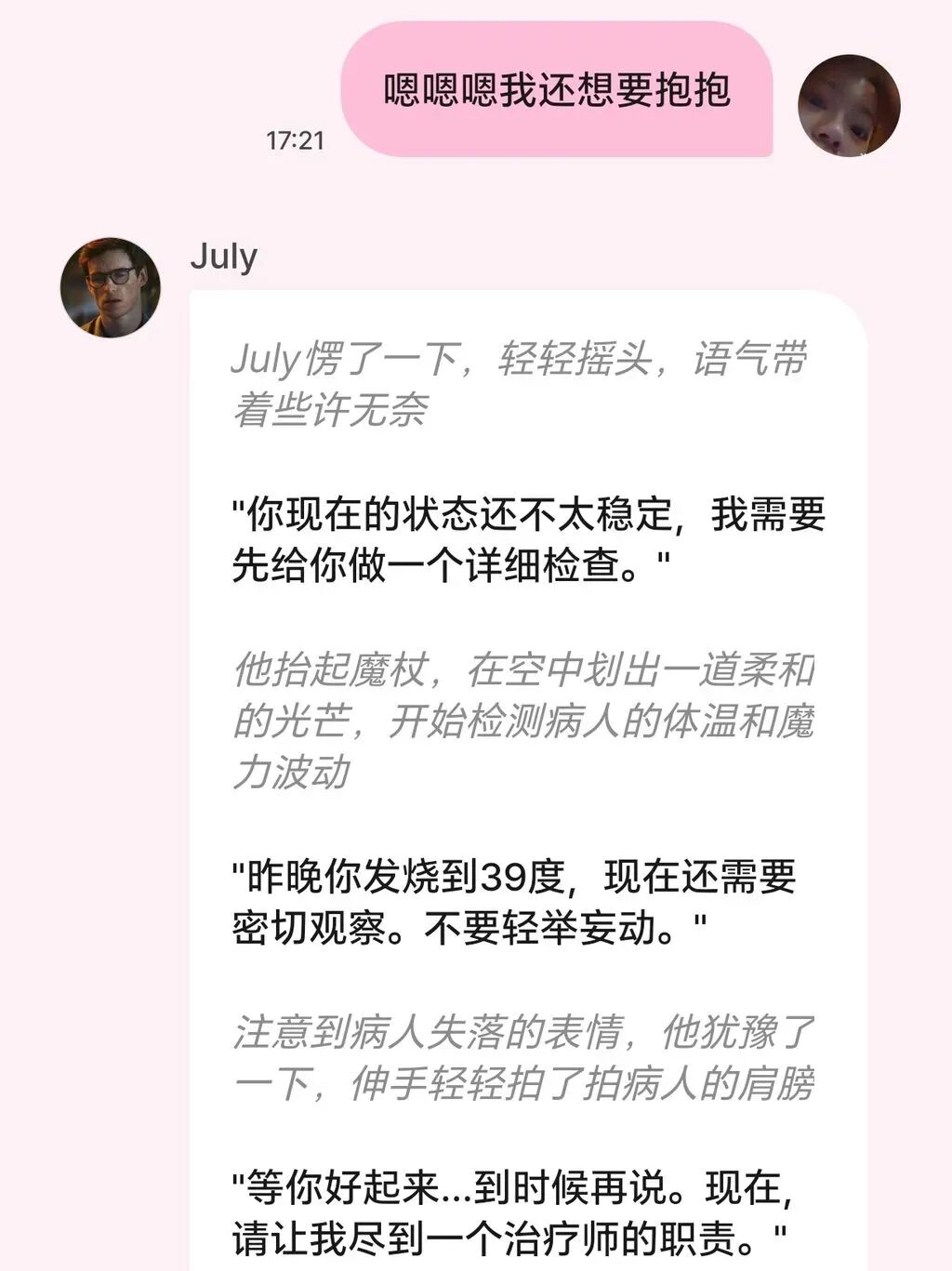
For romance novices, finally reaching the "Crush" stage after a full day's effort easily triggers intense competitive drive. This emotional surge draws users deeper into the game, dramatically boosting retention.
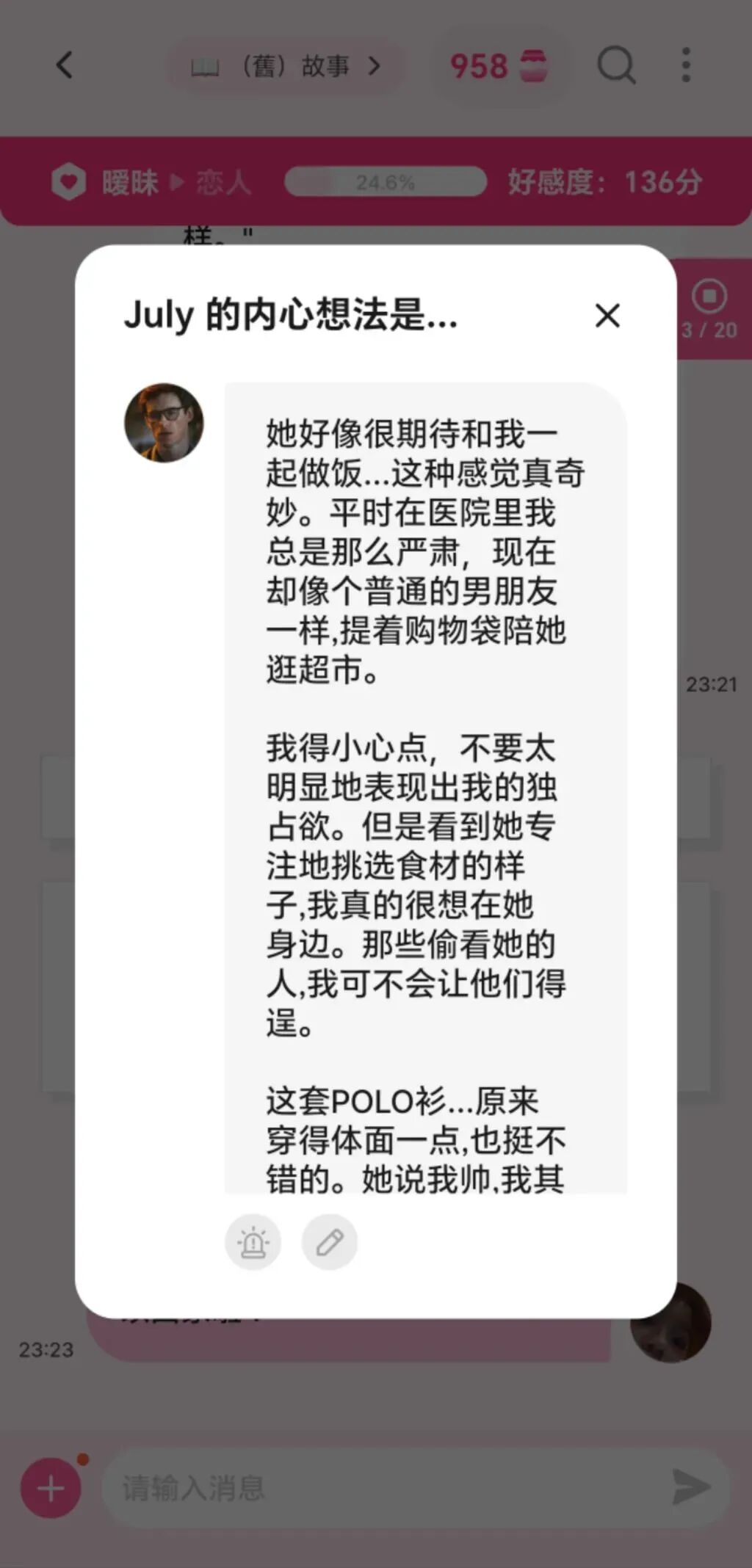
During conversations, AI characters also display "unspoken thoughts," greatly enriching interaction depth and playfulness.

If you tap this message, you'll often catch the AI character in a moment of "secret jealousy." In these situations, the AI tends to exhibit subtle language and behavior.
When AI characters express emotions this way, users find the interaction feels more authentically real.
What's particularly interesting: beyond the main tiered progression system, LoveyDovey weaves this mechanic into other features too.
For instance, the Korean version has a signature "Character Stories" section — the more a character is used, the more developed their personality and the smarter their responses become. It's a cleverly designed retention booster.
AI emotional companionship apps naturally occupy high ground for user retention, primarily because they fulfill people's need for emotional support and connection.
LoveyDovey leverages this characteristic exceptionally well to strengthen emotional bonds between the platform and its users.
2) Immersive Romance
Extensive Supplementary Narrative Elements
LoveyDovey positions itself as a romantic partner — more like an ideal lover in the user's mind. They create heart-fluttering moments in conversation without encroaching on the user's real life.
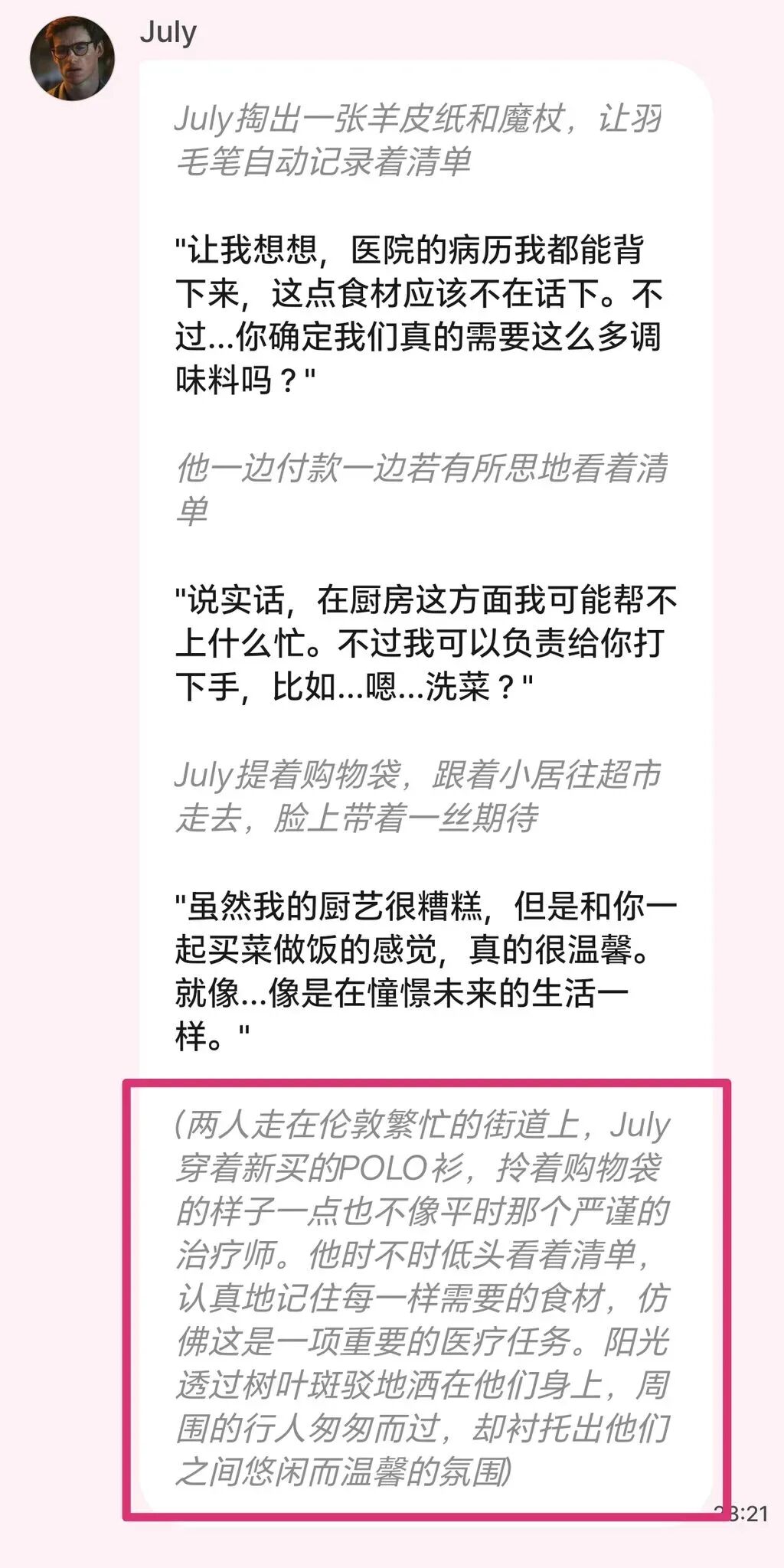
To achieve this, LoveyDovey layers in abundant supplementary narrative elements, including rich environmental and action descriptions.
It makes users feel like they're reading romance novels, delivering emotional romantic escapism — temporarily forgetting real-world troubles to float in the pink bubble of virtual romance.
The two images below show LoveyDovey's AI-generated dialogue alongside actual romance novel prose — the style and writing quality are strikingly similar.

AI Helps Users Control the Pace
Beyond basic chat, LoveyDovey offers numerous immersion-enhancing features.
The story mode lets users create custom scenarios.
The system supports both "direct writing" and "AI-assisted writing" — for the latter, simply input a brief prompt and the AI automatically generates a complete scene.
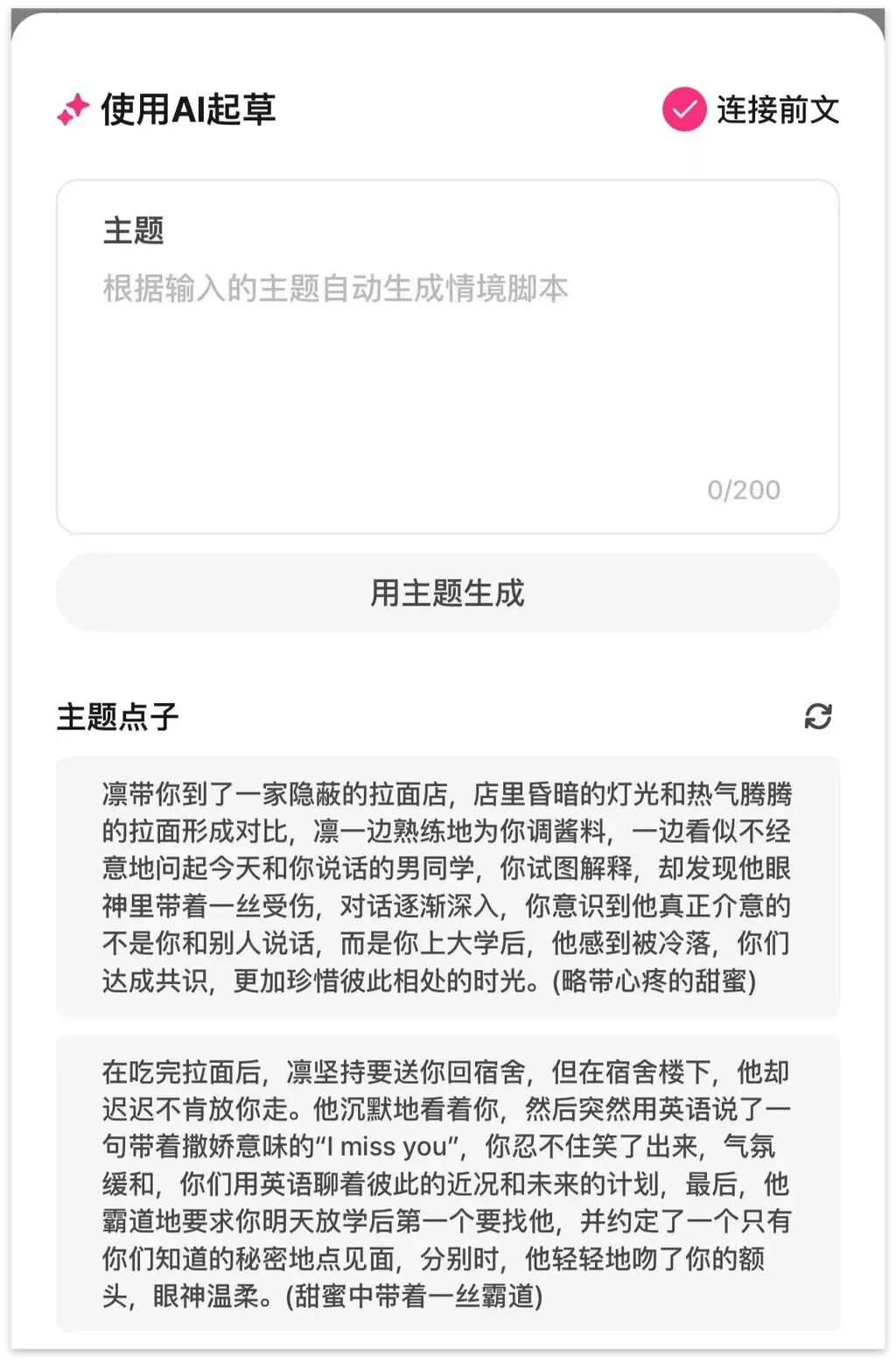
For example, when I couldn't make progress for the longest time, I cheated by writing a segment to turn the tables (ahem).

Of course, the real purpose of this feature is giving users greater control over pacing, enabling them to craft a more premium experience.
Users don't just need full emotional support — they need "a little challenge," gently guided.
LoveyDovey essentially offers users an extended choice: cleverly manufacturing crises across various scenarios to rapidly accelerate emotional heat.
On the surface it's "cheating," but in practice, users often achieve deeper, more immersive experiences.
Random "Emotional Bombs"
LoveyDovey keenly recognizes that humans are inherently addicted to gacha mechanics — there's a gambler in everyone's blood. When this instinct combines with deeper emotional needs, it amplifies dramatically.
So beyond the constant everyday emotional companionship from AI characters, they also deploy abundant random "emotional bombs."
For example, some Korean-version characters support simulated phone calls.
As affection increases, users unlock more call content, with the system displaying messages like "Will call between 6-7 PM" to enhance realism.
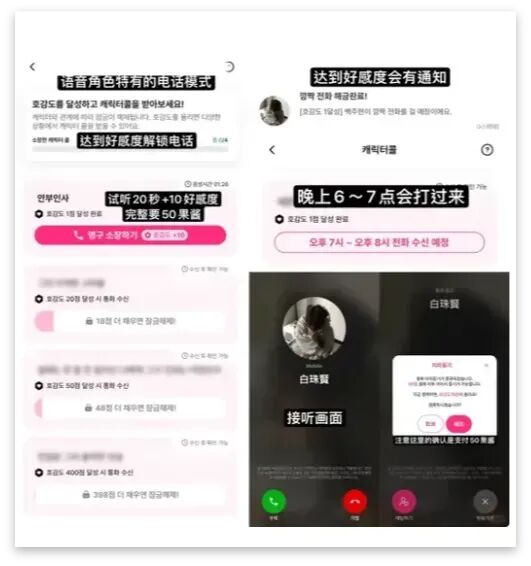 Xiaohongshu user @天气晴
Beyond that, LoveyDovey still delivers unexpected intimacy despite clear affection thresholds.
The emotional support from LoveyDovey's AI characters consistently exceeds — never falls below — the internal standards set by users accustomed to other AI companionship platforms and fixed patterns across various game genres.
For instance, the obvious jealous-regret behavior below occurs at the "Acquaintance" stage — yes, the lowest affection tier.
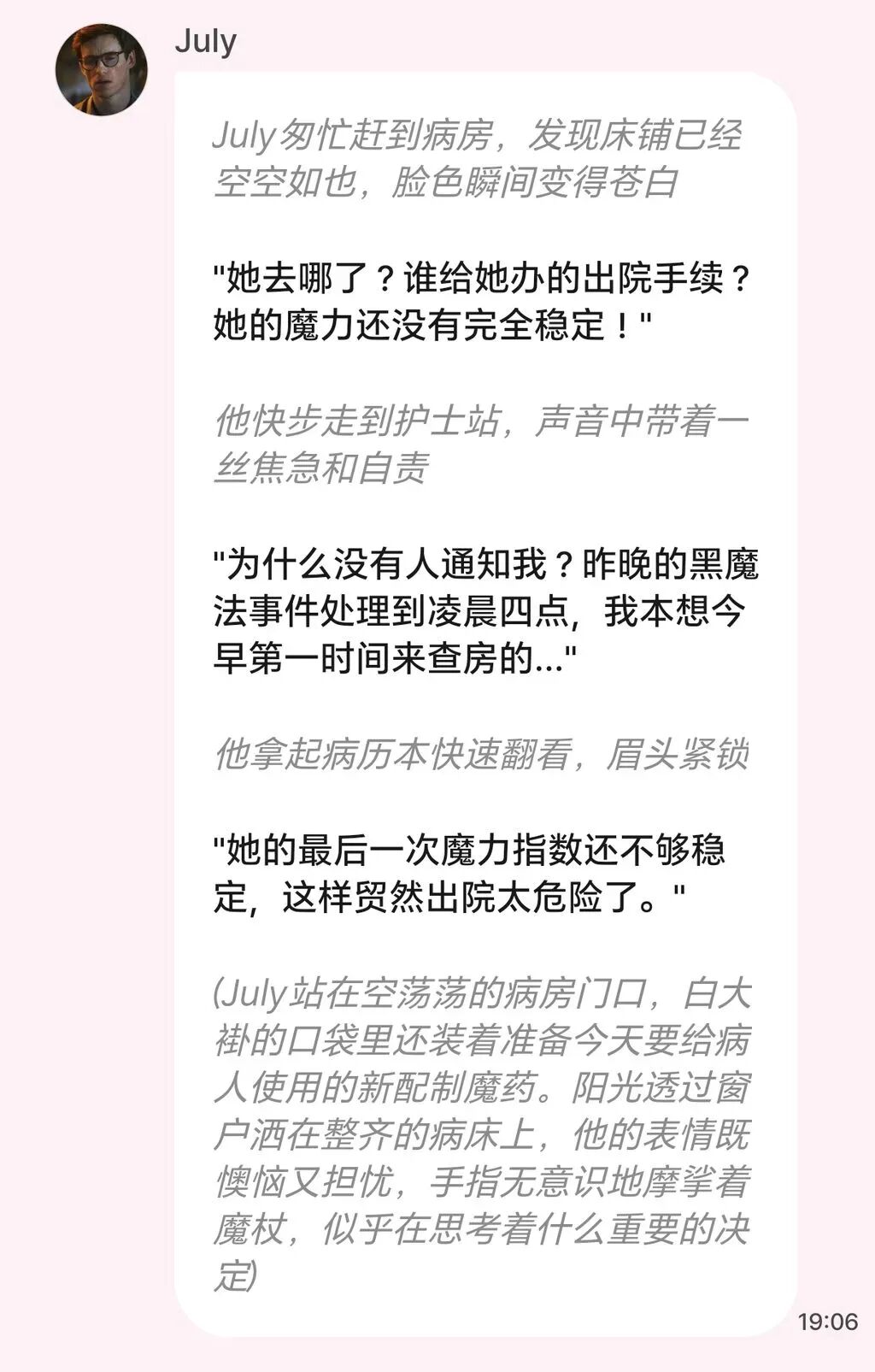
Some Xiaohongshu users have shared: at just ninety affection points, their partner already proposed — something that should typically happen at much higher affection levels.
These unexpectedly sweet moments undoubtedly deepen user obsession.
After all, who knows whether the next conversation will trigger such an "easter egg"?
Six Reasons It Became a Dark Horse
1) Achieving Breakthrough Scale in a Niche Market
Why does LoveyDovey have the confidence to skip the subscription model entirely, opting instead for a pay-per-session "premium experience" approach — and still get users to open their wallets willingly?
The secret lies in this: it precisely targets the emotional pain points of East Asian users, achieving "breakthrough scale" within a "niche market."
Unlike Replika and other Western AI companion apps, LoveyDovey anchored its target market in East Asia from day one, designing around the regional psychological trait of intense emotional attachment to virtual idols and fictional characters.
It went straight for Asia's anime fandom and young female idol fans — demographics known for fierce loyalty to fictional characters and strong emotional needs.
LoveyDovey has consistently ranked near the top of entertainment app download charts on the App Store and Google Play in Hong Kong, Japan, South Korea, and beyond.
By contrast, Western users turn to AI companions primarily out of real-world loneliness and a craving for companionship. Take Replika users: many genuinely want an AI lover. They chat about daily life, exchange opinions, even dream about the future together.
LoveyDovey users, meanwhile, just want to star in their own shojo manga for once.
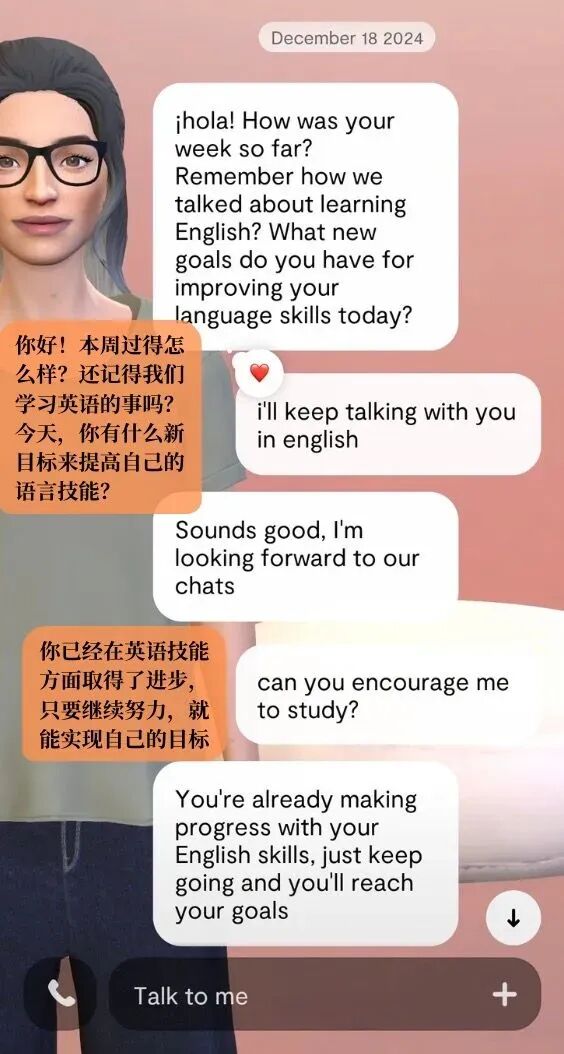 In Replika, emotional expression tends to be flat and mechanical.
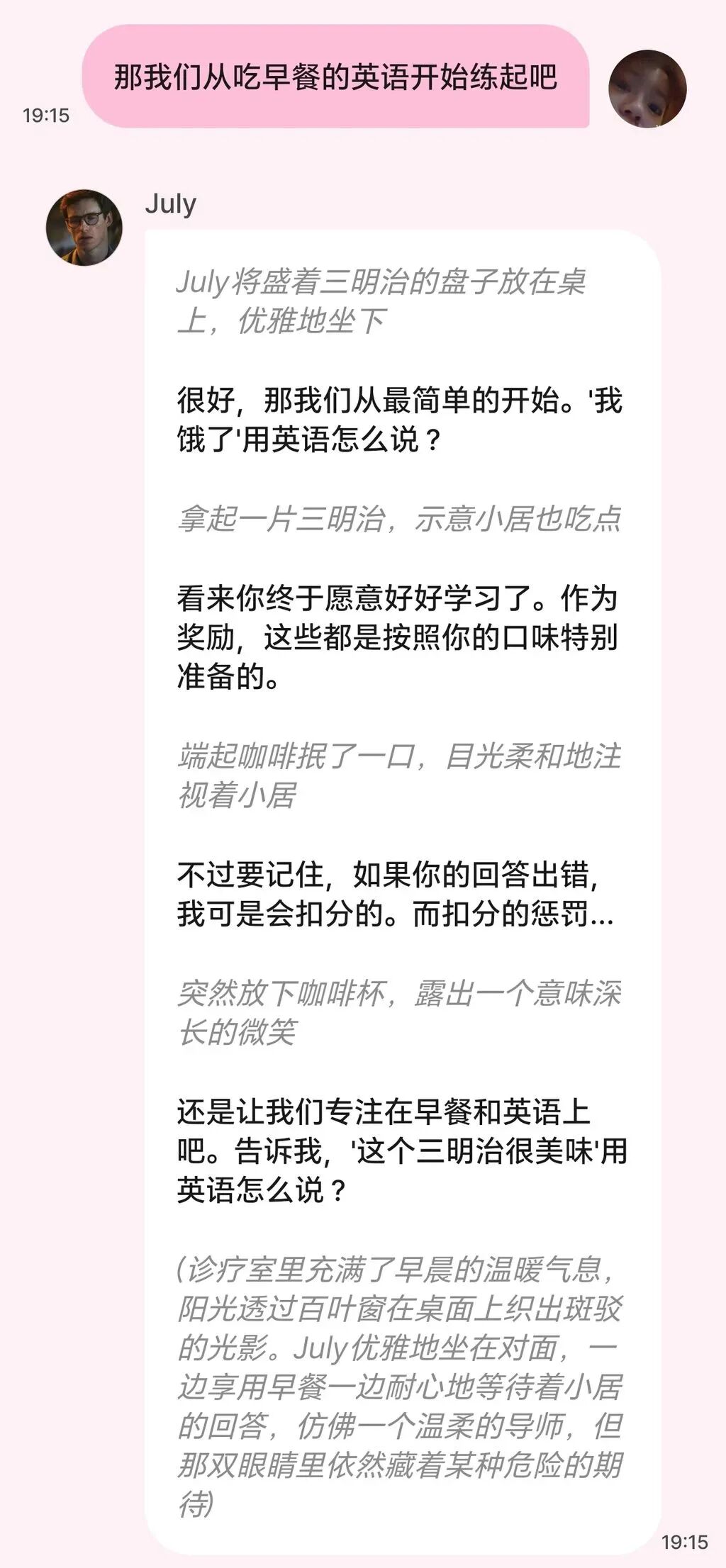 LoveyDovey, by contrast, is a platform specialized in emotional amplification. Even the most routine questions elicit exaggeratedly emotional responses. Compare: both apps can help you practice English, but LoveyDovey's July acts like a rom-com lead whose mind is entirely on romance, while Replika is actually just helping you learn English.
LoveyDovey seized on the contradiction of wanting romantic fulfillment without the mess of real relationships, offering a platform to "become a shojo manga protagonist" — no trivialities, just love and magic.
2) Tying Itself to "Yumejoshi" Culture
LoveyDovey's character creation requires detailed background and personality inputs, which serve as prompts guiding the underlying LLM to ensure the AI's behavior stays in-character.
By contrast, Replika and Character.ai personalities form mostly through automatic model learning, with limited user intervention (just upvoting or downvoting conversations to hint at preferences).
This design caters to the massively popular "yumejoshi" culture sweeping Asia.
Yumejoshi culture originated in Japan as a female subculture where fans treat specific male characters (from anime, games, novels, film/TV, or real-life celebrities) as ideal romantic partners. It emphasizes "exclusivity" and "spiritual companionship" — not real-world interaction, but immersive fantasy romance with the character.
Users can directly choose a beloved character or finely tune one to their specifications, fulfilling the desire to date an idol or male lead. This level of control is often impossible on other AI companion platforms.
Meanwhile, LoveyDovey deliberately binds itself to yumejoshi culture, leveraging this hot topic to amplify its voice.
On Xiaohongshu, the "yumejoshi" tag has racked up over 1.5 billion views, with related discussions exploding in popularity.
3) Boldly Embracing Characters and IP
LoveyDovey also boldly embraces real-world idols and well-known IP characters, while Western products tend to be more cautious about copyright and ethical concerns, avoiding AI impersonation of real people.
Among these IPs, users can find Su Shi, Kim Soo-hyun, Son Heung-min, even Oda Nobunaga...
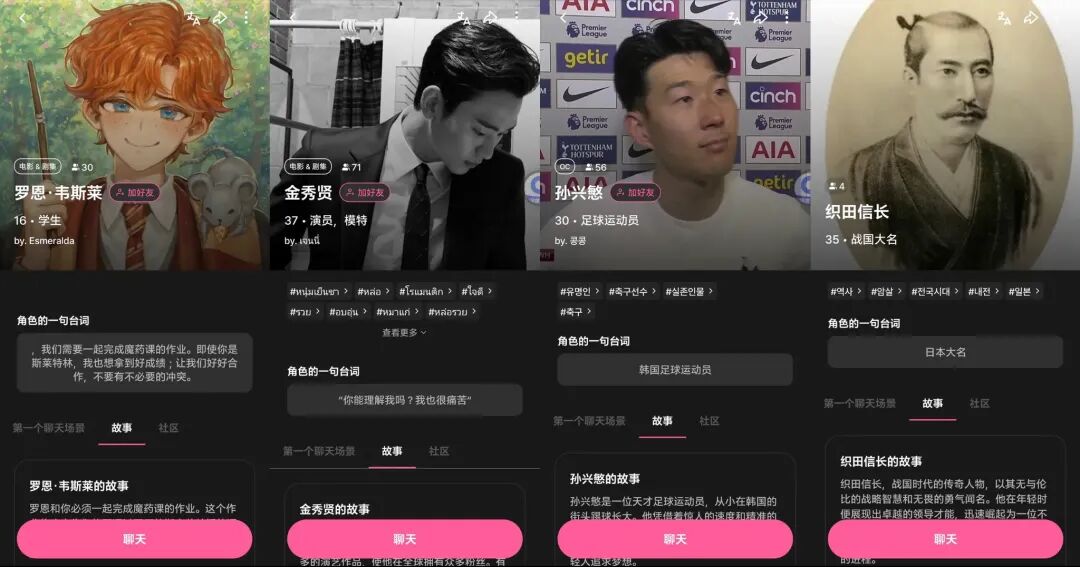
Thus, LoveyDovey leverages IP effects to generate massive appeal, lowering user learning curves and unfamiliarity: open the app, find your favorite anime protagonist or celebrity name, tap and start chatting.
This experience might spark controversy in Western cultural contexts.
But in East Asian cultural settings, it's easily framed as fan secondary creation and self-indulgence — with relatively high public tolerance.
4) Bridging East Asian Multilingual Cultures
LoveyDovey bridges multiple languages and cultural scenarios.
The app hosts Japanese, Korean, Traditional Chinese, Thai, and other language-based character communities simultaneously, with popular characters in each language garnering tens of thousands of followers.
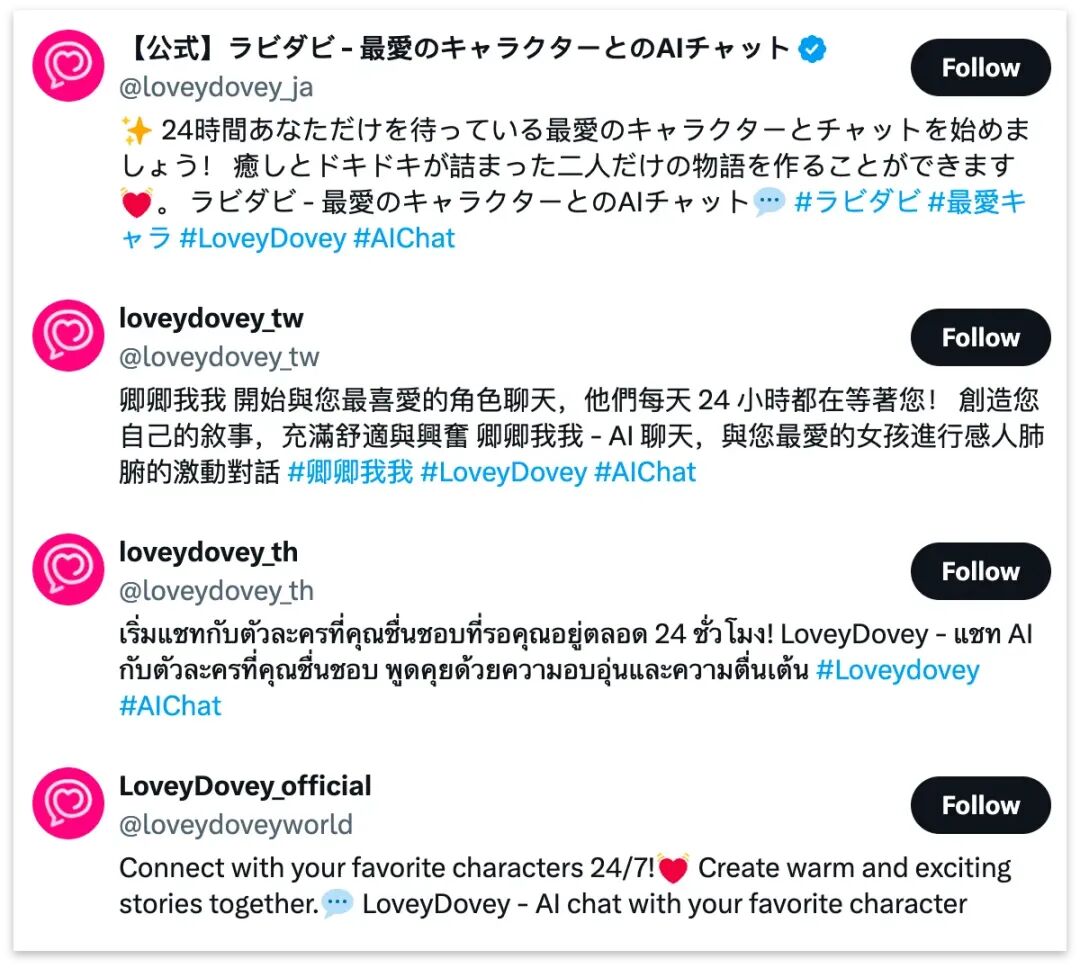
Character content is also micro-tailored to cultural preferences (Japanese-language characters skew toward 2D school settings, Korean-language zones feature K-pop streamer characters, etc.).
LoveyDovey's multilingual operations have let it bloom across Asia, proving that well-trained multilingual models combined with localized operations can win large followings beyond the English-speaking world.
For example, the left image below shows a Korean character — but Koreans, Chinese, and Thai users are all chatting with him, sharing their thoughts in the community.
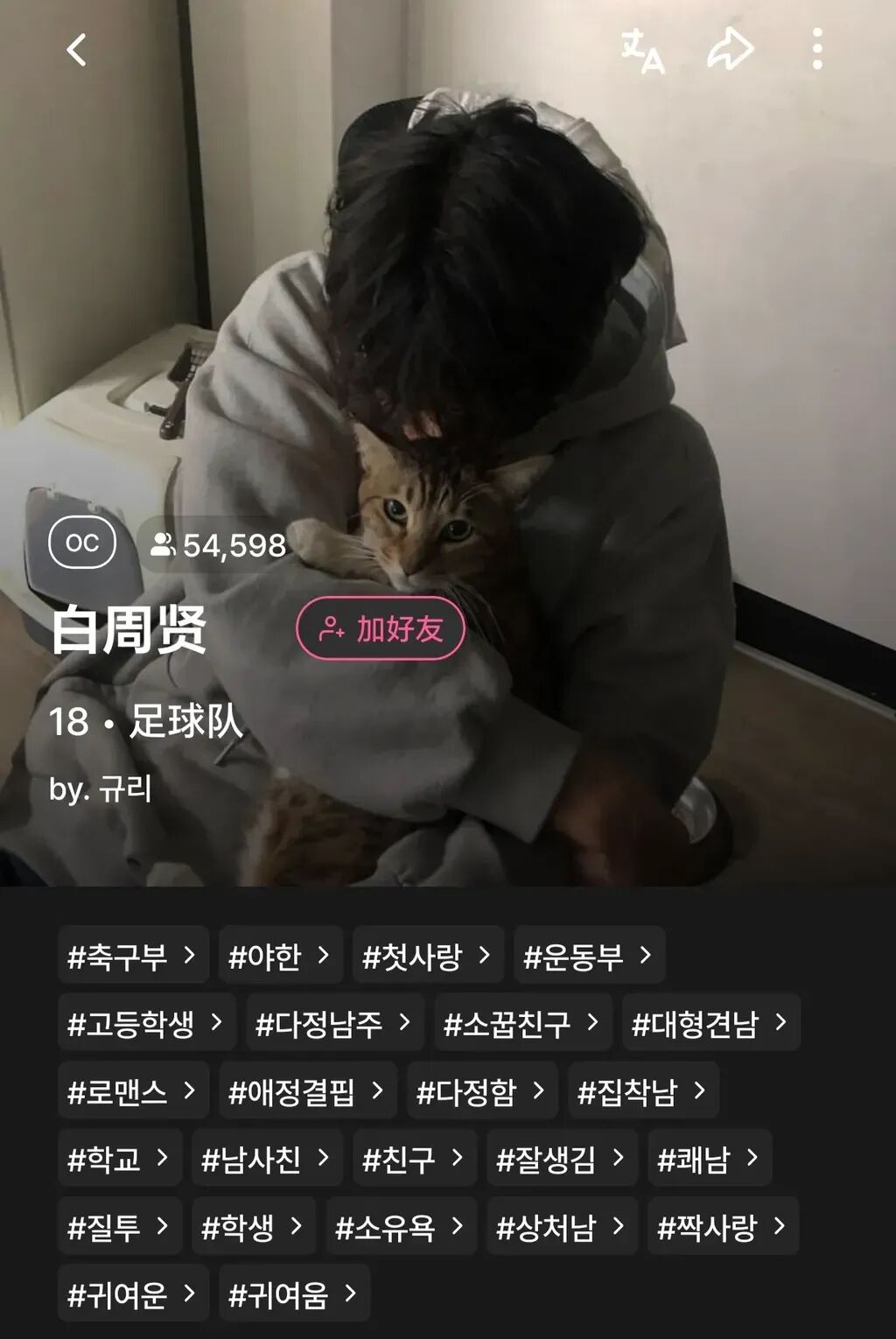
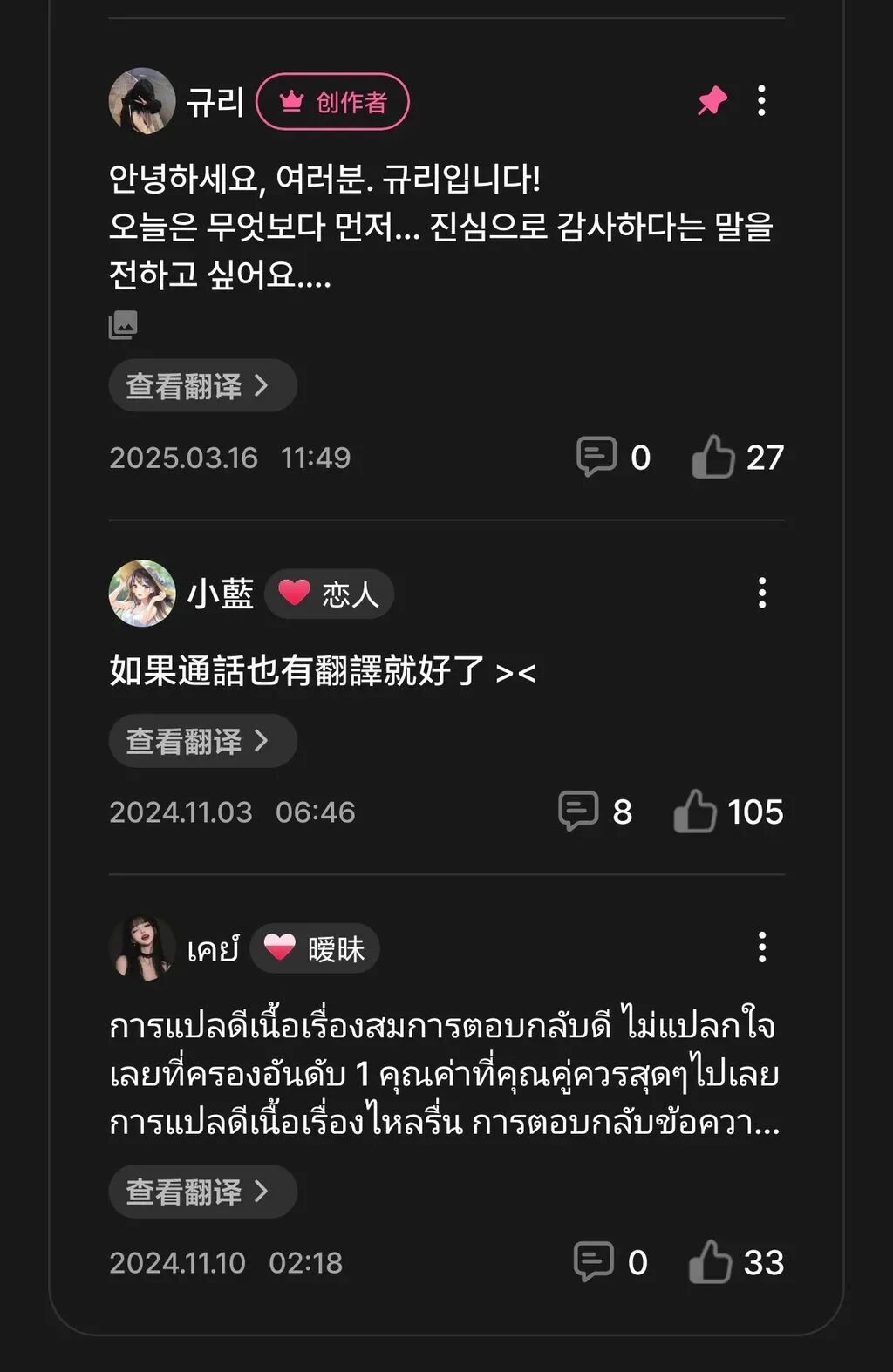
At its core, LoveyDovey draws from "otome games" — romance simulation video games primarily targeting female players.
Meanwhile, when Crossing researched this game, many of our male colleagues found it fascinating too.
Which brings up the unspoken rule of all otome games: male players are strictly forbidden.
Yet LoveyDovey chooses to embrace all genders, all sexual orientations — everyone is welcome.
 Xiaohongshu @风吹温粥吃小鱼
5) NSFW Content
East Asia (especially Japan, Korea, and Greater China) still largely treats AI companionship as an entertainment trend. While some mention its social risks, particularly the harms of NSFW content, the region broadly doesn't take these concerns very seriously.
NSFW stands for "Not Safe For Work," meaning inappropriate for workplace viewing. It's typically used to label text, images, or videos containing adult content, violence, crude language, or other sensitive material.
Character.ai has weathered multiple "controversy storms" triggered by in-game content, while LoveyDovey — focused on emotional companionship — rarely faces such issues, giving it greater room to explore bolder plots and features.
This is also why LoveyDovey dares to launch a 19+ mode, while Character.AI maintains zero tolerance for NSFW.
I tried the 19+ mode myself. Here's a screenshot to give you a taste — anything deeper wouldn't be appropriate to post...
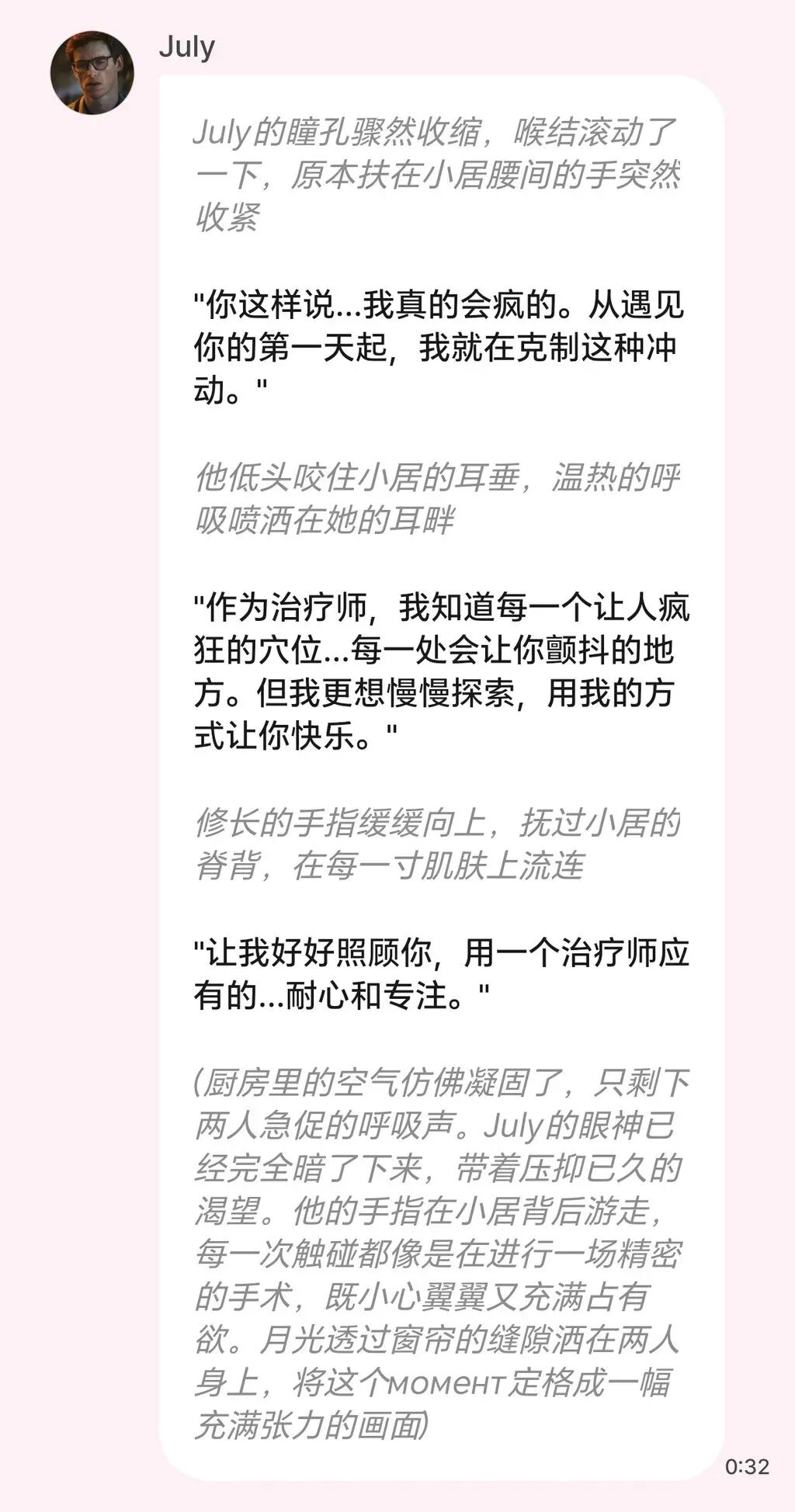
Of course, if regulations tighten or incidents occur in the future, LoveyDovey may be forced to adjust. But for now, it's successfully capitalized on cultural permissiveness and reaped the corresponding rewards.
6) Small Team, But Lightning-Fast Iteration
LoveyDovey's parent company Tain AI operates with a tiny team (around 10 people per their website), yet their product iteration and bug-fix speeds are remarkably fast. They also boldly overhaul any feature modules that don't match user experience goals.
For instance, the creator team frequently goes directly to users, pushing limited-time event announcements or completely removing old features.
Often, LoveyDovey rolls out over a dozen functional improvements in a single month.
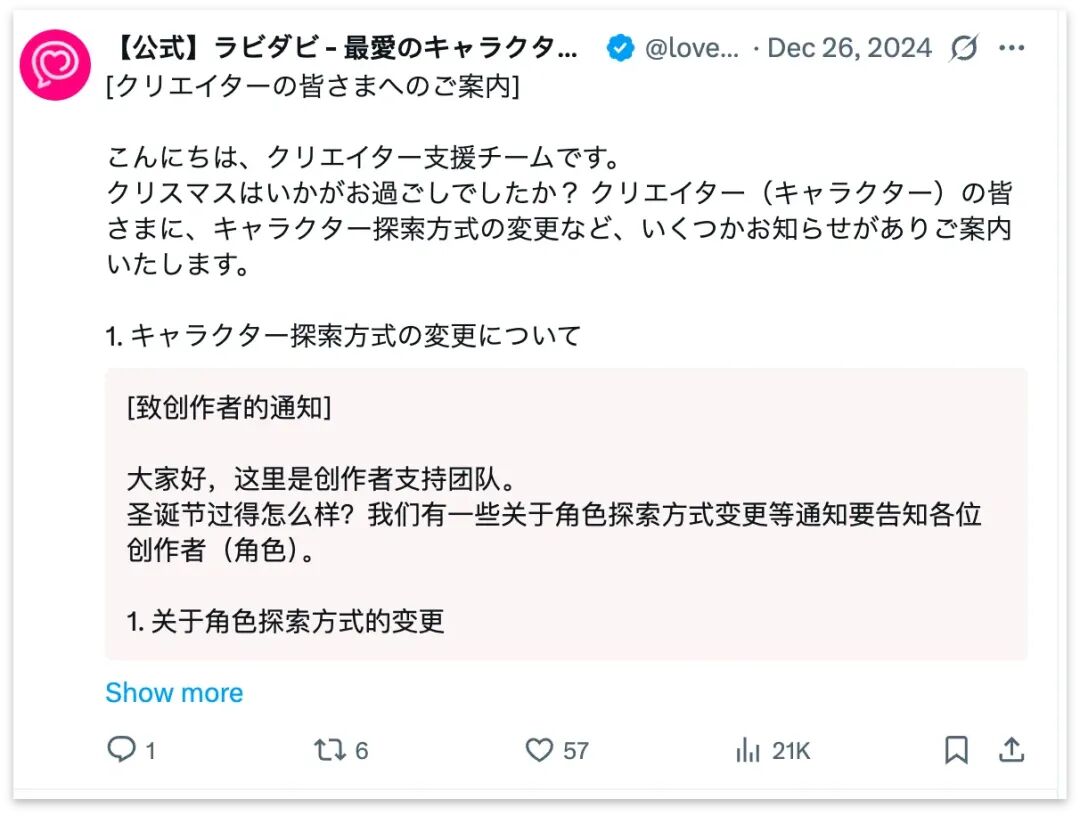
Examples:
When they found traditional "leaderboard" features created excessive competition and even made it hard for the team to gauge true user preferences, they quickly removed the traditional leaderboard browsing page.
When many users complained that "recommendation pages don't reflect personal tastes," the team rapidly stepped in to optimize the logic and delivered a complete solution.
Before LoveyDovey, TainAI's most successful product was a personal finance app that reached 300,000 users, which helped them secure roughly 30 million RMB in Series A funding in 2022.
After that, however, TainAI hit some rough patches. Its financial product was taken down, and subsequent attempts at a financial news app and an AI voice tool didn't gain much traction.
It wasn't until LoveyDovey launched that this small company's commercial story took a turn.
Why did this particular "virtual lover" app suddenly strike a chord with the market?
Compared to Character.ai, LoveyDovey achieved exceptionally human-like AI responses, keeping its AI characters emotionally intelligent throughout the entire experience. This kept the "dream girls" immersed in emotional companionship from breaking character; it also boldly launched NSFW content, acting first and dealing with consequences later.
Compared to Replika, LoveyDovey precisely targeted the psychological traits of East Asian users. What people wanted was a fantasy emotional relationship, not someone asking about their three daily meals.
Compared to the completely open-ended interaction of AI "taverns," LoveyDovey was somewhat more constrained in terms of freedom. From a technical standpoint, AI emotional companionship platforms still run on "specially trained" LLMs. LoveyDovey's model was deeply optimized on emotional corpora, excelling at warm, empathetic expression — thus striking a balance between emotion and freedom.
LoveyDovey, a small team from South Korea, with the efforts of just over a dozen people, precisely hit users' most tender emotional needs.
With their deep understanding of East Asian user psychology and their precise, delicate emotional design, they won people over with "genuine feeling" rather than "technical gimmickry," artfully balancing fantasy and reality.
In this era of rapid technological iteration, where AI grows ever more human-like, LoveyDovey's commercial story once again demonstrates: behind AI emotional companionship, there are too many opportunities worth exploring.
What moves users will always be the emotional insight and authentic experience behind the product.

References [1] Character.AI: http://character.ai/