Profitable in Three Months, Making Millions Monthly: How AI Sales Agents Are Disrupting B2B Marketing | A Conversation with Pan Yiming, Founder of Lightyear Reach

The ultimate allure of AI is that it lets doers who know nothing about marketing stand on the world stage.
The ultimate appeal of AI is that it lets doers who know nothing about marketing stand on the world stage.

👦🏻 Interview: Koji
🥷 Editing: Bella
🧑🎨 Layout: NCon

Imagine a hardware factory owner in Dongguan. He doesn't understand complex marketing theory, and he only has two or three salespeople with limited experience.
But now, his AI sales agent is working 24 hours a day across the global internet, conducting personalized initial outreach with hundreds of potential buyers in Germany and Brazil.
When he wakes up the next morning, several high-intent emails expressing interest in his quotes are already sitting in his inbox.
This is what Lightyear Reach is doing.
Founder Yiming Pan — a former core member who once used algorithms to turn around a business at DiDi and wrote code that controlled tens of millions of dollars in ad spend at ByteDance — is a quintessential "algorithm believer."
He believes that the ultimate appeal of AI is giving doers with great products but no marketing expertise a fair shot at standing on the world stage.
With this vision, he and his 30-person team achieved profitability within three months of launching the company.
Yiming's perspective stems from a practical problem: even the best SaaS software needs a savvy operator who knows what they're doing. Most small and medium-sized enterprises don't have such a person. So from day one, Lightyear Reach has been committed to making AI that "savvy person."
Below is Crossing's interview with Yiming Pan.
Quick-Fire Q&A
👦🏻 Koji
Age?
👦🏻 Yiming Pan
👦🏻 Koji
Alma mater?
👦🏻 Yiming Pan
Graduated from Tsinghua University in 2015.
👦🏻 Koji
MBTI and zodiac sign?
👦🏻 Yiming Pan
INTJ-A, Libra.
👦🏻 Koji
One sentence to describe your current company and product?
👦🏻 Yiming Pan
Lightyear Reach hopes to use AI technology to give every company comprehensive and accessible marketing capabilities, to increase the profit share of product design and production, and let more enterprises focus on the product itself rather than marketing.
Our currently promoted product is iSales. It aims to build AI-driven, personalized, customized, and continuously evolving sales AI agents, helping B2B enterprises achieve personalized, scalable, and automated online customer acquisition.
👦🏻 Koji
Funding status?
👦🏻 Yiming Pan
In progress, finalizing this month.
👦🏻 Koji
Revenue and profit?
👦🏻 Yiming Pan
Monthly revenue above 1 million RMB, company cash flow positive.
👦🏻 Koji
Team size?
👦🏻 Yiming Pan
30 people.
👦🏻 Koji
What were you doing before starting up?
👦🏻 Yiming Pan
I worked on product and algorithms at internet companies in Beijing — DiDi and ByteDance. In 2019, I also published a book on algorithm applications called The Beauty of Product Logic.
A project I'm particularly proud of was solving the dispatch problem for scheduled orders at DiDi, which helped the premium ride-hailing model become viable and turn profitable.
The project investors tend to like was designing an automated ad placement algorithm at ByteDance, which spent 80% of the $30 million daily overseas ad budget.
I started my entrepreneurial journey last year, joining another AI B2B application startup as a product and R&D partner, where I defined the product and validated the business model — essentially an internship for this current venture.
 (Photo: Yiming Pan speaking at a Crossing open mic event in late August 2025)
From 0 to 1: Profitable in Three Months
👦🏻 Koji
We understand Lightyear Reach achieved positive cash flow within three months of launch, with very fast growth. What's the core value you provide to customers?
👦🏻 Yiming Pan
First, what we're doing is using AI for customer acquisition — our product helps companies increase revenue. Even in China's SaaS environment, business owners are very willing to pay for our product.
👦🏻 Koji
"Helping businesses grow revenue" sounds like the goal of every B2B company. What are you doing right?
👦🏻 Yiming Pan
Our product works without requiring the client company to have exceptionally smart young employees.
For years, SaaS software has been stuck in a feature-stacking arms race.
More and more features, but one core problem was never solved — with such complex functionality, many SMEs simply can't find anyone to use these tools, or they use them very poorly.
Our product design principle is to hide the algorithmic details and keep interactions simple enough for users at every level to use effectively.
Of course, the model customization model itself is highly attractive. Our product enables lightweight model customization for clients with a sufficiently streamlined workflow. Clients only need simple interactions with the product to achieve continuous improvement in results.
And this development capability accumulates in the form of algorithmic parameters — it doesn't reset to zero when an employee leaves.
The combination of these factors allows the enterprises we serve to achieve more than tenfold improvement in customer development conversion rates without adding significant extra workload.
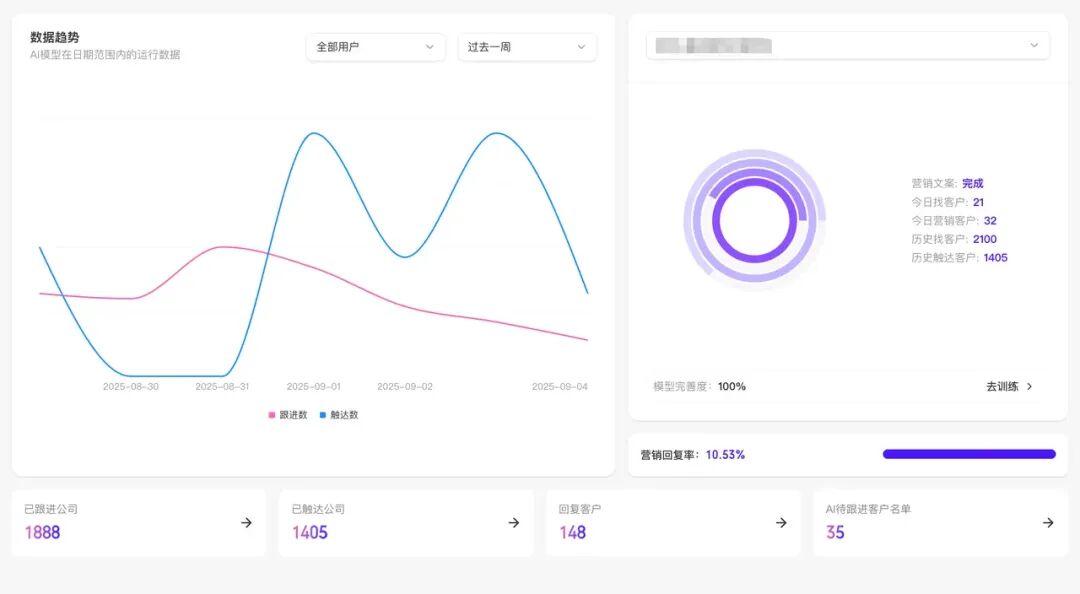 (Photo: Macro data from an enterprise homepage)
👦🏻 Koji
Can you walk through Lightyear Reach's complete conversion process using a customer example?
👦🏻 Yiming Pan
Right now, we still help our clients find their precise customers, obtain key contact information, and send emails and WhatsApp messages.
When AI startups build products in this space, they typically follow fixed workflows — like Clay, 11x, Artisan, and similar products.
Users belong to a search keyword and channel (like Google, maps, social media), the system searches and analyzes, obtains contacts, and ultimately sends marketing content according to orchestrated rules.
We've built our own algorithmic systems at each of these stages to achieve better results.
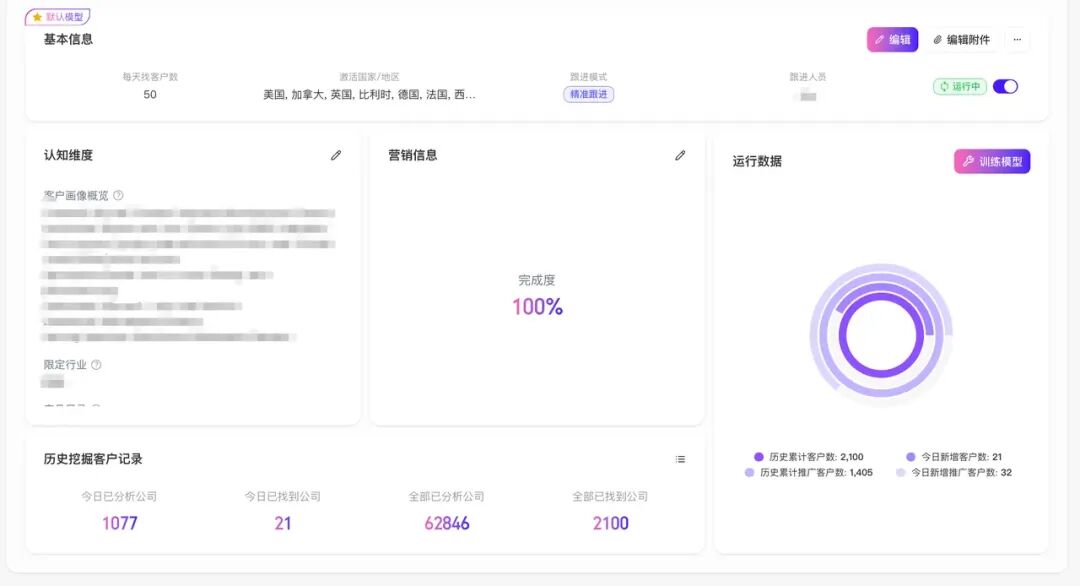 (Photo: Enterprise model: automated execution, no extra operation needed)
👦🏻 Koji
Can you elaborate on what your algorithmic systems are?
👦🏻 Yiming Pan
In the precise customer discovery stage, we don't require users to input search keywords themselves. Instead, we maintain the user's customer profile needs from the start, and based on that profile combined with our own analysis engine, generate tens of thousands of possible search commands.
We also use an automated planning algorithm in the closed loop of search and analysis information to continuously plan the optimal path. This way, users don't need to analyze and think about what methods or channels to use for customer acquisition — they simply find large numbers of customers.
We maintain the discovered customers in a graph algorithm structure. As users interact with the product, they express preferences for certain customers, and this data diffuses through the graph structure to other unlabeled customers, allowing us to form relevance scores for all customers.
We also maintain user contact preferences from the start — some want emails to go to CEOs, some prefer procurement contacts, some want CTOs.
The contact information we obtain gets scored and ranked according to user preferences, and these weights influence marketing task priority when we orchestrate marketing tasks.
👦🏻 Koji
Your background is impressive — from DiDi to ByteDance, working on core algorithmic systems. What advantages does this give you that others don't have?
👦🏻 Yiming Pan
The awareness and experience of translating business problems into algorithmic problems.
For startup teams, designing effective algorithmic systems in new business scenarios and bringing breakthrough new models to the business — this is a very difficult problem.
Many startup teams have partners with algorithm backgrounds, but they don't actually apply their past algorithmic experience. That's because the current challenges are all new business scenarios created by new technology, and the first step — translating business problems into algorithmic problems — is something most algorithm engineers aren't good at.
The mobile era had traditional news portals, and then it had Toutiao. It had Xiaokaxiu, and then it had Douyin.
In today's new technology dividend era, using new technology can indeed enable product development, but building algorithmic systems can create more competitive product forms.
👦🏻 Koji
Why do you emphasize algorithms so strongly?
👦🏻 Yiming Pan
Because using large model technology alone cannot help our clients achieve autonomous business planning, long-term accurate memory, or self-iterative evolution.
Products built with these gaps can certainly find paying users — as long as you do fancy algorithmic external presentations and product marketing well — which leads many companies to overlook the fundamental problems with large models themselves.
But we're no longer in the early days of mobile internet, without massive traffic dividends, and the generalization of programming capabilities has brought more sophisticated competitors.
We chose to incorporate algorithmic systems from the start, doing what's correct for the long term, achieving better results and higher retention, which also improves our competitiveness and barriers. For example, our memory system is built on graph algorithms rather than conventional RAG.
If a product's functionality can be implemented by two or three people using AI coding in a week or two, even if short-term growth through marketing is possible, it's hard to see what barriers exist in the long term.
In AI's Uncharted Territory, Building Our Own Map
👦🏻 Koji
Compared to other AI tools on the market that also help foreign trade clients, what are Lightyear Reach's advantages?
👦🏻 Yiming Pan
Customized enterprise models that can be quickly deployed without hiring marketing-savvy people.
Personalized effects that achieve better customer accuracy and response rates.
Model algorithms that continuously self-iterate and evolve, with improving results and higher stickiness.
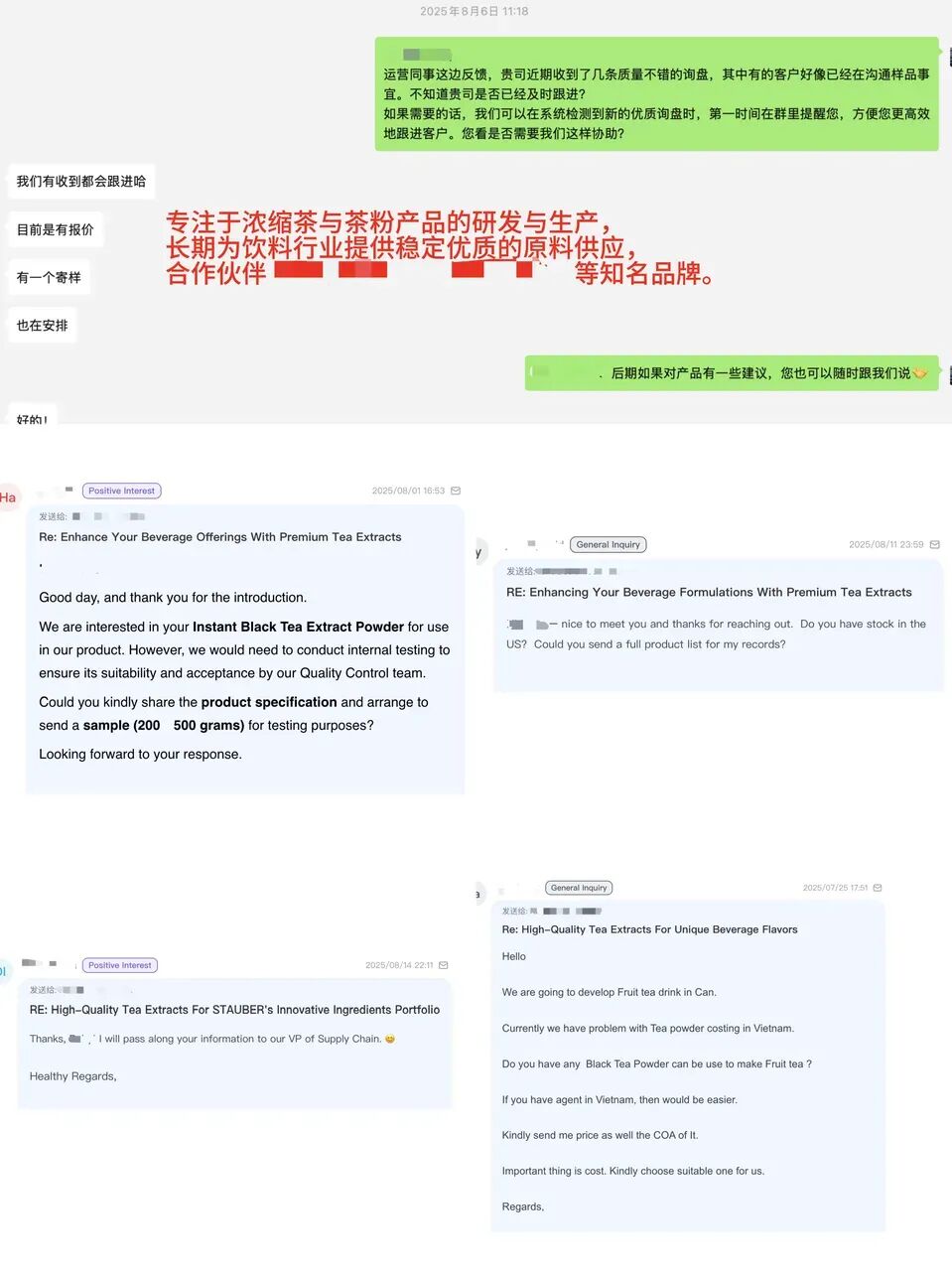 (Photo: Sales customer follow-up and inquiry cases)
👦🏻 Koji
B2B customer acquisition is difficult. What acquisition model have you chosen? How will you achieve scalable growth in the future?
👦🏻 Yiming Pan
We currently rely mainly on offline sales team outreach — chatting with business owners at trade shows, approaching companies recruiting foreign trade salespeople.
We've also partnered with some channel companies who know many enterprises, allowing rapid promotion through these channels.
Of course, B2B customer acquisition is hard, but the ROI isn't low. If sales salary plus commission is 30%, the ROI is actually 3.3 — a dream number for C-side products.
In the future, we'll expand through more channel partners while also pursuing a product-led growth path.
For example, before committing, users can interact directly with our product to do a lightweight model customization, find some of their own customers, get a feel for it, and then proceed through the sales process or even purchase directly on their own.
Going forward, we'll also do full-funnel AI marketing — AI-managed social media operations, automated ad placement, AI-automated SEO.
Unlike other companies' tool-based approach, we'll ensure every functional module has a self-iterating algorithmic mechanism that gets better with use.
Meanwhile, data collected from each module will influence other modules' algorithmic parameters, making the entire online marketing system an organic whole.
Providing enterprises with more marketing channel options will also accelerate scalable growth.
👦🏻 Koji
Why do you use "graph algorithms" rather than mainstream RAG for your agent's memory system? What's better about it?
👦🏻 Yiming Pan
An analogy: RAG is like a clumsy search engine — you ask it a question, it gives you a pile of possibly relevant documents. Graph algorithms are like a smart librarian who not only knows what's in every book but also understands the relationships between books — which are classics, which are introductions.
Graph algorithms preserve business information weights very well. For example, one company has 1,000 people, another has 10. If this information is compressed into a company's semantic vector as long text, there's almost no distinction. But in business scenarios, this is crucial information.
Business information suffers massive loss when compressed into semantic vectors, while graph structures can preserve such business weights through tags and weight calculations.
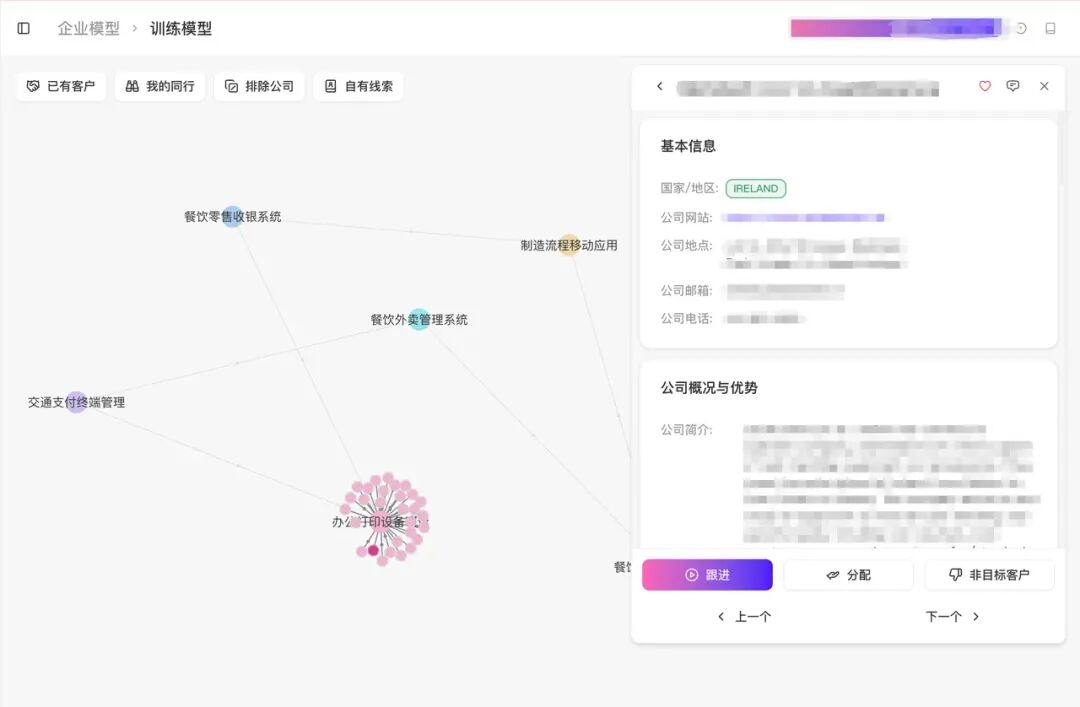 (Photo: External presentation of enterprise graph algorithm, retaining only customer segments, companies, and user operations on companies)
👦🏻 Koji
What's the problem with RAG?
👦🏻 Yiming Pan
RAG has no scale effects. Take customer service as an example — if you maintain multiple answers under questions in a small domain, this doesn't improve results but causes more confusion. Graph algorithms don't have this problem; as data expands, results simply get better.
Of course, our current graph algorithms also depend on large model capabilities.
After the transformer architecture emerged, graph algorithms underwent massive upgrades based on attention mechanisms. Such algorithms performed well in papers five or six years ago but weren't adopted in industry because there weren't enough Stanford and Tsinghua students to do basic graph information annotation for you.
What we're doing now is using large models to build a set of graph annotation methods — essentially making large models excellent annotators.
👦🏻 Koji
Why do you insist that an agent's "planning system" must be self-developed rather than relying on large models? How high is this barrier?
👦🏻 Yiming Pan
Because large models are inherently bad at strategic planning.
This goes back to the attention mechanism. If for a model task, most information in the long context we provide is irrelevant and only a small portion is useful, the attention mechanism can help us extract key information and summarize reasonable answers.
But if for a task, the extensive context we provide has already been compressed, or the information is equally weighted, requiring global understanding and computation to form the next set of tasks, then current large models cannot execute or generate massive hallucinations. This is the case in our customer discovery planning phase.
Suppose we've historically searched and analyzed ten thousand companies — the analysis process and scoring results for these companies all help with the next task execution, but clearly require global computation rather than partial information extraction. This is what attention mechanism-based LLMs are bad at.
AlphaGo already surpassed humans at Go eight years ago, yet LLMs with orders of magnitude more parameters still aren't great at chess, because chess requires global planning, even multi-step global planning. Large models aren't good at this.
This isn't really about barriers — it's more about cognition. And it's not just our problem that needs planning systems; many agents do. There are so many directions to pursue now, and this is a tough problem to crack, so people choose to take the easy way around.
I think as the early ARR number frenzy runs into more user effectiveness skepticism, more companies that figure this out will come back to build planning algorithmic mechanisms.
👦🏻 Koji
An agent's "self-iteration" is crucial. How does your system optimize the next task based on results from the previous one?
👦🏻 Yiming Pan
Take customer discovery as an example. For every potentially executable search command, we maintain a parameter weight. In each task execution, for every customer found, the large model conducts multi-dimensional relevance scoring, and we adjust global search command parameters based on these scores.
If this task performs well, this command and related commands' weights increase; if it performs poorly, this command and related commands' weights decrease. And our next task execution is computed based on these parameters, cycling repeatedly.
This resembles a reinforcement learning algorithmic mechanism. Search command parameters are the reinforcement learning state, large model analysis results are environmental feedback, executed commands are actions, and post-execution weight adjustments are the reward mechanism.
Of course, we don't directly use reinforcement learning algorithms — it's more like a low-dimensional unfolding of this high-dimensional algorithm.
👦🏻 Koji
Do you rely on a single algorithm or an algorithmic system? In the agent era, is this a true barrier?
👦🏻 Yiming Pan
We're building an entire algorithmic system, thereby forming new product models and self-iterative capabilities.
We have阶段性 barriers for now. Large companies lack innovative soil in specific departments — they can only talk concepts and repackage old features with new skins. Small companies struggle to build innovative algorithmic pipelines and can't form systematic algorithms.
Additionally, we're currently pursuing a direction that the capital market doesn't consensus-view favorably, using an algorithmic model that investors don't quite understand. Before we achieve results in the short term, there won't be capital inflows creating high-intensity competitive内卷.
But in the long term, algorithmic systems won't be absolute barriers — after all, ChatGPT had a significant lead, and domestic companies produced corresponding models in less than a year.
However, we'll accumulate data through our service process and rely on this data for algorithmic upgrades. Many hyperparameters in planning algorithms can be unfrozen for further algorithmic iteration using reinforcement learning. Graph algorithms can abstract industry models, add dynamic intelligence networks, and use graph neural network algorithms for further improvement.
We'll also upgrade our organization and service processes.
The ultimate true barrier is a company that can continuously self-iterate. I'm also working to design the company like I design algorithmic systems.
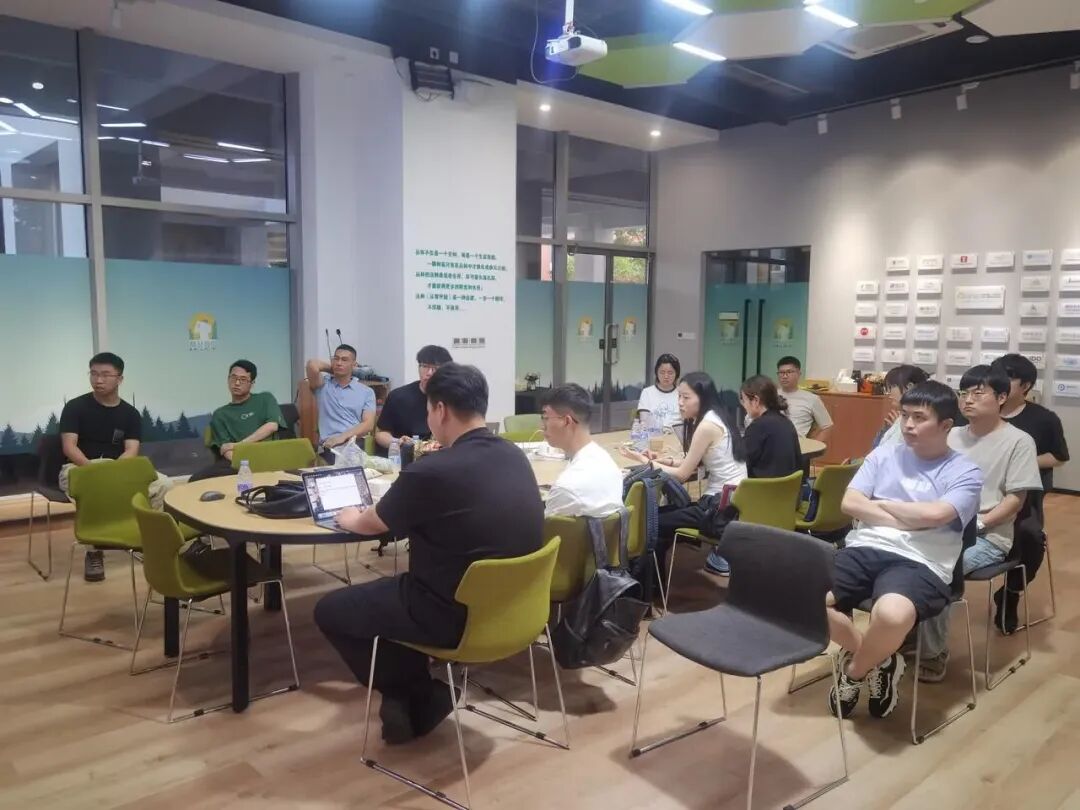 (Photo: End-of-May internal monthly meeting, CEO face-to-face)
The Endgame: Letting Business Return to Product
👦🏻 Koji
Why dare to do B2B entrepreneurship in China? Many B2B entrepreneurs have failed — why are you "going against the tide"?
👦🏻 Yiming Pan
First, doing B2B was the result of elimination after I decided to start a company. When large models emerged, I was considering my entrepreneurial direction.
After observing for more than a year in 2024, my thinking was: ToC opportunities either belong to individual developers or ultimately to companies with model training capabilities — not suitable for startups. So I should do B2B.
Of course, large models do represent disruptive change for the B2B domain. Extremely low-cost enterprise-level personalization dramatically improves B2B service cost-effectiveness; helping clients increase revenue brings higher enterprise willingness to pay; vast numbers of SMEs have incomplete internal organizations, but now AI can directly provide agency services and deliver results, skipping lengthy internal transformation and customization processes.
B2B services entering the AI era directly is like electric vehicle technology bypassing a series of engine problems — there's a new explosive opportunity.
👦🏻 Koji
How is this AI wave fundamentally different from past waves of enterprise informatization and SaaS?
👦🏻 Yiming Pan
The B2B domain has always emphasized online-ization, automation, and intelligence. Past enterprise informatization SaaS products were more about online-ization and automation.
Both require companies to have adapted personnel and organizations, and both primarily cover companies of certain scale.
Many of our clients — with annual revenue in the tens of millions, two or three salespeople — don't need CRM and various workflow products.
Meanwhile, because many domestic industries have vastly different internal organizational structures, such SaaS products either require extensive client training or even organizational restructuring to be useful, or they require customized services for each client, making it impossible for SaaS companies to scale or even become profitable.
Today we've directly entered the intelligence era, where we can directly complete tasks that enterprises previously delegated to external companies — like ad placement tasks from advertising agencies, customer discovery and order negotiation tasks from foreign trade companies, customer service for client companies.
No need for enterprises to adapt to our products. Today, standardized products can achieve customized and personalized service effects, completely amplifying SaaS product effectiveness and market size by an order of magnitude.
👦🏻 Koji
What's Lightyear Reach's endgame?
👦🏻 Yiming Pan
In the B2B domain, because of the massive amount of non-standardized information requiring communication, enormous sales and procurement time is consumed.
We believe such preliminary communication work can be completely AI-ified in the future. Sales agents and procurement agents communicate with each other, understand procurement needs, complete quoting — humans only need to make final decisions.
Such sales agents will certainly require personalized communication, customized understanding of enterprise information, and continuous evolution at work, constantly adapting to new enterprise needs.
Meanwhile, current information channels are designed for humans, so there are character limits, eye-catching marketing designs. If agents communicate directly, perhaps new information channels will be designed.
Because of the near-unlimited attention bandwidth between agents, such an enterprise agent communication two-sided network will be trillions of times denser than today's human-constructed inter-enterprise communication network.
Of course, such a business endgame is unlikely to belong to a single company. We hope to build such sales agents, such procurement agents, and participate in constructing such two-sided network mechanisms.
👦🏻 Koji
At what point would you consider this entrepreneurial venture a success?
👦🏻 Yiming Pan
Build a company with 60% NPS, hoping for customer-effect-driven growth rather than concept and marketing-driven growth.
I also hope to form some widely adopted industry practice solutions — such as paradigms for large model planning and memory — to push forward this wave of large model application落地.
👦🏻 Koji
Last question: We've known each other for over ten years, and I always remember you mentioning failing classes at Tsinghua. Today, you're a CEO building complex algorithmic systems. Looking back, what would you most want to say to that "problem student" Yiming Pan?
👦🏻 Yiming Pan
I come from a small county town that hadn't produced a Tsinghua student in twenty years, and I got into Tsinghua without any prep courses — back then I developed the illusion that I was the protagonist of the world.
When I discovered that even with effort I couldn't rank at the top of my class, my mentality completely collapsed. For several semesters, I skipped all my classes and played games in my dorm every day. With too many failed classes, I was once on the verge of dropping out.
What I'd want to tell myself back then:
"Actually 80 points is great, 70 points is fine too. What matters was never comparison with others, but your own growth.
Those small-data-scale heuristic algorithms will give you much inspiration and insight in your later work; Markov decision processes you'll use many times, becoming a cornerstone of your core algorithms; the algorithm for predicting supply chain changes you'll later explain to a top industry expert, giving him new ideas for predicting DAU.
"Everything that seems useless today is important foreshadowing for the future."
Because I failed so many classes, unlike the vast majority of Tsinghua students, I didn't choose to pursue a PhD but graduated with a bachelor's and went straight to work. And so I caught the tail end of the internet dividend and accumulated valuable project experience — another kind of gain in disguise.
Today our company, like that young man who had just entered Tsinghua, is not in the spotlight of the AI entrepreneurial wave. But unlike ten years ago, today I am more resolute, and more at ease.