AI in China ④: "My Interviewer Isn't Human? Isn't Human!" | A Conversation with Lianggongjun: Founder of Hina AI

"Entrepreneurs shouldn't be afraid of being disliked. Wanting to be liked by everyone is a fatal weakness."
This week on Crossing, our guest is Gongjun Liang. His company, Hina AI, is helping SF Express, Walmart, and Luckin Coffee use AI to interview employees — an estimated 8.5 million interviews in 2024 alone.
Crossing runs an ongoing series called "AI in China" that tracks how AI is actually landing in specific industries across the country. Together we're observing how AI is genuinely reshaping our work and daily lives. Gongjun Liang and Hina AI are the fourth installment in this series.
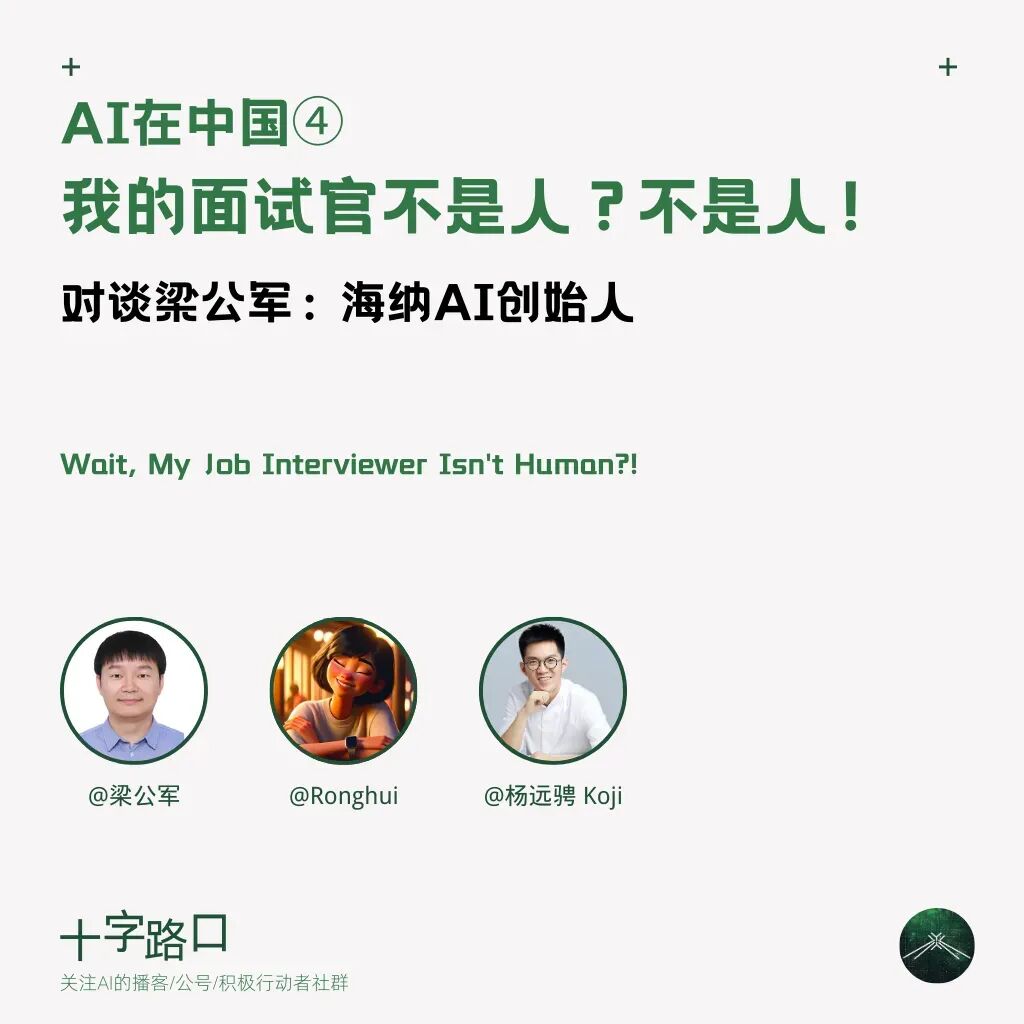
Koji: "My history with Gongjun Liang goes back to my 'Wudaokou era.' I'd just graduated from Beihang University, right as the web 2.0 wave was hitting. I was working under Xing Wang as a product manager on Fanfou and Hainei. My entire life — work, entertainment, socializing — revolved within a one-kilometer radius of Wudaokou, centered on Huaqing Jiayuan. That's where I first met Gongjun. At the time he was founder of Xianguo, a product as beloved as Zhuaxia, an RSS reader that had essentially captured the entire community of serious readers."
When we learned that Gongjun had founded Hina AI, our first reaction was disbelief. A founder who'd built a killer consumer product for knowledge elites — how did he end up charging into B2B? And not just any B2B, but blue-collar recruiting, about as down-to-earth as it gets.
This week on Crossing, we'll talk with Gongjun Liang about his journey as a founder: how to choose, how to trade off, how to persist — lessons that should resonate with anyone in their career. We'll also dig into AI, B2B, and enterprise management, hearing from an AI founder who's actually gotten results about what insights, methods, and hard-won secrets he can share.
Listen on WeChat:
Listen on Xiaoyuzhou:


From Xianguo to Hina: Liang's Entrepreneurial Pivot
🚥 Koji
First question, and the one everyone's curious about: Why did you deliberately walk into what's widely considered a minefield — choosing to do B2B in China?
👦🏻 Gongjun Liang
After Xianguo wound down in late 2014, I spent six months recharging and thinking, systematically analyzing the major transformations China might see over the coming decade. I identified three enormous variables: blockchain, AI, and the Internet of Everything. I ultimately chose to focus on AI.
2015 was an inflection point for China's internet: two decades of consumer internet behind us, with industrial internet and B2B ahead. The major structural opportunities in B2C were already scarce, so I judged the future direction to be B2B combined with AI as the biggest variable. I then founded Taiji Angel Fund with several former colleagues, focused exclusively on B2B investing. We analyzed over twenty major B2B industries one by one, looking for high-frequency transaction scenarios that could be structured and standardized, exploring where the AI variable might compound. We ended up investing in nearly 30 companies.
In 2016, I began systematically researching the massive human resources industry. I broke the entire industry down into over 300 segments, with recruiting alone containing 37 distinct links. Comparing China and the US, one pattern stood out: China's labor force of 800 million is four times the US's 210 million; average annual compensation in China is roughly 40% of US levels. This means China's HR market is about twice the size of America's.
Yet at that time, the US already had 20 publicly traded HR companies valued above $5 billion, 10 of which exceeded $10 billion, with ADP reaching the $100 billion level. China had only one company above $5 billion — BOSS Zhipin — with others stuck in the $1-1.5 billion range.
Why such a gap? Several core reasons:
- Extreme fragmentation: over 100,000 companies dividing a trillion-RMB market
- Low per-capita productivity: Chinese firms averaged ~300,000 RMB annual output per employee, versus $300,000-400,000 in the US — a tenfold gap
At root, it's a talent standardization problem.
Without solving this core issue, any other optimization is just scratching the surface, unable to fundamentally improve industry efficiency.

The Deeper Logic Behind Choosing B2B
👦🏻 Gongjun Liang
In searching for solutions, I discovered the US case of HireVue. Founded in 2011, funded in 2012, and taken private by Carlyle Group in 2019. HireVue's model was fascinating: focused exclusively on mega-conglomerates, starting from campus recruiting and gradually expanding into hourly worker hiring. They've now captured 80% of America's top 100 employers, conducting 20 million interviews annually, generating $300 million in revenue at $15 per interview.
🚥 Koji
Actually you're already at ten million, so the gap with their twenty million doesn't even feel like the same order of magnitude.
👦🏻 Gongjun Liang
Right — this is precisely the most striking advantage of China's unified large market. Entrepreneurship in China is actually quite fortunate: even when you切入 a very narrow niche, if you truly go deep and thorough, the ultimate scale can still be substantial. Especially with the emergence of large language models, society has reached consensus: for any complex problem, once scale crosses a certain threshold, solutions become findable.
Drawing on HireVue's success, we began exploring domestic possibilities. We first analyzed China's top 100 positions by employment volume. Take delivery couriers: 20 million nationwide. We started with industry leader SF Express, then expanded to JD.com and Cainiao — progression became relatively smooth from there. Or retail store clerks: roughly 15-16 million nationwide. We began with Walmart as a bellwether, then extended to China Resources and other retail chains — this path also proved workable.
🚥 Koji
Hina AI has already achieved some traction, with blue-collar recruiting as your entry point. After establishing this foothold, where else can this go?
👦🏻 Gongjun Liang
We're progressing through China's top 100 positions by employment volume, which naturally covers migrant workers flowing between regions, urban chain service workers, and manufacturing labor. Next we'll move upward to cover more mid-to-high-end services and white-collar segments. Once we complete the top 500 priority positions domestically, we can naturally extend into adjacent services: AI-powered precision training, AI job-candidate matching, and certification testing.

Structural Opportunity in the HR Market
🚥 Ronghui
This sounds like an enormously ambitious undertaking. But as you said earlier, after detailed decomposition and analysis, the core issue remains solving talent standardization as the foundational link.
Here's my question: This appears to be the hardest bone to chew in the entire HR value chain. Why hasn't anyone succeeded before? I suspect others must have tried — why did they fail?
👦🏻 Gongjun Liang
Excellent question. Previous approaches all used relatively traditional methods without deploying the most advanced technical tools. This created two major problems: first, assessment granularity relying on expert experience wasn't sufficiently fine-grained; second, evaluation dimensions couldn't be effectively quantified.
It's precisely the emergence of AI technology that makes this goal achievable — transforming talent assessment into a large-scale AI quantitative evaluation instrument, like a precision laser weapon.
🚥 Ronghui
Since you've both invested in and built B2B companies, you must know this space intimately. Previously, whenever our guests discussed B2B markets, they'd just shake their heads and sigh — it sounds brutal.
👦🏻 Gongjun Liang
Nearly everyone in B2B tells the "cost reduction and efficiency improvement" story.
But whose efficiency gets improved, whose costs get cut — this directly triggers organizational restructuring and optimization, which provokes significant pushback.
This pushback manifests during implementation and product rollout as deliberate or unconscious delays, obstruction, and various other problems.
We started this venture in 2019. Our first mega-group client was also China's first enterprise to fully deploy AI interviews company-wide — a replacement-level application affecting hundreds of thousands of employees. This was inherently revolutionary, directly changing how massive numbers of employees worked, involving workflow restructuring, process optimization across multiple layers. Too many interest nodes were involved; every link faced questioning and challenge. Looking back now, these constant trials were constantly tempering us.

The Founder's Anchor Point
🚥 Ronghui
Getting hammered that much — didn't you ever feel like quitting?
👦🏻 Gongjun Liang
The hammering was also helping us refine the product and elevate our service.
On top of that, because we had already broken down the foundational structural logic at the earliest stage, I had established a solid value anchor point in my mind.
When facing various entrepreneurial challenges, this anchor point overrides everything else.
If this anchor point isn't firm enough, it's easy to be shaken by outside voices and pressure, ultimately causing the entire endeavor to fall apart halfway through.
🚥 Ronghui
Does this also have something to do with your personality?
👦🏻 Gongjun Liang
It certainly relates to personality, but after more than 15 years of entrepreneurship and investing, I no longer rely on personal preferences or personality to make decisions. I return to the logic of the matter itself.
If you look at things from a five- or ten-year perspective, and the underlying logic of something is destined to materialize, then you do it with conviction. The problems encountered along the way are all trials that fate gives us. This energy is sometimes positive, sometimes negative — the key is knowing how to convert negative energy into forward momentum.
🚥 Koji
These days we advocate a certain value: understand yourself, see yourself, so you can live and work better, making every day fulfilling and meaningful, thereby maintaining resilience physically and emotionally.
But your sharing resonated with me as a "small-town test-taker" — we've been accustomed to constantly solving problems since childhood, even actively creating problems for ourselves. In this process, we often neglect our own emotions, rarely asking: do I actually enjoy this problem? Am I fully unleashing my potential in this process? I wonder if you've had similar feelings?
👦🏻 Gongjun Liang
Five years ago, ten years ago, I did have such doubts. But now I think this way: entrepreneurship is essentially a tug-of-war between personal inclinations, preferences, interests and social good.
To do entrepreneurship well, these two must achieve resonance — your personal preferences, inclinations, and emotions must align with the direction of the venture. But this is genuinely difficult.
Therefore, at least for my personal choice, I try to set aside all emotions, set aside personal impressions and preferences, and look at the essential logic of things from an objective perspective.
In the past three or four years, I've had some profound realizations. During this period, all Chinese startups have faced severe challenges, and Hina was no exception. This led me to think more deeply: what do we ultimately pursue? I believe it's maximizing social value.
In currently popular terms, this is "heavenly mandate" (tianming). Only when you find your heavenly mandate and combine it with your personal destiny can you accomplish something significant.
🚥 Ronghui
This is exactly what I wanted to ask. You mentioned being able to set aside personal emotions and view things purely from a logical angle, pursuing an extremely rational state. Indeed, many excellent entrepreneurs do this. But how do you get team members to establish this same mode of thinking?
👦🏻 Gongjun Liang
This is genuinely counter to human nature. We can only seek the greatest common denominator and find a balancing pivot point.
I myself went through a transformation in this regard: early on I would try to guide, even demand that others align with me, but later discovered this wasn't realistic — everyone has their own ideas. Eventually I realized that the best management approach is: ensure the team agrees on bottom-line principles, and that's enough. Other aspects don't need to be overly idealized.
🚥 Ronghui
You mentioned you started this in 2019. So was the pandemic that happened later a major inflection point?
👦🏻 Gongjun Liang
Yes, if there had been no pandemic, companies like SF Express and Walmart wouldn't have adopted it on such a massive scale.
🚥 Ronghui
Although this was a terrible thing, did you feel at the time that an opportunity had arrived?
👦🏻 Gongjun Liang
Yes, I believe any major human or social crisis will inevitably bring about foundational structural restructuring and innovation.
The pandemic was exactly such a case — otherwise it would have betrayed all the suffering people endured.

Beyond "Cost Reduction and Efficiency Improvement": Repositioning To B Product Value
🚥 Koji
When you previously spoke with us, you mentioned that China's To B companies are all pushing cost reduction and efficiency improvement, but this raises a question: whose costs are being cut, and whose efficiency is being improved?
In this process, senior leadership naturally supports the push, but frontline employees often have concerns and resistance, worrying that ultimately their own jobs will be sacrificed. Do you think this is a universal dilemma currently facing all To B companies?
👦🏻 Gongjun Liang
Yes, the point Koji just raised is actually a predicament that almost all To B companies encounter.
🚥 Koji
Do you think the industry has now realized the dilemma of being unable to use "cost reduction and efficiency improvement" as the main selling point? If so, what different solutions have various companies adopted?
👦🏻 Gongjun Liang
I've observed that the industry is still repeatedly trying down the "cost reduction and efficiency improvement" path. Very few companies can truly jump out of this framework and think about this issue from the strategic height of the corporate decision-making layer.
This is also why we completely shifted our thinking in the past two years, approaching it from the CEO perspective, and ultimately distilled two core strategic cards: first, the safety card, which is controlling employment risk; second, the standards card, which is unifying standards across all branches and stores of the entire group.
🚥 Koji
Why is the safety card so important, even ranking it before the standards card?
Indeed, employment safety issues occur frequently. Recently multiple chain brands have had related social controversies. Looking back at earlier cases, such as DiDi's Hitch service, which caused serious social safety incidents due to lax driver screening, resulting in vicious impacts including harm to women.
👦🏻 Gongjun Liang
The importance of such employment safety issues domestically will continue to rise, inevitably triggering high-level attention from government and major groups, especially at the group CEO level. For a company with 100,000 employees, even a single safety incident involving one person could cause fatal damage to the entire corporate brand.

AI Interview's Safety Dimension: Background Checks and Behavioral Assessment
🚥 Koji
I'm curious — when using AI to interview employees, how do you safeguard applicant safety through questioning and evaluation? What specific dimensions do you focus on?
👦🏻 Gongjun Liang
Mainly two major aspects. The first is background checks.
🚥 Koji
So you use AI for background checks?
👦🏻 Gongjun Liang
Our safety verification has two main components:
First is identity verification, requiring applicants to hold their ID card for facial recognition verification. At the same time, we connect with relevant databases to verify whether the person has negative records such as overdue online loans.
Second is behavioral assessment, mainly focusing on the applicant's behavioral state, particularly detecting whether there are tendencies toward self-harm or antisocial personality traits.
🚥 Ronghui
How is this verification implemented?
👦🏻 Gongjun Liang
We have a professional team of about ten people, all applied psychology experts from Peking University and Beijing Normal University. Our safety assessment operates on three levels:
First is written scale assessment, similar to traditional psychological evaluation methods. But written scales have clear limitations: they typically contain one to two hundred questions, and test subjects easily become fatigued and answer randomly, resulting in reliability and validity of only about 70%.
Second is micro-movement analysis. We require applicants to do grasping motions in front of their phones. This not only assesses wrist flexibility and work capability, but also allows observation of whether there are self-harm marks. Our psychology experts have summarized 28 key behavioral characteristic indicators.
Third is gamified assessment. During gameplay, a person's emotional reactions can be expressed more authentically. For example, when the game ends, if the test subject continues tapping on the screen, this may indicate difficulty controlling emotions under high-pressure situations, warranting further attention.
🚥 Koji
This indeed enables more comprehensive employment safety assessment than traditional phone interviews or ten-minute in-person conversations. However, employment issues are often tied to a family's source of income and happy life. If an assessment produces a false negative, not only might someone lose a job opportunity, but it could also cause psychological harm to the job seeker — these are all very serious issues.
I'm curious, what adversarial policies or mechanisms have you adopted to minimize false negatives and reduce negative impacts on job seekers?
👦🏻 Gongjun Liang
On the fairness and ethics of AI recruiting, there has been extensive discussion both in the United States and domestically. Hina has two core perspectives on this:
The first perspective is that traditional human interviews contain more unfairness — interviewers' emotions and subjective preferences have significant impact on candidate evaluation, and there is no appeal mechanism.
The second perspective is that AI interviews can achieve 24-hour precision and consistency, evaluating according to unified standards, thereby guaranteeing greater fairness. It executes evaluation standards in a completely objective manner.
Our philosophy is: matching people with different characteristics to suitable positions. For example, someone with strong service consciousness is suitable for frontline service positions; someone who needs to improve emotional management is more suitable for back-office or "four walls" positions. "Four walls" here is a professional term in blue-collar recruiting, referring to relatively independent work environments, such as assembly line workers, warehouse administrators, and similar positions.
🚥 Ronghui
How do you price? Because I saw in a previous interview you actually mentioned pricing. It seemed blue-collar was 10 yuan per person, white-collar was 20 yuan per person. Has anything changed?
👦🏻 Gongjun Liang
Our pricing standard is 10 to 20 yuan per person. Through actuarial analysis, traditional human interview costs are 100 to 200 yuan per person. In other words, our AI interview solution is only one-tenth the cost of traditional human labor.
Beyond cost advantages, this new model has additional value: it helps companies build a talent video database for subsequent talent analysis, talent activation, and re-engagement across multiple stages.

Highlights and Darkest Moments
🚥 Ronghui
In the process of building Hina, have there been any highlight moments and darkest moments?
👦🏻 Gongjun Liang
The first highlight moment was on April 17, 2021, when SF Express's top boss decided that the entire group's technical positions would 100% use Hina.
🚥 Koji
So if I were to interview with SF Express right now, the person on the other side would be Hina's AI?
👦🏻 Gongjun Liang
Yes, exactly.
Last month we launched the Hina 2.0 initiative. The core goal is to develop three to five enterprise-group clients with annual revenue exceeding 5 million RMB. During the Hina 1.0 phase, I led the team to focus all our energy on landing lighthouse clients like Walmart and SF Express. The hallmark of the 2.0 phase is making Hina's value truly manifest in price and annual contract value—avoiding the trap that 99% of Chinese B2B companies fall into.
Regarding lessons for surviving the darkest moments, I'd like to share two insights:
First, faced with a cacophony of voices, learn to filter out noise and zero in on the most critical problem to break through. Over the past six months, I've consistently emphasized "break through one thing per month, solve one problem per week." When problems are complex, identifying and resolving the most fatal one is often the key to breaking the deadlock. It's like a battlefield with bullets flying everywhere—there may be only one truly lethal round; neutralize it and the crisis dissolves.
Second, the most important thing on the entrepreneurial journey is finding "destined companions"—people fated to do this very thing. Their life trajectories and accumulated experience all point toward this moment. For them, choosing Hina represents the optimal choice for the next decade or even longer.
Finding several such destined companions is crucial for a team to survive life-or-death trials. Ten thousand kilograms of pressure on one person is fatal; distributed among three to five people, it's grueling but survivable. If you can find like-minded destined companions to pursue a shared mission together, the probability of success increases dramatically.
🚥 Koji
What you said reminds me of an article I read today—"Why Was I Thinking About a Tree This Morning?"[1]
The article describes the survival wisdom of redwood trees: these towering giants—people often assume their roots run deeper than a 30-story skyscraper. But in fact, the secret to their typhoon resistance lies in interconnected roots. Redwood root systems are actually quite shallow, yet every tree in the forest is tightly linked to surrounding redwoods through its roots. They aren't competing; they're connecting. No single tree is truly independent. It's this interconnection that allows them to collectively withstand floods and typhoons, remaining stable, strong, and resilient.
For entrepreneurs, if fate brings together a group willing to join hands and face the storms together, that is extraordinary fortune.
👦🏻 Gongjun Liang
Yes, I completely agree. Form a value community, a symbiotic entity, and ultimately let this symbiotic entity constitute an ecosystem.

Entrepreneurship Is a Journey Against Human Nature
🚥 Ronghui
I'd like to ask: in this process, when you discover that something you previously believed in and invested enormous energy into was actually wrong—what does that feel like?
👦🏻 Gongjun Liang
Entrepreneurs must deconstruct the entire entrepreneurial process into a series of sub-stages. Treat each stage as a fresh start; if problems or structural obstacles emerge in any stage, adjust decisively. Follow the principle of "fail fast, pivot promptly"—carry no baggage. Have the courage to negate past decisions, and face the next stage's challenges with entirely fresh perspective and posture. This is absolutely critical.
The most dangerous thing on the entrepreneurial path is the accumulation of emotional and historical baggage.
The more baggage you carry, the greater the hindrance to entrepreneurship. Therefore, the moment you recognize a problem, immediately release emotional attachments and make decisive adjustments.
🚥 Koji
This brings to mind the saying "we understand all the principles, yet still can't live this life well"—truly, knowledge and action are hard to unite.
But honestly, I have some concerns about the advice to "compartmentalize emotions." At least for me, it doesn't apply; I can't completely isolate my emotions.
Do you have methods for persuading or comforting yourself? Ways to help compartmentalize emotions and adjust your state more quickly?
👦🏻 Gongjun Liang
This comes back to the value anchor point. When I founded Hina, I established a 20-year value anchor point.
This thing is inevitably going to happen at the level of underlying logic—if not Hina, some other company would do it.
With such a firm value anchor point standing like a lighthouse, we maintain direction. As for the various twists and turns along the way, they're merely necessary paths toward the goal.
🚥 Ronghui
I think you're a very determined person.
👦🏻 Gongjun Liang
A mentality I've cultivated is to always treat my previous self as an idiot.
The more you defend and justify your previous self, the more energy you expend.
Especially for entrepreneurs—you're not just spending your own energy, you're spending the prime years of the brothers behind you on the team.
🚥 Koji
I'm curious how you view this issue, Gongjun. There's a perspective now that many people feel unhappy and unfulfilled because they choose to bury rather than process the negative emotions from their growth process. These neglected emotions may lurk like a black dog, suddenly appearing one day to devour you.
On social media today, a widely endorsed view is: we should take every negative emotion seriously, confront it, process it, reconcile with it, and only then move forward—this is how we can truly advance with lightness.
How do you view this perspective? Would you consider people who do this weak?
👦🏻 Gongjun Liang
I respect this perspective and choice; everyone has the right to choose the lifestyle that suits them. But entrepreneurs are a special group—the bravest among people. They cannot afford to immerse themselves excessively in self-reconciliation. For me personally, this inner reconciliation may have to wait until after age 90. Right now, we should shoulder the mission of entrepreneurship.
A core point I mentioned earlier:
The essence of entrepreneurship is finding a value fulcrum, and this value must be social value, not personal value.
🚥 Ronghui
I think what you're describing is an art of entrepreneurship. Many say startup failure often happens because the founder gave up—because there was no anchor point, no ability to persist.
Your earlier mention of promptly negating past decisions reminds me of a story about "closing the door behind you"—don't carry the baggage of the past. This is indeed an art that's extremely difficult to master; very few can truly achieve it.
Precisely because entrepreneurship is so difficult, I'm curious if there are any entrepreneurs or business leaders you particularly admire or have learned from? What inspiration have they given you?
👦🏻 Gongjun Liang
Elon Musk is pretty good.
🚥 Ronghui
I guessed you'd say that person (laughs).
👦🏻 Gongjun Liang
I recently came across something Musk said that deeply resonated with me:
"Entrepreneurs shouldn't fear being disliked. Wanting to be liked by everyone is a fatal weakness."
Looking back at decisions from five or ten years ago, I now recognize where the problems lay.
Entrepreneurship is fundamentally an act against human nature. Having chosen this path, accept that it won't be a likable endeavor. The entrepreneurial process constantly encounters ordinary people's incomprehension; facing doubt, dislike, even loathing is normal. If you care excessively about your own emotional fluctuations or others' negative evaluations, you're not suited for entrepreneurship.
🚥 Ronghui
If you've read the Musk biography, it does show he paid enormous costs—both his own happiness and that of those around him.
👦🏻 Gongjun Liang
This is normal, because the law of conservation of energy applies equally to entrepreneurship. To create something new, you must pay an equivalent price in energy and cost. The greatest consumption often comes from the founder themself. This reminds me of ancient Chinese swordsmiths who, to forge the perfect blade, would pour their entire life energy into the process.
🚥 Ronghui
Can you tell us about a difficulty that exceeded imagination?
👦🏻 Gongjun Liang
For To C products, the decision chain is very short—end users might purchase based on just 1-2 seconds of pleasant experience. But To B is completely different. Its decision chain is extraordinarily long: a systematic, rigorous, drawn-out process involving numerous decision-makers.
This complexity causes project timelines to far exceed expectations: it took us 13 months to land SF Express, and 10 months for Walmart—both far beyond our initial projections.
🚥 Ronghui
What was your original expected timeline?
👦🏻 Gongjun Liang
Two to three months. But we discovered the work required far exceeded expectations—not just technical challenges, but massive amounts of internal coordination. Here, I want to pay tribute to all entrepreneurs who have spent the past decade deeply cultivating China's To B sector. They have made tremendous efforts to advance China's industrial internet development and promote social progress.
🚥 Ronghui
For instance, with these two clients taking so long, when you finally signed, was it a numb feeling, or were you still extremely excited, or something else entirely?
👦🏻 Gongjun Liang
When we finally signed with SF Express, we genuinely felt exhilarated. Because SF Express became the world's first enterprise group to adopt AI interviewing across the entire group and at full scale. We're blazing trails in many respects, walking a path no one has taken before.
🚥 Ronghui
You're such a rational person. What do you do when you're especially happy?
👦🏻 Gongjun Liang
When happy, sleep. The next day everything's gone. Whether happy or pessimistic or unhappy from the previous day—eat when you should eat, drink when you should drink, then sleep. Everything refreshes; it's another day to start anew.
Advice for To B Entrepreneurs
🚥 Ronghui
Give our To B entrepreneurs some key takeaways.
👦🏻 Gongjun Liang
For all To B entrepreneurs, because this path is so long, so complex, so difficult—it consumes enormous energy from founders and teams alike. So you must find a solid value anchor point. Ideally, this anchor point comes from your own systematic, in-depth analysis, validated repeatedly with at least three to five experts, confirming this is an inevitable trend.
Once this direction is set, what remains is upgrading and battling monsters day after day, month after month, year after year. Just like Sun Wukong's journey to the West—once you've determined your heaven-ordained mission, next comes passing through eighty-one tribulations, breaking through one barrier after another. In this process, everyone is enduring the same pressure and difficulties; the key is who can persist to the end. This is a competition of relative competitive advantage—one more degree of persistence may make the king.
Over the past five years, I've focused exclusively on serving large enterprise groups with 100,000+ employees. One profound realization: once you've landed the number one and number two benchmark companies in an industry, then expand to the mid-tier enterprises.
🚥 Ronghui
Landing lighthouse customers is genuinely difficult for ordinary entrepreneurs. Your background and credentials give you the ability to impress these large enterprises, but many founders lack such advantages. What advice would you give them?
👦🏻 Liang Gongjun
I have two suggestions on this: First, you can choose to join a platform like ours; second, you can become a partner to large system integrators, participating in a specific segment and leveraging the strengths of big enterprises to grow.
Additionally, I'd like to point out a common misconception: many To B entrepreneurs prefer to start with SMEs. This strategy is actually problematic:
- SMEs have limited lifecycles — a client you close today may disappear tomorrow.
- China's current To B commercial environment hasn't yet developed to the point where businesses are willing to pay for cost reduction and efficiency gains. Even large enterprises struggle to achieve reasonable returns on value; charging SMEs is even harder.
🚥 Koji
Thank you, Liang Gongjun, for sharing so much valuable experience today. I admire that you've found your entrepreneurial anchor point — you even describe this mission as your "calling." What's rarer still is that you've found like-minded partners to pursue this goal together.
In my view, the significance of Hina AI's work runs deep. Because behind solving employment problems lie the futures of countless individuals and the happiness of countless families. I sincerely wish you continued progress in your work, and that you can enjoy this entrepreneurial journey along the way.
👦🏻 Liang Gongjun
Thank you, Koji, and thanks to Ronghui for sharing these stories together.
The past five years have been a dark time for Chinese society. Looking ahead, the entire society and industry will continue to face severe challenges. Particularly under the new international circumstances, with Donald Trump's re-election as US President, China's economy will face greater pressure — including in overseas expansion and other areas where various obstacles will emerge.
Against this backdrop, we need entrepreneurs to meet challenges with even greater energy. Because entrepreneurs are the most energetic, creative, courageous, and responsible group in society. If this group loses its fighting spirit, the entire society loses its vitality and hope.
So at this moment, we must encourage each other, cheer each other on, and work together to do things better.
Subscribe to the "Crossing" Podcast
🚦 We follow the industry transformations and new entrepreneurial opportunities brought by the new wave of AI technology. "Crossing" is Steve Jobs's metaphor for Apple — standing at the intersection of technology and liberal arts, where great products are born. AI is transforming every industry; we seek out, interview, and unite "active doers" in the AI era, exploring and embracing new changes and new possibilities together.
🚥 Host Koji: Co-founder of The Fair and Tangdao. I believe technology, especially AI, will fundamentally transform society and empower humanity. Welcome to reach out, exchange ideas, and connect on what's next. Koji's Jike[2], Koji's website[3]
🚥 Host Ronghui: Works at a tech VC, former Silicon Valley correspondent for CBNweekly. Ronghui's Jike[4]
Join the "Crossing" Membership Community
☀️ First-hand AI news and insights
👫🏻 We encourage everyone to date/make friends/find future collaborators
🦀 Add our assistant on WeChat to join: Rwkfbcianvd, or scan the QR code below


References
[1] Why I'm Thinking About Trees This Morning?: https://michelehornish.substack.com/p/why-im-thinking-about-trees-this
[2] Koji's Jike: https://okjk.co/0JSUes
[3] Koji's website: https://koji.super.site/
[4] Ronghui's Jike: https://okjk.co/0cbnYV