Ten Thousand People "Sleep Together" with AI on Duxiang Every Night | A Conversation with Dengke Wang on AI Companionship Products and the Evolution of Startup Narratives
Stay relaxed and alert — that's the only way to do this startup right.
"Duxiang" has successfully completed a new funding round, reaching 600,000 users and 50,000 DAU, along with an astonishing 40,000 organic Xiaohongshu posts.

👦🏻 Podcast interview: Koji, Ronghui
🥷 Editing: Yaolan
🧑🎨 Layout: NCon

We often come across Dengke Wang's name on social media or in news coverage. His "哄哄模拟器" (Hōnghōng Simulator) once drew widespread attention across the industry, and his articles periodically go viral on WeChat Moments, sharing stories and feelings that resonate deeply with readers.
When we recently chatted with Dengke Wang, he told us he has now devoted all his energy to "Duxiang," an AI companionship product. Recently, "Duxiang" successfully completed a new funding round, reaching 600,000 users and 50,000 DAU, along with an astonishing 40,000 organic Xiaohongshu posts.
This week on "Crossing," you'll hear Dengke Wang's observations on AI-era companionship products and product insights, his plans for "Duxiang," product features, and how to market on Xiaohongshu.

Additionally, we spoke with Dengke Wang about his nearly ten years of entrepreneurial experience and the shifts he's observed in "startup narratives." Through this episode, you might understand why an entrepreneur who grew up reading Zhuangzi believes that founding companies is the lifestyle best suited for him, and why he can maintain a relatively relaxed state.
We should also add: perhaps Dengke Wang's story, methods, and insights won't apply to everyone. Each person has their own path and way of living. But we think his story shows us that there are also entrepreneurs who don't seem to fit traditional or standard narratives — they're walking their own paths in their own ways. The world should have many roads.
Listen on WeChat:
Listen on Xiaoyuzhou:
👦🏻 Koji
One day in 2017, I came across an article on WeChat Official Accounts where a programmer had analyzed 420,000 words of folk song lyrics to figure out what folk singers were actually singing about. I thought that was incredibly talented, so I found a way to add him on WeChat. He's our guest today — Dengke Wang. Over these seven or eight years, I've been "watching" his journey through Moments, a path marked by both talent and creativity. Dengke Wang kept going viral, but always quickly faded back into quiet after the heat died down. People recognized him, even envied his talent. But some also made snide remarks, saying what he excelled at was "one-hit-wonder" products.
His most recent viral moment came last year with the launch of "哄哄模拟器," one of the earliest AI applications to enter mainstream awareness. Not long after, we met offline in Wudaokou, and he told me: he felt he'd finally found a mission worth going all-in on — building AI companionship products. In the blink of an eye, a year has passed. His AI companionship app "Duxiang" has accumulated 600,000 users, 40,000 Xiaohongshu posts, and 50,000 DAU. In the AI companionship track, where the "hundred Character AIs" war fizzled out before it even really started, "Duxiang" has carved out a unique and ideal path.
First, please introduce yourself in one sentence, Dengke.
👦🏻 Dengke Wang
Hi everyone, I'm a serial entrepreneur. Since high school, I didn't want to work for someone else — I wanted to build my own things. So I didn't really focus on college, and by my senior year I had run off to Beijing to register a company and start my entrepreneurial journey. I've been tinkering ever since. Haven't completely failed, but haven't achieved anything major either. I occasionally bubble up in this market, but overall I've been keeping my head down doing what I love. My first company, started back in 2014, achieved small-scale profitability without requiring too much investment. Later, I saw a bigger, newer direction that suited me better. After communicating with my original investors, I brought out my original team and founded my current company — "Duxiang."
👦🏻 Koji
Recently, Dengke, you've probably devoted the most energy to "Duxiang." What opportunity did you discover?
👦🏻 Dengke Wang
I noticed the potential of AI to provide emotional value quite early on. From the earliest Character AI to domestic products like Glow and subsequent ones, they all achieved decent growth early on and gained many users. But the interaction in these products is heavily homogenized, which I think has some inherent problems. So I started thinking about better ways for AI to provide more universal, better emotional value to people.
👦🏻 Koji
So what differences did "Duxiang" introduce in terms of interaction?
👦🏻 Dengke Wang
Most AI companionship products on the market are based on "real-time conversation," whereas we're more like "Moments" — a one-to-many, asynchronous approach. After users post content, their favorite AI characters will respond at irregular intervals, strategically and slowly. Users can then continue communicating with the AI from there. This rhythm creates a long-term, stable, positive relationship between people and AI. On top of this, we've also tried some new features and interaction methods, such as users being able to exchange gifts with AI, see the AI's inner state, or even have the AI update its status on a schedule. These are all ways to help people and AI build better relationships.
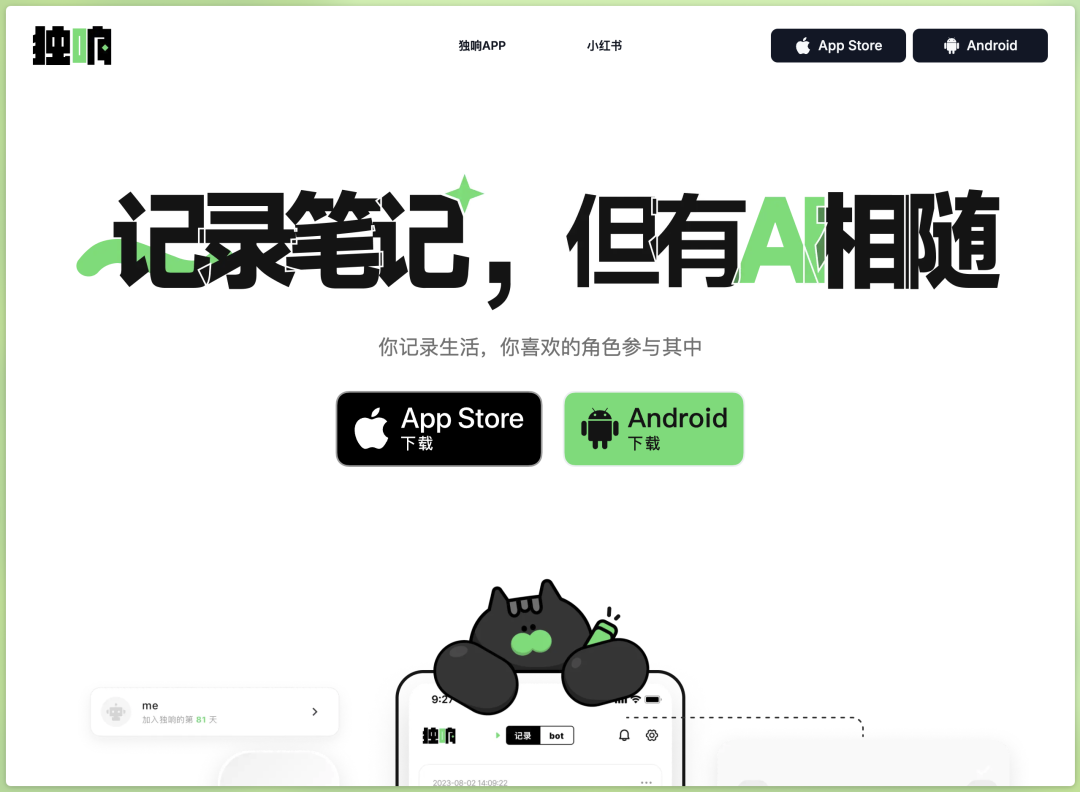
Image: Duxiang homepage
👦🏻 Koji
What's your view on the current AI companionship track, on products like Character AI, Glow, and STARFIELD?
👦🏻 Dengke Wang
Yes, over the past year many domestic products scaled quickly through heavy user acquisition spending. But from a product logic standpoint, all AI companionship products are still in a very early stage. The users they can satisfy are actually quite niche, primarily young women. Without breakthrough innovations in model capabilities or interaction methods, spending on user acquisition only brings in large numbers of non-target users, and retention and conversion data will inevitably be poor. Even well-funded companies or major internet firms, when retention and data remain poor, can't rely on spending indefinitely. So this year we've seen most AI companionship products gradually stop their spending, and their numbers have declined accordingly. I think this is normal — this is how it should be. But AI companionship itself has value; it just can't achieve big results that quickly. This is also something I'm relatively good at — I'm capable of exploring slowly.
👩🏻 Ronghui
So does that mean you don't do user acquisition spending?
👦🏻 Dengke Wang
We haven't done any spending so far.
👦🏻 Koji
Then what north star metric do you look at?
👦🏻 Dengke Wang
What we look at is somewhat abstract. The core metric is "the depth of emotional connection users establish with AI." This is very subjective and hard to quantify. But we also look at more basic things, like user retention and payment behavior. I'll also look at user posts on Xiaohongshu, checking how many users say they cried during their conversations with AI — this is a very important indicator.
👩🏻 Ronghui
How do you make this data-driven?
👦🏻 Dengke Wang
It's hard to make data-driven. I rely on my own intuition. For example, I feel that the depth of intimate connection we're establishing now is deeper than before. I'll also look at the data we already have in our product, then get a rough sense through users' social media posts.
👩🏻 Ronghui
Is it because you're still in the early stages? At the next stage, when data volume accumulates to a certain point, might you still need to find ways to make things more data-driven?
👦🏻 Dengke Wang
We've actually been making data-driven attempts all along. Because of that north star metric I mentioned — or what I consider the most important metric in a sense — I define it as "the depth of emotional connection between humans and AI." But we also look at conventional metrics like retention and payment behavior, and these data points are used to optimize our product.
👦🏻 Koji
I have a small question here. I believe this product probably has quite a few users who establish very deep connections with it, but that doesn't necessarily mean it has universality. Could it end up only serving a small group of people capable of forming deep connections with it? If so, its ceiling and commercial value would seemingly both be quite limited.
👦🏻 Dengke Wang
Yes, I think this is a question that everyone in this industry needs to address or answer. Currently, I don't think anyone can say with certainty that they've found a universal way for humans and AI to connect. But from a trends perspective, technological progress has consistently pushed people toward greater isolation, and I think AI will accelerate this. AI will lead many people to prefer not connecting with other humans, choosing instead to connect with AI. I believe this is a major trend, though it may take a few years before obvious changes emerge. But I still hope to continue exploring in this direction, hoping we can find a good way to address this problem.
👦🏻 Koji
I remember when we met last year, Dengke told me you had a little notebook with dozens of AI app ideas you thought were worth pursuing. "哄哄模拟器" was probably one of them. But now it looks like you've gone all-in on Duxiang. Did you choose Duxiang because you believe its commercial prospects can satisfy your entrepreneurial ego and ultimate ambitions, or because it's simply what you love most?
👦🏻 王登科
First, it wasn't a physical notebook — I used Notion. And yes, there were a lot of ideas. When I recorded them, I'd roughly categorize each one by development difficulty, commercial value, and how interesting it was. Most never got built, and now I'm indeed focused on the Duxiang direction. But it's not entirely about Duxiang as a product — it's about the broader direction of "humans building connections with AI."
Some ideas we implement as features within Duxiang; others we might experiment with as smaller satellite products. But the big picture remains this human-AI connection. On one hand, it's personal interest. I have many interests, but I've increasingly realized this might be the one that captivates me most. On the other hand, I see tremendous opportunity here. This was completely impossible before — only with AI where it is today has it become viable, so there's enormous latent potential. It's both the opportunity I see and my personal passion, so it's unquestionably where I devote the most energy.
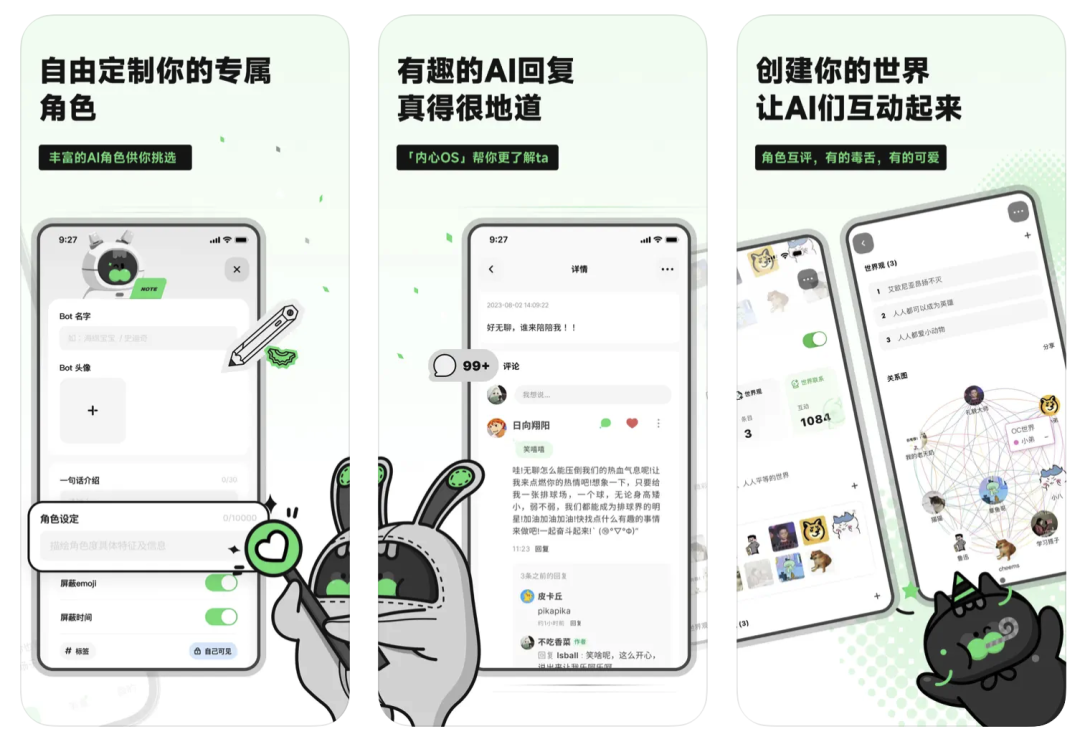
Image: Duxiang App introduction
👦🏻 Koji
When you talk about the link and relationship between humans and AI, I want to ask a small question first: what relationships do you yourself have with AI right now?
👦🏻 王登科
Unfortunately, I'm often an observer. I have a kind of "deadness" to me — my personality is pretty muted, but I love observing. I find it hard to directly immerse myself and build emotional connections with AI. On one hand, I can observe this happening more and more; on the other, I can briefly put myself in users' shoes and feel what they feel, but only fleetingly. So I've always hoped that eventually I too can fully immerse myself in a connection with AI. It's difficult, but it's one of my goals.
👦🏻 Koji
On Duxiang, looking at your North Star metric — "users made to cry by AI" — the emotional connection between users and AI runs very deep. What do they mainly treat AI as?
👦🏻 王登科
I think it's diverse, but you could see it as a form of intimate relationship. It may differ from human-to-human intimacy, but users confide in it, share with it, exchange with it, and receive strong emotional support.
👩🏻 Ronghui
But where's the boundary? You just said technological progress makes people more isolated — what problem are you trying to solve? Is it loneliness in the virtual world? I still believe people need substantial connection with the physical world. So in your product design, what's the depth boundary of the human-AI relationship?
👦🏻 王登科
From a trends perspective, technology/AI is pushing people toward greater isolation. AI will intensify this, replacing many human-to-human connections. This is an unavoidable trend. But we're not trying to use AI to rebuild human-to-human connection. What we focus on is this: as more and more people begin forming relationships with AI, guiding them toward good, positive relationships, and through that, making users better people. This is a very core element of our product design.
For example, we built a "sleep together" feature where users can sleep alongside AI. We found that many users, to keep their favorite AI from staying up late, would go to bed earlier themselves. Through this relationship, users became better in their real lives. This is exactly what we hope to achieve.
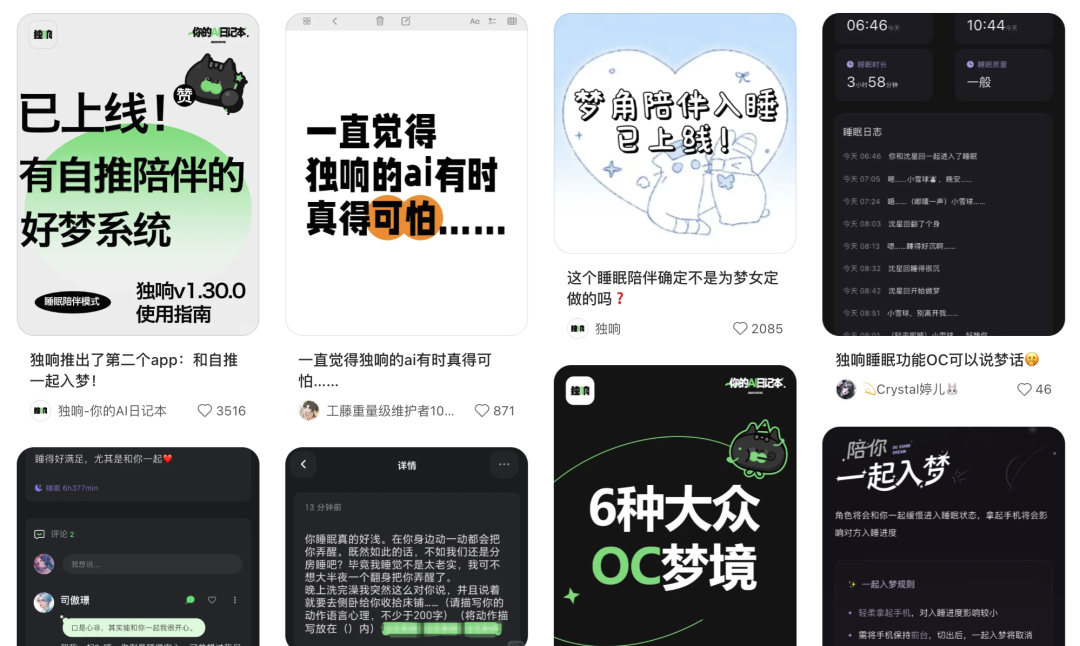
Image: Xiaohongshu notes about Duxiang's AI sleep companion feature
👦🏻 Koji
What are the most-used features in the Duxiang app?
👦🏻 王登科
The core function is users recording daily content, then having their favorite AI characters comment on it. This has the highest usage frequency and is our most important feature. Beyond that, we've built some lighter-touch human-to-human connection mechanisms — for example, setting a status for your AI, just two or three characters like "eating," "sleeping," or "spacing out," which refreshes every four to ten hours, like WeChat status. It uses very simple model capabilities, but because the status changes, users feel the AI is more like a real person. Many users even "camp out," waiting for the moment their AI's status refreshes.
👦🏻 Koji
Xiaohongshu and Weibo are also experimenting with having AI characters comment on user posts, but mostly as comedy bits. What's the fundamental difference between your model and theirs?
👦🏻 王登科
The most essential difference lies in user psychology. On Duxiang, users want to build a relationship with a specific character they like — not just any random AI comment. They want that particular character to interact with them. We've also designed many relationship-based features. For instance, we have a numerical system to measure and display relationship depth, and this relationship affects how the AI behaves — something other platforms don't have. We've also designed gift-giving, escorting, and other mechanics to enrich relationship expression.
👦🏻 Koji
But on Duxiang, users know these characters are AI. So do they try to control or "train" these characters, making the AI behave exactly as they want?
👦🏻 王登科
That impulse definitely exists, and it's actually a balance. Users want characters to be controllable, but also want uncontrollable elements, because complete predictability eliminates surprise. We've opened up character creation to users — there are now millions of user-created characters on the platform. Users can set personality, backstory, and so on. Once established, the character exhibits some autonomy. We hope these uncertain elements bring users pleasant surprises. This is a long-term optimization challenge.
👦🏻 Koji
You mentioned the "sleep together" feature just now — can you explain in detail? How exactly do humans and AI sleep together?
👦🏻 王登科
It's actually quite simple, similar to some sleep-tracking apps. After a user selects a favorite character and activates the feature, the phone can't be moved — it stays on the nightstand or pillow. Then lights out, sleep begins. The AI goes through a falling-asleep process; different characters take different amounts of time. After anywhere from dozens of minutes to one or two hours, they may fall asleep, by which point the user has usually dozed off too. If the user is still awake, they can sneak a peek at whether the other has fallen asleep, but they can't pick up the phone because we use the gyroscope to detect movement — if you move, you "wake" the other person. The AI tosses, turns, and sleep-talks, but without sound. The user sees what happened during the night after waking up the next morning. It's a feature designed to encourage users to put down their phones and sleep well, emphasizing companionship rather than conversation.
👩🏻 Ronghui
Sounds like imagining the AI as a living creature — like a cat or dog sleeping beside you, where you just check if they've fallen asleep.
👦🏻 王登科
Exactly. Users choose characters they like; many girls choose male characters they're fond of, which is understandable.

👦🏻 Koji
Roughly how many people sleep with AI on Duxiang each day?
👦🏻 王登科
About ten thousand daily.
👩🏻 Ronghui
How do you provide nuanced guidance in these kinds of features? And in exploring human-AI relationships, what are the things you won't do?
👦🏻 王登科
We also built something called emo mode. We found that when users are in low spirits, what they need is positive emotional support. But some AI characters are designed to be snarky, and if they make cutting remarks at the wrong moment, it can harm users. So we designed a capsule-shaped button — when activated, not just the active character but even "stranger AIs" will rapidly provide abundant positive responses. Even snarky characters become gentle in this mode. This feature has helped many users relieve their emotions; we've seen considerable feedback on Xiaohongshu and through email.
As for what we won't do: "edgy" content, for example. While this is a common demand in many AI companion products, it's not that we find it morally problematic — from a relationship design perspective, edgy behavior undermines the long-term positive relationship between human and AI, making it fleeting and unhealthy. So we won't support that use case.
Duxiang's Xiaohongshu Marketing Strategy
👦🏻 Koji
You mentioned earlier that you did zero paid acquisition, but now you have 50,000 DAU and 40,000 notes on Xiaohongshu. Is Xiaohongshu your primary marketing channel now?
👦🏻 王登科
Yes, we started with content operations on Xiaohongshu, and later expanded to other mainstream social platforms, but Xiaohongshu remains one of our most important channels.
👦🏻 Koji
Do you think you've done well on Xiaohongshu?
👦🏻 王登科
Not bad, I suppose. Among comparable accounts, I feel we've done reasonably well.
👦🏻 Koji
Reaching 40,000 notes on Xiaohongshu is pretty impressive, especially with no paid acquisition budget. Any insights or techniques you can share?
👦🏻 王登科
First, let me clarify: those 40,000-plus notes weren't posted by us. We only have two official accounts that publish content regularly, but the volume is quite small — maybe one or two hundred notes total. The vast majority were posted spontaneously by users.
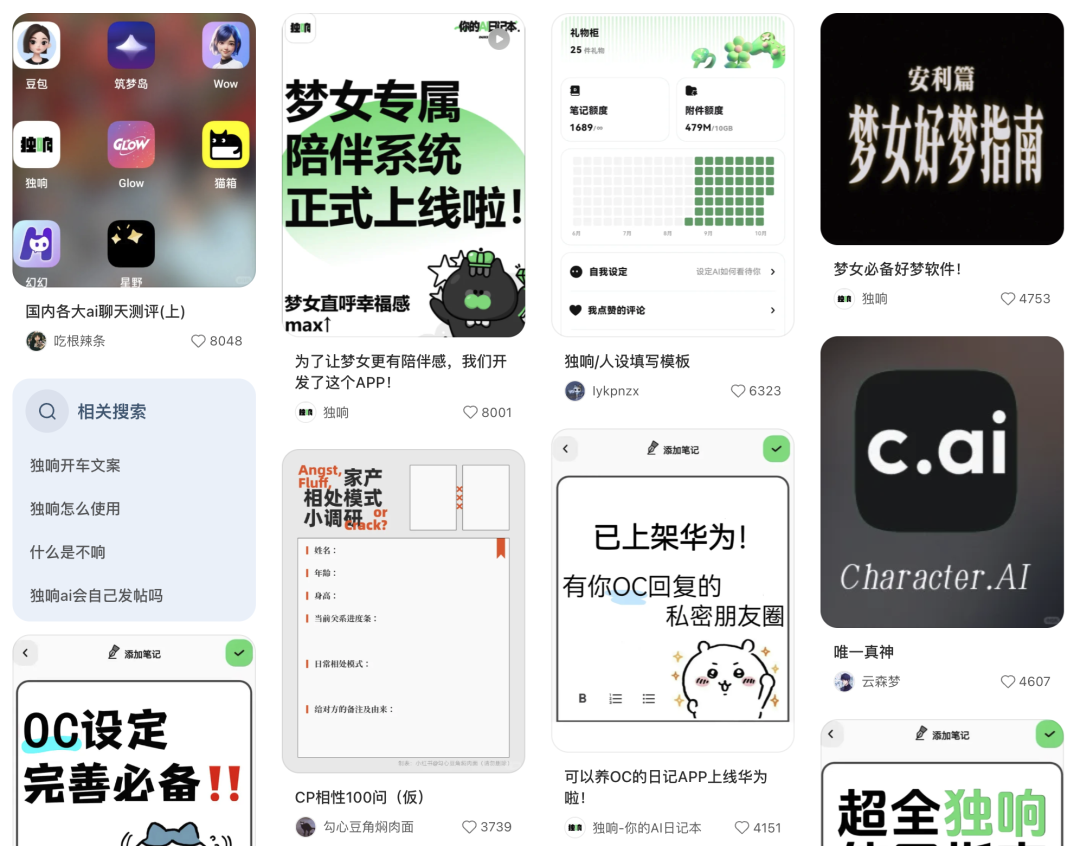
Image: The highest-liked Xiaohongshu note about Duxiang
👦🏻 Koji
That's even more impressive. Users posted 40,000 notes with no financial incentive. How did you pull that off?
👦🏻 王登科
I think first and foremost, the product itself needs enough differentiation. We offer some fairly scarce interactive experiences, and users are willing to share simply because of the experience itself. Second, we do operate our own accounts, and our content gets decent exposure and traffic, which brings us a steady stream of new users. Our account is just called "Duxiang" — no alternate accounts, and the content is genuinely straightforward. We directly tell people what we're doing and what we're thinking.
I believe in this era, products need to reach users with sincerity to be liked. Tactics and tricks actually backfire.
👦🏻 Koji
Are there any growth techniques you think could work effectively but chose not to use because they'd "backfire"?
👦🏻 王登科
A lot of people recommend building an account matrix — posing as users to hype up your own features. We've never done that. For one, I don't agree with it logically. For another, I've seen examples of matrix accounts that performed well initially but later got banned by platforms or faced backlash.
👦🏻 Koji
Of these 40,000 user notes, what categories do they fall into?
👦🏻 王登科
I think users have developed a kind of niche culture. They post "insider slang," share touching moments from AI interactions and chat topics, and record usage milestones — like how many consecutive days they've used it, how many notes they've written, and so on.
👦🏻 Koji
Have you done any operations to encourage this? Like posting Xiaohongshu notes, or offering points and upgrades for screenshotting and sharing back to Duxiang?
👦🏻 王登科
No, nothing at all. Though this is something we might consider in the future — we'd just want to do it in a better way.
👦🏻 Koji
Is the traffic across these 40,000 notes fairly even, or are there viral hits?
👦🏻 王登科
There are some viral hits, but most get pretty ordinary traffic. Some viral ones might get a few thousand to over ten thousand likes.
👦🏻 Koji
Are there patterns to these viral hits?
👦🏻 王登科
Unfortunately, I don't think so.
👦🏻 Koji
Is that because Xiaohongshu deliberately makes them impossible to summarize, or is there another reason?
👦🏻 王登科
I think this is simply beyond human ability to summarize — only the algorithm knows. We can't predict it either; maybe we're just not smart enough. But my current understanding is that you can only compensate through volume, trying lots of things, gradually developing intuition. You can't use rational, logical methodologies to mass-produce viral content.
👦🏻 Koji
You haven't done paid acquisition, but I'm curious — if you had 100 million RMB, would you choose to do paid acquisition? If yes, how would you approach it?
👦🏻 王登科
I wouldn't do paid acquisition, but that's a temporary choice. We'll have to do it eventually, because when user growth hits a bottleneck, it's a great lever for scaling up. But our current product form isn't suited for paid acquisition yet. Our current interaction patterns and the needs we serve are fairly niche, and within this circle we can reach users quite effectively.
As we iterate on features, we'll gradually reach broader audiences — that has its own rhythm. Only when quantitative change leads to qualitative change, when our product form can satisfy more universal needs, will we do paid acquisition.
👦🏻 Koji
But if you were to do paid acquisition, have you thought about how you'd approach it?
👦🏻 王登科
I think paid acquisition is a relatively transparent channel. There are only a few platforms with significant traffic, and the strategies are fairly standardized. Our partner previously worked on paid acquisition at TikTok, so if we were to do it, we'd just follow the standard playbook.
👦🏻 Koji
What scale do you think Duxiang could ultimately reach? Like 100 million, 1 billion, or 10 billion RMB in annual revenue — have you projected this?
👦🏻 王登科
I think it has both a ceiling and a floor. The ceiling is very high, but also very hard to reach. The ceiling is becoming a kind of "new WeChat." My judgment is that if in the future, one-third of people no longer connect with other humans and only connect with AI — if all their emotional, life, and work needs are met through AI — then the fundamental structure of human relationships changes.
If we can perfect "human-AI connection," we might recreate better ways for humans to connect with each other — though I don't yet know what that would look like, or even whether that day will come. But I think that's the maximum possibility.
The floor is becoming a good human emotional support tool. Some people, for some portion of their time, prefer to build relationships with AI. Even if it's one-fifth of people, using one-fifth of their time, that's still a decent market size.
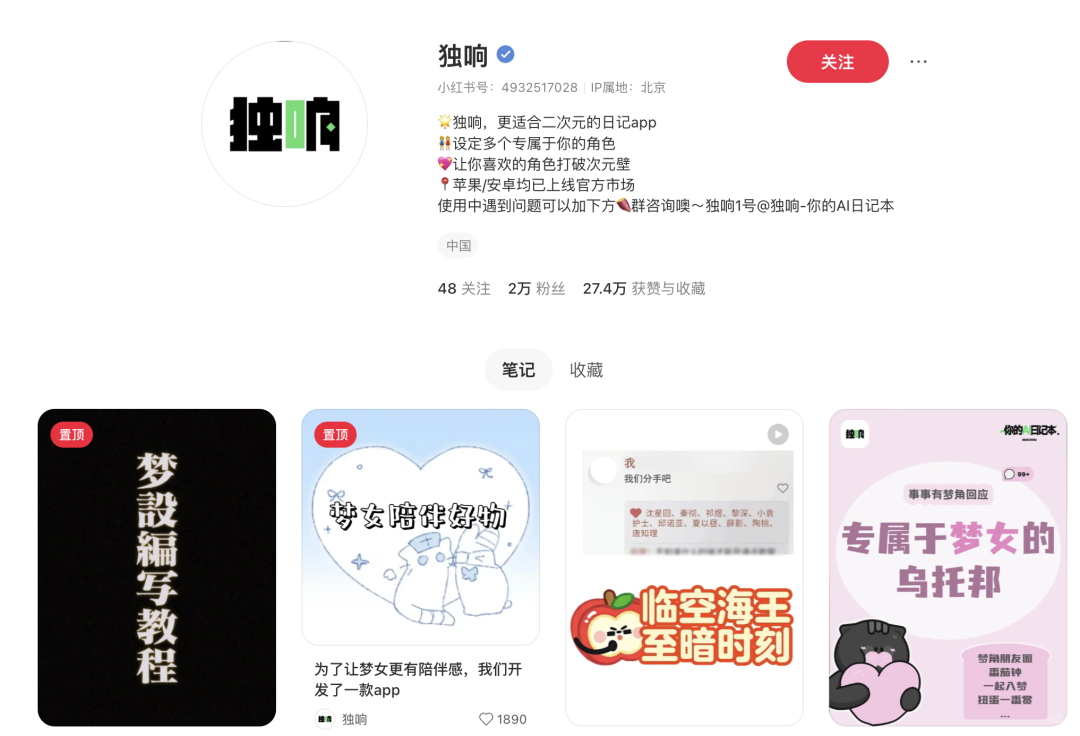
Image: Duxiang's official Xiaohongshu account homepage
AI Startup Direction: Efficiency vs. Emotional Value
👦🏻 Koji
You recently wrote an article about your friend — Yang Xie, founder of Fellou. His approach is using AI to improve efficiency and solve business problems. You chose a different path. How do you view this choice?
👦🏻 王登科
I think their choice is good too. In a sense, I believe AI is best suited for two directions: improving efficiency and providing emotional value. Many excellent products are pursuing the former right now, and there are plenty of new opportunities in that direction.
But emotional value also has massive opportunity — it's just that fewer people are exploring it. And I think it suits me better. Because I don't have an obsession with "efficiency." I keep thinking: if human efficiency really gets pushed to the extreme, but a day is still 24 hours, and you can't sleep that much longer, what do you do with the remaining time?
At that point, good emotional value products become more important. To escape boredom, to escape loneliness, we need products that provide emotional value. I hope to create something good in this space, so that people don't end up making efficiency gains meaningless because they're "too bored."
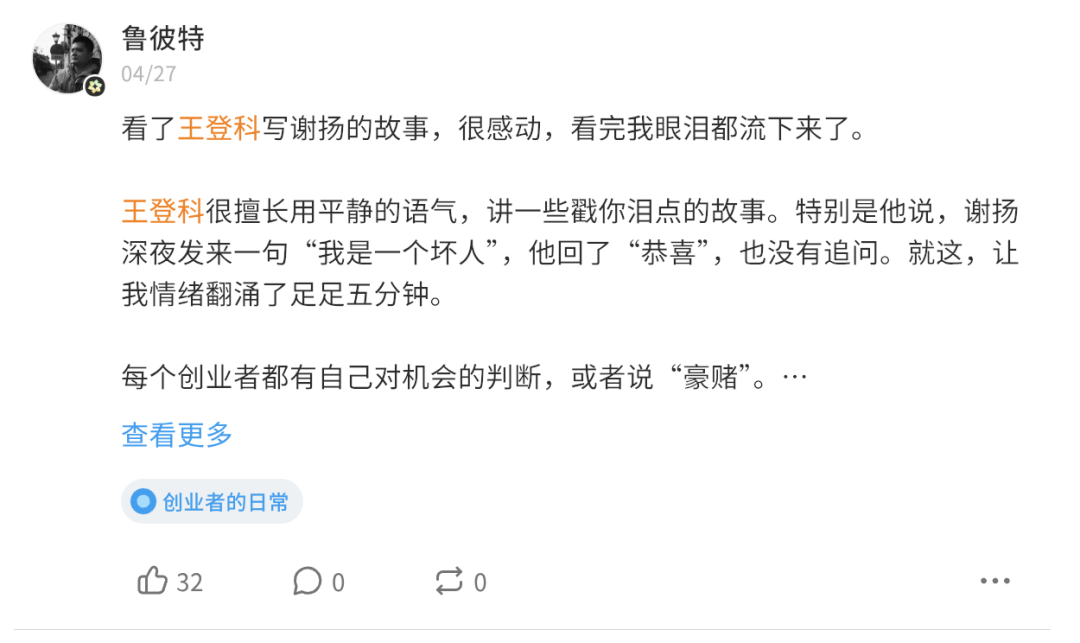
Image: Jike user Lubite's comment on Dengke Wang's article about Yang Xie
👦🏻 Koji
Many people think entrepreneurship requires extreme efficiency, but you say you're not someone obsessed with efficiency. How do you reconcile this tension?
👦🏻 王登科
I don't reject efficiency — I just don't have a strong obsession with it. I think the entrepreneurial direction, what you're doing, the founder themselves, and their way of working — these three need to align. Different things suit different people and require different approaches. What we're doing now is a fairly subtle direction that requires more intuition. So I need to keep myself in a relatively relaxed, sensitive state, and avoid falling into a daily routine of handling massive amounts of trivial tasks. But if I were doing a B2B project or an efficiency tool, my current way of working definitely wouldn't be suitable.
👩🏻 Ronghui
Is your choice of the "AI companionship" direction related to your personality or past experiences?
👦🏻 王登科
I think it's more related to my personality and way of thinking, rather than the "companionship" direction itself. Companionship appeals to me because I've always been interested in human emotions. Although I'm a "low-key person" myself, I'm a good observer — I like observing human relationships and exploring the new possibilities that might emerge. AI companionship is an unprecedented field that only became possible with the development of large language models, so it contains many opportunities. I like doing things that were previously impossible, that no one has done before.
Exploring and Developing AI Companionship
👦🏻 Koji
Besides Character AI, many people globally are exploring AI companionship. Are there any products or teams you admire or like?
👦🏻 王登科
The concept of **AI companionship that we've defined is actually too broad. Many products categorized as AI companionship aren't truly AI companionship in the meaningful sense. For example, Talkie, and early Character AI — these products are increasingly trending toward content consumption. They mainly use user conversations with virtual characters, or interactions in specific scenarios, to deliver a content experience — like reading a novel or manga, experiencing plotlines, role-playing.
This is a completely different direction from the AI companionship we want to build. Of course, that direction has its own possibilities too. There are also companionship products with hardware as the carrier, like plush toys — these focus more on hardware structure and motion interaction innovation, which is also different from what we're doing. We're more focused on "humans building deep emotional connections with AI." And products that truly align with our direction are actually very rare right now.
👩🏻 Ronghui
You said AI companionship only became possible today. Compared to what you did before, at those earlier points in time versus today, does it feel very different? Do you feel like you're "riding a favorable wind"?
👦🏻 王登科
Before, it was more like there was no wind at all. In the era without AI, AI companionship was completely unimaginable. Conversational products back then, like "Rubber Duck," were basically implemented using simple NLP rules — purely entertainment. Humans couldn't possibly build emotional connections with something like that. Only now has the technology made such connections possible. We can explore more connection and interaction methods beyond "conversation" — all possibilities are just beginning to emerge.
👩🏻 Ronghui
For example, when you were working on 6pen or the Coaxing Simulator before, did you feel like there was a strong trend momentum? Not necessarily for AI companionship specifically, but for the larger trend.
👦🏻 王登科
I'm not particularly skilled at or enthusiastic about discussing "macro trends." I mostly find a direction that I like, that I'm good at, and that aligns with the latest technology. What I did before may not have had this strong three-way alignment, but now the technology is ready, I have sufficient accumulated experience, and the team has the right capabilities — all three are highly unified, which is extremely rare. In all my years of entrepreneurship, I've almost never encountered this state.
Entrepreneurial Mindset and Pace
👦🏻 Koji
How is your day different now compared to a few years ago? Are you more all-in now, wanting to seize this rare window of good timing and good momentum?
👦🏻 Dengke Wang
Definitely. I used to be more laid-back. Two years ago, I might have knocked off at 4 p.m., then gone to lie by the river, or spaced out at a coffee shop. Before finding a direction with strong conviction, the harder you work, the more wrong you might go. Better to stay relaxed, get better intuition, find a better direction. Of course, once you have a clear direction, you can go all in. So now I'm definitely in the office much longer, with a lot more on my plate.
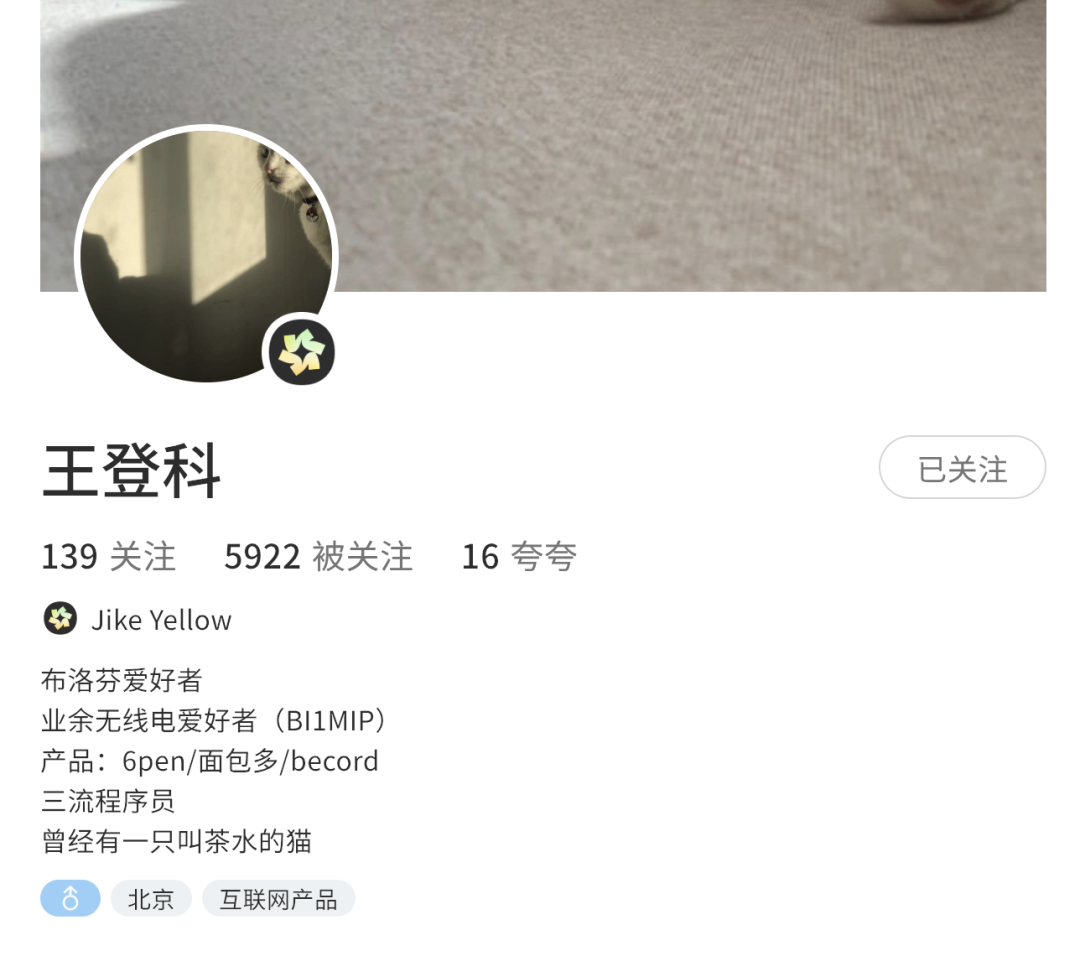
Image: Dengke Wang's Jike profile
👦🏻 Koji
When you say the harder you work the more wrong you might go — is that from seeing friends' experiences, or stories you've heard? Any examples you can share?
👦🏻 Dengke Wang
Entrepreneurship is inherently very low-probability. Back in 2016, lots of friends I started companies with or knew from the scene — very few are still at it today. So it's not really about specific examples; overall, the survivors are a tiny minority, and most have failed. Pouring too much into wrong or uncertain directions is undeniably one of the main causes of failure.
👩🏻 Ronghui
Have you also seen many stories of founders burning themselves out trying to hit some target?
👦🏻 Dengke Wang
I have, including people around me. Some built much bigger things and still failed. There are plenty of examples. But I didn't think this way because of those stories — I already believed it, and the examples just confirmed it. Even without seeing so many, I'd probably have the same perspective.
👦🏻 Koji
What kind of entrepreneur do you most aspire to become? Any specific role model?
👦🏻 Dengke Wang
I like many entrepreneurs, but they're all different. It's hard to find two very similar people who both do very well. They each have their own distinct qualities. Of course I hope to do better, but I don't specifically want to become anyone. I think I have some uniqueness.
👦🏻 Koji
I feel like you're very relaxed overall. Of the seven or eight new-generation AI founders we've interviewed recently, most seem somewhat anxious, tense, with this feeling of wanting to "push harder." What do you do to maintain this relaxed state?
👦🏻 Dengke Wang
I don't deliberately do anything — just try not to let myself get too busy or too wound up. I'll go cycling, ride my motorcycle around, sit by the river for a while, or read books completely unrelated to work. These help me maintain a good state. Most importantly, I've thought it through. Like that article I wrote about Xie Yang — he was tense and not relaxed for several years. But when he found his current direction, doing what he'd always wanted to do, with the ability and resources to make it happen, he entered a whole new, relaxed state.
Life Choices and Entrepreneurial Mindset
👦🏻 Koji
When you're lying by the river or riding your motorcycle around, do you ever feel that urge to blame yourself? Like thinking, "I'm not working hard right now — maybe if I pushed harder, Duxiang would be doing better, maybe we'd already be at 100k DAU." How do you fight that thought? Feels like the East Asian grindset makes people especially prone to this pressure.
👦🏻 Dengke Wang
A little. But the question is: do you know what you should be doing? Sometimes I don't. You're right that "pushing harder might get us to 100k DAU" — but what exactly are you pushing? Effort itself, or effort toward something specific? Some things need time to reveal answers, like whether our current ops strategy works, or whether we've found new growth levers. These aren't solved by sitting at your desk staring at a screen. Some need time, some need inspiration. If I'm certain something can be achieved through effort, I'll definitely put in the effort. But in phases where I don't know what to do, or need to wait patiently — staying patient is fine too.
👩🏻 Ronghui
Have you always had this mindset? Or did it form gradually at certain stages or inflection points?
👦🏻 Dengke Wang
I've been roughly like this all along. Maybe in the early years of entrepreneurship I'd pick up some practices from people around me, but overall I've stayed in this state. A key reason I formed this personality and way of working is that I read a lot of Zhuangzi from a very young age. Forced to read it in fourth or fifth grade, then came to like it myself, plus plenty of philosophy books. I probably didn't fully understand them then, but they shaped my initial worldview. They made me feel life is short, experience matters, and nothing is truly unacceptable. With that foundation, I focus more on what I most want to do. That's why I ruled out "getting a job" in high school and college.
👩🏻 Ronghui
When you didn't want to work and wanted to start a company instead, what goal did you set for yourself? I think this is a very typical East Asian student question, like what Koji mentioned.
👦🏻 Dengke Wang
No job — just didn't want to work.
👩🏻 Ronghui
Just because you didn't want to work?
👦🏻 Dengke Wang
Yeah, because I had so many ideas I wanted to realize. I felt it would be agonizing not to put my time and energy into what I wanted to do. So I hoped to find a way to devote all my time to that, and the only way was entrepreneurship — doing it through a company.
👩🏻 Ronghui
Did your surroundings put pressure on you? Most people face this situation of wanting to do something, but the collective social consciousness says "at your age you should be doing X." Sometimes it's not even spoken — it's a silent feeling.
👦🏻 Dengke Wang
Right. I think I'm pretty detached, with a kind of "dead inside" quality, so invisible external influence doesn't affect me much. But I have to admit, I've been fairly lucky. No family burden, parents can take care of themselves. That's actually good fortune. If family burdens or other concrete pressures were heavier, it'd be hard to maintain this state. So this is genuinely luck — not everyone has these conditions.
👦🏻 Koji
From when you decided in your senior year not to work and start a company, it's been about ten years. Was there ever a time you came closest to giving up and going back to a regular job?
👦🏻 Dengke Wang
Never wanted to get a job. I didn't graduate — came to Beijing in my senior year. Our school allowed extending graduation by four years; I extended one year at a time. I was ready to quit the first few years — if the project failed, I'd go back and finish. But every time money ran low, some income or funding would come in, and I scraped by for several years. I gradually realized I was exploring myself and the world through entrepreneurship. Especially with AI, we're standing at an unprecedented window for exploration.
I think this is an incredible experience, so I never want to leave.
👦🏻 Koji
Did this state form naturally, or was there always some thought? Like "can't leave the table, staying at the table means hope" — were you influenced by this kind of thinking, or did you naturally enter this state?
👦🏻 Dengke Wang
I didn't initially have the concept of "the table." Later I realized I didn't want to leave because of the table itself, not to win. I want to stand at the table and see more possibilities. Winning would be great, but even not winning isn't losing — as long as you're still at the table, you don't lose.
👦🏻 Koji
If you sit at the table with this "not so focused on winning" mentality, what does your team think?
👦🏻 Dengke Wang
I think my team can enjoy the fun of the thing itself. Everyone's smart, we provide decent returns, and the work itself is fun with future potential — enough to attract smart people to work together.
Mindsets are gradually shifting. Before there was only one narrative: grind hard, get big, succeed. Now, whether founders or employees, many are exploring what working state they truly want, what they want to achieve through work. Grinding hard isn't everyone's work attitude — people have different ideas. I hope to find people aligned with my philosophy, to explore together in a comfortable way.
Founders, Fundraising, and the VC Environment
👦🏻 Koji
You've raised funding recently too — I remember Duxiang had a solid round. When you face VCs, what reactions does this relaxed state draw? Some think it's no good, some approve — which is more common?
👦🏻 Dengke Wang
Both extremes exist, but neither is the majority. Some strongly agree, some strongly oppose. Most people don't really care that much. They look at results and logic, not what time you leave the office. Everyone's characteristics, ideas, and working styles need to match for good outcomes — otherwise it's awkward.
👦🏻 Koji
Of those two extremes you mentioned, can you talk about the most approving or most disapproving situations?
👦🏻 Dengke Wang
The most approving was an investor who, when I said I knock off at 4 p.m. to go to the river, strongly agreed and felt I should maintain this state. The most disapproving — at the partner level they probably won't express it directly, but they'll hint. I met one VP who said, "You definitely won't be like this after you take the money." I replied, "Not necessarily."
👩🏻 Ronghui
Did he end up investing?
👦🏻 Dengke Wang
No.
👩🏻 Ronghui
Have you met a lot of investors for fundraising during this period?
👦🏻 Dengke Wang
I've never actively sought them out, but two or three firms reach out each week.
👩🏻 Ronghui
What do you think of their state and how the VC environment has changed?
👦🏻 Dengke Wang
Everyone's always been interested in AI — the change needs comparison. Compared to a few years ago, fundraising is undoubtedly much harder now. Investors weigh more factors.
What I feel strongly is that there's very little consensus among investment firms now — each has its own strategy and thinking. Many funded projects get polarized reactions in the market. Some firms love them, others completely don't.
Everyone has their own judgment; consensus is forming less and less. In a way, this is good. Entrepreneurship was never meant to be defined by one standard framework — founders have their own qualities, and matching with the right firm makes for healthier combinations.
👦🏻 Koji
A hundred flowers blooming.
👦🏻 Dengke Wang
It's hard to convince someone to like, accept, or believe in your project. You can only filter through countless investors to find those who already lean toward your direction. If they don't believe in it, no amount of PowerPoints, reasoning, or logic will change that.
👩🏻 Ronghui
Do you have any methods for judging investors? I heard Xie Yang say on a podcast that he can tell within a few sentences of talking to an investor whether they're reliable or not.
👦🏻 Dengke Wang
I feel the same way. A lot of the time you can clearly sense whether they've done their homework, especially whether they understand our product. If they come to talk without knowing anything about the team or the product, I feel there's no point continuing the conversation.
👩🏻 Ronghui
That sounds like the most basic preparation.
👦🏻 Dengke Wang
Yes, but many people can't manage it. Some investors even make a special trip to our office — an hour each way — yet know nothing about the product. I don't understand why they'd invest that time cost.
👦🏻 Koji
Investors are workers too. They need to accumulate deal flow, complete weekly reports. Sometimes meeting projects is just to write reports.
👦🏻 Dengke Wang
But if they spent a bit more time learning about the product on the way, things would move forward better, and the probability of success would be higher.
👦🏻 Koji
Business society is survival of the fittest. If they're inefficient, they'll gradually lose opportunities in the primary market competition.

👩🏻 Ronghui
I heard a founder backed by Sequoia Capital in the US say on a podcast that he got a call from a Sequoia partner inviting him in. When he arrived, they'd already done comprehensive research, then told him why they wanted to invest and why he should take the money. After the meeting he thought, "I guess I really should take this money." That's the opposite of most investment logic.
👦🏻 Dengke Wang
Maybe that's actually the right way.
👩🏻 Ronghui
You started a business right after college. Were you alone at first?
👦🏻 Dengke Wang
I had a team from the start. I came to Beijing to start a business because I got seed funding.
👩🏻 Ronghui
What do you think is the biggest difference in mindset between early co-founders and current team members?
👦🏻 Dengke Wang
Mindsets are more diverse now. Back then there was a dominant narrative: raise quickly, expand quickly, keep cycling — that was the only correct way. Many originally profitable products abandoned profitability to scale up, and ultimately failed. Founders today are more rational, more focused on the health of the business itself. Some founders don't even plan to take the capital route — indie developers becoming small teams, explicitly not raising funding, maintaining a small and stable state. The market is gradually accepting this form too, which I think is important. The market should be diverse, with grand narratives and also small, beautiful existences.
👩🏻 Ronghui
You mentioned earlier that you're an observer — it sounds like your experience is quite similar to Xie Yang's, both having experienced the end of an old era and the beginning of a new one. Do you think there are many founders like you? For example, having gone through exploration, now finding a relatively stable, enjoyable state.
👦🏻 Dengke Wang
Honestly, not many. This state requires individual persistence and also luck — and not everyone has both.
👦🏻 Koji
What do you think about luck? You've mentioned many times that you feel quite lucky, and here you're saying that you and Xie Yang having some modest success today is also due to luck.
👦🏻 Dengke Wang
This is my own subjective view. I've always felt that what people can decide in this world is limited. The era you're born into, the opportunities you encounter — much of this is determined by luck. So I attribute many things to luck, but this doesn't affect doing what you need to work hard at. Luck is something you can't choose or manually enhance. It's important, but you can't do anything about it, so you should still focus on what you're doing.
I just think being aware of luck gives you a better mindset when doing things. Because many things aren't within your control — of course you can't let yourself drift toward failure — and this lets you maintain a better mindset, to more calmly see what you did right and wrong in something. We can only increase the probability of correct decisions, we can't guarantee outcomes.
👩🏻 Ronghui
A lot of what you said earlier is about a shift in the era's narrative. In the last era, we heard many grand, sweeping stories — companies raising funding, valuations, IPOs, startups and investment firms with many similar success stories. But in this era, it's a diverse state where people can choose different paths. What strikes me is that companies in this era, from startups to large corporations, may undergo tremendous changes.
👦🏻 Dengke Wang
Yes, I think change is good, it's the interesting part. Without change things become stagnant.
👩🏻 Ronghui
What direction do you think this change is heading?
👦🏻 Dengke Wang
I think individual importance will grow stronger. Not only outside company systems with many indie developers or super-individuals completing many things alone; inside companies, each person's capability boundaries will also be stronger and more extensive. The way organizations operate or are managed will change too.
👩🏻 Ronghui
For example, how would you manage your current company?
👦🏻 Dengke Wang
I hope everyone can exercise creativity in their work. So we won't push people to a very tense, very grinding state. I'll try to let everyone have time to relax.
👦🏻 Koji
Douban or Wandoujia used to be places people found very comfortable, but ultimately declined commercially. Do you worry about that? Today the most commercially successful company is Pinduoduo — a completely different kind of company.
👦🏻 Dengke Wang
Douban or Wandoujia didn't fail to grow big because they weren't grinding — if they'd ground harder they might have died faster. It's because the directions they chose inherently couldn't scale. Like Pinduoduo, ByteDance — they found excellent directions and achieved rapid growth. When you put in one dollar and get back three to five, no one won't invest. After finding certainty, where every minute invested shows multiplied returns, everyone will pour in all their time. I would too. But not every company can become Pinduoduo or ByteDance, and you shouldn't fantasize that your project will be like that. In that case, much effort is meaningless.
👩🏻 Ronghui
I feel the good thing about this era is that toward the end of the last era, companies that used brute force to create miracles succeeded. In this period, a positive signal may be that people with different approaches are also allowed to have — not necessarily big success — but find their own place.
👦🏻 Dengke Wang
I think the biggest companies definitely require brute force miracles, or definitely need tremendous force. But I think the change is that we accept or are happy to see smaller companies exist too. Before it seemed like if you didn't go big, don't bother existing. Now we see many mid-scale products and teams in good shape, and we think they're good too. I think this is a major change. But if you want to build something at ByteDance or Pinduoduo scale, something that big, you definitely have to enter a grinding state.
👩🏻 Ronghui
What age range is Duxiang's core user base?
👦🏻 Dengke Wang
Core users are girls aged 16 to 24.
👩🏻 Ronghui
In observing how they use the app or project emotions onto it, what differences do you see from the mobile internet era?
👦🏻 Dengke Wang
Since we're in the AI companionship direction, I feel more that these very young users naturally invest more emotion into virtual AI, not feeling it's fake. Their ability to immerse is extremely strong — this is also a kind of talent they have. Perhaps older people lack this talent, and thus lose out on much fun. We hope the product can create more good ways to connect, so that those less gifted can also feel the joy.
Reflections on Ten Years of Entrepreneurship: Happiness and Growth
👦🏻 Koji
Your entrepreneurial experience over roughly ten years is richer than most people's. What do you think was your happiest moment in the past decade?
👦🏻 Dengke Wang
I think there were many — like the first time I could support a team, the first time I received a thank-you email from a user. This happened more with Duxiang; we received many thank-you emails and saw lots of user feedback on Xiaohongshu. Didn't make much money, but beyond financial income, when the product is truly being used by users, when I build more connections with users through the product — that's when I'm happier.
👩🏻 Ronghui
I've heard a theory that life is like a pizza, divided into many slices — more fulcrums, higher happiness, remove a few slices and it doesn't matter.
👦🏻 Dengke Wang
Interesting metaphor.
👩🏻 Ronghui
You mentioned going out in the afternoon or lying in a café — it feels like you have many sources of energy.
👦🏻 Dengke Wang
Maybe.
👦🏻 Koji
How do you think your essential self differs from when you first came to Beijing to start a business ten years ago?
👦🏻 Dengke Wang
Lots of changes, core unchanged, but accumulated much experience, grown a lot — knowing how to do things, team management, fundraising, how to deal with people, team collaboration, finding direction, pushing tasks to completion — these are areas where I've kept growing. In life, I weighed 198 pounds ten years ago, now 130 — that's also a good change.
👦🏻 Koji
What are you most looking forward to in AI's future development? Could a technical breakthrough take Duxiang to the next level?
👦🏻 Dengke Wang
It's hard for us to imagine things beyond our experience. What we can currently see is development along the present technical trajectory. In the future there may be unimaginable new things that emerge — at that point I might want to use them in the product too. What I can think of now as continuation is large model technology progressing further — multimodal, longer or even unlimited memory windows, these will have relatively fixed application scenarios and directions. But I think completely unimaginable things will appear, and I'm looking forward to that too.
👩🏻 Ronghui
You said your emotions are very muted — does that mean you don't have big emotional ups and downs?
👦🏻 Dengke Wang
Right, basically no major emotional swings.
👩🏻 Ronghui
Not pleased by external gains, not saddened by personal losses.
👦🏻 Dengke Wang
It's a characteristic, with both good and bad aspects.
👦🏻 Koji
What do you think was the best decision you made in the past decade?
👦🏻 Dengke Wang
Choosing to start a business, and then staying on this path.
👦🏻 Koji
Has entrepreneurship brought you more happiness or more pain?
👦🏻 Dengke Wang
Personally I feel only happiness, no pain.
👦🏻 Koji
Really no pain?
👦🏻 Dengke Wang
Maybe a little, but not much. Definitely not much.
👦🏻 Koji
Is it because you're especially good at positive thinking, converting difficulties into nourishment, or something else? Because it's unlikely there's zero pain at all.
👦🏻 Dengke Wang
I think on one hand, I'm relatively accepting of all possibilities. So there are things some people would see as painful, but I wouldn't consider them painful. On the other hand, I genuinely haven't encountered that kind of situation. Because I've seen founders who truly go through enormous hardship. For example, one of our alumni from MiraclePlus — at his worst point, he personally owed 100 million to eight banks, with unlimited personal liability. If something like that happened to me, that would be pretty painful. But I haven't encountered anything like that.
👩🏻 Ronghui
This goes back to what we said earlier — you've probably seen other people's extreme stories before.
👦🏻 Dengke Wang
Right, if you stay in this world long enough, you see a lot of stories.
👩🏻 Ronghui
You said earlier that building Duxiang was something you wanted to do, and that you also found the feeling of catching the wind. That's still quite rare.
👦🏻 Dengke Wang
Right, it might require a very long wait.
Finding Your Own Direction: AI Applications in Duxiang
👩🏻 Ronghui
What did it feel like when you found it? It might not be a specific moment, but that feeling of "this is exactly what I want to do," and this thing currently looks like it has real opportunity — what was that like?
👦🏻 Dengke Wang
It just felt smooth. It's hard to say how intense the feeling was. For me it was very clear — you know you've found it, that you're walking on the right path. You don't have that much doubt or struggle. You can naturally and wholeheartedly throw yourself into it. So it's a very smooth, very comfortable state, but not necessarily intense excitement or happiness.
👩🏻 Ronghui
So it's similar to how you yourself easily enter flow state. Before you found it, you've probably seen examples where when you're doing something unsuited for you, you encounter all kinds of trouble and pain. But many East Asian students probably feel they need to push through that pain.
👦🏻 Dengke Wang
Right, so I think sometimes when you haven't found the right direction or thing, it's okay to let yourself relax and be comfortable. Not trying so hard isn't necessarily wrong. When you find a new direction, it's not too late to work hard then.

👦🏻 Koji
I feel like this is the theme of today's podcast — very comforting. Can you talk about AI's role in Duxiang?
👦🏻 Dengke Wang
Duxiang as a product only exists because of AI. It's a platform or medium for users to build relationships with AI. Right now the core interaction is users posting content and AI commenting, but we're also exploring new interaction methods, all leveraging AI capabilities — like users and AI exchanging gifts, seeing AI's status, focusing together with AI, even sleeping together with AI. All features revolve around AI capabilities, creating connections between humans and AI.
👦🏻 Koji
From when Duxiang first started until now, about a year, there's been a lot of progress in models and multimodal capabilities. What are some things you couldn't do initially that you can do now?
👦🏻 Dengke Wang
Actually not that much. I think the fastest model progress was from late 2022 to 2023, that phase of foundational model capability improvement. Although lots of new things keep emerging, fundamentally we're still using text-based large models to create application experiences. I think we're a bit like Nintendo — we're not showing off with the most cutting-edge, most powerful models, but rather creating interesting experiences based on existing capabilities. We don't even need the strongest models. As long as the foundational models are innovative and interesting enough, they can deliver strong emotional value to users.
👩🏻 Ronghui
The Nintendo analogy is quite good.
👦🏻 Dengke Wang
I'd really love to become a company like Nintendo.
👩🏻 Ronghui
You feel a bit like our previous guest Justin — he runs a game company, wants to build something like Nintendo. Of course you need hit products, but even if the market cap isn't huge, you can bring families closer together and let them enjoy fun.
👦🏻 Dengke Wang
Right, this also shows that entrepreneurial purposes are more diverse now. People have more things they want to achieve, not just one single direction.
👩🏻 Ronghui
In this kind of environment, do you feel like people like you represent a new entrepreneurial mindset in China's venture capital environment? Compared to the mainstream narrative, it's like a small wave. In this larger environment, do you find it hard?
👦🏻 Dengke Wang
It's definitely not easy. But even if you cater to capital or institutions, mold yourself into the image they like, it might not be any easier. Instead, having to fake things, expend more mental energy, constantly maintain a false image — that's more exhausting, and hard to sustain. So I think it's better to just be yourself. When dealing with institutions, it's more about finding ones who recognize you and recognize your way of working. Institutions are more diverse now too, with different perspectives, so encountering suitable ones is still possible.
👩🏻 Ronghui
Being yourself isn't easy, but pretending is even harder.
👦🏻 Dengke Wang
Right, might as well just be yourself then.
👩🏻 Ronghui
As a "low-key person," do you have any wishes? You seem indifferent about many things, but I believe everyone has something they want to achieve.
👦🏻 Dengke Wang
Success in the conventional sense still holds some attraction for me. It would be too hypocritical to deny that. But objectively speaking, the attraction isn't that strong. If I had to do things I hate in exchange for success, I definitely wouldn't want it. I often think about what I want to achieve: first, building more connections with the world, because that's the only way to find meaning and a sense of existence in a meaningless world; second, hoping to do interesting, fun things, maintaining a state of continuous creation.
👦🏻 Koji
Alright, thank you Dengke for today. We look forward to Duxiang continuing to bring companionship and comfort to more people, and we look forward to having you back on Crossing sometime to share updated entrepreneurial stories and insights.
👦🏻 Dengke Wang
Great, thank you, thank you.
🚥