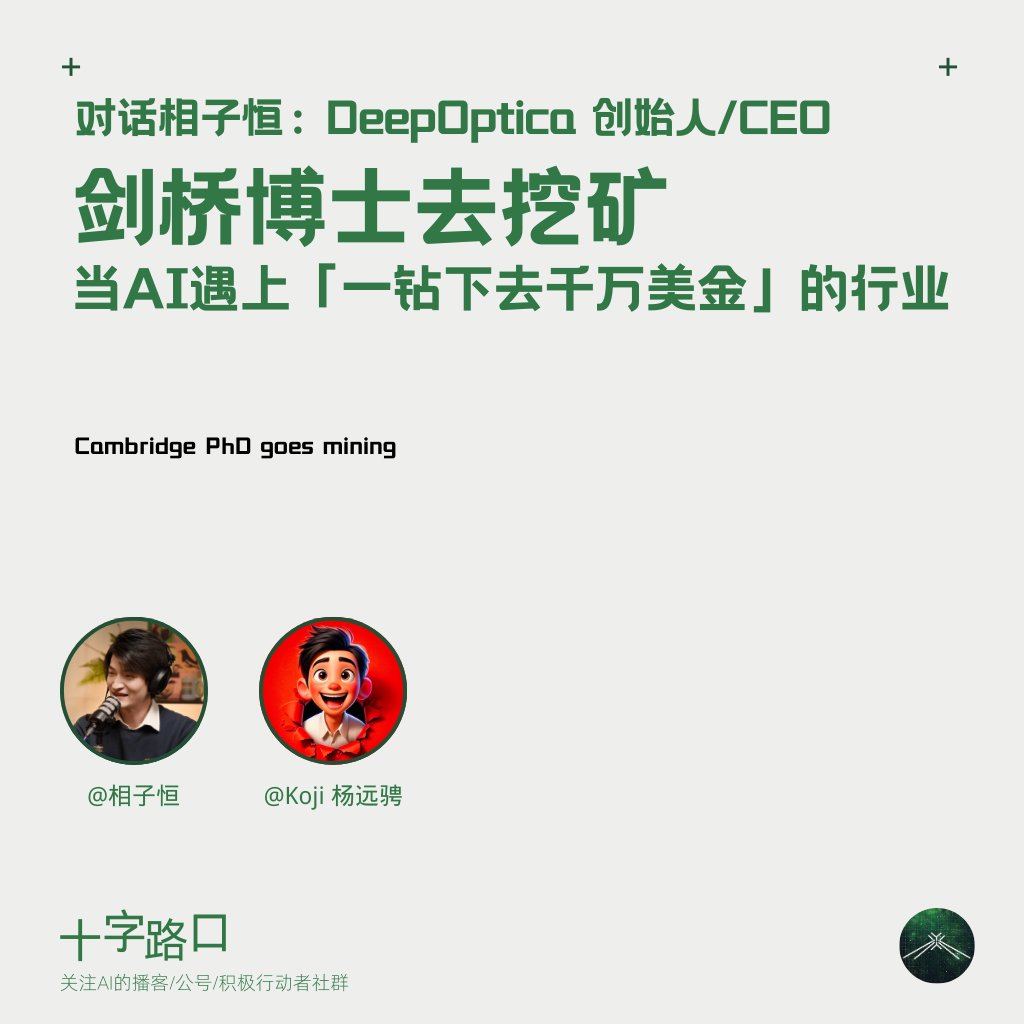
Cambridge PhD Turned Miner: When AI Meets the "Ten Million Dollars per Drill" Industry | A Conversation with Ziheng Xiang: Founder/CEO of DeepOptica
Elon Musk is exploring space; he wants to explore what's beneath the earth.
Elon Musk explores space; he wants to explore what's beneath our feet.

👦🏻 Podcast interview: Koji
🥷 Edited by: Crossing
🧑🎨 Layout: NCon

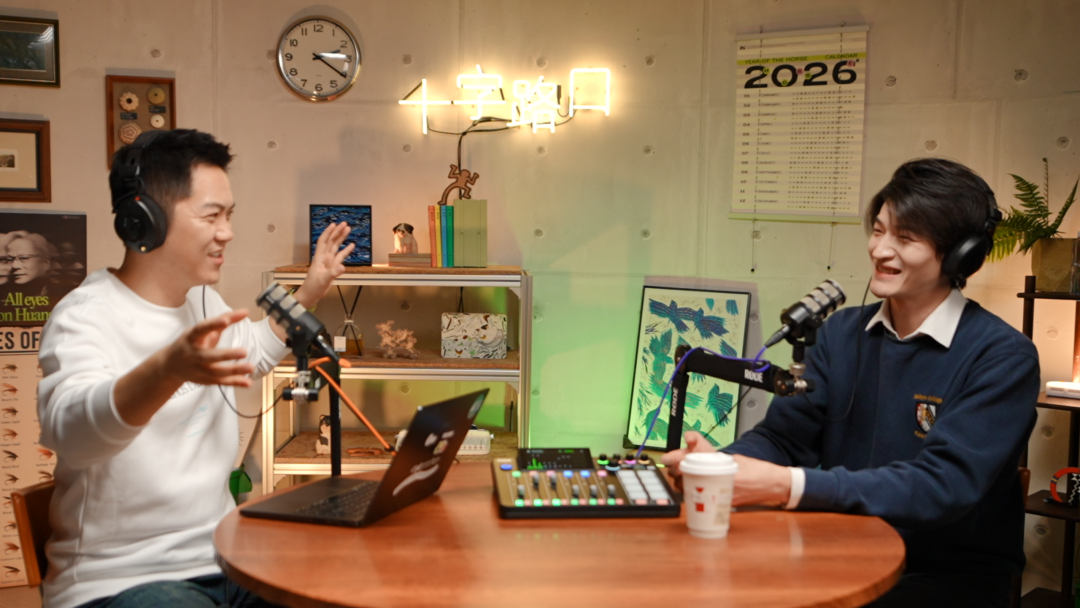
🚥 This week's guest on Crossing is Ziheng Xiang, founder and CEO of DeepOptica.
During his four years as a PhD student at the University of Cambridge, he rowed for four years and became the first Chinese captain in his college's history. After graduating, he didn't go into investment banking or Big Tech. He chose to go mining — with AI.
Mining is an industry where a single decision can lock up hundreds of millions of dollars, and once you break ground, there's no turning back. It's ancient, expensive, and extremely uncertain. And Ziheng Xiang — a Cambridge PhD in quantum optics, former technical lead at the UK Space Agency — chose to break into it with AI.
What DeepOptica is building is a world model for mining — integrating geophysical, remote sensing satellite, and geochemical multimodal data to let AI truly "see through" to three-dimensional ore structures underground. Not just telling mining companies "where to drill next," but directly answering the probability distribution and confidence intervals for "how many tons of copper, how many ounces of gold" lie beneath.
🚥 In this episode, we discussed:
- Just how hard is mineral exploration? From geologists' field surveys to geophysical remote sensing to AI world models — how a century of industry evolution is being rewritten by a new technical paradigm; why synthetic data is so critical in mining AI, already comprising 50% and climbing; the fundamental difference between DeepOptica and pioneers like Kobold Metals — from "decision optimization" to "value assessment," entirely different product logic; and how an all-Chinese team landed a partnership with GE21, the largest geological consultancy in South America, and completed early validation in Mongolia, the Middle East, and Brazil.
- We also talked about the story behind that Cambridge rowing captain experience — how to win over a team that doubts you, how to build leadership without formal authority, and how these lessons map directly onto his entrepreneurial path today.
- Those who master AI have become the barbarians at the gate. A thread running through this episode: the ones who disrupt traditional industries are rarely insiders. They're outsiders armed with new tools and fresh perspectives. There's a massive gap between earth science and computer science — and the teams bridging that gap are the ones standing at this interdisciplinary crossroads.
If you're following the AI for Science direction, or thinking about "where AI can create real value in extreme-risk traditional industries," this episode is worth your full attention.

Listen on WeChat:
Listen on Xiaoyuzhou:
🎬 The video podcast is also live on Koji's WeChat Channels, Xiaohongshu, Bilibili, YouTube, and other platforms.
As the full interview is quite long (12,785 Chinese characters), here's the table of contents:
🟢 Rapid-fire Q&A: Age, alma mater, MBTI and zodiac sign, one-sentence DeepOptica intro, funding status, revenue and order scale, pre-founding experience
🟢 The First Chinese Captain of a Cambridge Rowing Team
In a team that's 90% European, with results that weren't the best, what qualified him for captain?
🟢 Elon Musk Explores Space; He Wants to Explore What's Beneath Our Feet
Mining isn't a business for provincial bosses.
🟢 How to Fit an Elephant in a Fridge
Three key steps to AI-powered mineral exploration.
🟢 Why Would a Quantum Optics PhD Go Into Mining?
🟢 Twenty People. That's Enough.
In the AI era, the consulting company business model is being rewritten.
🟢 This Track Isn't as Crowded as You Think
🟢 What Being Rowing Captain Taught Him About Leadership
Leadership isn't about whether people like you.
🟢 If DeepOptica Fails, What Would Most Likely Be the Cause?
🟢 DeepOptica in Five Years, and True Ideals
🟢 One Piece of Advice for Early-Stage Founders
Rapid-Fire Q&A
👦🏻 Koji
DeepOptica is a company that uses AI to help people make decisions in extremely uncertain environments. That environment is mining — an industry where a single decision can cost hundreds of millions of dollars, and once you start, there's often no turning back.
Ziheng and his team are using AI to more accurately find where minerals are.
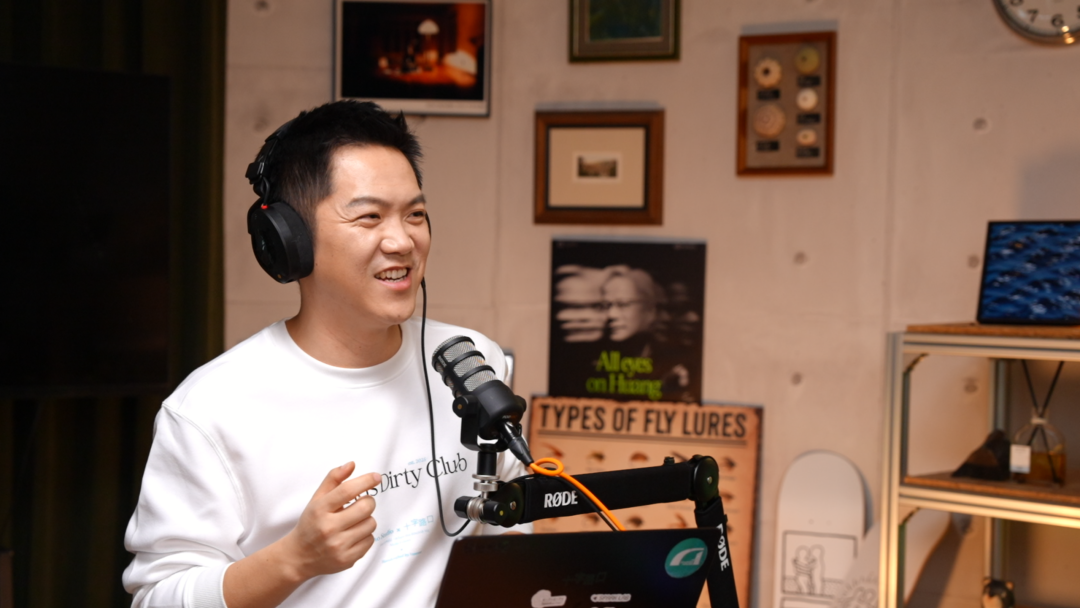
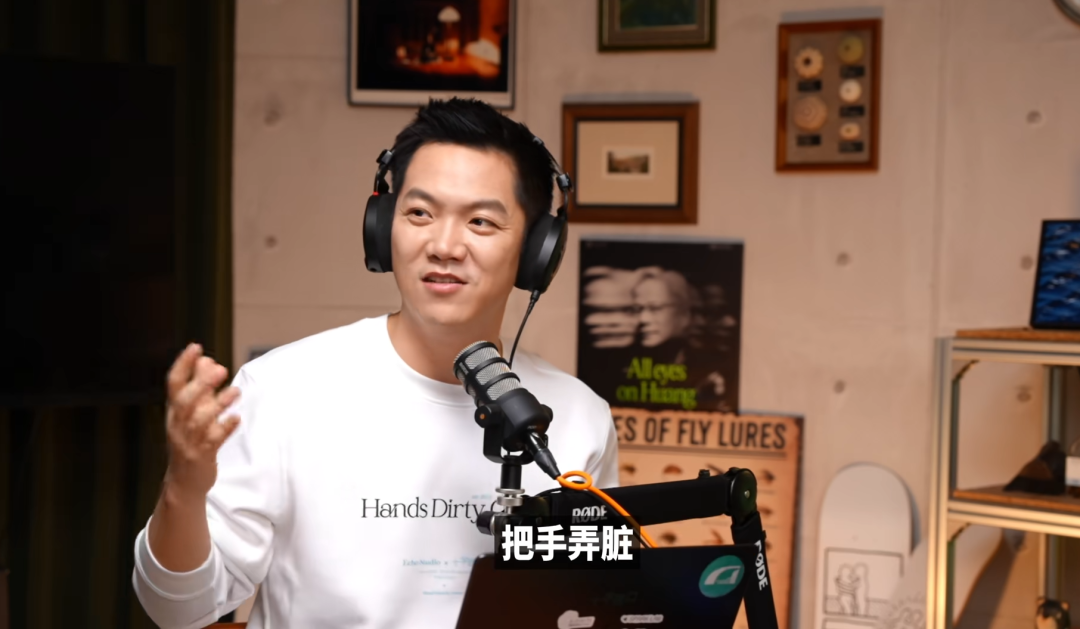
Interestingly, I'm wearing one of our podcast's merch hoodies today. It says "hands dirty club," because we often say entrepreneurship is about getting your hands dirty. What Ziheng is doing now might be one of the dirtiest-hand industries there is.
🧑🏻💻 Ziheng Xiang
Haha, you'll have to send me one.
👦🏻 Koji
No problem!
Ziheng also has an impressive credential from his Cambridge PhD years: he rowed for four years and in his final year became president and captain of his college's entire rowing team. Is this unprecedented in Cambridge rowing history?
🧑🏻💻 Ziheng Xiang
To my knowledge, I should be the first person to represent our college as captain in the number one position.
👦🏻 Koji
Impressive! We'll dig into that experience in a bit.
Today let's start with Crossing's traditional rapid-fire round. Ziheng, your age?
🧑🏻💻 Ziheng Xiang
👦🏻 Koji
Your alma mater?
🧑🏻💻 Ziheng Xiang
University of Cambridge.
👦🏻 Koji
MBTI and zodiac sign?
🧑🏻💻 Ziheng Xiang
INFJ, Taurus.
👦🏻 Koji
Describe DeepOptica in one sentence.
🧑🏻💻 Ziheng Xiang
DeepOptica is an AI-driven enterprise dedicated to making the Earth transparent.
We use AI technology to help companies discover and evaluate mineral resources faster and more accurately, and we look forward to becoming a mining technology finance company in the future.
👦🏻 Koji
Current funding status?
🧑🏻💻 Ziheng Xiang
We closed a seed round in the second half of this year, led by Baidu Venture.
👦🏻 Koji
Revenue and profit?
🧑🏻💻 Ziheng Xiang
We just signed orders worth about 5.5 million RMB, with current revenue approaching 1 million RMB.
👦🏻 Koji
What were you doing before founding the company?
🧑🏻💻 Ziheng Xiang
We're a three-person founding team. Before founding, I mainly worked on remote sensing satellite projects. Earlier than that, I was technical lead on projects for the European Space Agency and UK Space Agency.
Our CTO previously co-founded a remote sensing startup with me. Before that, he was AI leader at the UK's largest financial institution.
Our CFO Jesse was previously VP at Chifeng Gold, and before that was a staffer and mining lead for Greater China at boutique investment bank Lazard.
The First Chinese Captain of a Cambridge Rowing Team
👦🏻 Koji
That's a beautifully assembled résumé.
The first question I think everyone would be curious about: how did you work your way up to becoming captain of your Cambridge college rowing team?
🧑🏻💻 Ziheng Xiang
Looking back on this experience, it still moves me quite a bit.
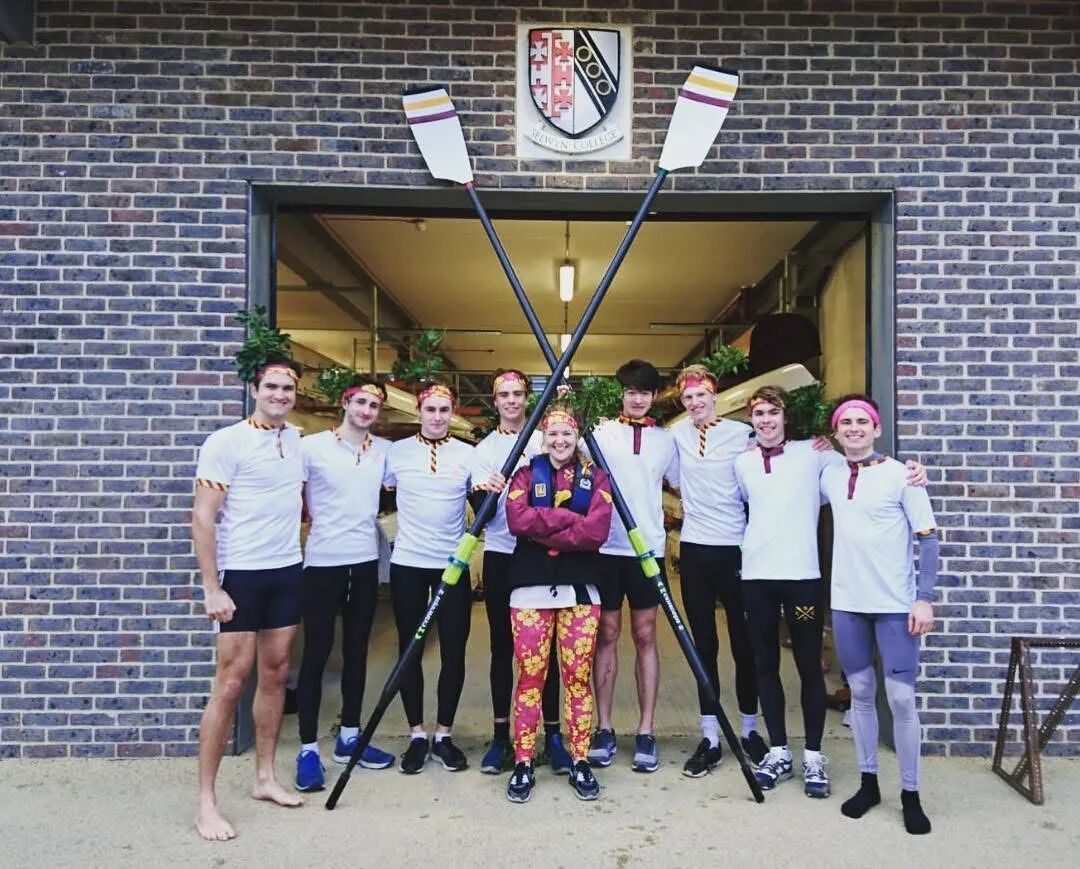
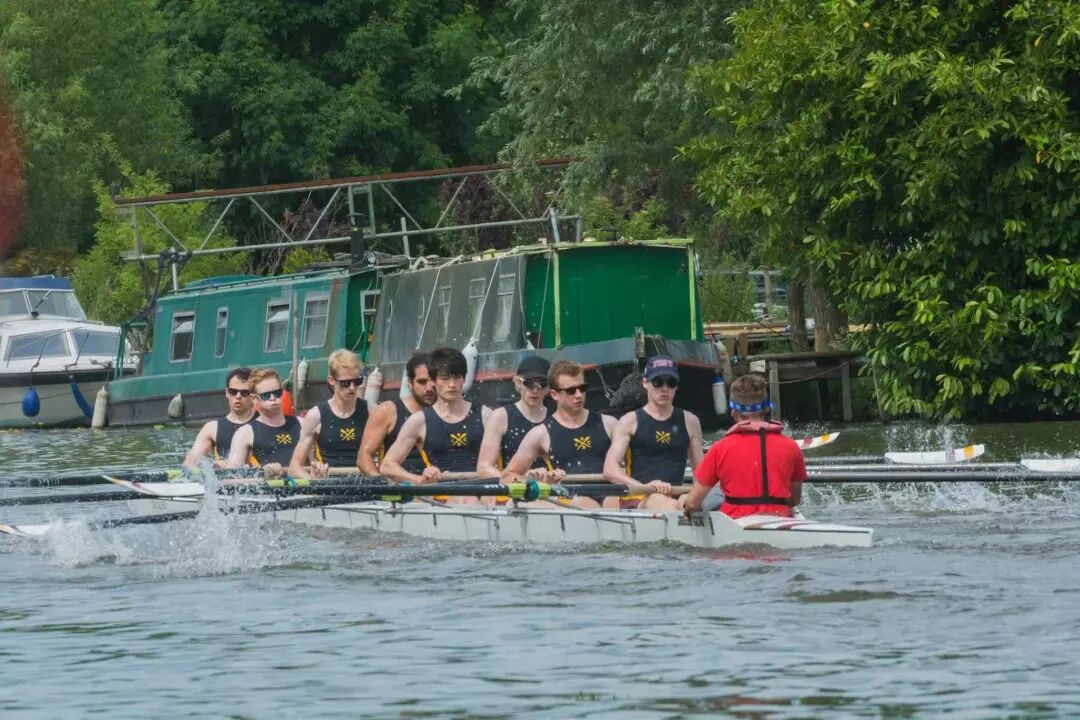
My first year at Cambridge, I just wanted to do things you can only do at Cambridge. Beyond the formal dinners everyone talks about — the whole "Harry Potter" thing — that meant sports. So I joined the rowing team. First year I was on the men's second boat, second year the first boat, third year vice-captain of the first boat, and by fourth year I was president of my college boat club.
You could say I spent four years mastering the sport, and I genuinely loved every minute of it.
👦🏻 Koji
I've seen lots of photos of college rowing teams online, and you almost never see Chinese or even Asian faces. Did you become captain because you were an exceptional rower, or was there something else going on? Some special aptitude for Eastern political arts, perhaps?
🧑🏻💻 Ziheng Xiang
No political arts whatsoever. You definitely need solid technique — I wasn't the absolute strongest, but I ranked second or third in my college.
More than that, I had a deeper understanding of the sport itself: how to organize people, improve performance, and win races. So by fourth year, stepping into the captain role felt completely natural.
👦🏻 Koji
I suspect a lot of people would love to hear more about your leadership stories in international teams — we'll circle back to that. For now, let's talk about the AI side of things. In your view, what kind of industry is mining?
🧑🏻💻 Ziheng Xiang
Most people think of mining as ancient, but I actually think it's a pretty cool industry. Here's the thing: Elon Musk is exploring space; mining is exploring Earth — specifically, what's beneath it.
A lot of people have this traditional image of mining: ore carts, excavators, mine bosses running old-school operations. But once you actually engage with international mining companies, you realize their leaders come from either finance or technical backgrounds. It's a striking contrast.
My own view is that mining is an industry that discovers Earth's resources through technology and financial tools, then delivers raw materials that help the entire planet and humanity grow. I have enormous respect for it.
👦🏻 Koji
Choosing to enter now, you must see AI playing some new role in this industry. What kind of role?
🧑🏻💻 Ziheng Xiang
Our vision is to make Earth transparent — to know what minerals exist where across the globe, pinpoint them with precision, and extract those resources for humanity's future development. The critical piece is how far AI capabilities have progressed, and whether they can support us in doing this.
👦🏻 Koji
How far along are we? Are we there yet?
🧑🏻💻 Ziheng Xiang
Honestly, we're still slightly short. But with the emergence of large model architectures, growing understanding of world models, and the potential to integrate physical knowledge into AI models, the timing is already excellent. The mining models we're building embed Earth science directly into the model — it's not just a pure physical world representation. That's what makes this so fascinating.
Putting the Elephant in the Fridge
👦🏻 Koji
At your company, specifically how do you plan to use AI to make Earth transparent? What are the key steps, and what role does AI play in each?
🧑🏻💻 Ziheng Xiang
Let me first explain how people used to explore for minerals.
Originally, geologists would assess which areas had mineralization potential, which had magmatic activity that created opportunities, and whether specific events within that magmatic activity led to mineral deposits. They did this through field reconnaissance, geological mapping, and looking for clues — like whether mineral outcrops were visible at the surface. "Outcrop" means minerals from underground that have weathered over time and become exposed, so you can see them directly.
Later came more precise techniques like geophysics and remote sensing satellites. On one hand, you could observe variations in surrounding magnetic fields, gravitational fields, and electromagnetic resistivity. Higher concentrations of iron, copper, and other elements underground distort magnetic and gravitational fields. On the other hand, through remote sensing satellites, when alteration minerals exist underground, they create spectral responses at the surface — and we can detect mineralization potential through these spectral signatures.
After field reconnaissance by geologists, combined with geophysical and remote sensing data, people develop a fuzzy understanding of whether a location can host minerals and what kind.
Next, mining companies drill — using boreholes to see what rock types exist at various depths and what metal concentrations are present.
So how does AI fit in? Any superficial, single-modal AI cannot absorb this knowledge. What we're doing is using massive datasets to help AI understand how physical quantities integrate with geology.
For example, in a given area, if the magnetic field shows some anomaly, how does that connect to local geology? Traditionally, there might be dozens of possible 3D ore bodies underground that could produce the same magnetic signature. What AI needs to do now is constrain the structure so that under local geological conditions, it satisfies both mineralization characteristics and our measured physical quantities.
That's the core driver of our AI model — it integrates knowledge from geology, geophysics, and remote sensing satellites.
How do we actually do this? We use large datasets to let different components parse the information. For instance, we combine 3D inversion and geological parsing using massive data. But this runs into a problem: insufficient data. That's where we use synthetic data to enhance the AI's generalization capability.
👦🏻 Koji
What's the current proportion of synthetic data in your training datasets?
🧑🏻💻 Ziheng Xiang
Right now it's roughly 50%, but we're continuing to expand our synthetic data volume.
👦🏻 Koji
How do you verify the accuracy and validity of synthetic data?
🧑🏻💻 Ziheng Xiang
When generating synthetic data, we compare our existing ore body structures against the actual synthesized 3D geological states we create.
👦🏻 Koji
Are there any successful precedents globally for using AI to assist mining?
🧑🏻💻 Ziheng Xiang
Let me start with the global picture. You've probably heard of KoBold Metals, the AI-for-mining startup. They initially helped mining companies optimize drilling through Bayesian decision-making.
What they do is take existing drilling information, match it with surface measurements, then run a Bayesian decision algorithm that outputs two results.
Result one: where and how to drill next to maximize the probability of locating the ore body.
Result two: where and at what angle to drill next to eliminate the most uncertainty.
By combining these two approaches, they help mining companies determine a location's mineralization potential at lower cost. That's KoBold Metals' typical solution.
👦🏻 Koji
Have they found many mines?
🧑🏻💻 Ziheng Xiang
Their most prominent case is in Zambia, where they discovered a significant world-class copper deposit around an existing mining area. Our analysis is that they primarily leverage surrounding existing data, combined with years of accumulated decision intelligence, to strongly assess which areas have better mineralization potential. Then they acquire the mineral rights and explore.
👦🏻 Koji
So is your technology similar to KoBold Metals, or is it different?
🧑🏻💻 Ziheng Xiang
Quite different. We're more focused on building what we call a "world model for mining."
We want to use technology to truly reveal 3D ore body structures underground — even to the point of assessing their economic value — rather than simply providing mining companies with single-layer decision solutions like "where to drill next."
👦🏻 Koji
Why not use KoBold Metals' already proven approach? It sounds like it advanced previous technology by a whole generation.
🧑🏻💻 Ziheng Xiang
Decision intelligence is on our product roadmap too. But the core issue is that going forward, we need to help mining companies evaluate a deposit's value, and that involves far more complex logic.
KoBold Metals can help companies determine where the next drill hole should go, but it cannot tell you how many tons of copper or ounces of gold are underground. What we truly want to do for mining is use fewer drill holes and more powerful data to know earlier exactly how much copper and gold lie beneath the surface. This gives mining companies better decision-making mechanisms when evaluating a deposit's value, or lets them discover a deposit's potential economic value earlier than competitors.
👦🏻 Koji
So you're going further — not just saying there's high probability here, but actually trying to make transparent what's specifically hidden below?
🧑🏻💻 Ziheng Xiang
Exactly.
👦🏻 Koji
Is your ambition to make the entire Earth transparent? Or is that just dramatic rhetoric, and what you can actually do is still slice by slice?
🧑🏻💻 Ziheng Xiang
Making the entire Earth transparent is genuinely what we want to do. But we'll start with these economically valuable ore bodies.
Why Would a Quantum Optics PhD Go Into Mining?
👦🏻 Koji
Ziheng, I know your PhD was in quantum optics. That seems completely unrelated to mining. How did you end up in this industry?
🧑🏻💻 Ziheng Xiang
These fields are both close and distant. Mining commonly uses geophysical detection methods, and the typical physical quantities in geophysics are gravity, magnetic fields, electromagnetism, and resistivity.
In my quantum optics PhD, I worked on a technology called "quantum sensing," whose two largest application areas are quantum gravimeters and quantum magnetometers. I was already starting to engage with mining and oil & gas exploration companies, because they're the biggest users of quantum sensing.
My own perspective is that once you get to the physics level — whether geophysics or quantum physics — many principles are interconnected. For example, solving partial differential equations in geophysics uses analytical and problem-solving methods very similar to what we use in quantum physics and wave optics. So for me, this was actually a fairly natural transition.
👦🏻 Koji
So when friends and family heard you were going into mining, were they confused, supportive, or what?
🧑🏻💻 Ziheng Xiang
Everyone was quite supportive. People generally recognize that mineral resources, and mining as a whole, is an industry that will only keep trending upward.
First, it's non-renewable. Second, human demand for metals rises every year, which means minerals will only become more valuable.
From my personal perspective, working in mining actually helps drive new energy and sustainable development. Whether it's data centers, new energy, or robotics, they all require massive amounts of metal. This is something I, the people around me, my partners, and my colleagues all agree on.
So rather than pulling us apart, this mission has brought everyone together to do it better.
Twenty People, That's Enough
👦🏻 Koji
You mentioned earlier that modern mining isn't what people imagine — it's not local bosses with dirt under their nails. It's driven more by technology and finance. When people mention DeepOptica in the future, how do you want them to describe it?
🧑🏻💻 Ziheng Xiang
I want people to think of DeepOptica as a company that's not particularly large, but really cool — a tech mining company with deep exploration technology.
👦🏻 Koji
Not particularly large?
🧑🏻💻 Ziheng Xiang
Right. The scale doesn't need to be huge, or rather, we don't need that many people.
👦🏻 Koji
Why?
🧑🏻💻 Ziheng Xiang
Because with AI technology, startups today no longer need teams of hundreds like in the past. What we care more about is: can we find the core dozen or twenty people? Can we use AI to maximize their productivity? Can we make sure everyone genuinely enjoys what they do every day? I think a team of twenty or thirty might be enough.
👦🏻 Koji
I would've thought this would be labor-intensive, since your clients are all major accounts requiring one-on-one service, which inevitably means building out sizable project teams.
🧑🏻💻 Ziheng Xiang
We did take on a service-oriented case recently, and we currently have a fairly large service contract in the Middle East.
What we've found is that with AI's productivity boost, each service project no longer requires the heavy manpower investment of the past. If we actually need to do fieldwork, we go complete those specific tasks, then bring everything back for collective analysis.
So I believe this model will, to some degree, replace a lot of traditional consulting services going forward.
👦🏻 Koji
Since you started the company, what important new technological breakthroughs have emerged that might help you realize this vision of "making the earth transparent"?
🧑🏻💻 Ziheng Xiang
First, world models. We're paying close attention to progress in this area. The core idea is embedding physical laws into the model, allowing it to predict the potential motion patterns of each object in the next frame based on the previous one. This has been enormously inspiring for our geological synthetic data and geological inference work.
Because when you understand an ore-forming system, you're not just looking at geophysical, remote sensing, or geochemical data — you also have to consider ore-forming systems and theory.
How do deposits form? A large part of it is that plate boundaries create space for magmatic activity deep underground. Magmatic activity is a time-driven, stochastic event. When magma carrying high-temperature, high-pressure materials rushes toward the surface, it undergoes intense reactions with surrounding rock and soil. The metal ions carried in the magma exchange with metal ions in the surrounding rock, and that's how deposits form.
So the physical laws in earth science and the motion patterns that world models bring are two very adjacent technology stacks. We're watching this space very closely.
Second, language models. In the past, assessing a deposit's potential economic value relied more on analysts looking at resources, reserves, and estimating value. But now, many language models, including agents, can directly handle this kind of work.
Both of these areas have made enormous contributions to our company's efficiency and model development.
👦🏻 Koji
These technological breakthroughs also stand on the shoulders of open source — lots of teams should be able to do this. Why you?
🧑🏻💻 Ziheng Xiang
First, our mining models aren't built on open-source foundations. The general world model architecture differs substantially from our mining world model architecture, though we do adopt some small modules from it to optimize our model.
In the exploration model space, we built our own. It's more similar to other models in the AI for science track — things like AI drug discovery, AI materials science — and we draw inspiration from their approaches.
As for large language models, the key is how well you can collect data. If we have a stronger mining database, especially on the technical and operations side, we can better help evaluate a deposit's value.
So the moat comes down to two things: first, your data; second, whether you have a team that can support the entire pipeline from mining synthetic data to mining world models.
👦🏻 Koji
What's the most challenging question you've faced when fundraising?
🧑🏻💻 Ziheng Xiang
That's an interesting one. Many people ask a similar question: among our three partners, CFO Jesse has spent over a decade in mining, while CTO Fang Bo and I have only been grinding in this industry for a relatively short time — maybe five or six years combined.
Why should we be the ones to tackle something in such a traditional industry? That's the question I get asked most.
👦🏻 Koji
You want to play the barbarians at the gate of traditional mining, but you don't seem very "barbarian."
🧑🏻💻 Ziheng Xiang
That's fair. But when we think about it, we often feel that it's precisely a team with our profile that can truly change this industry.
In mining, CFO Jesse plays the user role — he needs to know what the end result should be.
Fang Bo and I — I lean toward exploration technology, he leans toward AI — and together we can see which AI areas, combined with the latest exploration technology, can offer new approaches.
If I were a geologist who'd worked at a mining company for 50 years, I'd likely be trapped by my own thinking rather than approaching things from a data- and technology-driven angle. Of course, that's not absolute — I believe other teams have opportunities to do good work too. But we can bring a fresher perspective and energy from the outside.
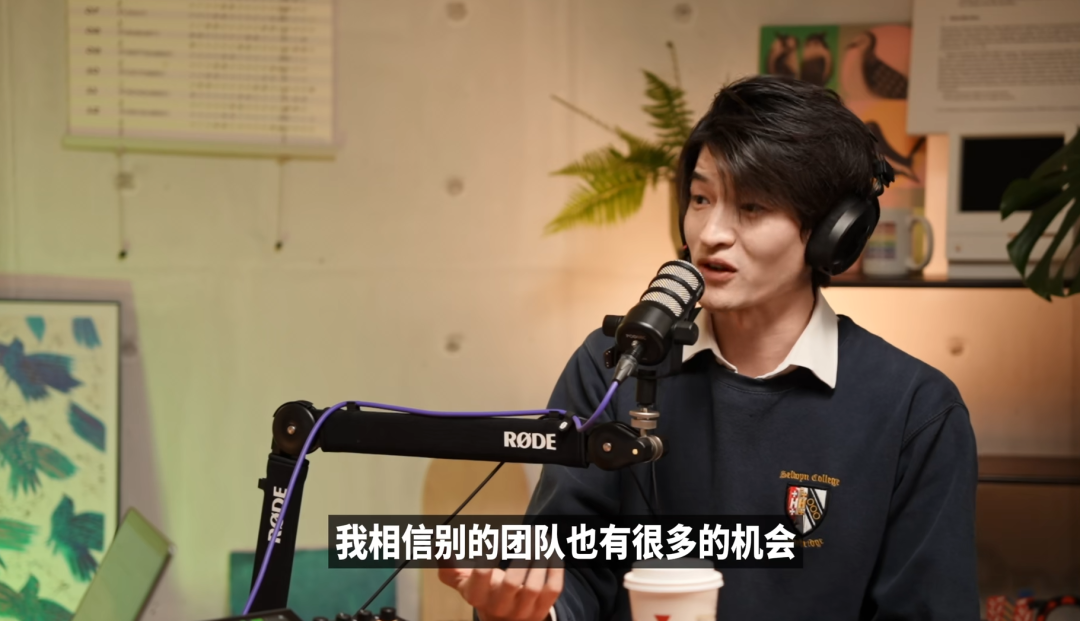
Another interesting fact: our team's background is very similar to KoBold Metals'. They have a scientist who worked in quantum computing, one in earth science, and one from finance. Our founders' backgrounds closely mirror theirs.
👦🏻 Koji
Entrepreneurial DNA converging.
🧑🏻💻 Ziheng Xiang
Yes, converging without coordination.
👦🏻 Koji
Right now, is "making the earth transparent" still just a hypothesis, or has it already been validated in certain scenarios?
🧑🏻💻 Ziheng Xiang
We already have several validated cases. The commercial contracts we've taken on all came after early proof-of-concept work that earned clients' trust.
For example, we have validated results in Mongolia, the Middle East, and Brazil. Interestingly, we're a Chinese team that just raised a seed round, yet one of our largest clients is Brazil's GE21, the biggest geological consulting firm in South America. We've already launched data and product-level cooperation with them. The reason such a large company is willing to trust a startup like us is that we did extensive proof-of-concept work with them early on. Our model capabilities and data processing abilities have been validated on some of their projects. That itself is a recognition of our capabilities.
👦🏻 Koji
As an all-Chinese team, with a typically Chinese face, how do you build trust?
🧑🏻💻 Ziheng Xiang
Thanks to my various experiences at Cambridge, building trust is a very natural process for me. For example, yesterday we had late meetings with Middle Eastern clients — my last call was past 9 p.m. The first thing I said was that we'd already done preliminary analysis on the requirements they'd sent the day before. The client's project manager immediately said to his partner: "See, I told you this team can manage a lot of stuff."
Building trust is multi-dimensional logic.
First, you absolutely have to be reliable. This is something we pay close attention to — whatever results we deliver to clients, we make sure they're solid.
Second, when dealing with international people, the most important thing is being able to quickly get, in an English-language environment: who are they? What do they want? Why do they want to talk to you? If you can get this within a minute, you basically already have the answer in your head. Whether with clients from the UAE or Brazil, often it's just a matter of chance — standing together and chatting for a minute, I immediately know their needs are something we can solve, and then I can introduce our solution through a very warm introduction. It's a very smooth process.
Also, I feel that many Chinese people in international settings tend to either be very shy or eager to express themselves. But genuine interpersonal communication is more about first establishing a heart-to-heart connection, then talking specifics. That's my international communication philosophy.
👦🏻 Koji
As Chinese, do you have advantages in the business world of mining?
🧑🏻💻 Ziheng Xiang
Yes. Because this wave of AI development has made everyone realize that in AI, Chinese people are the most reliable.
As a team providing AI solutions for mining, we have both international perspective and know how to communicate with them, which actually closes a lot of distance.
👦🏻 Koji
Your name DeepOptica — my first reaction was DeepSeek, second was DeepMind. Is there similarity between using AI to look at protein structures and using AI to look at earth structures?
🧑🏻💻 Ziheng Xiang
Whether it's proteins or materials, to measure system properties we typically need to turn complex three-dimensional systems into two-dimensional or N-dimensional measurement data. One problem AI solves is: with the goal of optimizing measurement data, how should I design this complex three-dimensional system?
The underlying logic is connected: to find a deposit, what should the subsurface structure look like? Or, what subsurface structure corresponds to a given measurement? I want a material to achieve certain properties — what should its structure look like? All of these involve the same question: can we converge what's called the "multi-solution inversion problem."
This was the core of our first-generation AI tech stack — whether we could solve the convergence problem of inversion through large amounts of data.
Previous inversion methods relied on massive simulation — simulating various complex geological or protein structures to match measured values. When the measured values matched, the simulation result was considered valid. But the downside was strong multi-solutionality — a single geophysical surface measurement might correspond to 100,000 possible subsurface ore body structures.
After AI learns from large amounts of data, we can know what kind of terrain corresponds to what kind of structure. This is what AI can solve.
This is also very relevant to medicine — we have team members with medical backgrounds. Much of their past research was about how to match two-dimensional images of photographed organs with three-dimensional organ structures. The technology stack is very similar. We use many optimization methods here, like ViT and multimodal techniques, to extract features and define the depth corresponding to certain ore bodies or signals. But much of the judgment is actually completed by AI itself.
👦🏻 Koji
So it's a bit like taking a CT scan or X-ray — you get a two-dimensional image, and then you have to figure out how to interpret it as a three-dimensional structure.
🧑🏻💻 Xiang Ziheng
More like building on that, we're trying to train a multimodal CT model. But geophysics, or the entire prospecting model, is far more complex. With a human CT, you can take photos all around the person. But with Earth's "CT," you can only measure from the surface.
So you have to trade spatial dimensions for depth understanding.
👦🏻 Koji
What do you mean by expanding space? Surveying a larger area, then looking for feature vectors?
🧑🏻💻 Xiang Ziheng
Exactly. You obtain broader surface measurements to infer the underlying subsurface structure.
This space isn't as crowded as you might think
👦🏻 Koji
Using AI to improve mining accuracy — do you see this as a globally crowded, bloody-red-ocean kind of race? Is it saturated?
🧑🏻💻 Xiang Ziheng
We put pressure on ourselves, so of course it feels crowded. But stepping back, this space actually isn't crowded at all. There are still vast numbers of unsolved problems and untapped customers. There are thousands of publicly listed mining companies globally, many of them small — what we call "junior miners." These are often teams of just a few people. They're nowhere near accessing the kind of powerful AI systems or data solutions we're developing.
So what we're doing is building a product — selling our solution to these small and mid-sized mining companies. Large corporations may be developing their own efficient exploration methods, but because this industry isn't monopolized, there are still plenty of untouched regions worth exploring.
👦🏻 Koji
Here's an important strategic choice: do you build software to serve all these SMEs, or do you master the technology and become a mine owner yourselves?
🧑🏻💻 Xiang Ziheng
Regardless of whether we become mine owners in the future, we have to get the model and product right first. This product can serve small mining companies down the line. Once we develop stronger understanding of a particular region, it becomes natural to evolve into a mining enterprise ourselves.
Of course, we could also partner with clients to acquire new mining rights, becoming a mining company through technology equity.
There are many ways to operate, but right now we're solely focused on the product and the model itself — seeing how much it can solve for our customers.
👦🏻 Koji
How long do you think it takes to validate this model? What's the clear North Star metric or signal?
🧑🏻💻 Xiang Ziheng
We believe we'll complete validation this year across several core mineral belts — Australia, South America, and Africa. By sometime in the first half of next year, we expect to launch the first generalized mining world model.
As for acquiring our own mines, that's more about seizing the right opportunities. For instance, some of our partner clients may have highly prospective targets adjacent to their existing claims. Once we gain that information, we can work with the mining company to secure those rights. This doesn't necessarily have to wait until our model generalizes extremely well — it happens organically. We complete a project, then in a "claim the surrounding hills" fashion, we partner to secure nearby mining rights.
👦🏻 Koji
Do you think your technology will eventually become commoditized? Could it become something any top-tier engineering team could replicate?
🧑🏻💻 Xiang Ziheng
I think that would be difficult. It's like the companies building large language models and world models — in the end, only a handful truly achieve practical applicability.
👦🏻 Koji
Behind them is the massive capital investment required, which blocks more entrants. Talent, too.
🧑🏻💻 Xiang Ziheng
Right. And I think there's a huge gap here: the integration between earth sciences and computer science isn't tight at all.
It's not like physics and computing, or biology and computing, where established interdisciplinary fields already exist. But geology, including disciplines like geostatistics, hasn't been around that long. So there's a massive gap. The teams that can bridge it need to put down deep roots in this domain.
I actually don't think this is something a few engineers or a mining company with data from a handful of its own mines can just pull off.
👦🏻 Koji
So you're standing at a kind of interdisciplinary crossroads?
🧑🏻💻 Xiang Ziheng
Yes, a crossroads of disciplines.

👦🏻 Koji
Does building this technology require a lot of money?
🧑🏻💻 Xiang Ziheng
It does. But that doesn't mean we can't accomplish things with our existing investment. If you truly want to build an Earth-scale foundation model, the investment would be enormous. But if you're building a regional, generalizable model, the investment is much smaller.
That said, for our team's ambition, we genuinely want to build a world-scale model. We want to become a company like DeepMind — applying advanced technology to the mining sector.
👦🏻 Koji
To become a company like DeepMind, what key stages do you still need to go through, or what critical talent do you need to add?
🧑🏻💻 Xiang Ziheng
First is our synthetic data engine. It's still being optimized. It may already perform quite well in certain typical mineral belts, like porphyry deposits. But ore body structures are far from uniform — there are also iron oxide, skarn, sedimentary types, and more. These all require continued investment.
On the talent side, we're currently recruiting mainly in three directions: earth sciences, AI synthetic data, and large-scale models. We hope to attract more people to join. Looking at milestones, we're actually quite confident about commercialization, because there are so many entry points in mining. Once the model reaches a certain capability level, it can serve mining companies of all sizes across many regions.
So what we care more about is: first, under what conditions can our technology actually solve problems for users, and with what accuracy; second, whether our product can truly resonate deeply with customers.
What being a rowing captain taught him about leadership
👦🏻 Koji
Does the experience of starting a company remind you of your time as rowing team captain — that kind of managerial leadership? Are there parallels?
🧑🏻💻 Xiang Ziheng
Yes, very much so. Every time this comes up, I'm still deeply moved. One of the biggest characteristics of rowing is how "intense" it is. Unlike basketball or track, where you might train three times a week, our rowing team — especially the squad I captained in my senior year — trained twice a day.
👦🏻 Koji
Twice a day? And you were doing your PhD then?
🧑🏻💻 Xiang Ziheng
Yes, I was still doing my PhD, still running experiments.
👦🏻 Koji
Did every team member have to attend?
🧑🏻💻 Xiang Ziheng
Yes, everyone had to. Rowing is a team sport. If even one person doesn't show up, that boat can't go out on the water.
So bringing everyone together to do something that might not necessarily help with academics — it's very difficult, especially when many are undergraduates under heavy academic pressure. This is very similar to starting a company.
👦🏻 Koji
I remember you mentioned that you'd get on the river at dawn, because the first boat out has an endless expanse ahead — the best training environment. But the hard part was getting everyone up at 5 a.m. together.
🧑🏻💻 Xiang Ziheng
Yes, this is a classic team cohesion problem.
👦🏻 Koji
How did you do it?
🧑🏻💻 Xiang Ziheng
I didn't deliberately think about how to make everyone cohesive. But first, all team members have to buy into it — this touches on something like core values. Everyone needs to feel that joining the rowing team is cool, that winning and outperforming other colleges is something to be proud of. That's intrinsic motivation.
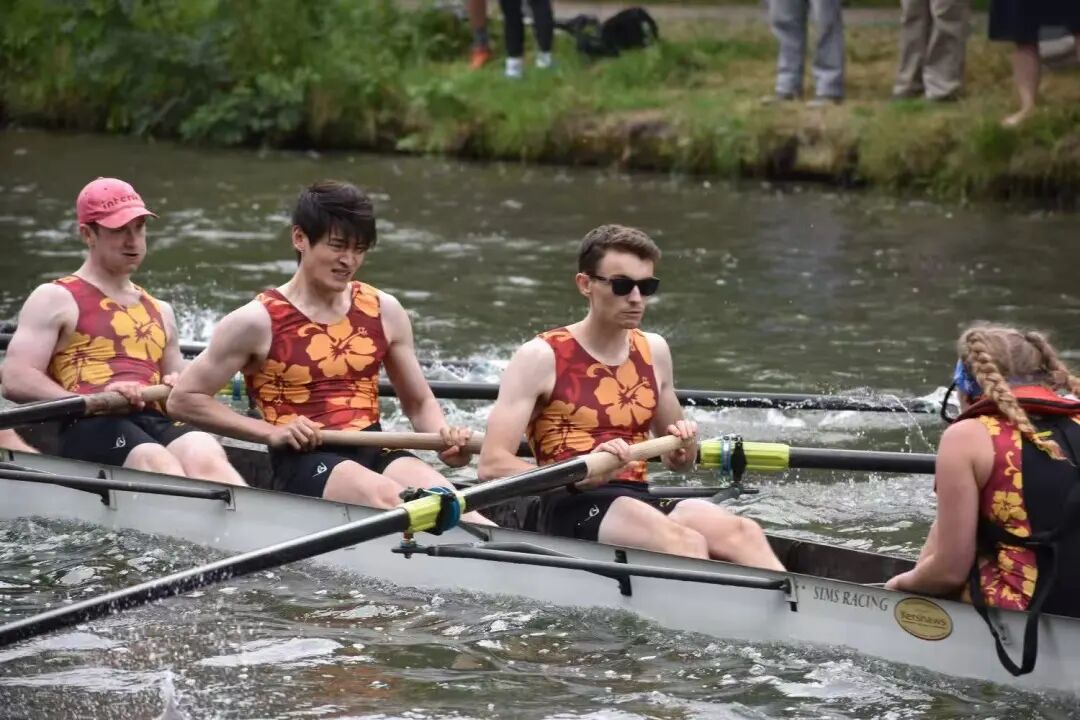
Second, we had an internal alarm system. In spring we'd assemble at 5:30, so by 5:00 people would be asking in the group chat who was up. Anyone who wasn't would definitely get their door knocked on. Before training, we'd have a brief meeting to clarify today's goals — what we needed to improve from yesterday. We'd also mention where we'd go eat after training, building team atmosphere.
We'd break down goals. For example, in the 2km rowing event, how many seconds each person needed to improve within a month; what our competition targets were for the year.
Breaking down goals, giving the team a sense of identity, people getting closer and closer — with these things, cohesion emerges naturally.
👦🏻 Koji
Were there challenges? Like people wondering, can a Chinese face really be captain?
🧑🏻💻 Xiang Ziheng
There was at first. Especially with new team members — they'd think, "Wow, your college is so weird, Europeans are 90% of it, why is the captain Chinese?" I cared a bit at first, but once people see what you've done, the questions stop.
A captain's primary job is to lead the team to grow, to win races, and to make the team members popular — that's something British people really value. If you can make them feel that, you've succeeded as captain.
So I got into the groove quickly — securing better coaches and equipment, leading the team to competitions we'd never done before, hauling boats and oars 100 kilometers to race at Battersea and Oxford. These were things people felt had never happened before. And of course, we'd throw parties too.
Gradually, that doubt dissipated. And we did win — a very hard-fought victory at the Cambridge races. When people see your results, they start thinking, this person is pretty good.
👦🏻 Koji
So this is a kind of leadership without authority, something you have to build slowly?
🧑🏻💻 Xiang Ziheng
Yes. My own style isn't someone who looks sharp on the surface — it's more about gradually influencing through action.
👦🏻 Koji
Especially since you mentioned your own performance wasn't the best. Did that become an obstacle? Would people say, you're not even the strongest, why should you lead us?
🧑🏻💻 Xiang Ziheng
I could sense some team members thinking that at the time: your physique isn't better than mine, your times aren't that much faster, why are you our big leader? It's the same issue. I'd put enormous pressure on myself to improve my performance, to make sure I worked harder than everyone else. That's my mentality in starting a company too — first, I have to work extremely hard myself, then lead the team well.
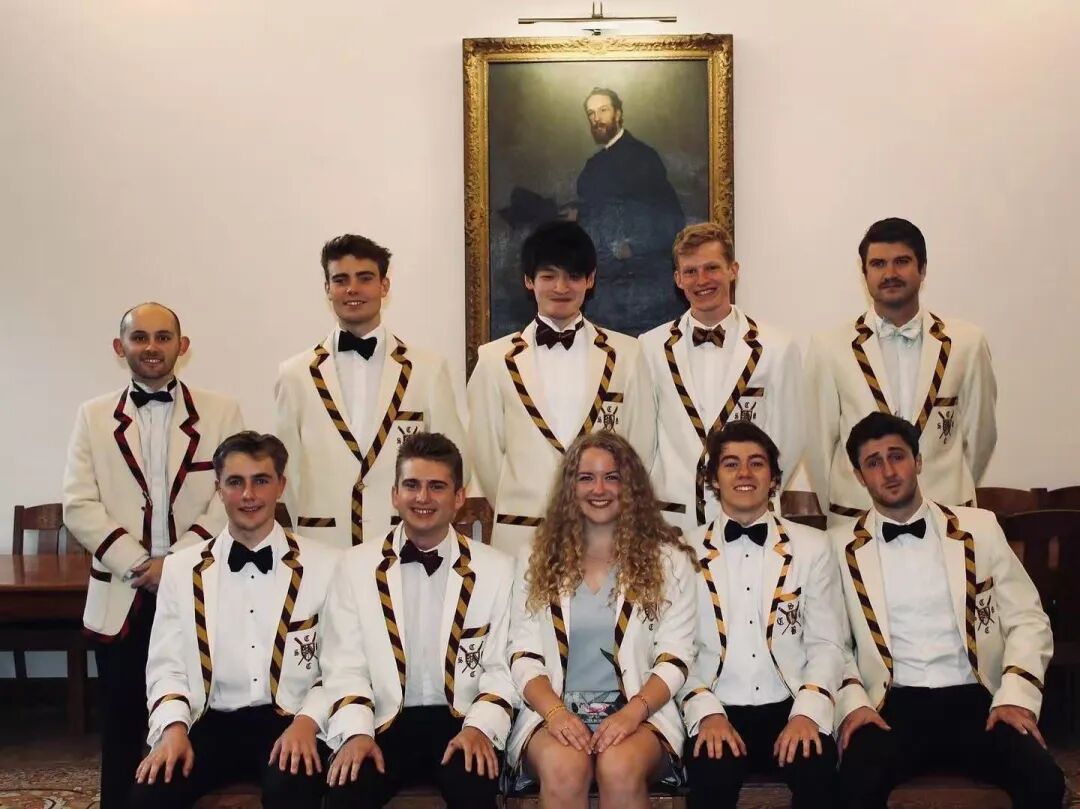
Second, I care more about whether my teammates can find happiness and fulfillment in what we're doing. If as a leader I can make them genuinely happy, why wouldn't they trust me? For those British undergraduates who had just entered university, they all had a certain arrogance — just like students who had just gotten into Tsinghua or Peking University. But when you make them feel that there's someone reliable they can grow with — even if they don't 100% like you — that's what makes a good leader.
👦🏻 Koji
So you didn't try to get every teammate to like you?
🧑🏻💻 Xiang Ziheng
I don't think leadership and whether people like you are necessarily connected.
👦🏻 Koji
Was there anyone who disliked you at first but eventually accepted you as captain?
🧑🏻💻 Xiang Ziheng
There was one Russian guy who really didn't like me at first — he wouldn't even talk to me. But later you realize that people like that have their own loneliness inside. Why didn't he want to talk to me? Maybe he felt like he had to act close to the British guys, and he didn't want to hang out with a Chinese person. That was his own internal drama. I didn't feel like I needed to cater to him or avoid him either. To me, he was simply a teammate I needed to help improve.
👦🏻 Koji
If you had to sum it up in a few keywords, how did being captain help you with entrepreneurship now?
🧑🏻💻 Xiang Ziheng
First, energy. I really do have good energy. I can grind hard.
Second, a kind of calm leadership. I know my style — it's not the kind that's sharp on the surface.
Third, and more importantly, the big picture. Individual considerations matter, of course — they determine the team's direction. But in execution, you care more about whether the team can get things done.
If DeepOptica fails, what would most likely cause it?
👦🏻 Koji
We often say startups need to answer two "whys": Why now and Why you? I want to flip that — if one day DeepOptica fails, where do you think the biggest problem would be?
🧑🏻💻 Xiang Ziheng
The biggest problem would likely be rhythm — we didn't get the timing right. Whether it's fundraising rhythm or customer acquisition rhythm, you have to complete corresponding tasks within certain time windows.
If you don't manage it well and don't deliver at that point, the company will likely start declining.
👦🏻 Koji
How do you learn and model this?
🧑🏻💻 Xiang Ziheng
We have a very detailed plan: a three-year long-term plan and an 18-month medium-term plan. We then break the 18-month plan into quarterly short-term milestones, with clear targets for where the technology needs to be in three months and what commercialization support is needed.
👦🏻 Koji
That sounds a bit like the "small-town test-taker" mindset — turning entrepreneurship into a problem set, breaking it into smaller problems.
🧑🏻💻 Xiang Ziheng
Unlike the small-town test-taker, they focus more on just solving the problem.
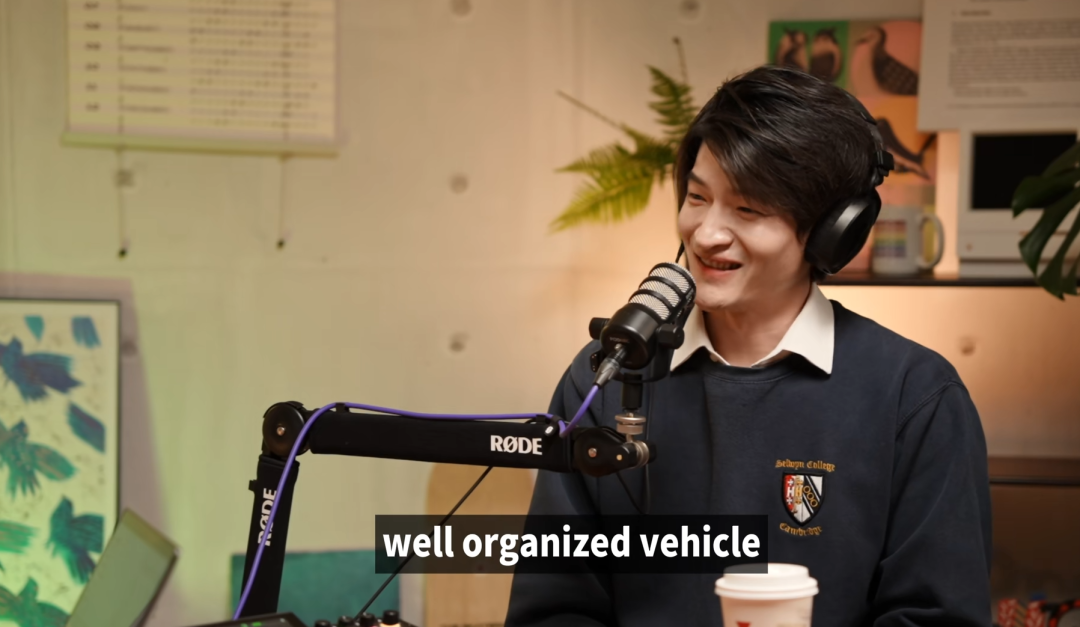
What we do is guided by a long-term vision, which leads to a medium-term vision, which then gets broken down into small executable goals for everyone. So rather than being test-takers, we're more like a well-organized vehicle.
DeepOptica in five years, and the real ideal
👦🏻 Koji
Let's imagine — if DeepOptica is very successful in five years, what would that success look like?
🧑🏻💻 Xiang Ziheng
First, our model would definitely have global influence — an AlphaFold-level model, probably with a basic open-source version and a commercial version. Many mining companies would be able to use our model to practice in their own mining areas and understand the geological characteristics there. That's the technology side.
On the business side, we would definitely have very close partnerships with several of the world's largest mining companies.
Third, we should have accumulated substantial mining finance experience. We could use our own models and valuation systems to make some mining royalty investments, even take equity stakes in some mining rights. It would definitely be an integrated entity combining technology, mining operations, and mining finance.
I think we can definitely achieve this within five years.
👦🏻 Koji
It feels like your life has been a straight success story, very much the top student type. Were you always like this? Have you experienced setbacks that people wouldn't imagine?
🧑🏻💻 Xiang Ziheng
I wasn't always a top student — I was consistently ranked 5th to 10th in class, throughout middle school and high school. Maybe my grades improved a bit in college, and I was lucky to get into Cambridge. But this isn't some cheat code — there's a lot of hard work behind it, I just come across as pretty chill.
During my PhD and subsequent work, there were quite a few setbacks. I had to manage the rowing team while doing experiments, and the results often fell short of expectations. When you feel like your lab mates' research directions are more impactful than yours, it's hard not to feel down.
Then in 2021, I also had a completely unsuccessful startup attempt, which was quite a blow. Having just finished my PhD, giving up a lot, investing my own money into a venture that failed — that really hits you.
Only after going through several setbacks can you better manage stress and expectations, and become more optimistic when you encounter setbacks again.
👦🏻 Koji
Did that make you more conservative, less willing to take risks?
🧑🏻💻 Xiang Ziheng
No. It's related to personal pursuits and personality. I've never felt like I have particularly strong material desires. I even feel that if one day I truly had no job, what I'd feel more is an inner emptiness, not anxiety about having less money or my living standards stagnating. I'd be more anxious about not accomplishing what I want to do.
So what I want to think more about is how to build my ideal together with everyone. I really want to do these things well.
👦🏻 Koji
What ideal?
🧑🏻💻 Xiang Ziheng
My ideal is to explore space, to explore Earth. During my PhD, I was more wandering in the physical world, thinking a lot about quantum mechanics and relativity, and also a lot about philosophy.

In recent years, working on remote sensing satellites, low-orbit satellite thrusters, and now mining — my interest in Earth has grown tremendously. I'm about to travel to Abu Dhabi and South Africa for work, and I really enjoy these journeys to explore the different characteristics of worlds beneath the surface.
I just want to turn this journey into a successful experience, share it with my team, and through this experience achieve bigger ideals — like space mining, seabed mineral exploration, or doing something even crazier.
One piece of advice for early-stage founders
🧑🏻💻 Xiang Ziheng
I'd also like to ask you — doing Crossing, after talking with founders like us, what's your biggest takeaway? Any advice for entrepreneurs at our stage?
👦🏻 Koji
What I'm particularly interested in is where entrepreneurs' entrepreneurial spirit actually manifests. In early-stage investing, so much is invisible — like the world model we discussed today with DeepOptica, it's hard to judge whether it will ultimately be realized. What angel investors can grasp at this stage is their judgment of the founder and the team.
So I'm curious whether there are patterns that can be summarized, especially working backward from already successful founders to see what traits they showed at a similar young age.
Resilience is definitely crucial — no one has a smooth path. Leadership is also important, especially leadership without authority, because no one starts as CEO; everyone goes from leading without authority to gradually gaining legitimacy.
🧑🏻💻 Xiang Ziheng
Anything else?
👦🏻 Koji
One possibly universal piece of advice: Startups have a huge advantage — they can recruit exceptionally talented people who would be very hard to hire at big companies.
Why? Because startups can offer hope. Many people are willing to invest their time, energy, and lives for hope.
So in the early days of a startup, you must leverage this advantage and attract these talented people as much as possible. Especially with your strong backgrounds and visionary work, this is an extremely high-leverage opportunity — use it extremely well.
Because this leverage might disappear instantly by year three or four.
Either the company didn't make it and can't attract people anymore; or the company got big, so why would they still join you? They might go join an earlier-stage company instead, for greater hope.
🧑🏻💻 Xiang Ziheng
Yes, that makes a lot of sense.
👦🏻 Koji
I think at this stage, you need to be full of ambition, even recruit with somewhat unrealistic ideas. You might think someone in this industry is impossible to poach, but you never know — maybe they're right in a career焦灼期 [career焦灼期: a period of career anxiety/uncertainty], and very likely willing to give it a shot.
🧑🏻💻 Xiang Ziheng
Yes, that's excellent advice.
👦🏻 Koji
Thank you Ziheng for coming to Crossing today. We look forward to DeepOptica achieving even greater things, and we look forward to having you back again someday.
🧑🏻💻 Xiang Ziheng
Thank you Koji, definitely.
🚥