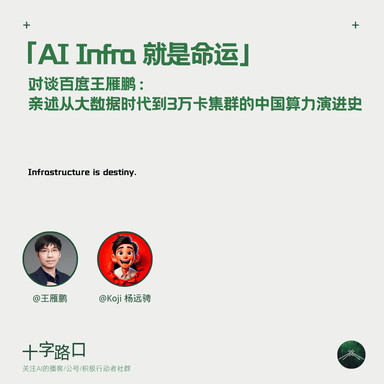
This week on Crossroads, we're diving into AI Infra — the infrastructure powering artificial intelligence.
This year, OpenAI — the infrastructure maniac — has been dominating headlines. First came rumors of Stargate, a supercomputer project costing hundreds of billions of dollars. More recently, it signed a deal with Oracle worth up to $300 billion to build 4.5 gigawatts of massive data centers across the United States.
To put that in perspective: 4.5 gigawatts is roughly the output of nearly four nuclear power plants. $300 billion exceeds the annual GDP of many countries.
Behind these astronomical contracts lies an increasingly clear signal — in the second half of the AI race, algorithmic innovation still matters, but compute power is becoming the ultimate variable.
This arms race for the future has extended from code and models to more fundamental physical layers: chips, electricity, and data centers.
As OpenAI titled a report late last year: "Infrastructure is destiny" — AI Infra is destiny. So where do China's tech companies stand in all this? And where are we positioned in this competition that will determine our future?
This week, our guest is Yanpeng Wang, Chief Scientist of AI Computing at Baidu. His career spans the full evolution of China's internet infrastructure, beginning in the big data era. He'll share firsthand accounts of this journey — from self-developed servers in the CPU era, to large-scale clusters in the GPU era, to today, where Baidu has built China's first fully self-developed 30,000-card cluster.
Beyond that, Yanpeng and we covered plenty of ground, including:
- His take on Silicon Valley AI giants (OpenAI, Google, Meta)
- The only viable path for domestic AI chips to break through
- How architects can avoid becoming mere "ops engineers" and find their professional value
We hope this episode offers something useful for you.
🟢 02:41 Rapid Fire
Age, alma mater, MBTI and zodiac sign, one-sentence introduction to Baige.
🟢 03:38 A History of Internet Infrastructure Evolution
From hailing cabs to haul servers across town, to one-click scheduling of 10,000-card clusters — three computing eras through the eyes of an insider.
- Phase one: The big data era. Google defined the game with three papers, building high-performance systems from cheap PCs and prompting internet giants to construct their own data centers.
- Phase two: The cloud computing era. Amazon made "elasticity" central, using virtualization to free entrepreneurs from the "prehistoric age" of moving their own servers.
- Phase three: The AI era. The computing paradigm leaped from CPU to GPU, pushing compute power to extremes — but at the cost of requiring "hardware-software integration." Software could no longer ride hardware gains for free.
Why is the large model a true "industrial revolution"? It brought Scaling Law — a replicable, predictable "industrial paradigm" where stacking compute buys you intelligence.
Intel vs. NVIDIA then and now: one believed in "hardware-software decoupling," the other insisted on "hardware-software integration." Why did the latter become AI's sole dominant force?
🟢 25:06 Is OpenAI's $100 Billion Bet Foresight or Waste?
"If AI investments waste hundreds of billions, that's unfortunate. But the risk of not investing is greater."
Compute, algorithms, data — which matters most? Compute. Internet data is largely exhausted. Whether through synthetic data or reinforcement learning, the future requires compute to "manufacture" new data.
Can DeepSeek's "cleverness" counter OpenAI's "brute force"? The two aren't contradictory — algorithmic efficiency still needs compute to prove itself.
The China-US compute gap: 30,000 cards vs. 100,000 cards. How will this physical chasm affect innovation?
10,000-card cluster challenges: Power is the massive bottleneck. A 30,000-card cluster requires a campus-level substation.
"Is building data centers now a waste?" — Not building is the problem. Not building means rejecting innovation. Today's spending is "using money to shorten the time to reach the future."
🟢 40:10 Baidu Baige: Why Claim "Strongest Yet"?
What is Baige? An efficient AI compute platform built for AI, with core principles of supporting ultra-large scale, cross-location heterogeneous multi-network usage, pursuing extreme engineering efficiency.
The confidence behind "strongest": rooted in Baidu's decade-plus of AI application accumulation and full-stack integration from chip to platform to model to application.
Baige's differentiation: four-layer architecture with joint optimization, achieving parity between internal and external use with extreme efficiency.
🟢 45:20 Will China Birth a NVIDIA? Is There Still Room for AI Infra Startups?
The reality of AI Infra entrepreneurship: opportunity exists, but giants are hard to birth.
The only path for a Chinese NVIDIA: it must emerge deeply bound to "the most advanced models."
When domestic chips can support the most leading-edge models, it will have succeeded.
🟢 49:16 US AI Giants: Each Their Own Path
- Google's comeback: Possesses the most abundant compute (TPU) and the deepest tech stack.
- Meta's astronomical poaching: The capital logic checks out ($100 million for talent vs. $100 billion for chips), but it's organizationally unhealthy.
- OpenAI: Leveraging future vision, using high risk to drive an infrastructure revolution.
🟢 58:42 Advice for a New Generation of Engineers in the AI Era
"Infra that doesn't understand algorithms isn't good Infra."
How to escape the "firefighter" fate and produce innovation worthy of the "$1 million top prize"?
Why will algorithm engineers who don't understand Infra be eliminated in the future?
Top AI talent as full-stack: from applications to architecture, you need to know it all.
Advice for the new generation of engineers: This is a beautiful era. How far you go depends on connecting the full stack.
Subscribe to the Crossroads podcast 🚦 We track the industry shifts and entrepreneurial opportunities brought by the new wave of AI technology.
🚦 "Crossroads" was Steve Jobs's metaphor for Apple — standing at the intersection of technology and liberal arts, where great products are born. AI is transforming every industry. We seek out, interview, and bring together a new generation of AI founders and active players in the AI era. Together with them, we explore and embrace the changes and new possibilities.
👦🏻 Host Koji: I founded Crossroads and launched AI Hacker House, a community space for a new generation of AI founders. I serve as Venture Partner at ZhenFund. I believe technology, especially AI, represents the greatest value-creation opportunity of our generation. Koji on Jike | Koji's website
👧🏻 Host Ronghui: I co-founded Crossroads, worked at a dollar-denominated VC, and spent five years as a Silicon Valley correspondent. I follow tech development and business stories. Feel free to reach out and chat. Ronghui on Jike
🎄 This podcast is supported by The Fair Sound Forest Podcast Initiative.