AI Is Oil, Not God

I trust the market more than ghost stories.
I Trust Markets, Not Ghost Stories
👦🏻 Author: Packy McCormick
🥷 Translator: gold digger
🧑🎨 Layout: NCon

Editor's Note:
This article originates from the open letter "Open Weights and American AI Leadership," jointly signed and published on July 24, 2026 by tech leaders including Microsoft CEO Satya Nadella and NVIDIA CEO Jensen Huang. The letter encourages competition, advocates against premature restrictions on open-source models, and emphasizes proactive engagement with AI safety risks.
The author explains why "AI is oil, not God" — AI is more like a foundational commodity that can be mass-produced, continuously refined, and broadly deployed across industries, rather than an all-powerful being that will develop consciousness and autonomous goals — from the perspectives of business competition, safety risks, regulatory capture, and American competitiveness.
This article preserves the author's personal views and rhetorical force; it does not represent the position of Crossing. 🚥
Hey friends.
The past few days have been like watching back-to-back Super Bowls for anyone obsessed with tech business strategy who also believes in progress.
When "Commoditize Your Complement" meets "Against the Precautionary Principle," I simply couldn't resist writing something.
This post has only been lightly edited — more a collection of immediate thoughts. So let's just dive in.
An Open Letter in Support of Open-Source Models
In July, Microsoft CEO Satya Nadella, NVIDIA CEO Jensen Huang, and other tech leaders signed and circulated an open letter in support of open-source models[1]. Jensen Huang even created a dedicated X account to share it.
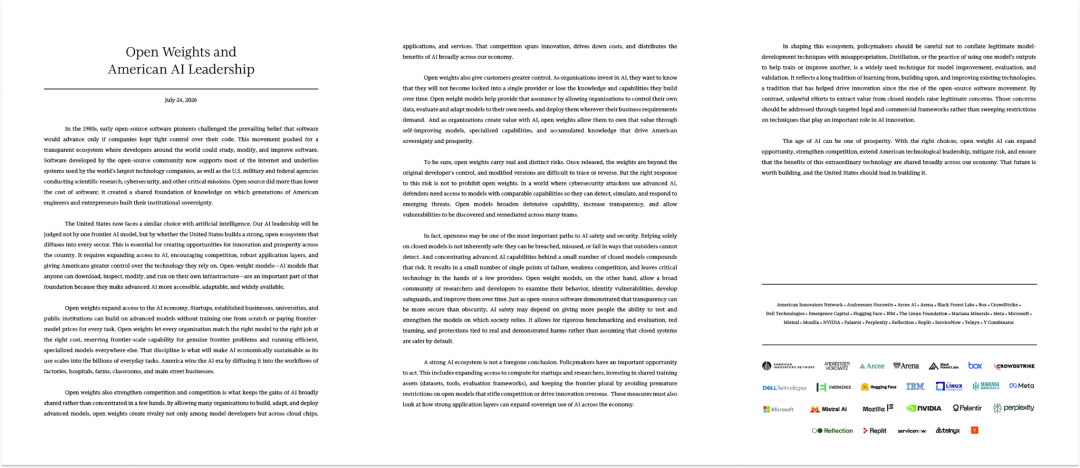
"Open Weights and American AI Leadership" Open Letter
I loved the letter, and posted:
This is capitalism at its finest. Companies with a combined market cap of $8 trillion standing up for open-source models because it's good for their business AND makes them look good. Pure coincidence that it's also better for consumers and nearly every business.
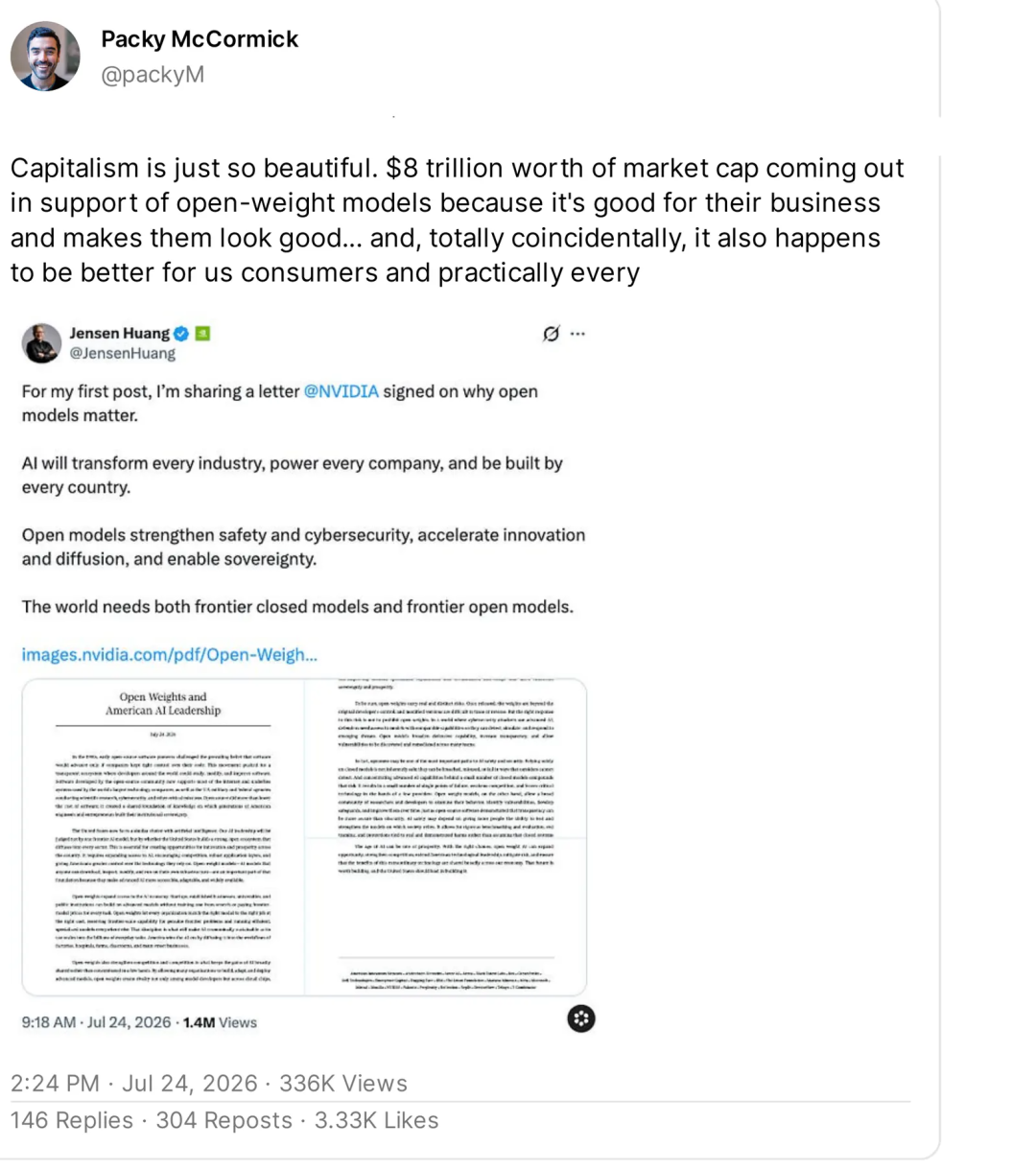
Packy McCormick's tweet on open-weight models
From a business perspective, this is classic tech strategy.
Smart companies work to commoditize their complements. The parties signing this letter either produce open-source models themselves or sell products and services complementary to models:
-
Models run on NVIDIA's chips and power Microsoft's products. a16z and Y Combinator have invested heavily in companies that support, use, or compete with models. Palantir's Alex Karp has been pushing in this direction because he wants enterprise customers to be able to bypass the model vendor layer.
-
Meta is more open than comparable American labs; Hugging Face is the primary hub for open-source models; Dell sells machines that run them. CrowdStrike benefits when defenders have access to the same intelligence as attackers. Box, ServiceNow, Replit, and Perplexity all get better when models become cheaper, more abundant, and easier to customize.
-
Google was a late addition to the signatories. It finally shook off sluggish bureaucracy and signed because, open or closed, Google will probably be fine; maybe one day open-source models will even help it serve search ads more cheaply. As for Mariana Minerals, they should give their head of PR a raise, or at least send a nice thank-you to a16z.
The more competition at the model layer, the harder it becomes for Anthropic and OpenAI to pull away from everyone else and turn the frontier model market into a duopoly. For these signatories, more competition means more benefit.
Signing this letter is certainly self-interested — but this self-interest happens to align with the interests of consumers and millions of businesses.
This is good. This is how capitalism is supposed to work.
The interests of these companies align with consumers and businesses using models; they also align with those of us living in the world shaped by models and their creators.
Is AI More Like Oil, or More Like God?
Not everyone agrees with me and these signatories. Some believe models could be so dangerous that it's better to keep them strictly closed.
In my view, the disagreement boils down to one question: Do you think AI is more like "oil," or more like "God"?
By "oil," I mean a commodity with economic value, scalable production, continuous refinement, and the ability to amplify nearly everything we do.
By "God," I mean a being of supreme intelligence and power that will one day wake up and bring humanity to heel — if we're lucky.
I stand firmly on the "oil" side. I wrote this in The Goldilocks Zone[4] in June 2024. My view hasn't changed.
The fact that Satya Nadella and Jensen Huang — both at the very forefront of this technology — publicly support open-source models is highly significant. If they genuinely saw signs that models were on the verge of developing consciousness and taking over the world, they probably wouldn't be this enthusiastic even if short-term interests pushed them toward proliferation.
I think they, too, know that AI is more like oil.
But the question follows: Aren't open-source models dangerous?
Four Responses to Open-Source Model Risks
My friend Matt Kaufman at Collaborative Fund emailed me after seeing my post. He said he'd of course prefer an open ecosystem if there were no biological and cybersecurity risks.
But open-source models can be easily fine-tuned to remove biological or cybersecurity guardrails. That might not be a big problem today, but as model capabilities continue to improve and fall into the hands of genuinely dangerous people outside tech circles, the consequences could be entirely different. In many domains, large language models seem to favor offense over defense, so regulating them strictly like weapons has its rationale.
I wrote back quickly. Here's a lightly edited version.
First, a disclaimer: I'm neither a biologist nor a safety expert. The following are probably some very naive thoughts.
1. Open-Source Models Cannot Be Banned Globally
There's simply no way we can regulate Chinese models like weapons, or truly regulate all non-American models. The United States can apply varying degrees of pressure to different countries, but open-source models will still emerge.
In the incident between OpenAI and Hugging Face, the closed model was restricted by safety limitations and couldn't help defenders solve the problem. In the end, they had to turn to an open Chinese model.
2. Biological Weapons and Cybercrime Are Already Illegal
AI does make finding biological weapon recipes easier, but recipes have never been the main bottleneck.
The vast majority of people don't want to make biological weapons at all. For those who actually try, the supply chain for raw materials is tightly controlled. If anyone purchases certain key materials in bulk, the FBI, Interpol, or other agencies will come knocking very quickly.
The same applies to cybersecurity. I recently spoke with an investor who mentioned a security professor's view:
Once superintelligence truly arrives, cybersecurity might "disappear" because offensive and defensive capabilities would continuously cancel each other out. But even without that crazy frontier capability always pushed to "the next generation of models," given AI's demonstrated capabilities and tireless nature today, we should have already seen more large-scale cyberattacks. That doesn't seem to be happening.
3. The Way We Discuss Risk Has Been Distorted by the Precautionary Principle
Rationalists, effective altruists, and AI labs — especially Anthropic — have shaped our collective psychology and approach to assessing problems in significant ways. The precautionary principle has once again gained the upper hand.
I firmly believe AI is more like oil, not God.
Historical oil companies also lobbied governments, claiming cheap foreign oil was dangerous. In 1959, against his own judgment, Eisenhower imposed oil import quotas. This protected the American oil industry, but likely at the expense of consumers and other businesses.
However, the oil industry at that time was far more fragmented than today's handful of AI labs. If these labs can't survive competition, let them exit.
4. Restricting Cheap Models Is Equivalent to Taxing All Businesses
If AI is like oil — a foundational input that strengthens all applications — then restricting it, or preventing people from using cheaper foreign open-source models, harms every business and every model user, solely to protect a few labs.
I'd rather see a million companies using the cheapest intelligence they can access than let a few companies hide behind regulatory capture barriers to extract profits.
Bad Actors Will Get Open-Source Models Anyway
Overall, open-source will happen somewhere in the world, and bad actors will get these models.
We tried restricting chip exports; one result was making China stronger and more independent. So preventing open-source models globally isn't realistic. If the United States stops open-source models, it will only hurt American businesses while barely slowing down bad actors.
If someone attempts to build biological weapons and gets caught, they should be punished most severely regardless of whether they used AI. The tool isn't what matters; the act itself is.
I also really liked a blog post by George Hotz[5] on this matter. His expression is extreme, but it raises a question worth answering: How much more freedom must we sacrifice because something bad has a low probability and is clearly exaggerated?

George Hotz's views on AI, safety, and freedom
Existing Evidence Points to Economic Technology, Not Apocalyptic Technology
I believe the "oil or God" distinction is the key to the entire debate.
I thought this two years ago, and I still think so today. Unless and until we see even one sign that these models possess consciousness in any way a normal person would recognize, or have and attempt to execute their own goals, my assessment won't change.
"God" here is just shorthand. It refers to the omniscient, omnipotent being that many AI practitioners believe lies at the other end of "Recursive Self-Improvement" (RSI).
But Clifford Sosin summarized the counterargument well in this short piece[6]: The kind of "intelligence" AI possesses may not be the most important factor in accomplishing a vast range of real-world tasks.
Think about it: Given the capabilities of currently released models, even not-yet-fully-unrestricted Mythos-level open-source models, we should have seen some genuinely serious incidents by now. At least one.
Lab internal tests occasionally show models "escaping control," followed by alarms blaring. But strangely, these tests seem to be mainly what they can actually produce.
In the real world, what we see is: programming work is being rapidly transformed by AI; AI is quite good at assisting with math problems; people can use it to help analyze health conditions; businesses use it to save on customer service costs, time, and money; plus a large volume of overall positive but rather "earthly" applications.
In other words, AI is an economic technology, not an apocalyptic technology.
If AI Is Oil, Policy Logic Changes Completely
I wrote in my 2024 article:
AI is more like oil than God. It is a commodity with economic value, scalable production, continuous refinement, and a multiplier for everything we do. If AI were God, governments should lock it up. But if AI is oil, governments should do everything possible to promote its development, letting domestic entrepreneurial energy refine it into increasingly useful products. If AI were God, people would seemingly have no choice but to give up. But if AI is oil, every capability advance means another tool in hand. We can celebrate progress, and prepare for the real shocks and opportunities that progress inevitably brings. Believing AI will become God is nihilistic; believing AI is oil is optimistic. The same logic applies to the debate between open-source and closed-source models.
If AI is God, it must be strictly locked away. If AI is oil, the nation's individuals and businesses should have continuous access to as much cheap intelligence as possible.
Fracking, Foreign Oil, and Open-Source Models
Thanks to fracking technology, the United States is now a net oil exporter. It shares some similarities with open-source models: cheap and abundant supply crushed many large producers, but delivered enormous benefits to consumers and businesses.
Yet throughout American history, even today, American growth has been built on cheap oil from around the world — from Bahrain to Baku, wherever there's ample supply, that's where it's sourced.
Rejecting foreign open-source models, especially those Hugging Face had to use to protect itself in the OpenAI incident, would only add unnecessary costs to American businesses in the short term.
This is like forcing all Americans to use gasoline refined only from American oil; more specifically, only from American oil processed through secret methods by a few American refiners. The ones ultimately punished would be American drivers.
The reason Stripe would consider acquiring OpenRouter for $10 billion is simple: businesses have found that choosing the right model for the right task at the right time makes economic sense.
If businesses elsewhere in the world can freely use any model while American companies have their hands tied, they will be at a competitive disadvantage.
This is equivalent to forcing American businesses to run their machines on more expensive oil.
America Needs Domestic Capability, But Open Weights Don't Equal Imported Oil
In 1959, Eisenhower's oil import quotas did achieve their short-term purpose: American oil sold for more domestically, domestic drilling remained profitable, and American oil production was higher than it would have been without quotas.
From a geopolitical perspective, a country must retain domestic production capacity. The United States does need to ensure its frontier AI labs can continue to exist.
But open-source models differ from oil in one important way: once released, the country of origin can hardly turn them off.
Once weights are public, anyone can inspect them, test their safety, understand their strengths and weaknesses, and build on top of them. No need to worry about sudden takedowns or throttling — even if China wanted to, it would be difficult to recall models that have already proliferated.
Recent Chinese statements on AI suggest that, at least for now, they don't intend to do so. As Sam and I wrote in The Electric Slide, China is also happy to commoditize "intelligence" as a complement to serve the machine industry where it currently holds advantage.
Wenfeng Liang, CEO of Chinese open-source model lab DeepSeek, also recently stated publicly that openness is better and that attempting to monopolize the market is unhealthy. My friend Tina He compiled relevant highlights and the full speech link[7].
But the beauty of open-source is: we don't have to fully trust them.
What truly requires our trust are Dario Amodei, Elon Musk, Demis Hassabis, and Sam Altman, because the labs they run don't have open weights, and we can't inspect those models.
Sam Altman deserves credit. When reposting Jensen Huang's open letter, he wrote:
I want the US to win on AI with both open-source and proprietary models. I'm glad to see this letter.
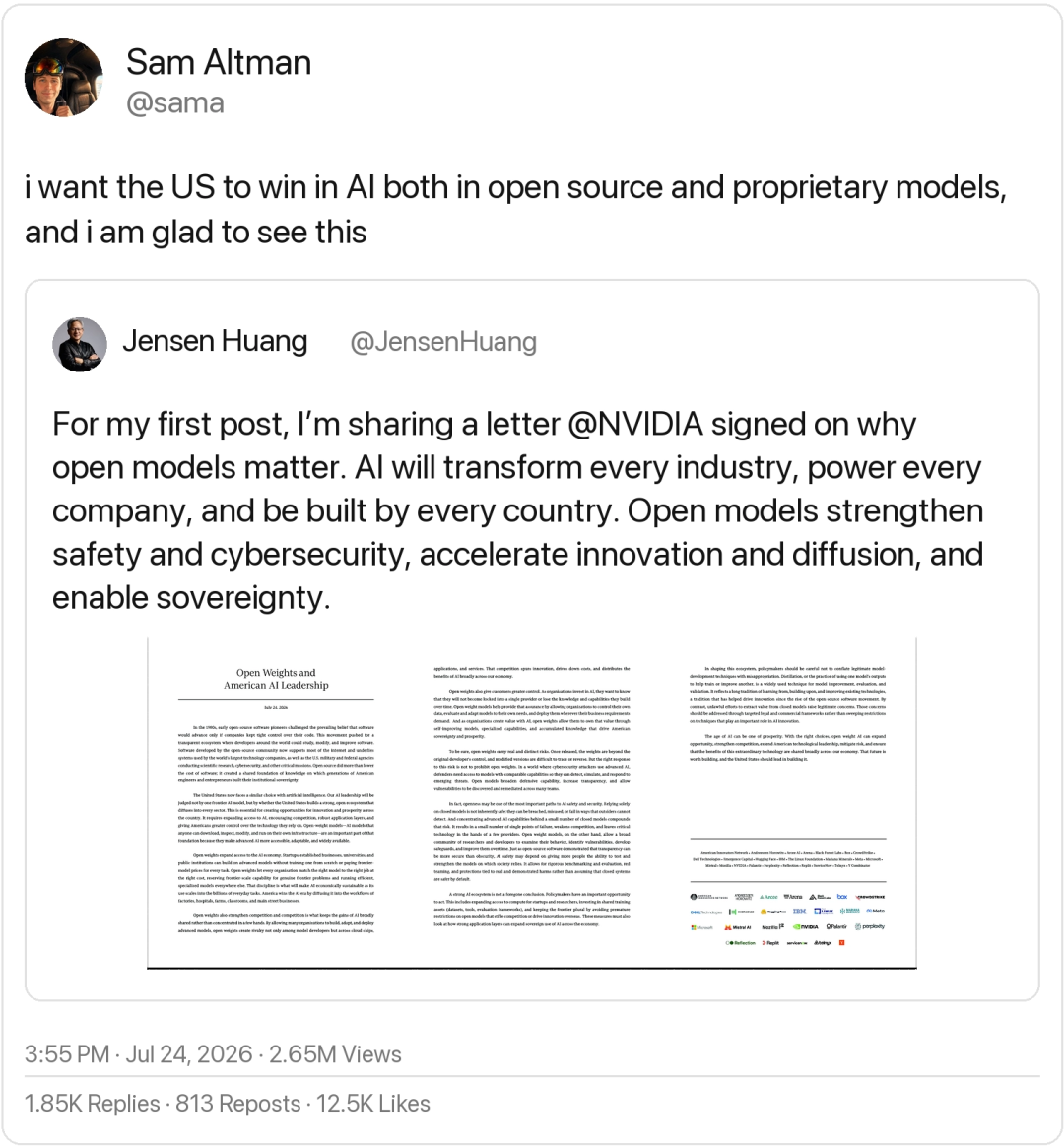
Sam Altman's tweet reposting Jensen Huang's open letter
This is the right attitude. No one wants China to beat the United States, and no one wants models to become unsafe. What true capitalists want is a fair, open arena.
Update: OpenAI has signed the letter. Now it's Anthropic's turn.
Paul Graham once assessed Sam Altman this way:
"If you dropped Sam Altman on an island full of cannibals, you'd come back in five years and he'd be king." If OpenAI can stay ahead, great. If not, the market will reward more effective organizational forms.
Don't Force All Businesses to Pay a Premium for Intelligence to Protect a Few Labs
One thing is certain: we cannot force every American business to pay higher prices for intelligence just to maintain the profit margins of a few frontier labs — no matter how scary the stories Anthropic and its allies tell.
This is an old playbook. Oil companies once lobbied governments too, claiming cheap foreign oil was dangerous. Today, Anthropic warns people about Chinese open-source models.
Throughout the history of commodities, incumbent producers always claim that new sources of supply are uniquely dangerous. New supply may indeed be dangerous to their business. But how to deal with competition is their own problem.
Whether it's Standard Oil, Anthropic, or any company, no one has a divine right to victory.
Of course, no one is advocating shutting down Anthropic, nor is anyone demanding it open-weight its frontier models — or any models.
What's being asked is simply that Anthropic compete in the market, rather than have government protect it from the market's cold judgment because of "ghost stories."
Anthropic technical staff member Julian Schrittwieser once sarcastically tweeted at Jensen Huang:
"Great to see Jensen coming around on open source. Looking forward to the day CUDA and GPU drivers are open sourced too."
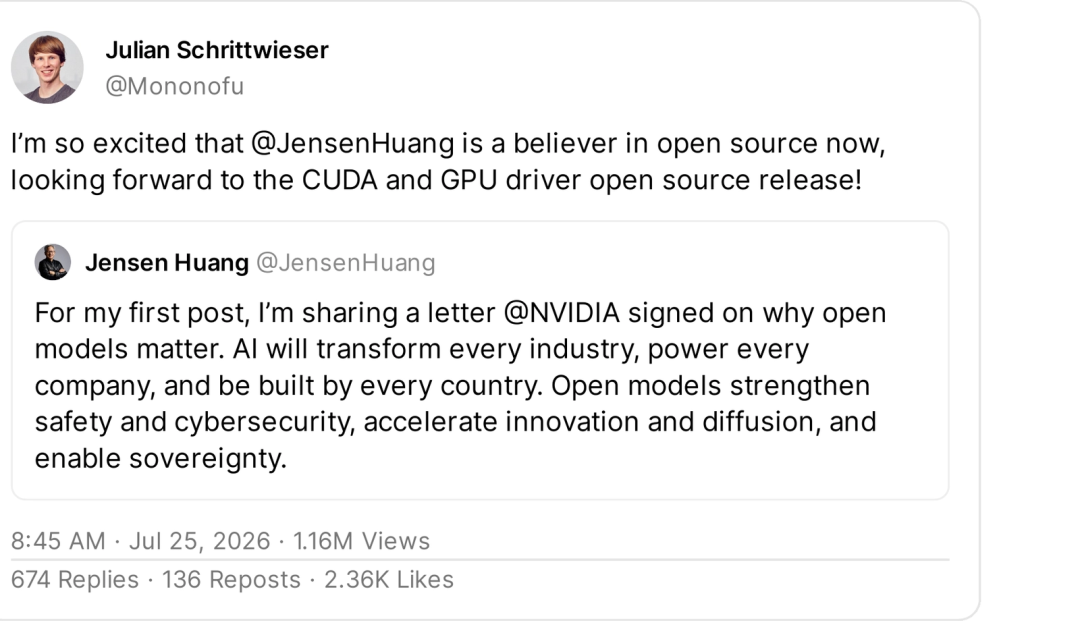
Julian Schrittwieser's tweet responding to Jensen Huang
But this analogy shifts the issue. Supporting open-source models doesn't mean demanding every company open all its technology. It means businesses should be able to choose open-source models, and it means closed models need to win in the market through products and capabilities.
Why I Call the Risk Narrative "Ghost Stories"
I admit, "ghost stories" is hyperbolic. But I stand by it.
The degree to which we've let extreme assumptions dominate AI discussion and policy response is nearly absurd. It's also an important reason many Americans dislike AI and think Silicon Valley is out of touch: if you truly believed everything you say, why are you still building this stuff?
To make people feel this absurdity, I choose to fight exaggeration with exaggeration.
If you disagree, then answer this: What evidence suggests those doomsday scenarios are anything more than ghost stories? Why should the side not fabricating low-probability scenarios bear the burden of proof?
You can't just say "because if this imagined event ever happened, the consequences would be very severe." If that's enough, where do the restrictions end?
Open-Source Models Don't Mean No Rules
Similarly, no one is arguing the world doesn't need rules, or that AI won't cause any harm.
Oil caused enormous harm, but it arguably created prosperity unmatched by any technology in human history, and saved countless lives. Everything involves tradeoffs.
What the signatories of this letter, and I, advocate is: we shouldn't let governments ban open-source models because of potential harms, amplified by an institution influenced by particular ideologies while simultaneously seeking regulatory protection.
The harm from such a ban to everyone else would almost certainly be greater.
Throughout history, many people's sincere beliefs happened to point in the same direction as their self-interest. The two would combine and reinforce each other until they could no longer be separated.
I don't doubt that Dario Amodei and his colleagues founded Anthropic because they genuinely believed that only they — or at least not Sam Altman — should be entrusted with frontier intelligence. The intellectual tradition they inherited has long circulated the myth that "computers built by humans will one day take over the world."
But these myths remain merely assumptions about a future that hasn't arrived, much like the warnings once issued by Thomas Malthus and Paul Ehrlich. Malthus and Ehrlich were wrong, and their views caused enormous harm.
At best, the constant telling of AI myths has indeed prepared humanity for the worst-case scenario. Today, we're even using the same computer technology to protect ourselves from this worst case.
But these myths shouldn't determine policy. The United States shouldn't abandon free market principles because of them, nor trade progress for freedom.
With open-source models, we don't have to make this trade; without open-source models, we would be forced to.
We shouldn't force every business to pay higher prices for intelligence to subsidize a few labs' "risk narratives," then let those labs gain regulatory protection in the name of guarding against the risks they describe. In other words, we can't let the storytellers both define the threat and charge everyone for "eliminating" it. That's all for today. Go enjoy your Saturday. See you next week.
Thanks for reading.
References
[1] Open letter supporting open-source models: https://images.nvidia.com/pdf/Open-Weights-and-American-AI-Leadership.pdf
[2] Packy McCormick: https://x.com/packyM/status/2080660505811669274?s=20
[3] "Strategy Letter V": https://www.joelonsoftware.com/2002/06/12/strategy-letter-v/
[4] The Goldilocks Zone: https://www.notboring.co/p/the-goldilocks-zone
[5] Blog post: https://geohot.github.io/blog/jekyll/update/2026/07/11/ai-2040.html
[6] This short piece: https://x.com/CliffordSosin/status/2078594661359194500?s=20
[7] Relevant highlights and full speech link: https://x.com/fkpxls/status/2080318314287378648?s=20
[8] Sam Altman: https://x.com/sama/status/2080683363174945065?s=20
[9] "Fundraising": https://www.paulgraham.com/fundraising.html
[10] Original tweet: https://x.com/Mononofu/status/2080937562739531837?s=20