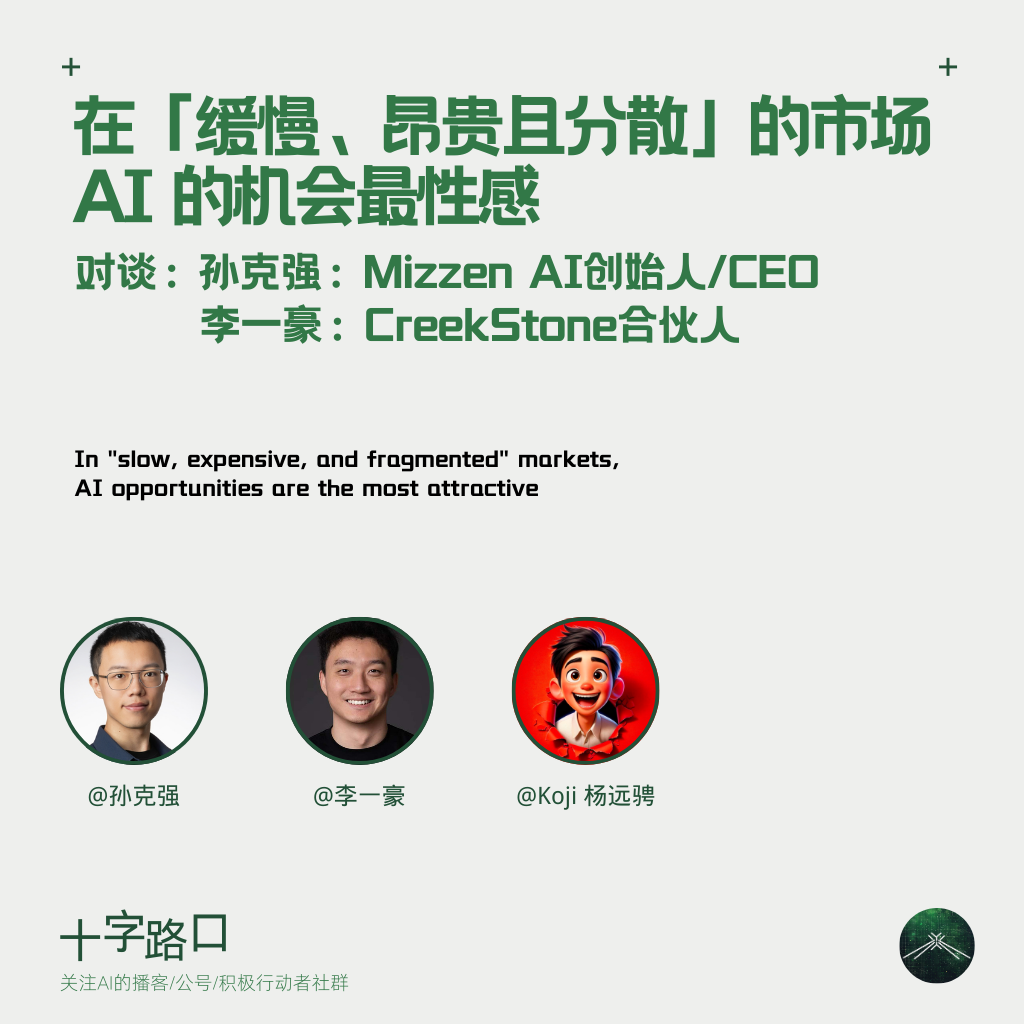
In Markets That Are "Slow, Expensive, and Fragmented," AI's Opportunity Is the Sexiest | A Conversation with Mizzen AI's Keqiang Sun and Yihao Li

"I hope to leave behind a work that the world will remember."
"I want to leave behind a work that the world will remember."
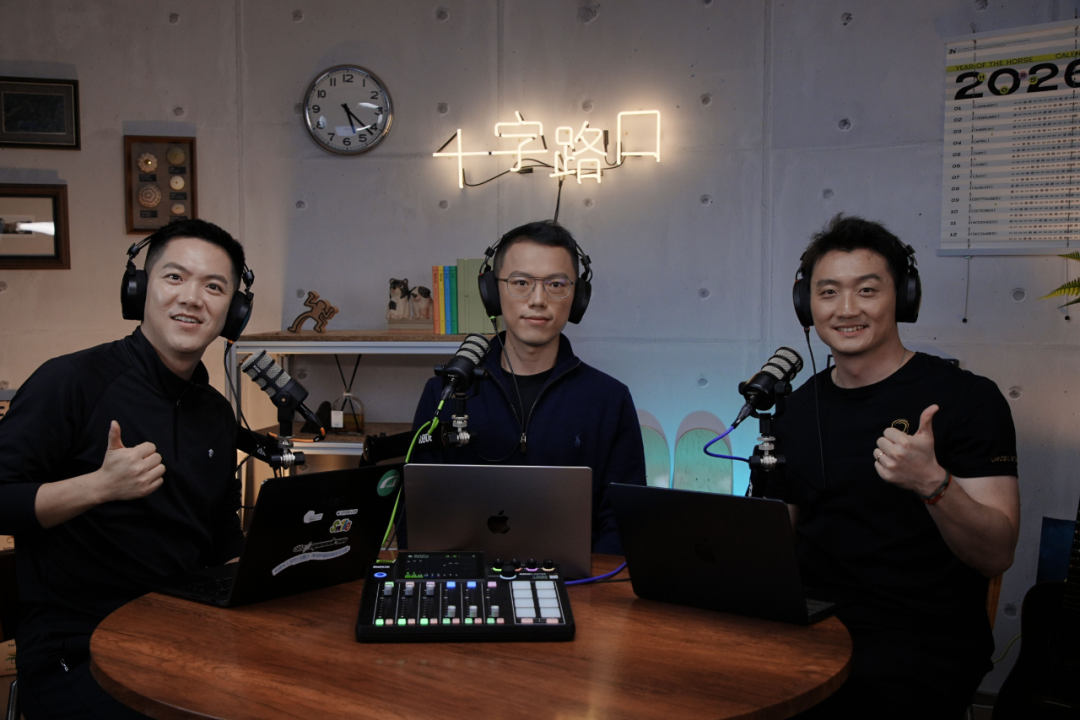
👦🏻 Podcast interview: Koji
🥷 Edited by: Crossing
🧑🎨 Layout: NCon

🚥 This week on Crossing, we're honored to welcome Keqiang Sun, founder and CEO of Mizzen AI[1], an AI-assisted user research startup, along with his angel investor, Yihao Li, Partner at CreekStone.
Keqiang Sun is a computer vision PhD turned entrepreneur, and an irrepressible optimist with "YOLO (You Only Live Once)" etched into his bones. He's taking on the century-old tradition of user research, using AI to map an unprecedented "human preference graph" across the entire internet.
He proposes Vibe User Research, hoping to form a closed product loop with Vibe Coding and move toward a new paradigm of "product self-iteration."
As an investor, Yihao Li not only shares his experience of exploring and growing alongside the team in its early days, but also offers a capital markets perspective: What does the vertical AI paradigm look like, and why are those slowest, most expensive, most fragmented "legacy" sectors precisely the best soil for nurturing new oligopolies in the AI era?
This is a conversation about technology, human nature, and market opportunity. We hope it brings fresh inspiration to those of you exploring at the crossroads.
Listen on WeChat:
Listen on Xiaoyuzhou:

🎬 Our video podcast is now live on @Koji's WeChat Channels, Xiaohongshu[2], Bilibili[3], and YouTube[4]
Since the full interview is quite long (13,897 words), here's the table of contents:
🟢 Rapid Fire
Age, alma mater, MBTI and zodiac sign, one-sentence company and product description, team size, pre-founder experience
🟢 AI Has Accelerated Production, But Gotten Stuck at Insight
A massive supply-demand scissors gap: When AI blew the ceiling off productivity, insight remained stuck in the labor-intensive era.
- A hundredfold efficiency difference: Traditional user research is linear and serial; AI can interview everyone concurrently.
- A huge supply-demand contradiction: AI has dramatically sped up product development, but feedback from users lags far behind.
- Why is this a path to greatness? When research speed catches up to development speed, products may even achieve "automatic iteration."
🟢 Finding New Monopolies in a Hundred-Billion-Dollar Stalemate
The more entrenched the market — the slower, more expensive, and more fragmented — the more attractive the AI opportunity.
- Endgame market推演: In markets like Legal, HR, and user research that are ossified yet structurally fragmented, technological variables most easily catalyze new oligopolies.
- A counterintuitive judgment: The more labor-intensive and traditional the industry, the greater the supply-demand gap AI creates.
- Why bet on Chinese teams? Internet-native understanding + exceptional operational delivery capability.
- Future organizational forms: AI will spawn many "super companies" of just 1-10 people.
🟢 The Eternally Curious AI
- What is the "alignment tax"? The steep hidden cost of synchronizing information and aligning granularity across multiple hosts.
- Human cognitive marginal returns diminish: You're excited for interview #1; by interview #20, your interest concentration drops sharply.
- AI's advantage is "eternal curiosity": It can pursue the 100th respondent with the same enthusiasm as the first.
🟢 Humans Are More Honest in Front of AI
If the interviewer is female and the respondent male, the male unconsciously becomes more defensive; but when facing AI, people let their guard down.
- Playing to strengths and avoiding weaknesses: Hack the special human perception of AI, using the Hawthorne effect to make respondents feel valued.
- More truth means more money: Build a benchmark system that uses game theory to guide users toward honesty — not just facts, but subjective analysis.
- Why do respondents become more talkative with AI? Because the social pressure and performative urge of facing a "person" disappears.
🟢 Large Models Are Good "Answerers," But Terrible "Askers"
- Why AI-simulated users don't work: Models cannot perceive dynamic, present-tense environments (like the massive psychological shifts before and after the pandemic).
- A common misconception in tech circles: Today's LLMs are all trained to be excellent Answerers, but no one has taught them how to be good Askers.
- How to train AI's questioning ability? Use reinforcement learning (RL) to build environments, with the industry's best interview data as benchmark.
🟢 Mapping a "Human Preference Graph" Across the Entire Internet
- Beyond标签化: Traditional user personas are discrete tags; future personas should be立体 3D models built on language and dialogue.
- From "project-based" to "continuous and incremental": User research is no longer a months-long megaproject, but as routine and frequent as opening a camera to take a photo.
- Not trying to replace product managers: We want to be the PM's "Iron Man suit" — let AI handle tedious interviews, let humans deploy strokes of intuitive genius.
🟢 Keeping Death Always in Mind
- Since extinction is inevitable, what do I leave the world? A product-work that can impact hundreds of millions.
- The logic behind the pivot: From computer vision PhD to AI user research — the essence hasn't changed. It's all about understanding the scarcest native information: "human preferences."
- The $3M Question: If you had $3 million to invest right now, which three people would you back?
Rapid Fire: Age, Alma Mater, MBTI and Zodiac Sign, One-Sentence Company and Product Description, Team Size, Pre-Founder Experience
👦🏻 Koji
Hi, I'm Koji. This week on Crossing, we have Keqiang Sun, founder and CEO of Mizzen AI. They're using AI to conduct user interviews and research. And his angel investor Yihao Li, also a partner at CreekStone — our old friend.
Welcome to Crossing.
👨🏻💻 Keqiang
Hello.
👨🏻 Yihao
Hello Koji.
👦🏻 Koji
Our show has a tradition — we start with rapid fire. Since Yihao has been here before, we'll let you off easy today. Keqiang, let's start with you. Your age?
👨🏻💻 Keqiang
👦🏻 Koji
Alma mater?
👨🏻💻 Keqiang
Tsinghua master's, CUHK MMLab PhD.
👦🏻 Koji
Your MBTI and zodiac sign?
👨🏻💻 Keqiang
ENTJ, Cancer.
👦🏻 Koji
One sentence to describe your company and product.
👨🏻💻 Keqiang
Mizzen AI builds AI-native user research infrastructure. Mizzen Insight is the first product we've developed in this context — it can accelerate traditional user research by 100x while cutting costs to one-tenth.
👦🏻 Koji
Current team size?
👨🏻💻 Keqiang
Eight people total.
👦🏻 Koji
One sentence on what you were doing before this?
👨🏻💻 Keqiang
Before this, I was still founding companies. I was a partner working with Musical.ly founder Louis on a new startup. Before that last startup, I had five years at SenseTime and six months at Meta.
AI Has Accelerated Production, But Gotten Stuck at Insight
👦🏻 Koji
Let's start with your new product direction, Keqiang — the AI user research track. Lately it seems to be gaining traction both in China and the US. Can you share why you chose this direction?
👨🏻💻 Keqiang
The core of my thinking came down to three questions when choosing this entry point: Is this a real need? Is there a sufficiently disruptive technological variable? And is this a path to greatness? All three pointed to this track.
First, it's a real need. We know that the world's largest user research company, Nielsen, was founded over 100 years ago.
👦🏻 Koji
It's been around that long?
👨🏻💻 Keqiang
Yes, but unfortunately, we're still using methods from over 100 years ago — a very crude, inefficient way to conduct user research.
👦🏻 Koji
Is Nielsen a very labor-intensive company?
👨🏻💻 Keqiang
Yes, exactly. The reason it requires so many people is that a single project typically consumes 60 person-days and averages around 100,000 RMB in costs — slow, expensive, and inefficient.
I've felt this firsthand. We actually started this company back in May, and Yihao and I were exploring all kinds of ideas at scale. A lot of really interesting product directions would emerge from that. But from the very first step of a product, we had to go to users and do research. And we found this process incredibly drawn-out. Usually we'd spend an entire week interviewing about a dozen people just to confirm whether a need was real. The whole process felt exhausting and painfully slow.
We discovered that AI has dramatically accelerated product iteration speed, but user research speed lags far behind R&D speed.
👦🏻 Koji
So basically, building things has gotten faster, but the question of what to build still requires user research to solve. So what you want to do is help people better discover user needs?
👨🏻💻 Keqiang
Exactly. We interviewed many frontline user researchers and validated that this need is real. It's a genuine demand.
The second aspect is that technological change has created a new inflection point here — a disruptive shift. Traditional user research can only be done serially, but AI makes it possible to conduct interviews concurrently, talking to all twenty or thirty people, even over a hundred, simultaneously. This isn't an "optimization" — it's a direct disruption of the traditional paradigm.
And third, I came to realize this is a path to greatness.
👦🏻 Koji
You mean this could become a very large company, that this business can scale?
👨🏻💻 Keqiang
Not only that — we also see enormous future possibilities and imagination here. What does a product's closed loop look like? It starts with user research, moves through product development, and finally returns to users. If any single link in that chain lags behind, your ultimate product iteration speed remains inefficient. With a platform like ours that can further accelerate the user research piece, what we see ahead is the possibility of products that automatically iterate and upgrade themselves — that's incredibly exciting for us.
👨🏻 Yihao
Yes, and one more thing. This generation of AI models are all doing implicit modeling — they may actually surpass traditional human product managers in extracting more information from user feedback. And this information, through implicit alignment, can directly reflect in a product's interaction, experience, performance, even pricing. That's a journey we're very excited to explore together.

👦🏻 Koji
Keqiang just explained why you're building this product. So what's the current status? Has it launched? How many users?
👨🏻💻 Keqiang
Let me take this opportunity on the Crossing platform to insert a hard advertisement. We're very honored that Mizzen AI's first product is officially making its debut here on Crossing.
👦🏻 Koji
Let's see how hard this ad is, hahaha!
👨🏻💻 Keqiang
Our product is called Mizzen Insight — it's a full-stack AI user research platform. From now on, user research will no longer be something lengthy, expensive, and only accessible to large companies. It will become an affordable, real-time capability. With Mizzen Insight, you can come into the office in the morning with a question and have insights by lunch, compressing research cycles from months to hours. If you're making decisions but lack confidence in what users think; if you're hesitating whether to launch a traditional, inefficient study — come try Mizzen Insight. Uncover market insights at 100x speed and make decisions faster than everyone else.
👦🏻 Koji
Wow, feels like we should have some dramatic classical music playing in the background.
👨🏻 Yihao
OK, dropping the link.
👦🏻 Koji
3, 2, 1, dropping the link.
👨🏻💻 Keqiang
Link in the comments, help yourselves hahaha.
👦🏻 Koji
I know you have a partner, Andy, who spent over a decade in user experience and user research. Could you talk about what you're seeing in the user research industry as a whole — what's the current state?
👨🏻💻 Keqiang
My product partner Andy was a founding employee at Tang Consulting, currently the largest user experience consulting firm in China. As a founding member there, he worked for many years, and later gained strong ToB service experience building infrastructure for Lark's multidimensional tables at ByteDance. He brought many clients, and through co-creation with them, we uncovered many insights about this market and industry.
The Eternally Curious AI
👨🏻💻 Keqiang
There is indeed a contrarian insight here: we found that using humans as moderators for user research has some systemic problems.
First is the high alignment tax brought by our cognitive boundaries. Since human energy is limited, traditional projects often involve multiple moderators conducting interviews. When different moderators need to synchronize and align information, the dilution of insights and the cost of alignment become very high.
Another issue is that human fatigue accumulates easily, and your emotions affect interview quality. If Koji weren't in such an energized state for our conversation today, I probably wouldn't feel as expressive either.
Finally, and importantly, even if you use the same moderator for all interviews, problems remain, because moderators experience cognitive diminishing marginal returns.
👦🏻 Koji
Cognitive diminishing marginal returns?
👨🏻💻 Keqiang
Say I'm about to interview 20 people. With the first person, I feel like I'm uncovering a lot of information in this direction. But by the second person, the information density and my interest concentration drop significantly.
So beyond the slowness and exhaustion we mentioned earlier, there's a hidden problem that people don't easily notice: human interview insight efficiency and depth aren't actually that strong or deep. What AI makes possible here is:
AI has extremely strong consistency. It can approach every single interviewee with the same curiosity as the very first one, probing every possible point, thereby extracting insights from all 30 people.
👦🏻 Koji
There's been a popular prompt recently where you ask ChatGPT: based on what you know about me from our past conversations, point out three fatal weaknesses in me. Because its memory function is getting stronger, you do find that it has very strong insight into people.
Finding New Monopoly in a Hundred-Billion-Dollar Stalemate
👦🏻 Koji
The AI-assisted user research track already has many players in North America — we know the most funded is probably Listen Labs, a company backed by Sequoia Capital. So I'm curious, from Yihao's perspective, how big is this track?
👨🏻 Yihao
We've been emphasizing two points. In this first phase of the AI wave, there are actually many opportunities in vertical niches — we're pursuing Super Intelligence in specific vertical domains. Second, we believe that labor-intensive, traditional, and semi-digital industries are precisely where AI has more opportunity, where the supply-demand gap is larger.
Looking at the research market, traditional research globally is about 80-90 billion USD, but this includes extremely traditional players like the Nielsen Keqiang mentioned earlier. The newer UX Tools market is actually much smaller, around 3-5 billion USD.
The second question we focus on is that this broad market structure has already solidified, already entered M&A consolidation. It's very similar to HR Tools, like traditional Legal Tools markets — early oligopolies have emerged, but the structure remains highly fragmented. This actually fits our market preferences very well. Markets like this, when new technological variables arrive, are where new entrants and new oligopolies most easily emerge.
Second, we find that every industry has its own species characteristics. The user research market, like HR and many traditional financial and legal markets, doesn't evolve that quickly — which反而 gives new startup entrants better opportunities. Already deeply digitalized industries, including e-commerce and content marketing that we see, because they're inherently deeply digitalized and were catalyzed by a new generation of internet giants, actually face greater competitive pressure from giants, especially when your ecosystem itself is the giants' playground or the scenarios they created.
Third, we see that the research market itself is very similar to agencies and even China's internet education market at the time — market diversity and the industry expertise of vertical markets means that in every valuable niche, companies with very considerable sales scale and economic returns can emerge. Based on these points, we developed strong interest in this market. More comes from market demand — how AI combines, its insights and changes, most of which Keqiang and Andy's team discovered through genuine daily interaction with customers, extracting real needs and PMF opportunities.
After looking at the market, one more important thing is: where's the opportunity for Chinese teams? I think this is crucial. What we Chinese teams have, in summary, is very strong understanding of internet-native products, extremely strong user insight and understanding, continuous product iteration and deep operational capabilities, and heavier, more complex user interactions — especially enterprise-facing ToB delivery capabilities. This is also what we see as a very strong combination in Keqiang's team, a very competitive advantage.
It's the tool for solving this era's problems, and it's fully entered a new paradigm — AI-native. With Keqiang leading this team, there's profound, insightful, and long-term understanding of the technology itself. And within the team, we have seasoned business veterans who come from the internet era — from enterprise products like Lark, one of the most successful globalized B2B products — and from deep industry experience in consulting. This fusion, with AI-native technology as the starting point, is what we see as an extremely competitive team for this era and this track.

👦🏻 Koji
When Yihao just mentioned the total market size is close to $100 billion, I found that very surprising — that's a huge number.
👨🏻 Yihao
Right. We actually found that many markets share quite a lot of commonalities. This market is quite similar to the US, including mainstream European and American markets, where the traditional legal market is roughly around $400 billion.
👦🏻 Koji
Legal is $400 billion?
👨🏻 Yihao
Yes, but Legal Tech accounts for roughly $60-70 billion of that — purely SaaS-ified, the previous generation of cloud and SaaS service and software companies alone represent $60-70 billion. And the best parallel in China is actually our K-12 education. Before the "double reduction" policy, K-12 education grew from roughly $26 billion to $46 billion, approaching a $50 billion market. And from this emerged several leading companies — our domestic "big three" — each basically at $10-15 billion in annual revenue. So you see, these markets themselves are like a species with very similar characteristics. Their market depth, service intensity, and industry-specific traits mean they're naturally fragmented, yet the market leader, driven by massive market forces, has sufficient scale to go public and deliver strong returns for investors.
👦🏻 Koji
So for user research, this $80 billion market today — it's also very fragmented?
👨🏻 Yihao
Yes, very fragmented. The leading players only have annual revenues of roughly $2-3 billion, yet they've already been able to continuously acquire many small and medium-sized companies and regional players in the industry.
👦🏻 Koji
So would you say that with this AI wave, the leading players could become even larger, and there might even be an entirely new species?
👨🏻 Yihao
Yes. We believe especially in new markets, new demand, and new customers. Just as the internet spawned many internet-native companies, AI will spawn many AI-native companies. Perhaps these companies will naturally use AI-native user research tools to accompany their product iteration and self-growth, even evolving toward extreme 10-person or even 1-person super-companies — and such companies will generate new demand.
👦🏻 Koji
That's very interesting.
👨🏻💻 Keqiang
Yes. Traditionally, user research has been a very labor-intensive industry. So many small companies in this space find that their headcount grows with business growth every year, and eventually discover that management becomes an extremely heavy burden for the company.
👦🏻 Koji
That makes sense. Because it's not just labor-intensive, it's intellectually labor-intensive. Managing this kind of person is much harder than managing factory workers, because the work requires subjective initiative, intellectual labor, and mental energy. The more people you have, the wider your management span, and the harder it becomes to manage well. Yet every client requires the same delivery quality, so the ROI diminishes.
👨🏻 Yihao
I think there's another major shift. The fact that this market is so large and was previously accessible meant it was part of a high-inflation cycle game — a service that only high-margin, high-surplus-value companies could afford. But when we look at some industrial finished products, or some lower-value finished products, they may not have sufficient margin to afford what counts as user research services, or even user research products. But in the AI era, this could change — precisely because it becomes so cheap, so efficient, so automated and AI-driven — this could be new market creation. We tend to favor new over old; new opportunities in new markets are actually more friendly to startups.
👦🏻 Koji
That makes a lot of sense. Because when I was CEO of Tangdao, we also did user research, including one-on-one interviews with users, and I felt this was extremely important. The difference between consumer products and apps or websites is that you can't just iterate freely. The cost of shipping a version is high. Preparing 10,000 units of inventory — if they don't sell, it becomes dead stock, and even disposing of it costs money. But with software, even if you miss on demand, you can iterate quickly or even roll back. Yet not every company has the budget for user interviews, because the caliber of people required isn't low, and their hourly rates are high.
So what Yihao just said I find quite interesting. In the past, I've been a research subject myself — interviewed by companies like Dyson, NIO — but looking back, they were all like what you mentioned: companies with money could afford this kind of thing.
👨🏻💻 Keqiang
Right. So actually our platform's greatest hope is to make user research no longer the exclusive privilege of core projects at large companies. What we want to build is essentially an accessible, real-time user research platform — democratization of user research.
👦🏻 Koji
Among your current customers, have you already started seeing co-creation cases like this? Where previously they wouldn't have invested research costs for this project or product, but with you, they've started doing research and perhaps even gotten some feedback?
👨🏻💻 Keqiang
Yes, there are many such cases. We're currently working with one of the world's largest consumer electronics companies, and in our co-creation process with them, we found that while they started with some fairly important research, they gradually began doing much smaller projects. For example, they just launched a project a few days ago wanting to understand whether their users would be willing to use a "buy now, pay later" payment model for shopping. Just this one point — they needed to launch a project to research it. Another project at another of their companies is exploring whether handwriting and on-screen typing should be separated, whether they're suitable to appear in the same product form. Just this small application — now they're using a dozens-of-questions survey to conduct deep user research.
👨🏻 Yihao
Actually Koji's earlier question was excellent — it's an investor's question. And as investors, a question we often ask founders, one we've been thinking about recently, is about the cognitive kernel. We define cognitive kernel as: with the smallest possible MVP, can you verify the user's most painful, most "aha" need? Because this is so important — it guides the team's entire focal point, capital and resource allocation, and even based on this cognitive kernel, you build what kind of team you need. So we wanted to ask Keqiang — you're working closely with our customers, the ones who will actually pay us in the future — what counterintuitive insights do you have? What's our cognitive kernel?
👨🏻💻 Keqiang
There is indeed a counterintuitive insight here that I can share. It's that under AI-driven conditions, product building costs have dropped dramatically, even below distribution costs. Against this backdrop, the traditional user research paradigm will inevitably be disrupted. Our previous understanding of user research was like this super expensive thing — I spent hundreds of thousands, spent a whole month, and a research company produced a report and a accompanying presentation.
So as we further improve the efficiency of user research, the paradigm of user research itself undergoes fundamental change. People now want it to become continuous, incremental user research.
👦🏻 Koji
Continuous, incremental user research?
👨🏻💻 Keqiang
Right. Unlike before where you'd spend a whole month on one big research project, it becomes: today I want to understand one small point, so I quickly launch an interview or user research project, and perhaps before evening I've already received a report — iterating on the product daily in small, rapid steps, pushing product upgrades forward.

👦🏻 Koji
Could Keqiang then introduce what specific user research Mizzen can help clients with? What types are included? For example, you mentioned you already have clients co-creating — could you walk us through the complete lifecycle chain using one client example?
👨🏻💻 Keqiang
Of course, I can give a real example. Recently we've been working with the largest lead-generation product brand domestically, and what they came to our platform to do is quite straightforward.
The first agent is an interview creation agent. The brand can directly state their requirements for this user research project, and our automatic interview-outline-generating agent will, in conversation with them, build out the interview outline in real-time on the right side.
The second step is sample recruitment. You just tell us your user persona, and we can quickly find people matching that profile on our platform. We also have a screening step where we invite these potential respondents to spend 5-10 minutes confirming some identity information, ensuring they meet the brand's requirements.
The third step is where our AI moderator conducts the exchange with the respondent. We invite the respondent to turn on their camera, and it directly asks for information about you and how you think, pulling you back into that situational context to explore and probe further.
In the fourth step, our reporting Agent compiles all these interviews into a structured final report. It includes everything from summary-level conclusions to detailed qualitative and quantitative analysis for each question — all of it backed by source material — so they can use this report to drive subsequent decisions and project execution.
People Are More Honest with AI
👦🏻 Koji
Have you observed a phenomenon where, when someone realizes the moderator on the other side is AI, they become kind of perfunctory, or less emotionally engaged than they would be with a human, or not paying full attention? Have you seen this? And if so, what have you done to counter it?
👨🏻💻 Keqiang
There was some of that at first, but we've essentially solved this through our overall product design. Since we're an AI-native company, we play to our strengths and avoid our weaknesses. We leverage AI's unique advantages and hack into humans' special perception of AI. There are three key points.
First, we make respondents feel that what they're doing has value. They're helping a real brand refine its product, which gives them a sense of participation and worth.
Second, there's the Hawthorne effect — when a human is moderating, your chemistry actually affects the other person. For example, if the moderator is a woman and the respondent is a man, the man will want to show off his masculine charm more. If the interview is with an AI, what we're finding is that respondents actually let go of their feelings about the person across from them. They drop their guard and all the distracting factors, and just express themselves as honestly as possible.
👦🏻 Koji
That's pretty interesting.
👨🏻💻 Keqiang
The third thing is that we've developed a Benchmark system here. We use a system to score respondents' answers across dimensions including whether the content is authentic — we identify this through multimodal analysis of the respondent's overall behavior. We also assess whether what you're saying has enough detail, whether you have your own subjective analysis, and whether there's consistent exploration.
So from the very beginning of the respondent's answers, we tell them what these evaluation criteria are, and their final score is tied to the actual incentive payment they receive. We're proposing very objective metrics. In the game between the respondent and our evaluation system, the optimal solution is: you become more authentic, more willing to express yourself, and you get more compensation. Through this entire system, we've found that respondents' desire to share has actually become stronger than before.
👦🏻 Koji
Are all your respondents registered Mizzen users? Did they actively sign up to be interviewed by Mizzen's clients?
👨🏻💻 Keqiang
We've actually built a massive respondent pool with several different channel sources.
One is that we have a large base of suppliers at the bottom layer. We've currently completed integrations with two domestic suppliers and two overseas suppliers, totaling roughly tens of millions of respondents. On top of that, we've built our own Agent capabilities to conduct sample screening through Agents, verifying whether their information meets our interview project requirements. We've also built an interview Agent to confirm that your respondent information is authentic and satisfies the interview conditions for this particular project.
Second, we've also established partnerships with leading domestic and international consulting firms and research companies, who have opened their expert databases to us.
Finally, we're also building our own community.
Large Models Are Good "Answerers," But Poor "Questioners"
👦🏻 Koji
Another approach would be interviewing AI instead of interviewing people. Since AI can simulate humans too, what do you think of this possibility?
👨🏻💻 Keqiang
We've found that this approach isn't viable for supporting user research at the current stage, for two core reasons.
One is that the technology isn't mature yet. Current large models still have a massive gap when it comes to humans' real context. People are easily influenced by their environment — every change in the environment has a huge impact on how people think, their attitudes, their preferences. Current models fix their context with each training run, so it's very difficult for the model to simulate the most cutting-edge, most authentic user attitudes and insights. With this approach, you can only get lagging, one-sided conclusions. That's the first important reason.
The second is that general intelligence capabilities aren't sufficient yet — it's hard to understand through your own reasoning what kind of experience a respondent will have when facing this product. In our extensive communication with brands and frontline brand teams, we've also found that everyone has significant concerns about the authenticity and validity of AI-simulated respondents. So this was the core reason we rejected this direction.
👦🏻 Koji
Although you're launching today, you've actually been co-creating with many users beforehand. In this process of co-creation, were there any particularly surprising discoveries that you didn't anticipate at first?
👨🏻💻 Keqiang
There was one very interesting discovery. When we discussed with them what the most core element is in a traditional research project, everyone reached the same conclusion: the key is what kinds of questions the moderator can ask — this determines how much information you can extract from the respondent.
👦🏻 Koji
So to what extent can current models perform as moderators?
👨🏻💻 Keqiang
They actually can't do this well yet. There's a very core point here: we've found that current large models are all good answerers, not good questioners. Large model research companies don't spend much effort optimizing questioning ability during post-training. We can see that with GPT, for example — it has users choose the better answer, not choose which way of asking can get to the heart of the matter.
Another difference is that all this interview data is actually closed-source. For example, we know Apple conducts massive amounts of user research every year, but it's very difficult to find online what their interview process looks like.
👦🏻 Koji
Given that large models aren't good questioners, and excellent interview Q&A exchanges aren't publicly available data either, how are you approaching this?
👨🏻💻 Keqiang
On one hand, we've already reached partnerships with several leading domestic and international research firms and consulting companies. They'll open up interviews that have passed their confidentiality agreement periods, and they've signed exclusives with us. Over the past six months, we've also designed a dedicated system for training a good AI moderator. Combining these two approaches, we've now begun developing our own interview model. But we're not just building a model that can talk — more importantly, we're developing a professional AI moderator that can dig into the crucial points.
👦🏻 Koji
Could you expand on this a bit? Specifically, how are you doing this?
👨🏻💻 Keqiang
We've chosen to use reinforcement learning for this. Training a good interviewer and improving their questioning ability is something that fits very naturally into the reinforcement learning paradigm. The core elements here are building a good environment and a good Reward Model.
In our scenario, this environment is built from the data we've collected to simulate the project context at the time and these respondents' answers. When our moderator model poses a question in this project context, our simulated respondent will answer, and this answer will align with the real respondent answer information from the data we obtained. No one has conducted this kind of research before, so we need to develop this environment ourselves to train our moderator. That's the first part.
The second is that we need to build a good Reward Model. We need to score these simulated respondents' answers across different dimensions. These respondents' answers are drawn out by the moderator, so the higher quality the respondents' answers, the better the moderator's questioning ability.
👨🏻 Yihao
I think this is a great callback to the new paradigm of AI's second half. Having looked at thousands of AI companies, we've found that in every vertical industry, the best way to extract domain knowledge and compress intelligence is to define that industry's environment and what its most valuable Benchmark is.
In the user research industry, asking good questions — a good moderator itself — this Reward Model may be the most critical Benchmark. Pre-training Based Models, even general purpose Post-training Models, their intelligence levels will keep improving, but when it comes to our domain, this is the best tool we can harness.
But the best Benchmark in this domain always comes from domain experts continuously forming it through practice and edge data flywheels. This is actually what we see as the most powerful moat for AI-native companies in the AI era. This is also what excited us again and again through round after round of discussion with Keqiang and frontline practice.
Mapping a "Human Preference Graph" Across the Entire Network
👦🏻 Koji
When I talked with Keqiang before, you mentioned that beyond user interviews and questioning, you also want to build a very ambitious concept called a conversational and human preference graph. Could you expand on this?
👨🏻💻 Keqiang
We've found that human preference in traditional contexts roughly equals personalized recommendation. Personalized recommendation essentially uses crude tags to label each user, but these tags are discrete — it's very difficult to shape a person three-dimensionally through such tags.
But we've found that language can. We express so much every day, say so much, leave our traces on different platforms. In the past, there was no good way to integrate them completely, because the computational complexity involved is extremely high. Through our accumulation over these years, we've built up our own infrastructure for a human preference graph. Through this infrastructure, we can integrate everything you've ever said,沉淀下来 your preference graph, and retrieve the preferences most relevant to you and your previous context in the most efficient way, thereby modeling your entire profile in the most three-dimensional and comprehensive manner.
This is the capability we've built up. And as infrastructure on our platform, this capability can bring new experiences to our customers.
For one, we can help them find more precise matches. In the past, when I tried to find people, I relied on limited tags — but that approach is too crude. To find the most precise match, you really need a three-dimensional profile, positioning you through the most comprehensive dimensions of information. That's where our accumulated user preference graph capability comes in, quickly helping you integrate and pinpoint the right people.
Second, I can use our accumulated user preference graph to verify what respondents say on our platform. If you stated certain information in one interview and completely contradicted it in the next, we'll have the moderator follow up for confirmation — ensuring that clients and brands get the most effective, highest-quality insights from us.
Third, we can simulate the perspectives of specific respondents. Since all respondent information is accumulated on our platform, we can help clients simulate users for efficient, real-time, ultra-low-cost experimental research.

👦🏻 Koji
Mizzen — while today, when our podcast goes live, marks your official launch — it sounds like you already have quite a few early users. Do you have paying customers yet? And how are you charging them?
👨🏻💻 Keqiang
Yes, we already have paying customers. Currently, for our first month live, we're waiving platform fees and charging per project.
👦🏻 Koji
So it's something like: 10 interviews at 1,000 each, roughly 10,000 total — that kind of logic?
👨🏻💻 Keqiang
Yes, exactly.
👦🏻 Koji
We mentioned earlier that the user research market is large enough, so whether in North America or China, there seem to be quite a few AI vertical startup teams doing this. I'm curious — from Keqiang's perspective, what is Mizzen's competitive advantage?
👨🏻💻 Keqiang
We want to continuously improve our product in an AI-native way. We've found that when users come to an AI platform, what they care about most is what user insights you can extract — and ultimately, that's the AI moderator's ability to question users. That's why we've insisted on developing our own AI moderator model in-house. We're a relatively rare team that can tightly integrate product capability with technical capability. We also have seasoned business veterans on our team who can push the product in the market. Our core team is our biggest competitive advantage for staying ahead in this market.
Keeping Death in Mind at All Times
👦🏻 Koji
We've talked a lot about Mizzen the product. Let's shift to Keqiang's personal journey. Because when Yihao mentioned you earlier, he said your entrepreneurial passion is very, very, very high — he used three "very"s.
👨🏻💻 Keqiang
My personal belief is YOLO — You Only Live Once. Ben Horowitz in The Hard Thing About Hard Things also mentions that the way of the warrior is keeping death in mind at all times. For me, I will die eventually. Before that, I want to leave something for this world. I hope to leave behind a work that the world will remember.
👦🏻 Koji
Why did Keqiang choose to start a company at this particular moment, doing this particular thing?
👨🏻💻 Keqiang
On one hand, I've been studying AI technology, continuously observing the entire technical chain, and I've found that AI technology has already crossed the inflection point for real-world deployment — I see a platform-level opportunity. On the other hand, my own skill stack, including technology, product, growth, operations, and so on, has gradually matured. So I feel now is the right time.
👦🏻 Koji
Your background is actually computer vision, but this startup doesn't seem to particularly draw on that research foundation. What kind of shifts and iterations did you go through to end up on this path?
👨🏻💻 Keqiang
If you look deeply at my research and entrepreneurial explorations over this long period, you'll find there's always been one core thread: how to make AI better understand human preferences.
It started with GPT-3.5, which used RLHF to show the world that human preferences are an amplifier for models. During my PhD, I also did a systematic preference research series called HPS — the world's first systematic model for mining different human visual preferences. This work further confirmed that when models truly align with human preferences, capabilities undergo qualitative transformation. Models keep getting stronger, but the ability to understand people is an eternal need. Human preference is the most scarce yet most core native information in AI systems.
Eventually I realized that if AI is to truly land in the business world, it must understand not just visual preferences, but more complex, multimodal human preferences — more motivations and reasons behind choices. And the means to obtain these human preferences is user research. Because here, we can not only use AI to understand users, but also help enterprises efficiently accumulate real human preferences as structured data, providing long-term value for brands.
Essentially, this isn't a jump from computer vision to user research — it's a further persistence and deepening of my main thread around human preferences.
👦🏻 Koji
Keqiang's previous startup was actually with Louis, the founder of Musical.ly — he's quite legendary. What were some of your feelings and takeaways from partnering with him?
👨🏻💻 Keqiang
He shared one point with me about why Musical.ly became so successful. He believed it was because of a leap in productivity. Specifically, the普及 (popularization) of cameras. Steve Jobs gave everyone a rear camera and a front camera — this was massive productive capacity. Such a leap in productive capacity changed how people would create in the future, which further changed how they would consume.
This later influenced me too. The essence of our project is actually also a leap in user research productivity. In the future, you'll be able to launch a user study as easily as opening your camera.
👦🏻 Koji
Yihao, how did you discover Keqiang's team? When you decided to invest, to pull the trigger, what judgments did you make?
👨🏻 Yihao
This is another romantic story. I still very clearly remember that first morning meeting Keqiang — it was summer, probably May or June. We had scheduled an hour and a half, but ended up sitting and talking for over three hours. It was raining that day; we talked from when it was raining until it stopped.
The biggest feeling throughout was what I mentioned earlier — his passion for entrepreneurship itself. The life path he expressed, every choice he made, the options he had behind each choice, and finally the path he chose among so many options — all of it validated that this person is pursuing an infinite game, constantly expanding his own boundaries, constantly using his experiences, thinking, and the youth he can give to make changes, to create value for a group of people. Such a high-stakes pursuit can guide a person for a very long time to overcome many difficulties, to keep iterating and evolving. In just those three hours, this moved me again and again. This was the starting point of everything.
The second starting point: I think Keqiang is one of very few people among the 500 we see each year whose insights on AI are extremely native. I later realized this is because he had already been researching for many years — five years at SenseTime, then Meta. He very early proposed the important value of Benchmark itself, which is a very Agent, very future-facing definition, and we really did a lot of exploration based on this definition.
Actually, before this we had already gone through one pivot. We earliest explored based on human preference, based on vision, whether there was a place in the art world to give greater value to a human preference Benchmark, and opportunities for platforms like this Benchmark platform or Arena. But in exploring this opportunity, I discovered another great strength in Keqiang — he samples from reality, gaining valuable practical cognition from real environments. He researched countless art galleries, talked to many artists, even people trading in the industry, before realizing what the supply-demand structure of the art market really looks like, that supply may no longer be in a scarce phase, that channels, capital, and distribution are already dominating value. This is very similar to what we see now in short dramas, comics, and novel markets — perhaps not a place where a technology-led product can break through. So he faced rapid transformation.
And this transformation process suffered many blows — this is the third thing I felt very strongly, his resilience, his purity is very powerful. We suffered blows from many investors, we reviewed together, we felt together, also suffered negative feedback from some industry people. But none of this feedback ever truly defeated Keqiang, only forced him to explore: OK, where's the new opportunity? Where does our thing have opportunity? Until positioning in the user research market, he extremely quickly launched research, launched real user cognition acquisition, which kept adding to our investment conviction.
Finally, I think it's still very strong — we always say to build good relationships widely. Keqiang is someone who, along the way, whether technical collaborators, business partners, and being able to bring someone like Brother Peng, a seasoned entrepreneur, into the team — I think this has a lot to do with his character, his fundamental nature. Including us — on one hand deeply attracted by Keqiang, on the other hand deeply moved by his humanity, his qualities as a friend. We're willing to walk a long way with such a founder, step in many pits, make many pivots, but persist to the end. This is the journey that formed our very firm investment conviction.
👦🏻 Koji
You mentioned vision earlier, so I want to ask Keqiang — what kind of company do you ultimately hope Mizzen AI becomes?
👨🏻💻 Keqiang
In the short term, I definitely hope it becomes a user research platform that everyone uses. The most critical thing here is the product-building loop I mentioned earlier: a product starts with good user insights, and when the product is developed it must go back to users — the entire process is actually an alignment with user preference. We hope to become the hub connecting products and users.
It becomes Iron Man's suit for every PM. Humans contribute the strokes of genius, intuition, insight, and extreme aesthetic sensibility — while AI handles the entire chain from user research to product iteration. We'd want this Iron Man, in part, to be Vibe Coding, and in part, Vibe User Research. And these two combined become the powerful hands of Iron Man, allowing PMs to unleash their creativity more freely.
👦🏻 Koji
Then one last question: if you were given $3 million right now to invest, and you could pick three people, who would you invest in?
👨🏻💻 Keqiang
The first two would go to CreekStone — my existing investors. There are only two of them right now, and I'd definitely invest in them because they've given me an enormous amount of advice on both product and market, which I deeply appreciate. As an investment firm, they're professionalism personified. At the same time, they're also a startup — they just started their own company this year — so I deeply resonate with them on the founder experience. I genuinely believe in this startup.
The other would be my good friends from my Silicon Valley days, their company Krea. They're a team that was able to conduct high-frequency user research very early on, taking product iteration speed to the extreme.
👦🏻 Koji
Well, thank you so much to Keqiang and Yihao for joining us at Crossing today. We look forward to having you back to share more once your product has been running for a while, with more customers, more stories, and new observations and insights.
👨🏻💻 Keqiang
Great, thanks.
👨🏻 Yihao
Thanks, Koji.
🚥

References
[1] Mizzen AI: https://mizzen.top/
[2] Xiaohongshu: https://www.xiaohongshu.com/user/profile/548251dce779893bcf3f77bc
[3] Bilibili: https://space.bilibili.com/505301413
[4] Youtube: https://www.youtube.com/@kojiyang