AI Designer Handbook: Who Am I, Where Did I Come From, Where Am I Going? | A Conversation with Pozzo and Zhao Chen
Designers are among the professions most affected by AI — they stand at a crossroads.
Crossing has produced two "guide" style interview episodes: The AI Product Manager's Guide [1] and The AI Engineer's Guide [2], both well received. So naturally, our comment section filled with requests: "When are you doing an AI designer's guide?"
So, to make this week's episode count, we interviewed many designers in advance, and were fortunate to invite two friends who are quite representative of China's design industry.
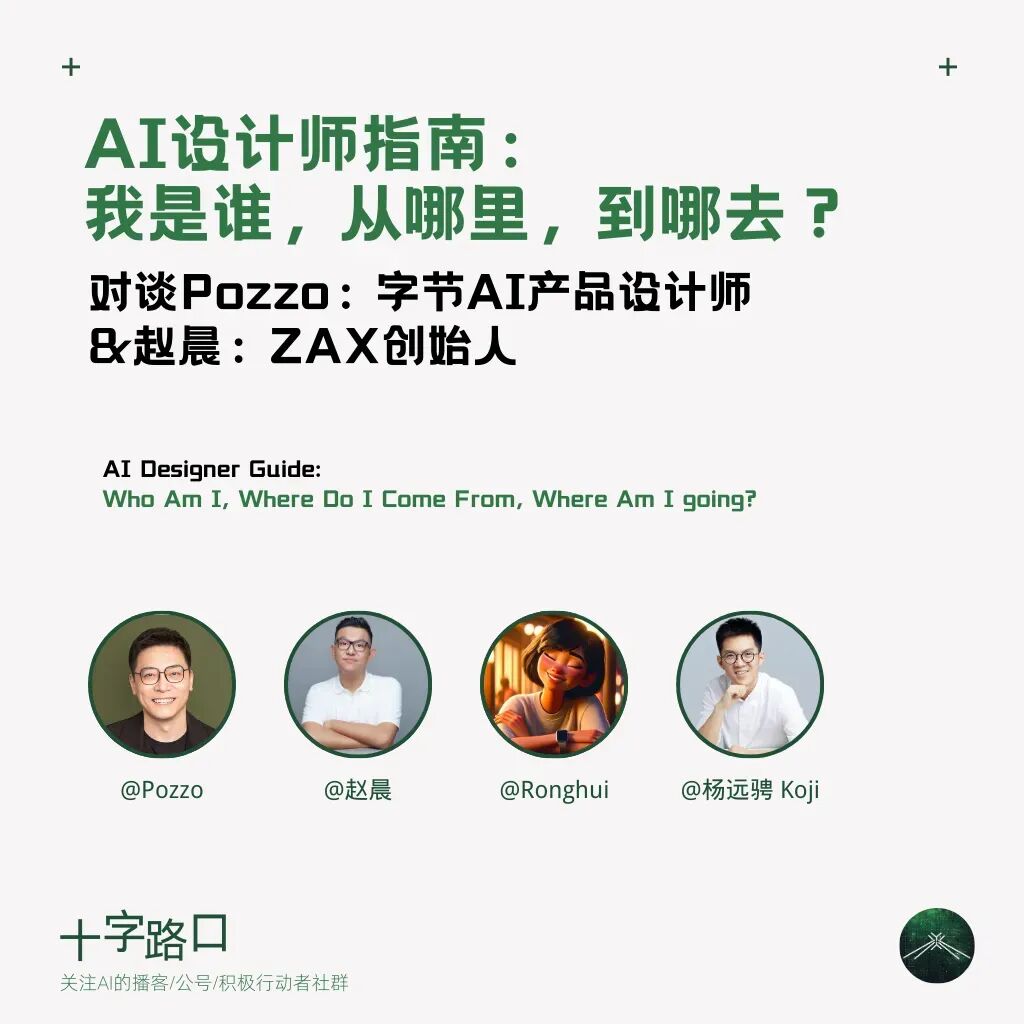
This week's two guests are:
- Pozzo Zhang Yuan, an AI product designer at ByteDance who has interviewed nearly 50 designers over the past year. At ByteDance, Pozzo works on product design for graphic content, platforms, and intelligent creation (AIGC). He also has years of AI product design experience at Alibaba and Microsoft.
- Zhao Chen, founder of ZAX Studio. He has two widely celebrated signature works: the hippo IP for Freshippo, and the "cat head" super symbol for Tmall.
They represent two types of designers — product design and creative design — and will share stories from both perspectives about how designers are using AI in their day-to-day work, as well as their views on how AI is impacting design, the commercial development of design studios, and even the aesthetics of our era.
Hope you find this episode valuable!

Before we begin, a quick salon announcement
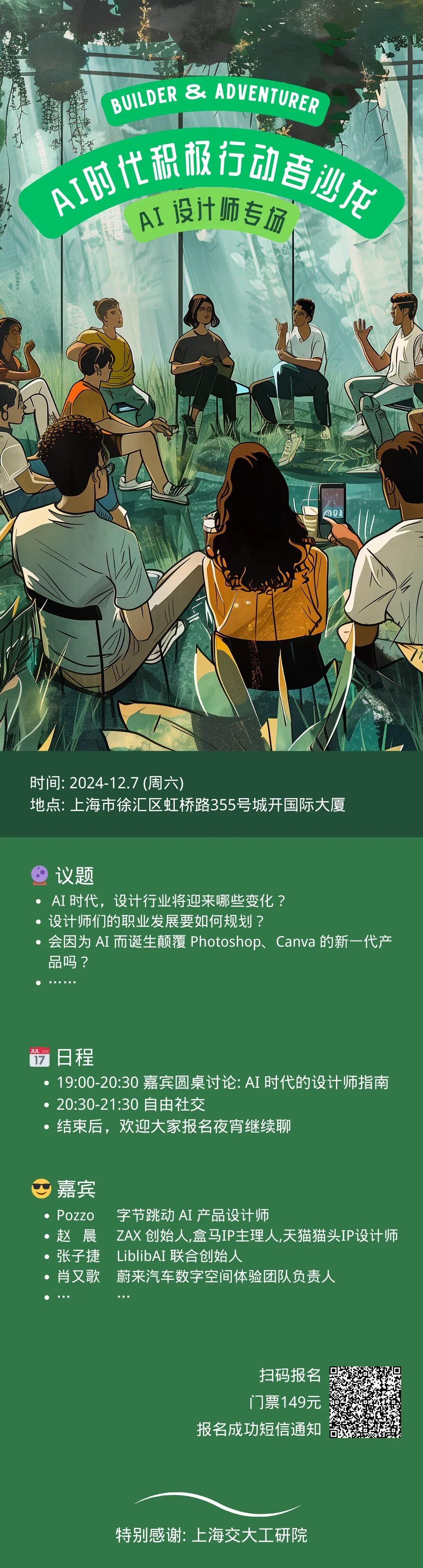
Welcome to Crossing's "Active Agents Salon" — AI Designer Special
Crossing continues to host "Active Agents in the AI Era" salons, because in-person events offer face-to-face exchange, real-time interaction, deep discussion, and human connection — sparking creativity and collectively exploring the industry's future, a unique experience that simply listening to podcasts cannot replace.
Our next salon is the "AI Designer Special," focused on the design industry and designers in the AI era.
In addition to this week's podcast guests, we'll be joined by Zhang Zijie, co-founder of LiblibAI and a designer by background, as well as Xiao Youge, head of NIO's digital spatial experience team, among other leading voices in design.
Building on this week's podcast, we'll discuss what changes the AI era will bring to the design industry, how designers should plan their career development, and whether AI will give rise to a new generation of products that disrupt Photoshop and Canva.
Hope to see you there! Scan the QR code on the poster to register.
Listen on WeChat:
Listen on Xiaoyuzhou:

Pozzo & Zhao Chen's Career Highlights and Moments of Doubt
🚥 Koji
Hello everyone, welcome to today's episode of Crossing.
Our two guests today are quite representative — Pozzo represents UI/UX, while Zhao Chen represents visual design. So I believe designers of all stripes will find something to take away from this episode.
Alright, let's start by having each of you share one career highlight and one moment of doubt. Pozzo, why don't you go first.
👦🏻 Pozzo
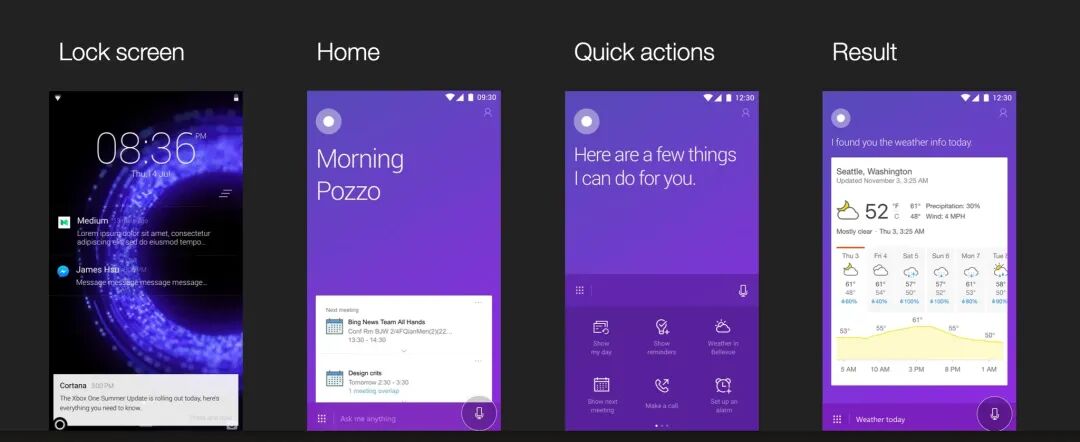
Hi everyone, I'm Pozzo. My first job directly related to AI was Cortana — at Microsoft, I worked on the mobile product. Cortana was actually Microsoft's first AI assistant; its Chinese name back then was Microsoft Xiaona.
We started out with a lot of confidence, wanting to build a great personal assistant experience. But what made us doubtful was this: we had such strong text-to-speech capabilities, such strong automatic speech recognition, but what was the biggest use case? Having Xiaona tell jokes, sing songs, and set alarms. That wasn't the AI I had imagined. It was genuinely a period of doubt.
After that period of doubt, I started thinking about whether I could go into the physical world and use AI to solve real problems, to create new experiences. Serendipitously, new retail was booming then, as was "Internet Plus," so I followed the trend to Freshippo, to Alibaba.
At that time, I was thinking about how we could combine AI to transform the in-store experience. Computer vision was gaining traction then. We incubated several products combining computer vision-based AI with IoT, including self-checkout, facial recognition payment, visual recognition self-weighing, and AI-powered loss prevention across the entire store.
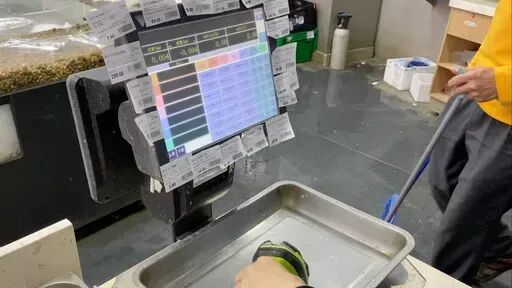
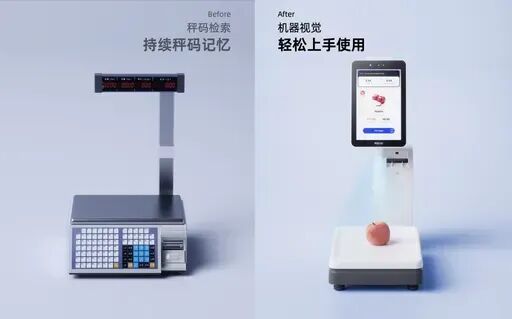
Looking back now, these are quite commonplace. Why do I consider this a highlight? My understanding is: we used mature, cost-controllable, stable technology, combined with experience design that could drive change at scale. That's what I believe AI can actually do.
🚥 Koji
Great, thank you. Now Zhao Chen, please share your career highlight and moment of doubt.
👦🏼 Zhao Chen
Hi everyone, I'm Zhao Chen. I currently run my own creative studio called ZAX. It's a creative-led studio focused on making brands cooler, on repackaging brands — that's our goal. I was previously colleagues with Pozzo; we both came from Freshippo. But before Freshippo, I was at Alibaba for about five-plus years.
Right out of college, I was at a 4A agency — **TBWA**, a company that has long done advertising for Apple. Our spirit was called the pirate spirit. We could steal new clients from any 4A agency, then use our creativity to make anything possible.
My biggest client then was Wyeth infant formula. Wyeth was essentially the wealthiest client at the time. Their spokesperson was Jacky Cheung. I personally worked with Jacky Cheung to discuss scenes and shoot their ads. I felt I had reached the ceiling of the infant formula advertising industry.
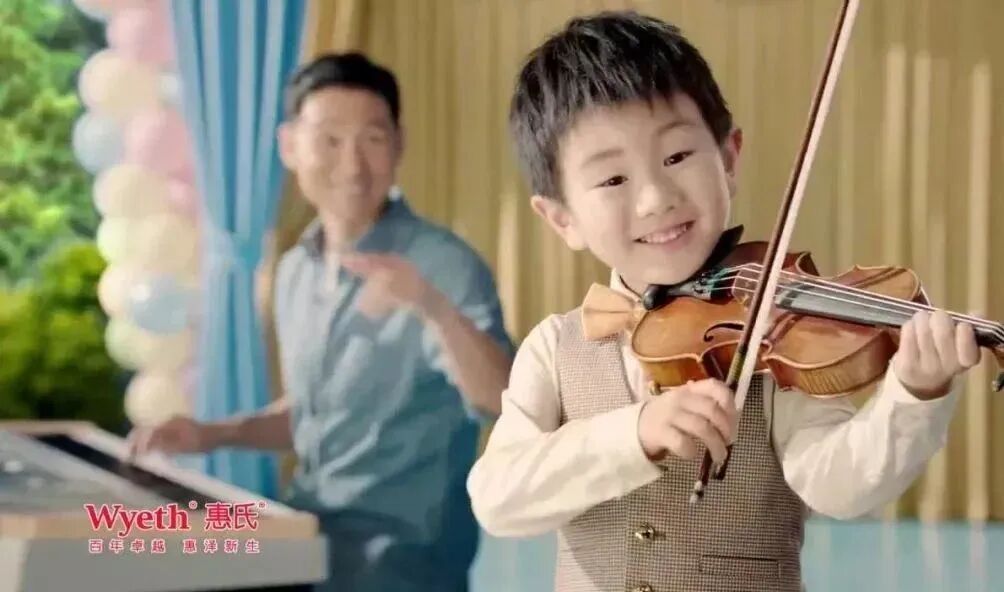
But one day, while at work on Huaihai Road, I looked up at our Huaihai International building and thought: I'm almost 30 — am I going to do infant formula for the rest of my life?
Or even if I became the best creative in all of Shanghai at doing infant formula, so what?
I still had to follow my heart. Because I loved digital things, internet things, I wanted to try that. So when the opportunity came, I went to Alibaba.
🚥 Koji
And the highlight?
👦🏼 Zhao Chen
My highlight was building two brands at Alibaba: first Tmall, then Freshippo.
When I first joined Tmall, what we wanted to do was make Tmall the most trustworthy fashion platform for consumers. So we thought about what visual asset Tmall could use as its core creative idea, to make everyone believe that Tmall equals brands, that Tmall is a platform brand center. The idea of the cat head emerged from this.
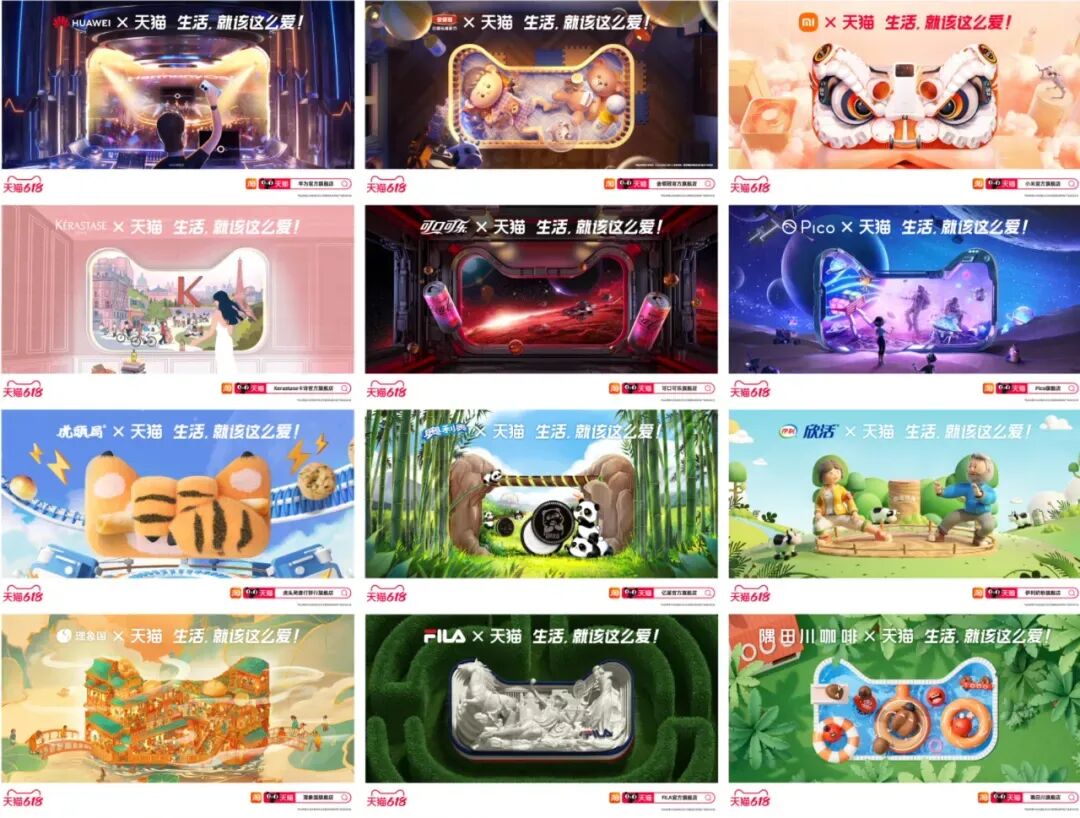
I'm also especially grateful to my boss at the time for insisting on carrying this visual symbol — now called a visual hammer — forward continuously, and for making the cat head into something of a cat head competition that all brands could participate in. That was when I felt happiest.
Then, due to some family reasons, I transferred to Freshippo. Freshippo was also a brand I particularly liked; even before joining, I thought Freshippo was a really cool supermarket.
And when I was a kid, I dreamed of opening a little convenience store. In a way, I've fulfilled that dream.
There was also a professional puzzle I faced at the time. Tmall debuted as an incredibly powerful platform, so whatever you did there, you had ample budget — or effectively no budget ceiling. You couldn't tell whether your marketing spend worked because Tmall was already so dominant, or because your ideas were genuinely good and that's what made the cat head iconic. So I kept wondering: how do I prove this is my creative ability? How do I make a brand distinctive on my own terms?
That's why coming to Freshippo felt like a 180-degree turn. Freshippo had very little brand budget, but it gave me the chance to build brand perception from zero — to establish what Freshippo meant, this idea of "fresh, beautiful living." I created the Freshippo IP, gave it a personality, built its own accounts. The highlight for me was probably Freshippo's Douyin account.
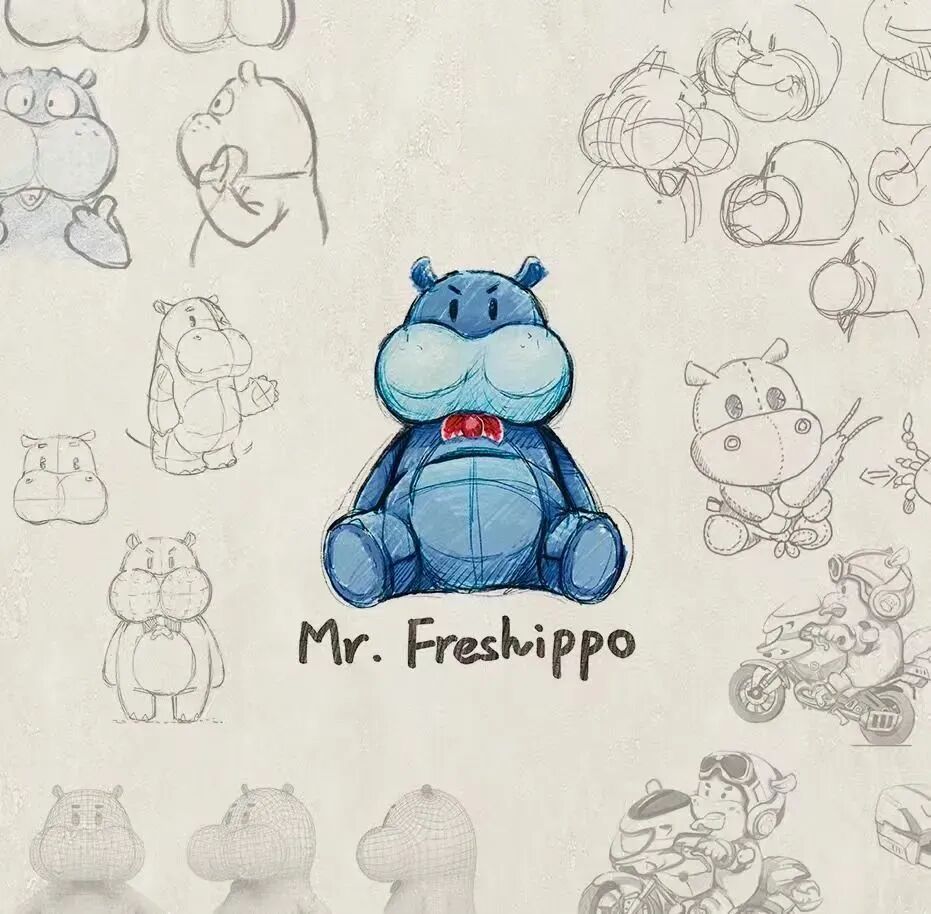
I worked really hard to grow it from zero followers to 50,000 on my own. Then one day I posted a video in a group chat that suddenly got nearly 1.8 million likes and around 20 million views. It just exploded. Followers grew by tens of thousands daily. That moment gave me my answer: the character I'd created at Freshippo had worked.
It became known through its own effort, not by standing on some platform's shoulders.
Most Memorable AI Story From Work Lately
🚥 Koji
Please share the most memorable AI story from your recent work.
👦🏻 Pozzo
Mine's pretty simple. I'm a product designer without much hand-drawing or flat graphic skills. But our team needed Mid-Autumn Festival posters for operations. So during the last Mid-Autumn Festival, we used Stable Diffusion to generate a poster of our service mascot sitting on a rooftop eating mooncakes and admiring the moon. This is the kind of thing our product design team can now regularly do with AI.
In the past, this would have required one to two weeks of prep, and we'd need to ask operations design and creative design colleagues to help. Now we just define the graphics and style, run it through SD, pick the image, add text in Photoshop — done pretty quickly.
👦🏼 Zhao Chen
AI is constantly present in my current work; it's become absolutely essential.
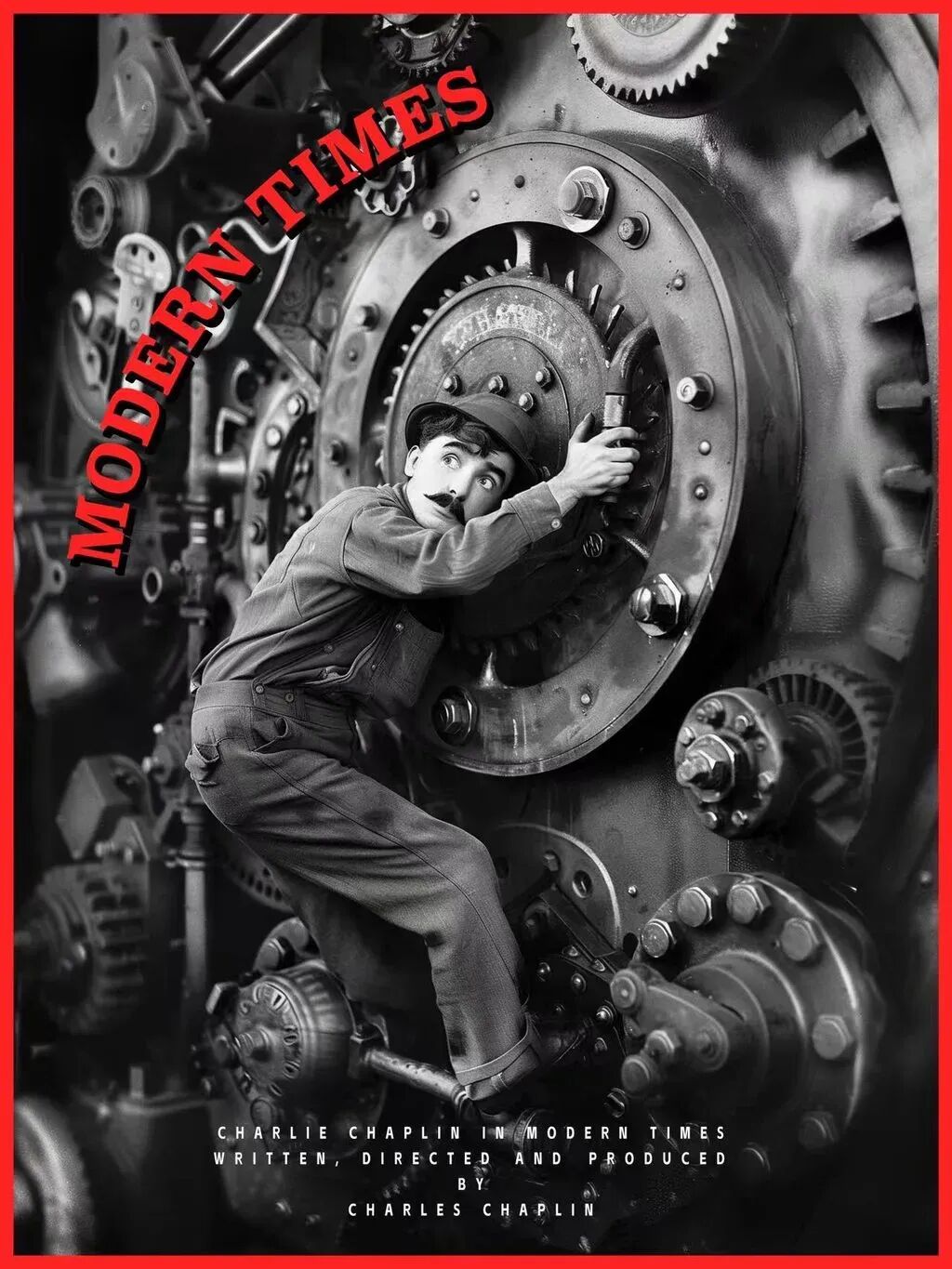
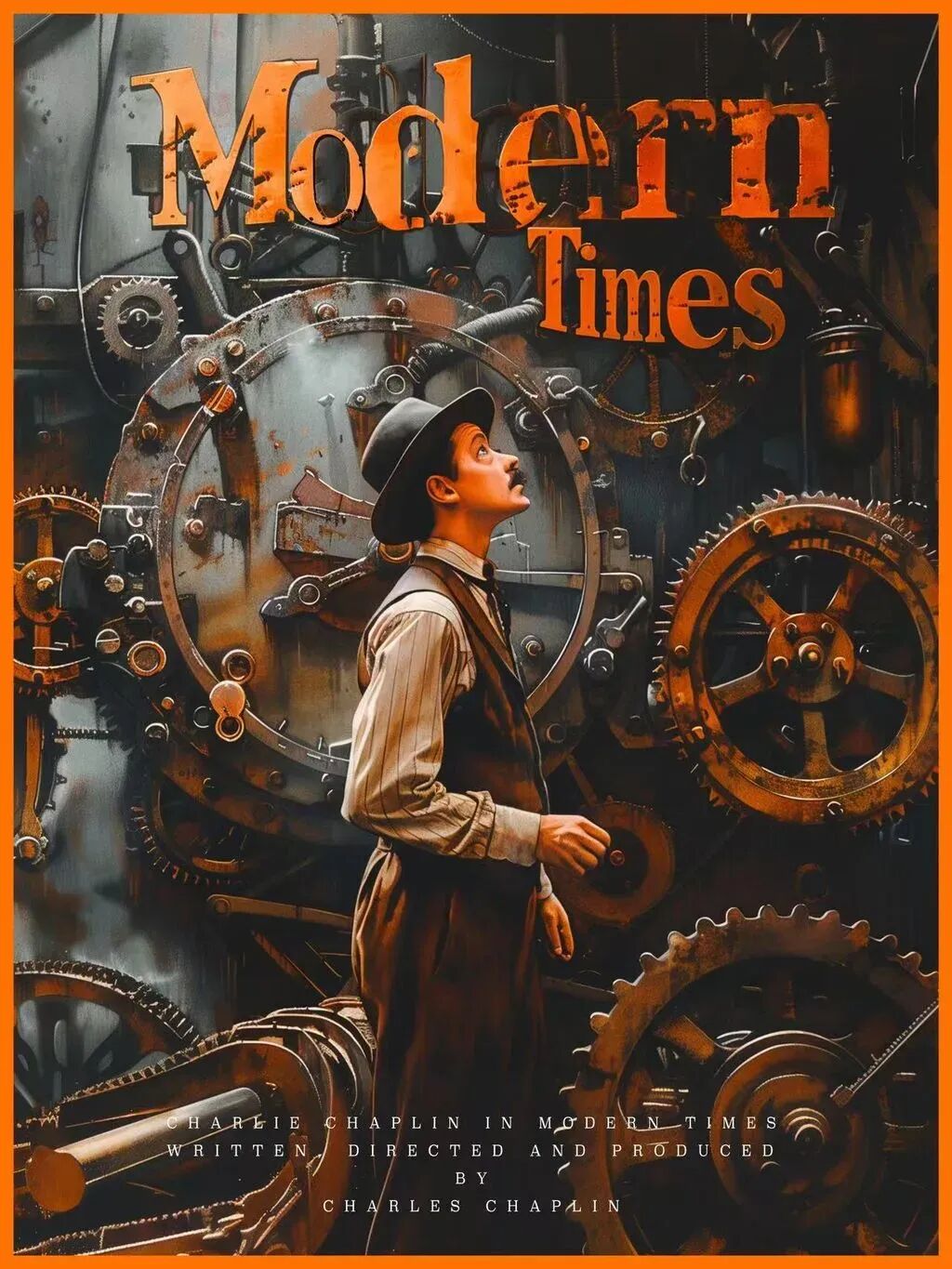
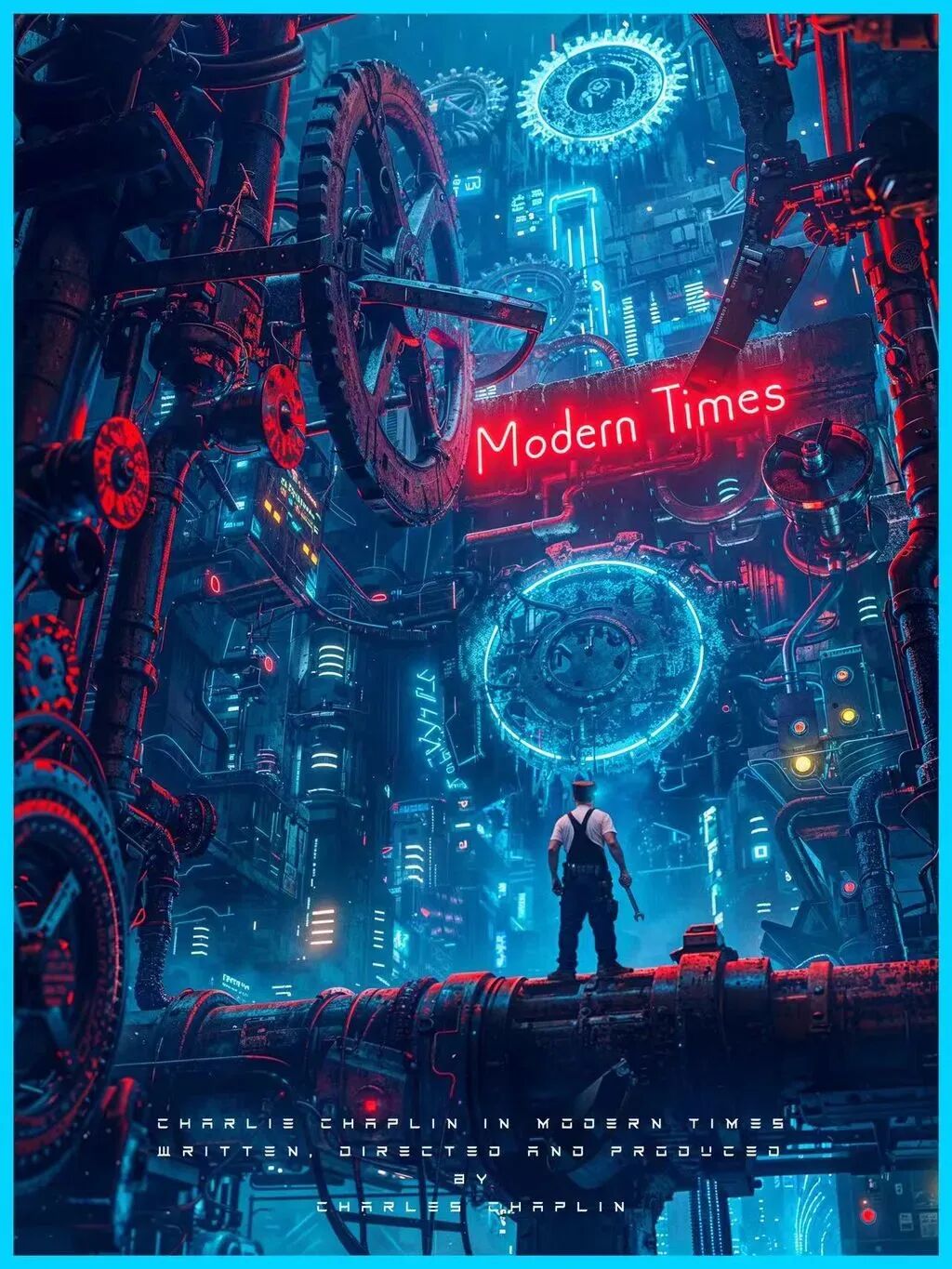
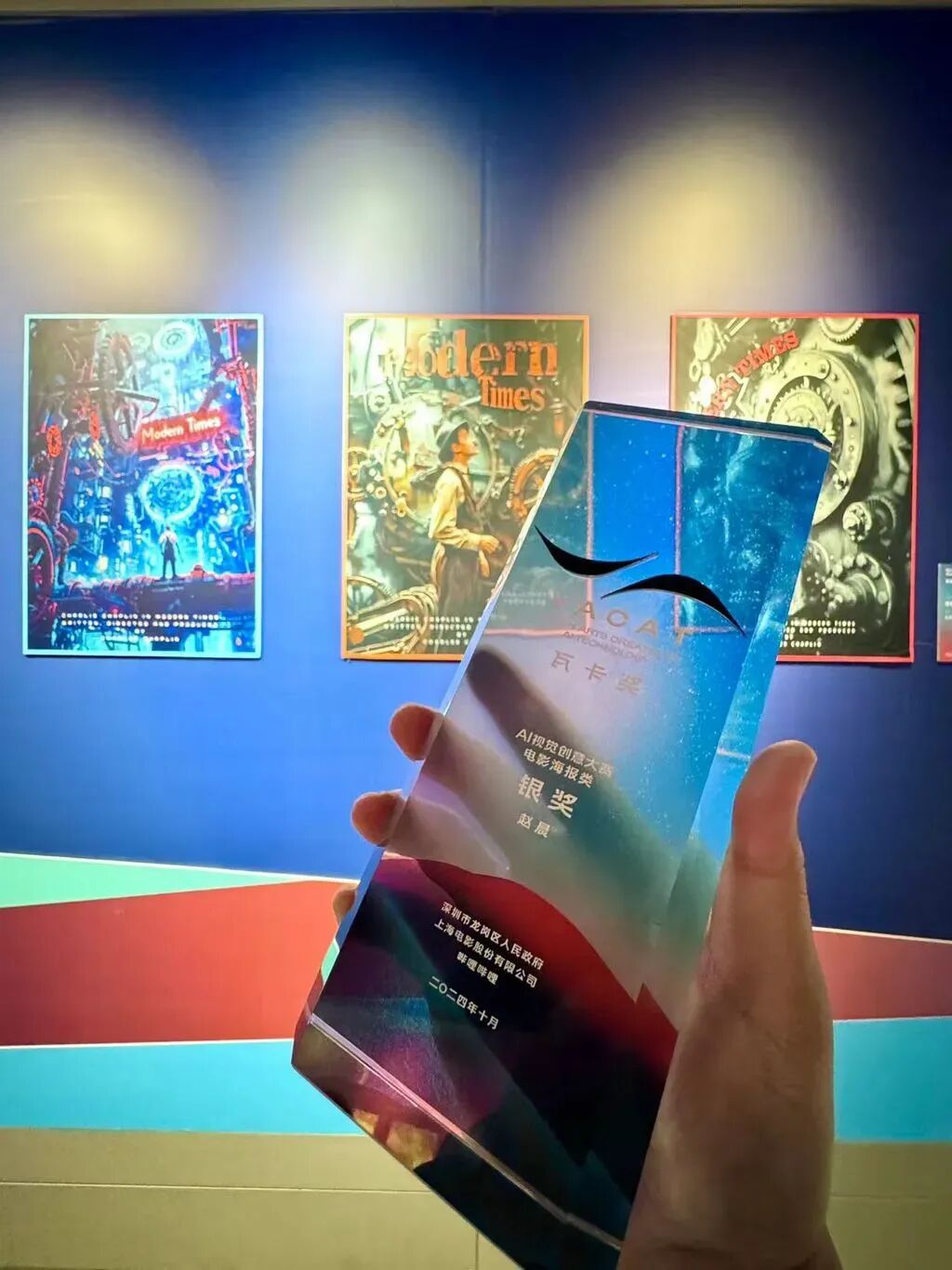
Recently I was invited to an AI painting competition in Shenzhen. The theme was film — creating movie posters or reimagining classic ones. I chose Chaplin's Modern Times, a real classic. Because AI is also a productivity tool, and Modern Times shows productivity from 100 years ago. Though it was that mechanical, industrial structure, I created three posters:
- "Modern Times 1936" — when the film was first released.
- "Modern Times 1966" — a period of further mechanized mass production.
- "Modern Times 2077" — what a future Modern Times poster might look like.
🚥 Koji
It feels like AI has infiltrated every corner of work. Pozzo, for you in UI/UX product design, do you feel that same kind of infiltration?
👦🏻 Pozzo
Not really, actually. If we're talking narrowly about image generation, UI/UX is more about rational, structured constraints — it's not infinitely open-ended.
Previously, product design teams had real limitations in emotional communication for product design and expanding operational resources; we needed collaborative teams to support us. Now the benefits are:
- Simple flat graphics: IP emotion stickers, for example — our product design team can handle these entirely on our own.
- Operational hero images: when we want them to move, we used to need the effects team. Now image-to-video gets us a dynamic operational hero image quickly.
It's more an extension of our existing scenarios, but hasn't really changed our core product design work.
First Encounter With Generative AI
🚥 Koji
Sounds like you both have a very clear grasp of where AI can be used, where it can't, and how to use it. Could you each describe your first encounter with AI — generative AI specifically? What was the scene? What was the story? How did you feel?
👦🏻 Pozzo
If we're still talking narrowly about generative AI as a phenomenon, I think it was early 2022 when I saw that famous DALL-E 2 illustration of an astronaut riding a horse on Mars and the Moon, and then a wave of AI-generated images appeared.
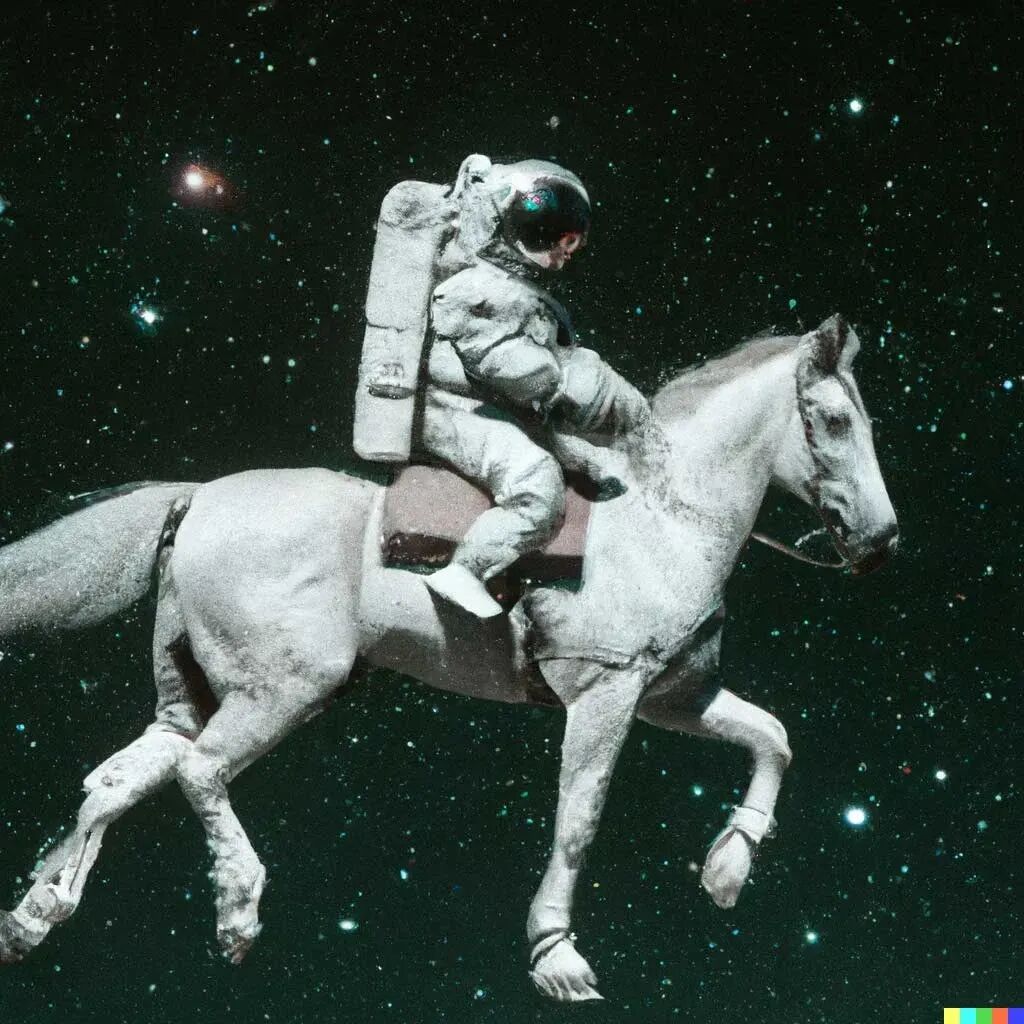
My first reaction was: no way, is AI really this powerful already?
For technical designers like me without illustration skills, this meant we could handle practical illustration and operations design work ourselves without having to ask anyone for help.
🚥 Koji
What did you do at the time?
👦🏻 Pozzo
My immediate action was rush to join the waitlist (laughs), to experience it, to play with it. I remember going to OpenAI's website and looking at all the DALL-E artwork, still not quite believing it was real.
🚥 Koji
Zhao Chen, do you remember your first time?
👦🏼 Zhao Chen
If we discuss AI more broadly, I think voice assistants like Xiao Ai might count as AI-related. But I always felt they belonged in the "artificially stupid" category.
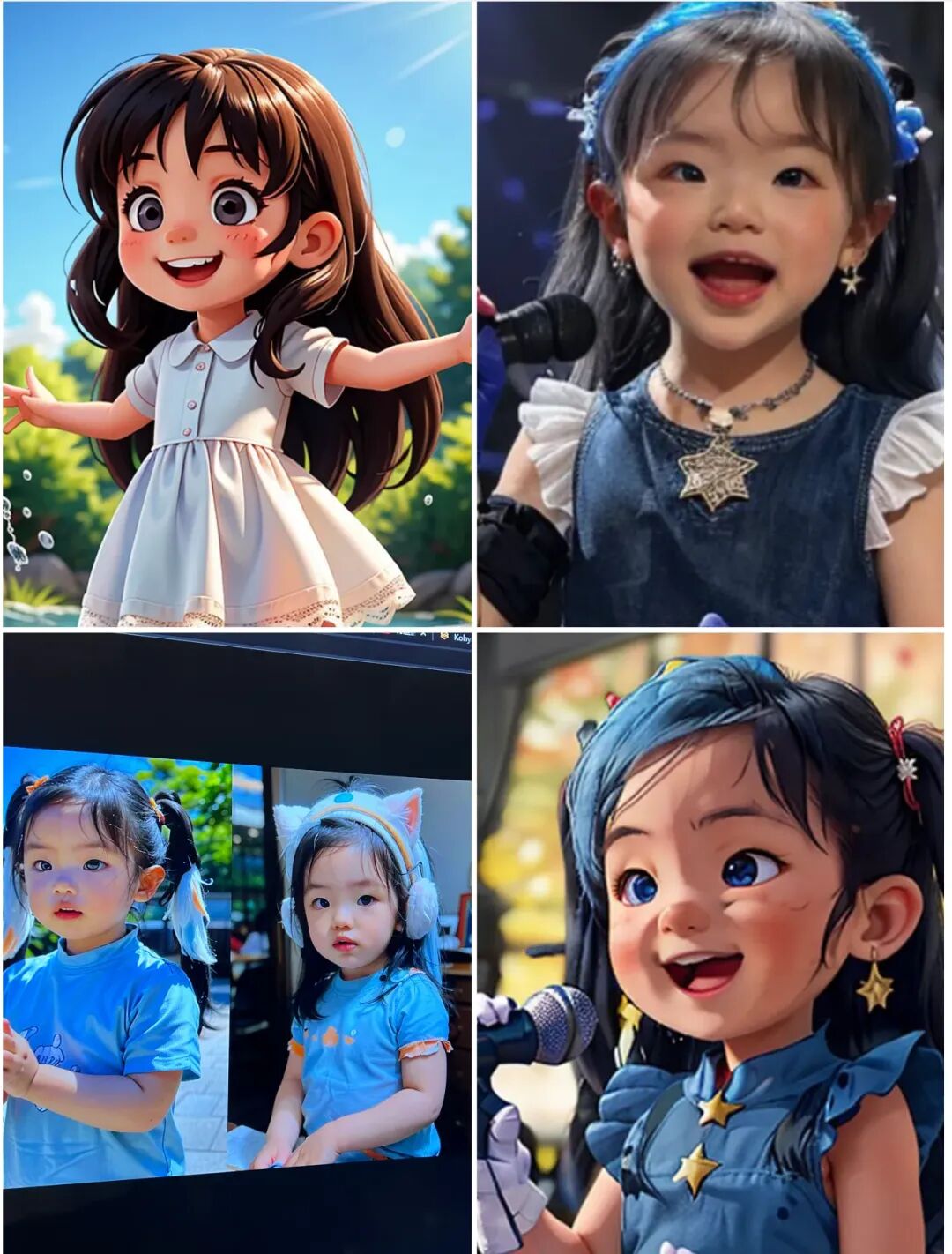
My first contact with image-generating AI was probably late 2022. There was an American app called Dream — a text-to-image tool. That was my first exposure to AI image generation. But I didn't really get deep into learning AI until around June last year. That's when I dedicated a solid block of time to really learning it — learning Stable Diffusion, learning "alchemy" (model training).
For me, this was the first time in over a decade that I felt something like magic actually existed.
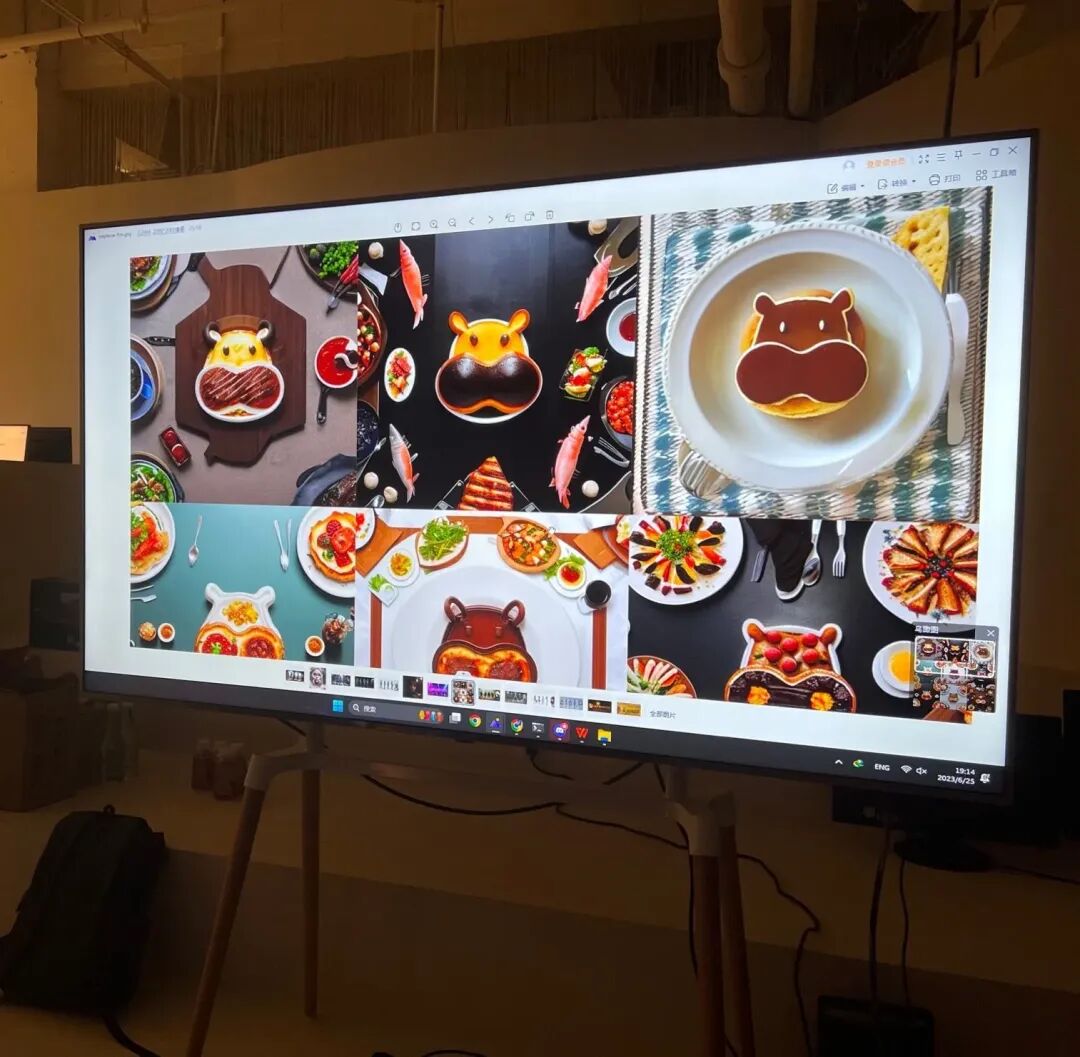
It felt like a new technology had emerged, one I'd never seen before. It genuinely shocked me and made me especially eager to explore how this AI could generate so many images.
The last time something moved me this way was probably around 2000, when I first connected to the internet and dialed up with a modem. That feeling, you know? It made me feel like my DNA activated. That's what made this moment so different.
How AI Has Changed Your Design Work
🚥 Koji
Let me ask Pozzo first: in what ways has AI changed your own design work?
👦🏻 Pozzo
Actually, AI's impact on product design itself is still quite small. But I'd say that AI has, in a sense, created my work throughout my career. Because AI exists, its transformations have brought various new interaction forms, giving me opportunities to participate in different products — user products, hardware products, platform product redesigns.
For example, the earliest AI we called semantic understanding, right? Intelligent voice recognition capabilities made new voice interactions possible. Back then there was Cortana, right? We worked on intelligent service assistant products.
🚥 Koji
So you don't really feel it's changed your day-to-day work so much as created opportunities for work.
Pozzo, you actually manage a fairly large team at ByteDance, so you must have all kinds of designers on your team. Of the types you see today, which designers are being most impacted and helped by AI?
👦🏻 Pozzo
If we look at designer categories, there's effects design, creative design, brand design, product design — these sub-disciplines. Since my team is mainly product designers, my own take is that creative-oriented designers, the ones who generate ideas, are being most affected. Effects, creative/graphic design — those are seeing bigger impact.
🚥 Koji
Pozzo, you mentioned before that you created a dedicated AIGC designer role internally. Could you expand on that?
👦🏻 Pozzo
Because at ByteDance, besides front-end user products and mid-end platform products, we also have some AIGC-capable platform tools and products. So my team actually hired model trainers specifically for several different scenarios.
First, front-end business units need to call AI capabilities, and I need customized vertical style models.
We have model trainers who can help front-end business units with LoRA training for model styles and Workflow setup — serving the front-end from the mid-end.
Second, for our designers, we also have some mass production-oriented work: graphic illustrations, IP operation banners, that kind of design. For efficiency gains like this — previously, if we wanted to do a 3D model render of an IP, training the whole workflow was very long, crossing multiple disciplines. I'd need 3D white model building, then rigging, then rendering — the entire workflow was extremely lengthy. But the model trainers we recruited in this vertical can quickly train something IP-like based on existing model assets.
For example, like Zhao Chen mentioned with the Freshippo IP model, it can be repurposed for different IP applications in operational scenarios. Say today I need Freshippo holding mooncakes, tomorrow I need Freshippo rowing a dragon boat. These scenarios are exactly what model trainers and model designers can support. Besides this 3D model trainer type, we also have portrait and other categories serving different verticals to supply raw materials.
🚥 Koji
Why did you need to create this dedicated trainer role?
👦🏻 Pozzo
I think it's because the business has demand, there's a trend, and design is also an essential competitive advantage here.
First, to define "AI alchemy" — it's mainly a role focused on training image and video models and building workflows. From an industry trend perspective, besides general-purpose large models and open-source models, a large portion of business applications come through model communities.
The next step for model communities is refined model customization services. Like commercial brands, every business entity wants its brand to be unique and recognizable. Vertical businesses and vertical scenarios also want their own exclusive model for mass production in their business, not shared with others. Adobe Firefly, for instance, is also opening commercial model customization services. All of this requires designers to participate in defining the visual style and model.
Second, in the model definition part, design is actually the core competitive advantage. Looking at the competitive advantages from current model community outputs, many top model contributors have design backgrounds. Design inherently has aesthetic foundation and attributes, and this itself provides strong constraints to help brands or vertical businesses constrain their model generation.
Third, businesses actually have higher requirements for controllability. We need not just aesthetics, but also the ability to combine algorithm engineering to define our aesthetics into concrete Workflows delivered to users. This business demand requires a designer who understands technology and has aesthetic sense — from aesthetic definition, to Workflow building, to final delivery. So top model designers in this field are extremely rare. Look at C-Station (Civitai) — the top model contributors, it's just those few people. And the things these people make can be applied in commercial scenarios, because the model training that design teams own or build, directly or indirectly, serves business needs.
🚥 Koji
Same question for Zhao Chen — I'd like to know how AI has changed your design work from various angles?
👦🏼 Zhao Chen
First, I think something very important is that it makes it easier for me to become what you'd call a super individual.
Because previously at the ad agency, I was the idea person, but I had a huge production team — overseas illustrators, top-tier directors, excellent 3D modelers, animation teams — to execute my ideas. A lot of things, whether in advertising or creative work, start very rough. Maybe you can only use your brush to simply sketch out your idea, then communicate with the client bit by bit, gradually turning that idea from pencil sketch into reality. That was the previous workflow. But after AI came, everything changed.
I can even present client-ready quality work to clients in the first round of proposals. For many clients, you can't use your own language and a sketch to tell the client "I want to make a cloud like this, a scene like this." But most people believe their eyes, so they need something more concrete and direct that gives them visual impact.
I think AI actually solved these problems for me, and it can let me cross boundaries and disciplines to achieve what I want to achieve. Because some images might be better presented in pencil, some in oil painting, some in 3D. But in the traditional workflow, I'd need to coordinate different teams and spend huge amounts of time on these things.
Now with AI, while I can't guarantee it's final quality, at the proposal stage it's definitely the most effective. It can give my client the most intuitive feeling, telling them what I want to make. That matters a lot to me.
I think right now we're just in AI's awkward growth period. It's like a teenager, a bit rebellious, not quite tameable yet.
But in the next 5, 10 years, AI will become an essential tool just like the computers we use to communicate now. And there won't be a podcast doing a show about how AI has changed your life, because it'll just be everywhere in your life.
🚥 Koji
Like there won't be a podcast specifically talking about Photoshop, hahaha.

Who Will You Hire in the AI Era?
🚥 Ronghui
Actually, listening to all this, I have two directional questions I want to ask.
First, as someone who used to do creative work, you mentioned several times how AI helps with your creativity. I'm curious how a creative person uses AI to become more creative?
Second, you mentioned you've returned to running a design agency. I'm curious what an agency's personnel structure looks like with AI's help? What kind of people might you hire?
👦🏼 Zhao Chen
Let me answer your first question — as a creative, how does AI give me more inspiration.
First, I think it solves the problem that creative people aren't universally talented. For example, I probably can't paint oil paintings better than art school students. I probably can't illustrate better than animation school students. And I definitely can't shoot films better than professional directors. But I know what I want, and they just help me present what I'm thinking, expressed in the way they excel at.
But AI has become my partner — a tireless, never-gets-tired partner that really understands what I'm thinking, and it can cross time and geography.
For example, if I want something in American style, previously I might only be able to search American-style image libraries. At most I'd find some American-style illustrator references, study how they draw, learn from them, then copy it as a layout for creation, then tell my client "I drew this, maybe it's not truly American comic style, but it has that American comic tone in it, imagine what that tone is like."
And at this point the client's brain might have already crashed. But with AI, I can truly find an authentic American comic illustrator who sits inside my computer to execute my idea. So again, as I mentioned before, it reduces the intermediate损耗.
So I can more极致地 pursue the image and creative in my mind, what it might look like, rather than being constrained by "I need to find an American hero pose but I just can't find it." But in SD I just need to随便 find a wooden mannequin, pose it, use a human skeleton model, take a photo, then redraw — problem solved.
Something that might take an hour in the traditional workflow, maybe 5 minutes now. The remaining time I can spend more on refining the idea, deliberating on what I think matters more.
👦🏼 Zhao Chen
Second, for example, an important business in my current company is customizing IPs for enterprises — whether it's IP mascots or IP figurines. In this process, I might think, "I want to make an apple person, but there are 100 ways an apple person could look — which is better?" Typically I'd turn this into as detailed a prompt as possible, give it to SD, load different models, let it generate images, then I'd go eat. Maybe two hours later it gives me four or five hundred images.
None of these images may be perfect on its own, but they let me try different approaches. If my initial idea has three directions, it can expand into 300 different expressions. None of these images may be the final result, but after seeing them, I'll take what the AI computed and run it through my own brain again. That's how it generates different inspiration for me.
For me, this is the crucial point. It's something the old agency approach of searching stock photo libraries and references could never achieve — AI can give designers more precise inspiration.
But for an experienced designer, you know how to take the essence and discard the dross, then create the character or the specific element you want. Because I believe an idea is choosing the best one from infinite possibilities. When I was at Tmall, there were all kinds of visual hammers we could have used. But why did we ultimately choose the cat head? That was a choice made through human experience — discarding the dross and taking the essence.
So for me, AI can give me more options to draw inspiration from, creating inspiration on one hand while letting me choose the best one on the other. That's an important way AI has changed my workflow. This is how I use AI in my design process.
I don't think I should depend on it, but I should use it — let it create more value for my inspiration. Not "I'm out of ideas, AI, you draw something," because then AI just becomes something everyone despises. That's a really different thing.
🚥 Ronghui
So humans and AI still have a collaborative relationship.
👦🏼 Zhao Chen
Right, it's collaborative, and it's mutually beneficial and interdependent. For me, up to this point in September 2024,
AI still needs human creativity to do a lot of its work, and it can feed back into humans and inspire more creativity. I think that's the most important way it serves people.
So next, how will our children coexist with AI? In 20 years? I think the crucial thing is to become creative talent. Because in that era, AI will be everywhere — no one will be saying in detail, "Wow, you solved that arithmetic problem so fast."
Instead, people will focus more on what your thinking is, what meaningful thing you want to do, how you create something from 0 to 1, from nothing to something. I think in that era, everyone might be creative — they'll create something distinctive.
This topic might be straying a bit far into the future, but I think at this inflection point of the AI era, at this crossroads from 0 to 1, we should be imagining this. Otherwise, in 20 years we might all be wiping down servers with rags.
What Skills Have Improved After Using AI
🚥 Ronghui
I believe many people have already started using AI-related tools, and they may be aware they need to embrace this change. But how can they become more refined?
Since both of you mentioned using AI-related tools since 2022, over these past two years, what skills have you specifically focused on improving?
👦🏻 Pozzo
I think people define design far too narrowly as the creation of beauty and flat graphics. Actually, I want to elevate the definition of design itself, especially product design. We're designing experiences, and this experience itself has nothing to do with technology or what production tools we use to create it.
For example, we can look at Leng Jun's paintings, right? Leng Jun's paintings are incredibly detailed — he uses oil paint to create extremely fine brushwork. I find this beautiful. I could also achieve the same result in Photoshop, pixel by pixel, and create the same painting. And I could also use AIGC to generate the same painting. The overall process would differ in efficiency, but the final object that you perceive as good and beautiful remains unchanged.
Returning to product design, I personally feel that in the past two years, technology has actually changed significantly, right? Previously when we talked about AI, especially AIGC, about design generation, especially images or video, there were two biggest problems: authenticity and controllability. We could generate massive quantities of images, but only one or two might be truly usable.
But the logic is: as long as it's more efficient than our original traditional design tools or editing tools, it has value.
From my perspective, if we look at this from a tools or skills viewpoint, we might as well look at what we're actually delivering. For example, design at its essence is creation, or design is experimentation, and creation can be divided into ideation, editing, and scaled production and manufacturing. So what changes and value does AI bring in each of these three areas? I find this quite interesting.
The first is, for example, when Midjourney came out, our first feeling was that it could help every individual create inspiration without limitations, bringing new effects. People who never studied art, never learned hand-drawing could also create things — this actually expanded individual capabilities for many product designers.
👦🏻 Pozzo
The second stage is editing — we can make design adjustments through very natural interaction methods. For example, early on, although we didn't have generative AI, we used things like saliency-based cutouts, right? Remove background is also AI. Compared to our early days in Photoshop cutting out pixel by pixel, AI genuinely helped us make better design adjustments through natural interaction, lowering the barrier to design and optimization itself.
This skill and technical capability actually became simpler as our capabilities improved, whether through large models or AI generally. For example, now in Stable Diffusion, ControlNet's various controllable editing and generation capabilities actually help us do better on AI controllability.
Is there a big difference between having this tool and not having it? I think it's more about helping you improve efficiency and enabling better delivery.
Then the third is production facing commercial scenarios, which emphasizes our scaled production and scaled delivery. What scenarios require scaled production and delivery? For example, facing different cities, I might need different posters; facing different people, even my product images look different. Previously our approach might have been limited page layouts, limited text expressions, then cross-multiplying to produce infinite — or larger-scale — supply. Now we can truly achieve that different people, different scenarios, we can generate different personalized pages and presentations. But in reality, not many people actually use this, right? Currently it doesn't see much use. Actually only things like special effects, AI special effects scenarios — where I expect to generate something different with extreme contrast — do we see better applications.
So from my perspective, returning to your earlier question about what changes there have been in designers' professional capabilities or tool requirements over this past period,
I personally feel I pay more attention to people's aesthetic ceiling, their understanding of the business, their understanding of the final interaction form — rather than the tools themselves.
If we're talking about narrow image generation capability, there's still another direction, which is what I've been talking about:
AI will bring new products and new experiences, and this is what product designers most need to pay attention to.
For example, without visual recognition, right? When we're checking out at a register and scanning a product, we needed to precisely align the barcode with a scanner. Now we just need to recognize the product.
Without machine vision, we might scan faces — we used to need QR codes for checkout, now we just scan faces. Now with large models, which scenarios, which ones with text-based large models will see significant changes? For example, text-based service products, like customer service products — previously we served frontline users through 1-on-1 human service, right?
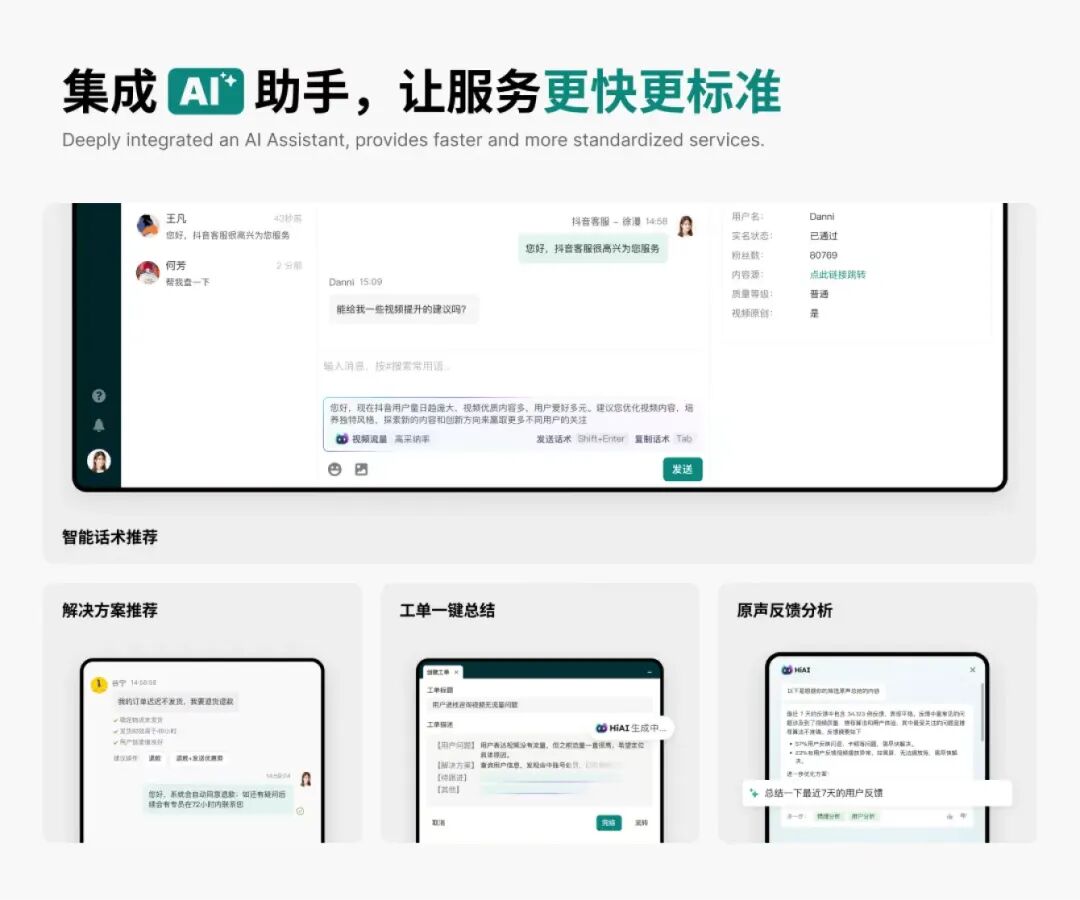
So can we use text-based capabilities and generation capabilities to enable one person to simultaneously serve 3 people, one person to simultaneously serve 6 people, even moving from traditional 1-on-1 text-based service communication to me monitoring like watching stocks — seeing which people need service and directly intervening.
This kind of frontline and product interaction form will change dramatically. I think this is actually what I focus on with my team at this stage — discovering this essential part, the possible changes in frontline interaction brought by technology, then guiding our products to advance in this direction.
🚥 Ronghui
I think you two have elevated this topic a notch — one from creativity, one from the beauty of experience.
What you just said actually inspires me to think that perhaps what we discussed earlier about design is limited to a tool, something more skill-oriented. But what you both mentioned makes me think that what designers do is actually connect people with experiences, connect people with beautiful experiences.
Just like Steve Jobs said before: design is actually everything — it's the logic of how the whole thing operates.
👦🏻 Pozzo
I think if we look at design from a product design perspective, we're actually creating an experience. How to achieve maximized business efficiency, maximized ROI, while users can use it extremely well and continue using it.
Good Examples of Design + AI
🚥 Ronghui
Of the categories you just mentioned, have you seen any particularly good examples? Whether using AI to provide a better experience, or the new experiences AI will bring us that you mentioned last. What are some things now that you feel are good attempts in this direction? It doesn't need to be a standard answer — it doesn't need to be something already done exceptionally well — but attempts in this direction worth sharing?
👦🏻 Pozzo
Sure, I can share two interesting cases — one consumer-facing, one enterprise-facing. On the consumer side, this is actually where most users encounter AI today. At least from my own experience, if you spend a lot of time on Douyin, scrolling through short videos, a lot of the AI applications you see are in special effects.
A major weakness of AI image generation, at least from a designer's perspective, is that its realism and controllability are somewhat unstable, right? But flip that perspective, and in special effects — especially in consumer entertainment scenarios — that instability becomes an advantage.
Because AI's value lies in the novelty and shock of AI-generated creativity. For example, with trending special effects, we often rely on contrast and反差感 to grab users. When AI gets baked into these effects, it can take a beautiful user and suddenly make them ugly, make them funnier, right? Typical examples would be the AI wedding photos, the claymation filter — you feel like you're seeing versions of yourself you never could have imagined. Then there's the other direction: taking things that were originally static, or things we couldn't even conceive of, and making them possible. In video, think of the viral clips of Guo Degang doing English stand-up comedy, or Trump speaking Chinese. These are all scenarios where special effects, powered by AI, create novelty and a sense of possibility.
👦🏻 Pozzo
On the product side, especially for B2B products, what I emphasize is that the core scenarios come down to two fundamentals: improving efficiency and lowering the barrier to entry for that scenario. On the efficiency front, what I personally pay more attention to is large language models, especially text-based models, in our B2B applications. Take the customer service scenario I just mentioned — conventionally, one agent handles 3 to 6 customers simultaneously.
What LLMs bring is the opportunity to transform how customer service operates at the input and communication level. Good agents no longer need to answer every single user who reaches a human; instead, they supervise AI-generated auto-responses. "From multiple-choice questions to true/false questions" — figuring out which scenarios require intervention, which need their professional skills to answer well, which problems they can help users solve. Only stepping in for key conversations, achieving a tenfold leap. These are the changes that transformed service models bring to the customer service workspace, and ultimately they create new products and new capabilities.
Take that customer service workspace. Beyond these vertical scenarios that need transformation, different businesses have their own customized service scripts — e-commerce service language, lifestyle service language, content creator service language, they're all different. Can we use LLM-based agent tools to help different vertical businesses define and customize their own service scripts, forming more emotionally resonant communication? And simultaneously configure quality inspection and training bots to help different businesses with monitoring? These are all product design opportunities that AI creates — transforming previous workflows, transforming previous interaction patterns, and creating new products.
How AI Is Changing Hiring
🚥 Ronghui
Are there new jobs emerging from all this? Or have your hiring standards shifted — are you requiring new skills?
👦🏻 Pozzo
The logic is still the same logic. I'd separate the evolution of product design from the definition of new job roles, and look at these two parts distinctly.
From the product design evolution angle, I'd say it's gradual. The understanding of skills and craft hasn't changed dramatically. What matters more for competitiveness is your long-term value — your taste, your curiosity, your business understanding, your professional capabilities like foundational interaction, visual, and product sense. These underlying abilities are more demanded; there isn't actually huge upheaval in skills.
You could say, from the early internet UI/UX days, right? Graphic designers, then interaction designers, then experience designers, then product designers — all these changes have been gradual.
🚥 Koji
So can I ask more directly: after AI arrived, did your hiring standards for designers change or not?
👦🏻 Pozzo
I think one additional vertical requirement emerged, and I'm paying more attention to long-term value. First, you need good taste, right? You can judge what's good, because AI can help you with more foundational knowledge.
Second, you need curiosity and a spirit of exploration. AI brings more possibilities — can you, driven by curiosity, explore what the optimal interaction is when a new interaction or new technology is being defined? Do you have the curiosity to track the best or leading products?
🚥 Koji
So in the past, when you hired, you didn't value taste and curiosity as much?
👦🏻 Pozzo
Relative to this current stage, I think this is differentiated value. It's not just change brought by AI; it's industry trends plus AI-driven change.
Traditional product designers and experience designers, right? I can complete end-to-end product delivery, I can use components to build pages, I have user empathy to do design — prototypes with a certain aesthetic sensibility. This is universal; most designers can do this.
But looking at what our team needs now, I'm more focused on what incremental value this person brings to the team? Or this person's future potential if they join us.

A Design Team with "AI in Its Blood"
🚥 Koji
Can you give two examples? After the AI era began, hires that have been especially helpful to your team.
👦🏻 Pozzo
We actually brought in a model designer specifically serving IP and model generation — 3D model generation.
His 3D and IP design capabilities are quite exceptional, and simultaneously he can do 3D and model LoRA training himself. After he joined, he was able to help my team and surrounding teams better complete deliveries that previously graphic design or UI/UX design couldn't achieve — 3D expressive elements, especially IP mascot illustration deliveries.
I think it's the incremental value that one individual brings to the team as a whole, especially for scaled delivery.
👦🏼 Zhao Chen
I understand what Pozzo just described, and I can also speak from the advertising, branding, and creative industry perspective.
AI's emergence has indeed changed how we evaluate designers or creative talent.
Before AI, my team had to have 3D designers, illustrators, or colleagues with editing capabilities. But AI lowered the barrier for certain kinds of creation. Before CapCut, everyone had to use less user-friendly software like Final Cut or Premiere — you needed to spend a lot of time learning to produce personal work or vlogs. But with one-click generation tools like CapCut, video production became much easier.
From my perspective, AI has dramatically lowered the technical barrier — anyone can become a "director." But simultaneously, it's raised the content barrier. As a creative industry participant, I believe content is always paramount, and AI has made the content barrier even higher because the technical barrier has dropped.
So when hiring, I focus more on a person's creativity, aesthetic sense, openness to new things, and curiosity. I can place more attention on these abilities rather than whether they master illustration or 3D design, because with some AI knowledge, these skills can also be achieved through AI.
We're in AI's "adolescence," an awkward stage.
I think things like Stable Diffusion, Midjourney — these aren't the final form of products, they're just transitional stages. Maybe in another three to five years, AI products will become so easy to use that even my grandmother could use them. But by then, for creative talent, the highest requirement will be their thinking and their 0-to-1 creative ability.
These are actually what I value most in hiring or in work: their perception of the world, their insight into people, their sensitivity to things. These are uniquely human capabilities that AI currently cannot reach. I think this will become the most important consideration in hiring for the next 10, 20 years.
Because I don't think people should become numb. When a person over-relies on technical capability as their primary strength, they become numb and dull.
But thanks to AI, it broke the cycle of endless technical "involution." It gives everyone the opportunity to create illustrations, photography, or 3D work that previously might have required years of study and practice. This way, good creative ideas can more easily stand out.
This is also a kind of achievement AI brings to humanity.
🚥 Koji
Do you think AI will cause some designers to lose their jobs?
👦🏼 Zhao Chen
I definitely think it will.
AI will certainly put pressure on designers who only pursue technical skill, but simultaneously it will empower designers with ideas, imagination, and creativity.
This reminds me of an experience from university.
Our photography teacher told us on the first day that there are two kinds of people in photography: "gear heads" who always carry the most expensive lenses to shoot newspapers, constantly calculating focal lengths, researching how shallow their aperture can go, pursuing bokeh effects. But in reality, after shooting tens of thousands of photos, they end up with just piles of exquisite "little trash."
The other kind doesn't care what equipment they use — they can create great work even with a phone. I think the same principle applies to AI and graphic design today. What matters isn't whether you use Midjourney, Stable Diffusion, or some seemingly simpler AI tool — none of that is key. What truly matters is what's in your head, what you want to communicate.
🚥 Koji
Pozzo, in your team, because of AI's emergence, do you think the number of roles has increased, decreased, or stayed the same?
👦🏻 Pozzo
From what I've observed, AI's development hasn't really brought major changes to the overall number of roles. On the contrary, it may create more front-end product and new platform capability demands.
For example, we now need to do model training, data labeling, and tag construction — all of which require new products to support them, and thus need product designers to get involved.
AI's development will indeed create some new job positions, especially in product design-oriented directions. Previously, when we evaluated a good product experience, we mainly looked at whether it had specific interactions and visual effects. But in the future, a product's quality may also need to consider the richness and matching degree of its experience model.
If we narrowly view assisted design as merely a tool for replacing human delivery, then in the creative design field, especially in basic delivery design, it may lead to workforce reduction. But at the same time, new design positions may also emerge in the creative field.
For example, we may need roles for AI-oriented designers, responsible for aesthetic labeling of models, defining aesthetic standards, and so on. These all require designers with aesthetic capabilities to participate. Additionally, on the business delivery side, particularly in the final delivery logic of models — whether it's model training, release, or iteration, especially when it involves aesthetic adjustments — designers need to be involved. These are all new job positions created by AI.
AI may also create some new design patterns, breaking through the ceiling of design itself.

If AI Had Existed When We First Started
🚥 Koji
If today's AI had already existed when you two first entered the industry, right after graduating from university, what changes do you think would have happened in your careers?
👦🏼 Zhao Chen
My view is that AI's emergence might have allowed me to focus more on a specific area within creativity. It saves me a tremendous amount of time, which I could then invest in deeper learning — such as directing techniques, illustration creation, hand-drawing methods, or storyboard design. Although it sounds like AI can do these things too, in reality it still requires people to control and guide AI in completing these tasks.
Looking back, if I had these AI tools when I graduated from university, I probably wouldn't have needed to learn so much software.
This way I could have avoided many detours, and used the saved time to do more of what I truly wanted to do.
For today's college students, the problem they face is: what should they do after graduation? Do they need to compete with AI? Or should they do what they love? I think we should discuss these questions more.
My suggestions are:
- Maintain an open attitude toward AI, actively embracing this new technology.
- Pay more attention to excellent works in your field, whether in painting or creative works. Just as AI models need large amounts of data for training, people also need to "absorb" large amounts of excellent works to form their own understanding and creativity.
🚥 Koji
Pozzo, as a product designer, if AI had existed when you first entered the industry, what changes do you think would have happened in your career?
👦🏻 Pozzo
Two paths:
- The first path is: I might become a super individual, expanding my boundaries more. I would no longer be just a product designer; I might be a product designer and developer, making my own products. I could incubate many things and creative ideas.
- I would more resolutely, more decisively throw myself into products related to AI infrastructure construction.
Current AI capabilities are not the endgame — they're maybe not even Windows 98, not even at the DOS interface stage. At that stage, you'll find that the biggest change isn't the applications on top, but that the rapid iteration of infrastructure brings infinite possibilities.
So what will AI-era infrastructure look like? It's what we just discussed: data algorithms, computing power, and platform tools. If I were still working in a designer's role and function, I would probably invest in building platform-type products rather than front-end applications. If I were to do front-end applications, I would start my own business. It's one or the other.
🚥 Ronghui
Sounds like from a product designer's perspective, you'd prefer to join the most influential product in this industry.
👦🏻 Pozzo
Right, I think the logic is still products that can grow long-term and sustainably — either that or starting my own business.

The Endgame of "AI-Era Design Tools"
🚥 Koji
Actually, you two just mentioned Midjourney, Stable Diffusion, but at the same time you mentioned that you don't think these will be the endgame of AI design tools. Could you both share your vision of what that endgame might look like? Or have you seen any glimpses of the future in any products?
👦🏼 Zhao Chen
For me, I'm currently using many AI tools together. The basic one I use is definitely Photoshop, but 10 years ago or throughout the past decade, using just Photoshop plus stock image libraries was enough. But now with various AI tools, I need AI tools to help me generate all kinds of materials, then finally stitch them together in Photoshop, or integrate them.
Although Photoshop has its own AI capabilities, compared to some professional platforms like Midjourney, and some localized tools like ComfyUI, Web UI, and SD-type products, it's still too weak — it's practically kindergarten-level. Let me use Midjourney as an example. I might first use GPTs to help me generate the prompts I want, then generate these technical images in Midjourney.
After generating these basic graphics, I feel Midjourney's outpainting capabilities and some detail rendering capabilities aren't good enough, so I might put them into ComfyUI or Web UI to make these adjustments, but these adjustments are very time-consuming — I need to download my LoRAs, I need to download my large models.
So recently I've been using Magnific more often, which is essentially a remotely deployed SD. It can do good outpainting, plus some style transfer, lighting transfer — you can think of it as a highly integrated version of SD. It doesn't do many things, but what it does, it does quite well.
Then after I finish outpainting, I take it back to Photoshop to complete the final compositing.
So you hear this process — I'm already using four or five, six AI tools, and each AI tool probably requires payment. So I definitely don't think this is a normal state.
So in the future, shouldn't there appear a behemoth form, or an integrated form?
— It's a platform that connects many AI tools together via API interfaces, allowing me to complete my entire design workflow. That might be one work form. Or if we think even more sci-fi, it becomes something like ChatGPT where through chat format, something gets generated bit by bit.
👦🏼 Zhao Chen
But going back to what we were discussing earlier — what AI can bring me is allowing what's in my mind to be communicated without loss, or to be made concrete and presented.
But with so many AI tools, each one I use causes the result to degrade bit by bit. So I hope that in the future there's a good tool, or that I can use just one tool to complete this task.
In this process, I don't need to switch my mental model, don't need to shuttle back and forth between different platforms. That's the first point.
The second point, from a designer's or AI user's perspective, I think something extremely, urgently needed is breaking through the barrier between Windows and Mac. I think this part is also something that AI will inevitably improve as it continues to grow — I believe it will definitely be accomplished within the next five years.
🚥 Koji
Have you seen any signs of this? Returning to the question above — have you seen any startup make any product that gives you that feeling of secretly catching a glimpse of the future?
👦🏼 Zhao Chen
I don't think we've reached that era yet. Really, from my 20-plus years of understanding in the digital and tech circles, I don't think we're there yet. I think now is a time of blooming flowers, which is quite nice. Right now it's a bit like the mobile phone era of 2004-2005 — all kinds of bizarre phones, all kinds of bizarre digital devices appeared, but maybe years later they'll all look like the iPhone, unified by something like the iPhone.
But I think it doesn't matter — we need an era of blooming flowers. Yes, right now I even miss that era when Chinese shanzhai phones ran rampant — I think that time was really full of creativity.
🚥 Koji
Has Pozzo seen similar signs?
👦🏻 Pozzo
I think right now, what we're talking about as design tools are mostly editing tools, and editing tools with AI added have generation capabilities within editing — I think this part exists. But independent, generation-dominated products where the last mile becomes editing — basically no such products exist. If you're asking whether there's an all-in-one product that can complete your final deliverable, where generation as the main capability can complete the final deliverable — currently there isn't.
👦🏼 Zhao Chen
We're far from talking about the last mile — the large warehouse hasn't even been built yet, so how can we talk about the last mile? (laughs)
👦🏻 Pozzo
There's no AI-native product that can cover our entire chain from creativity to editing to scaled production.

Designers' New Business Stories in the AI Era
🚥 Koji
We've talked about a lot of abstract stuff so far — tools, careers, that kind of thing.
Now I want to ask you two: have you seen any designer friends around you change significantly because of AI? Like, has anyone made a ton of money, or seen their income plummet? Any real stories you can share?
👦🏼 Zhao Chen
I have a friend who's an illustrator with about 20 years of experience, mainly doing commercial advertising work. When he got access to Stable Diffusion, he started training LoRAs on his own work. He successfully distilled his style into a unique illustration model.
Then he used this personalized model to take on more projects and publish work.
His workflow transformed completely — from the traditional, purely manual, stroke-by-stroke approach to a cutting-edge AI illustration studio.
I think this friend is really impressive. When SD first came out, he dove into learning Web UI, then later ComfyUI. He caught the inflection point and successfully transformed his company.
The most important thing is that his revenue structure changed. Because in advertising, these past two years — you know, the economy hasn't been great — it's really hard to land long-term, stable client relationships.
👦🏼 Zhao Chen
When his studio transitioned to an AI studio, his business channels changed dramatically. Before, he might only get assignments from advertising agencies. Now he can serve end clients and product clients directly, delivering images and illustrations for them. This massively expanded his scope of business and really helped his bottom line.
In the advertising industry, typically you have the client (甲方) at the top, the advertising agency in the middle, then production companies below — profits getting sliced at every layer. But in recent years, more and more clients have been building in-house design teams, like Pozzo's team — really strong, really assertive teams.
These internal teams can now handle much of what used to go to external vendors and production houses. Poster design, for instance — work that used to be outsourced can now be done internally.
So what happens to the original production companies (丙方)? They don't necessarily have to shut down. Instead, they can go deeper on certain specialized details. They can use LoRA training or other tools to batch-process requests that seem low-value or boring, or secure large volumes of these commercial orders.
The key is productivity and efficiency gains. What used to take a week in the traditional workflow, AIGC methods might finish dozens of in a day. That's a hugely valuable change for a team.
Conversely, if some traditional studios didn't transform in time and kept working the old way, they'd find orders drying up until they could barely survive.
This is a major shift for studios and designers.
The question may not be whether a specific designer gets eliminated, but how studio heads recognize and respond to the massive transformation AIGC has brought to the visual imagery industry over the past year or two.
🚥 Koji
Pozzo, any stories from your side?
👦🏻 Pozzo
From a product design perspective, AI has definitely created more possibilities for designers. Let me share two small stories showing how AI plays a role in product design.
The first story is about supporting the design of an internal ByteDance survey product. Traditional survey products mainly include an editor and publishing features, but users often face a pain point: how do you ensure a survey's professionalism, standardization, reliability, and validity? Because the company's internal user research resources are limited.
One colleague, right when GPTs launched, used ByteDance's internal AI platform Coze (now open to the public) to develop a survey-generation bot. He combined structured pages and standards accumulated from previous collaborations with user researchers, along with standard survey documents that ensure reliability and validity, to train this bot.
Test results showed the bot could meet basic usage needs with pretty good results. He then partnered with the frontend team and user researchers to develop an internal smart survey generation tool. Now this tool is widely used within ByteDance — not just for survey generation, but also for summarizing interview outlines and various other user research efficiency improvements.
The second story is about the AIGC direction, mainly serving ByteDance's model platform and services, including model training, access, and an experience center. One colleague had direct access to these model capabilities and could sense which parts scaled well and performed effectively.
This colleague noticed that product designers mainly work in Figma, but frequently need 3D elements, icons, flat illustrations and such to enrich page designs — like making hero images or empty states. So he worked with the R&D team to develop a Figma plugin. This plugin brings underlying model capabilities, especially models serving designers, directly into Figma.
Using this plugin, designers can quickly generate needed assets based on business models without leaving Figma, and drop them directly into design files. The plugin also integrates functions designers commonly use like outpainting and background removal. This way, designers no longer need to switch between multiple tools (like using remove.bg for background removal or Photoshop for editing) — everything can be done in Figma.
These are all new possibilities that emerge when product designers combine with AI, whether solving their own problems or solving for target users through different approaches.
🚥 Ronghui
From what we've discussed, it feels like the outside world might be imagining something more dramatic and exaggerated?
👦🏻 Pozzo
I think it's somewhat exaggerated. Actually, for us right now, since so many products need to layer on AI, the bar for design is higher, not lower.
Something Zhao Chen mentioned earlier really resonated with me — he talked about the iPhone era versus the pre-iPhone smartphone era. If we're talking about UI/UX, what we currently define as UI/UX on phones was really systemically defined after the iPhone launch with the iOS HIG (iOS Human Interface Guidelines), after which everyone gradually converged on a standardized interaction pattern.
Before these foundational interaction paradigms were defined, designers actually spent huge amounts of time and energy exploring. I think the current AI stage is in exactly such a state — the interaction paradigm hasn't been clearly defined yet.
We can absolutely explore what generative interaction could look like. For product design, this is our era. We're out to explore the iOS of generative AI.
🚥 Ronghui
So actually, this relatively early or embryonic period of AI means there's tons of work for product designers to try and do.
Because on one hand, as many people say, all the past apps can add AI, can be rebuilt. On the other hand, there's huge exploratory space in how hardware interacts with people. As mentioned earlier, interaction patterns are still being explored and defined, so the space is still massive.
👦🏻 Pozzo
Yes, personally I feel that if we're purely talking about the UI or UI/UX layer, it's exactly like the state right before the mobile internet explosion. If you factor in hardware, even more so. For example, large language models combined with hardware — there really aren't any phenomenon-level products yet. That area has even more possibility.

Aesthetics and the Imprint of the AI Era
🚥 Ronghui
I want to ask a somewhat abstract question: do you two observe, or feel, that people's aesthetics have undergone any major changes in the AI era?
Because I personally feel there's a phenomenon — I don't know if this is just a small-circle thing? For example, both Koji's and my avatars have become AI-generated. I see more and more of these avatars on social media.
I read an article a while back about AI's impact on content and news. It said news content needs to move in two directions: one, make people pay as much as possible; two, from a layout perspective, make it as appealing as possible to AI-influenced young people. I feel this reflects, to some extent, that our aesthetics are being shaped by AI.
👦🏻 Pozzo
I find this perspective quite interesting, though it may not be directly related to design. Personally, I feel that especially for young people, youthful perspective is scarce — which is equivalent to personalized expression.
Why do I say this? Before AI, everyone would use cartoon avatars or stylized avatars as their profile pictures, because these elements expressed individuality well. But when AI can make these things extremely low-cost and low-barrier to produce, I反而 feel that realness, authentic documentation, genuine content might become scarce. Of course, this is from a long-term perspective.
👦🏼 Zhao Chen
I think the current "AI taste," including GPT-generated content, is easily recognizable in news. This characteristic shows up especially in images — somewhat like half-CG, half-not 2.5D images with an obvious templated feel. I believe ten, twenty years from now, this trend and style will be seen as the defining characteristic of the 2020s. Just like how we now recall 80s style, 50s style, that era's traditional very-red-very-orthodox poster style. Or the 90s style with that slightly electronic breakdance vibe.
I think this AI style will forever remain part of our memory. It's just that we're now in AI's growth period, and this kind of ambiguous style has emerged. What's interesting is that there are already many ironic artists creating authentic artworks that mimic the "glitched" images AI generates. Like someone having ten fingers, or those weird yoga girls. You know what I mean? Because in AI large models, if you generate yoga girl images, the poses often come out strangely.
But I think sooner or later, from a technical standpoint, these issues will be solved. This is just the imprint of an era.
I imagine when our children see the so-called AI avatars we're using now, they'll feel the same way we feel looking at QQ avatars from 20 years ago. It becomes the mark of this era.
I think especially during this explosive phase of AI, this phenomenon is genuinely fascinating. It'll probably come up in documentaries and nostalgia programs twenty or thirty years from now.
Just enjoy or accept this style for now. It's just a small interlude of the era, a style of this time.
👦🏻 Pozzo
I have a really curious question I'd love to ask Zhao Chen. As AI capabilities keep getting stronger, with controllability and realism becoming virtually limitless — do you think our real-world expression will become more convergent, or more diverse? Especially when it comes to image-based expression and creativity.
👦🏼 Zhao Chen
My take is that AI has actually dramatically raised the floor for design and aesthetics — wait, not the floor for aesthetics, but the floor for design and aesthetics has been dramatically raised. If everyone can really use Meitu to make their own storefront signs, then I think storefront signs everywhere — in China and globally — would see a major upgrade. The baseline gets higher.
But the ceiling has actually gotten higher too, and harder to reach. Because once every artist is also using AI, their work will definitely become more distinctive. I think this is a kind of liberation for humanity — it lets artists better express themselves. That's what AI brings to society. But before this era of unification arrives, there will definitely be a chaotic period. This chaotic period is when it seems like everyone can generate pretty decent images. This messy, mixed phase will make the future feel a bit unclear.
AI dramatically raises the floor for design and aesthetics, while simultaneously making the ceiling higher and harder to reach.
And for me personally, I use AI in my work. There are many so-called AI content generators now who aren't necessarily designers — they're just playing with AI. I think this is also a temporary product of the era, because sooner or later all of this will become a productivity tool. Think about it — twenty years ago there were internet cafes. What were they for? People just went online to chat. It wasn't work, it wasn't anything really. Looking back now, that seems pretty laughable, or at least very dated.
So coming back to AI design today — there are many AI generators who treat AI as a toy to play with. I don't think there's anything wrong with that. It's just a transition for this era.
Thoughts on IP & Good IP Case Studies
🚥 Ronghui
I have a question for Zhao Chen. If you were to create an IP today, how would you approach it?
👦🏼 Zhao Chen
I think it's about staying true to your original intention. Whatever you do, you still need insight — you need to understand the product, understand why you're creating this IP, what kind of persona you want to build for it. There has to be a soul first, then an exterior. I think maybe many people like the hippo butt-face IP, and I think an important reason is that it's an IP with a soul.
Going back to Midjourney — it can generate 10,000 IPs in a second, but those IPs all carry a weird AI flavor. Why is that? Because there's no soul in them. And that soul has to be infused by a human. As a creative, what you're creating is that soul, and the value of that soul is 99% of the equation for me. But once I know how to use AI, I can then dress that soul in billions or trillions of ordered skins. That makes for a really interesting IP.
So for me, there's nothing truly disruptive here — it still has to start with human emotion and human feeling, thinking about what kind of IP I want to create, and then completing it through AI, through my own hands, or by hiring others. Yeah, don't change that creative original intention. If you do that, I think AI will always be a great partner for you, and you don't need to worry about it replacing you, because it will always exist in a complementary relationship with human souls.
🚥 Ronghui
Have you seen any good IP cases in the past year or two?
👦🏼 Zhao Chen
I think there are probably some fun IP cases every month. For example, Butterbear. Don't you think Butterbear is adorable? Its design, its persona — it's really well done. It's just a mascot for a Thai coffee shop, or maybe a bakery. Why did it break through? Besides being turned into countless memes, there must be some emotional factor, some human factor that made it an IP with a soul first. And then also, The Walt Disney Company has created some completely original IPs — my favorite is LinaBell, right?
She was definitely a character created through human observation of the world, and through all kinds of human activities, her soul keeps getting richer. You see all those LinaBell clips on Douyin, all those fun gestures — that's why you grow to love her more and more, not just because you like a pink fox.
I just think on one hand, don't underestimate AI's capabilities, because I think it has already changed how humans produce. But don't be obsequious to AI either, thinking it can do everything.
Respect AI, but also demystify it — that's the balance designers should find.
🚥 Koji
Thank you both for your time today. We talked about AI designers, from how designers should embrace AI to how designers can use tools to make the most of AI.
We discussed how AI and designers' souls can complement each other — quite fascinating!
I hope listeners of this week's podcast can also draw some strength and inspiration from it. Thank you both again for your time, and you're welcome back anytime. Crossing, bye bye.
Pozzo Team Is Hiring
🖋 Scan the QR code to learn about open positions
Subscribe to the "Crossing" Podcast
🚦 We track the industry shifts and entrepreneurial opportunities brought by the new wave of AI technology. "Crossing" is Steve Jobs' metaphor for Apple — standing at the intersection of technology and liberal arts, where great products are born. AI is transforming industries across the board. We seek out, interview, and bring together "active agents" of the AI era, exploring and embracing new changes and new possibilities alongside them.
👦🏻 Host Koji: Co-founder of The Fair / Tangdao. I believe technology, especially AI, will fundamentally transform society and empower humanity in the future. Feel free to reach out to chat, exchange ideas, and connect on the next possibility. Koji's Jike[4], Koji's website[5]
👧🏻 Host Ronghui: Works at a tech VC, former Silicon Valley correspondent for CBNweekly. Ronghui's Jike[6]
Join the "Crossing" Membership Group
☀️ First-hand AI news and insights
👫🏻 We encourage everyone to date / make friends / find future kindred spirits
🦀 Add our assistant on WeChat: Rwkfbcianvd, or scan the QR code below

🎄 This podcast is supported by the Sound Forest Podcast Plan.
References [1] AI Product Manager Guide: https://www.xiaoyuzhoufm.com/episode/66778d74d3fc5dd62759ba5f
[2] AI Engineer Guide: https://www.xiaoyuzhoufm.com/episode/66d3f5f85a91beebb3e9a22d
[3] remove.bg: http://remove.bg/
[4] Koji's Jike: https://okjk.co/0JSUes
[5] Koji's website: https://koji.super.site/
[6] Ronghui's Jike: https://okjk.co/0cbnYV