Standing at the AI Crossing, the Future Comes Roaring In | 16 Observations and Reflections from My Q1
The green mountains endure, the clear waters flow on — change never misses its cue.

Hi, I'm Koji Yang Yuancheng. "Crossing" is my personal newsletter. The name comes from something Steve Jobs said — standing at the intersection of technology and liberal arts.
I'm the co-founder of sleep environment brand Tangdao and content company The Fair. I previously founded the app Jiepang and was part of the founding teams at Fanfou and Jumei International Holding Limited.
As a quintessential cross-disciplinary entrepreneur, I've let curiosity carry me across all kinds of "crossings" — from mobile internet to e-commerce, from content to consumer goods.
🟢
Preface
Q1 2024 is in the books — the most "maniacal" three months of input and output I've had in years. I spent nearly all my free time reading, talking, and writing.
I launched the newsletter "Crossing" at the start of the year, along with a podcast by the same name. I've published over a dozen articles and six podcast episodes.
This is an electrifying year. Technological change is unfolding at breakneck speed. If you're in the right place, you can practically smell the excitement and sweat in the air.
In this piece, I'm attempting a summary of my observations and reflections from Q1.
Because if you asked me what my biggest takeaway from Q1 was? It would be the Feynman Technique — output is the best input.
Ever since I started reading and thinking with the intention of "explaining this to someone else afterward," I've not only taken more notes but also found myself weaving knowledge, perspectives, and concepts into a much clearer web.

DALL·E generation: Standing at a crossing where cherry blossoms fall like snow, the future comes roaring in
❶
The Future Comes Roaring In: Two Signals from 2020
In early 2020, my friend Indigo wrote a post on his blog "Indigo's Digital Mirror" about two important signals for that year. Four years later, looking back, it was remarkably prescient.
1.1. Before 2020, Technology Was Stuck in Traffic
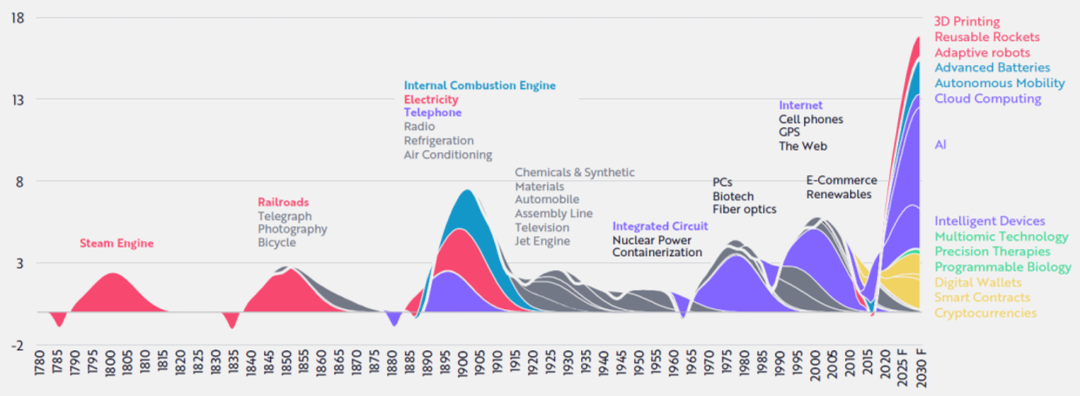
In a white paper ARK published in 2019, there was a chart showing how technological innovation had affected economic productivity over the past two centuries:
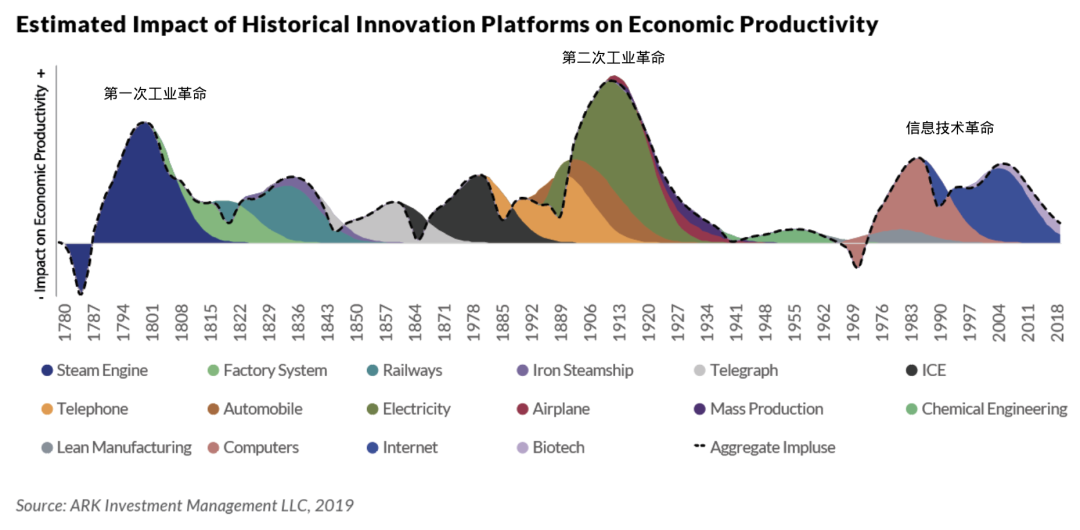
Imagine if you traveled from 1800 to 1970 — you'd find life utterly transformed, thanks to the Second Industrial Revolution's electrification and automobile adoption.
But if you traveled from 1970 to 2020, the daily lives of people in developed countries — food, clothing, housing, transportation, healthcare, education — hadn't changed nearly as dramatically as the leaps brought by the first two industrial revolutions.
The information technology wave spawned a new generation of tech giants, but its impact on economic productivity paled in comparison. After that wave receded, the downward slope of the Great Stagnation began.
As Peter Thiel once put it in that famous line mocking the entire Silicon Valley tech industry, featured on the Founders Fund website:
"We wanted flying cars, instead we got 140 characters."
In 2011, Tyler Cowen — economics professor at George Mason University and New York Times columnist — published a highly influential book at the time: The Great Stagnation.
It was a pessimistic book. Its core argument: for the next twenty years, our technology would remain in a state of stagnation.
1.2. The First Signal in 2020
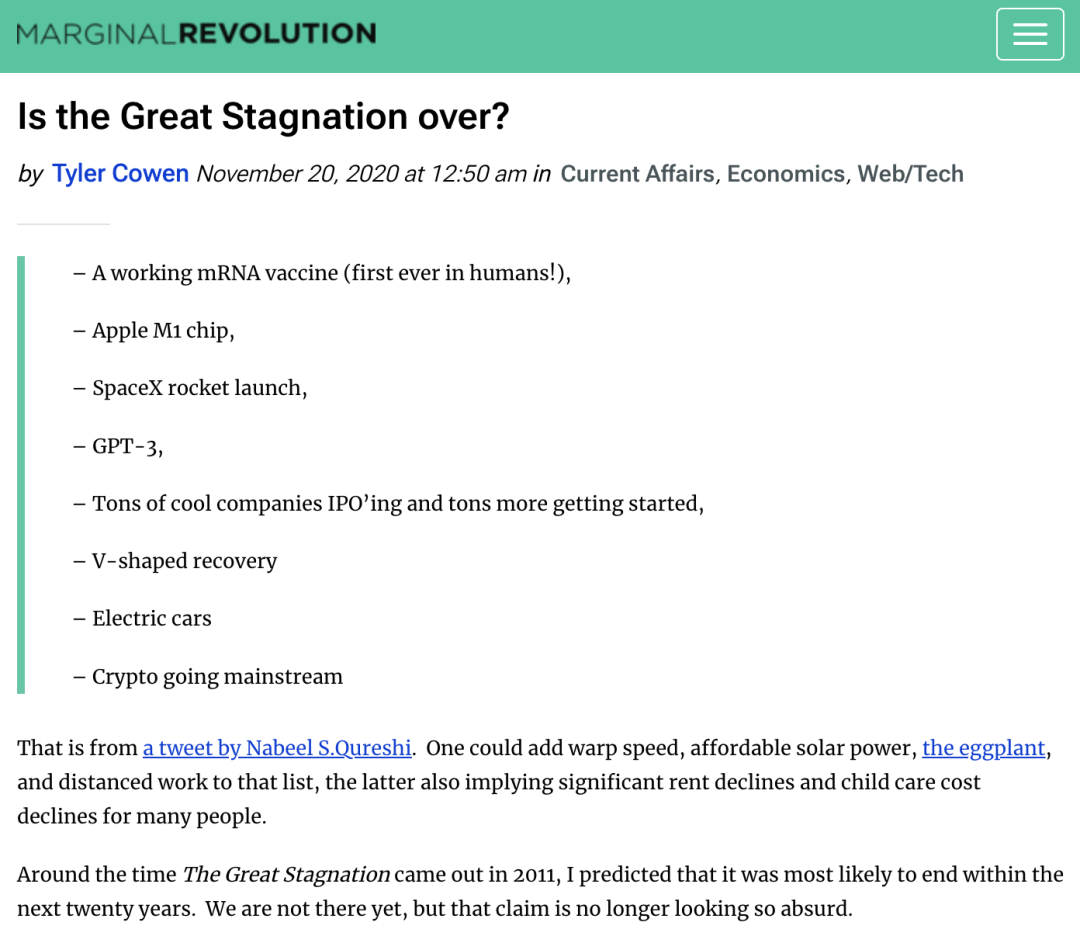
Yet in November 2020, the very author of The Great Stagnation declared that "the Great Stagnation may be ending early."
On his blog Marginal Revolution, he cited a tweet listing all kinds of exhilarating new advances: mRNA vaccines, SpaceX's reusable rockets, electric vehicles, digital currencies — and, of course, OpenAI's GPT-3, then still in its infancy.
1.3. The Second Signal in 2020
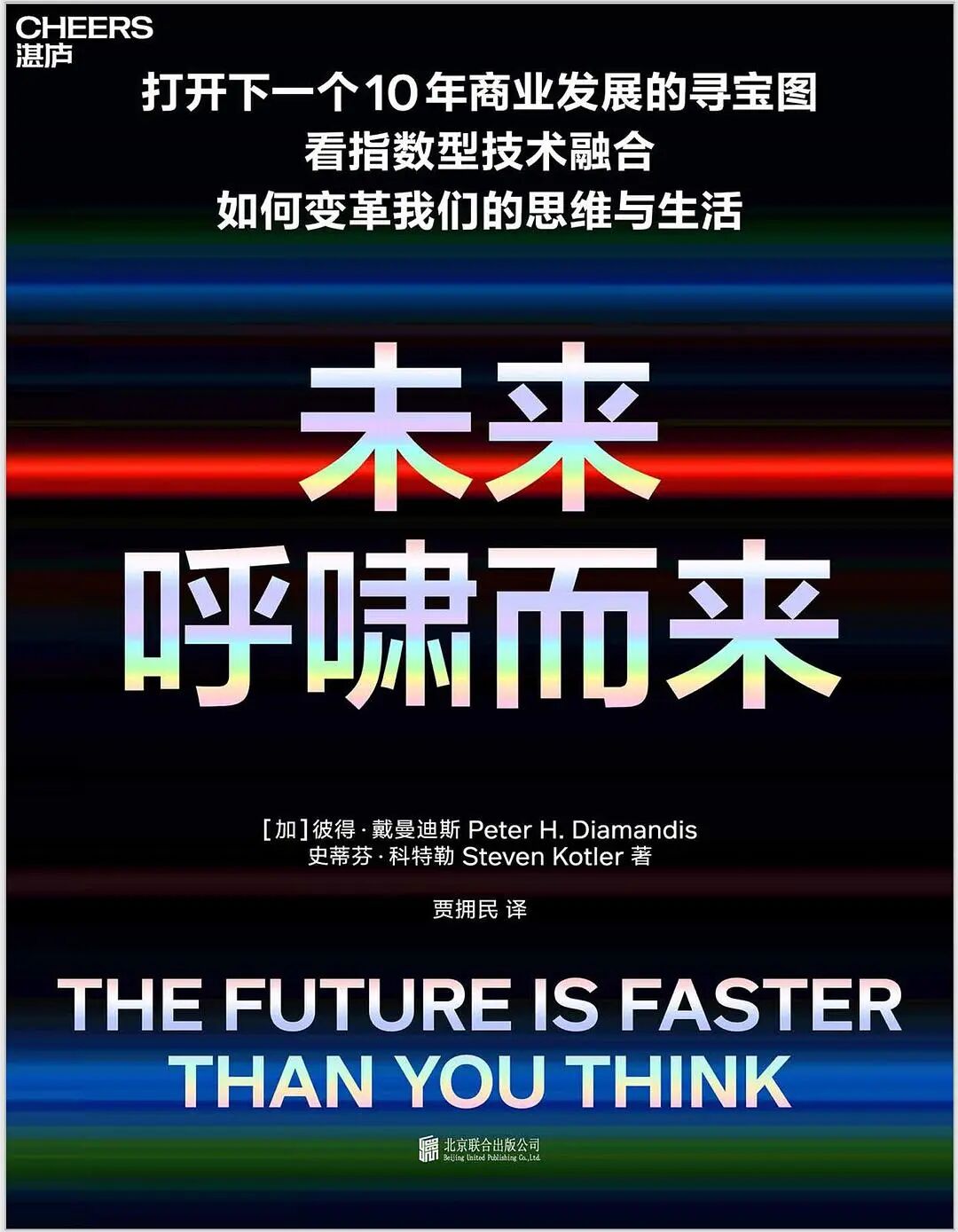
Another bestseller published in 2020 was The Future Is Faster Than You Think, by Peter H. Diamandis, executive chairman of Singularity University.
The book introduced nine exponential technologies riding the wave — quantum computing, artificial intelligence, networks, robotics, virtual and augmented reality, 3D printing, blockchain, materials science and nanotechnology, biotechnology — and insightfully argued that the convergence of these nine exponential technologies would unleash transformative power, completely reshaping our lifestyles and business models.
He made three main points:
- Past innovation stagnated because forces were still gathering; now the time had come — the decade starting from 2020;
- Technology convergence creates 1 + 1 > 2 power, capable of bringing massive change;
- Technological progress doesn't just affect its own domain, but entire lifestyles and business models.
1.4. "One AI Year Equals Ten Human Years"
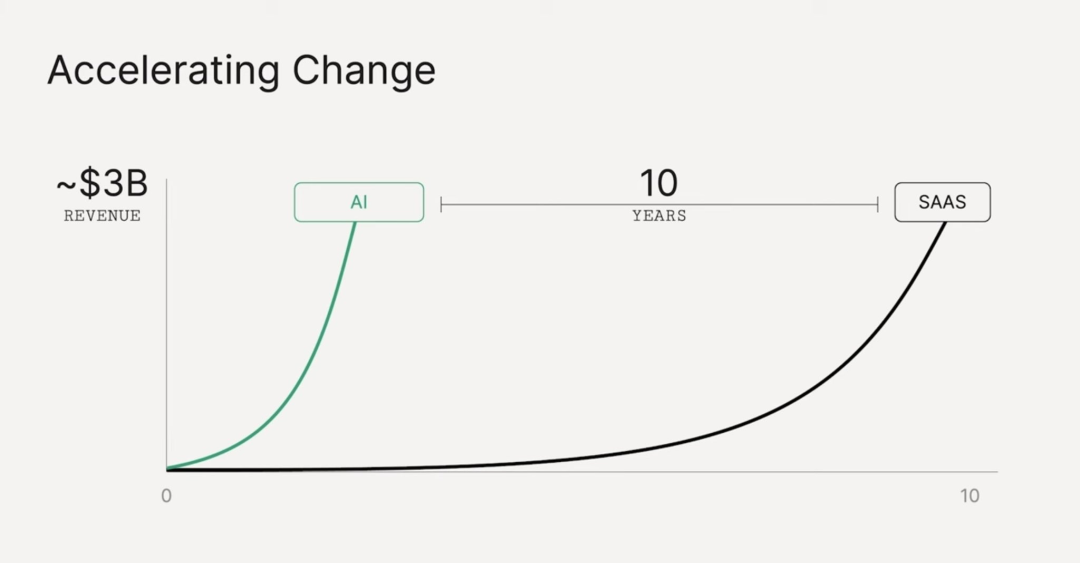
From 2020 to now, four years later, no one can deny that technology has shown us new potential for massive global change. Leading the charge, naturally, is the tidal wave of generative AI. As the joke goes, "One AI year equals ten human years."
Throughout Q1, almost every morning brought remarkable news. For instance, on the day I was writing this, the most notable headline was: Elon Musk announced that all Tesla owners in the United States could use its dramatically improved new autonomous driving version, FSD 12.3, free for one month.
At its recent AI Ascent 2024 event, HSG noted that generative AI's total revenue stands at roughly $3 billion — not counting all incremental revenue from the F.A.N.G. giants and cloud AI providers. Using $3 billion as a baseline: the SaaS market took nearly a decade to reach that revenue level; generative AI did it in one year.
❷
What's Happening in the United States in Q1?

2.1. Ark's Predictions for 2024
Optimism is the core keyword of Ark's Big Ideas 2024 report.
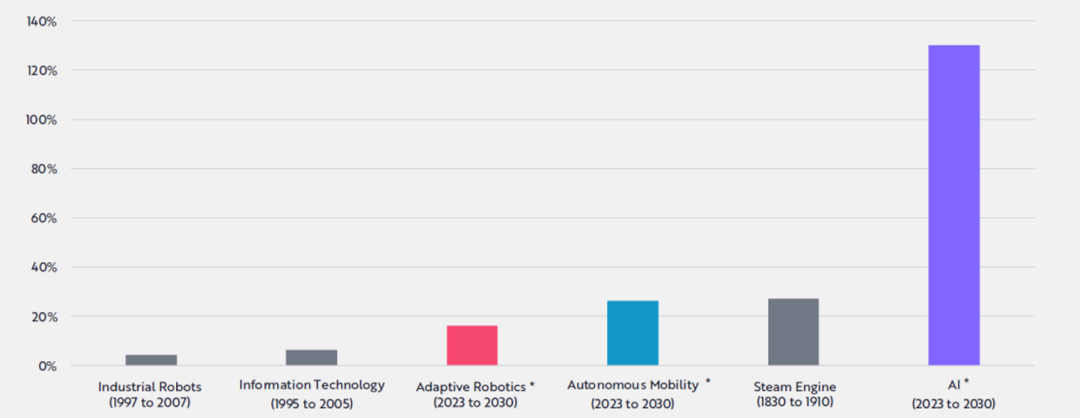
That optimism springs from the rapid advances of new technologies, with generative AI leading the pack, followed by adaptive robotics, autonomous driving, reusable rockets, next-generation batteries, 3D printing, and more.
Whether measured by their annual contribution to GDP growth and consumer surplus (Figure 1 below), or their overall contribution to GDP growth (Figure 2 below), the impact is striking.
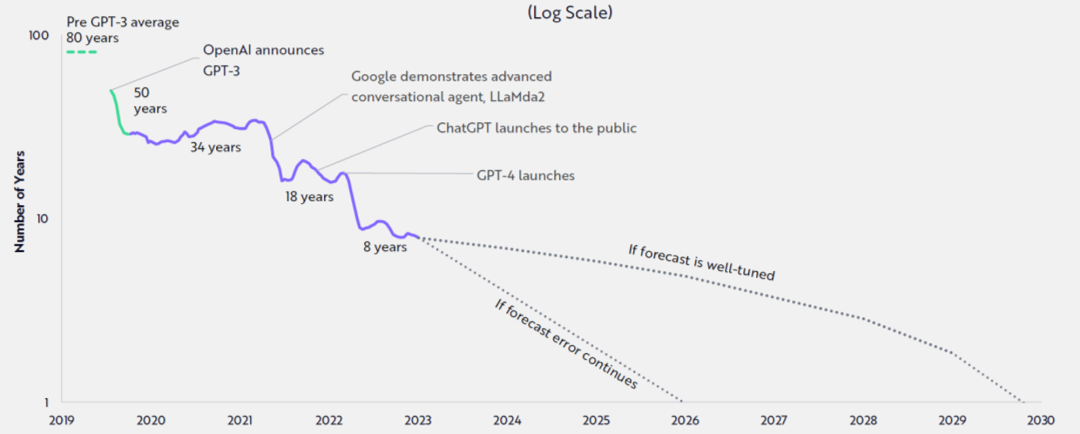
Predictions for when AGI will arrive are also accelerating. In the pre-GPT-3 era, conventional wisdom held it would take 80 years; now, in Ark's adjusted forecast, it's just 8 years away.
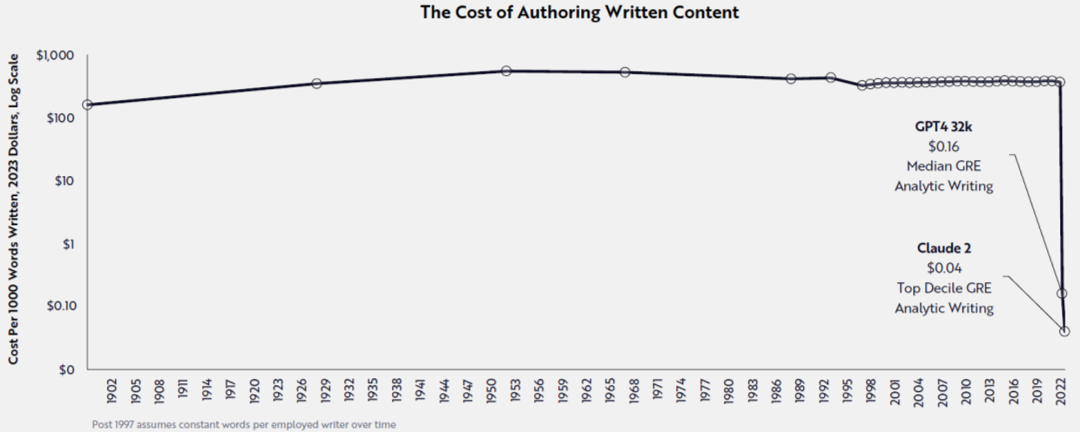
For the past century, the cost of producing written content remained relatively stable in real terms. Yet in the past two years, as LLM writing quality has improved, that cost has plummeted.
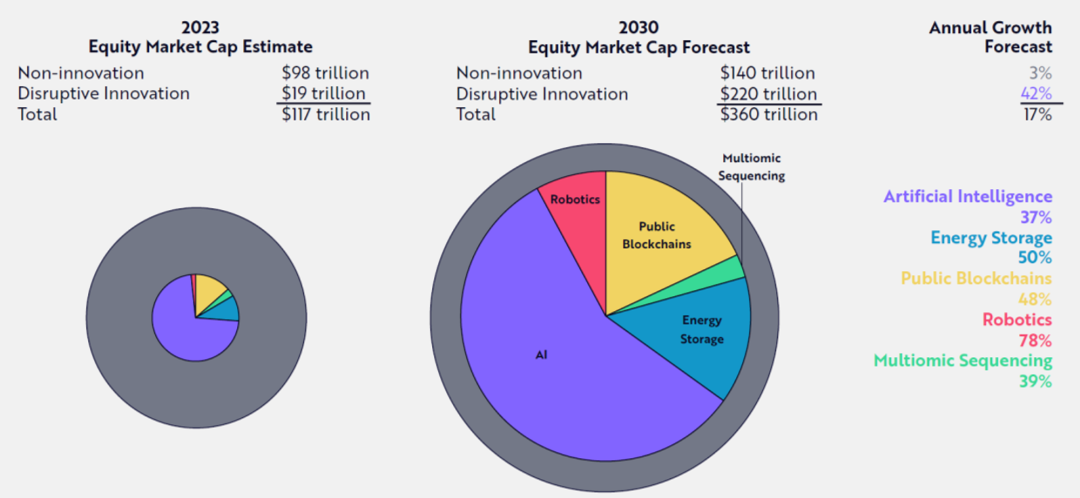
Technological innovation may be disruptive enough to dominate global equity market capitalization. Ark estimates 2023 stock market capitalization at $117 trillion, with breakthrough innovation accounting for $19 trillion and non-innovation for $98 trillion. By 2030, disruptive innovation market cap is projected to reach $220 trillion — far exceeding non-innovation's $140 trillion.
2.2. Sora, Suno, and Devin
Sora dropped on the third day of Chinese New Year, flooding Moments feeds with the same intensity as the fifth day's welcoming of the God of Wealth. It demonstrated the continued potential of Transformer models to brute-force miracles, generating jaw-dropping, stunning video.
Beyond Sora, LTX also caught my eye. If Sora showcased raw muscle, LTX demonstrated a complete user experience that lets ordinary people direct and produce full-fledged films.
Personally, I find the AI music generator Suno v3, released last week, even more distinctive than Sora. In the past, ordinary people could shoot video with smartphones, but they couldn't write an original song. Suno lets everyone write songs. This may not create timeless, soul-stirring art; it may not produce the next Jay Chou or the next Eason Chan. But it can at least bring more joy through music — like, say, "The Lianhua Qingwen Instruction Manual Song."
I wrote two articles about Sora and Suno, interviewing five top-tier professional video creators (leading Chinese directors, cinematographers, and designers) and two music industry behind-the-scenes heavyweights (CEOs of China's most formidable music labels):
Sora: After the Hype, Rationality Emerges | I Got These 5 Top Creators' Honest Thoughts
— Their views diverged considerably. But I think everyone would agree: the future is already here, it's just not evenly distributed.
Devin, the first AI software engineer widely recognized by the industry. When it hits a problem, it even runs to Slack to ask humans for help, then comes back to keep coding. A team of 10, zero revenue. Today's news: they're pursuing a $2 billion valuation in a new funding round.
The Sora team: 15 people. Suno: 12. Devin: 10. Thanks to advances in production tools and infrastructure improvements, a new generation of AI companies needs only tiny teams to build world-shaking products.
2.3. NVIDIA Continues to Pull Away
In just three short months of Q1, NVIDIA's stock rose 82%, driving the Nasdaq QQQ and S&P 500 SPY up roughly 10% each.
On March 19, NVIDIA unveiled the GB200 superchip at its GPU Technology Conference (GTC). Billed as the most powerful AI chip in history, it packs 208 billion transistors.
Pulling away.
2.4. SpaceX Starship's Third Launch
SpaceX's Starship is the most powerful rocket ever built. Its ultimate design goal is full reusability — controlled landing on the launch tower, and relaunch within hours of recovery. Starship can reduce the cost of space travel and carry humans to the Moon and Mars.
In March, Starship's third launch was one of the rare "failures" I've cheered for — a failure that counted as success.
This is SpaceX's philosophy of technological exploration: "Starship follows a rapid-iteration, fail-fast development philosophy — unafraid of exposing problems, quickly identifying technical gaps from each failure, and optimizing them into the next version." — Discovering and solving problems through real, high-stakes launch missions, improving reliability. Rather than spending time on prolonged, repetitive论证 and testing.
2.5. Tesla FSD 12.3's Leapfrog Development
Tesla's autonomous driving FSD new version v12.3 adopts a completely new end-to-end neural network architecture, significantly improving recognition and planning capabilities. Its driving is smoother and more natural, closer to the human driving experience.
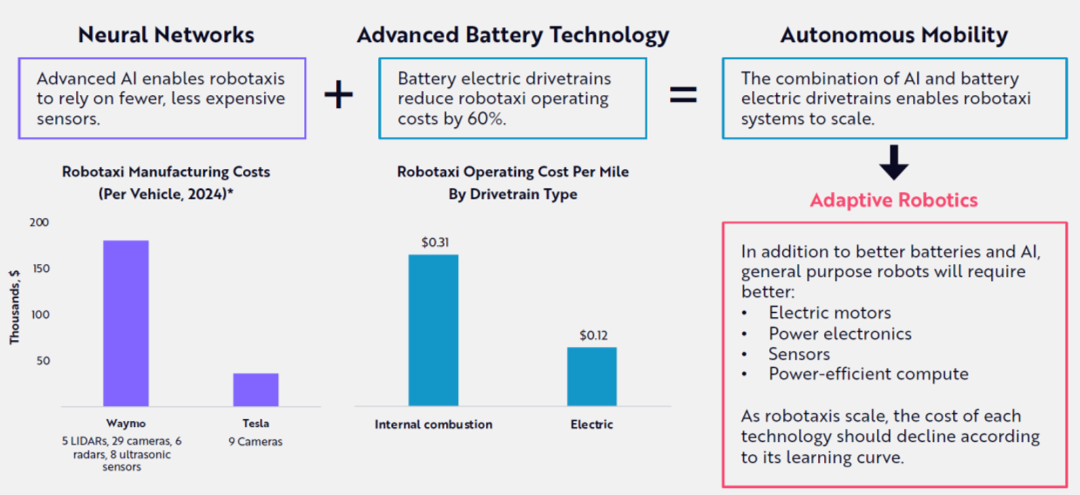
In autonomous driving systems, comparing Google's Waymo and Tesla's FSD: Waymo requires various radars and sensors, while FSD needs only 9 cameras — clearly lower cost.
In automotive power, electric is also far cheaper than traditional internal combustion. The convergence of neural network + battery technology advances is driving rapid autonomous driving progress.
2.6. Figure 01: A Harbinger of "Embodied Intelligence"
OpenAI-backed humanoid robotics company Figure AI demonstrated its new robot Figure 01 in a video.
In the video, Figure 01 engages in fluent dialogue with humans, understanding human intent and natural language instructions; it can perform basic household tasks like picking up and placing items, and explain its own actions.
Figure 01's technical approach also benefits from AI advances, based on end-to-end neural network control. Its demonstration is considered a major breakthrough in robotics, showcasing natural human-robot interaction capability — seen as a harbinger of "embodied intelligence."
2.7. Apple Vision Pro
This may be the new product that excited the most people.
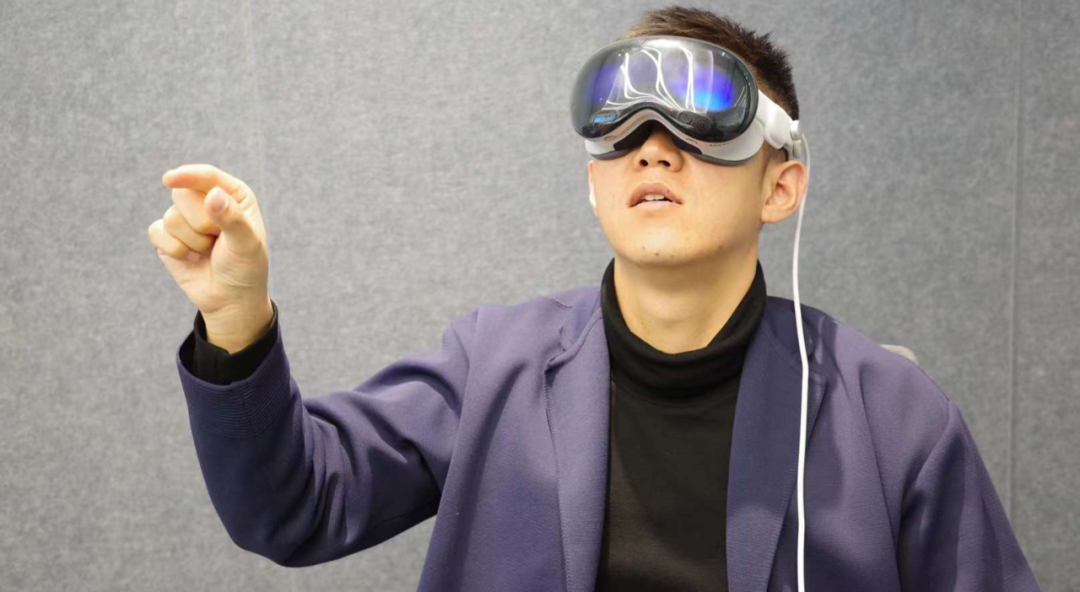
Funny to admit, I've been too embarrassed to share this. I might be one of the few Alicia Keys fans in China, so my first anticipation after the Apple Vision Pro launch was seeing Alicia's Immersive Video.
I put on the Vision Pro, and Alicia Keys flashed before me, slowly singing "No One" — "everything is gonna be alright." I felt an electric current run through my entire body — a singer I've loved since I was 14, singing the song I listened to at 14, standing half a meter away, confident and gentle, smiling at me, singing to me.
Performing arts: changed forever.
❸
What's Happening in China in Q1?
3.1. Allen Zhu vs. Zhilin Yang
Tencent Technology interviewed Allen Zhu and Zhilin Yang respectively in Q1 — two representative entrepreneurs and investors in the AI field. Both are bursting with energy, but their energies are completely different, forming a sharp contrast.
Zhilin Yang's "Zhi" (the "lin" in his name meaning "unicorn") — in China right now, it's the "lin" of "as rare as a phoenix feather or unicorn horn." Allen Zhu's view is mainstream, applicable to most entrepreneurs aspiring to AI.
In this article "China AI: Less Dreaming, More Money-Making", the author writes:
AI is both an extraordinary scientific competition and a brutal financial wrestling match. China's AI enterprise faces, first, a shortage of quality long-term capital like dollar funds. Second, NVIDIA's best GPUs — unavailable.
Actually, Zhilin Yang and Allen Zhu aren't opposites. You can build large models in China, but based on two truths. First, cloud computing vendors like Alibaba will throw money — after all, large models buy their compute, and investment can even be paid in compute credits. Cloud scale goes up, price wars can follow. Multiple birds, one stone, something for nothing. Second, large models as infrastructure — China definitely needs self-controllability. Regardless of quality, it must exist.
These opportunities belong to people like Zhilin Yang, a chosen one who has co-authored papers with Yann LeCun. For ordinary people doing AI, listen more to what Allen Zhu says: don't challenge lofty scientific research, must do applications, must find ways to make money fast, support yourself.
Facing the gap squarely can actually help you get your mindset right, actually help you find confidence. Be a good追赶者, focus on technology落地. Actually, looking globally, being able to追赶 and talk about AI落地 is already a very high bar.
To borrow a line from The Grandmaster: Today we're not comparing martial arts, we're comparing ideas.
3.2. Domestic Large Models Definitely Have a Shot
World bipolarization means China and the United States' large model enterprises will inevitably develop independently. Domestic large models had their own bustle in Q1.
Moonshot AI raised $1 billion at a $2.5 billion valuation. Its Kimi product, with its exceptional experience and convenient access points (smooth experience across mini-program, App, and PC), gained high social media traction. The A-share market even briefly saw a Kimi concept stock frenzy.
MiniMax is widely rumored to be closing a new funding round with Alibaba and HSG at a valuation exceeding $2.5 billion.
Zhipu AI, MiniMax, StepFun, and Baichuan each released new models in Q1.
Context length became a competitive battleground for large models. Shortly after Kimi announced support for 2 million-character context length, 360 announced 5 million characters, and Alibaba's Tongyi Qwen directly opened 10 million characters for free, claiming global first.
Open-source large models are also a competitive route many chose, such as Kai-Fu Lee's 01.AI Yi-9B, iFlytek's SparkDesk, and Alibaba's Tongyi Qwen Qwen-72B.
And new "veterans" are entering. Lightyears Away co-founder Jinhui Yuan announced another venture — founding new company SiliconFlow, raising 50 million in angel funding from Innovation Works, Huiwen Wang, and others.
3.3. Big Tech's C-End Products
The Copy to China model is back.
360高调 launched AI Browser and AI Search, benchmarking against Arc and Perplexity, pixel-level "borrowing." Though there are also micro-innovations Chinese players excel at: for instance, displaying search results in mind-map mode, conveying the emotional value of "wow, AI is amazing" — personally, I don't find this feature practically useful.
Big tech's AI Chatbot products are multiplying left and right, but who would have thought Kimi would steal all the limelight in Q1. I installed Doubao on my kids' iPad so they can chat with Elsa and Sun Wukong; but when it comes to work, I still habitually reach for Kimi.
Beyond AI-native products, big tech is also actively adding AI to existing products. Alibaba launched internal testing for conversational recommendation product "Taobao Wenwen" and product seeding marketing tool "Huiwa"; Baidu applied large models to its core advertising marketing scenarios; CapCut and Meitu certainly won't miss the opportunity, continuously adding AI features to their core video and image editing workflows.
3.4. Celebrities "Resurrecting" Daughters with AI
In Q1, using AI to resurrect loved ones repeatedly trended on hot search, becoming most people's first association when AI is mentioned.
Musician Bao Xiaobo "resurrected" his daughter with AI, and bravely shared the entire process. This is a story about "how technology will affect people's loves and hatreds in the future" that deserves to be seen, discussed, and understood.
I hope to see more such stories told. They may be surprising or even perplexing, but through the storytellers' narration, their underlying meaning will spark reflection on technology and liberal arts, and even inspire action.
3.5. Global Arbitrage
The temperature difference between domestic and overseas capital markets, plus the gap in willingness to pay, has spawned an extremely hot entrepreneurial direction: AI + going global.
Linear Capital founding partner Harry Wang proposed a "new recipe for success": global arbitrage — international team + overseas technology + China's supply chain (talent and production capacity) + international market.
Global arbitrage is a relatively positive framing, but it also reveals some helplessness. Many people go global not just because they have advantages overseas.
❹
The 6 Directions I'm Watching Most Closely
So, what opportunities does AI actually bring us? At its AI Ascent 2024 conference, HSG mentioned that LLM-based AI brings us three entirely new capabilities that can be woven into various applications.
First is creativity, the source of generative AI's name. AI can generate images, text, video, audio, and other content — capabilities previous software didn't have.
Second is reasoning capability, which can be single-step or multi-step agent-like reasoning — also something previous software couldn't do.
With creativity and reasoning, you effectively have both hemispheres of the brain. This means software now has human-like interactive capability for the first time. This is crucial because it implies profound business model transformation.
The 6 directions I'm watching most closely:
- How does AI落地 in consumer goods and marketing? This directly relates to Tangdao and The Fair's business.
- Character.ai spawned the "Hundred C Battle," but I'm not particularly interested in AI flirty chat or AI anime character roleplay. I'm more focused on how products like Pi and Forest Healing Institute will use AI well to provide emotional value, even psychological healing for people?
- Because I've already been captured as a heavy user by browser (Arc) and search (Perplexity), I trust my feelings and experience as an early adopter. I'm also wildly excited about the potential for Chrome and Google to be disrupted, so I'm closely watching developments in these two areas.
- How can enterprises use AI to improve efficiency and build their own internal AI applications? Though middleware companies like Dify and Langchain already exist, given the complexity and long-tail nature of enterprise services, opportunities abound — the competition progress bar may have only reached 0.1%.
- What new content idols will the rapid advances in creative tools represented by Sora, Suno, and LTX bring us?
- How does AI落地 in law (Harvey, EvenUp, DraftWise), healthcare (Hippocratic), finance (Reportify), and education (Khanmigo, Speak)? These are knowledge-intensive industries, also extremely text-creation-dependent industries, that will be first and foremost transformed by AI.
👦🏻 Koji: If you're also interested in the above topics, feel free to add me on WeChat: YuanchengYang
Closing: Miracles of the Future
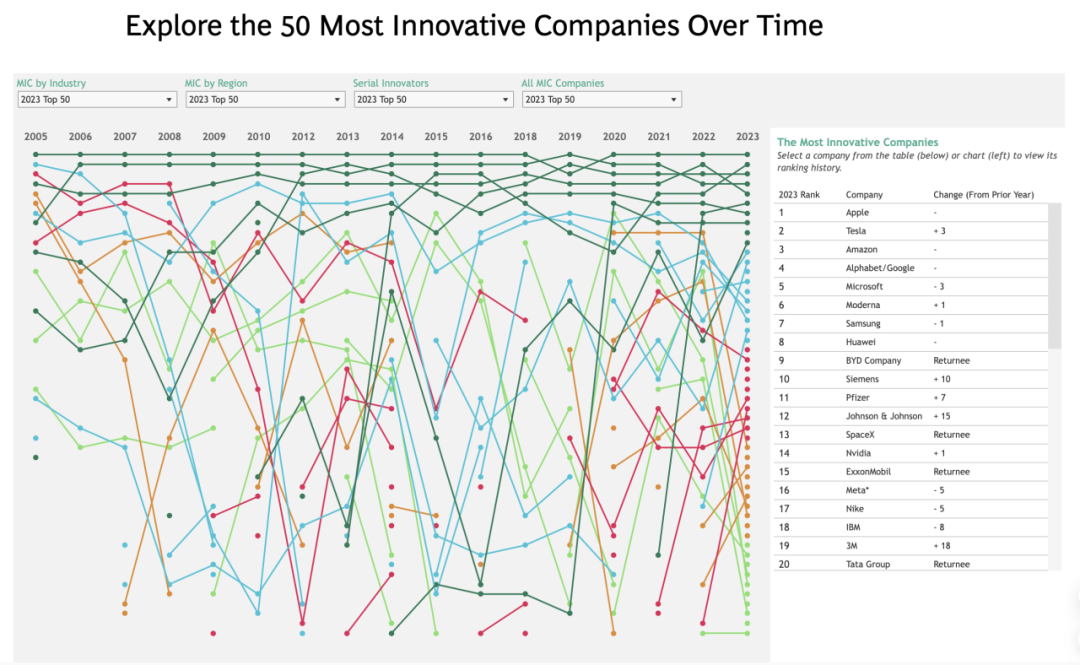
Boston Consulting Group BCG releases its Top 50 Most Innovative Companies list every year, for over two decades now. This year, they made the historical list changes into an interactive chart.
Day by day, we easily grow numb and assume the world is stagnating, that there's nothing new under the sun. Not so. Look at this chart — the world has clearly been full of transformation, ambition, and opportunity all along. Even the most innovative companies are in dramatic flux. The green mountains remain, the blue waters flow — change never takes a holiday.
Last week, an editor at Citic Press Corporation asked me to write a blurb for Same as Ever, the new book by the author of The Psychology of Money. I thus got to read an advance copy. There's a chapter "Miracles of the Future" with a small story about Edison that makes a perfect ending for this article:
116 years ago, in 1908, the Washington Post interviewed Edison: "Is the age of invention passing?"
Edison was baffled: "Passing? How could it be passing? The age of invention hasn't even begun. Now, do you have any other questions?"
🥳
Add assistant on WeChat: Rwkfbcianvd
Join the "Crossing" WeChat group
Unlike any other WeChat group, we do two things:
🏃🏻♀️ Daily AI news briefs — master information, master advantage 🏃🏻♀️
👩🏻❤️👨🏻 The group encourages dating, finding partners, finding future fellow travelers 👩🏻❤️👨🏻