"With AI, I Want to Make Investing as Easy as Scrolling Douyin" | A Conversation with Vakee, Founder of RockFlow

Can AI + Finance Actually Change Anything?

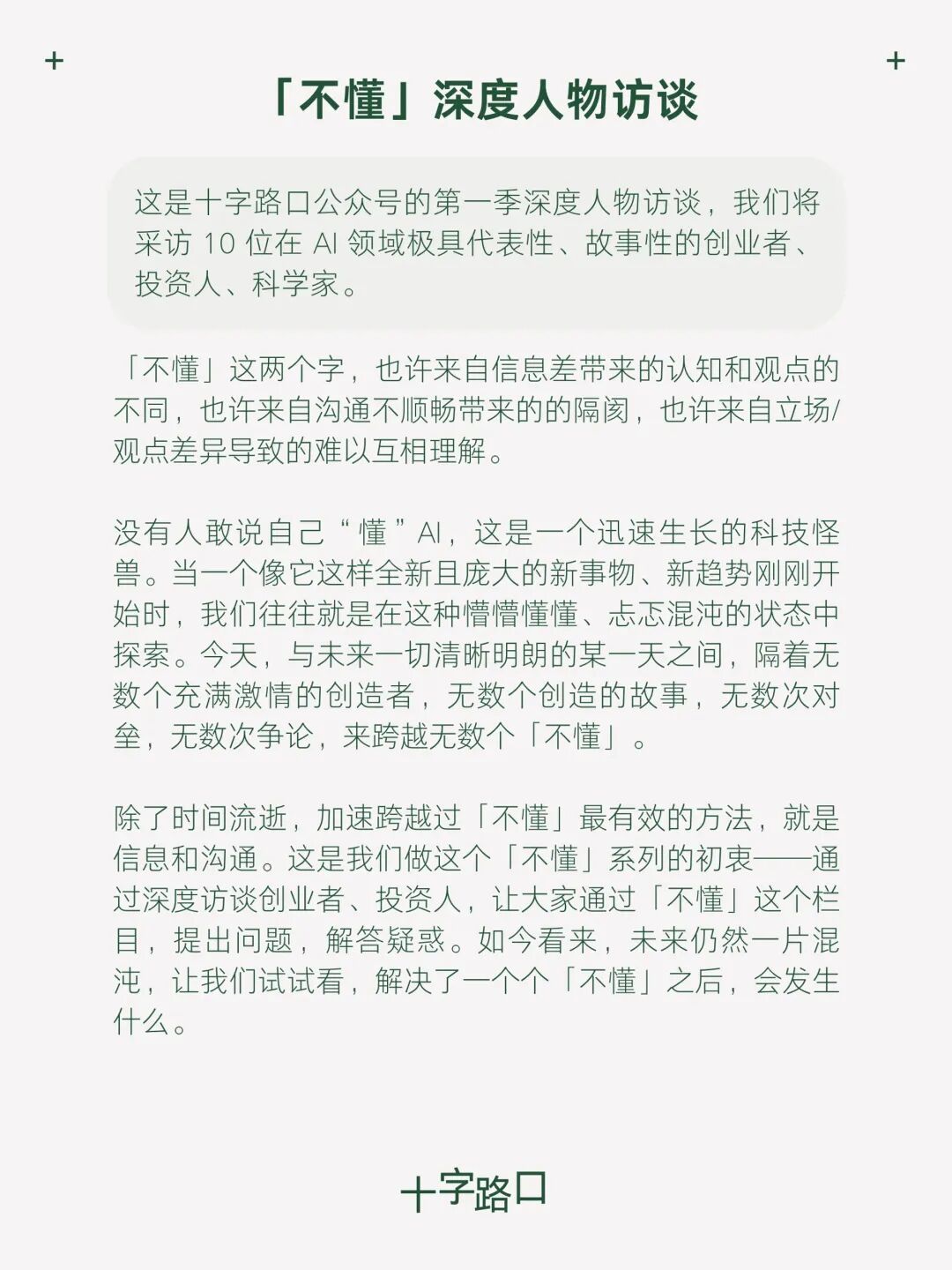
🚦 When the Crossing podcast hit 10,000 subscribers, we teased the "Don't Get It" interview series — we'll interview 10 founders, investors, and scientists with compelling stories in AI. Through these conversations, we hope to bridge information gaps, build connections, and encourage debate.
For the second installment of "Don't Get It," we invited Vakee Lai[1], founder and CEO of RockFlow, an AI-powered fintech company headquartered in Singapore. As a next-generation AI investment platform, RockFlow aims to use artificial intelligence to simplify trading and investing, offering global young investors one-stop access to cross-market, multi-asset services.
In 2021, RockFlow raised a $10 million angel round led by BlueRun Ventures. Before founding RockFlow, Vakee worked at Hongtai Capital and Baidu, among others.
She was also a guest on the late-July Crossing episode "Are My Investor Friends Really Dumping All Their NVIDIA Stock?"[2]
What has generative AI brought to finance?
With this sweeping question in mind, we spoke twice with Vakee — someone with deep experience on both the investment institution and secondary market sides, who founded AI-native investment platform RockFlow before large language models became mainstream.
It turns out this isn't a question that one or two "10,000-word deep dives" can answer (probably not even one or two books). So we kept narrowing the scope during our conversations, hoping to glimpse the relationship between finance and AI through RockFlow's growth story and Vakee's career trajectory.
From the broad — where exactly does generative AI create opportunities in finance? — to the specific — how do you build an investment platform designed for Gen Z? — this is our attempt to deliver some informational value. As always, we welcome your thoughts.
I. What Is RockFlow?
🚥 Crossing: What is RockFlow? Why did you start this company?
👩🏻 Vakee: RockFlow is an AI-native investment platform. We help users open accounts in as little as one minute, fund them in one minute, and buy $1 of Tesla stock in one minute — the operation is extremely simple. If you don't know what to buy, no problem. We have real-time personalized AI trading opportunities — Trading GPT — that let you swipe through tailored trade ideas like you're browsing Pinduoduo. You can also copy-trade top investors whose style suits you best worldwide. Plus, we offer the world's simplest options products — "Bull Cub" and "Bear Cub" — alongside our "Haomai" wealth management, so you can easily experience your first US stock options trade!
I started out doing AI quant in London, joined Baidu's Phoenix Nest in 2013 after returning to China, spent five years as a VC investing in early-stage AI companies from 2015, then went back to the secondary market in 2020 doing AI fundamental quant for US stocks and options. My entire decade before founding a company was AI and investing. When I started up in 2021, I wanted to build a global AI fintech company combining my two favorite and strongest areas. During the pandemic, the Robinhood retail-trader phenomenon showed me that young people everywhere wanted an incredibly simple, user-friendly investing app. There was strong user demand and a massive market. I found it deeply meaningful, I was passionate about it, and I was good at it. I hoped to create a brand as cool as Apple in the global fintech space.
🚥 Crossing: I heard the decision to start in this direction was also a very rational deduction?
👩🏻 Vakee: Yes, four points. First, it had to be big enough. Finance is actually much larger than the internet. You can count the $100-billion-plus internet companies on one hand. But there are many $100-billion-plus financial institutions. It's a huge industry. Starting a company is hard no matter what — even opening a Shaxian Snack shop is hard — so you might as well go big.
Second, I wanted to build an AI company. As I mentioned, I'd spent about ten years before founding working on AI products and AI investments. I firmly believe AI will bring massive change to many industries. When I was doing VC, I shared a view that the three best industries for AI are advertising, finance, and gaming. In the last machine-learning wave, almost all the AI talent at major internet companies was supporting ad platforms. But that's not a startup opportunity — Baidu and ByteDance built ad platforms because they had traffic first. Gaming is a great industry but has content DNA. My team, myself included, didn't have content capabilities, so it was good but not for us. Finance is a pure data business — cash itself is data. What these three domains share is being purely online, no offline component. So not just AI, but all algorithmic iteration, all efficiency gains from information technology, show up dramatically.
The third and fourth points are more personal. Third, I'm genuinely passionate about this. I've been interested in investing since I was nine, started trading stocks then. My entire career has been in investing and trading — it's the only thing I want to do and can see myself doing until retirement. Fourth, I can actually do this. On one hand, it's very difficult. We say RockFlow is first and foremost a financial institution, not just an internet company. Finance requires understanding compliance, internet products, and AI. And doing US stock investing is a global business requiring an internationally capable team — the bar is very high. On the other hand, if I had chosen something else, I probably would've died a thousand deaths already. When I was considering entrepreneurship, I looked at other directions too — cross-border e-commerce, for example. Anything requiring lots of team coordination across many people, I'm completely terrible at.
🚥 Crossing: What are the main problems with existing similar products? What specific solutions does RockFlow offer, and what's unique about them?
👩🏻 Vakee: Existing mobile brokerage products are actually quite good — they fit the target user needs from when they were founded, mainly post-70s and post-80s generations. RockFlow is a very young team designing for post-90s and post-00s users. The new generation has its own demands: the design has to be especially cool, the trading experience especially simple, with gamified and social experiences. They especially love trading options, love sharing.
Moreover, I believe innovation in this space, beyond internet experience innovation, requires financial mathematics innovation to transform complex financial products that Wall Street doesn't want ordinary people accessing into features everyone can understand and use. That's real financial democratization. Unlike the team backgrounds at the previous generation of mobile brokerage companies, our core team's background is primarily in AI, financial mathematics, and investing.
🚥 Crossing: RockFlow describes itself as an AI-native investment platform. Please introduce how AI is applied at RockFlow.
👩🏻 Vakee: Yes, RockFlow is an AI-native application — that was my original intention in founding it. Having invested in over 20 AI companies, this time I wanted to build one myself, and fintech is one of the best scenarios for AI. RockFlow's next-generation AI-native products will build experiences across information acquisition, analysis, trading strategy construction, and order execution — the four key steps in investing. Through AI capabilities, we'll deliver personalized user experiences and make everyone's investing more efficient.
🚥 Crossing: What do you think an AI-native product organization should look like? What changes do you think AI usage will bring to future enterprise organization?
👩🏻 Vakee: In the large model era, the R&D workflow for AI products has changed. Many things may no longer need engineers — product managers can rapidly iterate and close the loop themselves. RockFlow only hires "AI masters." From early 2023, we began integrating various large models and AI tools into our workflow. Every day, regardless of role, everyone is deeply using AI to improve work efficiency, enabling organizational efficiency to reach its extreme. One of our talent principles is: fewest people, best people. You have to be an AI-native organization to possibly build AI-native products.
II. Market and Users
🚥 Crossing: What aspects of RockFlow's product are you most satisfied with today? What's your product philosophy?
👩🏻 Vakee: This is RockFlow's first-generation product. The goal is simple — and the future goal is also simple and efficient. AI serves simplicity and efficiency. We've done well on simplicity. As a product manager, I believe products are designed for needs, not for demographic segments. Like Pinduoduo — both wealthy people and ordinary people use it because "same product, cheapest price" is a universal need. "I'm rich but I'm not a sucker." Back then, Pinduoduo won over tier-one city users with massive subsidies. Many people's first purchase on Pinduoduo was Apple products. This proved that products are designed for "certain shared needs across different groups."
🚥 Crossing: What's RockFlow users' favorite feature, and how did you think about and design these features?
👩🏻 Vakee: Bull Cub and Bear Cub. Compared to stock trading, young people globally now prefer trading options. The maximum loss on buying options is what you paid for them — say $100 — while the upside can be dozens or hundreds of times in a day. Among available products meeting this young investor demand, US stock options are fair, transparent, and regulated. We've designed our options products to be extremely simple and easy to understand, paired with AI trading opportunities and copy-trading. Whoever you are, whatever your age, you can come to RockFlow every week to easily buy a Bull Cub or Bear Cub, casting your vote for trade opportunities you believe in.
🚥 Crossing: RockFlow's users span over 30 countries and regions, with offices in five countries and regions. The company went international from day one. What's the biggest challenge in product internationalization, and what has RockFlow done right?
👩🏻 Vakee: We're headquartered in Singapore. The product launched globally from day one. Our team members have experience living and working in various countries, and their English is excellent. I believe the first priority for international products is making them extremely simple and easy to use — like TikTok, Temu, WhatsApp. Then you need an international team. I believe Chinese entrepreneurs of my generation must have the capability to build global businesses. Think of our parents' generation — they went overseas to do business without knowing a word of foreign language. Now the new generation of entrepreneurs has received the best education and work experience domestically and abroad, can understand and respect different cultures, has experience and perspective from China's massive market, plus strong team execution. Building international businesses, we definitely have major advantages.
🚥 Crossing: One of RockFlow's visions is "making investing part of everyone's life." What traditional investing habits do you see changing significantly among younger generations?
👩🏻 Vakee: Younger generations use investing to express their lifestyle and values. For example, when they invest in NVIDIA, they tell their friends "I believe in AI so I invest in NVIDIA." They like Elon Musk, so they buy Tesla stock. They work in luxury goods, think Hermès is very solid, like it, so they dollar-cost average into Hermès stock. The new generation's investing has a consumption attribute.
III. Finance v.s. LLM
🚥 Crossing: Since large language models emerged, what's the most direct or most significant change they've brought to finance?
👩🏻 Vakee: Before large models, AI was already widely used in finance — credit risk control and credit scoring, for instance. Why loan customer A 20,000 and customer B 50,000? Insurance actuarial work and damage assessment — personalized modeling in these scenarios all used AI.
I view this large model wave as an AI technology democratization movement. The barrier to using AI has been greatly lowered, making AI product engineering much simpler and dramatically reducing costs. I started my AI fintech company before GPT-3.5 was released. Without large models, I'd have needed to hire multiple NLP algorithm engineers to achieve the same product functions. Now that's unnecessary. I often tell friends that in this large model startup wave, compared to "hackathons," what's more needed might be "productathons" — the market is severely lacking product managers who understand both AI and industry needs. This may be what's special about my background and RockFlow's team background. Users don't care what technology you use; ultimately you still have to build good products.
Generative AI makes it possible to provide personalized, high-quality financial services at extremely low cost. In the past, personalized financial services was an extremely high-barrier industry. Today these high-quality financial services that required graduates from top-tier universities can now have their barriers dramatically lowered through generative AI.
🚥 Crossing: Do you see anyone acting on this now?
👩🏻 Vakee: I think this is very difficult — it comes down to the thing itself. People who understand finance don't necessarily understand AI; people who understand AI don't necessarily understand finance. Both are high-barrier industries. Mastering one can yield high returns, so the willingness to deeply master both simultaneously isn't high, and the ROI on learning isn't high either.
🚥 Crossing: Where exactly is the "don't get it"? In using AI, especially generative AI, what industry-specific characteristics does finance have that entrepreneurs must confront?
👩🏻 Vakee: The biggest characteristic of finance is its compliance requirements, meaning entrepreneurs need more composite backgrounds. It's not just internet company entrepreneurship — the company is first a regulated financial institution. You need to find the balance between product innovation and compliance. From founding to now, three years without pivoting, one important reason is that the DNA of financial business is stability. Slow is fast — do product innovation well, wait for the cycle, and when a wave comes you can ride it. Compared to internet's DNA of "move fast and break things," when big companies incubate financial businesses, over time it's hard to persist. Compared to other internet businesses showing results in three months, financial businesses might still be waiting for licenses after three years. Doing AI fintech, entrepreneurs need to know where the boundary between innovation and compliance lies — so it's very difficult.
🚥 Crossing: What role do you think AI will play in future fintech? What are RockFlow's plans in this regard?
👩🏻 Vakee: AI will enable personalized financial services to permeate every aspect of everyone's life imperceptibly. We'll start from the investment and wealth management scenario, building on AI-native product experiences to make investing part of everyone's life.
🚥 Crossing: There's a view that "in secondary market investing, AI just summarizes market news and information to give investment advice — by the time AI summarizes it for users, the market has already priced it in." How do you evaluate this view?
👩🏻 Vakee: There are two dimensions of cognitive difference here. AI summarizing information is a very traditional use case. Have you considered that ultimately AI might not need to interact with you through a process at all? Your personalized AI knows you, knows what you're interested in, what trading strategy you'd make based on this information, and the AI will real-time backtest and calculate the potential win rate and payoff of trading strategies corresponding to this information, iterating algorithms to help you make optimal trading decisions based on your preferences.
Overall, AI iterates 24/7; humans don't. From an application perspective, as long as it performs better than most people in most scenarios, the product has value. Autonomous driving may never beat the most skilled veteran driver, but compared to my own driving skills, I'd definitely choose autonomous driving.
IV. Entrepreneurship and Life
🚥 Crossing: How has entrepreneurship changed you?
👩🏻 Vakee: Weight and personality, I guess. Lost 20 pounds. Went from an emotionally stable young person to a middle-aged person who sometimes loses it.
🚥 Crossing: Has anything particularly interesting or memorable happened during your entrepreneurial journey?
👩🏻 Vakee: On a business trip to Dubai, I happened to see an Indian guy at a coffee shop with the RockFlow app on his phone. It turned out he was an early seed user from 2022. He said a former colleague recommended it, and he's still using it. Felt very magical.
🚥 Crossing: What advice do you have for young people who want to start companies?
👩🏻 Vakee: Starting out, have a "70-point spirit." Clarify the need, ensure the market is big enough, be passionate about it. Don't hesitate — start immediately. Prepare for the worst, try your hardest. First become a serial entrepreneur, then become a serial successful entrepreneur.
V. "Don't Get It" Three Questions
🚥 Crossing: What is something that right now everyone doesn't understand or get?
👩🏻 Vakee: Everyone's investment method is an expression of their personality and worldview. So it's very hard for someone to copy another person's entire investment method wholesale, unless your backgrounds and worldviews are very aligned. So everyone should start by trying investing and trading, find the most comfortable method through experience — value investing, short-term trading, quant, whatever — what suits you is best. Then what you need to do is optimize every execution detail of this suitable method.
🚥 Crossing: What is something you've figured out that the rest of the world hasn't yet?
👩🏻 Vakee: I don't know if others have figured this out or not. AI can't solve 0-to-1 problems. If you can't ask questions, can't think, AI can't save you. AI will only turn a 5x capability gap between two people into a 500x gap. It's brutal.
🚥 Crossing: What don't you get — specifically, what's the most recent thing that gave you a "I don't get it" feeling? Who do you think gets it, and what would you want to ask them?
👩🏻 Vakee: Large model development will make the strong stronger, with power and resources more concentrated. Is this the outcome everyone wants to see? I'd want to ask Maitreya Buddha: what will the future world be like, and what is happiness.


References
[1] RockFlow: https://rockflow.net/
[2] "Are My Investor Friends Really Dumping All Their NVIDIA Stock?": https://www.xiaoyuzhoufm.com/episode/66a5b30733ddcbb53c8c7594