AI Staying the Scalpel: Would You Let a Robot Operate on You?

The Scalpel Has Been Handed to AI: Are You Ready?


🚀 Google Releases Small Model Gemma 2 2B
🔍 arXiv Discussion Platform AlphaXiv Launches
🤖 AI Da Vinci Robot Autonomously Completes Surgical Tasks
🤔 Jia Yangqing: Large Models Are Retracing CNN's Path
🎬 China-Developed Video Model Vidu Goes Global
🔍 Sun Yat-sen University and Meituan Break Through Open-Vocabulary Object Detection
💰 AI Sales Assistant Sybill Raises $11 Million
💰 Vanta Secures $150 Million Series C
🚫 Elon Musk Denies xAI Acquisition of Character.AI Rumors

Google Releases Small Model Gemma 2 2B
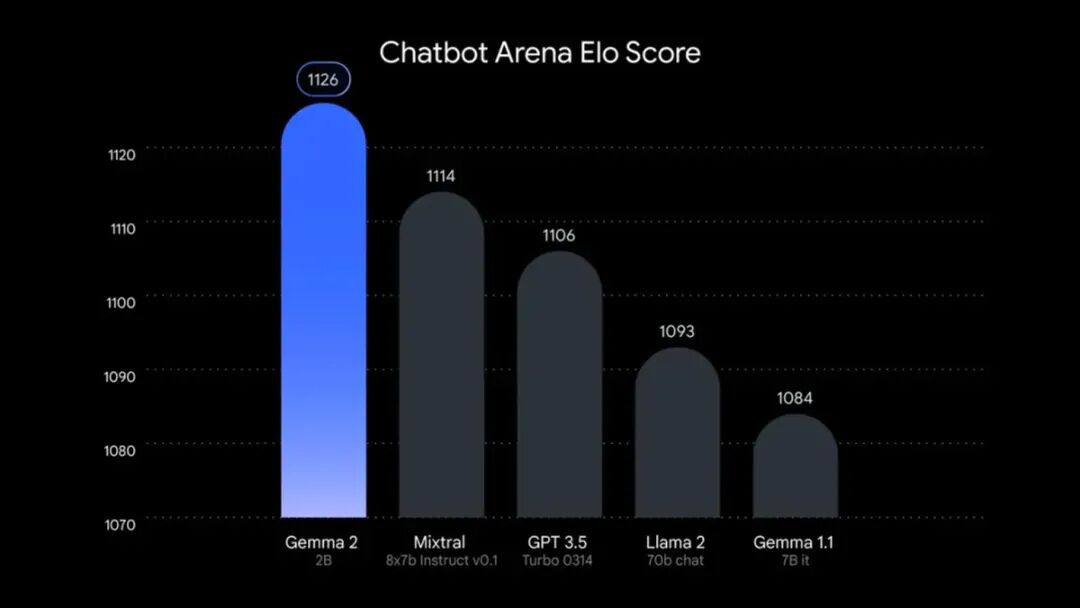
Google DeepMind has launched Gemma 2 2B[1], a lightweight model distilled from Gemma 2 27B. Despite having only 2.6 billion parameters, Gemma 2 2B has already surpassed GPT-3.5 and Mixtral 8x7B on the LMSYS arena, scoring 56.1 on MMLU and 36.6 on MBPP — more than 10% improvement over its predecessor.
Gemma 2 2B can be deployed across all kinds of edge devices, including phones, laptops, and cloud platforms. Optimized through NVIDIA TensorRT-LLM, it supports multiple platforms and frameworks such as Keras, JAX, and Hugging Face. Developers can download model weights from Kaggle, Hugging Face, and Vertex AI Model Garden, or try it out in Google AI Studio. Google also released ShieldGemma, a safety content classifier, and Gemma Scope, an interpretability tool, further expanding the Gemma 2 family.
arXiv Discussion Platform AlphaXiv Launches
AlphaXiv[2], an open discussion platform for papers developed by Stanford University computer science students, has officially launched — causing a stir in academic circles. The platform allows users to ask questions and discuss any paper on arXiv by simply replacing "arXiv" with "AlphaXiv" in the URL, or by using a browser plugin.
AlphaXiv offers multiple comment types, including general questions, research insights, links to related resources, and private notes. Users can apply to become reviewers in specific fields, moderate discussions, and vote on featured papers. To encourage engagement, the platform also runs a "Paper of the Week" program requiring selected paper authors to respond to all comments within one week.
The project was created by Rehaan Ahmad and Raj Palleti, two students from Andrew Ng's lab, originally as a final project for a web development course. It has received support from multiple industry heavyweights including Sebastian Thrun.

AI Da Vinci Robot Autonomously Completes Surgery
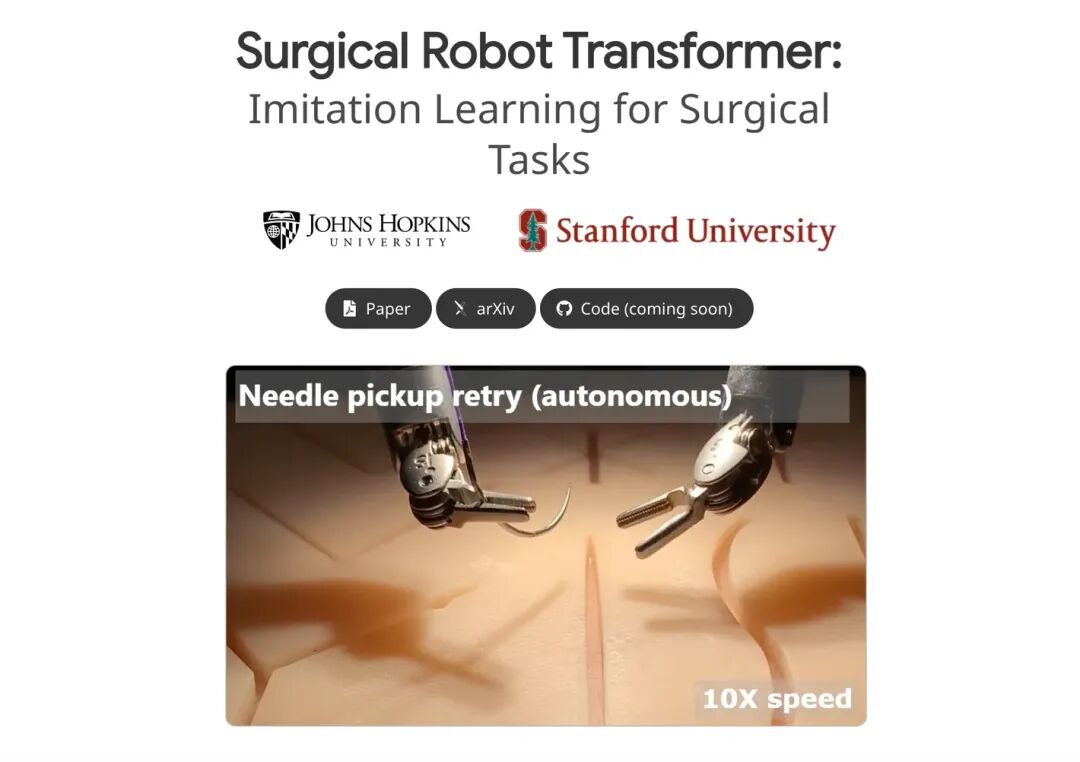
A research team from Stanford University and Johns Hopkins University has successfully taught a Da Vinci surgical robot basic surgical skills through imitation learning. The robot can autonomously perform tissue manipulation, needle handling, and suturing tasks without human intervention.
The researchers overcame challenges unique to the Da Vinci system by introducing a relative action formulation to train policies. Experiments showed that this method not only effectively learns complex surgical tasks but also generalizes to new scenarios. The robot demonstrated zero-shot generalization capabilities, operating on unknown animal tissue and handling environmental perturbations.
The team also conducted repeatability tests, proving the AI Da Vinci's operational stability across different viewpoints. They trained policies using endoscopic and wrist camera images as input rather than relying on unstable kinematic data. This approach significantly improved success rates for surgical tasks, laying groundwork for future clinical applications.
Jia Yangqing: Large Models Are Retracing CNN's Path
Jia Yangqing has observed that large model size evolution is retracing the development path of CNNs. In a tweet[3] on X, he noted that the industry is shifting from pursuing ever-larger scale toward smaller, more efficient models. This trend mirrors the ImageNet era for CNNs, which saw rapid parameter growth followed by a turn toward more compact, efficient designs.
Karpathy and Elon Musk hold similar views. Karpathy believes models need to get bigger before they can get smaller, in order to restructure training data. He predicts future models will be small in parameter count yet excellent in performance. Jia Yangqing noted that 7B-70B parameter models are easier to host and monetize while still delivering decent output quality.
However, dissenting voices exist. Some point out that top AI companies are still developing larger models. In response, Jia Yangqing clarified that his view isn't about halting large model training, but rather that the industry is beginning to focus on more cost-effective models. This trend may challenge the "bigger is better" assumption and redefine what constitutes AI "intelligence."

China-Developed Video Model Vidu Goes Global
Vidu[4], a general-purpose video foundation model jointly developed by Tsinghua University and Shengshu Technology, has officially launched globally. Vidu supports text-to-video and image-to-video generation, producing 4-second or 8-second HD videos at up to 1080P resolution. The model features "long duration, high consistency, and high dynamism," capable of simulating the real physical world and generating complex scenes that obey physical laws.
Vidu supports various cinematic styles and special effects, enabling different shot transitions and complex dynamic camera movements. Beyond core functionality, Vidu has introduced new "anime style" and "character consistency" features, expanding creative freedom for users. Anyone can experience Vidu's capabilities with just an email registration.
Vidu's core technical architecture stems from the research team's long-term accumulation in machine learning and multimodal foundation models. The model can generate videos up to 32 seconds in a single pass, demonstrating exceptional dynamism in generating complex moving shots and precise actions.
Sun Yat-sen University and Meituan Break Through Open-Vocabulary Object Detection
Sun Yat-sen University and Meituan have jointly launched OV-DINO[5], a next-generation open-vocabulary object detection model that substantially outperforms existing technologies. This breakthrough enables AI systems to more flexibly recognize and locate diverse objects without predefined fixed categories.
The OV-DINO model employs innovative language-aware technology that comprehends textual descriptions and precisely locates corresponding objects in images. In authoritative tests on COCO and LVIS datasets, OV-DINO demonstrated exceptional detection capabilities, particularly in handling previously unseen object categories.
The research team has open-sourced relevant code and papers, and provided an online demo. This advance opens new possibilities for computer vision, with broad application potential in security, autonomous driving, smart retail, and other fields. Despite remaining technical challenges, OV-DINO's emergence undoubtedly charts new research directions for open-vocabulary object detection.

AI Sales Assistant Sybill Raises $11 Million
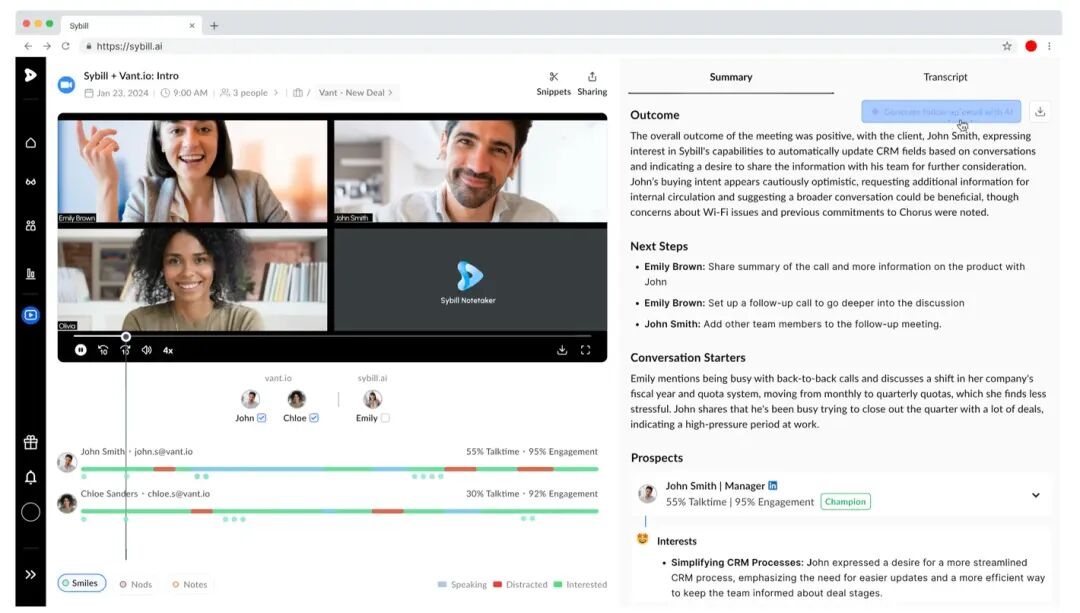
Sybill[6] has completed an $11 million Series A led by Greycroft, bringing total funding to $14.5 million. The company's AI sales assistant analyzes calls and emails to provide contextual insights and summaries, saving sales representatives over 5 hours per week.
Built on GPT models with an internal RAG system, Sybill records sales conversations, provides summaries, drafts emails, and updates CRMs. Targeting salespeople rather than leadership, the company grew ARR from $100,000 to $1 million in 9 months and now serves over 500 paying customer teams.
Sybill plans to use the new funding to further develop its AI assistant and expand the team. Amid the current tech industry slowdown, Sybill's product for improving sales efficiency has gained strong traction.
Vanta Secures $150 Million Series C
Vanta[7] recently raised $150 million in Series C funding led by Sequoia Capital, at a $2.45 billion valuation. Goldman Sachs, JPMorgan Chase, and other new investors joined, alongside multiple existing investors. With $353 million in total funding, Vanta aims to become an AI-powered comprehensive enterprise trust management platform.
Founded in 2018, Vanta initially focused on automated compliance, helping companies quickly obtain various certifications. As global regulatory environments evolve and AI-related risks intensify, Vanta has continuously expanded its business, simplifying security and compliance processes through expert services and automation tools that can automate up to 90% of audit preparation work.
Vanta's main products include Vanta AI, vendor risk management, and the Vanta Trust Center. Vanta AI provides AI-powered vendor security assessments and intelligent control mapping. Vendor risk management helps clients manage third-party application risks. The Vanta Trust Center serves as a platform for demonstrating security and compliance.

Elon Musk Denies xAI Acquisition of Character.AI Rumors
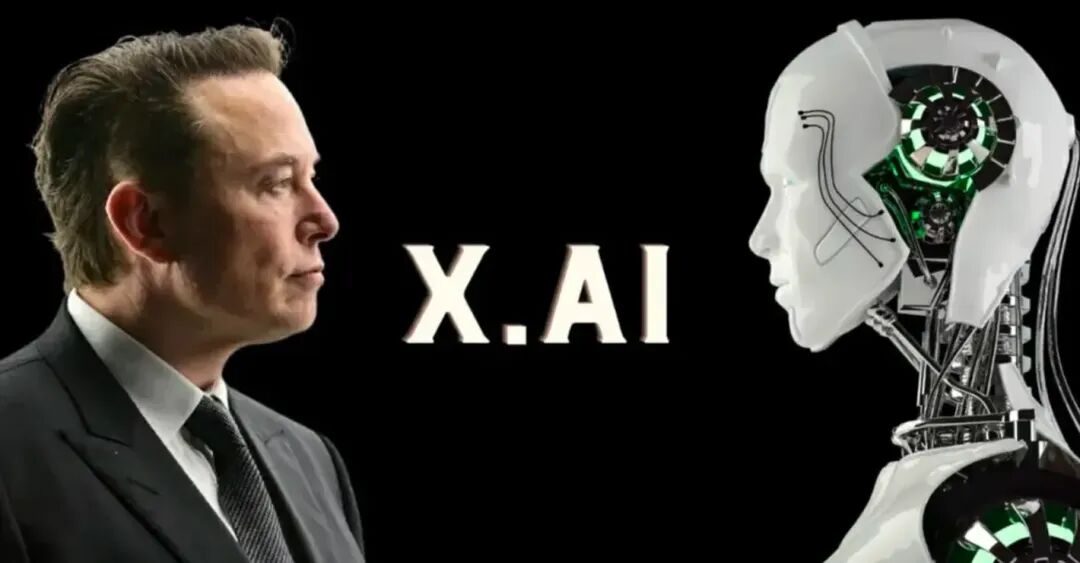
Elon Musk denied on X that xAI is considering acquiring AI chatbot startup Character.AI. Previous media reports had suggested xAI was exploring the acquisition as a way to find more methods for testing its Grok AI model.
Musk founded xAI in 2023, launching the ChatGPT-competing chatbot Grok. xAI recently raised $6 billion in Series B funding at a valuation exceeding $24 billion. Character.AI, founded by former Google employees, allows users to create and customize various virtual characters and was valued at over $5 billion last year.
Musk previously ran a poll on X asking whether Tesla should invest $5 billion in xAI, and raised the possibility of integrating xAI technology into Tesla's autonomous driving features. Despite acquisition rumors, Musk made clear that xAI is not currently considering buying Character.AI.

You must give up the hope for a better past.
— The Gift of Therapy



Editorial Team Editor: Ziwen
Design: Ivan
For business inquiries, contact WeChat: Rwkfbcianvd
References [1] Gemma 2 2B: https://huggingface.co/google/gemma-2-2b
[2] AlphaXiv: https://alphaxiv.org/
[3] Tweet: https://x.com/jiayq/status/1818786673695809793
[4] Vidu: https://www.vidu.studio
[5] OV-DINO: https://arxiv.org/abs/2407.07844
[6] Sybill: https://www.sybill.ai/
[7] Vanta: https://www.vanta.com/