Rebuilding on the Ruins of "Double Reduction": A Conversation with Serial Entrepreneur Liu Ye — From Zuoyebang to Talkit

Keep swimming until the sea turns blue.
Keep swimming until the water turns blue.

👦🏻 Podcast interview: Koji, Ronghui
🥷 Edited by: Starry
🧑🎨 Layout: NCon

This week's guest on Crossing has had a career that felt like a roller coaster — Liu Ye, former founder of Zuoyebang (Homework Box), now founder of VisionFlow.
Liu Ye once built Zuoyebang into an edtech unicorn serving over 100 million teachers and students across 100,000 schools. Then the "double reduction" policy hit suddenly, devastating the business. After this seismic shift, Liu Ye decided to start anew from the "ruins" of double reduction, launching a new AI + education venture.
VisionFlow raised approximately $10 million in seed funding — the largest seed round in the AI language learning space — with investors including renowned entrepreneur Xiang Li, Alibaba partner Ming Zeng, and Yuyan, among others.
Liu Ye believes that AI has finally unlocked the spoken-language problem that has stumped language learning for decades — what was "impossible" for generations is now possible. Based on this conviction, VisionFlow launched its first product, Talkit, a fully AI x 3D virtual world built entirely for speaking practice.
In this episode, we'll talk product and AI, and we'll hear Liu Ye share his remarkable journey from Zuoyebang to Talkit — his reflections on entrepreneurship, how he adjusted when everything suddenly collapsed, and how he regrouped and set sail again.
Each of us may face a pivotal "life restart" moment. We hope Liu Ye's experience brings you inspiration and courage.
Listen on WeChat:
Listen on Xiaoyuzhou:


Rapid Fire
👦🏻 Koji
Let's start with rapid fire. How old are you, Liu Ye?
👦🏻 Liu Ye
I'd say post-80s generation.
👦🏻 Koji
Alma mater?
👦🏻 Liu Ye
University of International Business and Economics.
👦🏻 Koji
Your MBTI and zodiac sign?
👦🏻 Liu Ye
Leo, ENTJ.
👦🏻 Koji
Can you describe your current company and product in one sentence?
👦🏻 Liu Ye
We want to build a virtual world where everyone learns language as if they've immigrated to an English-speaking country.
👦🏻 Koji
Current funding status? We mentioned the $10 million seed round — any new rounds since?
👦🏻 Liu Ye
Not yet. We raised a relatively large amount early on, but we plan to in the future.
👦🏻 Koji
Current revenue and profit situation?
👦🏻 Liu Ye
Our new product's official version took two years to refine and just launched last weekend. We're already seeing some promising user behavior data.
👦🏻 Koji
Team size? And what were you doing before this startup?
👦🏻 Liu Ye
About 40 people now. I founded Zuoyebang in 2014. Before that, I spent 10 years building a low-code SaaS platform — a very successful pivot. Then came double reduction and COVID. For three years I was constantly searching for direction while helping friends think through business problems. I looked at healthcare, chain coffee, and other directions.
AI + Education
👦🏻 Koji
After all that exploration, you went all-in on AI + education again with Talkit. Can you give friends who don't know it yet a brief introduction? Especially what features and value ordinary users get?
👦🏻 Liu Ye
I've been thinking about one question: every generational technology shift doesn't equal value. Technology usually needs to transform into user value through human-computer interaction. Fortunately, I've always been among the earliest adopters of new human-computer interactions after each tech innovation. For example: Gmail — I was among the first 5,000 global users; World of Warcraft — among the first 1,000 beta testers; Google AdWords — one of the first 100 accounts; my QQ number has five digits.
👦🏻 Koji
Always ahead of the curve, a true early adopter.
👦🏻 Liu Ye
For Vision Pro and Quest, I've played roughly 70% of the games on them — over 1,000 titles, went through several boxes of motion sickness pills, haha. I was thinking: what will ChatGPT or large language models actually bring humanity? The first sentence I wrote in my notes when founding the company was: For the first time in human history, people will spend more time talking to machines than to other humans.
Before, our interaction with machines was mainly typing — we didn't chat, we didn't speak. But overnight, people worldwide started talking to a chat box. Human-computer interaction shifted from "hands" to "speech." Yet English learning still relies on hands. We learned English with our eyes and hands since childhood. Even today's Duolingo is still finger-based English learning. Investors often ask me: what's the difference from Duolingo? I say, Duolingo is a company focused on "hands"; I'm a company focused on "mouth."
👦🏻 Koji
That's a major difference. Can you describe the user experience after opening the app?
👦🏻 Liu Ye
I defined the entire product as "all in talk." Like learning a native language, you need eyes, ears, and mouth.
The product has three pillars:
The first module is "Course." If your level is low, you need to start with hands to learn basic words. We call it "A better Duolingo" — more immersive, you can learn vocabulary and basic grammar.
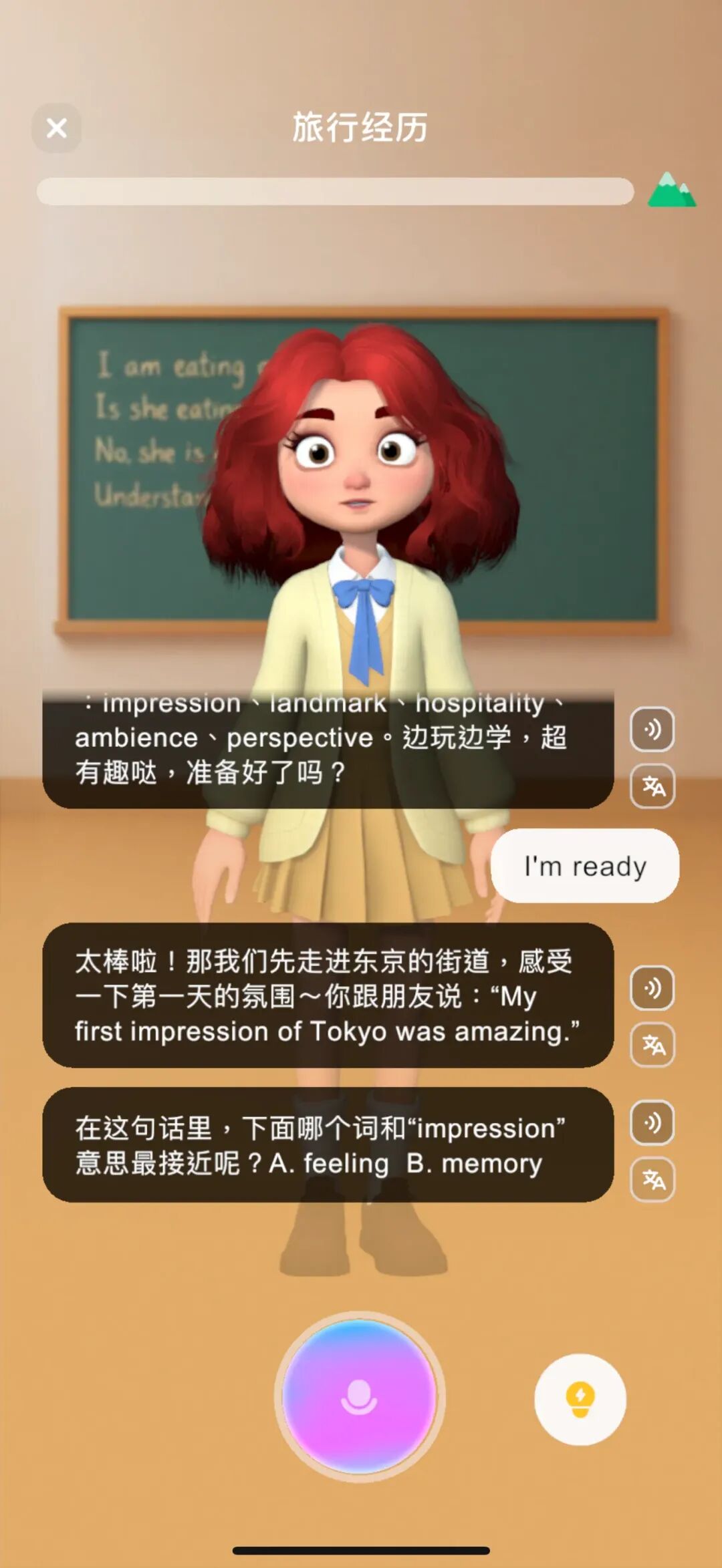
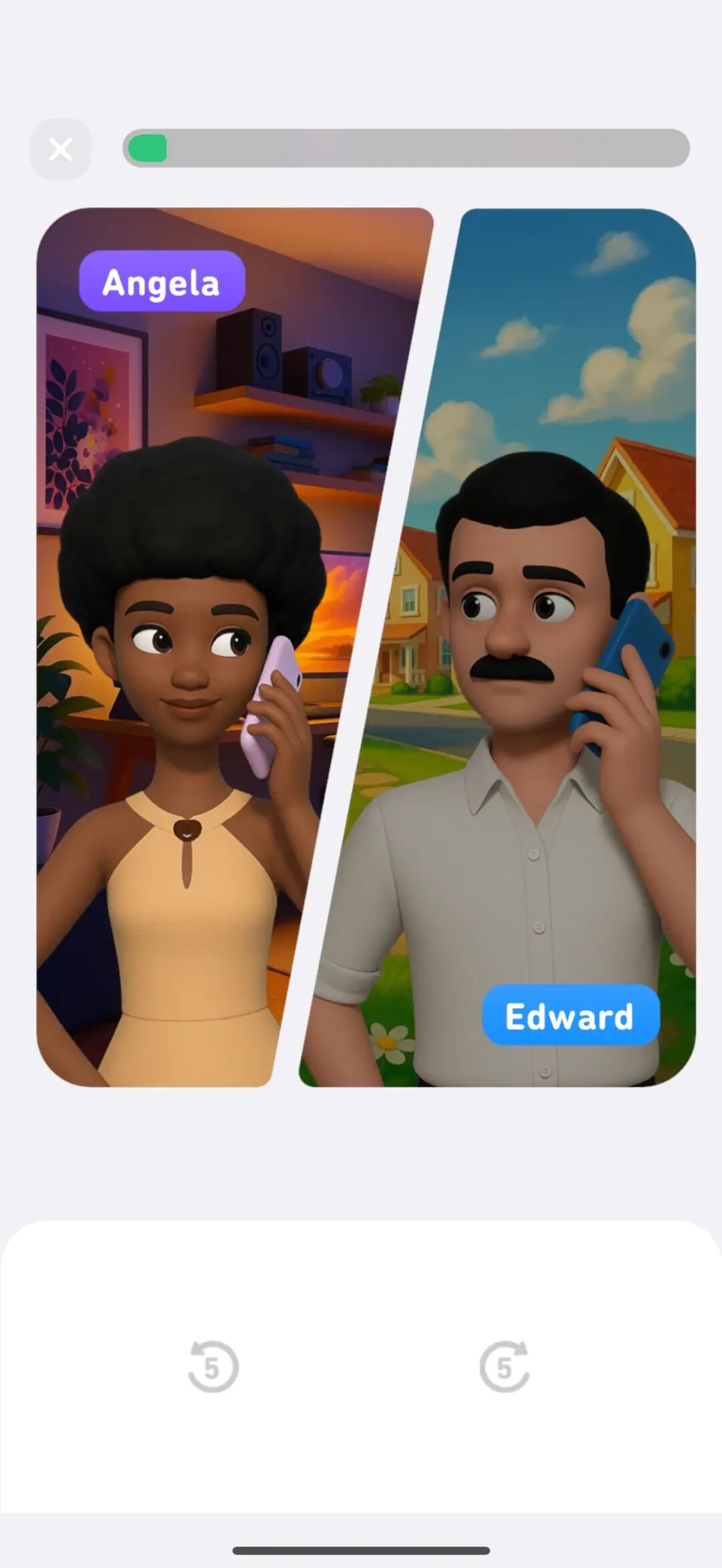
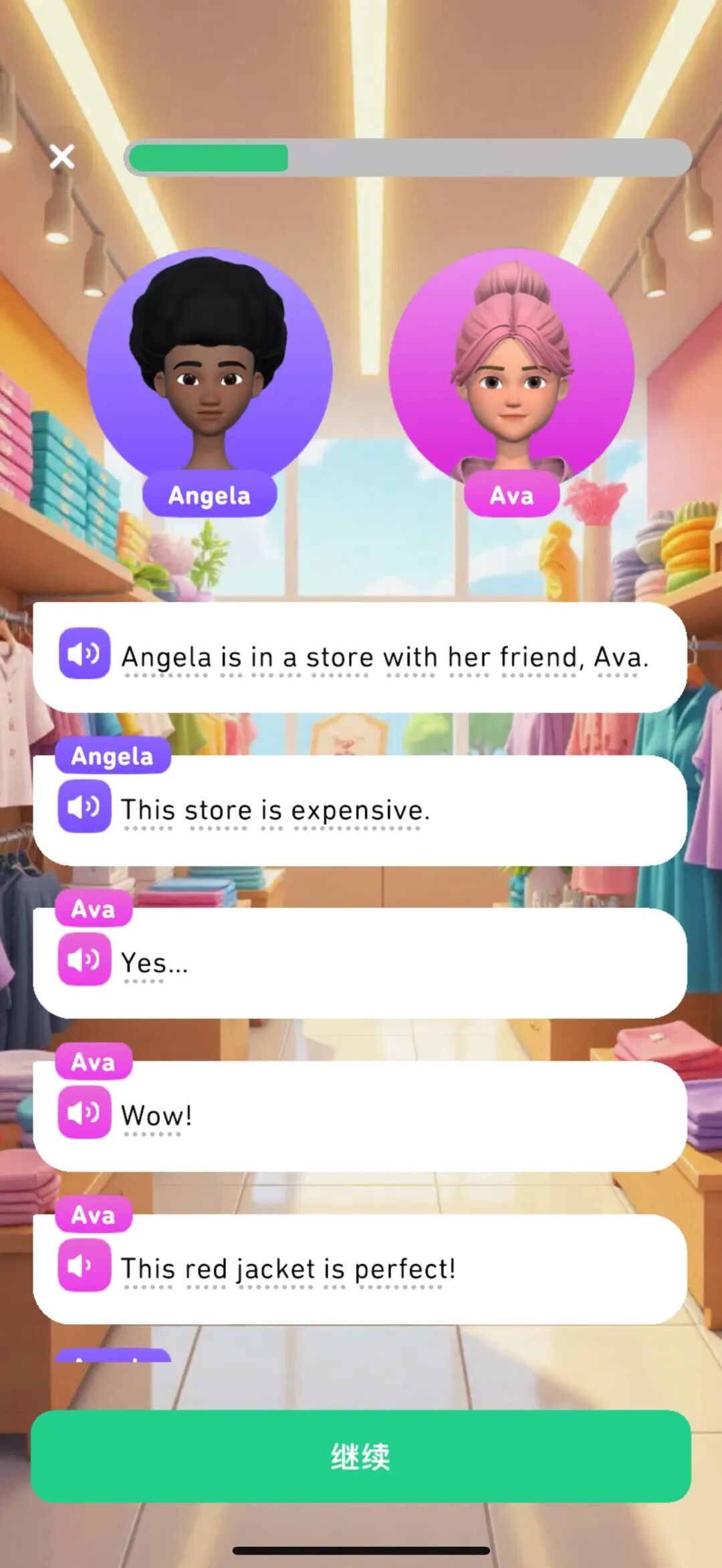
The second module is "Rehearsal," named Explore. We designed this based on TBLT (Task-Based Language Teaching) theory, a very new language learning approach. It's already mainstream offline but was impossible to implement online before — because there were no large language models. Users complete real-scenario tasks we call Living Scenarios: job interviews, asking for someone's WeChat, bargaining, resolving disputes, ordering food, traveling, buying plane tickets, checking out of hotels, filing claims, renting apartments, etc. The interface resembles Douyin, driven entirely by recommendation algorithms and strategy.
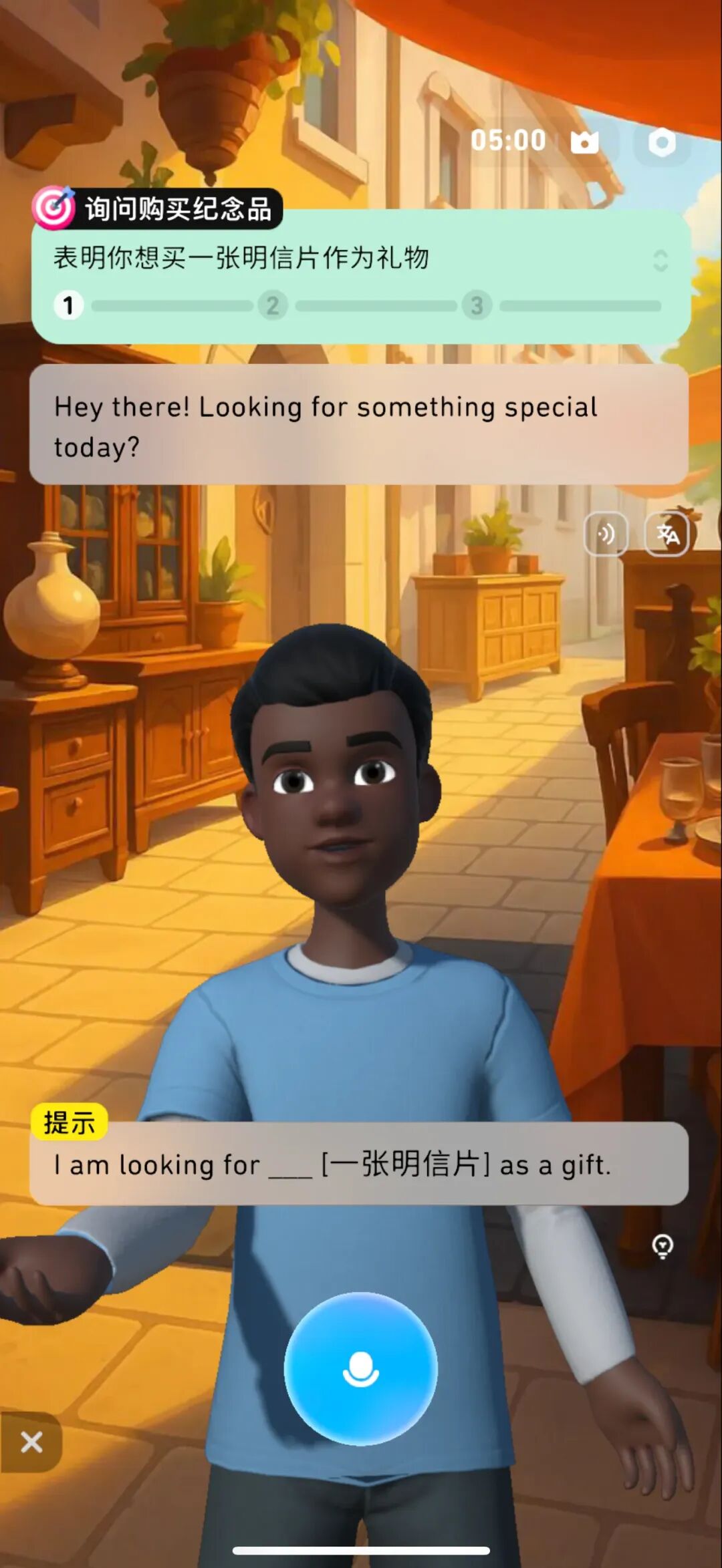
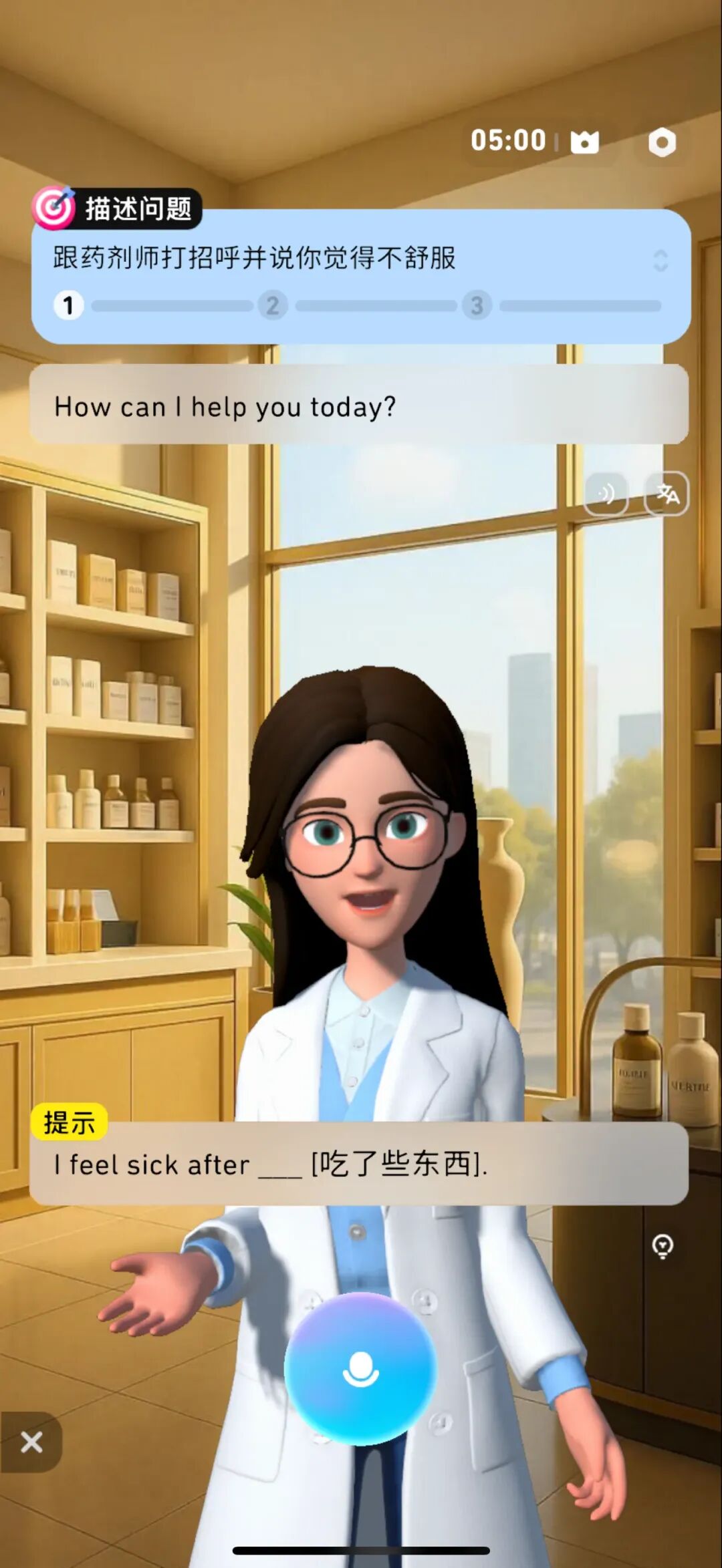
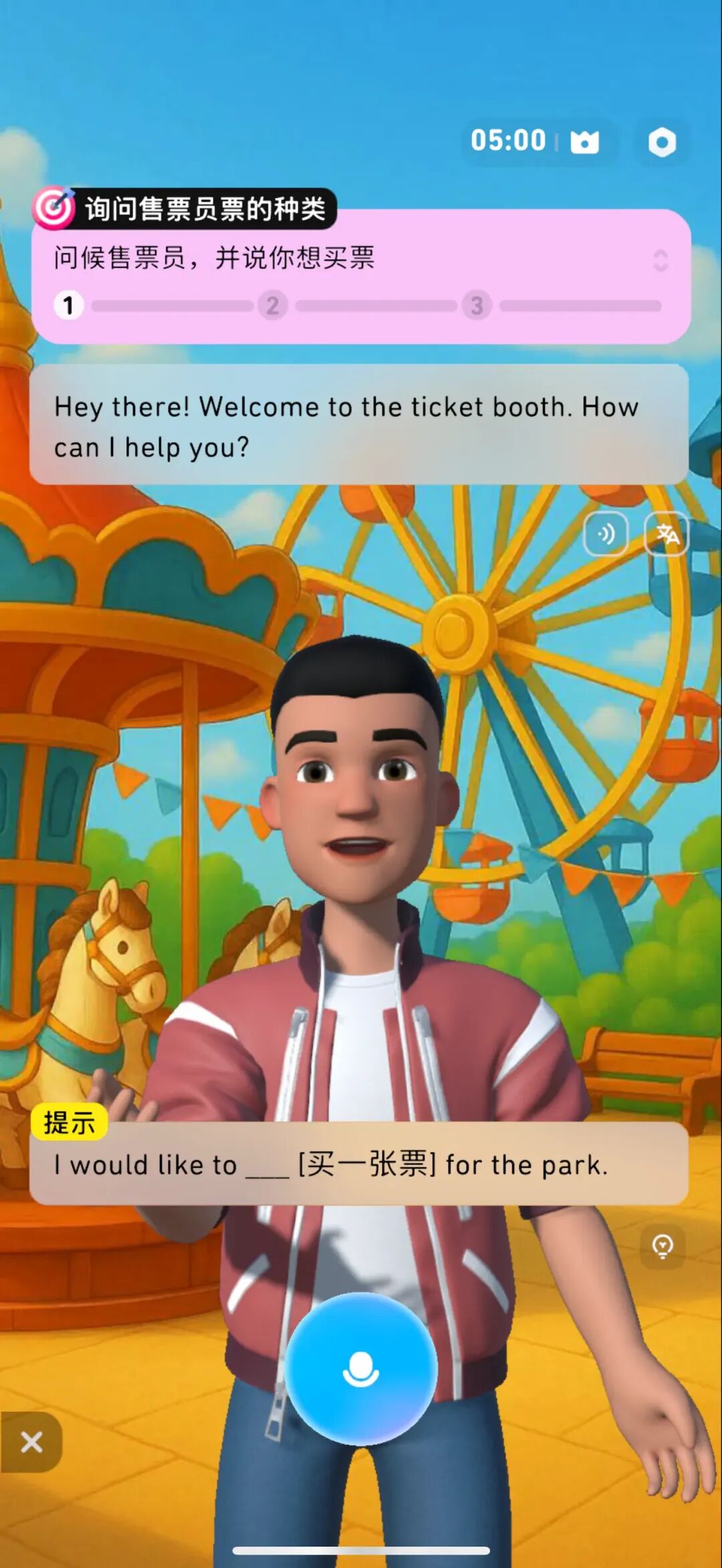
The third module is "social." Based on scenarios, users can meet people and convert them into friends, building emotional connections (make friends to get intimacy). This concept is similar to Tolan, but we started earlier. We believe language learning requires three aspects: studying (like Duolingo), applying in life (scenarios), and making friends. Otherwise your language ability won't truly improve.
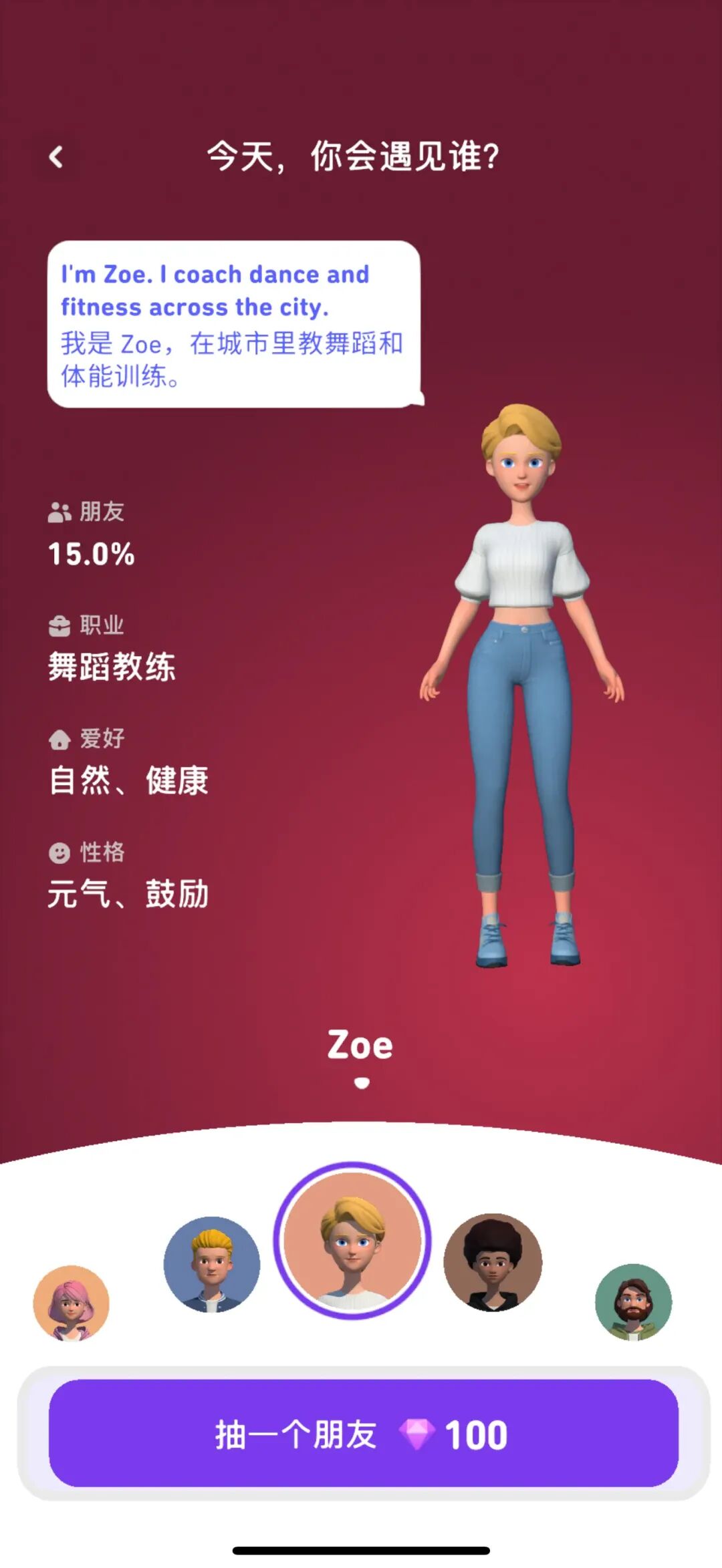
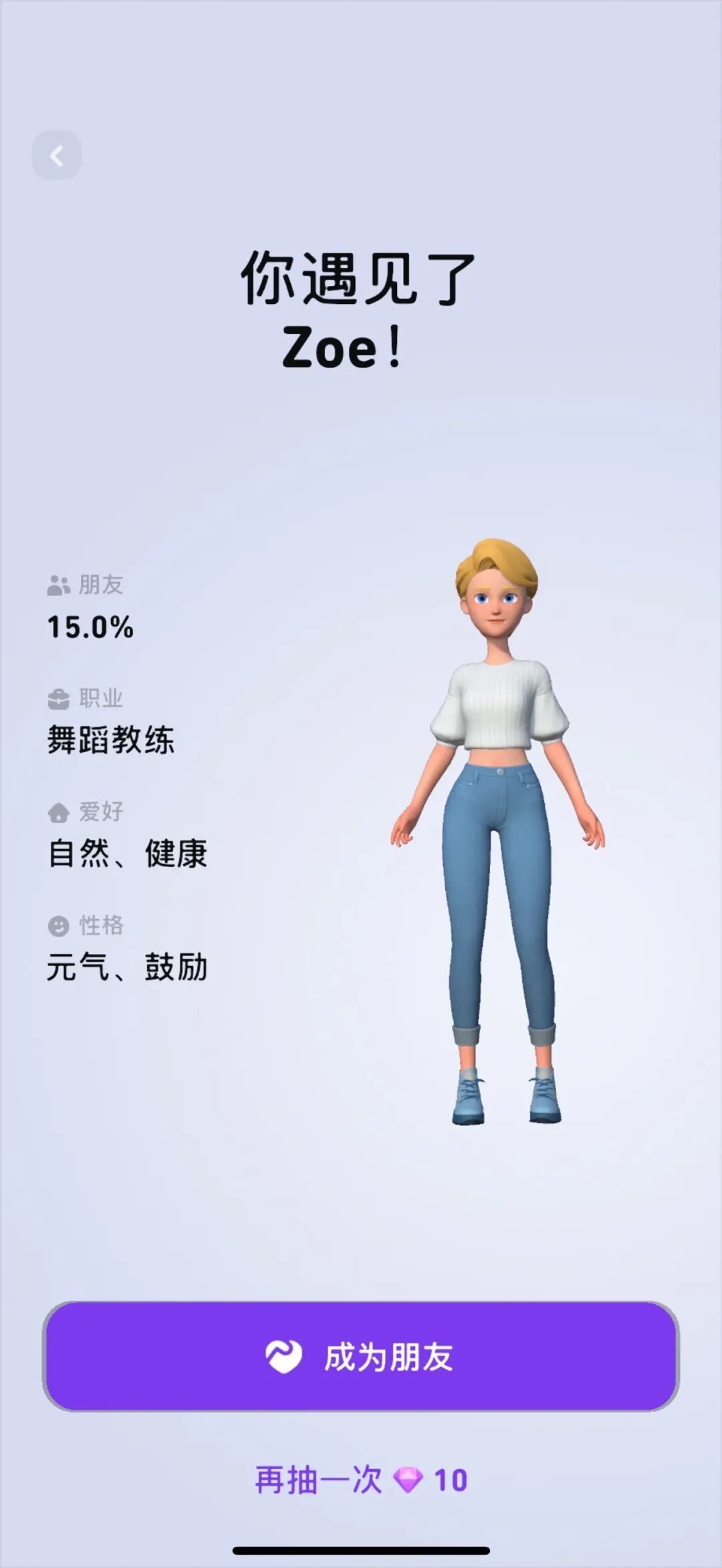
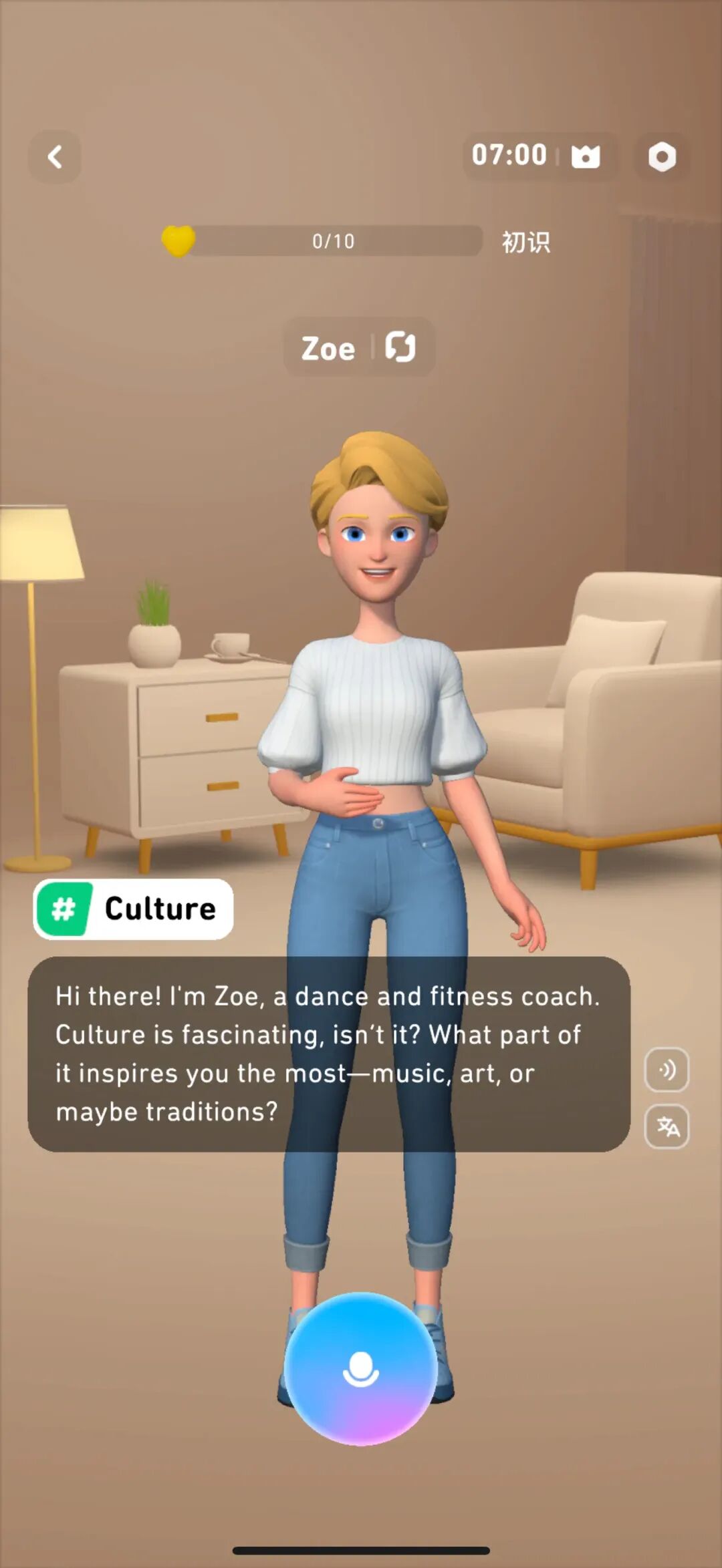
The final step is "Apply" — users can connect directly with real people from English-speaking countries right in the app.
Talkit: Building a Friendly Virtual World for Language Learning
👦🏻 Koji
We all know that learning English requires an immersive environment, an atmosphere of native speakers. Everyone gets the theory. But actually building a product like that, one where users truly feel immersed — like you said, "immigrating to an English-speaking country" — how do you pull that off?
👦🏻 Liu Ye
When anyone learns a language, from day one they're essentially in a 3D world. We don't learn our mother tongue by watching TV. We learn it in a real world, with real people and real scenarios, through "Learn by finishing the real tasks" — learning by speaking and completing tasks.
At first my thinking was pretty simple: this is just how language should be learned. Later we found our head of curriculum and research, who told me this approach is called TBLT — Task-Based Language Teaching. A few education scholars and linguists proposed this framework back in the 1980s, but it never made its way into apps or online teaching, remaining confined to offline classrooms. The reason? Traditional AI, when judging whether a user spoke correctly, could only recognize standard answers. "How are you? Fine, thank you. And you?" would be marked correct, but "Hi bro" or "Hi there" would be marked wrong. BERT-based natural language models simply couldn't cover all possible expressions.
Then the Transformer architecture came along like a wrecking ball, overnight pushing natural language understanding accuracy to 99.99%. Only models like ChatGPT can flexibly judge whether a user has achieved the learning objective in TBLT, provide personalized assessment and generation, and thereby reinforce learning.
👩🏻 Ronghui
You just mentioned that the product's biggest differentiator is these immersive mini-scenarios. About how many scenarios are there? Where does the data come from? How are they designed?
👦🏻 Liu Ye
That's a great question. Let's start with the industry's pain point: there are countless language learning courses and apps worldwide, yet many people still fail to learn a language. Everyone's answer is the same: I don't have the environment. It's not that they lack tools, textbooks, or materials — they lack the environment.
So our solution is to create a virtual world that provides that environment. For this we built something called the "Gen World Engine," a generative world engine with three components:
- Gen Soul Engine: We start with a 3D avatar shell, then combine it with large language models to generate avatars at scale. The process of learning one's native language is essentially encountering all kinds of people and characters in the world. Roblox relies on an editor for users to create content, and it's worth $100 billion. We're based on AIGC — one intern can generate 1,000 virtual characters in a month. Most speaking products today have just a cardboard cutout of a person, no personality, no movement, fixed expressions. Even when the user speaks well, all they get is a "Good job" sound and light effect. We can do gestures, facial expressions, movement feedback — encouraging users much more naturally.
- Gen Scenario Engine: Not fully cracked yet. Right now we can generate 2D backgrounds that look 3D. I'm confident that text-to-3D models will break through within a year or two.
- Gen Task Engine: 20% of ChatGPT's DAU uses it to learn foreign languages, but the generated content is often inaccurate and hard to sustain. Behind our product is an entire complex system of models, linked together through infrastructure, prompts, routines, and agents, plus some engineering-layer constraints. For example, we follow the n+1 principle: only one or two new words per sentence; content aligns with spaced repetition, interest points, learning style, and language level; study duration can also be precisely controlled.

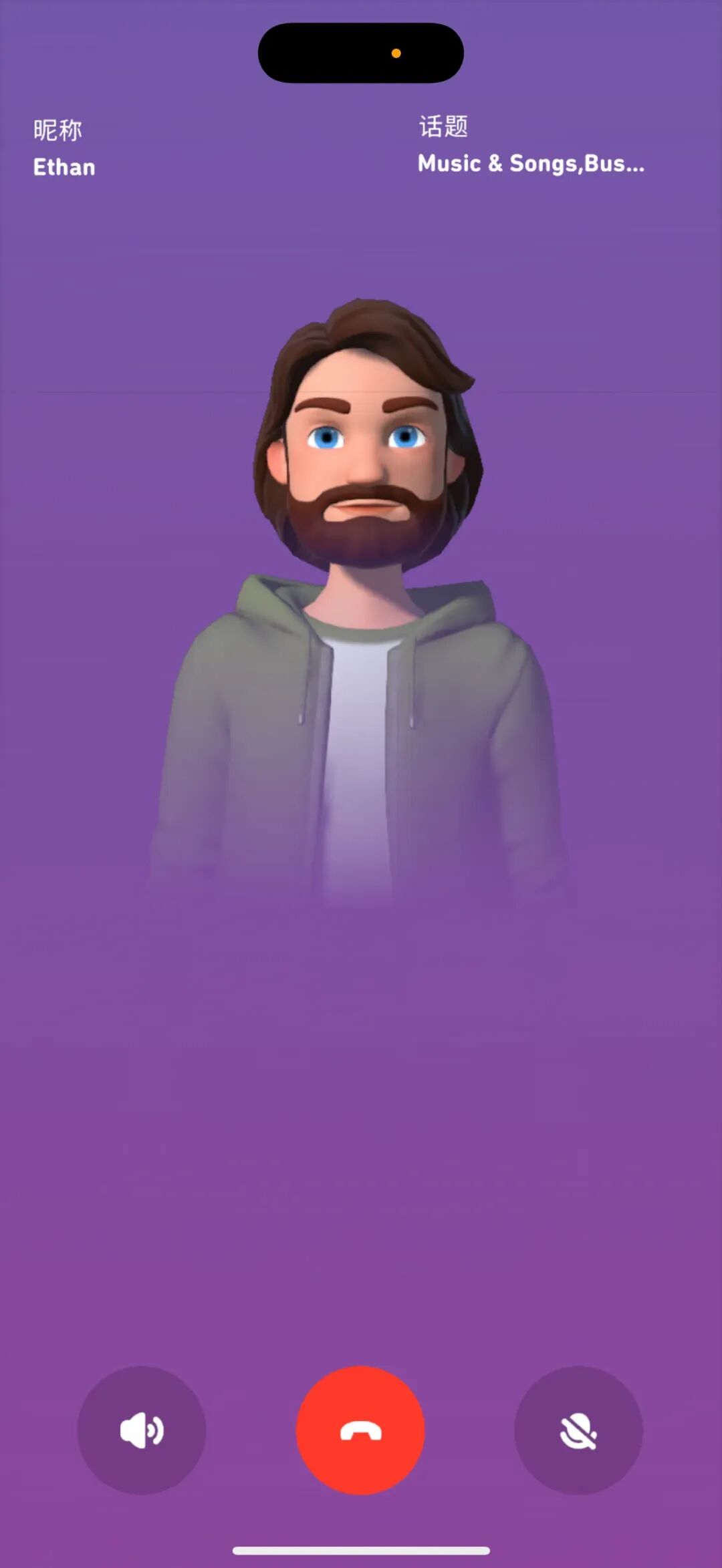
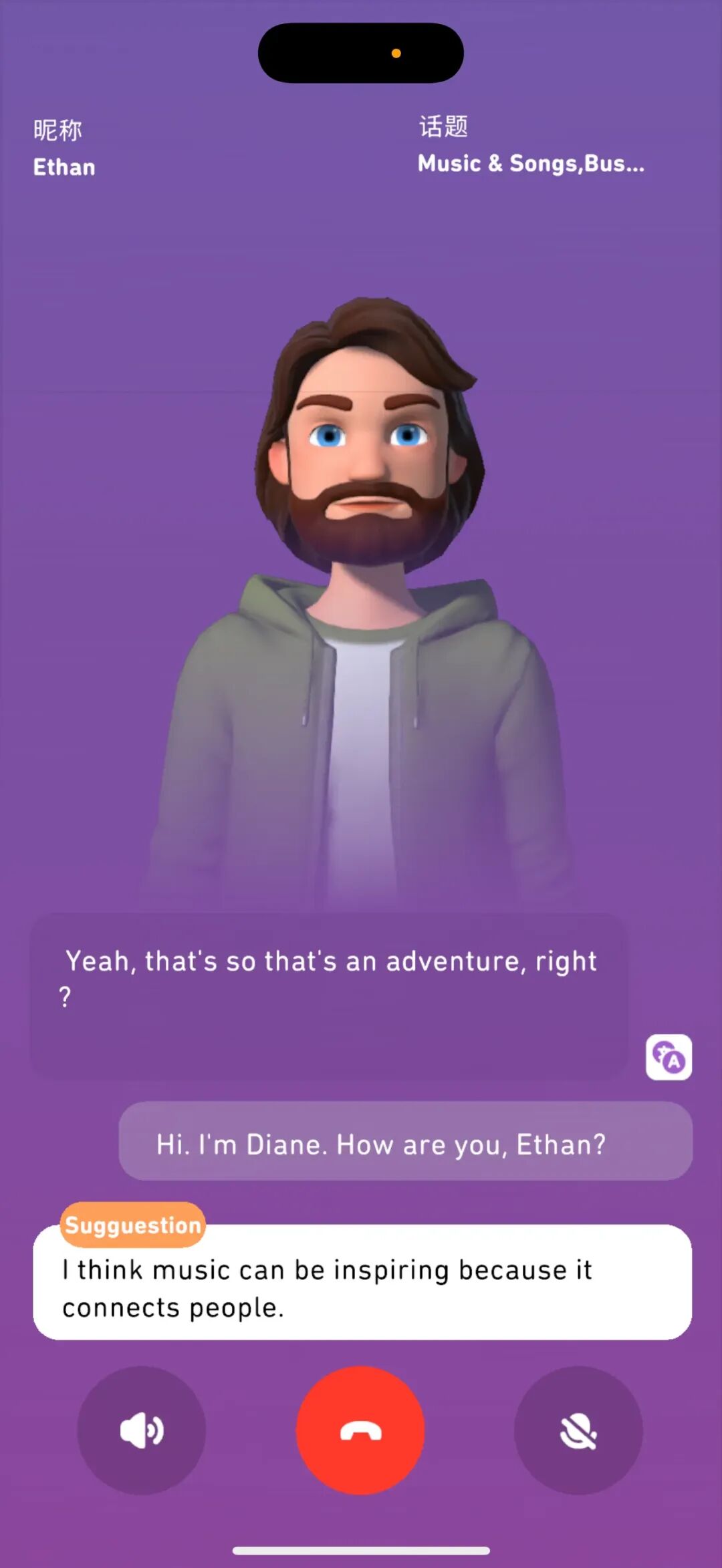
In reality, if you actually immigrated to the United States, that world might not be so friendly. Americans might deliberately speed up their speech, making it hard for you to keep up. But what we're building is "A virtual world for language learning" — here you are the core user, and virtual characters will converse with you based on your language level and interests.
👦🏻 Koji
Sounds amazing. I can keep speaking English with an AI companion that's completely attuned to me, getting more and more confident. Any data on this? Like what's the longest a user has spent on your product in a single day?
👦🏻 Liu Ye
It's still a test version, lots of bugs. But many users come back every day, for an hour, two hours. Our core metric is "speaking time." On average, daily user speaking time is already two to three times higher than Speak.
👦🏻 Koji
During the rapid-fire round you said revenue and profit aren't the key metrics right now. So what's your North Star metric at this stage?
👦🏻 Liu Ye
Conversation duration and retention among target users. Basically: do they come, and how long do they speak.
A Great Rival: Duolingo
👦🏻 Koji
We've talked about Duolingo many times before. Every time it comes up, I'm reminded of a phenomenon: many people have a love-hate relationship with it, saying "I don't actually learn anything." But maybe its real value, from day one, was never just "teaching you a language." The implicit value it offers users is "making you feel confident." Most people won't directly say "I pay to become more confident," but they keep using it, keep paying — and the underlying reason is: I feel like I'm getting better, I feel like I'm making progress. Perhaps Duolingo isn't really satisfying the need to learn English, but rather the need to "become more confident." And it's precisely this that sets it apart from so many similar English learning apps on the market. What do you think?
👦🏻 Liu Ye
That's a really good question. I think Duolingo is the greatest rival I've seen in this space, and I don't use "greatest" lightly.
The language learning market has 2 billion people — 1.5 billion learning English, and another 500 million learning Spanish, French, German, Italian, Japanese, Korean, Chinese... But only about 10% of English learners are doing it for exams. The remaining 90% we call "weak-motivation" users.
I've always felt that solving hard-need problems doesn't count as greatness. By "hard need" I mean the kind where "you die if you don't use it." But most of what we spend money on today stopped being hard needs long ago. I didn't start a company because of a hard need — I did it out of a sense of mission, out of pursuing a better life experience and a sense of achievement.
👦🏻 Koji
Right, just like how we do podcasts — that's not a hard need either. Podcast listeners don't say it's something they absolutely need.
👦🏻 Liu Ye
Last week Luis Yang (co-founder of Musical.ly, TikTok's predecessor) posted something on his Moments that really stuck with me: "If all AI products only compete on features, not on experience, not on feeling — this world would be so boring. Every day it's just various agents doing work for you, what's the point?"
So we fully endorse Duolingo's philosophy. Their annual reports, earnings calls, CEO Luis's podcast interviews, even the wording in their handbook — I've read them all repeatedly. They're really only doing one thing: "Make language learning effortless first, and effective next" — that's my own summary.
Most entrepreneurs in education, their first instinct is "it's gotta be effective." And yes, that's absolutely correct, but the market doesn't need "the second effective product." What's impressive about Duolingo is that it's become part of the American lifestyle. Out of 100 friends around me, 99 are using it. I often ask them why they're learning Spanish, French — and their answer is actually: to show off.
I have a friend who's streaked Arabic for 1,000 days. I said, "You're the coolest person here tonight." Turns out he's never even met an Arab person.
Why? Because when you open Duolingo, your first reaction is: oh, this is just like the cloze tests I did in middle school! Tap the blank, fill in the word... So a lot of people feel like "I'm not really learning anything." But when there's no better option, might as well use it.
So we reached a conclusion: Language learning, like many modern needs, isn't "essential for survival" — it's "nice to have." Language learning products are essentially closer to a lifestyle, a consumer fashion statement. Learning is just the byproduct; what they're really selling is entertainment, companionship, the feeling of self-improvement.
👦🏻 Koji
A lot of people say "when life sucks, memorize vocabulary," because memorizing words gives you the fastest, smallest, most frequent positive feedback. That feeling of "I'm making progress."
👦🏻 Liu Ye
Exactly. That's what's so interesting. Back in the day, partying and drinking were popular in the United States, then hiking took over. For the past 20 years, our entertainment has been gaming and short videos — but always with a twinge of guilt. Duolingo? It gives you the same dopamine hit as a match-three game, except the byproduct is that you actually learned some language. That's the brilliance of it.
Luis von Ahn, Duolingo's CEO, said something I deeply admire: "You can never teach a student who doesn't show up." So their core philosophy is — effortless first, then effective. Because language learning operates on a ten-year cycle. However effective your method, if people can't stick with it, it's useless.
👦🏻 Koji
So how did this insight influence your product?
👦🏻 刘夜
Not influence — we follow this principle completely.
👩🏻 Ronghui
When Coursera first launched, people constantly asked about one key metric: completion rate. Registration was high, but completion was low.
👦🏻 刘夜
Duolingo has over 1 billion registered users, roughly 150 million MAU, 50 million DAU. An estimated 12 million people have streaked 365 days without interruption. But where did the other 850 million registered users go?
We've conducted thousands of user surveys. The core finding can be summarized in one sentence: They wanted to improve their spoken language.
Many people clocked 300 days, 500 days, even 1,000 days, only to realize they had mastered fill-in-the-blanks and vocabulary but still couldn't actually open their mouths to communicate. So they left. Because nobody wants to spend their whole life practicing finger taps and sentence gaps instead of truly speaking.
👩🏻 Ronghui
So that's your core difference from them? If you had to describe it in one sentence, who is your target user?
👦🏻 刘夜
Yes. Essentially, anyone who genuinely wants to improve their spoken language. When buying a car, users don't fundamentally care whether it's gas or electric — what they want is to get from point A to point B faster and more conveniently. Language learning is the same. Memorizing words is just the process; ultimately, everyone wants to be able to speak.
👦🏻 Koji
Earlier we mentioned that many Duolingo users aren't serious learners — they're there for the joy of learning. So we say "when life sucks, memorize vocabulary," because it's the smallest, most frequent positive feedback you can get. But spoken language isn't like that. It's frustrating at first, confidence-killing. What have you done to counter this?
👦🏻 刘夜
Let me not jump to the solution — that's a complex problem. Flip it around: spoken language is painful when you're like an ascetic practicing alone with American TV shows. A good friend of mine, David Li, CEO of Hesai, said the most effective way to learn English is to date a foreigner — fighting is the most effective method. Making language learning effortless hinges critically on engagement. The people involved need to be interesting, emotionally present, they need to remember you. Difficulty must be calibrated right, tasks need to be engaging, situated in immersive scenarios rather than flat worlds. Interaction, narrative, challenges, rewards — these are all well-worn ideas.
The difference is, before, there was no large language model, no engine. ChatGPT provided the engine. In seventh grade, I failed geography and history. But when I played Uncharted Waters, I memorized every port in the world. Fundamentally, what we're solving is how to make speaking effortless rather than painful.
Over the past two years, we tested more than 100 versions, overturned three major product architectures three times — it was genuinely that hard. That's why I only accepted my first interview after launching last week. The product is far from success, but I think it scores 30 — at least it's presentable. It's like a child: born with all limbs intact, breathing, able to draw breath on its own.
👦🏻 Koji
Congratulations, not easy. There's a joy like having given birth. Twenty-four months of pregnancy.
👦🏻 刘夜
Nezha, haha. Mortals have ten months — only Nezha takes twenty-four.
👦🏻 Koji
What did you think about most during these years? In this 24-month gestation.
👦🏻 刘夜
Really just one question: Is the product philosophy I believe in, and the language learning philosophy I believe in, actually right?
👦🏻 Koji
And what are these two philosophies now?
👦🏻 刘夜
One is a user-value philosophy. Language learning is a need for the masses, but it's too hard, so many people give up. We call it "effortless first, then effective and enjoyable" — from the user's felt experience.
From the pedagogical perspective, it's learning English the way you learn your mother tongue. This is TBLT theory — the teaching-research side of language learning philosophy.
From the product-form perspective, it must be immersive. I use "create an emotional immersive world for language learning" to address this.
👩🏻 Ronghui
When you saw ChatGPT emerge, how did that "doors opening" feeling compare to before and after?
👦🏻 刘夜
During the three years of the pandemic, I looked at over 30 industries without finding a satisfying direction. When ChatGPT appeared, I decided on this direction in one day — before GPT-3.5 or GPT-4 even launched. In an offline environment, I wrote out the key prompts and generation flows for several engines in a single day, simulating conversation flows. Then I reached out to Xiang Li. Coincidentally, I had a class at Hupan the following week, and during a classmate gathering I briefly presented the idea — that completed the first funding round.
👦🏻 Koji
Quite a lot of funding — a $10 million seed round. Some people don't reach that until Series A or B.
👦🏻 刘夜
Yes, friends all wanted to invest; there actually wasn't enough allocation to go around. I said everyone gets $1 million, no negotiating who gets more or less. Then began two years of grueling exploration. I basically stayed at the company the whole time. Roughly once a quarter I'd go to the United States.
👩🏻 Ronghui
How is this startup different in terms of goals compared to your previous ones?
👦🏻 刘夜
With Zuoyebang, it was my first time in education — I was just looking for a "sexy" direction, something meaningful. Later we became number one in our vertical, which was decent. I wanted to change the world further but couldn't pull it off.
This time the vision is clear and extremely firm. We hope to fundamentally change how humans learn languages for decades to come.
I felt this deeply when I was in the United States. There are 8 million Chinese people in America, even more in Silicon Valley, California — all elites. We feel superior to Indians, we do all the work, yet we report to Indians. A friend of mine did a computer science PhD in the US, an early Meta employee, now at Snapchat. I assumed his English was excellent. He said English isn't his mother tongue — they can discuss technology in English, but not management, not small talk. At Snapchat and Meta, the two sentences he said most were "Yes, I can do it" and "Can you speak again," while his superiors were Indian. So the language barrier truly prevents everyone from unleashing their potential. Even someone with a US PhD is like this, let alone ordinary people. We don't get the opportunities we deserve.
Chinese people are hardworking, smart, diligent. If we're to have more voice globally, this problem must be solved. But we can't make English our mother tongue — so what do we do?
👩🏻 Ronghui
I've heard friends mention that in tech companies, Indians are very tight-knit and very expressive in all kinds of settings.
👦🏻 刘夜
I see it differently. The Chinese people most skilled at expression are right here in China — in Zhongguancun, on podcasts, at Hupan University, in big tech, in Wangjing. We haven't broken out. Once we do, wouldn't we know how to speak? When I first went to America, my English wasn't great, but I frequently attended parties. People asked me: "How many years have you lived in America? Are you an ABC?" I said: "Have you ever met an ABC with this heavy an accent?"
China's economic development is excellent, with more outstanding people, but most stay domestic. India's economy isn't as strong, and English is their mother tongue, so they naturally go abroad. If our spoken English were excellent from childhood, I believe more Chinese would go global, unconstrained.
The "Double Reduction" Moment: From Industry Wipeout to Inner Liberation
👦🏻 Koji
Every time I chat with Liu Ye, the conversation somehow circles back to the same moment. A moment that didn't just change Liu Ye, but likely changed an entire generation of online education entrepreneurs — 2021's "Double Reduction." After that, the entire industry seemed to hit pause overnight. Many companies already IPO'd or pre-IPO, massive in scale, were forced to "zero out."
Every time I encounter Liu Ye's story, I find him deeply representative. So this time on the podcast, we especially wanted to discuss — in that moment when "the world suddenly collapsed," what did it actually feel like to stand center stage?
There's another phenomenon I've always found fascinating: that cohort of outstanding online education founders — almost none of them truly "stopped." After brief adjustment, they quickly "rebooted" —
Yuanfudao internally incubated Grid Coffee, Sky People down jackets, even Moli Smart Postpartum Care Center; Xiao Dun from 17zuoye chose to go overseas, founding Alina; Huaiting Zhang in Beijing founded "Yuaiweiwu," betting on AI+education and the new possibility of AI replacing human teachers; Shuai Ke, Yuanfudao's co-founder, built ClassUp, a one-on-one platform for North America.
You could say this generation of outstanding online education founders are all getting back on the road.
So we especially want to ask Liu Ye: People always say the most important quality for entrepreneurs is "resilience." But in this cohort, I feel "resilience" has become their most luminous badge.
My first question: When the "Double Reduction" shoe truly dropped, what was your most authentic emotion? Resentment, pain, or some sense of liberation? Can you share with us?
👦🏻 刘夜
Actually, everyone thought the "Double Reduction" policy landed suddenly, but internally we knew long before — it was only a matter of time. The night the policy came down, I called my co-founder in the United States. He asked how I felt. I said "pretty good." He said he felt "pretty good" too.
The feeling of "pretty good" actually came from the fact that in 2018 and 2019, the two most sensible things to do were traffic and growth, then monetization. But starting in 2019, the industry rapidly descended into the "large-class, dual-teacher model ad wars" and "talent-poaching wars."
Those years our commercial conversion felt unnatural and exhausting — we were basically persisting by "numbing ourselves." Every day was about "how to renew subscriptions," "how to craft sales scripts," "how to improve ROI." You know, in that era, one teacher could simultaneously endorse three different companies in ads. That wasn't the education we wanted.
Actually, it wasn't just me. Later when I talked privately with Bangxin and Xiaodun, everyone felt roughly the same. Anyway, the pandemic hit around then too, so people had more time and more chances to connect. I think the core thing is: most online education entrepreneurs, especially the leading ones, genuinely have ideals. People without ideals don't do education in the first place.
At the time I'd only raised $1 million, and almost nobody believed I could pull it off. In the end, Richard Liu and Bangxin helped me out.
When "Double Reduction" came and hit the pause button, in a sense I felt "liberated." That moment was fundamentally about reflection — is this the life and career we truly wanted? That's a big question. When an industry becomes so cutthroat that it betrays your original intentions, its value becomes quite limited.
👩🏻 Ronghui
But the emotions must have been complicated, right? After all, you'd invested so much.
👦🏻 刘夜
Actually, at the moment of "apocalypse," there aren't really emotions. Because when all problems become "not problems," you反而 become calm. Of course there was regret. But I think the only way to dissolve that regret is to build something bigger, more successful, and more valuable.
👩🏻 Ronghui
So only by doing something even bigger?
👦🏻 刘夜
Yes, only by doing something better than before can you possibly dissolve all the regret.

👦🏻 Koji
So do you think now, whether it's you or this wave of online education entrepreneurs, everyone has this feeling of "unfulfilled ambition" deep down, and that's why you want to start something even bigger?
Could this motivation be a bit dangerous? After all, what we fear most are "revenge entrepreneurs" — those desperate to prove themselves. The ideal state should be vision-driven, passion-driven. What do you think?
👦🏻 刘夜
I can only speak for myself.
When I was building my previous company, we were constantly in the public eye. This time around, I really haven't appeared publicly for two years — I've been heads-down on product. If the product isn't ready, I don't launch, I don't promote. There was a period where I couldn't take it anymore. Seeing competitors constantly releasing products, setting off fireworks, I wanted to release too, wanted to show my face. But this time I forced myself to stay submerged — if the product isn't good, stay silent.
👩🏻 Ronghui
So between the end of that chapter and the beginning of this one, or even earlier, when you first saw ChatGPT emerge and that door swing open — during that window before that, how did you get through it?
I imagine a lot of people invited you to start companies, to invest, gave you lots of options. How did you control yourself in that situation?
👦🏻 刘夜
Yeah, so many, and I missed out on hundreds of millions, hahaha.
Three Years of Drifting: A Top Entrepreneur's Survival Rules for the "In-Between"
👩🏻 Ronghui
How did you adjust during that time? Many entrepreneurs go through a "reset and restart" phase. How did you control yourself, keep yourself calm? Like the "revenge entrepreneurship" Koji mentioned — you didn't rush to prove anything, but eventually found something that fit you. How did you get through those days?
👦🏻 刘夜
I can't really call it a method, I can only share my own journey.
I studied finance in college, but quickly realized I didn't actually like it — I spent 90% of my time on computers, entering competitions. When I graduated I didn't look for a job, just chose to start a company directly. I knew nothing back then, the pressure was enormous. Later I spent ten years in SaaS, and when I left the company still had tens of millions in accounts receivable on the books. In the end I gave all my shares to the partners who stayed, taking only three people with me. Everything was settled within a week. They said that wouldn't do, since I was 100% owner, so they kept 10% as a memento.
For me "Double Reduction" felt more like liberation. Because I'd already felt dissatisfied — that wasn't the entrepreneurship I'd originally imagined: not creating value, polishing product, but getting trapped in endless operations and social competition. I often asked myself: if I had kids, would I send them to cram school? The answer came in one second: "No." So outsiders saw me as successful, but I wasn't happy at all.
Of course that moment was painful too, but more than anything it was calm. I反而 felt this was an opportunity to make up for the imperfect parts of my previous entrepreneurship. I didn't expect three years to slip by — those three years were about watching for directions, consulting for friends' companies, running and working out. If ChatGPT hadn't emerged, I probably would've already gotten into triathlons.
👩🏻 Ronghui
So can we understand it as: you'd done things that made you unhappy for so long, and now you finally had your own time to do things that truly made you happy?
👦🏻 刘夜
Not exactly right either. Actually I was extremely panicked during that time. Because I'd been entrepreneuring for over twenty years since college, never truly rested. Suddenly being idle, I didn't know how to arrange my time. I was incredibly anxious. So when friends asked for help, I was extremely enthusiastic, wanting to help "ten times over." Honestly it was just too boring, haha.
👦🏻 Koji
Sounds like you really craved being needed.
👦🏻 刘夜
Yes, that's exactly right. Outwardly enthusiastic, but actually suffering inside, very lost. The tracks around me all looked promising, like you could raise money doing any of them. But at the final step I couldn't go through with it. Investors were already ready to wire, and I'd say "I can't." Because I couldn't pull the trigger.
👦🏻 Koji
Why?
👩🏻 Ronghui
Was it because it wasn't truly yours?
👦🏻 刘夜
It could make money, but it wasn't what I wanted to do.
👦🏻 Koji
Didn't you say your MBTI is ENTJ? I used to be too, but now I've become ENFJ haha, T turning to F with age. Listening to you just now, I felt like you already have some F traits.
👦🏻 刘夜
Haha, yeah, I want to develop toward F too.
👦🏻 Koji
If it were a "pure ENTJ," facing whether to "pull the trigger," they might do all kinds of analysis. But your answer just now was very direct: it just "didn't feel right."
👦🏻 刘夜
For me, "huge commercial value" is a necessary condition, but not sufficient. It must be big enough, affect hundreds of millions of people, truly create value. But at the same time I have to like it myself, have to feel it's right.
👩🏻 Ronghui
Looking back, what do you think that experience left you with?
👦🏻 刘夜
The biggest gain was truly seeing a complete cycle of a company from startup to peak to trough. In the end it comes down to one core: whether you truly created unique, irreplaceable value for this world, for users. This makes me more resolute — nothing else matters.
👩🏻 Ronghui
And you happened to hit the pandemic too, what were you busy with those years?
👦🏻 刘夜
Hahaha, I did so many exploratory things. Like researching coffee. I talked with CEOs and frontline staff from McDonald's, Luckin Coffee, Starbucks, all kinds of chains. I pretty much hit every specialty coffee shop in Shanghai and Beijing, starting at six cups a day for half a year, drinking until my heart raced. I also looked at locations, research reports, learned to make coffee myself, studied equipment.
I also have to thank Ma Yin — he approved a plot for me at Crossing in Anaya, the building even went up, and he personally helped me design the interior. That was supposed to be my first store. But at the final step, I said again: "Something feels off, we can't do this." Investors were ready to wire, and I still stopped it. Even though the team had researched with me for half a year, I ultimately felt this couldn't scale. That group of people I later pulled into VisionFlow.
👩🏻 Ronghui
So when you said "something feels off," you actually felt you couldn't create truly unique, irreplaceable value in that space?
👦🏻 刘夜
Opening a coffee shop can certainly make money, but it's not unique. Value isn't determined by function, but by uniqueness. You either create unique, irreplaceable value, or you're just arbitraging. Arbitrage businesses — someone will do them, they don't need you. What entrepreneurs should do is: things that if you don't do, no one else will, and they must be meaningful to society.
👩🏻 Ronghui
This is actually the classic question: Why you?
👦🏻 刘夜
Yes. Something that's both hard and valuable — that's what makes it unique. There are too many ways to make quick money, but the only things that make me stay up all night, endure the inhuman pain to push through, are those things that "must be done by me."
👦🏻 Koji
I was reminded of something an older friend once shared. His company went bankrupt, his marriage ended — truly left with nothing. But he did one thing: rented a small house in the suburbs, every morning he had to do calisthenics, keep the house spotlessly clean, then go buy groceries and cook. First get life back into a rhythm. With this anchor point, he slowly regained his strength, then went on to do other things.
I'm quite curious. After Double Reduction, how did you and the education entrepreneurs around you cope? Was it "drowning sorrows in wine," or like this older friend, finding a rhythm for life? Because this kind of dramatic turn isn't something everyone experiences in life. I'd love to hear if there's any experience that could inspire people.
👦🏻 刘夜
Actually I've had two similar "gap periods."
The first was 2013. The company was still running, but I felt the direction was wrong, so I kept searching for a new direction. Searched for over a year without finding one, and finally got depressed — clinically diagnosed depression. The doctor said if psychotherapy didn't work, I'd have to go on medication soon. That moment反而 gave me motivation — I didn't want to take medication, I wanted to get out. So I talked to people frantically, ran frantically, just these two things. The doctor asked: "Can you still talk?" I said yes. Can you still exercise? I said yes. He said, then go talk and exercise like crazy, get everything out. Two months later, I told the doctor all my symptoms were gone. That was my first low point.
That pain actually came from "having no goal." I felt like I might be finished for life, unable to find a truly worthwhile career.
The second low point was during the pandemic years. But that time was different — I wasn't depressed. Because of Zuoyebang, I'd accumulated some achievements and recognition, so opportunities were abundant. It wasn't "having no path." I just hadn't found the direction, which was still anxiety-inducing. Six months, a year went by like that. Fortunately, the pandemic hit, everyone was stuck at home lying around, not just me, hahaha. That made me feel much better. Once the pandemic passed, OpenAI emerged. Luck was on my side, more or less. So it didn't feel as bad. It's not that I was especially zen — it was "horizontal comparison" that balanced me out, hahaha. Then the pandemic ended, everything started moving again. God probably still favors me.
👦🏻 Koji
So what do you think this "phoenix rising from the ashes" experience means for this entire generation of edtech entrepreneurs who lived through "Double Reduction"?
👦🏻 刘夜
I think there are at least three things.
First is "value." People started reflecting: is what I'm doing actually valuable? In a sense, the policy was also reminding us: you created some value, but you may have also destroyed some value. Is the net result positive or negative? Hard to say. But at minimum, it's controversial. We should try to do things whose value is "beyond question." Like nobody debates whether Steve Jobs was worth it — his value to society was enormous.
Second is "cycles." At your best, anticipate that things might turn bad later; at your worst, believe this might be the prelude to the next upswing. Many young entrepreneurs don't understand rhythm — they linger when things are bad, yet give up when things are good. This isn't "impatience"; it's failing to read the cycle.
Third is "vision." Entrepreneurs of this generation who have the means are almost without exception going global. Look at me — my English is terrible, but I still ran to America saying I wanted to do English education. Americans immediately asked: "Your English isn't even good, how can you do this?" I said: "Then I'll start learning." You know, when I went to the US two years ago, I could barely get through customs.
👦🏻 Koji
That didn't become your obstacle either. You opened a coffee shop — location, team, funding, renovation all ready, Jack Ma even helped you build a building at Anaya Crossing, you were about to open, yet you hesitated. But with the spoken English product — your own spoken English couldn't even get you through customs — you didn't hesitate, you stuck with it. That's quite a contrast.
👦🏻 刘夜
My understanding is: willpower > karma > ability.
Karma is objective, but as long as willpower exceeds karma, things can work out. Look at Steve Jobs — terminal cancer, his physical strength was definitely worse than ours, but his willpower sustained him to see things through to the end. Entrepreneurs must ask themselves: where is your willpower? If you can't pass this test, you shouldn't be an entrepreneur at all.
👩🏻 Ronghui
So you're actually someone with extraordinary resilience. Once you decide to do something, you go all in.
👦🏻 刘夜
In a sense, yes.
👩🏻 Ronghui
And you mentioned earlier, your first low-code SaaS company lasted ten years, then Zuoyebang also went on for a long time — both were long-term commitments.
👦🏻 刘夜
Right. When I went to America, people asked me: "If the project hits difficulties, how long will you persist?"
I couldn't convince them with logic, so I simply answered: I have three decades, first decade, second, then it's third.
12 "I am..." Sentences
👦🏻 Koji
Speaking of which, we happen to have a light segment. We'd like our guest to make 10 sentences using the format "I am..." Through this little game, we hope everyone can discover more dimensions of our guest, even some "hidden identities" not usually revealed. Liu Ye, want to take the challenge?
👦🏻 刘夜
First: I am a national runner-up in alpine skiing.
Second: I am a national second-level swimmer.
👦🏻 Koji
Wow, the first two are both athlete identities.
👦🏻 刘夜
Right, because my biggest dream at the time was: achieve my career goals before 30, then transition to being a professional athlete.
👦🏻 Koji
This is the first time I've heard someone's goal is "career first, then sports."
👦🏻 刘夜
For me life has two goals: achieve enough in business, then win my own medals in sports. Everyone who knows me discovers on day one that I do this every single day.
👦🏻 Koji
You've already won national runner-up in alpine skiing, that's a silver medal too.
👦🏻 刘夜
Amateur, but if I had enough time, I actually could have gone pro.
👦🏻 Koji
Though some sports you can do for life, right?
👦🏻 刘夜
Right, leisure sports for seniors, like triathlons you can keep doing forever. National fitness, totally fine.
👦🏻 Koji
Hahaha, even bridge and Texas Hold'em count as sports.
Alright, let's continue. You've done two, third one?
👦🏻 刘夜
Third: I am a frequent flier member of Jishuitan Hospital's orthopedic trauma department.
👦🏻 Koji
Still sports-related, as expected.
👦🏻 刘夜
Ribs twice, three times, then face — nose, lip peak had a 5-centimeter deep laceration, came out of a plastic surgery hospital. Tibial plateau fracture, ACL and PCL tears, severe meniscus damage, 1st through 4th metatarsal osteotomy, foot arch reconstruction. The board of directors used to say my skiing required board approval.
Fourth: I am a member of the Global Physician Community. The Global Physician Community is a evidence-based medical database called UpToDate, annual membership fee of 2,800 RMB. Actually my first beloved profession was doctor — I aspired to become one since childhood.
👦🏻 Koji
So this Global Physician Community requires you to be a doctor to join?
👦🏻 刘夜
No need, just pay. It covers everything — gastroenterology, endocrinology, immunology, all specialties. I remember there were 50,000 posts at the time, I read them all.
👩🏻 Ronghui
Then why didn't you apply to medical school?
👦🏻 刘夜
Good question. I think medicine represents my passion for expertise — to this day I've read ten times more medical books than computer science books, and ten times more computer science than finance. I flip through clinical medicine books for fun, sometimes after Zuoyebang meetings until 1 or 2 AM, I'd still read for an hour. But in medicine, I'd find it hard to build a company I consider great, probably don't have that ability.
👩🏻 Ronghui
It's unrelated to entrepreneurship.
👦🏻 刘夜
Right, I still wanted to start a company, so medicine could only be a hobby.
👦🏻 Koji
You pay 2,800 for the Global Physician Community membership, what activities or benefits does it include?
👦🏻 刘夜
It's an evidence-based medical database, covers all diseases. Like if I cough, I'll look it up, and end up reading through cough syndrome, related immunology, gastroenterology, respiratory — the whole thing.
👦🏻 Koji
Let's continue, we've done 4.
👦🏻 刘夜
Fifth: I am an enthusiast of physics and philosophy. These two are actually similar, both are explorations of the world. Philosophy is unverifiable, unfalsifiable; physics is verifiable, falsifiable.
👦🏻 Koji
How much time do you spend on physics and philosophy daily now?
👦🏻 刘夜
Much less now. Classic physics — from quantum to Einstein's relativity, original works and popular science, I've finished them all.
On philosophy, from Socrates, Plato, Aristotle to Hume, then to Wittgenstein, I've read pretty much everything that interests me. Actually large language models are essentially the embodiment of Wittgenstein's philosophy of language, and he also inspired Einstein.
So I've basically read all works by philosophers I'm interested in. Back at Zuoyebang, coming home at midnight, I'd still squeeze in an hour or two for physics, philosophy, and medicine.
👦🏻 Koji
I feel like you have incredibly abundant energy every day. Alright, let's see, only at 5 "I am"s, and you already seem to have three times more hours in a day than I do to do all sorts of things. Let's continue with the sixth.
👦🏻 刘夜
Sixth: I am a teenage geek. Started learning computers and programming at ten. This one's pretty cliché, the ones above were more special.
Seventh: I am a serial entrepreneur, three decades.
Eighth: I have streaked over 400 days on Duolingo.
👦🏻 Koji
What are you learning?
👦🏻 刘夜
English, hahaha.
👦🏻 Koji
How many days have you streaked on Talkit?
👦🏻 刘夜
Talkit beta to now, over 300 days, from the first official beta.
Ninth: I have experienced over 100 language learning products.
Tenth: I once almost founded a chain coffee brand, and I'm a passable barista.

👦🏻 Koji
These 10 "I am"s were probably prepared after seeing the outline. We've decided to add two on the spot, because prepared ones tend to be too "perfect." We're forcing you to come up with two more.
👦🏻 刘夜
Eleventh: I am a street racer.
You know "Second Ring Thirteen"? Not me, I never got caught, hahaha. When Beijing's Fourth Ring Road first opened, I did a lap in just over ten minutes, there were few cars back then. I used to max out every car I owned, normal commute on the highway, speedometer at 250, I'd drive 250.
👦🏻 Koji
Still racing now?
👦🏻 刘夜
No more, don't like driving now, take cabs to work every day.
👦🏻 Koji
Then the 12th "I am"?
👦🏻 刘夜
Twelfth: I am a spicy hot pot enthusiast.
I've eaten at all the famous spicy hot pot places in Beijing countless times, can eat seven meals a week.
👦🏻 Koji
About to start recommending?
👦🏻 刘夜
No recommendations. At every hot pot place, my first sentence is "top spice level, extra mala extra spicy."
👩🏻 Ronghui
You seem to pursue adrenaline-exploding experiences, with many pillars in life.
👦🏻 刘夜
The biggest is still career. Before career reaches a certain level, everything else is decompression and support.
Keep Swimming Until the Sea Turns Blue: Three Pieces of Advice for the New Generation of AI Entrepreneurs
👦🏻 Koji
I noticed your slogan for this venture is "Keep swimming until the sea turns blue." You've mentioned it on many occasions, and I love it too — the imagery is so moving. When you first proposed this phrase, it was at the starting point of your entrepreneurial journey, right? How did you understand it then? What did the sea look like in your eyes at that time? And what did the distant "blue ocean" mean?
👦🏻 Liu Ye
Right. Actually, this line was written by Yu Hua, who's also a fellow Zhejiang native. You know, the seawater in Zhejiang is yellow. I felt the blue ocean was somewhere far away. You've imagined the blue sea on TV, in your mind — the image is so vivid and clear. For me, in the process of reaching that blue ocean, the so-called "sea of suffering" wasn't really suffering. Because I knew there was a blue ocean ahead, those yellow waters, those bitter waters, were simply processes I had to go through. The blue ocean represents places where few people have set foot, represents walking a path that others haven't taken.
👩🏻 Ronghui
So what you're saying is, you knew there were truly excellent companies and great entrepreneurs in the world. Precisely because you saw them, you could head in that direction too.
👦🏻 Liu Ye
Yes. I've always believed that a sense of achievement comes from two things: First, what you do must genuinely have value; but value alone isn't enough. Second, it must be difficult enough, and few enough people must be doing it. Only then is achievement amplified. Look at SpaceX, Tesla — they're exactly that kind of example.
So the longer you swim through the "sea of suffering," the stronger the sense of achievement actually becomes. If you only swim one kilometer from the yellow sea to the blue ocean, the blue ocean loses its charm. Like when I recently saw Charles Zhang cross the channel — I thought, if I ever have the time, I definitely want to cross a channel too. I certainly wouldn't go river swimming; I could cross rivers as a kid, two kilometers there and back, that's nothing.
👩🏻 Ronghui
Then why not take this opportunity to give some advice to the new generation of AI entrepreneurs? You've been through three decades, encountered both good and bad, so you must have fresh perspectives. Especially these past few years — the pandemic, the tutoring crackdown — they all bring to mind that saying, "Fortune and misfortune are intertwined." If a very young founder came to you for advice today, what would you tell them?
👦🏻 Liu Ye
Look at it from a different angle. Actually, I've seen countless industries that at the time seemed like opportunities were right there, as if countless choices lay before you. But looking back now, the real opportunities were actually few. Where does everyone's anxiety come from? It comes from "opportunity explosion." It looks like opportunities everywhere, but many of them are "false opportunities" — that's the root of the anxiety.
So strive to find things with genuine long-term value, don't chase short-term illusions, and don't be distracted by noisy market voices. Something truly valuable is worth spending two or three years to find. Once you find it, don't fear loneliness. Loneliness is often the right signal — it means you're walking a path others haven't taken. Loneliness means scarcity, and scarcity is what creates value.
Many young entrepreneurs fear loneliness, fear making mistakes, fear doing what others won't do, and fear missing what everyone else is chasing. This seriously impairs their thinking. But only through making mistakes can you truly be alone with yourself, can you know what's right for you. Flip it around — what if everyone else is wrong?
👩🏻 Ronghui
That's beautifully put. "Only through making mistakes do you have the chance to be alone with yourself."
👦🏻 Koji
Mm. Thank you, Liu Ye. And I hope every day of this entrepreneurial journey ahead is fulfilling and remarkable.
👦🏻 Liu Ye
Thank you, thank you both.
🚥