To AI Founders: In 2025, Go to These VCs for Funding | Debriefing a Year in Primary Markets with Jing Liu of "Waves"
"2024: Who's Still Actively Investing in AI?"
This week, Crossing's year-end review series turns to the primary market. We've invited Jing Liu, editor-in-chief of "Waves", to join us in unpacking what VCs still actively deploying capital in AI are thinking about — and what they're actually investing in.
We hope this episode delivers real value for founders.
For entrepreneurs, the two most important things will always be: finding people and finding money. So understanding the primary market, understanding the VC ecosystem, understanding what investors are thinking about, what they're watching, even what they're anxious about — these are all things founders should pay attention to, and need to pay attention to.
Just a few days ago, "Waves" published an article called "China's Dollar Funds Won't Disappear", examining the current state and future of dollar funds through the interesting lens of their year-end AGM gatherings.
— Know yourself and know your enemy, and you can plan your fundraising strategy with precision.

Listen on WeChat:
Listen on Xiaoyuzhou:

A Panoramic View of Active AI Investment Funds in China
🚥 Koji
First question for Jing Liu — what's your overall impression of AI-focused funds after this past year?
👦🏻 Jing Liu
I think rather than talking about AI funds specifically, it's more about the shifting flow of capital. In the first half of this year, attention was still mainly on large language models. The initial wave of attention and capital that this AI surge brought started with LLMs. The most important development in H1 was probably the financing of Kimi, the most closely watched among China's "Six Little Dragons." The numbers genuinely shocked the industry — Alibaba invested $1 billion, which everyone knows by now.
In the second half, LLM financing slowed somewhat, which was actually inevitable since capital itself moves in cycles. H2 saw some sizable rounds in embodied intelligence and AI hardware, like Unitree and others. But in overall scale and impact, it was definitely somewhat smaller than H1. Also, there were more Club Deals in AI applications in H2 than people expected — a private equity structure where multiple PE firms or investors join together to invest in a large project.
🚥 Koji
Let's talk about active domestic AI investment funds and their strategies. Jing Liu, which funds do you think have distinctive identities this year — ones that immediately come to mind when people think of AI?
👦🏻 Jing Liu
In the narrow sense of AI investing, I'd say there are really only about a dozen or so domestic funds with genuine method right now — not that many. They're mainly dollar or dual-currency institutions.
First to mind is Monolith, the fund Xi Cao built. We'll get into specific Club Deals later, but Monolith is behind many hot deals. Most notably, they were very decisive in their bet on Moonshot AI. For a fund founded around 2021, this has been a significant strategy.
Then there's ZhenFund, which has always had very clear investment logic. They've done exceptionally well building their people network. A lot of founders in this AI wave have substantial US work experience or come from major tech companies, and ZhenFund has real advantages there. Whether they ultimately invest is another matter, but many founders were on their radar early.
Sequoia Capital overall has maintained its previous strategy — the principle of not missing out. People know they invested in Kimi, MiniMax, Zhipu AI and others, but I think Sequoia's actual AI portfolio is far larger than what's publicly known.
Future Capital also has a strong AI portfolio — MiniMax, Liblib, Yueguang Zhang's Muyan Zhiyu, LimX Dynamics were all early bets, and they're continuing to invest upstream in hardware and supply chain. A defining feature of Future Capital: they went all-in on Li Auto during the last EV wave, and this wave of "AI + compute," their strategy is equally clear. They entered very early, got great entry tickets, and keep deploying. They're among the most active AI investors in the industry.
There's also Jinqiu Fund. People know founder Jie Yang previously led ByteDance's financial investments and also spent time at Sequoia. They're systematically focused on AI investing, and I hear they position themselves as an AI Native Fund — that's their distinguishing feature.
🚥 Koji
An AI Native Fund? How do they define "Native"?
👦🏻 Jing Liu
I'm not entirely sure of the specifics, but I think the difference is: Monolith or BlueRun Ventures still invest in general tech projects, some mobile internet projects. Jinqiu seems to be purely focused on AI.
🚥 Koji
I saw Jinqiu recently launched a program called Soil, which resembles Linear Capital's earlier Bolt program. Both Soil and Bolt focus on AI applications, with slightly smaller check sizes than their standard investments but very rapid decision-making.
👦🏻 Jing Liu
Shunwei Capital's performance in this wave is actually quite interesting, because they're the ones who truly went all-in. From what I understand, they invested in at least five of the "Six Little Dragons."
I spoke with one of their partners before, and they were very candid. When I asked why they invested in so many, they said at very early stages, it's hard to judge who's good or bad, hard to see who has "kingly bearing." They had an interesting line:
If you feel like investing, you can find a thousand reasons to support it; if you don't, you can find a thousand reasons against it — so they just invested in all of them.
Also, Shunwei's overall fund performance has been quite strong these years, so they have the confidence to do this. These investments weren't Shunwei acting alone — since everyone knows Shunwei is backed by Lei Jun, many deals were co-invested with Xiaomi and Kingsoft. That's a very distinctive institutional setup.
BlueRun Ventures has also been aggressive in betting on top-tier projects. This summer we spoke with one of their managing partners, Terry Zhu. He directly addressed how expensive these projects are, but explained why they still have to bet on quality. I think this resembles Monolith in some ways, though BlueRun is an institution that entered China back in 2005. But when a new cycle begins, established firms and new funds face similar challenges and opportunities.
The difficulty for them is that unlike new firms that can travel light, these legacy funds often carry heavy baggage. A major pain point is organizational — getting people to change.
BlueRun has been very clear and all-in on AI investing. Their newly announced projects over the past year or two have basically all been AI-related.

The Financing Stories of Large Model Companies
🚥 Koji
We just discussed several distinctive and very active AI investors — Sequoia, ZhenFund, Monolith, BlueRun, and others. We mentioned some star projects along the way, and large models remain the most closely watched investment direction this year.
The recent arbitration news around Moonshot AI attracted enormous attention — I believe "Waves" was the first to report it. When that story dropped, I watched the share icon in the bottom-right corner of the WeChat post go absolutely viral, instantly blowing past 100, 500, 1000 shares. Speaking of large models, there's also the mysterious company DeepSeek — "Waves" also had exclusive interviews with their CEO two years running.
Jing Liu, let's talk about large model companies. Looking back at this year, what stories stand out as particularly worth mentioning, especially financing-related ones?
👦🏻 Jing Liu
I think everyone would first think of Kimi. Kimi isn't just the AI industry — it was probably the hottest company in all of China's primary market this past year. Last year, especially in H1 2023, when people paid attention to large models they were mainly watching Huiwen Wang's Lightyears Away. But after Kimi got Alibaba's investment around this past Chinese New Year, they rapidly got a seat at the table — and moved to the center of it.
So I think Kimi is a company that rose abruptly in this wave. A lot of stories happened around its financing — people can check our reporting.
🚥 Koji
Feels like your coverage adds up to almost a book at this point (laughs).
👦🏻 Jing Liu
Compared to Kimi, MiniMax's overall pace has been more measured, including their business development which has been quite stable. From what I understand, MiniMax also has a new financing round underway. These two companies were often compared directly. At an event we held in June, people were still putting MiniMax and Kimi head-to-head, like two companies in the "Six Little Dragons" going toe-to-toe.
Of course, that comparison has gradually shifted to one between startups and tech giants. The event was titled "When Kimi's and MiniMax's Investors Sit Together" — three investors showed up for one side, two for the other.
What I found quite interesting was that I spontaneously asked the investors a question: "How many of you here can code?" This question was perhaps somewhat biased — it's certainly not the case that investors who can code are necessarily better at investing in large language models.
But what's interesting is that among the five investors present, none of Kimi's investors could code, while all of MiniMax's could.
To some extent, this reflects the differences between these two companies and their founders' styles. You could sense that beyond its pursuit of "China's AGI," Kimi also has a strong humanistic spirit. For instance, there's a white piano at the entrance to their office, while MiniMax comes across as a more engineering-oriented company. The contrast reflected by the investors at the time was quite fascinating, and very helpful for observing these two companies.
Speaking of Baichuan, they announced a financing round of roughly 5 billion RMB not long ago — this figure is likely the total of several rounds bundled together. Baichuan stated at the time that its valuation reached 20 billion RMB, a figure that generated some discussion in the industry. Another particularly interesting thing about Baichuan was that among the investors it announced were three state-owned entities, which to some extent indicates the current direction of capital flows. As for 01.AI, I've never really understood them that well — when they recently announced funding, they mentioned a strategic investor and a Southeast Asian consortium.

Illustration: In a spacious conference room, investors are focused on a large screen displaying an impassioned demo of new technology. "Illustrated by Recraft"
🚥 Koji
Yeah, they even coined a new term — some kind of "international strategic investor."
👦🏻 Jing Liu
That seems to be Ant Group. Beyond large language models, I think there have been some notable financing events in the broader AI space — Unitree, for example. Unitree has been quite a star project this year, with a funding amount reaching 1 billion RMB.
Among this cohort, Xingxing Wang is a very interesting person — I've chatted with him too. I think he's actually quite a distinctive founder, in terms of how he resonates with this era.
Because founders in tech basically all come from prestigious backgrounds. Look at Zhilin Yang or whoever — they all have excellent academic credentials, with high-quality papers published in important journals. But Xingxing Wang isn't like that. He was very lopsided in his abilities from a young age, and apparently his English wasn't good either. His academic background in robotics isn't particularly standout, but he personally loves robots — probably loved tinkering since childhood. So this company is quite popular with investors now, because people feel that in an uncertain era, a company that can achieve a good balance between technology and commercialization is something that gives everyone a sense of security.
Another one is AgiBot — AgiBot and Unitree are two very noteworthy companies in robotics this year. They also completed an A++++++++ round of financing.
🚥 Koji
The most "pluses" in history — can't even count how many there are (laughs).
👦🏻 Jing Liu
I previously asked an investor why there are so many "plus-plus-plus" rounds in this wave of financing? Unlike the mobile internet era where you had A, B, C rounds, maybe going up to F round.
His explanation at the time was that tech companies today don't have such clear milestones — maybe some small technical or commercial progress triggers a funding round. But because the change isn't that significant, companies may not want to define it with a new letter, so it becomes plus-plus-plus rounds.
There's a particularly interesting phenomenon in this financing process — they previously even gave investors awards. I think this to some extent indicates the changing relationship between entrepreneurs and investors in the current VC circle.
🚥 Koji
What awards did they give?
👦🏻 Jing Liu
They seemed to have set up awards like "Strategic Think Tank" and "Post-Investment Enablement."
Also, Yueguang Zhang — I think Moonlight has been quite a hot topic of discussion this year. Because around this past Spring Festival, he completed four rounds of financing at very high speed. And Moonlight's overall profile is also very archetypal.
He's a high-level executive from a major tech company. During his time at Alibaba, he developed Miaoya Camera — he has his own signature work. But I think his timing of leaving was quite clever, because Miaoya Camera was clearly an opportunity with limited upside, and leaving at its peak actually earned him maximum curiosity from the primary market. Founders similar to him might include people like Renjie Guo or Leon Ming. I think we can expand on this later.
In this section, I think an interesting trend has emerged.
After AI's rise, people felt it brought the possibility of technological democratization to some extent.
It seemed like anyone could build their own AI product. In this opportunity, a new group of people emerged — so-called indie developers. They were previously programmers, designers, and so on. At the time, people thought many AI entrepreneurs would emerge from this wave of indie developers. I know quite a few funds spent considerable effort mapping this group.
I remember we previously interviewed Chunxiang Zhao — he's a fairly typical example of this profile. I remember Crossing also spoke with everyone before, but later I felt like he didn't get funding, and he was quite sad about it, wondering why investors didn't give him more positive feedback. From the current stage, I feel most funds' overall investment strategy is either to invest in people returning from overseas study, or like in the late-mid internet era, to seek out high-level executives from major tech companies.
2024's Club Deals: Some Happy, Some Worried
🚥 Koji
I think some divergence has emerged here. Indie developers, or "super individuals" and small teams, can now leverage well-built infrastructure and AI empowerment to quickly build AI applications. And they can receive money from day one — this is different from earlier times.
On one hand, for them, they can go from 0 to 1 on their own, without needing much startup capital. On the other hand, for VCs, they may feel such projects' future ceiling may not reach the attractive multiples that VC logic demands. So both sides gradually realized they don't really need each other that much, and funds returned to their original investment logic.
Actually, you mentioned "Club Deal" several times just now — want to explain what a club deal is? Then let's talk about which club deals happened this year?
👦🏻 Jing Liu
I remember when I first heard this term a few years ago, I specifically looked it up — it's a term commonly used in PE funds and buyout funds. Simply put, it's everyone chipping in, especially when facing very large deals where one party might find it hard to swallow such a big ticket, so several parties come together to complete it.
I think when the VC industry started using "Club Deal," it was probably around 2021 or 2022, with a GPU company called Biren. Many people described it as a club deal at the time, because it completed many funding rounds in a very short time — half a year or a year — with three or four dozen funds behind it. So initially people might have felt club deal was a derogatory term. But I don't think it's necessarily negative — it's probably more of a neutral term.
Some might be because the company is good, a star project everyone wants to invest in — that's one type. Some might be what I just mentioned, the ticket is too big for anyone to swallow alone. Of course, there's also a saying that with this wave of AI companies, funds' overall certainty may not be that high, so everyone might adopt a strength-in-numbers strategy, mutually encouraging each other to invest — that's another interpretation of club deal.
Speaking of this year's club deals, I think the first was definitely Kimi. I remember we previously wrote a piece about a $3 billion-level round, with Tencent and Hillhouse investing in Kimi that round. At the time, we specially made a graphic in the article listing all of Kimi's historical investors — it was quite densely packed.
The next club deals were probably more in AI application areas in several directions, like the Yueguang Zhang I just mentioned, plus Leon Ming from Kimi, and Renjie Guo from Dreame. Dreame also produced another person called Shengle Wang, whose pool cleaning robot also counts as one. These club deals often happen under certain market sentiments — for example, Yueguang Zhang's Muyan Zhiyu.
This company's financing pace was extremely fast. I heard at the time that the time between when various funds committed was perhaps just a morning versus afternoon difference. In this process, everyone would also pay attention to whether other institutions were getting in, which might generate peer anxiety.
There's another quite interesting thing — won't name names — about one of the companies I just mentioned, where two investors actually met through gaming. One investor who decided to invest first accidentally let it slip, and the next day the other investor contacted the founder and quickly got in. These are all characteristics of club deals — the financing progress happens quite fast.
🚥 Koji
Which funds are behind Yueguang Zhang? Monolith, BlueRun Ventures, Gaorong Ventures, seems like Future Capital is in there too.
👦🏻 Jing Liu
Including Zhipu AI. Zhipu AI seems to be his first investor.
🚥 Koji
And Leon Ming's name has been coming up a lot recently. He just came out of Moonshot AI, where he was previously product lead for their overseas product Noisee.
👦🏻 Jing Liu
Right, I think many funds are looking at him, but the direction he's working on doesn't seem directly related to what he did before — seems to be AI coding direction.
🚥 Koji
Should be a $50 million valuation.
👦🏻 Jing Liu
Even more than that, seems higher.
🚥 Koji
You just mentioned two founders who came out of Dreame — can you elaborate?
👦🏻 Jing Liu
What's been discussed more recently is Renjie Guo, who was previously Dreame's China President. I understand he was more focused on marketing, but for home appliance products like robot vacuums, marketing is a very critical role. This time he seems to be doing AI toy companion robots, with investment from many well-known institutions.
The other is Shengle Wang, who is doing Xingmai Innovation — behind which Monolith seems to be a very important participant.
Then there's Huaiting Zhang, a founder many people probably haven't heard of. He was previously CTO at Gaotu Techedu. His company's name is quite interesting — it's called Yuaiweiwu, where the "ai" (love) is sometimes written as "AI" in certain contexts. The project counts HSG, Gaorong Ventures, and ZhenFund among its investors.
🚥 Koji
I feel like BlueRun Ventures shows up in star projects with remarkable frequency. Whether it's Moonshot AI, MainFunc (whose product is called Genspark) founded by Kun Jing, Yueguang Zhang mentioned earlier, or Huaiting Zhang we just discussed — BlueRun's presence is everywhere.
They're also quite active in embodied intelligence and robotics, with investments in very top-tier projects like AgiBot and Galaxy Universal. Another one is my schoolmate Gonglue Jiang, who previously worked at Apple and recently launched the smart hardware brand VITURE — another relatively early BlueRun investment that was named to The Information's 2024 list of the 50 most promising startups globally.
Actually, when tallying things up today, I suddenly realized BlueRun doesn't seem to publicize these investments very aggressively. But laying it all out like this, they've actually invested in quite a lot. Have you interviewed any of their partners recently?
👦🏻 Jing Liu
I have. BlueRun's PR is actually decent — they do quite a bit, and it shouldn't just be about promoting portfolio companies. I find BlueRun quite interesting. It was established in China in 2008. The founder Jui (Jui Chan) previously worked at Nokia's venture capital fund before building this brand in China. When I first entered the industry, I had a very long interview with Jui — we talked for probably seven or eight hours.
I find Jui quite fascinating. He's Singaporean, a Southeast Asian investor. His whole demeanor comes across as very unhurried, but I think he's actually an extremely disciplined person.
In 2019, I ran into him on a flight from Hong Kong to Beijing. I was quite surprised to see him sitting in economy class, and I felt a bit embarrassed to greet him because of that. Despite his seniority and track record, I think he remains very driven, always wanting to build BlueRun into a more top-tier institution. That's probably why they've been so active in this wave.
They recently released some figures, saying they've invested in over 20 projects this year with total investment of roughly around 1 billion RMB.
🚥 Koji
In this market environment, that investment pace is truly impressive — very valuable support for entrepreneurs.
AI Era vs. Mobile Internet Era: The Evolution of a New Generation of Entrepreneurs
👦🏻 Jing Liu
Actually Koji, I have a question for you. You've been running Crossing for about a year now, and you've systematically interviewed many participants in this industry. You yourself started entrepreneuring back in the mobile internet era.
From your observation, how are this wave of AI entrepreneurs different from that previous generation?
🚥 Koji
I think the most obvious difference is that teams can be smaller and startups can launch more easily. I'm talking about applications, not models. Because in the mobile internet era, building an app basically required more than ten people: backend, frontend, Android, iOS — all needed. But today, several things have changed. First, infrastructure has gotten much better — whatever you want to do, you can find a SaaS for it, especially for overseas markets where there are many mature SaaS options. Second, with AI assistance, whether it's programming, design, marketing, copywriting, or back-office operations, efficiency has increased dramatically — one person can do much more.
Another very important point: AI applications can make money from day one, which was almost impossible with apps in the past. Before, you had to build volume first, then figure out monetization later. So teams can be smaller, and as a result, many of the new wave of entrepreneurs are fresh faces emerging from all kinds of fields.
I feel that whether in Silicon Valley or domestically, especially for early-stage funds, everyone has realized they need to build new networks and cultivate new circles of friends. At this moment, the reputation and visibility of early-stage funds have become important again. Because the old approach of systematically recruiting from top schools and big tech companies, while still effective, is no longer the only option — and relying solely on it can cause you to miss important opportunities. So we've seen many incubators emerge recently, and many funds actively operating communities and creating content. This is a major new shift.
👦🏻 Jing Liu
I mentioned ZhenFund earlier — it may have fully leveraged its years of accumulated network advantages. But I think for most institutions, this is a new cycle. Everyone may be standing at a new starting line again. So what you mentioned about network building is indeed a very urgent problem facing funds now, especially early-stage funds.
You can see many institutions trying various incubators and startup camps — I think this is largely about enabling the new generation of entrepreneurs to find you more efficiently.
🚥 Koji
And I've noticed these startup camps and incubator programs differ somewhat from the previous generation. They emphasize community more, particularly founders help founders. Perhaps because by 2024, we already have many founders from the previous generation whose accumulated experience can be passed down. For example, the program that Sinovation Ventures and Founder Park run together strongly emphasizes inviting experienced entrepreneurs to help the new generation. I happen to have two friends who participated in BlueRun's Buming Startup Camp.
The two of them — one named Xiyuan, the other Jay — gave me very positive feedback, describing it as a very pure founder community. First, BlueRun's Buming Startup Camp isn't only for portfolio companies; it's open to everyone. They felt it was like returning to school, because participants come from diverse backgrounds and are all quite excellent. An interesting characteristic is that Buming emphasizes being a "DAO" — here, everyone co-creates.
I still remember them mentioning that Buming invited Kun Jing (former Xiaodu CEO, founder of the Genspark project) to share. In a closed-door session, Jing talked about his methodology for finding direction and analyzing himself during the 0-to-1 preparation process after leaving his position at Baidu. According to their feedback, these sessions were very helpful.
👦🏻 Jing Liu
The "DAO" you mentioned is quite interesting — I think the logic is similar to Tiao Hai's approach. Also, the founders help founders you mentioned is actually YUE's slogan, which forms a nice echo with Sequoia's "the entrepreneur behind the entrepreneur." Speaking of which, MiraclePlus's latest Demo Day seemed extremely hot, but I couldn't make it that day.
Koji, were you there? Can you tell us more?
🚥 Koji
Actually, speaking of MiraclePlus, I was particularly moved after reading an article. It was written by one of their alumni, Dengke Wang — most people have probably heard this name. He has made many viral hits historically, including the recent "Coaxing Simulator," which was the first wave of viral AI applications. The article was written with such deep feeling. What struck me was that I hadn't expected MiraclePlus to have such a profound impact on participants. For Wang Dengke, MiraclePlus gave him not just funding and resources, but also a lot of spiritual strength.
There's one sentence in the article that left a deep impression on me:
"Today's investment market is becoming increasingly cautious, fundraising increasingly resembles taking out loans, to the point that Chinese entrepreneurs are all discussing whether to go overseas. MiraclePlus still very purely makes full, adequate investments every year to those young entrepreneurs who are just starting out yet wildly ambitious."
Because there has been much positive and negative discussion about MiraclePlus externally. Some say many of MiraclePlus's investments are incomprehensible, or even very crazy. But from another angle, doesn't this show that investing early, even at the earliest seed stage, should mean supporting some crazy dreams? For today's entrepreneurs, I think actively learning about various incubators and startup camps is a particularly fast way to gain resources and knowledge. So I really recommend everyone search and learn more, sign up and participate.
Speaking of which, I think it's worth noting that this generation of entrepreneurs can access more first-hand experience sharing from other founders than entrepreneurs five or ten years ago — this is extremely valuable. From Silicon Valley to China, there's a trend around what's called build in public. Founders share their 0-to-1 process on social media, which can help you gain more early users and attract investors. For others, you can also observe how various entrepreneurs go about building. In the past, people may not have had such strong desire to express and share, but now because everyone is doing self-media and actively outputting content, this motivation has become stronger.
Speaking of sharing, Chinese podcasts have also become very popular in the past year or two. From the founders of the "Six Little Dragons" to this new wave of entrepreneurs, I'd say 90% have been on podcasts, whether in China or the US (even more so there). The sharing on podcasts tends to be first-hand stories and feelings — somewhat different from reading text in the past.
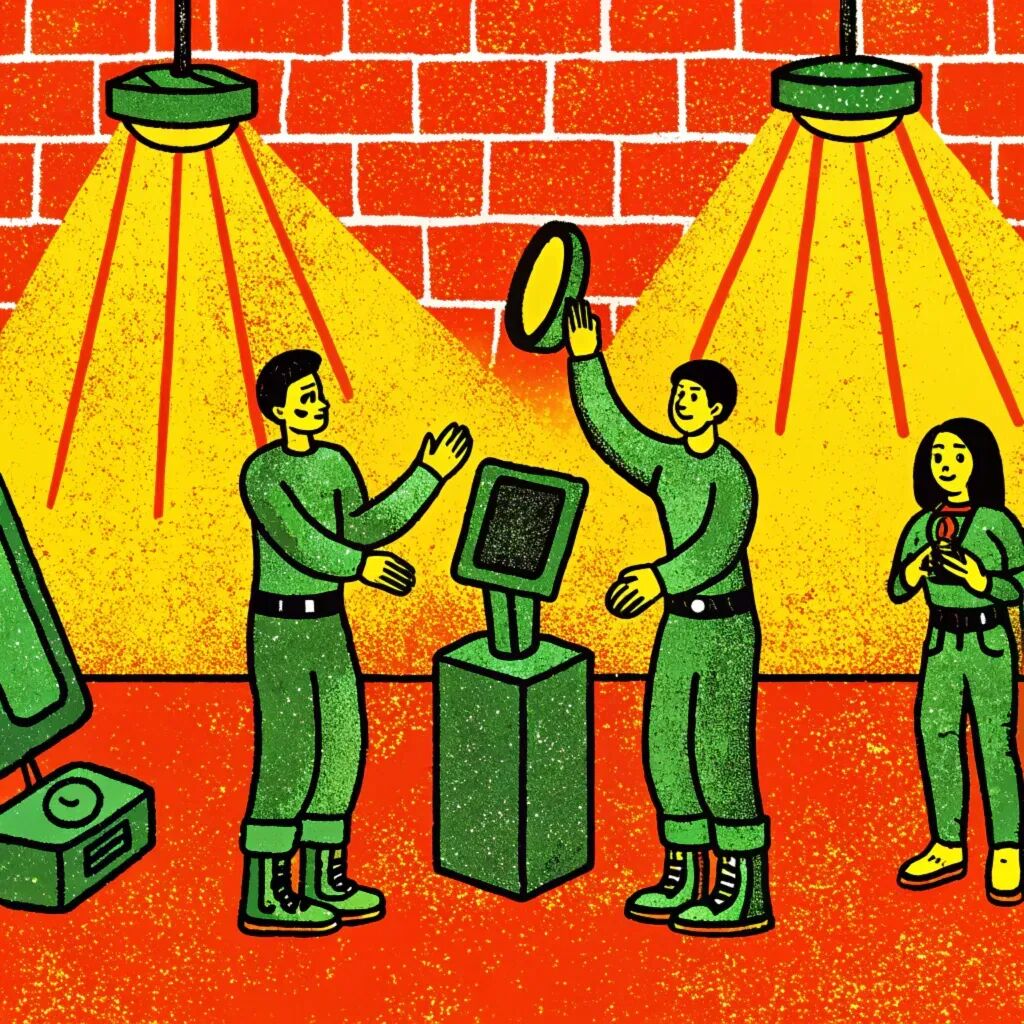 Illustration: In an incubator stage, Chinese tech entrepreneurs gesture to manipulate holographic displays floating in mid-air, showcasing their latest AI achievements. "Illustrated by Recraft"
👦🏻 Jing Liu
And from my limited observation, one characteristic of this wave of AI entrepreneurs is that they're all particularly articulate — many are excellent writers. For example, Dengke Wang's articles are very moving.
Koji, you must feel this deeply, having interviewed many such entrepreneurs.
🚥 Koji
Yes, this is indeed very important. How you express yourself to customers, employees, and investors — here "selling" is a neutral term — it's about making your ideas and your dreams understandable to everyone, making people willing to believe in you and jump on the same boat with you. And perhaps founders with this expressive ability are also more likely to stand out early on.
For example, we see Sam Altman or Anthropic's founders — they write articles from time to time, always published on their personal official websites with very beautiful layouts and design. When such an article comes out, it quickly spreads across the entire internet. I think today's media environment allows individual voices to get better exposure and influence — the leverage effect is truly significant.
👦🏻 Jing Liu
Because I was just thinking, earlier generations of entrepreneurs — like the '93 generation or mobile internet era founders — actually quite a large portion were relatively shy. Back then, people even felt that not being particularly good at expression was some kind of virtue. But today, I think this situation has changed dramatically.
🚥 Koji
Right, I think that's more of a China thing. In Silicon Valley, there's always been active encouragement of self-expression. Bill Gates is still constantly doing podcasts and short videos, actively putting content out there. He even started a Chinese WeChat public account called "Bill Gates" with very frequent updates.
Continuing on, there's another resource that AI application founders should definitely apply for today. Though it's not directly related to our primary market discussion, it's very helpful for entrepreneurs, so we'll mention it here specifically. Everyone should search for various support resources from the major tech companies.
First and foremost, I'd recommend Microsoft's Startup Founders Hub. The support it offers is quite substantial — I've confirmed this repeatedly and applied myself. It provides up to $150,000 in cloud credits (unlocked gradually), which can be used for various models including OpenAI's GPT-4o mini and o1. It also includes a startup toolkit with:
- GitHub Enterprise (20 seats, one-year term)
- Full Office suite (50 seats, one-year term)
- Stripe credits (worth $25,000, effectively waiving fees on your first $1 million in revenue)
Additionally, Google has its Startups Cloud Program, NVIDIA has the Inception program, and AWS has similar offerings. From what I understand, these programs basically require just filling out an online form — no interviews needed. There are also many similar programs domestically, including Alibaba Cloud, Huawei Cloud, Doubao, StepFun, Zhipu AI, and SiliconFlow, all with various entrepreneur support initiatives. I'd encourage everyone to look into these.
Jing Liu, I noticed that Waves has done a lot of coverage this year on dollar funds investing overseas. I was particularly struck by your piece on BAI going to Mexico, and I saw you're even considering organizing study tours to South America together. I think this reflects the proactive global posture that dollar funds are adopting.
Beyond BAI, what other funds have you observed taking concrete action?
👦🏻 Jing Liu
Everyone's talking about globalization, Hong Kong listings, or going overseas now — not just companies, but funds too. Because funds essentially follow entrepreneurs. I remember when we interviewed Songyan Huang, a partner at Linear Capital, who was in Munich, Germany. He had previously invested in Agile Robots, and through that connection discovered some local investment opportunities. I recall my repost comment when sharing that article was "The Wandering Earth of Investors."
This is a major trend — you'll find most institutions are looking for external opportunities. For example, HSG and Hillhouse announced plans to open offices in London, which got quite a bit of attention. I think in the long run, a fund like Hillhouse will definitely do global investing. Lei Zhang seemed to have early layouts in Japan and Southeast Asia, Linear may be focused on Europe, BAI chose Mexico for specific reasons. Because BAI had previously invested in some fintech companies, like Stori — initially perhaps investing with a fintech logic, only to discover Mexico's significant investment opportunities after the fact. Though indeed, after Donald Trump took office, many may have different views on Chinese VCs investing in Mexico.
But so far, the fintech sector seems relatively less affected. Going to Silicon Valley is the biggest trend — not just BlueRun Ventures, ZhenFund, and Gaorong Ventures, but including 5Y Capital, all have varying degrees of presence there. Some funds may have local teams in Silicon Valley to help build on-the-ground relationships. For instance, BlueRun Ventures' Jui previously spent ten years investing in Silicon Valley on his own, which may have created some continuity in relationship networks.
🚥 Koji
Another one worth mentioning is Sky9 Capital. I recently heard from friends there that their partners make two trips to the United States together each year. Their purpose is to build early personal connections with American scientists and PhDs. They go skiing and hiking together — trips that last several days. I think this is also their way of actively building out their Chinese network in Silicon Valley.
When discussing the overall state of dollar funds, we need to look not just at what projects they've invested in, but also at their fundraising situations.
Jing Liu, I'd like to ask — are there any particularly notable recent fundraisings? They may represent certain trends or signals.
👦🏻 Jing Liu
Overall, there haven't been that many dollar market fundraisings completed in the past three years. Some context: the 2020 consumer investment boom was actually fueled by massive dollar liquidity. So between 2020 and 2021, and even partially extending into 2022, dollar funds completed relatively large fundraisings. But after 2022, new fundraisings have indeed been scarce. I may not be able to speak systematically now, but from memory, there have been some completed rounds: the most prominent being HSG's $9 billion, which is a very large fundraising. Then Monolith as a new fund had two rounds: a $300 million VC fund and a $500 million secondary fund. Matrix Partners China also completed a relatively large round of over a billion dollars, and 5Y Capital should be around $700 or $800 million.
When 5Y Capital completed that fundraising, there was even market chatter: "5Y took the last dollar LP money available for investing in China." BlueRun Ventures should have completed a $500 million round in 2022, covering both early-stage and Priority.
Speaking of dollar funds, I think we need to distinguish a concept.
People basically equate dollar funds with foreign funds, but in the current US-China rivalry environment, typical American dollar capital actually makes up a relatively small portion of many institutions' completed fundraisings.
For example, in HSG's $9 billion, I understand a considerable proportion came from old money in the Middle East, Southeast Asia, and Hong Kong. GPs are deliberately reducing the proportion of typical American dollar capital in their funds.
This is a significant change, and a new footnote for how we re-understand so-called "foreign funds" or "dollar funds."
Also, Jinqiu Fund should have completed a relatively large new fundraising as well.

Shifting Capital Flows: New Challenges for Dollar Funds
🚥 Koji
We've talked a lot about various investment situations, including Club Deals and everyone's fundraising. If you had to use one keyword to describe this year's primary market overall, what would come to mind?
👦🏻 Jing Liu
I think the current market has several characteristics, the most prominent being fragmentation. For the past 20 years, China's primary market was mainly dollar-dominated, or dominated by dollar fund aesthetics. Back then, RMB funds spoke of dollars with envy. Even in the past two or three years, a phrase Xiao Bin often used was "the scales of history have finally tipped to the RMB side."
Now the market shows very clear fragmentation, with dollar and domestic markets further diverging. The macro backdrop is of course the result of US-China rivalry, while also relating to the asset-side characteristics of the market. Because the targets and assets that fit traditional dollar fund aesthetics are themselves quite limited now. In this process, an important trend is that state capital is gradually becoming absolutely dominant. Data shows that now, when traced through, perhaps 80% of primary market capital comes from state sources — either through direct investment or as ARP.
There's an interesting phenomenon here: the mobile internet era was a highly marketized, highly private-sector era, with founders coming from all corners. When the market began transforming in 2022, many dollar investors found it difficult to participate in some locally characteristic projects, because these were often energy companies, manufacturing companies, where the most important production factors beyond capital were government relations, land, even water and electricity — these concrete issues.
But when AI emerged, many dollar investors felt this seemed like a historical opportunity comparable to 2015, looking similar to mobile internet era opportunities. But in reality, AI differs greatly from the mobile internet era:
AI is a field carrying significant national will, quite different from those mobile internet companies that had limited relation to national livelihood.
This also explains why in this wave of AI companies, particularly the large model companies we mentioned, state capital enters relatively quickly in their fundraising processes.
🚥 Koji
Is this also because the overall dollar pool isn't large enough, and to continue raising money they can only turn to RMB?
👦🏻 Jing Liu
Right, because I think this is an important precondition. The so-called "dollar four fools" and similar institutions have indeed reduced their China investments, for market-level reasons. But the bigger backdrop is that these companies in their development do need more order support, more government interaction.
From the government perspective, they also have their own subjective will. Just as the United States has OpenAI, China also needs its own OpenAI. I remember when Sora first appeared, an AI video company shared a perspective with me: when they were raising funds in Shanghai, Shanghai wanted to build its own "Sora." This contained considerable government will.
Fragmentation is evident not just on the capital side — now institutions' investment strategies are also segmenting by region, by sector. Some investors even segment by personal judgment. For example, the recently hot topic of RBF is one case. Another notable characteristic of the era: the beginning of the era of taking sides.
In the US-China rivalry environment, beyond TikTok, dollar funds have become a target-like presence. From what I understand, The Information in its coverage particularly focuses on two institutions: HSG and TikTok. This is because they are both projections of enormous era-defining issues. I remember in early 2022, The Information's annual predictions accurately foresaw that HSG would undergo a brand split.
From today's perspective, funds' independence in brand and architecture all prove they need clearer ways to respond to the era's rupture. HSG, BlueRun Ventures, GGV, Matrix Partners China, DCM — all have made similar moves, and the logic behind this isn't hard to understand. This has a certain passivity to it, but also reflects funds hoping through this approach to achieve more flexible positioning under new geopolitical and commercial landscapes.
🚥 Koji
Right, many people are quite pessimistic about dollars now — do you share that view? Completely pessimistic, or do you see some optimistic signals within the pessimism?
👦🏻 Jing Liu
On the big beta level, it may indeed not be comparable to the past twenty years, but I also don't think we should overcorrect. Because those funds we just mentioned all completed relatively large fundraisings in 2021 and 2022. And the relatively long lifespan of dollar funds means many are still within their fund life. This also explains why there are so many Club Deals now, why many funds are still quite active in deploying — mainly because they still have ample ammunition on hand.
It's also worth noting that after the consumer investment frenzy of the past two years, dollar funds haven't actually deployed all their capital. This remaining dry powder forms an important backdrop to the current market.
Additionally, many dollar funds have recently been holding their AGMs — their annual year-end gatherings for LPs, primarily for reporting and fostering dialogue. Through our recent conversations with them, we've actually come to believe that dollar capital won't fully disappear from China. But as we mentioned earlier,
The real impact has been on US-based dollar funds; non-US dollar funds and funds denominated in other currencies still maintain allocation demand for the China market.
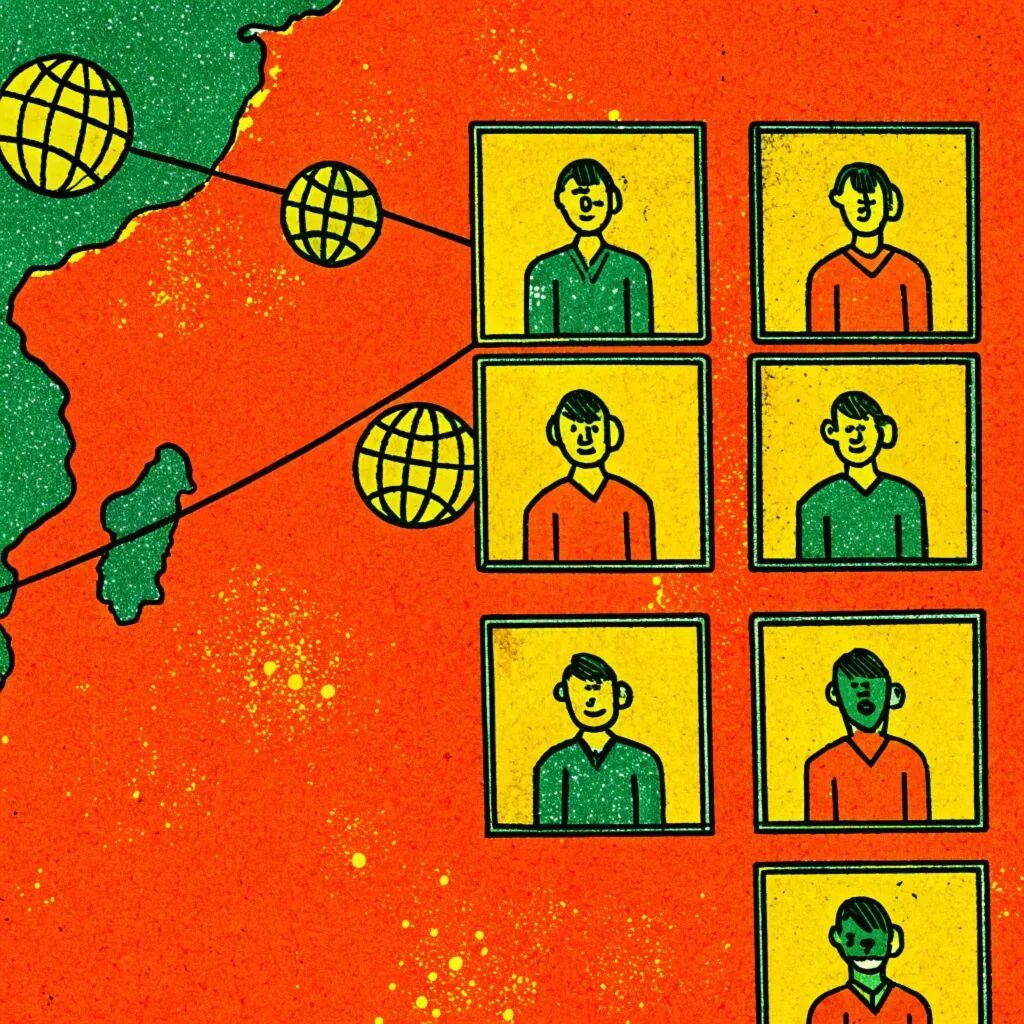
Illustration: In a workspace spanning Silicon Valley and Shanghai, entrepreneurs from different time zones discuss global expansion strategies via video conference. "Illustrated by Recraft"
🚥 Koji
For entrepreneurs, do you think there are better or worse choices when facing the decision between dollar funds and RMB funds, depending on an entrepreneur's style or the type of work they're doing?
👦🏻 Jing Liu
I think there definitely used to be this kind of fixed perception — that dollar funds were associated with greater idealism and long-termism. This is closely tied to where the money comes from and where it ultimately returns.
Because when we observe a fund's investment behavior, we focus mainly on how it deploys. But in the full cycle of raising, investing, managing, and exiting, fundraising is actually the vanguard, so I believe capital sources are crucial in determining investment aesthetics. Previously, because dollar capital had longer time horizons, it could support entrepreneurs for longer periods with more patience. So people saw this as the foundational strength of dollar funds — their greater support for idealism.
RMB funds gave the impression of being relatively more short-sighted, which also relates to their capital structure. Mostly because most have fund lives of just 5 years, some even 3. This forces them to move in and out more quickly. Though on the state capital side, you may have seen reports about supporting "bold capital" — encouraging state-backed capital to step forward boldly with government backing. I think this signal is being transmitted. But how quickly or to what extent this manifests in actual investment behavior, I think that may take time. So these different capital attributes determine how much time they give you. I think founders need to weigh this more carefully in their choices.
🚥 Koji
Entrepreneur psychology has actually undergone a sea change this year. My sense is that just 2-3 years ago, even during the pandemic, not just in tech internet or consumer internet but even in consumer goods, entrepreneurs broadly believed in the logic of "scale first, everything else follows." But now, in any field — whether consumer products or AI — everyone's discussing how to achieve profitability as early as possible. Does this observation match your experience?
👦🏻 Jing Liu
Broadly similar. I think this generation of entrepreneurs actually has it quite tough. Capital abundance today really can't compare to ten years ago, yet the things they need to do are quite difficult. To put it in perhaps slightly clichéd terms, they need to "keep their eyes on the stars while keeping their feet on the ground."
Take SiliconFlow founder Jinhui Yuan as a very typical case. Yuan himself is someone with strong technical ideals. His previous company, OneFlow, was acquired by Lightyears Away — that entrepreneurial journey was rather arduous, from 2016 to 2022, six or seven years. He used an interesting expression, describing himself as someone with strong technical ideals who paid almost no attention to commercialization. He always believed that if you built sufficiently excellent technology, commercialization would naturally follow. But he later had a major reckoning, feeling that those years of entrepreneurship were "like a performance art piece."
In founding SiliconFlow this time, his biggest change was moving toward commercialization very early, even specifically recruiting two co-founders responsible for that aspect. This transformation in Yuan is very pronounced.
Another interesting example is Yueguang Zhang's strategy. He raised roughly $50-60 million, which counts as relatively ample funding for a startup. But for a long period before determining direction, he kept total team expenses within what the investment's financial returns could cover. This reflects entrepreneurs paying greater attention to understanding cash flow and exercising stricter cost control — quite different from past spending logics of "brute force miracles" or "go big and go fast."
🚥 Koji
Right, in this wave we haven't really seen particularly exaggerated cash burning. Though there were some screenshots circulating recently claiming certain large model companies were spending heavily on Xiaohongshu and Douyin ads, these were quickly denied by the companies. Even so, we haven't seen that kind of "battered bodies everywhere" situation like the "Hundred Regiments War" or the "DiDi-Kuaidi war."
I think there are two reasons behind this: on one hand, past cash-burning wars left many people wounded with "PTSD"; on the other, at this stage, AI hasn't yet produced a "super app" truly worth burning cash for. Because AI applications currently haven't really developed network effects or social flywheels. Though some argue data has flywheel effects, market conviction on this point hasn't grown strong enough to drive large-scale cash burning.
👦🏻 Jing Liu
You're absolutely right, but I think there's an even larger backdrop — how founders today understand investment and investors. There's genuinely been a shift in thinking here, which demonstrates the value of accumulated human experience and the lessons history provides.
For example, in the mobile internet era, people generally believed business model innovation didn't have very strong moats, so whoever controlled more capital controlled the most important production factor. Later, many stories that ended in "a field of debris" made this generation of young entrepreneurs realize:
Every dollar of investment received comes with a price tag, every dollar demands its cost.
I think this reflects a more sober understanding of capital among the new generation of entrepreneurs.
Speaking of which, I'd like to ask you a few questions. You weren't strictly a primary market practitioner, right? Coming into the primary market to do Crossing for over a year now, what unexpected gains have you had?
🚥 Koji
Actually, I think everyone is more or less directly or indirectly affected by the primary market.
My three entrepreneurial ventures — Tangdao, The Fair, and previously Jiepang — all had VC backing. During the Jumei International Holding Limited period, I also experienced a story that garnered significant capital market attention — listing on the NYSE in under 4 years. As an important participant, I experienced the "full process" of the primary market.
In this AI wave, doing the Crossing podcast has brought me substantial gains. On one hand, it keeps me continuously on the front lines, engaging deeply with many people. With Jing Liu, for example, if not for the podcast, we might just be friends who meet for coffee to chat about travel — we wouldn't be having conversations as deep as today's. This lets me genuinely sense market temperature and sentiment.
On another hand, The Fair has always hoped to continue breaking through in content and marketing. We believe AI will bring many new interesting possibilities, and we're exploring in this direction.
Additionally, Crossing provides important emotional value for me. We've been saying that while the current macro environment isn't particularly ideal, this is a rare golden period of technological transformation in history. Seldom has such dramatic technological change occurred so rapidly within one or two years. The AI technological transformation has spawned many new desires, ambitions, and aspirations — behind all of which lies energy.
Doing Crossing has let me deeply feel this energy, and consequently meet a new cohort of entrepreneurs and become acquainted with many fund practitioners still actively working in the primary market. This has been a very interesting life experience. Quite different from observing the world during the smooth-sailing mobile internet wave a few years ago — for me personally, this has been significant growth.

Illustration: At this symbolic "Crossing," technology and humanities converge in warm-toned light, with people on both paths joining hands to create the future. "Illustrated by Recraft"
👦🏻 Jing Liu
Since Crossing has now done many episodes, you must have some expectations for what form it might take in the future.
🚥 Koji
Speaking of future possibilities, I was originally inspired to start podcasting by a Silicon Valley elder, Reid Hoffman. He's the founder of LinkedIn, now serving on the board of OpenAI or Anthropic. For over two decades he's been actively blogging and podcasting, which gave me much inspiration and strength.
Though we've only been at it a year, we've already gained tremendously. I think we need to persist — whether three years, five years, or throughout an entire career, doing it for 20, 30, or even 50 years is possible. Through this process, I believe it will continuously let me meet new friends and encounter new things. So this year I've encouraged many friends to start podcasts — Jing Liu should also be starting a new podcast, recommend everyone follow when it launches.
Also there's interesting news that many friends forwarded to me. In the English-speaking world there's a podcast called "20VC", hosted by Harry Stebbings. They've only been at it a few years, and recently completed fundraising for their third fund of $400 million. Starting from a podcast, they've developed into an early-stage investment fund based in Europe with global influence.
👦🏻 Jing Liu
The founder is also very young.
🚥 Koji
Right, very young.
👦🏻 Jing Liu
And you've interviewed so many AI sector participants — entrepreneurs, investors, even important people within major companies.
Among these interviewees, has anyone struck you as particularly memorable?
🚥 Koji
The most memorable recently has actually been Xing Meng, who just became a partner at 5Y Capital. We talked extensively about his career choices — how he came to understand who he really is, what his strengths are, what his vulnerabilities are. Then making subsequent career choices based on that. Though this episode was about AI, I think many listeners felt the greater inspiration came from the career choice aspect. That was true for me as well.
Another interesting one was our historically highest-traffic episode, from a former Baidu architect named Li Leding. The episode title was "I want to shatter all your illusions about AI." It was actually quite an accessible popular science piece, while he genuinely had comprehensive and detailed analysis of various major companies' AI strategies both domestically and in Silicon Valley. Combined with his strong logical expression abilities from his engineering background, that episode received much praise, and I personally gained a lot from it too.
I think both Xing Meng and Li Leding are friends I've known for ten years. But I don't think I would have had conversations like this with them before doing the podcast — especially Li Leding. We'd road-tripped to Inner Mongolia together, but we almost only talked about work, and pretty superficially at that — just "what projects are you working on lately?" But after starting the podcast, I realized it's actually been quite helpful for me. Output forces input. I've learned more, and discovered that I have so many hidden-gem friends around me.
Jing Liu
I think what you just said — I think podcasts have really given a lot of people who weren't journalists before the opportunity to do interviews.
Koji
Yes, exactly. There's another friend who left a deep impression on me. He hasn't been on our podcast, but he attended Crossing's AI Founders Meetup. This is a weekly online meetup we organize every Wednesday night with four AI founders participating. We've done 13 sessions now. Because it's closed-door, people sometimes share things they wouldn't want to say publicly.
In a recent session, there was a Silicon Valley startup founder born in the 2000s who got a16z investment — Jerry. His project addresses this: today, despite material abundance, people feel spiritually empty. Some might still find faith through religion, but most don't. So he's trying to see if AI can help people's spiritual lives — including but not limited to religious life — to get better infusions of spiritual strength.
After Jerry presented at the Meetup, everyone fell silent for a while. It was quite moving: in Silicon Valley, VCs are still actively backing dreams like this.
Jing Liu
I think this isn't just supporting dreams — it's supporting humanity's attempt at its own redemption.

Silicon Valley Ecosystem Observations: From Sequoia to YC
Jing Liu
Crossing did a collaboration with Stanford recently, and I saw you invited an a16z partner over. I'm quite curious about Silicon Valley, but I haven't had much exchange with people in that ecosystem.
Could you introduce what happened in Silicon Valley over the past year?
Koji
Actually, as we mentioned earlier, incubators have become important again for this generation of AI entrepreneurs, especially application-layer founders. In China there's Founder Park, Sinovation Ventures, and BlueRun Ventures' Buming, including MiraclePlus. In Silicon Valley, this has also become very important again.
I think the reason behind this is that in the late mobile internet era, people in Silicon Valley were focused on political correctness. Back then, people paid more attention to big M&A deals — there was even a saying that Silicon Valley was becoming Wall Street-ified. Plus crypto had its moment. Many people felt Silicon Valley had nothing to do with them anymore; even people living there found daily life boring. But with this wave of AI, we've seen Silicon Valley become the leader of the tech wave again, the engine. It feels like overnight, people were transported back to the early days of mobile internet, with many new startups emerging.
As we mentioned earlier, many AI application entrepreneurs can build a company with just one or two people, and the early-stage resources they need are exactly what incubators can provide. So incubators have become important again. Meanwhile, in this shift, I still see that the perpetual #1 and #2 are still Sequoia, still a16z. But they've also made many adjustments. For example, there was a recent interview with Sequoia Capital US about their third-generation leader, Roelof Botha.
His biggest challenge is that young entrepreneurs today feel somewhat intimidated when they hear the word Sequoia. It's associated with so many legendary names that people wonder — does this have anything to do with me? Can I even reach that level? So Botha has done many things. For example, they run this Scout program, developing various project hunters distributed across major tech companies and universities, increasing their touchpoints with early-stage entrepreneurs. At the same time, Sequoia has been writing articles and doing podcasts on social media, pushing many young, friendly-looking investor faces to the front.
And a16z — people even call it a media company — produces content at massive scale. They've taken the influence-building thing to an extreme. This is a rare institution in Silicon Valley that takes political stances; they even directly opposed California's AI bill. They do articles, videos, podcasts. Some even call it an events company — they do so many events. I think these trends are somewhat similar to what's happening domestically.
Jing Liu
You just mentioned that even an institution like Sequoia Capital US needs to make some changes, because young founders find them too distant, too old. They need to do many things to connect with new entrepreneurs. Have they made any specific new moves? For example, are they doing incubators?
Koji
I'm not sure whether they've done incubators, but as I mentioned, a16z has, and their incubator is called Speedrun, with quite a few mainland Chinese-background founders. Let's say mainland Chinese background rather than just Chinese — it better captures this group that came out of China's ecosystem.
For example, at the event we co-hosted at the Peking University Stanford Center — Abotify — they were invested by a16z through Speedrun. Also, Jerry I mentioned earlier, whose project hasn't launched yet, he's also in a16z Speedrun. I also once saw a WeChat group — they showed me their phone — there's a WeChat group of Chinese founders in a16z Speedrun with about ten people or so.
Here's another piece of information: a16z recently hired an investor with mainland Chinese background who did her undergrad in China — Daisy. They previously only had one Chinese GP, Jennifer Li. I think hiring Daisy fully demonstrates a16z's Consumer fund's active interest in Chinese projects.

Illustration: In a bright startup incubation space, young entrepreneurs are enthusiastically coding under mentors' guidance, with creative sticky notes covering the walls. "Illustrated by Recraft"
Besides a16z, we also have to mention Y Combinator. They've recently made a very big change — the biggest in their 20-year history: doing demo days four times a year, accelerating their pace. When announcing this change, they mentioned it was to adapt to the speed of AI entrepreneurship. Indeed, there are massive numbers of new projects emerging every month, every quarter, so their previous frequency wasn't enough — from twice to three times, and recently to four times.
At Crossing, we did a year-end review this year. Over roughly the past year, they invested in 270 AI-related projects. We spent about four or five hours going through them one by one. There was a data point then: among all Y Combinator's projects, even though 270 were AI projects, that was only 70% of all projects. And in their most recent demo day — the one on December 4th — AI projects reached 90% of the total, still climbing.
I said a16z is friendly to Chinese people — actually this is an overall trend. Many Silicon Valley incubators and accelerators are quite friendly to Chinese entrepreneurs. For example, HF0, this very strong incubator, only does ten projects per batch, providing three months of free food, housing, and teaching, plus $1 million. There are several Chinese projects in there, like Xiao Dun, former co-founder of Zuoyebang, with his new AI education project Ainia, and Michael Guan from Final Round. Recently Zhou Hongyi shot a short video where he himself went to HF0's house to interview Terry.
There's also the very strong AI Grant, an early-stage incubator. They're also friendly to Chinese people — they've invested in OpusClip, Creatify, Akool. As a side note, when I was preparing this content, I looked at AI Grant again. They've had four batches in their history. The first wave was around June last year; looking at that list now, it's absolutely star-studded. Didn't feel that way at the time, but now besides Perplexity, there's also Cursor, Recraft — companies that suddenly became the focus these past two months — all were in AI Grant's first batch.
Another worth mentioning is Sarah Guo. Her Conviction also did an incubator called Embed, which is also friendly to Chinese founders, like Demi Guo with Pika. The overall feeling is that in Silicon Valley, a large number of incubators are friendly to early-stage AI entrepreneurs, and friendly to Chinese entrepreneurs. Entrepreneurs with mainland Chinese background might consider looking at these incubator and accelerator opportunities. I happened to see a Notion document recently that compiled about twenty-plus such incubators and accelerators. We'll post it in the podcast show notes later for reference.
Why Be an Active Actor in the AI Era
Jing Liu
Crossing has that slogan — "Active Actors in the AI Era". I don't know why this slogan reminds me of The Fair's old slogan "We will eventually change the direction of the tide." You came up with this one, right?
Koji
Ronghui came up with it.
Jing Liu
What was her thinking at the time?
Koji
When we started this podcast, it was on January 1st, New Year's Day. Both of us felt a bit down, so we thought we should do something positive this year. This keyword was always there, and later got refined into "Finding, interviewing, and bringing together active actors in the AI era."
Today's episode touched on the market — everyone feels it's cold out there. But when we actually took stock, we found there are still quite a few active funds. You mentioned so many today, from Monolith to ZhenFund, HSG to BlueRun Ventures, then Jinqiu Fund, Shunwei Capital, Linear Capital, and more. There are actually many more names we didn't even get to. For founders in this generation looking to raise funding, I think it's worth reaching out proactively. Don't let all the news about funds "lying flat" convince you that fundraising is no longer an option.
If anyone wants to connect with any of these funds we mentioned, feel free to add us on WeChat and we'll do what we can to make introductions and help.
Jing Liu
Any final words for our listeners?
Koji
I hope everyone keeps taking positive action in 2025. And in taking action, that you keep making real progress and getting good feedback. There's a quote I've been really into lately:
"Pessimists are often right, but only optimists can succeed." Because optimists are the ones who actually take action.
And another one, from Mao Zhu, founder of Deja Vu — I've had this prominently displayed on my personal website's homepage this past year:
"Criticism always looks clever, just as building always looks clumsy."
I hope everyone can take positive action and build positively in the new year, even if it looks clumsy, even if it feels like swimming against the tide.
Jing Liu
Great. Thanks, Koji. Thanks to Crossing.
Koji
Thank you too, Jing Liu. You're welcome back on Crossing anytime, and looking forward to your podcast launching soon.
Subscribe to the "Crossing" Podcast
We focus on the industry shifts and new entrepreneurial opportunities brought by the new wave of AI technology. "Crossing" was Steve Jobs' metaphor for Apple — standing at the intersection of technology and liberal arts, where great products are born. AI is transforming every industry, and we seek out, interview, and bring together "active actors" in the AI era to explore and embrace new changes and new possibilities alongside them.
Host Koji: Co-founder of The Fair and Tangdao. I believe technology, especially AI, will fundamentally transform society and empower humanity. Welcome to reach out to chat, exchange ideas, and connect on what's next. Koji's Jike[1], Koji's website[2]
Host Ronghui: Works at a tech VC, former Silicon Valley correspondent for CBNweekly. Ronghui's Jike[3]
Join the "Crossing" Membership Community
First-hand AI news and insights
Encouraging dating, friendship, and finding future collaborators
Add our assistant on WeChat to join: Rwkfbcianvd, or scan the QR code below


References
[1] Koji's Jike: https://okjk.co/0JSUes
[2] Koji's website: https://koji.super.site/
[3] Ronghui's Jike: https://okjk.co/0cbnYV