Why Is Figma Still So Valuable in the Age of AI?

Are there other "Figma-type opportunities"?
Are there other "Figma-type opportunities"?

👦🏻 Author: Belulo
🥷 Editor: Koji
🧑🎨 Layout: NCon

Today, July 31, Figma listed on the New York Stock Exchange.
The industry is calling it the biggest tech IPO of 2025. Its valuation hit $19.5 billion, with a price-to-sales ratio exceeding 20x — nearly triple the current average for private U.S. SaaS companies (around 7x).
That premium looks even more striking when you consider how much lower Chinese SaaS valuations typically run.
A product that isn't AI-native, and that in 2025 is being targeted by AI agents as something to "challenge" and "reinvent" — how does it command such a high valuation? Has the market lost its mind?
I don't think so.
The significant P/S premium itself is the market's validation of Figma's business model maturity.
It means Figma's commercial flywheel is already clear, its growth path well-defined — not just the product of hype.
This isn't Figma's first time riding a valuation wave. Back in 2022, Adobe tried to acquire it for $20 billion. Antitrust blocked the deal, but the signal was clear:
The market had decided Figma's position wasn't just a design tool, but a super-gateway spanning creativity, collaboration, and project management.
So in this piece, we try to answer: Why, in the AI era, hasn't Figma been marginalized — why is it worth even more? What's the valuation logic behind it?
And more importantly, if that logic holds, are there similar assets still out there? Is there an overlooked "Figma-type opportunity"?
Signal one that Figma is valuable: AI amplifies the value of collaboration
A common fear is that AI-native apps will replace SaaS tools.
Figma's high valuation delivers the exact opposite answer:
The more capable AI becomes, the more important collaboration between people — and between people and AI — becomes.
The most basic design work might be simply "generate an image," but anything slightly more advanced is a complex process requiring constant team communication, iterative refinement, and tight integration with engineering.
AI does improve efficiency at individual steps.
A designer might have needed a full day to produce assets that AI now generates in a minute.
But this creates a new problem: with massive volumes of content and assets being created, how do you manage them? Curate them? Build consensus and move to the next stage?
So the more AI advances, the more valuable a collaboration platform that organizes and coordinates this creative chaos becomes — not less.
Figma is precisely that hub.
It bridges AI's productivity and human creativity, bringing order to the entire workflow.
Moreover, while Figma's pace of AI-powered product iteration hasn't been breakneck, it has consistently taken the initiative.
Right as the GPT boom was starting, Figma was already betting on AI and turning it into practical features. It didn't passively wait to be disrupted — it actively embraced the shift.
Figma started with AI-assisted auto-naming of layers, icon generation, and shape completion, then moved to Dev Mode with semantic code interpretation — consistently grinding away at productivity details.
Its subsequent launches of Make, Sites, and Buzz attempted to bridge creativity and delivery, expanding from graphical interfaces toward code generation and developer collaboration.
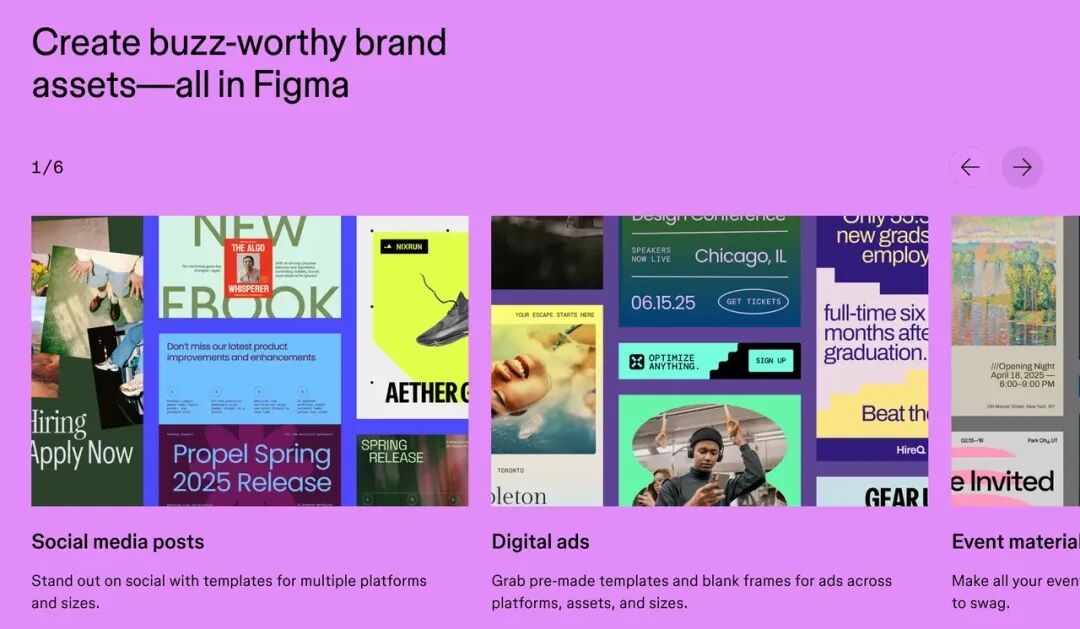
But these features remain in beta, and Figma's S-1 filing doesn't yet quantify them as major revenue drivers.
So Figma's high valuation can't simply be attributed to an "AI story."
Let's dig deeper.
Signal two that Figma is valuable: The canvas as code
Figma's deepest moat lies in its underlying architecture.
Figma's canvas is essentially "interfaces defined by code."
Every shape, every component you see — behind it all is structured code data.
And as we all know, large language models excel at understanding and generating code.
This makes Figma's architecture naturally compatible with generative AI. That opens up enormous possibilities.
For instance, a user could describe an interface in natural language, and AI would generate a highly usable design in Figma — even converting it directly to front-end code.
Andrej Karpathy, former OpenAI researcher and Tesla's former AI lead, put it bluntly in a recent tweet:
The tools that are "already code" and "naturally understandable and manipulable by LLMs" are AI's best partners.
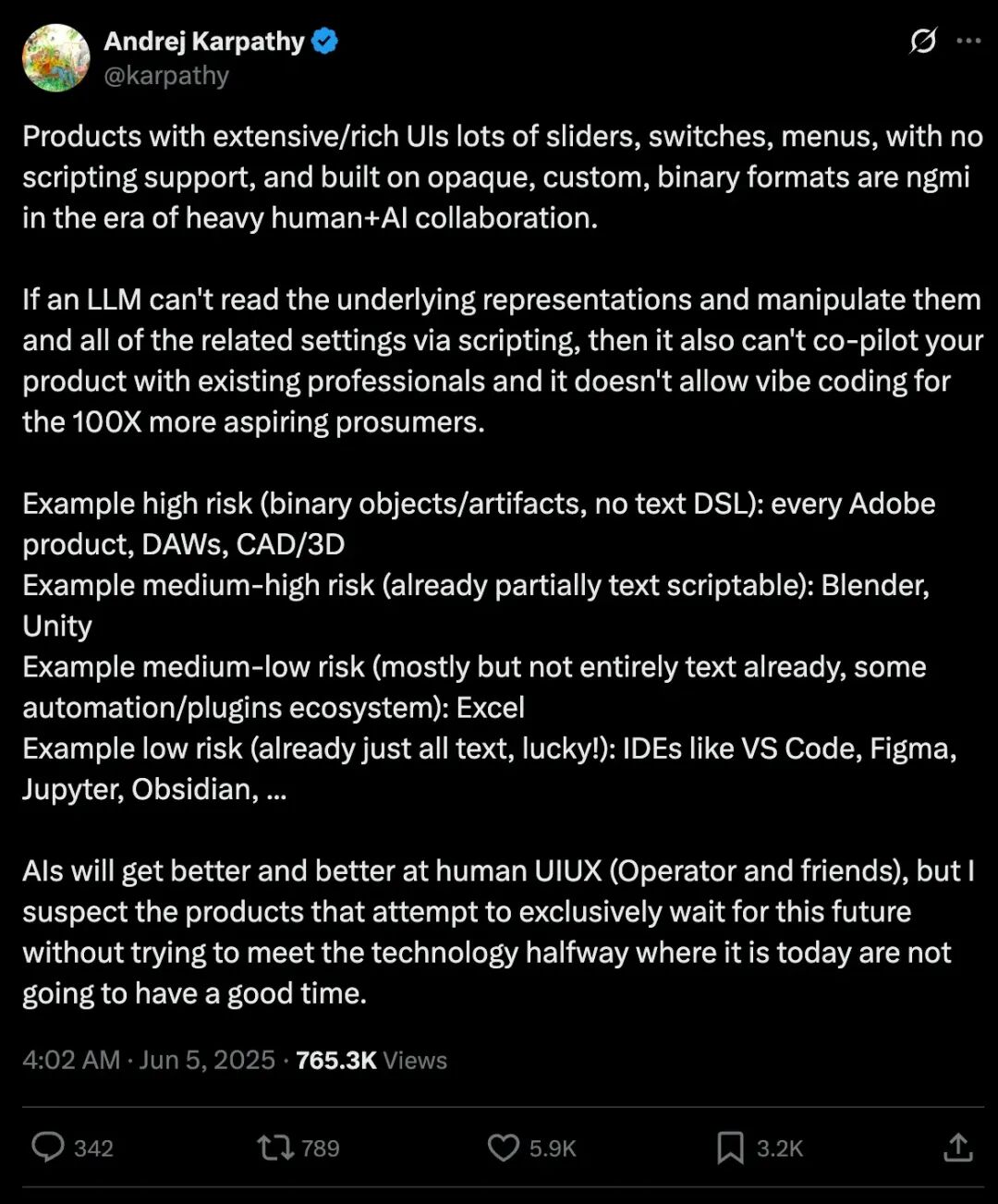
He named several products that could become AI's best partners: VS Code, Jupyter, Obsidian — and Figma.
By contrast, products that are extremely difficult to partner with AI — like the Adobe suite, digital audio workstations (DAWs), and CAD/3D tools — share a common trait:
Their foundations are closed binary files, lacking scriptable interfaces, with opaque structures that don't support natural language manipulation.
— These tools may have complex, powerful interfaces, but to large models they're essentially black boxes. LLMs can't read them, can't generate their content, and can't participate in collaborative workflows.
Karpathy put it plainly: in an era of deep "human + AI collaboration," these products are likely "ngmi" (not gonna make it).
And this precisely highlights the sophistication of Figma's architecture: It's not a pile of layers and pixels, but a collaboration container with clear structure, explicit semantics, and a "conversational interface."
This is a language AI can read — and the primary language of future collaboration.
Karpathy's insight cuts to the core, and it genuinely gave me a major realization:
Figma's underlying structure determines that it naturally synergizes with AI.
Figma is also valuable because of its user scale, strong business metrics, and wide moat
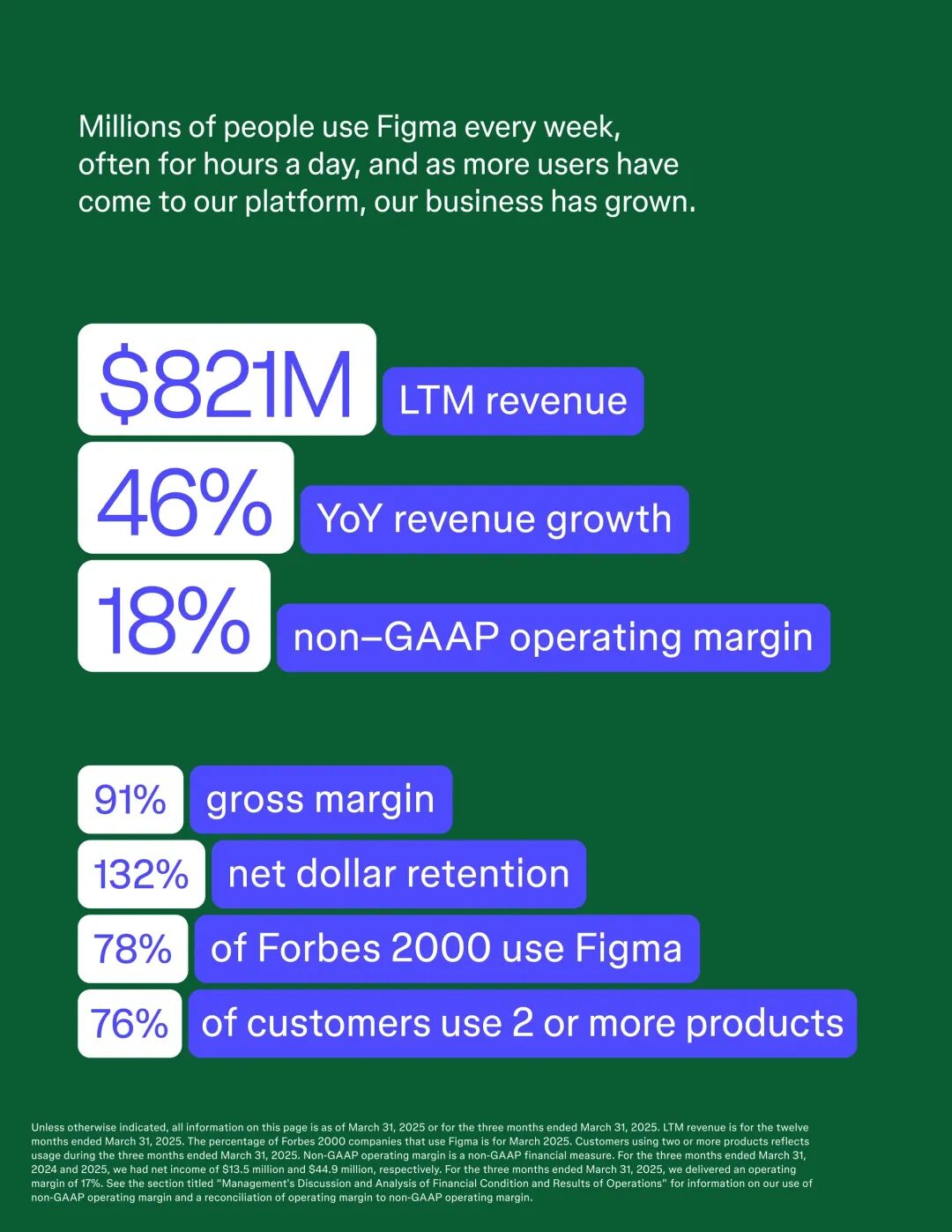
The key metrics in Figma's prospectus are stunning — its commercial performance is approaching the best levels among public companies.
Over the past year, Figma achieved:
- $821 million in revenue, growing 46% year-over-year
- 91% gross margin
- 18% non-GAAP operating margin (already profitable)
- 76% of customers using two or more products
More importantly, its customer stickiness is exceptional, with a net revenue retention rate of 132%, and 78% of Forbes Global 2000 companies using Figma.
At the same time, its strong community ecosystem, plugin marketplace, educational resources, and design system accumulation form multiple moats of high switching costs + ecosystem lock-in + tool standardization.
Where else might Figma-type opportunities be hiding?
First, let's recap Figma's success factors: powerful collaboration capabilities, AI-friendly code-based underlying architecture, continuous product innovation, strong community ecosystem, and excellent business model.
Who comes to mind?
I thought of the domestic equivalent: MasterGo. MasterGo possesses all the success factors listed above.
And it has strategic value for China that Figma lacks.
The first value is autonomy and control — fundamental to any enterprise's survival.
Many still remember when Figma cut off access to Chinese companies including DJI. This sounded an alarm for all Chinese tech firms. In an increasingly complex international geopolitical environment, building core design and R&D processes on foreign software carries extreme risk.
So MasterGo's existence first and foremost solves Chinese companies' security problem. It's not a dispensable "spare tire," but critical infrastructure safeguarding industrial security.
The second value is enterprise-grade service capability.
From day one, MasterGo chose the hardest path: serving large enterprise customers. Because in China, "whoever wins enterprise customers wins the market."
After years of investment, MasterGo's technology can stably support hundreds of users collaborating simultaneously, smoothly handling complex projects with hundreds of thousands of layers. Its performance and experience have no rival in the Chinese market.
Koji has recommended MasterGo to many people. Even internally at Tangdao — a consumer goods company without professional UI design needs — the team pays for MasterGo, because every product detail page requires meticulous refinement down to individual characters, images, and even punctuation marks, and MasterGo's collaboration features serve this need perfectly.

More importantly, MasterGo offers private and hybrid cloud deployment.
This satisfies the stringent data security requirements of finance, government, and defense industries.
This is something Figma cannot do.
Therefore, MasterGo is deeply embedded with hundreds of leading enterprises including Alibaba, Meituan, Baidu, and SF Express. Within just three years of launch, it has captured nearly 80% enterprise market share. Recognition from these top-tier customers constitutes MasterGo's most solid local network effect.
The third value is more agile AI implementation.
MasterGo was among the earliest platforms globally to integrate AI into design workflows.
It has not only launched AI-generated design drafts + automatic page code generation (AI Coding Agent) capabilities, but was also first to support the MCP protocol (Model Context Protocol),打通 from design to development across the full链路, enabling truly seamless collaboration among product, design, and engineering teams.
Compared to Figma, MasterGo has moved faster and more aggressively on AI capabilities. Its MCP Server can convert design drafts into structured data, enabling real-time linkage with AI coding tools like Cursor and VS Code, dramatically reducing the cost and error rate of design-to-code conversion, making "design as code" a reality.
More importantly, rooted in China, MasterGo has the richest accumulation of local data and deepest understanding of Chinese-language contexts, enabling it to train AI assistants that "truly understand Chinese designers" and serve real local usage scenarios.
This is the third value of MasterGo AI — not just cutting-edge technology, but practical落地; not just fast, but deep.
Figma's IPO has sent shockwaves through the tech world.
Figma combines high growth, high profitability, a clear business model, strong market recognition, and a strategic position that's hard to replicate.
In the current IPO market recovery, it has become one of the few "consensus-quality assets," naturally commanding a valuation premium.
This scarcity, resonating with market sentiment, further amplifies its valuation level, making it a rare quality asset in investors' eyes.
Just a year ago, AI image tools like Midjourney were loudly proclaiming they would replace designers. The result? Designers weren't replaced — instead, the value of design collaboration platforms surged to new heights.
In the AI era's scramble for dominance, the competitive landscape is being reshaped.
New-generation AI-native products have no baggage, giving them the freedom to build from scratch and the advantage of fully leveraging AI. But Figma shows us that mature products with scarce value won't be eliminated — they can be beneficiaries too.