The Evolution of AI Search, the Manus Explosion, the Rise of Agents, and AI's Transformation of Education: Jishisan's Tech Outlook for 2025
The world is speeding up.

This week on Crossing, we're joined by an old friend, Jisan Ji. He's best known as the founder and CEO of Guokr, but he's also a lesser-known hardtech angel investor whose fund has backed projects in brain-computer interfaces, AI hardware, and more. Beyond that, he's something of a Doraemon — his pockets are always stuffed with the latest AI gadgets and products.
Jisan and I have both found ourselves increasingly reaching for AI search tools like Perplexity[1], Quark[2], and Metaso[3] instead of traditional search engines like Baidu and Google. And AI search has evolved rapidly, from simple web-connected queries to DeepSeek[4] and Quark now supporting deep reasoning models layered on top of web search — the results are getting genuinely impressive. We'll talk about what this shift in search habits means for user experience and the competitive landscape.
We recorded this episode right in the middle of the Manus[5] frenzy. I'm an advisor to Manus, and I was also an early angel investor in Red Xiao's previous company, so I witnessed the entire journey from initial idea to internal testing to the stunning launch — it was a wonderfully magical creative ride. Jisan and I were among the first to get Manus invite codes, and we both came away highly impressed. In the days since, plenty of netizens have criticized Manus for hunger marketing and lacking substantive technical breakthroughs. I saw Jisan even wrote a spirited "In Defense of Manus"[6] piece. In the second half of this episode, we'll share our hands-on experience and observations.
Finally, I'll ask our Doraemon to open his pocket and show what new and interesting AI products and hardware he's picked up lately.
Listen on WeChat:
Listen on Xiaoyuzhou:

First Encounters with AI Search and Its Evolution
🚥 Koji
Let's start with Jisan introducing himself to everyone.
👦🏻 Jisan Ji
Hello, Crossing listeners! I'm Jisan Ji, founder of Guokr. Koji and I go way back, so I'm really happy to be here chatting today.
🚥 Koji
Welcome to Crossing, Jisan! Today we want to focus on search, especially AI search.
My first question for you: When did you first use AI search? What did it feel like? Do you remember?
👦🏻 Jisan Ji
It was probably not long after Perplexity first launched — I tend to try new products pretty early.
Looking back, it felt like the first time I used a touchscreen phone: surprising, yet completely natural. Surprising because I'd never searched this way before. Natural because it felt like a more intuitive product interaction, closer to what I'd always wanted search results to be. So it was quite remarkable.
🚥 Koji
From that first time until now, it's probably been a year and a half, maybe even two years. Have you noticed changes or evolution in Perplexity and similar products?
👦🏻 Jisan Ji
There's been plenty of evolution, but honestly I can't clearly recall specific product changes.
I think you gradually just get used to it being a better search mode — or at least for users like us, the structure becomes clearer, the content more expansive. But it also starts feeling like something completely natural, just part of your environment.
Actually, I'd be curious to hear your answer to this. What changes have you noticed over the past year?
🚥 Koji
I'd say it's gotten smarter.
At first, its understanding of intent could be fuzzy — you might need to follow up or adjust a couple times. Also, I remember web search being pretty slow initially, and that's improved a lot. I've also been constantly adapting — figuring out when to use it versus when to stick with Google or Baidu. It's been an ongoing process of adjusting my own habits as I interact with it.
So do you have your own distinctions now? When do you choose AI search versus traditional search like Baidu or Google?

Traditional Search vs. AI Search
👦🏻 Jisan Ji
If I'm looking for a specific URL, I'll definitely still use traditional search. Or if I clearly remember or am fairly certain I need to find specific information on a particular site, traditional search still makes sense.
But when you're just opening up a question and want a relatively straightforward way to get the full picture, I think AI search is the better presentation format today.
🚥 Koji
Yeah, that's similar to me. When I want a simple, factual answer — who wrote a certain book, or I heard about a new product and need to find its website — I'll use Baidu or Google. But for anything more complex, where I need a more developed answer, I instinctively go to AI search.
👦🏻 Jisan Ji
AI search generally takes longer overall. So when you know the answer to your question is relatively simple, traditional search is still the easier path.
🚥 Koji
Right, and with traditional search you still can't escape the ad experience, which today takes up quite a lot of real estate.
I think we've all developed the skill of identifying what's an ad and what isn't, but ads are still occasionally deflating. I saw a joke online where a user said "On Baidu, you have to climb over three mountains of ads before finding the real answer" — mocking how the top three results are almost always ads (laughs).
You mentioned using Perplexity. Beyond that, what other AI search products have you been using lately?

A Blooming Field of AI Search Products and Deep Reasoning Mode
👦🏻 Jisan Ji
Domestically I use Metaso, and I've recently started trying Quark, plus Google's newly released AI Mode — I try all these new products.
🚥 Koji
Quark has pretty solid mass-market penetration. I saw a16z put out a new ranking recently, a list of AI mobile apps. What's remarkable is that in MAU rankings, Quark came in sixth globally — definitely made me see it in a new light.
You also mentioned Google's new AI Mode in Search Labs, which is positioned as a Perplexity competitor. Whether it's Google's new product, or Moonshot AI, or ChatGPT, or Grok — they've all integrated web search functionality. Users can flip on the search switch and have the model query the web for information when asking questions.
Lately it feels like AI search has entered a kind of "hundred flowers blooming" phase. Jisan, have you tried DeepSeek's deep reasoning plus web search? It's built on top of the R1 reasoning model with web search layered on.
👦🏻 Jisan Ji
Yes, I think the combination of deep reasoning and web search makes for an excellent overall experience. It understands your intent much more accurately.
We all talked about this after the Spring Festival launch — watching its chain-of-thought process is genuinely fascinating. Of course, DeepSeek itself was pretty unstable initially, so everyone was scrambling for alternatives. That's actually what led me to try Quark's new search features — it was extremely fast and surprisingly impressive.
Quark is using their self-developed Tongyi Qwen model, right?
🚥 Koji
Right. I posted on Twitter a few days ago that while everyone was rushing to integrate DeepSeek's R1 reasoning model, three holdouts remained: Quark, Doubao, and Moonshot AI.
The reasons behind it are all pretty similar — all three have their own self-developed reasoning models. Moonshot AI has K1.5, while Doubao and Quark are built on ByteDance and Alibaba's respective reasoning models. So none of them chose to integrate DeepSeek, and instead used their own.
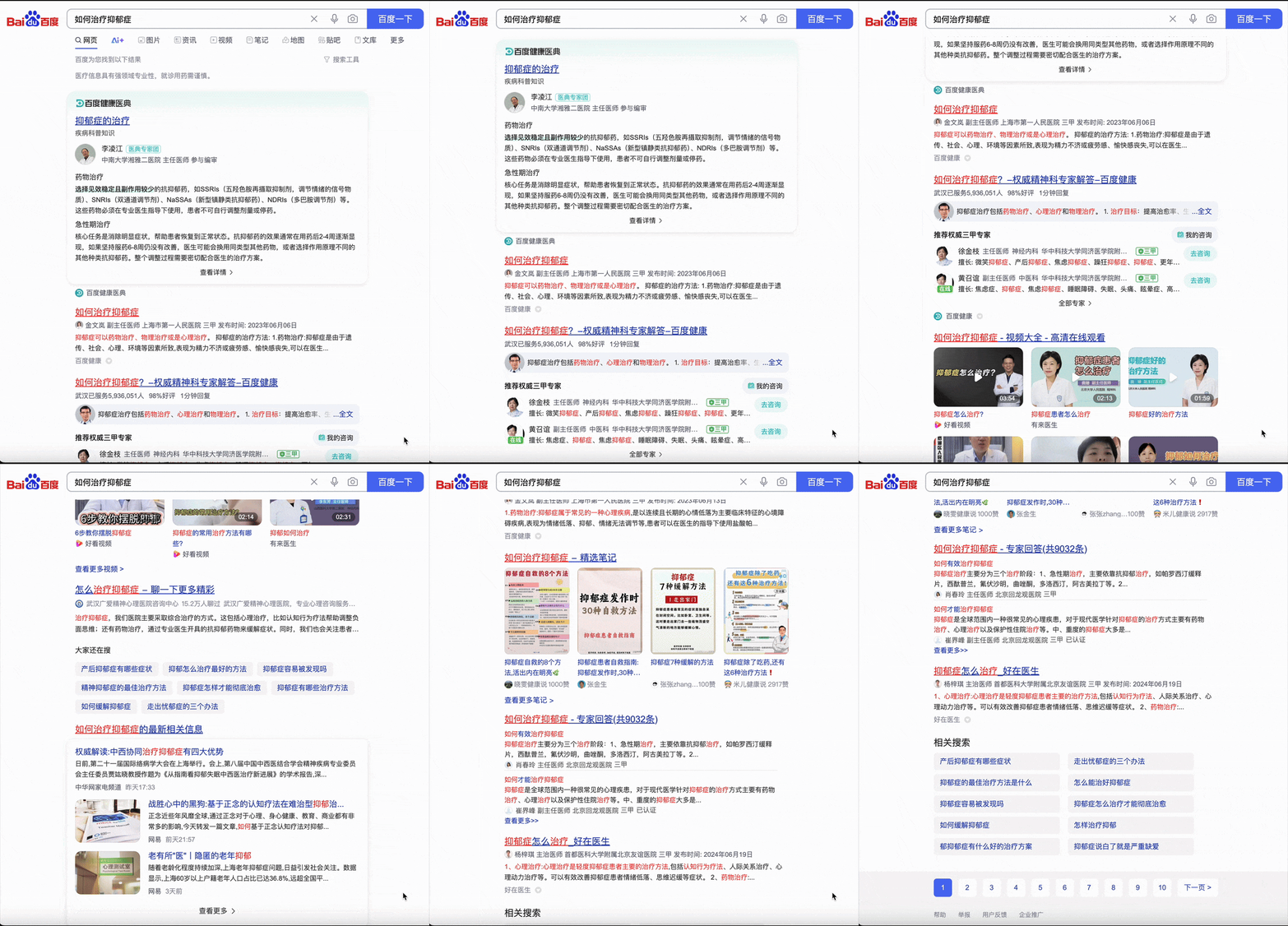
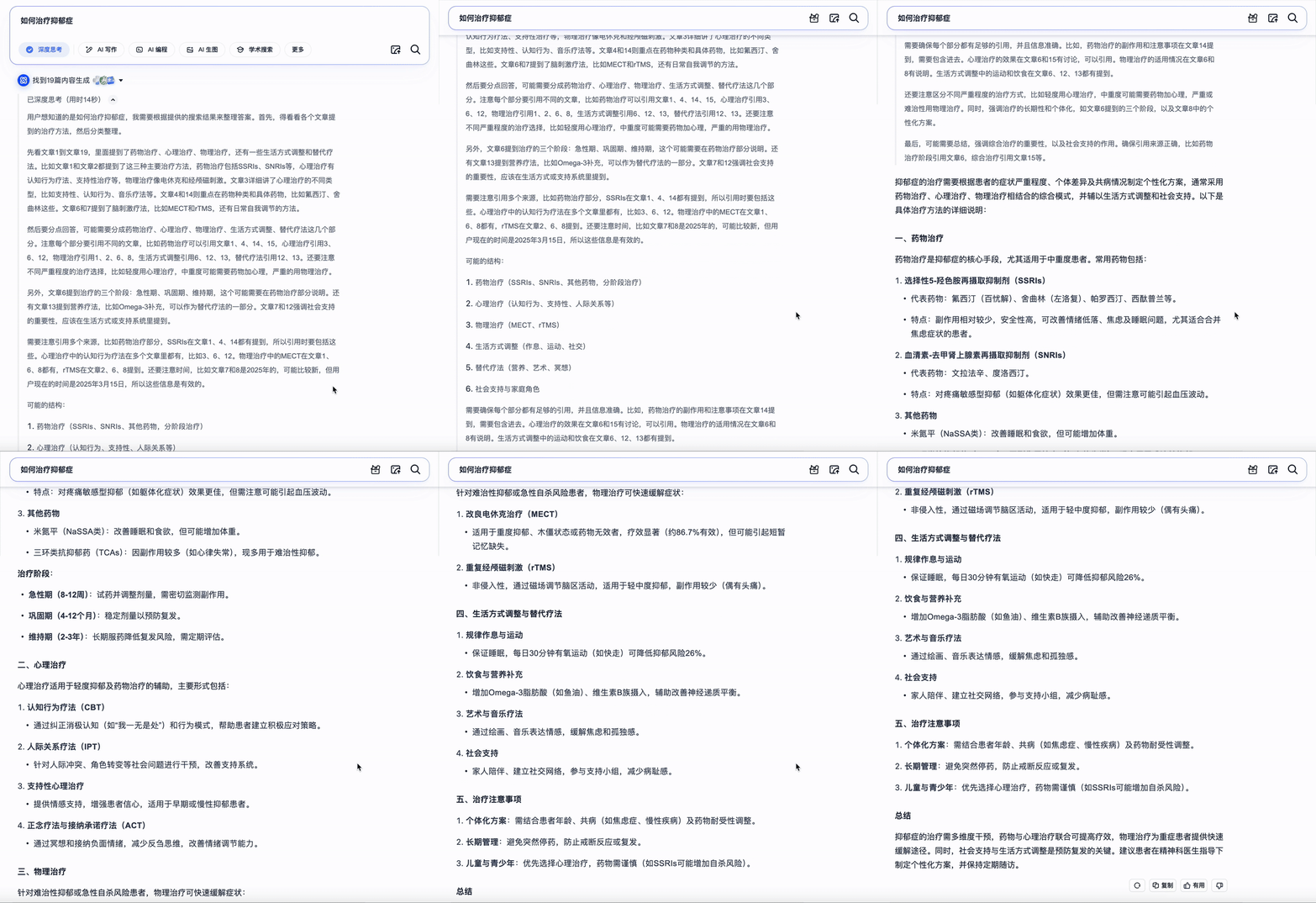
Actually, while Jisan was speaking, I was running a comparison. I came up with the question "how to treat depression" and tried it across Baidu, DeepSeek, and Quark with deep reasoning plus web search. The results came out quite differently.
For example, Baidu's results were pretty much what you'd expect — a bunch of links from all over the web. DeepSeek and Quark, on the other hand, delivered something more like a full article, covering the full context, various suggestions, and warnings in a much more complete way.
Attached: Baidu search results
Attached: Quark search results, with "Deep Reasoning + Web Search" enabled
Attached: DeepSeek search results, with "Deep Reasoning + Web Search" enabled
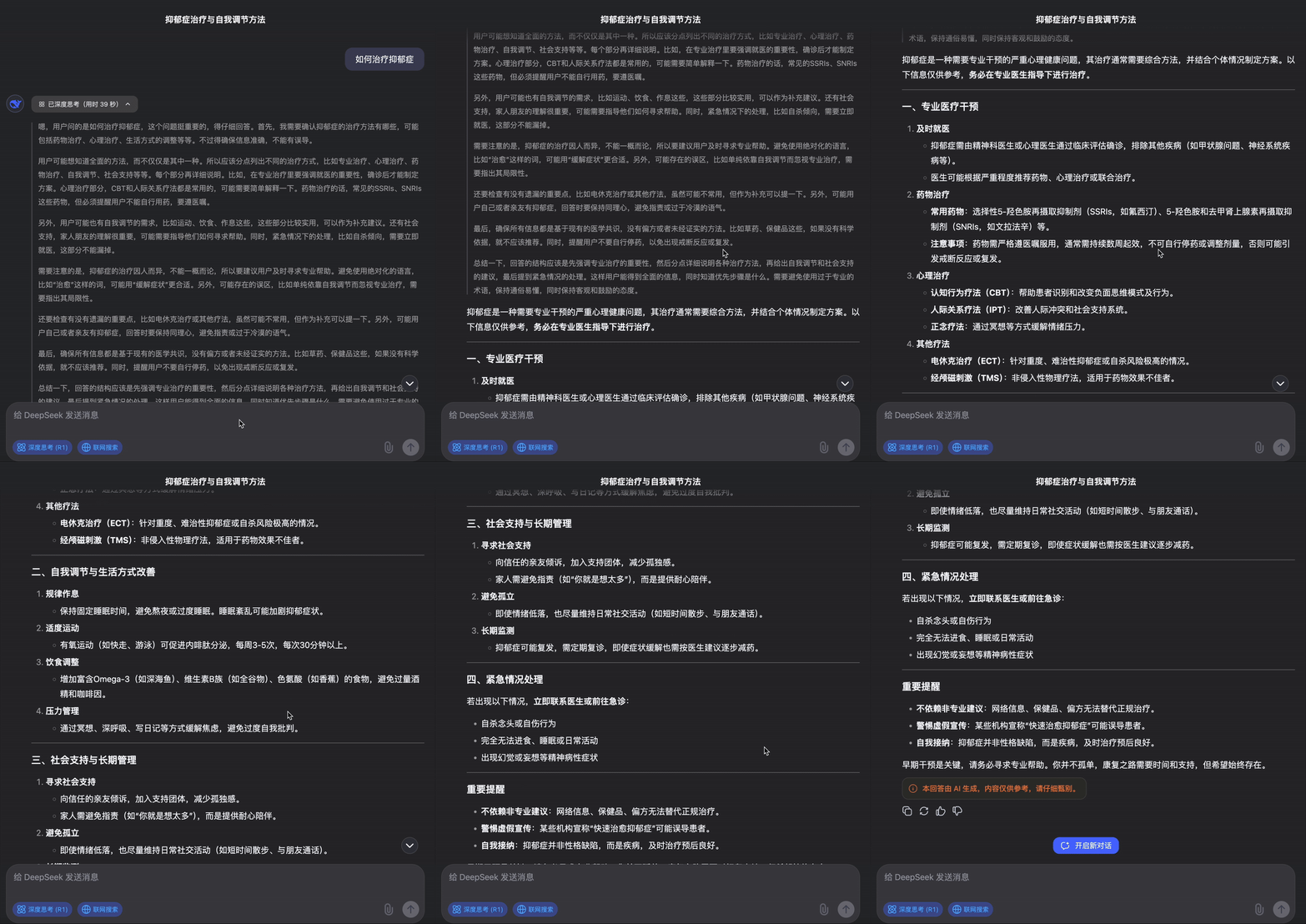
After reading through one of these results, you basically get a solid, comprehensive first understanding of the topic. So I really think this is something: AI search with deep reasoning feels like a far more thorough disruption of traditional search than anything before.
👦🏻 Jisan
Lately I might search for something like: "how the Russia-Ukraine battlefield has changed in the past two days after that White House argument." In cases like this, AI search gives you a really comprehensive overview, which I find incredibly useful.
🚥 Koji
That's fascinating. Because it can now pull real-time news from everywhere, then aggregate and analyze it to give you an interpretation — that's way better than traditional search.
With traditional search, I'd just get a pile of news articles. I'd have to read through them one by one, then do the comprehension and abstraction myself. Now AI search handles that step.
👦🏻 Jisan
For example, I could also ask it to look at media with different values, or media from different countries, and see how their coverage and slants on the Russia-Ukraine battlefield differ. That's something AI search can do pretty easily, but it's a real pain with traditional search.
🚥 Koji
With Baidu and Google, you need to input a fairly precise question. But with AI search, you can give it something really vague and conversational.
👦🏻 Jisan
With AI search, our habit is still to ask as clearly described a question as possible. But with traditional search, if you're mostly just trying to get a URL or something, you'd probably use more of a noun phrase. So this actually represents a shift in our search habits.
But asking a precise question in AI search is actually harder for ordinary users. So I'm not sure whether this raises the barrier or lowers it.
🚥 Koji
I think AI is evolving. Maybe three or six months ago, before DeepSeek launched, there were still tons of courses online teaching you how to write prompts, right? Like the whole "learning AI" thing was basically learning how to write prompts.
But now that's slowly disappearing. It's because AI is getting better and better at understanding vague expressions — even helping you summarize what you meant but didn't fully express, or following up with clarifying questions. So I think the barrier is actually dropping constantly. I sometimes find myself in what I'd call "low-altitude flying mode" when talking to AI, whether it's a chatbot or search — my brain isn't running at full speed, I'm kind of fuzzy, haven't thought things through completely, but I just type whatever comes to mind, and AI is pretty good at reading between the lines now.
👦🏻 Jisan
AI is still relatively slow to generate results, so sometimes I want my question to be more precise, to get as complete an answer as possible in one go.
🚥 Koji
I used to be like you, but now I've developed different styles for talking to humans versus talking to AI.
Early on, whether with AI or people, I'd deliberate over every word, wanting to express myself with crystal clarity and completeness, so the other party would have zero cognitive load and basically get what I was asking in one shot. Now, I still keep that habit with friends and colleagues. But when I talk to AI, I enter that "low-altitude flying mode" I just mentioned — I trust that the AI on the other end is omniscient, with high IQ and high EQ. No matter how vague, stupid, or clumsy I am, it can understand me, or it'll patiently chat with me for another round or two to figure out what I mean. That really does feel pretty great.
👦🏻 Jisan
If you equate AI with a partner, you basically default to assuming its intelligence is superior? Compared to a human partner, so you just need to toss it some vague requirements and get a better answer.
🚥 Koji
I don't think I've really thought about it from that angle specifically. I just feel like I toss everything at it first and see what it says. Then based on its response, I decide whether to adopt it or not.
I don't have unlimited expectations that it can solve everything. It's more that I run into stuff and I toss it in to try.
I think this is actually a mindset you gradually develop through the磨合 process. When you expect it to be omniscient, you get disappointed fast. There's plenty it can't do.
And I've noticed that AI always caters to me. For example, I was brainstorming with it before, and whatever I said, it was like "great idea." So I had to deliberately cultivate a habit: when I share a new idea, I tell the AI — you must give me enthusiastic praise and harsh criticism from both positive and negative angles. After that, the feedback becomes much more useful. AI is a great discussion partner, but you have to adapt to it, train it.
👦🏻 Jisan
It doesn't actually give you very surprising answers that easily, at least when your prompt is relatively simple.
So it's probably above average human level. But when you want more exceptional performance, your prompt needs to be good enough.
🚥 Koji
Right, one part is writing good prompts, another part is that I try to squeeze everything out of it.
For example, when generating headlines, I'll have it produce ten first, then if those don't work I'll immediately say ten more, ten more, ten more... until it surprises me. Because it's a non-complaining "AI workhorse."
🚥 Koji
Getting back to AI search — I even saw a self-media article recently saying: "We can't even remember the last time we used Baidu search." That's slightly exaggerated; I actually still use Baidu and Google pretty regularly.
Will AI search replace traditional search? What do you think?
👦🏻 Jisan
The fact is, traditional search market share hasn't dropped — the absolute numbers haven't fallen.
I think search will gradually evolve into a hybrid of AI search plus traditional search. For users, it's actually not that easy to clearly judge when to use traditional search versus AI search. Of course all search products will incorporate AI features, which I think will probably become standard.

AI Search's Impact on Traditional Search and Business Model Transformation
🚥 Koji
People tend to think Google and Baidu today are facing a classic "innovator's dilemma."
Because their business models are built on traditional search plus keyword-based advertising. As we mentioned earlier, netizens mock Baidu for having to climb over three mountains before finding organic search results and answers — Google is similar in this regard. And this business model has generated tens or hundreds of billions in commercial value, so they can't easily abandon it.
That's why I find Baidu and Google's responses to this wave of AI search disruption rather awkward, even clumsy. For instance, they've integrated AI search results, but seem reluctant to roll them out fully. Because once fully deployed, users might not need to scroll down to see ads anymore. Their business model, the very foundation of their companies, would be shaken.
👦🏻 Jisan
Right, this isn't a product and technology evolution problem — it's a battle of business models.
Because for major tech companies today, launching AI search doesn't seem like a huge technical challenge. But we've seen Google and Baidu face a genuinely difficult decision here. As you said, they've actually rolled out AI search features, but haven't fully released them.
It comes down to what monetization models AI search might have going forward. If AI search can make advertising work, or eventually will, then from Google and Baidu's perspective, change becomes easier. But if it remains a paid membership model, they'll continue facing the innovator's dilemma.
Advertising in AI Search and AI SEO: A New Value Weighting System
🚥 Koji
I've been looking at various attempts to monetize AI search, direct and indirect.
The first is Perplexity's paid membership model, from day one. This is completely different from Google and Baidu. Google and Baidu never had a paywall for search in their history, but Perplexity required users to pay from day one to access advanced search or more queries.
The second, also Perplexity, is that they've started experimenting with ads. When it returns a result, it serves recommended ads based on the intent behind the user's query.
There's a startup in Silicon Valley called Nexad[7], which co-hosted an offline event with Crossing in Beijing last year and is also backed by a16z. They're exploring AI-native advertising, partnering with search engines like iAsk.ai and various companion chatbots. When users interact with AI — whether chatting or asking questions — Nexad generates ads automatically based on contextual user intent and advertiser assets in their database, pushing them at precisely the right moment. They've been getting quite a bit of attention.
👦🏻 Ji Shisan
So do these ads appear alongside the answer as recommended ads, or are they embedded directly into the answer itself?
🚥 Koji
Both. What I've seen includes ads appearing directly on the side, as well as ones embedded right into the body of the response.
Speaking of embedding into responses, there's a buzzword going around lately called AI SEO. Everyone knows SEO — it's about influencing rankings on Google and Baidu. AI SEO refers to a series of actions, from content to operations, aimed at influencing large language models.
For example, if you ask ChatGPT or any large model "Is Coca-Cola good?", the answers will vary. As the Coca-Cola brand, you'd very much want the model to give positive, favorable responses whenever it mentions you. So-called AI SEO is about helping large models express, introduce, and represent brands in a better, more positive, more comprehensive way.
So I've seen some startups working on this too. Peter Thiel invested in a company called Profound[8], a New York-based startup. Their website lists a bunch of well-known consumer and financial brands, all hoping to influence AI so that when users ask about them or search for them, they get sufficiently positive responses and outrank competitors.
Traditional search engines rely on page rank for answer ranking. But AI search seems to be establishing a new value-weighting system, and how to win favor within that system is a pretty interesting new frontier.
👦🏻 Ji Shisan
Yeah, this is genuinely a fascinating new topic. After DeepSeek blew up domestically, I've gotten a lot of outreach from brands wanting to understand how to appear more in DeepSeek's answers. This really is a new opportunity in value-weight distribution.
It even makes me wonder: Will this process make the world better or worse? If answers can be SEO'd, and ads can be woven into them more seamlessly, more indistinguishably — does that make things better? I'm genuinely quite puzzled.
🚥 Koji
I think the question Shisan raised is something I've been mulling over too. It's a lot like Douyin, TikTok, or Xiaohongshu — constantly pushing you content you want to see. On the good side, it satisfies your needs and makes you happy; on the bad side, it locks you in a small information cocoon where you're content, oblivious to all the strange, wonderful, explorable things outside.
But regardless, this technological progress has an unstoppable quality. I think all we can do is advocate — for instance, if AI SEO really takes off, hopefully model providers will clearly label what's an ad versus what's organic when giving users answers.
👦🏻 Ji Shisan
So large models will eventually launch a true VIP version, completely ad-free (laughs).
🚥 Koji
Then again, are Baidu's organic search results really not ads? Or do they not have marketing motives behind them?
Not really, right? You can't say that if you stripped away Baidu and Google's ads today, the top results wouldn't be ads — they definitely have marketing attributes too.
Because things with commercial value are what people sustain and maintain, and only then can they get more content production resources and attention, and only then can they rank higher. So as they say: water too pure has no fish.

The Future of Search Entry Points and Hardware Evolution
🚥 Koji
Let's wildly speculate — I know Shisan has tried many pairs of AI glasses and buys all kinds of AI hardware the moment it drops. So I'd love to imagine together: what will search entry points look like in five years?
👦🏻 Ji Shisan
I was just telling a friend recently that everything I bought last year ended up gathering dust.
I think the most important computing center in five years will still be the phone. But there may be more opportunities for hardware presence across different endpoints. For example, I recently replaced my smart speaker at home with Xiaomi's latest version, so it can do continuous dialogue now, and I use it more. The glasses actually gathered dust too, but if they get lighter — and if Apple Vision Pro gets lighter — there'd be more occasions to use them. So I think the phone will definitely stay in your pocket; that pocket itself isn't disappearing.
But smart speakers are at the center of the home, glasses might be for outdoor scenarios, and in cars there'll be different interaction entry points for different situations. These entry points might manifest as search, or might not be what we call search today — hard to say.
But different scenarios having different hardware to share our interaction with the world feels quite natural. Including the recent rise of autonomous driving — Huawei domestically, FSD overseas — there's more interaction with the car while driving. The car itself can obtain much more multimodal information, whether video or voice, directly serving as a search input providing richer context. So search itself will get a better, more interesting experience.
🚥 Koji
You mentioned this Xiaomi speaker — you had to get the new version for multi-turn dialogue. Is that a hardware swap, or just a firmware/software upgrade?
👦🏻 Ji Shisan
Xiaomi launched a Pro version of their speaker, and supposedly only this version supports continuous dialogue, so I bought a new one.
🚥 Koji
What kind of continuous conversations do you have with it?
👦🏻 Ji Shisan
Not too many, but since it's mainly for my kid at home — before, the child would ask Xiao Ai a specific question, get an answer, then have to wake it again for the next question. Now you can do two or three rounds of dialogue, which is slightly more convenient.
🚥 Koji
I do feel that whether it's Xiao Ai, or in cars, or even AI glasses — all of this combined is a major shock to traditional search. Not to mention how much we already search within WeChat or on Xiaohongshu in so many scenarios. It really makes you worry for Baidu and Google.
👦🏻 Ji Shisan
Xiaohongshu recently launched a search product I find quite interesting, called "Dian Dian." Since Xiaohongshu is now using a standalone app, I think the ambition is pretty big, and quite interesting.
Because people already search quite a bit on Xiaohongshu today, so having a standalone app with an inference model integrated — the whole experience is pretty solid.
🚥 Koji
I actually downloaded Dian Dian too, but I can't seem to remember to open it. I search on Xiaohongshu constantly, but somehow can't recall when to open Dian Dian. Have you developed a habit of opening it?
👦🏻 Ji Shisan
Not really. But I think users who treat Xiaohongshu search as their primary product might be more receptive.
🚥 Koji
I really feel for Baidu — squeezed in front by Xiaohongshu and Douyin, WeChat eating away at its search market, and behind it a whole pack of well-executed AI search products.
Speaking of which, Quark is actually a long-time player in search too.
Previously when people mentioned it, they'd say Quark Search. But interestingly, it never had that much presence in the search space. And it's quite unique — unlike Baidu and Google, it didn't choose the ad monetization path from the start. It's always pursued search plus tools.
Then everyone suddenly realized, "This is interesting, they seem to have found the right direction" — when it pivoted to AI search, it didn't face the resistance Baidu had from being dependent on an ad-based business model.
Recently, Quark launched a major upgrade with the concept of "AI Super Box." Users simply input commands in the "AI Super Box," and Quark automatically recognizes intent, plans and orchestrates calls to various models and agent modules to help complete tasks.

Daily AI Applications and Productivity Tools
🚥 Koji
We've talked a lot about AI search. Next is something I've been looking forward to — I'd love to ask Shisan about AI apps you use daily. Which ones did you use heavily before but don't anymore, and which have you suddenly started using frequently?
👦🏻 Ji Shisan
I've been using Monica more lately. Its DeepSeek integration works quite well, and it's gained traction. I used Monica quite a bit before because it aggregates many AI models, so when you need different models, it's a one-stop solution. Koji, what do you use most?
🚥 Koji
I also use Monica the most, because it's N-in-one.
Sometimes when one model doesn't give an ideal answer, or gets stuck, I'll quickly switch to another. And it has an interesting feature where you can have eight models answer the same question simultaneously.
👦🏻 Ji Shisan
I often have it answer the same question and compare. Also, since I don't pay for Claude, when I want to use Claude I go through Monica (laughs).
🚥 Koji
I've also been using ChatGPT's Deep Research lately, mostly for tasks I want to slack off on.
👦🏻 Ji Shisan
I couldn't bring myself to pay $200 (laughs).
🚥 Koji
A friend who works at ChatGPT gave it to me.
For example, before we recorded this podcast, I had Deep Research look into some of Ji Shisan's recent activities and give me suggestions on what topics we could discuss.
While a regular chatbot could handle this kind of task too, Deep Research usually does it better and more comprehensively.
👦🏻 Ji Shisan
Do you use any more novel AI applications? Or something more niche, more cutting-edge?
🚥 Koji
I wouldn't call it niche — I'm extremely heavy on Notion AI.
👦🏻 Ji Shisan
I haven't turned on the AI features. What do you use it for?
🚥 Koji
First, I write all my documents in Notion, and Notion AI is seamlessly embedded into every single corner of your documents.
Like I mentioned earlier with "low-altitude flight mode" — when I'm tired, writing documents puts me in that state too. I don't fuss over word choice, whether in English or Chinese; I'm pretty casual about it. As long as my meaning is basically clear, after writing I'll select the content and have Notion AI rewrite and polish it for me, and the results are always excellent.
For instance, if I'm halfway through a document and getting tired, I just hit space to bring up the AI and have it generate a framework for the second half — works great too. Because AI is completely embedded in the document, you can use it anytime, anywhere. You can select any section and ask it to revise, or after finishing an article, if you find a transition too abrupt, select that sentence and have Notion AI give you five alternative options based on context.
What's even better is that it's not limited to working with a single document — it can draw from your entire Notion knowledge base. When I'm writing something new, like this interview outline, I can have it reference other related documents to draft it. Just @ those other documents to it, and it can combine my writing style with accumulated knowledge to generate appropriate content. So I've become quite dependent on it, interacting with it almost every day.
👦🏻 Ji Shisan
That sounds promising, I should try turning it on.
🚥 Koji
Another one that's had me pretty hooked lately is Recraft — it was trending on Xiaohongshu a while back.
What blew up on Xiaohongshu was its "highly overexposed photo" style, which is just one of its N filters. But many of its other filters, whether illustration mode or realistic photo mode, have very distinctive styles that I really like.
Every cover on the Crossing WeChat account uses a running theme. Whether it's doctors or geeks, they all show strong power and speed. This running style has become my main design element for covers lately. Besides that, Recraft's illustration templates are also very refined — I've used its fixed templates for several recent articles. This tool is really great, and it offers 50 free generations daily, which is completely sufficient for everyday use.
🚥 Koji
Shisan, you strike me as a hexagonal warrior — you're a CEO, you do investing, and you're also creating content yourself. So I can imagine your daily tasks must be extremely varied and messy. Have you found certain types of tasks that are particularly well-suited for AI?
👦🏻 Ji Shisan
I think what AI has changed most for me is how I learn about and understand new things.
Because before, we had to use traditional search to get some web pages, then dive deep into reading them, while also judging how they relate to each other, and then learn something. But today, whether it's AI search or AI dialogue, it can very quickly give you the full picture of something. You can even, as a beginner, tell it what role you're in, and have it give you information better suited to you. So I feel AI has dramatically changed the speed of learning and understanding something new. That's the most frequent use case for me.
🚥 Koji
For example, what have you used it to learn recently?
👦🏻 Ji Shisan
It's not really about learning anything specific. But when you encounter new information and knowledge — say, recently watching Xiaomi's car launch event, they might mention some structure, and my team and I are discussing how a certain car structure is designed. None of us really knows much about this area, so we can quickly use AI search or dialogue with AI to rapidly get information suitable for beginners. I think these are everyday scenarios.
🚥 Koji
We're recording this episode right when Manus is being hotly discussed across the entire internet.
I wanted to ask, Shisan, what Manus applications have you seen yourself? Because all kinds of people online have tested it and shared their demos. Manus did a great job with its sharing feature — you can share the entire process of the agent completing a task for you, letting everyone see the completely unaltered, pixel-perfect whole process. What tasks left the deepest impression on you?
👦🏻 Ji Shisan
The deepest impressions were actually from the earliest demos in the video. For example, resume processing — you directly upload a zip file, and it can give you brief summaries of ten resumes.
These functions that previously required step-by-step implementation can now be completed in one step through an agent. Of course, I've also seen a lot of feedback that as a first version, it stutters when completing tasks. Some people questioned: if you have eight to-do items and each step might get stuck, is the final completion rate high enough? I'm very much looking forward to the team's subsequent improvements on this front. But seeing this product at the time was genuinely impressive. Later I thought about it and guessed what kind of process might be behind this product, so I spoke up for Manus on social media, sharing a few points.
First, I think this product itself has some growth strategies. As you just mentioned, making the entire usage process publicly shareable is a very beautiful move from a product growth perspective, achieving viral marketing. This is a typical product growth feature, a product manager's clever idea, and completely reasonable and fair.
Criticizing these things, I think, is unwarranted. But in the next day's spread, after DeepSeek blew up, a large number of self-media outlets were all telling stories about how Chinese AI functions achieved world-class growth. This itself is a good method for self-media to ride the traffic wave, causing the entire discourse to enter an uncontrollable state.
I believe this brought a lot of noise to the team, because the influx of user demand might be completely different from what the team initially envisioned. From a product manager's perspective, the team probably hoped to control early users through invitation codes, managing user expectations and profiles. But this situation may have made the entire user profile chaotic, which is indeed somewhat regrettable.
🚥 Koji
I saw your post got shared a lot on Jike and Xiaohongshu, and the comment sections were quite lively, with some opposing voices. Which of these criticisms, after hearing them, did you think had a point?
👦🏻 Ji Shisan
I didn't really look at the critical voices on Xiaohongshu (laughs), because it was pretty messy.
Not even criticism — I've actually been thinking about whether a general-purpose agent is inferior to specialized agents for many tasks. In that case, where is the opportunity for general-purpose agents? What problems can they solve? These are directions everyone can think about going forward.
In different verticals and specific important problems, it may not match specialized agents. So where is the biggest opportunity for general-purpose scenarios?
🚥 Koji
There are differing views on this. The morning after their late-night 10 PM release, I attended a small Manus friends communication session. At the meeting, hidecloud shared some internal data.
They compared Manus against all the agent startups in Y Combinator's Winter 2025 batch. Most of these competitors were vertical agents, and the comparison evaluated how these vertical agents performed on their specialized tasks versus Manus.
The results were surprising — Manus outperformed three-quarters of these startups. This validates their philosophy: less structure, more intelligence. This approach may have advantages over vertical agents, because vertical agents must first build workflows, then optimize for specific scenarios. But the question is: do you really need to do this, or should you trust the foundation model's capabilities? DeepSeek holds a similar view behind the scenes — believing that models can evolve autonomously.
I think this is an open question, difficult to answer through pure theoretical reasoning. The truth can only be found in practice. The developments in AI in 2025 are indeed something to look forward to.
👦🏻 Ji Shisan
This is indeed, besides models like DeepSeek, the most eye-catching application product this year.
🚥 Koji
There's also a funny story here — when Manus was naming itself, it almost went with "dodo." At the time they had a pretty fun slogan: Nike's is "Just Do It," theirs was going to be "Just dodo It." They ended up not using this name because Anna from ZhenFund reminded them that the dodo is an extinct bird, which was a bit unlucky (laughs).
🚥 Koji
Last time I saw you, Shisan, you recommended a lot of things to me, from power banks to AR glasses.
You also mentioned earlier that a lot of things ended up gathering dust. Can you share what hasn't gathered dust? If you really think about it, is there anything that hasn't?
👦🏻 Ji Shisan
My non-electric phone stand is the least dusty thing (laughs). The MOFT[11] phone stand hasn't gathered dust. My Meta Rayban[12] glasses are basically half-dusty. I even bought two — one in the United States suited for Asian low nose bridges, and that one also gathered dust.
🚥 Koji
Is it because the features aren't good, or because you found the features useless? These are two different questions.
👦🏻 Ji Shisan
I think these products all provide colorful entry points into life, but middle-aged life doesn't seem to have that many brilliant moments — in the end you're still typing at your computer (laughs).
🚥 Koji
Did you use it to take photos at the time?
👦🏻 Ji Shisan
I used Meta glasses to record my kid's Spartan race and made videos. I used Vision Pro to film our family moving house, and even cried because of it.
I think every new piece of hardware is like opening a new window, letting you experience scenes you never experienced before. These scenes can even bring emotional touches, because hardware itself is your connection to the world — unlike software, the connection is tighter, so the emotional impact may be greater, but the novelty also fades more easily.
For example, last year I also bought a bunch of filming hardware, but I don't really have a habit of shooting vlogs in daily life, so these all gathered dust too.
🚥 Koji
You mentioned earlier that filming your move with the Vision Pro made you cry. Could you expand on that? What did you shoot?
Ji Shisan
It was when we were moving. That house was where we'd lived since my child was born — several years.
When I filmed with the Vision Pro, it felt like it was capturing a three-dimensional space, unlike the flat, two-dimensional world of regular photos. This spatial video, when I look back at it in the future, will be something more concrete, more capable of showing the scene as it was, more emotionally rich. So while filming, I was already imagining how I would watch it later.
Maybe twenty years from now, when my child and I are middle-aged or older, we'll look back at this video and be able to return to that moment more vividly. That feeling and that anticipation hit me all at once — two-dimensional photos could never carry that kind of memory and emotion. It becomes more complex, more concrete. Buying new hardware, something that might give you a completely different experience, really can touch emotional depths that weren't previously accessible.
🚥 Koji
Inside Guokr, you're doing both content and products now. What changes has AI brought?
Ji Shisan
We're constantly experimenting with products internally, but haven't found a real breakthrough yet.
🚥 Koji
If you saw an employee relying heavily on AI while creating content, what would you think?
Ji Shisan
If an employee relies heavily on AI but their output and deliverables remain high quality, I'd certainly see them as someone with stronger learning ability and greater creativity.
I've actually noticed that the earliest AI adopters inside our team tend to be the more creative people — they're the first to use AI to liberate their own productivity and creative capacity.
🚥 Koji
I'm curious — you have kids, and you yourself were a geek from childhood. Do you have any parenting philosophies or educational tools that might differ from the mainstream? Even better if AI is involved.
Ji Shisan
I'm quite curious about the answer myself, but I don't really have any particularly advanced experience.
I think this is a crucial question. We all know AI has enormously changed the present and future, and our children's futures will be enormously changed by it too. But in reality, school education today — as far as I understand — hasn't really been transformed by AI yet.
I've been quite curious about when this inflection point will come, but I don't have many answers. What would you do, Koji?
🚥 Koji
I think there's a simple question: would you let your kids use ChatGPT or ERNIE Bot or any chatbot?
Ji Shisan
Our child isn't that old yet (laughs).
🚥 Koji
But when they grow old enough, would you restrict them or encourage them?
Ji Shisan
I'd encourage them. I think you can't avoid any new technology, so you necessarily need to get your children using future tools faster. They'll become a truly AI-native generation — genuinely native.
🚥 Koji
I have some thoughts on education, though I haven't had the chance to practice them — my child is also under six.
I think previous education was really cultivating three things: brain, hands, and heart — "hands-brain-heart." But with AI, the priority of brain training will likely decrease somewhat. IQ and memory simply can't surpass AI's brain.
On the other hand, the educational priority of "hands" and "heart" probably needs to rise. "Hands" refers to practical ability, the capacity to create things, and the ability to organize teams to build something from nothing — these abilities to create or drive things forward with your hands will become more important. "Heart" is about how to make your emotions healthier, how to respond to various crises and upheavals. Especially since we don't know what kind of future world AI will bring, or what challenges we'll face, so we need healthier mental states to face whatever may come and embrace all kinds of change.
Ji Shisan
That's a great point. Over the past decade, we've been enormously fragmented by mobile internet. As adults we've gotten more and more information, and our time has become increasingly fragmented. This has caused psychological impact for many people, even distress from excessive information intake — and our next generation will face an even more severe situation.
Ordinary humans evolved over a long time to reach today, and are completely unadapted to such moments. The sense of contradiction will be even greater, so future problems will multiply. The "heart" training and adjustment you mentioned may be even more serious challenges that this generation will face.
🚥 Koji
Right, so returning to children's education — a concrete example: I recently compared two institutions.
One told me "we're very strict, parents need to be prepared, we'll be very intense, homework must be completed on time every week." The other told me "we actually have one goal: to make children feel happy and confident." After seeing both, I chose the second.
Ji Shisan
Really? Which school?
🚥 Koji
It wasn't actually choosing a school — it was choosing an extracurricular program. But this philosophy influences everything.
I now feel that rote memorization or skill mastery is important, but not that important, and possibly increasingly less so. But whether a child is happy, confident, constantly receiving positive feedback, always feeling "I can do this, I can do this, I'm improving" — this mental state that gives them confidence to use their hands, I think is more important. So I firmly chose the second institution, even though the first was more prestigious.
It's March 2025, and Guokr is a place that sounds quite futuristic. Do you have any predictions or expectations for what might happen in the remaining nine months of 2025?

2025 Tech Outlook and DeepSeek's Impact
Ji Shisan
Let me turn the question back to you. What interesting things do you think will happen in 2025? Whether in the industry or how our lives are changed by technology.
🚥 Koji
First, DeepSeek's release was an important inflection point that brought many changes.
DeepSeek brought cost reductions and capability improvements, unlocking numerous application opportunities. Then there are potential changes: boosted entrepreneur confidence, shifting capital market attitudes, and impacts on US-China relations.
These effects will be very far-reaching. While mostly positive, there are also some negative impacts, such as potentially intensifying US-China confrontation and global polarization.
However, DeepSeek's open-source nature is encouraging. Even amid political confrontation, knowledge transfer in the open-source world continues, constantly breaking new heights. DeepSeek both benefits from and gives back to the open-source community, allowing knowledge to flow without borders or bias — this is particularly important.
Second, another noteworthy area is agent technology, which has reached a fairly mature stage. Thanks to cost reductions and capability improvements, whether through more powerful reasoning chains or various attempts in the open-source world (including Manus), the potential is enormous.
There's a good analogy: Manus is like when Li Auto launched the ONE — though the ONE later ceased to be Li Auto's flagship product, it proved to the world that large multi-purpose vehicles had market demand.
Third, multimodal technology advances are also remarkable, with video and audio both developing rapidly, opening many new application possibilities.
For example, I was talking with friends at Yuanjing Capital yesterday, and they mentioned investing in a startup called 19Pine[13] (Pine). What they're doing is helping US users call to argue about their bills. You know in the US everyone uses credit cards, and sometimes when the bill comes, if something seems unreasonable, you have to call back to dispute it. If you're good at arguing, you can actually save a lot of money. Now Pine helps users handle these billing disputes, assisting with refunds or compensation for price differences.
This kind of application had been conceived before, but implementations tended to be awkward and clumsy. Now, with improved model capabilities, these application scenarios have become viable. So I think 2025 should see many breakthroughs in video and audio.
The founder of Vozo, whom we interviewed last episode, is a great example. This former Google X researcher returned to China and founded a startup years ago, and in just six months achieved million-dollar annual revenue for Vozo. They started with video remixing and now focus on video translation, meeting enormous market demand.
For example, when we record conversations on Tencent Video, translating the content into Japanese isn't easy. Translating text alone is simple, but making lip movements, duration, and emotion all match is challenging. Things like emotional changes while speaking — the time and emotion corresponding to half a sentence in Chinese — all need to remain consistent in the Japanese translation. This requires extensive engineering improvements and technical breakthroughs. Vozo has already achieved global leadership in this area. Innovative startups like this are constantly emerging in various niche domains, which is quite exciting.
Ji Shisan
I think DeepSeek has indeed first and foremost dramatically reduced costs, and on this basis, AI applications this year will definitely explode.
In terms of quantity, whether software applications or hardware-plus-software applications, I think we may both be approaching an inflection point. Second, it has indeed strengthened Chinese entrepreneurs' confidence, and will lead to a revaluation of Chinese assets overall, with more capital willing to go into early-stage startups. Looking back, the most important thing in 2025 will be DeepSeek's release — its impact may be even more far-reaching than what we see today. Over these past few months, confidence has been returning across various dimensions. Including DeepSeek, Nezha 2, and other events, all have brought better confidence to Chinese people about the nation's destiny and future.
🚥 Koji
Let's wrap up here for today. Thanks for your time, Shisan.
As you said, 2025 has had a spectacular start. We look forward to seeing more interesting innovations happening around us this year.
Thanks for sharing, and welcome back to Crossing.
Ji Shisan
Great, thanks ❤️.
Subscribe to the "Crossing" Podcast
🚦 We focus on new industry changes and entrepreneurial opportunities brought by the new wave of AI technology. Crossing is Steve Jobs's metaphor for Apple — standing at the intersection of technology and liberal arts, where great products are born. AI is transforming industries across the board. We seek out, interview, and bring together "active doers" in the AI era, and together with them, explore and embrace new changes, new possibilities.
👦🏻 Host Koji: Co-founder of The Fair and Tangdao. I believe technology, especially AI, will fundamentally reshape society and empower humanity. Feel free to reach out to chat, bounce ideas around, and connect on what comes next. Koji on Jike[14], Koji's website[15]
👧🏻 Host Ronghui: Works at a tech VC, former Silicon Valley correspondent for CBNweekly. Ronghui on Jike[16]
Join the "Crossing" Membership Group
☀️ First-hand AI news and insights
👫🏻 We encourage dating, making friends, and finding kindred spirits for the road ahead
🦀 Add our assistant on WeChat to join: Rwkfbcianvd, or scan the QR code below

References [1]Perplexity: https://www.perplexity.ai/
[2]Quark: https://www.quark.cn/
[3]MetaSo: https://metaso.cn/
[4]DeepSeek: https://www.deepseek.com/
[5]Manus: https://manus.im/
[6]"In Defense of Manus": https://web.okjike.com/u/D56F6C4D-763A-4F17-9F51-66F82C726BA6/post/67c988ac1ab958e77e563f2f
[7]Nexad: https://nex.ad/
[8]Profound: https://www.tryprofound.com/
[9]Notion AI: https://www.notion.com/product/ai
[10]Recraft: https://www.recraft.ai/
[11]MOFT: https://www.moft.us/
[12]Meta Ray-Ban: https://www.meta.com/ai-glasses/
[13]19Pine: https://19pine.ai
[14]Koji on Jike: https://okjk.co/0JSUes
[15]Koji's website: https://koji.super.site/
[16]Ronghui on Jike: https://okjk.co/0cbnYV