Your Next Wearable: A Health Companion Hanging Around Your Neck? | A Conversation with Chris Pan, Founder of AI Necklace Odyss, and Yihao Li, Partner at CreekStone

Working hard to write its own history through a "heroic narrative."
Strenuously writing his own history through a heroism narrative.
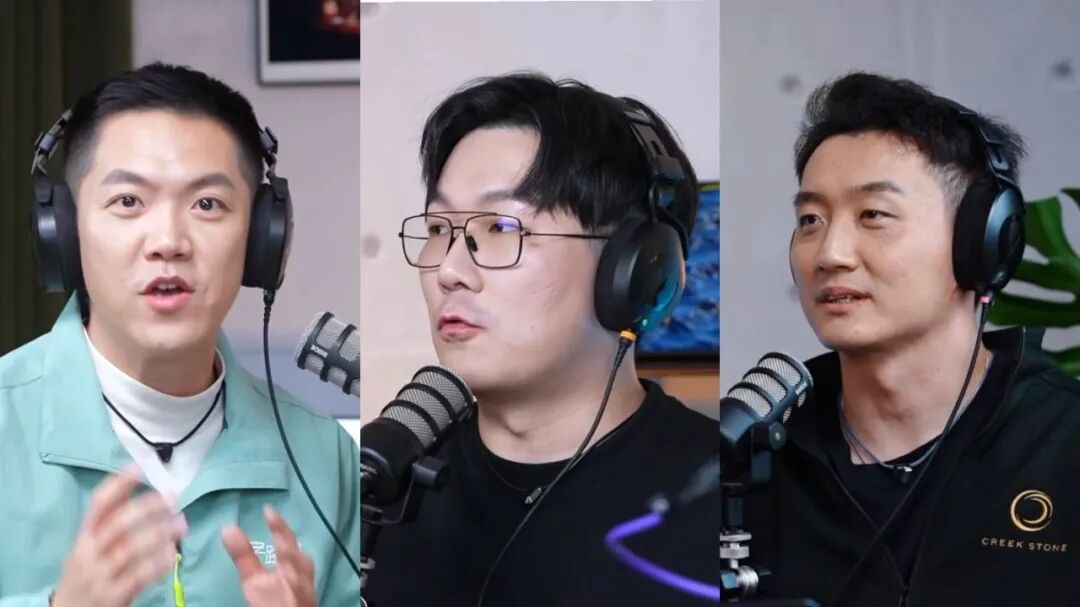
👦🏻 Podcast interview: Koji
🥷 Edited by: Crossing
🧑🎨 Layout: NCon

The AI hardware space always has new opportunities, and it's always full of ambitious founders.
This week, Crossing welcomes Chris Pan. He was one of the earliest product managers for Coze at ByteDance, and also led AI glasses projects at ByteDance and other companies. Chris is here today with his own startup product — the AI necklace Odyss. We're also joined by his angel investor, Yihao Li, partner at CreekStone.
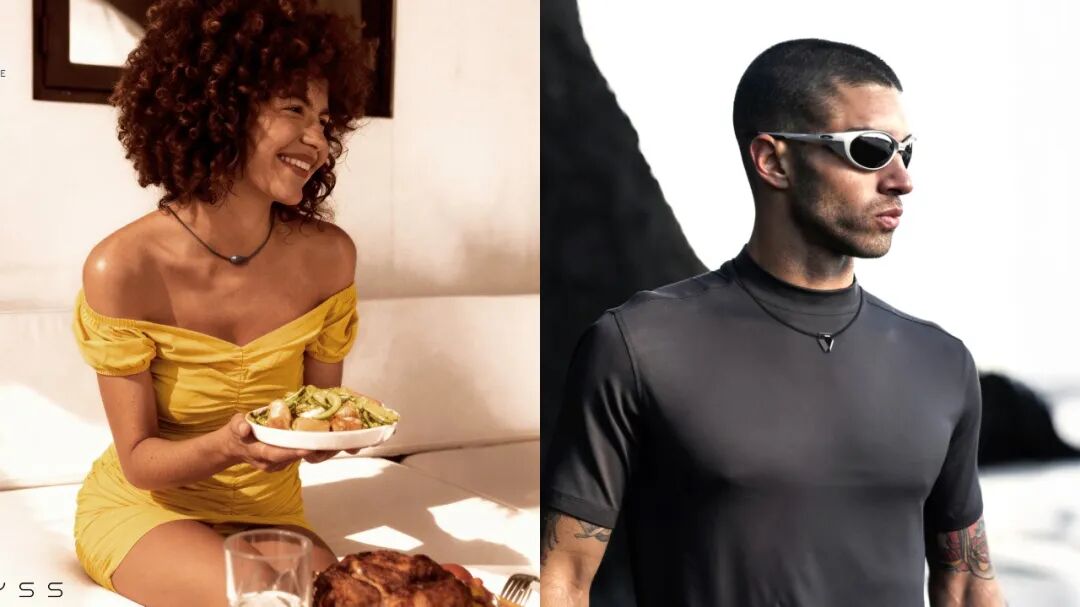
(Product image: Odyss AI necklace)
In this episode, we dive deep into Chris's "non-consensus" entrepreneurial path. As someone who was deeply involved in AI glasses projects, why did he ultimately abandon this hot赛道, believing it was more like "VR in 2015"? Meanwhile, Chris shares how he chose the "necklace" form factor and precisely targeted diet and health — a massive yet overlooked market. How does Odyss achieve seamless logging of every single bite? And how did he respond to accusations of being "anti-human"?
At the same time, as an investor, Yihao shares CreekStone's unique perspective as an AI-native fund. In this new paradigm opened up by AI, what kind of founders stand out and become the "Chinese AI mafia" they're searching for? We discuss how AI hardware entrepreneurs can find their own breathing room in vertical domains that major tech companies haven't yet touched — from product definition and brand building to go-to-market strategy.
Whether you're an AI entrepreneur, practitioner, or simply an explorer curious about new species, we hope this conversation about daring to define and bravely pioneering new frontiers will bring you fresh inspiration.
📢 Two messages from our guests:
Chris and his team are hiring: mobile developers, full-stack engineers, hardware project managers, interaction/visual designers, overseas marketing, and overseas community operations. Interested candidates, please contact hr@odyss.life
CreekStone Venture looks forward to accompanying AI entrepreneurs, exploring the cognitive core together, and grounding grand dreams in every step forward! We don't play the "dad" role — we seek resonance. Founders welcome to connect: yihaoli@creekstonevc.com
Listen on WeChat:
Listen on Xiaoyuzhou:

🎬 Our video podcast is now live on Koji's WeChat Channels, Xiaohongshu, Bilibili, YouTube, and other platforms
As the full interview is quite long (33,305 words), here's the table of contents for reference:
Lightning Round
Age, alma mater, MBTI and zodiac sign, funding status, one-sentence product description, launch date, team size, pre-founder experience
Why I'm Not Building AI Glasses
"Building glasses now is like building VR in 2015."
- The trap of AI glasses: they're too eager to serve AI (see what I see), but forget to serve humans (comfortable to wear, no frequent charging).
- Why Meta Ray-Ban's success can't be replicated in China? — We don't have a massive sunglasses market, nor a monopoly-level brand like Ray-Ban.
- The brutal truth of hardware entrepreneurship: battery and materials technology evolve slowly, unlike large models that make headlines every six months.
- Why ultimately choose "necklace"? The only solution derived from first principles: must bear weight (battery life), and must be on the front (visible, audible).
- Why target diet and health? It's the highest-frequency behavior for everyone, yet currently the only blind spot lacking hardware data monitoring.
Never Build Anything "General Purpose"
Ordinary people's lives are boring — what's worth continuously recording?
- Any hardware purchase needs a clear motivation; if you build a "general-purpose multimodal entry point," users will let it gather dust.
- So-called "general-purpose AI hardware" is essentially an illusion pieced together from multiple vertical agents.
- AI voice recorder products? — "Meeting notes will long-term become system-level work of mobile OS."
- AI camera? — "Ordinary people's lives are boring — what's worth recording?"
The "Eating" Skynet: How to Make AI Monitor Every Bite You Swallow?
The net of heaven is vast, "eating" and not leaking.
- True Always-on: users can't be expected to tap a device when eating; logging must be seamless.
- Hardware design trade-offs: cut the photo album function, keep only low-frame-rate, low-resolution but high-contrast images — this is what AI actually wants to see.
- How to solve power consumption and privacy? Edge-side compression at T0 moment + cloud model dynamically调配 T1 moment data load.
- Why existing calorie-counting apps are inaccurate? Layers, ice cubes, even "whether you actually finished the soup" — a single photo can't answer these.
- Currently the most accurate food recognition isn't vertical apps, but ChatGPT.
Facing the Harshest Criticism: On "Anti-Human" and Context
Apes coming down from trees to become human was itself "anti-ape-nature."
- A new perspective: collecting Context should be a byproduct of good experience, not the product's selling point — "My mom doesn't know what Context means."
- Facing investor criticism that the product is "anti-human"? — Apes coming down from trees to become human was itself "anti-ape-nature."
- Anti-human products aren't necessarily without value; their ceiling might just be 1 billion people instead of 7 billion.
- Why cut the "real-time reminder" feature? For health management, data presentation and behavior planning matter more than real-time intervention.
Brand Philosophy: No Serious Medical, No Duolingo Either
"Duolingo doesn't actually teach you English well, but I've checked in for 700+ days."
- Why not serious medical? That took 20 years to reach the mass market; we want a lifestyle.
- Why not like Duolingo? Too gamified; we want to be more like Oura — a social currency representing "growth and breakthrough."
- Decision theory on "beauty": team provides engineering feasibility, designers provide aesthetics, then ad spend lets user data decide ID.
- Hardware's magic moment: software is function-first then UI; hardware is appearance-first then function.
Yihao Li: Searching for "AI Native" Pioneers
"Massive ambition, minimal ego, complete worldview — you won't find 5 out of 500 people like this in a year."
- What exactly is an AI Native fund? No path dependency, sees itself as the underdog, acts as a thought companion to entrepreneurs.
- Profile of top-tier founders: non-consensus built on common sense, dares to define the赛道 rather than just solve problems.
- Why favor ByteDance alumni? ByteDance is the "most entrepreneurial" of all major tech companies, and the only place where young people could touch trillion-parameter models.
- Investing is like "pursuing a romantic interest": once decided, message founders on a daily frequency until deep connection is established.
Escaping Big Tech
"He had an AI device peeking out from his pocket, a backpack full of clanking hardware, completely not caring about strangers' gazes."
- The big tech PM's dilemma: most time spent competing for internal resources and convincing superiors, not touching users.
- The special nature of software-hardware startup: hardware has no A/B test, no code rollback — every decision must be deliberate.
- Post-founder mindset shift: "I used to game on weekends; haven't played once in six months of founding — not no time, just can't get into it."
- Final advice for entrepreneurs: don't solve hard problems (don't compete with big tech on specs), dare to define the赛道, focus vertical, stay close to users.
Lightning Round
👦🏻 Koji
Crossing has a tradition — before diving deep into stories, we do a lightning round to help everyone better understand our guests. Since we have two guests today, we'll start with Chris, then Yihao. Chris, your age?
🧑🏻💻 Chris Pan
👦🏻 Koji
Your alma mater?
🧑🏻💻 Chris Pan
University of Electronic Science and Technology of China, in Chengdu.
👦🏻 Koji
Your MBTI and zodiac sign?
🧑🏻💻 Chris Pan
INTJ. Gemini.
👦🏻 Koji
What's your current funding situation?
🧑🏻💻 Chris Pan
We recently closed our first round — several million USD — and we're now in talks for a second round.
👦🏻 Koji
Can you pitch your product in one sentence?
🧑🏻💻 Chris Pan
We're building an AI wearable necklace — the one all three of us are wearing right now. It recognizes all your eating and exercise behaviors, then organizes that data and creates health plans for you.
👦🏻 Koji
When's the launch date?
🧑🏻💻 Chris Pan
Earliest would be Q2 next year, latest Q3 — launching overseas.
👦🏻 Koji
Main market is overseas. Any plans for China?
🧑🏻💻 Chris Pan
Possibly, in the future.
👦🏻 Koji
Current team size?
🧑🏻💻 Chris Pan
We just hit 10 people.
👦🏻 Koji
One sentence on what you were doing before this?
🧑🏻💻 Chris Pan
Building AI glasses at a big tech company.
👦🏻 Koji
Now for Yihao. Your age?
👨🏻 Yihao Li
👦🏻 Koji
Your alma mater?
👨🏻 Yihao Li
Undergrad at Tongji, then a master's in France.
👦🏻 Koji
Your MBTI and zodiac?
👨🏻 Yihao Li
INFP. Aries.
👦🏻 Koji
Wow, that combination — that's incredibly romantic.
👨🏻 Yihao Li
Very passionate. Very high energy.
👦🏻 Koji
One sentence on your fund?
👨🏻 Yihao Li
We're an early-stage, dollar-denominated fund focused on AI.
👦🏻 Koji
Team size?
👨🏻 Yihao Li
Just two of us. Two partners.
👦🏻 Koji
The trendy solo fund model. One sentence on what you were doing before this?
👨🏻 Yihao Li
I've spent the past eight years in VC.
Why I'm Not Building AI Glasses
"Building glasses now is like doing VR in 2015." 👦🏻 Koji
Yuyang, you've worked on AI glasses projects at ByteDance and other companies — that's a hot AI hardware track right now. But you didn't choose that for your own startup. Why? Do you not believe in it?
🧑🏻💻 Chris Pan
I wouldn't say I'm completely bearish. In the China market, if ten years from now myopia or optical correction surgery still isn't widespread, glasses could become a terminal device. But building glasses now — I think it's exactly like doing VR in 2015.
What people see doing well overseas, like Meta Ray-Ban with a few million units shipped annually, that's really about the sunglasses market and the Ray-Ban brand. Overseas is a massive sunglasses market, and Ray-Ban has near-monopolistic channel power and brand recognition there. Neither of those conditions exists in China.
And I feel like right now, a lot of people building glasses are starting from the AI angle — this thing sits close to your eyes, close to your ears, it can "hear what I hear, see what I see." But that's serving AI. A product should serve people. And what do people want? They want something comfortable to wear, something that doesn't need constant charging, that keeps going. Something that looks good, that fits their dress code.
But glasses right now basically fail on all three counts. And the biggest constraints there — materials technology, batteries — those don't move like AI large models with big breakthroughs every six months. Their evolution is extremely slow.
A good new product needs to deliver an experience that exceeds the old experience plus switching costs. Glasses clearly have very high switching costs. Sometimes you need prescription lenses, and the lenses alone can easily cost more than the glasses themselves — that's a heavy burden on users. You need eye exams, you need to measure pupillary distance offline, a lot of that can't be done fully online. These are all real problems.
That's the domestic situation. Looking overseas — it's purely a sunglasses market, almost no one wears prescription frames. So as an AI entry point, you're asking someone with perfectly good vision to put on glasses just to chat with AI every day. That feels even more far-fetched, more distant. So I don't think AI glasses will become a mass-market terminal product anytime soon. But I still needed to find such a product.
👦🏻 Koji
OK, so the new form factor you landed on is the AI necklace. Can you walk us through how you discovered this opportunity?
🧑🏻💻 Chris Pan
I think our product has two parts: the necklace form factor, and health. We can talk about them separately.
First, the necklace form — it's a multimodal entry point. Our thinking on multimodal entry points is that the most important thing is being able to stay with people seamlessly, to be worn without awareness. Forget battery life, forget everything else — if a user feels uncomfortable wearing a product after an hour, it's simply not a qualified multimodal entry point. Second, it needs to be able to see and hear.
Just two things. First: say we wear 50-gram glasses, like Meta Ray-Ban's standard size at about 48.6 grams. Once they're on your head, they put a lot of pressure on your ears, your nose bridge. But the neck is actually the most load-bearing part of the entire human body. We wear a 50-gram necklace (and today's necklace isn't even 50 grams), we don't feel it. Even if it slips, or you wear it in some weird position — you simply don't notice it's there. That's incredibly important. Second, it needs to see clearly and hear clearly. To do that, it has to be on the front of your body — not on your finger, not on your wrist. Put those two requirements together, and you're left with basically this lanyard form factor. That's why we chose the necklace.
Then the other key point is health. Health came from a book I read earlier this year called Outlive, Chinese title Chaoyue Baisui (Beyond 100), written by a retired marathoner. It covers a lot of health perspectives, but the core idea is this: modern medicine and health are about treating disease after you get sick, but the future should be about preventing future health risks through lifestyle planning. That's the prevailing consensus in Europe and America now on health.
So what behaviors affect health? Eating, exercise, sleep, and mood. But exercise, sleep, and mood — there are already tons of products for each, you can easily find 10 or 20 in every category. But diet, which has the biggest impact on our health, has basically no hardware product focused specifically on that direction. That's the most missing data dimension.
👦🏻 Koji
There were probably some pretty crazy early ideas, like putting a camera on a spoon so it could record everything you ate, all your calories.
🧑🏻💻 Chris Pan
We did explore that — spoons, placemats, we tried every form factor. One issue: it's not really a multimodal entry point. It might only solve this one thing, with no room for scenario expansion down the road. Second, a spoon might see the food in front of it, but it can't access information from behind you at the table — like voice from when you ordered, your geolocation, all these things to cross-check what something actually is. Visually, if you only see this piece of meat, it's hard to tell what kind of meat it is. You need to synthesize many information sources. So we ultimately couldn't make the spoon work.

👦🏻 Koji
We'll dive deeper into the AI necklace and how it helps us eat healthier in a bit. But before we get there, could both of you walk us through your career backgrounds?
🧑🏻💻 Chris Pan
I'm '97. Joined Huawei through campus recruiting in 2019, started in algorithms on Xiaoyi, the intelligent assistant. No large models back then, so I was basically doing NLP, traditional CNN strategies. At that time, we were among the earliest people working on AI recommendation and assistant-type products.
Around 2020, I transferred internally to HarmonyOS. Very early days — it was the single-framework HarmonyOS based on OpenHarmony. So my Huawei experience was two chapters: AI and OS, doing R&D algorithms and product design.
Joined ByteDance in 2022. It was a confidential project that matched my background well, so they brought me in. But that project still hasn't fully launched today.
👦🏻 Koji
Not Coze?
🧑🏻💻 Chris Pan
Not Coze. When I joined ByteDance, Coze didn't exist yet. I was recruited for this confidential project that matched my background.
👦🏻 Koji
Phones?
🧑🏻💻 Chris Pan
I don't know, haha. I don't know what it was.
At the time, our internal observation was also that this was still very far from actual deployment. And when we joined, the larger Doubao (Flow) department hadn't even been established yet. We product managers were essentially doing internal entrepreneurship, exploring new topics. That's when we spotted the Coze opportunity. The earliest version of Coze was actually designed to let people from all industries turn their domain know-how into Agents, then transform those Agents into platformized data assets that could eventually serve a larger AIOS. That was the original starting point, though we later discovered it didn't quite work out.
We worked on Coze until early 2024, when we held our first public launch event. After shipping the product, I stepped back. There were some organizational adjustments at the time, and I started taking on AI hardware projects. ByteDance had actually tried quite a few things in AI hardware — including the Olafriend earbuds that launched last year, which came from our department. There may be some new form factors still in the works. Which brings us back to the glasses story we started with, and my entrepreneurship this year. That's roughly my background.
👦🏻 Koji
What about you, Yihao?
👨🏻 Yihao Li
Let me start with a small plug. This year, we're actually an early-stage venture fund. My partner Huan Lu and I left together to build a dollar-denominated fund focused on early-stage AI. We mainly do early-stage investing and incubation. We feel a very strong sense of mission — we want to genuinely serve every founder with care, and build a Chinese AI Mafia ecosystem.
I think whether it's mobile internet, consumer, or later hard tech, China has lacked something like Silicon Valley's Mafia spirit and culture, and a stronger organization and community. We see how YC brings vitality and energy to so many AI application and AI infra companies, and we want to create something like that. That's our mission and vision.
👦🏻 Koji
Your fund is called CreekStone — a stone in a creek. What's the story behind that?
👨🏻 Yihao Li
First, as an AI fund we definitely lean on AI, so AI actually named it for us.
👦🏻 Koji
Your logo too?
👨🏻 Yihao Li
Yeah, this on our shirts was also made with Figma's AI. We gave some prompts representing our ideas. We felt we needed natural elements, something more timeless and long-term to express.
👦🏻 Koji
Patience.
👨🏻 Yihao Li
Patience, long-term — sounds fake, I know, but I really want to treat this as a career, as something built to last. Second, our philosophy is "be fluid like water, firm like rock." Some things need to flow gently, to sustain over time. And at critical moments — we're entrepreneurs ourselves now, and Yuyang is also an excellent entrepreneur — there are always moments when you need a very solid, resolute backer, support as firm as bedrock. So thanks to Doubao for giving us the CreekStone name. I think it's quite good.
👦🏻 Koji
I'm seeing you in a new light now.
Never Build Anything "General Purpose"
Ordinary people's lives are boring — what's worth continuously recording? 👦🏻 Koji
Alright, let's get back to your Odyss AI necklace product. There are actually quite a few people doing AI plus necklace, but everyone seems to be choosing different directions. Many are going straight for a 24-hour Always-on device that records everything about you to provide more context for large models. That's the most generalized, most ambitious approach. But you chose the health track. Why didn't you do something else? Why health?
🧑🏻💻 Chris Pan
From day one of our startup, we completely ruled out doing anything general purpose. In fact, there are no general purpose products on the market. Take Manus today — is it a general purpose product? Not really. It's multiple vertically optimized Agents stitched together to create an illusion of generality. It looks like it can do everything, but the tasks it actually delivers well are still the ones it's been optimized for.
Plus, I don't think general purpose is a game for startups. And we're doing hardware, which is expensive — not just your BOM costs, but user acquisition costs. As a user, I can download 100 apps on my phone in a day, no reason needed. I see it, I think it's interesting, I download it. But buying hardware requires a clear motivation: what do I need this for?
We categorize "what for" into two types. One is emotional value. I think many products today are like this. I'm myself a hardcore DJI fan — I have every drone model they've made at home — but for me that's also emotional value.
👦🏻 Koji
What kind of emotional value?
🧑🏻💻 Chris Pan
It makes me feel like I'm impressive. It gives me a different perspective when traveling with friends. But maybe you only travel once or twice a year.
👦🏻 Koji
Doesn't stop you from buying every new generation.
🧑🏻💻 Chris Pan
Exactly. Like, another example — convertibles. You might put the top down once a year in the city, but for that one time, you want to have it. It's emotional value for us as humans. Hard to say it actually changes our lives.
The other type is products that genuinely solve specific problems. Like needing meeting notes, so you buy a product for meeting notes — that's a real pain point. So setting aside these two, if we just talk about a general multimodal entry point without refining it in any specific domain, users will end up with a product that gathers dust. That's obviously not what we want.
As for meeting notes specifically, I've always felt that's something phones and computers should handle. Because the whole point of external hardware is convenience. Take Plaud — I used it before, I think it's a very good product with very forward-thinking design. I can just open it, it has many meeting templates, and I can get high-quality meeting notes. But both of these things, long-term, are really phone OS jobs.
For example, the domestic foldable phone brand I use now, it's very thin, and its system-level built-in meeting assistant is extremely good. It can summarize all my meetings — whether on Lark, Tencent Meeting, or phone calls — into one place. So I think that's the most first-principles trend for the future.
Then there are life-logging products — I don't know what about people's lives is worth recording. Nowadays people won't even post a photo without editing it. We put on makeup just to appear on camera for interviews. Ordinary people's lives are actually quite boring. What's the point of presenting something so boring? I don't get it. So that sealed it for us — we won't do general purpose. We'll do vertical, and this vertical needs to have real pain points.
👦🏻 Koji
So you landed on health. And it sounds like you didn't pick health as the best option from a pile of possible things to do — you ruled out many directions that others are pursuing and decided they don't work.
🧑🏻💻 Chris Pan
Let's just talk about eating. Everyone does it multiple times a day, and there's zero record of it, zero monitoring. Think back — what did you eat for lunch? You might remember. But why did you eat those things? No idea. Maybe a sudden impulse, or you scrolled past something on a delivery app and ordered it. But you don't know how any of this connects to your body or what results it produces. So this is a completely blank market, and it's high-frequency, something everyone experiences. Why wouldn't I do it?
The "Eating" Skynet: How Do You Get AI to Monitor Every Bite You Swallow?
The net of heaven is vast — "eating" doesn't slip through.
👦🏻 Koji
So how does it work now? Specifically, what value does this feature deliver to users?
🧑🏻💻 Chris Pan
The core function of our product is that it can Always-on understand all your eating and exercise behaviors. Eating — it's not the traditional sense of taking a photo of what's on the table. It's more about recording every bite a person takes. At what time did I eat a piece of what meat, a piece of what vegetable.
👦🏻 Koji
What goes into my mouth.
🧑🏻💻 Chris Pan
Right, how big it is, what nutrients it corresponds to, calories, GI, what the structural conclusion is, how these things affect your body. For exercise, what we're doing is actually similar to traditional rings and bracelets. Then integrating all this information, we can get full-dimensional data: what actually happens to energy from when it enters the body to when it leaves.
👦🏻 Koji
Right before recording this podcast, I happened to come across a new piece of hardware on Xiaohongshu — it mounts on a toilet, it's a camera, monitoring what you described as "leaving the body." Closed loop.
👨🏻 Yihao Li
Now that's a startup with some flavor, haha.
👦🏻 Koji
So you just mentioned it can record every bite you eat — does that mean the camera has to be on all the time?
🧑🏻💻 Chris Pan
Yes. From our research in the United States, people eating snacks, drinking coffee, drinking water — these things happen very scattered throughout daily life. If it's not always on, users simply won't tap it every time they eat something. So it has to be Always-on.
👦🏻 Koji
But if it's Always-on, power consumption becomes terrifying, battery drain too. How do you solve that?
🧑🏻💻 Chris Pan
It depends on what user scenarios we need to support. In our user scenarios, for example — we had a camera from day one, but we killed the photo album feature on day one. Because I know that whether an image is for AI to see or for humans to see, the requirements are completely different.
For example, when feeding images to AI, it doesn't actually understand high resolution or high frame rates. When an image enters the model and gets tokenized, it still gets chopped into small pieces and compressed. So what does AI actually prefer? High contrast, high dynamic range, heavily sharpened edges, clear contours. But to humans, that kind of image might look terrible, because people prefer something close to reality — saturated, colorful, high resolution, high frame rate. These two are completely different, and we haven't found a hardware solution that can accommodate both.
So in what we're building today, if you want to make the perfect human camera, you'd have to make it like DJI, like Insta360 — that's what it would take. But that's terrifying: the power consumption, the size, the cost are all terrifying. That's not what we're good at. So we're making an AI camera. And if we're making an AI camera, we need to go extreme on the AI side.
For example, every component in our entire pipeline supports low frame rate, low resolution. And we've deployed some feature enhancement and compression algorithms on-device, so within a very constrained balance of size, power, and thermal, we can provide enough environmental information for AI. Think about it — if I'm building an AI to watch what I'm doing, is there a difference between 10 FPS and 30 FPS? Not really, either one can understand what you're doing. But in our testing, whether it's 10 FPS or 30 FPS, it's already well above the sweet spot that current VLM technology needs. Going higher provides zero gain on our benchmarks.
Of course, what we just talked about was "throttling" — reducing power consumption. The other side is "opening the tap," which basically means adding battery. It's a crude solution, but for the sake of clean design, we won't put the battery on the front. We have some techniques to hide the battery somewhere in the necklace.
👦🏻 Koji
So right now there's a battery hanging on the back.
🧑🏻💻 Chris Pan
Right, but it's extremely small. And all three of us are wearing this product — you genuinely can't feel it on your neck. That's the magic of the neck-worn form factor. There's so much space to work with.
👦🏻 Koji
So are you shooting a 24-hour video stream and extracting frames, or taking a photo every few seconds?
🧑🏻💻 Chris Pan
If forced to choose between the two, it's more like taking a photo every few seconds. But this actually gets at a more systematic issue. When we're doing this, we don't really know what content is needed in a given scenario. For example, in some scenarios, audio clarity might matter most — like right now, recording this podcast, the scene in front of us barely changes, so it needs to "listen." Sometimes, like when cooking, it doesn't need to see that clearly, but it needs frames delivered quickly. Other times, like scanning text, QR codes, or barcodes, it doesn't need high frame rate but needs to see clearly.
So all data requirements need dynamic allocation based on scenario. But our bandwidth is actually very limited — BLE at 30KB, Bluetooth maxing out at 80KB, WiFi is high power consumption so you can't stay connected continuously. So what we need to do is, within limited bandwidth, allocate the right dataset based on scenario.
👦🏻 Koji
So this allocation happens on-device?
🧑🏻💻 Chris Pan
Not necessarily. We can do some compression on-device. For example, if the histogram match between one frame and the next exceeds a certain threshold, that means the information in both frames is roughly the same, so we don't need to transmit both. But the device only handles simple things like this. Actually understanding scenarios — the device can't do that, because it requires the model to deeply reason about what information is needed based on my location.
So this actually involves a separate VLA system. Our model at T0, based on the scene at T0, determines what load I need at T1, then makes the load at T1 more evenly distributed.
👦🏻 Koji
Is this model in the cloud? And is the gap between T0 and T1 one second or a few seconds?
🧑🏻💻 Chris Pan
It's a very, very small model. It only outputs parameters in JSON format, nothing else. It's probably a 3B, 1B, 0.5B, or even smaller VLM. The latency is definitely around one second or a few hundred milliseconds — not too long.
👦🏻 Koji
I feel like what we're trying to do still has to handle quite a few edge cases. While you were talking, I was thinking — I occasionally love eating instant noodles, it's a guilty pleasure. But the best part is drinking the broth at the end. What if it can't detect that?
🧑🏻💻 Chris Pan
It wouldn't fail to detect it — it would capture the action.
👦🏻 Koji
Because I lift the bowl to drink, so it might capture the noodle bowl but not the food itself.
🧑🏻💻 Chris Pan
I see. There are many ways to handle this — we're not only capturing food going into the mouth, there are lots of inferences. For example, before and after you lift the bowl, how much did the contents decrease? Or we have IMU, so we know roughly what motion you maintained for how long, and we can infer approximately how much you drank.
👦🏻 Koji
So basically, the heavens' net is wide, but it lets nothing through.
🧑🏻💻 Chris Pan
It's definitely not an end-to-end model, but an architecture that covers all kinds of corner cases.
👦🏻 Koji
Every bite is recorded. Earlier we also mentioned data transmission. My own experience using Plaud's recording card — one of the worst experiences is how painfully slow transfer is. We record for an hour, and I feel like it takes ten-plus minutes to transfer. I often have seven or eight recordings on there, too lazy to transfer, because it feels slower than a snail. It has WiFi mode, but somehow it never seems to connect. Everyone seems unable to solve this, it's an industry-wide problem. Yours feels even smaller, and maybe has more data to transfer. How do you solve the transmission problem?
🧑🏻💻 Chris Pan
I don't think there's currently a solution in the industry that's both fast and power-efficient. But we won't be the ones to solve this — there are companies much more urgent about it than us.
👦🏻 Koji
But if you don't solve it, can you still guarantee user experience?
🧑🏻💻 Chris Pan
We'll first use the latest technology, but if the latest technology hasn't crossed that threshold, we'll do compression on top of it. For example, with the T0 to T1 scene recognition we mentioned — a 10KB or 20KB image might be completely sufficient for this, and that falls entirely within Bluetooth bandwidth.
Then for cases where users need very high-definition capture of current behavior, we might enable WiFi. But WiFi is very power-hungry, and with Apple, for example, it doesn't support dual WiFi — when connected to the phone, other functions might be affected. In those cases, we might have some queue redundancy, allowing users to process previously unfinished tasks at a certain moment. The results we deliver to users would be relatively asynchronous, because this doesn't need to be that real-time. You're not going to look at your phone while eating and say "how much did I just eat in this exact bite." Some delay — seconds or even minutes — is completely acceptable.
Like right now I'm wearing two rings on my hand. I've been evaluating Oura Ring against Dreame's new model, comparing their data side by side. But I don't look at them while sleeping — I can't while sleeping anyway. I check my overall summary data after waking up, some time later. That's more aligned with user behavior.
👦🏻 Koji
I usually check how I slept last night after my morning routine, sitting on the toilet, pulling up my Apple Watch Health app.
👨🏻 Yihao Li
Like people doing continuous glucose monitoring — the perverse pleasure after eating comes from knowing that when I ate some sugar, I can quickly control my blood sugar levels through brisk walking or the order in which I eat. And seeing my monthly progress in glucose control — it's a very subtle psychological pleasure, seeing your own improvement, digitally managing this thing.
👦🏻 Koji
In your current real-world usage, how long can it last?
🧑🏻💻 Chris Pan
We haven't reached final product-level optimization on hardware yet, so there's definitely still a gap. Theoretically, we expect users to charge once a day — at least 18-20 hours. Except when sleeping, because you won't wear a necklace to sleep, it's uncomfortable. You take it off, hang it on a beautiful charging jewelry stand we provide, sleep, then put it on in the morning, and it lasts the whole day. That's the usage pattern.
👦🏻 Koji
I think one particularly clever thing is that the camera is very discreet, hard to notice. On the other hand, it does reduce aggressiveness toward others — you don't feel like you're hanging a camera pointing at people. But you yourself still know it's seeing everything you see today. Especially with it hanging right here, it can see everything I chat about on WeChat. How do you convince users to trust you? As a startup, especially if you're selling overseas, how do users trust handing their data security to you?
🧑🏻💻 Chris Pan
Actually, we've talked to many users overseas, and privacy concerns aren't as big as we imagined. People's privacy concerns aren't really about whether the company will do evil with their data — they're about whether the person across from them will use this information maliciously.
First, we have no photo album. We don't let users see any of their own video or audio — they only see health summaries. So this prevents ordinary users or users with ulterior motives from using it for secondary creation. In our marketing, we don't promote camera specs — this is a food recorder. Most of the time, all data is burned after reading: the model looks at it, outputs a health summary, then discards it. That's this product's model. And its appearance doesn't make anyone think it's a camera.
We also provide a very low-friction way to disconnect — we haven't designed this into the hardware yet, but the interaction path will definitely be very simple, something you can do on the necklace body itself. So if you enter a very private situation, you can manually turn it off.
But from our current market observations, the people who worry about this usually aren't the users themselves — it's the people across from the user, or others sharing the same environment. In some especially private settings, you're not even allowed to bring a phone in. They won't ask you to power it off or switch to airplane mode; they'll ask you to leave it outside. This actually involves a very long shift in social norms. But I think we've already pushed the product perception about as far as it can go.
Facing the Harshest Criticism: On "Anti-Human Nature" and Context
"Ape climbing down from the trees to become human — that itself was 'anti-ape nature.'" 👨🏻 Yihao Li
There are quite a few hardware startups in the market, but in our conversations with Yuyang, what we care about most is: how do you view the value of Context? Because we feel the war for AI applications has already reached the stage of Context hijacking, Context grabbing. You've always had very sharp perspectives — how do you see this?
🧑🏻💻 Chris Pan
My views have actually shifted somewhat in recent months. Context — we want as much of it as possible, that's absolutely true, no change there. It's just that after we gather a lot of it, the application side or the technology side may not be able to process it yet, but eventually it will. GitHub is a great example of Context. For decades, it was just where programmers submitted code. But with AI coding, all of it can be used for training. This is really a change in how data gets used, driven by technology.
But for Context on the hardware side, beyond "more is better," I have two somewhat different views lately.
First: why would users help you collect Context? I think this question is worth serious consideration. Many products seem to use Context collection as a selling point. But what ordinary user even knows what that word means? My mom doesn't know Context, so ordinary users don't know what Context means. So this isn't a selling point. You should start by creating a good user experience, and collecting Context should be a byproduct of a product with good user experience. Users willing to immerse themselves in your experience will then be willing to continuously give you Context.
Second: after collecting Context, how do you use it? I think most big companies, small companies, startups — they're relatively lacking here, possibly due to some technical limitations. Because I've looked at many AI products: they collect Context somewhere, then just summarize it and dump it into the context window, into the System Prompt. But any model's System Prompt is very limited, and people write information quickly but don't do any evaluation of the Agent after modifying the prompt. I did something today and added it in — who can tell me whether the Agent's performance got better or worse after adding it? No company has the ability to evaluate every user's personalized prompt. This is also a problem.
So I think in the long run, Context usage will ultimately converge into vertical domain products. Just as GitHub or similar Git platforms gave rise to AI Coding. The next one might be dietary health — health as a domain may grow slowly, but it's hard for everything to grow in sync across all dimensions. It's still a bucket; you need some long planks to grow first, then gradually raise the average.
👦🏻 Koji
Because Yuyang, what you're making is a very innovative product, something that hasn't existed on the market before. So I believe anything new will face a lot of questions, even a lot of challenges or rejections. I'm curious — when you were doing your angel round, or talking to your earliest ideal users, what was the harshest criticism you heard?
🧑🏻💻 Chris Pan
The harshest was: "You're building an anti-human-nature product, and we don't like anti-human-nature products." There was quite a lot of this.
👦🏻 Koji
What do you think? When they say "anti-human-nature," what human nature are they talking about?
🧑🏻💻 Chris Pan
Actually this was mostly investors saying it — not a single user has said this to us, and we've already faced a lot of users. They feel that, for example, short video is a very human-nature-compliant product: once users start, they get completely hooked, immersed in it. But this doesn't mean anti-human-nature products have no value. Because an ape climbing down from the trees to become human — that's an "anti-ape-nature" thing. At that time, if it hadn't come down, there wouldn't be an "anti-human-nature" thing, it would just always be "anti-ape-nature."
It's just that "anti-human-nature" may not have a high enough ceiling — it can't serve 7 billion people, because there will always be some people unwilling to do anti-human-nature things. But the global smart wearables market has nearly 1 billion users, which is still a very, very large market. Products like Oura Ring, Whoop — they're also multi-billion or ten-billion-dollar companies, serving millions of people. So just because something becomes "anti-human-nature" doesn't mean it has zero market value. It's just that we need to think about who our users are, and how to reach them.
Second, after hearing this, we've been continuously improving. Because in our initial product definition, I still wanted to do some more real-time interactions. For example, when you're full, or today's calorie intake has hit a limit, I might send a reminder. But we killed all these features in subsequent designs. We actually only do data presentation and future behavior planning. I won't remind you that you overate this meal, because often the food is already cooked, and you're going to finish this meal no matter what. So we don't think this is a big problem.
Because we only do data presentation and behavior planning — these two things are already a completely new dimension that users have never experienced in any product, and they're enough to support our first-generation product. Then for our next generation, do we do some real-time interventions? Or do we target users more broadly or more vertically? We can see about that.
👦🏻 Koji
Anything else?
🧑🏻💻 Chris Pan
Besides "anti-human-nature," it's "non-consensus." I quite dislike the word "consensus," because I think market consensus only has two situations: either the thing has already become a red ocean — for example, large models are a consensus, now everyone knows AI is powerful, can change the world, but by the time you realize this, AI has already blown up. Second, other things that are consensus — most of them will slowly disappear into the dust of history, most are wrong. Because I believe correct things actually originate from a minority at first.
We talked a lot earlier about why we're doing the necklace form factor — it's based on a multimodal entry point, or the need to "collect users' personalized data," a first-principles product born from that. As for how this product wears on the user's body, how it serves more users — those are problems we need to solve. You can't reject the product just because its form looks like a necklace and feels different from ordinary jewelry.
I often give the example: when Apple Watch was being made, it didn't consider whether to imitate Rolex's design, like a high-end mechanical watch. Apple Watch is just Apple Watch. This is what a category definer should do, and we're actually a category definer right now.
👦🏻 Koji
Indeed, being a category definer is exciting but also very challenging. Let's get back to talking from the user's perspective. What have you learned or observed — when it comes to dietary health, how are you planning to solve users' problems? Just thinking roughly, some people want to lose weight, some have diabetes, some may follow specific diets.
👨🏻 Yihao Li
Including controlling for keto.
👦🏻 Koji
Right, so what pain points have you observed? And which needs and pain points are you targeting?
🧑🏻💻 Chris Pan
This has both more universal and more vertical aspects. The universal one is: what did you eat? Why did you choose to eat these things? What's the connection between these foods and your body? We're essentially turning a chaotic process into something concrete, scientific, and plannable. This is actually something everyone needs — it's just a matter of execution cost. In the past, to achieve this, you needed to learn a lot of nutrition knowledge, buy a lot of equipment to measure and weigh. But in the future you won't need to — it's like giving everyone a professional nutritionist, and this nutritionist is always on standby, doesn't require you to take photos to tell them, and won't intrude on your life. This is a universal need.
Then, beneath this universal need, we've also encountered users who previously took GLP-1, semaglutide, a weight-loss drug. These users gave us a huge shock. First, this drug actually has some emotional side effects — it makes your blood sugar low, makes you unhappy, unfocused. But what we least expected was: after taking this drug, because they feel full, they can only eat a tiny amount each day. But precisely because they have no appetite, when choosing this small amount of food, they become very unhealthy. They'll choose deep-fried, baked foods just to make themselves able to eat. It's actually worse than not getting the shot but eating a lot of healthy things every day. So they also urgently need us to tell them how to plan this small amount of food, and tailor it to their life rhythm — how to not make them miserable, how to prevent blood sugar cliff-dives.
Our more vertical approach is actually two categories. One is users who already have chronic diseases or some early warning signs. In the United States, this is basically people over 35. The US should have nearly 200 million — I remember the US population with at least one chronic disease is 190 million, something like that number. When they were young, because America is an open and inclusive culture, being a bit overweight or unhealthy didn't matter. But at some point they have an awakening — they discover "my family member got sick," or "my doctor warned me," and they get very scared, then start spending money to do many things.
Allergies are another example. Asians tend to be lactose intolerant, while Americans have gluten allergies — but you might also have high uric acid and be sensitive to purines. These things hide in food. You don't have the ability to identify them, but we can tell you exactly why and how.
Then of course there are the biohackers. This is like the category you just mentioned — many different schools of thought. This circle won't be particularly large, but they're definitely a critical audience for us to go from 0 to 1. They're Oura Ring and Whoop users. They desperately want to fully observe their body's daily data and changes. Previously, this type of user had no tools — they could only use scales or scan QR codes with their phones to measure food. We once looked at a food scale sold in the US that had a camera on it — a camera propped up above a plate, this ridiculously elaborate design. It shipped one to two million units a year. Not expensive, around thirty or forty dollars. This proves these users have been driven to the point of buying a scale with a camera. I find this absolutely absurd. So we're essentially providing them with this tool, filling in that gap.
👦🏻 Koji
I understand weight loss is also a massive need, and people go through repeated cycles of dieting throughout their lives, each time willing to pay a significant cost. But as you just mentioned, dieters, biohackers, and people over 35 with chronic conditions — their needs all seem quite different. How do you balance these different user needs and ultimately deliver a product experience that works well for everyone? Are there trade-offs involved?
🧑🏻💻 Chris Pan
If we were building for the China market, we'd definitely make weight loss a focus. But building for overseas markets, we won't do that. Because culturally, Americans don't really feel that being a bit overweight is a big deal. China's BMI threshold for obesity is 28; in the US it's 30. But America also has Asian populations, Chinese populations — it's not entirely a racial issue. Society's tolerance for obesity is actually quite high. We previously met some users in the US with BMIs of 30 or even 40 who didn't think they were fat. They thought they were "strong." This seems quite counterintuitive from a Chinese perspective.
👦🏻 Koji
I remember Du Haitao once said, "I'm not chubby, I'm strong."
🧑🏻💻 Chris Pan
They have this kind of mindset. Under this mindset, if you tell them "you're too fat, you need to lose weight," that's clearly wrong — it doesn't connect with this user. So what do they actually care about? They care that if my weight exceeds healthy values by a bit, will it affect my health status, my daily work efficiency, my daily energy levels? They need to manage this part. They don't actually care that much about appearance.
So we actually categorize this group of users into our first category as well — they may have their own concerns and need a product to solve their problems. Then biohackers — they may have no concerns at all, very healthy, lots of muscle, morning runs every day. This type of person really just needs data presentation. So these two seemingly different groups actually fall on the same spectrum. When we built our product, we designed it from data presentation, to data discovery, to finally converting that data into recommendations. Data presentation is what biohackers need; converting it into actionable recommendations is what this group with some health risks and concerns needs. They're in different tabs of the product, but of course form a continuous data flow on the same line.
👦🏻 Koji
We know that after this wave of multimodal AI capabilities emerged, there have been quite a few calorie-counting apps based on photo recognition. In the US there's Cal AI, apparently made by a high school student, which went viral at one point and grew very fast. I'm thinking that what they solve is somewhat similar to what our AI necklace does: monitoring what you eat daily, how many calories, whether it's healthy, giving recommendations. But one is a necklace — buying this necklace probably isn't cheap, it's an additional expense, definitely more expensive than software. Plus you have to charge it, wear it, so there's still some friction in usage. Compared to an app, to reduce this friction, you need to provide significantly differentiated value. So I'd like to hear you explain: compared to this type of app, what differentiated, incremental value do we provide?
🧑🏻💻 Chris Pan
Let me start with the usage scenario problem. If every time you do something — and eating is a high-frequency behavior — you need the user to take out their phone to do something, possibly with inaccurate results, and they still need to manually input some things, then this behavior fundamentally isn't for the masses. This is a core problem. And in the US, snacking or supplementary meals and extra eating happens very frequently. In some elementary and middle schools, parents are required to pack a meal for their kids, but their meals aren't like in Asia where everyone sits down together at lunch time. They might bring chips, cookies, milk — these eating processes are distributed throughout the entire school day. This leads to them maintaining such habits into adulthood, with relatively dispersed eating times and behaviors. Maybe I took a bite of chips one hour, then another bite two hours later. Do I have to open the app and scan every time I eat? This is a user experience problem.
Then let's talk about accuracy. I often tell everyone — this is now team consensus: do you know which app currently has the most accurate food photo recognition on the market?
👦🏻 Koji
No idea.
🧑🏻💻 Chris Pan
It's ChatGPT.
👦🏻 Koji
Wow. Then why hasn't its API capability been opened up to everyone?
🧑🏻💻 Chris Pan
Because many food recognition apps actually use fixed models, optimizing some agents, prompts, or doing simple fine-tuning, then throwing images at the model. But GPT is actually iterating at very high speed. After it updates its model, many apps can't fully keep up. Moreover, the model experience provided in GPT's app isn't completely the same as the API experience it exposes. GPT's app is smarter in certain scenarios, especially in multimodal aspects — this is something everyone has tested, though OpenAI itself doesn't say this.
So their underlying principles are all the same: throw an image at the model and guess. These types of products are fundamentally inaccurate. Because from a single photo — say there's a bowl here — how can you know how wide or deep the bowl is, how large each piece of food is? And a bowl has layers; you can only photograph the top, you don't know what's hidden underneath.
👦🏻 Koji
The fatty meat is all hidden underneath.
🧑🏻💻 Chris Pan
Right, and when many restaurants serve dishes, it might look like a full plate, but underneath it's all ice, or all vegetable base — you simply can't tell.
👦🏻 Koji
Also with Chinese food, everyone shares dishes.
🧑🏻💻 Chris Pan
Right, when sharing. And what if I don't finish? Do I have to take another photo when I'm done? These are all factors that make the fundamental principle inaccurate.
There are also more important things: beyond "what did I eat," the order in which different foods are eaten, and my eating speed, both affect certain metrics. For example, whether I eat vegetables or carbs first significantly affects GI — my blood sugar rise speed — which may affect the probability of developing diabetes decades later. These things, photo-only apps completely don't know.
Another factor is eating speed. Fast eating significantly delays the feeling of fullness. You've actually already eaten enough, but your body hasn't reacted yet, so you'll overeat during this process. We found that many users who are somewhat obese or have larger builds actually eat extremely fast. This information — if you just tell them about it, or let them know daily — they will improve. But traditional apps can't provide this experience.
👦🏻 Koji
That's quite interesting.
👨🏻 Yihao Li
And when you hear this information, you think "wow, I have so many problems with myself, so many behavioral issues — I need something to monitor and help me improve."
🧑🏻💻 Chris Pan
This is already advanced knowledge. Some more basic knowledge — we have a relative with diabetes in our family. Once I bought watermelon back for him to eat, and he said "I won't eat this, it's too sweet." Then he was eating hawthorn candy. He thought hawthorn is so sour, it shouldn't have much sugar, but actually that thing's sugar content is many times higher than watermelon. This is dangerous behavior. But this kind of thing actually happens daily in massive numbers of users' lives.
👦🏻 Koji
Indeed, I think diet is a particularly easy health blind spot for everyone. I was curious before, so I wore a continuous glucose monitor once — those two weeks massively increased my health knowledge. One day at 3 PM, I was too busy with work and forgot to eat lunch. Then at 3 PM I suddenly became extremely hungry, so I went to eat a bowl of beef noodles on the street. I actually had some awareness then — what you just mentioned, don't eat carbs first, eat other things first then carbs. So I ate the beef first then the noodles, ate one-third of the bowl of noodles, thought today that's enough, stop eating. Then after going back I became extremely drowsy, collapsed on the sofa and passed out. When I woke up again, I found that was my highest blood sugar point in two weeks. My eating behavior just now spiked my blood sugar to 17 or 18, which directly made me pass out and sleep on the sofa for an hour. Only then did I realize how damaging irregular eating and eating noodles could be to the body.
🧑🏻💻 Chris Pan
The human body is quite smart. I recently researched a topic: why is it that when we drink one type of alcohol we don't get drunk easily, but when mixing multiple types we feel uncomfortable? It's because when you start drinking one type of alcohol, the alcohol content and fusel oil content are fixed, so the human body quickly adapts to this pattern. Like when we eat meals regularly every day — at this time the body is ready, I'm going to eat, various hormones including insulin start secreting. But once you break this balance, switching from a 20-degree alcohol to a 50-degree alcohol, your body still processes the new alcohol in the previous mode, creating a very large stress response, leading to what you just mentioned as "carb coma" or having no energy, and feeling particularly uncomfortable when mixing drinks.
👨🏻 Yihao Li
This is actually one of our physiological protection mechanisms. Around 400,000 years ago, because materials were scarce and there were many threats from animals, changing environments would trigger your body to naturally reserve more heat and fat to cope with uncertain environments. In relatively regular, comfortable environments — this is why emotional stability is important, everyone is looking at HRV and such — actually a more stable living state and mood will naturally control your energy intake, which is very important for weight loss.
🧑🏻💻 Chris Pan
Our industrial society and food industry have developed far too fast, but our evolutionary speed hasn't kept up. Our bodies today aren't actually that different from a few hundred or even tens of thousands of years ago. When people see food, they still instinctively want to finish it, because they're afraid there won't be a next meal.
Brand Philosophy: Not Serious Medical, Not Duolingo Either
"Duolingo won't actually teach you English, but I've checked in for over 700 days." 👦🏻 Koji
Let's circle back — looking at this necklace, it's quite modernist in design, very geeky. I'm curious, what kind of persona do you envision for the product or brand going forward? Because off the top of my head, one possibility is something like Duolingo — gamified, sassy, fun, lighthearted. Another is something like Whoop or Oura Ring — more serious, more scientific. Can you share any preliminary thoughts?
🧑🏻💻 Chris Pan
First, this is just one of our designs. We have nearly 10 different style variations. The one I'm wearing today leans more masculine — women in tech might like it, but it doesn't fully work as jewelry. I've been thinking about this a lot.
For our users, we definitely won't do serious medical. We won't position it as a medical product like CGM. Because CGM was originally invented for Type 1 diabetics, around 1999 or 2000, and it took over 20 years to reach the general consumer market as a wellness product. That's the trajectory of a serious medical device, and we're not doing that — it also involves compliance, certification issues.
On the other hand, we probably won't make it as fully gamified as Duolingo. Because as everyone knows, Duolingo won't actually teach you English. I've been on Duolingo for over 700 days myself — I mostly learn Cantonese, occasionally some Korean. But every time I try to speak with someone, I get scared and can't use it. I still check in daily though, because I've got 700 days going, if I stop now wasn't all that for nothing? Every morning I check in, but I know deep down that even at 7,000 days, I'd probably still be at the same level.
👦🏻 Koji
Emotional value.
🧑🏻💻 Chris Pan
Instead, we feel that positioning the necklace as a jewelry product, the most important thing is that it integrates into life, that it can be worn as an accessory. And the people buying our product won't be those with poor economic conditions — they'll be people doing reasonably well, with some social status. These kinds of people actually demand a lot from an accessory in terms of quality feel and story.
We've recently talked to some domestic and international designer brands. Actually, some designer brands don't use particularly good materials either — no gold or silver. So why are people willing to pay a premium for that metal? The core is what story the brand carries behind it. Why did we choose the name Odyss? It's from Odyssey — it reflects a journey of adventure, of pushing beyond oneself. And this narrative is deeply rooted in Western culture. People want to live better, want longer lifespans, want to be happier and more energetic every day — so buy our product. That's the feeling we want to convey.
👦🏻 Koji
This is excellent. A friend once told me, your life journey can be viewed from different angles, and you should strive to write your own history with a "heroic narrative." This isn't literally writing it down — it's about how you interpret what has happened to you. Just remember you're a hero, and all of this, even the suffering, is tribulation heaven sends to heroes. Then your whole state of being, your luck, will improve.
👨🏻 Yihao Li
That's a deep insight. Actually, the United States has carried this spiritual core since the westward expansion, which is why we have Westerns, the old Marlboro, the old whisky — they all tapped into this essence. Then Jeep, maybe Hummer — these are labels a person might want to attach to themselves.
🧑🏻💻 Chris Pan
As a personal label, the meaning it conveys and what others think of it is the first priority. Whether you're accurate, including your functionality, is secondary. Because the first question is: can users keep wearing you, keep using you? Even when you're out of battery, I'll still wear you.
We've talked to many Whoop users recently. It's fascinating — many don't charge it. The battery life is already long, and its charging case clips on top, you don't need to take it off, just clip a battery pack on top. I asked, "Why don't you charge it?" They said, "I don't really look at it anyway." I asked, "Then why wear it?" They said, "I've already been wearing it. When I socialize with people, at the gym or dinner, we talk about this, it breaks the ice, brings us closer."
👦🏻 Koji
I think this is also an important point. About half a year ago I met Ji Shisan, and he pulled out all kinds of hardware devices, telling me this was his social technique. He very explicitly, naturally, and openly told me: "This is my social technique. I've never used these things, but pulling them out starts conversations." So he'd buy anything to initiate some social interaction. But what you just mentioned might be a more hidden, strong motivation for more people.
🧑🏻💻 Chris Pan
It really is like this. Because there's no screen, you don't even know if it has battery. We sit together, we all have one, then our souls naturally feel closer.

👦🏻 Koji
How do you think Whoop and Oura Ring built this kind of brand image?
🧑🏻💻 Chris Pan
Their paths are quite different. Oura Ring remains a very abstract presence to this day. You open its app, every page has a different landscape painting behind it. Many of the metrics it presents aren't actually real-time, but time-dimension integrated results. Yet it can tell you so much. Users wear it more for a psychological pleasure — "after wearing it, my body seems to be slowly recovering, it can continuously provide me energy." That's Oura's approach. And this is a somewhat technical insight: doing lots of detection on the finger is less accurate than on the wrist, because there's less blood flow, plus two extra joints interfering with motion detection, so precision is relatively worse. But precisely because this product is so distinctive, looks so cool, it can provide people with this imaginative space.
Whoop is completely different. From day one, Whoop went professional — professional athletes, sports stars, gym influencers, KOLs promoting it. Its entire dashboard is extremely geeky, covered in numbers. This group of geeks absolutely loves it. But this also destined Whoop to struggle becoming a mass-market product. You can see this in the companies' valuations and sales — there's still some distance between the two.
👦🏻 Koji
If you had to choose between Oura and Whoop, which company or brand do you hope to become more like?
🧑🏻💻 Chris Pan
I think definitely Oura. Or rather, if Whoop is here — extremely geeky, extremely digital; Oura is here — with some inspiration, abstract concepts; we might even be here, more Oura than Oura.
Because first, the data dimensions we provide are entirely new, and we can also do motion detection, and we actually do it more accurately than many watches and rings. Now when you use Apple Watch or some fitness bands, you know you need to select an exercise type when working out. Why? Because it needs to match its IMU algorithm — it needs to know what exercise you're doing to calculate accurately. But we don't need to do this, we have vision, I can see what you're doing. So exercise and eating, I can cover both, users actually have a complete story within my product. But people who choose to use it for monitoring still have some social needs. So having data is one thing, but having concepts, extensions, imaginative space is actually more important.
👦🏻 Koji
Today's consumption, as Chris mentioned from the start, is simultaneously buying practical value and emotional value. So whether Whoop or Oura Ring, they appear to offer only practical value, but actually give tremendous emotional value. Speaking of Whoop and Oura, there are more and more AI hardware devices being born today, many new ideas are very interesting, but there's also lots of non-consensus. Like we discussed glasses at the beginning, today some people are doing Pin, including Plaud's Pin, which apparently sells quite well. Then there are translation devices, and of course headphones. I'm curious — a year from now, which of these form factors do you think will at least not die?
🧑🏻💻 Chris Pan
With model capabilities developing so fast, I think the consensus form factor for hardware products remains difficult to determine in the coming year, so everyone will have various stories. But if we take a longer time horizon, I think products that follow first principles will survive.
What does that mean? Let me use Plaud as an example — this is a very good product, a very good company. But it's hard to imagine that in 10 years, you'll still be sticking a card on the back of your phone to record. You feel this can't happen ten years from now, somehow it'll be integrated into the phone. So this form factor isn't a long-term optimal solution, but it doesn't affect short-term PMF.
Another point: I think product insight needs to be close enough to users. The logic for all our hardware purchases is actually the same: User A uses B's selection logic, to buy product C, to solve problem D. So A, B, C, D — all four need to be answered very, very clearly. Like Plaud previously made that necklace, Plaud NotePin, its sales weren't as good as the card, and their third generation with a screen went back to the card form. Because that necklace didn't follow first principles. Why would you record from this position? This is clearly a visual position — for recording, just put it with your phone. So they pivoted quickly, which I think shows very good insight.
👦🏻 Koji
The product we're wearing today, I think it's actually quite a good-looking product. So I'm curious — on your team right now, besides your product R&D background, do you also have people with design or brand backgrounds? How did you arrive at this look? How do you control the aesthetic in the middle?
🧑🏻💻 Chris Pan
I think this is very hard for one person to control. Because although we call it a necklace, a piece of jewelry, you really can't compete on aesthetics with jewelry brands or decorative brands. Since we have to stuff electronic components inside, it's unfair to compete on aesthetics with something that doesn't have components. But we need it to look good, to be exquisite, and we might use some technological novelty to compensate for the gap in decorative attributes compared to traditional jewelry.
But in this process, we discovered two very conflicting points. The first is "only target users have the right to evaluate the product" — this is a consensus among product managers. The second point is Steve Jobs's famous quote: "Before you invent the automobile, everyone wants a faster horse." You can't stop them from evaluating the product, but you also can't let them fully evaluate it, so you have to find the right balance. What proportion do users and design each occupy in defining the product's appearance? Neither can take up everything, but both need to be present.
Our division of labor works like this: our own team has a very clear understanding of the entire product's stacking and structural feasibility. So at the time, our whole team, plus our designer, went to luxury stores together to look for inspiration. We looked at which luxury items might possibly fit our stuff (though probably all needed to be scaled up — those things are all very small). Then we'd buy products or images, bring them back, start brainstorming, and do secondary creation on these things — though they ended up looking very different from the originals.
We had roughly 10 different versions of the industrial design. Then we took these IDs, found many users in our target markets — like the US and UK, users whose profiles suggested they'd buy our product — and had them score these products. We ultimately selected three. Then we made different landing pages for these three products, including model wearing effects, product feature introductions, and so on, and we ran some ad campaigns to let a larger number of users decide which one was better. We're probably in the final stage now, not completely finished. So I'm saying this is a more masculine design, and we have some other designs as well.
So our summary is: our own team provides feasibility, the designer provides aesthetics, and users do the final acceptability scoring — this is actually a complete chain.
👦🏻 Koji
It feels like there's a pretty complete methodology.
🧑🏻💻 Chris Pan
It has to be this way, otherwise this thing really easily gets called ugly. No matter what you do, someone will think it's ugly, but you need to make that proportion of people as small as possible.
👦🏻 Koji
This is an interesting topic. Because I've done internet product companies and consumer product companies myself. When doing internet products, whether the UI is beautiful, I think it's relatively easy to reach consensus, because smoothness accounts for a heavy proportion. But when making a consumer product, it becomes very abstract — is this thing actually beautiful? This troubled me for a while too.
At the time I watched two documentaries. One was about a Dior designer who had just taken office and received an assignment to put on a major show in two or three months. The documentary recorded his entire decision-making process, and I found it very intuitive. Every morning there'd be a row of employees in front of him, each coming up to show what they'd made the day before, and he'd give a Yes or No judgment, often without giving reasons.
The second documentary I watched was a masterclass by Anna Wintour, the real-life inspiration for The Devil Wears Prada, as she was planning that year's Met Gala. The day before the opening, she was doing final checks, and the camera followed her as she looked at every detail and gave various suggestions — also very intuitive. A crowd of people followed behind her, and she'd walk in front pointing at this place saying "brighter," pointing at that place saying "more." Including when she reviewed every issue of Vogue's magazine cover, there'd be a pile of photos in front of her, and she'd look and say "this one," how to combine it, how to adjust it. So I think this is a quite interesting topic — how is "beauty" created, and are there actually methods behind it.
🧑🏻💻 Chris Pan
I think the core is still that person. Because Yes or No is said by that person, and everyone follows that person's judgment based on belief in that person. But today I'm soberly aware that I'm not that person, so I need to find such a person, or simulate such a decision through some method. Building such a process, I think is very critical, but there are definitely some very intuitive parts inside.
I think the point you just made about software versus hardware is very good. With software, you're definitely going for function — even if you're going for the software's name, you see the function first and then the UI, so the user's download and open decision is actually triggered by function. But hardware isn't like this — with hardware, you definitely see the appearance first, then the function, then use it — the order is reversed from software. So with any hardware, even hardcore consumer products like DJI, appearance is also extremely, extremely important.
👦🏻 Koji
This is the first lesson Procter & Gamble teaches all product managers.
🧑🏻💻 Chris Pan
Yes yes yes, I know this.
👦🏻 Koji
Two magic moments. The first magic moment is when you're standing in front of the shelf and see the product — it needs to "boom" out from a pile of competing products and hit you. Then the second magic moment is when the user starts using it.
🧑🏻💻 Chris Pan
Right, but apps are different.
Yihao Li: The Pioneer Searching for "AI Native"
"Massive ambition, minimal ego, a complete worldview — out of 500 people we see in a year, we don't meet 5 like this."
👦🏻 Koji
Let's ask Yihao — as Chris's angel investor, could you talk about how you discovered him and the story of investing in him?
👨🏻 Yihao Li
This is almost a romantic coincidence, but at the same time a systematic inevitability. This relates to our fund's approach. We've been thinking about how an AI Native fund should operate in this era. We essentially want to serve a group of excellent, young entrepreneurs who belong to this era.
Then we need to define where these people might come from. They're like models — their pre-training, their SFT, their environment, their context determines their capabilities and ceiling. Where do these people emerge from? And we actually need to help them delete some options — this is what I think investors need to help them do in this era. So we have a lot of ByteDance coverage, a lot of large model startup coverage. From these people, we move to the second question: what kind of people do we choose?
Actually, throughout the conversation earlier, Chris's personality, his self-awareness, his social awareness were very clearly expressed. We have several criteria for choosing people. The first is really "massive ambition, but minimal ego," while simultaneously having very deep self-awareness, and a relatively complete worldview for his age group. These few things actually build a person quite completely. Honestly, out of the 500 people we see in a year, there are never more than 5 like this — maybe two or three a year.
The second point, which Chris also mentioned, is that you need sufficient common sense, but on the basis of common sense dare to go against consensus. These two sound very conflicting, and this filters out a large batch of people. Like a piece of hardware, as Chris said — it needs to look good first to pass the first hurdle, then people will be willing to pay such a high purchase cost, this is common sense. But after common sense, there might be dozens of teams making glasses, dozens of teams making recording devices. I need to choose a track that I can define. This process of defining a track is actually deep self-awareness — you know where your advantages lie, and then you'll choose to go toward that track.
The third point, I think it's very important for people to build broad relationships. Maybe we can't tell sitting here today, but Chris is actually someone who builds very broad relationships — he'll have a group of very excellent people around him, he knows many particularly excellent people in the market. I think this is very important, because life, entrepreneurship — it's a journey, and every encounter in your life determines the opportunities you have.
The fourth point, I think, is continuous learning. Because we're now at a very early stage of the S-curve of a technology cycle, infrastructure is very poor, things change daily. If you can't learn aggressively, you actually can't keep up with this rhythm, and your solutions, your vision, will have major problems.
Chris is someone who fits these characteristics very perfectly. So after our first meeting, we'd feel like a person who keeps ticking our boxes, and we'd think "wow, this person is great." Then we'd increase, like pursuing someone, increase the density of our interactions with him.
👦🏻 Koji
You mentioned finding people — massive ambition, minimal ego, complete worldview. Massive ambition I think is easy to judge. "Minimal ego" and "complete worldview" — what questions do you ask?
👨🏻 Yihao Li
Great question. "Minimal ego" is — in any conversation with someone, you'll have some opposing views, just throw them out directly. People's first instinct is sometimes even impossible to hide, and people with ego have a hard time accepting it. Second, in the direction he's thinking, for example in hardware thinking, Chris has already refined things to where we actually can't raise anything, so you can raise some fatal questions at the strategic level, in his future planning — these don't necessarily have to be opposing views, but sincere questions. And you'll discover his mindset is truly infinitely open. This is the most obvious point of small ego. And, bravely raising some problems that people around him might encounter. People all have a protective instinct — people with large ego will feel that the people they chose are also the best, so you can't comment on people around them. These can all verify the size of a person's ego.
👦🏻 Koji
What about "complete worldview"?
👨🏻 Yihao Li
Worldview I think is actually quite important. Chris gave me a very strong feeling that he knows above us is massive uncertainty, there are always some super powers. For example, we're all in this process of de-globalization, below there are various economic cycles — Kuznets cycle, Juglar cycle, Kondratiev cycle, inventory cycle, then how political economy affects society, even what kind of cultural stage we're in now. You know so many elements are actually determining which direction your future entrepreneurial path goes. But many people think it's simple, they'll think "my technology is especially awesome, so I'll definitely succeed." This is missing worldview — he doesn't know that maybe one sentence from some leader, or an important partner definitely won't choose him, and then this thing can't be done. This is the completeness of worldview.
🧑🏻💻 Chris Pan
So why do I have this trait? I used to love doing something in particular — I'd interview for roles at companies or products I admired even when I had zero intention of leaving my job. Once you unlock this, you realize it's pure upside. Some people you'd normally have to pay to talk to, and they might not even agree to meet, but through an interview you can spar with them intensely for an hour. Wow, that hour of growth is incredible.
👦🏻 Koji
Who did you interview? That's amazing.
🧑🏻💻 Chris Pan
There were quite a few, honestly. Your mindset is completely different in this situation. If I were performing poorly at my company and job-hunting out of desperation, I'd approach it meekly — "please, give me a job." But that's not the case. When I'm employed, my mentality shifts entirely. I'm confident. I'll say, "that's not right, here's what I think," and you can really clash on ideas.
👦🏻 Koji
The power dynamic flips from vendor to peer-to-peer.
🧑🏻💻 Chris Pan
And many of the people I spoke with, especially senior folks — business unit heads, startup CEOs, CEO-1s at large companies — they really respond to this. They think, "this person is refreshingly different, I've never seen this before," and it can actually lead to a strong offer. Though I may not have taken them — my apologies, truly.
👨🏻 Yihao Li
Yuyang had so many moments that moved us. I remember vividly: it was raining, he'd come to Shanghai, and we were eating at a completely obscure little Japanese restaurant. He genuinely had a small AI device peeking out of his pocket, and when he opened his bag — clatter clatter — there were so many more devices. I was stunned. He didn't care at all what passersby thought. He dared to carry an AI device and actually use it. And his depth on every device's specs, how users were roughly using them — that depth was extraordinarily profound.
The second point that struck me: we were in Shenzhen together discussing team-building. We were thinking through how to structure the supply chain team, and there were different options. Yuyang listened to our suggestions with genuine openness. Our advice wasn't sophisticated or impressive — just some intuition about people, some choices about collaboration styles. Our suggestions could be harsh, or completely unrelated to what he'd prepared. But he proved his mindset was remarkably open, and that he could make hard calls, truly difficult decisions.
Third, in our approach — whether with advisors or founders we've backed, like Mingchao Ping, Zhijie Chen, or Juanjuan who we didn't invest in but have great relations with, or Daqian who we did back, or Chen Hong at MemU — this network itself forms what we call a Mafia. Yuyang with every founder we've invested in, every founder we're tracking, sparks fly everywhere. They're not in the same赛道. Some do AI entertainment, some efficiency tools, some Agent Infra. But everyone gains so much from exchanging with Yuyang, gets inspired, starts thinking "how might we collaborate someday." This is his gift for building broad, genuine relationships — intensely so.
And there's another person we've been tracking and incubating who's extremely cautious choosing partners, but once he clicked with Yuyang, he went all in without hesitation. One weekend we ate beef hotpot in Shanghai, by Monday he'd resigned to join. All these things kept building our conviction to invest. Every founder we spend at least four months, six months, even over a year with. This process is profoundly deep for everyone, and our greatest source of fulfillment. And after investing, with Yuyang too — including being here for this podcast today — this is the part of the journey we most enjoy. That's my story with Yuyang. I hope we'll have story after story like this with more founders in the future.
👦🏻 Koji
Very interesting. Let me flip the question to the pursued party, Yuyang — why did you choose to take CreekStone's money, to take Yihao's money?
🧑🏻💻 Chris Pan
You're making me blush. This was actually a gimme for me — no matter what, this deal was guaranteed. Because when I first met Yihao, I was still at ByteDance. My attitude then was: I knew I'd start a company someday, but I didn't know when. I'm not someone who starts a company for the sake of starting a company. I need to see a truly great opportunity, to feel "this is the moment," then I'll do it. But when I met Yihao, that wasn't the moment yet.
After we connected and added each other on WeChat, our first conversation was on video — I was in my car, since it was inconvenient to talk at the office. After that chat, he messaged me on a daily basis, sending me long, long messages about every new AI topic in the market. I thought, "huh, this is interesting, not like investors I've met before." I assumed he was casting a wide net, doing this with everyone. But I discovered he wasn't — he genuinely wasn't. He has very clear loves and hates, completely different strategies for different people. So I'm deeply grateful to receive this treatment.
On another level, Yihao and Huan (Luan)'s investment logic, as Yihao just described, is extremely AI Native. What does AI Native mean? The term is abstract. I think it means: young people without path dependency, using first principles and product innovation to solve vertical problems in AI's mainstream赛道. That's AI Native entrepreneurship. This is how they've managed, with limited resources, to continuously back hit projects.
And most importantly — as big-company employees, having spent nearly five or six years at Huawei and ByteDance, we know very well how to execute, how to ship products, how to pursue technology, how to learn. But "starting a company" is completely different from the technology and product we just discussed. It's an entirely new domain with no universal learning path. Who do I learn entrepreneurship from? Are there videos on Bilibili? Papers I can read? Nothing.
But here's what Yihao did: he genuinely entered our lives, slowly unpacking the know-how of entrepreneurship itself with us. So many of our ideas, company structure, how to hire — all the details, like having a teacher. Anything you send him, you grow in understanding. He'd give me a few keywords, I'd search what each means, what possibilities correspond to each, and form my own understanding. Rather than sitting in an office waiting for me to come find him.
And of course, our other investor this round, Linear Capital, was the same. Harry, Jun Yang, and Dunmin from Linear spent an entire day with us, from 9am to 9 or 10pm, talking product, talking human nature, talking about people's deepest motivations. Afterward my first thought was "god, I'm exhausted," and my second was "god, that was exhilarating — this is entrepreneurship." What more is there to say? These are the investors we want.
👦🏻 Koji
Yuyang just mentioned that CreekStone is an AI Native fund. So Yihao, you've actually been in the primary market quite a while — previously at large institutions, now running your own fund. In the AI era, what has changed and what hasn't for VCs?
👨🏻 Yihao Li
I think quite a lot has changed. Our decision to start out now rests on one major macro judgment: amid US-China bipolarization, China's "national fortune" is opening up. This may sound more mystical, but in our conversations with various LPs, policy-related people, capital-related people, industry people — the trends everyone sees matter enormously. Often in a trend, what matters most are the inflection points one by one, and we've very likely crossed this tipping point.
I think the biggest change point for VC is that this generation's paradigm has shifted. China's economic growth, the foundation of Chinese VC, was built on internet then mobile internet, then a small wave of consumer cycles — but all of this is past. Now AI is a stochastic era, a new paradigm. As Yuyang said, what's crucial is: no path dependency, no map. This is the most important thing.
What does this conversely require? I think it requires us GPs to stand beside founders, thinking through the same problems, the same strategic-level questions, meeting the same people, having similar context, then serving them. The opposite of this is having strong "weak-person thinking." I think in a certain cycle of mobile internet, you could operate with stronger deduction, stronger dominance in making judgments.
But for us, we genuinely feel weak at this stage. We need to be companions in thought — understanding, exchanging, communicating, helping — without making such forceful judgments. But at the "people" level, we need to make extraordinarily deep judgments. I think this is the era's biggest change.
We've actually seen intense changes from these solo GPs in the United States too. They're stepping to the forefront, becoming social media-native. We see more of each赛道's partners sharing their views, sharing their stories with founders. Every fund is actually becoming smaller but more agile, to respond to a rapidly changing era.
The second change is that underlying passion and focus have become more important than before. AI is essentially a process of infinitely amplifying super-individuals. In this process, pushing to the final 1% may capture 99% of value in every industry. As Yuyang so moved us with — a necklace can be an extremely general thing, but he focuses only on "health," to do health the absolute best, all other sexy stories are irrelevant to me. This focus and his inherent passion for the thing itself, this passion level — we could feel it through the screen the first time, and every meeting strengthens it. Only this pushes you to the most extreme taste, the most extreme discernment. This is what a future Agent world needs, the part of value humans can still provide in fine-tuning reward. We're looking for people of this type.
Finding such people may differ from the last era. Now is a first cycle with extremely incomplete infrastructure, but our previous habits, our investment cycles, sought people with resources, who'd operated things, who had experience. I believe in the next phase, such people will also have tremendous room. But right now we need many pioneers, entrepreneurs with the pioneering spirit that our Odyss represents. This, I think, is also a very big change.
What doesn't change, I think, is also at the level of people. It's actually quite sad — we're genuinely slow-to-iterate creatures, if you compare us to models. We touched on some perspectives on people earlier. I believe every era has its people beyond the Sigma, its outliers — those who dare to resonate with their times, then amplify their ambition, again and again, never feeling defeated. They're deeply mindful, deeply positive. It's a feeling. Like when you finally choose, it's a feeling.
Huan and I, when we judge a person — we've had long companionship with many — but at certain moments, we may stop with some. Others I'll keep accompanying, like with Chris, until the day he's ready. In that process, it's just a vibe. You sense he'll accomplish something, he'll forge his own path, and we just need to be the ones walking alongside. This, I think, is one of the biggest shifts for VCs in this era.
Escaping Big Tech
"He had an AI device poking out of his pocket, a whole pile more clattering around in his backpack, completely unconcerned about what passersby thought."
👦🏻 Koji
We just mentioned that Chris said he knew during his time at ByteDance that he'd start a company someday. So what was your original motivation?
🧑🏻💻 Chris Pan
Several aspects. This idea didn't come to me at ByteDance — it was probably college, high school, even earlier, when I felt I was meant to do something. I hope that when my life ends — this may sound grand — my impact on this world won't end with it. People may not remember the name Chris Pan that day, but there will be living people who've been made better by what I did. That's my core drive. For this drive, I don't actually care how much money I make or what kind of house I live in — those things are relatively secondary.
To put it practically, having had several big-tech stints, I feel building products in big tech is a bit like "dancing in shackles." Your product has to fit within the department and company's business direction, competing with others for limited resources. Most of your time may go to how to compete for resources, how to persuade your peers and superiors to do something, rather than spending time with users. In the end, it can get almost absurd — a few people in an office staring at a screen-share, looking at documents or PowerPoints to make the call, not a single person having touched a user, not a single person knowing how users will actually use this product. That's wrong. It's not what I dreamed building products would look like. So I had my core drive, identified problems with the status quo, and I had to leave. Ultimately, the reason I left was discovering this opportunity, which we've already discussed.
👦🏻 Koji
You mentioned there are quite a few differences between building products in big tech and starting your own company now. Beyond what you just mentioned, what else?
🧑🏻💻 Chris Pan
I think there are two dimensions of difference. One is from software to integrated hardware-software products. I spent most of my previous time on software. This is quite different. Software changes very fast — you write buggy code, you can just upgrade, delete the previous code.
👦🏻 Koji
Lark can roll back a version.
🧑🏻💻 Chris Pan
Every product can roll back. Doubao does rollbacks daily. But with hardware, you can't A/B test. Hardware demands extremely high judgment — you need to get everything right upfront. Once you start tooling and move to mass production, you almost can't change anything. So it requires us to put everything upfront, treating every decision with great gravity. This difference from software is enormous.
Second is the identity shift from employee to founder. Honestly, I do feel some pressure. Because in big tech, while you might apply for budget per project — maybe less than what we've raised today — you have endless backup resources to draw on. You can use models, algorithms, new tech from labs, big-tech platforms for marketing. All these things cost money in a startup. But big tech spreads these costs across headcount, they don't count as project money.
As founders, though, spending startup money feels pretty close to spending from my own pocket. It's not so carefree anymore. And you know there's a team behind you, your decisions affect everyone's trajectory. So when I was working, I'd still game on weekends. Since starting the company, basically half a year now, I haven't played once. Not that I don't have time — I have time but can't get into it. So after our product launches, I definitely need to give myself a week off.
👦🏻 Koji
Game for three days straight.
🧑🏻💻 Chris Pan
Haha, I might just disappear.

👦🏻 Koji
Yihao also mentioned earlier that when your fund does talent mapping, ByteDance founders are an important talent valley for you. Speaking of ByteDance founders — this is actually a label that's been discussed quite a bit today. So I'd like to ask you both, how do you respectively understand or evaluate ByteDance founders?
🧑🏻💻 Chris Pan
As someone from inside, I'll evaluate first. I think because one of ByteDance's values is "always be founding," but I believe ByteDance can't actually "always be founding" — no company of several hundred thousand or even over a hundred thousand people can do this. However, ByteDance is definitely the most entrepreneurial among all big companies.
Because culturally it likes founders — whether people going out to start companies, or founders who've succeeded or not being brought in — its tolerance for founders is much greater than other big tech companies. This leads to ByteDance being very strong in product capability and technical capability, because you have the most excellent, most focused, most mentally active group of people in the market. And basically all projects are bottom-up, not management setting a three-year roadmap of what we do this year, next year, the year after, then finding people to fill each slot. It has none of that model. Everything comes from people below thinking, validating, landing, growing bigger, then slowly dying. This is essentially the process of founding within a big company. Including when we built Coze — who knew what Coze was? Why build an agent platform? All bottom-up.
Another thing, I think ByteDance has innovative soil, it encourages new things to happen. I talked with another big tech product lead, also a very famous product, and his exact words were: "We use ByteDance's product movements as part of our market research. If ByteDance isn't doing a product, why should we? If ByteDance is doing it, we can follow in time."
👦🏻 Koji
Some say "ByteDance did it, we have no chance."
🧑🏻💻 Chris Pan
Because when many things first show signs, there's room for multiple companies, multiple businesses, multiple teams to compete. By the time it becomes a solidified red ocean, years may have passed. In those years, with big-tech resources you can catch up. But this also shows that ByteDance genuinely encourages things that haven't existed in the market to happen here. I think this matters too. Let's hear Yihao's view.
👨🏻 Yihao Li
Our angle is different, but much echoes Chris. As VCs, we're always looking for the #1 person — it's like every era we're finding where the supply-demand gap is largest. In the internet era, many at Meta came from Google; many at ByteDance came from Baidu. When you had an excellent ecological niche in the previous era, it gathered massive surplus value and talent, but when its business model no longer fits the new paradigm, there's natural talent overflow.
Now ByteDance also faces this to some degree. Though it has very large AI products growing well, we find ByteDance people — the standard being someone like Chris — they're in a still high-growth environment, before massive ambition, handling things where, like trading in a very large book, you see how a billion-user-scale product is built. And among those who've built things, some are still in the #1 seat, so this context is crucial. ByteDance also emphasizes context — what context and vision you provide talent matters greatly. This gives ByteDance's new generation of young people inherently larger channels for ambition amplification, and they see good enough things.
Plus there's the infrastructure phase one issue — people who've truly touched trillion-parameter models, then tuned model performance through data, then guided product through model — those with such privilege are rare, but ByteDance may have a large batch. This is partly why we're recruiting ByteDance people.
But actually, for people in the market, whether from big tech or independent teams, I also have tremendous confidence. Because the Renaissance was like this — it had scattered observations, social observations, observations of human nature, even acute feelers for cultural shifts, demographic changes. These feelers exist across all aspects of society. So you just need very brave young people with #1-person insight, carrying such observations, plus good technical understanding, and they can also run very good projects.
👦🏻 Koji
Chris, if this startup ends up very successful, looking back from that day, what would you say were the key things you got right?
🧑🏻💻 Chris Pan
Understood. I might answer this differently once I've actually succeeded.
👦🏻 Koji
What's your answer now? Leave some evidence here.
🧑🏻💻 Chris Pan
Right, stashing it away. Short-term, definitely product-market fit — users need the product, marketing execution lands right, supply chain management doesn't have major issues. I currently feel quite confident about this. But that's short-term.
Long-term, I think it's "getting the people right." Because I believe any company's product is a concrete manifestation of its team. Everyone can be drawn as part of the product. Like maybe I'm drawn as this pendant, our co-founder as this cord, others as the battery. It's a somewhat abstract metaphor. But I think our whole team is a very young team, basically all post-'95s, all approaching the market with first principles.
And entrepreneurship is a marathon. It can't be judged by the success or failure of a single product, or whether you're making money right now. So if we're successful in the long run, it must mean this methodology works. I believe this methodology works, so the people selected through this methodology must also work. So I think the core is still people. People are the most important.
👦🏻 Koji
What if you fail? What do you think would be the reason? For example, the technology just isn't there yet, or there's ultimately no market demand, or maybe you actually do it really well but a big company quickly copies and kills you?
🧑🏻💻 Chris Pan
I can only use process of elimination, because I don't know which one would be the landmine. Technology is unlikely, because technology is something you can mostly exhaustively evaluate before product launch — you can judge whether this technology actually works, you can verify it.
On the other hand, big companies — because I've worked at one, I think it's unlikely. A big company might copy something in this form factor, but they definitely won't go as deep into health as I will. And if they don't go as deep into health, they're not really competing with me to that extent. For example, if OpenAI made a pendant or a Pin or a necklace — there are supply chain rumors about this now — they definitely wouldn't do health. They'd use it as a very personalized expression of OpenAI, to give GPT enough context. Do you think I'd be competing with them? I don't think so. Because it's not on the main track of the AI arms race.
But the market is genuinely an uncertain factor, especially for a new category like ours. And since we're selling in overseas markets, there are also geopolitical and regulatory influences. So in the early stages, we can only exhaust all our efforts to verify whether this market actually works. But maybe we do 100% of the work and only scratch the tip of the iceberg of this market. But I think our advantage is that we can stay responsive — whatever comes up, we deal with it, we respond to market changes.
👦🏻 Koji
Earlier you mentioned that one key to success is people and team. What kind of team do you have now? Or have you distilled any abstract criteria for choosing who to work with?
🧑🏻💻 Chris Pan
We're a young team, and I'm quite proud of that. I think I can break it down into several points. First is entrepreneurial spirit. How do you understand entrepreneurial spirit? Don't overthink it — "this can work, just do it." Three sentences sum it up. If you come talk to me about this and that, needing to guarantee 200% probability of success before you're willing to join, I don't think that's someone with entrepreneurial spirit. Because you have to bet on risk to get returns. If you eliminate all the risk upfront, you definitely won't get the corresponding reward.
The second thing is what I've repeatedly emphasized — first principles. For example, if we're building an electric car, you can't just rip out a gas car's engine and stuff a battery in — that won't work. If we want to solve health problems, we need to look at how people actually eat and figure out how to make this device work so that process gets recorded. So first principles are very important. We don't do subtraction from products already on the market. If someone comes in and tells me, "You guys just take that feature from that product, swap it out, and that's it" — we can't accept that kind of person, because they're not thinking from the user and scenario perspective.
Learning ability has to be super strong. Every day, I'll ask about all the new things happening in the market. For example, I'll ask, "So-and-so released a new product yesterday, what do you think of it?" Basically, if you can't answer three questions, this person is done. Our own team can 100% answer them.
Then there's professional capability. That's basically what's on the resume and beyond. We actually rank this last, because I think the core is still those more fundamental qualities I mentioned earlier. Some people might be very capable, but due to circumstances, they haven't had a chance to show it — but you can't say that person is bad or not a fit. So we still need to look at the person, need to talk.
👦🏻 Koji
Is your team still hiring right now?
🧑🏻💻 Chris Pan
We're always hiring. Our team isn't large, but everyone is very lively, very active. We're very cautious about new members joining. We probably still need people in hardware projects, software R&D, marketing, design — but our overall scale won't expand too much. The principle is: no unnecessary expansion of full-time employees. We can probably get external support to solve things. We need to ensure every new person can integrate very well and hit the ground running. I need to be 99% certain of this before I'll let someone in.
👦🏻 Koji
So if any listeners are interested, you can find our contact info at the beginning of this conversation.
🧑🏻💻 Chris Pan
Sure, no problem.
👦🏻 Koji
Actually, talking to this point, my feeling is that you have a very clear strategy, Yuyang — whether it's user selection, product implementation, technology trade-offs, or even go-to-market, you already have many ideas. I'm curious, behind all this, in developing this series of moves and choices, do you have any personal insights to share with friends today who are going from 0 to 1 or at a similar stage?
🧑🏻💻 Chris Pan
A few points, I'll say whatever comes to mind.
As a startup, don't try to solve problems that the industry completely can't crack through parameter or technology breakthroughs. If someone tells me today that they solved a model problem that OpenAI couldn't solve (unless it's an OpenAI person who left to start a company telling me this), I probably wouldn't listen further. So we need to be good at using our market and product insights to capture product advantages, rather than going head-to-head with big companies on technology.
The second thing is what we've said many times — first principles. We need to use first principles to define new categories, not just do addition and subtraction on pre-AI products, swapping one module for an AI module. This is also a strategy we think is very important.
Also, focus on vertical domains — this is extremely, extremely critical. We don't do big-ego things. An MVP version, we verify its PMF. Even if it has no coding standards, bugs everywhere — as long as it has PMF, we always have the chance to scale it. Rather than coming out like a proper army with a complete system, throwing it into the market, and — boom — it fails. This is also something we think is important.
And the most important is staying close to the market and users. This is also something I think big companies have a hard time doing. As a startup, for example, me as founder or CEO, I can go to a user's home and talk with you. A big company — you can't possibly have Yiming go to users' homes to communicate, right? So our understanding and the firsthand information we get are different. This is also a point I think is important.
So to summarize, four things: don't solve hard problems, dare to define categories, focus on vertical domains, and stay close to market and users.
👦🏻 Koji
Let's ask one last question. If today you were given $3 million to do angel investing, and you could invest in three friends around you — whether they're already entrepreneurs or not. You don't have to worry about whether you can actually get in, who are three people you'd think of?
🧑🏻💻 Chris Pan
I'll first mention someone I might not necessarily be able to invest in — Yihao. I definitely couldn't invest in him, the money's too little. Because I really believe in his vision and strategy, that he can put money in the right places. I haven't been an investor, and while I know the logic, I'm definitely not as accurate at reading people as he is. So I believe if I give him the money, he won't lose it for me — maybe in year two or three, it'll come back to me 50x, 100x, and I'd be very happy with that.
For the others, I don't really want to invest in people already entrepreneuring or already scaled up, because I don't think it means much. You've already raised funding or have money, you don't need my little bit. I think it's better to send charcoal in snowy weather.
For sending charcoal in snowy weather, on one hand I'd want to invest in a former ByteDance colleague, now a friend. But since he's still employed, I won't say the name. Very young, even younger than me, but he has very deep thinking and product execution ability. He'll know I'm talking about him when he hears this.
👨🏻 Yihao Li
Several people are all saying it's them.
👦🏻 Koji
So make friends widely.
🧑🏻💻 Chris Pan
Because for young people in big companies, you know how to do products, how to do market insight, but it's really hard to cross the river from employee to entrepreneur. So if I have the chance, I can pull him across that river. I can tell him: "Don't worry about anything else, your ideas, just do it, I believe in you."
That's two. There's one more — I have a friend who was doing coffee. I actually don't want to invest in more tech-circle people, because if I have money, why not spend it myself? I think my controllability is much higher than the market. I have a friend doing coffee, and he's one of the few people I know who, despite having a really good family background and education, dared to jump out and turn a hobby into a career. Because a lot of times, our family, education, experience — they tie us to a job position. Wanting to leave requires paying a very, very large cost. For example, I like playing board games, playing Werewolf, but if you asked me today to become a Werewolf streamer, I really wouldn't dare — I'm afraid I won't have my next meal. But he dares.
And the first time he sent us his product, I could feel so many details and craftsman spirit in it. And he also doesn't come out guns blazing — like us, he starts from one SKU, does something very light, very good PMF, then slowly expands. So while I may not understand coffee as well as him, if I'm investing, I'm willing to pay for idealists.
👦🏻 Koji
Great, very happy to have you two on Crossing today. Really hope to see this product launch soon, and I'm looking forward to the day when I walk down the street and see them everywhere — people starting to wear Odyss. Thanks again, and hope to have you back on Crossing sometime.
🧑🏻💻 Chris Pan
Thanks Koji.
👨🏻 Yihao Li
Thanks Koji, thank you.

References
[1] yihaoli@creekstonevc.com: mailto:yihaoli@creekstonevc.com
[2] Xiaohongshu: https://www.xiaohongshu.com/user/profile/548251dce779893bcf3f77bc
[3] Bilibili: https://space.bilibili.com/505301413
[4] Youtube: https://www.youtube.com/@kojiyang