The Birth of StepFun Amoo: Welcome to the AgentEra!
Return people to imagination, passion, and creation.
Returning people to imagination, passion, and creation.

👩 Author: Ms. Yi
🥷 Editor: Koji
🧑🎨 Layout: NCon
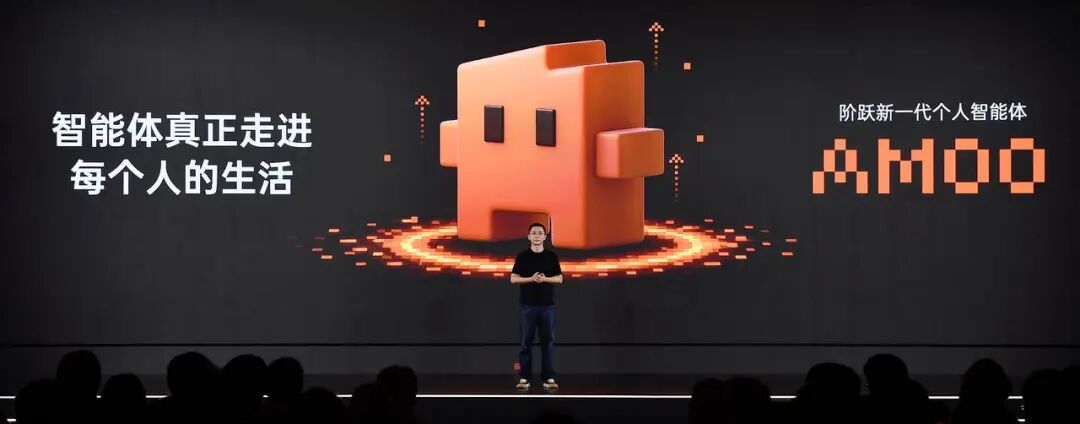
On July 13, StepFun unveiled its terminal brand launch for "The True Agent of the Agent Era."
On the massive screen, a tiny orange pixel flickered to life amid chaotic fragments of information. It looked around and whispered a question: "Who am I? Where am I?"
No one in the audience could answer. But over the next few minutes, this pixel — StepFun's Amoo — would traverse the entire sixty-year evolution of AI through a single animation.
The history of AI has never been a smooth upward curve. The earliest milestone came in 1956 at the Dartmouth Conference, where John McCarthy formally christened the nascent field "artificial intelligence." That was the golden age of AI history.
1966 marked a critical technical inflection point. That year, the ELIZA chatbot pioneered human-machine dialogue, the first speech recognition system gave machines their initial grasp of human language, and the Shakey robot project brought AI into physical action for the first time — together laying the early foundations for natural interaction and intelligent agent exploration.
But reality proved far more turbulent than anticipated. In 1973, mathematician James Lighthill submitted a report to the British government sharply concluding that AI's grand ambitions were almost entirely unachievable. Funding was drastically slashed, and AI entered its first winter. Expert systems briefly flourished in the 1980s, only to see their bubble burst just as quickly, exiling AI once more to the academic wilderness.
It wasn't until 2012 that an event known as the "ImageNet moment" changed everything. The University of Toronto's Hinton team deployed a deep convolutional neural network, AlexNet, to dominate the ImageNet image recognition competition with an overwhelming victory — its error rate more than 10 percentage points lower than the runner-up.
The sleeping giant finally awoke. In the decade since, deep learning has reshaped the entire technological landscape with devastating force.

From rule-based systems to ResNet, from large language models to generative AI, from RLHF to Agent — at the animation's conclusion, when a user awakens a forest with the words "I miss the Norwegian forest I visited two years ago," it signals that a milestone moment in AI has arrived:
AI is no longer merely "able to chat" or "able to think." It has begun to act.
The Birth of Amoo: Six Acts, A Brief History of AI
The six scenes of StepFun's The Birth of Amoo animation essentially compress sixty years of AI's technical evolution into a few minutes of visual narrative.
Each act is an era; every frame contains an allusion.
Act One: Birth.
Information fragments float in the darkness — text, images, sound, code, labeled data — the complete digital sedimentation of human knowledge. The orange pixel awakens and poses that philosophical proposition. It does not yet understand the world; it merely exists within it.
Act Two: Hitting the Wall.
A command appears on screen: "IF WALL → FALL." Amoo proceeds according to instruction, hits the wall, bounces back, hits again, bounces back again. This is the epitome of symbolic AI and rule-based systems — machines can execute rules written by humans, but never truly understand what they are doing.

Behind this scene lies one of the most profound debates in AI history — symbolism versus connectionism.
From Newell and Simon to McCarthy and Minsky, the symbolists believed intelligence arose from symbolic manipulation and logical reasoning, with all behavior driven by "If-Then" rules. Amoo hitting the wall, bouncing back, hitting again — this is the metaphor for that paradigm: it can execute rules, but cannot comprehend the world beyond them.
The connectionists, meanwhile, believed intelligence emerged from the connections and learning of vast numbers of simple computational units — yet they were long treated as heretics in academia. Representatives of this school include Frank Rosenblatt, who invented the perceptron in 1958, and Geoffrey E. Hinton, who in 1986 co-authored the backpropagation algorithm paper published in Nature. But this path was questioned by the mainstream for decades. Hinton and his fellow travelers were mocked as a stubborn handful of "fools" — until 2012.
Act Three: Labeling.
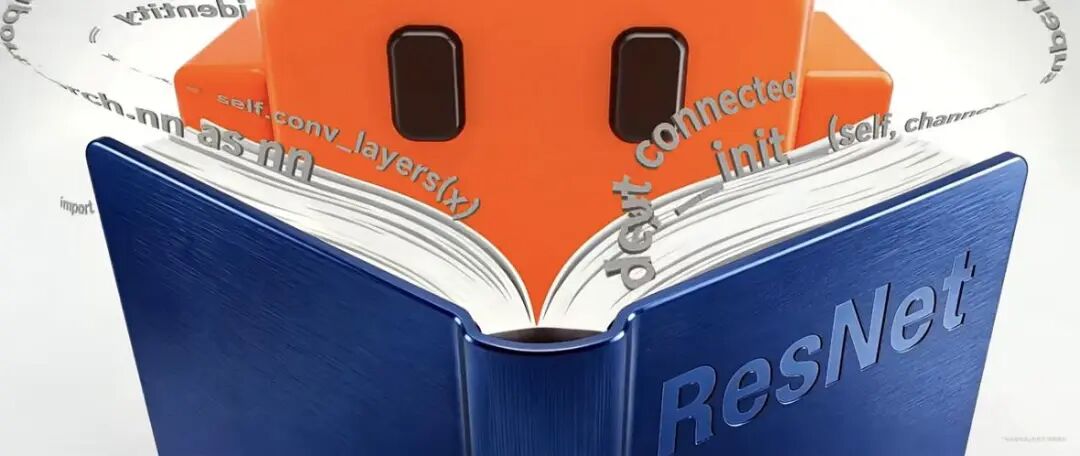
A human hand affixes a "CAT" label to a cat. Amoo excitedly rushes up and slaps a "BREAD" label on the cat — the cat becomes "toast cat." In panic, it pulls a tiny pixel book from its body, its cover reading "ResNet," and as pages flip, "shortcut connected" and "x+F(x)" flash by. Closing the book, it finally identifies the cat correctly.
In 2015, ResNet burst onto the scene, proposed by Xiangyu Zhang (StepFun's Chief Scientist) and his collaborators. Its core insight was using "shortcut connections" to enable the training of deep networks — the output equals the original input plus the learned residual. This idea solved deep learning's most fatal problem of "vanishing gradients," allowing neural networks to reach hundreds or even thousands of layers for the first time.
In 2016, ResNet received the CVPR Best Paper Award; a decade later, in June 2026, it won the CVPR Longuet-Higgins Test of Time Award, the highest recognition for a research contribution's ten-year impact. The ideas derived from residual connections have long since overflowed computer vision, permeating nearly every branch of deep learning — natural language processing, speech, multimodal, and more.
In this scene, Amoo opening the book, learning, correcting, finally identifying correctly — "every misrecognition makes the world a little clearer" — this is supervised learning from ResNet onward.
Act Four: Swallowing Tokens.
Text, code, emoji, and punctuation surge like marine life, washing over Amoo. At first, swallowing words only produces gibberish, but as it consumes more and more, it begins attempting speech: "ooo……o?"
This scene maps to the pretraining of large language models and their core task of "predicting the next token." And the foundation for all this was a paper that nearly went unnoticed.
At 5:57 PM on Monday, June 12, 2017, eight Google researchers submitted a paper to arXiv titled Attention Is All You Need. Transformer emerged, completely abandoning recurrent structures in favor of attention mechanisms, enabling parallel computation.
"Transformer is the 'T' in ChatGPT. The foundation of nearly all AI creation is Transformer." This paper is regarded as the foundational document of modern artificial intelligence, with over 180,000 citations by 2025.
The scene of Amoo being washed by waves of text is precisely the visual presentation of Transformer's "parallel attention" mechanism: every token is simultaneously attended to, processed, understood.
At this point, the text floating across the screen includes: Alan Turing, John McCarthy, Marvin Minsky, Fei-Fei Li, Convolutional Neural Network, Backpropagation, Word Embedding…… and "AI Infra" and "Distributed Training" — a tribute to StepFun's Chief Technology Officer, Yibo Zhu.
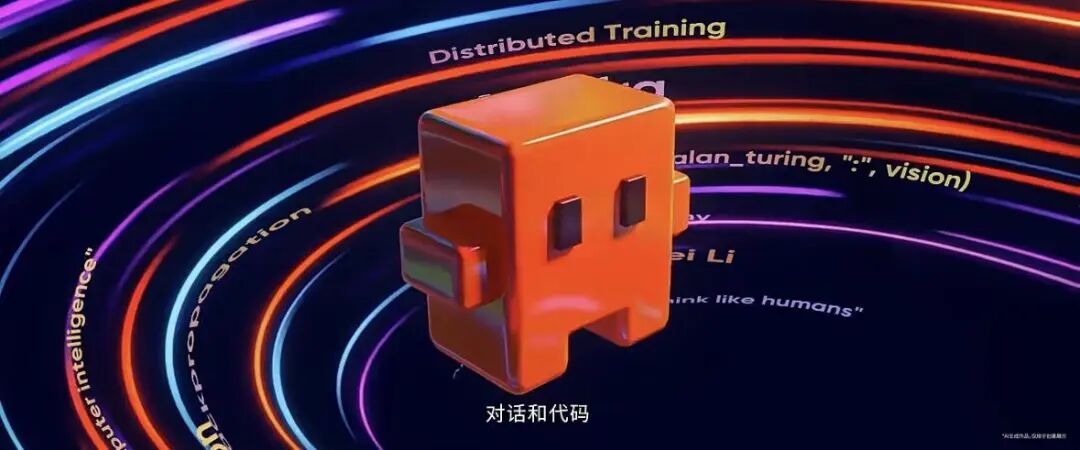
Yibo Zhu's career has tracked almost in parallel with the development of AI infrastructure. He conducted distributed systems research at Microsoft Research Asia, was among the early founders of RoCE network technology; then built one of China's largest-scale AI infrastructures from scratch at ByteDance; and later served as Google Cloud's GPU product technology lead.
He believes that AI infrastructure "is no longer merely a supporting role, but a core element determining large model success or failure." "To build the best large models, you must have the best infrastructure" — given fixed computing power, infrastructure quality determines ultimate model quality. When it comes to how to build and manage ten-thousand-card-level AI infrastructure, he is the true expert.
In this scene, when Amoo is swept along by the tide of words, what lies behind it is not merely "training," but the entire AI infrastructure keeping it from drowning.
From GPT-1 to ChatGPT, the evolution of large language models flashes by in Amoo's fourth act. In June 2018, OpenAI released GPT-1 (117 million parameters), its initial product "still rather unremarkable." 2019 brought GPT-2 (1.5 billion parameters), 2020 GPT-3 (175 billion parameters), with model sizes growing exponentially. The Scaling Law was validated: larger models, more data, better performance. ChatGPT arrived at the end of 2022, and the generative AI era truly began.
In fact, the fates of humanity and generative AI converged starting from 5:57 PM on Monday, June 12, 2017. That week, Transformer was born; that week, the future of large language models was being quietly written.

Act Five: Six Fingers.
A chat box pops up with a human command: "Draw a hand." Amoo waves, and a beautiful hand is generated — but with six fingers. The fingers wiggle, make a "NO" gesture, and a red sticker falls: "WRONG." The extra finger becomes a patch, returning to Amoo's body. An ahoge sprouts from its head.

This is the classic dilemma of the AIGC era: the stronger the generation capability, the greater the risk of hallucination and失控. Human feedback, RLHF, safety alignment — every "error" is absorbed as experience, the model corrected once more.
This scene also contains another important technical milestone: in 2014, Generative Adversarial Networks (GANs) were proposed, opening the door to machine-generated content. And ChatGPT's RLHF (Reinforcement Learning from Human Feedback) in 2022 gave AI its first systematic method for aligning with human values.
From GANs to diffusion models, from instruction fine-tuning to human feedback, AI progressed from "able to generate" to "generating well" to "generating correctly" — each step accompanied by countless "WRONG"s and corrections.
In this scene, Amoo's development of an ahoge and limb forms is itself the embodiment of AI's evolving intelligence.
Act Six: Beginning to Act.
The user whispers: "Right now, I really miss that forest in Norway I went to two years ago." Without follow-up questions, without confirmation, Amoo judges for itself: you're not in Norway, you're at home, and what you need is to have that memory awakened.
It extends its hand to release "magic" — forest, water sounds, wind, imagery, all brought to the user's side. A voice from beyond: "Hi, Amoo."

Beyond dialogue and reasoning, the AI agent has begun to act on its own initiative.
At this moment, AI is undergoing its third epochal shift. From the ChatEra of conversation to the ReasoningEra of inference, today we stand at the doorway of the AgentEra.
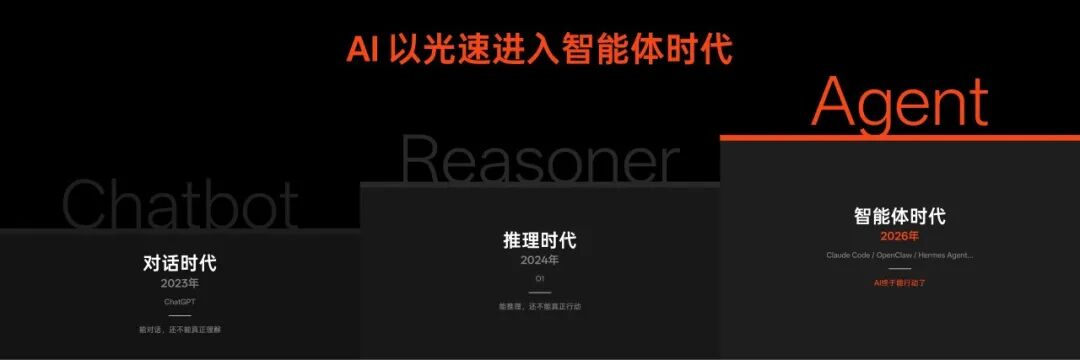
From symbolism to connectionism, from rule-based systems to neural networks, from perception to language, from generation to alignment, Amoo's six-act journey completes AI's full transformation from infant to adult. Amoo is the ticket StepFun extends toward the new world, standing at the threshold of the AgentEra.
Why StepFun Amoo? How is its proactive action different from other agents?
Behind this, what enables this pixel Amoo to step out of the screen and into the real world is the power of systems.
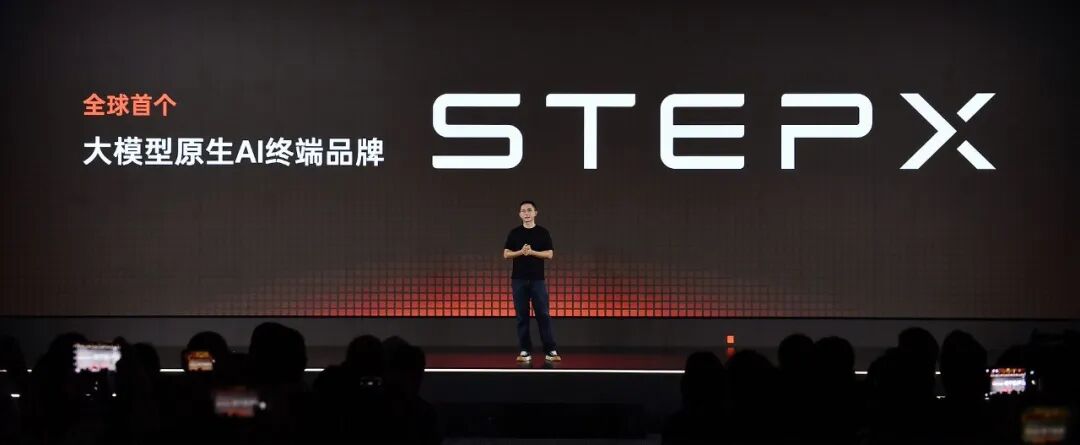
Beneath Amoo, STEPX does far more — it is not "installing an AI assistant on a system," but "building a complete action foundation for intelligent agents." This is also a breakthrough for StepFun, the multimodal "kingpin," extending its reach from foundation models to hardware terminals for the first time.
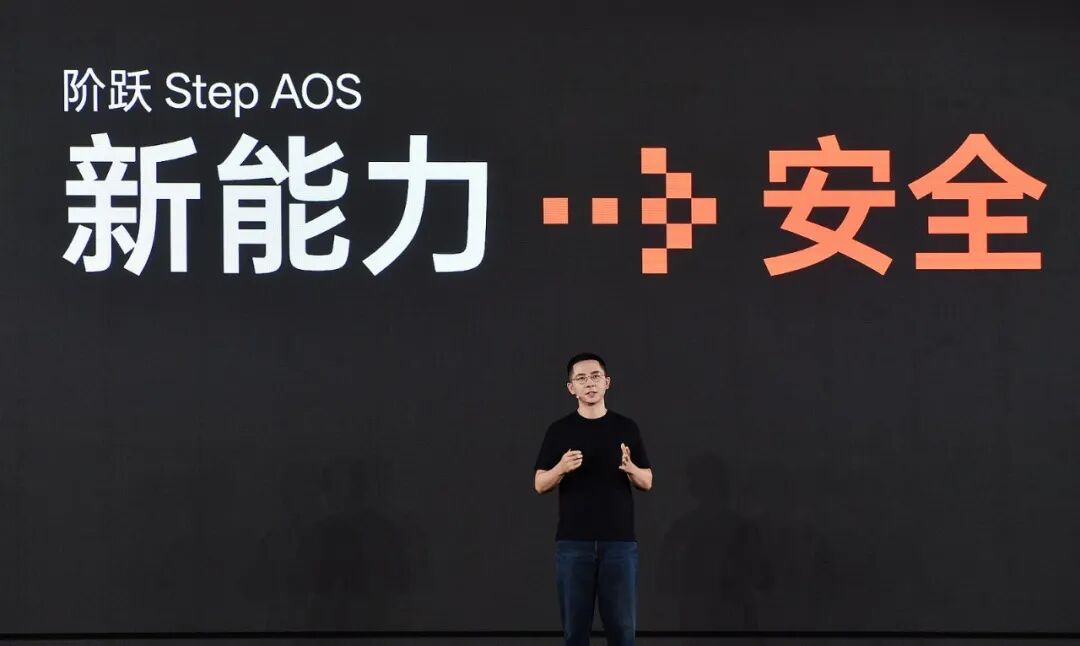
On the same day, StepFun made a series of heavyweight announcements: the terminal brand STEPX, the intelligent agent system Step AOS, and the large-model-native intelligent agent phone STEPX Neo.
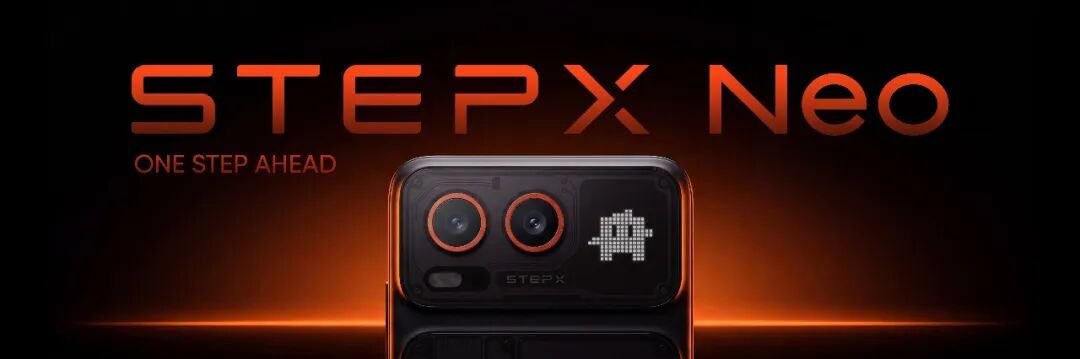
Step AOS, Born for Agents
Was it truly necessary to build an entire system specifically for StepFun Amoo?
Today's phones are not lacking in AI. Nearly every flagship claims to be "AI-powered." But "phones that can retouch photos, summarize, answer calls, and read screens are already too numerous." The bottleneck is that ordinary phone AI assistants can only complete Q&A, photo editing, and translation within single apps — they cannot execute coherent tasks across multiple applications.
For example, when we ask them to do something cross-application like "help me compare flight prices, then book a car to the airport," the result is typically: you need to open the airline app yourself, compare prices, then switch to the ride-hailing app to manually enter the address.
The reason: in traditional operating systems, AI is a "visitor"外挂 to the system, not a "native" embedded at the system foundation.
The Step AOS team summarizes this problem as "three walls."
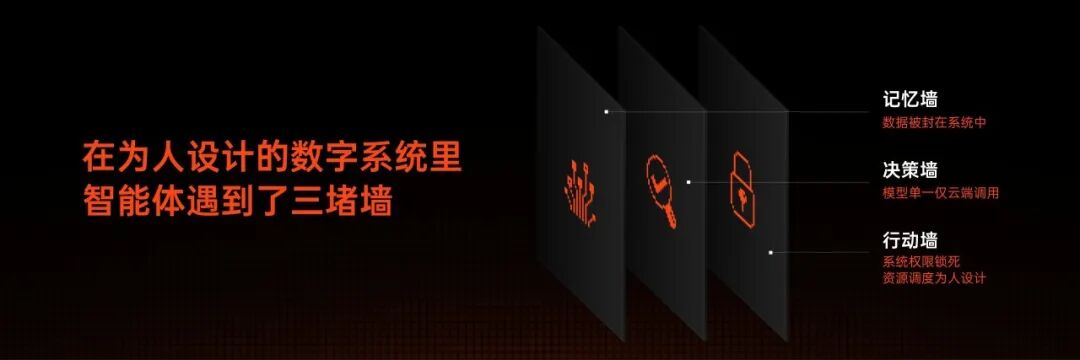
Wall One: Memory.
In traditional OS architectures, data does not flow between levels; apps are data silos unto themselves, and devices are isolated islands. App-level agents are doomed to "local memory" — they cannot remember what you said in another app yesterday, let alone form long-term memory across devices and scenarios. But true agents need to "remember completely, remember clearly, recall accurately, recall quickly." Without system-level reconstruction, none of this is possible.
Wall Two: Decision.
Good decisions require fast on-device response — setting alarms, finding photos, opening apps, at the hundred-millisecond level; they also require deep cloud-side thinking — complex reasoning, long-text analysis, multi-step planning. But in traditional systems, the two lack unified collaborative scheduling.
Wall Three: Action.
This is the most fatal wall. Without native interfaces, agents can only simulate clicks — like an invisible hand "poking" at the screen. Without legitimate identity, agents cannot obtain authorization, cannot access trusted action channels and manageable, traceable super-permissions. It wants to act, but the system won't let it.
Currently, the industry's mainstream "OS+AI" approach to these three walls is: add plugins, add voice entry points, add a floating ball. But essentially, this is still embedding agent capabilities into existing operating systems. For example, Google embeds Gemini Intelligence at the Android system layer, Apple opens its Foundation Models framework to developers, and Huawei released the HarmonyOS agent framework HMAF.
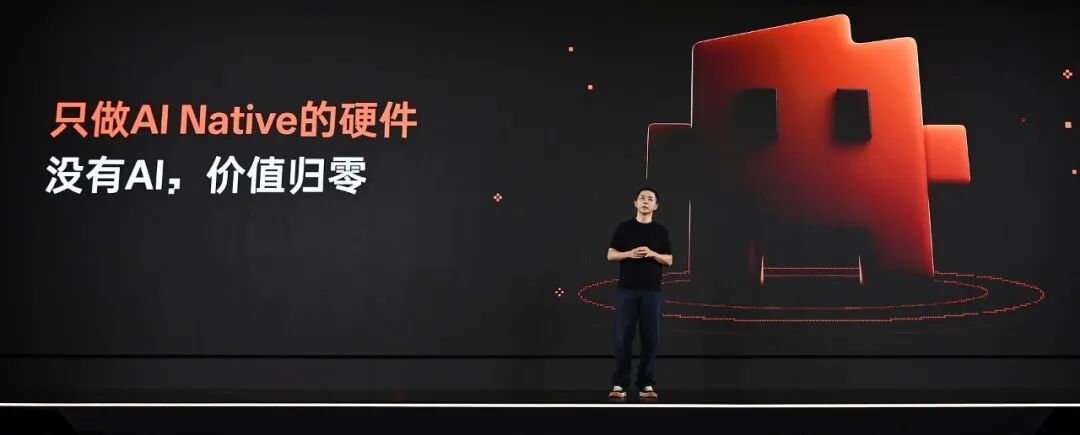
This time, StepFun's choice is completely different. It is the first to start from the model layer and redesign the entire system from the bottom up — born for agents.
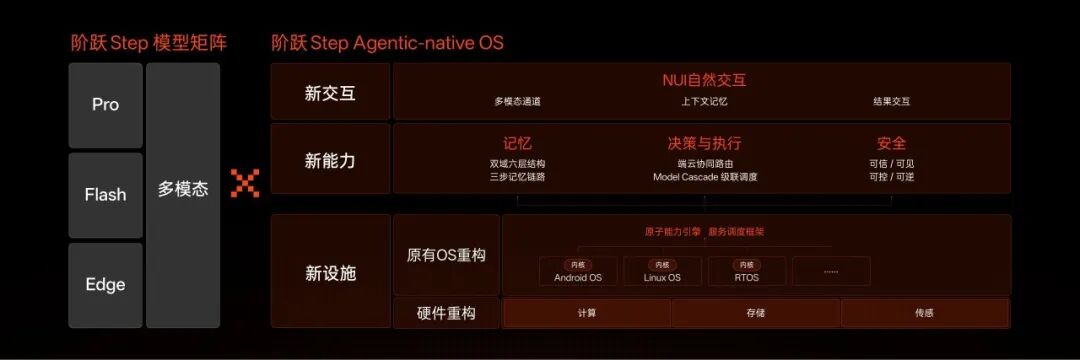
Step AOS adopts a three-layer architecture. The bottom layer is the resource supply foundation — deconstructing the capabilities of traditional operating systems like Android, Linux, and RTOS into three categories of resources: computation, data, and applications/services, with supply objects expanded from "humans and applications" to "agents." The middle layer builds three core characteristics: memory, decision, and security. The top layer delivers all system capabilities to users through intent-driven natural language interaction.
Where others' Agentic OS opens a window for agents in the old system, Step AOS directly builds a house for agents. From day one of its design, the system's service objects have changed: it must serve not only humans, but agents. Here, the agent is no longer a visitor, but a native resident.
However, "building a house" presupposes that you first have a sufficiently intelligent brain to move in. For this, StepFun deploys an entire model matrix to serve as that brain.
At the foundation model level, StepFun has established a complete three-dimensional "Pro+Flash+Edge" tier. The flagship Pro series (Step 2, 1T total parameters) handles deep reasoning and complex tasks; the standard Flash series (Step 3.7 Flash, 196B+1.8B ViT total parameters, only 11B activated) is optimized specifically for production-grade agent scenarios; the on-device Edge series enables agents to achieve low-latency, zero-token-cost immediate response locally. Meanwhile, Step Audio R2.5 in voice understanding gives agents "five senses and six perceptions."
According to StepFun, the division of labor among these three models runs through every action Amoo takes. Through collaboration between them — on-device when possible, cloud when necessary, with device-cloud handoff — each step is handled by the most suitable model. This is not one large model doing everything, but a model matrix ensuring everything has its most suitable model.
Moreover, none of this has remained in the laboratory.
This is not a model vendor's "technology licensing" story, but an on-device model system already proven on tens of millions of devices. To date, StepFun has released over 40 self-developed models, 60% of China's top phone brands have established deep partnerships with StepFun, model installations exceed 42 million units, and daily services approach 20 million users.
Now, STEPX is simply taking these capabilities from "empowering others" to "doing for ourselves." This is also StepFun's inherent advantage as a large model company — a moat that terminal manufacturers neither possess nor can build.
How Can I Be Sure Amoo Is Trustworthy?
When AI evolves from "digital brain" to "actor in the physical world," a question that must be confronted is: when it is no longer merely "saying" but beginning "doing," what gives us grounds to trust it?
StepFun's answer is to write Amoo's action principles into the Step AOS security framework.
At the launch event, StepFun proposed four elements of intelligent agent action governance: trustworthy, visible, controllable, reversible.
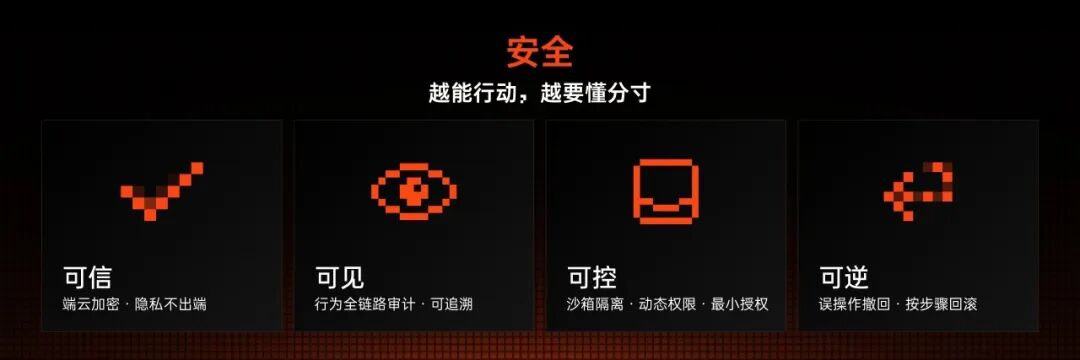
Trustworthy — operations completed in a trusted execution environment, data never leaving security boundaries; Visible — every step auditable and traceable; Controllable — permissions granted on demand, revoked after use, agent memory deletable; Reversible — mistaken actions can be withdrawn with one click, actions controlled.
And this security practice and standard has now been established as industry doctrine. Recently, STEPX jointly released the New Generation Intelligent Agent System Security Technology White Paper with the Shanghai Artificial Intelligence Laboratory, systematically proposing these four elements for the first time.
While the industry is still debating "whether regulation will stifle innovation," StepFun has already built compliance into the system foundation. The pace of technological advancement and the construction of security boundaries proceed in parallel, rather than "sprinting first, braking later."
On the external partnership front, StepFun Amoo's ecosystem continues expanding. STEPX has established deep AI partnerships with first-batch ecosystem partners including Trip.com Group, Alipay, DiDi, and Meituan, covering full-scenario services from travel and transportation, civic affairs, local lifestyle, office productivity, to content creation, bringing users a new AI ecosystem experience.
At this scale of ecosystem, "trustworthy, visible, controllable, reversible" is by no means icing on the cake, but a passport for agents to truly enter the physical world.
Finally, when Agent intelligent agents truly begin arriving beside us, we need to — reacquaint ourselves with them.
Returning to the first question that pixel Amoo initially asked: "Who am I?"
At the animation's conclusion, Amoo provides its answer: not "I am a superintelligence," but — "I understand you, I accompany you, I bring the world to you."
Behind this lies a word that recurs throughout StepFun Amoo's agent narrative: symbiosis.
This symbiosis manifests on three levels: human-agent symbiosis — Amoo grows to understand you better the more you use it, transforming from tool to companion; agent-ecosystem symbiosis — service providers access Step AOS through atomic capabilities; technological evolution symbiosis with security boundaries — the four-element security framework embedded in the system from day one.
So, when agents begin shouldering all the tedious "how," humans finally have time to ask "why" and "why not," to contemplate "what should I do, where should I go."
This is also the ultimate evolutionary direction StepFun has set for Amoo: to liberate people from operation and triviality, returning them to the imagination, passion, and creation they were born with.
Welcome to AgentEra
After years of the industry crying "AI's iPhone moment," STEPX has directly placed a large-model-native phone on the table — and ahead of Apple and OpenAI at that. This is the first time in the industry that a company has fully connected the "model-system-hardware" complete chain.
From StepFun's founding in April 2023 to this July's STEPX launch event, over these three years StepFun entered as a latecomer among foundation model vendors; today, as AI truly begins entering the physical world, it has chosen yet another more challenging path — from models to terminals.
The name STEPX: "STEP" inherits StepFun's DNA, signifying step-function leaps in technology; "X" represents exploration and boundary-breaking.
Today, a single pixel, StepFun Amoo, gradually awakens from chaos, traversing rules, perception, language, generation, correction, finally beginning to act, becoming humanity's intelligent agent companion. Its boundaries of action are also extending from personal devices toward real-world IoT full scenarios.
And what it marks is not merely the birth of a new product, but an inflection point of an era — Welcome to AgentEra!
Crossing is seeking independent contributors to write AI product and model reviews.
If you have written articles like: Hands-on with PixVerse C1[1], Hands-on with LibTV[2], please contact zeo0811@gmail.com. Your email should include: ① personal introduction, ② AI review articles you have written.
We offer competitive compensation. Looking forward to observing and documenting the AI era together with you 🎪